I’ve been running a series featuring 100 transit cities and a few days back I features a tram in Berlin advertising beer. Yesterday, I discussed photography at dusk. So today, I’m featuring a beer advertizing tram at dusk in the eastern Slovakian city of Kosice.
A purist might call me out on the fact that this tram is preserved and inactive in the photo, therefore might not qualify as a legitimate transit image. I do, however, have slides of Tatra trams working Kosice streets. I’ll need to locate and scan them.
This photo was exposed on Fujichrome with conventional daylight balance. I made no color correction or alterations in scanning or post processing.
It is unlikely you will find ‘East Northfield’ on most maps of Massachusetts, since this is a railroad location that doesn’t reflect local geography.
Not withstanding these directional peculiarities, East Northfield (as so-identified by New England Central’s sign) is a classic railroad location and a favorite place to photograph trains. Located on the Massachusetts-Vermont state line, this is where New England Central meets Pan Am’s Boston & Maine Connecticut River line from Greenfield.
On Friday, January 24, 2020, my friends, fellow photographers, Tim and Pat and I converged at the junction to make photographs of New England Central’s northward 611.
Here the train was held for a few minutes while Amtrak’snorthward Vermonter made its Brattleboro station stop. Operational considerations typically find freights holding south of East Northfield until Amtrak is north of ‘West River’ (a railroad location situated north of Amtrak’s Brattleboro station).
The light was fading fast. So working with my FujiFilm XT1 with 90mm prime telephoto, I exposed a series of images to make the most of the tinted low lighting.
The first view was made with an auto-white balance setting. The second two using a daylight preset that results in the camera capturing more of the blue-spectrum of dusk.
Auto white balance; no post processing color correction.
Daylight white balance without post processing corrections.
This exposure was made a few minutes later and reflects the approach of evening after the amount of light had diminished. It was also made using the ‘Daylight’ white balance preset.
I’ve made numerous photos of Sacramento California’s Regional Transit District light rail system, all of them on film.
Here are two scans from color slides that were exposed nearly 19 years apart.
In November 1989,I exposed this pan of a light rail car near the California State Capitol building.This elevated view of a light rail train at Florin Road, south of downtown Sacramento was made on Fujichrome using a Canon EOS3 with a 24mm lens.
Here’s a view I exposed of New England Central’s northward 611 crossing the 1905-built Millers Falls High Bridge at Millers Falls, Massachusetts on January 24, 2020.
This former Central Vermont Railway bridge has long been a favorite of mine.
After departing Greenfield, where I’d had the fortuity to catch a westward Pan Am empty grain train (Thursday’s posting on Tracking the Light), I drove to Millers Falls, Mass. My friends Tim and Pat were photographing the northward New England Central 611 turn on its run from Palmer back toward Brattleboro, Vermont.
I phoned Pat when I arrived at Millers Falls. “Where are you?”
“We’re in South Amherst, 611 is passing Amherst now.”
That was just the information I needed.
I knew it would be cutting it a bit fine (in other words; with the wind a my back, I’d barely make it) but I was going to try to run against this freight and intercept it at Leverett (north of Amherst on the old Central Vermont).
I’m no novice at following trains on this line. I recall a spirited chase of CV freight from Amherst to Millers Falls back in Spring 1986!
I had a clear shot to Leverett (I didn’t get stuck behind a school bus). I pulled in, grabbed my FujiFilm XT1, jumped out of the car and listened.
I could hear multiple 16-645E3 diesels working in run 7 or 8. They were very close.
I needed to change lenses and had just enough time to switch from a 27mm pancake lens to my fixed focal length ‘prime’ 90mm telephoto.
As I set my exposure, the freight roared around the bend! I exposed a burst of images and then laid chase back north again. At one point, I gazed in my rear-view and saw that my friends were behind me. Classic train chase!
Last week, I exited I-91 at Greenfield, Massachusetts with a vision of nipping over to Pan Am’s East Deerfield Yard—an old haunt that I hadn’t visited in a while.
As luck would have it, I never made it to the yard. Driving east I spotted former CSX GE DASH8-40Cs working west. It was an empty grain train! A prize indeed.
With no time to spare, and working from memory, I navigated post haste to Wisdom Way—a choice overpass on the former Fitchburg Main Line where I’ve made countless photos over the years.
I arrived in just enough time to set my exposure and capture this elusive freight as it passed in and out of dappled sun.
Exposed digitally using a FujiFilm XT1 with 18-135mm zoom lens.
Exposed digitally using a FujiFilm XT1 with 18-135mm zoom lens.
Not bad for a spontaneous catch. Soon I was on my way in another direction aiming to intercept New England Central 611 on its northward run.
This year instead of merely wandering the annual Amherst Railway Society’s BIG Railroad Hobby Show as a free agent, I spent most of my time there working for Conway Scenic Railroad.
But, I did wander the show making photos as I have in the past.
I also signed a few books, answered lots of questions, spoke with countless friends, and researched details for a number of upcoming articles.
I made these photos Saturday January 25, 2020 using my Lumix LX7.
Here’s another view from the amazing winter photography trip sponsored by Maine’s Wiscasset, Waterville & Farmington Railway Museum in conjunction with Portland’s Maine Narrow Gauge Railroad Company & Museum.
Sometimes conditions practically photograph themselves, all you have to do is point the camera!
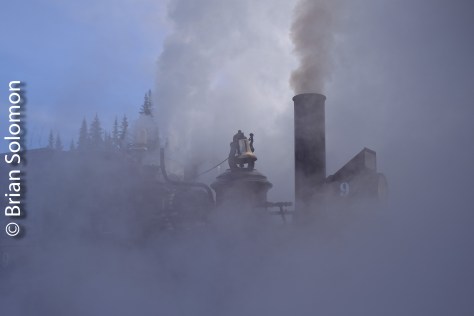
Exposed digitally using a FujiFilm XT1 with 18-135mm zoom lens. Arctic conditions produced some stunning steam effects.
Last weekend the Wiscasset, Waterville & Farmington Railway Museum in conjunction with Portland’s Maine Narrow Gauge Railroad Company & Museum invited me to a magical event featuring three steam locomotives under steam.
Arctic conditions were tough on fingers and toes, but made for spectacular displays of steam and condensation.
Among the stars of the event was former Wiscasset, Waterville & Farmington number 9, a legendary machine that had been saved from scrapping many years ago and then stored for decades in a Connecticut barn.
This was my first visit with old number 9.
I exposed these photos digitally but I also made use of an old Nikon F3 to exposed both black& white and color film so that future generations may be able to appreciate the cosmic even of January 18-19, 2020.
As a follow up to Monday’s post, I’m presenting these two photos of Maine Central 573 at milepost 64 on the old Mountain Division.
Friday, January 17, 2020, I was traveling with the Conway Scenic crew on their frosty expedition west toward Bartlett to inspect the line and clear snow.
I arranged for them to drop me near milepost 64 (east of the old Glen & Jackson station) where the line runs along the Saco.
Here I set up Conway Scenic’s company video camera with the help of Connor Maher, and made a short clip of the engine passing.
I also exposed these images with my FujiFilm XT1 with 18-135mm lens.
After filming, the locomotive crew collected us.
Flying white flags, old 573 was on home rails at milepost 64 along the Saco River.
Friday, January 17, 2020, I joined the Conway Scenic train crew of a light engine sent west on the old Mountain Division to inspect the line and clear snow and as far as Rogers Crossing east of Bartlett, New Hampshire.
It was clear, cold afternoon, which made for some magnificent views along the Saco River and looking toward Mount Washington.
My primary intent was to document the move and gather some video footage of the railroad operating in the snow.
using my FujiFilm XT1 with 18-135mm lens, I made these views at milepost 62 west of Intervale.
In the 1950s, New Haven Railroad worked with the Budd Company to develop a semi-streamlined self-propelled passenger train adapted from the successful Budd Rail Diesel Car—RDC for service as the Roger Williams.
The ends of the train featured a distinctive nose-section.
I recall these end cars working Amtrak’s Springfield, Mass., to New Haven, Connecticut shuttles in the late 1970s and early 1980s.
A couple of weeks ago on a business trip to Lincoln, New Hampshire, I saw that the Hobo Railroad has this portion of the old ‘Roger Williams’ RDC on display. I took a couple of minute to make a few photos. Someday I’d like to return for a more thorough documentation.
Exposed using my FujiFilm XT1 with 18-135mm lens.
Fresh snow made for a monochromatic setting with the bold New Haven logo.
In a city laced with railway lines, perhaps one of the most obscure is the light rail line that I call ‘the Tokyo Trolley’.
So here in the land of Fuji, I exposed this Kodachrome view on April 22, 1997, of the trolley leaving a private right of way and beginning a section of street trackage.
While I only have a few photos of the Tokyo Trolley, I’m quite pleased to have taken the time to seek out this unusual Japanese railway operation.
Earlier this month I exposed this view of Amtrak train 57 on the move crossing a fill on the Connecticut River Backwater just south of Brattleboro, Vermont.
There was soft directional lighting with a textured sky. To better balance the exposure I worked with an external graduated neutral density filter positioned over the front element of the lens with the darkest portion of the filter ever the sky.
I’m not entirely satisfied with the results, but the filter helped.
Luckily, I also exposed a black & white photo that I hope to process with my next batch of film!
For my second installment of my 100-city transit marathon, I thought it would be neat to display these three photos I made in Ostrava, Czech Republic.
This was during a visit with Denis McCabe and the late Norman McAdams on April 24, 2005—the my first of two trips to this industrial city in the eastern Czech Republic near the Polish frontier.
The morning air had a brown gauzy tint, while the streets were nearly devoid of traffic.
I exposed these images on Fuji Sensia II (100 ISO) using a Nikon fitted with a 180mm Nikkor telephoto lens.
We were fascinated by the antique streamlined electrics.
Remarkably, in 1979 many of the steam-era former Pennsylvania Railroad behemoths were still in traffic.
Amtrak and New Jersey Department of Transportation both had GG1s on their active roster.
Sunnyside Yard was a great place to see these once magnificent machines.
Sunnyside Yard, Queens, NY April 1979.
Amtrak GG1 927 was dressed in platinum mist with a red stripe. Very 1970s.
Most fascinating was motor 4876, which on January 15, 1953 had led the Federal Express into Washington Union Station—a famously spectacular runaway that sent the GG1 crashing through the station; sinking through the concourse floor and into the basement of the station. The accident was pictured in newspapers across the nation. And in 1979, the old beast was awaiting assignment.
Here’s an adjusted scan from my original 35mm black & white negatives. Old 4876 was in a prominent position for photography. I enlarged this scan to bring in the famous Twin Towers of the World Trade Center.
Working with my Leica, I exposed a variety of photos around Sunnyside yard on a visit with my family. Never mind Disney, I though Sunnyside Yard was the coolest place to be.
While I’ve run one or two of these photos previously, those images were taken from prints. I’ve recently located more the negatives from that day, nearly 41 years ago, and scanned them.
Notice the World Trade Center’s Twin Towers to the left of 4876. Kind of a cool juxtaposition.
Here’s another enlarged view that shows a Long Island Rail Road local switching. There’s a lot to digest in this view. Exciting stuff for a 13 year old obsessed by locomotives, epic urban city scapes, and post industrial settings.
The other day I posted a photo of the Los Angeles Metro Rail Blue Line and noted that I’d photographed many rail transit systems but ‘lost track’ after 50.
A regular Tracking the Light reader wrote in that he was close to 90 light- rail/streetcar systems, which made me wonder how many systems I’ve photographed over the years. So the other day, while the rain fell outside the window in North Conway, I made a list of every city/rail transit system that I’d photographed.
One two occasions, I’ve photographed streetcars at Mainz, Germany. This view was made of a route 52 car in September 2019.
For this exercise I included both light-rail/streetcar and heavy-rail metro rail transit systems. I excluded purely interurban lines where the frequency and service pattern doesn’t fit ‘rail transit’.
All of the systems are electric, rail-based transit, although I included rubber-tire/tyre metros such as Montreal, since rails and electricity are involved.
Fine print: I’ve excluded trolley bus operations (in most cases cities that I’ve photographed trolley buses also have some form of rail transit. However, this qualification excluded Chernivtsi, Ukraine—and yes I have a photo of an electric bus there). I’ve also excluded cities where I may have seen rail-transit but not photographed it. As may be inferred, cities with more than one mode (light rail and heavy rail metro for example) get counted only once. However, in situations where disconnected systems serve adjacent cities get counted individually. So I’ve counted the Newark City Subway and Jersey City-Hoboken light rail as two systems. Non-electric systems are not on my list. German cities with interurban interconnections, such as Bonn and Köln get counted twice. Systems with long extensions into adjacent communities such as Charleroi in Belgium and the Belgium coastal tram get counted once. (I realize that some viewers my take exception to my counting the Belgian coastal tram, and not including some Swiss interurban electric lines.) Systems that I photographed under construction or out of service without vehicles, will not be included (that leaves out Florence, Italy, and San Juan, Puerto Rico from my total).
Trolley bus systems are not included in my final count. SF Muni Potrero garage October 1990.
Chicago’s CTA ‘L’ lines are cool—systems like this make the list! Howard Street Line July 5, 1995.I’ve photographed in numerous cities across Eastern Europe. In 2003, I made this color slide in Zagreb, Croatia. I’ve been photograph Boston’s rail transit for more than 47 years! (Eeek!) So I have more coverage of the MBTA than many other systems. Park Street Station on the Green Line back in the day. (December 1980).
So as of January 2020, my list of photographed subway, metros, light-rail, streetcars, monorail, and rail-based cable car (aka San Francisco) systems total 100.
My challenge now will be locating original images from each and every of these systems. Mexico City was recently covered, so we’ll leave that one out.
Also, I may remember another system, presently off my list, and if so I’ll make note of that later.
Since North Conway doesn’t have electric rail transit, I can only wistfully look back on my photos.
Incidentally, while I have extensive photographic coverage of some cities such as Dublin, Boston and San Francisco, in others I may only have a handful of images. Kansas City, being one recent example, which I photographed from the dutch-door window of Budd dome Silver Splendor (now Rhonda Lee) while traveling East on Amtrak’s Southwest Chief in 2018.
This might take a while! (And no, I won’t be limiting my daily posts to rail transit, but will be including archive photos in the mix of other subjects).
I made this image while hiking the line toward Middlefield, Massachusetts from Chester. The freight was descending the grade near where the 1912-line relocation joined the original Western Rail Road alignment (seen to the left of Conrail 6619) at milepost 129 (as measured from Boston’s South Station).
Conrail’s ten General Electric C32-8s were delivered in September 1984 and in their early years largely work out of Selkirk Yard on the old Boston & Albany route.
GE assigned these unique pre-production DASH8 prototypes to Conrail for evaluation in preparation for wide-scale DASH-8 production that began a few years later.
I had countless encounters with the C32-8s on the Boston & Albany during the mid-1980s, but never had the opportunity to travel on one.
Later this year Kalmbach Media will release my new book titled Conrail and its Predecessors.
It was on this day six years ago (January 12, 2014) that I made this close-up view of Pan Am Railways 616 as it worked west at Greenfield, Massachusetts.
Exposed with a Canon EOS 7D with 100mm lens set at 400ISO at f3.5 1/400th of a second.
On this day, January 11, 2015 I made this telephoto view of Amtrak AEM-7 944 working the back of New York City bound Keystone train passing Torresdale, Pennsylvania.
At that time, Amtrak’s AEM-7s were on the wane and photographer Pat Yough and I were capturing the relatively brief transition period between the AEM-7s and new Siemens ACS-64 electrics.
Canon EOS-7D fitted with a prime 200mm lens, ISO 200 f5.6 1/1000 sec.
My Irish friends might wonder, since Irish Rail class 201 number 204 in unlikely to have ever reached Enfield, County Meath on the Sligo Line—although the older C-Class diesel with the same number probably did pass that point (before my time).
Amtrak F40PH-2 204 almost certainly passed Enfield, Connecticut on the former New Haven Railroad’s Springfield-New Haven Line, a route now described as the ‘Hartford Line’. While I have various photos in the 1980s of the 200-series F40PH-2s, it is unlikely that I have a photo of 204 at Enfield.
Then there’s an extremely remote possibility that I have a photo in my collection of a Boston & Albany 4-4-0 with that number passing Enfield, Massachusetts on the Athol Branch. I’ll have to review my B&A roster to confirm they actually had a locomotive with that number and if it ever ran up the branch.
So!
How about Guilford Rail System’s high-hood GP35 204 working the Maine Central with MABA at Enfield, Maine?
Regular Tracking the Light readers might understand my connections to this engine.
(It’s a sister locomotive to former Maine Central 216 that now resides at Conway Scenic where I now work.)
On February 5, 1996, I exposed a series of Kodachrome 25 color slides of New England Central 9529 switching at Palmer, Massachusetts.
The railroad later renumbered its engines from the 9500-series to the 3800-series, but in 2020 a few of its now geriatric GP38s still work the line in the 1995-era Conrail-applied New England Central start-up paint.
K25 exposed with a Nikon F3T fitted with an f4 Nikkor 200mm telephoto lens.
25 years in the same blue and yellow scheme. While not a world record, it is still pretty impressive.
On May 11, 2002, I worked with a Rollei Model T loaded with 120-size Fujichrome to make this view of Irish Rail 213 leading a Mark 2 set down road at Cherryville Junction, Co. Kildare (Ireland).
For the social media view I’ve cropped in on the original view, while for Tracking the Light, I’ve published the full un-cropped square.
Unfortunately in the original un-cropped version I centered up the front of the locomotive at the middle of the square. Poor composition!
In decades-old railroad tradition, Conway Scenic’s steam locomotive 7470 is largely painted black. While in winter, the environment around the railroad is largely snow covered (at least we hope it is) .
Why steam in the snow?
Drama!
The cold air contributes to spectacular effects from condensation tinted with smoke from the firebox.
Here are a few of my Lumix LX7 color digital photos from Saturday’s (January 4, 2020) Steam in the Snow excursion sponsored by the Massachusetts Bay Railroad Enthusiasts on Conway Scenic’s operation over the former Maine Central Mountain Division.
Dave Swirk at the throttle of 7470.
(And yes, maybe I made a few classic black & white images of this trip on film!)
Yesterday, January 4, 2020, Massachusetts Bay Railroad Enthusiasts Inc., operated its famous Steam in the Snow event at the Conway Scenic Railroad from North Conway to Notchland, New Hampshire.
Locomotive 7470 was the star of the show.
Several photo run bys were organized to allow travelers on the train to make photos and enjoy watching the locomotive in action.
Conway Scenic’s President and General Manager Dave Swirk was at the throttle of the steam locomotive.
As a representative of Conway Scenic, I traveled on the train for part of its journey and documented people enjoying the event.
This view at Notchland, shows Mass Bay RRE’s photo line up during the first of three staged runbys at this location.
Exposed using a FujiFilm XT1 with 18-135mm lens mounted on a Bogen tripod.
I arrived at the old Maine Central station at Crawfords (New Hampshire) in the ‘blue hour’—that last hint of daylight before night.
It was snowing lightly.
The railroad was quiet. No trains are expected for months to come!
The scene was serene.
To make this photo, I had my FujiFilm XT1 with 28mm pancake lens mounted on a Bogen tripod. I set the meter for 2/3s of stop over exposure in ‘A’ mode at the widest aperture. The camera selected the shutter speed at 25 seconds.
Over the course of several minutes, I made several exposures ranging from 20 to 30 seconds each.
Last November, photographer Mike Gardner and I paid a visit to the Mass-Central and caught the northward freight on its journey over the Ware River Branch from Palmer to South Barre.
Among the photos I exposed was this view at Gilbertville, Massachusetts, working with a Nikon F3 loaded with Ilford HP5 film.
Over the years, I exposed countless photographs along this former Boston & Albany branch; on film, digitally; in color and in black & white.
Forty years ago I had a fleeting glimpse of Mexico City’s streetcar system.
By the time of my December 1979 visit, all of the traditional streetcar lines in the downtown area were out of service. However, PCC cars remained in service on a pair of peripheral lines on the south-side of the city that connected at the end of a Metro Line.
I regret not having the opportunity to travel on the trolleys, but at least I got to see and photograph them.
This is one of my only color photos of Mexico City streetcars. I’d mounted the slide in glass, which didn’t do the emulsion any favors and resulted in unsightly moiré patterns (rainbow-like interferences). First I scanned the slide through the glass as seen here, then I very carefully removed the film from the glass and rescanned it. See below. This is the same Kodachrome slide after removal from the glass mount. I cleaned the emulsion and rescanned the image. This scan is cleaner, sharper and largely free from the distracting artifacts caused by the glass, yet a few defects and stains remain. I’d go back and make the photo again, but I think the setting has likely changed in the last 40 years!
For me this sunset view of Mexico City street trackage is a symbolic photograph, and yet one that has haunted my imagination for decades. Technically speaking it is a poor photo; under exposed and the last frame on a roll of Kodachrome with the right side effectively cropped by the tape used during processing. I’ve cleaned up the slide a little for better presentation here.
Sometimes those scenes we only glimpse stick in our imagination more than those that we were immersed in. Do you remember that 1960s song recorded by Vashti Bunyan ‘Some Things Just Stick in Your Mind’?