Yesterday, Thursday May 5, 2022 was a beautiful bright day in Conway, New Hampshire.
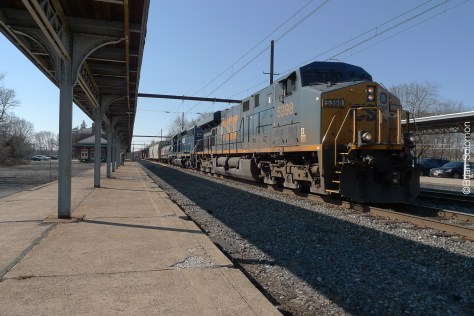
I traveled with the ballast train, which was the only train moving over the Conway Scenic Railroad.
Since the train made a number of stops to drop stone, I had ample opportunity to make photographs.
I exposed these views with my Lumix LX7, but also made a few photos of the lads working the train using my Nikon Z6 mirrorless digital camera. I’m saving the Z6 photos for a later post.
I first visited Irish Rail’s Connolly Station in February 1998.
That seems like a lifetime ago and the station facilities have been greatly altered since my early visits.
On Monday, 25 April , 2022, we transfered from the LUAS to Irish Rail’s DART at Dublin’s Connolly Station and on the way between the tram and the train, I exposed this Lumix LX7 photo 29000 and 22K series railcars under the old roof.
Although these are common varieties of trains in Ireland, there’s a certain thril of seeing them again in an historic setting, which reminds me that the common today will someday seem captivating. Everything changes and it helps to have been away for spell to better appreciate the effects of change.
An open eye can produce creative vision and a record for history.
Yesterday, April 12, 2022, Conway Scenic operated a loaded ballast train on the former Maine Central Mountain Division.
Leading the train was former Maine Central GP38 255 acquired by CSRR last October.
I arranged to be in position at the west end of the Frankenstein Bridge to catch the up-hill move, and exposed this sequence of digital photographs using my Nikon Z6 mirror-less camera with 24-70mm Z-series zoom.
Although overcast, the lighting was well suited to a red locomotive with black ballast cars.
My old Lumix LX3 had the ability to save a handful of photos in the camera’s built in memory (without an SD card).
This was a great benefit, especially in those moments where suddenly I realized that, “Oh Sh!#! I left the SD card on my desk!”
Not a problem, the camera would store the image internally for downloading later.
On 11 April 2012, I had one of those unforgettable “Oh Sh!#!” moments when I’d spotted a colorfully painted LUAS tram on Abbey Street in Dublin and when I went to photograph it the camera advised me I was saving to the internal memory.
Phew!
That was ten years, and three Lumixes ago.
However, not only did the camera save the photo, but it was able to save both as a JPG and as RAW. And this was lucky, because a pesky afternoon cloud had just drifted in front of the sun, so my photo was very constrasty and slightly underexposed. Working with Lightroom I was able to lighten the original photo, correct the color temperature, and level the image.
My scaled but otherwise un-adjusted Lumix LX3 RAW photo.This image was created by working with the RAW file in Adobe Lightroom to bring up detail in shadow areas, correct the color balance and level, and lighten the overall exposure while retaining desired color saturation.
No hope with getting that kind of double save if you forgot to put film in camera! (Been there, done that!).
In two weeks time, I hope to be making use of my latest Lumix on the streets of Dublin!
This was among the many slides that I scanned yesterday.
In my ongoing effort to scan, archive, and organize my slide collection, I’ve been scanning slides, and reorganizing the original chromes so that they are placed together by similar subject.
Conrail is just one of dozens of my subject categories . Ultimately, I hope to subdivide the Conrail slides in to smaller categories largely based on precursor railroad routes.
This Kodachrome 25 image of a westward Conrail unit coal train was exposed in September 1988 at School Road in Batavia, New York, near milepost 399 on the former New York Central ‘Water Level Route’ main line using my old Leica M2 with 50mm f2.0 Summicron lens.
It is one of hundreds of Conrail photos I exposed between 1985 and 1999 of Conrail trains working the old Water Level Route.
Three years ago—April 9, 2019—I visited SNCF’s Gare_de_Lille-Flanders (France).
It was a damp day with dark leaden skies and well suited for photography beneath a train shed.
I made this view using my old Fuji XT1 fitted with a 28mm Fujinon pancake lens.
Below are two interpretations. One is derived from the Fuji Raw by Lightroom, the other was first converted using Iridient and then adjusted (using the same color profile settings) in Lightroom. Compare the roof of the train shed in the two versions.
Converted from Fuji Raw using Lightroom.Converted to DNG format using Iridient then adjusted in Lightroom.
I wrote about Pennsylvania Railroad’s Rockville Bridge in my book Railway Masterpieces published in 2002.
“The third bridge at Rockville was started in 1900, and opened to traffic in 1902. It is listed in the Guinness Book of Rail Facts and Figures, as ‘the world’s largest stone arch railway bridge over a river’. It consists of 48 stone arch spans.”
Last month Kris and I paid a visit to the Rockville Bridge. As we approached this magnificent viaduct a westward Norfolk Southern freight was crawling across, yet we had arrived too late to catch the head end of the train on the bridge.
We decided to wait a little while to see if another freight would come along.
Finally after about 45 minutes, I could hear a GE diesel chugging away on the far side of the Susquehanna. As the train started across the bridge, the evening sun emerged from the clouds, producing some very fine light to photograph the train.
I exposed these photos with my Nikon Z6 with 70-200mm lens firmly mounted on my mid-1990s vintage Bogen tripod.
Nikon Z6 with 70-200mm lens set at 170mm, f5.0 1/500th of a second, ISO 200.Nikon Z6 with 70-200mm lens set at 76mm, f5.0 1/500th of a second, ISO 200.
Last month during our brief visit to Lewistown, PA, we caught two trains, one right after the other. Just a few minutes after the westward Pennsylvanian made its station stop, this Norfolk Southern intermodal freight worked west through the interlocking.
In the lead was 4092, one of Norfolk Southern’s AC44C6M rebuilds. These were converted from traditional DC traction Dash9-40CW locomotives into poly-phase AC traction diesels.
Photos exposed using my Nikon Z6 with 70-200mm lens and Lumix LX7.
NS 4092 west at Lewistown, PA. Nikon Z6 with 70-200mm Z-series zoom. Note the UPS truck on the road in the distance.Panned photo with Lumix LX7, f8 at 1/80th of a second.Trailing view with Lumix LX7
On this day three years ago, photographer Denis McCabe and I wandered the narrow streets of Lisbon, Portugal.
I used my Fuji XT1 to make this portrait oriented view of a classic tram navigating a steep narrow street.
Iridient software does a more effective job of interpreting the data from the Fuji camera RAW files than Lightroom.
Last night I imported the Fuji camera RAW file into Iridient for conversion to DNG format and then imported the DNG file into Adobe Lightroom for minor adjustments tothe color, constrast and exposure in order to make the most of the camera sensor.
Strasburg Rail Road’s former Canadian National Railway 2-6-0 made for a stunning silhouette against a late winter sky.
Gauging the exposure for these contrasty scenes requires a bit of interpretation.
Since the locomotive is black, I allow it to fall into the shadows, and instead concentrate on retaining detail in the highlight areas of the sky.
This is most effectively accomplished by making test images and studying the histogram that shows pixel distribution across the exposure range. With this tool I aim to avoid excessive over exposure in the highlight areas.
Then in post processing, I work with Lightroom to re-balanace the image by lightening shadow areas and controlling highlight detail.
Below are three examples providing variation on a theme.
Late season snow blanketed the ground and was still falling, when Kris & I caught former Canadian National Railways 2-6-0 number 89 leading the return run from Paradise.
Paradise, Pennsylvania, that is. We were set up near near Black Horse Road in Strasburg.
I made this photo on Saturday (March 12, 2022); but by Monday the grass was green and the birds were chirping.
Exposed digitally using my Nikon Z6 mirrorless digital camera with f2.8 70-200mm Z-series Zoom lens, set at f10, 1/1250th of a second, ISO 200. RAW image adjusted for contrast and exposure using Adobe Lightroom.
On March 8, 2014, photographer Dennis McCabe and I followed this Bord na Mona empty train compass west from the Edenderry Power Station to this rural level crossing near the village of Daingean, Co. Offaly.
The train was one of two heading out on the bog to a comparatively remote loading site to collect peat for delivery to the power station.
We had scoped out this location on an earlier trip, and at the time I was delighted to catch a train movement at this obscure location on the Irish Bord na Mona narrow gauge network.
Below are two variations of the same photo.
One was right out of my Lumix LX3, the other involves cropping the foreground and sky.
Uncropped Lumix LX3 photo.This is my preferred cropping of the image.
It was a typical overcast afternoon in Dublin on March 7, 2017.
I was in position above Irish Rail’s Phoenix Park Tunnel on Conyngham Road, not far from my bus stop.
Not far off camera to the right was the location of the Islandbridge apartment where I resided on/off for 15 years when visiting in Dublin.
Working with my first Lumix LX7, I made this image of Irish Rail’s UP IWT Liner from Ballina.
The RAW file was a little on the dark side, so I adjusted the image using Lightroom. I lightened the shadow areas, while working with the ‘Select Sky’ feature to hold detail in the sky area.
Not long after exposing this photo, I walked down to Ryan’s pub on Park Gate Street to meet some friends for a pint.
Ten years ago today (February 28, 2012), I made this photo of CSX Q300 on the old Reading Company at West Trenton, New Jersey.
My old Lumix LX3 was a little tricky to use when making action photos of trains. If the camera was in full ‘auto’ mode and I pressed on the shutter release the camera would hesitate for a moment.
The trick was to use the manual setting and then ‘queue-up’ the camera by presssing the shutter release halfway in preparation for making a photo. In this way the camera shutter would release almost instantaneously when pressed the remainder of the way, thus allowing for a composition with full-frame view of a moving train, such as this one.
On the evening of February 25, 2013, I was walking along the wall on the St. Johns Road in Dublin. There’s a low spot where a few stones have been dislodged, and it was here I peered over the wall.
A Cork train was heading down road behind 201-class 219. Working with my old Lumix LX3, I exposed this pan photo.
Irish Rail 219 departs Dublin Heuston Station on February 25, 2013.
The original file was a bit dark, so I lightened the camera-RAW file using Lightroom and scaled it for presentation here.
A few weeks ago I scanned a strip of 120-size Fuji Neopan 100 using my Epson V600 Scanner.
This featured some coming and going views of First Great Western HST in Newport, Wales, UK that I exposed using my Rolleiflex Model T.
One of the features of Epson Scan 2 software is the ability to apply an ‘unsharp mask’ at the time of scanning. Despite its confusing name, the unsharp mask is a digital sharpening tool. The software allows for three degrees of sharpening with the mask, ‘low,’ ‘medium’ and ‘high’.
Normally, I select ‘low,’ which I find makes for a better looking scan.
Another option is to scan without the unsharp mask, and apply sharpening in post processing.
The unsharp mask adds an edge effect that makes the photo appear sharper. It doesn’t actually add detail.
Below are three sequences of images showing the image without unsharp mask; with the ‘low’ unsharp mask, and an image created in post processing by applying sharpening after scanning. Each of the three sequences shows first the full frame scan followed by a greatly enlarged portion to allow for a detailed inspection and comparison. Each is captioned for clarity.
Full-size scan without mask or modification.Detail of the above scan without mask or modification.Full-size scan of scan with the ‘unsharp mask’ applied at the ‘low’ setting at the time of scanning. Detail of the above scan, made with the ‘unsharp mask’ applied at the ‘low’ setting at the time of scanning.Scan made without mask at the time of scanning; sharpening applied manually in post processing.Detail of the above scan; no mask at the time of scanning; sharpening applied manually in post processing.
NI Railways’ former Great Northern Railway (of Ireland) station at Lisburn is a classic that retains its traditional appearance including platform canopies and footbridge.
I made this view on a visit in Spring 2001. Working with my Rollei Model T, I exposed a geometerically balanced composition, where I’ve used the canopy supports as a visual partition that divides the photo evenly at the center.
Perfectly centered compositions are frowned upon in some circles, but I’ve occasionally executed successful and visually dynamic photos using this technique. In this instance I don’t think my photo could have been improved by off-center placement of the column.
Kodak 120 Tri-X procecessed in Ilfotec HC.
Since background elements vary considerably on the right and left sides, the centered composition helps weigh the intrigue of one side versus the other.
Do you think this image would be improved if I had included a train?
It is rarely recognized, however on a clear winter day you can see Mount Washington from the platform of the North Conway Station.
Yesterday, I made these photos of the arriving Snow Train as I perched atop a snow mound adjacent to the platform.
I lined up the mountain, station and train using my Nikon Z6 with Z-series 70-200mm zoom.
To soften contrast, I lightened the shadows in post processing, while slighly boosting the color saturation.
I imagine that back in 1874, when the station opened, there was an unobstructed view of Mount Washington. Today, trees, buildings, and wires make for a cluttered scene.
After a light snowfall in December 1993, I set up at CP79 east of Palmer, Massachusetts, where an eastward Conrail freight led by DASH-8-40C 6069 was holding on the Controlled Siding to meet a set of light engines rolling west behind B23-7 1992.
I was working with my Nikon F3T fitted with an Nikkor AF28MM lens. Since the F3T wasn’t equipped with autofocus, I set the focus manually.
This lens offered a wide perspective and tended to vignette the corners of the photo. Also because it was relatively wide, the relative motion of the leading locomotive to the film plane was greater than with a longer focal length lens, and resulted in a slight blurring, despite a 1/250th of second shutter speed.
On a visit to Oulu, Finland in Summer 2001, my friend Markku Pulkkinen arranged a visit the VR Group roundhouse.
At that time this was still the primary facility for locomotive storage and repair in Oulu.
In modern times, a big modern train care center has supplanted the old roundhouse, which on my visit in 2015 was largely used to house historic railroad equipment.
I made this photo on 120-size Kodak Tri-X using my Rollei Model T. In addition to a handful of black & white photos, I also made some color slides with my then-new Contax G2 rangefinder.
Friday, February 11, 2022, New Hampshire’s Conway Scenic operated its vintage Russell snow plow with former Maine Central Railroad GP38 255 pushing it west toward Attitash.
I followed the plow by road and made a few select digital photos with my Nikon Z6 fitted with 70-200mm lens.
To get a good snow exposure I dialed in ‘+3’ to the expose compensation, which helps keep the snow white. I metered manually with the in-camera ‘matrix meter’, then set both shutter speed and aperture manually.
Although I set the camera’s focas point, I let the Nikon’s autofocus system work as intended.
In a few instances, I hiked into locations to get the best angle where the snow was the deepest. On more than one occasion I found myself up to my hips in snow.
It was a good day out with the plow!
A couple of weeks ago, I put together a video for Conway Scenic on the operation of the plow. This was mostly filmed in 2021. It is available on You Tube at: https://www.youtube.com/watch?v=bp5Qg-5_B6M
Intervale, NH.Intervale, NH looking west toward Mount Washington.Clearing the line at Glen, NH.Glen, NH.Working upgrade along Route 302 west of Glen, NH.
On 13 April, 2001, I traveled with the Railway Preservation Society of Ireland to Mullingar, where I exposed a roll of Kodak 120 Tri-X using a Rolleiflex Model T.
Among the photos I made was this group portrait featuring RPSI’s steam locomotive 461 on the Mullingar turntable with an array of Irish Rail and RPSI crew and members.
If I recall correctly, RPSI’s Kevin Walker and Denis McCabe assisted with arranging the group portrait.
Many years earlier, I learned a trick for getting large numbers of people to all look at the camera at the moment of exposure.
On a session of the West Springfield Train Watchers, I made this view of four BIG Conrail diesels at the west end of the yard.
It was the evening of July 19, 1983.
I traveled there with Bob Buck in his green Ford van.
As dusk settled, I set up my Leica 3A on a tripod, carefully keeping the yard lights at the edge of the frame. I opened the shutter using the ‘T’ setting and illuminated the train with a Metz strobe to compensate for the inky shadows of the summer evening.
I was keen on making the most of the Conrail C30-7s and SD45-2s leading the evening westbound. These were rare locomotives and worthy of my attention at the time. On the recommendation of my friend and fellow photographer Doug Moore, I’d wrapped the head of the strobe in a white garbage bag to soften and diffuse the light.
Looking back this photo, what strikes me is the relative sophistication my composition. Yet, for years this image sat dormant because of its poor technical qualities. I over processed the film, leading to coarse grain and excessive contrast.
Conrail C30-7s and SD45-2s at West Springfield, Massachusetts on July 19, 1983.
I asked Kris why my early photos benefit from great composition despite their poor technical quality. She suggested that this was because I was making photo for joy of the subject without too much concern for technique.
Over the years my overall techique improved, but as my technical qualities were refined my compositions grew less innovative. Eventually my improved techniques resulted in superior images, but I still look back at my early efforts trying to see what I saw.
September 23, 1984; crisp autumn sunlight made for some nice light to capture a southward Central Vermont freight crossing the Boston & Albany at Palmer, Massachusetts.
I was working with Kodak Tri-X, which I was learning to process in D-76, rather than Microdol-X. D-76 offered broader tonality, but resulted in somewhat coarser grain. Complicating matters, my process time was a bit longer than necessary and I tended to over agitate, which resulted in denser negatives than I’d like.
A comparatively rare Central Vemont lash-up; GP9 4551 and GP18 3602. The former Rock Island GP18 was relatively short lived on CV.Palmer Union Station at left.
Despite the minor processing flaws, I scanned the negatives last week and made minor corrections in post processing to yield better results.
Yesterday, January 20, 2022 (01-20-2022), Conway Scenic Railroad operated its first plow extra of the season.
This resulted in the vintage Russell Plow being readied for the service it was built for. The extra was needed help clear flangeways of snow and ice accumulation, push back mounds of hardened snow, and to serve as an equipment refresher and training excercise for our crews.
I made this series of photos of the plow and GP35 216 using my Nikon Z6 mirrorless camera with 24-70mm zoom lens. For this I set the exposure mode to ‘A’ (for automatic/aperture priority), manually dialed in ‘+1/3 stops’ to help compensate for the bright snow, and controlled the aperture manually.
The bright snow conditions tend to result in underexposed railroad images because the camera meter treats the snow as gray rather than white. Thus the need for slight overexposure.
I made some nominal corrections to the camera’s NEF files using Lightroom and converted to moderate size JPGs for internet presentation here.
Here’s a photo from my black & white archives that I’d completely dismissed. I’d exposed it at Huntington, Massachusetts in March 1985.
There were a few of problems with this image that irked me.
The first was cosmic. Moments before I release the shutter, a cloud coverd the front of the train. That sort of thing used to drive me nuts.
The second was strategic. I’d released the shutter a little earlier than I’d like, leaving the train just a bit distant. I didn’t have a motor drive in those days, and typically would wait for the decisive moment to take my photo.
The third was a chronic failing from my Leica 3 days. I tended to photograph slightly off level, leaving most of my photos annoyingly tilted.
All of these flaws are now easily overcome using Adobe Lightroom.
I altered the exposure and contrast to correct for the obscured sun, while bringing in sky detail partially lost to over exposure. I cropped the photo to minimize the foreground, and this pleasantly altered the composition to feature the code lines to the right of the locomotives and milepost 119 on the left. Lastly, I leveled the image, a task that take now about 2 seconds.
Looking at this photo now, I find that I’m very pleased with it. It has aged very well. The minor flaws don’t bother me, since these were easily corrected, while the overall subject fascinates me. It is the time machine I needed today.
Tracking the Light Posts Daily!
Here’s the original, unaltered image for comparison.
During a week-long vacation to coastal Maine in July 1983 to visit my grand parents, I was given the keys to the family Ford for the day. On the recommendation of my friend Bob Buck, I visited a host of interesting railroad locations in Maine.
My forth stop was at Bangor, where I photographed the Maine Central yard and a local freight switching there using my Leica 3A.
The negative for this black & white image had resided in a marked envelope until last week when I finally scanned it.
In 1983, my photographic processing abilities were rudimentary, and frankly I wasn’t very good at developing black & white film. Only recently, I was able to overcome some of the technical failings in this image by adjusting the scan I made using Adobe Lightroom.
Adjusted and altered scan at Bangor Yard. Photo expsoed in July 1983.Version ‘B’ with additional adjustments.
Unlike some of my photos displayed on Tracking the Light that only receive minor corrections to tweak contrast or exposure, in this image I needed to make some fairly substantial corrections to contrast and exposure, while eliminating a host of spots.
There’s virtually nothing in this scene remaining today, and now manned crossings are nearly extinct.
Just for comparison, this is an un-modified version of the same scan (scaled for internet presentation). Hard midday backlighting made for a difficult photo, poor processing on my part made it worse. Yet, the subject matter is interesting.
Another choice image from my recently scanned roll of Ilford FP4 exposed in Spring 1985.
I made this view with a 50mm lens looking timetable west at the west end of Conrail’s old Boston & Albany yard in Palmer, Massachusetts. I had driven in behind Howlett’s Lumber to photograph a Sperry rail defect detection car that was stored near the B&A freight house.
Just about everything in this scene has changed. The freight house was demolished in Janaury 1989. The large building at right beyond burned down some years later. The code lines were removed after the B&A was re-signaled in 1986-1987.
I’ve posted two versions of this photo. The top is my unaltered and uncorrected scan. The bottom reflects a series of nominal adjustments using Adobe Lightroom.
Unadjusted sca&W negative. Back in the day, I suffered from a propensity to tilt my camera to the right, leaving many fine photos flawed by being off-level. I also had a tendency to over process my negatives, which led to ‘white skies’ and excessive highlight contrast.In this view, I leveled the image by rotating it about 2 degrees clockwise. I then adjusted sky density and contrast and make overall changes to image contrast and density to improve tonality and detail..
Last night (December 30, 2021) Conway Scenic Railroad took 0-6-0 number 7470 for a test run.
The locomotive with crew and mechanics operated within the North Conway yard limits to the ‘Bottom of the Hill’ and returned up the three percent grade to North Conway station.
This was the first run of the steam locomotive since its repairs, and the first time it has been under steam since January (2021).
I was making a video sequence using my Nikon Z6. The camera allows for medium-resolution Jpg still photographs to be captured simultaneously with video.
This 1 MB image was exposed early in my extended video sequence. Minor adjustments to exposure and contrast were implemented in post processing.
The other day on a brief visit to Palmer, Massachusetts,Kris and I paused for a minute to make a photo of this Buffalo & Pittsburgh GP38-2 at the New England Central’s former Central Vermont yard. (Both NECR and B&P are part of the Genessee & Wyoming family.)
I thought of the countless photos that I’ve made of locomotives here over the last 45 years. Yet, I had never seen this locomotive here before. (Or certainly not in its current guise anyway.)
I made the image toward the end of daylight. Rich winter light graced the late afternoon sky, while the locomotive was largely bathed in shadow.
Lumix LX7 photo. I arranged my composition to show more than just the locomotive, but also feature the road, yard tracks, freight cars, and of course the clouds. To minimize the effects of some distracting glint on therighthand number board on the locomotive, I took the photo from a relatively low angle.
To make for a more pleasing image, I balanced the highlights and shadows and made adjustments to color temperature and contrast using Adobe Lightroom. The Sky Mask tool sampled this work. I felt my initial edit was a bit heavy handed so I toned it down a bit for presentation here.
I made these glint images looking west from the Railfan’s Overlook at Cassandra, Pennsylvania toward the November evening sunset.
The trick to successful glint images is correctly exposing for the highlights in order to retain sufficient detail.
Another trick is to select a ‘daylight’ white balance, rather than using an automatic white balance setting.
Westward Norfolk Southern intermodal train passes Cassandra, Pennsylvania on the West Slope of the former Pennsylvania Railroad Main Line grade over the Allegheny Divide.Helpers at the back of a westbound double stack train.