Author of more than 70 books on railways, photography, and Ireland, Brian lives with his wife, Kris, in Lancaster County, Pennsylvania. Brian holds a BFA in Photographic Illustration from the Rochester Institute of Technology. In 2022, he was presented with the Railway & Locomotive Historical Society’s prestigious Fred A.& Jane R. Stindt Photography Award for his lifetime achievements in railroad photography.
For me the old Boston & Albany West end is hallowed ground. This was the first true mountain mainline in the modern sense. The line was surveyed in the mid 1830s and by 1839 trains were working over Washington Summit.
Over the last 30 years I’ve made countless trips to photograph this line and it remains one of my favorites. Yet, I rarely come up here in the winter.
On Friday, February 7, 2014, my father and I went up to Huntington to catch Amtrak’s westward Lake Shore Limited, train 449. Not far behind was CSX’s Q427.
This freight runs daily between Portland, Maine and Selkirk, New York via Ayer and Worcester, Massachusetts. This day it had a pair of General Electric Evolution-Series diesels of the type that have come to characterize modern freight operations on the Boston & Albany route.
Since the train wasn’t making great speed, we pursued it on Route 20, stopping to make photos at opportune locations. At CP 123 (where the line goes from single track to two-main track) Q427 met an eastward freight holding at the signal. We continued upgrade ahead of the train.
I remembered that there’s a gap in the hills at Chester which allows for a window of sun on the line that lasts late in the day. So we zipped ahead of the train.
Working with my Canon EOS 7D and 200mm lens, I exposed a series of vertical images of CSX Q427 (Portland to Selkirk) as it passed through a window of afternoon sun.The dappled light on the trees and the dark shadowed hillside beyond made for a dramatic painterly back drop, while tree shadows on the foreground snow minimized the effects of glare and provided texture.
At Chester, Pop set up his tripod to make a hi-resolution video of the train climbing. I positioned myself with my Canon EOS 7D with a telephoto lens to make use of the window of sun against a dark background.
As the train grew closer I also exposed more conventional views with my Lumix LX3. The heavy train took more than two minutes to pass.
Difficulties of Photographing in the Spring and Summer.
That’s just what you want to read about right now, isn’t it!. Gosh, those awful warm months with the long days, soft sunlight and thick foliage.
Well, here I have two views, both made at about the same location off Route 67 in West Warren, Massachusetts at approximately the same time of the morning. Both views show a CSX eastward freight.
On July 31, 2010, an eastward CSXT intermodal train works the former Boston & Albany at West Warren, Massachusetts. At the time heavy line-side brush made photography challenging. Canon EOS 7D.This sequence of photos was made at almost exactly the same location, but after CSXT performed undercutting work and brush cutting along the Boston & Albany route. These views were exposed on the morning of May 10, 2013.Slightly closer view that nearly approximates the position of the train in the July 31, 2010 photo.
The first was exposed on July 31, 2010; the second two views were made on May 10, 2013. While I’ve used one of these views in a previous post (see: Quaboag Valley in Fog and Sun, May 10, 2013 ), I thought these made for an interesting contrast with the earlier image.
The primary difference is that in the interval between 2010 and 2013 CSXT cut the brush along the Boston line and performed undercutting work at West Warren. This is just one of many locations that benefited visually from such improvements.
A secondary difficulty about photographing when foliage is at its summer peak is selecting the optimum exposure. In the 2010 image, I took a test photo and allowed for some nominal overexposure of the locomotive front in order to retain detail in the foliage. I then made a nominal correction in Photoshop during post processing to make for a more pleasing image.
This is the ‘unprocessed’ camera-produced Jpg to show the slight ‘over exposure’ on the locomotive front.
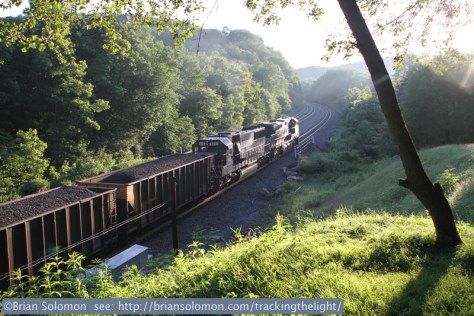
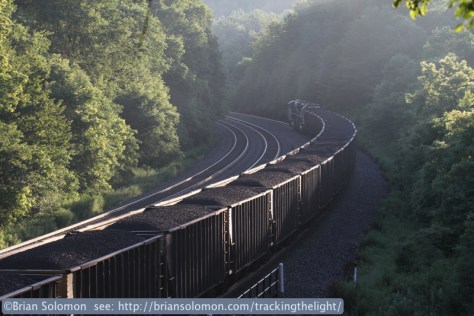
In contrast from the iced grip of winter, these photographs were made on June 30, 2010. This was a gorgeous warm summer’s morning; birds twittered the tree branches as the sun light streamed through a gauzy haze to burn away the dew.
I arrived early at the famed ‘Railfan’s Overlook’ to make photographs in the early light of day. In the distance, I could hear the thunder of a heavy train climbing east toward the Allegheny Divide at Gallitzin.
Norfolk Southern’s busy former Pennsylvania Railroad mainline rarely disappoints, and this morning it was alive with trains.
Using my Canon EOS 7D, I worked the glinting sun to its best advantage as an eastward Pennsylvania Power & Light coal train clawed into view. As it worked the grade, a westward RoadRailer led by former Conrail locomotive glided down grade.
At the back of the coal train were a pair of freshly painted SD40Es making a classic EMD-roar as they worked in run-8 (maximum throttle).
How I wish I was enjoying a warm June morning on the West Slope right now!
A Norfolk Southern coal train, likely destined for Pennsylvania Power & Light’s Strawberry Ridge plant, works west at Cassandra, Pennsylvnia. Canon EOS 7D with 24mm lens, exposed at f4 1/250th second, ISO 200. Back lit morning sun highlights the grass in the foreground.
Westward Norfolk Southern RoadRailer at Cassandra, Pennsylvania on June 30, 2010. The morning sun has caught the front element of my lens making for a bit of flare. Notice how this fogs the shadow areas and warms up the scene. Hollywood film-makers love this effect.I’ve stepped back into the shadow of a tree to control lens flare and stopped down my exposure to allow for better highlight detail on the sides of the RoadRailer. The result is a starker less atmospheric image.Morning glint illuminates the helpers at the back of coal train. Canon EOS 7D with 28-135mm lens, set at 120mm and at f5.0 1/500, ISO 400.
Here’s a view from my summer wanderings with TSH in July 1987. We’d camped along the Water Level Route at Lake City, Pennsylvania and spent the day watching and photographing trains.
The morning weather began heavy and damp, but as the day continued a thunderstorm rolled off Lake Erie and cleared the air.
Conrail SD50 6793 leads a westward train on the former New York Central at Lake City, Pennsylvania at 8:05am on July 25, 1987. I exposed this with a Rollei Model T, using T-Max 400 black & white film. F5.6 1/125th of a second. Processed in Kodak D76 1:1. I calculated exposure with a Sekonic Studio Deluxe handheld photocell. The camera’s Carl Zeiss Tessar allows for an exceptionally sharp image. I’ve reduced the scan to just a fraction of its original size for internet display.
Conrail was busy and presented an unceasing parade of trains. For this view, showing a pair of SD50s, I used my father’s Rollei Model T. I went low to emphasize the weedy grass, while using the old station to frame the train and provide historical context.
The combination of the grass, the thick white sky, and hazy light says ‘Summer’ to me.
On a recent ride out to Elwyn on a SEPTA suburban train, my brother Sean and I noted several large viaducts on this former Pennsylvania Railroad route.
The Elwyn route is one of several SEPTA lines that has been under threat of closure. The bridges on the route have been reported to be suffering from deferred maintenance which has made them candidates for replacement.
SEPTA’s Crum Creek viaduct. Exposed with a Lumix LX3.
This bridge piqued our curiosity. So on Monday, January 20, 2014 we decided to investigate the Crum Creek Viaduct which is easily accessed via The Scott Arboretum trails (near Swarthmore College).
An impressive viaduct, it spans the heavily wooded Crum Creek valley, looming above the tree tops like an ancient relic of another age. It reminded me of Milwaukee Road’s trestles on St Paul Pass in the Bitteroot Mountains of the Idaho panhandle.
This is a double-track tower-supported plate girder viaduct, of the type of construction common to many late-19th and early 20th century railway bridges. It dates to the mid-1890s.
SEPTA’s Crum Creek viaduct. Exposed with a Lumix LX3.
Photographically, the Crum Creek viaduct presents a challenge. The surrounding trees tend to obscure the bridge. While the most graphic images of the bridge are made near is base, yet working close to the bridge makes it difficult to adequately capture a train crossing the bridge. As we moved further away both train and structure tend to blend with the forest.
Since this bridge is in jeopardy of either replacement or abandonment, I thought it a worthy project to photograph it as functioning infrastructure. I tried panning an outbound train in an effort to show a train on the bridge.
An inbound SEPTA multiple unit rumbles across the Crum Creek Viaduct on January 20, 2014. Canon EOS 7D photo.Pan of an outbound SEPTA train crossing the Crum Creek Viaduct on January 20, 2014.
What will become of this bridge? Will it be restored, abandoned or replaced?
Below are some recent links that make references to the viaduct.
In 1992, I was living on Haight Street in San Francisco, just a short walk from this location. One August morning, I got up early to make photos of Muni’s light rail cars exiting the Muni Metro on Duboce in the sunrise glint light.
Exposed on Fujichrome 100 with a Nikon F3T fitted with an f1.8 105mm Nikkor lens, scanned with an Epson V600 desktop scanner.
For this image, I’ve used the trees at the left to shade the front element from direct sun to minimize flare. Although it was a clear morning, the sun was tinted by pollution that I remember as being a common effect in the Bay Area, especially in the summer.
My goal was to catch a car taking the wye from the J-Church line heading west on the N-Judah line, which was a common way for Muni to position cars in the morning. While I did make that photo, I felt this image was actually a better picture.
It shows an inbound J-Church car turning toward the subway portal with an N-Judah car outbound.
Although, I commonly used Kodachrome at the time, for this image I used Fujichrome 100 (before the introduction of Provia), which I processed myself at the photo studio where I worked in South San Francisco. Among my studio duties was running E6 transparency film. We used a roller transport machine and mixed the chemistry on site.
Yesterday (February 7, 2014), after several months of testing, Amtrak’s new ACS-64 Siemens built ‘Cities Sprinter’ locomotive 600 made its first revenue run on Amtrak train 171 (Boston to Washington).
My dad and I went to Milford, Connecticut on the North East Corridor to catch the new electric. Pop made some B&W photos with his Leica M3 from the east end of the platform. I worked the curve at the west end with my Canons.
I popped off a couple of slides with the EOS 3 with a 100mm telephoto, and exposed two bursts of digital images using the Canon 7D with 20mm lens.
Brand new Amtrak electric 600 leads train 171 (Boston to Washington) at Milford, Connecticut at 10:56am February 7, 2014. Canon 7D with 20mm lens. f4.5 1/2000th second, ISO 200.Canon EOS 7D with 20mm lens. Amtrak ACS 64 number 600.Canon EOS 7D with 20mm lens. Amtrak ACS 64 number 600.
Canon EOS 7D with 20mm lens. Amtrak ACS 64 number 600.
By the way the 20mm on the 7D has a field of view equal to about a 35mm lens on a traditional 35mm film camera.
The new electric sure looked nice! I’ll be keen to see the B&W photos and slides when they are processed.
After 171 passed, I made a few photos of a Metro-North local, then Pop and I went over to inspect the recently opened Metro-North station at West Haven, where we made a few photos of passing trains.
Today Amtrak number 600 worked train 171 from Boston.
Brand new Amtrak electric 600 leads train 171 (Boston to Washington) at Milford, Connecticut at 10:56am February 7, 2014. Canon 7D with 20mm lens. f4.5 1/2000th second, ISO 200.
My earliest attempt at a color railway photograph was an image at dusk of a searchlight signal on the former New Haven near East Haven, Connecticut. I was four years old. The result has been lost to the mists of time.
Signaling has always been one of my driving interests in railways. In 2002, MBI contracted me to write a history of American signaling practice, and this was published as a hardcover book in 2003. Since then it has been reprinted as a soft cover.
I presently working on its sequel, tentatively titled ‘Classic Signaling’, to be published by Voyageur Press, an imprint of the former MBI Publishing Company . This title will expand upon the topics discussed in my first book, and delve into the particulars of traditional American signaling with an emphasis on the classic hardware, including semaphores.
I’ve already uncovered a variety of information previously unknown to me. I’ll be sharing the fruits of my research combined with many first class signaling illustrations in this new work.
Caption: Conrail’s former Erie mainlines in western New York state were protected by classic Union Swich & Signal Style S semaphores into the 1990s. Here, Conrail SD50s work the number 2 track with the eastward BUOI (Buffalo, New York to Oak Island, New Jersey) east of Dalton, New York on May 7, 1988. The signal protects the number 1 track (westward main track) Where Erie painted semaphore masts black, Conrail preferred an aluminum shade of silver. Exposed on professional Kodachrome 25 using a Leica M2 fitted with a visoflex and Leitz 200mm Telyt lens. Brian Solomon
Click below to see previous signaling posts including:
Sayre, Pennsylvania, August 2010.Sayre, Pennsylvania, August 2010.
Watching trains today, it seems that graffiti is omnipresent. Hardly a freight passes without heavily tagged cars in consist.
Railcar graffiti isn’t a recent phenomena. Traditional chalked tags have appeared on cars for generations. I recall photographing a tag that read ‘Edward Steichen knew’ back in the mid-1980s, and I first noticed spray-painted graffiti on the New York Subways in the 1970s.
Yet, the proliferation of large colorful spray-painted murals and haphazard spray tagging has only become widespread on mainline trains in the last couple of decades.
While freight cars are the most common canvases, I’ve see locomotives and passenger cars tagged as well.
Nor is the phenomena isolated to the United States. Train graffiti is a worldwide occurrence. I’ve photographed heavily tagged trains in Poland, Belgium, and (wouldn’t you guess?) Italy! (Among other places).
Almost every photographer I’ve met has an opinion on graffiti.
Would you like to leave a comment? Tracking the light is interested in your opinion(s). See the comments section toward the bottom of the page.
New England Central at Montpelier Junction, Vermont.
Dubie campaign train approaches Montpelier Junction, Vermont on the afternoon of August 28, 2010. Canon EOS 7D with 28-135mm lens.
A freshly scrubbed GP38 led a pair of Pennsy passenger cars in a classic old-school whistle-stop campaign tour of Vermont.
On August 28, 2010, my dad and I drove to the Georgia high bridge (near St. Albans, Vermont) to intercept a New England Central special train hired by gubernatorial candidate Brian Dubie.
It was a sunny warm summer’s day, and we made numerous photos of the special as it worked its way south.
This pair of images was exposed at Montpelier Junction, where the train made a stop for the candidate to make a speech to his supporters. Traditionally, this was where Central Vermont met the Montpelier & Barre.
I used a telephoto for these views in order to emphasize the bunting and flags that marked the train’s distinctive qualities. Several of my photographs of the train appeared in Private Varnish.
I’ve long been intrigued by the short section of the former Southern Pacific Bayshore Cutoff at the old Potrero Wye, where the railroad runs beneath I-280.
This location offers a graphic contrast; the immensity of the highway shadowing the railroad both literally and metaphorically.
The location also poses a photographic challenge. During high light, the tracks are completely within shadow, so I’ve found the best time to photograph is early in the morning or late in the day, when sunlight is below the bridge.
Yet, low sun also poses a problem, as calculating exposure is neither intuitive nor can a camera meter be relied upon. The overwhelming highway structure will tend to result in overexposure as a camera meter tries to compensate for the darkness, yet the side of the train reflects the full brightness of the sun (which to further complicate matters, may be less than sun at midday).
I made this photograph of an inbound Cal-Train ‘Baby Bullet’ in April 2008, using my Canon EOS 3 with a 50mm lens on Fujichrome slide film. I used my Minolta Mark IV handheld meter in reflective mode to sample the exposure on the side of a gray highway support column, and preset my camera accordingly. (I didn’t make note of the exposure, but it was about f5.6 1/500th of second.)
The resulting color slide looks just about perfect, but my exposure/contrast problem was repeated when I went to scan the image.
My first scan of the slide resulted in this unacceptably dark and contrasty image. Specifically there was compression of the exposure curve that resulted in highlights that are too dark and a serious loss of shadow detail. I’d made this scan using my Epson V600 with the auto exposure feature ‘on’. Obviously to get a better scan, I’d need to take exposure matters into my own hands.
Here, I found the scanner software’s auto exposure had the reverse problem of my in-camera meter and tended to underexpose the scan. The result was not only too dark, but unacceptably contrasty.
I switched off the auto exposure, and instead used the software’s exposure histogram to set exposure manually as to better balance the highlight and shadow areas. Using this setting, I made a another scan. Afterwards, I fine-tuned the improved scan using Photoshop to make for a more pleasing image by adjusting both contrast and color balance.
This is my second scan. To capture the full dynamic range of the slide, I’ve broadened my exposure curve manually. Notice that there is considerably more detail in the shadow areas than in the original scan. I’ve allowed the over all image to appear relatively flat in order to obtain as much detail as possible between the extremes of highlight to shadows. This is an intermediate stage, as the image still doesn’t please me.I imported the second scan into Photoshop and then manipulated the color balance curve to compensate for an excessive red balance (likely the result of a processing inadequacy; specifically in the shadow areas, possibly the result of very slightly exhausted, or under replenished, color developer) then made a slight adjustment to the exposure curve to make the highlights slightly brighter and shadows a little darker. I still wasn’t satisfied. The image was neither as I remember it, nor as it appears in the slide. So went back to the second scan and made a new set of modifications, see below.Here is the fourth version of the image, and in my opinion the version that most accurately interprets the scene as I saw it. I’ve further manipulated the exposure curve to improve the highlight and shadow contrast while retaining detail in both areas. I was also less heavy-handed in my color adjustment because I felt that a warmer tone suited the scene.
This image is an exception; most of the time I’m satisfied with my first scan. Incidentally, the pictures reproduced here are scaled Jpgs from very large Tiff scans. The file size of the Jpgs is just a fraction of the original scan size, which is adequate for small-size internet viewing.
Tim Doherty asked me a few weeks back, “Have you ever tried a shot from the north side of the Millers Falls high bridge?” I’d looked a this several times, but was discouraged by the row of trees between the road and the railroad bridge.
Amtrak‘s northward Vermonter crosses the Millers River on January 12, 2014.
So, on January 12, 2014, at the end of the day (light), Tim and I went to this location with the aim of making images of Amtrak’s northward Vermonter crossing the aged Central Vermont span.
As there was only a hint of light left, I upped the ISO sensitivity of my Canon EOS 7D and I switched the color balance to ‘tungsten’ (indoor incandescent lighting which has the same effect as using tungsten balance slide film (such as Fujichrome 64T), and so enhances the blue light of the evening.
A call to Amtrak’s Julie (the automated agent) confirmed the train was on-time out of Amherst. Running time was only about 20 minutes (a bit less than I thought) but we were in place, cameras on tripods, several minutes before we heard the Vermonter blasting for crossings in Millers Falls.
The result is interpretive. The train’s blur combined with view through the trees and the deep blue color bias makes for a ghostly image of the train crossing the bridge.
Here we have an instance where everything came together nicely.
Amtrak 449 at West Warren, Massachusetts, 2:03pm January 24, 2014. Canon EOS 7D fitted with a 40mm pancake lens exposed at ISO 200 f5.6 1/1000th of a second. Camera RAW file converted to a Jpeg in Adobe Photoshop.
On Friday January 24, 2014, I’d got word that Amtrak’s heritage locomotive number 822 was working the westward Lake Shore Limited, train 449
This was the second time in a ten-day span that I’d be alerted to a heritage locomotive on this run. As noted in my January 18, 2014 post, Amtrak’s Lake Shore Limited, the weather wasn’t cooperative on my previous attempt at catching an Amtrak heritage locomotive.
By contrast on January 24th it was clear but very cold. I opted to make the photo at West Warren, where it’s nice and open and there’s a distinctive landscape.
Normally, Amtrak 449 passes East Brookfield at 1:30pm, and Palmer about 1:50pm. West Warren is roughly halfway between them, so I aimed to be there no later than 1:35pm
As it happened, 449 was delayed on Charlton Hill and passed more than 15 minutes later than I’d anticipated. Other than resulting in my nose getting a bit cold, this delay produced little effect on the photograph.
I opted for a traditional angle because I wanted to feature the locomotive as the primary subject this scenic setting. I picked a spot on the road bridge over the Quaboag River where I could make a view that included the old mills and waterfall, as well as a side view as the train got closer.
Working with my Canon EOS 7D fitted with a 40mm pancake lens, I set the motor drive to its fastest setting, and exposed three bursts of images as the train rolled east on CSXT’s former Boston & Albany mainline.
Since the camera’s buffer will quickly become saturated when making multiple photos in rapid succession, I was careful to wait until the train was nearly where I wanted it in each of the three sets.
This tighter view offers a clean perspective on the equipment. I was aiming to feature both the heritage painted locomotive and the ancient baggage car. Word to the wise; get the old baggage cars while you can, they won’t be around forever.
Have you had luck catching Amtrak’s heritage locomotives? Do you have a favorite? Let me know! There’s a venue for comments on this blog, scroll down.
Arctic Conditions in Central Europe Made for Great Light and Cold Fingers.
A Westward EuroCity train with Italian carriages accelerates away from Wörgl, Austria on February 1, 2006. Exposed on Fuji 400F slide film using a Canon EOS 3 fitted with 75-300 image stabilizing zoom lens.
It was my last full day of a week-long visit to Austria in winter 2006. I was changing trains at Wörgl, having spent the better part of the day making photos in the snow. Using my last roll of Fujichrome 400F, I exposed a series of sunset photos from the platform.
Wörgl is a busy place where lines converge on their way west through the Inn valley towards Innsbruck. Every few minutes something would pass over the mainline, and there was an electric switcher working the yard.
Thinking about the photography: working in low winter light the 400 ISO slide film had two advantages. Its faster film speed made it easier to work hand held and helped stop the action. While the warmer color balance favored the snowy sunset scene by accentuating the reds and yellows in the sky.
It was painful to be outside, and as the sun set it got even colder. But soon, I was gliding eastward on an InterCity train to Salzburg ensconced in the warm dining car. I’d enjoyed a hot ‘scheinsbratten mit sauerkraut’ and a tall glass of Schneiderweiss for dinner. The frosty landscape fading from blue to black as the train rolled into the night.
Looking west toward North Pownal, Vermont. The once standard searchlight style signal is rapidly disappearing. On Pan Am Railways many have already been replaced. Dull day’s can make for better signal photos because its easier to capture the signal aspect.
These old sentinels are on the wane. Get your photos before they are all gone.
25 Years Ago, Conrail Demolished Palmer’s Boston & Albany Freight House.
During the 1980s, Conrail demolished many disused structures along the Boston & Albany line. The East Brookfield freight house went in 1984, Worcester’s went in 1986. In January 1989, I noticed that the railroad was preparing to erase Palmer’s B&A landmark.
The wrecking machine was parked out in front and had already taken a bite out of the northeast corner of the steam-era red brick structure.
Palmer freight station on the eve of demolition. Exposed with a Leica M2 in January 1989.
I proposed a short article to the editor of Palmer Journal Register. The newspaper supplied me with a roll of black & white film and processed it for me. I photographed the building from every angle and wrote the article that appeared about a week later.
Conrail made short work of the old building, which had stood at the west-end of the yard near Haley’s Grain Store. Today there is almost no evidence of the building.
For me it had been tangible evidence of the old Boston & Albany—never mind Conrail or Penn-Central. While its usefulness to Conrail may have ended, I recalled speaking with the agent there on various occasions in previous years.
I still have the negatives that I exposed with my Leica M2 and I’ve scanned these using my Epson V600.
Palmer freight on the eve of demolition. Exposed with a Leica M2 in January 1989.Palmer freight on the eve of demolition. Exposed with a Leica M2 in January 1989.
Exposed on Tri-X with a Leica 3A; image cropped slightly to correct for level, contrast adjusted locally in Photoshop.
Of my older black & white images, I feel this is among my most successful compositions. For me it goes beyond simple documentation of the railroad, yet captures the essence of Northeastern railroading in the early 1980s.
I’m standing in the ruined shell of the old Boston & Maine tower at Johnsonville, New York, where the line to Troy had diverged from the route to Mechanicville and Rotterdam.
In the tower’s broken windows, I’ve framed a distant eastward B&M freight (operated by Guilford Transportation Industries). The railroad, like the tower, is a shell of its former glory, having suffered from decades of decline. Yet, the trains still roll.
The stark, yet diffused November light adds to the scene and backlights the train illuminating the locomotive exhaust. Although the train is small, it is clearly the subject of the photo. The eye is immediately drawn to the locomotives and only later explores the rest of the image. I was particularly pleased with the placement of the old railings inside the tower.
For many years I had a 5×7 inch black and white print of this image on my wall.
Amherst Railway Society‘s Big Railroad Hobby Show show is pure sensory overload. Everywhere you look there’s something or someone that seizes your interest. An old friend, an F-unit, a trolley buzzing underwire, video of a steam locomotive, the sounds of trains.
Paul Carver.Pioneer Valley Railroad‘s Dave Swirk.Dan Howard with the Seashore Trolley Museum.Wait, what? A vintage fishbowl bus? At the TRAIN show?!Caboose and a vision of Pennsylvania’s Martin Creek Viaduct in the distance.Lens-master George C. Corey.
It fills four buildings at the Eastern States Exposition grounds at West Springfield, Massachusetts and attracts tens of thousands of visitors.
For railway enthusiasts it’s an epic event and an annual pilgrimage. The show is the living testimony of the late Bob Buck—long time show director and proprietor of Tucker’s Hobbies.
Through clever marketing, unceasing persistence and a life-long passion for trains of all scales, Bob built the show from a small railroad hobby event into a massive one.
This weekend’s show was another well-attended event. It was a virtual sea of trains and people. Here are a few photos of people I met at this year’s show and exhibits that I enjoyed.
Otto Vondrak of Railfan & Railroad Magazine.Scarlett promotes Palmer’s premier railroad restaurant, the ever-popular Steaming Tender (located at the old Union Station).
Quabog Valley’s Boston & Albany J-2 Pacific.
Berkshire Scenic.Model Station.Phil and Rich.Rich Reed’s Penn Central display.Tucker’s Hobbies of Warren, Massachusetts.
Conrail’s sunday TV9 departs West Springfield yard at 3:55 pm on February 9, 1986. The film had a decidedly red color bias (Kodachrome as it aged tended to shift towards the red). This has resulted in a pinkish cast that is especially noticeable in the snow. The image is also off-level. I corrected these problems and others after scanning the slide. See below.
Here we have a typically New England scene; a fresh blanket of snow has fallen and the sky has cleared to a clear blue dome. Perfect light right?
Not exactly. The great contrast between the brilliant bright snow and the shadow areas makes for a difficult exposure. Complicating matters was Conrail’s rich blue paint.
While I was fortunate to catch Conrail’s TV9 leaving West Springfield Yard, I faced an exposure conundrum. If I exposed for the train, I risked grossly over exposing the snow, furthermore if I simply set the camera based on the snow on the ground, I’d end up with a pretty dark slide.
In the end I compromised, and stopped down enough to retain detail in the snow, while leaving the rest of the scene reasonably exposed.
However, 28 years later I’m still not satisfied with the slide.
There are three problems. I was concentrating on the exposure and the moving train (while trying to manipulate two cameras simultaneously) and I missed the level by about two degrees. Secondly, the Kodachrome film had a decidedly red bias, which resulted in pinkish snow (hardly what my eye saw that day).
I was easily able to correct these flaws after scanning the slide. I imported it into Photoshop and made three changes.
1) I cropped and rotated the image to correct for level.
2) Using the red-cyan color balance sliders, I shifted the highlights and mid-tone areas to toward cyan to minimize the excessive red in the scene. (cyan is the color opposite of red)
3) I made a localized contrast adjustment on the locomotives by outlining the area I wanted to change and then making a slight change using the curves feature.
I’ve illustrated the original unmodified scan two intermediate steps and the final image.
Here I’ve corrected the level; and using the color balance sliders I’ve shifted the color balance in the highlight and mid-tone areas to eliminate the pink-cast.The last step requires a subtle localized contrast adjustment. I selected the area to be adjusted and made a very minor change to the contrast and color balance. For this example I’ve grossly exaggerated the selected-area strictly to illustrate where I’ve made the changes. Obviously the extreme contrast change looks absurd when viewed out of context.Here’s the final image. One last change require the use of the burning tool; I made a few light passes around the seam between the area of localized contrast change to minimize the effect. My feeling is that if you can quickly perceive the adjustment, then the effect is too extreme.
Old Pointless Arrow and the Basketball Hall of Fame.
Springfield, Massachusetts Union Station, where Boston & Maine, Boston & Albany and New Haven once shared common space. Today, its a local Amtrak hub. Exposed with a Contax G2 with 28mm Biogon lens.
Ah Springfield! Probably best known because of the Simpson’s cartoon set in a mythical city of that name. Could be Springfield, Massachusetts, or Illinois, any of a couple dozen other cities with this common name.
On April 5, 2004, I met Tim Doherty for lunch and we made a few photos in Springfield.
A visit to Union Station found a westward CSX freight with a Conrail blue General Electric DASH8-40CW rolling through.
Later, we went down to an footbridge near the Basketball Hall of Fame to catch Guilford Rail System’s elusive EDPL (East Deerfield to Plainville, Connecticut) freight.
In 1982, Boston & Maine bought several Connecticut-based former New Haven Railroad operations from Conrail, and EDPL was one the only remnants of that transaction. At the time, the freight ran once a week. Catching it was a matter of planning and good luck.
Westward CSX freight rolls through Springfield Station on April 5, 2004.Guilford’s weekly EDPL against a backdrop of the Springfield skyline on April 5, 2004.This slightly closer view of the same train suffers (or benefits, depending on your perspective) from tree-branch shadows on on the front of the locomotives. Contax G2 photo.Guilford’s EDPL with Springfield’s top tourist attraction (or one would assume); the Basketball Hall of Fame.
I exposed these photos on Fujichrome Velvia 100F (RVP100F) color slide film using my Contax G2 rangefinder with a 28mm Biogon lens. The film was processed locally in Springfield at ComColor, which back then offered a 2-hour turn-around time for E6 films (processed and mounted).
In 2008, ComColor ceased processing E6 film. At the time, I was told my rolls were ‘the last run.’
The Amherst Railway Society ‘BIG RAILROAD HOBBY SHOW‘ is on this weekend (January 25 and 26, 2014) at the Eastern States Exposition in West Springfield, Massachusetts.
They were Budd’s follow up to its successful stainless steel rail diesel cars built in the 1950s. But where Budd’s RDCs had established standards for self propelled diesel cars, Budd’s SPV-2000 didn’t measure up.
I think ‘SPV’ was supposed to mean ‘Self Propelled Vehicle,’ but all the railroaders I knew called them ‘Seldom Powered Vehicles.’
These were adapted from the original Budd Metroliner (MP85) car style and in the same family as Amtrak’s Budd-built Amfleet.
For a few years they were routinely assigned to Amtrak’s Springfield, Massachusetts-New Haven, Connecticut shuttle trains.
Silhouette of a Budd SPV2000 at Springfield Station on the morning of September 30, 1984. Exposed on 35mm Kodak Tri-X with a Leica 3A with 21mm lens.On the morning of September 30, 1984, Conrail B23-7s lead eastward freight SEPW (Selkirk to Providence & Worcester) through Springfield (Massachusetts) Union Station. A set of SPVs rests in the shadows. Although not the primary subject, I was sure to include the SPV2000s in my photograph. Exposed on Tri-X using a Leica 3A with 21mm lens.
I admit now that I didn’t like the SPVs. I didn’t like them because they were new, and I much preferred the traditional RDCs. Also, at the time, I found the round car style un-photogenic.
Despite my dislike of the SPV’s, I photographed them anyway. While I wish that I’d made more photos of them, I’m very glad that I bothered to put them on film at all.
As it turned out, Amtrak appears to have disliked the SPV’s even more than I did! Their tenure on the Springfield run was short. By 1986, they’d been largely replaced with locomotive hauled consists. Other than my own photographs, I’ve seen very few images of these cars working on Amtrak.
A lone SPV2000 makes a station stop at Windsor Locks, Connecticut in May 1985. From my experience, it was relatively unusual to find single SPVs working in Springfield-Hartford-New Haven shuttle service. Exposed with a Leica 3A fitted with a Canon 50mm lens. Contrast controlled locally in post processing using Photoshop.
Here’s an irony: in retrospect I’ve come to appreciate the SPV’s. They were a rare example of a modern American-built self-propel diesel car, and to my well-traveled eye, I now find them very interesting. So, what seemed new and common, now seems rare and peculiar!
The Amherst Railway Society ‘BIG RAILROAD HOBBY SHOW‘ is on this weekend (January 25 and 26, 2014) at the Eastern States Exposition in West Springfield, Massachusetts.
As Transmitted from Amtrak number 56, The Vermonter.
This morning I started at Overbrook, Pennsylvania, where frosty temperatures and a clear sky made for some stunning lighting effects. The cold wasn’t aiding timely railroad operations.
I caught a SEPTA local to 30th Street Station. I was booked to travel on the Vermonter, but delays gave me ample time to wander around and down load digital photos from my cameras.
An outbound SEPTA multiple unit catches the glint of the rising sun at Overbrook, Pennsylvania before 8am on January 23, 2014. Canon EOS 7D with 200mm lens.An eastbound SEPTA multiple unit passes Overbrook, Pennsylvania before 8am on January 23, 2014. Canon EOS 7D with 200mm lens.Canon 200mm view of a non-stop SEPTA MU east of Overbrook, PA, on January 23, 2014.The Solari boards at 30th Street didn’t paint a happy picture. Delays and cancelations were the rule of the day. My train was only about 40 minutes behind the advertised. Lumix LX3 photo.30th Street Station, Philadelphia on the morning of January 23, 2014. Lumix LX3 photo.30th Street Station from the 29th Street side. Lumix LX3 photoAmtrak veteran, AEM7 932 roars into 30th Street Station with the Vermonter in tow. I’m riding behind this locomotive as I write this. Lumix LX3 photo.Amtrak 56 arrives at 30th Street, 40 minutes after its scheduled time. Better late than never. Lumix LX3 photo.
At present I’m gliding eastward across a snow covered urban landscape on the former New Haven Railroad. This is Tracking the Light’s first post sent directly from an Amtrak train.
View from Amtrak 56 on approach to New York’s Hell Gate Bridge with the New York City Transit Authority below and the Manhattan skyline beyond. Lumix LX3 photo.On board Amtrak number 56 The Vermonter, east of Penn-Station, New York. Lumix LX3 photo.Metro North Railroad HyRail truck as viewed from Amtrak 56 on the afternoon of January 23, 2014. Lumix LX3 photo.USDOT test car on the old New Haven Railroad west of Stamford on January 23, 2014. Lumix LX3.
Conrail C30-7 6608 pauses at Springfield, Massachusetts Union Station on March 31, 1984. Exposed on Panatomic-X ASA 32 (Kodak Safety Film 5060) with Leica 3A fitted with a 50mm Summitar.
I made this photo when I was a senior in high school. Paul Goewey and I’d planned to meet some friends at Springfield Station, and then drive north to photograph Boston & Maine at Deerfield.
While we waited for the others to arrive, I exposed a series of images of Conrail on the former Boston & Albany mainline. At the time, Conrail regularly stored locomotives between runs on track 2A in the station (at right). On the left is a set of light engines led by Conrail 6608, one of ten C30-7s.
More interesting is the locomotive trailing 6608, a relative-rare former Erie-Lackawanna SDP45.
The trip to the B&M was very successful and I exposed two rolls of 35mm Kodak Panatomic-X ASA 32 (Kodak Safety Film 5060) with my Leica 3A, and a couple of rolls of 120 B&W with my dad’s Rolleiflex. I processed all the film in the kitchen sink, using a crude formula of Microdol-X. I sleeved the negs and made 3×5 size proof prints.
The 120 negatives have been in my files for three decades, but the 35mm negatives had vanished. I have a photo album from 1985, with many of these images, but for years was vexed by the loss of the 35mm negatives. As a rule, I don’t throw photographs away.
The other day, I found a carton with school papers and photographs. There, at the bottom was an unlabeled crumpled manila envelope. What’s this? Ah ha!
It was chock full of negatives from 1984-1985. All missing for decades, many of them unprinted.
A raw negative strip from my morning at Springfield Station on March 31, 1984. Although stored in a manila envelop for the better part of three decades, the negatives were processed properly and kept flat in a cool dry place, and so remain in very good condition.
I scanned these negative strip on my Epson V600 scanner. Using Photoshop I cleaned up a few minor defect and made necessary contrast adjustments, then exported a reduced file size for display here. A photo lost for nearly three decades can now be enjoyed in through a medium I couldn’t have foreseen when I exposed it.
The Amherst Railway Society ‘BIG RAILROAD HOBBY SHOW‘ is on this weekend (January 25 and 26, 2014) at the Eastern States Exposition in West Springfield, Massachusetts.
The word was out that Norfolk Southern’s Pennsylvania Railroad painted heritage locomotive was to work a detoured stack train over CSX’s Trenton Subdivision to avoid a scheduled engineering project at Norristown, Pennsylvania.
Pat Yough and I planted ourselves at the West Trenton, New Jersey SEPTA station in anticipation. A number of other enthusiasts had similar plans, so there was plenty of company.
Former Reading Company station at West Trenton, New Jersey on the morning of January 19, 2014. Lumix LX3 photo.Detailed view of West Trenton station. Exposed with a Canon EOS 7D with 100mm lens.West Trenton station’s build date is carved in stone. Lumix LX3 photo.A SEPTA train for Philadelphia’s Airport pulls into the West Trenton station. CSXT’s unit oil train K040 with BNSF locomotives waits in the distance. Canon EOS 7D with 100mm lens.After the SEPTA local departed, CSXT KO40 led by BNSF 9688 and 5523 rolls southward through West Trenton. This section of the old Reading demonstrates how freight and passenger traffic can coexist on the same line. Canon EOS 7D with 100mm lens.CSXT symbol freight Q439 works south behind mixed consist of GE and EMD locomotives. Canon EOS 7D with 100mm lens.Switchers have become relatively rare items on modern railroads so I made this grab shot of CSXT 1137 as it rolled by. Lumix LX3 photo.A SEPTA Silverliner V waits to enter West Trenton Station. Canon EOS 7D with 200mm lens.
The much anticipated Norfolk Southern detour I5T, (running as CSXT B100-19) works northward through West Trenton. At the back of the train are a pair of NS diesels to aid with reverse moves necessary for the detour arrangements. Canon EOS 7D with 100mm lens.
The former Reading station building at West Trenton is now privately owned (and serves a non-railroad function), while the platforms remain active for SEPTA’s regularly scheduled passenger trains to Philadelphia.
When we arrived, morning clouds were giving way to sun. A pair of westward CSX trains was holding just west of the electrified zone and the radio was alive with activity.
In a little more than an hour we caught three SEPTA trains and four freights. This kept me and my three cameras pretty busy. My goal was not just to photograph the trains, but to capture these trains in this classic railroad environment.
Norfolk Southern 8102 was in clean tuscan-red paint at it trailed at the back of nearly two-miles of double stacked containers. Canon EOS 7D with 100 mm lens.Trailing with of NS I5T (CSXT B100-19) passing the West Trenton tower. Canon EOS 7D.CSXT empty oil train K041 works northward behind the detoured stack train. BNSF locomotives make a bit of color in this otherwise drab New Jersey scene. Canon EOS 7D with 20mm lens.
SEPTA local arrives at Overbrook on the way to Thorndale. Canon EOS 7D photo.
This morning dawned with a blood-red sunrise. Something about a red sky in the morning?
What I’d call ‘winter’ has been given all sorts of new fancy names. Probably the most absurd is the ‘polar vortex.’ Next up is the term handed to today’s precipitation: ‘bombogensis.’
Call it what you like. By about 2:30 pm today 6 inches of snow was improving photography all over Philadelphia, and by 5 pm there was 8-10 inches was making for interesting images.
My brother Sean and I spent the afternoon in Philadelphia making photos of SEPTA and snow accumulation while running errands. Falling and drifting snow made for some dramatic photography opportunities.
Inbound SEPTA multiple unit approaches Overbrook Station. Canon EOS 7D photo.Late-running Amtrak Keystone service crosses over at Overbrook. Canon EOS 7D photo.SEPTA number 10 trolley takes the corner at Lansdowne Avenue. Canon EOS 7D photo.SEPTA number 10 glides along in the snow on the afternoon of January 21, 2014. Canon EOS 7D photo.A vintage PCC in Route 15 service ambles along snow-covered Girard Avenue. Canon EOS 7D photo.Trailing view of a SEPTA PCC on Girard Avenue, on January 21, 2014. Canon EOS 7D photo.
Snow exposure I always tricky. My basic rule of thumb is to use the camera meter to set a gauging point, then open up (over expose) by 2/3s to a full stop above the camera meter. Using the histogram on the back of the camera, I then fine tune my exposure depending on the setting.
Cleaning the sidewalks on Viola Street at dusk. Canon EOS 7D photo.Former Pennsylvania Railroad position light signal shows a ‘stop’ aspect. January 21, 2014. Canon EOS 7D photo.
An inbound SEPTA MU arrives at Overbrook on the evening of January 21, 2014. Despite the snow, this service was on schedule. Canon EOS 7D photo.Former Pennsylvania Railroad Main Line looking east at dusk. Canon EOS 7D photo.
Philadelphia was the Pennsylvania Railroad’s headquarters city. Despite multitudes of change in the industry since PRR merged with New York Central in 1968, there’s still plenty of Pennsy cues around Philly.
For me this is like finding hints of a long lost empire.
Pennsylvania Railroad’s Suburban Station. Lumix LX3.Interior of 30th Street Station. The commemorative statue depicts an angel carrying a soldier skyward which symbolizes PRR’s employees who perished in action during World War II.
The keystone was PRR’s symbol. If one searches around Philadelphia’s 30th Street, there are still plenty of PRR keystones to be found. Lumix LX3 photo.Old PRR station at Clifton-Aldan, Pennsylvania. Lumix LX3 photo.A PRR-style position light signal at Overbrook, displays an ‘Approach-Medium’ aspect. Canon EOS 7D photo.Overbrook Station on the Main Line, as seen on the evening of January 18, 2014.
View from I-76; a crane attends to a derailed sand hopper at the site of the January 20, 2014 Schuylkill River Bridge derailment. Canon EOS 7D with 100mm lens.
The news media reported that early this morning (January 20, 2014), an oil train destined for Philadelphia derailed while crossing the Schuylkill River.
The derailment occurred near I-76 and within sight of Center City.
This afternoon, my brother and I were on our way through Philadelphia, and I had the opportunity to make photos from the car as we passed the derailment site.
Traffic was very slow on I-76, and I ample time to make snapshots with my Canon EOS 7D. On our way back, the clean up efforts continued, so I made a few more images.
It pays to have a camera at the ready to capture events such as this one.
View from I-76; a crane attends to a derailed sand hopper at the site of the January 20, 2014 Schuylkill River Bridge derailment. Canon EOS 7D with 100mm lens.View from I-76; a derailed sand hopper at the site of the January 20, 2014 Schuylkill River Bridge derailment. Canon EOS 7D with 100mm lens.View from I-76; a derailed sand hopper at the site of the January 20, 2014 Schuylkill River Bridge derailment. Canon EOS 7D with 100mm lens.
Dusk on January 20, 2014, clean up crews attend to derailed cars on the Schulykill River Bridge. ISO 6400, Canon EOS 7D with 100mm lens.
For me, SEPTA is one of the most photogenic American big city transit systems. Sure, other cities have their charms, but Philadelphia has a lot going for it; variety, accessibility, interval services on most routes, real time displays at stations, visual cues to its heritage, interesting and varied equipment and etc.
On January 16, 2014, my brother Sean and I, spent an afternoon and evening wandering on SEPTA’s rail systems making photographs. I had a minor agenda to ride a few pieces of the network I’d not yet traveled on.
I worked with two cameras; Lumix LX3 and Canon EOS 7D, but traveled relatively light (no film body or big telephotos)
Lumix LX3 photo.SEPTA has a App that shows schedules, train times & etc. Lumix LX3 photo.Philadelphia is one of the few North American cities with direct heavy rail airport connections. Trains run every half hour with stations at each terminal. Lumix LX3 photo.Afternoon sun catches an outbound Silverliner V at University City. A CSX freight rolls overhead on the Highline. Canon EOS 7D with 100mm lens.
All of the lines we traveled were well patronized (some at standing room only) and yet everything seem to run to time. SEPTA’s staff were friendly and helpful. (Especially when we were running for trains).
SEPTA SIlverliner V interior. Built by ROTEM. Lumix LX3 photo.End of the line at Elwyn.Silverliner V at Elwyn. The line used to continue to West Chester. Lumix LX3 photo.Old Pennsylvania Railroad station at Clifton-Aldan.End of the Sharon Hill trolley line. Lumix LX3 photo.69th Street terminal at Upper Darby. Outbound Kawasaki trolleys for Media and Sharon Hill. Lumix LX3 photo.Norristown High Speed Line at 69th Street. Lumix LX3 photo. Contrast adjusted in post processing to improve the overall appearance of the image.Norristown transportation center. The old Reading Company on the lower level. A Norfolk Southern freight rolled through as we boarded the train for Center City. Lumix LX3 photo.SEPTA Daypass; a bargain that cost just $12. We got good value with ours. SEPTA’s conductor sold us the passes on the train. Lumix LX3 photo.Market East. Canon EOS 7D photo.Market East. Lumix LX3 photo.Market East. Canon EOS 7D photo.Overbrook station on the Main Line. Canon EOS 7D photo, with 40mm pancake lens.
I used my trip on Amtrak 475/175 as an opportunity to make a few photographs. While I had some bigger cameras in my bag, I exposed all of these images with my Lumix LX3.
I boarded shuttle train 475 at Berlin, Connecticut just as the sun was setting. By the time I arrived in New Haven, only a faint blue glow remained of daylight.
Amtrak 475 (Springfield, Massachusetts—New Haven, Connecticut shuttle) works as a two-car push-pull with a former Metroliner (MP85) cab car leading. The train glides to a stop in front of the old Berlin, Connecticut railway station. Once a double track line, today this is a single track route. Lumix LX3 photo.Even the branch train has WiFi.A Boston-bound Acela Express pauses at New Haven. I had about 15 minutes to make photos before my connection, trian 175, from Boston arrived.The Acela Express accelerates out of New Haven. I panned the rear of the train with the Lumix image stabilization set ‘on’; f2.8 at 1/5th of a second, ISO 200.A Shore Line East suburban train roars away on the platform. These New Haven painted diesels have auxiliary engines to provide head-end power.A set of new Metro-North M8s arrived from Grand Central Terminal. It’s nice to see a shiny new train every so often!An HHP electric slides westward with train 175 in tow. How much longer will these powerful machines work the Northeast Corridor?
I didn’t have a tripod with me, so I used the station signs and other available flat surfaces on the platform to steady the camera. To avoid camera shake, after composing my image, I set the self timer to 2 seconds and press the shutter button.
Also, I overexposed each image by 1/3 to 2/3s of a stop to compensate for the prevailing darkness.
The trip was uneventful. Amtrak is my preferred means for navigating between cities in the Northeastern USA.
On board train 175 at New York Penn Station.Crossing the Delaware at Trenton, New Jersey.Philadelphia 30th Street. Amtrak 175 arrived about 5 minute behind the advertised, but that’s within tolerance, right? This classic Pennsylvania Railroad station is one of the gems of the Northeast Corridor.30th Street Station as viewed from the 29th Street side.A classical entrance to Philadelphia; you just don’t get the same feeling from an airport.Looking east on JFK Blvd toward Center City. SEPTA’s former PRR line to Suburban Station is on the left.
Amtrak 449, in sun and rain; one day and the next. Last week, I was over in East Brookfield visiting the LeBeaus to do some videography for a music video. Dennis LeBeau lives a block from the Boston & Albany (CSXT’s Boston Line).
I said to Dennis, “I’m just going to nip down to the bridge to catch 449. It should be getting close.”
“Passes here every day at one-thirty. I’ll join you in a minute.”
I phoned Amtrak’s Julie (the automated agent: 1-800-USA-RAIL) to find out if 449 as on time out of Worcester. As it turns out, it departed Worcester Union Station 4 minutes late.
Worcester is at CP45, East Brookfield is CP64. It takes 449 about 25-30 minutes to run the 19 miles.
Since it was nice bright afternoon, I opted for a broadside view that shows a few of the houses in town. At 1:39, Dennis shouted to me from the road bridge, “He’s around the bend.” I was poised to made my photograph with my Lumix LX3.
This can be tricky since there’s really only a split second to get the train in the right place. If the camera isn’t cued up, all I’ll get is a photo of the baggage car. But I was ready, and put the train precisely where I wanted it.
Amtrak’s westward Lake Shore Limited at East Brookfield, Massachusetts on January 13, 2014. Exposed with a Lumix LX3 at f4.0 1/1600th of a second. I selected a fast shutter speed to insure I stopped the train. When working broadside, the relative motion of the train to the film plane requires a fast shutter speed than when aiming at tighter three-quarter view.
The train glided through town. I turned to make a few going away views with my Canon, and said to Dennis, “You know that never gets old. I’ve been photographing that train since the 1970s.”
Dennis said to me, “I’ve been watching it since it was the New England States Limited, with New York Central E8s!”
A day later, I was in Palmer (CP83). The word was out that Amtrak 145 (one of the Genesis P42s in heritage paint) was working 449. The weather was foul, but since I was in town anyway, I figured I’d give the train a roll by.
It was stabbed at CP83 by a southward New England Central freight going into the yard, which allowed ample time for photos. Such a contrast in days. Pity the heritage P42 hadn’t worked west a day sooner.
Amtrak has painted P42 145 in its 1970s-era scheme. It leads train 449 which is sitting at CP83 waiting for a southward New England Central freight to clear the diamond on January 14, 2014. Driving rain was the order of the day. Canon EOS 7D with 20mm lens.
Pan Am Railway’s EDMO roars west on the Boston & Maine.
It’s almost like stepping back to the 1970s; three EMDs powered by turbocharged 16-645 diesels working under searchlight signals with a carload train.
On January 12, 2014, Pan Am Railway’s EDMO (East Deerfield, Massachusetts to Mohawk Yard) works the old Boston & Maine Fitchburg route at Greenfield, Massachusetts. The line on the left is the Connecticut River route running south toward Springfield. Exposed with a Canon EOS 7D fitted with an f2.0 100mm lens.
This is a nice contrast to the parade of double-stack containers and unit trains that characterize most American mainlines. While the details of the motive power have been altered since they were built, the spirit of the operation reminds me of watching trains more than 35 years ago.
If you think about it, as point of comparison, if in 1979 you were to see 35 year-old motive power and a traditional freight train that probably would have been either steam engines, or EMD FTs leading 40-ft cars.
Sure, you could argue that Pan Am’s paint scheme is a relatively recent development, and the locomotives have been modified since the 1970s (the lead former Santa Fe SD45-2 had its 20-645E3 swapped with a 16-cylinder engine among other changes), but that belies the point.
EDMO. Exposed with a Canon EOS 7D fitted with an f2.0 100mm lens.Tight view of Pan Am 616. Exposed with a Canon EOS 7D fitted with an f2.0 100mm lens.
The other day, I had a few packages to send out. I’d delayed going to the post office until after the school buses were out, using the logic that if I waited, I wouldn’t get stuck behind one on the way back.
On the way into the PO, I heard a distant whistle. And while at the desk, a train rumbled by.
New England Central’s (NECR) former Central Vermont line runs on a slightly elevated gradient behind the Monson, Massachusetts PO. This is on the climb up State Line hill, and heavy trains make a good racket coming though town. This freight, however, wasn’t very heavy and the engines weren’t working too hard.
I made an expeditious exit after mailing my packages, and started south on Route 32. No sooner than I was south of town, I found myself looking at the back of a school bus!
And this bus then stopped, as required, at the South Monson grade crossing.
I could hear the southward climbing. It had already gone through. Fortunately, once over the tracks, the bus driver kindly pulled in to let traffic around. I sailed southward, and arrived at State Line crossing. Once out of the car, I could hear the train working.
New England Central’s daily freight at the Massachusetts-Connecticut state line. Notice the granite marker to the left of the locomotives. Exposed with a Lumix LX3, set at ISO 200.
Although the light was fading, there was enough to work with. While, I’d left most of my cameras at home, I had my Lumix LX3 in my coat pocket. I set up a shot immediately south of the Massachusetts-Connecticut state line, and included the granite marker at the left of the image.
After the train passed, I followed it to Stafford Springs, where I made a few more photos. As it turns out, these NECR images are my first railway photos for 2014.
New England Central’s GP38s lead a southward freight through downtown Stafford Springs, Connecticut on January 9, 2014.New England Central’s GP38s lead a southward freight through downtown Stafford Springs, Connecticut on the afternoon of January 9, 2014. Lumix LX3 photo.
This pair of images will never be repeated. Here we have Irish Rail’s afternoon passenger to Dublin consisting of Mark 3 set led class 201 number 222 (known colloquially as the ‘Bishop Tutu’). That same afternoon, at about 3:40pm an empty timber with a mixed pair of 121/141s arrived from Waterford.
The afternoon Westport-Dublin passenger is ready to depart Westport on June 10, 2006. Nikon F3 with Nikkor f2.8 24mm lens.Irish Rail 146 and 134 arrive at Westport with an Empty Timber from Waterford on June 10, 2006. Nikon F3 with Nikkor f2.8 24mm lens.
What was unusual that day was an electrical power cut had required the use of portable generators at the station, making for an unusual discordant cacophony at the normally peaceful location.
Despite the racket, I went about making photographs. Here, I carefully composed both views from the footbridge by the signal cabin using the same angle to show the contrasting trains in the classic scene. It was the end of an era. Soon all would change.
Since that time, Irish Rail has retired the small General Motors diesels. The 121s made their final runs in 2008, the 141s finished a couple of years later. The Mark III passenger carriages were withdrawn from traffic; today passenger trains to Westport run with Irish Rail’s Rotem-built 22000-series railcars.
I exposed both photos on Fujichrome with my Nikon F3 fitted with a 1960s vintage Nikkor f2.8 24mm lens.
I returned to Dublin on the evening passenger train, also with Mark 3s and a 201 class General Motors diesel.
Thomasina the Cat is among the furry stars of Rock and Roll Panic the Third Rail Mix on YouTube. See http://youtu.be/1DweE3JLpEA
Tracking the Light takes a diverging route: Cats, Lionel, Beer, and Rock and Roll. Take a look at my most recent production. I’ve filmed and edited a short music video.
The soundtrack is the song Rock and Roll Panic performed by The Big Gunz of East Brookfield, Massachusetts. Popular for their evening entertainment at Dunny’s Tavern, the Big Gunz are a classic trio consisting of Paul, Tommy, and Dennis LeBeau.
Rock and Roll Panic third rail mix was filmed with my Canon Eos 7D and Lumix LX3 cameras, and has a train in almost every scene!