Author of more than 70 books on railways, photography, and Ireland, Brian lives with his wife, Kris, in Lancaster County, Pennsylvania. Brian holds a BFA in Photographic Illustration from the Rochester Institute of Technology. In 2022, he was presented with the Railway & Locomotive Historical Society’s prestigious Fred A.& Jane R. Stindt Photography Award for his lifetime achievements in railroad photography.
Amtrak FL9 488 leads an Empire Corridor train along the Hudson near Breakneck Ridge, north of Cold Spring, New York on November 20, 1992. Nikon F3T with 35mm PC lens; K25 slide film.
It was exactly 20 years ago today; November 20, 1992, I made this photograph of an Albany-bound Amtrak train along the Hudson Line near Breakneck Ridge north of Cold Spring, New York. Like today, this day in 1992 dawned cold and crisp. I was armed with my Nikon F3T with a 35mm PC (Perspective Control) lens and loaded Kodachrome 25 film. I metered manually with my Sekonic Studio Deluxe hand-held light meter. Amtrak’s classic FL9s were still working the Hudson Line on Empire Corridor trains. Later in the decade these were supplanted by modern General Electric dual-mode Genesis locomotives. Back then this train was common; today it’s a classic. Likewise, Kodachrome 25 was then my staple film, but its been gone for several years (discontinued well before Kodak stopped making K64). Wait 20 years, and see what changes unfold. Time passes and everything changes. Make your photos as you see them.
Mass Central 960 near Forest Lake, Massachusetts at 8:35 am on November 19, 2012. Exposed with Canon 7D, 28-135mm lens at 44mm, ISO 200 f7.1 at 1/500th second. Post-processing: minor contrast and saturation adjustments in Photoshop.
Between November 2008 and March 2009, I researched and wrote an article on Mass-Central for TRAINS Magazine that appeared in the March 2010 issue. I continue to photograph this short line which serves 25 miles of the former Boston & Albany Ware River Branch between Palmer and South Barre, Massachusetts. While on some days, I’ll make a project of working the branch, making photos from a variety of angles, and staying with the train for the whole day. This morning, after finishing non-photographic business in Palmer, I opted to catch the morning freight on its way northward on the branch. Today, I was only interested in catching it near Forest Lake, where the line crosses a short fill. During the summer this tends to get too brushed in for a satisfactory image, but after the foliage has gone, the location opens up. The difficulty this time of year is working around harsh shadows. I exposed this image at 8:35 this morning using my Canon 7D fitted with 28-135mm zoom. Initially I was tempted to make a tighter image, focusing more on the locomotive, but in the end I settled for a wider view that takes in more of the setting. Had Mass-Central been using its rare EMD NW5 number 2100, I’d probably stayed with a tight view. Reviewing my images, I decided the contrast was too much, and the light on the engine resulted in slight over exposure. As a result, I made a nominal adjustment to exposure curve using Photoshop, while boosting the saturation slightly to give the water and sky a bit more snap. These subtle changes required just a few minutes to implement. Other than that, the image is presented here un-cropped and more or less as I exposed it. Since Mass-Central departs Palmer northbound most weekday mornings between about 7 and 8:30 am, I’ll probably make another attempt at this location before the leaves return. The remarkable thing about digital photography is that as I write and post this, the train is still out on its run.
Mass-Central tracks at Thorndike, Massachusetts at 8:16 am on November 19, 2012. Mass-Central’s former Boston & Albany branch makes a near horseshoe through the village of Thorndike, just a few miles north of its interchange with CSX and New England Central at Palmer.
A little known piece of historic railway infrastructure is the old semaphore along New England Central’s (NECR) former Central Vermont Railway mainline in Monson, Massachusetts. I grew up in Monson and over the years I’ve included this signal in a few photos. Located about a mile from the railway crossing between NECR and CSX at Palmer this signal traditionally served as a fixed distant to the absolute signal protecting the Palmer diamond. Since it’s fixed, it’s always in the diagonal position indicating ‘approach’. Today, its within NECR’s Palmer yard limits. A similar signal exists about a mile north of the diamond. My challenge on November 15, 2012 was including it in photos of a northward New England Central freight. I made these early in the morning and low sun with a bit of frost offered some cosmic lighting, however the top of the semaphore was viewed against the opaque backdrop of evergreens. Ideally, I position myself a good distant back, which would show the sag in the track, mountains in the distance, while providing a silhouette of the semaphore with the train approaching it. Since the signal is on the outside of a curve, the closer I walked to it, the less of the curve and track in the distance were apparent, and no matter where I seemed to stand, I couldn’t find a good means of positioning the signal. This is not a new problem, I’ve been fighting the circumstances for years, but its worse now since the trees have grown exacerbating the situation. What I’ve offered here are two solutions, neither perfect. Since the northward train was moving slowly, I had an opportunity to adjust my exposure and framing. The more distant exposure shows the track and train in a more ideal light but the seamphore blade is lost; while with closer image, I’ve waited for the nose of the locomotive to enter the shadows and then slightly over exposed the picture in order to better separate the semaphore blade from the background trees. With both photos I was working with my Canon EOS 7D fitted with a 200 mm f2.8 telephoto lens. I metered manually and made several test exposures before the train filled the frame. I exposed closer images as well, but these didn’t work at all. Except for scaling, the images are unaltered and un-cropped.
Northward New England Central train approaches milepost 64 in Monson, Massachusetts on the morning of November 15, 2012. Exposed using a Canon EOS 7D with 200mm f2.8 lens set at f3.5 1/500 400 ISO.Closer view of the same train with a slight lighter exposure and vertical framing to better feature the semaphore. Exposed using Canon EOS 7D with 200mm f2.8 lens set at f3.5 1/320 400 ISO.
In November 2012, a laden Bord na Móna train ambles across the bog toward the Edenderry Power Station seen on the horizon. Exposed with Canon EOS 7D with 200mm lens.
Ireland’s Bord na Móna (Peat Board) operates an extensive network of three foot gauge railways in the midland’s for the primary purpose of harvesting peat for electrical generation from raised bogs in the Midland area. Bord na Móna’s website (www.bordnamona.ie) indicates that the company has more than 700 km (approximately 435 miles) of permanent line and another 140 km (86 miles) of portable temporary track. Some routes are more than a half century old, while temporary lines are located (and relocated) as needed to reach sections of the bog ready for harvesting. It’s been described as Europe’s most extensive industrial railway. Unlike traditional railways (which in Ireland are built to 5 foot 3 inch standard), bog railways use minimal infrastructure and engineering. Tracks are maintained for relatively slow speed freight movements and this part of the charm.
Bord na Móna plaque marks a road bridge over the line near Clonbulloge, County Offaly.
I first explored Ireland’s bog railways more than 14 years ago, and over the years I’ve occasional made images of Bord na Móna, but until recently I’ve not focused on these unusual railways, instead preferring Ireland’s main line operations. However, over the last few weekends, I’ve begun to explore and photograph the Bord na Móna network that serves the Edenderry Power Station.
Dramatic weather sweeps across the Bog of Allen near Daingean on 3 November 2012. The Bord na Mona crosses this country boreen at grade. Many narrow gauge spurs are only very lightly used and rainbows may be more common than trains. Exposed with Lumix LX3 at ISO 80.
The Bog of Allen in Counties Offaly and Kildare offers a stark landscape that reminds me a bit of the Scandinavian Arctic. While today the bog is largely devoid of trees, historically this was a heavily forested area (thus the concentration of peat). Locations for photography are very limited; by virtue of the bog, there are relatively few roads reaching points served by Bord na Mona. Low late-autumn sun suits photography in such an austere environment by accentuating the raised bog’s texture and while emphasizing the trains.
Bord na Móna’s Edenderry Power Station is just a few miles from the village of Clonbulloge. A frosty November morning mades for ample condensation of water vapor escaping the plant. Bog trains feed this plant from the surrounding area. Exposed with Lumix LX3.The road bridge over the line near the Edenderry Power Station offers an excellent place to watch and photograph Bord na Móna railway operations.
Exploration and patience are the key to catching the trains in action. Trains typically operate in pairs which facilitates switching and simplifies operations. Some lines are operated as double track, others as single line. However, the lack of easy access and myriad routes radiating across the bog make for a challenge. I’ve found that using my Canon EOS 7D and EOS-3 with Provia 100F and long telephoto lenses can produce some of the most effective images, although I’ve also made some interesting wide views with my Lumix LX-3. Just to cover the bases, I’ve also dragged out my Nikons for a bit of B&W work. The images presented here are part of a work in progress.
In October 2012, a Bord na Móna locomotive clatters along with an empty rake heading toward a loading point. Exposed with Lumix LX3 set at ISO 80.In late October 2012, a pair of trains are loaded on temporary track near Rathangan, County Kildare. Exposed using Canon EOS 7D fitted wtih 200mm lens, ISO 200.
A pair of laden turf trains work toward the Edenderry generating station having loaded near Rathangan. Exposed with Canon EOS 7D and 200mm lens; ISO 400, f4.5 at 1/500 second.
Railway Preservation Society Ireland with 461crosses the Curragh, County Kildare 6 November 2012. Exposed with a Lumix LX3; ISO 80 f3.5 1/640 second in ‘A’ (aperture priority) mode.
Low sun, frosty damp weather combined with constantly changing conditions make for a challenging but potentially rewarding setting for railway photographs. Add in a classic steam locomotive and you have all the potential for stunning dramatic images. That was my experience on Irish Rail yesterday (Tuesday 6 November) . I’ve already posted a few images from Monday and Tuesday (5-6 November, see: Gallery Post 5 and Gallery Post 6), I’ve now had time to plow through many of the digital images I exposed yesterday. As previously mentioned, in addition to digital images made with my Lumix LX3 and Canon 7D, I also exposed some Fuji Provia 100F. Deciding to use film or digital is a spot decision; while I use past experience with these materials to gauge when film or digital may be best, when the action is under way, I’m often juggling cameras and exposing as quickly as I can. When working with steam locomotives, wafts of steam and smoke and changing light mean that each moment can product dramatic changes in composition. Not only is the exposure impossible to predict, but the whole scene can change quickly and fantastically. Reaction time is crucial.
Boiler pressure on 461 is set at 160 lbs psi; safety valves lift at Portlaoise as the locomotive is being serviced in preparation for its return trip to Dublin. Initial reports indicate the locomotive enjoyed a very successful trial. Exposed with a Canon 7D; ISO 400, f8.0 at 1/1000 sec with 200mm f2.8 lens hand-held.Irish Rail Rotem-built 22000-series Intercity Rail Car (ICR) makes a station stop at Portlaoise on 6 November 2012. RPSI 461 waits for a signal on the down road to complete running around its train. Exposed with a Canon 7D ISO 400, 200mm lens.
Railway Preservation Society Ireland’s locomotive 461 and Irish Rail’s IWT intermodal liners were my primary subjects, but I focused on all elements of the railway, photographing the regularly scheduled trains, stations, and infrastructure, as well as what ever else caught my eye.
Irish Rail locomotive driver Ken Fox. Exposed with Lumix LX3.
On the afternoon of 6 November, Irish Rail class 201 (General Motors diesel built in London, Ontario) running light meets an Intercity Rail Car working uproad at milepost 40 east of Portarlington . RPSI 461 was just a few minutes behind the scheduled train on the up main—minutes that dragged like hours as the sun wafted in and out of clouds. Exposed with a Canon 7D with 200mm f2.8 lens.
Low sun backlights 461 and Cravens carriages working uproad near milepost 40 east of Portarlington. Dramatic light accentuates railway action. This was one of more than a half dozen exposures made in sequence with a Canon 7D with 200 mm lens.
Steam and smoke at milepost 40; RPSI 461 works toward Dublin on 6 November 2012. Exposed with a Canon 7D and 200 mm lens.
Irish Rail’s Portlaoise Station (formerly Great Southern & Western Railway’s Maryborough Station) catches the light on 6 November 2012). Exposed with Lumix LX3 at ISO 80 f4.0 1/500 second.
Locomotive 461 crosses the fill near Cherryville Junction county Kildare on its way to Portlaoise from Inchicore on 6 November 2012. Exposed with a Canon 7D with 28-135mm lens.The Railway Preservation Society Ireland trial train has taken the loop at Sallins as the 1100 Dublin-Cork passenger train (led by a 201 class General Motors diesel) overtakes it on 6 November 2012. Exposed with Canon 7D and 200mm lens.RPSI 461 passes the station on Portlaoise on its run down from Dublin, 6 November 2012. Exposed with Canon 7D fitted with 28-135mm lens.
These are just a sampling of my results. I’ll be very curious to see my slides, but it will be weeks before these are processed.
Brian Solomon will be giving an illustrated talk titled “Ireland from an American Perspective 1998-2003” at the Irish Railway Record Society’s Heuston Station premises in Dublin at 7:30pm on Thursday November 8, 2012. Admission free.
Today, Tuesday 6 November 2012, was another day of main-line trials with Railway Preservation Society Ireland locomotive 461; the locomotive departed from Inchicore and made its run to Portlaoise and return under mixed skies. Hugh Dempsey & I made a very productive day out catching the locomotive, IWT Liner and other trains at various locations. My Canon 7D was very active; its card is nearly full! Made use of the Lumix LX3, and exposed more than a roll of Provia 100F with the EOS-3. (What? Only one roll?! Yes yes, I know, but the digital cameras filled it where the film camera left off, or vice versa.) Here is just one of many photos from today’s very productive outing.
Sun and clouds; RPSI 461 works west toward Cherryville Junction, County Kildare on Irish Rail’s Dublin-Cork mainline on 6 November 2012. Made with a Canon 7D fitted with a 28-135mm lens. Photo by Brian Solomon
Brian Solomon will be giving an illustrated talk titled “Ireland from an American Perspective 1998-2003” at the Irish Railway Record Society’s Heuston Station premises in Dublin at 7:30pm on Thursday November 8, 2012. Admission free.
The morning of 5 November 2012 finds Railway Preservation Society Ireland’s former Dublin & South Eastern 2-6-0 461 approaching Stacumny Bridge (east of Hazel Hatch station) on Irish Rail’s quad-track mainline west of Dublin. Photo by Brian Solomon
This morning (Monday 5 November 2012) was unusually colourful for Irish Rail; on a railway primarily populated by Rotem-built 22000-series Intercity City Railcars and Class 201 (General Motors model JT42HCW) diesels with Mark IV trains, the course of just a few minutes saw passage of Railway Preservation Society Ireland’s historic 2-6-0 461 (on trial from Inchicore) followed by the weekday IWT intermodal liner (Dublin North Wall to Ballina, County Mayo) led by class 071 number 083 (General Motors model JT22CW). While it was a mostly sunny, a thin band of cloud managed to dull the light for 461, but bright sun prevailed for the liner. Stacumny is just a short jaunt for me (thanks to a lift from a friend). By noon I was home in Dublin, where I spent the afternoon processing B&W film. By constrast this morning’s efforts were made with my Canon 7D with 200mm lens. I also exposed some Provia 100F, but that will be in the camera for a while yet.
Just a few minutes behind the steam locomotive was Irish Rail’s weekday IWT Liner led by 071 class diesel-electric number 083. Photo by Brian Solomon
Brian Solomon will be giving an illustrated talk titled: “Ireland from an American Perspective 1998-2003” at the Irish Railway Record Society’s Heuston Station premises in Dublin at 7:30pm on Thursday November 8, 2012. Admission free.
Wearing a freshly applied advertising livery, LUAS tram 5008 works southward on Harcourt Street in Dublin on November 2, 2012. Photo by Brian Solomon
On the afternoon of Friday, 2 November 2012, I was only my way up to John Gunn’s Camera on Wexford Street in Dublin to buy a few rolls of film. (Yes, I still do that sort of thing). Gazing down Cuffe Street toward St Stephen’s Green, I noted a Green Line LUAS tram in a new advertising livery heading to its terminus. While most of Dublin’s Alstom-built Citadis tram fleet are painted in a metallic lavender with yellow safety stripe, from time to time LUAS dresses a tram or two in a full wrap advertising. In recent months, an attractive blue tram has been frequenting the Red Line route advertising a television service. Friday’s sighting caught my attention, since it’s the first time I noted this new livery. Sometimes these advertising trams can be very short lived, and I like to catch them on camera when I can. Although I was a bit tight on time, I diverted via Harcourt Street, where the Green Line passes nicely restored Georgian terrace houses. Normally a tram will turn around in about 5-10 ten minutes from St. Stephen’s Green, so I knew I wouldn’t have long to wait.
Unfortunately, during my short wait, the wind kicked up, the sky darkened, and a deluge ensued; in other words it was a typical Dublin afternoon. I held my ground, despite the difficult weather, which not only dampened my day, but knocked my exposure down about 8 stops. As always, I carried my Lumix LX3 digital camera (see: Installment 3: Lumix LX-3—part 1 An Everywhere Camera). While normally I use its lowest ISO setting of 80, the gloom didn’t permit this, and I bumped up sensitivity to ISO 200. Within a few minutes the tram was whirring down Harcourt Street allowing me to expose a sequence of images. My favorite is this pan view made at f2.8 at about 1/60 of second. Since lighting conditions were rapidly changing, I used the camera’s built in ‘A’ (Aperture priority) setting, which allowed me to set the low f-stop. By panning the tram, I kept it relative sharp while putting the Georgian houses and street into a sea of blur. If time allows, I’ll try to catch LUAS 5008 again on a brighter day.
Reminder: Brian Solomon will be giving an illustrated talk titled Ireland from an American Perspective 1998-2003 at the Irish Railway Record Society’s Heuston Station premises in Dublin at 7:30pm on Thursday November 8, 2012. Admission free.
Erie semaphore near Addison, New York displays ‘Approach’ following the passage of Conrail’s eastward BUOI on October 16, 1988. K25 film Leica M2 w 50mm Summicron.
When I discover something that fascinates me I’m drawn to visit repeatedly and make photographs. Long before I ever saw the old Erie Railroad route, I found it oddly compelling. The Erie was built early; it was a pioneer, constructed to the exceptionally broad six-foot track gauge. Although a major railroad, it suffered in the shadow of New York Central and Pennsylvania systems and yet never really thrived. It spanned sublimely beautiful pastoral countryside, yet operated as a ‘big-time’ railroad, focusing on heavy freight operations in its later years.
I never saw the Erie since it was merged into Erie Lackawanna six years before I was born. For that matter, I never properly experienced Erie Lackawanna, as it vanished into Conrail in 1976 when I was in fourth grade.
Move forward ten years, in autumn 1986 I was living in western New York while attending college at the Rochester Institute of Technology majoring in photography. On October 24th of that year, I ventured south from Rochester with the sole objective of following the old Erie Railroad mainline from Corning to Hornell. After a visit to the yard at Gang Mills, I drove west to Addison, and then took the Canisteo River Road that ran parallel to the old Erie main. This is a lightly populated and supremely scenic valley characterized by exposed shale cliffs, the lazy sinuous green-tinted Canisteo, and rustic farms with fields of corn and classic red barns.
The Erie has occupied the valley since the 1850s and seemed to me as much a part of the landscape as the river. Not far west from Addison, I spotted a silent sentinel—an old upper quadrant semaphore with its pointed yellow chevron blade aimed skyward. This Erie relic was as much key to my fascination as the distinct Canisteo Valley. Continuing west, I spotted another semaphore, and another. Leaving the Canisteo River Road, I drove down to the railroad on Newcomb Road near the village of Rathbone. Here I found a semaphore to inspect up close, located near a closed truss bridge on Newcomb Road. As it turned out, the bridge wasn’t long for the world; thankfully I had the insight to make a series of black & white photos of the old span while waiting for a train to pass the semaphore.
Finally, after hours of patience, Conrail fielded its daily OIBU (Oak Island, New Jersey to Buffalo, New York), a westward manifest freight. This came roaring up the valley. I learned my next lesson: freights really roll on the old Erie! Soon I was in hot pursuit. Following that freight up the valley I discovered semaphore after semaphore, each guarding the old Erie, as most had done for the previous 70 years. Erie’s famed S-class 2-8-4 Berkshire and K-class Pacific steam locomotives had worked past these old signals as had its early diesels. These signals were the glue that tied the past to present; they were part of a greater infrastructure that shaped the look of the line including the time-worn ‘code line’ (often incorrectly called a ‘telegraph line’), and rock-slide fences to prevent crumbling shale from causing a derailment.
Sun and snow; Conrail BUOI (Buffalo to Oak Island) rolls by an Erie semaphore in the Canisteo Valley near Cameron Mills, New York. Photo made with a Leica M2 rangefinder with 90mm Elmar on Kodachrome 25 slide film.
I found that most of the signals between Addison and Hornell remained as Erie semaphores. Better yet, west of Hornell to Dalton, New York, was likewise populated, as was the railroad east between Elmira and Binghamton. While I didn’t have the opportunity to capture it all on film during my first fleeting experience, the spark of fascination was firmly seated in my eye. Something as antique as an old semaphore couldn’t go unnoticed, and situated in such a stunning setting made them even more interesting. And yet the clock was ticking—I knew these old signals were on borrowed time. Having seen what happens when a railroad is torn asunder by efforts to modernize infrastructure I knew I needed to act! I spent the next three years making photographs along the Erie; not just signals, but trains, stations, bridges, towns, and railroaders. In fact, in most of my images the signals are incidental; they add interest, but only occasionally are the prime subject.
My friend Doug Eisele aided my efforts. He shared my interest in signals and educated me about them, while helping locate specific signals not obvious from main roads. Doug generously shared his own photography dating to the Erie-Lackawanna period, and helped put my work in context while providing hints for locations and lighting in various seasons and at different times of day.
On a snowy day in April 1988, Conrail’s BUOI (Buffalo to Oak Island) works its way east in a snow squall near West Cameron, New York. This freight had made a pickup at Hornell where it collected some rebuilt New York City subway cars, seen behind the locomotive on flat cars. Photo was made with a Rollei model T (featuring an f3.5 75mm Zeiss Tessar) with a super slide insert to provide a 645 size image.
The semaphores are now gone but I’ve continued my photography along the Erie route. My work now spans 25 years. I began working with Leicas, a Rollei model T, and a Canon A1, and Hasselblad 503c both borrowed occasionly from my college roommate. My original color work was largely exposed on Kodachrome, mostly K25, but other flavors as well. Later work was on Fuji and Ektachrome. My black & white photography was in its most experimental phase so I worked with a variety of films: Kodak Plus-X, Tri-X, my old staple Verichrome Pan, as well as Ilford emulsions. Most of the B&W work was executed in 120 format, but I played with 35mm and some 4×5 as well.
History and Context
I believe in learning as much as possible about my subject. My interest in railroad signaling dates back to my early childhood. As I matured I gradually researched this topic and this led to my book Railroad Signaling, published by MBI in 2003.
In the U.S. automatic block signals followed William Robinson’s 1870s development and perfection of the closed track circuit. Early automatic block signals were designed to automatically protect following movements, thereby providing a greater level of safety at relatively low cost. Electrical equipment was then in its infancy, and while the manually operated mechanical semaphore was well established in Britain, the lack of sufficiently compact and powerful motors made it impractical for this type of hardware to serve automatic block service. Instead, the earliest American block signals were enclosed banner style signals typified by the Hall disc, commonly known as the ‘Banjo’ signal because of their distinctive shape. The Hall Signal used a simple vain relay to display a light-weight colored disc within a window in the wooden frame. Hall promoted its disc signal standard until the early 20th century. It was most popular with eastern railroads; Boston & Albany, Lackawanna, Lehigh Valley and New Haven system all made widespread use of disc signals. Reading Company was probably the last railroad to employ Hall discs with a few signals surviving until after World War II. Although the disc was an early standard, within a couple of decades it was superceded by the semaphore as a block signal.
The Pennsylvania Railroad adopted the mechanical semaphore for interlocking signal service in the 1870s. In 1882, PRR installed pneumatic lower-quadrant signals for automatic block service. By the early 1890s advances in electric motor technology made electrically operated two-position lower quadrant semaphores commercially viable. Over the next few decades many American railroads installed lower-quadrant semaphores in automatic block service to improve safety and line capacity. Among the most popular types of automatic semaphore was Union Switch & Signal’s Style-B lower-quadrant. (‘Style-B’ refers to the control mechanism, which on this variety was located at the base of the mast.) Southern Pacific was one of the largest proponents of this style of signal. US&S lower quadrants survived in active service on several SP lines into the 1990s. These signals were featured in my post: “Southern Pacific Siskiyou Memories.”
Among the difficulties with lower quadrant semaphore was that each blade displayed two only aspects;: if three aspects were necessary, two blades were required. In 1903, the electric upper-quadrant semaphore was patented; it was widely adopted after 1908 and for many years reigned as one of the most common styles of American signaling. Each signal blade could display three aspects with a single blade. Coincident with development of three-position semaphore mechanisms was research by New York’s Corning Glass that produced standardized colored glass for signal lenses. This resulted in the universal adoption of red, yellow, and green as standard colors for railroad signals (later similar colors became highway signal standards). Prior to this, railroads employed a variety of different lens colors, which specific tints varying from line to line.
Union Switch & Signal’s Style-S mechanism was designed for three-position operation. Erie Railroad was an early user of the three-position semaphore, with its earliest installation dating to about 1906. After 1910, Erie installed large numbers of Style-S semaphores along its lines. By 1924, Erie had switched to US&S color light signals for new installations, yet continued to maintain semaphores where they were already in operation.
West of Binghamton, New York, these signals survived into the Conrail era. By the late 1980s, the old Erie Style-S signals that dated to the early 20th century were nearing the end of their service lives, and were being replaced as they failed. In the early 1990s, Conrail converted sections of its former Erie ‘Southern Tier line’ from directional double-track operation to a single track with passing sidings under a centralized traffic control style system (described in Conrail literature as ‘Traffic Control System’). As part of this program, traditional signals were removed and replaced with modern color-light hardware featuring signal heads with the triangular light pattern favored by Conrail. (This style was not new, as having been introduced by US&S in 1924.) A handful of Style-S semaphores survived for a few more years on a section that remained as directional double track between Waverly and Binghamton. In 2005, Norfolk Southern finally replaced the last Erie semaphore which had protected the eastward track near Endicott, New York.
Conrail BUOI passing an unusually tall semaphore near between Rathbone and Addison, New York. This signal once had a subsidiary arm that was dispatcher controlled and could be use to instruct a train to stop and ‘line in’ to the center siding at this location. In the steam era, Erie had center sidings at strategic locations to allow slower trains to get out of the way of faster ones, thus making more efficient use of its directional double track mainline. Lighting for this photo was unusual; the sun was just peaking out from heavy clouds and was slightly back lit, which helps accentuate the lens in the semaphore blade and illuminate the locomotive exhaust. It was 2 pm on April 16, 1988, and BUOI was beginning to accelerate after clearing a slow order. Photo made on Kodachrome 25 with a Leica M2 rangefinder fitted to a Visoflex with f4.0 200mm Telyt lens.
Fallen soldier; on May 2, 1987 this former Erie semaphore was lying on the ground along the right of way at Rathbone, New York following replacement with a color light. Most surviving Style S semaphores in the Canisteo Valley were replaced in 1993-1994, when Conrail installed a single track centralized traffic control system in place of Erie’s traditional directional double track. This work resulted in signal re-spacing with longer blocks and also involved removal of the above ground code line and related infrastructure. The photo was made with a Canon A1 and 50mm lens on Professional Kodachrome 25.East of Adrian, New York, Eastward Delaware & Hudson symbol freight ‘Jet 1’ passes semaphores at milepost 320 (measured from Jersey City) on May 14, 1988. Photo made on Professional Kodachrome 25 with a Leica M2 rangefinder fitted to a Visoflex with f4.0 200mm Telyt lens. The scan was modified using Adobe Photoshop to correct for a slight tilt, and adjust for both color and contrast. Among the difficulties with using Kodak’s professional Kodachrome was the tendency of the film to experience undesirable color shifts. The film required refrigeration until shortly before exposure and prompt processing afterwards; but even following this regiment, its color balance was often less than ideal.
(text originally reproduced in Irish Railway Record Society Journal no. 177, February 2012)
Photography is an art, not a science; yet it relies technology and it is necessary to master that technology to consistently produce successful images. Railway photography requires the photographer to make a variety of small decisions at precisely the right moment. Rapid movement combined with the operational uncertainties inherent to railway operations makes railway photography challenging and there is no proven sure-fire method of ensuring perfect railway photographs. There isn’t a single defined set of skills required to make pictures, furthermore efforts to impose absolute photo formulas have typically resulted in stale image making. By contrast there are diverse and myriad approaches toward photography each unique to the individual photographer, and it is this endless variety in approach to the subject that has kept the medium fresh and exciting. Many photo opportunities have been missed or ruined, or simply fall short because of the photographer’s momentary inattention or minor technical error. This is not limited to the novice or occasional photographer, as even the most experienced practitioners make mistakes. While formulas lead to dull repetitive images, here’s some simple philosophy and habits that may help you improve your odds at making successful railway action photos:
1) Always carry a camera: If you don’t have one, you can’t make a photograph.
2) Insure that your camera is ready: if it uses a battery, check to see that it’s fresh; if using a film camera, insure it’s loaded; if using a digital camera, insure the recording card is installed and working properly; double check to see that sufficient exposures remain on the film/card to make all the photos you have planned. If you reach the end of roll or fill your card unexpectedly, you’ll miss the critical image.
3) Always carry an extra battery and at least one spare roll of film/recording card.
4) If your camera has a light meter, check to see that it works; if using an automatic or program mode, be sure that these are set as you intended.
5) When using auto-focus, insure it is switched ‘on’; if you focus manually, check (and double check) your focus point.
6) Don’t fight with your equipment! Select a camera that you feel comfortable using. If you aren’t happy with your camera or it routinely malfunctions, replace it post haste.
7) Many fully automatic cameras are designed for making snapshots of children’s birthday parties and scenic vistas, so by design may greatly limit your ability to make successful railway action photos. Especially troublesome are automatic cameras that impose an unwanted shutter delay. Although these are prolific, the only advantages to them are high availability and low cost.
8) Use a camera that allows you to control the shutter speed. While working a camera manually grants the greatest operator flexibility it also requires a high-level of photographic skill and practice; using a camera in a ‘shutter priority mode’ is easier. Be sure to select a ‘fast’ shutter speed to better freeze the action and avoid motion blur. While the speed of the train, your relative angle to the train, and the focal length of the lens all affect the amount of blur, in most instances a shutter speed of 1/500th second is fast enough to stop the action. Any speed less than about 1/125th of a second is probably too slow for conventional railway action photography.
9) Think ahead and select your locations carefully: select an interesting backdrop or setting—is this a timeless scene or one about to change? Consider obstructions and if these may cast shadows; watch for objectionable wires, line-side rubbish, trees, and other items that may detract from your planned image. Pay close attention to lighting and watch the weather.
10) Study the details of railway operations so you may anticipate what and when trains will run and how they will perform. The more you know, the more likely you’ll anticipate a train’s performance and apply that information to your photography. Is the train on an upgrade or drifting? What is the track speed? Is the train approaching a junction, a station, or a speed restriction? Does it run regularly or is it a special move? Will it take the next passing siding or run through on the main line?
11) Arrive at your desired location well before the train is expected.
12) While waiting use your time wisely: make test photos to insure everything is working as intended. If using a digital camera carefully study test photos and check for: focus, exposure, overall composition, the locations of shadows or undesirable visual elements. If trains or equipment pass before the main attraction, always use these as practice for the main event. Some photographers might dismiss this action as ‘waste of time/film/pixels’, but not only will this exercise hone your skills, but in years to come you may find that the photo of the ordinary train dismissed on the day turns out to be more interesting than what you set out to capture!
13) Repeat number 12.
14) Be patient. If you leave before the train passes, your efforts will have been wasted.
15) Study and edit your results. While you should only display photographs that satisfy your expectations; it’s important to study failures and learn from your mistakes.
16) Share your work; idle photographs sitting on hard drives or stored in closets are wasted.
17) Have fun!
In August 2012, I made a few photos along the old Pennsylvania Railroad Main Line at Berwyn, Pennsylvania. Several weeks earlier, fellow photographer Pat Yough and I inspected this location and decided the open area on the outside of the curve was well suited for a westward train in the evening. Some photographers might have ignored the common SEPTA Silverliner IV multiple units, hundreds of which have worked Philadelphia suburban services for decades. Yet, this train provided me the opportunity to test exposure, composition, and focus, while keeping my photography skills sharp. For this image I used my Canon 7D with a 100mm f2 lens set in manual; ISO200, f5.6 1/1000. As always, I simultaneously exposed both a RAW and JPEG. Except for the scaling of the Jpeg (reduction of file size for internet display), I made no post-production adjustments to this image.
The main attraction for the curve at Berwyn was SEPTA’s AEM7 powered evening suburban trains. While these run every weekday, summer evenings are the best times to catch them in good light on the Main Line, as most sets only work one turn daily, and tend to lay idle during off peak. In the winter, they largely operate in darkness. Having refined my location based on passage of the earlier Silverliner IV, I was prepared for the arrival of the AEM7 and able to make a more pleasing image. High clouds slightly softened the sun so I adjusted my exposure accordingly; ISO200, f6.3 1/640.
Even after all my preparation, I wasn’t entirely satisfied with my results. I found the dumpster, fences and other clutter at the left distracting. You might say, ‘but this was part of the scene.’ True, but it doesn’t add anything to the image of the locomotive at work, and in this case I decided to crop the image square to eliminate distractions—photographer’s perogative. Ultimately, if time allows, I’ll return to Berwyn, and try the location again to make for a more dramatic image. I might go a little lower next time too, to allow for a better view of the wheels touching the rails.
Between 1990 and 1992, I made a series of trips to Southern Pacific’s Siskiyou Line in northern California and south-central Oregon. This fantastic stretch of railroad was characterized by exceptionally steep grades, sinuous alignments, stunning scenery and ancient lower-quadrant semaphore signaling. As a signal enthusiast, I was fascinated by the large numbers of active Union Switch & Signal two-position semaphores used in automatic block service. While these vintage signals could be found elsewhere on SP’s system, there was no greater concentration than on the Siskiyou in Oregon. Another attraction were SP’s collection of classic Electro-Motive diesels, including 1950s-era SD9s (technically SD9E after overhaul) and my favorite 1960s/1970s-era SD45/SD45T-2s famed for their powerful 20 cylinder 645 engine.
Afternoon sun backlights classic Union Switch & Signal lower quadrant semaphores on Southern Pacific’s Siskiyou Line in Oregon’s Rogue River Valley, in May 1990. Photo exposed with a Nikon F3, 35mm PC (‘shift’) lens on K25 slide film. Photo by Brian Solomon
At the time I was in a photographic transition: I had just discovered the virtues of the Nikon F3, while still working with my old staple tool, a classic Leica M2 range-finder. This moment of transition and discovery of Nikon’s single lens reflex (SLR) system made my early Siskiyou trips especially exciting. There’s nothing better than have a new tool in a new place! The flexibility, functionality, and ease of use of the F3 SLR was a revelation. Everywhere I turned I saw new photo possibilities! Among the lenses I played with was a Nikkor 35mm PC ‘shift’ lens that allowed adjustments with the front element to correct for linear distortion often associated with wide angle lenses—a tool valuable for keeping semaphore masts parallel to the film plane, and thus avoiding the effect of them visually ‘falling away’ when photographed relatively close. And fun for making skies more dramatic.
More than twenty years later, I still work with my F3T occasionally, as I find it’s strengths are not afforded in any other system. With more than 2,000 rolls through its body, and working on shutter number 3, this old work horse owes me nothing. Like SP’s SD9s, the F3 is tool that has its place, long after more modern and more powerful machines have been acquired to supplant it!
Southern Pacific SD9Es lead a local freight near Phoenix, Oregon in April, 1990. Photo exposed with a Nikon F3, 35mm PC (‘shift’) lens on K25 slide film Photo by Brian Solomon
My visits were well-timed too! SP’s operations of the Siskiyou route were about to wind down. I caught the last gasp of big-time railroading on what had once been SP’s primary route to Oregon, but which had been supplanted more than 60-years earlier by the Cascade route’s Natron Cutoff via Klamath Falls and Cascade Summit. All of my images were exposed with Kodachrome film, primarily K25 (ISO 25). I’ve scanned my images using a Epson V600 flatbed and scaled and optimized the scans for digital display using Adobe Photoshop.
Feel the ground shake! Southern Pacific’s ‘West Ashland’ (symbol MERV-M; Medford to Rosevile) led by SD45 7481 on the ascent of Siskiyou Summit in May 1990; Nikkor 105mm lens on K25 slide film. Photo by Brian Solomon
I’ve just produced a short video on Dublin. This was filmed on the city streets using my Lumix LX-3 and edited with Apple iMovie. While not really a railway video, it does feature a couple of short snips of the LUAS. You’ll like it.
For all interested, I’ve posted two new short videos to YouTube. One is a salute to Irish Rail driver Dan Renehan on the event of his final Railway Preservation Society Ireland (RPSI) steam run with locomotive Number 4 in December 2010. See: Dan Renehan Salute
On the morning of September 10, 2012, LUAS tram 4010 proceeding westward on Benburb Street toward Heuston Station in Dublin collided with a bin lorry (garbage truck) near the Croppies Park. This accident occurred on my virtual door step, so I reluctantly availed myself of the opportunity to make photos. I say reluctantly because I don’t relish railway accidents and I prefer to portray railways in a positive light. However, the proximity of the crash, and the fact I just completed my first LUAS video the previous day (September 9, 2012) encouraged me to make the ten minute walk to the crash site.
LUAS Crash on Benburb Street Dublin September 10 2012
When in Dublin, I routinely walk the route of the LUAS, and have passed this spot hundreds of times in the eight years since LUAS Red Line operations commenced. In fact, the Irish Railway Record Society Journal recently published a photo I made of LUAS at this location during the visit of Queen Elizabeth II in May 2011.
I regularly ride the trams as well. Normally LUAS is a pleasant, safe, and convenient means to travel into Dublin, which is why I chose to feature LUAS in my video: A Tram Called LUAS. http://www.youtube.com/watch?v=pn7HWp-KbAg&sns=em
These photos demonstrate the crash worthiness of the LUAS’ Citadis trams. Although the front was smashed, glass broken, and tram derailed, considering the impact, the vehicle survived in relatively good shape and appears to have protected people within as best as is possible in such circumstances.
LUAS Crash on Benburb Street Dublin September 10 2012
I made these images with my Lumix LX-3, the camera I carry everywhere just for these types of circumstances.
Check out my YouTube video on Dublin’s LUAS tram network. Short and sweet; this was filmed with my Lumix LX-3 and Canon 7D digital cameras and edited using Apple’s iPhoto.
New England Central milepost 65, Palmer, Massachusetts, July 2012. Exposed with Leica M4 and f1.4 35mm Summilux on Fuji Acros 100; unmodified scan.
Technique: Customizing process for optimal tonality with minimal post-process adjustment
I promised to reveal secrets! While I won’t tell you which American railroad CEO is a serious railfan, nor will I divulge which North American railway company is on the verge of centrifugal destruction, I will spell out the details of my proven black & white process!
Windsor, Connecticut, July 30, 2012. Exposed with Leica M4 and f1.4 35mm Summilux on Fuji Acros 100; unmodified scan.
In Installment 5 Black & White revisited Part 1, I elaborated on my philosophies and theories behind my traditional black & white photography. I’m not going to rehash that any more than necessary, instead I’ll detail the formulas and specifics of my process so that other photographers may take advantage of my experimentation, and perhaps further refine the process. I go into great detail, so hopefully the specifics will be easily understood.
Back in the late 1980s, I’d refined my B&W photography using Kodak Tri-X and other period films. Typically, I’d overexpose by a stop (basically by rating ‘400 ISO Tri-X’ at 200 ISO—a one stop difference, although in actual practice my system of exposure was more complex). Then, using a diluted mix of Kodak D76 or Ilford ID11 (1:1 developer to water), I’d under-process the film by about 20-25 percent from recommended time. My intent was to produce negatives that while appearing on ‘thin’ side in fact offered adequate detail to produce beautifully rich prints with deep blacks, and a full range of grays with minimum visible grain (in an 8×10 inch print). At that time I preferred prints with relatively low contrast and lots of gray, yet which retained clean, white highlights.
Today my process is different. First of all, I now expose film with the intent of scanning the negatives and not for making chemical prints. Secondly, I’ve altered the process to produce a higher contrast image, one that I feel is better suited for digital display. Instead of Tri-X I’ve been largely working with Fuji Neopan 100 Acros (ISO 100). While initial experiments required a bit of post processing manipulation in Photoshop to adjust the gamma curve of the film image, ultimately I aimed to produced negatives that don’t require this time-consuming post processing adjustment, and more to the point, look great on a computer screen; the intended output is Apple’s iPad.
Southward Vermont Rail System freight at Inwood, Vermont July 11, 2012. Exposed with Leica M4 and f1.4 35mm Summilux on Fuji Acros 100; unmodified scan.
As I mentioned in Installment 5, Black & White revisited; Old Tech for a New Era part 1, I experimented using my antique Leica IIIa with a 21mm Super-Angulon; with these tests I exposed Acros at its recommended 100 ISO, while using a hand-held Minolta Mark IV light meter in reflective mode to calculate exposure (and fine tuning the exposure aided by more than 25 years of my experience working with that unforgiving medium called ‘color slides’). With my exposure calculations my goal was not just to get a satisfactory exposure for each individual frame, but to maintain consistency through-out the entire roll of film, as I would with color slides. (Just for reference my typical daylight exposure with 100 ISO film in ‘full’ New England sun would be f5.6 at 1/500th of a second.)
Amtrak’s westward Lake Shore Limited (train 449) at West Warren, Massachusetts on August 3, 2012. Exposed with Leica M4 and f1.4 35mm Summilux on Fuji Acros 100; scan modified slightly using Photoshop to improve sky texture.
I then processed the film in Kodak HC110, using the as-recommended ‘dilution B’. (HC110 is a syrupy developer with a variety of different recommended dilutions; dilution B, as I mixed it, is one part HC110 syrup with 31 parts water. Since I require 32 ounces of developer, this makes for a relative straight forward mix. )
[Note: While a metric equivalent needs only to maintain the ratio; for reference: 1 ounce = 29.6 ml; 32 ounces = 946.2 ml]
From start to finish, my black & white process goes like this:
1) Load film on plastic reels into plastic tanks (in total darkness); cover tank and turn on darkroom lights.
2) Bring all chemistry to ideal developer temperature (in this case 68ºF/20ºC).
3) Pour 32 ounces of water into tank as a pre-bath, soak for 1-2 minutes (with very gentle agitation every 30 seconds; three slow inversions, then a firm tap with the tank at a 45-degree angle to dislodge any air-bubbles, sometimes giving a second tap if bubbles appear).
4) Drain pre-wash, and add developer, agitating to start for about 15 seconds (constantly, but very gently), then returning to the 30 second agitation interval as noted. My total process time at 68ºF was 4 minutes 45 seconds.
5) Drain developer, and quickly add stop-bath, agitating for 30 seconds total time.
6) Drain stop-bath, and add First Fix for 2-3 minutes. (My First Fix is typically already been used, and is ideally Ilford Rapid Fix mixed 1:4 with water). Agitate in same manner as developer.
7) Drain First-Fix, add Second-Fix (same mix as first fix, but freshly mixed) for 2-3 minutes.
8) Drain Second-Fix.
9) Rinse in running water for 3 minutes.
10) Inspect negatives.
11) Add Perma Wash/Hypo Clearing agent for 3 minutes.
12) Rinse in running water for 10 minutes.
13) Add Kodak Selenium toner solution (mixed 1:9 water), agitate very gently once every 30 seconds; total time for toning not more than 9 minutes. (Caution: Selenium toner is unhealthy; extreme care is required to avoid contact with the solution and toning should be done in a well ventilated place, typically outside. Wear gloves.)
14) Rinse in running water for 10-15 minutes.
15) Final rinse in clean de-ionized water with a few drops of Kodak Photo-Flo 200 (wetting agent).
16) Remove from reels and hang dry.
I’ve scanned the negatives at 3200 dpi using an Epson V600 flatbed scanner. After making hi-res TIFFs for my archive, I scaled selected images into the JPEG format for Web display. (While my initial application is computer/iPad display, I want a hi-res image for future use.)
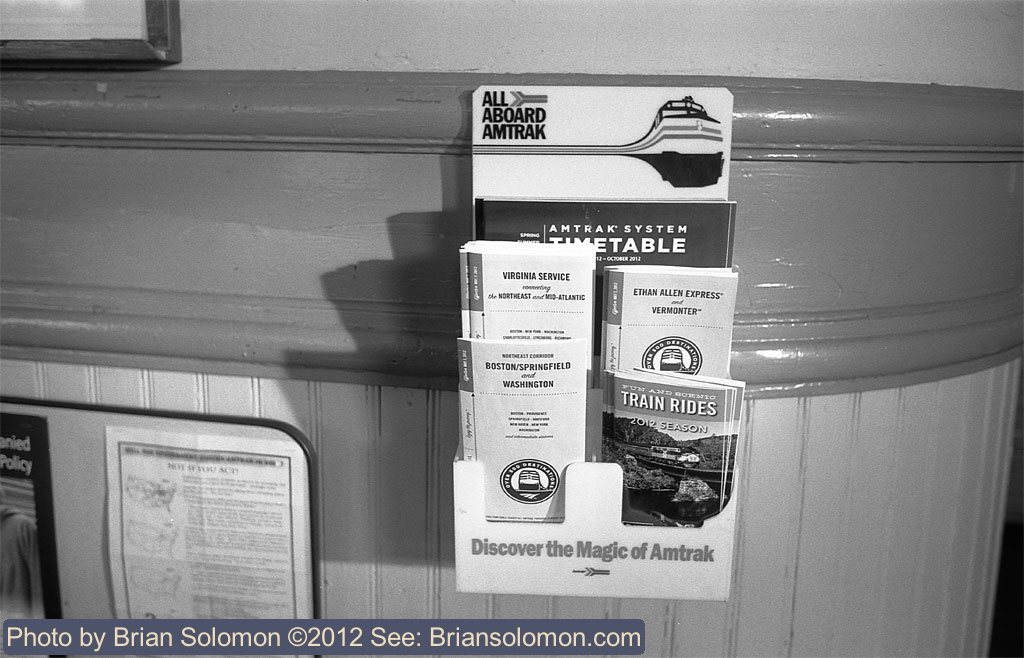
Amtrak timetable rack, Berlin, Connecticut, July 2012. Exposed with Leica M4 and f1.4 35mm Summilux on Fuji Acros 100; unmodified scan.
Using this process, I obtained satisfactory results for the iPad, but the negatives required too much post processing to adjust the gamma curve for desirable contrast. Specifically I needed to improve highlight and shadow areas. Also, I found that the peculiarities of the 21mm lens were complicating matters. This lens has almost a polarized contrast/color-palate which made for some challenging black & white images. Some of the photos are pleasing, but my success ratio was less than hoped for.
I found two more pleasing alternatives: One was my Nikon F3 with traditional lenses (topic for another post), the other was working with my Dad’s Leica M4 and a 35mm f1.4 Summilux lens. Using this latter camera/lens combination, I then further refined my processing. Specifically, I increased development time by 30 seconds to 5 minutes 15 seconds, then ultimately to 5 minutes 30 seconds while making two other small changes:
First, I added a very small amount of developer to my pre-bath. This is a technique I use for other B&W processes that seems to have helped here as well. In theory, a very small quantity of developer in the pre-wash should get the development process underway which allows for slight better shadow detail without a dramatic increase of overall negative density.
Second, I cut my Selenium Toning from 9 minutes to 5 minutes, then further to 4 minutes 30 seconds, in order to reduce the effect of the toner on the highlights.
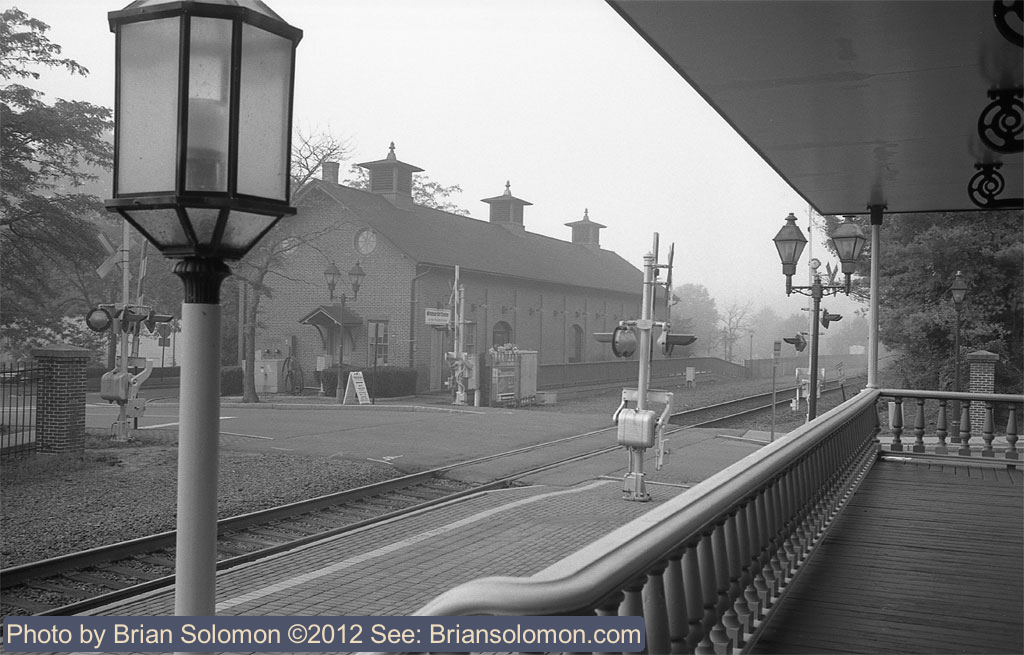
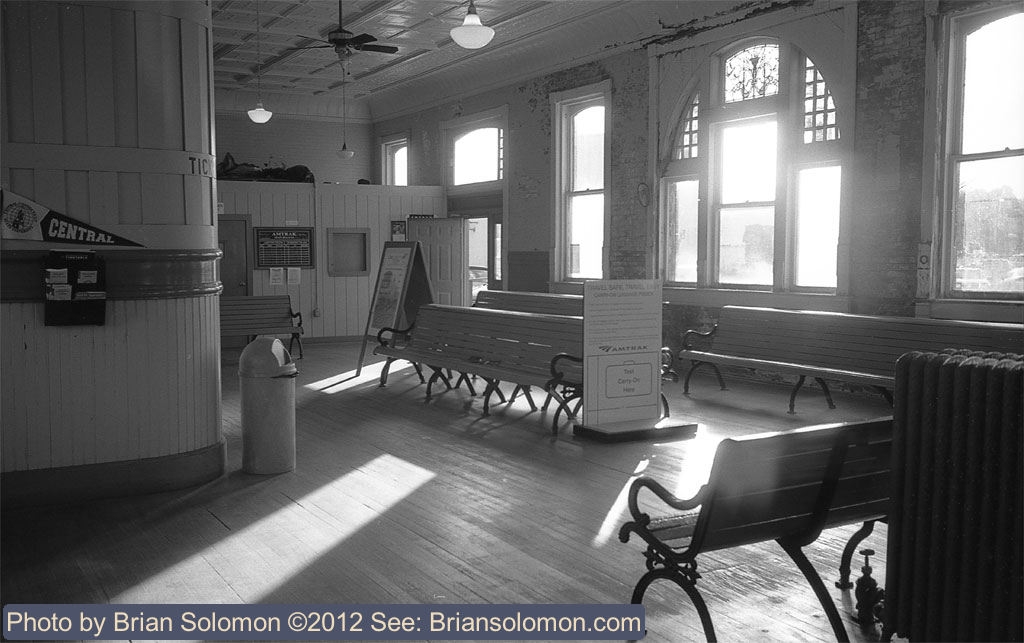
Amtrak station at Berlin, Connecticut, July 2012. Exposed with Leica M4 and f1.4 35mm Summilux on Fuji Acros 100; unmodified scan.
Using these final process modifications, I found that most of the resulting negatives made with the M4/Sumilux required virtually no post-processing and some were ready for display directly from the scanner. All of the photos displayed in this post were exposed and processed as described using the Leica M4 with 35mm Summilux lens with Fuji Across 100, and processed using the basic formula as illustrated. As always, I’ll probably continue to make adjustments to this formula as needed.
The year 2000 marked a new Millennium, or at least a big change in the way we wrote out the date. Has anyone forgotten the Y2K nonsense that led up to the first of January 2000? I recall predictions that planes would fall from the sky; crops would fail; and mass starvation would ensue! Anyway, I spent much of the first half of the new year in Ireland, doing as I usual do; keeping cameras busy. At that stage I’d been photographing Irish railways for two years, and had begun to figure things out to my satisfaction. (There’s always a learning curve when photographing a new place).
Driving wheel detail; locomotive 461 on RPSI excursion.
Among my projects were Railway Preservation Society of Ireland trips, and I rode and chased quite of few of them that year. I could fill an album with the images; instead I’ve decided to limit these to just a few that I exposed in colour around Mullingar, County Westmeath. Irish Rail at Mullingar was a working museum in its own right, albeit not a preserved one! Among its features was one of the last Midland Great Western Railway (MGWR) ‘double junctions’, which was still entirely operated with traditional mechanical signaling. A gem of an old station straddled between routes to Sligo and Galway, the latter devoid of traffic, save the very occasional permanent way (maintenance) train.
Taking 461 for a spin at Mullingar in April 2000.
Operationally, Mullingar was a throwback to another time, add in a bit of steam, and for me it was like stepping back to another era altogether. While today, the RPSI still routinely runs steam on the MGWR route, Mullingar underwent a series of rationalizations during the 2000s that stripped way crucial elements of its historic character; including removal of the classic double junction and most of the semaphores. While I recognise that these ‘improvements’ were allocated to the necessities of ‘progress,’ my feeling is they unnecessarily ruined one of the great railway towns in Ireland. Collateral damage? While its easy to sniff romantically about grinding steam roller called ‘progress’, regarding Mullingar, I write with the insight of having visited hundreds of railway junctions around the world. Had the whole operation been preserved in working order, it would be a national treasure; if not a gift to the world. It’s too late now.
Cabin and station at Mullingar the way it was. Simplification and Mini-CTC transformed this classic MGWR junction.
These photographs were made with Nikon cameras (an F3T, and N90S) using traditional manual focus 24, 50, 105, and 135mm lenses and Fuji Sensia 100 slide film, processed on Abbey Street in Dublin. A topic for a later post are the black and white images I made during the same occasions using an old Rollei Model T.
Locomotive 461 at Mullingar.
Locomotive 461 shunts a carriage in Mullingar on April 21 2000.
The signalman at Mullingar assists locomotive 461 as it shunts a carriage.Locomotive 461 catches the sun looking toward Moate.
Great Northern Railway (of Ireland) 171 at Mulligar on July 15, 2000.
Irish Rail 071-class General Motors diesel works a passenger train toward Sligo in July 2000.
Mechanical lower-quadrant semaphores protected the line at Athenry, County Galway in February 1999. New signaling installed with the Mini CTC program replaced semaphores on the Galway line in Spring 2003.
During the past 15 years I’ve witnessed a complete transformation of Irish Railways. Virtually no aspect of the network has been free from change. My fascination upon setting foot in Ireland in 1998 was the extraordinary combination of vintage American-made General Motors diesels, British-style mechanical lower-quadrant signaling, steam-heated carriages, vacuum braked freight trains, not to mention the friendly staff. I owe my ability to have made an extensive documentation of Irish railways to the excellent hospitality and generosity of the Irish Railway Record Society, Railway Preservation Society of Ireland (RPSI), and, of course, the staff at both Irish Rail and NI Railways/Translink. Presently, I’ve been going through the first five years of my 35mm slides for the program I’ll present to the Irish Railway Record Society at its Heuston premises in Dublin at 7:30 pm on November 8, 2012. Titled “Ireland from an American perspective; 1998-2003,” this will feature some of my favourite colour work from an era now ten years gone. In examining hundreds of images, I’m reminded just how much things have changed. Below is just a sampling of the pictures I plan to present; all were exposed on Fuji slide film largely with Nikon 35mm cameras.
A signalman works the lever frame at Waterford Central Cabin in June 1998.
Now the site of Celtic-Tiger era apartments; in July 2001 this was the busy North Wall freight yards in Dublin. Virtually nothing in this view remains today.
An empty passenger train crosses the viaduct at Laytown in August 1998.
Irish Rail 182 leads a shale train at Birdhill, County Tipperary on May 28, 2001.
An Irish Rail liner approaches Claude Rd, Dublin on a warm evening in May 2000.
Former Great Northern Railway (of Ireland) 4-4-0 Slieve Gullion works an RPSI special at Connolly Station, Dublin in May 2001.
A short train of empty beet wagons crosses the Taylorstown viaduct on its way to Wellingtonbridge, County Wexford on December 8, 2001.
Only a stone’s throw from the Point Depot; in August 2000 new DART suburban electric multiple-units are being delivered at Dublin Port
A sunny morning on December 10, 2001 greets Irish Rail 166 with a bag cement train at Thurles, County Tipperary.
An RPSI Strawberry Fair Special on the Dublin & South Eastern route near Rathdrum in July 2001.
Irish Rail145 leads a loaded welded rail train at Kildare in August 2002.
Irish Rail’s Sperry rail inspection train at Islandbridge Junction, Dublin August 30, 2012.
Camera: Canon 7D fitted with an EF 28-135mm zoom.
Every so often everything comes together nicely. Yesterday (August 29, 2012), I learned that Irish Rail would be running its Sperry inspection train up to Dublin for stabling at the sidings near Heuston Station. This suits me well, as I’m staying just a short walk from Islandbridge Junction, immediately west of Heuston. While I caught the train yesterday afternoon, the conditions were less than ideal, although typically Irish; it was heavily clouded and lashing rain. I racked up the ISO to 800 on my Canon 7D digital camera and popped off a few frames, which I was happy to get. In 14 years of photographing Irish railways it was the first time I caught the Sperry train on camera.
What’s a ‘Sperry train?’ In the early part of the 20th century, a hidden rail fracture caused a serious derailment on the Lehigh Valley Railroad in New York. This tragic incident inspired prolific inventor Elmer Sperry to devise a system of inspecting rails. This consisted of a magnetic induction profile. For many years self-propelled black and yellow ‘Sperry Cars’ have been seen making the rounds on American railways. In more recent years, Sperry Rail devised a testing system using ultrasonic equipment to reveal rail fractures. Today, Sperry provides rail-defect detection services in many countries. On today’s train, Sperry’s detection equipment is in the yellow container riding on a flat wagon immediately behind the locomotive. The yellow tank wagons are to assist with braking.
A perfect sunny day greeted me this morning. I’d heard the train was due to depart the old Guinness sidings at Heuston about 9 am, so I was in place at that time. For this exercise I used my Canon 7D fitted with a EF 28-135mm lens. This arrangement gives me great flexibility, produces high quality images, and allows me to post images very quickly after exposing them. Another benefit is the digital medium allows me to make test frames that I can analyze on site to check for proper exposure, adequate focus, as well as framing and etc. For this image, the famed Wellington Testimonial (located at the east end of Dublin’s Phoenix Park) is featured. I’ve made many photos here before, but sometimes with film I’ve inadvertently cropped the top of monument while focusing on a moving train. I tried to avoid this mistake today, and with digital I could check right away, and not wait days or weeks to find out. With the camera set manually (in ‘M’ mode) I made several exposures bracketing my crop and exposure. This one was made at f6.3 1/500th of second at ISO 200; lens set to about 35mm. I made two files in camera; a large Jpg and a RAW. I made no adjustments to this image, other than scaling the large Jpg to 1024 pixels on the long side and adding my name and copyright information.
I feel I’ve had a productive morning so far! Later, I also caught one of Irish Rail’s IWT Liners, an intermodal container train that runs from Dublin Port to Ballina, County Mayo. Today, this was led by one of Irish Rail’s 201-class General Motors diesels wearing the Enterprise livery. While not unheard of, it is a good catch to see one these in freight service.
Irish Rail’s IWT Liner passing Islandbridge Junction, Dublin, photo by Brian Solomon
I’ve described myself as a ‘progressive obsoletist,’—an unfamiliar term that I may have invented. Invariably, someone will try to pigeon-hole me, demanding, “what is that?!”—as if the term wasn’t completely self-explanatory. Without a long-winded, half-cynical satirical diatribe, I doubt I could convey my definition of this obscure set of beliefs, however, in photographic terms I’ll offer a contemporary corollary based on recent experiments.
I’ve been dabbling with black & white photography for decades. I nearly perfected my technique when I was in college, only to virtually abandon black & white professionally in favor of color media. However, from time to time, I return to black & white, and with each visit try to further hone my process.
What does that mean? Well, first off, I always process my own film. Secondly, I’m very conscious of the processing method and formulas I hope to use while I’m making photographs. Thirdly, I’m always making small adjustments in my process in efforts to making more pleasing images.
The caveats to this process adjustment are that: 1) I’m never really satisfied with my results; 2) I never will be; and, 3) despite constant tinkering with formulas, my actual process is based on empirical analysis, rather than a strict, calculated scientific approach. I’m sure photo-chemists, when analyzing what I do, would decide that about half my process is unnecessary, and while on the whole it’s too complicated and could be better achieved in some alternative manner. But for me that’s not really the point. Making and developing the images are all part of the process, and this process involves converting what I see in three dimensions and full living color into a static, two dimensional, mono-chromatic set of images.
In January, 1998, TRAINS Magazine, I had a portfolio of photos published, and in that series, I described the spread with three monochromatic images as ‘One Thousand Shades of Gray’. Well, in light of some recent popular literature (not involving monochromatic images, so I am told), a similar title with fewer numbers of shades has stolen my thunder. Fair enough, but not really my point. With One Thousand Shades of Gray I was only trying to be clever, since proper black & white photography is more than just black and white but more about all the gray in between. And that’s largely what I’m after in my process refinement and adjustment — tonality and contrast. The machinery and landscape of the railroad are subjects ideally suited to this medium, while slight adjustments can make the difference between a fairly interesting railroad image and a truly memorable one.
Why not just convert modern digitally produced color files into monochromatic images? Good question. First of all, I’ve done that, both with my Lumix LX3 and my Canon 7D, and I’ve been happy with my results. Secondly, I don’t have any qualms about producing monochromatic images digitally. There are different tools for different type of images. There are times when a digital monochromatic image feels like the best choice, and there are times when color works better. (Generally, however, if I’m going to make a monochromatic image, I work with that medium on-site, rather than produce after the fact.)
So, why use film? The short answer is pretty selfish; because I want to! I like B&W photography, I like film, I’ve always worked with film, and continuing to work with film (at least part of the time) lends a certain continuity to my photography.
I have other reasons as well. I’ve found that using film, processed in accordance with my customized formula, and then scanned with a flatbed scanner, produces an image file that looks really pleasing to my eye. The combination of tonality (technically, “dynamic range”), acutance, and granularity when viewed on an iPad or computer screen looks great. This is the visual embodiment of progressive obsoletism!
Another reason is archival quality. And here I’ll dare tread on some sensitive toes. From my experience and understanding of the digital mediums, there are no sure-fire means of insuring long term digital storage without regular intervals of human intervention. In other words, if you don’t make multiple copies of your digital images, and continue to copy them, basic flaws in digital storage will probably result in the complete loss of your images within years or decades. My father, Richard J. Solomon, has illustrated this in the Center for Railroad Photography and Art’s annual Talks on Photography held at Lake Forest, Illinois, and in various articles. Simply, the very nature of the digital age tends toward the ephemeral use of data. While in the near term you can preserve your digital photos; long term, if a conscious effort isn’t made at continuing your storage, in all likelihood your images will completely vanish. (As anyone who has ever dropped a hard disk will sympathize.)
By contrast, my black & white process uses techniques that are known to produce negatives that should last for hundreds or thousands of years without regular intervention. So, barring disaster, long after all the hard drives have been wiped clean, the DVDs have faded into uselessness, and the software used to decipher today’s data has become more arcane than odd-dialects of ancient Sumerian, my black & white negatives should still be identifiable and usable as photographs.
Whether or not anyone cares in a hundred-plus years is another story. In my research for books and other photographic endeavors, I’ve often thought it ironic that 19th century glass plates will likely outlive virtually all the images being made today. I hope that I’m wrong. And, since I won’t be around in 100+ years, I’ll never know, but just in case I keep at black & white film photography, at least some of the time. And since I scan my negatives at high resolution, I’ll have most of the benefits of digital storage as well as that offered by traditional film. At least there’ll be some images of modern trains alongside the plates of Baldwin 2-8-0s.
In the last few months, I plunged into our collection of antique cameras and gone back to my roots. In my youth, I was always seen carrying a prewar Leica IIIa. With that I exposed countless railway photos, from Central Vermont GP9s and RS-11s crossing the diamond at Palmer, Massachusetts, to GG1s grinding into South Amboy, New Jersey, as well as views from Amtrak’s Coast Starlight negotiating SP’s Cuesta grade near San Luis Obispo, California. Remarkably, I still have this camera, or its near cousin (in truth, I think we had three different IIIa bodies in our house plus a postwar IIIc, and several later model Leica M’s). In my recent IIIa efforts, I employed my father’s Leica-screw-mount 21mm Super-Angulon (actually a Schneider lens design), and wandered around my old territory in New England exposing a few rolls of Fuji Acros 100. (I also recorded thousands of digital images as well)
Having earlier this year made modifications to my process (for a future post), I then souped the film, scanned it, and analyzed my results.
Pulling the film out of the tanks, I was immediately disappointed, but then, after scanning, I gradually came to accept and finally embraced my results. I’ve displayed a few here. Choice of subject matter was key to my choice of equipment and media. I largely photographed former Boston & Albany, Central Vermont, and Boston & Maine lines; the same railway lines I photographed as a kid—thus keeping with my theme of continuity. Earlier this year, I’d embarked on a similar project, photographing in Dublin, but using a different set of retro-equipment (another the topic for a future post).
Not only do these images offer an element of consistency working with photos from my archive, but I feel they also work well as stand-alone photographs. I have plenty of color digital images to satisfy commercial illustration requirements and my personal needs for instant image analysis (did I catch it? Was the light right? Did that cloud get in my way? Are my exposures tight?). But, I also have these satisfying monochromes, that may, so it seems, last for a virtual eternity. Coming soon, I’ll post the details of my exposures, technique, and chemical process. Stay tuned!
Technique: Use a tripod and select a slow ISO; then after making a test shot, adjust exposure to ‘overexpose’ by about one stop, while using the self timer to actuate the shutter to avoid camera shake.
On the left an ÖBB steel train led by Siemens Taurus electrics has paused at Schwarzach-St. Veit, Austria . This photo was exposed using a Panasonic Lumix LX-3; ISO 80, lens set at f2.2 with a timed exposure estimated at one second with the camera in ‘M’ (manual exposure) mode and fitted to a portable miniature Gitzo tripod.
As described in Installment 3, the Lumix LX-3 is a compact lightweight digital rangefinder camera that features excellent optics (Leica Vario-Summicron f2.0-2.8/5.1-12.8 [mm] ASPH) and the ability to set functions manually. I’ve found this is a great tool for making urban night photos, and I’ve developed a successful technique well-suited to nocturnal railway images. I made this image with my LX-3 on January 11, 2012, at Schwarzach-St. Veit, Austria, which features double-headed Siemens Taurus electrics on a steel train.
Schwarzach-St. Veit offers a well-lit moderate-size station near the junction of two routes, one of which is the OBB (Österreichische Bundesbahnen/Austrian Federal Railways) main-line over the famous Tauern Pass through the Alps to Villach (with international connections beyond to Italy and Slovenia). Some Irish friends and I were on a week-long visit to Austria. On this evening, after dinner at a nearby hotel, we spent a little while at this station watching trains and making casual night photos. This OBB steel train had come in from the north and was awaiting a path over the Tauern, and so had paused for several minutes, which provided ample time to make some time-exposures (long exposures). Rather than go through all the effort to set up a large tripod, instead I opted for a relatively compact ‘pocket’ tripod with ball head (to adjust the angle of the camera), which I positioned on a snow bank piled at the center of the platform. Instead of using one of the LX-3’s many automatic modes, I opted to set ISO, shutter speed and aperture manually, which is easily accomplished using the ‘Q-menu’ toggle switch at the back of the camera to step through the appropriate selection menus. (Other cameras that have the ability to make manual settings will have similar means of making adjustments — consult your camera manual or guru for details.)
When making night photos, the tricky part is obtaining a satisfactory exposure while keeping stray light away from the lens. For night photography, ‘faster’ isn’t necessarily better and the first thing I did was select the slowest ISO. The slowest ISO results in less noise, offers better exposure latitude (range of exposure captured from the highlights to shadows), while offering a sharper and more saturated image. Through experience, I’ve found that the LX-3 produced its highest image quality at ISO 80, and above ISO 200 its images tend to toward the unacceptably noisy (‘grainy’ or pixilated to the eye). Since my subject is static and the camera was secured on a tripod, there’s little advantage in selecting a Higher (faster) ISO. Its true that higher ISO allows for faster shutter speeds, but in this case the difference of a stop or two would be effectively irrelevant; since the light was so low, my exposures would be relatively long anyway.
To calculate the appropriate exposure, I’ll make and analyze a test image. Here, my process may seem counterintuitive and it requires me to override the camera’s programming. In a nocturnal situation, where the sky is completely dark and there are a variety of hotspots caused by electric lamps (and in this case, acerbated by bright piles of snow), I’ve found that the LX-3’s automatic metering modes tend to seriously underexpose the image (in other words, it fails to allow sufficient light to reach the sensor). This is a result of the metering biased for daylight situations which has tendency weigh the effects of bright lamps too heavily and thus overly shorten the exposure time for a nocturnal setting. Strictly relying on either the camera meter or the basic automatic settings is an underexposed digital image. (Lumix offers some automated programmed settings to serve these situations, but I prefer to do this manually).
Another problem is the camera display image. In extreme circumstances, such as night photography, the jpeg displayed on the camera screen is a ineffective tool for correctly gauging exposure. Not only is this jpeg compressed and optimized for computer-screen viewing, but on-camera it is presented much lighter than the data in the actual file and so doesn’t provide an accurate assessment of the scene. So, what looks great on the back of the camera may in fact be way too dark in the file.
To overcome these difficulties, I make a test exposure with the camera, then carefully observe the histogram to make manual corrections that increase the exposure. In this nocturnal circumstance the majority of the histogram exposure graph may be too far to the left (indicating overall under exposure). Since I want to retain some highlight detail, I’ll make a second exposure, usually between ½ and a full stop over exposed (that is, I make the exposure lighter than that recommended by camera-meter, usually by increasing the amount of time the shutter is open, say from ¼ second to ½ second; or by using the exposure compensation feature, see below), and then gauge the histogram so that there’s a hint of highlight hitting the far right, but with the majority of the image-data filling the central portion of the graph (rather than too far to the left, as in the first exposure).
In a rushed situation, I might skip the test exposure and histogram analysis, and just increase the exposure by 2/3ds to a full stop. This can also be accomplished by simply adding in ‘+2/3’ or ‘1’ on the exposure compensation menu at the left-hand side of the screen (with the LX-3: using the ‘Q-menu’ toggle, go left until the ‘+/-’ is highlighted yellow on the screen, then with the same toggle, move up two clicks for ‘+2/3’, or three clicks for ‘+1’). Then you can use the camera in either aperture priority mode (‘A’ on the top dial) or shutter priority mode (‘S’ on the top dial). This is a great compromise, if you don’t feel confident reading the histogram. If possible, make several exposures, perhaps increasing them in 1/3 stop increments.
Examining the test exposures, I also watch carefully for flare caused by stray light hitting the front element of the lens. Flare greatly reduces shadow detail and may cause unpleasant or unnatural patterns in the image. While Hollywood productions in the 1970s ‘discovered’ the use of flare as a dramatic technique, and I occasionally use this myself for effect, generally speaking it is best avoided, especially in situations such as that at Schwarzach-St. Veit. If I cannot place the camera in a natural shadow (such as that presented by a mast, canopy, or other infrastructure), I’ll carefully shade the lens with my handheld notebook (or anything else that I have handy). It’s important to insure the notebook doesn’t crop the frame.
One last point, to avoid shaking the camera, I set the self timer for 2 seconds, and then gently stand back and remain still while the camera exposes the frame.
In this particular case I’d been making photos on the platform for about half and hour, and prior to the steel train’s arrival I’d already made a variety of images that helped establish my base exposure. The photo displayed here was exposed at ISO 80, at f2.2 for 1 second. I used the camera’s pattern metering to base the general exposure, then gave it an extra stop. (If I’d followed the camera meter recommendation, I’d have exposed the image for ½ second instead of a full second.)
On March 30, 2012, a northward CSX auto rack train passes beneath the Bear Mountain Bridge near Fort Montgomery, New York, on its way up the Hudson River. This afternoon image was exposed with my electronic Lumix LX-3. This is the in-camera jpeg, made with the ‘vivid’ color profile with the camera set in the ‘S’ (shutter priority) mode using pattern metering. It was exposed at 1/640 of a second at f 5.0.
Technique: Bring This Camera Everywhere!
I’m a big proponent of always carrying a camera. And as I’ve written elsewhere, ‘If you don’t have a camera, you can’t make a photo.’ As soon as you let this guideline slip, a unique visual opportunity will occur and you won’t be able to capture it. A caveat is: always carry a good camera (why lessen the magic of a unique event with a poor quality photo?). My father had given me an antique Leica IIIa for my tenth birthday and I carried it everywhere and made photos of everything. When I was in school I was ‘the kid with the camera.’ While many of those photos aren’t very good, the point is that I was always ready —constantly going through the motions of making photos taught me how to work under numerous lighting situations. I never relegated my photography to ‘perfect sunny days.’
Over the years my philosophy has resulted in towing around various and different amounts of equipment. Constantly carrying a film-based SLR with a full set of lenses really was pretty awkward, not to mention the big bag of film! It’s one thing to have a camera, it’s another to try to anticipate every possible situation all the time. Beginning in 2001, my ‘everywhere camera’ was a Contax G2 range finder, which had its benefits, but was comparatively heavy, and while it came with interchangeable lenses, these tended to fill my pockets.
In summer of 2009, my digital guru Eric Rosenthal lent me a Panasonic DMC LX-3; I was immediately convinced of its merits and bought one. Since then I’ve made great use of it, and I feel it is as near as perfect an ‘everywhere camera’ as I’ve ever owned. The LX-3 has a variety of kin, including the newer LX-5, as well as the almost identical Leica D-Lux3/4/5 models, with newer models recently introduced. I’ve only used the LX-3, and I’m not intending to compare my camera with the gamut of similar models or its competitors available to photographers today. Rather, I describe its pros and cons, and how this tool has benefited my photography.
The LX-3 offers several key qualities that have allowed me to make numerous excellent photographs: it’s compact, versatile, flexible, fast, durable, and offers exceptionally high quality images for its relatively small size. I can bring it just about everywhere (within reason), and with it I have a dependable tool to make photos. Three of my principle objections to many small. ‘snapshot-style’ cameras are their low-quality optics, an inability to operate the camera manually, and an unavoidable delay from the time the shutter-button is pressed to the time the shutter opens. With the LX-3, not only I can get around all of these problems, but I get performance that rivals that of much larger camera systems.
The LX-3 is equipped with a great lens — a Leica Vario-Summicron f2.0-2.8/5.1-12.8 [mm] ASPH, which is extremely sharp, fast, and offers a nice color palate. While the LX-3 has a variety of modes, it has manual capabilities that allow me to set shutter speed, aperture, ISO, and focus settings (although manual focusing is awkward). Furthermore, when automatic settings are used, these allow for a degree of manual override including the ability to change metering modes and make adjustments with exposure compensation. The degree of delay varies depending on how the camera is set; when the LX-3 is used as a fully automatic camera, or allowed to ‘sleep’ between exposures, there is an objectionable delay. However, when operated manually, setting focus and exposures using the toggle switch, and leaving it ‘queued up’ and ready to go, exposure can be made virtually instantaneously. I’ve used my LX-3 set at 1/2000th of a second to capture a German ICE-3 gliding along at more than 160 mph—no easy feat even with an SLR. If you ever want that ‘deer in the headlights’ feeling, try photographing a truly high-speed train full frame with a standard lens (and no 10 frames-per-second motor drive!).
I’ve found several failings with the LX-3. It lacks a built-in view finder. While there is a separate viewfinder attachment, I’ve shied away from this for two reasons: it’s relatively expensive, and I’ll surely lose it. So while in most situations the window at the back of the camera works reasonably well, it suffers in bright daylight, and I don’t like to stand around with the camera at arms length trying to compose an image. While other models have longer zooms, the LX-3’s range is limited to a view roughly equivalent to 28-65mm on a traditional 35mm film camera. This ranges suits about 85 percent of my requirements, while having the side effect of taking away the ‘telephoto crutch’, which forces me to work with more conventional focal lengths. The battery life on the LX-3 is poor, so as a result I carry three or four batteries with me, especially in cold weather. On a busy day, I can easily tap through three batteries.
Another flaw is slow cycle time, which is partly a function of how I’ve set up the camera. I expose both a RAW and large JPG file simultaneously. While jpegs suit most of my requirements, I’m not just taking photos for today, and I’m uncomfortable with long-term storage problems and compression qualities inherent to JPG format. Furthermore, RAW files offer considerably more data, and this can be valuable both for publication and situations where post processing manipulations are necessary (both topics for another day). But, I’ve made prints from in-camera jpegs up to 13×19 inches that are fantastically sharp and colorful (including the photo displayed here). And I’ve used LX-3 jpegs in books and magazines.
The LX-3 also offers a variety of in-camera color profiles with various color palates and saturation levels; while these are strictly applied to the jpegs, they allow for added creativity when composing images. It has an excellent image stabilizer, which allows for very slow shutter speeds hand-held, and can be switched off when necessary. Another distinctive tool is the ability to control the aspect ratio (external dimensions) in camera; its four standard ratios range from a square to 16:9. In addition, there are myriad controls that enable a high-degree of customization for both user convenience and file output.
Control, flexibility, and high quality are the prized qualities that sold me on the camera. The LX-3 may appear as a snapshot camera to the unknowing observer but it offers most of the control and quality that I’d expect from a high-end SLR. My intended purpose for LX-3 was as a ‘everywhere camera’ to be carried when I wasn’t carrying my full camera kit, but it soon developed into my staple tool for railway photography, as well as urban adventures and other projects. Later installments of Tracking the Light will highlight images made with the LX-3, to demonstrate its abilities as a high quality image making machine.
Conrail C30-7As drift eastward at milepost 131 near Middlefield, Massachusetts on March 23, 1986. Photo by Brian Solomon on Kodak 120 Verichrome Pan B&W film.
Recently I was searching for another and completely different image to illustrate a point for this essay when I accidentally came across the photograph above. It struck me that I’d fortuitously made the most of a common event. The date was March 23, 1986, and I was working one of my favorite sections of railroad: Washington Hill on the old Boston & Albany ‘Westend,’ at that time operated by Conrail. The section of the line between Chester and Becket, Massachusetts, is well-known for its scenery and difficult operations. As I’ve written elsewhere, this route was built as Massachusetts’ Western Rail Road, an extension of the 1830s Boston & Worcester, considered the ‘world’s first mainline mountain grade’ (built on the principles of wheel/rail adhesion, as opposed to the more peculiar methods of moving goods by rail over mountains, such as cable-hauled portage railways). Surveyed in the mid-1830s, Washington Hill was constructed between 1839 and 1840; the track pictured is on its original, unaltered Western Rail Road alignment—a relatively unusual situation for a line that old. My late friend Robert A. Buck gave me my first proper tour of the B&A Westend when I was a child, and I’ve been making regular trips to document this line, its operations, and its history for nearly 30 years.
On this particular day, as with many of my Westend trips, I had started out from Monson, Mass., before the dawn, and drove directly to the old station location at Middlefield (near the village of Bancroft, as Middlefield village itself is actually several miles to the north, on top of a hill). Bob Buck had first visited Middlefield 40 years earlier, and had the fortune to watch and photograph Boston & Albany’s magnificent A1 Berkshire-type steam locomotives at work on the grade. His photos and descriptions had inspired this day’s visit and my numerous other trips over the years.
Conrail had a habit of operating a fleet of eastward trains in the morning, and my first train of the day was eastward intermodal (piggyback) train symbol TV14X, running from Chicago to Boston. This passed the site of the old Middlefield station at 7:29 am, shortly after sunrise. Later that same morning, I positioned myself on the ‘shelf’ near milepost 131 (the distance from South Station, Boston), around the corner and upgrade from the old station. The month of March can be a good time to work this part of the railroad since the days are relatively long, the air tends to be clear, the trees are barren, and weeds and underbrush haven’t yet started to grow — all of which helps portray the lay of the land and display a railroad’s infrastructure at its finest. Although a favorite vantage point, this shelf at milepost 131 has a difficulty: the hill behind me and the trees growing on it tend to shadow the line until mid-morning, making traditional railroad photography difficult. By the time the sun hits the rail it has come around to almost a nose-lit angle, a condition that might trouble some ‘three-quarter’ purists.
The morning had started out clear and sunny, but by 10am high filtered clouds had begun to soften the light and bring a bluish hue that is poorly suited to Kodachrome (then my staple color film), but is well suited to black & white photography. In the distance I’d heard a hint of a train drifting downgrade and got myself in position. Having put my slide camera away (at the time I was using an antique 35mm Leica IIIa with a Summitar 50mm lens), I instead opted for a black & white image of the eastbound train.
Eastward trains could easily sneak up on you at milepost 131 since the roaring water of the West Branch of the Westfield River tended to mute all other sounds. Yet, a keen ear might pick up the distant whistle when a train blew for Lower Valley Road in Becket, several miles to the west. Also, heavy eastward trains could be heard from the sound of their engines’ dynamic brakes howling, and the squeal of the wheels as the trains negotiated B&A’s tight curves—but such was not the case this morning.
I’d been studying the work of New York Central’s company photographer, Ed Novak, who had recently published a book of his black & white photos, most of which were made in the 1940s and 1950s. The text revealed that Novak used a Rolleiflex, a twin-lens reflex, with 120 Kodak Verichrome-Pan black & white film. (‘Verichrome-Pan’ inferred that the emulsion was ‘panchromatic’, meaning sensitive to all colors. Today we might assume this characteristic of all sensitive media, film and digital sensors, but until commercial development of panchromatic emulsions, most available black & white products suffered from limited spectral-sensitivity; in other words, they didn’t respond well to all colors, and lacked sensitivity to certain elements of the spectrum. Although panchromatic products date to the early years of the twentieth century, popular use panchromatic films didn’t predominate until the 1940s. If you ever wondered why many steam era photos appear to have been made on cloudy days, this is because typical orthochromatic emulsions of the period were overly sensitive to the blue spectrum and thus tended to render blue skies as white.)
Inspired by Novak’s commercial images of New York Central Mohawks, E7s, and other classic locomotives, I made regular use of my father’s Rollei Model T (which he purchased new in Düsseldorf, Germany, in 1960) loaded with 120 Verichrome. While an excellent film in some regards, Verichrome was limited by modern standards, and my choice of cameras and film was antique (if not obsolete) even by 1986. I think many B&W photographers of the time would have preferred either Kodak Tri-X (rated at 400 ISO) or Kodak Plus-X (rated at 125 ISO), and probably using a yellow filter to compensate for films that remained over-sensitive to blue. However, among the advantages of Verichrome was its exceptionally fine grain, a quality that when combined with the Rollei T’s f3.5 Zeiss Tessar lens lent to exceptionally sharp images.
At that time, Verichrome was nominally rated by Kodak at 125 ISO, however I’d found through experimentation that more pleasing results were afforded when I rated the film at 80 ISO and processed it with Kodak D76 mixed 1:1 with water. My preference was to slightly over-expose film (by giving it more light) and then slightly under-process (shortening the process time) which created a broader tonal range while avoiding blocking up the highlight areas and minimizing build up of grain. Key to my processing technique was in the extremely gentle agitation of the tanks and tight temperature control (usually within one degree from pre-wash to final wash). I was studying photography at the time I made this image, and so was acutely aware of my intended processing at the time of exposure.
The Rollei offered few crutches to the inexperienced photographer. Not only was this a fully manual camera without battery or automatic functions, but it had no meter. To calculate exposure, I carried a pocket size handheld meter, and then refined my settings based on experience and detailed notes.
Note the rectangular format; as presented this image is full-frame and un-cropped. As a student with limited means, I tended to take advantage of the Rollei Model T’s ‘super slide’ insert, which allowed for approximately a 645 negative size and gave 16 rectangular frames per roll rather than a dozen 2¼ inch square frames. (Later, I came to prefer the aesthetic qualities of the square and made almost exclusive use of that format with the Rollei.)
The train heard in the distance was soon upon me, and, following moments of anticipation and hasty preparation, at 10:25am the ‘train’ came into view. I was immediately disappointed! It really wasn’t really a ‘train’ at all, but just a set of light engines running east from Selkirk Yard! (In 1986, Conrail didn’t assign helper engines to the B&A, yet light power moves were a common means for balancing traffic and positioning locomotives and crews.) Sure, locomotives are better than nothing at all, but I’d really hoped for a long train trailing behind the locomotives—making it a revenue move, which is what I’d come to expect. However, despite this letdown, I persevered and exposed a single frame anyway! I’ve always maintained a philosophy of photographing anything and everything that passes over the railroad and making the most of every opportunity. There’s a lesson here: I know many railway photographers who would have put their cameras down on the sight of a light power-set ‘to save film.’ Where’s the savings? If you fail to make a photo, not only won’t you have it to enjoy later, but you might be plagued with a nagging ‘what if’ sensation that follows you like an unwelcome cloud. Remember: subjects so common today as to seem unworthy of a photo will be history tomorrow. Case in point: 25 years earlier my father was near Paoli on the Pennsylvania Railroad’s ‘Main Line’. A set of light engines and caboose passed him and he made two photos (with the very same Rolleiflex) — one coming and one going. Just a pair of diesels, probably hardly worth the price of film. More than 30 years passed before those negatives were printed. The mere diesels of that day turned out to be a rare set of Baldwin centipedes, now considered among the most unusual diesels ever built.
Lets get back to the photo on March 23, 1986. Key to my location is the old B&A ‘tombstone’ milepost at the left. I’d positioned myself to feature this landmark, and carefully waited until the locomotives were near it, but not so close as to obscure it. Not only did milepost 131 hark back to New York Central days, but it identifies the location: there’s only one milepost 131 on the B&A route in the Berkshires. The milepost and hills, while important, are incidental to the primary subject, the locomotives, which as it happens, are now among my favorite diesels. These are General Electric C30-7As, a model built only for Conrail and delivered in summer 1984. But in 1986 these were standard motive-power assigned to the B&A route, and by no means unusual or noteworthy. In fact most of the trains I photographed that day were operated with C30-7As. This three-unit light power set was recorded as Conrail C30-7As 6567, 6553, and C32-8 6616 (just in case anyone needs to know). From an aesthical point of view, this light power set was precisely long enough to add railway interest without obscuring the subtle sinuosity of track in the distance, key to the railroad’s history. It’s just a small point, but that S-bend beyond the engines helps reveal the line’s graded quality and the twisty nature of the B&A route. Had this been Conrail’s SEPW (Selkirk to Providence & Worcester), that typically operated about this time, the freight cars would have blocked the view of the tracks and thus probably resulting in a less interesting image. Although disappointed at the time, I was lucky to have had such a perfect length of train, and in the end this disappointment proved to be an advantage!
As an aside, take note of the twin-head block signal on the westward main track. This another subtle element of interest that has a bit of history behind it: two years after this photo was exposed Conrail re-signaled the B&A Westend using a modern system of cab signals that obviated the need for way-side intermediate block signals such this one. All the New York Central-era searchlights were taken down. This style of signal had replaced upper quadrant semaphores after World War II. After B&A’s re-signaling the only line-side signals were modern color lights at dispatcher-controlled interlockings (junctions, ends of sidings, and crossovers, all known as ‘control points’). Yet, the base of this signal survives to mark its location, leaving a reminder of the traditional signals. Interestingly, the intermediate block signals on Washington Hill were continuously lit, while intermediate signals elsewhere on the B&A tended to be approach-lit. I mention this because in the photo the signal displays green-over-red (clear) even though the next westbound was a good distance away; it wouldn’t pass until 2:24pm, almost four hours after I made this image. If this signal had been approach-lit, a train would have been in the circuit and thus very close at hand; just a minor observation, but one worth noting.
So there we have it! A lot of background for a photo that disappointed me at the time, and one I might have neglected to expose. One last caveat: I kept detailed notes of my photography, in part to assist with processing, but also to aid with captioning photos later. Bob Buck was a stickler for providing detailed captions and I learned from his example. By taking notes and making captions, I have an excellent record of what, when, and where, as well as how I made my photos. In case you were wondering, I exposed this photograph between f5.6 and f8 at 1/500 second.
Central Vermont Railway northward freight 323 at Windsor, Vermont, October 14, 1993. (Scanned from a 35mm slide using an Epson V500 scanner.)
This is among my favorite railway images. It was part of a sequence of photos I made—a similar version to this one appears on page 88 of Railway Photography (Solomon & Gruber, 2003). Need I detail the charms of Vermont in autumn? Crisp weather, colorful foliage, quaint villages, and stunning scenery have long made Vermont Octobers popular with photographers, while classic rural railway operations make it a great place to experience American railroads in action. My parents first brought me to Vermont in search of railways in the late 1960s, and my earliest memories of railroads include poking around Bellows Falls and riding Steamtown’s trains. In autumn 1993, I was on my annual shoestring tour of the East that brought me from Montreal to central West Virginia over the course of six weeks as I chased the foliage from north to south, while traveling in concentric circles looking for photo opportunities of trains.
Based on previous years’ travels, I’d ascertained that the first week of October tended to produce peak color in central Vermont, so on October 7th, I set out from Monson, Massachusetts, in a borrowed Honda Accord. Driving north on I-91, I got off at Bellows Falls, where I hoped to find working either the Central Vermont or Green Mountain railways. While, it isn’t necessary to find trains moving to make great autumn railway photos, I prefer action images to add a bit of thrill to the chase. At that time, CV’s Palmer, Massachusetts, to St. Albans, Vermont, through freight tended to depart Palmer yard limits in the very early hours of the morning and find daylight between Brattleboro and Bellows Falls. This proved true, and I followed the train for most of the morning, making photos along the way. Among the locations I chose was a view of this plate girder bridge over the Connecticut River near Windsor, Vermont. Standing on the New Hampshire side of the river (near the famous long covered bridge) I’d opted for a 200mm Nikon lens, and framed the locomotives tightly on the bridge; in the process I cropped out most of Mt. Ascutney. In that photograph the sun was shining brightly, so in almost all respects I’m happy with the result — except for the fact that my focus on the locomotives cropped one of Vermont’s most famous mountains.
My notes from the day show that I exposed my photographs using Kodachrome 25 at f5.6 and 1/125th of a second. At the time, I recorded each day’s photography on a detailed form. Kodachrome 25 was then my staple medium, and so went unrecorded; however, when I deviated from that choice I’d make special note of the film in my log. Later in the day, I photographed Central Vermont’s southward 324 on this same plate girder span featuring the covered highway bridge in the distance (this image appeared in TRAINSMagazine in 1998).
One week later, I made a repeat trip to Vermont. By this time the foliage was past peak, yet I was determined to make the most of the day, as autumn remained my prime season for photography. At 7:15 AM, I was back at Bellows Falls where I found a Boston & Maine (Guilford) local working the Green Mountain interchange tracks near the passenger station. A heavy river fog blanketed the town making the scene dark, but not especially ethereal (f4, 1/15 sec). The signal on the Conn-River mainline lit up in the northward direction, ‘yellow-over-green-over-red,’ meaning ‘Approach Medium,’ and I knew that CV’s 323 was close. Rather than make dull photographs with Kodachrome in the dimly lit morning gloom (which may sound more attractive than it was), I continued north to Claremont, New Hampshire, where the railroad crosses the Sugar River Valley on a high tower-supported girder trestle. My hope was that by the time CV 323 arrived the morning sun may have burned off the fog on the bridge. Good theory, but no joy. I ended up with a foggy silhouette of the train on the bridge at 8:05 AM.
While CV’s freights tended to clip along, I made good speed and returned to my spot near the Windsor covered bridge. I had enough time to set up my Bogan tripod and take a couple of cursory meter readings with my Sekonic Studio Deluxe light meter. The fog was lifting as I heard the train whistle for the highway crossing on New Hampshire Route 12A, and shortly before the train eased onto the bridge the sun popped out. Instead of the 200mm Nikon f4 lens I’d used the previous week, this time I chose my Nikkor 105mm f1.8 so as to better include Mt. Ascutney. Normally, I’d have used my Nikon F3T (my principle camera at the time), but this had suffered a shutter failure the previous weekend, and instead I was working with my Nikkormat FT3 (oddly adorned with red leather instead of black—not my choice, but I’d bought it second hand as a cheap extra body). CV 323 rolled into view as mist was rolling off the river — the sunlight was down about a stop from full daylight (which in an October Vermont would typically warrant about f4.5, 1/250, on K25). My exposure notes recorded “8:30 AM Windsor, VT (Conn River Bridge) f4.5 1/125 (bracket?) COSMIC Light!”.
I probably made three exposures: up a third, down a third, and spot on f4.5, that was my standard routine when the light was changing rapidly. Keep in mind there was a slow order on the bridge, so 323 wasn’t moving very quickly. (I also apparently made a 50mm view probably with my Dad’s Leica, although I’m not sure what happened to that image—possibly it didn’t turn out as hoped.) Although, this was by far the best shot of the day, I continued northward, and later in the morning picked up the New Hampshire & Vermont railway local that ran from White River Junction, Vermont, to Whitefield, New Hampshire. That also proved fortuitous, as much of the old Boston & Maine line between Wells River, Vermont north to Whitefield was abandoned and lifted a few years later. The bad news? I left the lens cap for my 105mm at the Windsor covered bridge! (one of many lens caps unhappily abandoned in the heat of a chase).
If you find a copy of Railway Photography that John Gruber and I wrote back in 2003, and seek out page 88, you may notice that the caption indicates that I used my F3T with 200mm f4 lens for the October 14, 1993 photo. This is an error, and in fact that was the data for the October 7th image at the same location. How could that happen?! Simple, when I wrote the photography book, I looked at the wrong set of notes. My mistake!