Excursions are a great opportunity to make detailed photos of railway equipment. In addition to the traditional angles, I like to get close and focus on characteristic elements of locomotives and railway cars.
Locomotive 461 is an old favorite. I’ve been photographing it for more than 15 years, and I think it’s safe to say that I have a fair few photos of it. But that’s never caused me pause; I keep looking for new ways and new angles on this old machine.
Here’s just a few from The Marble City trip on August 25, 2013.
461’s builders plate. The Lumix LX3 allows for exceptionally close focusing for macro views such as this one. I switched off the auto focus and set the focus manually which gave me better control. Lumix LX3 photo.Classic three-quarter ‘roster shot’ (rods down), a photographic style that evolved from the 19th century ‘builders photograph’ used to document new locomotives by their manufacturers. I made this image with my Canon EOS 7D, classic builders photos were exposed on glass plates.Wheel bearing cover with the initials of 461s first owner, the Dublin & South Eastern Railway. Lumix LX3 photo.461 drive wheel. Lumix LX3 photo.461 detail view exposed with a Canon EOS 7D.After watering the locomotive, RPSI crews laid out hoses on the platform to drain. This is an important part of the process, but rarely photographed. Lumix LX3 photo.A wisp of steam wafts by the cab on locomotive 461. Canon EOS 7D photo.
I was impressed by the efficiency of the trip. Irish Rail employees and RPSI volunteers cooperated to bring the trip off and ensure everyone on board had a safe and enjoyable trip.
As on other recent Irish excursions, I tend to focus on the people as well as the equipment. These trips are as much about the people as either the destination or the equipment.
Yet, it’s always interesting to see how people react to the steam locomotive. Passing Drumcondra Station in suburban Dublin, I watch the expressions of Irish Rail’s regular passengers as 461 puffed through with our excursion. These ranged from total bewilderment, as if a ghost from the past drifted across their bedroom, to nods of approval, and the occasional wave.
At every stop, passengers and passers by flocked to see the engine. The swarms of people are as much part of the scene as the engine and crew.
Yet, I found plenty of time to make close-ups of the equipment too. Check tomorrow’s post for some close-up views.
On the footplate of 461. Canon EOS 7D photo.RPSI train hosts. Lumix LX3 photo.Checking tickets in the traditional fashion. Canon EOS 7D photo.Driver Ken Fox has been on the footplate for many miles.An RPSI member assists with servicing the locomotive.Steam locomotives make for great photo subjects. Lumix LX3 photo.On 461’s footplate. It’s hard work, but has great rewards. Canon EOS 7D photo.Planning to inspect the locomotive with an expert eye. Lumix LX3 photo.At Athy 461 hadmany fans. Canon EOS 7D photo.
Passengers enjoying the spin behind steam. Canon EOS 7D photo.
Railway Preservation Society of Ireland’s “The Marble City.”
461 at Connolly Station, Dublin.
On Sunday, August 25, 2013 locomotive 461 hauled a well-patronized Railway Preservation Society of Ireland’s excursion from Dublin’s Connolly Station to Kilkenny via Cherryville Junction.
As is often the case this time of year in Ireland, it was a largely gray day. Steam locomotives present a difficult subject on warm dull days. As a result, I opted to travel on the train, rather than stake out a spot in the countryside to try for the one ‘master shot’.
This gave me ample opportunity to make close-ups of the locomotive, its crew, and friends traveling with the train. As well as pictures from the window.
I’d intended to bring my trusty old Nikon F3 to make a few color slides, but on the previous evening, I’d been making time exposures of Dublin and the trusty old battery in the F3 gave up the ghost. Failing to follow my own advice, I didn’t have a spare. (Although I have plenty of spare cameras).
As a result all of my images of “The Marble City” trip were exposed digitally. Some with my Lumix LX3, others with my Canon EOS 7D with 28-135 zoom. Check Tracking the Light over the next few days to view some of my results.
Overseeing boarding at Connolly Station, Dublin. Lumix LX3 photo.Locomotive driver Ken Fox greets RPSI’s members on the platform at Connolly. Lumix LX3 Photo.This RPSI safety vest shows the signs of steam service. Lumix LX3 photo.After leaving Dublin, ‘The Marble City’ was overtaken by the Dublin-Cork train at the end of the quad track on the down road at Hazelhatch. (Up tracks are to the left of the platform) Canon EOS 7D photo.
Passengers enjoying the spin behind steam.Startled cattle run alongside the train near Bagenalstown. Canon EOS 7D photo.
Gent (sometimes spelled on maps as ‘Ghent’) is a moderately sized Belgian city with remarkable beautiful architecture. You’ve probably heard lots about nearby Brugge. I visited that city in 1999. Last week, on recommendation of friends, I traveled to Gent, which I found vastly more interesting and photogenic.
Gent’s narrow gauge tram system navigates the some of the most unusual trackage I’ve ever seen, while the city’s buildings and canals make for stunning settings for which to make photographs.
Modern tram glides along the streets of Gent, Belgium. Canon EOS 7D photo.Gent’s older trams are 1970s era PCC (Presidents Conference Committee) cars based on American designs. Canon EOS 7D photo.Curiously sinuous trackage makes for some interesting images. Canon EOS 7D photo.A maze of tracks makes for curious operations.A De Lijn tram crosses a canal in historic Gent. Canon EOS 7D photo.
The question may be asked: does the city provide a backdrop for trams, or rather, do the trams augment photos of the city?
At Leige (Liège-Guillemins) I boarded an InterCity train for Brussels and glided along in comfort along perfectly maintained track. At Bruxelles-Nord/Brussel-Noord (French and Flemish names appear randomly applied to Brussels stations—so far as I can tell) I changed to another express, this one destined for Antwerp.
Gazing east from a westward SNCB InterCity train bound for Brussels. Lumix LX3 photo.
I was aiming for Antwerpen Noorderdokken, a location I explored in March, where freight trains access the port of Antwerp. Another change of trains at Antwerp Central brought me to this station. As I walked toward my desired photo angle, I noticed a dark wall of clouds rolling in off the North Sea. (It had been clear and cloudless at Liege!)
Yet, I managed to photograph six freights before the sun vanished—mission accomplished. Boarding my eighth train of the day, I aimed to ride around Antwerp and then back toward Brussels.
By the end of the day, I’d visited eight locations and traveled on ten trains. Not too shabby for the first day of my August visit to Belgium.
A French freight diesel leads a container train from the Port of Antwerp near Antwerpen Noorderdokken. Canon EOS 7D photo.Belgian Class 13 electrics crawl along with an empty freight train near Antwerpen Noorderdokken. Canon EOS 7D photo.SNCB class 28 electrics lead a train of tanks from the Port of Antwerpen. Canon EOS 7D.Dark clouds rolling off the North Sea signal the time to head back toward the station. Canon 7D photo.
Departing Antwerpen Noorderdokken on a local train, another SNCB passenger train was rolling along on an adjacent track. Lumix LX3 photo.Many SNCB passenger trains work with locomotives at both ends. Here a class 27 electric works the back of a train accelerating toward Antwerp Central. I’m on a local that will run around Antwerp on a different route. Lumix LX3.
Calatrava’s magnificent railway station at Liege is one of the finest modern structures in Europe. Lumix LX3 photo.
To my total surprise and delight, Liege (Liège-Guillemins) has been completely transformed since my last visit in August of 1998— when I paused to change trains from Bonn, Germany to Charleroi. I remember a dreary, tired and uninspired railway station and it was this facility I was expecting.
I admit, the new station had completely escaped my notice until that moment when I got off the train last week. I must have missed the memos, the parades and fireworks that certainly must have announced the opening of such a spectacular railway facility back in September 2009.
Liege station in August 2013. This graceful canopy was opened in September 2009. Lumix LX3 photo.
The station largely consists of modern vaulted canopy spanning five railway platforms. Designed by prolific Spanish architect, Santiago Calatrava it is constructed of steel, concrete and glass, and makes for a very positive railway experience.
The canopy softens the sun while maintaining a bright environment to watch and photograph the passage of trains. Exposures must be made carefully, because the large white structure tends to fool camera meters in the same way of a bright snowy day.
I found it necessary to overexpose (add more light) by about 2/3s of a stop above what the camera meter had recommended.
Incidentally, Calatrava also designed two Dublin bridges over the Liffey; the Joyce Bridge near Heuston Station, and the Samuel Becket Bridge in the Docklands, both of which I’ve often photographed.
The new SNCB Station at Liege is a total contrast with the dreary postwar facility it replaced. LX3 photo.This memorizing structure compels photography from every angle. Yet, exposures must be calculated carefully or the proliferation of white and skylight can result in an underexposed (dark) image). LX3 photo.When exposing for trains under the canopy, I found it necessary to manually override the camera meter by dialing in a 2/3s stop over exposure compensation or make manual equivalent based on the in-camera meter. Canon EOS 7D photo.I had just half an hour to wander around this amazing station. I was impressed, and hope to return some evening to photograph it in a post sunset glow. Lumix LX3 photo.SNCB InerCity train arriving at Liège-Guillemins. LX3 photo.
On the morning of August 16, 2013, I was changing trains at Ottignies, a suburban station south of Brussels on the line toward Luxembourg. I had just under an hour to explore and make photos.
For many ordinary passengers, I expect that changing trains is a purgatorial experience, but I’ve always found that is a great time to make photos and helps break up the journey. Such was the case this day.
The sky was bright and blue, and Ottignies was entirely new to me. The station has several platforms, and at regular intervals trains converge to allow passengers to change from one train to another. In addition it serves the local population.
I made this pair of photographs of a northward express train led by a SNCB (Société Nationale des Chemins de fer Belges—Belgian National Railways) class 13 electric. What impressed me about this location was the slight jog in the track on approach to the station and the immense proportions of the overhead footbridge, which combined give the image greater depth.
A SNCB class 13 electric leads a Brussels-bound express passenger train through the station at Ottignies, Belgium on August 16, 2013. Exposed with a Canon EOS 7D with f2.8 100mm telephoto. Both images required nominal contrast adjustment in post processing.
My quandary in editing is deciding which of the two photos I prefer. The first offers a view with signals and more of the footbridge, while the second is more focused on the locomotive and train.
Both were exposed digitally with my Canon EOS 7D and 100mm lens. The train was moving swiftly and I had only moments to make my composition before it blitzed the platforms.
Having explored various Bord na Mona railways (see: Irish Bog Railways—Part 1, Irish Bog Railways—Part 4, August, 2013), I find that the lines around Lanesborough are the most interesting and photogenic. Here variety of scenery and operations are exceptionally conducive to my photography.
Summer offers more pleasant temperatures and longer days, but also brings more foliage, taller grass and other challenges that I didn’t experience in February!
A tractor cuts road-side hedges near Lanesborough. Taller grass made this location more difficult than in February. Canon EOS 7D photo.
I think its safe to say that I didn’t get bored with Bord na Mona. From the first moment trackside, the railway seemed to be buzzing with trains. The section of double track running east from Lanesborough toward Mountdillon was especially busy.
Empties work the double track east of Lanesborough on August 10, 2013. The Lough Ree Power Station looms in the distance. Canon EOS 7D photo.
I even had another opportunity to catch one of the ash trains on the move. (See: Bord na Mona’s Ash Train). Perhaps my bold proclamation of its elusivity has tipped the scales in my favor—a sort of reverse jinx, as it were.
Or maybe, its my persistence. It’s nice to get a lucky catch, but likewise, the more time spent trackside, the better the odds of seeing the unusual, as well as the elusive, the rare, and the obscure. Having a better sense for when trains run helps too!
An empty Bord na Mona ash train passes Mountdillon on its way back to the Lough Ree power station at Lanesborough. Canon EOS 7D photo.Running meet on the double track between Mountdillon and Lanesborough. An empty rake of peat wagons meets an empty ash train. The intense clattering of narrow gauge trains gives the network a feeling of a large model railway.An empty rake near Derreghan Cross Roads with the expanse of harvested boglands on the right.
Empty trains take a passing siding at Derraghan More on the way out to be reloaded. Canon EOS 7D.An empty rake waits for a pair of laden trains near Derraghan More. Canon 7D photo.
For me anyway! On Saturday, August 3, 2013, I scored a few photographs of Bord na Mona’s ash train on the move near Shannonbridge, County Offaly. (Yes, and by the way, that’s ash train, and not ASH TRAY. Just to clarify.)
Bord na Mona’s laden ash train works east from the West Offaly power station at Shannonbridge. The ash train carries waste ash (left over from the burning of peat) for disposal back into the bog. Canon EOS 7D photo.
Now, someone at Bord na Mona might read this and say, “Elusive ash train? Why that’s scheduled to run every day at 2 pm.” Or, perhaps, it is scheduled to run every third Saturday after the first full moon on months that don’t end in ‘R’. (But, none-the-less, scheduled).
Irregardless, so far as I was concerned, photographing the ash train on the move was a real coup! In the last year, I’ve made a half dozen ventures to photograph Bord na Mona’s narrow gauge lines, this was the first time I’d seen an ash train on the move. Certainly, I’ve seen them before, just not rolling along out on the road.
Trailing view of Bord na Mona’s ash train near Shannonbridge. Canon EOS 7D photo.The laden ash train roars along at a walking pace near Blackwater. Lumix LX3 photo, contrast modified in post processing.
Yet, I’d call it elusive! It’s all a matter of perspective. More on elusive (or at least unusual trains) in future posts.
Incidentally, unlike elusive trains, Tracking the Light regularly posts new material almost every day! So, to use an obsolete cliché, stay tuned!
Bord na Mona ash train near Blackwater, August 2013. Canon EOS 7D photo.
In a follow up to yesterday’s post, here’s a few more images from my early August adventure with Ireland’s Bord na Mona narrow gauge. I was working with three cameras: my Lumix LX3, my Canon EOS 7D digital SLR (single lens reflex) and my Canon EOS 3 35mm SLR.
Since it will be a while before the slides are processed, all the images here are from the digital cameras.
Under showery skies, a Bord na Mona train heads out across the bog for reloading. Canon EOS 7D.Loading of a Bord na Mona train. Canon EOS 7D.
Road bridge over the Bord na Mona double track line near Shannonbridge, Co. Offaly. Canon EOS 7D photo.Bord na Mona track laying machine and an empty train. Lumix LX3 photo.An empty Bord na Mona train returns to the bog for reloading. Lumix LX3 photo.Peat hoppers and the harvested peat bog near Shannonbridge. Lumix LX3 photo.Maintenance train with sunny skies and weedy tracks. Lumix LX3 photo.Empty train growl along the bog. Despite their small size, Bord na Mona trains can be heard a long way before the arrive. Canon EOS 7D photo.Laden Bord na Mona train under a textured sky. Soon it will rain. Canon EOS 7D photo.
I’ve found my visits to photograph the Bord na Mona railways exceptionally rewarding and productive and I look forward to more photography trips in coming months.
It was fifteen years ago that I made my first acquaintance with Ireland’s bog railway, a narrow gauge network operated by Bord na Mona (peat board). At that time, a tourist train run as the Clonmacnoise & West Offaly made regularly scheduled trips from the Blackwater depot near Shannonbridge in County Offaly.
As I recall, it was an oppressively damp day. Having arrived under swollen skies, I checked in at the booking office, skeptical if the line was even in operation, only to learn that not only was it running, but that the first couple of trains were sold out!
Using the time between tourist trains, I made some black & white photos of the peat trains, then returned to ride the line.
On another occasion two years later, I returned with my father, and family friend Tom Hargadon, and made another spin out on the bog. Since that time, the Clonmacnoise & West Offaly excursion has been discontinued.
My August 2013 visit to the Blackwater network found the bog under rapidly changing skies. Lumix LX-3 photo. Contrast modified in post processing.
A Busy Irish Narrow Gauge Industrial Railway.
In early August 2013, I reacquainted myself with Bord na Mona’s Blackwater network, having explored other of Bord na Mona’s railway operations in recent months. See earlier posts:
Empty Bord na Mona narrow gauge train heading out to be loaded. August 2013. Canon EOS 7D with f2.8 200mm lens.
Blackwater is from my experience, by far the busiest of Bord na Mona’s operations, as the West Offaly power station at Shannon Bridge has the most voracious appetite of the peat burning plants served by Bord na Mona narrow gauge railways. Quite simply there were trains crawling everywhere I went.
The day featured a rapidly changing sky. This made for some wonderful lighting and visual effects, but also resulted in me getting unexpectedly soaked when the sky suddenly opened up. One minute it was sunny, the next there was near horizontal rain! On my next visit I’ll bring plastic bags and a jumper!
In addition to laden and empty peat trains, Bord na Mona operates various type of maintenance trains. Many of these are hauled by older and more eclectic looking locomotives. August 2013. Canon EOS 7D with f2.8 200mm lens.Bord na Mona trains are loaded with peat. A section of temporary track sits in the foreground. Exposed with a Canon EOS 7D fitted with a 28-135mm lens.A sudden downpour drenches the boglands near Shannonbridge. Canon EOS 7D photo.A laden Bord na Mona train crosses the Shannon near the West Offaly power plant. Discharge from the plant warms the river making it ideal for lilly pads to grow. Lumix LX3.
See tomorrow’s post for more Irish Bog Railway photos!
Bluebell staff on the platform at Kingscote. Exposed digitally with my Canon EOS 7D.
For many years Kingscote was effectively Bluebell’s northern terminus. That changed this year when the extension to East Grinstead was finally opened along with the direct connection to Network Rail.
Now, as a quiet mid-point on the Bluebell line, it embodies all the qualities of a small town passenger station from a time long ago. Adding to the rural solitude is a ban on visitor automobiles in the car park. (Railway riders are encourage to use other stations on the line).
The facilities are faithfully decorated to convey the spirit of long ago. I appreciated a lack of modern intrusions. Not so much as an electronic beep could be heard during my brief visit. (I turned off the various sounds uttered by my digital cameras!). I should have brought my Rollei Model T for effect.
During my hour visit at Kingscote, I was rewarded with the arrive of a wedding special hauled by a diminutive locomotive named ‘Bluebell’ and decorated appropriately.
Vintage sign inside Kingscote Station. Lumix LX3 photo.Station offices look like something from the late steam era. Notice the old manual typewriter. Lumix LX3 photo.Waiting room at the Bluebell Railway station in Kingscote. Lumix LX3.A period poster decorates the street side of Kingscote Station. Lumix LX3 photo.Locomotive ‘Bluebell’ is ready to depart Kingscote on the Bluebell Railway. Lumix LX3 photoA study in motion: drive wheel, cylinder, valves, crosshead and valve gear of locomotive 92212 at Kingscote Station. Canon EOS 7D photo.London Transport locomotive L150 leads a train of Metropolitan Railway carriages at Kingscote in July 2013. Canon EOS 7D with 28-135mm lens.
British Rail class 9F 2-10-0 92212 makes an impressive arrival at East Grinstead. Canon EOS 7D photo.
At the end of July, my friends and I made a pilgrimage to the Bluebell Railway, traveling by Southern Railway electric muliple unit from London to East Grinstead and transferring to the Bluebell’s steam train there.
This was my second trip over the Bluebell this year. While not the best day for photography, owing to a humid hazy morning with flat dull light and rain showers in the afternoon, I managed to make a variety of images of this classic British preserved railway. Regardless of the weather, Bluebell offers a pleasant trip to an earlier era.
In the last dozen years, I’ve made about a half dozen Bluebell visits that have allowed me to better appreciate the line and more fully experience it. It is one of just several dozen top notch preserved railways in Britain.
Engine driver on British Railways locomotive 92212 at Kingscote station. Canon EOS 7D photo.Levers at Sheffield Park signal box. Canon EOS 7D photo.Privatization of British Rail has invoked nostalgia for the old days of a unified nationalized network. Canon EOS 7D photo.Horsted Keynes is a popular mid-line layover.
See my earlier posts on the Bluebell for more details and photos of the line:
Trip on the old Midland Railway from St. Pancras to Market Harborough.
East Midlands Trains is a franchise operating in its namesake area north and east of London. Detail of an HST Class 43 power car (locomotive). Lumix LX3 photo.
I’d pre-booked tickets to ride from St. Pancras north on the old Midland Railway. The last time I made this journey I traveled on Midland Mainline trains, but this franchise was reconfigured in 2007 and now East Midland Trains handles the run.
Although my day’s journey began on the London Tube, the real part of the railway trip started from St. Pancras, a virtual cathedral of British Railways. (See my previous posts: London April 2013, and London Stations). Here the colossal Victorian era shed shelters Eurostar trains bound for Brussels and Paris.
William Barlow’s classic St. Pancras balloon arch train shed as seen in July 2013. Lumix LX3 photo.
Rebuilding and reconfiguring of St. Pancras in the mid-2000s, resulted in an inspiring interpretation of the historic architecture. However, domestic long distance trains were then relegated to the newer, less inspired train shed extension beyond William Barlow’s pioneering balloon arch.
I arrived looking for the 0930 departure, only to find the place in a bit of turmoil. When I enquired of member of East Midland’s staff where the 0930 was, he said to me, ‘Don’t know mate, the place is in a kip this morning, all the trains are running late, check the boards.’ An honest answer. I accept that.
Eventually, the same East Midlands man found me again, and said, ‘your train’s on platform 3b.’ Right. We only left about 7 minutes after the advertised schedule. However, we were out of path and got stuck in behind a slower moving First Capitol Connect electric suburban train and lost a few more minutes.
The old Midland route is one of the busiest mainline railways in Britain. It’s a four track electrified line from St Pancras to Bedford. Fast lines are good for 110 mph and used for express passenger trains, with slow lines accommodating stopping First Capitol Connect electric services to Bedford and freights.
It’s a thrill to be racing along at 100+ mph and overtake another train. The route is virtually saturated. This means that based on limitations of current infrastructure and signaling, the Midland route is accommodating the maximum number of trains possible at peak times.
I rode out on a class 222 Meridian diesel-multiple unit, and back to London on a 1970s era HST. The HST offered a nicer ride and more spacious accommodation.
I’m a biased fan of the HST, so the modern cramped facilities of the Meridian just wouldn’t impress me, although it’s a better option than a plane or bus, given a necessary comparison.
Macro view of my seat reservation from London to Market Harborough. Although the nationalized and unified British Rail network was broken up in the mid-1990s (with passenger services now provided by private companies operating designated franchise routes and to a limited extend via open access arrangements) the old British Rail logo is still used on tickets and related documents. Lumix LX3 photo.An HST powercar looms in the darkness of the modern St. Pancras shed extension. The station was officially renamed in 2007 and is now St. Pancras International using airport style lexicon to reflect its enhanced status among British railway stations. Lumix LX3 photo.East Midlands poster at Market Harborough in July 2013. This advertises 84 miles in 61 minutes. I wish Amtrak’s Acela could boast that sort of running from Penn-Station to New Haven Connecticut. Lumix LX3 photo.East Midlands class 222 Meridian trains at Market Harborough. Fast and comfortable, but not as nice as an HST. Lumix LX3 photo.An East Midlands express blitzes the up platform at Market Harborough. Lumix LX3 photo.An outbound East Midlands Trains HST (powered by class 43 diesels fore and aft) accelerates away from the down platform at Market Harborough. Just to clarify, this is the rear of the train, a similar powercar is roaring away at the head end. Lumix LX3 photo.View from a London bound HST overtaking a First Capitol Connect suburban electric train south of Bedford. The old Midland Railway four track mainline is among the busiest long distance routes in Britain.Commemorative plaque on an East Midlands Trains HST. Lumix LX3 photo.
My 84 mile trip from London to Market Harborough was accomplished in a little more than an hour and fifteen minutes, with station stops and delays. It was even faster on the return leg. It was a good trip!
Croydon Tramlink features street running in the classic tradition. Canon EOS 7D photo.
In my last post I covered the Docklands Light Railway (DLR). Today, I’m focused on the London Tramlink (an network centered on Croydon and previously known as the Croydon Tramlink). Here the terminology can get a bit confusing because while ‘Light Rail’ and ‘Trams’ are sometimes used to describe the same type of service, in London these services are distinctly different.
The DLR is an automated grade-separated rapid-transit type of service, but features stations that very close together while taking advantage of very tight curvature. By contrast, London Tramlink features street running and is largely a ground-level operation, with drivers on each car.
Where the DLR uses trains consisting of ‘light rail vehicles’ adapted on modern streetcar design, Tramlink uses trams or ‘streetcars’ and generally runs these singly, with a driver (or operator, if you prefer) on each car.
However, while the styles of operation vary, both systems provide intensive localized rapid transit that is fully integrated with the London transport network. Both systems also have lines on former ‘heavy rail’ rights of way.
I first experienced the Tramlink in January 2006. On a particularly bleak winter day, I rode most of the existing network and made a few color slides. The lighting was flat and very dull, so my photos from that effort have remained in the processing boxes.
A tram passes Lloyd Park. Lumix LX3 photo.
Last week, I had few hours to spare between appointments, and since it was sunny and bright, I opted to revisited the Croydon tram lines with the specific goal of making photos.
I was surprised to learn that the paint livery had changed. In my 2006 visit the trams were red and white, last week they were largely green and white, although there were a few running around in advertising colors. Also, there were some newer trams augmenting the older cars, which added to the variety.
I made photos with both my Lumix LX3 and Canon EOS 7D. All of these images were exposed in just a couple of hours. Thankfully, the trams operate on a close headway allowing for plenty of photo opportunities.
A tram approaches Lloyd Park on the line to New Addington. Exposed with a Canon EOS 7D and 28-135mm lens.A tram at Lloyd Park on the line to New Addington. Exposed with a Canon EOS 7D and 28-135mm lens.
Contrasts in modern design; a tram at East Croydon. Lumix LX3 photoOne of Tramlink’s new Stadler Rail Variobahn Trams glides along near East Croydon. Canon EOS 7D photo.This tram was difficult to miss in its iridescent special livery.Another unusually painted tram was this car which wore a scheme similar to the red and white that I remember from my earlier trip. Lumix LX3 photo.Older trams such as this one were built by Bombardier. The Tramlink was well patronized. Canon EOS 7D Photo.
London’s Docklands Light Railway is a rolling example of modern artistic design. Lumix LX3 photo.
Last week (July 2013), I made a visit to the Dockland Light Railway (DLR) on my urban exploration of London.
DLR appears as the manifestation of a future vision. What I mean is that, it seem like the sort of ‘futuristic’ transport envisioned in the 1940s or 1950s. In many places the trains run on purpose-built elevated structures while serving spacious modern stations.
Docklands Light Railway trains pass near Canary Wharf in July 2013. Lumix LX3 photo.
Most remarkable is its driverless automated operation. In this regard it’s more like an airport monorail than conventional urban rail transport. Except that it has several routes that meet with complicated flying junctions and dozens of stations.
Perhaps the best part of the DLR is the ability to watch out of the front of the trains as they roll along. Going west toward Bank/Tower Gateway the DLR runs adjacent to the suburban line to Fenchurch Street operated by C2C.
I made this selection of DLR photos with my Lumix LX3.
DLR train at Canary Wharf in July 2013.DLR map.View from the front of a DLR train bound for Bank. Lumix LX3 photo.DLR involves some intensive infrastructure. Lumix LX3 Photo.
As a follow up to yesterday’s post London Underground July 2013—Part 1, I’ve assembled some of my favorite images from last week’s exploration in London.
The classically tiled Underground Station at Covent Garden is easily identified. Lumix LX3 photo.
The Underground cleverly blends transport and style. In my experience it is one of the world’s most popular public transportation systems. Phrases like ‘Mind the Gap’ appear on mugs and T-shirts, while many shops sell stylized maps of the Underground network.
There’s a lesson here.
Charing Cross Underground station is the preferred way to access The National Gallery and other nearby museums. Lumix LX3 photo.The National Gallery and Trafalgar Square are among London’s largest tourist attractions. This poster describes Victorian interest in art and places photography in period context. Lumix LX3 photo.A passenger prepares to board as a Piccadilly Line tube train glides into the Kings Cross St Pancras Underground station. July 2013 photo exposed with a Lumix LX3.By placing the camera against the ceiling of the tube train, I secured an unusual angle, minimized vibration to allow for a long exposure, while momentarily attracting the interest of fellow passengers. Lumix LX3 photo.Historic Underground signs recall the fear from sky-bourne warfare. Canon EOS 7D photo.
Westminster Underground station with Big Ben clock tower, July 2013. Lumix LX3 photo.
London is among the world’s great cities. Last week I made my second visit to the British capital this year. While exploring the city and meeting with friends I traveled using London Transport, including the famous Underground.
This year London’s Underground celebrates its 150th anniversary. It is not only the world’s oldest ‘subway,’ but also certainly one of the most interesting and most photogenic.
Using my Lumix LX3 I made a variety of images of the Underground. The camera’s compact size and relative ease of use makes it an ideal tool for photographing in a subway.
For outdoor images I set the camera’s ISO at 80. When underground, I set the ISO at 200, and use the aperture priority (‘A’ on the top dial) while dialing in 1/3 stop overexposure. I generally use the auto white balance, which seems to work reasonably well.
Selective perspective allows for an interesting angle on Oxford Circus station on the Bakerloo Line.London tube cars have a lower profile than cars designed for the older Underground lines. July 2013. Lumix LX3 photo.London Underground train departing Covent Garden station, July 2013.A Virgin Trains advertisement in the London tube, July 2013.Classic tile-work at Caledonian Road tube station as photographed in July 2013. Lumix LX3 photo.Leicester Square Underground Station. Lumix LX3.
Compare the modern adaptation of the London Underground logo in this image with that of that on the Leicester Square station above. This logo cleverly uses the colours of the British flag and symbols that convey the tube. Lumix LX3 photo.For many passengers the tube offers little more than convenient transport. Lumix LX3 photo.
I’ve found that the digital camera is vastly superior to my old film cameras for making photos of London’s Underground. However, I have plenty of color slides of the Tube and Underground lines from earlier trips.
Check upcoming posts for more views of London Transport.
Last Tuesday, 23 July 2013, I boarded Dublin’s Airlink Bus (Route 747) on O’Connell Street. I was on my way to London.
The 747 takes a somewhat circuitous route through the Dublin City center. After encircling Bus Aras (Dublin’s central intercity bus station) it wanders along the north quays and then passed the North Wall on its way toward the Port Tunnel.
On this portion of the route, the bus crosses Irish Rail at grade on the line that runs down the Alexandra Road into the port. I was on the upper deck of the 747, and as we approached the crossing I withdrew my Lumix LX3 from my bag.
Most travelers on an airport bus would dread the possibility of being delayed by a freight train. However, I was delighted when the traffic light turned red in front of the bus, and I notice a man in an Irish Rail orange vest with a red flag hovering by the street corner. This could only mean one thing . . .
Irish Rail’s empty Tara Mines train eases across the road as viewed from the Airlink Bus on 23 July 2013. Lumix LX3 photo.
And there it was! Great! Acting quickly, I opened the side window of the bus and positioned my camera. In a moment’s time, Irish Rail’s 071-class locomotive, number 081 eased across the road with the empty Tara Mines train in tow. The flagman walked the train over the crossing to insure maximum safety. I exposed the sequence of photos displayed here.
This image reminds me of a photo my father made in the 1960s of an Erie-Lackawanna caboose seen crossing a road from the inside of an old GM bus in New Jersey. Lumix LX3 photo.
It was only a momentary delay. Soon the traffic light returned to green and the bus continued on its way. Oddly, I don’t think any of the other bus passengers shared my enthusiasm for the fortuity of the train’s passing. Can’t please everyone, I suppose.
LUAS tram advertising McDonalds pauses at Dublin’s Heuston Station on the evening of 20 July 2013. Lumix LX3 photo.
I was waiting to catch Dublin’s LUAS from Heuston Station to the city centre last Saturday evening (20 July 2013) when I spotted this advertising tram outbound.
I grabbed my Lumix, set it for ‘Aperture Priority’ (the ‘A’ on the top dial) and dialed in a 1/3-exposure override to compensate for the inadequate contrast ratio caused by sodium vapor streetlights against a dark sky.
As explained in earlier posts (click here), many camera meters expect daylight-type situations, and thus calculate exposure based on these parameters and this tends to result in under exposure of nighttime scenes. Since the camera meter doesn’t know what the scene looks like, it is important to make the adjustment manually.
I’ve found from past experience that a 1/3 to 2/3s stop override (in other words + 1/3 or 2/3s in the exposure menu) general provides the necessary compensation. Another alternative is to make a test photo and then expose manually based on the histogram output. This required more time than I had, so I went for the easy solution.
I faced another problem. No tripod. So, I relied on my fall back alternative of placing the camera on the ground while propping up the lens with my spare Lumix battery. This has the secondary effect of providing an unusually dramatic angle.
One last complication: I had only one exposure left on the camera’s card! I knew this and so had to get it right with one try. The tram only stopped long enough for me to make that one exposure anyway.
It was nearly a full moon, which gave me a little bit extra skylight. If I’d had more time and more exposures, I may have made a second photo with a 2/3s exposure override. But that’s a minor point. Hopefully, I have another opportunity to photograph this unusual tram. Perhaps next time in daylight
In previous posts I focused on the human side of Irish Railway Record Society’s Dublin-Cork excursion on 20 July 2013.
However, I also made my own share of classic views showing Saturday’s railway excursion at identifiable locations. I’ve displayed a few view here. In addition to digital image I also exposed color slides at key locations.
See posts from the last few days for more views of Irish Railway Record Society’s 20 July 2013 diesel hauled trip on Irish Rail to Cork, Cobh and Midleton.
Irish Rail 071 and 073 with IRRS Special at Templemore on 20 July 2013.Irish Rail class 071 number 073 led the excursion on the Cork-Cobh leg of the trip. It is seen during a photographers stop at Rushbrooke, County Cork. The best classic views were made from a nearby road bridge. The train was well spotted for photos. Canon EOS 7D with 28-135mm lens.
Irish Rail 071 catches the sun at Cobh, County Cork on 20 July 2013. Lumix LX3 photo.A vertical three-quarter view (or near to it) of Irish Rail 071 at Cobh, County Cork on 20 July 2013. Canon EOS 7D photo.At Kent Station Cork, engine 071 runs around the train and will follow to Middleton. There doesn’t appear to be anyone in my photo and who’s that shouting? oops. 😉Irish Rail 073 reflects into a Mark 4 train at Kent Station in Cork on 20 July 2013. Canon EOS 7D photo.
Operation to Midleton required a bit of shuffle owing to a lack of run around facilities. Presently this is the end of the branch. Normally the only equipment on the line are double-ended railcars. Photos of locomotive hauled trains here are highly prized and photographers vied for position to get the best views. Locomotive 073 which brought the train from Cork can be seen in this distance. Canon EOS 7D photo.
A bit of color: 201-class General Motors diesel number 209 (painted for the Dublin-Belfast Enterprise) on a Mark 4 set at Cork on 20 July 2013.Twin 071s couple on to the excursion at Kent Station Cork. The view from the Dublin-end of the shed is among the best in the city. Lumix LX3 photo.
Irish Rail’s 2600-series railcars pause at the back of the train shed in Cork. These are typical of the trains normally assigned to Cork suburban services. Canon EOS 7D photo.Irish Rail 086 rests with a ballast train at Lisduff as viewed on the return trip of the IRRS special. Lumix LX3 photo.
More views of Irish Railway Record Society Trip to County Cork, 20 July 2013.
There’s a long history of special trains with unusual locomotives, rare events, or otherwise noteworthy occurrences of railway operations that have encouraged railway photography.
Saturday’s trip to Cork and Midleton was no exception. (see yesterday’s post).
Among the photographic events was the rare locomotive hauled consist on Cobh and Midleton Branches. The Cobh branch has been exclusively a railcar operation since the mid-2000s, while the Midleton line has only seen railcar operation since its reopening a few years ago.
Our train pauses at Templemore for photographers on the morning of 20 July 2013. Canon EOS 7D photo. A strategically placed bit of greenery adds depth to the image. (And, yes, I have photos without it).Fans snap freshly painted 071 class leader at Templemore on 20 July 2013. Canon EOS 7D photo.Enjoying the spin.
In time-honoured tradition, at every photo stop, photographers rushed to snap images of the train. Occasionally, an individual entranced by the fresh paint on locomotive 071 or fascinated by some other peculiarity of operation or equipment, would wander haplessly in front of a line of eager photographers. Shouts of ‘Hey!’ ‘Oy!’, ‘Down in front!’ and the like would ensue.
Especially amusing was when a particularly oblivious passenger or passerby would drift with their backs to the anxious photo line (time is precious on these outings as only a few minutes are allowed at each stop), and proceed to linger staring in wonder at the train. In such cases a diplomat would be elected to negotiate a solution.
‘Down in front!’RPSI staff make necessary arrangements with Irish Rail staff at Kent Station Cork.
A Cobh, I was queried by a German woman as to why so many people were photographing the train. It didn’t appear in the slightest bit unusual to her. Significance is in the eye of the observer. I explained that, ‘locomotives were never operated on this line, and the locomotive that brought the train down was in fresh paint, and that the train had carried the photographers for this purpose.’ She seemed satisfied with that.
While I made plenty of images of the train, 071 and 073 and etc, I also focused on the people. From my experience, images of people surrounding the train tend to be more interesting than the train, and tend to have greater value in the end.
Photographs provide clues to memories that may last a lifetime. Someday everyone and everything maybe gone, yet we can remember the thrill of the day as a result of pictures. At Cobh, two young lads get their image made with the driver of locomotive 071. Canon EOS 7D photo.Kevin, a tracking the Light follower, proudly displays his model of Irish Rail’s 071 in the new livery.
Photographers vie for positon at Kent Station Cork.Aiming for the best angle at Midleton on 20 July 2013. Lumix LX3 photo.Staff water the train at Kent Station, Cork. Lumix LX3 photo.
RPSI staff servicing the train at Cork. Lumix LX3 photo.Not everyone is bothered to get every photo. Some prefer to relax and enjoy the journey. Lumix LX3 photo.Irish Rail employee (and Railway Preservation Society Ireland member) Kevin Walker enjoyed the view from a Cravens window on the Irish Railway Record Society’s outing.Irish Rail staff conducted the trip professionally and efficiently, keeping to schedule despite abnormally complex arrangements necessary for the trip.
Driver Ken Fox on 071 at Cork.Driver Ken Fox greets passengers after arrival at Heuston Station. Lumix LX3 photo.
At the end of the day, Heuston, Station. Lumix LX3.
I traveled on the Irish Railway Record Society’s “Special Train” consisting of locomotive hauled Cravens carriages to Kent Station Cork, with side trips Cobh, and Midleton operated on 20 July 2013.
Photographers crowd toward the Cork-end of the platform at Heuston to catch snaps of freshly painted 071 on the special train to Cork.
My reasons for traveling were largely to visit with friends on and about the train while enjoying a spin around Cork.
Tracking the Light followers Noel Enright and Mark Healy at Heuston Station, Dublin on 20 July 2013.Gerry is fellow traveler on many railway adventures. Did he tell you the story about the priest, the minister and the rabbi? Canon EOS 7D photo.Tracking the Light reader Stephen Hirsch displays his new Lumix camera. Lumix LX3 photo.
The special was unusual. The carriages were Railway Preservation Society’s former Irish Rail Cravens. It’s been nearly seven years since the old Cravens were withdrawn from regular service, thus ending Irish Rail’s routine use of traditional steam heated stock.
More usual was operation of a pair of Irish Rail’s General Motors-built class 071 diesel-electric locomotives. In the last few years, most Irish Rail trains have been operated with various classes of self-propelled rail cars. The exceptions being Dublin-Cork push-pull trains and the Dublin-Belfast Enterprise, both of which routinely call for class 201 diesels.
Thus, the 071 diesels have been largely relegated to freight and per-way (maintenance) service. The days of 071s roaring in ‘run 8’ (maximum throttle) down the Cork mainline hauling Mark II, Mark III or Cravens carriages in regular service is a memory.
Pairs of 071s were never common and multiple working of 071 virtually unknown (although it has been known to have occurred, at least once). So the ability to travel behind a pair of 071s was indeed very unusual. On Saturday’s trip only one of the locomotives was working at a time.
Also, this trip featured freshly painted 071-class leader, now officially known as ’92 60 0117071-7′ in an effort to comply with European common numbering. It’s still just engine 071 to the rest of us.
So far as I know, this was the first scheduled passenger service with an 071 in Irish Rail’s new gray and yellow livery. While, I’d previously photographed 077 (pardon me for not using its full European number) in this paint, this was my first opportunity to make photographs of 071 in gray.
Irish Railway Record Society special on 20 July 2013 pauses at Rushbrooke, Co. Cork on its way to Cobh. Irish Rail 073 leads a former British Rail steam heat van and Cravens carriages. Canon 7D photo.Cobh (pronounced ‘Cove’) was the last port of call for the Titanic. Canon 7D Photo.Locomotive 071 couples to the excursion at Cobh. The train had been brought from Kent Station Cork by 073. Lumix LX3 photo.
Enthusiasts grab photos of locomotive 073 at Kent Station in Cork. Lumix LX3 photo.During an engine change friends chat on the platform at Kent Station in Cork, 20 July 2013.
Irish Rail driver Ken Fox at Kent Station, Cork. Lumix LX3 photo.
I was impressed with the time keeping. I enjoyed the company on board the train and on the platforms. All of Irish Rail’s and IRRS staff performed admirably, efficiently, and safely. On the trips to Cobh and Midleton, and especially on the return run to Dublin, driver Ken Fox showed exceptional professionalism and skill of operation.
Yet, what impressed me the most, and by far the most unusual aspect of the trip, was they call here ‘wall to wall sun’. Although, I’m told there’s been a spell of good weather in Ireland, I cannot recall the last time I’ve taken an entirely cloud free railway trip in Ireland!
More to come in future posts . . .
Irish Rail 071 at Midlton County Cork. First grey 071 at Midleton? Comments anybody? Lumix LX3 photo.
Orange Engine at Stafford Springs, Ct., and Irish Rail’s IWT Liner in Dublin.
New England Central 3015 in fresh Genesee & Wyoming corporate colors passes the Stafford Historical Society in Stafford Springs, Connecticut. Canon EOS 7D with 28-135mm lens.
Irish Rail’s IWT liner passes Islandbridge Junction in Dublin.
Last week I made these photos, nearly exactly 24 hours apart (one in the morning, the other in the afternoon).
The first image shows New England Central’s freshly painted GP402-L 3015 leading a southward freight at Stafford Springs, Connecticut. I was delighted to finally get this elusive orange engine operating on a road-freight in daylight.
The next image was made in Dublin, after a trans Atlantic crossing courtesy of Aer Lingus. This shows locomotive 073 struggling along with the second IWT Liner at Islandbridge Junction near Heuston Station in Dublin, Ireland.
Later, I heard through the grapevine that 073 failed a few miles down the line and require assistance.
Both images were made with my Canon EOS 7D. Also both feature 1970s-era General Motors diesels singly hauling freight under bright sunny skies.
About four miles east of the center of Palmer (Depot Village) CSX’s former Boston & Albany mainline passes a bucolic setting at the bottom of a broad sweeping field as it heads up the Quaboag River Valley. This is best viewed from Route 67, not far east of the split with Route 20.
One summer’s evening more than 30 years ago, my father and I stood out in the field to make a photo of Amtrak’s westward Lake Shore Limited (train 449). Since that time I’ve returned many times to photograph trains.
On March 15, 1986, Amtrak’s eastward Lake Shore Limited heads toward Worcester and Boston on Conrail’s former Boston & Albany main line. Exposed on 120 sized black & white film using a Rollei Model T equipped with an f3.5 75mm Zeiss Tessar lens.
I’ve paired two sets of images here. The black & white photograph was made on March 15, 1986 (‘Beware the Ides of March!’). The color images I exposed a week ago Sunday (July 14, 2013).
Among the changes to the scene over the years has been an increase in undergrowth. A more dramatic change was the recent installation of a voltaic farm (solar panels) on the northside of the field. This alteration has greatly changed the character of the place.
According to an article in a recent Palmer Journal Register, perimeter fencing may soon encircle the voltaic farm. Undoubtedly this progress will further improve the photographs made here beyond all previous measures of aethetic virtue.
Approaching CP79 (at the east end of the Palmer controlled siding)Amtrak’s eastward Lake Shore Limited—train 448, catches the golden glow of evening as it passes the field along Route 67 east of Palmer, Massachusetts. Exposed with a Canon EOS 7D and 40mm pancake lens.The recently installed voltaic farm adds a lovely rustic quality to this bucolic New England scene. Soon electricity will be pulsing from these panels to the electric power grid reducing all forms of polution in the region.
A headlight illuminates freight cars at New England Central’s Palmer Yard on Friday July 12, 2013. Lumix LX3 photo.
Although Palmer is a relatively small town, it has long been the focus of railway activity. Today, it hosts yards for both New England Central and CSX, as well as nominal terminal facilities for Mass-Central.
CSX has a four-mile dispatchers controlled siding the runs from CP79 to CP83 (the numbers are based loosely interpret mileage from South Station, Boston). Just past the west switch at CP83 is the level crossing with New England Central—colloquially known as the Palmer Diamond. The popular Steaming Tender restaurant occupies the old Union Station between the two lines.
New England Central home signal at the ‘Palmer Diamond’ on July 12, 2013. Lumix LX3 photo.New England Central 606 heading north across CSX’s former Boston & Albany main line. Lumix LX3 photo.
After 10pm, trains converged on CP83. A CSX westbound on the main track met an eastward freight running via the controlled siding, as New England Central’s northward job 606 was looking to cross CSX to double its train together before heading toward Vermont.
The awkward nature of the former Central Vermont yard at Palmer complicates operations over the CSX diamond. Not only is the yard too short to hold long trains, but the yard was built on a grade which crests at the CSX (former Boston & Albany crossing).
A CSX westward freight holds at CP83 as New England Central 606 heads north. The Steaming Tender is located in the old Palmer Union Station. Lumix LX3 photo.
Challenges for railroaders produce opportunities for photography, especially in the evening hours. As the railroads weaved their trains through Palmer, I made a series of photos.
However, time was catching me up: I’d had a long day and by 11pm, I needed a bit of that elusive commodity—sleep. As Bob Buck would have said, I was the ‘hero’, and departed as more trains were focused on Palmer. The approach lit signals at CP83 were still lit when I hit the road. The regular gang can report on what I missed!
Deutche Bahn InterCity train 522 Berchtesgadener Land (Berchtesgaden—Hamburg) catches the glint of the setting sun at Bonn, Germany. Compare this view with that of Amtrak’s Lake Shore Limited catches the glint at Palmer, May 28, 1986. (posted December 7, 2012). Exposed on Fuji Sensia II (ISO 100) slide film using a Nikon F3T fitted with f2.8 135mm lens. Exposure calculated manually with a handheld Sekonic Studio deluxe light meter (approximately f8 1/500 sec).Chicago, August 19, 1984. Exposed on Kodak Safety Film 5063; bulk loaded Tri-x 400, exposed at ISO 400, processed in Microdol-X.
As a result of my careful marketing analysis, I’ve determine the best ways for Tracking the Light to go viral are:
1) Encourage Sperry to plan a safely staged ‘derailment’ on Dublin’s LUAS route (to demonstrate the dangers of hidden rail fractures, perhaps) using former a Central Vermont Railway switcher painted in Irish Rail grey and then photograph it on a dull day using my Lumix LX-3. (Along the lines of the theatrically arranged ‘cornfield meets’ of the late Victorian era.)
2) Hire a Korean guy with sunglasses to dance around near the tracks. (Gangnam Style) —hey, with more than 1.5 Billion hits, something must be working, right??
3) Offer free Twinkies to all Tracking the Light subscribers.
4) Plan a merger with LeakyWiks.
5) Encourage everyone who enjoys the site to spread the word (and links) with their friends and urge regular visitors to subscribe! (there’s a box for comments toward the bottom of the posts and a box to tick that enables the subscription feature—admittedly this is a bit Kafkaesque, and hopefully I’ll find a better means of enabling subscriptions soon!)
Incidentally, my elaborate plans to import a German electric for demonstration were to be aborted, unfortunately Amtrak didn’t get the memo! 😉
Thanks again for checking Tracking the Light!
Brian Solomon
Chicago & North Western’s Chicago-Omaha mainline at sunset.
New England Central’s elusive GP40L 3015 pierces the gloom at Palmer with its headlights. Time exposure with Canon EOS 7D fitted with f2.8 200mm lens.
It’s always nice to be the first to catch a freshly painted locomotive on its maiden run. Or, failing that, to at least see it in its first few days of operation. Or weeks.
When you regularly observe railway operations, often you get lucky and stumble upon new things as they happen.
When I’m in New England, I regularly check New England Central to see what’s going on. I’ve been observing the railroad on and off since its days as the Central Vermont. My earlier posts have reflected this on-going interest.
Lately, it seemed as just about everyone has seen one of the railroad’s freshly painted orange engines . Everyone, that is, except me.
A few months ago, Genesee & Wyoming took control of New England Central’s parent company, Rail America, and to make its mark on the new properties it rapidly began placing locomotives in G&W corporate colors.
I’ve been familiar with Genesee & Wyoming since the days when its was just a New York State short line moving salt from the mine Retsof for interchange with Conrail.
My normally good luck didn’t favor my photography of G&W locomotives on New England Central. Much to my astonishment, just about everyone I know seems to have had better luck with seeing orange engines than I.
A few weeks back, I had a fortuitous meeting with the retired Central Vermont trainmaster at the bank. He was delighted to report having seen an orange engine roll through town, and keenly advised me to ‘get some pictures, quick, before it gets dirty’. Thanks. I’ll work on that.
Yet, every time I’ve swung by the yard, or rolled by a freight, I’d see the same old blue and yellow GP38s that have ruled the railroad for 18 years. Or perhaps some of the recently acquired former Union Pacific or Florida East Coast engines.
One night a few weeks back, I’d been in Palmer, but skipped my normal visit trackside (owing to rain and the late hour—not that this ever gave me pause before!).
I was informed the next morning that the elusive orange engine had been by the yard office, just out of sight. Poor show (on my part.)
Last friday I was again in Palmer (Massachusetts) to meet Rich Reed, Bill Keay & co. for dinner. Before dinner I stopped by the station. I heard a local working, and looked in my rear view mirror. And there! There it was! I made a few photos, and then returned later to make night shots.
At last, an orange engine, and holding still long enough for a time exposure portrait. Lumix LX3 photo.
Luck, after all, improves with time. Right?
Caption:
New England Central’s elusive GP40L 3015 pierces the gloom at Palmer with its headlights. Time exposure with Canon EOS 7D fitted with f2.8 200mm lens.
At last, an orange engine, and holding still long enough for a time exposure portrait.
New England Central, South of Stafford Springs, July 16, 2013
I rarely post photos the same day I make them. Today is an exception. Why? Because, I feel like sharing this image now rather than waiting. It’s a photo I made a little more than an hour ago of New England Central’s southward freight running from Palmer to Willimantic, Connecticut.
I exposed this using my Canon EOS 7D and 28-135mm zoom lens. The flexibility of the zoom allowed me to more easily frame the locomotives with grade crossing signals at the right. The train was still en route to Willimantic by the time I was home and downloaded the images.
Brand New General Electric Locomotives at a Classic Location.
CSX eastward Q012 at State Line Tunnel on the morning of July 9, 2013. Despite its name, the tunnel is actually several miles west of the New York-Massachusetts border. Canon EOS 7D with 40mm pancake lens.
On the morning of July 9, 2013, I visited State Line Tunnel on CSX’s former Boston & Albany mainline. This is a favorite place to catch trains in action on the line.
The air was heavy with moisture and as a result sound carried exceptionally well. I arrived at my location at 6:48 am. At 6:54, I could hear an eastward train blowing for a crossing near Chatham, New York, approximately 10 miles to the west (as per the timetable). At 6:56, the train reported a ‘clear’ signal aspect over the scanner.
Since the only signal in the area is located at CP 171 (the control point east end of the siding at East Chatham) I knew the train was about to cross the New York State Thruway. I then could trace the progress of the train as it sounded for various crossings in Canaan. By 7:04 am, I could cleared hear the engines working upgrade.
A 7:08, CSX’s intermodal train Q012 came into view. In the lead were three factory-clean General Electric ‘Evolution-Series’ diesel-electrics in the 3100-series (model ES44AC). As modelers might say, ‘right out of the box.’ Nice!
A motor drive has its advantages. I made a sequence of images as the Q012 roared eastward. Canon EOS 7D with 40mm pancake lens.This is my favorite of the three images. I like the foliage in the foreground which adds depth.
The train roared into the tunnel below me as I exposed a sequence of images with my Canon EOS 7D and 40mm pancake lens. I’d brought a tripod, but opted not to use it, as hand held gave me greater flexibility.
About 40 minutes later, I heard a westward train sounding for Stateline crossing. I relocated, and made images of CSX light engines exiting the west portal of the tunnel.
Until late-1988, this line had directional double track. Since then, just a single main track passes through the tunnel. The railroad uses the 1912-era bore, leaving the older 1840s-era bore void of track.
Headlights gleam inside State Line Tunnel.State Line Tunnel is a relatively short bore. The twin tunnels were built decades apart, and at one time both bores had twin tracks in them.The tighter view gives a better view of the new engine but obscures the older tunnel portal. Why make one photo when three will do?
SERVICE NOTICE: Tracking the Light will soon be undergoing an upgrade which may result in a temporary service disruption of a day or more.
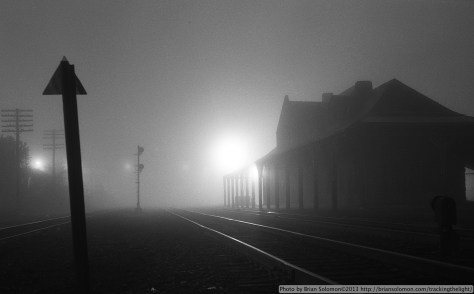
Palmer Union Station in the foggy gloom of a May 1985 evening. Exposed with a Leica 3A rangefinder on black & white film.
Yesterday (July 10, 2013), I posted night photos I made in Palmer on June 28, 2013. I mentioned that my night photography efforts were part of a long standing tradition. So I dug up this image of the Palmer station exposed nearly three decades earlier.
This was undoubtedly made on a Friday evening. A thick fog from the Quaboag River had enveloped the valley. In the station parking lot, and out of sight, Bob Buck is holding court.
That night I made several views of the Palmer station in silhouette. All were exposed with my old Leica 3A and a 50mm lens, probably a Canon screwmount which I favored at the time. I was using my father’s Linhof tripod to support the camera. Exposure was calculated strictly from experience, and was probably about 30 seconds at f2.8.
Interestingly, just the other day (July 9, 2013) I had the opportunity to interview Jim Shaughnessy about the night photography techniques he used to capture steam locomotives on film back in the 1950s. While similar to mine, his approach was very different and he perfected it more than three decades before my image was exposed.
Where I used 35mm film and strictly ambient light for this image, Jim tended to use a 4×5 camera and a skilled combination of ambient and artificial flash.
Of course, I was well acquainted with Jim’s work by the time I made this photo. There has been a copy of Donald Duke’s 1961 book Night Train on our shelf for as long as I can remember! This features Jim’s work among that of other well-established practitioners of the art of railway night photography.
I don’t remember making my first night photo in Palmer. But I do recall spending Friday evenings there in the 1980s with Bob Buck and company, watching and photographing Conrail and Central Vermont. See: Drowning the Light
New England 611 crawls southward across the Palmer diamond on June 28, 2013. Lumix LX3 photo.New England 611 glides into Palmer on June 28, 2013. Lumix LX3 photo.
The Friday evening tradition was maintained on June 28, 2013, when a group of us convened, as we have for many years, near the old station. A few weeks earlier, I posted some photos made on exceptionally wet Friday night. By contrast, June 28th was warm, dry and very pleasant. And busy too!
The variances of railway freight operations make it difficult to pin point precisely when trains will pass or arrive Palmer. Complicating matters on the week of June 28, was on-going undercutting on CSX’s B&A route (see: Ballast Train East Brookfield), and the after effects of a serious derailment on the Water Level route near Fonda, New York a few days earlier.
However, these events appear to have benefited us on the evening of the 28th. I arrived at CP83 (the dispatcher controlled signals and switch at west end of the controlled siding, 83 miles from Boston) just as CSX’s westward Q437 was rolling through.
New England Central freights 604 and 606 at Palmer, Massachusetts. Lumix LX photo.New England Central 2680 on train 604 at Palmer. Lumix LX3 photo
New England Central had no less than three trains working in Palmer, jobs 604, 606, and 611, and these entertained us for the next couple of hours. In addition, we caught more action on CSX, including a very late train 448, Amtrak’s Lake Shore Limited.
I made these photos using my Lumix LX3 and my father’s Gitzo carbon fiber tripod. Some of the exposures required the shutter to remain open for 25 seconds or longer.
Amtrak’s 448 Boston Section of the Lake Shore Limited eastbound at CP 83 in Palmer. Lumix photo.Limited clear off the control siding at CP83.
In 2005, SEPTA re-introduced regular streetcar service to its number 15 route along Philadelphia’s Girard Avenue using historic President Conference Committee (PCC) trolley cars. These are painted in the old Philadelphia Transportation Company’s livery, which ads class to the service.
SEPTA’s number 15 Streetcar makes the corner at 26th and Poplar Streets in Philadelphia. Lumix LX3 photo.
My brother Sean lives just a few blocks from Girard Avenue, and on the afternoon of July 3, 2013, we made a project of photographing the cars in service. While on previous trips we’ve gone for a spin, this time we drove, allowing me to make the maximum number of photos in just a limited time. We’ll take another spin on another day soon!
While SEPTA’s Route 15 seems to run on 10-15 minute intervals, not every service has a PCC. At least one of the runs was provided by a bus. I made an image of this as well because I’ve learned from my study of railways, that it is best to photograph everything and sort out the wheat from the chaff at a later date. (In other words don’t judge your subject).
While anticipating a PCC I was surprise to see that SEPTA was providing some the 15 services with buses. Yet, this is part of the story, so I made an image of the bus too. A streetcar was not far behind. Lumix LX3 photo.This is the PCC that followed the bus. Patience paid off. Lumix LX3 photo.SEPTA PCC cars on Girard Avenue cross Broad Street on July 3, 2013. Lumix LX3 photo.
This trip, I made digital images with my Lumix LX3 and Canon EOS 7D. On previous trips I’ve photographed the Route 15 in black & white using a Leica M4, and made color slides using my Nikons and Canon EOS 3.
Instead of the destination, this PCC promotes the Philadelphia Phillies. Lumix LX3 photo.
On the sidewalk, SEPTA’s initials are set in cement. Lumix LX3 photo.
Philadelphia area transit is provided by SEPTA. The city’s eclectic collection of routes and modes has its origins in the 19th Century. In Philadelphia’s heyday, a myriad of railways laced the city and pulsed with passengers. One hundred years ago, 500 million fares were collected annually on Philly’s streetcars alone.
Market-Frankfort subway at 30th Street, Philadelphia. July 2013. Lumix LX3 photo.
Pennsylvania Railroad and Reading Company vied for suburban fares, and both railroads electrified key routes in the early decades of the 20th century. This foresight continues to benefit Philadelphia to the present.
Sadly, while Philadelphia once enjoyed one of the most extensive streetcar networks in the world, much of this was gradually dismantled during the second half of the 20th century. Yet, a few key streetcar routes survive. Here and there tracks tell of past glory.
I visited my brother Sean in Philadelphia in early July, giving me ample opportunity to experience SEPTA and its buses, streetcars, subways, and railroad operations.
Center City is what Philadelphians call ‘down town’. While SEPTA’s operations reach myriad points across the region, Center City is the focus of most public transport.
Here are a collection of views of Philadelphia and its public transport.
The former Pennsylvania Railroad Suburban Station as seen in Philadelphia, Pennsylvania in July 2013. Lumix LX3 photo.Pedestrian entrance to Pennsylvania Railroad Suburban Station as seen in Philadelphia. Lumix LX3 photo.
SEPTA train at Suburban Station, Philadelphia. Lumix LX3 photo.SEPTA Silverliner V pauses at Market-East Station in July 2013. Market-East is directly below the old Reading Terminal on Market Street. Lumix LX3 photo.This mural in the old Reading Terminal depicts the station’s former glory. Lumix LX3 photo.SEPTA Silverline V heads outbound near the 40th Street Bridge in July 2013. Canon EOS 7D photo.SEPTA’s Route 15 Trolley making turn at 26th Poplar Streets in July 2013. Lumix LX3 photo.SEPTA is one of the last American cities to issue transfers.List of SEPTA bus routes at a stop near City Hall.SEPTA Silverliner IV outbound. Canon EOS 7D photo.
Contemporary views of a Traditional Streetcar Route.
On the afternoon of Sunday June 30, 2013, Pat Yough and I visited Media, Pennsylvania to photograph SEPTA’s Route 101 Streetcar.
SEPTA’s Route 101 car on East State Street in Media, Pennsylvania. Canon EOS 7D with 28-135mm lens (set at 135mm).
A century ago, single-track streetcar lines graced many American towns. The era of the electric trolley car faded decades ago. Today, Media is virtually in class by itself. Historic re-creations aside, where else in the USA does a single-track streetcar route serve “Main Street”?
The 101 Route is one of two SEPTA (former Red Arrow) streetcar lines radiating from its 69th Street Terminus in Upper Darby in suburban Philadelphia. The other trolley line is the 102 route to Sharon Hill. 69th Street is also served by the Route 100 high-speed interurban line to Norristown (the old Philadelphia & Western line) and the Market-Frankford elevated.
SEPTA’s 101 trolley stops at street corners to collect and drop off passengers. Lumix LX3 photo.A Kawasaki streetcar near the end of the line in Media, Pennsylvania on June 30, 2013. Lumix LX3 photo.The trolley is a Media, Icon. Canon EOS 7D photo.East State Street, Media, Pennsylvania on June 30, 2013. Canon EOS 7D with 200mm lens.
Norfolk Southern X999 works southward on the former Reading Company at Yardley, Pennsylvania. Exposed with Canon EOS 7D with 200mm lens.
On June 30, 2013, Pat Yough and I photographed Norfolk Southern X999, an extra-dimensional (oversized load) move carrying an Air Products industrial heat exchanger.
Norfolk Southern X999 carrying a heat exchanger near Yardley, Pennsylvania. Exposed with a Lumix LX3.Norfolk Southern X999, Yardley, Pennsylvania.
We photographed this twice. Once on the former Reading Company line at Yardley, Pennsylvania. And again on the former Pennsylvania Railroad Trenton Cutoff near Morrisville.
This unusual train had locomotives at the front and back (to aid in changing direction) and an Air Products caboose.
Norfolk Southern X999 near Morrisville, Pennsylvania. Exposed with a Lumix LX3.Norfolk Southern X999 carries an industrial heat exchanger. Exposed with a Lumix LX3.