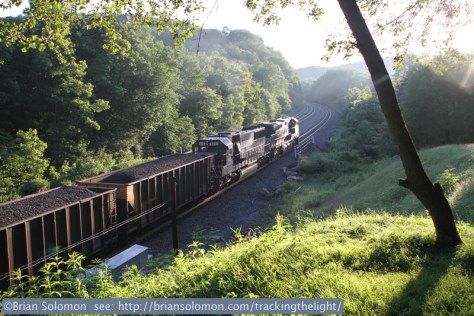
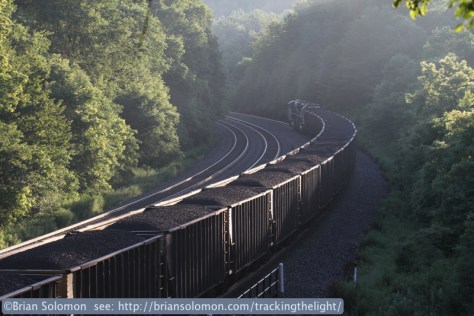
In contrast from the iced grip of winter, these photographs were made on June 30, 2010. This was a gorgeous warm summer’s morning; birds twittered the tree branches as the sun light streamed through a gauzy haze to burn away the dew.
I arrived early at the famed ‘Railfan’s Overlook’ to make photographs in the early light of day. In the distance, I could hear the thunder of a heavy train climbing east toward the Allegheny Divide at Gallitzin.
Norfolk Southern’s busy former Pennsylvania Railroad mainline rarely disappoints, and this morning it was alive with trains.
Using my Canon EOS 7D, I worked the glinting sun to its best advantage as an eastward Pennsylvania Power & Light coal train clawed into view. As it worked the grade, a westward RoadRailer led by former Conrail locomotive glided down grade.
At the back of the coal train were a pair of freshly painted SD40Es making a classic EMD-roar as they worked in run-8 (maximum throttle).
How I wish I was enjoying a warm June morning on the West Slope right now!
A Norfolk Southern coal train, likely destined for Pennsylvania Power & Light’s Strawberry Ridge plant, works west at Cassandra, Pennsylvnia. Canon EOS 7D with 24mm lens, exposed at f4 1/250th second, ISO 200. Back lit morning sun highlights the grass in the foreground.
Westward Norfolk Southern RoadRailer at Cassandra, Pennsylvania on June 30, 2010. The morning sun has caught the front element of my lens making for a bit of flare. Notice how this fogs the shadow areas and warms up the scene. Hollywood film-makers love this effect.I’ve stepped back into the shadow of a tree to control lens flare and stopped down my exposure to allow for better highlight detail on the sides of the RoadRailer. The result is a starker less atmospheric image.Morning glint illuminates the helpers at the back of coal train. Canon EOS 7D with 28-135mm lens, set at 120mm and at f5.0 1/500, ISO 400.
On a recent ride out to Elwyn on a SEPTA suburban train, my brother Sean and I noted several large viaducts on this former Pennsylvania Railroad route.
The Elwyn route is one of several SEPTA lines that has been under threat of closure. The bridges on the route have been reported to be suffering from deferred maintenance which has made them candidates for replacement.
SEPTA’s Crum Creek viaduct. Exposed with a Lumix LX3.
This bridge piqued our curiosity. So on Monday, January 20, 2014 we decided to investigate the Crum Creek Viaduct which is easily accessed via The Scott Arboretum trails (near Swarthmore College).
An impressive viaduct, it spans the heavily wooded Crum Creek valley, looming above the tree tops like an ancient relic of another age. It reminded me of Milwaukee Road’s trestles on St Paul Pass in the Bitteroot Mountains of the Idaho panhandle.
This is a double-track tower-supported plate girder viaduct, of the type of construction common to many late-19th and early 20th century railway bridges. It dates to the mid-1890s.
SEPTA’s Crum Creek viaduct. Exposed with a Lumix LX3.
Photographically, the Crum Creek viaduct presents a challenge. The surrounding trees tend to obscure the bridge. While the most graphic images of the bridge are made near is base, yet working close to the bridge makes it difficult to adequately capture a train crossing the bridge. As we moved further away both train and structure tend to blend with the forest.
Since this bridge is in jeopardy of either replacement or abandonment, I thought it a worthy project to photograph it as functioning infrastructure. I tried panning an outbound train in an effort to show a train on the bridge.
An inbound SEPTA multiple unit rumbles across the Crum Creek Viaduct on January 20, 2014. Canon EOS 7D photo.Pan of an outbound SEPTA train crossing the Crum Creek Viaduct on January 20, 2014.
What will become of this bridge? Will it be restored, abandoned or replaced?
Below are some recent links that make references to the viaduct.
Yesterday (February 7, 2014), after several months of testing, Amtrak’s new ACS-64 Siemens built ‘Cities Sprinter’ locomotive 600 made its first revenue run on Amtrak train 171 (Boston to Washington).
My dad and I went to Milford, Connecticut on the North East Corridor to catch the new electric. Pop made some B&W photos with his Leica M3 from the east end of the platform. I worked the curve at the west end with my Canons.
I popped off a couple of slides with the EOS 3 with a 100mm telephoto, and exposed two bursts of digital images using the Canon 7D with 20mm lens.
Brand new Amtrak electric 600 leads train 171 (Boston to Washington) at Milford, Connecticut at 10:56am February 7, 2014. Canon 7D with 20mm lens. f4.5 1/2000th second, ISO 200.Canon EOS 7D with 20mm lens. Amtrak ACS 64 number 600.Canon EOS 7D with 20mm lens. Amtrak ACS 64 number 600.
Canon EOS 7D with 20mm lens. Amtrak ACS 64 number 600.
By the way the 20mm on the 7D has a field of view equal to about a 35mm lens on a traditional 35mm film camera.
The new electric sure looked nice! I’ll be keen to see the B&W photos and slides when they are processed.
After 171 passed, I made a few photos of a Metro-North local, then Pop and I went over to inspect the recently opened Metro-North station at West Haven, where we made a few photos of passing trains.
New England Central at Montpelier Junction, Vermont.
Dubie campaign train approaches Montpelier Junction, Vermont on the afternoon of August 28, 2010. Canon EOS 7D with 28-135mm lens.
A freshly scrubbed GP38 led a pair of Pennsy passenger cars in a classic old-school whistle-stop campaign tour of Vermont.
On August 28, 2010, my dad and I drove to the Georgia high bridge (near St. Albans, Vermont) to intercept a New England Central special train hired by gubernatorial candidate Brian Dubie.
It was a sunny warm summer’s day, and we made numerous photos of the special as it worked its way south.
This pair of images was exposed at Montpelier Junction, where the train made a stop for the candidate to make a speech to his supporters. Traditionally, this was where Central Vermont met the Montpelier & Barre.
I used a telephoto for these views in order to emphasize the bunting and flags that marked the train’s distinctive qualities. Several of my photographs of the train appeared in Private Varnish.
Tim Doherty asked me a few weeks back, “Have you ever tried a shot from the north side of the Millers Falls high bridge?” I’d looked a this several times, but was discouraged by the row of trees between the road and the railroad bridge.
Amtrak‘s northward Vermonter crosses the Millers River on January 12, 2014.
So, on January 12, 2014, at the end of the day (light), Tim and I went to this location with the aim of making images of Amtrak’s northward Vermonter crossing the aged Central Vermont span.
As there was only a hint of light left, I upped the ISO sensitivity of my Canon EOS 7D and I switched the color balance to ‘tungsten’ (indoor incandescent lighting which has the same effect as using tungsten balance slide film (such as Fujichrome 64T), and so enhances the blue light of the evening.
A call to Amtrak’s Julie (the automated agent) confirmed the train was on-time out of Amherst. Running time was only about 20 minutes (a bit less than I thought) but we were in place, cameras on tripods, several minutes before we heard the Vermonter blasting for crossings in Millers Falls.
The result is interpretive. The train’s blur combined with view through the trees and the deep blue color bias makes for a ghostly image of the train crossing the bridge.
25 Years Ago, Conrail Demolished Palmer’s Boston & Albany Freight House.
During the 1980s, Conrail demolished many disused structures along the Boston & Albany line. The East Brookfield freight house went in 1984, Worcester’s went in 1986. In January 1989, I noticed that the railroad was preparing to erase Palmer’s B&A landmark.
The wrecking machine was parked out in front and had already taken a bite out of the northeast corner of the steam-era red brick structure.
Palmer freight station on the eve of demolition. Exposed with a Leica M2 in January 1989.
I proposed a short article to the editor of Palmer Journal Register. The newspaper supplied me with a roll of black & white film and processed it for me. I photographed the building from every angle and wrote the article that appeared about a week later.
Conrail made short work of the old building, which had stood at the west-end of the yard near Haley’s Grain Store. Today there is almost no evidence of the building.
For me it had been tangible evidence of the old Boston & Albany—never mind Conrail or Penn-Central. While its usefulness to Conrail may have ended, I recalled speaking with the agent there on various occasions in previous years.
I still have the negatives that I exposed with my Leica M2 and I’ve scanned these using my Epson V600.
Palmer freight on the eve of demolition. Exposed with a Leica M2 in January 1989.Palmer freight on the eve of demolition. Exposed with a Leica M2 in January 1989.
Exposed on Tri-X with a Leica 3A; image cropped slightly to correct for level, contrast adjusted locally in Photoshop.
Of my older black & white images, I feel this is among my most successful compositions. For me it goes beyond simple documentation of the railroad, yet captures the essence of Northeastern railroading in the early 1980s.
I’m standing in the ruined shell of the old Boston & Maine tower at Johnsonville, New York, where the line to Troy had diverged from the route to Mechanicville and Rotterdam.
In the tower’s broken windows, I’ve framed a distant eastward B&M freight (operated by Guilford Transportation Industries). The railroad, like the tower, is a shell of its former glory, having suffered from decades of decline. Yet, the trains still roll.
The stark, yet diffused November light adds to the scene and backlights the train illuminating the locomotive exhaust. Although the train is small, it is clearly the subject of the photo. The eye is immediately drawn to the locomotives and only later explores the rest of the image. I was particularly pleased with the placement of the old railings inside the tower.
For many years I had a 5×7 inch black and white print of this image on my wall.
Old Pointless Arrow and the Basketball Hall of Fame.
Springfield, Massachusetts Union Station, where Boston & Maine, Boston & Albany and New Haven once shared common space. Today, its a local Amtrak hub. Exposed with a Contax G2 with 28mm Biogon lens.
Ah Springfield! Probably best known because of the Simpson’s cartoon set in a mythical city of that name. Could be Springfield, Massachusetts, or Illinois, any of a couple dozen other cities with this common name.
On April 5, 2004, I met Tim Doherty for lunch and we made a few photos in Springfield.
A visit to Union Station found a westward CSX freight with a Conrail blue General Electric DASH8-40CW rolling through.
Later, we went down to an footbridge near the Basketball Hall of Fame to catch Guilford Rail System’s elusive EDPL (East Deerfield to Plainville, Connecticut) freight.
In 1982, Boston & Maine bought several Connecticut-based former New Haven Railroad operations from Conrail, and EDPL was one the only remnants of that transaction. At the time, the freight ran once a week. Catching it was a matter of planning and good luck.
Westward CSX freight rolls through Springfield Station on April 5, 2004.Guilford’s weekly EDPL against a backdrop of the Springfield skyline on April 5, 2004.This slightly closer view of the same train suffers (or benefits, depending on your perspective) from tree-branch shadows on on the front of the locomotives. Contax G2 photo.Guilford’s EDPL with Springfield’s top tourist attraction (or one would assume); the Basketball Hall of Fame.
I exposed these photos on Fujichrome Velvia 100F (RVP100F) color slide film using my Contax G2 rangefinder with a 28mm Biogon lens. The film was processed locally in Springfield at ComColor, which back then offered a 2-hour turn-around time for E6 films (processed and mounted).
In 2008, ComColor ceased processing E6 film. At the time, I was told my rolls were ‘the last run.’
The Amherst Railway Society ‘BIG RAILROAD HOBBY SHOW‘ is on this weekend (January 25 and 26, 2014) at the Eastern States Exposition in West Springfield, Massachusetts.
They were Budd’s follow up to its successful stainless steel rail diesel cars built in the 1950s. But where Budd’s RDCs had established standards for self propelled diesel cars, Budd’s SPV-2000 didn’t measure up.
I think ‘SPV’ was supposed to mean ‘Self Propelled Vehicle,’ but all the railroaders I knew called them ‘Seldom Powered Vehicles.’
These were adapted from the original Budd Metroliner (MP85) car style and in the same family as Amtrak’s Budd-built Amfleet.
For a few years they were routinely assigned to Amtrak’s Springfield, Massachusetts-New Haven, Connecticut shuttle trains.
Silhouette of a Budd SPV2000 at Springfield Station on the morning of September 30, 1984. Exposed on 35mm Kodak Tri-X with a Leica 3A with 21mm lens.On the morning of September 30, 1984, Conrail B23-7s lead eastward freight SEPW (Selkirk to Providence & Worcester) through Springfield (Massachusetts) Union Station. A set of SPVs rests in the shadows. Although not the primary subject, I was sure to include the SPV2000s in my photograph. Exposed on Tri-X using a Leica 3A with 21mm lens.
I admit now that I didn’t like the SPVs. I didn’t like them because they were new, and I much preferred the traditional RDCs. Also, at the time, I found the round car style un-photogenic.
Despite my dislike of the SPV’s, I photographed them anyway. While I wish that I’d made more photos of them, I’m very glad that I bothered to put them on film at all.
As it turned out, Amtrak appears to have disliked the SPV’s even more than I did! Their tenure on the Springfield run was short. By 1986, they’d been largely replaced with locomotive hauled consists. Other than my own photographs, I’ve seen very few images of these cars working on Amtrak.
A lone SPV2000 makes a station stop at Windsor Locks, Connecticut in May 1985. From my experience, it was relatively unusual to find single SPVs working in Springfield-Hartford-New Haven shuttle service. Exposed with a Leica 3A fitted with a Canon 50mm lens. Contrast controlled locally in post processing using Photoshop.
Here’s an irony: in retrospect I’ve come to appreciate the SPV’s. They were a rare example of a modern American-built self-propel diesel car, and to my well-traveled eye, I now find them very interesting. So, what seemed new and common, now seems rare and peculiar!
The Amherst Railway Society ‘BIG RAILROAD HOBBY SHOW‘ is on this weekend (January 25 and 26, 2014) at the Eastern States Exposition in West Springfield, Massachusetts.
As Transmitted from Amtrak number 56, The Vermonter.
This morning I started at Overbrook, Pennsylvania, where frosty temperatures and a clear sky made for some stunning lighting effects. The cold wasn’t aiding timely railroad operations.
I caught a SEPTA local to 30th Street Station. I was booked to travel on the Vermonter, but delays gave me ample time to wander around and down load digital photos from my cameras.
An outbound SEPTA multiple unit catches the glint of the rising sun at Overbrook, Pennsylvania before 8am on January 23, 2014. Canon EOS 7D with 200mm lens.An eastbound SEPTA multiple unit passes Overbrook, Pennsylvania before 8am on January 23, 2014. Canon EOS 7D with 200mm lens.Canon 200mm view of a non-stop SEPTA MU east of Overbrook, PA, on January 23, 2014.The Solari boards at 30th Street didn’t paint a happy picture. Delays and cancelations were the rule of the day. My train was only about 40 minutes behind the advertised. Lumix LX3 photo.30th Street Station, Philadelphia on the morning of January 23, 2014. Lumix LX3 photo.30th Street Station from the 29th Street side. Lumix LX3 photoAmtrak veteran, AEM7 932 roars into 30th Street Station with the Vermonter in tow. I’m riding behind this locomotive as I write this. Lumix LX3 photo.Amtrak 56 arrives at 30th Street, 40 minutes after its scheduled time. Better late than never. Lumix LX3 photo.
At present I’m gliding eastward across a snow covered urban landscape on the former New Haven Railroad. This is Tracking the Light’s first post sent directly from an Amtrak train.
View from Amtrak 56 on approach to New York’s Hell Gate Bridge with the New York City Transit Authority below and the Manhattan skyline beyond. Lumix LX3 photo.On board Amtrak number 56 The Vermonter, east of Penn-Station, New York. Lumix LX3 photo.Metro North Railroad HyRail truck as viewed from Amtrak 56 on the afternoon of January 23, 2014. Lumix LX3 photo.USDOT test car on the old New Haven Railroad west of Stamford on January 23, 2014. Lumix LX3.
The word was out that Norfolk Southern’s Pennsylvania Railroad painted heritage locomotive was to work a detoured stack train over CSX’s Trenton Subdivision to avoid a scheduled engineering project at Norristown, Pennsylvania.
Pat Yough and I planted ourselves at the West Trenton, New Jersey SEPTA station in anticipation. A number of other enthusiasts had similar plans, so there was plenty of company.
Former Reading Company station at West Trenton, New Jersey on the morning of January 19, 2014. Lumix LX3 photo.Detailed view of West Trenton station. Exposed with a Canon EOS 7D with 100mm lens.West Trenton station’s build date is carved in stone. Lumix LX3 photo.A SEPTA train for Philadelphia’s Airport pulls into the West Trenton station. CSXT’s unit oil train K040 with BNSF locomotives waits in the distance. Canon EOS 7D with 100mm lens.After the SEPTA local departed, CSXT KO40 led by BNSF 9688 and 5523 rolls southward through West Trenton. This section of the old Reading demonstrates how freight and passenger traffic can coexist on the same line. Canon EOS 7D with 100mm lens.CSXT symbol freight Q439 works south behind mixed consist of GE and EMD locomotives. Canon EOS 7D with 100mm lens.Switchers have become relatively rare items on modern railroads so I made this grab shot of CSXT 1137 as it rolled by. Lumix LX3 photo.A SEPTA Silverliner V waits to enter West Trenton Station. Canon EOS 7D with 200mm lens.
The much anticipated Norfolk Southern detour I5T, (running as CSXT B100-19) works northward through West Trenton. At the back of the train are a pair of NS diesels to aid with reverse moves necessary for the detour arrangements. Canon EOS 7D with 100mm lens.
The former Reading station building at West Trenton is now privately owned (and serves a non-railroad function), while the platforms remain active for SEPTA’s regularly scheduled passenger trains to Philadelphia.
When we arrived, morning clouds were giving way to sun. A pair of westward CSX trains was holding just west of the electrified zone and the radio was alive with activity.
In a little more than an hour we caught three SEPTA trains and four freights. This kept me and my three cameras pretty busy. My goal was not just to photograph the trains, but to capture these trains in this classic railroad environment.
Norfolk Southern 8102 was in clean tuscan-red paint at it trailed at the back of nearly two-miles of double stacked containers. Canon EOS 7D with 100 mm lens.Trailing with of NS I5T (CSXT B100-19) passing the West Trenton tower. Canon EOS 7D.CSXT empty oil train K041 works northward behind the detoured stack train. BNSF locomotives make a bit of color in this otherwise drab New Jersey scene. Canon EOS 7D with 20mm lens.
SEPTA local arrives at Overbrook on the way to Thorndale. Canon EOS 7D photo.
This morning dawned with a blood-red sunrise. Something about a red sky in the morning?
What I’d call ‘winter’ has been given all sorts of new fancy names. Probably the most absurd is the ‘polar vortex.’ Next up is the term handed to today’s precipitation: ‘bombogensis.’
Call it what you like. By about 2:30 pm today 6 inches of snow was improving photography all over Philadelphia, and by 5 pm there was 8-10 inches was making for interesting images.
My brother Sean and I spent the afternoon in Philadelphia making photos of SEPTA and snow accumulation while running errands. Falling and drifting snow made for some dramatic photography opportunities.
Inbound SEPTA multiple unit approaches Overbrook Station. Canon EOS 7D photo.Late-running Amtrak Keystone service crosses over at Overbrook. Canon EOS 7D photo.SEPTA number 10 trolley takes the corner at Lansdowne Avenue. Canon EOS 7D photo.SEPTA number 10 glides along in the snow on the afternoon of January 21, 2014. Canon EOS 7D photo.A vintage PCC in Route 15 service ambles along snow-covered Girard Avenue. Canon EOS 7D photo.Trailing view of a SEPTA PCC on Girard Avenue, on January 21, 2014. Canon EOS 7D photo.
Snow exposure I always tricky. My basic rule of thumb is to use the camera meter to set a gauging point, then open up (over expose) by 2/3s to a full stop above the camera meter. Using the histogram on the back of the camera, I then fine tune my exposure depending on the setting.
Cleaning the sidewalks on Viola Street at dusk. Canon EOS 7D photo.Former Pennsylvania Railroad position light signal shows a ‘stop’ aspect. January 21, 2014. Canon EOS 7D photo.
An inbound SEPTA MU arrives at Overbrook on the evening of January 21, 2014. Despite the snow, this service was on schedule. Canon EOS 7D photo.Former Pennsylvania Railroad Main Line looking east at dusk. Canon EOS 7D photo.
Philadelphia was the Pennsylvania Railroad’s headquarters city. Despite multitudes of change in the industry since PRR merged with New York Central in 1968, there’s still plenty of Pennsy cues around Philly.
For me this is like finding hints of a long lost empire.
Pennsylvania Railroad’s Suburban Station. Lumix LX3.Interior of 30th Street Station. The commemorative statue depicts an angel carrying a soldier skyward which symbolizes PRR’s employees who perished in action during World War II.
The keystone was PRR’s symbol. If one searches around Philadelphia’s 30th Street, there are still plenty of PRR keystones to be found. Lumix LX3 photo.Old PRR station at Clifton-Aldan, Pennsylvania. Lumix LX3 photo.A PRR-style position light signal at Overbrook, displays an ‘Approach-Medium’ aspect. Canon EOS 7D photo.Overbrook Station on the Main Line, as seen on the evening of January 18, 2014.
View from I-76; a crane attends to a derailed sand hopper at the site of the January 20, 2014 Schuylkill River Bridge derailment. Canon EOS 7D with 100mm lens.
The news media reported that early this morning (January 20, 2014), an oil train destined for Philadelphia derailed while crossing the Schuylkill River.
The derailment occurred near I-76 and within sight of Center City.
This afternoon, my brother and I were on our way through Philadelphia, and I had the opportunity to make photos from the car as we passed the derailment site.
Traffic was very slow on I-76, and I ample time to make snapshots with my Canon EOS 7D. On our way back, the clean up efforts continued, so I made a few more images.
It pays to have a camera at the ready to capture events such as this one.
View from I-76; a crane attends to a derailed sand hopper at the site of the January 20, 2014 Schuylkill River Bridge derailment. Canon EOS 7D with 100mm lens.View from I-76; a derailed sand hopper at the site of the January 20, 2014 Schuylkill River Bridge derailment. Canon EOS 7D with 100mm lens.View from I-76; a derailed sand hopper at the site of the January 20, 2014 Schuylkill River Bridge derailment. Canon EOS 7D with 100mm lens.
Dusk on January 20, 2014, clean up crews attend to derailed cars on the Schulykill River Bridge. ISO 6400, Canon EOS 7D with 100mm lens.
For me, SEPTA is one of the most photogenic American big city transit systems. Sure, other cities have their charms, but Philadelphia has a lot going for it; variety, accessibility, interval services on most routes, real time displays at stations, visual cues to its heritage, interesting and varied equipment and etc.
On January 16, 2014, my brother Sean and I, spent an afternoon and evening wandering on SEPTA’s rail systems making photographs. I had a minor agenda to ride a few pieces of the network I’d not yet traveled on.
I worked with two cameras; Lumix LX3 and Canon EOS 7D, but traveled relatively light (no film body or big telephotos)
Lumix LX3 photo.SEPTA has a App that shows schedules, train times & etc. Lumix LX3 photo.Philadelphia is one of the few North American cities with direct heavy rail airport connections. Trains run every half hour with stations at each terminal. Lumix LX3 photo.Afternoon sun catches an outbound Silverliner V at University City. A CSX freight rolls overhead on the Highline. Canon EOS 7D with 100mm lens.
All of the lines we traveled were well patronized (some at standing room only) and yet everything seem to run to time. SEPTA’s staff were friendly and helpful. (Especially when we were running for trains).
SEPTA SIlverliner V interior. Built by ROTEM. Lumix LX3 photo.End of the line at Elwyn.Silverliner V at Elwyn. The line used to continue to West Chester. Lumix LX3 photo.Old Pennsylvania Railroad station at Clifton-Aldan.End of the Sharon Hill trolley line. Lumix LX3 photo.69th Street terminal at Upper Darby. Outbound Kawasaki trolleys for Media and Sharon Hill. Lumix LX3 photo.Norristown High Speed Line at 69th Street. Lumix LX3 photo. Contrast adjusted in post processing to improve the overall appearance of the image.Norristown transportation center. The old Reading Company on the lower level. A Norfolk Southern freight rolled through as we boarded the train for Center City. Lumix LX3 photo.SEPTA Daypass; a bargain that cost just $12. We got good value with ours. SEPTA’s conductor sold us the passes on the train. Lumix LX3 photo.Market East. Canon EOS 7D photo.Market East. Lumix LX3 photo.Market East. Canon EOS 7D photo.Overbrook station on the Main Line. Canon EOS 7D photo, with 40mm pancake lens.
Amtrak 449, in sun and rain; one day and the next. Last week, I was over in East Brookfield visiting the LeBeaus to do some videography for a music video. Dennis LeBeau lives a block from the Boston & Albany (CSXT’s Boston Line).
I said to Dennis, “I’m just going to nip down to the bridge to catch 449. It should be getting close.”
“Passes here every day at one-thirty. I’ll join you in a minute.”
I phoned Amtrak’s Julie (the automated agent: 1-800-USA-RAIL) to find out if 449 as on time out of Worcester. As it turns out, it departed Worcester Union Station 4 minutes late.
Worcester is at CP45, East Brookfield is CP64. It takes 449 about 25-30 minutes to run the 19 miles.
Since it was nice bright afternoon, I opted for a broadside view that shows a few of the houses in town. At 1:39, Dennis shouted to me from the road bridge, “He’s around the bend.” I was poised to made my photograph with my Lumix LX3.
This can be tricky since there’s really only a split second to get the train in the right place. If the camera isn’t cued up, all I’ll get is a photo of the baggage car. But I was ready, and put the train precisely where I wanted it.
Amtrak’s westward Lake Shore Limited at East Brookfield, Massachusetts on January 13, 2014. Exposed with a Lumix LX3 at f4.0 1/1600th of a second. I selected a fast shutter speed to insure I stopped the train. When working broadside, the relative motion of the train to the film plane requires a fast shutter speed than when aiming at tighter three-quarter view.
The train glided through town. I turned to make a few going away views with my Canon, and said to Dennis, “You know that never gets old. I’ve been photographing that train since the 1970s.”
Dennis said to me, “I’ve been watching it since it was the New England States Limited, with New York Central E8s!”
A day later, I was in Palmer (CP83). The word was out that Amtrak 145 (one of the Genesis P42s in heritage paint) was working 449. The weather was foul, but since I was in town anyway, I figured I’d give the train a roll by.
It was stabbed at CP83 by a southward New England Central freight going into the yard, which allowed ample time for photos. Such a contrast in days. Pity the heritage P42 hadn’t worked west a day sooner.
Amtrak has painted P42 145 in its 1970s-era scheme. It leads train 449 which is sitting at CP83 waiting for a southward New England Central freight to clear the diamond on January 14, 2014. Driving rain was the order of the day. Canon EOS 7D with 20mm lens.
The other day, I had a few packages to send out. I’d delayed going to the post office until after the school buses were out, using the logic that if I waited, I wouldn’t get stuck behind one on the way back.
On the way into the PO, I heard a distant whistle. And while at the desk, a train rumbled by.
New England Central’s (NECR) former Central Vermont line runs on a slightly elevated gradient behind the Monson, Massachusetts PO. This is on the climb up State Line hill, and heavy trains make a good racket coming though town. This freight, however, wasn’t very heavy and the engines weren’t working too hard.
I made an expeditious exit after mailing my packages, and started south on Route 32. No sooner than I was south of town, I found myself looking at the back of a school bus!
And this bus then stopped, as required, at the South Monson grade crossing.
I could hear the southward climbing. It had already gone through. Fortunately, once over the tracks, the bus driver kindly pulled in to let traffic around. I sailed southward, and arrived at State Line crossing. Once out of the car, I could hear the train working.
New England Central’s daily freight at the Massachusetts-Connecticut state line. Notice the granite marker to the left of the locomotives. Exposed with a Lumix LX3, set at ISO 200.
Although the light was fading, there was enough to work with. While, I’d left most of my cameras at home, I had my Lumix LX3 in my coat pocket. I set up a shot immediately south of the Massachusetts-Connecticut state line, and included the granite marker at the left of the image.
After the train passed, I followed it to Stafford Springs, where I made a few more photos. As it turns out, these NECR images are my first railway photos for 2014.
New England Central’s GP38s lead a southward freight through downtown Stafford Springs, Connecticut on January 9, 2014.New England Central’s GP38s lead a southward freight through downtown Stafford Springs, Connecticut on the afternoon of January 9, 2014. Lumix LX3 photo.
This pair of images will never be repeated. Here we have Irish Rail’s afternoon passenger to Dublin consisting of Mark 3 set led class 201 number 222 (known colloquially as the ‘Bishop Tutu’). That same afternoon, at about 3:40pm an empty timber with a mixed pair of 121/141s arrived from Waterford.
The afternoon Westport-Dublin passenger is ready to depart Westport on June 10, 2006. Nikon F3 with Nikkor f2.8 24mm lens.Irish Rail 146 and 134 arrive at Westport with an Empty Timber from Waterford on June 10, 2006. Nikon F3 with Nikkor f2.8 24mm lens.
What was unusual that day was an electrical power cut had required the use of portable generators at the station, making for an unusual discordant cacophony at the normally peaceful location.
Despite the racket, I went about making photographs. Here, I carefully composed both views from the footbridge by the signal cabin using the same angle to show the contrasting trains in the classic scene. It was the end of an era. Soon all would change.
Since that time, Irish Rail has retired the small General Motors diesels. The 121s made their final runs in 2008, the 141s finished a couple of years later. The Mark III passenger carriages were withdrawn from traffic; today passenger trains to Westport run with Irish Rail’s Rotem-built 22000-series railcars.
I exposed both photos on Fujichrome with my Nikon F3 fitted with a 1960s vintage Nikkor f2.8 24mm lens.
I returned to Dublin on the evening passenger train, also with Mark 3s and a 201 class General Motors diesel.
Mount Shasta looms more than 90 miles to north, as Southern Pacific’s most famous locomotives races railroad west through along Hooker Creek (near Cottonwood, California).
Southern Pacific’s Lima-built semi-streamlined 4-8-4 number 4449 works railroad west south of Cottonwood, California on the evening of September 2, 1991. Exposed on Kodachrome 25 using a Nikon F3T with 300mm Nikkor telephoto.
I exposed this image on September 2, 1991. Southern Pacific had organized the historic streamlined engine to make a public appearances in the Sacramento River Canyon as a goodwill gesture following a serious derailment at the Cantera Loop which spilled toxins into the river above Dunsmuir. The railroad had hired me for two days to make photographs of the PR event.
Brian Jennison provided transport, and the two of us spent a long weekend making numerous images of SP 4449 with the matching Daylight train. I borrowed Brian’s 300mm Nikkor telephoto for this dramatic image. SP ran one of my photos in their company magazine, Southern Pacific Bulletin.
While SP’s public runs ran from Redding to Dunsmuir and beyond to Black Butte, after the train returned to Dunsmuir, it would run light to the wye at Tehama for turning. It was on this portion of the journey(s) that I made some of the most dramatic photos because they occurred in the evening when the lighting was most pleasing.
I’d chosen this angle to feature Mt. Shasta. Unfortunately, owing to the time of year, the famous volcanic cone wasn’t covered with snow in its higher regions.
This photo has appeared in books, and I’ve used many of the images from the trip in publications. SP 4449 remains one of my favorite locomotives.
An eastward Ukrainian Railways passenger train catches the evening glint in L’viv. The Soviet-built passenger cars took their cues from Milwaukee Road’s lightweight Hiawatha cars from the 1930s. Exposed on Fujichrome slide film with a Contax G2 with 45mm lens.
For me, a casual visit Ukraine in July 2007 was a great opportunity to ride and photograph former Soviet Railways.
Although the weather was scorching, the sun remained out for days and the quality of light was fantastic.
My favorite place was L’viv, a former Hapsburg provincial capital (previously known as Lemberg), and one of the great un-sung European cities. I found the railways here accessible and very easy to photograph. The city itself was completely fascinating: dusty cobble stone streets with trams everywhere. The beer was cheap and the vodka cheaper.
L’viv’s railways were some of the busiest I’ve ever seen. Here heavily built double track electric lines were saturated with a mix of local electric multiple units, very long intercity passenger trains, and an unceasing parade of heavy freights. In addition to electrics, occasionally a matched pair of 2M62 diesels would chortle by.
Still photographs cannot convey the traffic density; no sooner than one train was out of sight, and the next could be heard grinding along.
Among the wonderful things about Ukrainian railways; lots of carload traffic and virtually no graffiti!
A Riga-built electric multiple unit in local passenger service hums along in L’viv. These cars were plentiful and colorfully painted. The styling reminds me of North Shore’s classic Electroliners.A bit of telephoto compression with my Nikon F3HP and 180mm Nikkor lens focuses on the glint of westward passenger train. The track and trains were heavily built and well maintained.Freight rules in the Ukraine; long freights like this ore train roll along every few minutes. This one is led by the common VL80 electric. Contax G2 with 28mm Biogon lens, Fujichrome film.A trailing view of the same freight. Also, exposed with a Contax G2 with 28mm lens on Fujichrome. I burned through several rolls at this one s-bend.At the back of the ore train was this semi-permanently electric pair. The ore may be headed for the US Steel plant at Kosice, Slovakia.
“Let’s get an ice cream,” my pal T.S.H. said as we drove by Conrail’s sprawling former Pennsylvania Railroad yards at Hollidaysburg, Pennsylvania.
Conrail, Hollidaysburg, Pennsylvania 6:30 pm on July 27, 1987. Exposed on Kodachrome 25 with a Leica M2 fitted with 50mm f2.0 Summicron.
There was a roadside ice cream stand on one side of the highway and the tracks on the other. I made this image showing Conrail SD40 6288, while enjoying the ice cream on the hood of the old Dodge Dart we were using as transport.
This engine had been painted with a slogan promoting the United Way. Second out was a former Erie Lackawanna SD45-2. This was a local that had come down from Altoona with bad-order cars for the car shops.
It was July 27, 1987 and we were on the tail end of a week-long exploration of Pennsylvania. The days had been hot and hazy, but evenings offered some rosy light, (when there wasn’t a thunderstorm). We had started the day on the old Baltimore & Ohio, working our way from Confluence to Sand Patch, then drove north to Hollidaysburg.
The ice cream is just a memory, but I still have the old chromes.
In July 1983, on one of my first solo-trips by automobile, I visited Bangor & Aroostook’s yards at Northern Maine Junction. My friend Bob Buck had recommended this location because at the time the railroad was very accommodating of photographers.
You could sign a release and pretty much have the run of the place—so long as you stayed out of the roundhouse. The railroad had a guestbook and a gift shop. The employees were friendly and would answer questions.
I think I was there on a weekend, because the Bangor & Aroostook was quiet. There was dead line filled with F3A and BL2s that garnered my attention, but nothing was moving.
I asked one of the railroaders if there was anything running; he replied there wasn’t, but he’d find out if anything was coming on Maine Central. A short time late he came back to me and said there was an eastbound close.
Maine Central’s line bisected Bangor & Aroostook’s facilities, and I waited on the south side of the main line to favor the sun. After a little while, a lone former Rock Island U25B hauling two piggyback flats rolled by with its bell ringing and strobe lights flashing; this was the East Wind (New Haven, Connecticut to Bangor, Maine).
Maine Central’s hot intermodal train East Wind blows through Northern Maine Junction in July 1983. Exposed on Ektachrome film with a Leica 3A with 50mm Summitar lens. Although not a great photo, this documented a fleeting period of railroading, and I’m glad to have made it. While, catching the strobes lit was just pure luck.
I made several image with my Leica 3A, but I wasn’t impressed. One engine? Two cars? Four piggyback trailers? No caboose?! I said to the Bangor & Aroostook man who had waited with me, ‘Not much of a train, was it?’ He just shrugged. I don’t think he was impressed either.
What I had witnessed was Guilford’s early 1980s effort at capturing high(er) value piggyback traffic. The theory behind trains such as Maine Central’s East Wind was that by speeding schedules and lowering operating costs, the railroad could compete with highways for more lucrative time-sensitive shipments, rather than merely settle for low-priority low-value bulk-commodity traffic.
In retrospect, although the train didn’t impress me at the time, I made a valuable record of that early period after passage of the 1980 Staggers Act, when railroads were trying to break into new markets. It was also the first caboose-less train I’d seen, and gave me a hint of what was to come in the future. The U25B? That was a bonus.
Canon EOS 7D with 100-400mm image stabilized zoom lens, set at 250mm.
I exposed this image on the evening of August 20, 2010 of a westward CSX stack train at CP431 in Depew, New York. What makes this photo interesting to me is the former New York Central signal bridge and searchlight signals.
Since I made this photograph, CSX has replaced many of the searchlights on the Water Level Route with modern color light hardware. While I’m sorry to see the old signals go, I’m not surprised.
Back in the 1990s, I wrote an editorial in Pacific RailNews (when I was editor of that magazine) warning enthusiasts that searchlights were on their way out, and explained why. At the time, searchlights were very common.
The photo is timely. This year I’ll be authoring a book tentatively titled Classic Railroad Signals to be published by Voyageur Press. It will be a follow up to Railroad Signaling, that I wrote several years ago, and will feature a variety of classic American signal hardware:
Semaphores, Searchlights, Positional Lights and Towers, of all varieties.
This will be a great book. I’ve been researching and photographing the subject for many years!
In late 1992, I recognized that Southern Pacific and its lightly used Modoc line were not long for the world. I knew then that I’d better act and get out there to make photographs before the Modoc went the way of Milwaukee Road’s fabled Pacific Extension. I’m sorry to report, that I was correct. The tracks here at Crest, pictured in January 1993 were abandoned by Union Pacific after it took over SP.
When I was a kid, change puzzled me. I’d look back over my father’s photographs and collection of timetables and books and wonder what had happened to the trains and railroads he’d seen and experienced.
But as a young child, I’d assumed that all change was in the past. Certainly things had been different. New York Central had become Penn-Central, and Penn-Central had become Conrail. But I naively assumed that everything else would remain constant!
Then I began to notice change myself: My favorite GG1 electrics were replaced by modern AEM7s and E60s. Those old Penn-Central black diesels were become ever more scarce. Boston’s PCC cars had become fewer and fewer.
By the late-1980s, I’d witnessed enough changes to recognize that documenting the railroad required careful attention to detail, and it was important to anticipate change before it begins.
Too often, railroad photographers wait until change is already underway before they act to make photographs. Sadly, sometimes they wait too long and miss the best opportunities to photograph.
With this in mind, in the 1990s, annually I drafted lists from which to work. It’s one thing to ponder photographing time-worthy subjects; its better to have a clear and prioritized strategy!
In 1993, I was remarkably organized: I’ve included a portion of that year’s ‘photo projects’ list. If you read through this carefully, you’ll see there’s considerable foresight in my approach. I was doing my best to predict the future and act upon that knowledge.
Below are pages from that list:
I originally drafted this list in late December 1992 (up-dated to Jan 3, 1993). I was doing my best to predict change and plan my strategy to photograph railways before they were affected by change. Within a few years of this list, most of my predictions proved true, even if my efforts at putting dates on them missed by a year or two. Those errors favored my photography and they gave me a time advantage. There’s more than one lesson here.Page 2 of my 1993 list. These are a scans of my actual list. The pages survived the years along with my notes from 1993. Luckily, I had the time and motivational energies (if not the adequate financial resources), to act on most of the subjects listed.
I’m really glad I made these lists! We can look back today, 21 years after I wrote this list, and see that many of the subjects I hoped to document have indeed vanished or changed. The pen-marked ‘ticks’ indicated that I’d made an attempt at the item.
How did I draft this list? Did I have a crystal ball? How did I know in 1993 that SP was soon to vanish? Why did I give SP’s Modoc line high priority? What caused me to anticipate changes to Canadian Pacific east of Sherbrooke? Pay special attention to my notes and comments for the clues. In some cased my anticipated dates were premature, but my vision was pretty accurate (I’m sorry to report.)
What is on your list for 2014?
Change is on-going. Think! What can you photograph now that will soon change unrecognizably? Remember, it is the common everyday subjects that are too often ignored until it’s too late to make photographs. Don’t wait until the last minute. Keep an ear to the ground and an eye on the rail. Anticipate, plan and then act.
Any suggestions? I’m all eyes and ears.
Canadian National electrics at Val Royal, Montreal on Jan 11, 1993. Time was running out for these ancient machines. Tom Carver and I made special trip to photograph them despite exceptionally frosty conditions. Exposed on Fujichrome Velvia 50 slide film using a Nikon F3T.A month after I photographed the electrics in Montreal, I was knee-deep in snow on the far side of the continent to catch the first run of SP’s rotary plows on Donner Pass in eight years. They worked for three days in February 1993. I’d anticipated their operation in my 1993 list, drafted two months earlier. Exposed with a Nikon F3T on Fujichrome 100 slide film.
Contrasting Views of Indiana Railway Lines, June 2004.
In a world of railway mergers and consolidation, we can divide railway routes into groups; survivors and losers. Some lines have prevailed while others have been abandoned and ripped up.
Of course, we can further divide surviving lines. There are lines that continue to function as busy corridors, while others may only exist in fragmented form, or as downgraded local routes. Often fragments have been sown together and so now old railway line serve routes that may be very different than as originally intended.
Putting these concepts on film presents a puzzle and a challenge.
I made this view looking west on Norfolk Southern’s former Wabash mainline at Marshfield, Indiana. This highly polished steel highway continues to serve as a vital interstate corridor.High summer sun scorched the ruins of the old New York Central Egyptian Line at the Indiana-Illinois Stateline. This is one of many Midwestern railways abandoned as a result of railroad merger and line consolidation and shifting traffic patterns.
In June 2004, I was exploring western Indiana with Pete Ruesch and with his help I exposed these two photographs. The ‘winner’ is a sunset view of Norfolk Southern’s former Wabash mainline at Marshfield, which serves as a heavily-traveled long-distance freight corridor. The ‘loser’ was a recently abandoned vestige of New York Central’s Egyptian Line at the Indiana-Illinois state line.
Both were exposed with Nikon cameras on Fuji color slide film.
My recent book North American Railroad Family Trees (Voyageur Press) discusses past and possible future changes to the North American railway network.
During the first half of 1994 I spent a lot of time photographing Southern Pacific on Donner Pass. I was especially interested in making images of hard to reach or rarely photographed locations.
June 21st is the summer solstice, the longest day of the year, and provides unique lighting opportunities. On this long day, I’d hoped to make some unusual images in the deeper reaches of the Truckee River Canyon.
At the time I had good access to train information, and I knew SP had a westward DVOAF (Denver-Oakland Forwarder) heading up ‘The Hill’ (as SP’s Donner Pass crossing is known, ironically).
Rather than catch this at one of many easy to reach locations off Interstate 80, I decided to hike west of Floriston, California toward old Iceland—where SP’s grade separated mainline came back together. My intention was to photograph the Harriman-era truss bridge with the train in evening sunlight.
Southern Pacific’s DVOAF Denver-Oakland Forwarder) works west in the Truckee River Canyon near Iceland at 6:00pm on June 21, 1994. Exposed on Kodachrome 25 slide film using a Nikon F3T with f4 200mm lens. Image was scanned full-frame (with edges showing) using an Epson V600 flatbed scanner. One of the benefits of Kodachrome was the ability to expose images like one this with deep inky black shadows. In comparison, other media tend to suffer from bland shadow definition.
As was often the case with SP, my desired westward freight ‘fell down’ (it was delayed) and didn’t reach my location in time. I stayed in place despite this set back. I was rewarded with a dramatic sequence of images, culminating with this silhouette.
The front of the locomotive has plunged into deep shadow, yet a shaft of sunlight has illuminated the engineer. It stands out among my hundreds of Donner Pass images, and is one of my favorite. I just can’t believe its been nearly 20 years since I exposed it!
Cumbres & Toltec former Denver & Rio Grande Western three-foot gauge line, Colorado.
Railway tracks are the defining infrastructure of this transport system. They are key to the whole technology as well part of the title of this Internet Blog.
Often, tracks are view as secondary to the trains that use them. Photographs tend to focus on the locomotives and cars, rather then the tracks themselves.
With this post, I’ve focused on the tracks. I’ve selected a few photographs from my archives in which the tracks are the subject: tracks leading to the horizon across a desolate desert landscape; tracks curling around a bend in the snow; tracks in the weeds and tracks catching the sunlight.
Tracks capture our imaginations, and the images of tracks can be timeless. Yet not all tracks are the same. The condition of the line and nature of the landscape is telling. I’ve made hundreds of images like these over the years; sometimes from trains, other times from the ground, or overhead bridges. The formula is simple, but the results vary greatly.
Often the thought of what lies beyond is the most intriguing. What lies around the curve or just over the horizon? It are images like these that inspire wanderlust for railway journeys. In days of yore, how many young men left home in pursuit of that the elusive view around the next bend in the tracks.
Cape Breton & Central Nova Scotia’s former Canadian National Railways trackage.Dandelions on the line; PKP tracks near Grodzisk, Poland.Canadian National crossovers at Bayview Junction, Ontario.Maine Central tracks at Lincoln, Maine.Derilict former Santa Fe sidings at Streator, Illinois on BNSF Railway.
Southern Pacific 2472 Entertains its Public in May 2008
Back in May 2008, I was researching for my book Railroads of California, when I visited the Niles Canyon Railway and made this photograph of Southern Pacific 4-6-2 No. 2472 at Sunol.
Fans of all ages gawk at Southern Pacific 2472 paused under steam at Sunol, California on the Niles Canyon Railway in May 2008. Exposed on slide film using a Canon EOS 3 with 24mm lens.
This Baldwin-built heavy Pacific was a fine sight that attracted thousands of visitors to the railway. To the delight of its fans, it powered excursions over the line between Sunol and Niles Station at Fremont.
I’ve made lots of photos of 2472 over the years; and one of these images from the 1990s is the cover of my recently released locomotive anthology titled Classic Locomotives published by Voyageur Press. By contrast, the photo display here is focused on the engine’s fans rather than the locomotive itself.
Incidentally, This old Baldwin has been one of my favorite locomotives for years, and coincidentally, when my mobile phone provider issued my cell phone number about ten years ago, it was these four digits I was given. Although the phone company had the right idea, they gave me the prefix for the Prairie wheel arrangement rather than that for a Pacific.
Villach is in southern Austria near the Slovenia-border. Here the Tauern and Semmering routes converge; there’s several yards, a handsome old passenger station, some stunning scenery. To the south, lines again divide, with one route heading southwest toward Italy, and another south into Slovenia.
There’s no shortage of trains.
An OBB Taurus electric leads a northward freight at Villach, January 2006.A southward Taurus lettered for GySev glides alongside the northward freight on the other track.A southward freight near Villach against an Alpine backdrop. My fingers were numb when I made this image.An OBB diesel chortles under wire.
This is a good thing, because while standing out on a freezing January 2006 morning, I was beginning to question the wisdom of making railway photographs.
After several hours in the cold, I noticed the Austrian equivalent of a convenience store near tracks and this seemed inviting. Inside it was immaculately clean, warm, nicely decorated, and (most importantly) it was serving piping hot cups of chocolate and freshly baked pastries. Hooray!
There was plenty of time to witness and photograph the Austrian Federal Railways after a thaw.
Blue sky and red signals; the old Boston & Maine-era searchlight protects the Bellows Falls diamond. In the steam era an old ball signal protected this crossing, then with Rutland Railroad.
Twilight, apparently, may strictly defined by the specific position of the sun below the horizon.
‘Civil Twilight’ as defined by the National Weather Service, is ‘the time at which the sun is 6 degrees below the horizon.’ Key to this period is that ‘there is enough light for objects to be clear distinguishable.”
I’ve always used the term in a more general sense to indicate the time of day when there’s a glow in the sky (before sunrise or after sunset). I suppose, the more appropriate title for these evening photographs would ‘Dusk at Bellows Falls.’
Anyway, it was the end of day’s photography in October 2004, when Tim Doherty and I visited Bellows Falls to witness the arrival of Guilford Rail System’s WJED (White River Junction-East Deerfield) freight.
This train worked interchange from Vermont Rail System’s Green Mountain Railroad and I made a series of atmospheric images at the passenger station. In the lead was a former Norfolk Southern high-hood GP35, a rare-bird indeed.
Bellows Falls is one of my favorite places to make railway images. I’ve been visiting as long as I can remember. My family had been taking day trips to Bellows Falls, and some of my earliest memories are of the tracks here. But, I’ve rarely made photos here at this time of day.
Twilight? Dusk? Evening? How about: dark enough to warrant a tripod, but light enough to retain color in the sky?
Guilford’s WJED eases past the Bellows Falls passenger station. Exposed using a Nikon N90S with Fujichrome.WJED shoves back on the interchange to collect cars from the Green Mountain Railroad. The Rutland had been gone more 40 years when I made these photos; more than 50 now. Which went first? The Rutland or the balls at Bellows Falls?
Wisconsin Central GP7 and a Northern Pacific 4-6-0 in August 1996.
This old Kodachrome is a prize! Sometimes a scene has more background that I could have incribed on the slide mount.
Back in August 1996, Dick Gruber and I drove up to Osceola, Wisconsin to spend a weekend photographing Northern Pacific 4-6-0 number 328 that was scheduled for Minnesota Transportation Museum’s Osceola & St. Croix Valley trips over Wisconsin Central’s former Soo Line.
Two days worth of trips were scheduled and we made the most of this classic locomotive under steam. There were some challenges; such as finding a place to stay. I recall scouring motels in the Minneapolis area without any luck.
A Wisconsin Central local freight meets Northern Pacific 4-6-0 number 328 at Dresser, Wisconsin on August 17, 1996. I made this image from a low-angle using my Nikon F3T with a 28mm lens.
We ended up back in Osceola in the early hours chatting with crew. The mosquitoes were fierce and accommodations were lacking. I had a sleeping bag in my car, and one of the steam crew suggested I sleep on 328’s tender.
I took this suggestion to heart and laid out my bag on a flat spot away from the coal and got a few hours rest. The heat from the boiler kept me warm, while the smoke discouraged the bugs. Unfortunately, about 5:30 am, a crewman woke me with an apology. “Sorry, you’ll need to move, I need to stoke the engine.”
This was the start for a long but productive day of photography. Some 13 hours later, I made this image. After an excursion, NP 328 had run, ‘light engine,’ (by itself) to Dresser to turn on the wye. Here it met a Wisconsin Central local freight with a former Chicago & North Western GP7, still in its former owner’s paint.
At the time I was researching for my book The American Steam Locomotive (Published by MBI in 1998). I couldn’t help but thinking, that it was GP7s like this one had ousted 4-6-0s from their duties more than 40 years earlier. (However, 4151 was built new for Rock Island, and only acquired by C&NW in 1981). The irony is the GP7 was probably scrapped while today 328 is still around (pending overhaul).
Footbridge at Clonmel, County Tipperary on November 19, 2004. Exposed with a Nikon F3 on Fujichrome slide film.
It would be something else if it were unreal, no?
I’ve always liked to make macro views of railways. Examining the texture, colors, and shape of the equipment, track and structures allows for better appreciation of the subject.
One of the best times to make close ups and detail photographs is under dramatic lighting; low sun or stormy light, where richer qualities make for more pleasing tones. Even the most mundane and ordinary subjects seem more interesting with great light.
Yet, detailed views can also make use of dull days when by focusing on texture and using extreme focus can compensate for flat lighting.
Irish Rail made for an especially good subject for detailed images, in part because there was so much antique equipment to photograph. Well-worn infrastructure is inherently fascinating. Here out in the open metal has been doing a job for decades and often it shows the scars from years of hard work, like an old weaver’s time weathered hands.
I’ve made hundreds of Irish Rail close-ups over the years. Here a just a few. Look around railways near you and see what you find! Sometimes the most interesting photographs can be made while waiting for trains.
Distant signal for Nicholastown gates. Nikon F3 with 180mm lens, Fujichrome slide film.Signal cabin interior at Rathmore. I like lever 23 the most. Exposed with a Contax G2 fitted with a 16mm Hologon, focused manually.Crows congregate on the Carrick on Suir footbridge on December 11, 2004. I made this image with my Nikon F3 with a 180mm Nikkor telephoto while waiting for an empty sugar beet train. Do you think the crows care about blue NIR diesels?On Spring evening, Enfield cabin catches a fading wink of sunlight.Irish Rail 175 basks in the November sunlight at Mallow, County Cork. Canon EOS 3 with 24-70mm zoom lens.
Ballybrophy is a rural station on Irish Rail’s Dublin-Cork main line. It’s probably the smallest community on the route to retain an active passenger station and survives as result of it being the connection to the Nenagh Branch.
Most trains blitz the place at track speed. A few miles east of the station is a summit known as the top of Ballybrophy Bank. Here a lightly used road crosses the line on a bridge which offers a nice view for Cork trains.
A Dublin-bound train led by an 071-Class flashes through Ballybrophy. What this photo can’t convey is the sound. I could hear this General Motors locomotive in full ‘run-8’ (maximum throttle) for several minutes before the train appeared into view. Powered by a 12-cylinder 645 turbocharged diesel, this machine makes a characteristic drumming sound that permeates the landscape. The sound receded as the train charged to ‘the top of Bally Bank’. Contax G2 rangefinder with 28mm Biogon lens.
I’ve made many visits to Ballybrophy over the years, both to ride the Nenagh Branch and to photograph trains on the mainline.
These images were exposed on an unusually sunny June 3, 2006 using my Contax G2 rangefinder.
The classic old stone railway station at Ballybrophy is a treasure. There’s plenty of time between trains to study the architecture. Contax G2 with 45mm lens.Freshly painted Irish Rail 215, a General Motors-built 201 class diesel, leads a Cork-bound train that has just crested ‘Bally Bank’ on its down-road run. Contax G2 with 28mm Biogon lens.
The classic old stone railway station at Ballybrophy is a treasure. There’s plenty of time between trains to study the architecture. Contax G2 with 45mm lens.
Among my favorite locomotives are Electro-Motive’s classic end-cab switchers, of the sort introduced in the mid-1930s with EMC model SC.
I became familiar with this type as a result of an O-Gauge Lionel NW-2 dressed for Santa Fe that my father bought for me about 1972. Later, I watched and photographed full scale switchers on Penn-Central, Conrail and Boston & Maine.
This type in effect emulated the shape of the common steam locomotive, allowing the engineer to look down the length of the hood, instead of a boiler. Electro-Motive wasn’t first to use this arrangement, which Alco introduced in the early 1930s. But, it was the Electro-Motive switcher that I found to have a classic sound and shape.
Rochester & Southern SW1200 107 is posed in front of the Brooks Avenue yard office between 9:45 and 10:15 am on September 23, 1987. I made this photograph with a Leica M2 with 50mm Summicron lens on Kodachrome 25 slide film. At the time was doing a lighting test with my Sekonic Studio Deluxe light meter. Puffy clouds were rapidly passing over and intermittently blocking (and diffusing) the sunlight. I made careful notes of changes in exposure which varied by two full stops between ‘full sun’ and shaded. — Incidentally, I published this image on page 53 of The American Diesel Locomotive (MBI Publishing, 2000).
When I was studying at the Rochester Institute of Technology in the late 1980s, Rochester & Southern’s Brooks Avenue Yard was just a few minutes away. I routinely stopped by the yard to see what was going on.
At that time, R&S 107—a former Southern Pacific SW1200—could be routinely found drilling cars. Over the years, I made a number of images of this old goat.
I left Rochester in 1989. I wonder what has become of this switcher? Does it still sport the SP-order oscillating lights?
Irish Rail’s 2003-2004 didn’t go as planned. Just as the season was gearing up, the Cahir Viaduct on the Limerick Junction-Waterford line collapsed under laden cement train, closing the line and forcing the detour of sugar beet trains via the much longer Waterford-Cherryville Junction route.
This complication for Irish Rail was a boon for photographers as it resulted in sugar beet trains running in places where they didn’t normally go.
This was especially timely, because the portion of line from Athy to Waterford West was still under control of traditional signal cabins with mechanical semaphores and the electric train staff system. But not for much longer! An all-color light mini-CTC control system was being installed and was finally commissioned in Spring 2004.
I began the morning of November 29, 2003 in Dublin, where it was cold, dark and very wet. It was one of those days where horizontal rain is the norm and it never gets bright enough for the street lights to shut off.
Despite the bad weather, a fellow photographer and I headed toward Cherryville Junction by road with visions of intercepting sugar beet trains on their diversionary route. Somewhere between Kildare and Cherryville, the ever-elusive NIR 112 (on long term loan to Irish Rail) roared uproad with an empty beet train returning from Mallow to Wellingtonbridge.
We reversed direction, and went to Kildare, where I exposed a ‘record shot’ of the train. My exposure was noted at f2.8 1/8th of second. (What some of us would call ‘f-dark at a week’ meaning; ‘hopeless exposure for a moving train.’)
Undaunted we pursued this unusual train toward Waterford, taking advantage of crossings with other trains on the single track line. Near Thomastown, we passed through a front.
This was like a line drawn across the sky! To the north it remained foul and dark, to the south clear, cold and bright! We made our way to an overhead accommodation bridge on the Dublin side of Thomastown station where I exposed this view of the train approaching the home signal.
Northern Ireland Railways 112 is a General Motors diesel built to the specification of Irish Rail’s 071 class. In 2003, it was on loan to Irish Rail and worked a great variety of trains. On the morning of November 29th, I made this view of it approaching Thomastown with an empty sugar beet train. The home signal was placed unusually high and setback from the line for sighting reasons.
I count this among my truly unusual Irish railway photographs.
In the damp evening gloom on July 18, 2003, Irish Rail’s signalman at Clonmel awaits the arrival of the Waterford-Limerick passenger train. He holds the metal staff that will authorize the train to proceed over the line to Tipperary.
Although the train is small in the frame, the composition focuses the viewer’s attention to the approaching locomotive. So! What is primary subject? The signalman, the station, or the train? Incidentally, I cropped the bottom of the photo to eliminate unnecessary foreground that featured the platform. Normally I object to cropping of images, yet as the photographer I reserve this right.
Often the most telling railway images don’t emphasize a train. In this photo, the Irish Rail General Motors diesel and Cravens passenger carriages are incidental. Here: the evening light, poised signalman eying the approaching train and quiet rural station tell the story.
I exposed this photo on Fujichrome Sensia 100 using my Contax G2 rangefinder with 28mm Biogon lens on a Bogan tripod. It was part of a series of images I made that evening at Clonmel of the signalman, the station and passing trains.