The head-end of Santa Fe’s second 199 works Southern Pacific rails in the Tehachapis between tunnel 1 and 2 near Bealville, California at 7:45am on April 3, 1993. I exposed this photo on Kodachrome 25 slide film using a Nikon F3T with 35mm lens at f4.5 1/125 second. Here’s a secret: the F3T has a removable prism; and to make this image, I pre-focused then took the prism off and held the camera close to the ground. Incidentally this means I composed the image in reverse. At the time, my camera didn’t have a motor drive, so this was a one shot effort. Take careful notice of the lighting and focus points.
California’s rolling Tehachapi mountains south of Bakersfield is one of the West’s great places to watch and photograph trains. Here through creative use of scale, depth-of-field and backlighting, I’ve made a real railroad look like a model!
In the early 1990s, I made several productive trips there. In Spring 1993, Brian Jennison and spent a few great days making images of SP and Santa Fe trains. On this morning we were joined by local photographers Bruce Perry and the late David Burton.
On the morning of April 3, 1993, I climbed a grassy hill near Bealeville to make this image of Santa Fe’s westward second 199 winding its way downgrade between tunnels 1 and 2.
Working with my Nikon F3T and 35mm PC lens, I played with focus and scale to make an image that looks like one exposed on a model railway. This was my way to cope with some difficult lighting on a photogenic subject and following in the California tradition, I’ve micturated on established ‘rules’ of conventional railroad photography.
I’ve always liked the purple lupin in the foreground.
On August 22, 2010, Norfolk Southern SD60M 6777 leads symbol 048—a special move of James E. Strates cars—working eastward at West Cameron, New York. Photo made with a Canon EOS 7D in manual mode fitted with a 24mm lens; exposure f3.5 1/500 at ISO 200. (Jpeg and RAW files exposed simultaneously)
Originally Posted September 28, 2012.
On Sunday August 22, 2010, fellow photographer Pat Yough and I were making photos in western New York south of Rochester, when we got word of an unusual train on Norfolk Southern’s former Erie Route. Having worked this territory for more than 25 years, I navigated a course cross country to intercept our mystery train south of Silver Springs at Castile, New York. We were both curious to see what this was. As it turned out it was a single SD60M leading a portion of the James E. Strates Show train. We made our photo at Castile near the remains of old Erie Railroad water tower, then chased eastward. We followed it to Swain, Canaseraga, Arkport, and to Hornell, New York, then into the Canisteo River Valley. Among the locations we chose was at West Cameron, New York, a spot on the inside of curve, where in the 1980s I’d often photographed Conrail and Delaware & Hudson trains passing a former Erie Railroad Style-S upper quadrant semaphore (see Curiously Seeking Erie Semaphores posted on September 23). Conrail had single-tracked the old Erie route through the Canisteo Valley in 1993-1994, so it had been a long time since the semaphore came down, yet a portion of the old westward main was retained at West Cameron for use as a setout track, so despite changes, this location didn’t look substantially different to me than it had ‘back in the day’ .
In 1988, Conrail SD50 6700 leads eastward BUOI (Buffalo to Oak Island) carrying New York City subway cars rebuilt by Morrison Knudsen at Hornell. This passes a semaphore on the westward main track at West Cameron, New York. Photo made with a Rollei Model T, a twin-lens reflex featuring a 75mm f3.5 Zeiss Tessar lens. Exposure calculated with a Sekonic Studio Deluxe hand-held light meter. Negative scanned with an Epson V500 scanner.
Afterwards, I searched back over my 120-size black & white negatives, and located this view made with my old Rollei model T of Conrail’s BUOI in 1988. Compare these two photographs made at virtually the same location, at approximately the same time of day, yet more than 22 years apart. There are many advantages to working the same territory repeatedly over the years. While familiarity may lead to boredom, it can likewise lead a photographer to make interesting comparisons.
A lesson: keep making photographs despite changes that appear to make the railway less interesting.
The BIG CHASE: Pan American Southern’s EDRJ, November 2013.
Pan Am 618 roars west at Wisdom Way on November 21, 2013.
In yesterday’s post, I waxed nostalgic about the old Boston & Maine, illustrating it with images made around East Deerfield on November 21, 2013.
The big chase! Pan Am’s EDRJ (East Deerfield to Rotterdam Junction, New York) roars west at Wisdom Way in Greenfield. As we’d say, “To the River!”
One of the highlights of the day was midday westbound freight, train symbol EDRJ (East Deerfield to Rotterdam Junction) that departed the yard on the Hoosac Tunnel route.
One of my favorite railway activities in the 1980s was a good westward chase on the old B&M. Nothing made this better than a good consist of locomotives. Last Wednesday was like stepping back 30 years. (Sort of).
As we’d say, ‘To the River’ (meaning ‘to the Hudson’).
Although we only got as far as the Vermont-New York state line before the light faded, the spirit of the chase (and chases from year’s gone by) was with us.
Old Boston & Maine 3-bay hoppers.Roaring through the valley at Charlemont, Massachusetts.Easing up to the grade crossing at ‘Florida Station’ near Soapstone, on approach to the east portal of the Hoosac Tunnel.North Adams, Massachusetts.Norfolk Southern 206 eastbound.
Hoosic River Bridge.
The light was fading at North Pownal, Vermont.Pan of Pan Am at Petersburg, NY.
Thinking up new ideas everyday takes a lot of effort, so today, I’ll rely on clichés and old ideas with a new twist to fill the gap.
Pan Am’s EDPL (East Deerfield, Massachusetts to Plainville, Connecticut) rolls south on the Conn River Line near Hatfield on November 21, 2013.
Back in the day, in the 1980s, I’d wander up to the Boston & Maine at East Deerfield where I’d photograph trains on well-worn rights-of-way led by first and second generation EMDs. I was thrilled to find freight trains on the move!
The poor ‘ol B&M had seen better days. New England had been in industrial decline since World War I. It was my understanding that the old phrase ‘it’s gone south,’—meaning ‘it’s gone to the dogs’—originated when New England’s textile industries began closing and heading to the Carolinas and Georgia. (Never mind Southeast Asia, China and what not).
Guilford Transportation came about and melded Maine Central with B&M and briefly with D&H. For a few years the railroad was really busy. Traffic was on the upswing, new intermodal trains were introduced, and run-through locomotives from D&H, Maine Central, as well as Norfolk & Western/Norfolk Southern became common.
Then a souring passed over the scene. ‘All that glitters is not gold’, as they say (paraphrasing an English poet), and the well-trodden paths to the Hoosac Tunnel and along the Connecticut quieted for a time.
Things changed again with the dissolution of Conrail. Now Guilford is Pan American Railways and Pan Am Southern. Metallic blue paint has begun to replace charcoal and orange. And traffic is on the rise.
Yet to me, while there’s been some changes, the old B&M is a throwback to another time.
Yes, there’s a few new signals, some new welded rail here and there, and some nice fresh ties. Many of the old searchlight signals and signal bridges are gone and here and there the tracks have been trimmed back. But the B&M has the appearance of retro railroad. It’s like classic rock with spin.
Last week, on November 21, 2013, my old friend Paul Goewey and I went up to East Deerfield. It was like old times. First and second generation EMD diesels were moving freight in every direction while decaying vestiges of New England industry could still be found at every turn.
Just sayin’ it seems to me that at the end of the day, it is what it is, and MORE!
Paul Goewey snaps Pan Am’s MOED (Mohawk Yard to East Deerfield) crossing an early 20th century span in Greenfield, Massachusetts. Lumix LX3 photo.Greenfield, Massachusetts. Canon EOS 7D with 100mm lens.These old diesels are the same age as me! (more or less). MOED crawls through Greenfield. The old signal bridges are fading fast.I find the sound of 645 diesels, old bridges and vine-covered bricks in low autumnal light stirs nostalgia within me.Back in the day I was delighted to find old B&M EMD diesels wearing pre-McGinnis maroon and yellow paint. That was 30 years ago!The East Deerfield hump set on the Connecticut River Bridge, November 21, 2013.Maine Central 507 leads a short eastward freight across the Connecticut River.Pan Am’s ED2 departs East Deerfield for points north on the Connecticut River Line.North of Greenfield, ED2 grinds along on its northward plod. New rail and ties are being installed on this line and soon trains will be zipping along. Just like the old days when ‘the Boot’ (for Bootlegger) connected Washington D.C. and Montreal. (Amtrak’s Montrealer). Like, man, its all coming back!The big chase! Pan Am’s EDRJ (East Deerfield to Rotterdam Junction, New York) roars west at Wisdom Way in Greenfield. As we’d say, “To the River!” Stay tuned tomorrow for photos of the BIG EDRJ chase west. (What!? All this in one day?)
Venerable four wheel beet wagons are fully laden with freshly harvested sugar beet at Wellingtonbridge in December 2005. Exposed with Nikon F3T with 180mm lens on Fujichrome.
Between September and January Irish Rail moved sugar beet from a loading facility at Wellingtonbridge to a processing factory in Mallow county Cork. In the last beet season, six days a week Wellingtonbridge loaded six to seven trains.
This was Irish Rail’s most intensive freight operation and operated with a fleet of ancient looking four-wheel beet wagons.
Short sidings at Wellingtonbridge required the shunting of most laden trains. On this frosty clear autumn afternoon, I made a variety of images on Fujichrome with my Nikon F3T to capture the atmosphere of this operation.
What sticks in my mind were the background sounds of conveyors dumping freshly harvested beet into the old wagons and the signal cabin with its mechanical signals and Victorian-era electric staff machine and bells. The scene is all quiet today.
Irish Rail locomotive 072 (built by General Motors in La Grange, Illinois.) shunts sugar beet wagons to assemble a train destined for Mallow. The loading equipment is behind the engine.Irish Rail 072 during shunting maneuvers at Wellingtonbridge.The short four-wheel wagons made for uniform looking trains. Cross lighting these wagons offered a ‘picket fence’ effect that I’ve always found appealing in railway images.
Last Friday evening, November 16, 2013, I stopped by New England Central in Palmer, Massachusetts on my way to meet friends for dinner.
The moon was nearly full and a venerable GP38 was resting in the yard. Here was an opportunity for a photograph (or two)!
Lumix LX-3 photograph: exposed for 30 seconds at f2.8 at ISO 80. Notice my shadow at far left.
I’ve made numerous images of New England Central 3855, since this locomotive arrived with the creation of the railroad nearly 19 years ago. So why bother make more, especially on a chilly November evening?
My short answer: because it was there to photograph.
The long answer: the moon was out casting a surreal glow across the Palmer yard and the mix of moonlight and sodium vapor street lights inspired me to expose some long time exposures.
I positioned my Lumix LX3 on my large Bogen tripod and manually set the camera. I carefully avoided direct light by using tree branches and nearby buildings as natural lens shades. I also minimize the effect of street lamps in the photograph, while aiming skyward to catch the twinkle of evening stars. (On the full-sized un-scaled RAW file, the stars are very clear in the sky. Unfortunately the scaled and compressed images do not translate as well as I’d hoped.)
Lumix LX-3 photograph: exposed for 15 seconds at f2.8 at ISO 80. The best part of this image is the tree shadow on the locomotive side.
I’m often asked, “How do I find trains to photograph?”
CSX’s former Boston & Albany mainline at West Warren on Sunday October 20, 2013. Canon EOS 7D photo.
The short (and not especially enlightening answer) is that I pay close attention to the railway. (Whichever railway I’m photographing). Here are some basic tips:
1) Always pay attention.
2) Carefully study the details of the operation you wish to photograph: Learn when crews are called, how far they normally work, and what is expected of them en route. How long does it take to make a brake test? How long to make a station stop? How long to make a set-out or pick-up? Where are passing sidings and what are the distances between them. Learn about train weights, locomotive performance, and rates of acceleration and braking. Learn grade profiles and how these can affect train speeds. Find out about slow orders (both temporary and those in the timetable). Keep in mind, a scanner can only help you when you understand the information it provides.
3) Use these details to find out how they may affect when trains run.
4) Learn to distinguish good information from poor information.
5) Never assume anything without good solid information.
6) Don’t assume that everyday is the same (but always learn from the passage of trains, make careful notes as to the times trains pass and how long it takes for them to get between stations, and why.).
7) When interpreting schedules, find out how a specific schedule is to be used by the railway in question.
8) Know what questions to ask, and find the right people to ask.
9) Don’t assume that because someone works for a railroad that they are up to date on operations. Railroaders are like photographers, if three of them answer a question, you’ll get four answers.
10) Don’t expect railroaders to: ‘tell you when the train is coming.’ (see number 9).
11) Remember: on a railway plans will change, trains may be delayed, and no day is ever exactly the same (except in Switzerland).
12) Never assume there isn’t a train coming; you’ll be surprised.
13) When a train passes take the time to learn about it. Was it a regularly scheduled move? Was it an unscheduled extra? Was it running to schedule or was it hours late? Is it scheduled to run daily, three times a week or once a year? IF it runs daily, is it scheduled for the same time every day? If it doesn’t run at the same time, find out why.
14) When nearby a railway always use your ears. LISTEN! One of the best tip-offs that a train is approaching are the sounds it makes. Listen for whistles, engines working upgrade, as well as the sounds of braking, and cars clattering. Listen for switch points being moved or other tips that something may be about to happen.
15) Learn a railroad’s signaling and how its signals are expected to normally work. No two signaling systems are exactly the same. Learn when ‘red’ means a train is coming and ‘green’ means one is not (and vice versa!) Also, when ‘yellow’ means you just missed the train you were hoping to see.
16) Remember, a train is coming (but so is Christmas).
17) Put all of the pieces to puzzle into play.
18) Be patient.
19) Be persistent.
20) Take notes.
21) Accept that everyday is a learning experience.
CSX eastward intermodal freight (probably Q012) passes West Warren, Massachusetts on Sunday morning October 20, 2013. Canon EOS 7D with 40mm Pancake lens. A scanner, detailed knowledge of CSX operations, and patience all helped in executing this image.
More on finding Passenger and Freight trains in future posts.
Finding an old EMD Locomotive at Work Near its Birth Place.
Followers of Tracking the Light may have noticed that I have a penchant for Electro-Motive Division 20-Cylinder diesels. Not only have I featured these in many of my books, but also they have made regular appearances in my Daily posts.
In 2013, true 20-cylinder EMD locomotives have become really rare machines. Many of the surviving SD45/SD45-2 locomotives have been ‘de-rated’ and are now actually powered by variations of the 16-cylinder 645 engine.
Not that this difference really affects the photos, but for the purest, a true 20-cylinder locomotive has no match. For me, it’s the sound that makes the difference.
When I lived in California, Southern Pacific and Santa Fe both still had substantial fleets or 20 cylinder diesels. These days there are probably more old EMD F units in daily service than 20-cylinder 645s. (Maybe? Anyone know?)
Last week (Tuesday November 12, 2013), John Gruber and I were driving from Madison, Wisconsin toward Chicago to meet Chris Guss and Pat Yough. Chris rang me before lunch to say that an Illinois Railnet freight was ready to depart BNSF’s Eola Yard and had an old SP SD45 in the lead. A real SD45.
While not the prettiest locomotive, Illinois Railnet’s ex SP SD45 was worth the drive. I even exposed a slide with my dad’s Leica M4. This photo was made with my Canon EOS 7D with 20mm lens. I was balanced on a rock in the Fox River to get just the right angle. Nice to have the sun too!
I stepped up the pace, and with creative driving and some vital landing instructions from Chris and Pat, John and I arrived at the old Burlington bridge over the Fox River west of Aurora just in time to catch this relatively obscure Chicago-land freight railroad at work. I owe this image to teamwork and the ability to react quickly. Hurray!
Canadian Pacific Ethanol Extra Near Milwaukee Airport, November 2013.
Among the biggest changes to North American railway freight traffic in the last five years has been the enormous growth in liquid energy trains. Ethanol and oil train movements have mushroomed.
This is especially noticeable in the Midwest, where it seems like long black worms of tank cars are crawling everywhere.
This a real benefit for railway photography. Not only are many railway lines busier, but long uniform tank trains are especially photogenic.
Canadian Pacific 602-322 is heavily loaded with Midwestern ethanol. I made this image with my Canon EOS 7D with 200mm lens. The telephoto compression makes for a graphic treatment of the uniform train. It also makes for interesting juxtaposition of this rolling energy pipeline with the high-voltage electric lines along the railway.
On November 8, 2013, Chris Guss and I photographed Canadian Pacific ethanol extra 602-322 at Grange Road in Oakgrove, Wisconsin, near Amtrak’s Milwaukee Airport Station.
It was on this route, many years ago, where Milwaukee Road’s Hiawatha sprinted along at 100 mph and faster behind Alco-built streamlined 4-4-2 and 4-6-4 steam locomotives.
A tighter view with the same lens and camera combination.
CN’s Latest Alternating Current Traction Diesels ply the old Wisconsin Central.
In the fading light of a November 2013 evening three new Canadian National GE-built ES44ACs pass the Metra station at Round Lake, Illinois. Canon EOS 7D photo.
There’s nothing like a shiny new locomotive; It will never look any better. Best of all, it’s really something new, not just the ‘same-old, same-old.’
Last week, Chris Guss and I were working CN’s former Wisconsin Central Limited lines in Illinois and Wisconsin where CN’s latest locomotives were plying the rails.
Until very recently, CN was the last major North American freight railroad to refrain from AC traction technology. First used on wide-scale by Burlington Northern beginning in 1993, by the late-1990s most big railroads had at least sampled AC traction diesels. Yet, CN kept ordering DC traction. But not anymore; today AC’s are the latest thing even on CN!
New ES44ACs lead a freight near Theresa, Wisconsin on November 8, 2013. Canon EOS 7D with 200mm lens.New CN General Electric diesels with M34241-07 with a freight some 9,300 feet long (weighing an estimated 17,000 tons). Another new GE was cut-in mid-train working as a radio controlled ‘distributed power unit.’ This train is holding at Marsh siding for a northward train. Lumix LX3 photo.
CN’s new ES44DCs look good working in pairs in the rolling Midwestern countryside.
Here’s a few photos I made over a two-day period in early November 2013.
On our second day, Pat Yough joined us for some of the photos and we also met up with Iowa-based Craig Williams near Fond du Lac while waiting for southward CN ES44ACs to emerge from some trees.
We were all on our way to one of the Midwest’s premier railway photography venues: Beecherfest (held near Milwaukee every year).
Southbound CN Stacks work the old Soo Line, November 8, 2013.
CN’s Q11651-04 at Waukesha at 10:50 am on November 8, 2013. I exposed this photo using my Canon EOS 7D with 100mm lens. To gain a bit of elevation, I stood on Chris Guss’s Toyota 4Runner that is specially equipped with a roof rack for photography.
Between July 1994 and October 1996, I lived within walking distance of the former Soo Line station at Waukesha, Wisconsin.
At that time the railroad was owned and operated by Ed Burkhardt’s Wisconsin Central Limited (a 1980s regional carved from the old Soo Line after Soo Line merged with the largely parallel Milwaukee Road)
I’ve long since moved to new horizons and in the meantime, the ever-expanding Canadian National empire assimilated the WCL. The line through Waukesha that had once been part of the Canadian Pacific family is now a CN route.
Today’s CN has a very different operating style than that of WCL in mid-1990s.
Where WCL ran a tightly scheduled railroad with frequent but relatively short freights connecting Shops Yard at North Fond du Lac with various Chicago-land terminals, CN leans toward enormous rolling land-barges, many of which now take an Elgin, Joliet & Eastern routing around Chicago to reach the former Illinois Central or other connections.
Like the WCL, EJ&E and IC are now part of the CN empire.
On November 8, 2013, Chris Guss, Pat Yough and I photographed CN’s southward intermodal train symbol Q11651-04 led by SD70M-2 8800 passing the old Waukesha Soo Line station. At the back of the train was a modern General Electric working as a ‘distributed power unit’ (a radio-controlled remote locomotive controlled from the head-end).
This is a big change from the pairs of SD45 leading strings of 50 foot box cars or Duluth, Missabe & Iron Range ore jennies that I regularly saw in the 1990s. And, by the way, DM&IR is also another of CN’s railroads.
Vertical view at Waukesha. CN rolls right along and passes through the town much faster than WC did in the mid-1990s.The DPU at the back of Q11651-04 crosses East Broadway in Waukesha. Chris Guss is in position on the roof of his Toyota. Canon EOS 7D with 100mm lens
On the afternoon of December 3, 1994, Mike Danneman and I were following a southward Wisconsin Central freight up the 1 percent grade south of Fond du Lac known on the railroad as Byron Hill.
Wisconsin Central as viewed from across a cornfield at Byron, Wisconsin on December 3, 1994. Exposed with a Nikon F3T with a 28mm wide angle lens on Kodachrome 25 color slide film. Scanned with a Epson V600 scanner. No post processing except as necessary to scale image for internet use and insert byline tag.
Here, heavy freights would slow to a crawl for several minutes as they laboured to reach the summit at Byron. With a bit of swift driving we were able to make several images of the train in the low evening light.
The best part of the experience was listening to the 20-cylinder throbbing roar pulsing into the rural Wisconsin countryside as the SD45s clawed their way up the hill.
Ten years later, I returned to Byron Hill with a DAT recorder to make stereo sound records of SD45s at work.
Tomorrow, Tracking the Light looks at CN on Wisconsin Central.
The late Mike Abalos and I attended Illinois Central’s public open house on October 8, 1995. This was a well attended event.
Illinois Central open house October 8, 1995. Kodachrome 25 slide exposed with a Nikon F3T with 105mm lens.
Among the highlights was the railroad’s brand new SD70 number 1000 with its cab open for public inspection. Also on display was the railroad’s business train with former Burlington E-units.
The IC business train must have been one of the most secluded executive trains. Not only was this the only time I saw it, but I’ve seen relative few photographs of it on the move.
It’s livery was an impressive application of a monochromatic design.
Although it was overcast that day, I worked with Kodachrome 25 in my Nikon F3T. When exposed properly, K25 could produce a well rendered image on dull days. I also had Fuji Provia 100 in my Nikormat FT3. Both cameras allowed me to expose some interesting photos of the event.
Illinois Central executive E unit on October 8, 1995. Kodachrome 25 slide exposed with a Nikon F3T with 105mm lens.Illinois Central’s executive train on display at Woodcrest Shops on October 8 1995. Exposed on Fujichrome Provia 100 slide film. Notice that the Fuji film did a better job than Kodachrome rendering detail in the overcast sky.Illinois Central business car. Kodachrome 25 slide film with 28mm lens.Illinois Central open house October 8, 1995. Kodachrome 25 slide exposed with a Nikon F3T with 105mm lens.
What happened to Illinois Central? See my new book North American Railroad Family Trees for evolutionary discussion of the North America rail network.
Belt Railway of Chicago Alco C-424s work the KCBX bulk commodity trans-loading facility in Chicago on July 2, 1995. Exposed with a Nikkormat FT3 on Kodachrome 200 slide film.
In early July 1995, Sean Graham-White and I spent several days working with the Belt Railway of Chicago for an article on Clearing Yard for Pacific RailNews.
At the time, I was PRN’s Associate Editor and Sean was among our regular contributors.
Sean had organized with the railroad for us to interview employees and make photographs. BRC assigned an Assistant Yardmaster to drive us around and provide introductions.
Belt Railway of Chicago Alco C-424s work the KCBX bulk commodity trans-loading facility in Chicago on July 2, 1995. Exposed with a Nikkormat FT3 on Kodachrome 200 slide film.
Among the facilities we toured was the KCBX Terminal (a bulk commodity trans-loading facility for barges) that was routinely served by a BRC local.
On July 2, 1995, the local was worked by a pair of BRC’s vintage Alco C-424 diesels. These locomotives were very popular with railway enthusiasts, but could be a bit elusive and hard to find running, unless one was very familiar with Chicago-land operations.
I made a number of images of the Alcos and the facility, but most of these did not run in the magazine article, which instead focused on BRC’s Clearing Yard rather than the Alcos or the KCBX terminal.
BRC’s Alco C-424s near the KCBX terminal in Chicago on July 2, 1995. Nikkormat FT3 with Kodachrome 200 slide film.Belt Railway of Chicago Alco C-424s near the KCBX terminal in Chicago on July 2, 1995. Exposed with a Nikkormat FT3 on Kodachrome 200 slide film.
Over the last few posts, I’ve alluded to this location at milepost 67. On the morning of October 26, 2013, I was up early. Before 8 am, I photographed at New England Central local at Palmer, and I suspected a CSX eastward intermodal train was getting close.
My feeling was confirmed when I heard that CSX Q012 was at CP 109 (near Westfield, Massachusetts). This was at least 40 minutes away, and I didn’t want to photograph this train at Palmer so I began driving east.
I looked a few old standby locations on my way toward Brookfield, but I was really intend on my location at milepost 67. Why?
Looking west at milepost 67 on CSX’s former Boston & Albany mainline in Brookfield, Massachusetts. EOS 7D with 200mm lens.
On October 25, 2007, I’d caught CSX’s eastward autorack train (symbol Q264) at the Route 148 Bridge at milepost 67. This was a good angle and foliage was just how I like it, but the light was dull.
Move forward six years and the day was clear and bright and the rusty reddish leaves were clinging to selected trees making for a perfect autumn morning.
Looking east on CSX’s former Boston & Albany mainline at Brookfield, Massachusetts. My first visit to this spot was back on Labor Day weekend 1978, when my father brough my brother Sean and I out to watch Amtrak’s Lake Shore Limited roll west. Back then EMD E8As were the rule of the day. Somewhere I have B&W negs from that afternoon. This image was exposed with a EOS 7D fitted with a 200mm lens.
After a half and hour in the cold, which I used to make some test photos and vignettes of the old Boston & Albany line, I could hear the sound of General Electric diesels working eastbound. In short order the hot Q012 intermodal train came into view with relatively new Evolution-Series diesels.
CSX’s hot intermodal train symbol Q012 chugs eastward at milepost 67. Cross-lighting the train adds a sense of drama and provides visual balance to the trees at the right of the locomotives. Canon EOS 7D with 200mm lens.
I’ll tick that off in the ‘success’ category. Since the next eastward train hadn’t reached Pittsfield, I decided to get some writing done and called it a day.
Trailing view of CSX Q012 at Brookfield. This would make a great view of a westward train here at sunrise. A week later, I caught a nice afternoon image from this angle on the bridge and that will be the subject of another post. Stayed tuned!
An empty CSX ethanol extra rolls west on the former Boston & Albany at Brookfield, Massachusetts on the evening of October 25, 2013. Exposed with a Canon EOS 7D with f2.0 100mm lens.
Acting fast, I made the most of an extra move. Earlier in the day, I’d stopped in to Tucker’s Hobbies in Warren, Massachusetts on Friday afternoon October 25, 2013. I was there to visit with Rich Reed who was working the counter.
Back in the day, I’d made many Friday trips to Tucker’s to visit with my old friend Bob Buck, proprietor of the hobby shop (and premier Boston & Albany railroad enthusiast). It’s been a little more than two years since Bob took the final train home, but his spirit still smiles on Warren.
I inquired if Rich had seen much on the mainline (CSX’s former B&A route), which passes within sight of Tucker’s. “No, there’s been nothing except the Lake Shore (Amtrak 449 Boston to Chicago).”
These days, east of Springfield, CSX can be very quiet in daylight. There’s a couple of eastward intermodal trains destined for Worcester (symbol freights Q012 and Q022) that make it over the line in the morning, and recently I’ve occasionally seen trains running to Pan-Am Railways via Worcester and Ayer (Q426 eastbound and Q427 westbound).
Departing Warren for East Brookfield, I turned on my old scanner, just in case.
Driving east on Route 9, I’d just passed the State Police Barracks, when the radio crackled, and I heard a key snippet of information, ‘ . . . clear signal CP64, main to main westbound’ (or something along those lines).
I was just east of milepost 67, and now I knew that train was heading west across the Brookfield flats at milepost 64. But the sun was near the horizon and I had to act quickly if I hoped to make a photograph.
Initially, I thought, ‘I’ll head to the Route 148 Bridge at milepost 67’, but I quickly changed my mind because I realized that the tracks swing slightly to the north before reaching milepost 67, and at the late hour in October, the line might be shadowed. I didn’t want to risk it.
Instead, I pulled off of Route 9, near the old Clam Box road-side restaurant. Here, CSX had cleared the right of way of bushes and trees (during recent upgrading and undercutting work to improve clearances.)
Within a couple of minutes the train came into view. It was an extra westward empty Ethanol train, the first I’d seen in many months on CSX. I exposed several digital photos and made a few images with my father’s Leica M4.
It had been exactly four years to the day, since I made the photos of East Brookfield Station that appeared in my post on October 25, 2013. See: East Brookfield Station, October 25, 2009 Coincidence? Not really. I know the foliage and light angles favor the Brookfields at this time of year.
CSX’s empty ethanol train catches the glint of the setting sun at Brookfield, Massachusetts. Exposed with a Canon EOS 7D with 100mm lens at f8 1/500th of a second ISO 200, daylight white balance.
See tomorrow’s post for action shots at milepost 67.
The Industrial Designer Famed for his Steamlined Locomotives was Born November 5, 1893.
I’ve rearranged my postings to honor Raymond Loewy, whose streamlined industrial designs greatly impressed me during my formative days in railway photography.
Pennsylvania Railroad GG1 Electric 4935 is displayed in Strasburg at the Railroad Museum of Pennsylvania. Exposed on 120-size Fujichrome 100F using a Rolleiflex Model T fitted with a 75mm Zeiss Tessar lens mounted on a tripod.
As a youngster, I was thrilled by former Pennsylvania Railroad GG1s and made many photographs of these electrics in service on Amtrak and NJ Transit.
Today, I’ve chosen a relatively modern image of preserved and beautifully restored PRR Electric 4935 that is displayed at the Railroad Museum of Pennsylvania. I exposed this photograph in June 2007 while working on my book Railroads of Pennsylvania.
Among Loewy’s early assignments for Pennsylvania Railroad was to refine the styling on its new GG1 electric. Loewy suggest using a welded body instead of a traditional riveted design, while providing the classic ‘cat’s whiskers’ livery and tidying up marker light housings, cab windows and other body details.
The GG1 remains one of Loewy’s best known designs and an American classic.
Just over 30 years ago, on October 29, 1983, I was among the faithful that rode New Jersey Transit’s ‘Farewell to the GG1’ excursion.
Thanks to Stephen Hirsch for reminding me of today’s significance!
Autumn Color and Mirror-Like River Make for a Diorama-Like Setting.
The rugged unsettled Quaboag Valley between Palmer and West Warren is a beautiful place, but difficult to work with photographically. Access is limited and the narrow valley combined with heavy overgrowth shadows the line much of the day.
CSX’s Q022-22 works east on the former Boston & Albany mainline near West Warren, Massachusetts. Exposed with a Canon EOS 7D and 40mm pancake lens. Minor adjustments in post-processing were necessary to control contrast and improve exposure.
My favorite vantage-point is this twin stone-arch bridge near West Warren. Since my last visit, logging efforts have opened the vista a bit more, allowing a slightly higher view of the tracks.
On October 23, 2013, I learned that CSX’s Q022 (eastward Intermodal container train destined for Worcester) was about an hour away, so I put myself in position to make a photograph.
The season’s leaves were just past peak, which is my preferred time to make autumn images of trains. Why? I’ve found that when almost all the trees are orange, brown and yellow, with hints of red, images seem more autumnal than when some trees are their most brilliant shades of red and orange but others remain green.
A stroke of luck was the very still day: there was virtually no wind while relatively low water-levels in the Quaboag allowed for a mirror like reflection of the bridge and train. This effect is much harder to achieve when the sun is out causing light breezes that tend blur the surface of the water.
Unusual Locomotives Cross the Millers High Bridge.
There’s something very ‘October’ about Millers Falls. It’s just a bit spooky and has an air of decay and rust about it. The village has seen better times, but it’s a great place to photograph trains.
On October 22, 2013, Amtrak ran a set of light engines on New England Central from Palmer to North Walpole.
These are unusual locomotives: built as model GP40TC for Canada’s GO Transit they were acquired by Amtrak and later converted into ‘GP38-2TCs’ by Altoona shops. (Thanks to Rich Reed for help in identifying locomotive’s lineage). Amtrak tends to assign them to maintenance trains. They are rare visitors to the New England Central at Millers Falls. Canon 7D photo.
I spent the morning at Millers Falls photographing New England Central and Pan Am Railways freights, and culminated my efforts with this image of Amtrak’s engines crossing the Millers River on the high bridge.
This pin-connected deck truss dates from the early 20th century and like just about everything in Millers Falls has a look that harks back to another time.
I exposed the image of the bridge with my Canon 7D fitted with a f2.0 100mm lens. I made some minor adjustments to the RAW file in post-processing to adjust color balance, saturation and contrast to improve the look of the silver locomotives against colorful autumn trees, then converted the file to a relatively small Jpg for display here.
While several locomotives have been painted in the new corporate colors (or rather, G&W’s traditional paint scheme), many of New England Central’s locomotives remain in various former liveries, including the railroad’s original blue and yellow.
On Monday October 28, 2013, New England Central job 610 (a turn that runs from Willimantic, Connecticut to Palmer, Massachusetts) sported a pair of nicely painted G&W locomotives.
My dad and I made chase of this train on its southward run. I exposed digital still photographs, while Pop made some video clips with his Lumix LX7.
The sun was playing tag with us, but the locomotives were so bright and clean it hardly mattered if the sun was out or not.
The view from Smith’s Bridge on Stafford Hollow Road in Monson, Massachusetts where Bob Buck exposed dramatic photos of Central Vermont steam more than 60 years ago. New England Central job 610 climbs the grade toward State Line. Canon EOS 7D fitted with 20mm lens.Richard J. Solomon (at left) exposes a short video clip as New England Central job 610 passes Stafford Springs, Connecticut. Canon EOS 7D fitted with 20mm lens.New England Central job 610 works south of Stafford, Connecticut on October 28, 2013. Canon EOS 7D fitted with 20mm lens.
Broadside View of the Old New Haven Railroad Bridge.
On the afternoon of October 20, 2013, Amtrak train 54, the Sunday Vermonter crosses the Connecticut river on a 107 year old former New Haven Railroad span. Locomotive 147 is at the back of the train pushing. Leading is a cab-control car. Canon EOS 7D fitted with an f2.8 200mm lens.
What better than a bright sunny Sunday afternoon to execute a classic image of a big bridge.
Amtrak operates the former New Haven Railroad line between Springfield, Massachusetts and its namesake Connecticut city as a branch off its primary North East Corridor route.
In addition to shuttle trains running between Springfield and New Haven, the Washington D.C. to St Albans, Vermont, Vermonter travels this line daily. Infrequent freight services are operated by Connecticut Southern (sister operation to New England Central) and Pan Am Southern/Pan Am Railways.
Although much of the line is scenically challenged as it runs through built up suburban and urban areas of central Connecticut, it does have a few garden spots. I think the scenic highlight is this crossing of the Connecticut River near Windsor Locks.
I’ve made various views of this bridge over the years, and last Sunday (October 20, 2013) I thought I’d look for something a little different. There’s a lightly used road that follows the east bank of the Connecticut south of the bridge, and here I found a safe place to park and walk to the river,
A call to Amtrak’s Julie (the automated agent) revealed the northward Vermonter was operating about 9 minutes behind its scheduled time. I was in position a good 20 minutes before the train and so had ample time to make test shots to pick the best angle and exposure.
I made this photograph with my Canon EOS 7D fitted with an f2.8 200mm lens. The train rolled across the bridge at a restricted speed so it was easy to pick off several frames. The bigger challenge will be to catch one of the freights on this bridge. It’s been a good few years since I’ve succeeded in that mission.
On the afternoon of October 20, 2013, Amtrak train 54, the Sunday Vermonter crosses the Connecticut river on a 107 year old former New Haven Railroad span. Canon EOS 7D fitted with an f2.8 200mm lens.
A Clear Autumn Day to Photograph a Shiny Blue Bird.
Today, Massachusetts Central assigned one of two recently acquired GP38s to its weekday Palmer-South Barre local freight. Although Mass-Central received the two locomotives earlier this year, it is my understanding that today’s train is the first regular revenue service run to use one.
Mass-Central 1751 leads the northward freight at Forest Lake, north of Thorndike, Massachusetts on October 24, 2013. Canon 7D photo.
The train departed Palmer this morning with the GP38 leading Mass-Central’s 2100 and 960. The second two locomotives were left in Ware, while the freight continued up the Ware River Valley on the former Boston & Albany branch.
Both of the Massachusetts Central’s GP38s have been beautifully painted in a livery inspired by the classic Boston & Maine ‘Blue Bird’ scheme. Although most of Mass-Central’s current route uses former Boston & Albany tracks, the railroad began as a switching operation on vestiges of Boston & Maine’s Central Massachusetts line around Ware.
Historically, the Central Massachusetts was a Boston & Maine route between Boston and Northampton, although it hasn’t served as a through route since the 1930s. Massachusetts Central still operates a few segments of old B&M trackage, notably in Ware.
Mass-Central 1751, 2100 and 960 lead the northward freight near Ware, Massachusetts on October 24, 2013.Mass-Central arrives at Ware Yard on October 24, 2013. Canon 7D.Mass Central 1751 works toward South Barre, Massachusetts on October 24, 2013.
Trains Converge on Palmer; 2 Hours of Non-stop Action.
At 2:02 pm, New England Central GP38 3855 works CSX’s Palmer yard. Canon EOS 7D photo.
In the 1980s, Trains Magazine occasionally ran articles that featured ‘hot spots’ illustrated by sequences of photos showing different trains passing the same place over the course of hours.
These always caught my attention. While the individual images ranged from pedestrian to interpretive, the collective effect produced an understanding of how a busy spot worked.
Trains tend to arrive in clusters. Hours may pass where nothing goes by except a track car, then trains arrive from every direction. The astute photographer has learned when to make the most of these situations.
Palmer, Massachusetts can be a busy place, if you’re there at the right time. CSX’s east-west former Boston & Albany mainline crosses New England Central’s (NECR) former Central Vermont line at grade. An interchange track connects the two routes and serves as connection to the former B&A Ware River Branch operated by Massachusetts Central.
Afternoon tends to be busy. Among the moves through Palmer are Amtrak’s Vermonters that use CSX’s line between Springfield and Palmer, and NECR’s line north of Palmer toward Vermont. There isn’t a direct connection to allow an eastward train on the CSX route to directly access the NECR’s line.
To compensate for this, Amtrak’s trains must use CSX’s controlled siding to access the interchange track, and this to reach the NECR. This requires trains to reverse direction. As a result, Amtrak trains either have locomotives on each end or run with a push-pull cab control car.
On the afternoon of October 17, 2013, the interchange track proved one of the busiest lines in Palmer and was used by a succession of NECR, Mass-Central, and Amtrak trains.
Complicating matters was Amtrak 57 (southward Vermonter) which was running more than an hour behind its scheduled time, and so met its northward counterpart at Palmer. New England Central was also busy with no less than three trains working around Palmer about the same time.
I’ve put the following photos in sequence with the approximate times of exposure. I stress ‘approximate’, since my digital camera’s clocks not only didn’t agree on the minutes passed the hour, but were set for different time zones as a function of recent travel.
It was a nice bright day too. Patrons at Palmer’s ever popular Steaming Tender restaurant (located in the restored former Palmer Union Station) were entertained with a succession of trains passing on both sides of the building.
A southbound New England Central local approaches the Palmer diamond at 2:33 pm. Canon EOS 7D photo.At 2:49 pm Mass Central’s freight from South Barre looks to work the interchange track to reach the CSX yard. Canon EOS 7D photo.New England Central 3809 has gone across the diamond to collect southbound train 611 and is now returning with the train and looking to re-cross CSX . Canon EOS 7D photo.Having dropped its interchange and collected its cars from CSX’s yard, Mass-Central 960 returns west on the interchange track at 3:23 pm. A New England Central local with engine 3855 can be seen in the distance working the yard. Canon EOS 7D photo.Photographer Paul Goewey focuses on Mass-Central as the train passes over the interchange. Lumix LX3 photo.Paul inspects his results.At 3:37pm Amtrak 56, the northward Vermonter crosses the Palmer diamond and enters the controlled siding at CSX’s CP83. Its locomotive, P42 153 is shoving at the back. The Steaming Tender is in the old station building on the left. Canon EOS 7D photo.With Amtrak 56 tucked in on the controlled siding, New England Central’s local passes on the interchange track at 3:40 pm. Lumix LX3 photo.Amtrak 56 has pulled forward onto the interchange and then reversed back again to make room for its southward counterpart to access the switch that connects the interchange track with CSX’s controlled siding. Lumix LX3 photo.Amtrak’s southward (left) and northward (right) Vemonters are nose to nose at Palmer. Lumix LX3 photo.At 408pm, both Vermonters depart Palmer. The train on the left, leading with P42 number 153, is heading north to St Albans, Vermont, while on the right the southward train will exit CSX’s controlled siding and head west toward Springfield before continuing south to New York, Philadelphia and Washington DC. Lumix LX3 photo.
Not bad for one afternoon! Yet, not a CSX train in sight. These days much of CSX’s business passes Palmer in darkness.
It was 16 years ago that Mike Gardner and I drove to New Hampshire to photograph Guilford Rail System’s WJED (White River Junction, Vt., to East Deerfield, Mass.) freight. It was a clear October day and the foliage was nearing its peak.
Boston & Maine 340 leads WJED at North Walpole, New Hampshire on October 21, 1997. Exposed with an Nikon N90S with f1.4 50mm lens. Slight back lighting accentuates the autumn leaves and nicely illuminates the side of the locomotive.
We found the train near Claremont Junction and followed it south to North Walpole, where I exposed this color slide.
Leading the train was GP40 340 lettered for Guilford’s Boston & Maine component. I like this trailing view because the color of the tree above the train mimics the orange band on the engine. Also the three-head General Railway Signal searchlight at the left offers a hint of the Boston & Maine from an earlier era.
Here, Autumn offers multiple connotations. At one time the White River Junction to Springfield, Massachusetts Connecticut River Line was a busy Boston & Maine route, handling more than a half dozen passenger moves and several freights daily, plus those of Central Vermont Railway. By 1997, Guilford’s operations on was limited to just a few weekly trains.
Last Thursday, October 10, 2013, I took Irish Rail’s DART (Dublin Area Rapid Transit) from Connolly Station, Dublin to Glenageary. While not specifically a trip to make photos, I had a couple of cameras with me, you know, just in case.
While waiting for my southward train, an 8600-series DART set pulled into platform 6. It was the first DART set that I’ve seen featuring the new Irish Rail logo.
Irish Rail’s DART at Connolly Station, Dublin, October 10, 2013. Lumix LX3 photo.Irish Rail’s DART at Connolly Station, Dublin, October 10, 2013. Lumix LX3 photo.
This logo was introduced a few months ago, and thus far I’d seen it on some of the Mark IV and 22000-series Intercity trains as well as a few ‘HOBS’ ballast wagons (HOBS is an Irish Rail abbreviation for ‘high-output ballast system’).
The sun was out brightly, which made for a good opportunity to document this nominal change.
The all-black variation of the logo on the front of the DART car is different from what I’ve seen on other equipment.
From my experience, It’s always a wise move to photograph these types of changes as soon as they appear, because you never know when some little change might turn out to be a short-lived one-off.
Low Sun at a Hackneyed Location—Nine Years Ago Today.
On the evening of October 12, 2004, I exposed this photograph from the popular ‘waste too much film bridge’ at the west-end of Guilford’s East Deerfield, Massachusetts yard. I’ve made hundreds, if not thousands of images over the years from this spot. I’m not alone.
I exposed this on Fujichrome with a Nikon F3 fitted with a Nikkor f2.8 24mm lens.
I’d followed a local freight (ED-4?) from the Hoosac Tunnel east on the old Boston & Maine Fitchburg line. This was the locomotive from the local. Having dropped its train in the yard, it has come to the west end and will reverse into the engine house tracks.
The shaft of light of the setting sun made for an opportunity. Rather than make a standard view, I opted for this wide angle image that features the locomotive’s high short -hood. This was one of the railroad’s second-hand GP35s noted for this arrangement. (short/long are used to describe the hood length, while high/low the height, thus the contradictory sounding description).
The low angle of the sun allowed for light across the front of the locomotive, while the rest of the scene is draped in shadow. You can see the shadow of the bridge I’m standing upon in the distance.
Exposed on Kodachrome 25 color slide film using a Nikon F3T with 28mm Nikkor lens.
This was a favorite location of mine on the old Boston & Albany west end. The curve and cutting were built as part of a line relocation in 1912 aimed at reducing curvature and easing the westward climb toward the summit at Washington, Massachusetts.
There are several commanding views from the south side of the rock cutting near milepost 129, west of Chester, Massachusetts. My friend Bob Buck had showed me these locations back in the early 1980s, and I’ve made annual pilgrimages ever since.
Conrail was still going strong in 1996, although the forces were already in play that would see the line divided between CSX and Norfolk Southern. In less than three years time, this route would become part of the CSX network, and has remained so to the present day.
Conrail’s SD80MAC were new locomotives and several pairs were routinely assigned to the B&A grades east of New York’s Selkirk yard.
What makes this image work for me is that the foliage has just begun to turn and has that rusty look. Also, the train is descending on the old westward main track, which allows for a better angle.
After Conrail reworked the B&A route in the mid-1980s, bi-directional signaling on this section allowed them to operate trains in either direction on either track on signal indication. The result is that moves such as this don’t require unusual attention on the part of either dispatchers or train crews.
This photo appeared in my article on Conrail’s SD80MACs that was published in RailNews magazine about 1997.
Exposed on Kodachrome 25 color slide film using a Nikon F3T with 28mm Nikkor lens.
On October 9, 2004, Vermont Rail System freight 263 is near the summit of the old Rutland Railroad near Mt Holly, Vermont.
Nine years ago today, I exposed this photograph of Vermont Rail System train 263 at Mt. Holly, Vermont while traveling with Pat Yough and a guest visiting from England.
Compare this view with that as presented in an early Tracking the Light post titled Red Locomotives in the Snow; Mt Holly, Vermont.
Finding peak autumn color is always a challenge, and finding it with a train moving can be even more difficult. It always seems that the best color isn’t anywhere near the tracks. On this day in 2004, the view at Mt. Holly was an exception to the rule.
Canadian Pacific SD40-2s roar west on Guilford Rail System’s former Boston & Maine Fitchburg main line at Zoar, Massachusetts on October 7, 2003.
It was a brilliant clear afternoon ten years ago, when Tim Doherty, Pat Yough and I followed Guilford Rail System’s EDMO (East Deerfield, Massachusetts to Mohawk Yard, Schenectady, New York) freight westward into the Berkshires of western Massachusetts.
Rich blue skies, rusty foliage and a great sunlight make October a great time to photograph in New England.
I exposed this image on Fujichrome using a Contax G2 rangefinder with 28mm Biogon lens. At the time Canadian Pacific Railway EMD SD40-2s were commonly assigned to this run, which made it a popular photographic choice.
I spent a lot of time exploring Southern Pacific’s Donner Pass in 1990. Among my favorite locations was ‘Old Gorge’, sometimes referred to as ‘American,’ where SP’s line rides briefly on an open shelf some 2,000 feet above the American River.
Southern Pacific SD45 7418 is downgrade on Donner Pass between Midas and Towle, California at the American River overlook in July 1990. Exposed on Kodachrome 25 with a Nikon F3T and 35mm PC ‘Shift’ lens.
This offers a stunning view of the American River Canyon, but can be a pretty challenging place to effectively portray a train on film.
On this day in July 1990, I’d been following a westward SP freight downgrade, and driven as close to my location as was practical, and then walked to this ledge overlooking the line.
The classic whine of dynamic brakes preceded the train by several minutes. I made several exposures as the train came into view.
In this situation, I used the camera and lens handheld, and made a slight adjustment to the shifting element front element. Instead of aiming the camera down toward the front of the locomotive, as I would with a conventional 35mm lens, I aimed toward to the far rim of the canyon, while lowering the front element downward to take in the tracks.
As the train passed, I panned the nose of the leading SD45, exposing this frame when it was roughly parallel with the film plane.
Since I didn’t have the camera completely level there is still a bit of line convergence, yet the overall view helps put the magnitude of the canyon in perspective with the train without the locomotive appearing too small or seriously distorted.
I’ve posted this image as another example of my work with a perspective control lens. This was a tool I made excellent use of in the early 1990s. On the recommendation of J.D. Schmid, I bought a Nikon 35mm PC ‘Shift’ lens for my Nikon F3T.
Among the advantages of a perspective control lens is the ability to shift the front element. This can be used to keep vertical lines from converging, but also to alter the image in subtle ways.
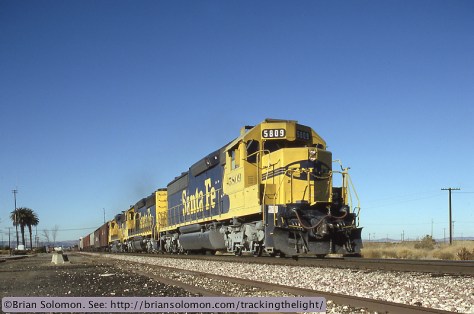
Santa Fe SD45-2 5809 thunders east with a freight at West Pittsburg, California in November 1990. Exposed on Kodachrome 25 film with a Nikon F3T with 35mm PC lens at f4 1/500th of a second.
It was a clear Saturday morning in the Bay Area, and Brian Jennison and I were on one of our jaunts looking at area railroads. We stopped near the old station location at West Pittsburg (no ‘h’), California. (I believe the palm trees in the distance are an indication of where the building once stood.) Here we photographed several trains.
For this eastward freight, I positioned the camera relatively low to the ground and raised the front element of the 35mm PC to near its maximum. I didn’t quite keep the camera level. The result includes a large amount of crystal blue sky, while minimizing the foreground and keeping the vertical elements of the lead locomotive nearly parallel with the image frame.
I feel the subtle effect allows the locomotive visually surge forward, seeming to charge along. This was my intent. Santa Fe 5809 is an SD45-2, a machine powered by EMD’s 3,600 hp 20-cylinder diesel.
In their heyday these were powerful machines that produced an awe inspiring low-base sound in the high-throttle positions. I hoped to convey that power visually while making use of the California sky.
Tracking the Light posts new material daily. Please spread the word and share Tracking the Light with anyone who may enjoy seeing it!
Thalys crosses Hollands Diep south of Dordrecht, The Netherlands in September 2013. Exposed using a Canon EOS 7D fitted with f2.8 200mm lens; ISO 800 f4 1/250 second.
I exposed this image of a Thalys at speed crossing a arched bridge over Hollands Diep minutes before the fading orange ball of the sun melted into North Sea coastal fog.
Thalys is an international high-speed train branding applied to services connecting Amsterdam-Brussels-Paris, and Köln-Brussels-Paris. Technologically speaking the train is a French-built TGV, but specially painted and decorated for Thalys services.
This was an evening run from Amsterdam to Paris. Hollands Diep is the coastal estuary fed by Rhein and Meuse Rivers. This bridge features a pronounced sweep up and over the water. Beyond it is an older (and busier) truss that has two main tracks for ordinary rail services (freight and passenger).
I panned this train with my Canon EOS 7D fitted with f2.8 200mm fixed telephoto. The light was fading rapidly, so I set the ISO to 800, adjusted the white balance manually and pre-focused in anticipation of the fast moving train. My exposure was f4 at 1/250 of a second.
Earlier in the evening I’d seen a Thalys fly across the bridge and I recognized that the structure of the bridge mimicked the paint scheme on the train, so I released the shutter to allow for an arching visual flow between train and bridge. This is accentuated by the low light.
In October 2007, I was working on my Railroad’s of Pennsylvania book, when Pat Yough and I made a very productive chase of Tioga Central’s excursion train, which operated, from Wellsboro Junction, Pennsylvania compass north along the old New York Central Fallbrook route (including over a Penn-Central-era line relocation).
An RS-1 wearing a Lehigh Valley-like livery leads a Tioga Central excursion north of Wellsboro Junction on October 7, 2007. I’d just bought a second-hand 24mm Canon lens from Thom Kinard, and this was a good opportunity to try it out on my Canon EOS 3 loaded with Fujichrome.
Back in the mid-1980s, I failed to take the opportunity to chase an empty Conrail coal train down the line south of Gang Mills Yard (near Corning, New York). At the time the line still went all the way to Newberry Junction, near Williamsport, Pennsylvania.
Conrail operated ENSY/SYEN (Enola-Syracuse) manifest trains on this route three days a week, plus unit coal trains.
I’d been standing at the bridge (now gone) at the east end of Conrail’s Gang Mills Yard. There were two trains coming. A westward double stack on the former Erie route, and a southward unit coal train heading down the Fallbrook. I opted to follow the stack train because I didn’t have a good map of Pennsylvania.
Six months later Conrail abandoned the Fallbrook as a through route, and lifted the line south of Wellsboro through the super-scenic Grand Canyon of Pennsylvania.
While, I’ve since chased Wellsboro & Corning freights and the Tioga Central excursion, I’ve always regretted my poor decision that day. A map, a map, my kingdom for a map!
An RS-1 wearing a Lehigh Valley-inspired livery leads a Tioga Central excursion north of Wellsboro Junction on October 7, 2007. I’d just bought a second-hand 24mm Canon lens from Thom Kinard, and this was a good opportunity to try it out on Canon EOS 3 loaded with Fujichrome.
It was a cold and snowy day when I drove from Rochester to Binghamton, New York in December 1986. I photographed several trains along the former Erie Southern Tier route.
In the afternoon, I made this study of a New York, Susquehanna & Western Alco RS-1 at the railroad’s Binghamton yard.
Exposed on 120 size Kodachrome 64 roll film with a Rollei Model T featuring an f3.5 75mm Zeiss Tessar lens.
I was using my dad’s Rollei Model T loaded with 120 Kodachrome 64. I had the camera fitted with a ‘Super Slide’ insert that gave me 16 rectangular frames per roll, roughly in the 645 format. Pop had bought the camera in Germany back in 1960.
I think its neat that my father had photographed Susquehanna’s RS-1s in passenger service more than 25 years earlier with the same camera. Since I was only 20 then, it seemed to me that the locomotives (and the Rollei) had been around since the dawn of time!
This batch of Kodak 120 Kodachrome had a tendency to color shift red, so after scanning I made some corrections in post processing. Other than that the image is extremely sharp. Scanned at 4800 dpi as TIF file this is nearly 250 MB. That’s an enormous amount of information.
I’ve always liked locomotive details. Some of my earliest efforts focused on engine shapes.
HAPPY BIRTHDAY POP!
Tracking the Light posts new material on this site almost everyday!
Please tell your friends and anyone who might enjoy the site to take a look.
By 1997, the QuebecCartier Railway was among the last places in North America where sets of six-motor Alco-designed diesels worked in heavy daily freight service.
Quebec Cartier Railway C-636 number 78 leads a southward ore train in July 1997. This locomotive was one of several Alco demonstrators acquired by the Cartier. Exposed on Kodachrome 25 with a Nikon N90S and f2.8-80-200mm zoom lens.
This is a remote and isolated line in northern Quebec that extends north from Port Cartier on the north shore of the Gulf of St. Lawrence into the wilderness of the Canadian Shield.
George Pitarys and Bill Linley organized a pilgrimage to photograph this remote operation. Getting there from Massachusetts was half the adventure. The two hour drive to George’s place was the first leg. We rented Ford Explorer at the Manchester, New Hampshire airport, then drove north for about 16 hours.
Along the way we collected Bill and fellow photographer Ian at the ferry terminal at Baie-Comeau (they were coming from Nova Scotia.) We stayed at Port Cartier overnight. Our first full day wasn’t blessed with the finest weather, so we focused on some railway activities nearer to Port Cartier, including a tour of the shops of the Quebec, North Shore & Labrador.
After that the skies cleared. To reach the scenic areas of the Quebec Cartier Railway requires a long drive on dirt roads into forest largely populated by swarms of man-eating black flies, thirsty mosquitoes and the occasional moose, but very little else.
Yet, our efforts paid off. We spent several very productive days photographing loaded and empty iron ore trains in the rugged scenery of northern Quebec. This view was made on our second morning.
Among Pioneer Valley’s early locomotives was Alco S-2 switcher number 106 which came to the line from sister Pinsly road Frankfort & Cincinnati. On October 12, 1984 it stands at Westfield, Massachusetts engine house ready for its trip to Holyoke and back.
I exposed this view of Pioneer Valley Railroad’s Alco S-2 switcher with my old Leica 3A on black & white film on October 12, 1984. On the same day, I’d arranged with the railroad to ride this locomotive to Holyoke and back.
It was a memorable trip. In Holyoke we worked the Graham branch that followed the banks of old canals. Several times we had to stop to open and close gates across the line.
I featured this photo in my recent book North American Locomotives that features railroad by railroad locomotive profiles of many different lines. In addition to the Class 1 carriers, I also profiled a variety of smaller lines, many of which are my personal favorites.