West Brompton Station on the District Line on April 19, 2013. Notice the larger size of cars used on the District and Circle lines as compared with Tube trains.
As a follow up to yesterday’s post (London Underground April 2013—Part 1), I’ve displayed a few more London Underground images made during last week’s trip. I first photographed the Underground at South Kensington back in early 1998, using my Nikon F3T loaded with Fuji slide film. By contrast, all of my images displayed here were exposed digitally, primarily with my Lumix LX-3, although I also made a few with my Canon EOS 7D.
Riding the Underground, what always strikes me is the continual warnings to ‘Mind the Gap!
At noon on April 19, 2013, a Bakerloo tube train approaches Willesden Junction. At this location Tube trains share tracks with Overground services. Exposed with a Canon EOS 7D fitted with 28-135mm Canon lens.
Trains fit two profiles, the older and larger profile such as that used by Circle, District, and Metropolitan Lines, and the later and lower profile used by ‘Tube’ services. These days many people refer to the whole of the Underground as the ‘Tube,’ (technically only the lines linking tunnels bored through deep clay which the lower profile trains use are ‘Tube lines’). Of course, in addition to subterranean routes, Underground trains also work surface lines and in some places share tracks with Overground and Network Rail trains.
A Metropolitan Line train catches the glint on the evening of Wednesday, April 17, 2013. Lumix LX-3 photo.
Underground Station at London’s Covent Garden, April 18, 2013. Lumix LX-3 photo.Signs boast of renovations and improvements to the Underground at Tottenham Court Road. Lumix LX-3 photo.
Caledonian Road Tube Station on the London‘s Piccadilly Line, April 19, 2013.
During 2013, London’s Underground network has been celebrating 150 years of service. This milestone is marked by posters and artwork around the network. For me the Underground is both a convenience and a subject for photography.
London Transport Poster celebrating 150 years of service on the Underground. Lumix LX-3 photo, exposed at Bank station on Sunday April 21, 2013.
The Underground is one of the world’s most complex and extensive railway rapid transit networks, and is well integrated with the rest of London transport.
Photographing on the Underground has its challenges. Space is often constrained, it tends to be dimly lit underground, and trains and platforms are nearly always crowded. The system boasts that it carries more than 1 Billion passengers annually! At times it seems that each and every one of these billion are in the way. Yet, the passengers are the reason for the system and often make for the most interesting images.
I’ve included a small selection of photos of the London Underground that I exposed over the last week. Most were made with my Lumix LX-3, which owing to its compact size and ease of use makes it my choice camera for making Underground images. Use of flash is prohibited; a tripod is impractical, so all of my images were made handheld with existing light.
Highbury&Islington Tube Station on the Piccadilly Line, April 19, 2013.London Underground Station at Leicester Square on April 22, 2013.Classic Underground mosiac on the wall of the Tube. Lumix LX-3 photo.
Perhaps London’s most impressive railway backdrop is the disused Battersea Park Power Station. It is among London’s industrial icons and famous for its portrayal on the cover of Pink Floyd’s 1977-album Animals.
A Southeast Trains EMU from Waterloo Station passes the Battersea Park Power Station on April 17, 2013. Exposed with a Canon EOS 7D fitted with 28-135mm lens.
This location was recommended to me from veterans of railway photography and I first photographed here in the year 2000. The vantage point is from the lightly used suburban station at Wandsworth Road. Until recently, this was served by a loop service connecting London Victoria and London Bridge terminals. Now, the Overground rail network (subject of a future post) serves Wandsworth road.
Trains stop here every 15 minutes on the run between Clapham Junction and Highbury&Islington stations.
Several lines converge at Wandsworth Road, and in addition to continual parade of suburban trains are a variety of freight moves. Until a few years ago, Eurostar high-speed trains passed on their way to and from Waterloo International. Now, Eurostar serves St. Pancras and take a different route through London.
Southeast Trains services glide along at Wandsworth Road, London on April 17, 2013. Digital image made with a Canon EOS 7D fitted with 28-135mm lens.
I made these images only an hour or so after landing at Heathrow. As I waited for trains, helicopters were circling as result of on-going funeral proceedings for Margaret Thatcher. Battersea closed as a generating station in 1983; ironic, isn’t it?
Sir George Gilbert Scott’s Midland Grand Hotel along Euston Road, London, on the afternoon of April 18, 2013. Exposed with a Lumix LX-3
I first visited London more than 15 years ago and since that time, I’ve revisited this dynamic city dozens of times. The impetus for last week’s visit was the opportunity to give an illustrated talk to the London-area Irish Railway Record Society. I made this image of St Pancras on my way to the talk, which was hosted at the Exmouth Arms near London’s Euston Station.
This magnificent structure is one of several important railway terminals along Euston Road. The massive ornate building was designed by Sir George Gilbert Scott, and historically served as both the St. Pancras head house and the Midland Grand Hotel. It remains one of London’s finest railway buildings. Beyond the head house is St Pancras’ immense balloon-style iron and glass train shed—the pioneer work of this type.
During my visit to London, I had the opportunity to explore the transport network. I found a variety of changes since my last trip to London, nearly two years ago. As one of the world’s great cities, London is undergoing a continual transformation. While elements of its past are incorporated in its new urban fabric, in each and every visit I find some things new and note some things forever lost. If nothing else, this keeps my cameras busy.
During this trip, I exposed more than 1000 digital images, and nearly 3 rolls of slide film. I plan to explore this material over the next few posts. Stay tuned!
I’ve featured Chicago & North Western 1385 in a number of books, including my American Steam Locomotive (published in 1998 by MBI), and Locomotive (published in 2001 by MBI) and most recently in Alco Locomotives (2009 by Voyageur Press).
This view from inside the cross-tender’s shack at North Freedom show’s Chicago & North Western 4-6-0 1385 pulling up to the water tank to take on water. I made this classic scene in February 1996, during Mid-Continent’s annual “Snowtrain” event. I featured this image in my American Steam Locomotive among other publications. It was exposed on Kodachrome with my Nikon F3T and a 28mm lens.
The locomotive is preserved at the Mid-Continent Railway Museum in North Freedom, Wisconsin, and was operated regularly when I lived in Wisconsin in the mid-1990s. My friend John Gruber had helped save the locomotive in the early 1960s, and it was his son Dick Gruber who introduced me to the engine when we worked for Pentrex Publishing.
Here’s an excerpt of my text from Locomotive on C&NW’s R-1 Class 4-6-0s:
If any one locomotive could be selected to represent Chicago & North Western’s steam power fleet, it would have to be the Class R-1 Ten Wheeler. In its day, the R-1 was the most common, and perhaps the most versatile locomotive on the railroad. A total of 325 R-1 were built, the most numerous type of any C&NW steam locomotive, and they were among the longest lived classes on the railroad as well.
During the last 15 years of the 19th century, C&NW amassed quite a variety of 4-6-0s. Most were products of the Schenectady Locomotive Works, in Schenectady, New York, but some were built by Baldwin.
Yesterday morning (Tuesday April 16, 2013) was sunny and warm, but very windy. Fluffy clouds raced across the sky casting shadows as the rolled along. This is always a tough situation when waiting for a train to pass. Often, it seems the desired train passes just as cloud obscures the sun.
I was lucky; a big cloud was just clearing as Irish Rail 080 exited the Phoenix Park Tunnel. There was more than a two-stop difference between the cloudy and sunny spots. With full bright sun, I caught Irish Rail’s ‘High Output Ballast’ (known on the railway as HOBS) passing Islandbridge Junction.
Canon EOS 7D with 40mm pancake lens, exposed at 1/500th second f7.1. In-camera Jpg and RAW files were made simultaneously. This is a scaled Jpg from the in-camera Jpg.
I made a few Fujichrome slides with my EOS 3 and some digital with the Canon EOS 7D. I’ll have to wait a few weeks for the slides, but here are my digital efforts.
Canon EOS 7D with 40mm pancake lens, exposed at 1/500th second f9.0. I made a spot decision to stop down from f7.1 to f9, based on the camera meter. With rapidly changing light and a moving train, I didn’t have time to consult the exposure histogram.Irish Rail HOBS at Islandbridge.
I’ll be presenting my illustrated talk “Ireland through American Eyes 1998-2008 My first Decade in Ireland” to the London area Irish Railway Record Society tomorrow, April 18, 2013.
The program begins at 1900 (7pm) upstairs at the Exmouth Arms, 1 Starcross Street, LONDON NW1, (advertised as a 5 minute walk from London’s Euston station). A nominal donation of £3.50 is asked of non-IRRS members (members £2.50)
Pan Am’s executive F’s lead Saturday’s (April 13, 2013) excursion at Boston’s North Station: ASA 200, f/5, 1/40th sec. jpegs at full size (super size RAWs files were exposed simultaneously, along with color slides in another camera).
The next two images are clips taken from a HDTV video of the run-by made with my Olympus PL1 ‘micro 4/3ds’ sensor, and a 14-42mm zoom lens (probably set at 14mm, f3.0)
The camera was mounted on mini Gitzo tripod. No people filter used — just luck and low angle!
East Portal, Hoosac Tunnel on April 13, 2013.If I had two more hands I could have taken still digital with my Lumix LX-7 that would have been much sharper. The clips are processed in ‘Levels’ with an un-sharp mask.
And finally a shot inside Boston & Maine’s 4.75-mile Hoosac Tunnel; Exposed at f/4, 1s, ASA 800, 15mm with zoom, with image stabilization mode ‘IS2,’ exposed from the rear platform of the Caritas.
Freshly painted Irish Rail 077 approaches Clontarf Road on the afternoon of April 11, 2013. This is the first of the repainted 071 class to leave Inchicore Works. Exposed digitally with a Canon EOS 7D and 28-135mm lens.
Freshly painted in the new Irish Rail livery, 071-class locomotive 92-60-0117077-4 (077) leads a Tara Mines zinc train at Clontarf Road in Dublin on its way to the North Wall. The locomotive is the first to leave Inchicore in the new livery. See: Tracking the Light’s extra post from April 10, 2013.
Irish Rail’s Tony Cooke and Amtrak’s Douglas Kydd at Heuston Station with Intercity Rail Car 22311. Lumix LX-3 photo.
Click here for views of Irish Rail 077 in the new livery!
I featured Dublin’s Heuston Station in my 2002 book, Railway Masterpieces. Here’s a an excerpt of my text:
Located near the Guinness Brewery along the south bank of the River Liffey, Dublin’s Heuston Station is a classic example of a railway terminal from the dawn of the railway age. Despite its age it still serves as one of the city’s primary railway stations and is among the oldest railway stations in continuous use in the world. Few stations have survived from the formative age of railways, and far fewer city terminals exist from this period.
“The Dublin terminal was formerly known as Kingsbridge and was renamed in 1966, along with many other stations in Ireland, as a commemoration of the 50th anniversary of the Easter Rising. At this time, railway stations were renamed in honor of participants in the Rising who had been executed by British authorities in the aftermath of the event, so this station is named for Sean Heuston.”
On April 9, 2013, I facilitated a short tour of Heuston for visiting Amtrak locomotive engineer Douglas Kydd who was on vacation in Ireland with his Fiancée. Among the highlights was the opportunity to inspect one Irish Rail’s newest trains.
Irish Rail 22311 and other 22K-series Intercity Railcars under the restored 1840s-era Heuston Station train shed. Lumix LX-3 photo.Irish Rail 22311 arrived in Ireland on August 17, 2012 and officially entered traffic on on December 20th last year. It retains the gloss and an aroma of a new car. Lumix LX-3 photo.
Extra! Extra! Irish Rail 077 in the new Livery makes one its first daylight runs.
Irish Rail locomotive number 0117077 leads a wagon transfer over the River Liffey at Islandbridge at 4:25pm on April 10, 2013. Canon EOS 7D with 28-135mm lens.
A few minutes ago, at 4:25 pm, April 10, 2013, I caught Irish Rail’s 071 class locomotive 0117077 working a wagon transfer from Inchicore to Dublin’s Northwall . While the locomotive has worn this new paint for about a month, today it finally left its sequester at Inchicore works. It was understood to have worked a trial to Sallins (on the Cork road) earlier in the day.
Irish Rail locomotive number 0117077 leads a wagon transfer over the River Liffey at Islandbridge at 4:25pm on April 10, 2013. Canon EOS 7D with 28-135mm lens.
The locomotive’s expanded number is intended to comply with European numbering conventions.
Irish Rail 0117077 leads a wagon transfer over the River Liffey at Islandbridge at 4:25pm on April 10, 2013. Canon EOS 7D with 28-135mm lens.
British Rail 9F 92214 approaches Goathland on the North Yorkshire Moors Railway on the morning of April 10, 2011. Exposed with a Canon 7D with 28-135mm zoom lens; ISO 200 f10 at 1/250th second. Metered manually.
British Steam:
Two years ago today, I was visiting Britain’s preserved North Yorkshire Moors Railway. This is an amazing operation. The railway is worked with a colorful mix of preserved steam and diesel locomotives. Trains work on a regular schedule, traversing the sublime Yorkshire Moors. In addition to beautifully restored stations and signal boxes (tower), the railway is well accessed by hiking trails. This location was recommended to me by a member of the railway’s station staff at Goathland—and is only 10-15 minute walk from the station platforms.
This was a pleasant place to spend a crisp Spring morning. I could hear locomotive 92214 barking up the grade for several minutes before it came around the bend into view. Later in the week I had business attending the annual London Book Fair, which while interesting and necessary, couldn’t compare to my brief experience on the North Yorkshire Moors!
The other evening I was at birthday party in Dublin’s old Harcourt Street Station where I noticed the passing of a purple advertising tram. Wednesday, April 3, 2013 dawned clear and bright, so during the course of my day, I took a spin down the LUAS Green Line, and intercepted this latest ad tram. I exposed digital photos with my Lumix LX3, while making a few slides with my old Nikon F3.
Alstom Citadis Tram in advertising livery arrives at Kilmacud on the LUAS Green Line, April 3, 2013.
LUAS Alstom Citadis Tram seen at St Stephens Green, Dublin.LUAS Alstom Citadis Tram seen at St Stephens Green, Dublin.
I’ll be presenting my illustrated talk “Ireland through American Eyes 1998-2008 My first Decade in Ireland” to the London area Irish Railway Record Society on April 18, 2013.
The program begins at 1900 (7pm) upstairs at the Exmouth Arms, 1 Starcross Street, LONDON NW1, (advertised as a 5 minute walk from London’s Euston station). A nominal donation of £3.50 is asked of non-IRRS members (members £2.50)
One of the advantages of the LX-3 are its multiple aspect ratios. For this photograph, I selected the 16:9 ratio for a panoramic view.
175th Anniversary Plandampf:
Three years ago, four of my Irish friends and I flew to Germany to witness 175th anniversary of German railway celebrations and excursions. This was truly spectacular and featured an ambitious excursion schedule focused on Trier in the Mosel Valley. While we were up early every morning it was impossible to catch all of the more than 100 special trains operated over the six day period in early April. The lines covered by excursions were all new to me, so prior to our arrival, I’d spent more than a week pouring over maps and satellite views.
Among the lines intensively worked was the heavily graded single track route east of Gerolstein toward Daun. Here, my map-work paid off, as I’d picked out this spot never having been there before. Our means of obtaining the location was a bit unorthodox; we drove up a lightly traveled unpaved trail, then uphill across a field to reach a fire-road then further up hill. Upon reaching the ridge, we found there was actually an easier means of getting here. Some German enthusiasts already on-site were bemused by our bold arrival. ‘You must have a great faith in God to come here that way,’ they said to me.
Using my Lumix LX-3, I made this image of Deutche Bahn Class 52 8134-0 working up the valley toward Daun. I also exposed a series of color slides on Fujichrome with my Canon EOS-3.
GS&WR 186 with Easter Eggspress at the Dalkey Tunnel April 1, 2013. Exposed with a Canon EOS 7D fitted with 28-135mm lens, ISO 800.
This morning (April 1, 2013), I rode Irish Rail’s Dublin Area Rapid Transit service from Dublin to Dalkey, and walked out via Sorrento and Vico Roads to an overlook on the old Dublin & South Eastern line near the Dalkey Tunnel. While I photographed the parade of passenger trains, my primary objective was to catch GS&WR 186 exiting the tunnel with the Railway Preservation Society Ireland’s Easter Eggspress.
I featured this 19th century 0-6-0 in my book Steam Power (published by Voyageur Press in 2009) on pages 158-159 and 180-181. While I’ve made many photos of this engine over the years, I wanted to catch it at least one last time, as it’s my understanding that the locomotive is due to be withdrawn soon and may not be returned to traffic in the near future.
Using two cameras, I exposed two parallel sequences of digital images, which required some ambidextrous action on my part. I positioned my Lumix LX3 on a pocket tripod, and operated this with my left hand, while with my right hand I worked my Canon EOS 7D with 28-135mm lens. Displayed here are selected results from both cameras.
Lumix LX3 wide angle view.
Just a reminder:
I’ll be presenting my illustrated talk “Ireland through American Eyes 1998-2008 My first Decade in Ireland” to the London area Irish Railway Record Society on April 18, 2013.
The program begins at 1900 (7pm) upstairs at the Exmouth Arms, 1 Starcross Street, LONDON NW1, (advertised as a 5 minute walk from London’s Euston station). A nominal donation of £3.50 is asked of non-IRRS members (members £2.50).
When I was visiting Brussels last weekend, I made a series of nocturnal images of the city and its transport. Below are a few of my favorites.
Brussels Central Station is largely below street level. Access to the platforms is via this modern ground level building. I exposed this image on the evening of March 22, 2013 using my Lumix LX3 set at ISO 80 in ‘A’ (aperture) mode with a +2/3 exposure over-ride (to compensate for the night sky and highlights from streetlights). The final exposure was f2.8 at 1 1/3 seconds.Sometimes it’s best to take an opportunistic approach to urban photography. I made this grab-shot with my Canon EOS 7D (fitted 28-135mm lens set at 5000 ISO) from the front seat of a Citroen Picasso paused at a set of traffic lights. Panning the tram using slow shutter speed minimizes the visual defects caused by shooting through a car window. The combination of twilight, streetlights, and motion make for a surrealistic image.A Brussels PCC tram glides along at dusk on March 24, 2013. Exposed with a Canon EOS 7D fitted with 28-135mm, set at ISO 5000 f3.5 1/30 second.
Making the most of a Belgian Rail-Freight Hotspot.
Mid-Morning on Friday March 22, 2013, I took a SNCB (Société National des Chemins de fer Belges—Belgian National Railways) local train from Antwerpen Centraal to a suburban station at Antwerpen Noorderdokken. This is an important junction north of central Antwerp, where routes toward Amsterdam diverge from the principal freight line to Antwerp Port.
An SNCB InterCity train led by a Class 18 Electric (built by Siemens) passes the station at Antwerpen Noorderdokken on March 22, 2013. While something less than a garden-spot, this busy junction is a great place to watch and photograph trains. Canon EOS 7D.SNCB diesels working light-engine pass Antwerpen Noorderdokken on the morning of March 22, 2013. In the foreground is the link to the new Antwerp-Amsterdam high-speed line. Lumix LX3.
I was following the recommendation of a friend who had previously explored this junction. As one of Europe’s busiest ports, Antwerp is a large source of rail freight, and this route is famous for both its volume and variety of traffic.
An SNCF Fret (French National Railways Freight) diesel leads a grain train toward Antwerp port. Canon EOS 7D.
In addition to SNCB’s freights, open access arrangements allow for a variety of private rail operators and other national railways to serve customers. In a little more than 4 hours, I witnessed nearly 35 freight moves (including light engines) under partly sunny skies. In addition I also photographed a dozen or so passenger trains.
An SNCB Class 18 electric with double-deck push-pull train races through Antwerpen Noorderdokken. Canon EOS 7D with 28-135mm lens set at 120mm, 1/60 second at f25.0. ISO 200. Hand-held pan with image-stabilizer disabled.
My preferred locations were in a field about a 15 minute walk from the Antwerpen Noorderdokken station. Here, the freight line makes a sweeping ‘S-bend’ that allows for a variety of angles favoring the light.
After 4 hours of intense photography, I was cold and hungry, so I retraced my steps and headed back toward Brussels. In addition to digital images exposed with my Canon EOS 7D and Lumix LX3, I also made a number of color slides with my Canon EOS-3.
A pair of CFL (Luxembourg National Railways) electrics lead a train carrying structural steel.
SNCB Vossloh diesels work a mixed freight toward Antwerp port.SNCB local glides towards its station stop at Antwerpen Noorderdokken.
Belgium’s jewel is among Europe’s most magnificent railway terminals.
Antwerpen Centraal, Belgium on March 22, 2013. Author Carroll Meeks (The Railroad Station, 1956), credits architect Louis de la Censerie with the station’s Art Nouveau style. Censerie’s ornate decoration and exceptional use of light makes Antwerpten Centraal one of Europe’s finest railway terminals. Photo exposed with a Panasonic Lumix LX-3.
On the morning of Friday March 22, 2013, I rode an SNCB (Société National des Chemins de fer Belges—Belgian National Railways) train from Brussels to Antwerpen Centraal (Antwerp Central Station). It was bright and sunny, a real contrast to my experience in Dublin on the previous day where it was cloudy, windy and raining.
I first visited Antwerpen Centraal in May 1996. Since that time this classic stub-end terminal has been transformed into a three-level railway intermodal center. Tracks on the lowest level permit through services without the need for trains to reverse direction as was previously required.
Looking straight up at the domed roof in Antwerpen Centraal, Belgium on March 22, 2013. Lumix LX-3.
The station head-house is among the most opulent and best kept anywhere in Europe, while the steeply pitched balloon train shed makes for a wonderful venue to photograph trains, its glass windows acting as enormous soft-box.
On Friday March 22nd, I had about 45 minutes at Antwerpen Centraal between trains. I used my time to good advantage and exposed a variety of digital images with my Lumix LX-3, and some Fuji Provia 100F with my Canon EOS-3. The film will be processed at a later time.
New SNCB electric multple-unit at Antwerpen Centraal, Belgium on March 22, 2013. Lumix LX-3.New SNCB electric multple-unit at Antwerpen Centraal, Belgium on March 22, 2013. Lumix LX-3.
The terminal is well-suited to the city center and connected to myriad destinations through an excellent public transport system operated by De Lijn. This includes a 1000mm gauge tram network that still hosts vintage President Conference Committee (PCC) streetcars.
PCC Streetcar near Antwerpen Centraal on March 22, 2013.
My layover at Antwerpen Centraal was a sideshow to my main effort: I was on my way to a location near Antwerp port where I was aiming to photograph freight trains. Keep your eye on this space for those images!
This time last week (Thursday March 21) I was getting ready to fly to Brussels. My bag was packed; my passport and tickets were organized. Then word came over the telegraph that an 071 was to work Irish Rail’s second Dublin-Ballina IWT Liner (International Warehousing and Transport)
As previously mentioned on Tracking the Light (see: Irish Rail at Clondalkin, February 21, 2013), Irish Rail runs a weekday container train between Dublin and Ballina. On Thursdays, traffic demands a second Dublin-Ballina train.
In recent months, Irish Rail has largely assigned its common 1994-1995 General Motors 201-Class diesels to this freight service, and the older General Motors 071-Class have only worked it infrequently. So, when I heard that Irish Rail 075 was on the train, I was keen to make some photos.
I had two hours before I needed to aim for Dublin Airport—plenty of time. On the downside, the weather wasn’t so cooperative. It was overcast, very windy, and spitting rain. Not my favorite conditions, but I’ll make photos in just about any circumstances. So, when my friend Colm O’Callaghan suggested we make the effort, I grabbed my travel bag and cameras and headed out the door.
This would require only a very short wait, or so we thought! When we arrived at Cherry Orchard, an industrial area in the west Dublin suburbs, the telegraph informed us that the second IWT was still in the yard at the North Wall. In other words, it hadn’t left yet, and was still at least 20 minutes away. An hour ticked by. In the mean time we caught the Ballina-Dublin ‘up IWT’ liner with a 201-class.
Then my phone rang; a client needed a photo immediately. A difficult proposition considering that the photo was buried on a hard-drive that I hadn’t planned to access for another week! My plans changed, I had to head home and address this request before making for the airport. My two-hour cushion had just been eroded. Still no IWT liner, and time was running out.
We gave up and were about to leave, when the telegraph came to life: the IWT had passed Islandbridge! It was on its way and not far off. Unfortunately, a clattering of passenger trains preceded it. Another 10 minutes gone. Finally, we heard the approaching roar of a 12-645 turbocharged diesel! Our perseverance paid off: 075 with the ‘down IWT’.
Irish Rail 075 leads the 2nd IWT Liner at Cherry Orchard on Thursday March 21, 2013. Photo exposed with a Canon EOS 7D with 28-135mm lens, contrast and color balance adjusted in Photoshop.Photo exposed with a Canon EOS 7D with 28-135mm lens, no post-processing adjustment, except for scaling.
I dashed home, sent off the requested photo, then made for Dublin Airport on the 747 Airport Bus. Stay tuned for my photographs of Belgian railways . . .
Trailing view of the 2nd IWT Liner at Cherry Orchard.
I’ll be presenting my illustrated talk “Ireland through American Eyes 1998-2008 My first Decade in Ireland” to the London area Irish Railway Record Society on April 18, 2013.
The program begins at 1900 (7pm) upstairs at the Exmouth Arms, 1 Starcross Street, LONDON NW1, (advertised as a 5 minute walk from London’s Euston station). A nominal donation of £3.50 is asked of non-IRRS members (members £2.50)
One year ago today (March 20, 2012), I made this rosy sunrise image at Pan Am Railway’s East Deerfield Yard (Massachusetts) using my Canon 7D fitted with an f2.8 200mm lens. East Deerfield has long been a favorite place to begin or finish a day’s photography. Its curved east-west orientation makes it ideal for working with sunrise and sunset. Plus as an operations hub, there’s often something on the move, or at least getting ready. The morning of March 20, 2012 was quiet enough, giving me time to make some interpretive views of the yard.
Looking toward the rising sun at East Deerfield Yard. Canon 7D fitted with an f2.8 200mm lens; ISO 200, f3.5 1/500th second.
On June 25, 2010, I used my Lumix LX-3 to expose this backlit image of an eastward BNSF intermodal train hugging the east bank of the Mississippi River near Savannah, Illinois. My vantage point is a limestone outcropping atop the bluffs in Illinois’ Mississippi Palisades State Park
This former Chicago, Burlington & Quincy double-track line is part of BNSF’s raceway between Chicago and the Twin Cities.
General Electric DASH9 locomotives lead a BNSF intermodal train along the Mississippi River on June 25, 2010.
I exposed the image in manual mode, using the camera meter to gauge exposure for the river to avoid blowing out the highlights in the water. I turned all the automatic features, (including the auto focus) ‘off’, thus giving me a virtually instantaneous shutter release that allowed me to neatly fill the frame.
One of the difficulties with many small cameras is a ‘shutter lag’—an undesirable delay from the time the shutter button is released and the actual moment the shutter opens. This unfortunate problem handicaps a photographer’s ability to capture the decisive moment and greatly limits the potential for railway action photography. For me one of great advantages of the Lumix LX-3 is the ability to disable automatic functions and thus obviate the problems associated with a delay. The other camera’s other great advantage is its Leica Vario-Summicron lens, noted for remarkable sharpness and clarity.
Wellington Testimonial viewed from Islandbridge Junction.
I made this image the other night using my Canon 7D with f2.0 100mm lens mounted on a miniature Gitzo tripod positioned on the wall near Islandbridge Junction—west of Heuston Station.
Dublin has lit many of its most prominent architecture for St Patrick’s Day. The Wellington Testimonial in the Phoenix Park is believed to be the tallest obelisk in Europe. In the mid-19th century, when the railway line was built below the park, engineers were concerned that if the line passed to near the monument, it might undermine the massive structure. As a result the Phoenix Park tunnel is ‘S’-shaped, and swings to the west of the obelisk’s base.
A pair of Bord na Mona laden peat trains revese upgrade on temporary track near Annaghmore, County Longford. To maintain adhesion, sand is applied to the rails.
Saturday, March 2, 2013, some of my Dublin friends and I made another foray to County Longford to explore Bord na Mona’s Lanesborough/Mountdillon narrow gauge railway network. As I mentioned in Irish Bog Railways; Part 2, this is one of several extensive Bord na Mona narrow gauge railway systems. This one primarily serves the Lough Ree Power Station along the River Shannon. (Last autumn, we explored Bord na Mona’s network focused on the Edenderry Power plant, see Irish Bog Railways; Part 1)
A coupled pair of laden Bord na Mona trains struggles upgrade, laying sand down as they ascend a short steep grade on the run back toward Mountdillon. This is the same stretch of track pictured in Irish Bog Railways–Part 2.
Unlike Irish mainline railways, Bord na Mona operates on very lightly built track. Temporary spurs are laid out on the bog for loading trains with harvested turf. While these temporary tracks may only stay in place for weeks or months, Bord na Mona main trunks are well established, with some in place for five decades. Key routes are built with broadly spaced double-track The nature of the operation requires that trains are run cautiously, and rarely exceed 15 mph. Typically peat trains operate in pairs to assist with loading and reverse moves. At times these may be coupled together. In addition to trains of peat gather rakes, Bord na Mona also runs a host of maintenance trains, including fueling trains used to supply machines working in harvesting areas.
A bustle in the hedgerow; near Lanesborough on March 2, 2013.
The railway’s setting ranges from bucolic rolling woodlands to other-worldly landscapes consisting of heavily harvested bog lands. Trains announce their presence by a distinctive clattering that pierces the relative serenity of the bog. The combination of diminutive locomotives, track panels with steel sleepers, short trains and sections of hastily built temporary track, makes the whole operation seem like a vast, but delightful model railway.
Gatekeeper gives a laden train a wave on March 2, 2013. Catching the flashing lights on the gates requires a bit of practice. Exposed with a Panasonic Lumix LX-3.
Saturday began dull and misty, but brightened toward the end of the day. I made several hundred images with my digital cameras, while exposing more than a roll of Fuji Provia 100F with my Canon EOS 7D. Our conversations with Bord na Mona staff, found them hospitable and knowledgeable. We returned to Dublin, happy with our day’s efforts while formulating plans for our next adventure on Ireland’s elusive 3-foot gauge railways.
Bord na Mona bridge at Mountdillon.Train driver holds recent issues of the Irish Railway Record Society Journal. This compact magazine covers contemporary and historical Irish railway topics including Bord na Mona operations. It is available through membership of the IRRS. See Irish Railway Record SocietyEmpty train negotiates a tight curve on the double track Bord na Mona line between Lanesborough and Mountdillon on March 2, 2013. Exposed with a Canon 7D.An afternoon view finds soft light on the Lough Ree Power Station at Lanesborough, County Longford. Bord na Mona’s operations on its Lanesborough railway network are largely focused on delivering peat to this plant. Other activities include operation of an ash train that takes away waste ash from the plant.Some blooming gorse adds a splash of color to a bleak landscape. Loading areas on the bog, offer open views of the trains in an austere otherworldly environment.
Broadstone Station, Dublin greets the new millennium. Rollei Model T with f3.5 75mm Zeiss Tessar lens.
Broadstone Station was the Dublin terminus of Ireland’s Midland & Great Western Railway. This enigmatic railway was built west from Dublin parallel to the suffering Royal Canal, and Broadstone Station was located adjacent to the existing Royal Canal basin in the north city center. M&GWR was among lines consolidated as Great Southern Railways in 1924, a move that sealed the fate of Broadstone; it was closed as a passenger terminal in 1936 (although tracks remained for freight services into the 1970s). The buildings survive as a Dublin Bus depot (garage). The old canal basin was filled in many years ago and is now car park. The canal bridge that once spanned the road adjacent to the station is remembered in period photos on the walls of neighborhood pubs. Soon rails will return to Broadstone in the form of a LUAS light rail extension.
Broadstone Station is a vestige of Irish railways long gone. The station was executed in an Egyptian revival style and completed in 1850. I find the building fascinating, yet difficult to photograph because it is hemmed in by the five inhibitors of urban railway photography: pavement, walls, fences, wires and unkempt brush. On a weekday, cars and buses surround the old structure, which lend to ironic images of a grand decayed station encircled by transport modes that contributed to its redundancy. Making a simple image that captures the grandeur of the station isn’t easy. Here are two of my efforts: one was made with my old Rollei Model T on 120 size black & white film on January 3, 2000. I exposed the other digitally last Tuesday afternoon (February 19, 2013) using my Canon 7D and 40mm pancake lens.
Dublin’s Broadstone Station, February 19, 2013. Exposed with Canon 7D fitted with 40mm pancake lens.
White tram at Bus Aras, Dublin. February 19, 2013. Canon 7D with 40mm pancake lens.
White tram near Bus Aras, Dublin. February 19, 2013. Canon 7D with 40mm pancake lens.
The majority of trams on Dublin’s LUAS network are dressed in light silvery lavender with yellow safety strips around the body of the cars roughly at headlight level. The yellow stripe was added after the 2004 LUAS start up. Every so often, a single tram is decorated in an advertising livery. Last autumn (2012) there was an attractive blue tram advertising a cable television service. The other day, I noticed an all white tram advertising a phone service. This is like the one red jellybean in a bag of black ones. It’s something to watch out for and relieves the monotony of an otherwise uniform fleet. For photography it opens up opportunity to catch something a little different. After all, what can white do that silver cannot?
Ordinary LUAS tram catches the glint at Bus Aras, Dublin. February 19, 2013. Canon 7D with 40mm pancake lens.
An Irish Rail six-piece Intercity Railcar works down road at milepost 4 1/4 near Clondalkin. Canon 7D with 100 f2.0 lens. ISO 200 1/500th second at f5.6.
This morning (February 21, 2013), Dublin dawned frosty and dull. On Thursdays, Irish Rail runs a pair of intermodal freight liners between Dublin port and Ballina, County Mayo for shipping company IWT (International Warehousing and Transport). Today, the first of the two IWT Liners (as the freights are generally known) departed the yards at the North Wall just after 9:31 am. As it was led by a common 201-class diesel and the weather remained especially dull outside, I opted to let it pass undocumented, as I’ve often photographed this train in nice light. The second train, however, was running with Irish Rail 074, one of the 1970s-era General Motors-built 071 class diesels, which is of greater interest to me. So this afternoon, my friend Colm O’Callaghan and I went to a favored spot near Clondalkin in the western suburbs at milepost 4 ¼ , where we waited patiently in Baltic conditions. While the temperature was a balmy 3 degrees Celsius (about 37 Fahrenheit), the biting wind and general dampness made it feel much colder. Just ten days ago I was out in much colder conditions at Palmer, Massachusetts (USA), where it was about -17 degrees Celsius (1 degree Fahrenheit), and it hadn’t felt so bad. There’s nothing like a raw Irish day to cut through you.
Irish Rail 074 leads the second Dublin-Ballina IWT liner near Clondalkin on February 21, 2013 at 1:20 pm. Canon 7D with 40mm pancake lens; ISO 200 1/500th at f5.0.
Clondalkin is on the short stretch of quad-track mainline between Cherry Orchard (no cherries near the place!) and Hazelhatch that was expanded from the old double-line at the end of the Celtic Tiger-era boom years. The slight curve at the end of a long tangent in an area of industrial estates makes for an interesting setting to capture trains on the roll. However, it isn’t the nicest place to stand around exposed on a cold day. Complicating photography are high palisade fences and other fencing on the bridge that requires some creative solutions to overcome. While waiting for the down IWT liner, we witnessed the usual parade of passenger trains, all running to time, on the new Irish Rail time table.
The mildly overcast conditions encouraged us to make a cross-lit view of the liner from the north side of the line, rather than the more traditional three-quarter angle from the south side. I like the north side view on a dull day because it offers a better angle on the quad track and signaling.
A Dublin LUAS tram hums along Benburb Street heading toward Heuston Station. The Easter-like colors on the tram make for a cool comparison with those in the background on the Museum of Decorative Arts & History in the old Collins Barracks. Canon 7D with 40mm pancake lens. ISO 200 f18 at 1/60th second. (Full frame without cropping or post processing adjustment except scaling for internet viewing.)
Practice panning. I’ve found this increases the ratio of success. Trams are good subjects for practicing. They come by a frequently and at regular intervals. They operate in urban environments with interesting backgrounds. If one set of pans isn’t satisfactory, no problem, there’ll be another tram along shortly. Also, trams tend to be double-ended, allowing opportunities for panning coming and going.
Dublin is blessed with a modern tram system. The LUAS is well suited (and aptly named— translated from the Irish roughly means ‘speed’) for panning. LUAS Citadis trams built are by Alstom, and are a standard European model. I find these reasonably photogenic, so far as trams go and they glide along smoothly. Over the years I’ve made a variety of LUAS pans. I exposed this pair of tram pans yesterday afternoon (February 18, 2013) along Dublin’s Benburb Street using my Canon 7D fitted with 40mm Pancake lens (which as result of the 7D’s smaller sensor size provides a 35mm film camera equivalent of about 60mm lens)
Here’s a few tips for making clean pan photos:
1) Use a 50mm lens or short telephoto. (Making pan photos with wide-angles and long telephotos is much more difficult)
2) Manually select a shutter speed between 1/15th and 1/60th of a second. (the longer the shutter is open, the greater the effect of blurring, but the harder it is to obtain a clean pan).
3) Make a series of experimental photos to practice the panning motion.
4) Pan by pivoting the entire body.
5) Pick a point in the frame to line up with the subject; try to hold the subject to that point during the entire pan.
6) Begin panning well before the subject is photographed and plan to continue panning until well after the shutter is released. Don’t stop suddenly.
7) If using an SLR/DSLR, plan on making a single frame and not a series of motor drive exposures. (The mirror flapping up and down is distracting and may simply result in a series of badly blurred images instead of a single sharp one).
8) Pay careful attention to the background and how it relates to your subject.
9) Repeat steps 1 to 8 as often as is practicable.
I’ll divulge a few more panning tricks in a later post.
A LUAS Tram passes the Millennium Bar on Benburb Street. This was the location of the well-publicized tram crash on September 10, 2012, that I featured in a post on that day. See: LUAS Tram Crash on Benburb, Street Dublin. Canon 7D with 40mm pancake lens. ISO 100 f18 at 1/15th second. (Full frame without cropping or post processing adjustment except scaling for internet viewing.)
Irish Rail ICR near Islandbridge, Dublin, February 18, 2013. Canon 7D with 40mm pancake lens; ISO 200, f11 at 1/30th second.
Here’s a panned view of an Irish Rail intercity railcar near Islandbridge, Dublin that I exposed a little while ago (February 18, 2013). A pan of a 22K-series ICR? No, this isn’t a litany of complaint regarding the common Rotem-built Irish Rail intercity vehicle. Rather, it’s an example of one of my favorite techniques for showing motion. I learned to pan from my father, who used the technique to compensate for slow speed Kodachrome film. In the early 1960s, he made some stunning rainy-day images of Pennsylvania Railroad’s Baldwin ‘Sharknose’ diesels working the New York & Long Branch. Check my Vintage Diesel Power by Voyageur Press to view some of these photos.
The trick to making a successful pan is to manually select a moderately slow shutter speed (1/15th to 1/60th of a second), then follow a train with the camera, gently releasing the shutter at an appropriate moment. I find that pivoting my whole body helps makes for smoother motion. Key to this exercise is planning to continue the panning motion after the shutter is released. Stopping too soon may result in unplanned blurring of the main subject. Also, I usually pick a fixed point in the frame to follow the front of the train. My Canon 7D has lines on the viewfinder screen that aids this effort. I’ll discuss the panning technique in greater detail in a future post.
Ireland’s Bord na Móna (Peat Board) was the topic of my post, Gallery 8: Irish Bog Railways—Part 1 in November 2012. Yesterday, February 16 2013, I made another exploratory trip into the bog. Where previous investigations focused on operations at Edenderry, County Offaly, this trip was to the network that serves the Lough Ree Power Station along the River Shannon at Lanesborough, County Longford. Among the peculiarities of Bord na Móna’s narrow gauge operations are its temporary sidings laid out on the bog for the purpose of loading trains. Until put in place, these tracks resemble those of an oversized model railway and are in fixed sections held together by steel sleepers (ties), and often stacked in piles awaiting installation. The bog itself is spongy and wet, thus ill suited to permanent infrastructure. Since temporary track is only used at very slow speed for short periods of time, niceties normally afforded railway lines, such as grading, leveling, and drainage, aren’t considered.
Bord na Móna feeder for temporary track near Mt Dillon, County Longford; exposed with a Canon 7D with f2.8 200mm lens; ISO 400, f4.5 1/640th second.
This telephoto view exaggerates the undulating quality of a roadside Bord na Mona spur used to access an area of bog ready for harvesting. This particular section of track may be left in place for years to tap short-lived harvesting spurs.
This photographic adventure is among my works in progress; I plan to display more images of Bord na Móna in upcoming posts.
For years, friends have asked my advice on camera exposure, typically on-site with a train bearing down on us. Politely, I’ll offer suggestions—based on conditions, but such advice can be deceiving since conditions change quickly. For my photography, I often refine exposure as the scene unfolds. A train entering a scene may alter my anticipated exposure, which requires subtle adjustments at the last moment.
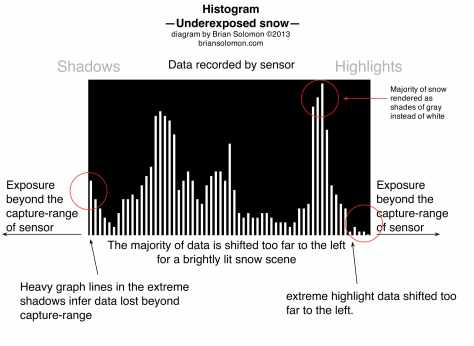
Using the camera’s histogram to judge exposure is part of my latest technique for refining exposure and making optimum use of the digital camera sensor. A histogram reflects exposure information collected by the sensor. This is displayed as a graph that offers exposure quantification: it shows the range of data recorded by the sensor and alludes to data lost. The histogram allows me to gauge when the scene is over- or under-exposed. It solves much of the guesswork previously necessary when shooting film, while providing real information by which to adjust future exposures. What it doesn’t tell me, is as important to what is displayed on the graph.
Using film, ‘over-exposure’ inferred that too much light reached the emulsion and resulted in an image that appears too bright, while ‘under exposure’ inferred that too little light, thus and a dark image. It was never as simple as that, but that’s good enough for the moment.
The advent of digital imaging combined with the ease of post-processing using digital technology has changed the definitions of exposure, so far as I’m concerned. I can now use information from camera sensor on-site to help capture the greatest amount of information.
This is not much different than my traditional approach to black & white photography. The new tools offered by modern digital cameras have altered my means for calculating exposure. More to the point; the need for obtaining desired visual balance between light and dark in-camera isn’t part of my exposure technique because the appearance of the exposed image in the thumbnail on the camera display doesn’t accurately reflect data collected, while the final image may be best refined after exposure.
Here’s a difference between film and digital: Film sensitivity is less definitive than with digital sensors; simply, the data accumulated during a digital exposure fits between definite parameters, while with film significantly more information may be retained than is readily visible to the naked eye. Beyond these limits with digital, data isn’t recorded (to the best of my understanding). Thus to obtain the greatest amount of visual information a digital exposure must be calculated to be carefully placed between the image’s deepest shadows and brightest highlights. The tool needed to gauge this decision is the camera’s histogram.
A histogram displays a series of lines progressing from dark to light. These lines reflect the number of pixels exposed in the various gradations. How this data is collected isn’t important for this exercise. Crucial, is the assessment of the histogram in order to make future exposures that don’t lose critical information in extreme highlight or shadow areas.
When I make snow photos, I expose in a manner to place the bulk of information toward the center of the graph. I pay close attention to highlight falloff. Losing detail in the brightest parts of distant clouds, or at the center of locomotive headlights isn’t a problem, but losing detail in snowy foreground is undesirable. Ideally, the graph will taper gently into the extremes, indicating the smallest degree of loss in the deepest shadows and brightest highlights.
The histogram is extremely useful when exposing bright snow scenes, because most camera automatic settings are not tuned to expose for large fields of white and tend to grossly misjudge a brightly lit and largely white scene. This typically results in under exposure which renders snow gray rather than white and, risks opaque shadows (a substantial loss of information). It renders many elements too dark (such as the train passing through the scene). However, a few modern digital cameras have ‘snow settings’ that should overcome these difficulties.
Before making my desired image sequence, I’ll make a series of test exposures to check the effect of camera settings. Based on information displayed by these graphs I’ll make exposure adjustments to place highlights and shadows appropriately. As my subject approaches, I’ll further refine my exposure by making adjustments in 1/3-stop increments. I’ll continue to compensate for exposure changes caused by the train entering the scene (including variations caused by locomotive headlights and ditch lights).
Displayed here are both hypothetical graphs to show how I read histograms, and images of the real graphs from my Canon 7D exposed in snowy scenes last Sunday, February 10, 2013. Both types of images are intended to illustrate how I’ve selected exposures.
I use the histogram feature all the time, but find it most useful in extreme situations. It has proved its value by eliminating uncertainties previously caused by the extremes of snow photography.
Some advice for the graph-adverse photographer working in snow: use the camera meter to gauge base exposure then override the meter by opening up by 2/3 of a stop (for example open from f11 to f9).
CSX light engines roll through CP83 at Palmer, Massachusetts on February 10, 2013.
I’m not talking about stripping down and running naked through the snow. That sounds like a recipe for frostbite, hypothermia or worse! Rather, I’m focused on how to best select exposure when working in winter situations. Snow is especially difficult to work with for several reasons. First, it’s abnormally bright and results in high contrast situations that is both difficult on the eyes and the camera sensor. Second, most camera meters aren’t designed to work with fields of white, so tend to recommend the wrong settings. Third, for many photographers, making images in snow is an infrequent experience, and one that tends to lead to uncertainty and higher rates of exposure error.
A blizzard blanketed the Berkshires with 3-4 feet of snow during second week of December 1992. On the morning of Dec 15, 1992, I caught a Conrail C36-7 leading a pair of SD40-2s on TV9 climbing westward through the deep cut at Washington, Massachusetts. While parking was difficult (drifts up to seven feet tall block all the usual spots, so I left the car in the road with its four-way lights flashing) the real challenge was selecting the best possible exposure for this backlit snow scene. The image was exposed using my Nikon F3T and f4.0 200mm lens. My exposure was about f5.6 1/250 second on Kodachrome 25.
My approach to snow photography stems from years of practice. In general, I take the information provided by camera meters as advisory. I rarely rely on automatic settings without some manual adjustment. Why? I’ve learned to carefully gauge exposure and apply settings manually. Furthermore, I’m distrustful of automatic metering, especially for railway photography, because the automation is programmed to deliver adequate imagery other than what I’m trying to achieve. Perhaps no other situation is as difficult for a common-meter to gauge as sunlit snow imaging.
Many years ago, my father lent me a Weston Master III, and instructed me to wander around the house making exposures and write them down. No photos were exposed. I was about nine and I found this exercise confusing and frustrating because I didn’t understand what I was supposed to be doing. However, I overcame frustration and learned to use the light meter. A decade later, I had the opportunity to learn Cibachrome printing (used to make vivid prints from color slides). At the time, I was primarily working with Kodachrome 25, which I’d been taught to nominally underexpose to produce more saturated colors.
Translating Kodachrome to Cibachrome was revealing; I’d found that my rich, slightly-underexposed slides, which when projected on a nice bright screen looked fantastic, were in fact rather difficult to print. The biggest issue was contrast. While under-exposure may have enhanced the color saturation, it also made the image more contrasty. So while it turned out that my old theory on underexposure had it flaws, I discovered that slightly overexposed slides printed very well. I needed to determine ideal exposures in order to make optimal slides.
Aiding my efforts was my notebook; I’d been recording my exposures for years, but with the Ciba exercise I began making even more detailed notes, recording slide exposures to the third of a stop. Eventually, I assembled a chart with ideal exposures for Kodachrome 25 in various lighting situations. In general, I’d discovered that to make prints, slides needed to be about 1/3 stop brighter than I’d been making them for projection. All very well, but what does this have to do with making digital images in the snow?
Exposing Kodachrome is history, but the lessons I learned from this material still apply. (The short answer to the question was that snow in bright daylight should be exposed at approximately 1 ½ stops down from the full daylight setting without snow; thus with Kodachrome 25, if my normal daylight setting was f4.5 1/250, my snow exposure was about f8 1/250 +/- 1/3 stop). Many of my slides have appeared in books, magazines, as well as here on Tracking the Light. Take a look at my recent book North American Locomotives for some top-notch printed reproductions of Kodachrome.
Digital photography offers some great advantages over Kodachrome, including the ability to review images on-site—thus removing the uncertainty of exposing slides and having to wait for days (or weeks) to see if your exposures were correct. It’s now easier than ever to make good snow exposures and learn immediately from miscalculation. Related to this is the ability to use a digital camera’s histogram as an on-site exposure tool.
Histogram? Yes! This is perhaps the greatest feature on my digital cameras. It allows me to set my exposure ideally, allowing key images to capture the greatest amount information, thus minimizing detail lost through unwanted under-or over-exposure. Positively invaluable when making images in the snow.
Sunday February 10, 2013, I made this image of New England Central GP38s climbing State Line Hill at the Route 32 crossing South Monson. Nearly 61 years ago, Bob Buck exposed an image of Central Vermont 2-8-0s 462 and 468 leading a southward freight from the same angle at this crossing. There were fewer trees back then! See page 66 of my North American Locomotives for a full page reproduction of Bob’s dramatic B&W photograph.
Today, before a train enters the scene, I’ll make a series of test exposures and judge them by the output of the histogram. This allows me to refine my exposure to a point that exceeds what I could have achieved with my detailed chart and Kodachrome. In my next post, I’ll detail this process with more examples.
On command, my Canon 7D offers a variety of useful information. Here’s the in-camera thumbnail of NECR’s GP38s crossing Rt32 in South Monson with relevant histogram as displayed on camera screen. Learning to interpret the graph is extremely useful in making exposures in difficult situations. While I’ve balanced the exposure to favor detail on the locomotives, I’ve managed to retain satisfactory levels of detail in the piles of snow both side of the tracks. The image was exposed using my Canon 40mm Pancake lens.
Shafts of morning sun illuminate exhaust from the Palmer yard office, while snow is blown from tracks at New England Central’s yard on February 10, 2013. Temperature = 0 Fahrenheit; image exposed digitally with a Canon 7D and 200mm lens; ISO 200.
The media loves storms; and they always have. New England’s first big snowfall of the on February 8th and 9th, seems to have made news everywhere. Friends from London called to say that the New England storm was a lead-in story on BBC.
New England Central at Washington Street, Monson—looking north before the storm, Friday February 8, 2013. Lumix LX-3 photo.Two days later: New England Central at Washington Street, Monson—looking north after the storm, Sunday February 10, 2013. Lumix LX-3 photo.
On the morning the snow began, I made a few photos at Washington Street in Monson with my Lumix LX-3 (for later comparison). Historically this was the site of Monson’s railway station, gone nearly 60 years now. Blankets of snow fell on Monson, Massachusetts through the day on Friday and into Saturday. I spent Saturday clearing off cars and whatnot, as you do after a heavy snowfall. The railroads were quiet, and a general ban on highway travel, plus dire road conditions discouraged me from going anywhere to make photos.
Churning blades of the snow-blower clearing Palmer yard. Canon 7D with 200mm lens.
Clearing New England Central’s Palmer Yard on February 10, 2013. Canon 7D with 200mm lens.New England Central’s Palmer Yard on February 10, 2013.
This morning (February 10, 2013) I aimed for Palmer, where it was clear and bright, but all of 1 degree Fahrenheit. Between 18 inches and 2 feet of snow covered the ground, with drifts several feet deep in places. Yes, it was a good dump, but not a record by my estimation. I’ve seen more snow.
Clearing New England Central’s yard was a bucket loader fitted with a snow blower. This made for a few impressive scenes, which I’ve tried to capture here. However, in general, traffic on the railways was quiet. CSX sent a set of light engines east. These stopped about a mile west of Palmer (milepost 84.5) because what I understood to be an axle problem with one of the General Electric locomotives. After a few minutes, these were on the move, and I made some views of CSX passing the old Palmer Union Station at CP83—now occupied by the Steaming Tender restaurant—a favorite eating place of mine.
Mid-morning on February 10, 2013, CSX light engines roll eastward passed CP83 in Palmer, Massachusetts. The old Palmer Union Station is now the Steaming Tender restaurant. Canon 7D with 28-135 zoom lens. Exposed at ISO 200 f10, 1/1000 second, metered manually.
About noon, New England Central dispatched a pair of GP38s south as ‘Extra 608’. Although once standard, today finding a pair of New England Central’s yellow and blue GP38s together is a rare treat. These ambled southward through Monson over Stateline Hill (so named because it crests near the Massachusetts-Connecticut border), which allowed ample opportunities for photographs. Extra 608 was destined for Willimantic to help clear the line and collect interchange left by the Providence & Worcester. All in all, this was a productive day for photography. I worked with my Lumix LX-3, Canon 7D, and Canon EOS-3. The Velvia 50 I exposed won’t be processed for a while; I’m on the big green bird tomorrow afternoon! Perhaps while traveling, I’ll write a detailed post on my experience exposing railway images in the snow.
New England Central extra 608 approaches Bridge Street in Monson, Massachusetts on February 10, 2013. Canon 7D with 100mm f2.0 lens.New England Central extra 608 at Stafford Springs, Connecticut on February 10, 2013. Lumix LX-3 photo.Trailing view of New England Central GP38s passing Stafford Springs, Connecticut. Canon 7D with 40mm pancake lens.
Braving frigid temperatures to take advantage of incredible low-light; on this day, three years ago (February 8, 2010), Pat Yough, Chris Guss & I were in Toronto photographing in suitably arctic conditions. Cold but clear—there’s a fantastic, surreal quality of light in sub-zero temperatures which can lead to great images if you chose to endure the conditions. Not, only were we up early, but the night before we spent an hour or more making night shots from the Bathurst Street Bridge. It didn’t get any warmer by daybreak, which we photographed from the lake front west of the city center. On that morning, after setting up the tripod, my numb hands only managed to record in my note book, “0646 [6:46 am]—ugg. Twilight—cold.”
View from Bathurst Street, Toronto approaching Midnight on February 7, 2010. Lumix LX-3 time exposure.Sunrise on Lake Ontario, February 8, 2010. Lumix LX-3 on tripod.
While we made an intense tour of Toronto area railroading, among the most memorable images were those exposed toward the end of daylight near Queensway & King Streets along the Canadian National quad-track line west of Union Station. This is one of the busiest lines in Canada, and hosts a flurry of trains at rush hour. For me the highlight was a pair of in-bound GO Transit trains with new MP40PHs running side-by-side as the sun hugged the horizon over lake Ontario. A few minutes later, I scored a VIA train gliding under a signal bridge in last glint of sunlight. At the time, I was still working primarily with film, and I kept both Canon EOS-3s busy. One was fitted with my 100-400 IS zoom, the other with a 24mm AF lens. The only digital camera I had was my Lumix LX-3, which I learned tends to chew through battery power in sub-zero conditions. By the end of the day, I’d drained three full batteries. The McDonalds on King Street made for a nice place to thaw hands on cups of hot chocolate while watching TTC’s trams glide by at dusk. On the way back we swung by Niagara Falls, my first visit to the famous waterfall, despite having photographed trains crossing the gorge on several occasions over the years.
Eastward GO Transit trains near Sunnyside at sunset on February 8, 2010. Canon EOS-3 with 100-400 zoom; Fujichrome RVP-100, exposure not recorded.Eastward GO Transit trains near Sunnyside at sunset on February 8, 2010. Canon EOS-3 with 24mm lens; Fujichrome RVP-100, exposure not recorded.Eastward VIA Rail train approaches Sunnyside at sunset on February 8, 2010. Canon EOS-3 with 100-400 zoom; Fujichrome RVP-100, exposure not recorded.View of TTC streetcar on King Street from McDonalds on corner of Roncesvalles Avenue and Queen at dusk on February 8, 2010. Lumix LX-3 ISO 80 at f2.8.TTC Streetcar at corner of King and Queen Streets, Sunnyside, Toronto, February 8, 2010. Lumix LX-3 set at ISO 80.Time exposure of Niagara Falls from the Ontario side. Exposed digitally with a Lumix LX-3 on a Bogan tripod.
Yesterday, January 25, 2013 proved to be a productive day for photography. My friend and fellow photographer Pat Yough had come up for the annual Amherst Railway Society ‘Big Railroad Hobby Show’ at the ‘Big E’ in West Springfield, Massachusetts, and as this was the day before the show we spent the day photographing around Palmer, Massachusetts. I hadn’t intended to specifically make grade crossing photos, but as I was reviewing my results, I noted this as the theme to the day’s photography. I’ve included a few here.
Mass-Central’s weekday freight led by NW5 2100 crosses Route 181 in Palmer, Massachusetts on the morning of January 25, 2013. First out at the crossing is the company HyRail truck. Canon 7D with 40mm Pancake Lens; ISO 200 1/250th second at f4.5. In camera JPG without modification to the file except for scaling for web. A RAW image was exposed in parallel with the Jpg.
Grade crossings offer interesting venues to photograph trains; here modes cross and so this provides opportunities to picture the railroad in its environment. For many observers, the grade crossing is the only place where they see trains. Unfortunately, crossings are not always merely benign interfaces. In a world with seemingly infinite distractions, to the non-enthusiast it might seem that a train appears out of nowhere and crosses the road. Nor does everyone find the same thrill of watching a train a crossing. More startling is when a motorist sails through a crossing, oblivious to tonnage bearing down upon them. The results don’t always favor the hapless. Ironically, waiting for me when I got home yesterday was the link to a recent video of truck-train collision on the Vermont Rail System that occurred a few days ago.
Near the Massachusetts-Connecticut Stateline, New England Central’s former Central Vermont Railway mainline cross Route 32 (which runs from Keene, New Hampshire via Palmer and Monson, Massachusetts to New London, Connecticut). Just north of the stateline New England Central freight 608 crosses Route 32 southbound on January 25, 2013. Canon 7D with 100mm lens; ISO 400 1/500th second at f9.0New England Central GP38 3850 leads train 608 at Stafford Springs on January 25, 2013. A series of difficult crossings in Stafford Springs is the primary reason for a 10 mph slow order through town. Especially difficult is this crossing, where the view of the tracks is blocked by a brick-building. Protection is offered by a combination of grade crossing flashers and traffic lights. Canon 7D with 40mm Pancake Lens; ISO 400 1/500th second at f8.0. In camera JPG modified with slight cropping to correct level and scaling for web. A RAW image was exposed simultaneously with the Jpg.
East Deerfield Yard during a snow squall on the evening of January 21, 2013. Photo exposed with a Canon 7D and 100mm f2.0 telephoto lens mounted on a Bogan tripod; ISO 200 set a f4.0 for 21 seconds.
It’s been a long time since the old tower at the west-end of Pan Am Southern’s former Boston & Maine yard served as intended. Yet it survives as a landmark and lends to the heritage of the place. I’ve photographed this building many times over the years; by day, by night, by sun, and in the fog. This Monday evening (January 21, 2013), I exposed a few time exposures during a snow-squall. The lightly falling snow diffused the light from the yard making for an eerie glow—a quality of light well suited to night-photography. Finding a focus-point in the dark was a challenge, as was remaining out in the frosty evening while the camera exposed the photos.
Pan Am 610 leads symbol freight POED west at the Groton-Harvard Road crossing near Flannagan’s in Ayer, Massachusetts on the afternoon of January 17, 2013. Exposed with my Canon 7D with 28-135mm lens, set at 135mm; 200 ISO f8.0 1/500th; in camera Jpg, no adjustments except for scaling.
Yesterday (January 17, 2013), Rich Reed and I spent a productive day photographing along the old Boston & Maine. B&M to Pan Am: a traditional New England road, Boston & Maine was melded in to Guilford Transportation Industries in 1982. Guilford acquired the rights to Pan American Airways in 1998, and during 2005-2006 the railroad became known as Pan Am Railways. In 2008, the railway engaged in a joint venture with Norfolk Southern involving the former Boston & Maine route (now coined the ‘Patriot Corridor’) between greater Albany, New York and suburban Boston. As a result, Norfolk Southern locomotives are usual assigned to intermodal and automotive traffic operating over the old B&M route; in addition Pan Am operates a pair of through freights in conjunction with CSX between Portland, Maine and CSX’s Selkirk, New York yard (Pan-Am’s symbols SEPO/POSE; CSX’s Q426/Q427). These typically operate with CSX locomotives. Other traffic includes, coal trains originating on Providence & Worcester and traveling north via Pan Am rails to Bow, New Hampshire which run with P&W’s locomotives. Pan Am runs a few trains with its own locomotives; however while a number of Pan Am’s locomotives have been painted for the railroad, a good number of older locomotives still serve the railroad in Guilford paint.
The long and short of this essay is that lately, I’ve found it challenging to photograph Pan Am painted locomotives hauling trains on their own line, since the predominance of daylight traffic tends to feature locomotives from other lines. Yesterday, we caught six symbol freights, one of which was the westward POED (Portland, Maine to East Deerfield, Massachusetts), which was led by Pan Railways 610, a former Southern Pacific SD45 rebuilt to SD40-2 specs. Pan Am on Pan Am! Yea!
Pan Am 610 with POED at Shirley, Massachusetts. Canon 7D with 28-135mm lens, set at 33mm; 200 ISO f7.0 1/500th. Photo scaled from in-camera JPG file; compare this image with adjusted RAW file below.Pan Am 610 with POED at Shirley; this is a camera RAW image, adjusted using Photoshop to compensate for exposure (specifically to better retain detail in the snow, sky, and shadow areas), with nominal adjustments in color balance and edge sharpening.