Author of more than 70 books on railways, photography, and Ireland, Brian lives with his wife, Kris, in Lancaster County, Pennsylvania. Brian holds a BFA in Photographic Illustration from the Rochester Institute of Technology. In 2022, he was presented with the Railway & Locomotive Historical Society’s prestigious Fred A.& Jane R. Stindt Photography Award for his lifetime achievements in railroad photography.
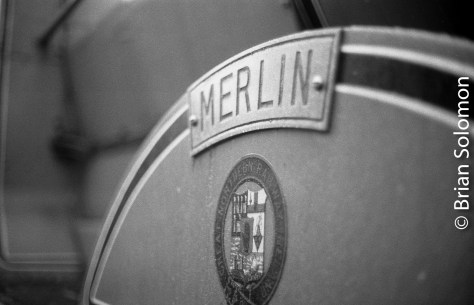
It’s undoubtedly all wrong. It was nearly dark and raining steadily when I exposed these photos of former Great Northern Railway (of Ireland) V-Class 4-4-0 number 85 Merlin at Lisburn.
This is a follow up post from my digital views of the same evening titled Steam in the Rain: RPSI Steam & Jazz at Lisburn—25 August, 2017 that appeared on Tracking the Light a couple of weeks ago. Honer Travers had brought me down to Lisburn to watch 85 arrive and introduce me to the crew.
Working in low light, exposed these photos on Fomapan 100 Classic using my battle worn Nikon F3 with an old non-AI f1.4 50mm lens.
My exposure times ranged from 1/30th to 1/8th of a second, and all photos were made handheld. I processed the film in Ilford Perceptol stock solution for 5 minutes 45 seconds at 71 degrees F.
By panning vertically I aimed to convey a sense of motion. Notice that the buffer beam on 85 is sharp.Trailing view at the footbridge in Lisburn.
1/8th of second at f2.
By using the lens wide open, I was working with shallow depth of field and a comparatively soft overall view. While the slow shutter speed allowed for motion blur. These are not conditions conductive to making razor sharp images. So I had no intentions of doing so.
Sometimes making softer, more interpretive images better conveys the spirit of the scene than clinically sharp images with over the shoulder light.
Here’s another view that won’t appear in my book on European Railway travel. (Are you missing the mist? Facebook viewers will need to click on the post to get the whole picture).
I’m just days away from submitting my final chapters.
Believe it or not, I substituted a film photo from this same location for consideration in the book instead of this digital photo.
Why?
I felt the film image captured the scene more effectively.
This is a digital photo at the three-level Biaschina Loops; for the book I went with a film photo of an SBB Re4-4 at the same spot.
I like the way the mist and rain add depth to this famous location at the Biaschina Loops on the south slope of Switzerland’s Gottard Pass.
Think about it? How many different type of light will you work with?
I know a fair few sunny-day photographers. No sun, no photo.
I know others who only come out at night.
I have my favorite types of light and preferred angles, but I’ll photograph in a variety of situations.
There’s your old standby; ‘over the shoulder three-quarter sun’.
But there’s lots of types of sun and angles; clear cloudless mid-morning sun is nice; how about side-lit midday sun? Or hazy backlit sun?
Hazy cross-lit sun with white sky.
Then there’s; low sun, glint, and the full back-lit sunset silhouette.
Of course with glint, you can subdivide it any number of ways; hard glint (silver glint), soft glint, golden glint, etc.
Likewise with overcast lighting. Not all cloudy days cast the same light.
Perhaps the most difficult is when the darkest cloud is above you and the rails glisten silver and the sky is white (but bright) off in the distance.
Then there’s rain; light rain, hard rain, driving rain, and ‘#@*#@@!!!! what am I doing out in this?!’ rain. Then there’s; sun and rain, and rainbow with dark sky.
Also; light falling snow, falling powdery snow, heavy falling snow, and one of my favorites; heavy falling snow with cross-lit sun’.
Then the next day: light snow on ground, heavy snow on ground, VERY heavy snow on ground. Then after it warms up; dead dirty snow.
Evening dusk with a hint of blue; evening dusk with stars twinkling. Evening dusk with comet (I’ve got it!), and even better, morning twilight with comet (got that too).
Then you have your mists and fogs; light fog, heavy fog, and mist clinging to top of hill in distance with full morning sun in foreground (another old favorite).
Night with stars; night with half moon, night with full moon; sodium vapor light, mercury vapor light; florescent light; incandescent light; and mixed electric light.
I like some of the specialized lighting effects such as ‘cathedral light’ where daylight is allowed to pierce shadows indirectly from the side, with no direct daylight in the scene. (Best accomplished in a snow shed, under a highway bridge, or in a train shed.)
There’s; train lost in shadow of its own exhaust backlit by rising sun.
And; everything in scene covered in hoar frost, backlit by rising run.
Not to mention; train in silhouette against fog bank in front of hill backlit by rising sun.
There’s more, but I bet I’ve lost some readers already.
Tracking the Light Discusses Photography Everyday.
I realize that today’s title might not catch everyone’s eye.
How about: ‘Clean GM Diesel on a Freight’?
Or, ‘Irish Rail at Rush Hour’ ?
‘Gullet Glint’?
Anyway, this post is about light.
I was waiting on the Up IWT liner (International Warehousing & Transport Ballina, County Mayo to Dublin Northwall container train)with recently painted Irish Rail 071 class diesel number 082.
Just ahead of this Dublin-bound freight was the Up-Galway passenger train with a common set of ICRs (InterCity Railcars).
I was photographing into the sun. My intent was to work the glint effect. (That’s when the sun reflects off the side of the train).
Usually, I find this is most effective when you shade the front element of the lens to minimize flare. Notice the two variations with the ICR.
By shading the front element I’ve prevented the rays of the sun from directly hitting the front element of my lens, thus minimizing the effects of flare.In this view, exposed moments after the photo above, I’ve allowed the sun to hit the front element to show the effects of flare. This small adjustment can produce very different results. Often I aim to control the amount of flare; a little bit lightens shadows and adds some colour to the scene but too much can result in unpleasant and unnatural looking light streaks or light fog.
By the time the freight reached me clouds had partly shaded the sun leaving only a hint of back-lighting.
All the photos were made using my FujiFilm XT1 with 90mm f2.0 lens. The camera RAW Files were all adjusted for colour balance, colour saturation and contrast using the same ratio of change. (In other words, although I’ve manipulated the final result, all the photos have received the same degree of alteration).
The clouds shaded the sun for me here.In this image, I adjust the exposure on site to compensate for the clouds blocking the sun.
I had a few minutes between trains at Belfast Central, so in the interval I made a few photos with my Lumix LX7.
To compensate for less than ideal lighting I made nominal adjustments to the RAW files in post processing using Light room.
Essentially I lightened the shadows, brought down the highlights in the sky, and boosted colour saturation while slightly increasing overall contrast.
Douglas Adams once wrote something to the effect: ‘There’s no language that has a word that means “as pretty as an airport”‘.An inbound NI Railways train.Red ‘tail lamps’ indicate that this is a trailing view.NI Railways 8209 on the Belfast-Dublin Enterprise.No flash was used in the exposing of this photo.
Last week Irish Rail class 071 worked the IWT Liner.
Dressed in the 1970s-era heritage livery, this locomotive has been a popular topic with local photographers.
The bright orange locomotive glistens even on a dull day.
Digital photograph exposed using a FujiFilm XT1 with 27mm lens.
I exposed this view on Friday (1September 2017) from Conyngham Road in Dublin (at the entrance to the Phoenix Park Tunnel) using my FujiFilm XT1 with 27mm pancake lens.
A few days ago, my daily Tracking the Light post featured a long distance telephoto view of Irish Rail’s Tara Mines zinc ore train crossing the Malahide causeway.
In that photo the train is relatively small in a big scene.
Three days later, David Hegarty and I were again out along the old Great Northern line, this time at Drogheda, to photograph the Tara Mines on the move.
In contrast to the distant view in the earlier posting, the photographs displayed here focus tightly on the locomotive and train using more classic three-quarter angle.
In the top photograph, I used my FujiFilm XT1 with a 90mm fixed telephoto for a tight compressed view (what some photographers might term a ‘telewedgie’).
While in bottom photograph I used my Lumix LX7 with zoom lens set with a wide-angle perspective that approximates the angle of view offered by a 35mm focal length lens on a traditional 35mm film camera.
Exposed using a FujiFilm XT1 with 90mm fixed telephoto lens. Notice the crossovers located on curved track.Lumix LX7 wide view.
I prefer the telephoto view for overall appeal; this handles the soft lighting conditions more satisfactorily, focuses more closely on the locomotive and train, minimizes bland elements of the scene such as the ballast and white sky, and offers a high impact image of the train in motion. Also it helps emphasize the trackage arrangement with crossovers between the up and down lines.
Tracking the Light Discusses Railway Photography Daily.
Irish Rail’s quad-track line southwest of Dublin is a popular place for photos.
Last week, Colm O’Callaghan and I made a trip down to Hazlehatch to make photos of trains on the move in the afternoon.
Belmond’s Grand Hibernian was passing down road when Colm said to me, ‘Quick, it’s the inspection car’. I had only a few seconds. I turned around and with little time to compose I fired off a few frames.
Both the train and the inspection car were in motion.
FujiFilm XT1 photograph at Hazlehatch. The fifth line in the center serves a stub-end track to a bay platform at Hazlehatch station.
Only see one photo? That’s because you are not viewing this post on Tracking the Light (Hint: click the link).
Irish Rail maintains its 29000-series diesel railcars (built by CAF) at its Drogheda Depot.
Back in Janaury 2003 I photographed the very first of these trains being lifted out of the boat at Dublin port. (Thanks to the late Norman McAdams who had encouraged me to be dockside to make photos for the Irish Railway Record Society Journal).
I was reminded of that event while crossing the now disused trackage (half paved over) by the old Point Depot along the north Liffey Quays near where I made my photos.
These images were exposed last week at Drogheda using my digital cameras.
Exposed using my Lumix LX7. Notice Irish Rail’s Tara Mines train at the upper left.Irish Rail 29000s by the dozen! FujiFilm XT1 photo.Lumix LX7 photo looking toward Dublin.Lumix LX7 photo.FujiFilm XT1 photo.
There’s a lightly used road bridge over Irish Rail’s old Great Northern line south of the former station at Mosney that offers a clean view in both directions.
The Irish Sea is in the distance to the east.
A week ago David Hegarty and I spent a few hours here making photos of passing trains.
The Enterprise is a cross-border service connecting Belfast and Dublin. Trains are arranged in a push-pull configuration with the locomotive at the Belfast-end. Exposed at 1/1000th of a second to minimize motion blur.Trailing view: Exposed at 1/1000th of a second to minimize motion blur.
I made these views using my FujiFilm XT1 fitted with a fixed focal length 27mm pancake lens, which offers an angle of view rough equivalent to a 41mm lens on a traditional 35mm film camera. In other words it is a slightly wide-angle perspective.
On the morning of 25 August 2017, David Hegarty and I were in position at Malahide looking toward the old Great Northern Railway causeway to photograph a laden Tara Mines Zinc Ore Train led by Irish Rail class 071 locomotive number 077.
I liked this location because it allowed me to picture the whole train in a scenic setting. As you can see the Tara Mines train is very short as demonstrated in this broad-side view (if you are viewing on FB you may need to click on Tracking the Light for the full photo).
Exposed digitally using a FujiFilm XT1 fitted with an f2.0 90mm fixed telephoto.
To make this work I used a medium telephoto and then in post processing cropped the extraneous portions of the sky and water at top and bottom of the image.
I also altered contrast, colour balance and colour saturation.
I’m not fully satisfied though, because the dark locomotive and dull wagons with relatively flat lighting tend to get lost in the overall scene.
Tracking the Light Explores Photographic Technique Daily.
Lisburn is a surviving gem among old Great Northern Railway stations in Northern Ireland.
RPSI’s steam crew apologized for the weather, but there was no need. Steam locomotives make for excellent subjects when photographed at dusk in the rain.
This was my reunion with Railway Preservation Society of Ireland’s engine 85, a Great Northern compound 4-4-0.
Great Northern Railway (of Ireland) engine 85 is named Merlin. It was one of five V-class compounds, all of which were named for birds of prey.
Honer Travers arranged my visit to Lisburn to witness the arrival of the scheduled Steam & Jazz special from Belfast, and introduced me to members of the crew (some of whom I’d met on previous occasions).
Working with three cameras, I made dozens of atmospheric images in the course of about 15 minutes. These photos were made digitally with my FujiFilm XT1 and Panasonic Lumic LX7. In addition, I exposed a handful of black & white photos using a Nikon loaded with Fomapan Classic.
RPSI’s Steam & Jazz excursion arrives from Belfast in a steadily drizzling rain.Cold, windy, wet and dark, but great for atmospheric photos. It helps to have a FAST lens, in this case an f2.0 90mm Fujinon telephoto.Number 85 runs around at Lisburn. Fuji XT1 photo.Exposed with a FujiFilm XT1, notice the effect of shallow depth of field and selective focus.Lumix LX7 photo at Lisburn.
Belmond is a high-end tour train operator that since 2016 has served Ireland with its Grand Hibernian sleeping car train.
This has been a popular topic for railway photographers as it represented a return of the Mark 3 carriage to Irish rails and makes for a decidedly different passenger train in contrast with Irish Rail’s regularly scheduled services.
Yet, as previously mentioned on Tracking the Light, the train itself is challenging to capture in images owing to its largely unbroken dark navy-blue paint.
In dull light this looks nearly black.
I’ve found that the most effective photographs of the Belmond Grand Hibernian are made in bright sunlight.
These views were exposed at ‘the Gullet’ west of Dublin’s Heuston Station. One was made with my Lumix LX7 with the Vivid colour profile; the other two with my FujiFilm X-T1 using the Velvia colour profile.
Belmond’s Grand Hibernian exposed using a FujIFilm X-T1 digital camera with fixed 90mm lens.A view of the same train exposed moments later with my Panasonic Lumix LX7.On Saturdays the Belmond train is shunted in the Gullet in order to move it from Heuston Station to Dublin Connolly. This requires another locomotive to couple to the back of the train and haul it via the Phoenix Park Tunnel. Notice the changeable lighting conditions and how that affects the appearance of the navy-blue paint. Exposed using a FujIFilm X-T1 digital camera with fixed 90mm lens.
Files were scaled in Lightroom for internet presentation, but were not altered in post processing in regards to exposure, colour balance, colour temperature or contrast.
Making the most of the moment: Using my Lumix LX7 I exposed this photograph of an Irish Rail 29000-series CAF-build diesel railcar crossing Dublin’s Loop Line at Gardner Street a few days ago.
The old Belfast & Northern Counties Railway Derry Station is adjacent to the contemporary Translink/NI Railways’ station.
Where the modern station is a functional utilitarian facility with all the charm of a small town bus station, the old station sits as an elegant vestige of former times when a railway station was viewed as a city gateway and endowed with suitable architecture.
Maybe someday the old station building will be a station again?
It had been a long time since I’d last traveled NIR’s Belfast to Derry railway line (in the original version of this post, I’d described this as the ‘Derry Road’ but several readers wrote into correct me, as the phrase ‘Derry Road’ refers to the long abandoned GNR route to Derry and not the present NIR line), and while I’ve been over the whole line between Derry and Belfast in stages, I’d never before actually traveled all the way from Belfast to Derry.
So, two weeks ago, Honer Travers and I organized a day out to Derry. We began our rail journey at Lisburn and traveled to Belfast Great Victoria Street where we changed trains.
After a wander in Derry, we returned by rail the way we had come.
I made these photos using my Lumix LX7.
Interior view of a 4000-series CAF train.Holding the Lumix above my head I made this interior view.Interior view of a 4000-series CAF train.Rolling toward Derry, Northern Ireland.Interior view of a 4000-series CAF train. Although only moderately busy when we departed Belfast, by the time the train arrived at Derry it was packed.Outside NI Railways’ Derry station.An NI-Railways train rolls along the Foyle on its return trip to Belfast. In the distance is Derry’s Peace Bridge.View of the line along the Foyle looking toward Derry’s station from the Peace Bridge. Would this be a better photo with a train?A panoramic composite photo exposed with my Lumix LX7 from the platform at Derry.
Irish Rail’s class 201 General Motors-built diesel-electric number 215 (now technically 92 60 02 10215-6) was recently repainted in fresh green and silver paint.
Over the last few days I had several opportunities to photograph this locomotive up-close, allowing for some detailed images.
Here’s a selection of Lumix LX7 views.
Irish Rail 215 works the back of a Mark 4 set on approach to Heuston Station Dublin.Irish Rail 215 at Dublin’s Heuston Station. Lumix LX7 digital photo.Irish Rail 215 at Dublin’s Heuston Station. Lumix LX7 digital photo.Irish Rail 215 at Kent Station, Cork. Lumix LX7 digital photo.Irish Rail 215 at Kent Station, Cork. Lumix LX7 digital photo. Contrast and saturation adjusted in post processing.
A few weeks back on a trip to Belfast, I exposed these views of NI Railway’s CAF-built diesel railcars crossing the River Lagan.
To convey a sense of motion I panned the trains using a relatively slow shutter speed with a medium telephoto lens. By using an even panning motion I was able to keep the train sharp with the background is blurred.
Exposed at f 22 for 1/60th of a second. 135mm focal length.Exposed at f20 for 1/60th of a second.
Islandbridge Junction near Heuston Station in Dublin.
I exposed this photo of Irish Rail’s IWT Liner (Dublin North Wall to Ballina, Co. Mayo) on the morning of 17 August 2017 using my FujiFilm X-T1 digital camera fitted with a 27mm pancake lens.
Exposed at f9 1/500th of a second at ISO 400 using a 27mm pancake lens (provides an angle of view equivalent to a 41mm lens on a full-frame 35mm film camera).
Brian Solomon’s Tracking the Light posts something new everyday.
I found it fascinating to finally see a tram negotiating Dublin Cross City trackage having followed the construction of the line over the last few years.
This my third post showing LUAS tram trial on 18 August 2017.
These photos were exposed using my FujiFilm X-T1 fitted with a 27mm pancake lens. That’s right: fixed focal length (no zoom).
Never mind the camera, what amazed me was how completely oblivious most passers by were to the tram. What does it take these days to catch notice?
Warning!Exposed with a FujiFilm X-T1 digital camera fitted with a Fujinon 27mm lens at Parnell Street.Marlborough Street in Dublin on 18 August 2017.The soon to be Marlborough LUAS stop.Crossing Abbey Street at the Abbey Theatre.College Green, soon to be Trinity LUAS stop.Warning!College Green, Trinity LUAS stop (future).LUAS trial in the rain near Grafton Street shopping.St. Stephens Green.
On Friday August 18, 2017, Mark Healy and I met to document a LUAS 5000-series tram trial on new Cross City trackage.
This was my first experience seeing a tram working recently completed Cross City trackage.
Mark and I have been documenting LUAS Cross City progress for more than two years.
Working with Lumix LX7 RAW file, I lightened shadows and adjusted contrast. In the distance is Dublin’s famous Spire.I made this view using my Lumix LX7s HDR (high dynamic range) mode that digitally combines several images in-camera to allow for better shadow and highlight detail.The trailing tram takes the points at the top of O’Connell Street to use the turn back loop to reach the southbound line on Parnell Street. Is this the first time a tram has negotiated this trackage? First time I’ve seen it anyway.
A couple weeks ago, I met fellow photographer Jay Monaghan in Cabra to document the passing of Belmond’s luxury tour train that was making it’s scheduled move to Dublin’s Connolly Station.
Using my FujiFilm X-T1 digital camera, I opted for this portrait-oriented (vertical) telephoto view to accentuate the Dublin Mountains. In contrast to my view, Jay executed a very nice wide-angle photograph that better shows the cutting and the length of Belmond’s train.
Working with the camera-RAW file in post processing, I adjusted contrast and lightened shadow areas slightly to lessen the effects of midday-sun.
The Grand Hibernian uses 10 custom refurbished former Irish Rail Mark3 carriages, making it the longest regularly scheduled passenger train in Ireland.
In this instance an Irish Rail class 071 diesel is working the train, but for most moves Irish Rail 216 specially painted in Belmond navy-blue is assigned to it.
In season, Belmond’s high-end excursion train makes tours of Irish railways.
This afternoon Mark Healy and I were in the Dublin city centre to observe a LUAS tram trial on new Cross City trackage.
The trial was delayed when the tram was blocked by what appeared to be an illegally parked white Toyota Prius occupying the tracks on Parnell Street.
Lumix LX7 photo showing a white Toyota Prius apparently illegally parked on Parnell Street in Dublin on 19 August 2017.Lumix LX7 photo showing a white Toyota Prius apparently illegally parked on Parnell Street in Dublin on 19 August 2017.
Eventually the driver of the automobile arrived to remove it from the tracks and the tram resumed testing.
I’ll post more LUAS Cross City trial photos in the coming days.
Brian Solomon’s Tracking the Light Posts new material daily!
Here’s another instance where I was working with two cameras and two very different photographic media.
My Lumix LX7 is an easy tool to capture images digitally, while the Leica IIIa I carry requires a bit more work and yields a very different result using traditional 35mm black & white film.
Newcastle, County Down is a classic sea-side resort on the Irish Sea at Dundrum Bay.
It’s been many years since the old Belfast & County Down Railway branch line saw activity, yet the station-building survives.
Exposed on Kodak Tri-X using a Leica IIIa with 35mm screw mount Nikkor lens. Film processed in Agfa-mix Rodinal Special mixed with water at a ratio of 1 to 31 at 68F for 3 minutes. Negatives scanned with an Epson V500 flatbed scanner.Colour view exposed digitally using a Lumix LX7. Notice how the Lidl logos jump out at you in the colour views.Flowers work better in colour than in black & white.A sidelight view of the old station building showing old railway fencing. Exposed on Kodak Tri-X using a Leica IIIa with 35mm screw mount Nikkor lens. Film processed in Agfa-mix Rodinal Special mixed with water at a ratio of 1 to 31 at 68F for 3 minutes. Negatives scanned with an Epson V500 flatbed scanner.
A couple of weeks ago, Honer Travers brought me on a tour of rural County Down and was keen to point out the old Newcastle Station and nearby railway hotel.
Today, the old station has been repurposed to house a Lidl market, while the old railway hotel remains as a resort hotel (sans railway traffic).
Exposed on Kodak Tri-X using a Leica IIIa with 35mm screw mount Nikkor lens. Film processed in Agfa-mix Rodinal Special mixed with water at a ratio of 1 to 31 at 68F for 3 minutes. Negatives scanned with an Epson V500 flatbed scanner.Does this colour view work better?The automobiles are part of the scene. Lumix LX7 view.The old station as seen in context with the surrounding buildings and streets.
My intent was to document these historic structures in their present roles.
I had the Leica IIIa fitted with a vintage Nikkor f3.5 35mm screw-mount lens and loaded with Kodak Tri-X.
And yes, I had a digital camera with me. Two, really. And I also made some colour views. I’ll tend to cover my bases when at a special location.
Honer Travers and I traveled down from Dublin on the Enterprise, having changed at Portadown to an NIR (Northern Ireland Railways) 4000-series CAF built railcar. Arriving at Lisburn, I paused to make these two black & photos of our train.
Fine grain in the rain. Lisburn station exposed on black & white film.This a view from the footbridge. Both images were exposed with a Leica fitted with a vintage f3.5 Nikkor 35mm wide-angle lens.
In Dublin, I processed the film using Agfa-mix Rodinal Special (not to be confused for bog-standard Agfa-mix Rodinal) mixed with water 1 to 31 at 68F for 3 minutes.
I like to play with developer to see what I can get with different combinations of chemistry. Agfa Rodinal Special with short development time allows for fine grain and a metallic tonality. While not as rich as Kodak HC110 (dilution B), the grain appears finer with Rodinal Special.
The Dublin-Belfast Enterprise service is a joint effort of NI Railways-Translink and Irish Rail.
I’d bought my tickets on-line from Irish Rail’s website.
It was a rainy weekday at Dublin’s Connolly Station when Honer Travers and I boarded the train for Portadown.
After arrival at Portadown we changed for a NI Railways local train.
I exposed these photographs using my Lumix LX7.
Ticket barriers at Dublin’s Connolly Station, exposed with a Lumix LX7 digital camera.The Enterprise uses specially appointed equipment dedicated to the service.First Class features 1 x 2 seating.My Lumix LX7 is an excellent tool for making interior views of railway carriages.Drizzly weather on the way north.Cross-platform transfer at Portadown.An NI Railways CAF-built 4000-series diesel railcar at Portadown. This was a very well-patronized local train.
I made these views from the St. John’s Road Roundabout bridge at Killmainham/Islandbridge in Dublin.
The light was fading, the train was shadowed and the situation routine: Irish Rail’s ICR pass this spot dozens of times daily. In fact, these trains rumble up and down all day long.
Unmodified Lumix camera RAW file (except for scaling). I’ve exposed for the sky.
What initially caught my interest was the sunset glow in the north-west sky.
I made these photos using my Lumix LX7, which exposes a RAW file.
After the fact, I made some heavy handed adjustments to exposure, contrast, colour balance and colour saturation to show what is possible with post processing.
Here’s my first adjusted file; working with the RAW I’ve made a variety of alterations.
In addition to enhancing the sky, I lightened the train and cutting while making a variety of localize adjustments, such as to the flowers at lower left.
I’m using the same essential approach that I used to apply to my black & white photography when making prints in the darkroom, except its now done digitally on the computer.
Unmodified camera RAW (scaled as a JPG for internet presentation).My first modified RAW image (presented as scaled JPG).
The graffiti at lower right is bit of an annoyance. In my final version, I’ve darkened the area around the graffiti to minimize it.
My second modified RAW where I’ve tried to minimize the graffiti under the bridge.
My first modified RAW image (presented as scaled JPG).
It was a bright morning. I was out for the down IWT Liner (International Warehousing and Transport container train that runs almost daily from Dublin’s Northwall to Ballina, County Mayo).
While I was waiting this Irish Rail ICR (InterCity Railcar) came up road on it approach to Dublin’s Heuston Station.
Sometimes its nice to catch an ordinary train in great morning light.
On July 22, 2017, I made this unusual view of CSX Intermodal train Q012 on the old Boston & Albany mainline at West Warren, Massachusetts.
July 22, 2017; CSX at West Warren, Massachusetts, exposed on Kodak Tri-X.
What’s unusual about it?
Not only was it made on Kodak Tri-X black & white film using an 80-year old Leica camera body fitted with a 21mm Super Angulon lens, but my processing was non-standard.
After a pre-soak with a miniscule amount of developer, I gave the film it’s primary development in Ilford Perceptol stock mixed with water 1-1 for 8 min 30 seconds at 69 F. Following development, stop, fix1, fix2, and thorough rinse, I treated the still wet film in selenium toner mixed 1 to 9 with water for 8 minutes.
The selenium toner gives the negatives a slightly lavender hue while increasing the highlight density to provide a silvery sheen. This involves an ion-exchange with the silver halide in the film which offers a secondary benefit of greater long term stability.
After toning, I re-wash negatives for at least 10 minutes.
For internet presentation here, I scanned the dried negatives on an Epson V750 flatbed scanner at high-resolution TIF files, then imported the files to Lightroom for final adjustment, dust removal and scaling. (My TIF files are far too large to upload on Word Press for internet).
Instead of scanning the negatives in black & white, I scanned them in color which retains the purple tint of the selenium toner for effect.
My twin posts focused on Lena, Illinois drew considerable interest and answers.
Regarding the monster eastward Canadian National freight; the actual number of cars carried on this one train was 280 (plus three leading locomotives and a lone DPU). That’s a real whopper at 1,144 axles (24 are the locomotives)!
A number of Tracking the Light readers wrote to me about the unusual GREX drawbar connected maintenance train. I’ve compiled these below into a brief essay.
Dusk view of the GREX Slot Train at Lena, Illinois.
The curious maintenance train was built by Georgetown Industries (a spinoff of Texas-based Georgetown Railroad), which uses the GREX reporting marks. This train is described by the manufacturer as a Self-Powered SlotMachine® and commonly as ‘slot train’ which is designed to distribute materials. Instead of conventional gondolas, this is in effect a string of permanently connected articulated gondolas with the ends removed.
Since there are no bulkheads between cars an excavator can be used to traverse the entire length to load or unload material. The train is especially useful when a railroad is faced with limited track access time or locations that are inaccessible by road. One application is to dump ballast between the rails on ‘skeletonized’ track.
Articulated gons behind the locomotive.
One flaw with the train is that the solid draw bar and articulated connections between cars make it impossible to set out a car in case of defect.
The Slot train’s power is a relatively new creation and appears to be based on LORAM’S boxy power unit. Georgetown has several Slot train sets that work at various places around the country, the machinery is still being evaluated or leased an as of yet, these trains are a rare sight on American rails.
Dusk view of the GREX Slot Train at Lena, Illinois.
Another Georgetown creation is its Dump Train, which is a series of drawbar-connected hoppers featuring a conveyor belt running under the length of the train and a swing out conveyor belt at the unloading end to deliver aggregate line-side. The style of construction gives the train a nearly European appearance.
A thick layer of fog in Stafford, Connecticut made for an excellent environment for dramatic photos.
New England Central 608 (Willimantic – Palmer way freight) was on its northward leg, when I caught it approaching Connecticut Route 319 at Orcuttville.
A lone GP38 was at work this day with more than 20 cars in tow.
Exposed using a FujiFilm XT1. The tricky part of this photo was balancing the exposure of the headlight/ditchlights with ambient light. I prefer the overall exposure slightly on the darkside for greater drama. Compare with the Lumix LX7 image below.New England Central 608 with GP38 3845 approaches the crossing at Orcuttville. Exposed using a Lumix LX7.
During the long days of July, I made a point of being up and OUT as early as there was light in the sky.
Those trains that go bump in the night in Winter have a bit of light on them in July.
I made this view before 6 am of the New England Central local crossing the Palmer diamond. The popular Steaming Tender restaurant is located in the old Palmer, Massachusetts Union Station station at left.
Exposed digitally using a FujiFilm X-T1 with f2.0 90mm lens.
In July (2017), John Gruber and I visited the old Chicago & North Western at Jefferson Junction, Wisconsin. I was surprised to find that the railroad’s old mailbox remained.
It has been more than 22 years since the old C&NW was absorbed by Union Pacific. In 1995 at the end of C&NW’s independent operations I’d made photos of this same mailbox, which for me served as a symbol of the railroad.
Now it’s a faded vestige of another era. More than just the paint has changed.
Exposed using a FujiFilm X-T1 digital camera with 18-135mm lens.Lumix LX7 photo at Jefferson Junction, Wisconsin.