
Here’s two comparisons of Irish vehicles in heritage liveries.


Here’s two comparisons of Irish vehicles in heritage liveries.
Back in April (2017), on the advice of Stephen Hirsch I visited the tram junction at Porta Maggiore in Rome, and those photos appeared in an earlier Tracking the Light post.
On my recent trip to Rome with Honer Travers in September we revisited this interesting location where several tram routes cross against the backdrop of a 3rd century Roman Wall and the Porta Maggiore city gate.
For added interest, the approach to Rome Termini runs on the east side of the wall and there’s a constant parade of Trenitalia passenger trains.
I like to use the Roman Wall as a frame.


I made these photos using my Lumix LX7 digital camera, but also exposed a few colour sldies.
The tram junction sits in the middle of a roundabout (traffic circle) with some of the most irrational driving I’ve ever witnessed. Despite the road chaos, we were able to nip across the street for a gelato (ice cream).
Today, 14 October 2017, is the date of the long anticipated Munster Double tour (operated by the Railway Preservation Society of Ireland in conjunction with Irish Rail), so I thought I’d run these images from 2006 when I photographed Irish Rail 080 working a Dublin-Tralee passenger train passing Limerick Junction.
On Friday, 13 January 2006, David Hegarty and I had been photographing Irish Rail’s sugar beet trains. Toward the end of the daylight we found ourselves at Limerick Junction in time to catch the Friday only ‘down Kerry’ that was still regularly worked with steam-heated Cravens carriages.
At the time, the new Mark4 trains were still being tested and hadn’t yet entered regular traffic.


Call it a ‘Retro-Metro’. The Rome metro trains are still covered in graffiti. How 1980s is that?
I made these views using my Lumix LX7 on my visit to Rome with Honer Travers in September 2017.
I’d set the ISO at 200 and 250, and the white balance to ‘auto’, which I’ve found from experience photographing subways tends to yield some of the most effective photographs.

My Lumix is handy for underground railway photography because it’s compact, lightweight, minimally obtrusive, and has a very fast (f1.4) Leica lens that yield sharp images wide open.


 Tracking the Light Posts Everyday.
A couple of weeks back, I made these views of Belmond’s Grand Hibernian luxury cruise train at Islandbridge Junction in Dublin.
What’s a Kodachrome sky? The old Kodak Kodachrome had the ability to capture a sunny day with vivid contrast; so when you had over-the-shoulder light with fluffy clouds dotting a blue sky we called it a ‘Kodachrome Sky’.
It think it’s safe to say that no one has ever photographed the Grand Hibernian on Kodachrome slide film! And if they have, they will never see their results in vivid colour. (Kodachrome is no longer commercially processed).


A couple of weeks ago I made these views of some colorful Trenitalia trains at Roma Termini.
Bright Mediterranean light is pleasant to work with. In this situation I’ve taken the classic approach with the sun over my left shoulder. It was nice to have some interesting, yet static subjects to work with.
I made several digital views with my Lumix LX7, but also exposed some 35mm color slides on Fujichrome Provia.


These are the digital images. We’ll need to wait to see how the slides turned out.
Notice my placement of the shadows in the scene.
Rome’s largest station is a vast stub end terminal aptly named ‘Roma Termini’. In addition to nearly 30 platforms, this features a huge shopping mall that is integrated with the terminal facilities.
Rome’s metro lines cross here and there’s a surface tram terminus on the west side of the station.
in late September 2017, I exposed all but one of these photos using my Lumix LX7.
My aim was to capture the bustle and atmosphere of this enormous transport node. At peak times 30 trains an hour depart the station.
Roma Termini is one of more than a dozen major railway stations featured in my upcoming book on European Railway travel.


I made this view of a Trenitalia ETR1000 rolling along using my Lumix LX7.
To capture the effect of motion I used a comparatively slow shutter speed of 1/60th of a second.
Notice the relative motion of the train to the tracks and background.

Tonight (Monday, 9 October 2017), I’ll be presenting my program on Railway Photography to the Irish Railway Record Society in Cork.
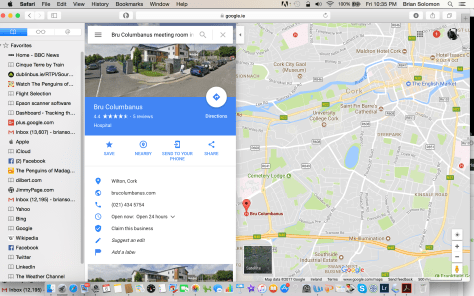
This will be held at 8:00pm (2000) at the Bru Columbanus meeting room in Wilton, Cork City.
I’ll display a great variety of railway images exposed in Ireland and elsewhere, with an emphasis on photos of Irish Rail in counties Cork, Kerry, Tipperary and Limerick.
The program will be aimed at enlightening the audience on precisely I how I made images (with detailed technical explanations as required). I’ll take questions at the end.

Tomorrow (Monday, 9 October 2017), I’ll be presenting my program on Railway Photography to the Irish Railway Record Society in Cork.
This will be held at 8:00pm (2000) at the Bru Columbanus meeting room in Wilton, Cork City. (see Google Maps).
I’ll display a great variety of railway images exposed in Ireland and elsewhere, with an emphasis on photos of Irish Rail in counties Cork, Kerry, Tipperary and Limerick.
The program will be aimed at enlightening the audience on precisely I how I made images (with detailed technical explanations as required). I’ll take questions at the end.


Rome’s tram line 19 still uses some pretty old streamlined cars.
Not only do these make interesting photographic subjects, but because they have opening windows the make for a great way to see (and photograph) Rome’s neighborhoods.


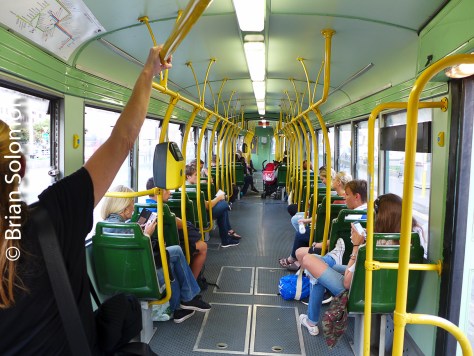


I wonder how many cities in Europe still have trams in daily revenue service that are more than 65 years old?
I made these photos in September 2017 using my Lumix LX7 and FujiFilm XT1 digital cameras during a spin on the 19 while exploring Rome with Honer Travers.
It was a bright morning last week when I exposed this view of a Trenitalia double-deck suburban train approaching its station stop at Rome Trastevere en route to Roma Termini (Rome’s main station).
I worked with my FujiFilm XT1 with 90mm f2.0 lens for this photo.

Regular readers may have noticed that I’ve been making regular use of this camera/lens combination.
I have four lens for my FujiFilm XT1; 12/27/90mm fixed focal length (prime) lenses, plus an 18-135mm zoom lens. Lately the 27 and 90mm primes have been the most useful.
Why not use the zoom lens more? Here’s three reasons:
1) The 18-135mm zoom not as fast as the primes. My 90mm f2 is 2.5/3 stops faster that the 18-135mm.
2) The 18-135mm zoom isn’t as sharp.
3) I find that the discipline of working with a fixed focal length lenses lends to stronger images. This is an abstract notion, but often seems to be true.
Over the years I’ve gone back and forth between a preference for zooms over primes. It’s the toss up of convenience over image quality. There’s no one ‘right’ solution. But when I look back at my images that I prize the most, many of them have been exposed using prime glass.
Here’s something different for Tracking the Light.
A tourist snap.
Nothing fancy. Nothing tricky. No special equipment or techniques to describe.
This is just a view of ancient Rome from a footpath exposed a week ago using my Lumix LX7.

Here’s sunrise last week as viewed from the hotel near Trastevere Station in Rome
Look carefully at the central lower left and you’ll see the multiple track FS line and a Trenitalia suburban train.

Exposed using my FujiFilm XT1 with 90mm f2.0 lens.
Rail-connected airports have become common on the European continent.
The ability to walk directly from your terminal to a waiting train that takes you directly to your destination is a very civilized way to travel.


In recent months I’ve learned the intricacies of navigating Trenitalia’s automated ticket machines.
While these have an English language option, to buy a ticket typically requires more than a dozen steps, including ‘continuing’ through various warnings that advise you about pickpockets, unauthorized persons supplying information, and reminders to validate your tickets (you’ve been warned!).
So last week (September 2017) when Honer Travers and I arrived at Rome’s Fiumicino Airport, we were well armed with the knowledge to obtain the correct tickets. We rapidly paged through the automated machine and without difficulties had tickets in hand in just minutes.
We boarded our double-deck local train and were on our way to Roma Travestere.
Buying local transit tickets the next morning wasn’t as painless, as the automated machines we found did not seem to work as intended.
Photos exposed using my Lumix LX7.
The other day on the way to Dublin Airport with Honer Travers, I spied a LUAS trial making its way northward on O’Connell Street on recently completed CrossCity trackage.
This made for an unplanned photographic opportunity. I posed near the Larkin Statue that I featured on the cover of my illustrated E-book on Dublin titled Dublin Unconquered (designed for viewing on Apple iPad and similar Apple devices).

After making a silhouette that mimics my book cover, I turned to make a few going away views of the tram passing Dublin’s iconic General Post Office.
The GPO is a symbol of Irish independence owing to its roles in the 1916 Easter Rising.


Later Honer and I boarded the 747 Bus, which gave me another opportunity to catch LUAS trial trams working CrossCity trackage.
This new LUAS line forms a link between the Green Line and Red Line routes that were formerly completely isolated from one another.


If you have access to an Apple iPad, iPhone, iPad, iPod touch, and Mac and are interested in my E-book Dublin Unconquered you can download the book from Apple iTunes for roughly the price of a sandwich. The book features many carefully crafted photographs along with detailed text and a lovely map.
https://itunes.apple.com/us/book/dublin-unconquered/id548794442?mt=11&ign-mpt=uo=4
Sometimes the sideshow makes for good photos.
The main event at Dublin Connolly Station last Monday (25 September) was the launch of the 2017 Emerald Isle Express. I featured those photos in yesterday’s post. See: Emerald Isle Express at Connolly Station, Dublin.
While on the platforms at Connolly I also made photo of Irish Rail’s ordinary trains.
I have a feeling that these images may age well. Often the common becomes fascinating over time.


In addition to these digital photos, I also made a few choice colour slides on Fujichrome Provia 100F with my old Nikon N90s and 35mm f2.0 lens. Those are still unprocessed.
Monday, 25 September 2017 saw the launch of this year’s week-long Emerald Isle Express sponsored by Railtours Ireland.
The train consisted of Railway Preservation Society of Ireland’s preserved Cravens carriages hauled by Irish Rail class 071 locomotive number 073 recently repainted in a heritage orange livery.
It was a fine bright morning and I made these photos from Platform 5 at Connolly Station using my Lumix LX7 and FujiFilm digital cameras.


Tracking the Light Posts Daily
It was the annual Dublin Culture Night Event when dozens of establishments open their doors and/or host special events free for the public.
I was making my rounds, and I happened upon a LUAS 4000-series tram making trials of the new Cross City trackage.
I believe in taking advantage of photographic opportunity when presented, and I made these views using my Lumix LX7.


Tracking the Light Posts Daily!
On the evening of February 9, 1994, I exposed the final frame on 36 exposure roll of a Southern Pacific eastward freight ascending Donner Pass at Yuba Pass, California near where I-80 crosses the railroad.
I used an old Nikkormat FTN for this view and exposed the film with the aid of a Sekonic Studio Deluxe handheld photocell light meter.
This photo demonstrates two things. Firstly the enormous dynamic range of Fujichrome slide film. Secondly, my ability to get the most out of each roll.
At the time I had very little money and yet spent what little I had on film and fuel for my car. I would routinely save the final frame of a roll for something special.

About this time I submitted a page of 20 35mm color slides to the well-known editor of a major railroad magazine, all frame number 37 and 38. I did this to check his attention to detail to see what he’d say.
Years later when I met him face to face, I’d mentioned this effort to him, and he admitted that he’d never even noticed.
You do know that I like to hide things in plain sight? Right? It always astounds me when no one seems to notice. (Rest easy, there’s nothing to see here except a California sunset.)
Back in the summer of 1981, I was changing trains at New Haven, Connecticut and made this photograph of a new Budd-SPV2000 assigned to the New Haven-Springfield shuttle.
Until I scanned this photo, I didn’t realize I’d made a photo of Amtrak’s short-lived LRC tilting train. Look in the distance to the right of the SPV-2000 and you’ll see the Canadian-built tilting train.


Erie Railroad Semaphore—Canisteo River Valley at Cameron, New York.
I made this view during a snow squall at Cameron, New York in 1987.

This shows the old Erie Railroad mainline at the Canisteo River Road grade crossing near milepost 314, a line then operated by Conrail.
That’s my old 1973 Plymouth Scamp parked by the side of the road.
The subject of the photo is the vintage Union Switch & Signal Style-S three-position upper quadrant semaphore.
I was on an exploratory trip of the Canisteo River Valley that contributed to many photographs of trains in this supremely scenic area.
The early hours are often a cosmic time for photography.
Last week I visited NI Railway’s Lisburn Station with Honer Travers to catch a morning train into Belfast.
There was just a hint of colour in the sky and mist covered the ground. A wisp of smoke from the station chimney makes for a classic touch.


I exposed these views with my Lumix LX7 handheld.
Warning Facebook viewers: Facebook crops! (Click on the post that link with Brian Solomon’s Tracking the Light for the full view).
Irish Rail 201 class diesel-electric number 221 has been recently painted.
On Thursday 21 September 2017, I exposed this view of the locomotive working the down IWT Liner at Islandbridge Junction near Heuston Station, Dublin.
There was a mix of sun and clouds that produced soft dappled lighting.

My Lumix LX7 has an ‘high-dynamic range’ feature. Otherwise known by its initials ‘HDR’, high-dynamic range is a technique for digital imaging that allows greater detail in highlights and shadows by combining several images of the same subject that were exposed at different values.
The LX7 includes the HDR setting as one of the options in ‘scene mode’ (SCN on the selection dial). This rapidly exposes a sequence of images and combines them in-camera to produce a single HDR JPG. Obviously you need to hold still when you make the photo.
Also it helps to photograph a static scene or the result my get a bit weird.
In this instance, I photographed some flowers on the platform of NI Railway’s station at Whitehead, Co. Antrim (Northern Ireland).

There are other ways of accomplishing a similar result.
So I decided to compare the HDR with some manipulated versions of a camera RAW file that I exposed of the same scene. With the RAW images, I’d adjusted the file with Lightroom post processing software, selectively altering contrast, gamma, and colour saturation and colour temperature to make for a more pleasing photograph.
Specifically I applied a digital graduated neutral density filter, while making global changes to highlights and saturation.
The output of the RAW is also as a JPG, which I scaled for presentation here.


I made two versions of the RAW interpretation.
In both sets of images I’ve intentionally focused on the flowers and not the NIR train.
Which do you prefer?
This is a follow up to yesterday’s post on NI Railway’s Moira Station.
I’m always looking for a different angle, and I found a variety of ways to photograph Moira last Sunday.
The vantage points for these photos were all within a one-minute walk of each other.


Last Sunday, I spent several hours photographing NI Railways and Enterprise trains at Moira, a station on the old Great Northern Railway’s Belfast-Dublin route.
The attractions of this location include a preserved signal cabin and a footbridge at the Dublin-end. Another benefit is the level crossing with a local road at the Dublin end. The barriers protecting the road drop 3-4 minutes before trains pass, which provides ample warning to prepare for photography.
This is especially helpful if you are sitting in a car nearby trying to edit texts and photos for a book on deadline.


I exposed these photos using my FujiFilm XT1 with 90mm f2.0 telephoto lens.
This is among the hundreds photos I chose for final consideration for my book on European Railway Travel. It is not an outtake. Instead this is among my selections for the section on railways of Great Britain.

In the text I discuss the great London terminals, and I use this photo to illustrate Kings Cross. I like it because it features a vintage HST in nice light with a dynamic view of the classic train shed beyond.
The HST (High Speed Train) was introduced by the then nationalised British Railways (BR) in the mid-1970s as the Intercity 125.
As a 125 mph train capable of operating on many existing lines with minimal changes to infrastructure and signaling this represented a significant improvement over older trains that allowed BR to speed schedules and more effectively compete with other modes.
More than 40 years later, many of the old HSTs are still on the move.
Exposed on 3 May 2016 using my Lumix LX7. This image was adapted from the camera RAW image for maximum dynamic range.
On my more than a half dozen trips to the Czech Republic I’ve made hundreds of photos of Czech Railways in action.
Here are a couple of outtakes from the selection of Czech photos considered for my book on European Railway Travel.
Both were exposed digitally in October 2016.


This morning I’m posting from a NI Railways train en route Bangor, County Down.
I’m reviewing Scandinavian photos for my book on European Railway Travels.
This view of a Finnish intermodal train near Oulu didn’t make the cut.
I exposed it on Fujichrome slide film using my Nikon N90S with 135mm lens.

I could have titled this ‘Dusk in the Rain’.
As it happens I was at Irish Rail’s Portlaoise Station on my way up to Dublin and I needed a few potential illustrations of the 1840s buildings for my book on European railway travel. I thought, ‘what better time than now to make some up to the minute photos?’
Working with my Lumix LX7 I made these views that I feel capture the atmosphere of the station.


Any favorites?
Tracking the Light Posts Daily.
I’m still editing photos for my European Railway Journeys book.
There were more tough choices and this one had to go!
This photo has drama but the light is flat.
Flat light and dead snow just don’t make the cut.

This photo was exposed the narrow gauge Swiss Rhätische Bahn at Küblis .
Tracking the Light Posts Daily!
I’ve been reviewing hundreds upon hundreds of photos for my book on European Railway Travel.
Here’s a view I like but it didn’t make the cut because I’m using a similar angle that works better. It was one of several views that I made on film, although was also working with my digital cameras that day.
This pictures the famous ‘Hanging Viaduct’ in the Mosel Valley near Bullay.

Two years ago I visited this unusual railway construction with my friends Gerry Conmy, Stephen Hirsch and Denis McCabe.
Tracking the Light posts every!
Another example of some photos that didn’t make the final cut for my book on European Railway Travel.
You might think that catching a train with medieval castles in the background is pretty neat.
It is.
But I have many photos at this curve at Oberwesel on the busy Rhein left bank route. I’ve selected several potential candidates from this excellent German location and these two just didn’t seem book worthy.


Exposed using my FujiFilm XT1.
Perusing my photos of France and French railways for my up-coming book on European Railway Travel, I was surprised to find how many excellent images I had in my collection.
I’ve made about a half dozen trips through France over the years, and I’ve generally had good weather.
In reviewing my selection I’ve decided to cull these two images from consideration for the book.

This train photo is of an SNCF train but it’s not in France, and rather in Basel, Switzerland. More to the point, the lighting isn’t wonderful, and the setting is awkward.
I chose it because it’s a contemporary photo of an SNCF locomotive-hauled passenger train (which are becoming increasingly rare in France.) I have better SNCF photos than this one for the book.

I liked this Eiffel Tower image because it shows the scale of the structure. However, I have some really stunning views of this Parisian icon that better capture its majesty. This one gets the axe.
As mentioned last week, I’m in the final lap of assembling a book on European Railway travel.
This image is among my ‘outtakes’ from the section on Germany.
I have hundreds of photos along the Rhein. I like this one because it shows the twin tunnels on the right bank opposite Oberwesel, but the wires in the sky annoy me, as does the clutter in the river at right and shrub on the left.
There’s better photos to select from for my book.


