Former VIA Rail FPA4s lead a northward Napa Valley Wine Train. Exposed on Kodachrome 25 with a Nikon F3T fitted with a 300mm Nikkor Lens.
In 1989, Napa Valley Wine Train began public operations on a former Southern Pacific branch through its namesake valley. I first explored this railway in October 1989. A little more than a year later, Brian Jennison and I spent a very productive day photographing the line on Kodachrome.
Brian lent me a Nikon 300mm lens for this photograph. I’ve always like the image because the extreme compression offered by the long telephoto accentuated the classic lines of the Montreal Locomotive Works diesels (and the steam era bell on the top of the lead unit) while offering a pleasing juxtaposition between the train and the background foliage.
Santa Fe EMD-built FP45 number 98 eastbound near Mojave, California. I exposed this on Kodachrome 25 using my Nikon F3T with an f4.0 200mm lens positioned on a Bogan 3021 tripod with ball head.
In the early 1990s, I made several productive trips to the California Tehachapis. Southern Pacific owned and operated the line over the mountain, while Santa Fe operated by virtue of trackage rights.
Yet at that time, Santa Fe ran about three times the number of trains as SP. On this morning, T.S. Hoover and I were set-up on the east slope of the mountain. While catching a Santa Fe FP45 in the ‘Super Fleet-Warbonnet’ livery leading was certainly a coup, it wasn’t especially unusual.
Dry desert air and clear skies were nearly ideal conditions for Kodachrome 25 film. This was one of many choice chromes exposed that day. I wish I could turn back the clock!
The locomotive survives at the Orange Empire Railway Museum in Perris, California. I made some more recent photographs of it on visit in June 2008.
Sometimes special events make for great opportunities to make detailed photos of equipment, structures and settings.
Last Saturday’s Irish Railway Record Society excursion from Dublin to Cork, Cobh and Midleton was an opportunity for visual exploration.
Check previous posts for other images of this historic trip.
Irish Rail diesel number 073 catches the sun at Kent Station Cork on 20 July 2013. Canon EOS 7D photo.
Driver Ken Fox works the ground at Cork.
Railway Preservation Society Ireland’s Cravens catch the sunlight at Kent Station Cork on 20 July 2013.
Brake cylinder on locomotive 071.Freshly painted Irish Rail locomotive 92 60 0117071-7 catches the sun at Heuston Station in Dublin. Its still just old 071 to me! Lumix LX3 photo.Irish Rail’s Rotem-built intercity rail cars arrive at Heuston Station on the morning of 20 July 2013. Lumix LX3 photo.
In previous posts I focused on the human side of Irish Railway Record Society’s Dublin-Cork excursion on 20 July 2013.
However, I also made my own share of classic views showing Saturday’s railway excursion at identifiable locations. I’ve displayed a few view here. In addition to digital image I also exposed color slides at key locations.
See posts from the last few days for more views of Irish Railway Record Society’s 20 July 2013 diesel hauled trip on Irish Rail to Cork, Cobh and Midleton.
Irish Rail 071 and 073 with IRRS Special at Templemore on 20 July 2013.Irish Rail class 071 number 073 led the excursion on the Cork-Cobh leg of the trip. It is seen during a photographers stop at Rushbrooke, County Cork. The best classic views were made from a nearby road bridge. The train was well spotted for photos. Canon EOS 7D with 28-135mm lens.
Irish Rail 071 catches the sun at Cobh, County Cork on 20 July 2013. Lumix LX3 photo.A vertical three-quarter view (or near to it) of Irish Rail 071 at Cobh, County Cork on 20 July 2013. Canon EOS 7D photo.At Kent Station Cork, engine 071 runs around the train and will follow to Middleton. There doesn’t appear to be anyone in my photo and who’s that shouting? oops. 😉Irish Rail 073 reflects into a Mark 4 train at Kent Station in Cork on 20 July 2013. Canon EOS 7D photo.
Operation to Midleton required a bit of shuffle owing to a lack of run around facilities. Presently this is the end of the branch. Normally the only equipment on the line are double-ended railcars. Photos of locomotive hauled trains here are highly prized and photographers vied for position to get the best views. Locomotive 073 which brought the train from Cork can be seen in this distance. Canon EOS 7D photo.
A bit of color: 201-class General Motors diesel number 209 (painted for the Dublin-Belfast Enterprise) on a Mark 4 set at Cork on 20 July 2013.Twin 071s couple on to the excursion at Kent Station Cork. The view from the Dublin-end of the shed is among the best in the city. Lumix LX3 photo.
Irish Rail’s 2600-series railcars pause at the back of the train shed in Cork. These are typical of the trains normally assigned to Cork suburban services. Canon EOS 7D photo.Irish Rail 086 rests with a ballast train at Lisduff as viewed on the return trip of the IRRS special. Lumix LX3 photo.
More views of Irish Railway Record Society Trip to County Cork, 20 July 2013.
There’s a long history of special trains with unusual locomotives, rare events, or otherwise noteworthy occurrences of railway operations that have encouraged railway photography.
Saturday’s trip to Cork and Midleton was no exception. (see yesterday’s post).
Among the photographic events was the rare locomotive hauled consist on Cobh and Midleton Branches. The Cobh branch has been exclusively a railcar operation since the mid-2000s, while the Midleton line has only seen railcar operation since its reopening a few years ago.
Our train pauses at Templemore for photographers on the morning of 20 July 2013. Canon EOS 7D photo. A strategically placed bit of greenery adds depth to the image. (And, yes, I have photos without it).Fans snap freshly painted 071 class leader at Templemore on 20 July 2013. Canon EOS 7D photo.Enjoying the spin.
In time-honoured tradition, at every photo stop, photographers rushed to snap images of the train. Occasionally, an individual entranced by the fresh paint on locomotive 071 or fascinated by some other peculiarity of operation or equipment, would wander haplessly in front of a line of eager photographers. Shouts of ‘Hey!’ ‘Oy!’, ‘Down in front!’ and the like would ensue.
Especially amusing was when a particularly oblivious passenger or passerby would drift with their backs to the anxious photo line (time is precious on these outings as only a few minutes are allowed at each stop), and proceed to linger staring in wonder at the train. In such cases a diplomat would be elected to negotiate a solution.
‘Down in front!’RPSI staff make necessary arrangements with Irish Rail staff at Kent Station Cork.
A Cobh, I was queried by a German woman as to why so many people were photographing the train. It didn’t appear in the slightest bit unusual to her. Significance is in the eye of the observer. I explained that, ‘locomotives were never operated on this line, and the locomotive that brought the train down was in fresh paint, and that the train had carried the photographers for this purpose.’ She seemed satisfied with that.
While I made plenty of images of the train, 071 and 073 and etc, I also focused on the people. From my experience, images of people surrounding the train tend to be more interesting than the train, and tend to have greater value in the end.
Photographs provide clues to memories that may last a lifetime. Someday everyone and everything maybe gone, yet we can remember the thrill of the day as a result of pictures. At Cobh, two young lads get their image made with the driver of locomotive 071. Canon EOS 7D photo.Kevin, a tracking the Light follower, proudly displays his model of Irish Rail’s 071 in the new livery.
Photographers vie for positon at Kent Station Cork.Aiming for the best angle at Midleton on 20 July 2013. Lumix LX3 photo.Staff water the train at Kent Station, Cork. Lumix LX3 photo.
RPSI staff servicing the train at Cork. Lumix LX3 photo.Not everyone is bothered to get every photo. Some prefer to relax and enjoy the journey. Lumix LX3 photo.Irish Rail employee (and Railway Preservation Society Ireland member) Kevin Walker enjoyed the view from a Cravens window on the Irish Railway Record Society’s outing.Irish Rail staff conducted the trip professionally and efficiently, keeping to schedule despite abnormally complex arrangements necessary for the trip.
Driver Ken Fox on 071 at Cork.Driver Ken Fox greets passengers after arrival at Heuston Station. Lumix LX3 photo.
At the end of the day, Heuston, Station. Lumix LX3.
Orange Engine at Stafford Springs, Ct., and Irish Rail’s IWT Liner in Dublin.
New England Central 3015 in fresh Genesee & Wyoming corporate colors passes the Stafford Historical Society in Stafford Springs, Connecticut. Canon EOS 7D with 28-135mm lens.
Irish Rail’s IWT liner passes Islandbridge Junction in Dublin.
Last week I made these photos, nearly exactly 24 hours apart (one in the morning, the other in the afternoon).
The first image shows New England Central’s freshly painted GP402-L 3015 leading a southward freight at Stafford Springs, Connecticut. I was delighted to finally get this elusive orange engine operating on a road-freight in daylight.
The next image was made in Dublin, after a trans Atlantic crossing courtesy of Aer Lingus. This shows locomotive 073 struggling along with the second IWT Liner at Islandbridge Junction near Heuston Station in Dublin, Ireland.
Later, I heard through the grapevine that 073 failed a few miles down the line and require assistance.
Both images were made with my Canon EOS 7D. Also both feature 1970s-era General Motors diesels singly hauling freight under bright sunny skies.
About four miles east of the center of Palmer (Depot Village) CSX’s former Boston & Albany mainline passes a bucolic setting at the bottom of a broad sweeping field as it heads up the Quaboag River Valley. This is best viewed from Route 67, not far east of the split with Route 20.
One summer’s evening more than 30 years ago, my father and I stood out in the field to make a photo of Amtrak’s westward Lake Shore Limited (train 449). Since that time I’ve returned many times to photograph trains.
On March 15, 1986, Amtrak’s eastward Lake Shore Limited heads toward Worcester and Boston on Conrail’s former Boston & Albany main line. Exposed on 120 sized black & white film using a Rollei Model T equipped with an f3.5 75mm Zeiss Tessar lens.
I’ve paired two sets of images here. The black & white photograph was made on March 15, 1986 (‘Beware the Ides of March!’). The color images I exposed a week ago Sunday (July 14, 2013).
Among the changes to the scene over the years has been an increase in undergrowth. A more dramatic change was the recent installation of a voltaic farm (solar panels) on the northside of the field. This alteration has greatly changed the character of the place.
According to an article in a recent Palmer Journal Register, perimeter fencing may soon encircle the voltaic farm. Undoubtedly this progress will further improve the photographs made here beyond all previous measures of aethetic virtue.
Approaching CP79 (at the east end of the Palmer controlled siding)Amtrak’s eastward Lake Shore Limited—train 448, catches the golden glow of evening as it passes the field along Route 67 east of Palmer, Massachusetts. Exposed with a Canon EOS 7D and 40mm pancake lens.The recently installed voltaic farm adds a lovely rustic quality to this bucolic New England scene. Soon electricity will be pulsing from these panels to the electric power grid reducing all forms of polution in the region.
A headlight illuminates freight cars at New England Central’s Palmer Yard on Friday July 12, 2013. Lumix LX3 photo.
Although Palmer is a relatively small town, it has long been the focus of railway activity. Today, it hosts yards for both New England Central and CSX, as well as nominal terminal facilities for Mass-Central.
CSX has a four-mile dispatchers controlled siding the runs from CP79 to CP83 (the numbers are based loosely interpret mileage from South Station, Boston). Just past the west switch at CP83 is the level crossing with New England Central—colloquially known as the Palmer Diamond. The popular Steaming Tender restaurant occupies the old Union Station between the two lines.
New England Central home signal at the ‘Palmer Diamond’ on July 12, 2013. Lumix LX3 photo.New England Central 606 heading north across CSX’s former Boston & Albany main line. Lumix LX3 photo.
After 10pm, trains converged on CP83. A CSX westbound on the main track met an eastward freight running via the controlled siding, as New England Central’s northward job 606 was looking to cross CSX to double its train together before heading toward Vermont.
The awkward nature of the former Central Vermont yard at Palmer complicates operations over the CSX diamond. Not only is the yard too short to hold long trains, but the yard was built on a grade which crests at the CSX (former Boston & Albany crossing).
A CSX westward freight holds at CP83 as New England Central 606 heads north. The Steaming Tender is located in the old Palmer Union Station. Lumix LX3 photo.
Challenges for railroaders produce opportunities for photography, especially in the evening hours. As the railroads weaved their trains through Palmer, I made a series of photos.
However, time was catching me up: I’d had a long day and by 11pm, I needed a bit of that elusive commodity—sleep. As Bob Buck would have said, I was the ‘hero’, and departed as more trains were focused on Palmer. The approach lit signals at CP83 were still lit when I hit the road. The regular gang can report on what I missed!
Deutche Bahn InterCity train 522 Berchtesgadener Land (Berchtesgaden—Hamburg) catches the glint of the setting sun at Bonn, Germany. Compare this view with that of Amtrak’s Lake Shore Limited catches the glint at Palmer, May 28, 1986. (posted December 7, 2012). Exposed on Fuji Sensia II (ISO 100) slide film using a Nikon F3T fitted with f2.8 135mm lens. Exposure calculated manually with a handheld Sekonic Studio deluxe light meter (approximately f8 1/500 sec).Chicago, August 19, 1984. Exposed on Kodak Safety Film 5063; bulk loaded Tri-x 400, exposed at ISO 400, processed in Microdol-X.
As a result of my careful marketing analysis, I’ve determine the best ways for Tracking the Light to go viral are:
1) Encourage Sperry to plan a safely staged ‘derailment’ on Dublin’s LUAS route (to demonstrate the dangers of hidden rail fractures, perhaps) using former a Central Vermont Railway switcher painted in Irish Rail grey and then photograph it on a dull day using my Lumix LX-3. (Along the lines of the theatrically arranged ‘cornfield meets’ of the late Victorian era.)
2) Hire a Korean guy with sunglasses to dance around near the tracks. (Gangnam Style) —hey, with more than 1.5 Billion hits, something must be working, right??
3) Offer free Twinkies to all Tracking the Light subscribers.
4) Plan a merger with LeakyWiks.
5) Encourage everyone who enjoys the site to spread the word (and links) with their friends and urge regular visitors to subscribe! (there’s a box for comments toward the bottom of the posts and a box to tick that enables the subscription feature—admittedly this is a bit Kafkaesque, and hopefully I’ll find a better means of enabling subscriptions soon!)
Incidentally, my elaborate plans to import a German electric for demonstration were to be aborted, unfortunately Amtrak didn’t get the memo! 😉
Thanks again for checking Tracking the Light!
Brian Solomon
Chicago & North Western’s Chicago-Omaha mainline at sunset.
New England Central’s elusive GP40L 3015 pierces the gloom at Palmer with its headlights. Time exposure with Canon EOS 7D fitted with f2.8 200mm lens.
It’s always nice to be the first to catch a freshly painted locomotive on its maiden run. Or, failing that, to at least see it in its first few days of operation. Or weeks.
When you regularly observe railway operations, often you get lucky and stumble upon new things as they happen.
When I’m in New England, I regularly check New England Central to see what’s going on. I’ve been observing the railroad on and off since its days as the Central Vermont. My earlier posts have reflected this on-going interest.
Lately, it seemed as just about everyone has seen one of the railroad’s freshly painted orange engines . Everyone, that is, except me.
A few months ago, Genesee & Wyoming took control of New England Central’s parent company, Rail America, and to make its mark on the new properties it rapidly began placing locomotives in G&W corporate colors.
I’ve been familiar with Genesee & Wyoming since the days when its was just a New York State short line moving salt from the mine Retsof for interchange with Conrail.
My normally good luck didn’t favor my photography of G&W locomotives on New England Central. Much to my astonishment, just about everyone I know seems to have had better luck with seeing orange engines than I.
A few weeks back, I had a fortuitous meeting with the retired Central Vermont trainmaster at the bank. He was delighted to report having seen an orange engine roll through town, and keenly advised me to ‘get some pictures, quick, before it gets dirty’. Thanks. I’ll work on that.
Yet, every time I’ve swung by the yard, or rolled by a freight, I’d see the same old blue and yellow GP38s that have ruled the railroad for 18 years. Or perhaps some of the recently acquired former Union Pacific or Florida East Coast engines.
One night a few weeks back, I’d been in Palmer, but skipped my normal visit trackside (owing to rain and the late hour—not that this ever gave me pause before!).
I was informed the next morning that the elusive orange engine had been by the yard office, just out of sight. Poor show (on my part.)
Last friday I was again in Palmer (Massachusetts) to meet Rich Reed, Bill Keay & co. for dinner. Before dinner I stopped by the station. I heard a local working, and looked in my rear view mirror. And there! There it was! I made a few photos, and then returned later to make night shots.
At last, an orange engine, and holding still long enough for a time exposure portrait. Lumix LX3 photo.
Luck, after all, improves with time. Right?
Caption:
New England Central’s elusive GP40L 3015 pierces the gloom at Palmer with its headlights. Time exposure with Canon EOS 7D fitted with f2.8 200mm lens.
At last, an orange engine, and holding still long enough for a time exposure portrait.
Classic Image in California’s Feather River Canyon.
Union Pacific C30-7 2474 works an eastward train over the North Fork Bridge near Poe, California on May 18, 1990. Exposed using a Nikon F3 with 135mm lens on Kodachrome film. The camera was mounted on a Bogan 3021 tripod with a ball head.
In the early hours of May 18, 1990, I departed Sacramento, California destined for the former Western Pacific mainline through the Feather River Canyon.
On the drive, I saw a pair of eastward trains in the Central Valley north (railroad timetable east) of Marysville. This sighting influenced my decision to work the lower regions of the canyon, rather than driving through on Highway 70 toward Keddie and Portola, as I had done on previous trips.
A bit west of Pulga, there’s a long and winding dirt road that drops from Highway 70 down toward the North Fork Bridge. Finding it is counter intuitive. On an earlier trip I’d become rather lost trying to find the bridge. A Northern California DeLorme Atlas ultimately provided me the necessary navigational tools.
Having reached the bottom of the road, I hiked into position before 8am and waited on the side of a hill overlooking the modern open spandrel concrete arch bridge. This is late-era construction, built in the 1960s when construction of the Oroville Dam resulted in flooding of the lower Feather River’s North Fork which required relocation of Western Pacific’s line out of the canyon via a series of tunnels and bridges.
At 8:15 am, Union Pacific DASH8-40C 9174 rolled westward across the bridge with an APL double stack train. The sun hadn’t fully hit the bridge and I was happy that the stacks bought me additional time on my anticipated pair of eastbound trains.
The westward stacks must have met the first eastbound at James, a CTC siding immediately west of the Canyon (and another favorite place for photos). Just 20 minutes after the stacks had passed, the first eastward train emerged from the tunnel on the west side of the bridge. I made several exposures, bracketing from f4.5 to nearly f5.6 1/125th of a second on Kodachrome 25 film.
Exposure in the Feather River Canyon can be deceiving. Because of the depth of the canyon, less skylight reaches the tracks than in open territory. Also, the dark green trees and bushes lining the canyon walls absorb a considerable amount of light. The result is that direct and unfiltered sunlight isn’t as bright as it seems.
Careful use of my handheld meter was crucial in calculating the accurate exposure, but I still felt compelled to make fine adjustments as the train rolled into view.
The second eastward train was 20 minutes behind the first. I stayed for the rest of the day in the lower reaches of the canyon and photographed five more Union Pacific trains by 6:09 pm.
Caption: Union Pacific C30-7 2474 works an eastward train over the North Fork Bridge near Poe, California on May 18, 1990. Exposed using a Nikon F3 with 135mm lens on Kodachrome film. The camera was mounted on a Bogan 3021 tripod with a ball head.
New England Central, South of Stafford Springs, July 16, 2013
I rarely post photos the same day I make them. Today is an exception. Why? Because, I feel like sharing this image now rather than waiting. It’s a photo I made a little more than an hour ago of New England Central’s southward freight running from Palmer to Willimantic, Connecticut.
I exposed this using my Canon EOS 7D and 28-135mm zoom lens. The flexibility of the zoom allowed me to more easily frame the locomotives with grade crossing signals at the right. The train was still en route to Willimantic by the time I was home and downloaded the images.
Brand New General Electric Locomotives at a Classic Location.
CSX eastward Q012 at State Line Tunnel on the morning of July 9, 2013. Despite its name, the tunnel is actually several miles west of the New York-Massachusetts border. Canon EOS 7D with 40mm pancake lens.
On the morning of July 9, 2013, I visited State Line Tunnel on CSX’s former Boston & Albany mainline. This is a favorite place to catch trains in action on the line.
The air was heavy with moisture and as a result sound carried exceptionally well. I arrived at my location at 6:48 am. At 6:54, I could hear an eastward train blowing for a crossing near Chatham, New York, approximately 10 miles to the west (as per the timetable). At 6:56, the train reported a ‘clear’ signal aspect over the scanner.
Since the only signal in the area is located at CP 171 (the control point east end of the siding at East Chatham) I knew the train was about to cross the New York State Thruway. I then could trace the progress of the train as it sounded for various crossings in Canaan. By 7:04 am, I could cleared hear the engines working upgrade.
A 7:08, CSX’s intermodal train Q012 came into view. In the lead were three factory-clean General Electric ‘Evolution-Series’ diesel-electrics in the 3100-series (model ES44AC). As modelers might say, ‘right out of the box.’ Nice!
A motor drive has its advantages. I made a sequence of images as the Q012 roared eastward. Canon EOS 7D with 40mm pancake lens.This is my favorite of the three images. I like the foliage in the foreground which adds depth.
The train roared into the tunnel below me as I exposed a sequence of images with my Canon EOS 7D and 40mm pancake lens. I’d brought a tripod, but opted not to use it, as hand held gave me greater flexibility.
About 40 minutes later, I heard a westward train sounding for Stateline crossing. I relocated, and made images of CSX light engines exiting the west portal of the tunnel.
Until late-1988, this line had directional double track. Since then, just a single main track passes through the tunnel. The railroad uses the 1912-era bore, leaving the older 1840s-era bore void of track.
Headlights gleam inside State Line Tunnel.State Line Tunnel is a relatively short bore. The twin tunnels were built decades apart, and at one time both bores had twin tracks in them.The tighter view gives a better view of the new engine but obscures the older tunnel portal. Why make one photo when three will do?
SERVICE NOTICE: Tracking the Light will soon be undergoing an upgrade which may result in a temporary service disruption of a day or more.
I made this image during my senior year of high school. I don’t remember the specific circumstances, but on that day I’d followed Central Vermont Railway’s southward freight from Palmer to Stafford. I made photos of it south of downtown Monson off Route 32, and at the Massachusetts-Connecticut State Line.
Shortly before the train came into view a cloud conveniently softened the sun. Central Vermont GP9s ease toward a grade crossing at Stafford Springs, Connecticut. With a carefully composed vertical in my rangefinder’s view, I released my Leica’s shutter with an audible snap. Many years later I scanned the negative.
This view in downtown Stafford Springs has always intrigued me. The railroad runs tight to a row of buildings along the main street in town. Today, the brick building featured in the photograph hosts a trendy coffee shop where I sometimes meet my friend Roger Ingraham to wait for trains to pass and discuss photography.
In 2013, New England Central operates the railroad, but the scene hasn’t changed all that much. I still make photos here from time to time.
I exposed this image with my old Leica 3A and 50mm Summitar lens, and used a Weston Master 3 light meter to assist in exposure calculation. I processed the film myself in Microdol-X. Typically, I used a weak formula to save money. By doing so, I inadvertently avoided over developing my negatives (which was a flawed inclination of mine at the time).
I made a few minor contrast modifications in post processing and cleaned up a few small spots and scratches on this nearly 30 year-old 35mm negative.
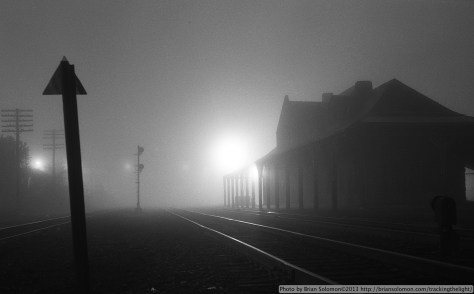
Palmer Union Station in the foggy gloom of a May 1985 evening. Exposed with a Leica 3A rangefinder on black & white film.
Yesterday (July 10, 2013), I posted night photos I made in Palmer on June 28, 2013. I mentioned that my night photography efforts were part of a long standing tradition. So I dug up this image of the Palmer station exposed nearly three decades earlier.
This was undoubtedly made on a Friday evening. A thick fog from the Quaboag River had enveloped the valley. In the station parking lot, and out of sight, Bob Buck is holding court.
That night I made several views of the Palmer station in silhouette. All were exposed with my old Leica 3A and a 50mm lens, probably a Canon screwmount which I favored at the time. I was using my father’s Linhof tripod to support the camera. Exposure was calculated strictly from experience, and was probably about 30 seconds at f2.8.
Interestingly, just the other day (July 9, 2013) I had the opportunity to interview Jim Shaughnessy about the night photography techniques he used to capture steam locomotives on film back in the 1950s. While similar to mine, his approach was very different and he perfected it more than three decades before my image was exposed.
Where I used 35mm film and strictly ambient light for this image, Jim tended to use a 4×5 camera and a skilled combination of ambient and artificial flash.
Of course, I was well acquainted with Jim’s work by the time I made this photo. There has been a copy of Donald Duke’s 1961 book Night Train on our shelf for as long as I can remember! This features Jim’s work among that of other well-established practitioners of the art of railway night photography.
I don’t remember making my first night photo in Palmer. But I do recall spending Friday evenings there in the 1980s with Bob Buck and company, watching and photographing Conrail and Central Vermont. See: Drowning the Light
New England 611 crawls southward across the Palmer diamond on June 28, 2013. Lumix LX3 photo.New England 611 glides into Palmer on June 28, 2013. Lumix LX3 photo.
The Friday evening tradition was maintained on June 28, 2013, when a group of us convened, as we have for many years, near the old station. A few weeks earlier, I posted some photos made on exceptionally wet Friday night. By contrast, June 28th was warm, dry and very pleasant. And busy too!
The variances of railway freight operations make it difficult to pin point precisely when trains will pass or arrive Palmer. Complicating matters on the week of June 28, was on-going undercutting on CSX’s B&A route (see: Ballast Train East Brookfield), and the after effects of a serious derailment on the Water Level route near Fonda, New York a few days earlier.
However, these events appear to have benefited us on the evening of the 28th. I arrived at CP83 (the dispatcher controlled signals and switch at west end of the controlled siding, 83 miles from Boston) just as CSX’s westward Q437 was rolling through.
New England Central freights 604 and 606 at Palmer, Massachusetts. Lumix LX photo.New England Central 2680 on train 604 at Palmer. Lumix LX3 photo
New England Central had no less than three trains working in Palmer, jobs 604, 606, and 611, and these entertained us for the next couple of hours. In addition, we caught more action on CSX, including a very late train 448, Amtrak’s Lake Shore Limited.
I made these photos using my Lumix LX3 and my father’s Gitzo carbon fiber tripod. Some of the exposures required the shutter to remain open for 25 seconds or longer.
Amtrak’s 448 Boston Section of the Lake Shore Limited eastbound at CP 83 in Palmer. Lumix photo.Limited clear off the control siding at CP83.
Norfolk Southern X999 works southward on the former Reading Company at Yardley, Pennsylvania. Exposed with Canon EOS 7D with 200mm lens.
On June 30, 2013, Pat Yough and I photographed Norfolk Southern X999, an extra-dimensional (oversized load) move carrying an Air Products industrial heat exchanger.
Norfolk Southern X999 carrying a heat exchanger near Yardley, Pennsylvania. Exposed with a Lumix LX3.Norfolk Southern X999, Yardley, Pennsylvania.
We photographed this twice. Once on the former Reading Company line at Yardley, Pennsylvania. And again on the former Pennsylvania Railroad Trenton Cutoff near Morrisville.
This unusual train had locomotives at the front and back (to aid in changing direction) and an Air Products caboose.
Norfolk Southern X999 near Morrisville, Pennsylvania. Exposed with a Lumix LX3.Norfolk Southern X999 carries an industrial heat exchanger. Exposed with a Lumix LX3.
Fifteen years ago today, I exposed this image of Irish Rail’s empty Ammonia train at on the South Eastern route Bray Head (former Dublin & South Eastern Railway, nee Dublin, Wicklow & Wexford Railway).
Irish Rail empty ammonia works around Brayhead, County Wicklow. Exposed on Fuji Sensia 100 with a Nikon F3T fitted with an f2.8 135mm lens. Exposed calculated manually with a Sekonic Studio Deluxe handheld light meter.
At that time, there were three daily ammonia trains between Marino Point, County Cork and Shelton Abbey near Arklow, County Wicklow. The trains operated to tight schedules and were among the most predictable freight trains on the Irish Rail network.
For me the Ammonia was a bonus. I was actually out for a Railway Preservation Society Ireland (RPSI) steam special running with engine 461. To make the most of the morning, I taken the first southward Dublin Area Rapid Transit (DART) run from Pearse Station (Dublin) to Bray, then walked roughly two miles to this location in anticipation of catching the regular passenger trains and the empty Ammonia.
The line itself was in transition. If you look carefully, you’ll see the electrification masts along the line, as Irish Rail was preparing for extension of DART services to Greystones (the next station south of Bray).
The run around Bray Head is one of the most scenic on Irish Rail. Here the line clings to cliff and passes through several tunnels all the while in view of the vast expanse of the Irish Sea.
It was my first July 4th outside of North America. Irish Rail’s ammonia traffic ceased in 2002, when the fertilizer factory at Shelton Abbey closed. Today there’s no regular freight traffic on the South Eastern route.
Grand Central’s colossal architecture exudes magnificence. Lumix LX3 photo.
New York City’s Grand Central Terminal is unquestionably America’s best known railway station. This year it celebrated its 100th anniversary.
The station is also probably the most photographed in the USA. At any given time tourists and visitors are actively making images of its awe inspiring interior.
On the evening of June 29, 2013, I joined the masses in their image making crusade.
I also took a spin up the Hudson Line to Tarrytown, where I made some twilight views of Metro-North.
Grand Central’s most memorable feature is its grand concourse, a vast interior space intended to accommodate tens of thousands pedestrians daily.
Working with both my Lumix LX3 and Canon EOS7D, I made a variety of digital images. These may soon augment my older images of Grand Central and Metro-North.
Metro-North at Tarrytown, New York on June 29, 2013. Lumix LX3 photo.Metro-North M7 multiple unit glides into Tarrytown, New York. Canon EOS7D with 40mm pancake lens.Passengers flood from a Hudson Line train on Grand Central’s upper level. Lumix LX3 photo.MTA Metro-North Railroad.Grand Central’s exterior is faced with a blend Bedford limestone and Stony Creek granite. Atop this façade is an enormous neo-classical sculpture of Mercury, Minerva and Hercules that incorporates a huge clock—Time keeping, is of course, integral with railway travel. Canon 7D with 40mm Pancake lens.Grand Central ceiling features a unique depiction of the Mediterranean Zodiac as interpreted by French painter Paul Helleu. Lumix LX3 photo.The ghost of an early twentieth century bicycle crosses Grand Central’s concourse. Lumix LX3.
Between the 1960s and the 1980s, Northeastern commuter rail operations made the transition from private to public operation.
In 1983, after more than a decade of various forms of subsidy, operation of commuter rail service radiating from Grand Central Terminal on former New Haven and New York Central Railroad routes was conveyed to Metro-North (an affiliate of New York’s Metropolitan Transportation Authority).
Thirty years later, Metro-North is one of America’s busiest commuter railways.
New Haven, Connecticut’s railroad station. I remember in the early 1980s when this waiting room was closed and the old station was a rotting relic of an earlier age. Exposed with a Lumix LX3 on June 29, 2013.
It embodies a curious aesthetic by blending infrastructure and classic architecture from the golden age of railroading with utilitarian modern railway equipment, while offering convenient no-frills public transport.
The days of boarding a well appointed parlor car on New Haven Railroad’s exclusive, luxurious Merchants Limited at Grand Central Terminal for the run to Boston ended long ago. Likewise, New York Central’s New York-Chicago all-sleeper extra-fare Twentieth Century Limited is now the stuff of legend.
Solari arrivals-departure board at New Haven, Connecticut, June 29, 2013. Lumix LX3 photo.
When the new Grand Central Terminal opened in 1913, it was the grandest and most opulent railway station in the world. It represented the power of private capital, and was New York Central’s gift to New York City.
On June 29, 2013, I made a foray in to Metro-North territory. Since I’m not a regular commuter, I have the privilege of enjoying my travels on Metro-North trains, which included my first spin on a new M-8 electric multiple unit.
Lumix LX-3 photo.A 1970s-era Metro North ‘M2CSR’ multiple unit at New Haven, June 29, 2013. Lumix LX3 photo.Destination board on a new M8 multiple unit. Lumix LX3 photo.Brian’s seat check on a nicely air conditioned M8 heading toward New York City. Lumix LX3 photo.M8 interior. Lumix LX3 photo.Metro-North M8 passes Noroton Heights, Connecticut. June 29, 2013. Exposed with Canon EOS 7D with 40mm Pancake lens. 1/60th second.Grand Central Terminal’s 42nd Street Façade, New York City. Lumix LX3 photo.
See: Tracking the Light on July 3, 2013 for Metro-North Anniversaries Part 2!
Please share Tracking the Light with anyone who might enjoy it!
On June 26, 2013, a variety of errands that brought me to Ware, Massachusetts. I knew the Mass-Central’s daily freight ought to be in the area, but I wasn’t sure where it was. (Pardon pun).
I checked Ware yard; not there. So I drove north along the line. Since it is my understanding that the railroad is expected to acquire some nicely painted GP38s, I was curious to see what engines were working that day.
No sign of the train at Gilbertville, so I continued northward along Route 32 toward Creamery. My sixth sense was tingling. I knew the train was close.
Looking railroad east on the old Central Massachusetts line. This was once a through route from Boston to Northampton. Hush! Was that a whistle? Lumix LX3 photo.
At Creamery, Boston & Maine’s Central Massachusetts line once had a grade separated crossing with Boston & Albany’s Ware River Branch, and when B&M retrenched in the early 1930s, a connection was built between the two lines just to the north (east) of this crossing. Further retrenchment over the following decades resulted in almost complete abandonment of the Central Massachusetts line in the area.
Today, a portion of the Central Mass route at Creamery is now a rail trail. I paused at the trail, inspected a bit of an old cross-tie and then listened. . . wind rustled in the trees, then in the distance I heard a low air whistle. I turned my head. It was coming from the south. Had I overtaken the train, or had I missed it?
A second blast, confirmed my suspicions; I’d missed the train between Gilbertville and Creamery. I jumped in my car and headed briskly back toward Ware. I overtook the train a mile north of town.
At Ware, Mass-Central had some work at Kanzaki Specialty Papers—a customer served by a short surviving section of the former B&M line that connects with the B&A route south of Ware Yard.
Mass-Central 2100 and 960 shove boxcars toward Kanzaki Paper on a surviving segment of the Central Massachusetts line at Ware, Massachusetts. In the 1970s, Mass-Central was created as a switching railroad to operate Boston & Maine trackage at Ware. Later it expanded operations over the former Boston & Albany Ware River Branch between Palmer and South Barre. Canon EOS 7D with 28-135mm lens.
I caught the train shoving down, then waited a few minutes for the locomotives to return. In this way I executed several photos of the rare NW5 (one of just 13 built by General Motors Electro-Motive Division) on rare track
Mass-Central on the Central Mass; NW5 2100 works toward Ware yard on June 26, 2013. Lumix LX3 photo.At Ware, Boston & Maine’s Central Massachusetts line ran parallel to Boston & Albany’s Ware River Branch; both lines remain at this grade crossing south (west) of Ware Yard. Canon EOS 7D with 28-135mm lens.
I could tick off that errand for the day! Mass-Central NW5, check.
Mass-Central 2100 and 960 work back toward Ware Yard. Notice the grade crossing warning in the distance for Mass-Central’s former B&A Ware River Line. Imagine the day, long ago, when you could have seen 4-4-0s with passenger trains on both lines. Canon EOS 7D with 28-135mm lens.
On the evening of June 26, 2013, I arrived at East Brookfield to find Dennis LeBeau observing CSX’s undercutting operations immediately east of CP64.
CSX ballast train in the East Brookfield yard. Exposed with Canon 7D and 28-135mm lens. RAW file modified in post processing to adjust for contrast and exposure with mild sharpening.
Over the last few years, CSX has been improving its former Boston & Albany route between Selkirk Yards (near Albany, New York) and its Worcester, Massachusetts terminal.
Conrail improved clearances on the line in the mid-1980s and began running international containers on double-stack trains in 1989 (I first photographed an eastward Conrail double-stack in Spring 1989). However, CSX’s desire to run larger domestic containers on double stack trains has required further clearance improvement.
Once complete, the Boston & Albany route will be clearance compatible with most of CSX’s former Conrail mainline, which should allow for more traffic to be sent to Worcester. The clearance improvements are coincident with the recent closure of Beacon Park Yard at Alston, Massachusetts in favor of expanded facilities in Worcester.
On Wednesday evening, CSX had every track in East Brookfield occupied, as it cleared equipment from the mainline to allow east and westbound freight to pass (Amtrak had cancelled train 448 (Boston section of Lake Shore Limited). Once traffic had passed, work crews resumed their re-ballasting of the recently undercut mainline.
On the evening of June 26, 2013, East Brookfield was a hot bed of railway activity. Dennis downplayed the scene, ‘I’ve seen it like this before . . .with Conrail in the 1980s!’. Canon 7D with 200mm lens.A General Electric Evolution-series diesel leads an eastward intermodal freight through the work-zone east of CP64 in East Brookfield, Massachusetts. Decades ago Boston & Albany had three main tracks between East Brookfield and Charlton. A tower near the location of today’s signals controlled the plant. Today, the line is dispatched remotely from Selkirk, New York. Canon EOS 7D with 200mm lens.Wide view: A General Electric Evolution-series diesel leads an eastward intermodal freight through the work-zone east of CP64 in East Brookfield, Massachusetts. The old B&A station once stood to the right of the mainline. This burned to the ground in 2010. Lumix LX3 photo.
I was one of a half-dozen civilians observing the activity. Late in the day, the sun emerged from a cloudbank to provide some soft lighting and I kept three cameras busy, documenting the changes.
Observing the on-going work at East Brookfield. Lumix LX3 photo.Recording changes on CSX at East Brookfield, Massachusetts.
CSX’s westward Q427 eases over freshly ballasted track at a walking pace as it approaches CP 64 at East Brookfield. The signals showed ‘red over flashing green’ —Limited Clear. Canon EOS 7D with 200mm lens.Dennis LeBeau rolls by Q427. Lumix LX3 photo.
CSX ballast train at East Brookfield. Lumix LX3 photo.Discharging ballast on the former Boston & Albany at East Brookfield. Lumix LX3 photo.Discharging ballast on the former Boston & Albany at East Brookfield. Canon EOS 7D with 200mm lens.CSX SD40-2 8854 works at ballast train at East Brookfield. Canon EOS 7D with 200mm lens.
A few weeks back, I traveled to West Brookfield to meet with my friend Dennis LeBeau—East Brookfield’s musical godfather and preeminent historian. Dennis had organized for me an informal tour of the former Boston & Albany station—now a local history museum.
Our timing was neatly suited to catch the passing Amtrak’s 449, the westward Boston section of the Lake Shore Limited. A phone call to Amtrak’s Julie (the computerized information voice) advised us that the train was a few minutes late out of Worcester.
I was playing with a Pentax ZX-M 35mm camera fitted with an f1.4 50mm Pentax lens and loaded with Velvia 50 color slide film. While not my regular combination of equipment and media, I like to vary my approach and experiment with different types of cameras.
West Brookfield was once a place of great importance for Boston & Albany predecessor, Western Rail Road of Massachusetts. This was the mid-way point between Worcester and Springfield. Back in the 1830s and 1840s, all trains stopped here for water, while passenger trains also allowed time for a meal stop. It was a meeting point for local stage routes and so serving as an early transportation hub.
As late as the 1940s, water tanks were maintained east of the station and freights would often take water here after the long climb east from Palmer.
The original Western Rail Road station was replaced in the late 19th century with a stone building designed by Shepley, Rutan & Coolidge (the architectural successors to the late H. H. Richardson who’s vision shaped station design on the B&A in the 1880s). The original station was relocated to the west side of the Long Hill Road crossing, and still stands today.
The brick building in the photograph on the far side of the tracks is the original Western Rail Road freight house, dating to the mid-19th century.
Today, the only functional track in West Brookfield is CSX’s mainline. There’s no switches, water tanks, or open railway stations. The surviving buildings are relics of an earlier age. No passenger train has called on West Brookfield since the early 1950s.
Just about 2pm, Amtrak 449 came into sight. I exposed two frames of Velvia. This is the closer of the two exposures. I scanned this with my Epson V600 scanner and adjusted the curve of the film to lighten mid tones and control contrast, and adjusted color balance. (Velvia 50 tends to shift red). Both corrected and raw scans are presented below.
Amtrak 449 at West Brookfield, Pentax ZX-M with f1.4 50mm lens; Velvia 50 corrected scan.
Amtrak 449 at West Brookfield, Pentax ZX-M with f1.4 50mm lens; Velvia 50 corrected scan.
Amtrak 449 at West Brookfield, Pentax ZX-M with f1.4 50mm lens; Velvia 50 raw ‘uncorrected’ scan.
Last week I rode from Chicago Union Station over the former New York Central Water Level route to Albany and then via the Boston & Albany to Worcester, Massachusetts.
A contemporary work of fiction: Amtrak’s Lake Shore Limited public timetable. Exposed with my Lumix LX3
A familiar run, I first made this trip in August of 1983 and I’ve done it many times since. However, both my first trip and most recent have a commonality: I began these trips with some photography on the former Chicago, Burlington & Quincy ‘Triple Track’ near Aurora, rode a ‘scoot’ into Chicago and changed for the Lake Shore at Union Station.
While I enjoy train travel, I’m not especially keen on really long runs. My usual limit is about 8 hours. I make exceptions for the Lake Shore. For me this is one of the most interesting American runs.
Amfleet II rolling east. Exposed with a Lumix LX-3
The queuing process at Chicago Union leaves much to be desired. It reminded me of a recent experience with jury duty. Yet once ensconced in my seat in an Amfleet II coach I was happy enough.
We departed Union Station 3 minutes after the advertised and gradually lost more time over the course of the run. I don’t mind this especially, after all the train’s long standing nick-name is, “The Late for Sure Limited.’
Gliding east in the darkness, I squinted to pick out familiar landmarks, as this trip is the thread that really ties my recent posts together.
At 9:37 pm we eased over the 21st Street Bridge; a few minutes later we clattered across the diamonds with the old Rock Island at Englewood, and at 9:58 we raced through Hammond-Whiting, Indiana. I noted where Chris Guss and I had stood a week earlier to photograph both an EJ&E freight and NS’s Interstate Heritage Unit.
Northern Indiana was alive with trains. We passed a CSX stack train at Curtis on the adjacent former Baltimore & Ohio. East of Michigan City we overtook a South Shore freight led by a pair of GP38s roaring along under wire like an apparition from another era. I heard the Doppler blast as the South Shore hit a crossing alongside of us. It was just a momentary glimpse in the night and not far from a spot where Mike Danneman made photos on an icy February afternoon some 18 years ago.
A seeming endless parade of Norfolk Southern freights greeted us on the Water Level Route. Every few minutes a low base roar would precede locomotives blasting by on an adjacent main track. Although Conrail has been gone 14 years, I still find it odd that Central’s old Water Level Route is now run by two separate railroads.
I dozed off, waking briefly at Toledo to watch an oil train roll east, and empty hoppers used to move fracking sand clatter west. Somewhere between Toledo and Berea, Ohio we lost about an hour.
A jet soars westward, as Amtrak 448 approaches Berea, Ohio. Lumix LX-3 photo.
Near Berea we met the rising sun and passed the old tower—sacred ground visited by my late friend Bob Buck and countless other fans over the years. This is the divide, from here east we were rode on CSX tracks.
Cleveland’s skyline features the Van Sweringen brothers’ famed Terminal Tower (center, near the apex of the lift bridge). Lumix LX-3 photo.
We paused for Cleveland, then Erie, and for many miles we ran parallel to the former Nickel Plate Road, which now carries Norfolk Southern freight east of Cleveland. I was pleased to see many photographers line-side; my train’s journey was well documented!
At Buffalo, I had a pleasant surprise: instead of taking the normal route via CP Draw and CP FW, we were routed over the Compromise Branch that takes a more northerly (and slightly longer route) through Buffalo, rejoining the other line at CP 437 (the control point near the ghastly decaying remnants of Buffalo Central Terminal). Amtrak’s 48/448 serves the suburban Buffalo-Depew station instead of the old terminal.
Behind me a woman traveler was on the phone describing her trip on Amtrak from Oregon: “We live in such an amazing country! Crossing the plains I saw endless herds of wild Bison and red Indians on horseback! There were wagon trains crawling dusty trails against purple mountains and rainbows! And amber fields of grain! Is that wheat, do you think? And Chicago was like the emerald city, its towers scraping the sky. Such a skyline! And all through the Midwest big factories making the produce of America! It’s just wonderful!”
Indeed. Was she on number 8? Or perhaps one of those ‘Great Trains of the Continental Route’ as advertised in my August 1881 Travelers’ Official Guide?
At Rochester, my old friend Otto Vondrak came down for a brief visit. He and I share various Rochester-area experiences. Then eastward into ever more familiar territory.
Otto Vondrak gives me a wave at Rochester, New York—home of Kodak. Lumix LX-3 photo.
At Schenectady, a Canadian Pacific freight overtook us on the Delaware & Hudson before we resumed our sprint to Albany-Rensselaer, where we then sat for an eternity waiting for station space. Here 48 and 448 are divided, with the latter continuing down the Hudson to New York City.
My seat on the Lake Shore. Comfortable and relaxing. Certainly superior to flying, provided time isn’t an issue. With today’s technology, I can review photos I made of Metra’s train shortly before boarding the Lake Shore. I don’t have to wait days or weeks to see my results. Well, except for the Provia I exposed with my EOS3. (I like to keep the bases covered, as it were).
East of Rensselaer, I paid extra special attention to our progress. There are few railroads I know as well as the B&A. At 4:38pm we met CSX’s Q283 (empty autoracks) at Chatham. We paused at CP171 (East Chatham) to let pass our westward counterpart, train 449. At Pittsfield, CSX’s Q423 (Worcester to Selkirk) was waiting for us.
Brian gives Q423 a roll by. Self portrait with Lumix LX-3.CSX GP40-2s at North Adams Junction in Pittsfield. It was here that Bob Buck photographed a Mohawk in the snow back in 1947. Lumix LX-3 photo.
The highlight of the trip was the sinuous descent of Washington Hill’s west slope. There was test of the Westinghouse brakes near the deep rock cut east of Washington Station, and I continued my trip through time and space. Familiar places and landmarks blitzed by the glass; Lower Valley Road, Becket, Twin Ledges, old Middlefield Station, Whistler’s stone bridges along the valley of the Westfield’s west branch, the old helper station at Chester, and east through Huntington, Russell, and Woronoco.
Drifting downgrade at the famed ‘Twin Ledges’ (between Becket and Middlefield, Massachusetts). Lumix LX-3 photo.Middlefield: where I’ve made many photos from that grassy knoll. Lumix LX-3.‘Chesta!’ (Chester, Massachusetts). Lumix LX-3. (Old Norvel C. Parker grew up here).
At West Springfield we passed the old Boston & Albany yard. Watching the parade of trains in evening at the west end of the yard were ghosts of departed members of the West Springfield Train Watchers; among them founding member Norvel C. Parker, Stuart Woolley—retired B&A fireman, Joseph Snopek—photographer and author, and of course, Bob Buck—B&A’s greatest fan and proprietor of Tucker’s Hobbies. I waved and they waved back. (Hey, at least I wasn’t seeing herds of wild bison!)
After a stop at Springfield Station, I was on my final leg of this journey. We rattled over the Palmer diamonds—where I’ve exposed countless photos over the years, and raced up the Quaboag River Valley, through West Warren, Warren, West Brookfield, Brookfield, and East Brookfield—where my friend Dennis LeBeau and his loyal dog, Wolfie, were line-side to salute my passage.
Palmer, Massachusetts, looking railroad-south on New England Central. It is here, I’ve exposed countless hundreds of images since the 1970s. Home territory and all that. And it goes by in the blink of an eye on 448! Lumix LX-3 photo.West Warren, Massachusetts along the Quaboag River. Another favorite spot for railway photography. Lumix LX-3 photo.Worcester Union Station at sunset. Lumix LX-3 photo.Boston & Albany carved in stone—Worcester, Massachusetts.
At Worcester, my father, Richard J. Solomon was poised to collect me. And so concluded my latest Lake Shore epic. And, yes, 448 was indeed late: 1 hour 15 minutes passed the advertised. Tsk!
General Motors Single Cab Diesels Wander Far and Wide in their Final Years.
In June 2006, Irish Rail 134 had been assigned to the Waterford-Ballina Norfolk Liner container trains. I featured it in this image exposed at Ballina, County Mayo. I used this photo in my book on Intermodal railroading, published by MBI. Fujichrome film exposed with my Nikon F3T and 180mm lens.
In their final few years of service, Irish Rail 124 and 134 worked a great variety of services. For me, simple knowing these two engines were out there, made photographing Irish Rail more interesting.
Sometimes I knew where they were, other times one would appear unexpectedly. Occasionally they’d get paired together and stay that way for a while, but more often than not, they’d be paired with one of the 141/181 class Bo-Bos.
All of my images of 121s at work were made on film (slide and black & white negative). By the time I’d acquired my first digital camera, old 124 and 134 were no longer active.
Sifting through my slides from their last five or six years, I’ve found numerous images of these engines. As I’ve mentioned previously, every time I saw one, I expected it to be the last time, so I made the most of every opportunity. Here’s a lesson: never expect that you’ll see something again; so photograph to the best of you ability when you have the chance.
The 29th of October 2005 was an exceptional wet, windy and dark autumn day. Irish Rail sugar beet train V252 with 124 and 163 had worked from Wellingtonbridge to Limerick Junction, where it reversed direction for the remainder of its journey to Mallow, County Cork. As driver Ken Fox was easing the train out of Limerick Junction Station there was a momentary burst of sun, making for a dramatic image. Sometimes it pays to go out on the worst days because they can result in the best photos. Although the 121 was trailing, this remains one of my favorite images of a 121 at work. Exposed with my Canon EOS-3 with 50mm lens on Fujichrome Velvia 100 film.
It helps to have an apartment near the line: in July 2005, I heard the pair of 121s rumble across Irish Rail’s bridge over the Liffey at Islandbridge. I sprinted up to Islandbridge Junction and made a series of photos of the pair with a late-running Dublin-Waterford Liner. Despite the rain, this is another favorite photo. The day didn’t end there, and by evening, thanks to some swift driving by David Hegarty, I had a nice selections of images of the pair of surviving 121s at work. Exposed with my Nikon F3 with 85mm lens on Fuji Sensia 100 slide film.On April 24, 2006, driver Eamon Jones was at the trottle of Irish Rail 166 working with 134 on a ballast train from Portlaoise destined for Waterford where it was based for the next few days. David Hegarty & I caught it passing Cherryville Junction as it slows to take the switch for the Waterford Line. Fujichrome Sensia 100 exposed with my Nikon F3T and 180mm lens.In April 2006, 166 and 134 are working toward Wellingtonbridge with a ballast train from Waterford. At this moment the train has paused to allow the guard to shut the gates behind the train. I opted to strongly feature the gorse that was in full bloom. The old South Wexford line was among my favorites in Ireland. Exposed with Nikon F3T with 24mm lens on Fuji Sensia 100.Irish Rail 134 leads a laden sugar beet train at Carrick-on-Suir in December 2005. Exposed with a Nikon F3 with 180mm lens on Fujichrome Provia 100F.
The S-bend at Nicholastown was among our favorite locations on the line, and I’ve made dozens of images here. Exposed with a Nikon F3T with f2.8 180mm lens on Fujichrome slide film.
During sugar beet season Irish Rail was tight for motive power, as the six to seven extra laden trains per day, plus returning empties, tended to tax the railway’s small locomotive fleet to its limits.
Beet season was always a good time to make photographs. During the 2004 season I was fortunate to catch surviving class 121 diesels several times working laden trains. The tuned ear could always pick out the sound of a 121 over the other classes.
On November 22, 2004, David Hegarty and I caught this mixed pair with 124 in the lead, hauling a laden beet train just passed Nicholastown Gates between Clonmel and Cahir, County Tipperary.
It was a hard pull up the bank from Clonmel to Nicholastown, and just east of the gates the line leveled out. We could hear the pair clattering away in run-8 for several minutes before they appeared. The gates were manually operated, and would be closed well ahead of the train.
The S-bend at Nicholastown was among our favorite locations on the line; I’ve made dozens of images here.
Exposed with a Nikon F3T with f2.8 180mm lens on Fujichrome slide film.
Irish Rail 124 with Mark 3 Push-pull at Oola with on 19 April 2003. Exposed with a Nikon F3T and Nikor 85mm lens on Fujichrome Slide Film.
My favorite Irish Rail diesels were the Class 121s. This single cab General Motors type was derived from the standard American switcher, as typified by the various NW and SW models.
However, unlike switchers built for North American railways, the 121’s were intended for road service and worked freight and passenger trains. The fifteen locomotives were delivered in 1961, and were not only the first La Grange built diesels in Ireland, but are understood to have been the first production-built diesels from La Grange to work in Western Europe.
I liked the way the looked and sounded as they reminded me of the locomotives I grew up with in the USA. Also, we have a Lionel O gauge NW2, which was among my favorite locomotives as a kid.
In early 2003, Irish Rail retired and scrapped most of the 121s. However two survived in service for another five years. Numbers 124 and 134 continued to work in a variety of services after all the others of their class. They had been fitted with multiple unit connections, so they could work as pairs with other ‘Bo-Bo’ General Motors types (the class 141s built in 1962, and class 181s built in 1966.)
In Spring 2003, David Hegarty and I made several trips to photograph the last surviving 121s. Number 124 was the easiest to find, as it was assigned to push-pull service on the Limerick to Limerick Junction shuttle. While these were by no means my final images of these locomotives, I considered myself fortunate every time I photographed them from that time onward. The 121s were clearly running on borrowed time.
Irish Rail 124 near Dromkeen, County Limerick with Push Pull 19 April 2003. Exposed with a Nikon F3T with 105mm lens on Fujichrome Slide Film.
MRSI Excursion at Ferrycarrig, County Wexford. Exposed with my Nikon F3T and 180mm lens with Fujichrome slide film.
At noon on May 13, 2006, David Hegarty and I photographed this Modern Railway Society Ireland special exiting the tunnel at Ferrycarrig, County Wexford on the old Dublin & South Eastern Railway. The gorse lined tunnel made for an unusually scenic view. My notes from the day indicate that driver Ray Collins was at the throttle.
We followed the train, catching it again on the South Wexford line near Robbinstown, and later in the day between Waterford and Carrick-on-Suir at Fiddown, then one last time at Nicholastown Gates. It wasn’t the brightest day in Ireland, but that didn’t stop us for making some memorable images.
Amtrak shuttle approaches Berlin. Canon EOS 7D with f2.8 200mm lens
Exactly two years ago, I delivered my brother Sean to the Amtrak station in Berlin, Connecticut. He was on his way back to Philadelphia after a brief visit to Massachusetts. Amtrak’s Berlin agent, Bill Sample, is always very friendly and helpful, so we prefer Berlin over some of the closer stations.
I made this image of the southward shuttle train using my Canon EOS 7D with f2.8 200mm lens. There’s a lot of history in this simple photo. The train is led by a cab-control-car rebuilt from one of the old Budd-built Metroliner multiple units. Today’s single main track doesn’t tell much of a story, but Berlin was once a busy junction.
While Pan Am Southern’s route toward Plainville and Waterbury diverges here (at the left), this only sees about one round trip per week. Historically there was a diamond crossing here between New Haven Railroad lines. Also, one of New Haven Railroad’s earliest experimental electrified schemes reached Berlin, but I’m not sure if that would have been in this scene or not.
If all goes according to plan, the double track to Springfield, Massachusetts will someday be restored.
John Gruber and I went over to Madison’s Lake Monona anticipating Wisconsin & Southern’s (WSOR) road freight heading to Janesville. I’m working against a deadline, so I brought the laptop with me to read, write and edit, while waiting for the train thus making dual use of my time. John said, ‘You’re putting me to shame!’ All he brought was a camera.
After a 40 minute wait, we heard a horn sounding for a crossing. But it wasn’t coming Madison as we expected. This wasn’t the southward train, but the northward run! So 20 minutes from sundown a pair of SD40-2s crawled across the causeway. It was here that Bill Middleton made some iconic photos more than 60 years ago. John remembered, “His first published picture in Trains; it featured the Dakota 400 crossing the bay.”
Wisconsin & Southern SD40-2 4010 eases across Lake Monona with a freight for Madison. Exposed with my Canon 7D fitted with 28-135mm lens. ISO 200.Wisconsin & Southern SD40-2 4010 catches the glint crossing Lake Monona in Madison. Exposed with my Canon 7D fitted with 28-135mm lens. ISO 200.
I exposed a few slides with my Canon EOS 3, and a flurry of digital images with my EOS 7D. Then we drove over to WSOR’s Madison yard, where we found another freight ready to leave. I made a few photos with my Lumix LX-3 in the fading light.
Wisconsin & Southern’s Madison Terminal. Lumix LX-3 exposed at f3.5 1/13 second.
Dick Gruber did the driving, John offered historical context, while I made notes. We all made photos. I was working with three cameras; my EOS-3 film camera loaded with Provia 100F slide film, my EOS 7D digital camera, and Lumix LX-3.
John Gruber, says as we inspect a grade crossing near Sun Prairie, Wisconsin, ‘Passenger trains were allowed 75mph through here. The Hiawatha’s Atlantics worked here towards the end. It was probably the last regular trains they worked. When I saw them they were pretty dirty.’
Wisconsin & Southern’s westward freight L464 hits the a highway crossing near Deansville, Wisconsin on June 1,4 2013. Canon EOS 7D with 28-135mm lens.
Visions of high-speed service on this route were revived in recent years (as part of a Chicago-Milwaukee-Madison route) then dashed again when political philosophy interfered with transport reality. Track speed is 10mph, and the only service is Wisconsin & Southern’s (WSOR) local freights.
Wisconsin & Southern’s westward freight L464 near Sun Prairie. Canon EOS 7D with f2.8 200mm lens.
We drove from DeForest, pausing for lunch near Sun Prairie, to a lightly used grade crossing near Deansville where we intercepted the WSOR local freight. This was hauled by a clean pair of GP38s clattering upgrade with a long string of ballast cars and mixed freight at the back.
WSOR’s burgundy and silver makes for a pleasant contrast with rural scenery. I can only imagine what it was like with a streamlined A1 Atlantic clipping along with light-weight passenger cars at speed. Different worlds.
Sun Prairie, Wisconsin: Wisconsin & Southern’s westward freight L464 drops down the grade from Deansville. Canon EOS 7D with f2.8 200mm lens.Wisconsin & Southern’s westward freight L464 at Sun Prairie. Lumix LX-3.Detailed view of WSOR GP38 number 3801 at Sun Prairie, Wisconsin. Lumix LX3 photo.
For more on Wisconsin & Southern locomotives click here.
Brian Solomon’s Tracking the Light post new material daily!
Canadian Pacific’s former Milwaukee Road M&P Branch.
Dick Gruber, John Gruber and I, explored some former Milwaukee Road lines near Madison, Wisconsin on June 14, 2013.
“You hear a lot about deforestation these days,” Dick says to me, “I quite like it. What’s wrong with DeForest Station anyway?”
DeForest station, as photographed with my Lumix LX-3 on June 14, 2013.
Having inspected the restored depot. We continued northward (timetable west) along Canadian Pacific’s former Milwaukee branch from Madison to Portage. We had good information that the weekday freight was working towards us. Since track speed is about 10 mph, there was little chance that we might miss the train.
However, we weren’t expecting to find a CP work extra with an SD40-2 and vintage Jordan Spreader doing ditching work. Another case of good luck on my part. I’ve said this before, but I often have good luck on the railroad.
A Canadian Pacific Jordan performs ditching work for improved drainage. Canon EOS 7D with f2.8 200mm lens.
A few miles north of DeForest, I said to Dick, ‘Turn here, I think that road crosses the line, maybe there’s a photo op.” Sure enough! There we see the spreader working. While watching the works, I gave John a quick lesson on how to work his new Canon 7D. In the meantime, the weekday freight crept up and we made photos of the two trains together.
The Canadian Pacific Jordan has folded in its wings and prepares to get out of the way CP’s weekday Portage to Madison local freight. Canon EOS 7D with f2.8 200mm lens.
This local freight was led by a GP38 and one of the new ‘Eco’ GP20Cs built by Electro Motive. It was my first experience with these new units. Dick was appalled with the appearance of the GP20C, “Ah! What do you call those engines? LODs! Lack of Design!”
Canadian Pacific’s local consists of a GP38 and new GP20C leading a pair of tank cars. A Canadian Pacific Jordan performs ditching work for improved drainage. Canon EOS 7D with 28-135mm zoomm lens.Trailing view showing Canadian Pacific’s new ‘Eco’ GP20C which features a blocky adaptation of EMD’s road switcher body design.John Gruber inspects the new GP20C as it works industrial trackage near DeForest. Exposed with a Lumix LX3.
The local got around the spreader and did a bit switching at an industrial park then continued past the DeForest Station toward Madison.
CP Rail approaching DeForest station. Canon EOS 7D with 28-135mm lens.DeForest station. Exposed with my Lumix LX3.
Soon we were heading toward Sun Prairie and Waterloo to intercept a Wisconsin & Southern freight working toward Madison. I’ll cover that in a future post.
It’s impossible for me to visit Rondout Tower and not see the ghost of a streamlined F7 Hudson blasting by with the Hiawatha in tow. Ghosts only; I’m not nearly old enough to have witnessed such a spectacle.
On Wednesday 12, 2013, Chris Guss and I paused on the footbridge to have a late lunch and watch a couple trains. Nothing unusual, just an outbound Metra train for Fox Lake and Amtrak’s Chicago-Seattle Empire Builder a few minutes later.
Metra F40PH 115 leads a Union Station-Fox Lake commuter train at Rondout Tower on June 12, 2013. Canon EOS 7D with 100mm lens.
Amtrak number 7, the westward Empire Builder blasts by Rondout Tower on June 12, 2013. Canon EOS 7D with 100mm lens.
Back when the Hiawatha raced between Chicago and Milwaukee, Milwaukee Road was operating the fastest regularly steam powered trains in the world and the famous for its order, ‘Slow to 100’ for the Elgin, Joliet & Eastern crossing at Rondout.
Today, maximum speed on the line is 79 mph. Occasionally someone mentions ‘progress’. For me this abstract concept has little meaning. Change, certainly.
Someday, change will mean that Rondout Tower, too, will only be a ghost.
Chicago is well suited for night photographs. On the evening of June 11, 2013, Chris Guss and I took advantage of warm and windless weather to make a variety of railway images in the downtown area.
I employ a variety of techniques to make night photos. This evening, however, I emphasized my Canon EOS 7D and turned up the ISO to unusually high settings in order to stop the action.
Union Station as viewed from Roosevelt Road. Exposed with my Canon EOS 7D with a 70-200mm f2.8 zoom lens at f2.8 1/40th second, ISO 6400 Camera was firmly mounted on a tripod.
Where color slide film essentially topped out at 400 ISO. My 7D allows me to dial in up to 6400 ISO. Does this offer the same clarity of ISO 100 or 200? No, of course not. But, it’s not so bad either. Is this high ISO technique the only way to make night photos? Hardly, there are many good ways to go about exposing images at night and this is just one.
An Amtrak train passes CP 21st at Chicago’s 21st Street Bridge. Handheld Canon EOS 7D with a 40mm pancake lens, 1/6th second at f.3.2 5000 ISO. It helps to have a rock steady hand.Chicago’s 21st Street Bridge looking south from the nearby grade crossing. Canon EOS 7D with 40mm pancake lens at 1.20th second at f2.8. ISO 5000. This image is a bit pixelated and not as sharp as I’d like, but not bad all things considered.
Today, I can make photos digitally, that would have been all but impossible with film. (Although, that’s never stopped me from exposing a few slides here and there anyway).
Another philosophy: low ISO with long exposure. This makes for a sharper and less pixilated image, but doesn’t allow for stop action of moving trains. In this case I used my Lumix LX3 on a miniature Gitzo tripod positioned on the railing of Roosevelt Road. Exposure: f3.5 at 3.2 seconds, ISO 80. (The camera was set in aperture-prioritiy ‘A’ mode, but I manually over exposed by 2/3s of a stop to compensate for the bright sodium vapor lights and dark sky which tends to cause the camera’s automatic metering to lean toward underexposure.)
In Pursuit of a Norfolk Southern GE Diesel dressed in Heritage Paint.
NS Interstate heritage unit.
On the evening of Tuesday, June 2013, Chris Guss and I were exploring the convergence of railroad lines in northern Indiana. Here myriad routes aiming for Chicago traverse a heavily industrialized environment; tracks and trains are everywhere.
At Hammond-Whiting, Indiana the former Pennsylvania Railroad (PRR), New York Central and Baltimore & Ohio routes run roughly adjacent to each other. Just east of the Amtrak station, Norfolk Southern’s (NS) former Conrail line moves from the old PRR alignment to that of the old New York Central. Immediately to the north is CSX’s former B&O line, while beyond that is Canadian National’s Elgin, Joliet & Eastern (EJ&E) line.
An Elgin, Joliet & Eastern local works eastward at Hammond-Whiting, Indiana. In the distance is a set of CSX locomotives on the old Baltimore & Ohio. Lumix LX-3, exposed at f4 1/100 ISO 80.
Earlier a thunderstorm had raged through the area, and this left behind tell-tail puddles. The setting sun was about to drop below a thin layer of clouds. We were following an EJ&E local, while keeping an eye open for Norfolk Southern’s 65R (empty oil train destined for BNSF Railway at Chicago and then to North Dakota).
We’d been expertly informed that NS’s Interstate Railroad painted heritage locomotive was leading.
A hint of chatter on the radio and then—THERE!—we saw 65R with the Interstate in the lead. It was paused on the mainline. We jumped into position just as the EJ&E local emerged and another NS train was racing eastward out of the sun with a Union Pacific SD70M in the lead.
Union Pacific SD70Ms lead an eastward Norfolk Southern freight near Hammond-Whiting, Indiana. Canon EOS 7D with 100mm lens set at 1/250th second f4 ISO 200.
When it rains it pours! Any one of these three trains would be of interest, but having all three converge on us simultaneously with no time to properly assess the lay of the land presented a challenge.
Norfolk Southern freights meet in the fading light of evening. Lumix LX3 f2.8 at 1/640 second.Norfolk Southern’s Interstate heritage unit catches the glint. Lumix LX3 f2.8 1/250th second.
Some much favored ‘drop under sun’ graced the landscape. In a flurry of activity, lenses were swapped, light readings made and pixels were exposed. The ‘creamsickle’—as the Interstate Railroad heritage repaint has been known (because of its distinctive livery), was all to soon on the move! A face-paced, but skillfully navigated chase ensued. Chris did all the work as I snapped photos from the window.
Away we go into the sunset hot in pursuit of an oil train. Canon EOS 7D with 100mm lens set at f6.3 1/1000 second at ISO 200.
In the end, we followed the prize west across the state line to Illinois and made this selection of images.
Pace shot executed near the Indiana-Illinois line. The Interstate Railroad is a Virginia line that is a lesser-known component of Norfolk Southern. Lumix LX3 f2.8 at 1/125th second.
Norfolk Southern 8105 is a General Electric ES44AC diesel-electric. Canon EOS 7D with 100mm lens.
Norfolk Southern 65R with led by the Interstate heritage locomotive at South Chicago, Illinois. Canon EOS 7D.
Infrastructural Views Fresh From the Digital Cameras.
The other day, I landed at Midway where I was met by Chris Guss. We immediately set to work making images of America’s most railroad intensive city. It’s been nearly two years since I was last here; and nearly 30 years since my first visit. Time passes and much has changed, yet there are many vestiges of old railroads.
There’s always a wheel turning in Chicago, but these pictures are more about the railroad infrastructure than the trains themselves. There’s a book in this somewhere.
Chicago Transit Authority Midway train catches the glint of the evening sun near Corwith. Canon EOS 7D with 200mm lens.DIsused former Grand Trunk Western near Corwith, Illinois. Canon EOS 7D with f2.0 100mm lens.Former Gulf Mobile & Ohio line at Brighton Park, Chicago, Illinois. . Canon EOS 7D with f2.8 200mm lens.Vestiges of the old lever frame at Brighton Park. Canon EOS 7D with 40mm pancake lens.Weeds grow trackside at Brighton Park. . Canon EOS 7D with f2.8 200mm lens.Metra Train rolls toward Union Station on the former Pennsylvania Railroad Panhandle route at Racine Avenue. Canon EOS 7D with 40mm pancake lens.Metra Train glides through Racine Avenue, Chicago. Lumix LX-3 handheld.Norfolk Southern GP38 working a local freight at Racine Avenue. Lumix LX3 panned at f2.8 1 second.Norfolk Southern local at Racine Avenue, Chicago. Canon EOS 7D with 40mm pancake lens, exposed for 1.6 seconds at f2.8 ISO200; camera on mini Gitzo tripod.
These are just a sample from my Canon EOS 7D and Lumix LX-3 cameras. More to come!