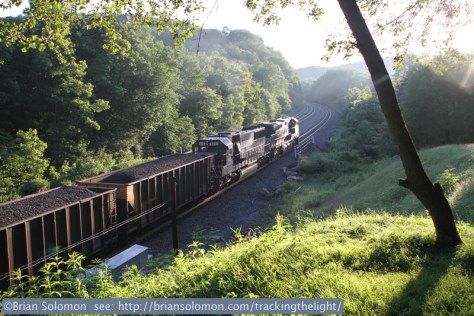
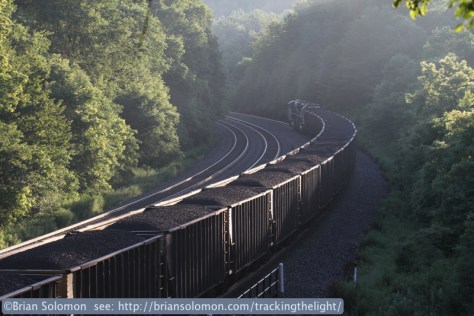
We could hear a freight dropping downgrade toward Fitchburg on the old Boston & Maine mainline. I was traveling with Rich Reed and Paul Goewey. We had limited time to select a photo location.
Complicating matters, Pan Am’s dispatcher came on the radio and told the train it would be working at Fitchburg Yard.
The implication to this seemingly innocuous instruction was that it might be hours before we saw the train east of the yard. We needed to pick a location west of the yard as it might be our only chance to catch this train.
We drove into Fitchburg, and overtook the slow moving freight. After inspection of a few ground level locations, we decided to try the top of the parking garage near the MBTA station.
This offered a superb elevated view. And we arrived in time to check out several angles, before settling on the southeast corner.
Pan Am Railway’s EDPO (East Deerfield to Portland) eases downgrade in downtown Fitchburg. Our vantage point from the top of the parking garage at the railway station offered a superb place to make photos. Canon EOS 7D with 100mm lens.
I made a series of photos using my Canon EOS 7D with 100mm telephoto and Lumix LX3. One of my favorite images is the unconventional down-on view of the old SD45-2 (now effectively converted to an SD40-2, having had its 3,600 hp 20-cylinder 645E3 replaced with the 3,000 hp 16 cylinder version of this engine). This angle shows the great length of the locomotive.
Canon EOS 7D with 100mm lens.A view made with my Lumix LX3 takes in the panorama of downtown Fitchburg, Massachusetts.I turned the Lumix vertically to make this photo. I didn’t get the level perfect, so I made a minor adjustment in post processing (in other words: I cropped the photo.).Tight view of Maine Central 507 (a former Canadian National GP40-2L) exposed with my Canon EOS 7D with 100mm lens.My favorite of the sequence: an unconventional view of Maine Central 614, a locomotive built as an SD45-2, which featured an unusually long frame. Lumix LX3 photo.From the stairwell in the parking garage looking down on the MBTA station as Pan Am Railway’s EDPO trails away. Lumix LX3 photo.
We made a wise choice. Not only did Pan Am Railway’s eastward EDPO pick up at Fitchburg yard take more than two hours, but the crew finished before the train could continue east. At 1pm, it was still sitting in the yard.
Sculpting with Light: CSXT Eastbound Freight Emerges from the Cut at Charlton, Massachusetts.
I thought I’d follow up on theme of yesterday’s post: sometimes the infrastructure is more interesting than the train.
On the morning of February 22, 2014, I met Paul Goewey in Palmer, Massachusetts. We were on our way to Fitchburg. He tells me; “An eastbound train came through about ten minutes ago.”
“We’ll get that. Hop in.”
I know that from many years of photographing on the Boston & Albany route, it is easy enough to catch an eastbound after it’s passed Palmer. The railroad loops north through the Quaboag Valley to Warren. And after passing the Brookfields, it climbs over Charlton Hill.
By contrast, the Mass-Turnpike and Route 20 offer a much faster and more direct route. So we drove to Charlton posthaste.
Old milepost 57 (as measured from Boston, Massachusetts), located at the east end of the cut in Charlton. Canon EOS 7D photo.
I have a long favored location east of CP57 at milepost 57 (pardon any sense of gratuitous redundancy) where the line exits the rock cut constructed in the 1830s. In 2011, a new road bridge was built here to improve clearances on the railroad to allow for operation of taller double-stacked container trains.
A window of morning sun on the tracks was nicely illuminating the new bridge while leaving a good spot to feature the leading locomotive.
We could hear CSXT’s Q436 (Selkirk, New York to Framingham, Massachusetts) climbing Charlton Hill when we arrived. For ten minutes we listened to modern General Electric Evolution-Series diesels chug up the old railroad grade.
Then a headlight came into view. As the train exited the cut, I used my pair of digital cameras to expose a sequence of images featuring the new bridge.
A view with my Lumix: CSXT’s Q436 exits the cut at Charlton, Massachusetts. Which is the subject: the freight or the bridge?I made this closer view with my Canon EOS 7D. The Evolution-Series locomotive has entered a nice patch of morning sun. A moment later the nose of the locomotive hit a series of obtrusive shadows that disrupted my intended composition.Trailing view of CSXT’s modern GE diesels as they descend the old grade toward Worcester. Lumix LX3 photo.
On the morning of February 16, 2014, I anticipated a photo of a westward CSXT empty intermodal train on the former Boston & Albany at the Massachusetts-New York State Line.
Where B&A’s Lima 2-8-4 Berkshires once hauled freight, now CSXT’s modern GE Evolution-Series diesels do the job.
Today Stateline is just a wide spot on a curve, but there’s a lot of history here.
Lumix LX3 photo. Looking east at Stateline.
A trackside concrete marker identifies the border. B&A’s one-time multiple track mainline is now a single main track. A vestige of the old eastward main is buried beneath the snow.
New Haven had maintained an interchange with New York Central here; this was a carryover from the early years, when no less than four railroads operated to Stateline to interchange traffic. Their convergence on this spot was no coincidence as the state border defined original operating charters.
Waiting in my car near the grade crossing on this cold windy morning, I knew this train was close, so when the warning lights began to flash, I jumped into position.
To capture the effect of the locomotive enveloped in swirling snow, I used my Canon EOS 7D with a 200mm telephoto. Exposure: f5.6 1/800 ISO 200. (I’ve allowed the blowing snow to lose detail, while retaining detail in the crusted snow on the ground).
I exposed this image of Pan Am Railways GP40 310 leading MOED on the afternoon of February 17, 2014. By any measure this scene posed a difficult exposure.
Canon 7D in-camera Jpg of Pan Am Railways 310 east of Shelburne Falls, Massachusetts. To my eye, this image appears too bright. Had it been a color slide I’d say it was about a half stop ‘over exposed.’ This Jpg was created using the Canon’s picture style profile called ‘landscape’ (one of several built in Jpg picture styles).
The locomotive is a dark blue, while the scene posed a full range of tones from bright white snow to deep shadows. The train was moving, and there was little time for exposure bracketing.
Using the camera’s histogram, I’d made a test exposure before the train came into the scene, and then made a series of images focused on the composition.
Working with my Canon EOS 7D, I always expose simultaneous Jps and Camera RAW files. Most of the time the in Camera hi-res Jpg proves acceptable, and simply archive the RAW files for the future.
However, in this instance when I got home, I found that the in-camera Jpg appears to bright to my eye. I re-checked the camera’s histogram for that file and confirmed that the image was exposed correctly.
This is the information displayed at the back of the camera. The histogram is just about ideal. The bulk of the exposure is at the center of the graph and there is virtually no clipping of shadow or highlight areas. (See my earlier post on snow exposure for graph interpretation.)
In previous posts I’ve explained that with modern digital imaging old-school film-based assessments of ‘under’ (too dark) and ‘over’ (too light) exposure do not allow for the most accurate way of selecting exposure. (see: Snow Exposure—Part 1)
Instead of using the image at the back of the camera, or even the photo on my home computer screen, to judge exposure, I use the histogram. This graph allows me to select an exposure that maximizes the amount of information captured by the camera on-site.
In this case, although the Camera processed Jpeg seemed too bright (over exposed), the camera RAW file was perfect. Since the problem was in the camera’s translation of the RAW to Jpeg, the solution was simple:
I converted the RAW to a Jpeg manually, which produced a result that matched the scene. This retained excellent highlight detail in the snow, produced a pleasing exposure for the side of the locomotive and hills beyond, while retaining good shadow detail in the tree at the left.
Here’s the camera RAW file. This has not been interpreted by in-camera processing to conform to a pre-established ‘picture style’. The result is perfectly exposed. I simply converted the file to a Jpg manually and scaled it for display here. I did not adjust exposure, contrast, or color. In other words it was an easy fix: there was never really a problem with the file, only with my perception of how the ‘landscape’ style Jpg had interpreted the image.
I did not manipulate or adjust the file except to scale the image and convert it to a Jpg for presentation. (the RAW file is far too large to up-load effectively).
On October 20, 2013, I stopped by the Connecticut Trolley Museum near East Windsor and made a variety of photos. The day was perfect; warm and sunny with a cloudless clear sky. A bit of autumn color clung to the trees.
This was an opportunity to experiment with my cameras and I’ve displayed here three images of former a Boston Type 5 streetcar that was working the line.
I exposed the top image on Fuji Velvia 50 color slide film with my father’s Leica M4 fitted with a 35mm Summicron. The bottom images were simultaneous files made with my Lumix LX3 (which features a Leica Vario-Summicron lens).
MTA type 5 streetcar photographed at East Windsor, Connecticut on October 20, 2013 using a Leica M4 with 35mm Summicron and Fuji Velvia 50 slide film.Lumix photograph; Camera RAW converted to a scaled JPG in two step post processing for internet display.In-camera Lumix JPG exposed using the ‘Standard’ color profile. File scaled for internet display.
The Lumix allows me to make both a camera RAW file and a JPG at the same time. The Lumix software has a variety of color profiles for the JPG files that alter the appearance of the image. Typically, I use the “Standard” profile such as displayed here.
Although I’ve scaled all of the files and processed them for internet display, I’ve not made major changes to contrast, exposure or content. The color slide required a nominal color balance adjustment to remove the inherent bias associated with this film.
I scanned the slide using my Epson V600 scanner.
My father has some nice views of Boston’s Type 5s in revenue service exposed on Kodachrome in the 1950s.
All things being equal, I wonder which photographs will survive the longest? The 50+ year old Kodachromes? My Velvia slides exposed in October? Or the digital files exposed the same day? All the digital files (including scans) are preserved on at least three hard drives. While the slides are stored in a dark, cool dry place.
Lumix LX3 close up of the classic North Shore Electroliner displayed at the Illinois Railway Museum
I grew up seeing the Electroliner projected on our slide screen; my father had photographed these classic trains on several occasions between 1958 and 1963 on the North Shore, and later on Philadelphia’s Red Arrow Lines.
Many years ago, I saw an advertisement on the back cover of Trains Magazine asking for donations to help save one of the trains. I sent $15, which wasn’t much money, but it was every penny I had. I was only about 13 or 14 at the time.
Happily both streamlined sets have been preserved: one is at the Illinois Railway Museum at Union; the other at the Rockhilll Trolley Museum in Pennsylvania.
On June 19, 2010, Hank Koshollek, John Gruber and I traveled from Madison, Wisconsin to the Illinois Railway Museum. Among the trains on display was the Electroliner.
It was the first time I’d seen the train outdoors since catching a fleeting glimpse of it at SEPTA’s 69th street shops in the late 1970s.
I wanted to make a distinctive image of the train, so I used my Lumix LX3 to make a dramatic close up. I also made several more conventional views.
Posed in the sun at IRM. Lumix LX3 digital photograph.
This is relevant because IRM is now hoping to restore the train to service. IRM’s Tom Sharratt contacted me via Tracking the Light, and detailed their plan along with a plea to get the word out:
IRM is pleased that we are finally working on completing the restoration of our [Electroliner] set (801-802), hopefully in time for its 75th Anniversary (Jan 2016.) All eight motors need to be removed and inspected and repaired as necessary, the air conditioning needs to be replaced, and the interior worked on (we have the fabric and a volunteer who is working on that now.) We only (!) need to raise $500K. We have right around $100K now, and need $150K before we drop the motors and take them to a contract shop. We have a Facebook page– http://www.facebook.com/Electroliner
Back in the old days, if I went out and forgot to load my camera it was tough luck. No film, no photo. And, yes, there were several occasions where I suffered this humility.
Today, with my Lumix LX3, there’s a feature that gets me out of the occasional jam. The camera has a built-in memory that allows me to make several photographs when there is no memory card inserted (or if the memory card has an error/failure).
This means that in those rare situations where I have the camera, but have forgotten the card, I can still make a few photos.
Case in point. On April 11, 2012, I’d grabbed the camera and walked into the Dublin city center to run some errands. At the time, the LUAS tram network had a specially painted tram advertising Magnum ice cream bars. I’d seen this several times, but not managed to get a photo of it.
In fact, this tram had proved unusually elusive, and previous efforts to find it in sunlight failed. But on this day, as I wandered through Smithfield, the purple Magnum tram glided along side of me and came to a stop at an intersection in full sun. Perfect!
Except, when I went to make a photo, I got an error message telling me there was no card! I’d taken it out to download it and left it at home! OH NO! But the camera gave me the option of saving the file to the camera memory! Yea!
Specially adorned LUAS tram advertising Magnum ice cream bars pauses at an intersection near Smithfield in Dublin on April 12, 2012. Exposed with a Lumix LX3 and saved to the internal camera memory.
Here’s a pair of opportunistic images. I’d not gone out to make photographs, but while at dinner near Ardmore, Pennsylvania, I noted that Amtrak’s former Pennsylvania Railroad four-track Main Line ran adjacent to the car park.
After dinner, I wandered up to the tracks to investigate the potential for photography. At the edge of the car park was a sign post that I co-opted to use an impromptu camera support (I’d call this a ‘tripod’ but in fact it really was just a post), and placed my Lumix LX3 on the post.
Looking east on the Main Line. Exposed with a Lumix LX3. I used the manual ‘m’ setting and gauged my exposure based upon my test-photo histogram.Looking railroad-west on the Main Line toward Ardmore, PA. Exposed with a Lumix LX3. I used the manual ‘m’ setting and gauged my exposure based upon my test-photo histogram.
The prevailing darkness and extreme contrast combined made for a tricky exposure. Instead of relying on the camera’s internal meter. I first made a test photo, then using that as a gauging point, set the camera to ‘over expose’ by about a full stop for each angle.
To avoid camera shake, I set the self-timer for 2 seconds, pressed the shutter button and stepped back. These are my results. It was cold, and I didn’t believe that any train movements were very close, so I didn’t opt to wait for a train.
Would have a train improved the scene?
See my earlier posts on night photography for suggestions and guidelines:
It doesn’t snow in Dublin very often, and when it snows it rarely stays on the ground for long. It had started snowing heavily overnight on November 28, 2010 and when I awoke, there was a fresh blanket of snow all over everything.
I made the most of morning. Among the locations I selected was along the LUAS tram line that follows the Grand Canal.
A man was feeding the birds and these were circling. Using my Canon EOS 7D with 200mm lens, I made a series of photos of an inbound LUAS Citadis tram heading toward the city center from Tallagh.
The birds in flight make an already unusual situation even more interesting. They add depth and life to a cold and frosty scene. The tram itself is almost incidental. Yet we can follow its progress along the canal, its tracks gradually descending in the distance.
Tight view of BNSF Railway SD70MAC 9261 at Norfolk Southern’s Enola Yard. Exposed with a Canon EOS 7D.
Fifty years ago, it would have been pretty neat to see a Burlington GP30 at Pennsylvania Railroad’s Enola Yard. Yet for the context of that photo to be fully appreciated, it would help to have the location of the locomotive implied in the image.
A few weeks ago, Pat Yough and I were driving by Norfolk Southern’s Enola Yard and spotted this SD70ACE. These days, BNSF locomotives on Norfolk Southern and CSX are not unusual occurrences. Not in Pennsylvania anyway.
After a tight image of the locomotive, I stood back and made a few views intended to convey location.
It’s not what you see, but the images made of what you see.
The sign at the left conveys location and provides a bit of information about safety conditions at Enola. Canon EOS 7D.In this view the sign is the subject, and the locomotive just a decorative background. Canon EOS 7D.
Flexity tram at Place Royale. Exposed with my Lumix LX3 in August 2013.
The Belgian cities have admirable tram networks. By far the most extensive is that in Brussels. Here tram routes crisscross the city. While long sections of tram subway now serve central Brussels, there’s still lots of street running.
Modern Bombardier-built ‘Flexity’ articulated trams dominate the fleet. Yet there’s still some variety of older cars, including articulated PCCs.
For this segment, I’ve largely focused on the more modern cars as they offer the greatest contrast with Brussels’ eclectic old world architecture.
I have mixed feelings about the gold and silver livery. While more subdued than the gaudy colors used in some cities, it tends to look a bit grimy, especially in dull light.
I explored a theme of contrasting Brussels’ old architecture with its modern trams. Lumix LX3 photo.A tram lurks beyond the fountain. Lumix LX3 photo.This tram was wrapped in an advertising livery. It offered a change from the gold and silver that dominates the modern fleet. Exposed with my Canon EOS 7D.Twilight glow near Place Royale, Brussels. Canon EOS 7D.This number 94 car is headed for the Tram Museum (in service, not for preservation—not just yet, anyway!). Canon EOS 7D.Sunset in Brussels. Reminds me of a scene from the cover of a fantasy novel . . .
For me the old Boston & Albany West end is hallowed ground. This was the first true mountain mainline in the modern sense. The line was surveyed in the mid 1830s and by 1839 trains were working over Washington Summit.
Over the last 30 years I’ve made countless trips to photograph this line and it remains one of my favorites. Yet, I rarely come up here in the winter.
On Friday, February 7, 2014, my father and I went up to Huntington to catch Amtrak’s westward Lake Shore Limited, train 449. Not far behind was CSX’s Q427.
This freight runs daily between Portland, Maine and Selkirk, New York via Ayer and Worcester, Massachusetts. This day it had a pair of General Electric Evolution-Series diesels of the type that have come to characterize modern freight operations on the Boston & Albany route.
Since the train wasn’t making great speed, we pursued it on Route 20, stopping to make photos at opportune locations. At CP 123 (where the line goes from single track to two-main track) Q427 met an eastward freight holding at the signal. We continued upgrade ahead of the train.
I remembered that there’s a gap in the hills at Chester which allows for a window of sun on the line that lasts late in the day. So we zipped ahead of the train.
Working with my Canon EOS 7D and 200mm lens, I exposed a series of vertical images of CSX Q427 (Portland to Selkirk) as it passed through a window of afternoon sun.The dappled light on the trees and the dark shadowed hillside beyond made for a dramatic painterly back drop, while tree shadows on the foreground snow minimized the effects of glare and provided texture.
At Chester, Pop set up his tripod to make a hi-resolution video of the train climbing. I positioned myself with my Canon EOS 7D with a telephoto lens to make use of the window of sun against a dark background.
As the train grew closer I also exposed more conventional views with my Lumix LX3. The heavy train took more than two minutes to pass.
Difficulties of Photographing in the Spring and Summer.
That’s just what you want to read about right now, isn’t it!. Gosh, those awful warm months with the long days, soft sunlight and thick foliage.
Well, here I have two views, both made at about the same location off Route 67 in West Warren, Massachusetts at approximately the same time of the morning. Both views show a CSX eastward freight.
On July 31, 2010, an eastward CSXT intermodal train works the former Boston & Albany at West Warren, Massachusetts. At the time heavy line-side brush made photography challenging. Canon EOS 7D.This sequence of photos was made at almost exactly the same location, but after CSXT performed undercutting work and brush cutting along the Boston & Albany route. These views were exposed on the morning of May 10, 2013.Slightly closer view that nearly approximates the position of the train in the July 31, 2010 photo.
The first was exposed on July 31, 2010; the second two views were made on May 10, 2013. While I’ve used one of these views in a previous post (see: Quaboag Valley in Fog and Sun, May 10, 2013 ), I thought these made for an interesting contrast with the earlier image.
The primary difference is that in the interval between 2010 and 2013 CSXT cut the brush along the Boston line and performed undercutting work at West Warren. This is just one of many locations that benefited visually from such improvements.
A secondary difficulty about photographing when foliage is at its summer peak is selecting the optimum exposure. In the 2010 image, I took a test photo and allowed for some nominal overexposure of the locomotive front in order to retain detail in the foliage. I then made a nominal correction in Photoshop during post processing to make for a more pleasing image.
This is the ‘unprocessed’ camera-produced Jpg to show the slight ‘over exposure’ on the locomotive front.
In contrast from the iced grip of winter, these photographs were made on June 30, 2010. This was a gorgeous warm summer’s morning; birds twittered the tree branches as the sun light streamed through a gauzy haze to burn away the dew.
I arrived early at the famed ‘Railfan’s Overlook’ to make photographs in the early light of day. In the distance, I could hear the thunder of a heavy train climbing east toward the Allegheny Divide at Gallitzin.
Norfolk Southern’s busy former Pennsylvania Railroad mainline rarely disappoints, and this morning it was alive with trains.
Using my Canon EOS 7D, I worked the glinting sun to its best advantage as an eastward Pennsylvania Power & Light coal train clawed into view. As it worked the grade, a westward RoadRailer led by former Conrail locomotive glided down grade.
At the back of the coal train were a pair of freshly painted SD40Es making a classic EMD-roar as they worked in run-8 (maximum throttle).
How I wish I was enjoying a warm June morning on the West Slope right now!
A Norfolk Southern coal train, likely destined for Pennsylvania Power & Light’s Strawberry Ridge plant, works west at Cassandra, Pennsylvnia. Canon EOS 7D with 24mm lens, exposed at f4 1/250th second, ISO 200. Back lit morning sun highlights the grass in the foreground.
Westward Norfolk Southern RoadRailer at Cassandra, Pennsylvania on June 30, 2010. The morning sun has caught the front element of my lens making for a bit of flare. Notice how this fogs the shadow areas and warms up the scene. Hollywood film-makers love this effect.I’ve stepped back into the shadow of a tree to control lens flare and stopped down my exposure to allow for better highlight detail on the sides of the RoadRailer. The result is a starker less atmospheric image.Morning glint illuminates the helpers at the back of coal train. Canon EOS 7D with 28-135mm lens, set at 120mm and at f5.0 1/500, ISO 400.
Yesterday (February 7, 2014), after several months of testing, Amtrak’s new ACS-64 Siemens built ‘Cities Sprinter’ locomotive 600 made its first revenue run on Amtrak train 171 (Boston to Washington).
My dad and I went to Milford, Connecticut on the North East Corridor to catch the new electric. Pop made some B&W photos with his Leica M3 from the east end of the platform. I worked the curve at the west end with my Canons.
I popped off a couple of slides with the EOS 3 with a 100mm telephoto, and exposed two bursts of digital images using the Canon 7D with 20mm lens.
Brand new Amtrak electric 600 leads train 171 (Boston to Washington) at Milford, Connecticut at 10:56am February 7, 2014. Canon 7D with 20mm lens. f4.5 1/2000th second, ISO 200.Canon EOS 7D with 20mm lens. Amtrak ACS 64 number 600.Canon EOS 7D with 20mm lens. Amtrak ACS 64 number 600.
Canon EOS 7D with 20mm lens. Amtrak ACS 64 number 600.
By the way the 20mm on the 7D has a field of view equal to about a 35mm lens on a traditional 35mm film camera.
The new electric sure looked nice! I’ll be keen to see the B&W photos and slides when they are processed.
After 171 passed, I made a few photos of a Metro-North local, then Pop and I went over to inspect the recently opened Metro-North station at West Haven, where we made a few photos of passing trains.
Today Amtrak number 600 worked train 171 from Boston.
Brand new Amtrak electric 600 leads train 171 (Boston to Washington) at Milford, Connecticut at 10:56am February 7, 2014. Canon 7D with 20mm lens. f4.5 1/2000th second, ISO 200.
Sayre, Pennsylvania, August 2010.Sayre, Pennsylvania, August 2010.
Watching trains today, it seems that graffiti is omnipresent. Hardly a freight passes without heavily tagged cars in consist.
Railcar graffiti isn’t a recent phenomena. Traditional chalked tags have appeared on cars for generations. I recall photographing a tag that read ‘Edward Steichen knew’ back in the mid-1980s, and I first noticed spray-painted graffiti on the New York Subways in the 1970s.
Yet, the proliferation of large colorful spray-painted murals and haphazard spray tagging has only become widespread on mainline trains in the last couple of decades.
While freight cars are the most common canvases, I’ve see locomotives and passenger cars tagged as well.
Nor is the phenomena isolated to the United States. Train graffiti is a worldwide occurrence. I’ve photographed heavily tagged trains in Poland, Belgium, and (wouldn’t you guess?) Italy! (Among other places).
Almost every photographer I’ve met has an opinion on graffiti.
Would you like to leave a comment? Tracking the light is interested in your opinion(s). See the comments section toward the bottom of the page.
Tim Doherty asked me a few weeks back, “Have you ever tried a shot from the north side of the Millers Falls high bridge?” I’d looked a this several times, but was discouraged by the row of trees between the road and the railroad bridge.
Amtrak‘s northward Vermonter crosses the Millers River on January 12, 2014.
So, on January 12, 2014, at the end of the day (light), Tim and I went to this location with the aim of making images of Amtrak’s northward Vermonter crossing the aged Central Vermont span.
As there was only a hint of light left, I upped the ISO sensitivity of my Canon EOS 7D and I switched the color balance to ‘tungsten’ (indoor incandescent lighting which has the same effect as using tungsten balance slide film (such as Fujichrome 64T), and so enhances the blue light of the evening.
A call to Amtrak’s Julie (the automated agent) confirmed the train was on-time out of Amherst. Running time was only about 20 minutes (a bit less than I thought) but we were in place, cameras on tripods, several minutes before we heard the Vermonter blasting for crossings in Millers Falls.
The result is interpretive. The train’s blur combined with view through the trees and the deep blue color bias makes for a ghostly image of the train crossing the bridge.
Here we have an instance where everything came together nicely.
Amtrak 449 at West Warren, Massachusetts, 2:03pm January 24, 2014. Canon EOS 7D fitted with a 40mm pancake lens exposed at ISO 200 f5.6 1/1000th of a second. Camera RAW file converted to a Jpeg in Adobe Photoshop.
On Friday January 24, 2014, I’d got word that Amtrak’s heritage locomotive number 822 was working the westward Lake Shore Limited, train 449
This was the second time in a ten-day span that I’d be alerted to a heritage locomotive on this run. As noted in my January 18, 2014 post, Amtrak’s Lake Shore Limited, the weather wasn’t cooperative on my previous attempt at catching an Amtrak heritage locomotive.
By contrast on January 24th it was clear but very cold. I opted to make the photo at West Warren, where it’s nice and open and there’s a distinctive landscape.
Normally, Amtrak 449 passes East Brookfield at 1:30pm, and Palmer about 1:50pm. West Warren is roughly halfway between them, so I aimed to be there no later than 1:35pm
As it happened, 449 was delayed on Charlton Hill and passed more than 15 minutes later than I’d anticipated. Other than resulting in my nose getting a bit cold, this delay produced little effect on the photograph.
I opted for a traditional angle because I wanted to feature the locomotive as the primary subject this scenic setting. I picked a spot on the road bridge over the Quaboag River where I could make a view that included the old mills and waterfall, as well as a side view as the train got closer.
Working with my Canon EOS 7D fitted with a 40mm pancake lens, I set the motor drive to its fastest setting, and exposed three bursts of images as the train rolled east on CSXT’s former Boston & Albany mainline.
Since the camera’s buffer will quickly become saturated when making multiple photos in rapid succession, I was careful to wait until the train was nearly where I wanted it in each of the three sets.
This tighter view offers a clean perspective on the equipment. I was aiming to feature both the heritage painted locomotive and the ancient baggage car. Word to the wise; get the old baggage cars while you can, they won’t be around forever.
Have you had luck catching Amtrak’s heritage locomotives? Do you have a favorite? Let me know! There’s a venue for comments on this blog, scroll down.
Looking west toward North Pownal, Vermont. The once standard searchlight style signal is rapidly disappearing. On Pan Am Railways many have already been replaced. Dull day’s can make for better signal photos because its easier to capture the signal aspect.
These old sentinels are on the wane. Get your photos before they are all gone.
Amherst Railway Society‘s Big Railroad Hobby Show show is pure sensory overload. Everywhere you look there’s something or someone that seizes your interest. An old friend, an F-unit, a trolley buzzing underwire, video of a steam locomotive, the sounds of trains.
Paul Carver.Pioneer Valley Railroad‘s Dave Swirk.Dan Howard with the Seashore Trolley Museum.Wait, what? A vintage fishbowl bus? At the TRAIN show?!Caboose and a vision of Pennsylvania’s Martin Creek Viaduct in the distance.Lens-master George C. Corey.
It fills four buildings at the Eastern States Exposition grounds at West Springfield, Massachusetts and attracts tens of thousands of visitors.
For railway enthusiasts it’s an epic event and an annual pilgrimage. The show is the living testimony of the late Bob Buck—long time show director and proprietor of Tucker’s Hobbies.
Through clever marketing, unceasing persistence and a life-long passion for trains of all scales, Bob built the show from a small railroad hobby event into a massive one.
This weekend’s show was another well-attended event. It was a virtual sea of trains and people. Here are a few photos of people I met at this year’s show and exhibits that I enjoyed.
Otto Vondrak of Railfan & Railroad Magazine.Scarlett promotes Palmer’s premier railroad restaurant, the ever-popular Steaming Tender (located at the old Union Station).
Quabog Valley’s Boston & Albany J-2 Pacific.
Berkshire Scenic.Model Station.Phil and Rich.Rich Reed’s Penn Central display.Tucker’s Hobbies of Warren, Massachusetts.
As Transmitted from Amtrak number 56, The Vermonter.
This morning I started at Overbrook, Pennsylvania, where frosty temperatures and a clear sky made for some stunning lighting effects. The cold wasn’t aiding timely railroad operations.
I caught a SEPTA local to 30th Street Station. I was booked to travel on the Vermonter, but delays gave me ample time to wander around and down load digital photos from my cameras.
An outbound SEPTA multiple unit catches the glint of the rising sun at Overbrook, Pennsylvania before 8am on January 23, 2014. Canon EOS 7D with 200mm lens.An eastbound SEPTA multiple unit passes Overbrook, Pennsylvania before 8am on January 23, 2014. Canon EOS 7D with 200mm lens.Canon 200mm view of a non-stop SEPTA MU east of Overbrook, PA, on January 23, 2014.The Solari boards at 30th Street didn’t paint a happy picture. Delays and cancelations were the rule of the day. My train was only about 40 minutes behind the advertised. Lumix LX3 photo.30th Street Station, Philadelphia on the morning of January 23, 2014. Lumix LX3 photo.30th Street Station from the 29th Street side. Lumix LX3 photoAmtrak veteran, AEM7 932 roars into 30th Street Station with the Vermonter in tow. I’m riding behind this locomotive as I write this. Lumix LX3 photo.Amtrak 56 arrives at 30th Street, 40 minutes after its scheduled time. Better late than never. Lumix LX3 photo.
At present I’m gliding eastward across a snow covered urban landscape on the former New Haven Railroad. This is Tracking the Light’s first post sent directly from an Amtrak train.
View from Amtrak 56 on approach to New York’s Hell Gate Bridge with the New York City Transit Authority below and the Manhattan skyline beyond. Lumix LX3 photo.On board Amtrak number 56 The Vermonter, east of Penn-Station, New York. Lumix LX3 photo.Metro North Railroad HyRail truck as viewed from Amtrak 56 on the afternoon of January 23, 2014. Lumix LX3 photo.USDOT test car on the old New Haven Railroad west of Stamford on January 23, 2014. Lumix LX3.
The word was out that Norfolk Southern’s Pennsylvania Railroad painted heritage locomotive was to work a detoured stack train over CSX’s Trenton Subdivision to avoid a scheduled engineering project at Norristown, Pennsylvania.
Pat Yough and I planted ourselves at the West Trenton, New Jersey SEPTA station in anticipation. A number of other enthusiasts had similar plans, so there was plenty of company.
Former Reading Company station at West Trenton, New Jersey on the morning of January 19, 2014. Lumix LX3 photo.Detailed view of West Trenton station. Exposed with a Canon EOS 7D with 100mm lens.West Trenton station’s build date is carved in stone. Lumix LX3 photo.A SEPTA train for Philadelphia’s Airport pulls into the West Trenton station. CSXT’s unit oil train K040 with BNSF locomotives waits in the distance. Canon EOS 7D with 100mm lens.After the SEPTA local departed, CSXT KO40 led by BNSF 9688 and 5523 rolls southward through West Trenton. This section of the old Reading demonstrates how freight and passenger traffic can coexist on the same line. Canon EOS 7D with 100mm lens.CSXT symbol freight Q439 works south behind mixed consist of GE and EMD locomotives. Canon EOS 7D with 100mm lens.Switchers have become relatively rare items on modern railroads so I made this grab shot of CSXT 1137 as it rolled by. Lumix LX3 photo.A SEPTA Silverliner V waits to enter West Trenton Station. Canon EOS 7D with 200mm lens.
The much anticipated Norfolk Southern detour I5T, (running as CSXT B100-19) works northward through West Trenton. At the back of the train are a pair of NS diesels to aid with reverse moves necessary for the detour arrangements. Canon EOS 7D with 100mm lens.
The former Reading station building at West Trenton is now privately owned (and serves a non-railroad function), while the platforms remain active for SEPTA’s regularly scheduled passenger trains to Philadelphia.
When we arrived, morning clouds were giving way to sun. A pair of westward CSX trains was holding just west of the electrified zone and the radio was alive with activity.
In a little more than an hour we caught three SEPTA trains and four freights. This kept me and my three cameras pretty busy. My goal was not just to photograph the trains, but to capture these trains in this classic railroad environment.
Norfolk Southern 8102 was in clean tuscan-red paint at it trailed at the back of nearly two-miles of double stacked containers. Canon EOS 7D with 100 mm lens.Trailing with of NS I5T (CSXT B100-19) passing the West Trenton tower. Canon EOS 7D.CSXT empty oil train K041 works northward behind the detoured stack train. BNSF locomotives make a bit of color in this otherwise drab New Jersey scene. Canon EOS 7D with 20mm lens.
Philadelphia was the Pennsylvania Railroad’s headquarters city. Despite multitudes of change in the industry since PRR merged with New York Central in 1968, there’s still plenty of Pennsy cues around Philly.
For me this is like finding hints of a long lost empire.
Pennsylvania Railroad’s Suburban Station. Lumix LX3.Interior of 30th Street Station. The commemorative statue depicts an angel carrying a soldier skyward which symbolizes PRR’s employees who perished in action during World War II.
The keystone was PRR’s symbol. If one searches around Philadelphia’s 30th Street, there are still plenty of PRR keystones to be found. Lumix LX3 photo.Old PRR station at Clifton-Aldan, Pennsylvania. Lumix LX3 photo.A PRR-style position light signal at Overbrook, displays an ‘Approach-Medium’ aspect. Canon EOS 7D photo.Overbrook Station on the Main Line, as seen on the evening of January 18, 2014.
For me, SEPTA is one of the most photogenic American big city transit systems. Sure, other cities have their charms, but Philadelphia has a lot going for it; variety, accessibility, interval services on most routes, real time displays at stations, visual cues to its heritage, interesting and varied equipment and etc.
On January 16, 2014, my brother Sean and I, spent an afternoon and evening wandering on SEPTA’s rail systems making photographs. I had a minor agenda to ride a few pieces of the network I’d not yet traveled on.
I worked with two cameras; Lumix LX3 and Canon EOS 7D, but traveled relatively light (no film body or big telephotos)
Lumix LX3 photo.SEPTA has a App that shows schedules, train times & etc. Lumix LX3 photo.Philadelphia is one of the few North American cities with direct heavy rail airport connections. Trains run every half hour with stations at each terminal. Lumix LX3 photo.Afternoon sun catches an outbound Silverliner V at University City. A CSX freight rolls overhead on the Highline. Canon EOS 7D with 100mm lens.
All of the lines we traveled were well patronized (some at standing room only) and yet everything seem to run to time. SEPTA’s staff were friendly and helpful. (Especially when we were running for trains).
SEPTA SIlverliner V interior. Built by ROTEM. Lumix LX3 photo.End of the line at Elwyn.Silverliner V at Elwyn. The line used to continue to West Chester. Lumix LX3 photo.Old Pennsylvania Railroad station at Clifton-Aldan.End of the Sharon Hill trolley line. Lumix LX3 photo.69th Street terminal at Upper Darby. Outbound Kawasaki trolleys for Media and Sharon Hill. Lumix LX3 photo.Norristown High Speed Line at 69th Street. Lumix LX3 photo. Contrast adjusted in post processing to improve the overall appearance of the image.Norristown transportation center. The old Reading Company on the lower level. A Norfolk Southern freight rolled through as we boarded the train for Center City. Lumix LX3 photo.SEPTA Daypass; a bargain that cost just $12. We got good value with ours. SEPTA’s conductor sold us the passes on the train. Lumix LX3 photo.Market East. Canon EOS 7D photo.Market East. Lumix LX3 photo.Market East. Canon EOS 7D photo.Overbrook station on the Main Line. Canon EOS 7D photo, with 40mm pancake lens.
I used my trip on Amtrak 475/175 as an opportunity to make a few photographs. While I had some bigger cameras in my bag, I exposed all of these images with my Lumix LX3.
I boarded shuttle train 475 at Berlin, Connecticut just as the sun was setting. By the time I arrived in New Haven, only a faint blue glow remained of daylight.
Amtrak 475 (Springfield, Massachusetts—New Haven, Connecticut shuttle) works as a two-car push-pull with a former Metroliner (MP85) cab car leading. The train glides to a stop in front of the old Berlin, Connecticut railway station. Once a double track line, today this is a single track route. Lumix LX3 photo.Even the branch train has WiFi.A Boston-bound Acela Express pauses at New Haven. I had about 15 minutes to make photos before my connection, trian 175, from Boston arrived.The Acela Express accelerates out of New Haven. I panned the rear of the train with the Lumix image stabilization set ‘on’; f2.8 at 1/5th of a second, ISO 200.A Shore Line East suburban train roars away on the platform. These New Haven painted diesels have auxiliary engines to provide head-end power.A set of new Metro-North M8s arrived from Grand Central Terminal. It’s nice to see a shiny new train every so often!An HHP electric slides westward with train 175 in tow. How much longer will these powerful machines work the Northeast Corridor?
I didn’t have a tripod with me, so I used the station signs and other available flat surfaces on the platform to steady the camera. To avoid camera shake, after composing my image, I set the self timer to 2 seconds and press the shutter button.
Also, I overexposed each image by 1/3 to 2/3s of a stop to compensate for the prevailing darkness.
The trip was uneventful. Amtrak is my preferred means for navigating between cities in the Northeastern USA.
On board train 175 at New York Penn Station.Crossing the Delaware at Trenton, New Jersey.Philadelphia 30th Street. Amtrak 175 arrived about 5 minute behind the advertised, but that’s within tolerance, right? This classic Pennsylvania Railroad station is one of the gems of the Northeast Corridor.30th Street Station as viewed from the 29th Street side.A classical entrance to Philadelphia; you just don’t get the same feeling from an airport.Looking east on JFK Blvd toward Center City. SEPTA’s former PRR line to Suburban Station is on the left.
Amtrak 449, in sun and rain; one day and the next. Last week, I was over in East Brookfield visiting the LeBeaus to do some videography for a music video. Dennis LeBeau lives a block from the Boston & Albany (CSXT’s Boston Line).
I said to Dennis, “I’m just going to nip down to the bridge to catch 449. It should be getting close.”
“Passes here every day at one-thirty. I’ll join you in a minute.”
I phoned Amtrak’s Julie (the automated agent: 1-800-USA-RAIL) to find out if 449 as on time out of Worcester. As it turns out, it departed Worcester Union Station 4 minutes late.
Worcester is at CP45, East Brookfield is CP64. It takes 449 about 25-30 minutes to run the 19 miles.
Since it was nice bright afternoon, I opted for a broadside view that shows a few of the houses in town. At 1:39, Dennis shouted to me from the road bridge, “He’s around the bend.” I was poised to made my photograph with my Lumix LX3.
This can be tricky since there’s really only a split second to get the train in the right place. If the camera isn’t cued up, all I’ll get is a photo of the baggage car. But I was ready, and put the train precisely where I wanted it.
Amtrak’s westward Lake Shore Limited at East Brookfield, Massachusetts on January 13, 2014. Exposed with a Lumix LX3 at f4.0 1/1600th of a second. I selected a fast shutter speed to insure I stopped the train. When working broadside, the relative motion of the train to the film plane requires a fast shutter speed than when aiming at tighter three-quarter view.
The train glided through town. I turned to make a few going away views with my Canon, and said to Dennis, “You know that never gets old. I’ve been photographing that train since the 1970s.”
Dennis said to me, “I’ve been watching it since it was the New England States Limited, with New York Central E8s!”
A day later, I was in Palmer (CP83). The word was out that Amtrak 145 (one of the Genesis P42s in heritage paint) was working 449. The weather was foul, but since I was in town anyway, I figured I’d give the train a roll by.
It was stabbed at CP83 by a southward New England Central freight going into the yard, which allowed ample time for photos. Such a contrast in days. Pity the heritage P42 hadn’t worked west a day sooner.
Amtrak has painted P42 145 in its 1970s-era scheme. It leads train 449 which is sitting at CP83 waiting for a southward New England Central freight to clear the diamond on January 14, 2014. Driving rain was the order of the day. Canon EOS 7D with 20mm lens.
Pan Am Railway’s EDMO roars west on the Boston & Maine.
It’s almost like stepping back to the 1970s; three EMDs powered by turbocharged 16-645 diesels working under searchlight signals with a carload train.
On January 12, 2014, Pan Am Railway’s EDMO (East Deerfield, Massachusetts to Mohawk Yard) works the old Boston & Maine Fitchburg route at Greenfield, Massachusetts. The line on the left is the Connecticut River route running south toward Springfield. Exposed with a Canon EOS 7D fitted with an f2.0 100mm lens.
This is a nice contrast to the parade of double-stack containers and unit trains that characterize most American mainlines. While the details of the motive power have been altered since they were built, the spirit of the operation reminds me of watching trains more than 35 years ago.
If you think about it, as point of comparison, if in 1979 you were to see 35 year-old motive power and a traditional freight train that probably would have been either steam engines, or EMD FTs leading 40-ft cars.
Sure, you could argue that Pan Am’s paint scheme is a relatively recent development, and the locomotives have been modified since the 1970s (the lead former Santa Fe SD45-2 had its 20-645E3 swapped with a 16-cylinder engine among other changes), but that belies the point.
EDMO. Exposed with a Canon EOS 7D fitted with an f2.0 100mm lens.Tight view of Pan Am 616. Exposed with a Canon EOS 7D fitted with an f2.0 100mm lens.
The other day, I had a few packages to send out. I’d delayed going to the post office until after the school buses were out, using the logic that if I waited, I wouldn’t get stuck behind one on the way back.
On the way into the PO, I heard a distant whistle. And while at the desk, a train rumbled by.
New England Central’s (NECR) former Central Vermont line runs on a slightly elevated gradient behind the Monson, Massachusetts PO. This is on the climb up State Line hill, and heavy trains make a good racket coming though town. This freight, however, wasn’t very heavy and the engines weren’t working too hard.
I made an expeditious exit after mailing my packages, and started south on Route 32. No sooner than I was south of town, I found myself looking at the back of a school bus!
And this bus then stopped, as required, at the South Monson grade crossing.
I could hear the southward climbing. It had already gone through. Fortunately, once over the tracks, the bus driver kindly pulled in to let traffic around. I sailed southward, and arrived at State Line crossing. Once out of the car, I could hear the train working.
New England Central’s daily freight at the Massachusetts-Connecticut state line. Notice the granite marker to the left of the locomotives. Exposed with a Lumix LX3, set at ISO 200.
Although the light was fading, there was enough to work with. While, I’d left most of my cameras at home, I had my Lumix LX3 in my coat pocket. I set up a shot immediately south of the Massachusetts-Connecticut state line, and included the granite marker at the left of the image.
After the train passed, I followed it to Stafford Springs, where I made a few more photos. As it turns out, these NECR images are my first railway photos for 2014.
New England Central’s GP38s lead a southward freight through downtown Stafford Springs, Connecticut on January 9, 2014.New England Central’s GP38s lead a southward freight through downtown Stafford Springs, Connecticut on the afternoon of January 9, 2014. Lumix LX3 photo.
Blue sky and red signals; the old Boston & Maine-era searchlight protects the Bellows Falls diamond. In the steam era an old ball signal protected this crossing, then with Rutland Railroad.
Here, a potpourri of images illuminated the net; covering everything from unit oil trains to obscure eastern European transit. So, looking back, 2013 has been a productive and busy time for Tracking the Light.
My original intention with Tracking the Light was to disseminate detailed information about railway photographic technique. Over time this concept has evolved and I’ve used this as a venue for many of my tens of thousands of images.
Among the themes of the images I post; signaling, EMD 20-cylinder diesels, Irish Railways, photos made in tricky (difficult) lighting, elusive trains, weedy tracks and steam locomotives are my favorites.
Since March, I’ve posted new material daily. I’ve tried to vary the posts while largely sticking to the essential theme of railway images. I hope you’ve enjoyed the posts and will tell your friends about this site! There’s more to come in 2014!
Happy New Year!
Brian Solomon
Southern Pacific 7547 leads a manifest freight timetable east at Brock, California, on SP’s East Valley line on April 28, 1991. This 35mm Kodachome image was scanned with an Epson V600. Minor adjustments were necessary using Photoshop to lighten exposure, correct contrast and color balance. The photo is seen full-frame.Wisconsin Central as viewed from across a cornfield at Byron, Wisconsin on December 3, 1994. Exposed with a Nikon F3T with 28mm wide angle lens on Kodachrome 25 color slide film. Scanned with a Epson V600 scanner. No post processing except as necessary to scale image for internet use and insert byline tag.Bord na Mona trains are loaded with peat. A section of temporary track sits in the foreground. Exposed with a Canon EOS 7D fitted with a 28-135mm lens.New England Central freights 604 and 606 at Palmer, Massachusetts. Lumix LX photo.Exposed with a Nikon F3T with 24mm lens with R2 red filter on Fuji Neopan 400, processed in Agfa Rodinal Special.My known good spot: here a Bluebell train works the bank north of Horsted Keynes. Lumix LX3 photo.
Screamer kicks up snow near Shirley, Massachusetts. Canon EOS 7D with 100mm lens. Contrast adjusted in post processing.This tram was difficult to miss in its iridescent special livery.The National Gallery and Trafalgar Square are among London’s largest tourist attractions. This poster describes Victorian interest in art and places photography in period context. Lumix LX3 photo.In 1989, New York, Susquehanna & Western served as the court appointed operator of Delaware & Hudson. By virtue of the 1976 Conrail merger, D&H had been granted trackage rights on the former Erie Railroad route from Binghamton to Buffalo, New York. On this March morning, a new NYS&W General Electric led an eastward double stack train on the old Erie near West Middlebury, New York, 384 miles from Jersey City.Exposed on 120 Kodachrome transparency film with a Hasselblad 500C with 80mm Zeiss Planar lens
A study in motion: drive wheel, cylinder, valves and valve gear of locomotive 92212 at Kingscote. Canon EAS 7D photo.The former Pennsylvania Railroad Suburban Station as seen in Philadelphia, Pennsylvania in July 2013. Lumix LX3 photo. I made this photograph with my Canon EOS 7D with f2.8 200mm lens, set at ISO 400 f 4.5 at 1/1000th. In post-processing I made minor adjustments to contrast and saturation to match how I perceived the light at the moment of exposure.
A landscape view of Irish Rail’s HOBS at Islandbridge Junction near Heuston Station in Dublin on August 2, 2013. Canon EOS 7D photo.Pan Am 618 roars west at Wisdom Way on November 21, 2013.Distant signal for Nicholastown gates. Nikon F3 with 180mm lens, Fujichrome slide film.Away we go into the sunset hot in pursuit of an oil train. Canon EOS 7D with 100mm lens set at f6.3 1/1000 second at ISO 200.First of four eastward unit oil trains; CSX K040 with a mix of CSX, KCS, and BNSF locomotives.
I was visiting Philadelphia for the holiday season. I’d just got my Lumix back from Panasonic following a warranty-repair and I was happy to make some photos with it.
A wander around Center City on December 30, 2010 with my family made for ample opportunities to exercise the shutter. Sometimes the ordinary scenes make for interesting photos, and over time these tend to age well; witness below.
Panasonic’s Lumix LX series cameras are idea for making urban images. Compact size, ease of use, plus a very sharp lens and the ability to shoot RAW files, gives benefits of both snapshot and professional quality cameras. I’ve enlarged my LUMIX LX3 images to 16×20 inches with excellent results and routinely included LX3 photos in books and articles.
This view was exposed on the platforms of SEPTA’s Market East station (the 1980s replacement for Philadelphia & Reading’s Victorian train-temple, Reading Terminal—today a convention center, sans tracks).
Here I found a pair of 1960s vintage Silverliners working the R3 service. These elegant classics were nearing the end of their working careers. After nearly five decades, the last of these machines were withdrawn in June 2012.
New England Central’s local freight with locomotive 3015 idles in front of the Palmer Yard (Massachusetts) office. I exposed several images, this one was at about 15 seconds.
The other night in Palmer, Massachusetts an arctic breeze was blowing, but that didn’t stop me from making time exposures to capture the holiday spirit.
I exposed these photos despite numb hands and cold feet. I used my Lumix LX-3 (choice night camera in cold weather) fitted to a large Bogen tripod.
Years ago, I fitted plastic-foam pipe insulation to the tripod legs (as per recommendation by experienced cold-weather photographer Mike Gardner). This makes it easier to handle the tripod when it’s very cold.
My exposures varied from about 1.6 seconds at f2.8 (ISO 200) to 25 seconds at f4.0 (ISO80). I set the camera manually using the histogram from test exposures to gauge my settings.
Christmas lights on dark nights make for exceptionally difficult contrast. If you overexpose to allow good shadow detail the lights get blown out (losing their color[s] as a result). Underexpose to feature the lights and the sky and shadows turn to an inky black.
Somewhere in between is a compromised setting. Rather than ponder the subtleties of the histogram as the blood in my toes congealed, I opted to take a series of images, one after the other, and select the best of the bunch in a warm environment later on.
Palmer’s star railroad themed restaurant is the Steaming Tender; this has been colorfully decorated with holiday lights. I made a series of exposures from several angles. This one was exposed correctly for the lights and looked good in the histogram, but appears too dark in my opinion. I prefer the image below.This is about one stop brighter. While I feel it looks better overall, one noticeable flaw is that the ‘Steaming Tender’ sign is overexposed and the lettering isn’t readable. Ultimately the solution may be to blend two images of different exposures in post processing, but I’ve not bothered to do that yet.New England Central’s 3015 pauses in the yard for a 25 second time exposure. I wonder if the car adds an element of interest to the photo? If not now, maybe in years to come. Lumix LX3 photo.Looking toward CP83 (interlocking at the west end of Palmer) and the old Union Station (now the ever-popular Steaming Tender restaurant). A westward CSX intermodal train from Worcester is gliding through the scene. I exposed this at about 5 seconds at ISO 200. It is about 1.5 stops ‘over exposed’ as per the camera meter, but by using a much lighter exposure I’ve captured the effect of the moonlit high clouds and textures of the snow. On the downside, some of the Christmas lights have blown out (become seriously overexposed).
Photographing on the old Boston & Maine in the Snow.
Pan Am Railways’ local freight ‘FI-1’ works west at Derby on its return to Fitchburg Yard. This is the approximate location of the photo in Ball’s book, but a bit higher. Canon EOS 7D with 100mm lens.
A few weeks ago I called into Tucker’s Hobbies to visit with Rich Reed who was working the counter. I picked up a copy of Don Ball Jrs’ classic book Americas Railroads, The Second Generation.
I remember finding a copy of Ball’s book at the Wilbraham Library when I was in Junior High School and being very impressed by the photographs and their arrangement.
In October 1981, my parents drove me to Brattleboro, Vermont on a windy, rainy evening to watch a slide show that Ball was presenting. After the show, I spoke to him briefly. I met him once again, two years later on Steamtown’s Vermont final run from Bellows Falls to Rutland. Ball was running the operation at the time.
Anyway, as I was thumbing though the pages, I came across an image at the bottom of page 29 of a pair of Boston & Maine GP9s in the 1970s-Blue Bird livery with a long freight. The location looked familiar, but I couldn’t place it. The caption read ‘Lunenburg, Massachusetts.’
This puzzled me. I’m usually very good with picking out specific locations. I have a memory for that sort thing . . . most of the time.
“Hey Rich, where’s this?”
“Lunenburg, that’s Derby Curve just west of the new interlocking. We were there a few months ago to roll by the NS intermodal train.”
Indeed we were, I remember!
So then, on Thursday, December 19, 2013, Rich, Paul Goewey and I were back in that part of the world, and we went to the very spot where Don Ball made his photograph. That wasn’t really why we were there, but we were.
The reason for our visit was that the lighting angle suited a westbound train. More to the point, Pan Am Railways’ POED (Portland to East Deerfield) freight had stalled about a mile to the west. A light engine had come out from Ayer and had tied onto the head-end to assist the train up to Gardner.
A Boston-bound MBTA train shoves eastward with the locomotive at the back. This is one of the old ‘screamers’ featured on Tracking the Light on December 21, 2013.
Instead of standing precisely in Ball’s shoes, I scrambled up the side of the hill to get a slightly higher angle. We photographed the parade trains, including the struggling POED. Looking back at Ball’s photo, it is interesting to see how much the location had changed over the years. And the railroad too!
Pan Am Railways was having a difficult time. POED with 102 cars and weighing 4,882 tons, had stalled climbing the hill west of Shirley when its lead locomotive suffered some electrical difficulties. To get the train moving, this Norfolk Southern GE DASH8-40C was sent from Ayer to assist. The train is on the move heading west at Derby Curve just after 1:34 in the afternoon. Canon EOS 7D with 100mm lens.Trailing view of Pan Am Railway’s POED. The failed locomotive is a former Southern Pacific SD45. I wonder, had I seen this locomotive on Donner Pass or climbing the Siskiyou Line? Anyone have a roster handy? Today its Pan Am 611, what was it back then?
On Thursday (December 19, 2013) I made these photos of Massachusetts Bay Transportation Authority Commuter trains on the old Fitchburg route.
A screamer roars west of Derby on December 19, 2013. Pan photo exposed with a Canon EOS 7D.
For some 35 years, Electro-Motive F40PH diesels have worked these lines. MBTA’s early F40PHs supply head-end power from the 16-645E3 prime mover by running the engine at high rpms. The result is a high-pitched scream that has given these locomotives their nickname.
Replacement locomotives are on their way and the first have already arrived. How much longer will these old screamers work the Fitch? Bets anyone?
Screamer kicks up snow near Shirley, Massachusetts. Canon EOS 7D with 100mm lens. Contrast adjusted in post processing.
Boston & Maine 1220 is a locomotive I recall well. The full-sized machine was a regular at East Deerfield Yard in the early 1980s.
Earlier this year, my friend Dan Bigda asked me to make photographs of his magnificent O-scale layout for a feature article in the January 2014 issue of O-Scale Railroading (recently published).
I made several visits and with the help of Dan Bigda and Dylan Lambert, I exposed several hundred digital images with three cameras.
For close ups and macro views I used my Lumix LX 3 and my father’s Lumix LX-7, while for telephoto images, I worked with my Canon EOS 7D.
Most of the scenes were artificially lit with hot lamps. I positioned twin Lowel halogen lights on tripods to emulate natural light. Depending on the scene, I worked with blend of direct light with light diffused with photo umbrellas.
Almost all the photographs required long exposures and most were made with the aid of a tripod.
Dan’s layout features some fascinating structures, and I made a special effort to capture these as well as making images of the trains. Also, Dan has a great collection of O scale freight cars and well weathered locomotives.
The layout recreates the setting of New England industrial railroading as it looked from the late 1960s until the early 1980s.
It’s a look back on the early Penn Central years when GP9s still ruled New England branch lines. Canon EOS 7D photo.Hampden Terminal Railroad blends elements from a variety of New England railroads. Equipment includes Mass-Central’s Whitcomb 44-ton diesel as well as a good variety of Penn-Central, Conrail and Boston & Maine equipment.The layouts main attractions include complex mills, factories and warehouses typical of New England mill towns such as Ware, Holyoke, and Lowell, where I often photographed years ago.I exposed this view of Dan’s model of the Bondsville trestle using my Canon EOS 7D fitted with 100mm telephoto. I’ve set up two Lowel halogen lamps; one with an umbrella for an overall diffused light, the other I’ve focused on the train to simulate afternoon summer sun.Freight cars are an important part of Hampden Terminal, so I staged a variety of images that focused on the cars rather than on the O-scale locomotives. For these extreme close-up views I used my Lumix LX3 and focused the camera manually. I then set the self-timer to minimize vibration during the exposure. I set the aperture manually, and selected the smallest possible sized aperture hole (which confusingly is identified with the largest ‘f-number’), in this case ‘f 8’. In addition to my lamps, this image has caught a bit of daylight from the windows above the railroad.I’m partial to pairs of EMD switchers running with cabs facing out.
Erie Railroad Mallet compound steam locomotives neither fit Dan’s period or location, but since he had one of these locomotives on hand, I included it anyway. I’ll admit, that the Erie 0-8-8-0 Camelback Mallets are among my favorite steam locomotives and I couldn’t resist posing one on the Hampden Terminal!
For this view I opted to emulate the lighting on a bright overcast day. Penn-Central black seemed to photograph well on dull days so I went with what worked best on the prototype.I often use the backlit ‘glint’ effect for my prototype photos, so I thought I’d try this on the O-scale railroad as well. As with the Erie Mallet, Dan’s Boston & Albany tank engine doesn’t exactly fit with the period, but I like it anyway! For this view I surrounded the engine with New Haven Alco road-switchers since these locomotives may have coexisted in Framingham or South Boston.Penn Central makes for a fascinating subject to model. Here I’ve emulated late afternoon sun using the halogen lamps. Canon EOS 7D photo.Dan’s Hampden Terminal is really a big model railway. While many of my photographs are focused on specific scenes, this view gives a sense for the greater railroad with the tracks extending out of the frame at the top right. Lumix LX3 photo.I exposed this image with natural light. Dan’s Warren truss crosses in front of a window making for a nice silhouette.