London Overground Train. Exposed with a Lumix LX3.Overground train approaches Brondesbury on April 19, 2013. Lumix LX3 photo.
Since Overground primarily serves neighborhoods in London’s outer reaches and is a much more recent addition to London Transport, it is undoubtedly less-familiar to visitors than the Underground. Yet, Overground is a boon for the railway enthusiast, since it connects a variety of interesting railway hubs and junctions.
Overground crossing the Regents Canal at Haggerston on April 17, 2013. Lumix LX3 photo.Interior of London Overground train on April 21, 2013. Lumix LX3 photo.
Overground services are fully integrated with other elements of London Transport, and there are many places allowing cross platform transfers to Underground and Network Rail services, as well as connections to buses and the Docklands Light Railway. Overground is open to holders of Day Travel Cards, Oyster Cards and other urban fares.
An EMD-built Class 59 diesel leads an empty stone train through Kensington-Olympia station on April 19, 2013. The Overground offers a convenient link to freight routes. Exposed with a Canon EOS 7D and 28-135mm lens.London Overground train approaches West Hempstead station on April 19, 2013. Canon EOS 7D with 28-135mm lens set at 135mm.London Overground train at Clapham Junction. Lumix LX3 photo.
On the down side, many Overground stations suffer from austere, utilitarian, and otherwise uninspired architecture (if the term can be applied to the line’s platforms and shelters). Yet, I found the services well run, and stations and trains clean and easy places to make photographs.
An EWS Class 66 diesel leads a northward container train through the Overground station at Wandsworth Road on April 22, 2013. Canon EOS 7D photo.Wandsworh Road on April 22, 2013. Lumix LX3 photo.
A platform mirror catches a view of an Overground train at Willesden Junction on April 19, 2013. Lumix LX-3 photo.Hoxton Station on London’s Overground. Lumix LX3.
Perhaps London’s most impressive railway backdrop is the disused Battersea Park Power Station. It is among London’s industrial icons and famous for its portrayal on the cover of Pink Floyd’s 1977-album Animals.
A Southeast Trains EMU from Waterloo Station passes the Battersea Park Power Station on April 17, 2013. Exposed with a Canon EOS 7D fitted with 28-135mm lens.
This location was recommended to me from veterans of railway photography and I first photographed here in the year 2000. The vantage point is from the lightly used suburban station at Wandsworth Road. Until recently, this was served by a loop service connecting London Victoria and London Bridge terminals. Now, the Overground rail network (subject of a future post) serves Wandsworth road.
Trains stop here every 15 minutes on the run between Clapham Junction and Highbury&Islington stations.
Several lines converge at Wandsworth Road, and in addition to continual parade of suburban trains are a variety of freight moves. Until a few years ago, Eurostar high-speed trains passed on their way to and from Waterloo International. Now, Eurostar serves St. Pancras and take a different route through London.
Southeast Trains services glide along at Wandsworth Road, London on April 17, 2013. Digital image made with a Canon EOS 7D fitted with 28-135mm lens.
I made these images only an hour or so after landing at Heathrow. As I waited for trains, helicopters were circling as result of on-going funeral proceedings for Margaret Thatcher. Battersea closed as a generating station in 1983; ironic, isn’t it?
Sir George Gilbert Scott’s Midland Grand Hotel along Euston Road, London, on the afternoon of April 18, 2013. Exposed with a Lumix LX-3
I first visited London more than 15 years ago and since that time, I’ve revisited this dynamic city dozens of times. The impetus for last week’s visit was the opportunity to give an illustrated talk to the London-area Irish Railway Record Society. I made this image of St Pancras on my way to the talk, which was hosted at the Exmouth Arms near London’s Euston Station.
This magnificent structure is one of several important railway terminals along Euston Road. The massive ornate building was designed by Sir George Gilbert Scott, and historically served as both the St. Pancras head house and the Midland Grand Hotel. It remains one of London’s finest railway buildings. Beyond the head house is St Pancras’ immense balloon-style iron and glass train shed—the pioneer work of this type.
During my visit to London, I had the opportunity to explore the transport network. I found a variety of changes since my last trip to London, nearly two years ago. As one of the world’s great cities, London is undergoing a continual transformation. While elements of its past are incorporated in its new urban fabric, in each and every visit I find some things new and note some things forever lost. If nothing else, this keeps my cameras busy.
During this trip, I exposed more than 1000 digital images, and nearly 3 rolls of slide film. I plan to explore this material over the next few posts. Stay tuned!
SP SD7s work Roseville Yard in February 1990. Exposed on Kodachrome 25 slide film with a Leica M2 fitted with a Leitz f2.8 90mm Elmarit. Metered manually using a Sekonic Studio Deluxe handheld photocell light meter.
In early 1990, I was living in Roseville, California and working in Sacramento. I worked nights, which meant I had lots of daylight to play with for photography. However, this was a Saturday evening. The day had been miserable—cold, damp, and dark. Not what people think of as ‘California weather,’ but typical enough for winter.
I’d been itching to make some photos, but theses dire conditions were uninspiring. Roseville wasn’t especially photogenic even on a good day, but there was lots of railroad interest around the place. Toward the end of the day, I saw clearing to the West, so I nipped down to the yard.
The East-end of Roseville was fairly accessible from public property. There was a grade crossing near the split between East Valley and Donner Pass routes. I made this image just as the sun dropped below clouds that were still spitting rain. A pair of SP’s venerable EMD SD7s working the East end caught the glint of the setting sun. The dark sky and glossy ground with evening sun is hard to top.
This remains one of my few good photos of Roseville Yard. Since then, Union Pacific merged with SP, and UP completely rebuilt the yard. The SD7s are long gone.
I’ve featured Chicago & North Western 1385 in a number of books, including my American Steam Locomotive (published in 1998 by MBI), and Locomotive (published in 2001 by MBI) and most recently in Alco Locomotives (2009 by Voyageur Press).
This view from inside the cross-tender’s shack at North Freedom show’s Chicago & North Western 4-6-0 1385 pulling up to the water tank to take on water. I made this classic scene in February 1996, during Mid-Continent’s annual “Snowtrain” event. I featured this image in my American Steam Locomotive among other publications. It was exposed on Kodachrome with my Nikon F3T and a 28mm lens.
The locomotive is preserved at the Mid-Continent Railway Museum in North Freedom, Wisconsin, and was operated regularly when I lived in Wisconsin in the mid-1990s. My friend John Gruber had helped save the locomotive in the early 1960s, and it was his son Dick Gruber who introduced me to the engine when we worked for Pentrex Publishing.
Here’s an excerpt of my text from Locomotive on C&NW’s R-1 Class 4-6-0s:
If any one locomotive could be selected to represent Chicago & North Western’s steam power fleet, it would have to be the Class R-1 Ten Wheeler. In its day, the R-1 was the most common, and perhaps the most versatile locomotive on the railroad. A total of 325 R-1 were built, the most numerous type of any C&NW steam locomotive, and they were among the longest lived classes on the railroad as well.
During the last 15 years of the 19th century, C&NW amassed quite a variety of 4-6-0s. Most were products of the Schenectady Locomotive Works, in Schenectady, New York, but some were built by Baldwin.
Exposed using a Nikon F3T with 24mm lens and R2 red filter on Fuji Neopan 400, and processed in Agfa Rodinal Special.
As I mentioned in Polish Steam Working Disused Track (Published on March 6, 2013), eleven years ago I rode a enthusiast’s excursion from Wolsztyn to Zagan in south eastern Poland led by PKP (Polish National Railways) 2-10-0 Ty3-2. This trip covered a variety of disused lines southwest of the Wolsztyn steam depot.
On that day, the train stopped more than 25 times for photography. This image was made near the end of the run. We were at a remote spot, not far from Zagan. The track was fairly derelict. After we got off, the train pulled ahead making for some nice effluence from the engine. Spring was in bloom and I framed the World War II-era 2-10-0 in the blossoming branches of a hedge.
On the afternoon of September 3, 2005, I made this photo of vintage General Motors diesels working Irish Rail’s Ballina Branch train. The train was working from its connection at Manulla Junction to the north-end of the branch at Ballina. While mixed pairs of class 121 and class 141/181 diesels wasn’t unheard of, by 2005 it was a rare event. Irish Rail’s 071 class General Motors diesels were more common.
Today, the branch passenger service is the domain of railcars. Gone too are the old steam heated Cravens carriages.
Exposed with Nikon F3 fitted with a Nikkor f2.8 24mm. Fuji Sensia 100 slide film.
I was working with a pair of Nikon F3s (my old F3T and a F3HP). On one I had a Tokina 400mm lens, on the other a Nikkor f2.8 24mm. Both photographs were exposed on Fuji Sensia 100 slide film and scanned.
I’ll be presenting my illustrated talk “Ireland through American Eyes 1998-2008 My first Decade in Ireland” to the London area Irish Railway Record Society this evening (April 18, 2013) at 7pm, .
The program begins at 1900 (7pm) upstairs at the Exmouth Arms, 1 Starcross Street, LONDON NW1, (advertised as a 5 minute walk from London’s Euston station). A nominal donation of £3.50 is asked of non-IRRS members (members £2.50)
Yesterday morning (Tuesday April 16, 2013) was sunny and warm, but very windy. Fluffy clouds raced across the sky casting shadows as the rolled along. This is always a tough situation when waiting for a train to pass. Often, it seems the desired train passes just as cloud obscures the sun.
I was lucky; a big cloud was just clearing as Irish Rail 080 exited the Phoenix Park Tunnel. There was more than a two-stop difference between the cloudy and sunny spots. With full bright sun, I caught Irish Rail’s ‘High Output Ballast’ (known on the railway as HOBS) passing Islandbridge Junction.
Canon EOS 7D with 40mm pancake lens, exposed at 1/500th second f7.1. In-camera Jpg and RAW files were made simultaneously. This is a scaled Jpg from the in-camera Jpg.
I made a few Fujichrome slides with my EOS 3 and some digital with the Canon EOS 7D. I’ll have to wait a few weeks for the slides, but here are my digital efforts.
Canon EOS 7D with 40mm pancake lens, exposed at 1/500th second f9.0. I made a spot decision to stop down from f7.1 to f9, based on the camera meter. With rapidly changing light and a moving train, I didn’t have time to consult the exposure histogram.Irish Rail HOBS at Islandbridge.
I’ll be presenting my illustrated talk “Ireland through American Eyes 1998-2008 My first Decade in Ireland” to the London area Irish Railway Record Society tomorrow, April 18, 2013.
The program begins at 1900 (7pm) upstairs at the Exmouth Arms, 1 Starcross Street, LONDON NW1, (advertised as a 5 minute walk from London’s Euston station). A nominal donation of £3.50 is asked of non-IRRS members (members £2.50)
Pan Am’s executive F’s lead Saturday’s (April 13, 2013) excursion at Boston’s North Station: ASA 200, f/5, 1/40th sec. jpegs at full size (super size RAWs files were exposed simultaneously, along with color slides in another camera).
The next two images are clips taken from a HDTV video of the run-by made with my Olympus PL1 ‘micro 4/3ds’ sensor, and a 14-42mm zoom lens (probably set at 14mm, f3.0)
The camera was mounted on mini Gitzo tripod. No people filter used — just luck and low angle!
East Portal, Hoosac Tunnel on April 13, 2013.If I had two more hands I could have taken still digital with my Lumix LX-7 that would have been much sharper. The clips are processed in ‘Levels’ with an un-sharp mask.
And finally a shot inside Boston & Maine’s 4.75-mile Hoosac Tunnel; Exposed at f/4, 1s, ASA 800, 15mm with zoom, with image stabilization mode ‘IS2,’ exposed from the rear platform of the Caritas.
Yesterday, April 13, 2013, Pan Am Railways hosted a passenger excursion over the historic Boston & Maine route from Boston to Mechanicville. My father, Richard Jay Solomon, was among the passengers, and he sent me regular updates on his progress. This inspired me to revisit images such as this one.
Exposed on Kodachrome using a Leica 3A fitted with a 65mm Elmar and Visoflex.
Scouring the archives, I found this Kodachrome slide from the 1980s. It shows Guilford’s Boston & Maine mainline at Rices, near Charlemont, Massachusetts at 11:05 am on June 26, 1986. A westward freight led by B&M’s lone GP40-2 slug set (on left) is holding at the signals for an eastward train coming from Mechanicville, New York.
This image was never among my best photographs. At the time, I was using my old Leica 3A fitted with a 65mm Elmar using a Visoflex reflex arrangement. To gauge exposure, I used an antique hand-held General Electric photo cell. The camera arrangement allowed for a sharp image but was awkward to use. More to the point, the meter wasn’t very accurate and my sense for exposure wasn’t highly tuned. As a result, this slide was overexposed, as were most of my efforts from the day.
Thankfully, my choice of film at the time was Kodachrome 64, which was relatively tolerant of inaccurate exposure. So while, this slide appears too bright when projected on screen, the emulsion retained sufficient detail to be recovered digitally. I scanned the slide using my Epson V600 scanner, then corrected for my flawed exposure with Adobe Photoshop by manipulating the ‘Curves’ function. The end result isn’t objectionable.
Exposed on Kodachrome using a Leica 3A fitted with a 65mm Elmar via a Visoflex.
Conrail C39-8 6005 leads a westward freight on the former New York Central ‘Water Level Route,’ approaching School Road in Batavia, New York on April 12, 1989. A thin layer of high cloud has lightly diffused the morning sunlight which has also cooled the color temperature—an effect exaggerated by the blue sensitivity and saturation characteristics of Kodachrome 25 film.
This day, twenty four years ago, April 12, 1989, I sat in the morning sun at School Road in Batavia, New York, 399 miles from Grand Central Terminal. This was a favorite location to watch the Water Level Route on a weekend morning. At the time I was a student at the Rochester Institute of Technology, I lived south of Rochester at Scottsville, New York, and it was about a half and hour drive to this lightly used crossing. Here I’d read, write in my notebook, and document the passing parade of Conrail freights and the occasional Amtrak train. A talking equipment detector a few miles to the west would alert me to approaching eastward trains, but westward trains might creep up on me. These tended to be crawling, as there is a slight grade up the Niagara Escarpment known local as Byron Hill. ‘Hill’ is a relative term, since this grade seemed almost invisible to the eye. However, freights powered for the low-grade run from Selkirk to Buffalo would stagger up this nominal rise. On this morning, the distinctive chug of General Electric 7FDL diesel engines caught me ear above the twittering birds and the rush of a light breeze. Before I knew it the gates were motoring down and lo and behold, a westbound was coming down the hill.
My Leica M2 was fitted to an f4.0 200mm Leitz Telyt using the awkward Visoflex II attachment, which effectively transformed my rangefinder into a single-lens reflex. This entire contraption was positioned on my recently acquired Bogen 3021 tripod with ball-head. (The ball arrangement seemed like a good idea when I bought it, but I was forever fighting it to make fine adjustments with long lenses.) This morning, I had everything all set up and pre-focused; I exposed a couple frame of Kodachrome 25. Leading the train was one of Conrail’s unusual GE-built C39-8s, a favorite model because of its angular cab-arrangement.
Six weeks after I made this image, I graduated from R.I.T. and by end of September that year, I was on my way to California. The old crossing at School Road closed a number of years ago as part of a grade crossing elimination scheme. Last summer, I unexpectedly found a former Conrail C39-8s at Lansdale, Pennsylvania along with a few of its ilk in black Norfolk Southern paint, but that’s a story for another post.
Irish Rail’s Tony Cooke and Amtrak’s Douglas Kydd at Heuston Station with Intercity Rail Car 22311. Lumix LX-3 photo.
Click here for views of Irish Rail 077 in the new livery!
I featured Dublin’s Heuston Station in my 2002 book, Railway Masterpieces. Here’s a an excerpt of my text:
Located near the Guinness Brewery along the south bank of the River Liffey, Dublin’s Heuston Station is a classic example of a railway terminal from the dawn of the railway age. Despite its age it still serves as one of the city’s primary railway stations and is among the oldest railway stations in continuous use in the world. Few stations have survived from the formative age of railways, and far fewer city terminals exist from this period.
“The Dublin terminal was formerly known as Kingsbridge and was renamed in 1966, along with many other stations in Ireland, as a commemoration of the 50th anniversary of the Easter Rising. At this time, railway stations were renamed in honor of participants in the Rising who had been executed by British authorities in the aftermath of the event, so this station is named for Sean Heuston.”
On April 9, 2013, I facilitated a short tour of Heuston for visiting Amtrak locomotive engineer Douglas Kydd who was on vacation in Ireland with his Fiancée. Among the highlights was the opportunity to inspect one Irish Rail’s newest trains.
Irish Rail 22311 and other 22K-series Intercity Railcars under the restored 1840s-era Heuston Station train shed. Lumix LX-3 photo.Irish Rail 22311 arrived in Ireland on August 17, 2012 and officially entered traffic on on December 20th last year. It retains the gloss and an aroma of a new car. Lumix LX-3 photo.
A former Chicago & North Western GP15-1 at the old Northwestern Pacific station in Petaluma on April 9, 1994. Exposed with a Nikon F3T with 28mm lens on Kodachrome 25 slide film.
19 Years ago Today.
On April 9, 1994, I made this image of a freshly painted California Northern GP15-1 in front of the former Northwestern Pacific station at Petaluma, California. In the foreground are some poppies—California’s state flower.
California Northern had only recently assumed operation of several former Southern Pacific lines, including the lower portion of the NWP route via Petaluma. As it turned out, California Northern only operated the NWP segment for a few years, making this a relatively rare image. It was published in Pacific RailNews in the mid-1990s.
Tunnel Hill, Gallitzin, Pennsylvania on November 3, 2001.
This image of rear-end helpers on the back of a loaded Norfolk Southern autorack train was part of a sequence of photos I made at this location shortly after sunrise on November 3, 2001. My friend Mike Gardner and I were on a weeklong photo-pilgrimage in central Pennsylvania.
The location is a classic and there’s a lot of history here: I’m looking from Tunnel Hill in Gallitzin railroad-direction east toward Bennington Curve on the former Pennsylvania Railroad. If you look carefully, you can see more of the train winding through the curve in the distance. The line descends along Sugar Run. A short while after I made this image, the train looped around the famous Horseshoe Curve near Altoona, Pennsylvania.
Just below the last autorack, ahead of the helpers, is a bridge that once crossed the old line that went around the Muleshoe Curve. Conrail lifted that route in the early 1980s. In the 1960s, my father made photos from ground level at this location with PRR trains coming off the Muleshoe line.
Because of the weight of the train, the helpers were needed for dynamic braking to keep train speed at a safe crawl down this unusually steep mainline railroad. Although Conrail was two-years gone when I made this image, the SD40-2 helpers based at Cresson were still largely dressed in Conrail blue. The whine of their dynamic braking rounded across the valley on this crisp clear morning.
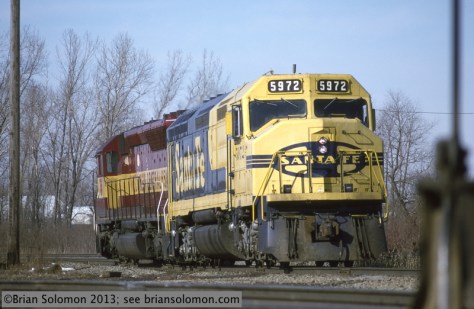
Santa Fe had been first to order the FP45—intended as a dual service machine used passenger service and for fast freight. The only other customer for the FP45 was Milwaukee Road which bought five of them. Significant of these designs was the external semi-streamlined cowling leading the locomotive’s ‘Cowls’ nickname.
EMD’s F45 was intended primarily for freight so it didn’t feature a large steam generator. As a result it was several feet shorter. Santa Fe ordered 40, while along with Great Northern and its successor Burlington Northern, bought 56 F45s. Like its SD45, EMD rated both FP45 and F45 at 3,600 hp.These locomotives had a similar appearance to the SDP40F and F40C (see: Locomotive Geometry Part 4).
Former Santa Fe 5959 leads a northward freight near Slinger, Wisconsin in May 1995.
Although Wisconsin Central operated seven of the big cowled EMDs, I found these to be relatively elusive when compared to WC’s far more common SD45s. Yet, I count myself fortunate to have caught the cowl 20-cylinder locomotives at various occasions, both in Santa Fe and Wisconsin Central paint.
This broadside view of a northward WC freight in Spring 1996 demonstrates the length difference between the leading F45 and trailing FP45.Nose view of WC F45 6656 on May 4, 1996.F45 interior view showing the 20-cylinder 645E3 diesel engine.
One of the advantages of the LX-3 are its multiple aspect ratios. For this photograph, I selected the 16:9 ratio for a panoramic view.
175th Anniversary Plandampf:
Three years ago, four of my Irish friends and I flew to Germany to witness 175th anniversary of German railway celebrations and excursions. This was truly spectacular and featured an ambitious excursion schedule focused on Trier in the Mosel Valley. While we were up early every morning it was impossible to catch all of the more than 100 special trains operated over the six day period in early April. The lines covered by excursions were all new to me, so prior to our arrival, I’d spent more than a week pouring over maps and satellite views.
Among the lines intensively worked was the heavily graded single track route east of Gerolstein toward Daun. Here, my map-work paid off, as I’d picked out this spot never having been there before. Our means of obtaining the location was a bit unorthodox; we drove up a lightly traveled unpaved trail, then uphill across a field to reach a fire-road then further up hill. Upon reaching the ridge, we found there was actually an easier means of getting here. Some German enthusiasts already on-site were bemused by our bold arrival. ‘You must have a great faith in God to come here that way,’ they said to me.
Using my Lumix LX-3, I made this image of Deutche Bahn Class 52 8134-0 working up the valley toward Daun. I also exposed a series of color slides on Fujichrome with my Canon EOS-3.
Exposed with a Nikkormat FT3 fitted with a Nikon f2.8 28mm lens; Kodachrome 25 slide film.
By the mid-1990s, Wisconsin Central Limited operated one of the largest fleets of secondhand 20-cylinder EMD locomotives in the United States, having acquired more than 100 SD45s, F45s, among other 20-cylinder models from class I railroads. It rebuilt the locomotives at its North Fond du Lac shops.
At the time, I lived in Waukesha within earshot of WC’s former Soo Line mainline to Chicago. A few miles to the north was WC’s crossing of Soo Line’s former Milwaukee Road mainline. (This confusing arrangement stemmed from Soo Line’s 1985 merger with Milwaukee Road, and the subsequent spin off of former Soo Line routes which in 1987 had been regrouped as Wisconsin Central Limited.)
Among WC’s freights was T047, which connected with Soo Line in Milwaukee and so utilized the former Milwaukee Road mainline between Milwaukee and Duplainville. On the afternoon of May 7, 1996, I exposed this Kodachrome slide of a pair of WC SD45s (one of which still wearing Santa Fe paint) leaving the Milwaukee mainline on its way north toward North Fond du Lac.
GS&WR 186 with Easter Eggspress at the Dalkey Tunnel April 1, 2013. Exposed with a Canon EOS 7D fitted with 28-135mm lens, ISO 800.
This morning (April 1, 2013), I rode Irish Rail’s Dublin Area Rapid Transit service from Dublin to Dalkey, and walked out via Sorrento and Vico Roads to an overlook on the old Dublin & South Eastern line near the Dalkey Tunnel. While I photographed the parade of passenger trains, my primary objective was to catch GS&WR 186 exiting the tunnel with the Railway Preservation Society Ireland’s Easter Eggspress.
I featured this 19th century 0-6-0 in my book Steam Power (published by Voyageur Press in 2009) on pages 158-159 and 180-181. While I’ve made many photos of this engine over the years, I wanted to catch it at least one last time, as it’s my understanding that the locomotive is due to be withdrawn soon and may not be returned to traffic in the near future.
Using two cameras, I exposed two parallel sequences of digital images, which required some ambidextrous action on my part. I positioned my Lumix LX3 on a pocket tripod, and operated this with my left hand, while with my right hand I worked my Canon EOS 7D with 28-135mm lens. Displayed here are selected results from both cameras.
Lumix LX3 wide angle view.
Just a reminder:
I’ll be presenting my illustrated talk “Ireland through American Eyes 1998-2008 My first Decade in Ireland” to the London area Irish Railway Record Society on April 18, 2013.
The program begins at 1900 (7pm) upstairs at the Exmouth Arms, 1 Starcross Street, LONDON NW1, (advertised as a 5 minute walk from London’s Euston station). A nominal donation of £3.50 is asked of non-IRRS members (members £2.50).
Making the most of a Belgian Rail-Freight Hotspot.
Mid-Morning on Friday March 22, 2013, I took a SNCB (Société National des Chemins de fer Belges—Belgian National Railways) local train from Antwerpen Centraal to a suburban station at Antwerpen Noorderdokken. This is an important junction north of central Antwerp, where routes toward Amsterdam diverge from the principal freight line to Antwerp Port.
An SNCB InterCity train led by a Class 18 Electric (built by Siemens) passes the station at Antwerpen Noorderdokken on March 22, 2013. While something less than a garden-spot, this busy junction is a great place to watch and photograph trains. Canon EOS 7D.SNCB diesels working light-engine pass Antwerpen Noorderdokken on the morning of March 22, 2013. In the foreground is the link to the new Antwerp-Amsterdam high-speed line. Lumix LX3.
I was following the recommendation of a friend who had previously explored this junction. As one of Europe’s busiest ports, Antwerp is a large source of rail freight, and this route is famous for both its volume and variety of traffic.
An SNCF Fret (French National Railways Freight) diesel leads a grain train toward Antwerp port. Canon EOS 7D.
In addition to SNCB’s freights, open access arrangements allow for a variety of private rail operators and other national railways to serve customers. In a little more than 4 hours, I witnessed nearly 35 freight moves (including light engines) under partly sunny skies. In addition I also photographed a dozen or so passenger trains.
An SNCB Class 18 electric with double-deck push-pull train races through Antwerpen Noorderdokken. Canon EOS 7D with 28-135mm lens set at 120mm, 1/60 second at f25.0. ISO 200. Hand-held pan with image-stabilizer disabled.
My preferred locations were in a field about a 15 minute walk from the Antwerpen Noorderdokken station. Here, the freight line makes a sweeping ‘S-bend’ that allows for a variety of angles favoring the light.
After 4 hours of intense photography, I was cold and hungry, so I retraced my steps and headed back toward Brussels. In addition to digital images exposed with my Canon EOS 7D and Lumix LX3, I also made a number of color slides with my Canon EOS-3.
A pair of CFL (Luxembourg National Railways) electrics lead a train carrying structural steel.
SNCB Vossloh diesels work a mixed freight toward Antwerp port.SNCB local glides towards its station stop at Antwerpen Noorderdokken.
Belgium’s jewel is among Europe’s most magnificent railway terminals.
Antwerpen Centraal, Belgium on March 22, 2013. Author Carroll Meeks (The Railroad Station, 1956), credits architect Louis de la Censerie with the station’s Art Nouveau style. Censerie’s ornate decoration and exceptional use of light makes Antwerpten Centraal one of Europe’s finest railway terminals. Photo exposed with a Panasonic Lumix LX-3.
On the morning of Friday March 22, 2013, I rode an SNCB (Société National des Chemins de fer Belges—Belgian National Railways) train from Brussels to Antwerpen Centraal (Antwerp Central Station). It was bright and sunny, a real contrast to my experience in Dublin on the previous day where it was cloudy, windy and raining.
I first visited Antwerpen Centraal in May 1996. Since that time this classic stub-end terminal has been transformed into a three-level railway intermodal center. Tracks on the lowest level permit through services without the need for trains to reverse direction as was previously required.
Looking straight up at the domed roof in Antwerpen Centraal, Belgium on March 22, 2013. Lumix LX-3.
The station head-house is among the most opulent and best kept anywhere in Europe, while the steeply pitched balloon train shed makes for a wonderful venue to photograph trains, its glass windows acting as enormous soft-box.
On Friday March 22nd, I had about 45 minutes at Antwerpen Centraal between trains. I used my time to good advantage and exposed a variety of digital images with my Lumix LX-3, and some Fuji Provia 100F with my Canon EOS-3. The film will be processed at a later time.
New SNCB electric multple-unit at Antwerpen Centraal, Belgium on March 22, 2013. Lumix LX-3.New SNCB electric multple-unit at Antwerpen Centraal, Belgium on March 22, 2013. Lumix LX-3.
The terminal is well-suited to the city center and connected to myriad destinations through an excellent public transport system operated by De Lijn. This includes a 1000mm gauge tram network that still hosts vintage President Conference Committee (PCC) streetcars.
PCC Streetcar near Antwerpen Centraal on March 22, 2013.
My layover at Antwerpen Centraal was a sideshow to my main effort: I was on my way to a location near Antwerp port where I was aiming to photograph freight trains. Keep your eye on this space for those images!
This time last week (Thursday March 21) I was getting ready to fly to Brussels. My bag was packed; my passport and tickets were organized. Then word came over the telegraph that an 071 was to work Irish Rail’s second Dublin-Ballina IWT Liner (International Warehousing and Transport)
As previously mentioned on Tracking the Light (see: Irish Rail at Clondalkin, February 21, 2013), Irish Rail runs a weekday container train between Dublin and Ballina. On Thursdays, traffic demands a second Dublin-Ballina train.
In recent months, Irish Rail has largely assigned its common 1994-1995 General Motors 201-Class diesels to this freight service, and the older General Motors 071-Class have only worked it infrequently. So, when I heard that Irish Rail 075 was on the train, I was keen to make some photos.
I had two hours before I needed to aim for Dublin Airport—plenty of time. On the downside, the weather wasn’t so cooperative. It was overcast, very windy, and spitting rain. Not my favorite conditions, but I’ll make photos in just about any circumstances. So, when my friend Colm O’Callaghan suggested we make the effort, I grabbed my travel bag and cameras and headed out the door.
This would require only a very short wait, or so we thought! When we arrived at Cherry Orchard, an industrial area in the west Dublin suburbs, the telegraph informed us that the second IWT was still in the yard at the North Wall. In other words, it hadn’t left yet, and was still at least 20 minutes away. An hour ticked by. In the mean time we caught the Ballina-Dublin ‘up IWT’ liner with a 201-class.
Then my phone rang; a client needed a photo immediately. A difficult proposition considering that the photo was buried on a hard-drive that I hadn’t planned to access for another week! My plans changed, I had to head home and address this request before making for the airport. My two-hour cushion had just been eroded. Still no IWT liner, and time was running out.
We gave up and were about to leave, when the telegraph came to life: the IWT had passed Islandbridge! It was on its way and not far off. Unfortunately, a clattering of passenger trains preceded it. Another 10 minutes gone. Finally, we heard the approaching roar of a 12-645 turbocharged diesel! Our perseverance paid off: 075 with the ‘down IWT’.
Irish Rail 075 leads the 2nd IWT Liner at Cherry Orchard on Thursday March 21, 2013. Photo exposed with a Canon EOS 7D with 28-135mm lens, contrast and color balance adjusted in Photoshop.Photo exposed with a Canon EOS 7D with 28-135mm lens, no post-processing adjustment, except for scaling.
I dashed home, sent off the requested photo, then made for Dublin Airport on the 747 Airport Bus. Stay tuned for my photographs of Belgian railways . . .
Trailing view of the 2nd IWT Liner at Cherry Orchard.
I’ll be presenting my illustrated talk “Ireland through American Eyes 1998-2008 My first Decade in Ireland” to the London area Irish Railway Record Society on April 18, 2013.
The program begins at 1900 (7pm) upstairs at the Exmouth Arms, 1 Starcross Street, LONDON NW1, (advertised as a 5 minute walk from London’s Euston station). A nominal donation of £3.50 is asked of non-IRRS members (members £2.50)
Exposed on Kodachrome 25 (PKM) with a Leica M2 and 50mm Summicron.
While on the topic of the former Erie Railroad, I thought I would post this unpublished view of brand new New York, Susquehanna & Western Dash8-40Bs working a Delaware & Hudson freight on Conrail’s former Erie route between Hornell and Buffalo, New York.
The new units were ordered by NYS&W during its brief court-ordered operation of D&H between 1988 and 1990.
I started following this train earlier in the day. It was a typical western New York morning, with fits of sun bursting through a deck of thick gray clouds.
That’s the reason for this unusual composition: for a moment the sun emerged to flush the front of the bright yellow GE’s. I made a spot decision to photograph the train more distant than I’d originally intended.
At that time, Conrail was only maintaining the old number 2 track (eastward mainline) for 10 mph. Most traffic was routed on the number 1 main (traditionally the westward track) that was in much better condition. However, by Spring of 1989, Conrail’s Erie route was bursting with traffic. To avoid congestion, Conrail’s dispatcher opted to keep this D&H train bumping along at 10mph, while westward traffic stayed on the faster track.
East of Canaseraga, the Erie line was in characteristic grade separated arrangement that probably dated from Underwood-era improvements in the early 20th century. If I write my book on the Erie, I’ll be finally able to confirm this fact.
In the early 1990s, Conrail reconfigured this portion of the Erie. It replaced the traditional directional double-track with a single-track main and centralized traffic control-style system. The change resulted in abandonment of the number 1 main at this location, and spelled the end for the steam-era Union Switch & Signal Style-S upper quadrant semaphores.
Just for the record, I made several closer views of this train.
Former Erie Railroad mainline east of Kenton, Ohio. West of the Pennsylvania-Ohio line, the former Erie route was fragmented following the creation of Conrail in 1976.
On June 14, 2010, I spent the day tracing the route of the old Erie Railroad between Marion, Ohio and the Ohio-Indiana state line. At Marion, the former Erie line is still active, albeit integrated with other routes. West of Marion, it’s largely abandoned. In some places the former double-track mainline is easy to follow, in others it has been ploughed under with virtually no evidence left to hint that it was ever there.
At Kenton, Ohio, I found this vestige of Erie double track, where the line crossed County Road 140, east of Main Street. I’m looking east, toward Marion. I can only imagine The Lake Cities (Jersey City-Chicago) racing west across this crossing, or one of Erie’s magnificent S-class Berkshires hitting the crossing with tonnage.
I was happy to find track in place to give me some sense of what the railroad was about. Who knows what I’ll find if I return in ten years time.
On the eve of assumption of operations by Conrail in Spring 1976, my father and I had explored railway operations in the New York City area. Twenty-three years later, we spent a long weekend in New York’s Mohawk and Hudson Valleys photographing the last days of independent Conrail operations before the railway was divided between its new owners CSX and Norfolk Southern.
I exposed this on Fuji Astia (100 ISO) using a Canon Elan 7e with a 100-400mm lens (extended to its maximum focal length). Canon’s auto-focus and/or image-stabilization system were temporarily confounded the harsh morning light, resulting in unanticipated ‘fluttering’ as the camera tried to compensate for the circumstances. In the end, I made a split-second decision to switch off the auto-focus. I’ve made a few minor adjustments in Photoshop to correct color-balance and other nominal defects in the original slide.
On the morning of May 29, 1999, I made this dramatic image of a westward Conrail double-stack train blasting along the former New York Central Water Level Route at Fonda, New York.
Evidence of the old New York Central can be seen in the wide right of way left over from its four-track days, and the steam-era signal bridges with classic General Railway Signal searchlights. In the last few years, CSX has replaced most of the NYC-era signals with modern hardware.
Leading the train was one of Conrail’s ten C32-8s, a pre-production model built by General Electric in 1984, unique to Conrail (although nearly identical in appearance to the slightly more powerful C39-8, bought by Conrail and Norfolk Southern). This one was dressed in Conrail’s short-lived ‘Ballast Express’ livery.
A variation of this image was published by RailNews, shortly before that magazine concluded operations. Hard to believe that both Conrail and RailNews have been gone nearly 14 years.
I made this image of an outbound Metra-Electric multiple-unit in the summer of 1996. This heavily traveled former Illinois Central suburban line remains a rarely photographed operation. I’ve always thought it was odd that it’s so infrequently pictured. Often, photographers neglect the most common subjects. So, there’s a lesson on seeing the ordinary in interesting ways.
On February 25,1995, I made this atmospheric image of an inbound Metra train on the ‘Burlington Triple Track’ at Highlands, Illinois (Today a BNSF mainline). A mix of thin high clouds and smog has tinted the winter sun. A cropped version appeared on the cover of Passenger Train Journal issue 217. At the time, I was employed as an Associate Editor at Pentrex Publishing, including PTJ, and often contributed photograph to the Pentrex magazines.
Chicago suburban passenger railway, Metra operated the only fleet of Electro-Motive Division F40Cs a six-motor cowl-type passenger locomotive similar to Amtrak’s SDP40F, but equipped with HEP (headend power), and featured corrugated stainless-steel side paneling. The 5 EMD F40Cs, were acquired through Metra predecessor agency for service on Milwaukee Road. Numbered 600-614, the F40Cs were the last Metra heritage units in regular passenger service.
These were an unusual modern application of a six-motor diesel for passenger service. Since the mid-1970s, most passenger locomotives have been four-motor ‘B-B’ models.
They exhibit General Motors classic well-balanced utilitarian appearance, and are similar to other cowl models built from the late 1960s and mid-1970s.
METRA F40C 614 works west at A2 tower on June 22, 2004.
These were among the locomotives I featured in my popular book EMD Locomotives published in 2006. Available from my publish Voyageur Press or at Amazon. I also discuss their history in my recent North American Locomotives.
A pan photo of Metra 606 catches the evening glint near Tower A5.
I like to offer special thanks to Marshall Beecher for providing location assistance in Chicago.
One year ago today (March 20, 2012), I made this rosy sunrise image at Pan Am Railway’s East Deerfield Yard (Massachusetts) using my Canon 7D fitted with an f2.8 200mm lens. East Deerfield has long been a favorite place to begin or finish a day’s photography. Its curved east-west orientation makes it ideal for working with sunrise and sunset. Plus as an operations hub, there’s often something on the move, or at least getting ready. The morning of March 20, 2012 was quiet enough, giving me time to make some interpretive views of the yard.
Looking toward the rising sun at East Deerfield Yard. Canon 7D fitted with an f2.8 200mm lens; ISO 200, f3.5 1/500th second.
On June 25, 2010, I used my Lumix LX-3 to expose this backlit image of an eastward BNSF intermodal train hugging the east bank of the Mississippi River near Savannah, Illinois. My vantage point is a limestone outcropping atop the bluffs in Illinois’ Mississippi Palisades State Park
This former Chicago, Burlington & Quincy double-track line is part of BNSF’s raceway between Chicago and the Twin Cities.
General Electric DASH9 locomotives lead a BNSF intermodal train along the Mississippi River on June 25, 2010.
I exposed the image in manual mode, using the camera meter to gauge exposure for the river to avoid blowing out the highlights in the water. I turned all the automatic features, (including the auto focus) ‘off’, thus giving me a virtually instantaneous shutter release that allowed me to neatly fill the frame.
One of the difficulties with many small cameras is a ‘shutter lag’—an undesirable delay from the time the shutter button is released and the actual moment the shutter opens. This unfortunate problem handicaps a photographer’s ability to capture the decisive moment and greatly limits the potential for railway action photography. For me one of great advantages of the Lumix LX-3 is the ability to disable automatic functions and thus obviate the problems associated with a delay. The other camera’s other great advantage is its Leica Vario-Summicron lens, noted for remarkable sharpness and clarity.
Amtrak number 5 in the Truckee River Canyon near Boca Dam.
Amtrak’s scheduled daylight operation of its California Zephyr over Donner, makes this popular train by far the most photographed train on the pass. In November 2003, Amtrak number 5, passes the signal bridge near Boca Dam on its westward ascent of Donner. I featured this photo in my book The World’s Most Spectacular Railway Journeys.
Shortly after sunrise on June 7 1992, I made this silhouette of Denver & Rio Grande Western SD45 5318 leading SP’s westward 1UPOAM (Union Pacific to Oakland manifest) at Soda Springs, California. Nikon F3T with f4.0 200mm lens and Kodachrome 25 slide film.
Southern Pacific’s Donner Pass crossing was one of my big projects. I’ve called this ‘the mother of all mountain grades,’ other authors have simply described it as ‘The Hill’.
I wrote in my Southern Pacific book:
“Where other SP mountain crossings can claim steeper grades, heavier traffic and more sinuous track arrangements than Donner, no other grade is as old or as formidable as this storied mountain crossing. Donner’s exceptionally long eastbound grade—96 miles—rising from near sea level in California’s Central Valley to a summit 7,000 feet high in the Sierra, would test the mettle of any railroader, but what places Donner in a class by itself, is exceptionally harsh, and often unpredictable, winter weather.”
I made my first trip over Donner in my white Toyota Corolla on the final leg of my drive to California, yet I was already well acquainted with the pass through the photos of Richard Steinheimer. In October 1989, I began exploring the pass.
At one point I phoned Steinheimer to ask his advice on making photographs of the pass. His kindness to me told me more about the man than his thousands of wonderful photographs. He spent a least an hour on the phone and inspired my efforts. In later years I occasionally encountered him working SP rails, and he always acknowledged me.
Fellow photographers aided my efforts: Brian Jennison, whom I met in the snow on Donner, and former SP dispatcher J.D. Schmid—known for his skilled use of light to expose Kodachrome slides.
While I’ve explored many of the difficult to reach locations on Donner, for this essay I’ve chosen a favorite image made at one of the most clichéd places, the easy-to-reach Soda Springs grade crossing.
I’d been up on the pass early; I found this westward train led by a Denver & Rio Grande Western SD45, complete with classic dual headlight arrangement. Soda Springs offered nice more ‘glint’, and the train is bathed in an ethereal blend its own exhaust and ground fog illuminated by the rising sun. The details make this image for me; the warm morning light provides atmosphere, while the searchlights on distant SP signal bridge mimic the vertical pattern of the SD45’s headlights.
Between 1989 and 1994, I made more than 50 trips to photograph Donner, and perhaps another dozen since then. Despite my many books, most of these Donner Pass photos remain unpublished. Stay tuned . . .
Driving west across the United States, you reach a point beyond the Missouri River where the skies are truly clear—free from pollution and moisture—and the landscape reaches to seemingly endless horizons. At that point, you have transcended that abstract American frontier between ‘East’ and ‘West’. That was my take on it, when in September 1989, I made my first cross-country drive from Massachusetts to California. They write songs about that sort of thing.
In Tuesday’s post (March 12, 2013), I told of my misfortune caused when I lost the services provided by my Toyota’s alternator in the Utah desert and alluded to the photographs I made, despite this setback.
Amtrak’s California Zephyr rolls west on the Denver & Rio Grande Western through Gore Canyon, Colorado in September 1989. At the back of the train is privately owned former Lehigh Valley observation car 353. Ok, so the sky had a few fair weather clouds, but these dispersed as the day cooled. Leica M2 with Kodachrome 25.
Immediately prior to the alternator event, I’d spent a full day photographing the Denver & Rio Grande Western in the Colorado Rockies. Then, the next day, with the alternator light ‘on,’ I spent an equally productive morning on Utah’s Soldier Summit.
Feel the power; a pair of D&RGW SD45s in ‘run-8’ roar west on Soldiers Summit. In the distance, an eastward train approaches. I didn’t dare turn the car off, for fear it wouldn’t start again.
The railroad was alive with trains, the weather was fine, and I made good use of my Leica M2 loaded with Kodachrome 25.
‘There’s a feeling I get when I look to the west . . .’ Although I was making photos, my drive West wasn’t really about photography. I was following old sage advice and was moving West to live. And I did, too. For five years I called California home.
There’s nothing like seeing someplace for the first time, and this trip west opened my eyes to railway photography, in ways I’d not previously experienced. Five years in California changed the way I looked at things and my photography evolved very quickly. When I came back to Colorado and Utah in later years, I was armed with new vision and a whole new set of equipment.
Searchlight signal displays ‘Approach’ at Brookfield, Wisconsin; exposed with a Nikon F3T with f1.8 105mm lens on Fuji Provia 100 film.
In 1996, I was living in Waukesha, Wisconsin and working for Pentrex Publishing as the Editor of Pacific RailNews. One evening shortly before sunset, a heavy fog settled in. Twilight is my preferred time to make signaling images because lower light in the sky allows for greater emphasis of signaling aspects. Fog is an added attraction, especially for searchlight signals. This style of signal head was developed by the Hall Switch & Signal Company in the 1920s. The searchlight uses a miniature semaphore in front of a focused beam of light that allows for a very low powered lamp to be sighted at a great distance. This effect is most evident when the focused light beam illuminates water droplets comprising heavy fog.
The Rollei’s viewfinder allowed me to shoot from the hip. The combination of the low angle and softer contrast and muted color balance allowed me to get this alternative view of Palmer and unlike those I tended to produce with my old Leica 3A. Compare this image with the 2002 Polish branch line view displayed yesterday’s post; Polish Time Machine.
Trying something different: in October 1984, I was taking a course in photography as part of my studies at Hampshire College in Amherst, Massachusetts. This involved an introduction to color printing. For this exercise I exposed a few rolls of 120 Kodak professional color negative film rated at 160 ISO. This material appears to have been designed for low-contrast imagery, such as portraiture, and so had a very different color palate than the 35mm Kodachrome slide film I was used to.
Using my father’s Rollei Model T, I made a series of railway images around Palmer, Massachusetts. I made prints for my class, then I filed the negatives along with my other work and promptly forgot about them. A couple of years ago, I rediscovered them while digging through the archives. Color negatives tend to be less robust than either slide film or black & white, and my negatives had suffered from a variety of light abrasions that would have made conventional printing problematic. Through the magic of digital technology, I was able to easily scan them and then touch up the scratches in Photoshop.
Among the more interesting photographs is this view of the dwarf signal at the Palmer diamond, back when Conrail’s Boston & Albany line was still equipped with directional double track and traditional multiple-tier code lines. It was a crisp clear October afternoon with a light breeze, and the trees were approaching their autumnal peak.
A horse-drawn wagon crosses the line at Nowa Weis, Poland. The semaphores have ‘x’s’ on them indicating they are out of service. Exposed on 120 black & white film with a Rollei Model T.
One my favorite images from the April 2002 Polish adventure is this timeless scene of three middle-age men on a horse-drawn wagon crossing the line at Nowa Weis. I caught this on film shortly before sunset with my Rollei. It was on PKP’s (Polish National Railways) secondary line that runs southeast from Wolzstyn to Leszno across through unspoiled pastoral countryside. The largely steam operated and under-maintained railway, added to a rural charm that harked back to another generation. For me it was like stepping back a half century, or more.
Regularly scheduled revenue steam-powered passenger train in rural Poland in April 2002.
As a follow up to yesterday’s view of a 2-10-0 on disused track, here’s a view of a regular revenue train from that same visit to Poland in April 2002. On a scheduled run from Poznan to Wolsztyn, PKP Ol69-111 passes German-style semaphores on approach to a rural station. At this time, several of the daily passenger Poznan-Wolzstyn trains routinely operated with steam, with Ol69 class 2-6-2s being the most common type on them. This was a secondary main line, and although weedy, the track was in reasonably good shape. Chasing the trains on the road was a challenge.
I made this image with my Rollei Model T on 120 black & white film, hand processed using my preferred recipe. The combination of traditional subject matter and the classic camera with 75mm Zeiss Tessar lends to a timeless view. Only, the rake of East German-built double-deck passenger carriages might seem incongruous to un-trained eyes. In fact, these cars were standard in the late era and consistent with Polish passenger practice. In this picture they are dressed in a olive drab livery, however some were later painted in a dandelion yellow, which truly seems out of character behind steam.
Check Tracking the Light tomorrow for more on this theme!