On October 8, 1992, I made this Kodachrome 25 slide of the old Boston & Maine station building at Woodsville, NH.
Although a relatively subtle quality, notice that the verticals are parallel with the sides of the photo. This was made possible by working with a Nikkor 35mm PC (Perspective Control) lens. This had an adjustible front element used to keep vertical lines from visually falling away from the film plane (when the camera was kept level).
I miss my old PC lens, which I sold in 1997.
The line in front of the Woodsville Station was lifted in the mid-1990s.
Last night Conway Scenic Railroad operated its annual Firecracker Expresses to carry spectators from Conway to North Conway for a patriotic fireworks display.
Although it had been raining all afternoon, the sky cleared off at sunset, and the fireworks went ahead as scheduled, beginning just after 930pm.
As part of of my role as Conway Scenic’s Manager of Marketing & Events, I helped organize our special trains and their promotion. Several hundred people rode the trains which operated as advertised.
My Fiancé Kris Sabbatino and I traveled on the Firecracker Express to North Conway and made photos of the railroad’s iconic station and the explosive displays.
It was an excellent event.
Working with my Nikon Z6 Mirrorless digital camera mounted on my antique Bogen tripod, I made a variety of time-exposures.
Years ago I’d photographed fireworks using color slide film. I realized that I hadn’t done this in a long time and this was my first serious effort to capture a fireworks display digitally. I was a bit rusty at getting my timing right, but after missing a few of the loud bangs in the sky, I managed to refine my technique.
Working with the camera at ISO 200, my exposure times ranged from 4 seconds to 30 seconds, while I varied my f-stop between 4.0 and f11.
In general, I found I obtained my most satisfactory results at about 10 seconds at approximately f8.
After exposure, I imported the camera’s RAW NEF files into Adobe Lightroom for contrast and color adjustment. Through this technique I was able to improve the sky detail and balance the appearance of the images to reflect the scene more closely as I saw it. The benefit of the Nikon Z6 is its sensor’s exceptional dynamic range.
In March 1991, I exposed this view of a Southern Pacific coal train ascending Donner Pass.
Working with my Nikon F3T and Nikkor f4.0 200mm lens, I focused on the loaded hoppers of the coal train as diesel exhaust poured forth from tunnel 8 on Donner Pass.
SP’s SNTA-C (Skyline Mine to Trona-coal) had been routed over Donner Pass via Track 1. This was the historic 1860s alignment that involved a difficult sinuous climb around the north face of Mount Judah.
Backlighting aided capturing this contrasty scene, that I preserved on Kodachrome 25 color slide film.
In 1993, SP lifted Track 1 over Donner Pass (between Shed 47 and Norden), opting to route all traffic on its newer alignment on Track 2 via Tunnel 41.
I’ll be featuring SP and Donner Pass in my September 2021 Trains Magazine column that looks back at Southern Pacific 25 years after its merger with Union Pacific.
In 1990, I’d bought a second-hand F4 Nikkor ‘prime’ 200mm telephoto. For several years I made great use of this lens to photograph trains across the West.
Through the 1990s, my photography was telephoto heavy.
These days, I’ve shifted my focal length wide.
Most of my digital photos are made with focal lengths between 16-70mm (super wide to short telephoto).
But, when I tend toward the longer telephoto range, I still reach for my film cameras.
Partially because I have several excellent long telephotos for my Canons, but also because when I think ‘long’, I think film.
So when Kris Sabbatino and I visited the Junction at ‘East Northfield,’ Massachusetts on March 8th (2021), I made this long view on Ektachrome using my old Canon EOS-3 with f2.8 200mm lens. This winning camera-lens combo has served me well for nearly 15 years.
Perhaps, it helps that I’m photographing a classic train with 1960s-1970s vintage EMD diesels bracketed by searchlight signals.
New England Central southward 611 approaches the junction at East Northfield, Massachusetts on March 8, 2021. Ektachrome 100 slide film.
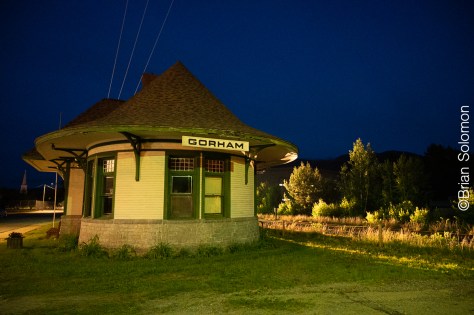
St Lawrence & Atlantic 393 passing the Gorham Station made for a subject akin to the UFO landing in the 1970’s film ‘Close Encounters of the Third Kind,’ but accented with an awesome sounding EMD 645-diesel roar.
These photos were exposed last Friday night using my Nikon Z6 mirrorless digital camera.
Here’s another of my photos at dusk from our pursuit of St. Lawrence & Atlantic’s westward freight 393 last week. Kris and I were positioned along the south shore of the Reflection Pond near Gorham, NH.
My tripod was occupied holding my Canon EOS-3 during a 30 second time exposure. This film photo remains latent at this writing.
While the Canon was exposing film, I made a few hand held photos with my FujiFilm XT1 fitted with a Zeiss 12mm Touit with the ISO set at 5,000.
These are two of the 1/2 second exposures that night.
I adjusted the Fuji RAW files using Adobe Lightroom.
I made these images the other night when Kris & I were photographing the St Lawrence & Atlantic’s westward road freight (train 393).
Night photography isn’t easy, or straight forward.
There’s a variety of approaches.
These images were exposed during the last hints of daylight.
To capture the train in motion in very low light I used a ‘secret combination’: a telephoto with a wide maximum aperture and a high ISO setting on the camera.
The telephoto minimizes the relative movement of the train to the camera sensor; the wide aperture lets in greater amounts of light and thus allows for a faster shutter speed. Likewise, the higher ISO also contributes to using a faster shutter speed.
However, the real secret was exposing manually, taking into account of the very bright headlights relative to the over all scene, while taking a position relatively off axis to the headlights to avoid the very bright lights directly hitting the front element of the lens.
FujiFilm XT1 with f2.0 90mm lens, camera set to ISO 3200 and 1/60th of a second.
We paused last winter at Ely, Vermont where I made this silhouette on Ektachrome of the old Boston & Maine station and its historic train order semaphore.
This was one of several slides I made that day of railroads in Vermont.
Why film? Because it works. Because some photos made on film wouldn’t as well if exposed digitally. But most importantly, because I like film. I made my first Ektachrome color slide c1971, and some 50 years later, I still occasional expose slides.
Canon EOS-3 loaded with Kodak E100; 40mm Canon pancake lens set at f22. Film processed by AgX lab. Slide scanned using an Epson V600 flatbed scanner.
The long days of summer offer a rare opportunity to catch Genesee & Wyoming’s St. Lawrence & Atlantic through freights in daylight.
Last Friday, 25 June 2021, my fiancé Kris Sabbatino and I drove to Locke Miles, Maine, east of Bethel, where we set up along South Pond to wait for the westward freight, job 393.
The light was fading when we finally heard a distant whistle.
Our friend Andrew Dale had been keeping us updated as to the trains’s westward progress.
I made this image of the leading locomotives reflecting in South Pond using my Nikon Z6 mirrorless digital camera. I set the ISO to 800, the aperture to f4.0 (my widest setting), and the shutter speed to 1/100th of a second.
After the train passed we pursued it West into the night.
24-70mm Nikkor zoom set at 53mm. Full frame sensor
Two weeks ago ,on our last of three evenings at Moosehead, Maine, Kris and I set up at the East Outlet Bridge of the Kennebec River to catch the westward CP Rail road freight in the fading glow of dusk.
The light was dropping quickly. And by the time the train came into view it was almost dark.
Working with my Nikon Z6 mirrorless digital camera attached to a Bogen tripod, I set the ISO to 4000, the aperture to its widest (f4) and the shutter speed to 1/60th of a second.
Notice the reflection of the locomotive head light on the bridge.
The bugs on the river were fierce!
Long after the freight passed us we could hear it making its way toward the Canadian frontier.
On Thursday, June 24, 2021, I was live on the radio at North Conway during a simulcast for New Hampshire’s Lakes region radio stations FM 101.5 and FM 104.9.
This was a promotion for Conway Scenic Railroad as part of greater exploration of tourism in the White Mountains and Lakes regions.
I worked with the radio hosts to give listeners a greater appreciation for the railroad, its history and its excursions.
Using my Lumix LX7, I made these photos during broadcast and between interviews.
Last Saturday, June 19th, Kris & I met the first Conway Scenic Railroad Mountaineer of the 2021 season at Crawford Notch, NH on the former Maine Central Mountain Division.
We spoke with the crew and arranged to make photos from the sunny side of the tracks.
A few days later, I posted some of these to the Conway Scenic Facebook page, which is among my jobs as Manager of Marketing & Events for the railroad.
File converted from Lumix RAW file.Color adjusted and saturation increased working with the RAW file in Adobe Lightroom. I was trying to minimize the placement of automobiles parked along Rt 302 adjacent to the tracks., while featuring the textured sky.
I made these photos with a Lumix LX7 compact mirrorless digital camera fitted with external view finder.
It was a clear afternoon in central Maine- a perfect day for photography.
I’d reviewed Kris’s photos from the previous day, and I liked her angle on the bridge near Kelly’s Landing east of the Greenville Junction station. So, I tried that for myself.
Standing a road level and working with my Nikon Z6, I made this series of photos as the eastward CP Rail freight roared over the Greenville Junction/Kelly’s Landing bridge.
I processed the Nikon NEF files in Adobe Lightroom for display here.
During our foray back from Cape Cod in April 2021, Kris & I paused for about an hour at Shirley, Massachusetts, located on the old Fitchburg Line west of Ayer.
I first made photos here on a chase back about 1985.
Working with my Canon EOS-3 with 100-400mm image stabilization zoom, I exposed these Ektachrome slides of an MBTA shuttle train.
Fitchburg Line, Shirley, Massachusetts, 26 April 2021.Working with my Canon EOS-3 with 100-400mm image stabilization zoom, I exposed these Ektachrome slides of an MBTA shuttle train Ektachrome slide of an MBTA shuttle train at Shirley, Massachusetts.Ektachrome slide of an MBTA shuttle train at Shirley, Massachusetts.
Keolis, which is the designated operator of MBTA Commuter Rail was undertaking Positive Train Control installation in the Boston-area and shuttle trains were working back and forth on the west-end of the Fitchburg run.
In April, Kris Sabbatino & I made a visit to Cape Cod, where we spent a morning at West Barnstable photographing the Mass Coastal and visiting a chicken farm.
Mass-Coastal operated a ballast train with its rare GP28 (as previously featured on Tracking the Light). Working with my vintage Canon EOS-3 with 100-400mm image stabilization zoom, I exposed a slide sequence on Kodak Ektachrome E100 reversal film.
The film was processed by AgX lab in Michigan, and last night I scanned a few of the slides using a Epson Perfection V600 flatbed scanner powered by Epson software. After scanning, I imported the TIF files into Adobe Lightroom for color and contrast fine-tuning.
My finished results are below.
Mass Coastal GP28 with_Ballast train at West Barnstable, Massachusetts, 1138am 23April2021._Mass Coastal GP28 with_Ballast train at West Barnstable, Massachusetts, 1138am 23April2021._
Finding trains on CP Rail’s Moosehead Subdivision requires patience and good luck. On our visit last weekend Kris Sabbatino & I found that operations consisted of basically one road freight in each direction a day.
Moosehead Lake is an area of exceptional scenic beauty and Greenville, Maine is a lovely rural town with several fine places to eat. We only spent a small portion of our visit to the area line-side waiting for trains, but kept our ear to the ground anticipating the sounds of an approaching freight.
Several times, Kris heard or spotted a train before I did. And this was a huge help in getting into position line side with time enough to make photos of the passing freight.
One evening at Greenville, we heard a distant whistle, and drove west to the old Greenville Junction station to photograph its passage.
Lighting at the station was tricky. The evening sky exhibited subtle hues of magenta and blue, while the station building was in shadow. Light levels were low enough to require a high ISO setting on the camera to stop the action.
For these photos, I worked with my FujiFilm XT1 with 16-55mm Fujinon zoom lens. I set the camera to ISO 1000.
In post processing, I converted the Fuji RAW files to DNG format using Iridient X Transformer, then imported these into Lightroom for adjustments. These included lightening the shadows, while darkening the highlight regions to hold detail and color in the sky, plus some contrast and color control.
For comparison, I’ve included the unmodified In-camera JPG and the adjusted DNG versions of the same image at the bottom of this posting.
Greenville Junction, Maine. Fuji RAW file converted to DNG format and adjusted using Adobe Lightroom.Greenville Junction, Maine. Fuji RAW file converted to DNG format and adjusted using Adobe Lightroom. Compare this version to the unmodified in-camera JPG of the same image below.Screenshot of the in-camera JPG file with information showing details of exposure.
Last weekend on our visit to Moosehead Lake, Kris & I stayed at Wilson’s on Moosehead.
It was at this same lakeside cluster of cabins that my family and I stayed back in 1972.
Since the gaps between freights on the Moosehead Sub occasionally approached 18 hours, I thought I’d portray the passage of time with a few non-rail scenic views of the lake from Wilson’s.
Sunrise at Moosehead.Sunrise at Moosehead.Sunset at Moosehead.Milky Way over Moosehead Lake. Nikon Z6 photo.
Greenville Junction. In the 1950s my father stopped here while traveling on Canadian Pacific’s Scoot to make photos of the crew watering the locomotive.
I recall the station from our visit to Moosehead Lake in 1972.
Historically, Bangor & Aroostook’s line met CP’s just west of the bridge and station.
Last week, Kris Sabbatino and I raced ahead of an afternoon CP Rail eastbound freight so that we could photograph it crossing the bridge east of the Greenville Junction station near the popular restaurant called ‘Kelly’s Landing’.
I made this photo looking back toward the station using my FujiFIlm XT1.
We chased the westward CP Rail freight from Moosehead to Jackman, near the Canadian frontier.
Many years ago, my friends and I slept in a van at the Jackman Station, courtesy of the CP agent on our way to Quebec.
I recalled that night back in the 1980s, as my Fiancé Kris Sabbatino and I anticipated photographing CP Rail last weekend.
Lucky for us, it stopped to switch out its consist, giving use several opportunities to make photos.
On our return to Moosehead, we met many moose along Route 15!
Exposed on a tripod with a Nikon Z6 mirrorless digital cameraExposed on a tripod with a Nikon Z6 mirrorless digital cameraExposed on a tripod with a Nikon Z6 mirrorless digital cameraExposed on a tripod with a Nikon Z6 mirrorless digital cameraMoose family on Route 15, east of Jackman, Maine. Exposed with a FujiFilm XT1.
Among the CP Rail freights we caught on the move on the Moosehead Sub, was this westbound rolling across the Kennebec East Outlet Bridge just after sunset.
Working with my Nikon Z6 mirrorless digital camera, I made this trailing view with the camera set at ISO 1600, shutter speed 1/50, aperture at f4.0, and the 24-70mm zoom adjusted to its widest (24mm) position.
Soon after the locomotives passed we were in hot pursuit of the train for nocturnal photos. More soon!
My first visit to Canadian Pacific Railway’s Moosehead Subdivision was in the summer of 1972, when my family rented a cabin on Moosehead Lake near the East Outlet of the Kennebec River.
In the 1980s and 1990s, I made several excursions to this beautiful and sometime elusive railroad line.
Over the years this line has changed ownership several times, and CP Rail has recently re-acquired the historic route, and since then I’d been itching to get back up there.
Over this last weekend, my Fiancé, Kris Sabbatino and I made the drive from Center Conway, NH to Moosehead, Maine where we stayed at the very same campground that I had visited as a child back in 1972.
Train operations are sparse and I wanted to make the most of trains if and when we caught them on the move. So first we investigated locations near our cabin.
Here are a few photos exposed using my FujiFilm XT1 of the East Outlet Bridge of the Kennebec River at Moosehead, Maine.
More photos of the Moosehead Sub to come over the coming days!
In December 2014 on a blitz of SEPTA’s rail transit in Philadelphia with my brother Sean, I made this view of the Broad Street Subway at the Girard Avenue stop.
My feeling is that SEPTA’s Broad Street Subway is among the least photographed rail transit lines in the Northeastern United States.
Exposed using my First Lumix LX7.
Tracking the Light normally posts daily!
Brian Solomon is traveling ‘off the grid’ and this post was prepared several days ago.
On 12 April 2003, I traveled on the Irish Railway Record Society special from Dublin to Northern Ireland. This operated with NI Railways GM 111 class diesels and NIR Mark II carriages.
I made this photo during a photographers stop at Cultra on the Bangor Line.
This was exposed using a Contax G2 rangefinder loaded with FUJI Neopan 400 black & white film.
I processed the film using Agfa Rodinal Special mixed 1-32 for 3 minutes 45 seconds at 70 degrees F. I scanned the negatives last year with an Epson V600 flatbed scanner.
I’ve composed this post several days in advance as I am ‘off the grid’ for several days.
I’d just returned to Dublin from Belfast on an Irish Railway Record Society special train.
Working with my Contax G2 rangefinder loaded with Fuji Neopan 400 black & white film, I composed this silhouette of the signals and buildings near Dublin’s Connolly Station.
I processed the film using Agfa Rodinal Special mixed 1-32 for 3 minutes 45 seconds at 70 degrees F. I scanned the negatives last year with an Epson V600 flatbed scanner.
This post was prepared in advance as I am ‘off the grid’ for a few days.
Yesterday I made this photo of Conway Scenic’s Bartlett Extra ready to depart the North Conway, New Hampshire Station. This was added to the schedule to handle a school group boarding in Bartlett.
Exposed using my third Lumix LX7. File adjusted using Lightroom.
Brian Solomon is traveling ‘off the grid’ for the next few days.
Over the weekend, I continued to wire and tidy up our HO-scale interpretation of the Reading Company.
Scenery and structures are still in the future.
Working with my Lumix LX7, I made this series of photos.
A couple were hand-held, but others were made with aid of a tripod to allow for greater depth of field, or exposed with the camera positioned on the track for stability.
Handheld Lumix LX7 photo.Handheld with the Lumix LX7.Lumix set a f8 and mounted on a tripod for greater depth of field.Pottsville Junction—Lumix on the track set at f8.Checking out the 2102!Chicks dig the Reading Company!
Eight Years ago today, June 5, 2013, Rich Reed and I photographed an MBTA equipment transfer at Ayer that had come up from Worcester, Massachusetts via Pan Am’s Boston & Maine Worcester-Ayer line.
Among the items of interest was MBTA 3249, one of two MBTA GenSet diesel-electric locomotives.
I made this photo using my Lumix LX3 from the Main Street Bridge east of downtown Ayer.
I was traveling from Philadelphia to Virginia on June 4, 2015.
Working with my first Lumix LX7, I made these photos of Amtrak’s 30th Street Station, focusing on the classic Solari Board that displayed arrivals and departures.
Stadler Flirts were standard equipment on the new Helsinki Airport train service when I visited in July 2015.
Finally, as Kris and I are contemplating overseas travel again, I’ve taken a renewed interest in airports! Although Dublin will be on the visit-list ahead of Helsinki.
June 1, 2011 freakish weather conditions produced an F3 Tornado that struck my home town of Monson, Massachusetts.
I had only recently returned from months in Ireland and Europe.
The day began with a violent thunderstorm, but most of the morning and afternoon were oddly still and bathed in a weird hazy sunshine.
The storm that brought the funnel moved quickly and brought destruction.
I saw the tornado from my window in Monson and made photos with my Lumix LX3. Two days later I went into town to document the damage.
Enlarged version of the above Lumix LX3 image. A green sky is a bad!Canon 7D photo, June 3, 2011.Destroyed house on Washington Street in Monson, MA. June 3, 2011. Lumix LX3New England Central Railroad at Washington Street in Monson. June 3.Downtown Monson after the storm. June 3, 2011. Canon 7D.Washington Street in Monson after the storm. June 3, 2011.