Last night I made two scans of an ET 160 (Tungsten balance) Ektachrome slide. This film was designed for use with incandescent lighting.
I exposed this slide as part of sequnece of night images at the Connecticut Trolley Museum in East Windsor, CT in December 1993.
The first scan was using an Epson V600 flatbed scanner powered with Epson Scan 2 software. The second was using a Nikon LS5000 Slide scanner powered with the latest VueScan software (version 9.7.96).
Other than scale the scans for presentation here, I made no changes to color, exposure, sharpness etc.
I’ve included a greatly magnified portion of each scan for comparison.
Epson V600 scan; 3200 dpi TIF format, scaled for internet.Nikon LS 5000 scan at 4,000 dpi TIF format, scaled for internet.V600 scan enlarged.Nikon LS 5000 scan enlarged
Over the years, I’ve photographed hundreds of locomotives, on scores of railways, in dozens of countries.
Occasionally I’ve opted for the classic ‘three-quarter’ roster angle. More often I’ve opted for various more dramatic, interpretive, or dynamic views.
A long time ago I learned that when I find some equipment resting in a accessible location, to photograph it from a great variety of different angles, because you never know what might suit a book or magazine article later on.
Two weeks ago on our visit to Cape Cod, I had the opportunity to make a sequence of photos of this former New Haven Railroad FL9 that now works for Cape Cod Central and was assigned to the west end of the Polar Express at Buzzards Bay, Massachusetts.
I have countless photographs of FL9s in various schemes when they worked for Amtrak, MTA, CDOT and Metro North, so this was an opportunity to do something a little different.
Perhaps the FL9’s most distinctive external attribute is the A1A Flexicoil truck at the rear of the locomotive.
While on the theme of tourist railroads on the old New Haven Railroad at Christmas, I thought I’d present this ten year old color slide.
In December 2012, Tim Doherty and I had visited Connecticut’s Valley Railroad that was featuring its Chinese-built 2-8-2 Mikado dressed in New Haven paint on its Christmas trains.
In the late afternoon light, I made this Fujichrome Provia100F slide at Deep River using my Canon EOS-3 with 40mm pancake lens.
I scanned the slide last night and processed the 4000 dpi TIF file using Lightroom. Below are two versions. The top is a scaled, but unadjusted, version of the original scan. The bottom one has been altered to more closely resemble the effect of 1950s Kodachrome film
Scale JPG from original TIF file without adjustments to color, exposure, contrast or sharpness.Slide adjust to resemble a 1950s Kodachrome.
Green Moutain Railroad GP9 1850 leads the railroads freight XR1 through a rock cut on the former Rutland Railroad near Gassetts, Vermont on November 19, 1992.
I was interested in featuring the use of old rails to support stones in the cut and had followed this freight since its engines left the railroad’s round house at North Walpole, NH, earlier that morning. The recent installation of an oscillating headlight on th GP9 also caught my attention
First round of adjustments to correct for color temperature and adjust shadow detail.In this version, I increased local contrast and lightened the overall scan while adjusting the highlights and shadows to retain detail and black point.
Working with my old Nikon F3T and Nikkor f1.8 105mm, I exposed this slide on Kodachrome 25 at f5.6 at 1/125 second.
Slide scanned with a Nikon LS-5000 slide scanner at 4000 dp, adjusted and scaled using Lightroom.
On the evening of Easter Sunday 1988, I visited the old Buffalo, Rochester & Pittsburgh station and yard at East Salamanca, New York.
CSXT was still a relatively new railroad, and this southward freight from Buffalo featured former Baltimore & Ohio GP40/GP40-2s painted for CSXT component Chessie System but with CSXT sublettering.
CSXT was in the process of spinning off it’s former BR&P trunk to Genesee & Wyoming start up Buffalo & Pittsburgh. I was anticipating the change, but the sale was still several months away.
I made a series of Kodachrome 25 slides of the train changing crews at dusk using my Leica M2 with 50mm Summicron firmly mounted on a tripod. Unfortunately, I miscalculated the exposure and my slides are about one stop too dark. This one was made at f4 at ¼ second.
Part of my problem was that my Sekonic Studio Deluxe lightmeter wasn’t accurate in low light. Another issue was that I didn’t compensate for reprocity failure, which was a characteristic of Kodachrome films in low light.
April 3, 1988. Kodachrome 25 exposed for 1/4 second at f4 with Leica M2 and f2.0 50mm lens.
I scanned this K25 slide with a Nikon LS-5000 scanner using VueScan software which enabled a multiple pass scan to maximize data capture of highlights and shadows. I imported the high-res (4000 dpi) scan into Lightroom and adjusted the file to compensate for underexposure.
Kris and I went to see the Cape Cod Central on Satuday evening. The railroad had decked out the former New Haven Railroad station and signal tower with an elaborate display of Christmas lights for their Polar Express excursions.
Working with my Nikon Z6 set at high ISO, I exposed this series of handheld night photos.
24mm; f4, 1/50th of a sec. Photo scaled from in-camera JPG33mm, f5, 1/50th of a sec. Photo converted from NEF camera RAW.
During a visit to Cape Cod the other day, Kris and I made photographs at Corn Hill Beach in Truro, Massachusetts.
Using my Nikon Z6 with f2.8 70-200mm Nikkor Z-series zoom, I made a series of the surf. To ‘freeze’ the water I used a very fast shutter speed (typically 1/8000th of a second) while back lighting the bay and using shalow focus for a diorama effect.
Below are six examples of the water frozen in time.
Some of my earliest digital photographs were exposed in Kenosha, Wisconsin.
In Novemeber 2008, I’d traveled to Chicago to visit with photographer Chris Guss and attend the annual Beecherfest railroad slide program.
At the time I was exclusively using film to make photos. Chris lent me his Canon EOS 50D and we spent several days in northern Illinois and Wisconsin making photos.
We stopped in to Kenosha, where we traveled on the streetcar loop and made photos of the vintage PCCs.
I exposed this view using my 100-400mm Canon zoom fixed to Chris Guss’s Canon 50D.
It was almost a year before I bought my own digital camera, and 18 months before I invested in a Canon EOS-7D.
The other day I was going through a carton of slide boxes from the mid-1990s. I found a roll from a day out with photographer Mike Gardner to capture New England Central in Connecticut.
On Halloween day 1997, we followed southward freight 608 to New London, photographed a few Amtrak trains on the Shore Line, then followed 608 on its northward return trip to Palmer, Massachusetts.
At South Windham, Connecticut, I made a view on the old Fuji Provia 100 (RDP) using my first Nikon N90S with f2.8 80-200mm Nikon zoom lens.
The soft afternoon sun resulted in a somewhat under exposed slide that never made my final cut, and so remained in the green Fuji box for more than 25 years.
I scanned it with a Nikon LS-5000 slide scanner powered by VueScan 9.7.95 (recently updated from the earlier version of VueScan that I’d been using for a few years), and then imported the high-res TIF file (scanned at 4000 dpi in ‘Fine’ mode) into Adobe Lightroom for adjustment and scaling.
Below are JPGs from the unaltered scan and from my adjusted scan to improve the overall visual appeal of the time. Adjustments included warming the color temperature, adjusting sky denisty, lightening the overall exposure, and contrast control.
I’ve also included a photo of Mike, who is a regular Tracking the Light reader.
Scan of my Fujichrome Provia 100 slide without adjustments. The slide is darker and cooler than I’d like, but captures the train in late autumn foliage.This is the same scan following myriad adjustements to improve the appearance of the image.Adobe Lightroom work window showing the relative positions of slider controls that implemented adjustments to my original scan.Mike Gardner catches the action on Halloween day 1997.
On the morning of 23 November 2004 a thin mist covered the ground near Ballycullane, County Wexford. A laden Irish Rail sugarbeet freight had just passed and I could still hear the drumming of the Class 071 diesel at it worked Taylorstown Bank.
I made this trailing view of Irish Rail’s per way gang using a Nikon F3 with Nikkor f2.8 180mm lens. The camera was loaded with Fujichrome Sensia II (100 ISO slide film). Note the lamps at the back of the freight.
I exposed a variety of slides during our visit to Maam Cross in October.
Jim Deegan and company were hard at work on the on their Midland Great Western restoration project when Kris and I arrived by coach.
Working with a 30-year old Nikon F3 loaded with Fujichrome Provia 100F, I made these slides of the lads.
The film was processed and mounted by AgX Imaging in Sault Saint Marie, Michigan. I scanned the slides with a Nikon LS5000 slide scanner powered by VueScan 9.7.08 software and processed the TIF files in Adobe Lightroom for presentation here.
A month ago—LUAS on Provia—18 Oct 2022—I made these photos of LUAS trams working the Green Line in the Dublin City Centre using a Nikon F3 with Provia 100F (RDPIII) color slide film.
During our trip to Ireland I exposed 7 rolls of film along with hundreds of digital photos. This is just a sampling of a few photos from our last day in Dublin.
Last night, I scanned the slides using a Nikon LS 5000 (Super Coolscan5000) slide scanner powered by VueScan software and then imported the scanner’s hi-res TIF files into Adobe Lightroom for minor color and exposure corrections.
I find that film offers a different quality of image, which is part of the attraction. But, I also find that working with my old Nikon F3s produces different compositions than I get when making photos digitally. So despite the inconvenience of carrying both film and digital cameras and the comparatively high cost of exposing color film, I continue to work with both film and digital media.
Fuji Provia 100F slide exposed using a Nikon F3 with f2.5 105mm telephoto lens.Fuji Provia 100F slide exposed using a Nikon F3 with f2.5 105mm telephoto lens.Fuji Provia 100F slide exposed using a Nikon F3 with f2.8 24mm wideangle lens.
Reviewing my slides from the mid-2000s, I find that 2006 was an unusually productive year for me. My techniques and equipment had reached a peak, while my varied subjects resulted a wealth of interesting images.
Consider this Fujichrome slide exposed near Branford, Connecticut in February 2006.
A westward Shore Line East commuter train caught the glint of the sun a few minutes before sunset. The low winter evening sun tinted with particulates from pollution along I-95 combined with crisp winter air to create a rich quality of light.
I scanned the slide last night at high resolution and made a few minor adjustment using Adobe Lightroom to improve the dynamic range of the scan.
A few days ago, I exposed this high contrast view of Conway Scenic Railroad’s Budd RDC ‘Millie’ at Conway, New Hampshire using my Lumix LX7 digital camera.
The camera simultaneously saves each exposure as a RAW and JPG file. I’ve set the camera to profile the JPG with the in-camera ‘Vivid’ color setting.
In this sequence, I compare the un-altered camera RAW (RW2) file with the un-altered in-camera JPG file and my altered (adjusted) Jpg image that I manipulated in Adobe Lightroom to make the most of the camera RAW data. Notice the differences to shadow and highlight detail.
I’ve also included a screen shot of the Lightroom work window to reveal the changes that I made.
Un-adjusted RW2 (scaled without color or contrast corrections)Un-adjusted in-camera JPG with ‘Vivid’ color profile.Adjusted RW2 (RAW) file with changes made using Adobe Lightroom.Screenshot of the Adobe Lightroom work window showing the position of sliders to adjusted RW2 file.
It was Irish Rail’s final sugarbeet season, although no one knew it at the time.
We set up at Charleville Junction on the Dublin-Cork line on the Cork-side of Limerick Junction to catch V250, a laden train led by locomotive 081.
I made this view on Fujichrome. It sat in a closet in Dublin for nearly 15 years and I only recently retrieved it from storage.
Last night I scanned the slide using a Nikon LS-5000 slide scanner and then adjusted the hi-res TIF file using Adobe Lightroom to correct color temperature and color balance while making minor contrast and exposure corrections.
Below is the file before adjustment and after. In both images presented here, I scaled the files as JPGs.
Scan prior to color and exposure adjustment.Scan after the first round of corrections.
To help promote Conway Scenic Railroad’s culinary services, I arranged to have the company culinary van wrapped with photos of the railroad.
For the sides of the van, I opted for a photo of the Mountaineer at Frankenstein Bridge that I exposed in September 2020. This image appears in many of the railroad’s billboard, print and digital ads and has become a marketing icon.
JPG of the original photo used in the van wrap and other Conway Scenic Railroad advertising.
The back of the van is decorated with a classic view of the North Conway, New Hampshire railroad station that also appears in print ads.
Silverline Graphics assisted with the basic design concept, and SignSmith LLC of Gorham, Maine performed final design and applied the wrap to the van.
I made these photos of the van in the railroad’s North Conway yard.
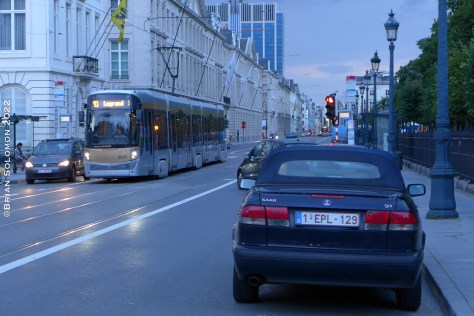
During our October visit to Dublin, I made this trailing panned photo of LUAS Citadis tram 5040 crossing the famed O’Connell Bridge.
I was working with my Lumix LX7 set at ISO 80, shutter speed 1/100th of a second, and f6.3. The key was maintaining a steady pan motion as the tail-end of the tram passed me.
O’Connell bridge is noteworthy for being wider than it is long.
Among the thousands of slides that I recently retrieved from storage in Ireland, was this image that I’d exposed on Fujichrome in Bavaria, Germany on January 20, 2008.
Denis McCabe and I were on a week-long photographic exploration of southern Germany, Austria and Switzerland.
This location on a Deutsche Bahn (DB) single track line at Bad Grönenbach featured traditional German mechanical signaling.
This slide was in a box labled ‘Bavaria, Extras’. (My code to indicate that I’d already culled the preferred images and filed them elsewhere.)
Last night, I scanned the slide using a Nikon LS-5000 Super CoolScan slide scanner powered by VueScan 9.7.08 software.
I selected ‘Ektachrome’ with a ‘White Balance’ color profile and scanned as a TIF at 4000 dpi. Then I imported the scan to Adobe Lightroom and made several JPG variation. The first is scaled without correction. The others display various minor adjustments aimed at improving the image.
Scaled scan, but otherwise unmodified.Scaled with first round of color and contrast correctionsScaled with second round of color corrections, contrast adjustment and minor sharpening.Image with final crop to minimize sky and foreground.
I’m speaking about my Nikkor f2.5 105mm and the famous trestle, and not about a radio station and a monster.
After returning from Ireland, I made a trip to inspect the former Maine Central Mountain Division to check out photo locations for the 470 Club Trip.
Here, I’d hiked into the Frankenstein bridge to see when the sun dipped behind the ridge shadowing the tracks. Owing to the high ridge line the bridge will shadow very quickly on a late fall afternoon.
The eastward Mountaineer was just minutes away when I arrived.
I fitted my old AI Nikkor 105mm to my Nikon Z6 digital camera. This is a magic combination for railroad photography which produced exceptionally sharp photos.
Yesterday, I posted a modified version of this image to Conway Scenic Railroad’s Facebook page and assigned it as the cover photo. It will also be used in late season advertising for the Mountaineer.
Conway Scenic Railroad’s Mountaineer is eastbound on Frakenstein Bridge. New Hampshire’s famed Mount Washington is seen in the distance to the right of bridge.This is a cropped and much enlarged section of the above image to demonstrate the sharpness of my old 105mm.
It’s been more than 23 years since my first visit to Athenry, County Galway.
On that day, my objective was to see an Irish Rail cement train (traffic long gone), and visit the signal cabin (which was then an active block post and interlocking. I was there the day it closed in May 2003.)
Last month, on our way back from Maam Cross, Kris and I were delivered by road to Irish Rail’s Athenry station. It was wet and windy. We had a half hour to wait for the evening Galway-Dublin train to arrive.
During the interval, an Irish Rail 2800-series railcar on its way from Galway to Limerick arrived to make its station stop before changing directions to head down the Western Rail Corridor.
I made this selection of action photos using my Nikon Z6 mirrorless camera set at high ISO (between 8000 and 12000).
This two-piece 2800-series railcar had just arrived from Galway. The Galway-Limerick railcar has the ‘feather’ to take the switch for the Western Rail Corridor toward Ennis and Limerick.The evening Galway-Dublin train approaches Athenry.
I’ve asked this question before. While it is nice to have bright sun, often I find the best photos are in the shadows where light and dark contrast to produce a moody image that tugs at something deeper.
Last week after arranging the photo runbys at the famed Willey Brook Bridge, I walked to the headend of the train while the passengers were reboarding. Here the 470 Club’s freshly painted F7A diesels were deep in shadow with the mass of Mount Willard looming above them.
I made these photos using my Nikon Z6 with 24-70mm lens and adjusted highlight and shadow areas in post processing.
For me these were among of the best photos of the day. They capture the rugged scenery of Crawford Notch from perspectives rarely pictured.
The first official photo stop on 470 Club’s Autumn 2022 trip (operated by Conway Scenic Railroad on Saturday October 22, 2022) was a photo runby on the Conway Branch at Hussey’s Field in Conway, NH. [I was responsible for the train schedule and assisting with organizing the photo stops.]
I chose this location for the first photo stop because it offered ample space for all the train’s passengers to spread out; provided good lighting for an eastward (northward) morning train; and was largely free from shadows, and distracting background elements.
This was the only photo stop on the former Boston & Maine Conway Branch. The other arranged photo locations were all on the former Maine Central Mountain Division
I made these photos using my Nikon Z6 with 24-70mm lens.
More photos from the 470 Club trip to follow in the coming days.
On my list for photographs for this trip to Ireland was the famous Boyne Viaduct at Drogheda.
Last Saturday evening, Kris and I walked to the river from the Scholars Townhouse Hotel, and were delighted when a set of Irish Rail class 29000 railcars rolled southward over the bridge.
It was in the ‘blue hour’ just after sunset. To stop the action, I set the ISO on my Nikon Z6 to 8,000. This allowed for a shutter speed of 1/160th of a second at f4.
Last week we paid an evening visit to Kent Station, Cork, to witness the departure of Irish Rail’s Mark IV to Dublin.
The lighting was mixed. My white balance on my Nikon Z6 was set to ‘auto’ which provided a good starting point. I didn’t want the balance to appear too neutral and negate the mood of evening.
I made a variety of small adjustments to the Nikon’s NEF RAW files in Adobe Lightroom to preserve the character of the light, while retaining highlight and shadow detail in what was a very constrasty situation.
Irish Rail class 201 number 221 works at the back of the train.
Another tip: So when selecting the appropriate Big Bus Dublin, it is helpful to find a relatively empty tour. Not only will the give you the best seat in on the bus (up top, at the back), but also great freedom to move around to capture the best angles.
The first bus of the day tends to be crowded, while I found those mid afternoon to have ample space.
I made these views with my Nikon Z6.
LUAS at College Green from the back of the Big Bus tour.LUAS near College Green from the back of the Big Bus tour.LUAS and the Aircoach at College Green from the back of the Big Bus tour.Heuston Station, Dublin.Heuston Station, Dublin.
Here’s an interesting way to make elevated views of Dublin’s trams: ride at the back of an open-top tour bus.
Kris and I bought 48-hour tickets for the Big Bus Dublin, which provides a half-hourly hop-on hop-off service.
This was primarily a way for us to play tourists in Dubln, but I quickly found that it offered an excellent means to photograph the LUAS.
We traveled on three different types of buses. The variety that was most effective allowed me to shoot over the railing at the very back of the bus. Some of the more modern coaches didn’t have this feature, so you should choose your bus carefully.
I made these photos using my Nikon Z6 mirrorless camera with a 24-70mm zoom.
Yesterday evening (September 22, 2022), I made a few photos of Dublin’s LUAS trams using my Nikon Z6.
It had been raining much of the day but about 6pm the sun came out, making for some interesting but high contrast scenes.
Back in the old days I’d have worked with black & white film to make the most of this type of lighting, and controlled the contrast chemically. Now, I’m applying contrast controls digitally to my Nikon’s NEF (RAW) files using Adobe Lightroom.
Do these photos work?
If they don’t, I’ll take more later.
LUAS tram on Parnell Street in Dublin. JPG from the unaltered NEF file (No changes to color, contrast, exposure etc).LUAS tram on Parnell Street in Dublin. This is my adjusted version of the same NEF file. I’ve paid special attention to the sky using Adobe Lightroom’s built in ‘select sky’ mask.Abbey Street in Dublin. JPG from the unaltered NEF file (No changes to color, contrast, exposure etc).Abbey Street in Dublin. JPG from the adjusted NEF file.
Yesterday (September 13, 2022) I returned to Goves, where the old Maine Central Mountain Division ducks under Route 302 east of Bartlett, NH, to again photograph Conway Scenic Railroad’s Mountaineer on its westward run to Crawford Notch.
The other day in my Tracking the Light Post, ‘Poles and Wires Conundrum,’ I described my compositional frustrations with this location.
Working with my Nikon Z6 with 24-70mm lens, I selected a slightly lower position that was a bit closer to the tracks.
On this attempt, the Mountaineer had two units and seven cars, which made for a more photogenic train. Also, it was brightly overcast, which helped to minimize the poles and wires, and I opted for a tight crop.
April 22, 1997: I ascended a footbridge over a busy Tokyo thoroughfare to make photos of the rarely captured Tokyo trolley.
Where most of the railway lines in Japan are meter-gauge, the Tokyo Trolley is unusual because it was an early use of 4 ft 8.5 inch gauge train in Japan. The other big users of ‘standard gauge’ in Japan are the Shinkansen routes.
In yesterday’s post, I described the compositional challenges of poles and wires near Bartlett, NH. Compare those images with the sea of poles and wires in this view!
Exposed on Fujichrome Velvia50 using a Nikon N90S with an AF f2.8 80-200mm Nikkor zoom lens.
Working with my Lumix LX7 last month, I made a variety of photos of St. Lawrence & Atlantic 394 coming down from the border crossing at Norton, Vermont.
When I first attempted to download the SD card from the Lumix, I noticed a serious problem with several of my files.
Portions of the files suffered from corrupted data, with large portions of the image area scrambled.
However, when I viewed the photos in camera, there was no sign of this problem.
Normally, I take the SD card out of the Lumix and used a card reader to couple the card to my MacBook Pro. Then I download the files using a program called ‘Image Capture version 8.0’. Once downloaded, I then upload select images into Lightroom. This saves the files which creates a secondary backup, while allowing me to organize the photos and make scaled and corrected copies.
After a bit of fussing, I decided that what I had suffered wasn’t a write error to the card (which is a very serious problem), but rather a card read error. In otherwords all the information was safely stored my SD card and it was getting corrupted during the downloading process.
What, I ended up doing was using Lightroom to download the card directly. Then I used Lightroom to output my originals in DNG format which I stored in a folder along with the rest of my August Lumix files.
Below, I show the corrupted files as I original saw them (scaled for internet), then the unadjusted DNG files (scaled); and finally my adjusted DNG files.
The lesson: don’t panic if you suffer from corrupted files. Your data may still be recoverable. [Just don’t erase or format the card.]
Corrupted file from my initial download using a card reader an Image Capture 8.0Unaltered file uploaded using Lightroom and exported in DNG format for archiving then converted to JPG for internet display.Adjusted DNG file using Adobe Lightroom, scaled and exported as a JPG for internet displayCorrupted file from my initial download using a card reader an Image Capture 8.0Unaltered file uploaded using Lightroom and exported in DNG format for archiving then converted to JPG for internet display.Adjusted DNG file using Adobe Lightroom, scaled and exported as a JPG for internet display
Friday, September 2, 2022, former Maine Central GP38 252 led the Valley train on its return run from Conway.
I made this view from the roof of the North Conway Station using my Nikon Z6 with 70-200mm Z-series zoom lens.
I set the camera Color Profile to ‘VI’ (Vivid), the white balance was at ‘Auto,’ and the exposure to ‘A’ (aperture priority). I selected f6.3, the camera metering selected 1/500th of a second. I had the lens full extended at 200mm. I was working with the NEF (RAW) file setting.
Adobe Lightroom enables me to apply the camera’s preset color profile to the NEF file while making adjustments to the file. Below are two versions. The top image is basically out of the camera and without modifications except for scaling, the bottom reflects minot adjustments to color temperature, shadow and highlight density, and a slight adjustment to the sky.
I’m not entirely satisfied with the image, so I’ll try it again sometime. Maybe with a slightly longer lens and different lighting.
Unmodified file with camera profiled color & etc.Adjusted version of the same file shown above. Changes to color temp, shadow and highlights, and sky