A Clear Autumn Day to Photograph a Shiny Blue Bird.
Today, Massachusetts Central assigned one of two recently acquired GP38s to its weekday Palmer-South Barre local freight. Although Mass-Central received the two locomotives earlier this year, it is my understanding that today’s train is the first regular revenue service run to use one.
Mass-Central 1751 leads the northward freight at Forest Lake, north of Thorndike, Massachusetts on October 24, 2013. Canon 7D photo.
The train departed Palmer this morning with the GP38 leading Mass-Central’s 2100 and 960. The second two locomotives were left in Ware, while the freight continued up the Ware River Valley on the former Boston & Albany branch.
Both of the Massachusetts Central’s GP38s have been beautifully painted in a livery inspired by the classic Boston & Maine ‘Blue Bird’ scheme. Although most of Mass-Central’s current route uses former Boston & Albany tracks, the railroad began as a switching operation on vestiges of Boston & Maine’s Central Massachusetts line around Ware.
Historically, the Central Massachusetts was a Boston & Maine route between Boston and Northampton, although it hasn’t served as a through route since the 1930s. Massachusetts Central still operates a few segments of old B&M trackage, notably in Ware.
Mass-Central 1751, 2100 and 960 lead the northward freight near Ware, Massachusetts on October 24, 2013.Mass-Central arrives at Ware Yard on October 24, 2013. Canon 7D.Mass Central 1751 works toward South Barre, Massachusetts on October 24, 2013.
Seeing Images; Railway Photographs without Trains.
Weed grown yard tracks at East Deerfield, Massachusetts, October 2013. Exposed with a Canon 7D and 200mm lens.
New England can be a challenging place to make railway photographs. While it provides endless quaint and picturesque settings, and in the autumn features wonderful light and bright foliage, compared with many other places, train movements are sparse, and simply finding trains on the move can be difficult.
So why wait for trains to make interesting railway images? I don’t.
Boston & Maine stone arch bridge on the Connecticut River line near East Northfield, Massachusetts. Canon 7D with 100mm lens.
Over the last three decades I’ve exposed tens of thousands of railway images in this region. And while I often capture trains in their environment (and on the move), I don’t rely upon trains to make images.
Below are selection of images exposed while driving around central New England observing railways.
The trains do run. Off in the distance, the sounds of Electro-Motive diesels reverberate off distant hills, a whistle blows, and soon headlights illuminates the rails. Later posts will focus on the trains; at work, in the light and on the move.
Massachusetts Central former Boston & Albany line on Ware Hill. October 2013. Lumix LX3 photo.CSX’s former Boston & Albany main line at West Warren, Massachusetts. Canon 7D with 200mm lens.New England Central near Vernon, Vermont. Lumix LX3 photo.General Railway Signal searchlight.
Bridge date.
New England Central’s former Central Vermont Railway bridge over the Connecticut River at East Northfield, Massaschusetts. Lumix LX3 photo.East Deerfield yard at Sunrise. Canon EOS 7D with 200mm lens.
Applying an Old Technique with Today’s Technology.
The other day I arrived at Pan Am Southern’s Boston & Maine East Deerfield Yard shortly after sunrise. Although not a wheel was turning, there was some nice light and I made a selection of images.
My challenge was in the great contrast between the ground and sky. With my Lumix LX3, I found that if I exposed for the track area, the dramatic sky was washed out (too light), and if I exposed for the sky the tracks area was nearly opaque.
East Deerfield Yard, Massachusetts at Sunrise. Unmodified ‘in camera Jpg’. Lumix LX3 photo exposed using the ‘V’ (for Vivid) setting.
With black & white film, I would have compensated my exposure and film development to maximize the information on the negative, then dodged and burned critical areas on the easel in the dark room to produce a nicely balanced print. I’d done this thousands of times and had my system down to fine art.
I applied this same basic philosophy the other morning at East Deerfield. I made several exposures from different angles. In one of these I slightly overexposed the sky to retain some detail in the track area.
The in-camera Jpg from this still appears both too dark and too contrasty (from my perspective having witnessed the scene). Rather than be content with this inadequate photograph, I took a copy of RAW file that I exposed simultaneously (one the benefits of the LX3 is it allows both a Jpg and a RAW to be exposed at the same time) and imported it into Photoshop. (I always work from a copy and I NEVER manipulate or alter the original file).
Under the ‘Image’ menu, I selected ‘Adjustments’ and then ‘Curves’; I then adjusted the curve to produce a more balanced over all exposure. This is possible because the RAW file has more information (detail) in it than is visually apparent.
While this improved the image, I still wasn’t satisfied. So I selected the ‘Dodge and Burn tool’ (which appears in the tool bar as a angled gray lollipop). Using the ‘Dodge’ function, I very slightly and selectively lightened track areas and foliage that I felt appeared too dark.
Then I used the ‘Burn’ function to selectively adjust the sky areas. If I’ve done this successfully, the scene should appear very close to the way I saw it. Similar techniques can be used to make for surreal and unnatural spectacular landscapes. While I may do that later, that’s not my intent today.
The same image as above, but from a modified RAW file using Photoshop to adjust contrast (both across the entire image and locally). Lumix LX3 photograph.
While modern tools, like those of the traditional darkroom, allow for improvement over in-camera images, the effort does take time. I estimate I spent 10-15 minutes adjusting this photograph.
Because this adds time to the work on the photograph, I don’t want to have to do this any more often than necessary. Most of my photographs are ready to go ‘in-camera’ (as it were).
View of a Line 40 Years after Closure; Abandoned but not Lifted.
Pennsylvania’s East Broad Top is among the most fascinating railways in the eastern United States. Largely built in the 1870s to tap coal fields in the Broad Top region, it was constructed to the three-foot gauge standard and remained that way until closed to traffic in 1956.
I exposed this photograph with my Nikon F3T on Fujichrome Provia 100F near East Broad Top’s Sideling Hill Tunnel.
A short segment at Orbisonia operated steam excursions from 1960 until 2011, but the remaining portions of the railroad have sat derelict in the mountains since it closed as a common carrier. Although unused, much of the track remained in place. Especially interesting were the tunnels at Sideling Hill and Wray’s Hill.
In September 1996, Thomas M. Hoover and I made a project of exploring EBT’s disused lines and facilities. I also made several trips to photograph the railroad’s excursions.
Close Ups, Details and Alternate Views: A Look Beyond the Obvious.
While photographing Ireland’s Bord na Mona narrow gauge last week, I was looking for different angles. I’ve made nearly a dozen trips to the Bord na Mona in the last year and I wanted to capture the essence of the operation up close.
Link and pin coupler between track panel bogies. Lumix LX3. Notice the photographer’s shadow.
This is a gloss free industrial railway. It’s like a big beat-up tin plate train set that has seen lots of use, and doesn’t adhere to prototype railroading in any normal conventions.
Tracks are laid down here and there. Curvature is very tight, in many places there’s no ballast. Junctions appear with little notice. And the trains bounce along at a grinding amble.
Points. Lumix LX3 photo.Level crossing warning. Lumix LX3 photo.Track panel train. Lumix LX3 photo.Track panels and panel train. Reminds me of Lionel or American Flyer. Somewhere out in the bog must be the world’s largest Christmas tree! Lumix LX3 photo.Bog tracks. Lumix LX3.Fellow photographer documenting an empty train near Derraghan Cross. Lumix LX3 photo by Brian Solomon.Tight telephoto view of an empty train scuttling along behind a Wagon Master locomotive. Canon 7D with 200mm lens.A cow observes an empty train. Lumix LX3.
See previous posts for more views on the Bord na Mona:
A Busy, Bright and Clear Day Visiting Irish Narrow Gauge.
A laden Bord na Mona approaches Lanesborough in October 2013. Canon EOS 7D with f2.8 200mm lens. Photo unmodified except for scaling.
Last week, Mark Healy and I made another venture to photograph Bord na Mona’s (Peat Board) three-foot gauge industrial railway. This time we chose the network focused on feeding the Lough Rea Power Station at Lanesborough in County Longford.
Although we departed Dublin under cloudy skies, by the time we reached the Midlands, the clouds parted and we enjoyed most clear sunny weather for the remainder of the day.
An empty train rocks and rolls as it heads out for reloading against a backdrop of the Lough Rea Power Station at Lanesborough. Canon EOS 7D with f2.8 200mm lens. Photo unmodified except for scaling.
From past experience, I’ve found that clear days are by far the best time to photograph Bord na Mona’s trains at work. The heavily harvested moon-like landscape of the peat bogs doesn’t translate as well on dull days. Also, the brown and cream livery on the locomotives and aluminum peat wagons look best with sun on them.
Finding a clear day in the Irish Midlands isn’t so easy. The weather is famously dull and changeable. On more than one occasion I’ve found that a forecast for fine weather proved overly optimistic.
Backlit view of a laden Bord na Mona train as it approaches the highway bridge at Derraghan Cross in October 2013. Canon EOS 7D with f2.8 200mm lens. Photo unmodified except for scaling.
For this excursion, I brought four cameras. Yes, four. In addition to the two digital cameras (Lumix LX3 and Canon EOS 7D), I had my Canon EOS-3 and a Rollei Model T 120-size camera both loaded with Fujichrome Provia 100F.
There’s certain types of images that I still like to put on film. Also, while I expose a lot of digital images (and make multiple back-ups of each and every file) I’m very reluctant to trust digital imaging for long term applications.
So, in the event of a digital apocalypse, I’d like to have a few Bord na Mona photos on color transparency film for posterity.
My film has yet to be processed, so here are a few of my recent digital results.
An empty scuttles below the road at Derraghan Cross. Lumix LX3 photo.A pair of laden trains amble toward Mountdillon on their way to Lanesborough. Canon EOS 7D with f2.8 200mm lens. Photo unmodified except for scaling.
A bit of foliage at Mountdillon. Canon EOS 7D with f2.0 100mm lens. Photo unmodified except for scaling.A lone locomotive with a per-way vehicle rests quietly on the bog. The turf has been exposed for harvesting and blackened by recent rains. This can make for some very tricky exposures. I used my handheld Minolta Mark IV light meter to help gauge the settings. Also, I made several test photos to keep the tones within an acceptable range. Simply using the camera meter resulted in a very washed out locomotive and a lightly colored bog. Lumix LX3 Photo.
Tune in tomorrow for more highlights from this most recent Bord na Mona adventure!
Last Thursday, October 10, 2013, I took Irish Rail’s DART (Dublin Area Rapid Transit) from Connolly Station, Dublin to Glenageary. While not specifically a trip to make photos, I had a couple of cameras with me, you know, just in case.
While waiting for my southward train, an 8600-series DART set pulled into platform 6. It was the first DART set that I’ve seen featuring the new Irish Rail logo.
Irish Rail’s DART at Connolly Station, Dublin, October 10, 2013. Lumix LX3 photo.Irish Rail’s DART at Connolly Station, Dublin, October 10, 2013. Lumix LX3 photo.
This logo was introduced a few months ago, and thus far I’d seen it on some of the Mark IV and 22000-series Intercity trains as well as a few ‘HOBS’ ballast wagons (HOBS is an Irish Rail abbreviation for ‘high-output ballast system’).
The sun was out brightly, which made for a good opportunity to document this nominal change.
The all-black variation of the logo on the front of the DART car is different from what I’ve seen on other equipment.
From my experience, It’s always a wise move to photograph these types of changes as soon as they appear, because you never know when some little change might turn out to be a short-lived one-off.
CSX L022 rolls west near Edwards Park, New York. Exposed at ISO 640 with a Canon EOS 7 with 28-135mm lens set at 53mm f5.6 at 1/200th second. To accentuate the autumn foliage, I manually set the white balance for a warmer setting rather than use the auto white balance that I find to be too cool for autumn trees.
On the morning of October 14, 2011, I crossed the Berkshires on the Mass-Pike as I drove west to meet with accomplished railway photographer John Pickett.
I had a few hours before our meeting, so despite low cloud and mist, I exited the highway at the Massachusetts-New York state line and drove toward Boston & Albany’s State Line Tunnel. While on Tunnel Hill Road in Canaan, New York, I noticed this colorful scene from the road side.
As I got out of the car, I heard the unmistakable sound of a train roaring west. I had just enough time to get out my Canon EOS 7 and make a test image before the train passed.
Another case of just being at the right place at the right time, and being ready to act.
View from Delaware-Lackawanna’s westward PT97 at the Delaware Water Gap, west of Slateford Junction, Pennsylvania on October 14, 2005. Exposed on Fujichrome with a Nikon F3T and 24mm lens.
In October 2005, I arranged through official channels at Genesee Valley Transportation to ride Delaware-Lackawanna’s trains PT98/PT97, and interview railroaders about their work as part of research for my book Working on the Railroad (published by Voyageur Press in 2006).
On the morning of October 13, 2005, I joined the crew in Scranton for their run to Slateford Junction near Portland, Pennsylvania. After a bit of switching we were on the road. The weather started out dark and damp, and didn’t improve any throughout the day.
The primary emphasis of my trip was the crew and many of my photographs from the day depict engineer Rich Janesko and conductor Shawn Palermo at work. These were featured in the book.
On the return run, I opted to ride in the second locomotive for a little while to make images of the train climbing west through the Delaware Water Gap on the former Delaware, Lackawanna & Western mainline. It was on this section that my father had photographed Erie-Lackawanna’s Phoebe Snow more than 40 years earlier.
We departed Slateford Junction in early evening. I exposed this image from the fireman’s side of former Lehigh Valley Alco C-420 number 405. Leading is a former Erie-Lackawanna C-425 (running back on home rails thanks to GVT’s policy of Alco acquisition).
I used my Nikon F3T with an f2.8 24mm lens mounted firmly on a tripod in the cab and set the shutter speed at between ¼ and 1/8th of a second to allow the trees and ground to blur.
I was trying to emulate the effect that Richard Steinheimer achieved on his famous cab ride photos at night in a Milwaukee Road ‘Little Joe’ electric.
View from Delaware-Lackawanna’s westward PT97 at the Delaware Water Gap, west of Slateford Junction, Pennsylvania on October 13, 2005. Exposed on Fujichrome with a Nikon F3T and 24mm lens.
Low Sun at a Hackneyed Location—Nine Years Ago Today.
On the evening of October 12, 2004, I exposed this photograph from the popular ‘waste too much film bridge’ at the west-end of Guilford’s East Deerfield, Massachusetts yard. I’ve made hundreds, if not thousands of images over the years from this spot. I’m not alone.
I exposed this on Fujichrome with a Nikon F3 fitted with a Nikkor f2.8 24mm lens.
I’d followed a local freight (ED-4?) from the Hoosac Tunnel east on the old Boston & Maine Fitchburg line. This was the locomotive from the local. Having dropped its train in the yard, it has come to the west end and will reverse into the engine house tracks.
The shaft of light of the setting sun made for an opportunity. Rather than make a standard view, I opted for this wide angle image that features the locomotive’s high short -hood. This was one of the railroad’s second-hand GP35s noted for this arrangement. (short/long are used to describe the hood length, while high/low the height, thus the contradictory sounding description).
The low angle of the sun allowed for light across the front of the locomotive, while the rest of the scene is draped in shadow. You can see the shadow of the bridge I’m standing upon in the distance.
On October 9, 2004, Vermont Rail System freight 263 is near the summit of the old Rutland Railroad near Mt Holly, Vermont.
Nine years ago today, I exposed this photograph of Vermont Rail System train 263 at Mt. Holly, Vermont while traveling with Pat Yough and a guest visiting from England.
Compare this view with that as presented in an early Tracking the Light post titled Red Locomotives in the Snow; Mt Holly, Vermont.
Finding peak autumn color is always a challenge, and finding it with a train moving can be even more difficult. It always seems that the best color isn’t anywhere near the tracks. On this day in 2004, the view at Mt. Holly was an exception to the rule.
Check out my Dublin Page ‘Recent Images of Dublin‘ on Tracking the Light for recent photos of architectural gems opened to the public on the weekend of October 5 and 6. I visited a dozen sites and exposed a variety of interesting photos.
Royal College of Surgeons Ireland. Lumix LX3 photo.
I exposed this image after sunrise just west of Union City, Pennsylvania. I was working with a pair of Canon EOS-3s. This photo was made with the EOS-3 loaded with Fujichrome Velvia 100 and fitted with a 24mm lens.
On the morning of October 8, 2009, I made a project of photographing Western New York & Pennsylvania Railroad’s westward freight HNME (Hornell to Meadville) that was working along the former Erie Railroad mainline in northwestern Pennsylvania.
I started before dawn near Niobe Junction and followed the train to its terminus at the former Erie yard in Meadville, Pennsylvania.
Speed restrictions on the line made for ample opportunities to photograph the freight as the sun brightened the sky.
See Tracking the Light post from December 11, 2012, Erie October Morning, for more images of this train exposed on October 8, 2009.
I spent a lot of time exploring Southern Pacific’s Donner Pass in 1990. Among my favorite locations was ‘Old Gorge’, sometimes referred to as ‘American,’ where SP’s line rides briefly on an open shelf some 2,000 feet above the American River.
Southern Pacific SD45 7418 is downgrade on Donner Pass between Midas and Towle, California at the American River overlook in July 1990. Exposed on Kodachrome 25 with a Nikon F3T and 35mm PC ‘Shift’ lens.
This offers a stunning view of the American River Canyon, but can be a pretty challenging place to effectively portray a train on film.
On this day in July 1990, I’d been following a westward SP freight downgrade, and driven as close to my location as was practical, and then walked to this ledge overlooking the line.
The classic whine of dynamic brakes preceded the train by several minutes. I made several exposures as the train came into view.
In this situation, I used the camera and lens handheld, and made a slight adjustment to the shifting element front element. Instead of aiming the camera down toward the front of the locomotive, as I would with a conventional 35mm lens, I aimed toward to the far rim of the canyon, while lowering the front element downward to take in the tracks.
As the train passed, I panned the nose of the leading SD45, exposing this frame when it was roughly parallel with the film plane.
Since I didn’t have the camera completely level there is still a bit of line convergence, yet the overall view helps put the magnitude of the canyon in perspective with the train without the locomotive appearing too small or seriously distorted.
I’ve posted this image as another example of my work with a perspective control lens. This was a tool I made excellent use of in the early 1990s. On the recommendation of J.D. Schmid, I bought a Nikon 35mm PC ‘Shift’ lens for my Nikon F3T.
Among the advantages of a perspective control lens is the ability to shift the front element. This can be used to keep vertical lines from converging, but also to alter the image in subtle ways.
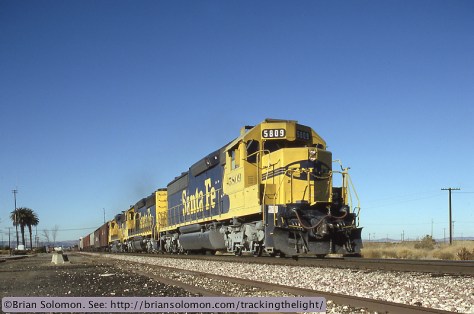
Santa Fe SD45-2 5809 thunders east with a freight at West Pittsburg, California in November 1990. Exposed on Kodachrome 25 film with a Nikon F3T with 35mm PC lens at f4 1/500th of a second.
It was a clear Saturday morning in the Bay Area, and Brian Jennison and I were on one of our jaunts looking at area railroads. We stopped near the old station location at West Pittsburg (no ‘h’), California. (I believe the palm trees in the distance are an indication of where the building once stood.) Here we photographed several trains.
For this eastward freight, I positioned the camera relatively low to the ground and raised the front element of the 35mm PC to near its maximum. I didn’t quite keep the camera level. The result includes a large amount of crystal blue sky, while minimizing the foreground and keeping the vertical elements of the lead locomotive nearly parallel with the image frame.
I feel the subtle effect allows the locomotive visually surge forward, seeming to charge along. This was my intent. Santa Fe 5809 is an SD45-2, a machine powered by EMD’s 3,600 hp 20-cylinder diesel.
In their heyday these were powerful machines that produced an awe inspiring low-base sound in the high-throttle positions. I hoped to convey that power visually while making use of the California sky.
Tracking the Light posts new material daily. Please spread the word and share Tracking the Light with anyone who may enjoy seeing it!
Early dawn light at Waterbury, Connecticut on November 16, 1992. As was typical for the time, I calculated the exposure manually using a Sekonic Studio Deluxe handheld photocell. I made several exposures on Kodachrome 25.
I was driving west on I-84 aiming for the Hudson River. It was a bitterly cold autumn morning before dawn and the sky above was a clear blue dome. I made a spot decision, to get off the highway and make a few photos around the old New Haven Railroad station.
I exposed this view of Metro-North FL9 2023 with the iconic silhouette of the station’s Italianate clock tower beyond. The locomotive was one of several restored in its as-built 1950s-era New Haven paint scheme.
The combination of the early hour and frosty conditions provided for an almost surreal light, but little in the way of personal comfort.
Using my Nikon F3T fitted with a 35mm perspective control lens; I composed this view with the camera mounted on a Bogen 3021 tripod with ball head. By keeping the camera level and adjusting the shift on the front element of the PC lens, I kept the vertical elements parallel.
I continued my drive west, and the rest of the day was spent productively along the former New York Central Hudson Division between Peekskill and Beacon, New York.
Every so often the sun shines in Ireland. When it does, it helps to be in position to make photographs. As it happened, on Friday September 27, 2013, Colm O’Callaghan and I were at Stacumny Bridge, near Hazelhatch in suburban Dublin.
A six piece 22000-series Intercity Rail Car glides up road at Stucumny Bridge, September 27, 2013. Exposed with an Canon EOS 7D.
Our aim was to photograph the down IWT (International Warehousing and Transport) liner which had an 071 class diesel leading. Stacumny Bridge is a favorite location to catch down-road trains mid-morning because of the broad open view of the tracks and favorable sun angle. I’ve post photos from this location on previous occasions.
While waiting for the liner, we got word of an up road wagon transfer. And caught that a few minutes before the liner came down. Then we heard that there was a permanent way department (PWD or ‘Per way’) ballast train coming up road as well. This was one of the elusive high output ballast trains (HOBS) I’ve mentioned in other posts.
Irish Rail 071 class diesel number 079 leads a wagon transfer up road at Stucumny Bridge. Up road is toward Dublin, down road away. Exposed with an Canon EOS 7D and 40mm pancake lens.Irish Rail 081 leads the down IWT Liner (International Warehousing and Transport container train Dublin to Ballina) approaching Stacumny Bridge near Hazelhatch on September 27, 2013. Exposed with an Canon EOS 7D with 28-135mm lens.Irish Rail 0117-071 leads a High Output Ballast (HOBS) train up road at Stacumny Bridge on Septemeber 27, 2013. Exposed with an Canon EOS 7D with 28-135mm lens.
Although an annoying small cloud softened the light at Stacumny when the HOBS roared up road. We pursued the train up to Dublin and caught it again reversing into the old Guinness sidings at Heuston Station.
For the all hours scouring the countryside for photos on dull days, it’s rewarding to catch a clattering of interesting action in just over an hour on a bright day. This is down to watching the weather, combined with patience and persistence and a good bit of luck.
The engine has run around in preparation to reverse the HOBS into the old Guinness sidings at Heuston Station, Dublin. A Mark 4 set passes the train. September 27, 2013. Lumix LX3 photo.Irish Rail HOBS at Islandbridge Junction near Heuston Station, Dublin. Lumix LX3 photo.Irish Rail 0117-071 prepares to reverse the empty HOBS into the old Guinness sidings at Heuston Station. The locomotive will ‘hook off’ for work elsewhere, while the ballast train will remain stabled in the sidings over the weekend. Canon EOS 7D photo.
Tomorrow: Tracking the Light looks back 13 years at Stacumny Bridge. What a change!
Tracking the Light posts new material on a daily basis.
Last week, I traveled by train from Dublin to Cork to make photographs and visit with friends. I was traveling light and only brought two cameras, my Lumix LX3 and Canon EOS 3. In addition to some Velvia 100F, I also played around with some Fuji 400 color print film I had stored in the refrigerator.
Initially I focused my attention on Kent Station, which features a unique curved train-shed that make it one of the most interesting railway structures in Ireland. Signaling at the Cobh-end still retains a few mechanical semaphores.
Kent Station, Cork. Lumix LX3 photo.New Irish Rail logo.
Later, I worked east making a variety of images at Glounthuane (Cobh Junction) where Cobh and Midleton lines come together. The Midleton line had been closed for decades and was only reopened for passenger service in 2009. Years earlier, I’d explored the then derelict line.
Where that visit was blessed with bright sun through out the day, on this recent trip I experienced more ordinary Irish weather.
Irish Rail signs at Glounthaune, Cork. Lumix LX3 photo.Irish Rail 2600-series rail car at Glounthaune, Cork. Lumix LX3 photo.Irish Rail train to Cobh near Fota, Cork. Lumix LX3 photo.Irish rail train departing Midleton, Co. Cork. Lumix LX3 photo.Irish Rail 2600s passing North Esk, Co. Cork. Lumix LX3 photo.
Here are a few views from the two cameras. Special thanks to Ken and Janet Fox and Donncha Cronin for location advice and local transportation. Also thanks to John Gunn Camera shop on Wexford Street in Dublin for color negative film processing and prints.
Kent Station, Cork. September 2013. Lumix LX3 photo.
Irish Rail Mark 4 at Kent Station, Cork. Exposed on Fuji 400 ISO color negative film (C41 process) using a Canon EOS 3 with 28-135 mm lens.
Tracking the Light posts new material daily. Please spread the word and share Tracking the Light with anyone who may enjoy seeing it!
Last week, Mark Healy and I made a foray into Irish bog lands searching for narrow gauge peat trains operated by Bord na Móna (Peat Board). We’d been watching the weather closely and tried to time our visit for a bright clear day.
We got it wrong. Despite a rosy sunrise in Dublin and generally good forecast, we faced fog, cloudy and just general overcast in County Offaly.
After more than a half dozen visits to this rarely photographed industrial railway, I thought I was beginning to have an understanding of their operations.
I got that wrong too! While, we’d photographed a dozen trains by the end of the day, actual operations were quite different than what I expected.
Trailing view of Bord na Móna’s Shannonbridge empty ash train returning to Shannonbridge, County Offaly, Ireland. Canon EOS 7D photo.Laden peat train near Shannonbridge, September 2013. Exposed with a Lumix LX3.Laden trains approach Shannonbridge. Canon EOS 7D photo with f2.8 200mm lens.
Initially we worked the lines radiating out from Shannonbridge. Our first train was the ever-elusive ash train. That was a bonus for us. After about five hours, having photographed several loaded and empty trains, we decided to head east toward Edenderry, which is the focus of another of Bord na Móna’s networks.
On the way we stumbled upon an obscure Bord na Mónaoperation. Driving east on highway R357 east of Cloghan, Mark noticed a level crossing. “Hey! There’s a pair of trains.” I mistook these for trains heading to Shannonbridge
My error was corrected when we chatted to one of the drivers. Turns out these were empty trains heading out loading to bring peat to the Derrinlough briquette factory. Just dumb luck to catch this operation.
Closing the level crossing gates on Ireland’s R357 east of Cloghan, County Offaly. Canon EOS 7D 7D photo with f2.8 200mm lens.A Derrinlough-based Bord na Móna train near Cloghan, County Offaly. Canon EOS 7D 7D photo with f2.8 200mm lens.A Derrinlough-based Bord na Móna train crosses highway R357 near Cloghan, County Offaly. Lumix LX3 photo.Trailing view of Derrinlough-based Bord na Móna trains near Cloghan, County Offaly. Canon EOS 7D 7D photo with f2.8 200mm lens.
We finished the day inspecting operations near Mt Lucas and Edenderry. Pity about the lack of sun.
I’ve dealt with Bord na Móna several times in previous posts.
Thunderstorms had blown through earlier in the afternoon. Then the sun beamed. All the while Netherlandse Spoorwagen’s double-track north-south mainline south of Dordrecht was saturated with an unceasing parade of trains. (See my earlier post: Netherlandse Spoorwagen Koploper near Dordrecht Zuid, Septemeber 2013).
NS keeps trains flowing one after another, and doesn’t seem to have any qualms about running freight tightly between passenger trains. I found that about every half hour a freight would be slotted in.
I made this photograph with my Canon EOS 7D with f2.8 200mm lens, set at ISO 400 f 4.5 at 1/1000th of a second. In post-processing, I made minor adjustments to contrast and saturation to match how I perceived the light at the moment of exposure.
This was one of the last exposures I made before sundown. A former Netherlandse Spoorwagen electric leads a southward Deutsche Bahn freight. While I’d seen several of these classic electrics on the move, this was the only one I caught in nice light hauling freight.
Thalys crosses Hollands Diep south of Dordrecht, The Netherlands in September 2013. Exposed using a Canon EOS 7D fitted with f2.8 200mm lens; ISO 800 f4 1/250 second.
I exposed this image of a Thalys at speed crossing a arched bridge over Hollands Diep minutes before the fading orange ball of the sun melted into North Sea coastal fog.
Thalys is an international high-speed train branding applied to services connecting Amsterdam-Brussels-Paris, and Köln-Brussels-Paris. Technologically speaking the train is a French-built TGV, but specially painted and decorated for Thalys services.
This was an evening run from Amsterdam to Paris. Hollands Diep is the coastal estuary fed by Rhein and Meuse Rivers. This bridge features a pronounced sweep up and over the water. Beyond it is an older (and busier) truss that has two main tracks for ordinary rail services (freight and passenger).
I panned this train with my Canon EOS 7D fitted with f2.8 200mm fixed telephoto. The light was fading rapidly, so I set the ISO to 800, adjusted the white balance manually and pre-focused in anticipation of the fast moving train. My exposure was f4 at 1/250 of a second.
Earlier in the evening I’d seen a Thalys fly across the bridge and I recognized that the structure of the bridge mimicked the paint scheme on the train, so I released the shutter to allow for an arching visual flow between train and bridge. This is accentuated by the low light.
A classic Netherlandse Spoorwagen (Dutch Railways) ‘Koploper’ approaches a pedestrian/cycle crossing at Dordrecht Zuid in September 2013. Appearently, the name loosely translates to ‘Head Walker’, or so I’m told. Does anyone know more about the name?
Earlier this month (September 2013), I traveled with an Irish railway photographer to the Netherlands. We spent a few sunny hours at a pedestrian/bicycle crossing near Dordrecht Zuid on a busy north-south line.
This was one of the most intensely used double-track mainlines that I’ve witnessed in any country. For two hours we photographed a constant parade of local and long distant passenger trains plus a great variety of freight. Trains passed the crossing every couple of minutes.
Bicycles are a Dutch national transport obsession. These cyclists had waited patiently for the barriers to lift before crossing the line near Dordrecht Zuid.
For me one of the most interesting trains to photograph are the Netherlandse Spoorwagen (translated as ‘Dutch Railways) ‘Koploper’ style electric multiple unit.
These are distinctively Dutch. As European railways are rapidly moving toward standard commercial train models, it’s nice to still see nationally characteristic equipment on the mainline.
I exposed these photos with my Lumix LX-3.
A classic Netherlandse Spoorwagen (Dutch Railways) ‘Koploper’.
In October 2007, I was working on my Railroad’s of Pennsylvania book, when Pat Yough and I made a very productive chase of Tioga Central’s excursion train, which operated, from Wellsboro Junction, Pennsylvania compass north along the old New York Central Fallbrook route (including over a Penn-Central-era line relocation).
An RS-1 wearing a Lehigh Valley-like livery leads a Tioga Central excursion north of Wellsboro Junction on October 7, 2007. I’d just bought a second-hand 24mm Canon lens from Thom Kinard, and this was a good opportunity to try it out on my Canon EOS 3 loaded with Fujichrome.
Back in the mid-1980s, I failed to take the opportunity to chase an empty Conrail coal train down the line south of Gang Mills Yard (near Corning, New York). At the time the line still went all the way to Newberry Junction, near Williamsport, Pennsylvania.
Conrail operated ENSY/SYEN (Enola-Syracuse) manifest trains on this route three days a week, plus unit coal trains.
I’d been standing at the bridge (now gone) at the east end of Conrail’s Gang Mills Yard. There were two trains coming. A westward double stack on the former Erie route, and a southward unit coal train heading down the Fallbrook. I opted to follow the stack train because I didn’t have a good map of Pennsylvania.
Six months later Conrail abandoned the Fallbrook as a through route, and lifted the line south of Wellsboro through the super-scenic Grand Canyon of Pennsylvania.
While, I’ve since chased Wellsboro & Corning freights and the Tioga Central excursion, I’ve always regretted my poor decision that day. A map, a map, my kingdom for a map!
An RS-1 wearing a Lehigh Valley-inspired livery leads a Tioga Central excursion north of Wellsboro Junction on October 7, 2007. I’d just bought a second-hand 24mm Canon lens from Thom Kinard, and this was a good opportunity to try it out on Canon EOS 3 loaded with Fujichrome.
It was a cold and snowy day when I drove from Rochester to Binghamton, New York in December 1986. I photographed several trains along the former Erie Southern Tier route.
In the afternoon, I made this study of a New York, Susquehanna & Western Alco RS-1 at the railroad’s Binghamton yard.
Exposed on 120 size Kodachrome 64 roll film with a Rollei Model T featuring an f3.5 75mm Zeiss Tessar lens.
I was using my dad’s Rollei Model T loaded with 120 Kodachrome 64. I had the camera fitted with a ‘Super Slide’ insert that gave me 16 rectangular frames per roll, roughly in the 645 format. Pop had bought the camera in Germany back in 1960.
I think its neat that my father had photographed Susquehanna’s RS-1s in passenger service more than 25 years earlier with the same camera. Since I was only 20 then, it seemed to me that the locomotives (and the Rollei) had been around since the dawn of time!
This batch of Kodak 120 Kodachrome had a tendency to color shift red, so after scanning I made some corrections in post processing. Other than that the image is extremely sharp. Scanned at 4800 dpi as TIF file this is nearly 250 MB. That’s an enormous amount of information.
I’ve always liked locomotive details. Some of my earliest efforts focused on engine shapes.
HAPPY BIRTHDAY POP!
Tracking the Light posts new material on this site almost everyday!
Please tell your friends and anyone who might enjoy the site to take a look.
Among Pioneer Valley’s early locomotives was Alco S-2 switcher number 106 which came to the line from sister Pinsly road Frankfort & Cincinnati. On October 12, 1984 it stands at Westfield, Massachusetts engine house ready for its trip to Holyoke and back.
I exposed this view of Pioneer Valley Railroad’s Alco S-2 switcher with my old Leica 3A on black & white film on October 12, 1984. On the same day, I’d arranged with the railroad to ride this locomotive to Holyoke and back.
It was a memorable trip. In Holyoke we worked the Graham branch that followed the banks of old canals. Several times we had to stop to open and close gates across the line.
I featured this photo in my recent book North American Locomotives that features railroad by railroad locomotive profiles of many different lines. In addition to the Class 1 carriers, I also profiled a variety of smaller lines, many of which are my personal favorites.
Looking south at Central Vermont’s Palmer, Massachusetts Yard in spring 1979. The Rocket was loaded circus style using a ramp in the yard. RS-11s were typically assigned to this train.
In spring 1979, my dad and I visited Central Vermont’s Palmer, Massachusetts yard. At the time Palmer activity tended to be nocturnal. A lone RS-11 for The Rocket (Palmer-St Albans, Vermont piggyback) was the only locomotive in town.
I made a few exposures on Kodachrome 64 with my Leica 3A. At the time I was in 7th grade at Monson Junior-Senior High School. Admittedly my photographic skills were rudimentary. The photos are passable, but a decent record of the scene.
I wish I’d made more photos of CV’s piggyback trains. By the time I understood what it was about, it had stopped running. I have a few images of The Rocket on the road, but not very many.
Detail view of CV RS-11 3611 at Palmer in spring 1979. RS-11s were among my favorite diesels and I’d see them regularly at Palmer.
Mike Gardner and I were poking around Scranton on October 14, 1997. Although the foliage was nearing its autumnal peak, the sky was dull, so we were mostly exploring locations.
A Delaware-Lackawanna freight led by an Alco C-425 diesel passes below a former Erie Railroad bridge near Scranton, Pennsylvania on October 14, 1997.
We drove into this spot along the old Lackawanna triple-track mainline used by Steamtown excursions and Delaware Lackawanna freights. I was curious about the abandoned former Erie line that crosses in the distance on a truss.
Neither of us expected to see a train, but to our surprise this Delaware Lackawanna local returning from Moscow came down grade. Even with 100 speed Fujichrome Provia 100F my exposure was difficult. I think this image was made at f4.0 at 1/60th of second with my Nikon F3T and 80-200mm zoom.
Interestingly, a decade later I made a project of photographing Delaware-Lackawanna operations while working on my book Railroads of Pennsylvania published by Voyageur Press. Between 2005 and 2007, I traveled about a half dozen times to Scranton and had several very productive chases of trains PT97/PT98 on this route.
Here’s an excerpt from Railroads of Pennsylvania:
Visitors to Steamtown will be pleased to see the occasional passing of freight trains on the old Lackawanna mainline. These are not for demonstration but rather are revenue-earning for profit freight trains operated by Genesee Valley Transportation’s Delaware Lackawanna railroad. Since 1993, Delaware Lackawanna has provided regular freight service in Scranton. Today, the railroad operates on three historic routes. The most significant is eastward on the old Delaware, Lackawanna & Western mainline. Here D-L freights share the line with Steamtown excursions, much in the way the historic DL&W’s coal trains shared tracks with its famous Phoebe Snow. Three days a week D-L freights make a round trip eastward over the Poconos, through the Delaware Water Gap to a connection with Norfolk Southern at Slateford Junction near Portland, Pennsylvania.
A Fleeting Glimpse of a Maritime Alco Diesel Oasis.
On July 24, 1997, a Cape Breton & Central Nova Scotia freight rolls west at Cape Jack along the Gulf of the St. Lawrence.
I featured this image of westward Cape Breton & Central Nova Scotia (say it five times fast) freight in my big book Locomotive, published by MBI in 2001. The concept of the book was very large photo reproduction of classic locomotives. There were three sections; steam, diesel and electric.
In July 1997, I made this image on trip with George Pitarys and Bill Linley. George and I had flown to Halifax from Boston. We spent three glorious days photographing in Nova Scotia and did exceptionally well with the CB&CNS. At the time the railroad ran its eastward road freight in the morning and westward train in the afternoon, which favored sun angles most of the day. George and Bill’s expert knowledge of the line allowed us to make the most of every train.
I was especially fascinated by the opportunity to photograph locomotives against the seemingly endless blue waterscape. This elevated location at Cape Jack overlooking the Gulf of St Lawrence was one of the best places to make watery vistas. I exposed this on Fujichrome Provia 100F using my Nikon N90s and Nikon f2.8 80-200mm zoom lens. Exposure was calculated using a Sekonic Studio Deluxe handheld photocell and the camera’s internal matrix meter setting.
Here’s an excerpt from my text published in Locomotive:
The CB&CNS was created as the result of CN’s desire to spin-off lightly used feeder lines. Initially the CB&CNS was part of the RailTex family of short lines and acquired by Rail America in 1999. CB&CNS operated from Truro (in western Nova Scotia) to Sydney plus a few short branches. Until 1998, this railroad was one the final strongholds for big MLW-built Alco locomotives. These were regularly assigned to daily through freights. Most were painted in CB&CNS’s attractive black & yellow paint scheme with a large red lion to reflect the region’s Scottish heritage.
A Canadian Pacific RS-18 works at Lyndonville, Vermont on October 8, 1992. Exposed on Kodachrome 25 slide film with a Nikon F3T with 35mm PC lens.
In October 1992, Tom Carver advised me to photograph Canadian Pacific’s Lyndonville Subdivision in Northern Vermont. At the time, traffic was down to two or three trains per week. Yet, these always operated with Montreal Locomotive Work’s diesels and despite their infrequency, departed the yard at Newport, Vermont on a predictable schedule.
At the time, I was on one of my extended autumn visits to the Northeast from California, and enjoying the cool air and anticipating the colored foliage characteristic of the season.
I departed Monson, Massachusetts at 4am and drove north on I91 directly to Orleans, Vermont, just a short distance from the yard at Newport. It was a crisp and clear morning. I expected the train to depart at 9 am, and sure enough, by 9:30 it made its appearance. I exposed some very satisfactory slides at Orleans and turned to chase (as per plan).
Although traffic had dwindled, track speed was still pretty quick, and I made a lively pursuit of the train to make more photographs. The single RS-18 was chortling along, belching the occasion puff of exhaust.
At Lyndonville, the train paused to switch, giving me ample opportunity to make photos. This was one of the images I made on Kodachrome 25 with my Nikon F3T.
In July 2012, George Pitarys and I repeated this adventure. This time chasing a Vermont Railway train running from Newport to White River Junction, again making the timed interception at Orleans. Track speeds were slower, and our chase was more relaxed. I’ve not yet made plans for my 2032 chase of the line.
I was at North Bennington, Vermont to photograph Pan Am Railways’ (formerly Guilford Rail System) RJ-1 local freight that was performing freight interchange with Vermont Railway System.
This route had been dormant for many years but reopened in recent times. While I’d been to North Bennington on several occasions, this was the first time I photographed trains there.
The North Bennington Station has been beautifully restored. Out on the platform is a statue of a man gazing impatiently at his watch, as if he were a passenger waiting for a train.
Statue with RJ-1 at North Bennington, Vermont on July 27, 2010. Exposed using a Canon EOS 7D with 100-400mm image stabilization zoom set at 190mm; f11 at 1/250 sec, ISO 200.
I made a variety of images of Pan Am’s former Canadian National GP40-2L working around the station. I like this one because it’s different. I used a smaller aperture to allow for greater depth of field, while focusing on the statue instead of the locomotive.
I believe that’s the old freight house beyond the locomotive and cars.
Views from the East Side of the Rhein—September 2013.
A DB freight rattles northward near Filsen on the east side of the Rhein in September 2013. Lumix LX3 photo.
For me the Right Bank (east side) of the Rhein has always been more challenging and more intriguing. This side has more freight, but the vistas are more difficult to access. Certainly getting the viewpoints that I envision take a little more work.
On this trip, with the help of maps and some advice from local photographers, I found several satisfactory spots to work from.
Where the Left Bank (west side) remains dominated by passenger traffic (with the occasional freight slotted in), the Right Bank is primarily a freight route, with the requisite hourly (half-hourly at peak times) stopping passenger train.
Since my last visit to the Right Bank in 2010, the passenger service has been upgraded with modern Stadler three and four piece Flirt-model railcars. The tide of freight ebbs and flows, but its not difficult to get four or five freights at one location in a relatively short span of time.
It seems that no sooner than one train has clattered out of sight when the next is on its way. If action on the east side ebbs too much, there are plenty of boats and barges on the Rhein as well as trains on the left side. Regardless of what happens, I find it easy to expose lots of images.
A Stadler Flirt railcar is ready to come out of the sidings at Kaub. These modern electric railcars provide interval passenger service between freights on the east side of the river. Canon EOS 7D photo.Picturesque villages line the east side of the Rhein. This view of Lorchausen was exposed shortly before sunset with my Lumix LX3.A southward freight is led by a common DB Class 185 electric. This view is made from a vineyard near Lorch that offers superb views of trains on both sides of the Rhein. Lumix LX3 photo.Plump grapes ripen in the autumn sun near Lorch, Germany. Lumix LX3 macro view.A blue electric leads a train of PKP coal wagons on the west side of the river (as viewed from a Vineyard in Lorch). Exposed using a Canon EOS 7D with 200mm lens.Looking south from a level crossing near Kaub, Germany. Lumix LX3 photo.A BLS Cargo electric hums northbound at a lightly used level crossing near Kaub. Once a manned crossing with classic signal tower, gates are now automated. The BLS freights from Switzerland are among the most prized daily catches for some photographers. Lumix LX3 photo.
Oberwesel is south of Boppard and also on an elbow-bend in the river. It’s spectacularly set along the river and against steeply rising hills while featuring castles and a medieval city wall.
A DB class 120 glides southward through Oberwesel in September 2013. Canon EOS 7D photo.
The old city wall is set up as a tourist attraction and can be easily used as a platform for photography. Not only does this provide great views of the line on the Left Bank, but gives superb angles of the dual tunnels on the line serving the Right Bank.
I visited Oberwesel in April 2010, but the light was a bit dull, so I’ve been aching for another try at it on a clear day.
While there are some good angles in the morning, I found the best light angles were obtained after about 2 pm. September is a great time to photograph because the light is good throughout the day and it’s past the peak tourist season. Jostling elbows with the masses while trying to focus on a IC train might be challenging.
A diesel running as a light engine northbound made for an ideal opportunity to frame a train in the window of a medieval wall tower. Canon EOS 7D photo.
The parade of trains is unceasing. If one side of the river starts to lag, the other will seem to make up the difference. It was only during the lunch that traffic seemed to lull. Certainly the passenger trains kept coming, but the freights must of all paused for a snack.
Not far from the south edge of city wall in Oberwesel, we found a suitable restaurant with outdoor seating, a choice of beer, and a view of the tracks
A few hours at Oberwesel gave me more great images than I knew what to do with. I could make this a multi-installment post. Will you still be there for Oberwesel Left Bank Northward Views Part 12? Hmm?
A DB Class 101 leads an InterCity passenger train southbound. This view is from the top of an old wall tower at Oberwesel, Germany. Canon EOS 7D.The Oberwesel city walls give good views of the line on the far side of the Rhein in the afternoon. A Swiss BLS locomotive is about to disappear into the tunnels opposite Oberwesel. Canon EOS 7D photo.An ERS Railways Class 189 hums along with a southward container train along the Rhein’s ‘right bank.’ Canon EOS 7D photo.Rich afternoon light graces a Taurus electric leading a northward InterCity train at Oberwesel. This view was made from the city wall. Canon EOS 7D photo.
The Left Bank at Boppard and Vicinity—September 2013.
Germany’s Rhein offers one of the World’s great railway experiences. Here busy double track railways occupy both sides of the river, largely in sight of one another. This narrow picturesque valley is dotted with old villages, castles, churches and blanketed with vineyards which adds to its charm and make for more interesting photographs.
An ICE train glides northward along the Rhein as morning mists give way to sun. Canon EOS 7D photo.
For the all the challenges of wandering down lightly travel rural branch lines, or seeking out unusual, peculiar and elusive railway operations, sometimes it’s nice to get ‘a fix’ and go to a place where you will see a great volume and variety of trains in a comfortable setting.
The Rhein in early September hit the spot. The weather was perfect; a mix of sun and mist made for great lighting conditions, while temperatures were comfortable. No rain, no heavy wind. And best of all every few minutes a train comes rolling up or down the river.
Historically, the line on the west side of the river, the ‘Left Bank,’ was almost exclusively a passenger line and featured a continuous parade of Regional, IC, EC, and ICE trains, while the ‘Right Bank’ carried freight and an hourly local service.
Today, there are fewer IC/EC/ICE trains on the Rhein as many through services run on the high-speed line between Köln and Frankfurt. While IC/EC/ICE trains still operate about once an hour in each direction (plus local stopping services) now there are more paths for freights on the Left Bank which makes the line more interesting and more varied.
Boppard is located south of Koblenz on a elbow bend and allows for a variety of angles as the sun swings around. I’ve found from previous trips that Boppard is best in the morning. These photos are a selection from three days of photography based around Boppard.
I worked with three cameras; a Lumix LX3, Canon EOS 7D and Canon EOS 3 with Provia 100F film. Only the digital results are displayed here.
A container train hums northward behind an ERS Railways Class 189 electric. Canon EOS 7D photo.
A DB Class 101 electric leads southward IC train through vineyards near Boppard, Germany in September 2013. Exposed with a Lumix LX3. The Lumix is fitted with a Leica lens that allows for great depth of field.Light cloud softens the morning sun making for better contrast on this back lit southward freight near Boppard. Careful placement of wildflowers adds depth and interest to the image. Exposed with a Canon EOS 7D with 40mm pancake lens.This class 642 Desiro railcar made for an unexpected visitor in the Rhein Valley. These are not the normal railcars used on the line. Canon EOS 7D with 40mm pancake lens.Old style Germany signals at Boppard. DB has been replacing this style of hardware with less complex signals. Many of the older signals survive on the Right Bank line. Canon EOS 7D photo.A DB class 120 electric shoves on the back of northward IC train departing Boppard station. Lumix LX3 photo.The morning sun glints off the side of an IC train paused at Boppard for a station stop.I’ve used the platform awning to shield the direct light of the sun from the camera lens to avoid unwanted flare. Lumix LX3 photo.
An RWE electric reverses a coal train near the Neurath Power Station. September 2012. Canon EOS 7D photo.
Continuing to explore RWE Power’s coal network brought us to the company’s Nord-Sud-Bahn. Although much of the line is sequestered by trees or inaccessible, we found some recommended locations toward the north-end of the route near the Neurath Power Station.
Our second afternoon proved pleasant weather-wise, and the continuous parade of trains, including a diesel-hauled limestone run, made for a successful photo adventure.
Among the advantages of the North-Sud-Bahn as stated in the May 2013 article in Today’s Railways, is a greater variety of trains.
Although it’s difficult to convey in photographs, what we found interesting was that many of the northward trains reversed up the line, with the locomotive at the back and the rear hopper making a loud beeping to provide warning.
It seemed that all of RWE’s trains moved a gentle speeds which eases the photographic process.
I mostly worked with my Canon EOS 7D, but also exposed some color slides with my Canon EOS 3. In addition to the trains, I made a few photos of the related power infrastructure—impressive because of its enormous scale.
RWE Power electric 542 leads a laden coal train near Neurath. September 2012. Canon EOS 7D photo.A diesel leads a train of limestone hoppers near Neurath. September 2012. Canon EOS 7D photo.RWE Power’s Neurath Power Station.RWE Power’s Neurath Power Station.High voltage electric pylons stand like enormous soldiers at attention. These power lines are an important part of the electrical infrastructure related to RWE Power’s railway operations.A panned view of an RWE Power EL1 electric locomotive. The line is electrified with an unusual 6000 volt 50Hz standard. Why a pan? This is an effective way of separating the dark green locomotive from the green trees. Canon EOS 7D photo.A Vossloh diesel leads a coal train that originated off the RWE network and was delivered via the Deutsche Bahn network. The hoppers are of a smaller lighter variety than those used in captive service on RWE’s lines.
Neither our map or Sat-Nav showed the new RWE-Power mainline at Buir, Germany—a line just recently opened. Yet, crossing the line on a road bridge we spotted this loaded train. We hadn’t been off the plane for even two hours. Canon EOS 7D photo.
German coal railway? 60 million tones annually? An article in May 2013 Today’s Railways Europe peaked my curiosity. Taking advantage of cheap fares on Ryan Air from Dublin to Maastricht, then into a Hertz rental car for the drive over the border brought an Irish friend and me trackside by early afternoon.
While I’ve long been aware of a heavy coal railway near Köln, despite regular trips to Germany over the last 20 years, until last week I’d never bothered to investigate it.
RWE Power (formerly Rheinbraun) operates an unusual railway. This is a largely electrified network which on its main stems primarily carries lignite coal from enormous open pits to nearby power stations. It is built to a very heavy standard and tracks are separated wider than normal to allow for larger than normal loading gauge.
Complicating matters, we’d forgotten to bring the Today’s Railways article with us. But we managed to find the tracks anyway. Our first glimpse of the RWE Power mainline was of the old Hambachbahn double track line serving the Tagebau Hambach coalfield. This line is soon to be removed to allow expansion of the coalfield.
Finding nothing moving on this section we decided to relocate and accidentally stumbled upon the ‘new’ Hambachbahn double track line located a couple of miles south of the old line, and parallel to Deutsche Bahn’s east-west Aachen and Köln main line at the village of Buir.
RWE Power is presently undertaking a massive relocation of railway, A4 autobahn, and town to develop the coal beneath. The newly built railway is extremely impressive and could easily be mistaken for a high-speed line.
At Buir, we met a local railway photographer named Björn who gave us lots of advice and assisted our further photography. As it turned out, the new line was only being used for loaded trains (which passed about every 20 minutes), while the old line was handling empties.
Driving toward Bergheim we found this location on the new line, near the junction with the older (so to be closed) RWE Power Hambachbahn route. In the lead is a 1950-1960s era Class EL 1 electric locomotive.We stayed overnight in Bergheim and returned to Buir the following morning. The day began clear and bright and a procession of coal trains kept us busy. Exposed with a Canon EOS 7D and 40mm Pancake lens.
This 300mm view demonstrates the heavily built nature of the new (relocated) Hambachbahn line which is built in a deep cutting. Train speed is a steady plod (perhaps 30 kph?). In the lead is a class EL 2000 electric. Canon EOS 7D fitted with 75-300mm zoom lens.At this point near the Tagebau Hambach coal field, the line follows a north-south alignment. By 10am clouds were racing across the sky making for some tricky exposures. Canon EOS 7D photo.Trailing view of a coal loads from a public road bridge west of Buir. Rarely did we wait more than half and hour for a loaded train to pass.
We spent a full 24 hours studying the railway and its operations. More to come!
Twenty Cylinder Monsters Roar West on July 19, 1997.
On July 19, 1997, a pair of Conrail SD80MACs is roaring westward (but progressing at crawl) on the 1.67 percent climb just passed Milepost 130 near the old Middlefield Station location. It is here that the 1912 line relocation rejoined the original 1840s Western Rail Road alignment. (seen disappearing into the trees immediately to the left of the SD80MACs) Exposed on Fujichrome with a Nikon N90s and Nikon 80-200mm zoom lens.
Between the mid-1980s and mid-1990s, I made many trips to the old Boston & Albany ‘West End.’ I often focused on the east slope of Washington Hill, where the combination of scenery, ruling grade and traffic patterns was especially conducive to my photography.
In 1995, Conrail ordered a small fleet of SD80MAC diesels from General Motors’ Electro-Motive Division. These were Conrail’s first AC traction locomotives and specially painted in a new white and light blue livery. (Later also applied to a small order of SD70MACs).
They were also the only modern GM diesel locomotives delivered domestically with the 20 cylinder 710 engine.
From early 1996 until CSX assumed operation, pairs of SD80MACs were common on the old B&A route. I made a concerted effort to make images of these machines. I exposed this color slide in the summer of 1997 when the locomotives were still relatively new.