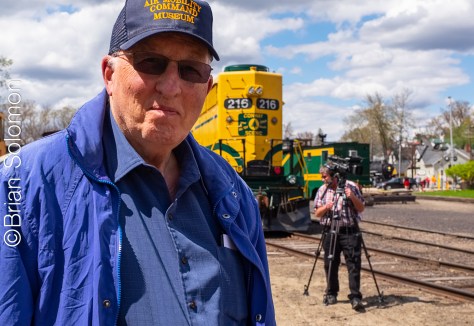
Yesterday I made this photo of Conway Scenic’s Bartlett Extra ready to depart the North Conway, New Hampshire Station. This was added to the schedule to handle a school group boarding in Bartlett.
Exposed using my third Lumix LX7. File adjusted using Lightroom.
Brian Solomon is traveling ‘off the grid’ for the next few days.
Over the weekend, I continued to wire and tidy up our HO-scale interpretation of the Reading Company.
Scenery and structures are still in the future.
Working with my Lumix LX7, I made this series of photos.
A couple were hand-held, but others were made with aid of a tripod to allow for greater depth of field, or exposed with the camera positioned on the track for stability.
Handheld Lumix LX7 photo.Handheld with the Lumix LX7.Lumix set a f8 and mounted on a tripod for greater depth of field.Pottsville Junction—Lumix on the track set at f8.Checking out the 2102!Chicks dig the Reading Company!
Eight Years ago today, June 5, 2013, Rich Reed and I photographed an MBTA equipment transfer at Ayer that had come up from Worcester, Massachusetts via Pan Am’s Boston & Maine Worcester-Ayer line.
Among the items of interest was MBTA 3249, one of two MBTA GenSet diesel-electric locomotives.
I made this photo using my Lumix LX3 from the Main Street Bridge east of downtown Ayer.
I was traveling from Philadelphia to Virginia on June 4, 2015.
Working with my first Lumix LX7, I made these photos of Amtrak’s 30th Street Station, focusing on the classic Solari Board that displayed arrivals and departures.
Stadler Flirts were standard equipment on the new Helsinki Airport train service when I visited in July 2015.
Finally, as Kris and I are contemplating overseas travel again, I’ve taken a renewed interest in airports! Although Dublin will be on the visit-list ahead of Helsinki.
June 1, 2011 freakish weather conditions produced an F3 Tornado that struck my home town of Monson, Massachusetts.
I had only recently returned from months in Ireland and Europe.
The day began with a violent thunderstorm, but most of the morning and afternoon were oddly still and bathed in a weird hazy sunshine.
The storm that brought the funnel moved quickly and brought destruction.
I saw the tornado from my window in Monson and made photos with my Lumix LX3. Two days later I went into town to document the damage.
Enlarged version of the above Lumix LX3 image. A green sky is a bad!Canon 7D photo, June 3, 2011.Destroyed house on Washington Street in Monson, MA. June 3, 2011. Lumix LX3New England Central Railroad at Washington Street in Monson. June 3.Downtown Monson after the storm. June 3, 2011. Canon 7D.Washington Street in Monson after the storm. June 3, 2011.
The busy triple main track line at Drahotuse, Czech Republic made for an interesting place to catch trains on the move.
This was one of many locations that Denis McCabe suggested on our weeklong visit to the Czech Republic and Austria in October 2016.
I made this view of a westward Slovak express under wire using my FujiFilm XT1 with 18-135mm zoom. In the distance is a Czech Railways maintenance train led by a diesel.
The mist added depth to my images, while also transmitting the sounds of the passing trains for great distance which aided in set up time.
During the course of last weekend’s special Railfan Photo Freight hosted by the Conway Scenic Railroad, I made several hundred images of the train and its preparation.
Today, I’m just getting through the editing of these images.
Today, I offer this selection, all exposed using my FujiFilm XT1 with 16-55mm lens.
Conway, NH.View from the head end working west near Bartlett, NH.Run by at Second Iron, west of Bartlett, NH.Looking west near Cobb Farm Road.
I converted my Fuji RAW files using Iridient X-Transformer and made adjustments to color and contrast using Adobe Lightroom. When I make contrast adjustments, I generally use the ‘highlights’, ‘shadows’, and ‘contrast’ slider controls.
Two years ago I made my first trip to Crawford Notch by road in 20 years.
I was on my way to the Conway Scenic Railroad at North Conway to write an article for Trains Magazine.
One thing led to another, and two years later Crawford is now a regular place on my visit list! I was up there again yesterday in HyRail truck TC-205 as part of a bridge inspection with Wayne Duffett of TEC Associates .
This photo was exposed on May 29, 2019 using my FujiFilm XT1 with a Zeiss 12mm Touit. I’ve posted two versions, one more saturated than the other.
On Saturday, May 22, 2021, Conway Scenic Railroad operated a retro-photo freight for railfan photographers.
Overseeing operations was the railroad’s Trainmaster Mike Lacey, whose long railroad career gave him decades of experience working with local freights. Adam Bartley was at the throttle of GP7 573.
The train originated at North Conway and proceeded timetable East to Conway to collect ballast hoppers stored in the sidings there. After meeting the regularly scheduled Valley passenger train, the freight ran west, running through North Conway without stopping all the way to Second Iron on the Mountain Division.
I exposed the photo below for the company archives and publicity using my FujiFilm XT1 with 16-55mm zoom lens.
Working with the RAW file, I first converted the image to a DNG file, then imported that into Adobe Lightroom for adjustment. Among the changes were local contrast modification, warming overall color temperature, plus desaturation and shadow lightening to emulate a period color slide.
The eastward Boston section of Amtrak’s Lake Shore Limited is train 448. Typically referred to as ‘Four Forty Eight’.
On this day in 2012 (May 24, 2012), I exposed this digital image of the train on the final leg of its journey from Chicago to Boston as it rolled east of Palmer, Massachusetts near CP79. (Control Point 79, as measured in miles from South Station, Boston).
I was working with my Canon EOS 7D and the 28-135mm kit zoom lens that came with camera. I had the lens extended to 50mm, a focal length that with the sensor size equated to a slightly telephoto perspective. Color temperature and saturation were adjusted in post processing.
On Friday, May 21, 2021, I served as the pilot for a private speeder trip over the Conway Scenic Railroad.
The speeders were largely from a Pennsylvania-based group that consisted largely of various privately owned Fairmont cars.
I traveled in the lead car and made photographs of the trip as it progressed westward over Crawford Notch. This first batch features Conway Scenic’s Redstone Branch from the State Yard at Kearsarge to Mountain Junction in Intervale.
These photos are scaled JPGs from larger JPG files exposed with my FujiFilm XT1 using the Velvia color profile.
It was a beautiful, if unseasonably warm Spring day for a run over the former Maine Central Mountain Division.
The most adventurous was inspection of Conway Scenic’s Willey Brook Bridge in Crawford Notch (NH)—From below track level—by climbing through the girders with ropes, and abseiling the central support.
All activities in accordance with proper procedure.
I’ve accompanied bridge inspector Wayne Duffett of TEC Associates on several of Conway Scenic’s bridge inspections, but this one was by far the most memorable.
I made my photos using a Lumix LX7.
There’s a time an a place for a big camera, and times and places for small ones. A 4×5 studio camera would not have been well suited for this day’s photography.
Supplemental photography was supplied by Wayne’s pocket Nikon AW130 digital camera (a water proof model).
And there I am among the girders.Not a place to visit if you have a fear of falling.I don’t fear heights, but that first step is a doozie!
Last week I accompanied Bridge Inspector Wayne Duffett on his inspection of the unusual truss bridge on the former Maine Central Mountain Division at Fabyan, NH.
The bridge dates from the 1890s. It originally served the Boston & Maine’s branch to Mount Washington that had run parallel to Maine Central for a few miles. At some point decades ago Maine Central decided the old B&M span was superior to its own and traded places.
I made these photos using my Lumix LX7. Images processed digitally in Adobe Light room to improve contrast, color and color saturation.
Greater bridge inspections were undertaken down the line! Stay tuned . . .
In July 2015, I accompanied my friend Markku Pulkkinnen on tour of Finnish railways that included a visit to greater Helsinki.
At Tikkurila in suburban Helsinki, I made this photograph of a VR Group Pendolino on its way north toward Oulu.
Finland is one of my favorite European nations and a wonderful place to watch trains.
Exposed using a FujiFilm XT1.
It is among the countries that I will feature today at 1pm in my Zoom presentation to the Virginia Rail Policy Institute titled “Optimizing shared-use rail corridors in Europe: How do rail freight and passenger operations co-exist”
On this day, May 16, 2011, I exposed this telephoto image of a number 20 tram in Munich, Germany.
I was working with my Canon EOS7D with a fixed 200mm f2.8 telephoto.
Notice the unusual point-work on the tram track in the foreground.
Selective focus made possible by the relatively wide aperture with a long focal length lens helps direct the eye to the primary subject, allowing for other elements of the scene to remain slightly out of focus.
I made a brief visit to Stuttgart during a trip to Germany and Switzerland in 1999.
On my first afternoon in Stuttgart, I exposed this Fujichrome Sensia II (ISO 100) color slide of a classic tram ascending away from the city center. Notice the effects of cross lighting. (The sun is to the left of the camera).
At the time I was working with an N90s with 80-200mm zoom lens, my standard camera combination for the period.
I’ve found that different types of equipment lend to different sorts of compositions. I wonder what images I would have made in Stuttgart if I could have carried the Nikon Z6 that I own today?
In March 2007, Pat Yough and I made a visit to the abandoned former Lackawanna Paulins Kill Viaduct in western New Jersey.
I was researching a book on railroad bridges, and needed to fill some gaps in my photographic coverage.
This was one of several massive concrete bridges built by the Lackawanna in the early 20th century. It has been disused since Conrail abandoned the Lackawanna Cutoff in the early 1980s.
Since that time the line has been repeatedly studied for reopening.
Previously on Tracking the Light in Jan 2014 I featured color photos of the bridge exposed the same day as these B&W images.
I made these photos on Fuji Neopan 400 black & white film using my Contax G2 rangefinder with 28mm Zeiss Biogon lens. I processed the film in Rodinal Special mixed 1-32 with water at 68F for three minutes and 15 seconds.
A few minutes ago, this image came up in rotation on my screen saver.
I exposed it two weeks ago while on a bridge inspection with Wayne Duffett of the Ellis River truss at Glen, New Hampshire.
Reflections of the sun in the Ellis diffused by clouds bisected with the lattice girder bottom lateral brace of the bridge reminded me of a Minor White black & white print.
White, famous for his exquisite black & white technique expanded upon the concept of equivalence as delineated by his teacher Alfred Stieglitz.
In his later year years White taught at the Rochester Institute of Technology. A decade after White’s death, I studied photography at RIT, and among my professors was Owen Butler, himself a student of White’s.
My photo is both a bridge and of a bridge.
Here I offer two interpretations of the same digital image. One features lower contrast and superior highlight detail.
Tracking the Light explores Railroad photography Daily!
Yesterday, May 9, 2021, Richard Luckin of Luckin Productions traveled to North Conway, NH., to interview me about General Motors Electro-Motive Division diesels.
I gave him and his production crew a tour of the railroad’s facilities and spoke about our selection of EMD diesels, then answered a variety of questions about the role of EMD, the success of its locomotives, and other historical queries.
During the course of the interview, Conway Scenic’s Valley train was coming and going, led by locomotive 573—an EMD GP7 diesel.
It was a lazy late-summer evening in September 1990, when I hiked up to the tunnels at Cape Horn, east of Colfax, California on Southern Pacific’s Donner Pass crossing.
East and westward freights were converging upon me, and I wondered which would reach me first. Listening to my scanner, I knew the down hill train was close, when I hear the eastward freight roaring through Colfax below me, on its approach to Long Ravine.
In this telephoto view, I’m focused on the rear-end helper on the uphill eastward freight.
Exposed on Kodachrome 25 using a Nikon F3T with f4.0 200mm Nikkor lens.
Among the most pictured locations on Conway Scenic’s former Boston & Maine Conway Branch is the wooden pile trestle at Moat Brook.
This stream is named for the Moat Mountains compass west of the railroad.
A few weeks ago during my bridge inspection with Wayne Duffett of TEC Associates, I carefully studied the bridge and its environs, considering how to best find a different angle on the bridge.
It occurred to me: while the bridge is often photographed, the stream itself is not. The reason is simple: much of the year there is very little water in the stream.
Last week Thursday and Friday were very wet. But Saturday was clear and sunny.
I walked the line and secured a new vantage point compass east of the famous bridge and along the swollen stream, where I captured the returning Valley train led by GP35 216 with engineer Tom Carver at the throttle.
These photos were exposed using my FujiFilm XT1 with 16-55mm lens,
I posted variations of these images on Conway Scenic’s Facebook page to assist with promotion of the popular Valley train on its Conway run.
Last week, I accompanied bridge inspector Wayne Duffett of TEC Associates on the second leg of his annual Conway Scenic bridge inspection.
Our first stop was the East Branch truss near Glen, NH.
I made these photos using my FujiFilm XT1 with 16-55mm lens. Images were converted from camera RAW to DNG format by Iridient X-Transformer then adjusted for internet presentation in Adobe Lightroom.
I’ve been photographing trains at Shirley for nearly 37 years.
Gosh that’s quite a while.
Kris Sabbatino and I paused at Shirley on the way back from Cape Cod last week.
We rolled by MBTA trains under clear Spring skies.
This gave me the opportunity to try out my third Lumix LX7 on moving trains.
I’d fitted the wee digital camera with an external viewfinder, a small electronic attachment that makes it much easier to photograph moving trains in bright sunshine with the mirrorless Lumix.
Working from the Lumix RAW file, I made this interpretation in Adobe Lightroom.
MBTA GP40MC_1133_works at the back of train 1406 running eastbound at Shirley, Massachusetts.
In December 2014, Pat Yough lent me his FujiFilm XT1. At the time I was seriously considering this camera system.
We drove to Prospect Park near Philadelphia, Pa., where I put the camera through its paces. I wanted to see how it handled sunset situations.
Among the test photos I made was of this northward Amtrak train on the Northeast Corridor led by then-new Siemens ACS-64 Number 607.
Ultimately, I bought an XT-1, and I’ve been using one for more than 6 years.
This photo was adjusted from the camera RAW using Adobe Lightroom to manipulate shadow and highlight settings as well as fine adjustment to color temperature.
May 1, 1971, Amtrak was born—Fifty years ago today.
I wrote about Amtrak’s 50th anniversary in my May 2021 Trains column.
To commemorate this half-century mark on Tracking the Light, I’m posting this scan of a color slide I that I exposed back in October 2000 of Amtrak P42 No. 1 crossing the Quaboag River at West Warren, Massachusetts.
At the time, I was working to fulfill a assignment for Mark Hemphill, then editor of Trains. Ultimately, Trains used a similar view of this same locomotive on this same bridge that I made a few days later. That photo showed P42 No. 1 panned using a slow shutter speed to convey speed.
Exposed on Fujichrome using a Nikon N90S. Amtrak train No. 449 the Lake Shore Limited, westbound at West Warren, MA.
It was a clear pleasant afternoon in Bordeaux, France on April 29, 2016, when I made this photo of a wireless Alstom tram using my first Lumix LX7 digital camera.
I was visiting this elegant French city on business with my father.
Bordeaux opted for a ground-based power supply for its modern tram system in historic areas of its city center.
Below are two variations of the same photo. The top is the camera produced JPG (scaled for internet without adjustment), the bottom is my interpretation of the camera RAW file with adjustments made using Adobe Lightroom.
Lumix LX7 camera generated JPG with the VIVID color profile, scaled fro internet presentation.Lumix LX7 RAW file interpreted using Adobe Lightroom; shadows lightened, level improved, and color balance adjusted. Note the hue of the tram.
Model GP28 with just over two-dozen domestic examples built may be considered one of General Motors Electro-Motive Division more obscure diesel-electrics.
It was contemporary with the relatively popular GP35 with which it shares a similar external appearance.
Where EMD’s GP35 was a high-horsepower model using a turbocharged variation of the 16-567 diesel to deliver 2,500 hp, the GP28 used a 16-567D1 aspirated with a Roots blower and delivered just 1,800 hp.
The GP28 was only in production for a few months during 1964 and 1965, and may be viewed as a transitional model between the GP18 and GP38.
I don’t recall having ever photographed a GP28 in action until last Friday.
Kris Sabbatino and I were fortunate to capture Mass Coastal GP28 2009 during the course of its daily duties on Cape Cod.
Working with my Nikon Z6, I made these photos as it worked near the Cape Cod Canal lift bridge at Bourne, Massachusetts and nearby at Monument Beach on the Falmouth Branch.
As part of my responsibilities as Manager of Marketing and Events at Conway Scenic Railroad, I organize the creation of our billboards in the Conway-area.
For this season’s billboard, I opted to feature our Mountaineer crossing the Frankenstein trestle on the former Maine Central Mountain Division. The Billboard design was the work of Silverline Graphics; printing and installation was performed by Gemini Sign and Design.
I exposed the billboard photo last autumn using my FujiFilm XT1. And using the same camera, I photographed the billboard itself where our Conway Branch crosses Rt302/Rt16 near White Mountain Oil in North Conway.
Also, I adjusted the photo file that appears on the billboard using Adobe Lightroom using the same MacBook Pro that I use to prepare Tracking the Light.
On Thursday afternoon, Kris Sabbatino and I arrived on the Bourne, Massachusetts side of the enormous Cape Cod Canal lift bridge just as the Massachusetts Coastal Energy train was approaching to cross.
Fortuitous timing considering we had left Center Conway, New Hampshire after 930am.
I exposed these photos using my Nikon Z6 digital camera and modified the color, contrast, and level using Adobe Lightroom.