Irish Rail’s line from Dublin to Rosslare hugs the River Slaney north of Wexford town.
On our exploration of disused lines in county Wexford, Ken Fox, Donncha Cronin and I made a short detour to photography the ‘Up-Rosslare’ at Killurin as it ran along the west bank of the Slaney.
This is a pretty part of the line, and a place I hadn’t explored in almost a decade.
The last time I’d made a photo here, it was a 141-class diesel hauling the then ‘new’ weedsprayer. That wasn’t yesterday!
Telephoto view at Killurin.From the Slaney bridge at Killurin.This trailing view reminds me of Maine Central’s Rockland Branch.
These images were made with my FujiFilm XT1 with 18-135mm zoom, files adjusted for contrast and exposure in Lightroom.
Fujichrome color slide exposed using a Canon EOS3 with 24mm lens.
I made this photo of Bob with Mass-Central NW5 2100 on a fine October morning about ten years ago at the railroad’s Palmer, Massachusetts yard.
This will be among the photographs I’ll present this coming Monday (8 October 2018) to the Irish Railway Record Society in Cork.
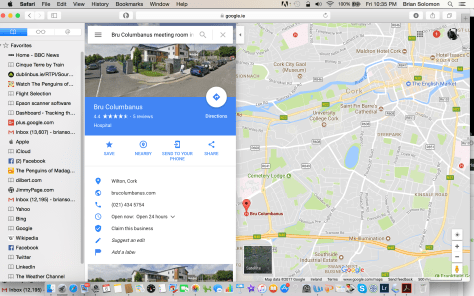
My talk, titled General Motors Diesel-Electric Locomotives in North America, will be held at 8pm on the 8thof October 2018 at the Bru Columbanus Meeting Rooms in Wilton, Cork City.
I’ve been exploring and photographing Irish railways since 1998. To mark my twenty years photography, I’ve been displaying images of each of Irish Rail’s 201-class General Motors diesels in numerical order.
Today’s locomotive is 224, seen above a while back in a view that’s up-close and personal. The introduction photo was made on 17 March 2017 in a curve between Mourne Abbey and Rathduff, Co. Cork. A green loco for St. Patricks Day.
On Monday, 8 October 2018 at 8pm (20.00), I’ll be giving a slide presentation to the Irish Railway Record Society in Cork on General Motors Diesel-Electric Locomotives in North America.
The talk will be held at the Bru Columbanus Meeting Rooms in Wilton, Cork City.
Conrail SD40-2s work as helpers on a loaded coal train at Mineral Point, Pennsylvania in October 1992. Exposed on Kodachrome 25 colour slide film.
I will show a wide variety of colour slides detailing General Motors Electro-Motive Division diesels at work.
This will cover numerous models on many different railroads, and feature some of my most dramatic locomotive photography.
Vintage EMD six-motor diesels lead New England Central 611 at Millers Falls, Massachusetts in 15 November 2017. Exposed on Fujichrome Provia 100F using a Canon EOS 3.
Although only partially related to my photographic work, I thought that Tracking the Light readers might be interested to learn that I’m conducting a series of audio podcasts with Trains Magazine.
Over the coming weeks and months, I’ll be interviewing and discussing railroads with a variety of knowledgeable and interesting people, including active and retired railroaders, tourist railroad operators, railroad activists, and a few well known railroad enthusiasts and railroad publishing professionals.
Among my first conversations was with John Gruber about his latest book: Beebe & Clegg—Their Enduring Legacy.
My hope is to allow my guests expertise and perspectives to entertain and inform my listeners and enable all of us a great appreciation and understand of railroad topics ranging from freight cars and locomotives, signals, stations and short lines to how to avoid snakes while making photos.
A new Podcast will be released every two weeks. My aim is to keep these to between 16 and 20 minutes.
In August 2018, I made this 12mm view at Kalmbach’s sound studio during recording sessions. My guests include Chris Guss, TRAINS Brian Schmidt, Bob Johnston, and Craig Willett.This was a preliminary promotional mock up to promote my Podcasts by TRAINS Drew Halverson
Earlier this week it was organized for me to travel on the footplate of Great Northern Railway of Ireland 85.
The thrill of experiencing a steam locomotive cab on the main line is a rare privilege.
My job was to make photographs and stay out of the way.
Locomotive driver Ken Fox works on the left side of the engine as it rolls through Tipperary countryside.
Locomotive 85 is a three cylinder compound 4-4-0, a 1932 product of Beyer Peacock.
The compound arrangement is what intrigued me, but like the low droning throb sounding from the 20 cylinder diesel powering an EMD SD45, this element of the steam equipment is beyond my ability to picture.
Instead, I had to settle for making images of the crew at work and the locomotive in motion.
Fireman’s view near Mountrath on the Cork Line.12mm Zeiss Touit view of the fireman shoveling coal.Fireman’s view of a Mark 4 train up road near Thurles. Special viewing equipment on my Fuji XT1 made images like this possible.Fireman’s view. Working the injector.View of the firebox.
The footplate offers a rough ride, while swirling coal dust and locomotive exhaust complicate photography and the handling of sensitive equipment. The lighting is at best difficult. Staying out of the way often means that I wasn’t always able to get the angle I really wanted and needed to make due with where I was able to stand.
Driver side view.Feeding the fire. Lumix LX7 photo.
The locomotive is bathed in smoke and dust.
Special thanks to everyone at the Railway Preservation Society of Ireland (RPSI) and at Irish Rail for making my locomotive journeys possible.
For details about the RPSI and scheduled steam and diesel trips see:
As it happens, Irish Rail 223 was one of the first Irish locomotives I put on film.
I made this view at Tralee back in February 1998. Expose with a Nikon F3T on Fujichrome slide film.
Additional views of 223 were exposed digitally in recent weeks.
Irish Rail 223 leads the up IWT liner from Ballina at Islandbridge in Dublin on a August 2018 evening.The next day, 223 works the down IWT liner at Islandbridge Junction. One a locomotive is assigned to the IWT liner it often works if for several days in a row.
Comparatively little rolling stock in service back in 1998 remain active on Irish Rail today.
Who could have guessed that I’d be making photos of Irish Rail 223 more than 20 years after I caught it at Tralee on that cloudy Febraury morning!
On Sunday’s an Irish Rail class 071 works Belmond’s luxury cruise train, the 10-car Grand Hibernian, on its run from Dublin Connolly to Waterford.
Although slightly back lit, I found the famed ‘Gullet’ offers a good place to catch this train at work.
This cutting dates from the 1840s and features three tracks.
In this instance, Irish Rail 082 was accelerating down the middle road with the posh-looking train. (‘Down’ refers to traveling away from Dublin, and doesn’t reflect the gradient, which in this situation is actually rising).
Working with both my FujiFilm XT1 with 90mm telephoto and Lumix LX7, I made two sets of digital photos.
Irish 082 with Belmond’s Grand Hibernian cruise train. FujiFilm XT1 with 90mm lens.Lumix LX7 view.
The locomotive sound was impressive as on this particular Sunday a couple weeks back the roads in the area were shut for a foot race and there was very little ambient noise compared with a typical day in Dublin. Perhaps, I should have made a recording!
In the mid-1930s, Milwaukee Road introduced its high-speed streamlined Hiawatha on its Chicago-Milwaukee-Twin Cities route where elegant purpose-built shrouded 4-4-2 and 4-6-4 Alco steam locomotives whisked trains along in excess of 110mph.
Today, Amtrak’s Hiawathas have Siemens Chargers on the Milwaukee end, and former F40PH Control-Cab/baggage cars, known as ‘Cabbages’ on the Chicago-end.
While Amtrak provides an excellent corridor service, today top speed is just 79mph.
I can’t help but think that as a nation we’ve lost the plot on this one.
We went from elegant, fast steam streamliners to this?
Panning my Fujifilm XT1 plus 27mm lens in parallel with Amtrak’s fast moving Hiawatha has allowed for the effect of speed and motion. ISO 200, 1/125thof a second. Note: that my shutter speed wasn’t especially slow.
I’m on my way from Dublin toward Belfast on the cross-border Enterprise.
Working with my Lumix LX7, I made these photos and I’m posting them via the Enterprise Wi Fi using my Apple MacBook.
The light weight Lumix LX7 with its easy to use controls and flexible zoom lens makes it an ideal travelogue device. Yet, it’s more than just a snapshot camera.
It makes simultaneous RAW and Jpg files while allowing adjustment of exposure via shutter speed and aperture controls. Plus it has a variety of pre-sets and automatic modes.
View at Drogheda.Old Great Northern Railway station at Dundalk. This morning just a few minutes ago.Near Newry, Northern Ireland.Moo?
Here’s four views of Irish Rail 221; two film, two digital; two orange, two green & silver; two with passenger, two with freight; one in snow, three without; but all showing this machine on the move.
221 leads the down Dublin-Cork liner at Ballybrophy on 25 March 2005. Exposed on Fujichrome Velvia 100F using a Nikon F3 with 180mm lens.
This is part of my on-going series depicting Ireland’s class 201 diesel electrics to mark my 20 years photographing in Ireland. Photographic details in the captions.
Irish Rail 221 leading Mark 3 carriages at Kildare on a damp summer day in 2005. Exposed on Fujichrome Velvia 100F using a Nikon F3 with 180mm lens.Freshly painted 221 (with expanded number) leads the down IWT liner (Dublin to Ballina container train) at Islandbridge Junction in Dublin. Exposed digitally using a FuijFilm XT1 with 90mm Fujinon telephoto lens. Notice the effect of scale with the monument visually positioned over the locomotive. The date of exposure was 21 September 2017.Irish Rail 221 in the snow at Islandbridge in Dublin on 28 February 2018. Exposed digitally with a FujiFilm XT1 and 27mm pancake lens.
Question: do head-on telephoto views portray the shape of the 201-class effectively?
On July 1, 2010, I exposed this sunrise glint view of an eastward Norfolk Southern freight led by an Evolution-Series General Electric diesel-electric at the Railfan’s Overlook in Cassandra, Pennsylvania.
I adjusted the file using Lightroom to balance the contrast between highlights and shadows and make for a more pleasing image.
Notice the effect of the backlit leaves and grass.
Norfolk Southern eastward RoadRailer East of Greensburg, Pennsylvania on June 29, 2010.Since these June 29, 2010 photos were made, Norfolk Southern has discontinued its RoadRailer operations in Pennsylvania.Steam era position light signals are on the wane. NS has replaced many of its classic Pennsylvania Railroad position lights with modern hardware. So scenes like this one are now doubly rare.
Using my Canon EOS7D, I exposed this sequence of photographs along the former Pennsylvania Railroad Mainline east of Greensburg, Pennsylvania on June 29, 2010.
Railroading is about change; and much in these views has changed in the intervening 8 years.
Exposed with a Canon EOS7D at Rochelle, Illinois on June 28, 2010.
I was traveling with John Gruber on this day eight years ago, when we stopped at the famous Rochelle, Illinois diamonds to photograph this Union Pacific eastward freight.
I opted for a classic view with short telephoto perspective, over the shoulder light, and locomotives framed under the signal bridge.
A lone loaded auto-rack was spotted in CSX’s Palmer Yard.
CSX’s local freight B740 had arrived from West Springfield Yard.
B740’s crew discussed arrangements with the dispatcher to reverse out of the yard (westward) with the auto-rack on the interchange track and then pull forward onto the controlled siding at CP83.
CSX B740 shoves back on the interchange track at Palmer, Massachusetts.
The reason for this was to avoid using the normal freight connection from the controlled siding into the yard because of the length of the auto rack was at risk of derailing over the tight switches.
The crossover at CP83 from the interchange track to the controlled siding was installed in 1995 to facilitate Amtrak’s Vermonter, which was then operating via Palmer and changed directions here to go between CSX and New England Central’s route on its Springfield, Massachusetts-St Albans, Vermont portion of the run.
The passenger crossover at CP83 has been rarely used, since Amtrak’s Vermont returned to the more direct routing in December 2014 (running north of Springfield on the Boston & Maine Connecticut River line via Greenfield to East Northfield).
CSX’s crewman lines the switch for the controlled siding on the now rarely used crossover. Notice the rust on the rail.CSX B740 pulls forward through the crossover and will soon head east on the Boston & Albany to East Brookfield. Notice how the CSX crewman on the ground is illuminated by the sun shinning through the gap between the locomotives and the auto rack.
It was a fortuitous situation to catch this rare move in nice morning sun.
B740 then continued east to East Brookfield, where CSX autoracks are unloaded on the East Brookfield & Spencer.
On November 15, 1987, I followed a loaded PLMT coal train east from Buffalo, New York. This train had operated with Pittsburgh & Lake Erie locomotives and was being handled by Guilford’s Delaware & Hudson via trackage rights over Conrail’s former Erie Railroad.
Try to fit all that on the slide mount!
At the time these coal trains operated about once a week, and while it wasn’t uncommon to find P&LE locomotives, catching the trains on film was challenging.
I made this view on Kodachrome 25 with my Leica M2 with 50mm Summicron Lens. It’s a badly under exposed long pan (about 1/8 of a second) from a hillside off the Canisteo River Road, in the valley of that name, a few miles east of Adrian.
The original slide was made at the very end of daylight, and the slow speed ISO25 film didn’t give me the needed sensitivity to capture the scene with adequate exposure.
That’s a long way of saying; it was dark and I underexposed the film.
Here’s the scaled, but unadjusted scan. It’s about 3 to 4 stops underexposed. The slide is nearly opaque except for the sky. Exposure was about f2.0 at 1/8 second on Kodachrome 25 (ISO 25).
Thankfully, I didn’t through the slide away.
I scanned it using VueScan 9×64 (edition 9.6.09) software and a Nikon Super Coolscan 5000 slide scanner. It opted for manual controls; I selected 4000 dpi input, under ‘color’ I used the Kodachrome K14 color profile, and while output was set at 4000 dpi as a TIF file.
I then imported the TIF into Lightroom for color, exposure and contrast adjustment, necessary to compensate for my extreme underexposure. To hold sky detail, I applied a digital graduated neutral density filter.
Here’s my first round of adjustments. I thought the sky and overall color balance seemed a bit otherworldly so I zeroed out the adjustments and started again. Compare this with the image below.Although similar, this version is better balanced and looks closer to the original scene. Although underexposed, the Kodachrome film was able to capture some detail over more than 6 stops, allowing for post processing adjustment.
Although slightly grainy, the results are much improved over the original and captures my intended effect of the train rolling at speed through the Canisteo Valley at dusk.
There’s little left to remind you of the historic building that once served passengers at Berlin, Connecticut.
In December 2016, during construction of the modern building, the historic New Haven Railroad station was suspiciously destroyed in a fire.
An artist vision of the proposed integration of the old station with the modern structures. It was not to be.
Last weekend was my first visit to the new station. This features some impressive looking architecture, elevators and a high glass enclosed footbridge.
Morning light on the impressive entrance to the new station. Exposed using a FujiFilm X-T1 with 12mm Zeiss lens.
However, it seems to be notably lacking a proper waiting room where passengers can get out of the elements, and features only a ‘portapot’ in place of proper toilets.
In place of our friendly ticket agent, there’s a modern CT rail ticket machine to dispense tickets. You can buy your Amtrak ticket on-line, over the phone, or using an App on your smart-phone.
Also on the ‘plus side’ the station is well suited to photography and will make for a nice place to board and photograph trains. Also, with the expanded Amtrak service and new CT rail Hartford Line trains, there’s more service than there has been in many years.
Any thoughts?
The east-side platform looking south toward New Haven, Connecticut at 8am. Exposed using a FujiFilm X-T1 with 12mm Zeiss lens.Exposed using a FujiFilm X-T1 with 12mm Zeiss lens.
CT rail 6400 making its stop at Berlin, bound for Springfield, Massachusetts. Exposed using a FujiFilm X-T1 with 12mm Zeiss lens.Amtrak 405 to New Haven. Exposed using a FujiFilm X-T1 with 12mm Zeiss lens.Amtrak 461 heading toward New Haven at midday is about to depart Berlin. All aboard! Exposed using a FujiFilm X-T1 with 18-135mm Fujinon lens.
Today, Irish Rail 216 wears a one of a kind navy-blue livery and is seasonally assigned to Belmond’s luxury Grand Hiberniancruise train.
This has become one of the most popular trains to photograph in Ireland and I’ve caught it here and there over the last few years.
For my 201 retrospective, I thought I’d present a few photos of 216 before it was blue.
Irish Rail 216 was among the first 201 class diesels I put on film. Here it is at Westport, County Mayo back in February 1998. Exposed on Provia100 with my Nikon F3T and 135mm lens.In April 1998, I made this view of 216 at Heuston Station, back when the station shed was blue, but 216 wasn’t! 24mm view with Fujichrome Sensia.Also in April 1998, 216 with a Mark3 set at Kent Station, Cork. A 135mm view on Fujichrome Sensia (100 ISO).This seems unusual now: Irish Rail 216 in orange paint on the container pocket wagons (CPWs) then assigned to Dublin-Cork midday liner. Photographed at Islandbridge Junction in Dublin using a Contax G2 with 28mm Biogon Lens. Give me a good price, and I’ll sell you the lens. (I’m totally serious!) briansolomon.author@gmail.comAnd there’s 216 in fresh green, yellow and silver paint, rolling through Cherryville Junction with a down Mark3 set on 20April2006. How things have changed!
Wow! It’s like a German train at Berlin. Berlin, Connecticut, that is.
A German electric multiple unit graces the cover of my book.
CT rail 6400 crosses an old stone arch bridge at Windsor, Connecticut on Sunday June 17, 2018.DB and CFL (Luxembourg Railways) EMUs working together on the famous Hanging Viaduct in Germany’s Mosel Valley.
I’m commenting on the paint liveries, not the equipment or the services.
Working with my FujiFilm X-T1, I exposed more than 100 photos of the new Connecticut commuter rail service on the Hartford Line.
There’s nothing like the first day.
Train rides were FREE.
Springfield, Massachusetts on June 16, 2018.Springfield, Massachusetts on June 16, 2018.Springfield, Massachusetts on June 16, 2018.
Amtrak 461 at Berlin, Connecticut on June 16, 2018.
Yesterday, June 16, 2018 the long awaited CT Rail Hartford Line Commuter service commenced.
My father and I traveled on the first train from Berlin, Connecticut to Springfield, Massachusetts. It was a bright clear morning.
Contrast was a challenge, and for some of these photos I imported the camera RAW image into Light Room for exposure, color balance and exposure adjustment.
Amtrak 460 at Berlin, Connecticut on June 16, 2018.CT Rail 6653 at Berlin, Connecticut on June 16, 2018.CT Rail 6653 at Berlin, Connecticut on June 16, 2018.CT Rail 6654 at Berlin, Connecticut on June 16, 2018.
Today, June 16, 2018, the long awaited CTRail service began public operation on the Springfield-Hartford-New Haven Line.
Free rides were on offer on both the new CTRail trains and some Amtrak services.
CTRail staff at Berlin supplied complimentary tickets!
My father and I traveled on the first northward train (CTRail 6400) between the new station at Berlin, Connecticut and Springfield. The train was very well attended!
More free train rides are available on the route tomorrow (Sunday June 17, 2018).
CTRail’s first public forward run, train 6400, makes its stop at Berlin, Connecticut. Exposed using a FujiFilm XT1 with 12mm Zeiss Touit.The view near Windsor Locks, Connecticut.
I made many photographs over the course of the day and I’ve yet to look at all of them. Stay tuned for more tomorrow!
For the last month, New England Central’s 608 (Willimantic, Connecticut to Palmer, Massachusetts and back) has continued to run with a pair of GP38s.
(I missed the day when 608 ran with three!)
What’s so special about this?
These locomotives began with New England Central when it commenced operations in February 1995, and have continued to work the railroad in the same paint (if not the same numbers) ever since.
A classic view of 608 running northward near Stafford Springs, Connecticut. Exposed with my FujiFilm X-T1 and 27mm pancake lens.A classic view of 608 running northward near Stafford Springs, Connecticut. Exposed with my FujiFilm X-T1 and 27mm pancake lens.
Originally there were a dozen, but the ranks have thinned.
New England Central has changed owners twice since 1995; it was originally a RailTex property, then RailAmerica, today Genesee & Wyoming.
NECR has acquired or borrowed many other diesels over the years.
Yet for me the few surviving blue and yellow GP38s offer a sense of continuity, and also represent a throw-back to when EMD’s 645 diesels were dominant on American railroads.
How much longer will New England Central continue this vintage railroading?
A view of 608 running northward passing Stafford Springs, Connecticut. Exposed with my FujiFilm X-T1 and 90mm telephoto lens.
Will these GP38s see G&W corporate colors? Will they be reassigned elsewhere on the expansive G&W railroad family? Will newer locomotives assume their duties?
Never take anything on the railroad for granted; eventually everything changes.
Change makes old photos more interesting.
A 12mm view with my Zeiss Tuoit lens fitted to the FujiFilm X-T1.
Last week I made these views of New England Central’s northward 611 freight as it crossed the Connecticut River bridge at East Northfield, Massachusetts.
The longer days feature the evening sun in a northerly position that allows for sunlight on the nose of the locomotive as it crosses the bridge.
Although I’ve often worked the south side of this span, this was the first time I’ve made successful photos of a train from the north side.
Exposed with a FujiFilm X-T1 and prime (not zoom) 90mm telephoto lens.Several turbo-flutters later (about 8 digital ‘frames’ or exposures), also made with my FujiFilm X-T1 and prime (not zoom) 90mm telephoto lens.
I was watching the light and the effect of reflections in the river as I composed my photos.
For these digital images I was working with both my Lumix LX7 and FujiFilm XT1.
Lumix LX7 photo. The locomotives are more fully on the bridge, but here I’ve lost the effect of the nose reflection in the water.
Irish Rail 215. Is this my least favorite of the 201 class locomotives?
It’s probably my most photographed.
My first recognition of the 215-effect was on a trip to Galway many years ago. Friends were visiting from America and we were traveling on the Mark3 International set.
Soon after departing Dublin Heuston, it was evident that the train was in trouble. We weren’t making track speed. When we got to Hazelhatch, our train took the loop. Old 215 had failed. We waited there for about 40 minutes until 203 was summoned for a rescue.
Some months later, I returned from Boston to Dublin, and on the front page of the papers was 215 at Heuston Station—on its side! It had derailed.
15April2006 Irish Rail 215 works the Galway train passing Attymon. Fujichrome slide.Possibly one of my first photos of 215, working the Mark3 push-pull at Westland Row in Dublin, April 1998. Fujichrome exposed with a Nikon F3T and 135mm lens.Old 215 in orange paint at Pearse Station in 1998.
And which loco worked the very first publically scheduled Mark IV set from Dublin to Cork?
215 with a patch! Islandbridge Junction in September 2006. Not its first trip on the Mark4 set, nor its last!
Out for the down train, take a guess which loco I’m most likely to catch!
Here’s a Mark4 trial in April 2006. Revenue working began a couple of weeks later. Top of Ballybrophy bank on the Dublin-Cork mainline.
Uh! There it is again. Damn thing is a like a shadow.
Near Newbridge on 14 April 2009. Back when film was all I had.Irish Rail 215 in clean paint with the up-road IWT liner passing Fonthill.
It was a lucky shot. I was changing trains at the Köln Hauptbahnhof in 1999, when I made this photo from the platforms at the east side of the station.
A DB Class 120 electric had been specially painted by or for Märklin model trains to commemorate the 70thanniversary of Disney’s Mickey Mouse.
I wasn’t expecting this locomotive, but as it went by I made a few choice photographs on Fujichrome Sensia using my Nikon N90S and a 105mm lens.
One of the great things about exploring German railways is a tremendous variety of trains complete with unexpected surprises in the form of specially painted locomotives, antiques on the roll, and special trains.
I rolled down the passenger-side window of my friend’s Golf, and exposed a series of photos with my Lumix.
Lumix LX7 RAW file adjusted for color, contrast, and exposure in post processing.
I’ve described this technique previously; I adjusted the f-stop (aperture control) manually to its smallest opening (f8), my ISO was at its slowest setting (80), and I put the camera to aperture priority.
I intended this combination of settings to automatically select the appropriate shutter speed for ideal exposure, while using the slowest setting to allow for the effect of motion blur.
Lumix LX7 RAW file adjusted for color, contrast, and exposure in post processing.
I kept the camera aimed at the locomotive while allowing for ample foreground to blur by for the effect of speed.
This works especially well to show the large diesel working long-hood forward, which is not its usual position.
Lumix LX7 RAW file adjusted for color, contrast, and exposure in post processing.Lumix LX7 RAW file adjusted for color, contrast, and exposure in post processing.
I got a bit confused as to where the extra was in relation to the regular northward New England Central 611 (that runs weekdays from Brattleboro to Palmer and back).
After being out of position, and some quick driving to recover, we managed to get the extra on the move at Vernon, Vermont.
This consisted of the lone New England Central former Southern Pacific ‘tunnel motor’ (SD40T-2 number 3317) hauling some ballast cars.
This isn’t Donner Pass! Here’s a former SP tunnel motor working long-hood forward leading a ballast extra at Vernon, Vermont. In the background is the decommissioned Vermont Yankee Nuclear generating station.
Unusual to say the least!
The regular freight followed about an hour later.
Both photos were exposed using my FujiFilm X-T1 with 90mm Fujinon telephoto lens.
NECR 611 on its northward run from Palmer, Massachusetts at Vernon, Vermont.
This pair of photos depict Irish Rail class 201, engine number 214 at work on passenger and freight.
The top photo was exposed in July 2005. I wanted to make a photo of the 0700 (7am) Dublin-Cork passenger train departing Dublin Heuston, before the service was changed to one of the new Mark4 sets.
My theory was that this service was rarely photographed leaving Dublin owing to the early hour and backlit sun. I had months left to do this, but by July the days were getting shorter, and by the following summer the Mark 4s would be in traffic. (It pays to think ahead).
So I went to my favorite spot on the St. John’s Road, and used my Contax G2 with 28mm lens and exposed a few frames of Fujichrome Sensia (100).
Irish Rail 214 departs Dublin with the 0700 train for Cork. Today the Mark3 carriages are a memory and 214 is stored at Inchicore.
The bottom photo was exposed at Mallow on 18 July, 2003 at 0622 (6:22am). I’d gone out for another train, but instead caught this late running cement that was carrying some containers at the front. The train paused for three minutes at Mallow to change crews.
Here, I worked with Fujchrome Sensia (100 ISO) using my Nikon F3 with a 180mm Nikkor telephoto lens.
These are part of my continuing series on the Irish Rail 201 class locomotives aimed to mark my 20 years of railway photography in Ireland (1998-2018).
It was three years ago that Pat Yough and I traveled to Manassas, Virginia, where we were joined by our friends Vic and Becky Stone, and spent several days with Norfolk & Western J-Class locomotive 611 under steam.
Although I largely worked with digital cameras, I also exposed some color slides to capture the spirit of the event.
These images were made using Fujichrome Provia 100F with my Canon EOS-3, I scanned the slides yesterday (June 5, 2018) using a Nikon Super Coolscan5000 using VueScan software.
Powell Wye at Manassas, Virginia, June 6, 2015.Markham, Virginia, June 6, 2015.Smart phones and steam, Markham, Virginia.
After intercepting Amtrak’s southward Vermonter on the Connecticut River Line, I drove to Pan Am’s East Deerfield yard(near Greenfield, Massachusetts) to see if anything was moving.
Fortuity and patience combined enabled me to make photos of Pan Am Railways POED crossing the Connecticut River Bridge (immediately east of the yard).
In the lead was 7552, one of two (soon to be three) former CSX DASH8-40Cs wearing Pan Am Railways paint, plus one of the railroad’s last remaining 600-series six motor EMDs (619, that began its career as a Southern Pacific SD45) still in traffic.
Exposed with my FujiFilm X-T1 with 18-135mm lens.
Catching this pair of locomotives together is a coup. I’ve always found transition periods make for interesting photographs; during the last year, these second-hand GE’s have sidelined many of Pan Am’s older locomotives.
Will this be the last time I catch one of the 1980s era GEs working together with a 1960s era six-motor EMDs in Pan Am blue paint?
Using my FujiFilm X-T1 with 18-135mm zoom lens, I exposed this view of Pan Am Railway’s symbol freight EDBF (East Deerfield to Bellows Falls) working the Connecticut River line at Bernardston, Massachusetts.
The early evening sun in May reaches the northside of the old stone viaduct at Bernardston.
I like the technological and geometrical contrasts of boxy General Electric diesels on the 19thcentury stone arch viaduct.
It was just after 8am on May 27, 1988, when I exposed this portrait (vertical) view of Conrail BAL013 stopped at CP123 east of Chester, Massachusetts.
The sun was perfect and I used this opportunity to make several photos of the train as it held for westward Conrail intermodal freight TV9, which passed CP123 at 8:13am
This is a Kodachrome 25 slide (using the professional PKM emulsion) exposed using a Leica M2 with 50mm Summicron lens.
I scanned the original Kodachrome slide with a Nikon Coolscan5000 scanner using VueScan. Later I scaled the file using Lightroom. I did not alter color balance, contrast, sharpness or other inherent characteristics. The original image has an overall cyan (blue-green) bias that was characteristic of Kodachrome from that period.
I calculated my exposure using a Sekonic Studio Deluxe light meter, and set the camera at f6.3 (half way between the marks for f5.6 and f8) at 1/125thof a second. This was equivalent to my standard exposure for ‘full sun’.
I learned when I moved west that ‘full sun’ is brighter in the Western states than in New England. A bright day in the Nevada desert is a full stop difference than in the Berkshires of Massachusetts.
My author’s advanced copy of the July 2018 Trains has been eagerly awaited.
July 2018 Trains will be available soon!
In addition to my monthly column, I authored and illustrated two large feature articles.
The first is a detailed nuts and bolts discussion on Positive Train Control signaling, the second a travel guide to one of my favorite places: Germany’s Rhein.
I’m extremely pleased with how both stories turned out. Special thanks to my hosts at SEPTA for allowing me to better understand the intricacies of their modern signaling. And thanks to everyone at Trains Magazine for bringing these stories to print!
My SEPTA PTC story starts on page 24, this is half of the opening spread that spans two pages. Exposed using my FujiFilm X-T1 with 12mm Zeiss lens.Travel down the Rhine beginning with my two page opener on pages 34-35. Can you guess which photo(s) in this feature were exposed on film and which are digital?
Classic Chrome: On this day, 24 May 1996 Views along the Rhein.
On this day in 1996, my father and I made a circle trip along the Rhein from Köln to Koblenz, traveling south via the Right Bank and north via the Left Bank lines.
Working with two cameras, I exposed these views on Kodachrome and Fujichrome slide film.
Looking back, its amazing to see how much has changed on German railways in the last 22 years.
Confluence of Rhein and Mosel rivers at Koblenz. 24 May 1996.DB shunting locomotives at Koblenz Hbf on 24 May 1996.View of a northward freight on the Right Bank line along the Rhein from the walls of the Festung Ehrenbreitstein (fortress).A northward IC train passes Namedy, Germany at speed behind a class 103 electric.Minutes later a northward EC (EuroCity) long distance train passes Namedy, this view with a 28mm lens.