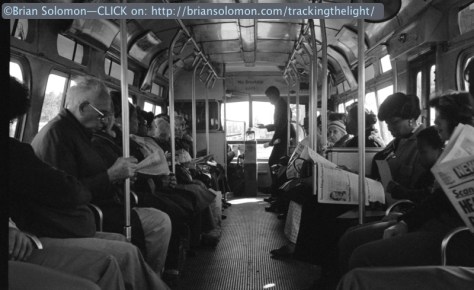
It was autumn 1986. As a photography student at the Rochester Institute of Technology, I’d receive an annual ‘care package’ of new, and sometimes experimental, Kodak products.
At the time I was a loyal Kodak film user, and dedicated to the careful exposure of Kodachrome 25. However, since I was on a shoe-string budget, I was happy to make use of the free roll of ‘Ektachrome du jour’—as we’d call whatever the latest flavor of Ektachrome was being peddled at the time.
Blessed with a rare bright day, and armed with my free roll of film, I wandered around Rochester documenting the railroads and the city. I had K25 in my Leica for the important photos, and loaded the free film into my roommate’s Canon A1 for experimental shots and comparison views.
I exposed this slide of Santa Fe freight cars on a westward Conrail freight using the Canon A1 fitted with a 50mm lens. I panned using a 1/30th of second to convey a sense of motion.
My time in Charleroi had come to a close. My next destination was La Hulpe in the suburbs south of Brussels. While I anticipated taking an Société Nationale des Chemins de fer Belges (Belgian National Railways or SNCB) train to Brussels and changing trains there, the ticket seller convinced me to try another option.
“It’s cheaper and faster to travel to Ottignies.” Ok, why not.
When I went up to platform 3A at Charleroi Sud, what appeared to be the oldest train in Belgium rattled in to collect me. I ended up riding a line I previously didn’t even have on my map (this turns out to be line 140).
While the train’s inside was nicely refurbished, it retained openable windows, a rare treat in today’s world of train travel.
No sooner than I boarded the train and the rain began, again. But after a while the sun came out and so I made a series of images using my Lumix LX7, which I was able to hold out the window at arms-length while keeping a sharp eye on the rear display screen.
Exposed with a Lumix LX7 with built in neutral density filter engaged, 1/3 second at f8, 80 ISO. Handheld with aid of built in image stabilizer. Looking away from the direction of travel.
Among the Lumix LX7s features are a built in neutral density filter and image stabilizer. This allowed me to make relatively long exposures in bright daylight while keeping the camera steady.
SNCB’s track is flawless, and the heavy aged train provided a solid, nearly vibration-free ride, allowing me to expose a series photos using long shutter speeds intended to blur the tracks and countryside while keeping the train sharp.
Hooray for old trains on good track!
Exposed for 1/8 second at f8, 80 ISO with neutral density filter. The ND filter cuts the exposure by two full stops, so without it my exposure time would have been about 1/30 of a second. Enough for a bit of blur, but not enough for the appropriate effect.
Sometimes I stumble into the past. Although I was keen to explore Charleroi by tram, I wasn’t expecting the vestige of roadside interurban operation on the long line to Anderlues.
Frequency on this line is only about every half hour, and I nearly gave up on this leg of my journey while waiting for a delayed outbound tram at the dark and dire brown-tile transfer station called Piges in western Charleroi.
Much of the route features modern construction on concrete elevated structures and subway, a creation of the Charleroi Metro. However, once beyond a turn-back station at the end of this infrastructure intensive right of way, trams operate on a vestige of the old Vicinal network (once the operator an extensive system of Belgium’s interurban tram lines).
In Anderlues, the tram uses single track gutter-side street running. Let me just say, is this really cool for a modern-day operation. Lumix LX-7 photo.
This includes side-of-road operation with long sections of single track, passing sidings and brick-lined streets. I was astounded. I checked my calendar, and it confirmed that it really was August 2014, not sometime in the mid-twentieth century.
However, as is too often the case, I was on short-time and only had a few hours to explore this fascinating railway.
A tram takes a corner in Anderlues. Moments later torrential rains dampened my photography. Lumix LX7 photo.Hard rain at Anderlues.A tram takes a siding on single track at Anderlues. Canon EOS 7D with 200mm lens.Working single track outbound at Anderlues. Canon EOS 7D with 100mm lens.This reminds me a bit of my father’s photos of Johnstown Traction Company’s operations in the 1950s. Lumix LX7.Streetside pickup point; an inbound tram pauses for a stop to collect passengers in Anderlues. Lumix LX7.
Having explored Manchester’s modern Metrolink tram system, I traveled by heavy-rail directly to Manchester Airport (which will soon enjoy a Metrolink extension as well), and flew via Ryan Air to Charleroi in Belgium.
Charleroi, like Manchester, is a city that once dependant on heavy industry that suffered from industrial declines. Another similarity is Charleroi’s approach toward rail transit. Like Manchester, it had grand plans for a modern tram network.
However, where Manchester’s Metrolink is a shining example of a modern tram system; Charleroi’s ‘pre-metro ‘doesn’t get top marks for progress, but it has moved slowly forward with expansion plans, and was interesting to ride and photograph.
Planning for the Charleroi Metro began in the 1970s, and while construction has been very slow, in the last few years it has finally opened extensions and now operates nearly 22 miles of light rail/pre-metro.
I was unfortunate to arrive at Charleroi too late to properly avail of public transport (of the rubber tired variety) and resorted to a taxi to my hotel in Charleroi Sud. However, I was lucky to have a room in the Ibis Hotel that faced the railway station and looked out on a portion of the tram loop through the city center. This allowed me to get an early start to my photography, despite my late arrival.
Room with a view! I awoke on clear August 2014 morning at the Ibis Hotel in Charleroi with a splendid view of the Charleroi Sub station and tram lines. Canon EOS 7D with 200mm lens.An inbound TEC tram glides along a shipping canal in Charleroi, Belgium as viewed from my hotel window. Canon EOS 7D with 200mm lens.Tirou Station is one of the few above ground stations on the city center metro loop. No matter where you go, you come back here. LX7 photo.New terminal at Soleimont, Belgium. This line has just recently opened. Trams run every 10-15 minutes midday. Lumix LX7 photo.In central Charleroi, the trams serve a modern subway. A central loop operates in both directions, which can be a bit disorienting, since trams will use the loop as a balloon, and often you can go in either direction and find yourself back where you started and pointed in the opposite direction.Old trams on display at Beaux Arts metro station. Lumix LX7 photo.Old trams on display at Beaux Arts metro station. Lumix LX7 photo.
Compared with Manchester Metrolink’s slick very modern trams and stations. Charleroi’s pre-metro reminded me more of contemporary transit efforts I’ve found in the old Eastern Bloc; it is characterized by Spartan boxy-looking trams and cavernous underground stations with vast amounts of poured concrete. Above ground things are brighter.
While functional and enjoyable to ride, it lacks the glitz and polish of many modern tram systems, especially those in France, and on a whole the system seemed a bit rough around the edges (as is the city and its suburbs.) On the plus side many of the stations are decorated with commissioned modern art, which adds a bit of charm.
Yet, photographically, Charleroi offered fascinating contrasts, making it far more interesting to me than I’d though it would be. Definitely worth a return visit someday!
TEC tram interior. Photographed with a Lumix LX7.Artwork at the transit transfer station in Madelein. Lumix LX7 photo.Artwork at the transit transfer station in Madelein. Lumix LX7 photo.An extension to the Charleroi suburb of Gosselies features lots of street running. Lumix LX7 photo.Waterloo Station, Charleroi, Belgium in August 2014.
I’m saving the best for last: stay tuned tomorrow for street running and a photographic foray on old interurban trackage to Anderlues!
On May 9, 2008, I took a trip on the California Western from Fort Bragg to North Spur as part of research for my book Railroads of California, published by Voyageur Press in 2009.
The attraction of California Western is the gargantuan trees along the line. The railway winds along the Noyo River passing trees reaching hundreds of feet into the sky.
I exposed this image with my Canon EOS 3 using a 20mm wide angle lens and Fujichrome film. The challenge was selecting the appropriate exposure: the shafts of bright noon-time sun making for extreme contrasts with the shadowy tree trunks. What is the primary subject of this photograph? Is it the GP9 situated at center? Or the ominous silhouettes of the massive trees at the right?
One of the spooky parts of this experience is the realization that these massive trees are second growth. The much larger original redwoods were cut down a century ago. All that remains of those leviathans is the occasional stump, some of which are more than a dozen feet in diameter.
Virgin Pendolino from London at Manchester Piccadilly. Lumix LX7 photo.Cast iron decoration. Lumix LX7 photo.
One of two functioning railway terminals in Manchester, United Kingdom. The third, Manchester Central Station has a vast balloon shed but neither tracks nor trains, and is a lot like Philadelphia’s Reading Terminal now.
I spent a few minutes at Manchester Piccadilly wandering around making photos. There’s a constant unceasing flow of passengers and trains. Many trains serve stub-end tracks below the shed, which a few serve through tracks on the west side of the station.
The contrast between the shed and its cast iron columns and the humming multicolored self-propelled trains below makes for interesting images. But what to focus on?
Afternoon sun illuminates the old shed. Lumix LX7 photo.An electric train arrives. Now look where they put the crossover, smack in the middle of the platforms! Lumix LX7 photo.A bouncy railcar departs Manchester for the hinterlands. Lumix LX7 photo.Playing with the HDR feature on the Lumix LX7 to reduce contrast and improve detail in shadows; possibly the subject of a later post.Old and new; selective focus with my Lumix LX7.
On August 23, 1989, twenty five years ago today in Warsaw, Poland, Tadeusz Mazowiecki became the first non-communist prime minister of a Warsaw pact nation. This symbolic event is credited as a landmark moment in the crumbling of the post World War II totalitarian grip on Eastern Europe.
On several occasions, more than decade after the momentous events of 1989, I traveled to Poland to photograph railways.
If Poland had remained under the old regime, I think it would have been far less likely that I would made these trips. The freedom to cross borders and wander around unhindered remains an important consideration in my travels.
Warsaw Central Station. Exposed on Fujichrome slide film using a Nikon F3T with 24mm Nikkon lens.
I made this view of Warsaw Central Station on May 1, 2002, having arrived by overnight sleeper from Dresden, Germany.
One of the highlights of the S&C route is the often photographed curved 24 arch Batty Moss Viaduct at Ribblehead. Some stunning views of this bridge can be made right off the main road, while the more intrepid photographers may brave the winds and rain by hiking around the massive bridge.
Although TSH and I waited with great patience for many hours, the mythical freight we had hope to see never materialized during our visit. As I wrote yesterday, bad luck. You can’t win all the battles, after all.
Ribblehead. Canon EOS 7D with 200mm lens.Ribblehead station with bovine all around.Ribblehead Viaduct with clouds streaming across the sun.
Britain’s famed Settle & Carlisle is among the great railway lines. Its superb engineering and stunning natural settings, combined with a history of dramatic lighting effects as a result of the surrounding topography have long made this a popular setting for railway photographers.
Many years ago I rode over the line on a trip from Haworth to Arnside via Carlisle, but until a couple of weeks ago, I’d never properly photographed the railway.
My old buddy and fellow railroad photographer, TSH and I used a hired car to explore this fascinating section of railway line. We started near Garsdale and worked our way back toward Settle.
A Leeds-bound class 158 DMU hums along the Settle & Carlisle towards Garsdale in August 2014. Canon EOS 7D photo, August 2014.Old station buildings at Dent on the Settle & Carlisle in August 2014. Canon EOS 7D with 200mm lens.As predicted, an EWS coal train led by a General Motors-built Class 66 diesel near Dent. Dappled sun illuminates the valley beyond. Canon EOS 7D with 100mm lens, August 2014.
I’ve often heard that this line carried a bit of freight, and my investigations prior to arriving there indicated we should have seen about 6-7 freights during the course of the day. We saw one EWS coal train. That was all. Thankfully, the regular passenger service operated about every two hours, so at least there was some movement over the line. Bad luck, as they say.
The scenery and engineering was sufficiently impressive to compensate for the comparative dearth of traffic and I made dozens of photographs using film and digital photography.
A northward railcar works toward Dent. Canon EOS 7D.In the evening, a class 158 emu approaches its station stop at Ribblesdale. Canon EOS 7D with 200mm lens.
Britain enjoyed an extensive canal network before its railways were built. In many places the canals survive, although today they are primarily corridors for pleasure craft.
South of the Leeds railway station, the historic Granary Wharf canal boat harbour has been incorporated into a revitalized area of tourism and commerce, where shops, hotels, restaurants and pubs occupy buildings and space one used for warehousing and industry.
Exposed with a Lumix LX7 at Leeds, UK.
On a cool damp August 2014 evening, I made these photos of a canal boat being lowered through a lock on the old Leeds-Liverpool Canal.
Lock from above. Lumix LX7 photo.Dusk on the old canal at Granary Wharf, Leeds. Lumix LX7 photo.
Hard to believe, but Pennsylvania Railroad’s GG1 electric 80 years old in 2014!
Exposed with a Nikon F3T with 105mm lens on Fujichrome Provia 100 film.
I made this detailed view of PRR’s pioneer GG1, number 4800 at the Railroad Museum of Pennsylvania in November 1996.
This machine was different than all the others because it didn’t have Raymond Loewy’s full styling refinement and featured a riveted skin. ‘Old Rivets’ is a favorite machine.
Canadian National had acquired WCL a few years earlier, and while many through freights were operating with CN locomotives a few trains out of Fond du Lac were still assigned WCL SD45s.
I’d made a project out of recording the sounds of these 20 cylinder dinosaurs, while using choice moments to make photos.
This freight had struggled up from Valley siding, where its lead unit had warranted attention from the mechanical department before ascending the five-mile grade to Byron.
The freight was paused short of the grade crossing at Byron, and I exposed this view in the last throes of daylight using my Nikon F3 with Fujichrome slide film mounted on a Bogen tripod.
I’ve exposed this view as a silhouette. Using my Minolta Mark IV handheld light meter in reflective mode, I sampled the mid section of the sky to calculate my camera settings then made a bracket of several exposures. While it’s easier to gauge exposure with a digital camera because you can see a result on-site, many digital cameras are limited when capturing a high contrast scene such as this one without making multiple exposures.
As regular viewers of Tracking the Light might recognize, I’ve made a variety of photos at Byron, Wisconsin over the years. Key to this composition is my positioning of the codeline, which conveniently switches from one side of the tracks to the other just shy of the grade crossing.
In yesterday’s Tracking the Light post, I extolled the virtues of Kodachrome film as a medium for capturing trains on the move in the fading light tinted by atmospheric pollution.
I’ve made many fine glinty photos on Fujichrome films as well. And speaking of Fujichrome and air-pollution, what better way to combine these topics than to illustrate them with this image I made of a Yamanote Loop train in Tokyo.
I exposed this view on Fujichrome Provia 100F with my Nikon N90S with 80-200mm Nikkor zoom lens.
The sun was out, but a thick layer of smog was choking the Japanese capital, and what a wonderful filter it was too!
Look, it’s not my job to defend the planet against particulates, CO2, and etc, I have good friends that take care of that! (You know who you are). I just use the tools at hand, and a nice thick layer of air pollution can really add color to a photograph!
On the evening of November 23, 1992, I was poised to photograph the action on Amtrak’s Northeast Corridor at Grace interlocking at Havre de Grace, Maryland.
I was interested in this angle specifically to use the glint light shortly before sunset. Kodachrome film had an exceptional ability to capture detail in the extreme contrast of sunset situations.
Although it had been a clear day, there was plenty of particulates in the air from tens of thousands of automobiles driving I-95 and adjacent roads. Almost invisible to the eye, this pollution acts as a reddish orange filter and changing the quality of sunlight toward the long end of the spectrum. Kodachrome with its red-bias amplified this effect while its great dynamic range maintained excellent detail in highlight areas.
Sunset on the Northeast Corridor on November 23, 1992. Exposed on Kodachrome 25.
Working with my Nikon F3T and f1.8 105mm Nikkor lens, I had only a few minutes before the sun disappeared behind the trees at the right.
Moments before the light changed, a late-running Florida train bound to Penn Station, New York glided into the scene with a 1970s-era E60CH electric in the lead. Perfect!
On Christmas morning 1979, I’d flown on a Eastern Airlines Lockeed L1011 from Kennedy Airport to Mexico City. There my uncle Mark met me for a week of travels.
Several days later we were staying in Cuernavaca. We walked from our hotel to the railway station in Cuernavaca, where for the price of about two pesos each, we bought tickets to ride the train to Iguala through the Rio Balsas valley.
At that time the passenger service only ran about once a week.
Exposed on black & white film with a Leica 3A with 50mm Summitar lens.
I made this view of a Frisco 50 foot gondola in the National Railways of Mexico yards near the station. At the time the old Frisco was about to be merged with Burlington Northern. I wonder if this car ever made it back to the United States?
The train ride was one of the most memorable events of my trip. Most of my photos from the train were exposed on Kodachrome film. I only made a few photos of the train itself, as it carried a intimidating armed guard in every car.
It was probably the first week of August. It was hot, humid, and stinky in New York City. The bus carried an aroma of garbage, sweat and diesel exhaust.
My grandmother, my brother Sean and I took a cross town bus from Coop City to Forham Road to go shopping.
My grandmother paid our fare, and we went to the back. As we stopped to collect passengers, I made a series of photos with my Leica, as you do. Right?
This was one of several photos I exposed with my Leica 3A with 50mm Summitar on black & white film.
The bus was ok, but I preferred our excursions on the subway.
Memory is an indefinite media: I remember making these photos, I just don’t remember exactly when. I think it was the summer of 1978 . . .
My father had a meeting with someone in an office in or near the old mills occupied by the Lyman Outlet in Chicopee. To get away from the monotony of a kid’s life in Monson, I traveled with him.
He spent about an hour in the meeting. I wandered around the old mills making photos with my Leica 3A, mostly using a 21mm Super Angulon, but also with a 50mm collapsible Summitar that was my stable lens of the period.
To calculate exposure I used an old Weston Master III, which by modern standards wasn’t especially accurate, especially in the hands of an eleven year old.
The sidings along the side of the old mills interested me, although there was no sign of activity that day. I was equally intrigued by the brick smokestack and made a number of photographs of this, many of them using a skyward vertigo-inducing perspective.
While 1978, it seemed like completely normal activity for an 11 year old to wander around alone photographing century-old mill buildings with a Leica, now I’m not so sure.
These photos, like many from my early years, remained latent for more than three decades. It wasn’t until 2012 that I finally got around to processing this film. By then, I’d developed a complicated multiple step chemical process to get decent negatives from old film.
Ironically, I probably ended up with better negatives than if I’d tried to process these at the time. My processing abilities from the 1970s were handicapped by inadequate understanding of the chemical processes and a tendency to keep using chemistry even after it was exhausted. My resulting negatives were often too thin to print.
I scanned these using my Epson V600 scanner. Until now, no one except me has ever seen them.
I was waiting with Ciarán Cooney for the up-IWT liner when I made this photo of the Cork-Dublin Mark4 push-pull in the Gullet on approach to Heuston Station. Lumix LX7 photo.The Mark4 set was blocked at the signals in the Gullet, while an outbound Inter City Rail departed Heuston Station.Irish Rail class 201 diesel numbe 224 worked the back of the Mark4. Locomotives typically face Cork on the Mark4. Lumix LX7 photo.Not long after the Mark4 had passed, the IWT Liner with locomotive 206 came into view. While not unheard of, it’s a bit unusual to find an Enterprise painted class 201 working freight in 2014. Stranger things have happened, but I was happy enough to catch this in the sun. Lumix LX7 photo.
Most weekdays, Irish Rail’s IWT Liner works between Dublin’s North Wall and Ballina carrying intermodal freight. Class 201 General Motors diesels are most common, although Class 071 diesels work it occasionally.
In the last week of July, locomotive 206 dressed in the Enterprise livery for work on the Dublin-Belfast express passenger service, made several trips on the IWT Liner.
This offered a refreshing visual change, from the relatively monotonous parade of trains out of Dublin on the Cork line. On several occasions, I intercepted 206 in its freight duties. Making exposures with my Canon EOS 7D and Lumix LX7.
Another day, another liner. Locomotive 206 works around from the North Wall with the IWT liner heading for Ballina, County Mayo. Lumix LX7 photo.
Since arriving back in Dublin, I’ve had good luck catching one of the two advertsting trams wandering the Red Line. Without much effort on my part, the ‘Join Me’ painted tram, has appeared at all the right moments, and I’d made several representative views of it—as featured in earlier Tracking the Light posts.
By contrast, I’ve found more colourful ‘HB ice cream’ tram, has been elusive and difficult to photograph. This seems to zip by whenever my back is turned, or when I’m walking with a mission in the opposite direction.
My fortunes changed on July 31, 2014, when the HB tram glided down Benburb Street and stopped in front of me for about four minutes while waiting to reach its Heuston stop (which, lucky for me, was occupied by the car in front of it).
LUAS 3014 has paused on Benburb Street in Dublin.
This was just enough time to make a variety of images from different angles. Which is exactly what I’d been hoping to do, since every section of the tram is painted differently. It’s arguably the most colorful LUAS vehicle to prowl the system to date.
Each of the sections of this Alstom Citadis tram have been colored differently with LUAS themed advertising relating to HB Ice Cream. Thus simply making a head on view cannot capture the whole effect.Lucky of me to have a moment to wander along the side of the tram and make detailed views of each of the sections.This end features a refreshing shade of blue that reminds me of another colourful tram that wandered the Red Line about two years ago.This trailing view made from a low angle is my favorite of the group of images because it best shows the various colour sections with minimal distractions. About this time my phone rang while the tram got the light to proceeed.
All these views were made with my Lumix LX7, a camera I tend to carry with me everywhere I go.
When I was growing up there were always stacks of old TRAINS Magazines piled around the house. I’d page through issues from the 1950s and 1960s and soak in the black & white photo stories and short essays by editor David P. Morgan.
In July 2004, I was working on a book on Electro-Motive Division F-unit diesels for Specialty Press and organized a cab ride on the Adirondack Scenic Railroad from Utica to Thendara, New York.
It was an especially damp day. At times, torrential rain reduced visibility to an ephemeral blurred view like some pictorialist tapestry. The speedometer registered 10mph, the wheel slip light was flashing as the windshield wipers banged back and forth. Each passing mile was a new view for me, as I anticipated every bend in the tracks. Yet expert eyes and steady hand on the throttle keep us moving safely over the road.
I exposed this forward view from former Alaska F7A 1508 near Remsen, New York using my Nikon F3T loaded with black & white film. Although this photo didn’t appear in the book, it reminds me of those old TRAINS magazine stories that recited the drama of every railroading with black & white photos and illuminating prose.
A Long Delay Results in an Unexpected Opportunity.
We waited at milepost 17 near Sallins for the return of locomotive 461 with Railway Preservation Society Ireland’s The Marble City rail tour from Kilkenny.
After a bit of a delay, I’d became curious and tried phoning people on the train. After a few phone calls I learned that tragedy had delayed the excursion.
It was reported that Irish Rail’s regular Intercity train from Waterford was involved in a fatality on the line and the steam special was stranded at Athy while the Gardai (An Garda Síochána is the Irish name for Ireland’s national police force) conducted an investigation.
I was told by an RPSI member on the train that it would be at least 8pm before the train was on the move.
Lumix LX7 view of the line looking toward Dublin.
Instead of giving up and returning to Dublin, fellow photographer Hugh Dempsey and I opted to remain trackside. After all, only the Waterford trains were affected, so there would be plenty moving to photograph. And there’s the element of curiosity, just how late would the train be?
I took the opportunity to update some local people who had turned out to watch the steam special of its misfortune.
Later, a local man took pity on our prolonged wait, and dropped down to us with cups of hot tea and biscuits (cookies). In the mean time there was some nice evening light to photograph the ordinary procession of Irish Rail trains.
The Cork-Dublin Mark4 works toward Dublin with a 201-class diesel locomotive at the back. This meets an ICR working downroad. Canon EOS 7D photo.Experimenting with the pan technique I exposed this view of a downroad ICR at milepose 17. With the same types of trains running every few minutes in the evening, I had lots of opportunity to try different angles. Lumix LX7 view.A blast of evening sun illuminates an old CIE 20 foot container along the line. Canon EOS 7D with 200mm lens.An uproad ICR at milepost 17. Canon EOS 7D with 200mm lens.An uproad ICR catches a wink of evening sun. Canon EOS 7D with 200mm lens.
Finally, at 9:18pm I got word that The Marble City with 461 had reached Cherryville Junction and was making its dash for Dublin—some four hours behind schedule.
The light was fading fast when I made this view of an uproad Irish Rail ICR at milepost 17. What could expect of the steam special?
It passed us just before 10pm, which made for a rare summer evening view of an Irish steam special. Most RPSI trips run in daylight! Using film I’d have been out of luck, but thanks to advances in digital photograph I was able to make a distinctive image.
Exposed at 9:51pm on July 27, 2014 with a Canon EOS 7D with f2.0 100mm lens, set at ISO 3200 1/80th of a second at f2.0. White balance set for ‘daylight.’ To keep the locomotive sharp, I panned slightly. I processed the camera RAW file in Photoshop to lighten the image slightly and improve contrast.
Railway Preservation Society Ireland’s July 27, 2014 ‘The Marble City’ tour was scheduled to depart Connolly Station in Dublin at 0935.
It was essentially at sunny morning, but when I arrived at my spot in Islandbridge, a location known colloquially among local photographers as ‘the Box’, a band of light cloud was muting the sun.
I waited patiently, Canons at the ready, for the sounds of locomotive 461 exiting the Phoenix Park Tunnel.
Finally: a shrill whistle, a puff of steam and the clatter of carriages over the Liffey—and then! Yes, at the last possible moment the sun emerged. I exposed a few slides and these digital photos.
The Marble City tour passes Islandbridge Junction near Heuston Station in Dublin on the morning of July 27, 2014. Exposed with a Canon EOS 7D and 40mm pancake lens; ISO 200 f8 1/500 sec.Locomotive 461 at Islandbridge Junction. I can almost see my apartment from here.
As quickly as it had come, the train was gone. Yet, for several minutes, I could hear the engine working up the ‘gullet’ toward Inchicore.
Little did I know, but nearly 12 hours later, I’d photograph the late running return trip! Stay tuned!
I arrived back in Dublin aware that LUAS had a couple of trams working the Red Line in colourful advertising liveries. As I was on the 747 bus passing the city centre from the airport, I noted one of these working its way toward the Docklands.
Although I’ve been gone a few months, my memory of LUAS timings had the wheels turning in my head as the bus wandered its circuitous path through Dublin’s inner city.
By the time the bus arrived a Heuston Station, where it terminates its airport run, I calculated that the brightly coloured Citadis couldn’t be more than a few minutes away. So, with my luggage in tow, I marched toward my preferred morning location.
Just then it came into view.
The shade of yellow on the front of the ‘Join Me’ LUAS tram reminded me of the Portugese multiple units I photographed in April. Lumix LX7 photo.
Thankfully, it made a prolonged stop at Heuston, giving me time to dig out my LX-7 from the camera bag and reset it. I’d last been making multiple exposure HDR images of real 747s at Logan!
Air France 747 at Boston’s Logan Airport on the previous evening.
Trains crossing vast western vistas make for compelling images, yet, back in 1989 I also made an effort to document western railroads in ordinary urban environments.
in December 1989, this Southern Pacific eastward freight was easing up to the east end of Roseville Yard, preparing to depart for its run over Donner Pass. Its EMD diesels with 20-cylinder 645E3 engines pulsed their dynamic sounds of power.
Southern Pacific 8233 at Roseville, California. Exposed on Kodachrome 25 with a Leica M2 with f2.0 50mm lens.
I framed it up in the trees and featured a non-descript donut shop that was part of the scene. Also, I placed my car in the photo. Soon, I was rolling east on I-80, thinking about where to catch the freight on the grade.
Exposed on Kodachrome 25 with a Leica M2 with f2.0 50mm lens.
On the morning of November 11, 2003, John Gruber and I set off from Reno, Nevada and drove up to Union Pacific’s former Western Pacific main line
Although we weren’t expecting it, we caught this BNSF westward freight near Reno Junction and followed it for many miles.
Western Pacific was built by virtue of improved bridge design. Steel tower-supported viaducts, such as this one, allowed for relatively inexpensive construction of very large and tall spans. More than a century later the bridge remains in service.
I opted for this view of the famous Clio Viaduct west of Portola, California, where 11 years earlier, I’d exposed a Kodachrome slide of Union Pacific’s Challenger from nearly the same angle.
For this photograph I use my Nikon F3T and Fujichrome slide film.
Personally, I like the bit of glint reflecting off the second locomotive.
Union Pacific’s Encina Hill in eastern Oregon on June 12, 1993.
Looking west on the Union Pacific. I exposed this view on Kodachrome 25 with a Nikon F3T fitted with a f1.8 105mm lens. Kodachrome had excellent dynamic range that allowed it to capture detail and color from the brightest highlights to the deepest shadows. Look carefully. Follow the tracks around the bend to the right; a train has passed, but the exhaust from its helpers can still be seen illuminated by the setting sun.
Pleasant Valley siding on Union Pacific’s mainline in eastern Oregon is aptly named. I made this image on Kodachrome 25 while traveling with Brian Jennison.
We’d driven up from Nevada to intercept Union Pacific’s Challenger, locomotive 3985, that was running trips toward Portland. The weather was excellent and this was a good excuse to photograph this remote but scenic section of heavily traveled steeply graded mainline.
I remember the scent of sage and the wide open skies and the relative quiet; qualities I associate with the great American west.
We were waiting for Pan Am Southern’s westward empty autorack, train 206. This was just the gravy: Earlier Mike Gardner, Brian Jennison and I, had already had a productive summer’s day following the Mass-Central and caught Amtrak’s Vermonter in perfect light at Millers Falls.
As we waited for 205, Pan Am’s dispatcher routed its eastward counterpart, loaded autorack train 206 (destined for Ayer, Massachusetts), through the yard at East Deerfield to get it around a track gang.
Pan Am Southern train 206 crosses the Connecticut River at East Deerfield, Massachusetts on the evening of July 10, 2014.
This was an unexpected bonus! The train was led by a colorful consist of General Electric diesels. A Union Pacific Evolution-series was up front, followed by a curious former Conrail and/or LMS DASH8-40CW lettered for Canadian National and sublettered for CN’s subsidiary Illinois Central. Trailing was a common Norfolk Southern DASH9-40CW.
It’s just as well I shot this as a digital image and not as a color slide. I couldn’t have fit all this information on the slide mount! (Although I did exposed a frame of black & white film).
We never saw Pan Am’s 205 that day.
Nor did we catch the following unit grain train with BNSF locomotives leading. You can’t win all the prizes.
In April 1988, I was exploring locations along Conrail’s former New York Central ‘Water Level Route’ west of Dunkirk, New York. Parallel to this line was the old Nickel Plate Road.
Where the former New York Central Line was a highly engineered grade-level route and crossed the terrain on high earthen fills, Nickel Plate was built to a lighter standard and used plate girder viaducts over the valleys of rivers and streams.
Lighter engineering often results in more interesting photographs.
Exposed on black & white negative film using a Rolleiflex Model T with f3.5 Zeiss Tessar lens. By using a 645 ‘superslide’ insert, I obtained a rectangular negative size instead of the more common square associated with the Rollei T. This gave me a more conventional photographic aspect. In retrospect, I’ve found that I prefer Rollei photos made in the square format.
I caught this Norfolk Southern freight working toward Buffalo over a tower-supported plate-girder trestle near Westfield, New York.
At the time, Norfolk Southern had recently purchased a fleet of General Electric C39-8s and tended to work these long hood first. I found this arrangement fascinating and so I made a variety of images of the big GE diesels working ‘hammer head’ style.
I exposed this image using a Rolleiflex Model T with fixed f3.5 Zeiss Tessar lens.
Twenty-eight years ago I made this photo. It was the day after Conrail began single-tracking the Boston & Albany route. On July 21, 1986, track forces had cut in CP83 at Palmer, and CP92 in Springfield, removing the old number 1 (westward) track from service.
The remains of the second diamond crossing with Central Vermont are in the foreground. A westward empty autorack is taking the new switch at CP83 in front of the Palmer Union Station.
Trying to see the railroad differently; I’ve been photographing the former Boston & Albany Ware River branch for more than 30 years, so finding new angles is a bit of a challenge.
On July 10, 2014, I met Mike Gardner, Paul Goewey and Brian Jennison in Palmer with the expressed goal of following Mass-Central’s daily freight northbound.
It was a bright morning following a night of heavy rain and mist still clung to the valleys. Mass-Central was working with GP38 1751, one of two locomotives acquired last year and custom painted into a variation of the 1950s-era Boston & Maine ‘Bluebird’ livery.
Mass-Central switches at the Route 181 crossing north of Palmer. The morning mist clung to the valley but it soon burned away. Canon EOS 7D with 200mm lens.Thorndike, Masschusetts on the morning of July 10, 2014. Lumix LX7 photo.
After the train passed Thorndike, (a few miles from Palmer yard), it slowed to a craw then stopped unexpectedly. Trees had fallen on the line. This delayed it while crews cut the trees with chain saws. In the mean time, Paul showed me an angle near Forest Lake that I’d never seen before.
Track speed on the line is a casual 10 mph. The trick isn’t trying to keep up with the train, it’s trying to stay focused on the subject. In addition to the slow running, Mass-Central spends a lot of time switching freight cars, and often in places that aren’t conducive to summer-time photography.
A plow warning signal near a crossing at Forest Lake. Mass-Central still retains many of these simple steam-era signals. Canon EOS 7D with 200mm lens.Mass-Central at Forest Lake where the water is covered with lilly pads and other growth. Thanks to Paul Goewey for showing me this angle. Canon EOS 7D with 20mm lens.Where? Ware. That’s right. Mass-Central 1751 crosses the old bridge over Route 32. Lumix LX7 photo.The Whistle Stop at Gilbertville was closed so I opted to feature the station building that is often blocked with cars. Canon EOS 7D with 20mm lens.Or, for an alternate view. . . .Pastoral scene near Barre Plains. Canon EOS 7D with 20mm lens.
South Barre is as far as the Mass-Central goes. Beyond that the old B&A branch is abandoned. Having done well with the northward run, we opted for lunch, then moved on to other lines.
I worked with three cameras; my Lumix LX7 and Canon 7D, plus my old Rolleiflex Model T. (This isn’t the same old Rollei, that I used back in the 1980s, but one similar to it.) Unfortunately, it wasn’t functioning perfectly in the morning, and I missed a few photos before I got it working. Now, to process the film!
South Barre, where Mass-Central reaches the old mills by way of a spur that crosses Route 32. Lumix LX7 photo.
In the last two years of Tracking the Light, I’ve covered a variety of themes, posted thousands of images, and visited many places.
What was your favorite Tracking the Light story?
Tracking the Light posts new material daily.
Subscribe to Tracking the Light
Click the ‘reply’ button/go to the ‘Leave a Reply’ box at the bottom of the page; then tick the box: ‘Check here to Subscribe / notifications for new posts’.
Trailing view at the Palmer diamond in the glinty evening light. A CSX westward intermodal train makes for a graphic subject. Canon EOS 7D with 200mm lens.
Four years ago today: John Gruber with his vintage Nikon F on a restored North Shore car at the Illinois Railway Museum. Exposed with a Canon EOS 7D.N&W 611 surrounded by the enemy.
CSX Q423 (or L423) was working Palmer yard. In this view it pulls passed CP83 to double its train out of the yard. I exposed several telephoto views with the LX-7. By keeping the camera relatively low to the ground, I’ve minimized foreground distractions while allowing for a more dramatic perspective on the locomotives.Exposed with a Nikon F3 with 85mm lens on Fujichrome Sensia 100 slide film.
Irish Rail 220 leads Monday’s Dublin-Ballina IWT liner seen west of Kildare, near Cherryville Junction. Exposed with a Canon EOS 7D with 100mm lens.A closer horizontal view with the same camera-lens combination. I adjusted the exposure by a one-third stop, opening to f8.0 to compensate for the lack of sky in the image. Locomotive 085 features a variation of the gray and yellow paint scheme introduced last year. This features the traditional three-digit locomotive number in larger fonts on the cab. This in addition to the recently introduced European multiple number printed in tiny type elsewhere on the engine.This car works interlaced track where up-hill and down hill lines overlap. Canon EOS 7D.
Exposed with a Canon EOS 7D fitted with a 100-400 image stabilization zoom lens set at 135mm; f8 at 1/500th of second, ISO 200.Exposed on Fujichrome Provia 100 using a Nikon F3T with an f1.8 105mm lens. Exposure calculated manually.Locomotive 461 works west along the Royal Canal near Enfield on March 23, 2014. Exposed with a Canon EOS 7D fitted with a 20mm lens and firmly mounted on a Bogen tripod. Focus and exposure set manually.I’d only had my Canon EOS 7D for a few weeks when I made this study of geometric shapes. Metra F40PHs at Harvard made for a colorful subject. Exposed with my Canon 200mm lens handheld at f13 1/250th of a second.The unusual curved York train shed was built between 1871 and 1877. A Virgin Cross Country HST pauses at York on 4 July 1999. This was led by one of the less-common varieties of the Class 43 power units that featured buffers. Exposed on Fujichrome Sensia using a Nikon N90S with 24mm lens.16mm Hologon view of Cincinnati Union Station.Canon EOS 7D with 20mm lens. Amtrak ACS 64 number 600.In July 1984, Conrail 6666 leads an eastward freight on the Boston & Albany at Washington Summit, Hinsdale, Massachusetts. This photograph is unpublished and previously unprinted. It was exposed on 35mm Tri-X using a 1930s-vintage Leica 3A with 50mm Summitar lens. Post processing allowed for localized contrast control to maximize the detail in the original negative.
Here’s the camera RAW file. This has not been interpreted by in-camera processing to conform to a pre-established ‘picture style’. The result is perfectly exposed. I simply converted the file to a Jpg manually and scaled it for display here. I did not adjust exposure, contrast, or color. In other words its was an easy fix: there was never really a problem with the file, on with my perception of how the ‘landscape’ style Jpg had interpreted the image.The dappled light on the trees and the dark shadowed hillside beyond made for a dramatic painterly back drop, while tree shadows on the foreground snow minimized the effects of glare and provided texture.
Market East. Canon EOS 7D photo.The Cement train crew gets off the engines after stabling the train in the sidings. After exposing these photos I boarded a train for Mallow and Tralee.Cumbres & Toltec former Denver & Rio Grande Western three-foot gauge line, Colorado.
Please spread the word! Tell your friends about Tracking the Light!
It was a bright afternoon on June 30, 2014, when Pat Yough & I arrived at Bryn Mawr. We’d been photographing the former Pennsylvania Main Line west of Philadelphia.
Bryn Mawr is a Welsh name. Pronunciation is tricky. It’s a great place to photograph the evening rush hour. The station is relatively open. The tracks come up a slight ascending grade, and since there’s a set of crossovers, there’s no fences between tracks that make for unobstructed images of westward trains.
SEPTA AEM-7 2302 leads an outbound rush hour stopping train at Bryn Mawr on June 30, 2014. Lumix LX7 photo.Panned view of SEPTA AEM-7 2302 westbound at Bryn Mawr on June 30, 2014. Lumix LX7 view.SEPTA Silverliner Vs approach Bryn Mawr on June 30, 2014. Lumix LX7 photo.
To the west of the station is the old Pennsylvania Railroad interlocking tower. It’s in sad shape, but survives as a reminder of the old order.
We spent about an hour here in nice light before working further west.
SEPTA Silverliner Vs catch the glint at Bryn Mawr on June 30, 2014.Close-up of SEPTA Silverliner Vs at Bryn Mawr on June 30, 2014. Canon EOS 7D photo with 200mm lens.SEPTA Silverliner Vs depart Bryn Mawr, Pennsylvania on the evening of June 30, 2014. Canon EOS 7D photo with 200mm lens.
NJ Transit’s Dinky approaches Princeton Junction on June 30, 2014. Lumix LX7 photo.
There’s something fascinating about a branch line. A single meandering track, often built for the single purpose of linking an important town or industry with the mainline. Branch lines are simple railroads; light appendages; feeder lines.
Once upon a time branch line passenger trains were part of the fabric of American transportation. A single engine and coach might traverse the line several times daily to meet through trains on the mainline. The conductor on the branch was a friendly chap who may have worked the line for years.
Mainline conductor directs passengers to the Dinky at Princeton Junction on June 29, 2014. Canon EOS 7D with 200 mm lens.The Dinky arrives at Princeton Junction on June 29, 2014. Lumix LX7 photo.Take spin, it isn’t very far. Lumix LX7.View from the Dinky towards a Trenton-bound train on the mainline. Lumix LX7 photo.Princeton Junction on June 30, 2014.
New Jersey Transit’s Princeton Branch is the shortest regular scheduled branch passenger train in the United States. A pair of electric EMU’s scuttle back and forth on the train to connect with the Northeast Corridor at Princeton Junction.
Until a few months ago, the branch served a handsome old station in Princeton. But the ever wise transportation visionaries decided this was too good to continue and forced a trimming of the line, moving its terminus further from downtown. It’s an old story, new again.
End of track near Princeton. The short branch was made even shorter. Exposed with a Lumix LX7 on June 30, 2014.Not everyone is impressed by Princeton’s latest improvement. A pen-wielding pundit wrote ‘The Princeton Buck Stops Here.’
Someone said something about it being cheaper to run a bus? Better than an electric train?
Might the Princeton Dinky join the hundreds of other branch American services that once dotted the pages of the official guide? There’s always that nefarious illusion of ‘progress’ often offered as the explanation for ill-minded change.
Print of George W. Kowanski made by Richard Jay Solomon from a digital file that I exposed one year earlier to the day.
On the first anniversary of his final run, retired locomotive engineer George W. Kowanski holds a photo that I made of him in front of his locomotive at Grand Central Terminal minutes before he took the throttle for the last time.
George holds a copy of my latest book, ‘The Twilight of Steam.’
Lumix LX-7 photo at Grand Central of the New York City Transit Authority’s Times Square Shuttle.
I was making my way from Grand Central toward Penn-Station and took a few minutes to photograph New York City’s famous Times Square Shuttle using a Lumix LX-7.
Although I’ve been making subterranean photos since the 1970s, I find that the digital photographic medium makes the process much easier, and my results generally are better.
In the 1990s, I made many New York City subway photos using a Nikon F3T with Ektachrome 200 and various filter combinations to compensate for artificial light conditions.
Calculating exposure was difficult, and despite the filtration my color balance was never 100 percent.
For these images, I set the camera for 400 ISO, selected the ‘A’-mode (Aperture priority) and set the aperture to f2.0, dialed in +1/3 exposure compensation (my standard override for interior photos), and allowed the camera’s auto-white balance take care of the artificial light.
Times Square, New York.
New York subway’s tiled signs are a vestige of another era. After leaving the Times Square Shuttle I made my way to a change of trains to bring me south to 34th Street.
America’s most famous station, New York Central’s crown jewel, and in 2014, a great place to photograph; that’s Grand Central Terminal. It was also my gateway to Manhattan in late June.
I’d taken Metro-North from New Haven.
When I arrived, I had a few minutes to re-explore the station and make a few photographs. I wasn’t alone in that regard. It seemed like everywhere I turned there were people aiming iPhones, or staring through the viewfinder of cameras.
The vast space of Grand Central’s main concourse with its trademark information desk and celestial ceiling makes for a compelling urban scene. It’s makes for complete contrast to New York Penn-Station’s maze of uninspired passageways that looks more like a run-down 1970s-era shopping mall or bus terminal. I was heading there next, by subway.