Irish Rail’s 1200 (noon) departure from Dublin Heuston Station to Cork consisted of a now standard Rotem-built Intercity Railcar. I made this photo on platform 7 before boarding my train, which was actually just ahead of this train set on the same platform. Lumix LX7 photo.Close up view of Irish Rail’s ICR on platform 7 on October 6, 2014. Lumix LX7 photo.
On October 6, 2014, I took a spin from Dublin to Cork. Irish Rail has been offering low fares online, and I booked a one-way ticket in advance for just 14.90 Euro. Word to the wise, walk up fares are much more expensive.
Sitting across from me was an American engineer who had just arrived in Ireland on business. He was impressed by the fast, smooth riding Intercity Railcar and its relatively full load. Sadly, he didn’t book online and so paid more than 85 Euro for a round trip fare.
I opted for the 1200 departure from Heuston Station and made some photos of the train using my Lumix LX7.
The interior of my train. Leaving Dublin it was nearly full, however large numbers of passengers disembarked at Limerick Junction to take a connecting train to Limerick, and at Mallow for the connecting train to points in county Kerry.Kent Station Cork features a distinctive curved train shed. Exposed with my Lumix LX7.
Upon arrival in Cork, my more serious photography began, and I made good use of the next 24 hours to make lots of photos of Irish Rail’s operations around Cork . . .Stay tuned for more images!
Tracking the Light posts new material every morning.
Sometimes familiar locations work best. In the past, I’ve made many photographs along the Boston & Albany at West Warren, the combination of easy of access, scenic environment, identifiable scene, and excellent afternoon lighting continue to make it one of my favorite places to photograph Amtrak’s Lake Shore Limited, train 449.
The afternoon of October 12th was clear and bright with hints of autumn color tinged in the trees. My father and I opted to intercept 449—one of the few trains running at that time of the day on a Sunday—and so we put ourselves in position on the road bridge near the old mill race. After a short wait the train came into view.
Richard J. Solomon at West Warren, Massachusetts on October 12, 2014. Richard has a mix of modern digital cameras and a traditional Rolleiflex loaded with color negative film.
I worked with my Canon EOS 7D and Lumix LX7, my father exposed a photo using his vintage Rolleiflex Model T on a Gitzo tripod, and used his Lumix LX7, plus Minolta Mark IV light meter and various other bits and pieces.
Amtrak 449 The Lake Shore Limited rolls west along the Quaboag River at West Warren, Massachusetts on the afternoon of October 12, 2014. Exposed with a Canon EOS 7D with 100mm lens.Amtrak 449 The Lake Shore Limited rolls west along the Quaboag River at West Warren, Massachusetts on the afternoon of October 12, 2014. Exposed with a Lumix LX7.Trailing view of Amtrak 449 passing milepost 75 at West Warren, Massachusetts, the site of the old station. Canon EOS 7D with 100mm lens.
This maintained our long tradition of going out to photograph the Lake Shore Limited that dates back to the 1970s.
Tracking the Light posts new material every morning.
General Electric Dual Mode in New Haven Railroad Paint.
It was a bright Spring morning, when Pat Yough, Otto Vondrak & I made some photos along the former New Haven Railroad Danbury branch. We photographed this dual-mode at the old Danbury station.
Bright sun and fair-weather clouds make for a pleasant day. New Haven Railroad introduced this livery in the mid-1950s. The Connecticut Department of Transportation revived it in the mid-1980s when four former FL9s were rebuilt and repainted in their as-delivered scheme. Here we have a dual mode General Electric Genesis in an adaptation of the classic paint.
It was about 30 years earlier, when my father, my brother Sean, and I boarded a wheezing Budd RDC at this very spot on a dull December day. The poor old car wasn’t working well and it coiled up when we reached Branchville, Connecticut. A substitute bus brought us to the mainline.
Tracking the Light posts new material every morning.
Yesterday, October 11, 2014, Tracking the Light received its 100,000th view!
Since I began Tracking the Light in July 2012, this site has developed a regular and loyal audience.
Thank you for tuning in! I hope everyone out there continues to enjoy the mix of photography!
I have many new posts planned and will continue to publish new material daily! Please feel free to share Tracking the Light.
Brian Solomon
On the morning of October 11, 2014, a LUAS tram pauses at Heuston Station, Dublin. Exposed using a Lumix LX7 in ‘Creative Control Dynamic Monochrome Mode’.
Tracking the Light posts new material every morning.
I exposed this slide about ten years ago. Although lattice truss bridge has its date stamped on it, for me the photo conveys the timeless quality of rural Vermont railroading. Yet, the bridge cannot last here forever. It’s a relic of another age and its time may soon come due.
Looking toward Rutland. Exposed with a Nikon F3 with 105mm lens on Fujichrome.
Tracking the Light posts new material every morning.
For decades the 40-foot box car was the standard North American freight vehicle. These ubiquitous cars were part of the railway furniture, and largely ignored by photographers.
Yet, by the mid-1980s the old 40-foot car was rapidly disappearing. I’d been alerted to this change by my late friend Bob Buck, who urged me to make photograph them.
Canadian Pacific 40-ft boxcars roll through Rochester, New York in November 1986. Exposed on black & white film using a Canon A1 with 50mm lens.
When I spotted this matched set of Canadian Pacific 40-foot cars on the move in a Conrail freight at Rochester, I exposed a few 35mm black & white photos, documenting their passage through the scene.
Today, keep your eye out for change. The 50-foot boxcar is now in the same position as the 40-foot car was in the 1980s, and are rapidly meeting dates with scrappers.
Of course, the amazing thing about reviewing my photos of 1980s freight trains is the complete lack of graffiti, save for the occasional traditional chalk tagging.
Tracking the Light posts new material every morning.
A perfect opportunity to photograph old and new together.
Both are commonly seen on Irish railways, but both are foreigners. The 461 was 1923 product of Beyer Peacock in England, while the ICR was built by Rotem in Korea. Where else can you see such an eclectic combination?
The steam locomotive was one of two built for the Dublin & Southeastern, and is one of only a few operating steam locomotives in Ireland. The ICR is Irish Rail’s standard type of train for intercity services. Do you think the ICR will still be around in 91 years?
Tracking the Light posts new material every morning.
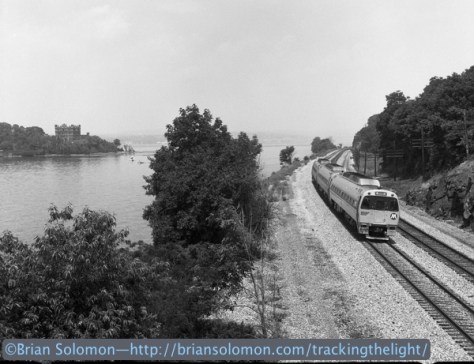
It was a hot and humid day. TSH and I were on a New York Central Hudson Division kick. I was working with my father’s Rolleiflex Model T loaded with Verichrome Pan black & white negative film to emulate the style images exposed here decades earlier.
Where in the 1940s, New York Central photographer Ed Novak had made photos of 4-6-4 Hudson and 4-8-4 Niagara type steam locomotives, and in the early 1960s my father had captured New York Central’s E-units with stainless steel streamlined cars, on this day, we had to settle for more modern trains.
I’ve always made it a point to make the most of whatever comes along. We were hoping to make photos of Metro-North’s FL9s, which were then the most interesting locomotives on the line, so far as I was concerned.
Metro-North SPV2000s roll along the Hudson River near the iconic Bannerman Castle. I was emulating an older style of photography by using a vintage 120-size Rolleiflex with Verichrome Pan black & white negative film. Would this photo be better as a digital color image?
When this three-unit set of Budd-SPV2000s rolled by on a shuttle from Poughkeepsie, I framed up the classic view and released the shutter. No regrets now. I Processed the film in D76 using stainless steel tanks. 25 years later I scanned the negatives.
Tracking the Light posts new material every morning.
The book was a square format and so the sky was partially cropped. That’s a pity since the sky was especially textured that afternoon.
I exposed it as part of a motor-drive sequence using my Nikon N90S with 28mm lens and Fujichrome Provia 100F. The photo on the book was one or two frames earlier in the sequence.
One of the strengths of the Lumix LX-series is the ability to make close-up and detail photos.
The camera’s optical system allows for great depth of field, while the ability to focus manually has allowed me unusual flexibility to make detailed photographs.
While experimenting with the LX7 at the Streamliners at Spencer event held by the North Carolina Transportation Museum, I made many detailed views. This was an idea time to get close, since there was a great variety of equipment on display with great pedestrian access.
Pennsylvania Railroad E8A 5711 on display at Spencer, North Carolina in May 2014.High gloss made for an opportunity to capture reflections and expose innovative compositions. LX7 photo.Union Pacific E9 949 had come a long way for the event and was looking well polished. LX7 Photo.These days an Amtrak F40PH is a novelty. LX7 detailed view.An old Missouri-Kansas-Texas stainless steel clad passenger car harked back to the streamlined era. Lumix LX7 view.The event was all about EMD locomotives, yet not everything on display was streamlined. LX7 photo.North Carolina Transportation Museum has plenty of regular exhibits. I recall flying Eastern Airlines back in the day.Birth certificate for decapod.
Tracking the Light posts new material every morning.
There’s only a few days during the year when the setting sun pierces deep into the darkness of the train shed at Heuston Station.
On the evening of September 20th, I made this image using my Lumix LX7 of the 7pm departure to Cork.
I had my camera set using the ‘A’ aperture priority mode, which automatically selects a shutter speed based on my manual selection of an f-stop. To compensate for the extreme contrast between the darkness shed roof and bright sunlight, I used the manual exposure over-ride to stop down (underexpose). This was necessary if the in-camera meter tries balances the scene it would have led to a total loss of highlight detail.
ISO 80 f2.8 1/80th of a second. RAW file manually adjusted to control contrast and exported as a scaled Jpg for internet presentation.
An alternative means to select the exposure, would have been to use the camera in ‘M’ mode and manually select both shutter speed and F-stop, but in this situation that would have taken too much time.
I had only a few moments to catch the Station Inspector with his arm raised to give the train the signal to depart.
To make the most of the information captured in this instant, I worked with the RAW file to make some contrast adjustments in post-processing. Using Photoshop, I adjusted contrast locally in highlight areas, while making some over all adjustments to the scene to best portray what I’d seen with my eye.
I wanted to retain the glint effect on the underside of the shed roof while making sure the relatively small silhouette of the Station Inspector wasn’t lost in the direct glow of sunlight.
After making my adjustments I export the file as a Jpg and then scaled this for internet presentation. The camera RAW file is 12.MB, much too large for presentation here, while my scaled image is just 737KB.
Tracking the Light posts new material every morning.
Looking west toward Duncormack, Wexford on the rusty South Wexford Line. A black & white print of a train climbing the grade here decorated my wall for years. Canon EOS 7D with 200mm lens.
Today saw a rare movement on a line devoid of regular traffic. Railtours Ireland’s Emerald Isle Express train was operated as empty carriage across the length of the South Wexford line from Rosslare Strand to Waterford.
Looking east toward the Robinstown Level Crossing. September 29, 2014, exposed with my Canon EOS 7D with 200mm lens.
Railtours Ireland’s Emerald Isle Express is a high-end tour train making a week-long tour of Irish Rail. This position-move was the most direct means of getting the train from Wexford to Waterford and saved a lengthy deadhead via Dublin and Cherryville. It was operated by Irish Rail in conjunction with the Railway Preservation Society of Ireland.
This was the first time I’ve photographed a train on the South Wexford in about six years. This line is storied ground: it was a favorite subject of mine a decade ago when a regular passenger service ran from Rosslare Harbour to Waterford using vintage General Motors diesels, and Cravens carriages like those that traveled the line today.
It was also the route of seasonal sugar beet trains that loaded at Wellingtonbridge, County Wexford for processing at Mallow, County Cork. Between 1999 and 2005, I made more than 50 trips to photograph the sugar beet, a project that resulted in thousands of color slides, black & white negatives, and DAT audio recordings. I could make a book of it.
Today, I traveled down from Dublin with Mark Healy to catch this unusual move. It was strange (and sad) to see this once-familiar line with rusty rails and heavy over growth along the right of way.
While my best photos of the day were exposed on Fujichrome Provia 100F with my trusted Canon EOS 3, I’ve published a few of my digital results here.
The Emerald Isle Express works west of Robinstown, County Wexford on September 29, 2014. Canon EOS 7D with 200mm lens.The Emerald Isle Express works west of Robinstown, County Wexford on September 29, 2014. Canon EOS 7D with 200mm lens.FInally after weeks, months, and years of disuse, a train comes to polish the rails. (I’m not counting the weedsprayer, inspection cars, or other perway moves, for the sake of sentiment.) The Emerald Isle Express works west of Robinstown, County Wexford toward Duncormick on September 29, 2014. Canon EOS 7D with 200mm lens.Rusty bullhead track at Ballycullane, County Wexford.The Emerald Isle Express passes Ballycullane, County Wexford on September 29, 2014. Regular schedule passenger service was withdrawn in 2010. The last sugarbeet train passed in early 2006—more than eight years ago. Canon EOS 7D with 100mm lens.Trailing view at Ballycullane, County Wexford. Lumix LX7 photo.
August 31, 1991. I’ll put this in the ‘forgotten images’ category! I remember the trip, I remember the day, but until I scanned it, I’d completely forgotten that I’d made this photo on black & white film.
SP Daylight 4449 crosses the curved tower-supported plate girder viaduct at Redding, California on August 31, 1991. Exposed using a Leica M2 with 50mm Summicron lens.
As I’ve describe in my previous post, Daylight Beauty at Hooker Creek. Southern Pacific had organized the streamlined engine to make a public appearances in the Sacramento River Canyon as a goodwill gesture following a serious derailment at the Cantara Loop (which spilled toxins into the river above Dunsmuir), and the railroad had hired me for two days to make photographs of the PR event. Brian Jennison provided transport, and the two of us spent a long weekend making numerous images of SP 4449 with Daylight train.
I exposed this image on the first day of excursions using my Leica M2 with 50mm lens. I’ve published many of the color slides I exposed from the same trip, including views I made on Kodachrome with my Nikon F3T at this bridge.
Some can be found in my book The American Steam Locomotive published by MBI in 1998, Steam Power published by Voyageur Press in 2009. Also, Audio Visual Designs used my photo of SP 4449 at Redding on a picture postcard back in the 1990s.
Finding this picture was a pleasant surprise. Compared with earlier years, I have relatively few black & white images from the 1990s in California, although I went through a phase where I’d use the Leica loaded B&W during the ‘high light’ when Kodachrome yielded substandard results.
In this case, I made the most of the situation by using two cameras and different types of film, I obtained a variety of photos from location. Also, the locomotive repeated the exercise the following day. By then, I’d re-loaded the Leica with Kodachrome 25.
Tight crop on the locomotive from the same b&w negative. SP Daylight 4449 crosses the curved tower-supported plate girder viaduct at Redding, California on August 31, 1991. Exposed using a Leica M2 with 50mm Summicron lens.
Richard has been photographing railways for decades and brought me on many of my earliest railway excursions, including a trip on the Flushing Line in Queens way back in the day.
Richard has worked with Leicas, a Rolleiflex, and a Linhof 4×5 view camera. Today has also a few digital cameras to play with including a Lumix LX7.
Many years ago he gave me my first camera, and after I wrecked that one, he gave me another, and finally a Leica model 3A. I continue to wear them out.
Regular viewers of Tracking the Light will recognize the subjects and locations. Together, Richard and I have years of continuous photographic record of railways in the United States and around the world. His photographs have appeared in many of my books.
Richard in eastern Pennsylvania in October 1964. He’s sporting two Leica Ms, including one with 135mm telephoto, and a Rollieflex Model T (Which I wore out, but eventually replaced).Last October my father an I photographed New England Central’s southbound freight (Job 610) passing Stafford Springs, Connecticut. Photo by Brian SolomonRichard goes for a spin at the Railroad Museum of New England. Photo by Brian Solomon with Canon EOS 7D.A brand new Pennsylvania Railroad Budd Silverliner rolls through North Philadelphia in 1963. Richard was panning with his Rolleiflex Model T. He exposed this on Kodacolor negative film, which I scanned using an Epson V600.Richard has made good use of his Rolleflex cameras. He bought the first on a trip to Germany in 1960, and used it to expose this classic image of the North Shore Electroliner on the streets of Milwaukee in June 1961. Richard’s North Shore photos have been published by David P. Morgan in TRAINS Magazine and by William D. Middleton in his books.On August 20, 1960, Richard exposed a Kodachrome slide of this American-style PCC car on the streets of Charleroi, Belgium using a Kodak Retina 3C. See comparison photos below.
I returned to the same street in Charleroi last month and made similar views of trams. I actually went to almost the same spot as the above photo, but exposed a couple of colour slides, which remain latent. Perhaps at some point I’ll do a ‘now and then’ comparison. (Film and film).
LX7 view in Charleroi, Aug 2014. Photo by Brian Solomon.Canon 7D view in Charleroi, Aug 2014. Photo by Brian Solomon.Richard on a recent visit to New Haven, Connecticut. Lumix LX3 photo.
An A-B-B-A set of General Motors Electro-Motive Division F9 diesels leads a set of empty iron ore jennies at the Kramer Tunnel on September 24, 1994.
Exposed on September 24, 1994 with a Nikormatt FT3 with a Nikkon 28mm lens on Fujichrome Provia 100 slide film.
I’d traveled to the Iron Range with Mike and Tom Danneman. We spent three intensive days making photographs. It was early autumn and the trees were tinged with color. The Dannemans led the way, as it was my first visit to the Range.
We spent just one day photographing LTV Mining, which was one of the last operations in the United States to still routinely assigned four-unit sets of Fs to heavy freight.
A cropped version of this image appears on page 50 of my American Diesel Locomotive, published by MBI in 2000.
It was the morning of August 28, 2010. My father and I had arrived at Bellows Falls, on our way to St. Albans. It was quiet and nothing was moving on any of the three freight railroads that serve the town.
East of the passenger station there were a few old Budd RDCs stored on former Rutland Railroad sidings. I took a few minutes to made some photos with my Lumix LX3. My father has some nice Kodachrome slides of Boston & Maine and New York Central cars working in the 1960s. I remember riding them out of Boston in the 1970s.
Exposed digitally with a Lumix LX3.Vestiges of another era at Bellows Falls, Vermont. Exposed digitally with a Lumix LX3.New York Central was first to install Budd Rail Diesel Cars in revenue service. They were known as ‘Bee Liners.’ Exposed digitally with a Lumix LX3.
One of the benefits of Budd’s Shotwelded stainless steel construction is that the cars won’t rust. Yet, the overgrowth makes for some interesting studies in decay. The cars still reflected the light nicely.
More than 30 years earlier we’d explored these same sidings. Back then there were decayed vestiges of wooden sided boxcars around the place, and considerably few trees.
Tracking the Light posts new material every morning.
I first visited Roscrea in August 1998. Denis McCabe was giving me a tour of rural Irish stations, and we stopped there to intercept the branch passenger train running from Ballybrophy to Limerick.
Back then the train consisted of an 071 diesel, a steam heating van and two ancient looking Cravens carriages. It was a cloudy morning.
Fast forward to August 2014, and Denis and I made a return visit to Roscrea. While I’ve visited this rural station on several occasions in the intervening years, what struck me was how little the station and its environs have changed.
Irish Rail station at Roscrea, County Tipperary in August 2014. Exposed with a Lumix LX7. (And yes, I also made a color slide, for the sake of modal consistency and archival longevity.)
The old signal cabin is still open and active; the mechanical semaphores remain as I remember them, the station building seems unchanged. Compared to many of the station I visited in 1998, this is one of the few that still looks the same. The Celtic Tiger years didn’t result in unnecessary uglification—er, I mean improvement—to Roscrea.
In 2004, Irish Rail replaced the traditional locomotive-hauled steam-heated Cravens with a more modern railcar. Today 2800-series railcars in the latest green and silver paint work the Nenagh Branch. Exposed with a Canon EOS-7D with 100mm lens.Exposed with Lumix LX7.
On the downside, you must know where the station is in the village. I don’t think there was any sign off the Motorway or in the town itself giving any hint of an active railway station there. It’s a real pity too. The Nenagh Branch is one of those throwbacks to another age. Unsung, unloved, and largely ignored, it soldiers on in a world that time forgot.
Tracking the Light posts new material every morning.
We followed a pair of empties from Shannonbridge, eastward toward Ferbane. Access is limited, owing to the nature of the bogs. Toward the end of the day, we set up at the N62 highway overpass, where the Bord na Mona’s line climbs away from the River Blackwater.
Bord na Mona’s three-foot gauge tracks looking west toward Shannon Bridge in August 2014. Canon EOS 7D with 200mm lens.
My challenge was making the most of the backlit scene. The sun was setting almost immediately behind the train. I opted for my 200mm lens in order to compress the perspective, eliminate the sky, and minimize the effects of flare. I positioned myself near post on the side of the road to help shade the front element of my lens.
Here the effects of backlighting combined with the long telephoto lens make for a cinematic look; the exhaust of the locomotive is more pronounced, the wavy condition of the tracks are exaggerated, and the pastoral scene made more impressive.
Exposed with a Canon EOS 7D fitted with f2.8 200mm lens set at 1/500th of a second at f5.6. Front element of the lens was shaded from direct sun.
I particularly like the silhouette of the train driver in the cab, which emphasizes the human element.
My only disappointment with the photos is that the following train hadn’t effectively enter the scene. (Often Bord na Mona trains working in pairs follow one right after the other. In this situation, the following train was just around the bend.) But, I’ve had plenty of opportunities to make images with two or more Bord na Mona trains, so I’ll settle for this one of a lone train.
Tracking the Light posts new material every morning.
Check out Tracking the Light’s Dublin Page to see lots of great photos of Dublin’s 2014 Culture Night event.
18th Century the Casino at Marino. This remarkable building is a visual enigma; it seems much larger on the inside than it does on the outside. Lumix LX7.The Casino at Marino exudes 18th century elegance. Lumix LX7 photo.
Dublin’s Writers Museum on Parnell Square.
Click on Tracking the Light’s Dublin Page for photos of Dublin’s 2014 Culture Night event!
Tracking the Light posts new photographs every day!
Union Pacific on Donner Pass; Standing in Steinheimer’s Footsteps.
Among my favorite locations in California is the spectacular overlook at ‘American’ or ‘Old Gorge’ (if you have a really old time-table) located on the former Southern Pacific crossing of Donner Pass east of Alta.
Here the railroad crawls out on ledge high above the waters of the American River. It’s a on sustained 2.2 percent grade, so eastward trains are in full throttle which makes for sublime sound show.
I was in position on an overcast afternoon, October 30, 2003. The American River Canyon was filled with a thick fog. To the west I could hear traditional EMD 16-645E3 diesels roaring in Run-8. That meant SD40-2s. Real locomotives.
Exposed on Kodak Tri-X which I processed by hand in San Francisco. After initial processing I toned the negatives in a selenium solution mix 1:9 with water for 9 minutes, 1 minute agitation (in a well-ventilated area).
As the train approached, the atmospheric pressure changed and the fog rose out of the canyon and enveloped me. Although it was only the day before Halloween, all of sudden it began snowing furiously. Visibility dropped to nil, and the roar of the eastward freight grew intense.
Working with my Rolleiflex Model T loaded with Kodak Tri-X, I exposed a series of images. It was a memorable moment on Donner.
Union Pacific SD40-2s emerge from the fog and snow at ‘American’ on their ascent of Donner Pass.
Tracking the Light posts new material every morning.
Norfolk Southern eastbound near Mexico, Pennsylvania with a former Conrail General Electric DASH8-40CW in the lead.
The former Pennsylvania Railroad Middle Division is one of the busiest freight routes in the eastern United States. On November 5, 2001, Mike Gardner and I spent the afternoon on Middle Division photographing Norfolk Southern freights.
The combination of pastoral Pennsylvania scenery, low November sun, and steady parade of freights made for lots of opportunity to make interesting railway images.
I’m always looking for a new angle. Here I worked with light and shade to sculpt scenes that captured the character of the place as well as the trains passing through it. I exposed these images using my Nikon F3 with Fuji Provia 100F.
Piggyback trailers roll toward Tuscarora Mountain on their eastward journey along the Juniata River Valley.USGS topo map showing Mexico and Tuscarora, Pennsylvania. I made my photos near the Olive Branch School, across the Juniata from Mexico.
Tracking the Light posts new material every morning.
Irish Rail’s only four track mainline transits the west Dublin suburbs. This was built toward the tail-end of the Celtic Tiger boom years. Rail traffic flows in fits and starts, but midday on week days can result in some interesting action.
Irish Rail 229 leads IWT liner.
The prize this day was catching Irish Rail’s General Motors-built 071 class locomotive 079 hauling the elusive per-way ‘Rail trucks’ (rail train) on its run from Platin (on the Navan Branch) to the per-way depot in Portlaoise.
I worked with my Canon EOS 7D, which handles the cloudy bright lighting conditions admirably.
Tracking the Light posts new material every morning.
Fish with man-legs, scenes of torment and pleasure gardens, along with medieval apocalyptic visions were among the topics painted by Jheronimus van Aken aka Hieronymus Bosch who hailed from the Dutch city of ‘s-Hertogenbosch, or ‘Den Bosch.’
This is a city of narrow canals, winding cobblestone streets, traditional market squares, surrounded by post World War II ‘Lego-block’ sprawl.
Market square Den Bosch in August 2014. Lumix LX7 photo.
The railway station is an unusual blend of an 1896-built iron and glass train-shed with modern facilities.
My visit to the station was brief. I explored for about half and hour, making a variety of images. I was surprised by the arrival of one of NS’s older Hondekop ‘dog face’ EMUs. I’d photographed some of these ancient units back in the 1990s and didn’t realize that any remained in traffic.
The old shed dates from 1896. Lumix LX7.NS operates an interesting variety of distinctive equipment. There’s no mistaking these Dutch trains for those in other countries. Canon EOS 7D with 200mm lens.I found the shed to be very photogenic. I made this study from a modern mezzanine using my Lumix LX7.Blast from the past! One of the older ‘dog nose’ electric multiple units.Den Bosch station with a decorative lion. Exposed from an escalator using my Lumix LX7.An express train passes on a middle track with an electric locomotive shoving at the back.
As across most of the Netherlands, passenger trains operate on regular interval frequencies (typically every half hour) to most major points.
The station was remarkably clean, and despite the dull light, made for an interesting place to photograph.
Tracking the Light posts new material every morning.
Among the iconic locations on the former Pennsylvania Railroad ‘West Slope’ (west of the summit at Gallitzin) is a massive curved stone-arch bridge near Mineral Point, known as ‘The Big Viaduct.’
In the early hours of September 5, 1997, Mike Gardner and I drove down a heavily brushed in road that had once been the right of way of a Johnstown Traction Company’s electric line.
Mike was dubious when I urged further forward progress into the inky gloom and thick bushes. It seemed like an adventure into the rain forest.
We arrived at on overlook near the famous bridge just as the first hints of daylight colored the sky. A thick fog covered the ground, but the fuzzy twinkling spots above told us that it would be a clear morning.
In the distance, I could hear Electro-Motive diesels whining in dynamic as they approached with a westward Conrail freight. Despite the fog and gloom, I set up my Bogen tripod, attached my N90s with 24 mm lens, and when the train passed, made a series of long exposures with Fujichrome Provia 100F.
A Conrail freight growls downgrade across the Big Viaduct. Exposed on Fujichrome Provia 100F with a Nikon N90s with 24mm lens. Time exposure: about 8 seconds with camera on tripod.
Soon the sun crawled above the hillsides and began to burn off the fog, Conrail ran a procession of trains, mostly westbound. Later in the morning when a clear blue dome prevailed I relocated trackside to make a view of an eastward freight climbing across the bridge.
A westward Conrail freight emerges from the fog near the Big Viaduct. Exposed on Kodachrome 200 using a Nikon F3T with 80-200 zoom lens.Conrail 6180 east at Big Viaduct Mineral Point PA September 5, 1997. Nikon N90S with 28mm lens, Fujichrome Provia 100F slide film.
It is mornings like that one, 17 years ago, that make me wish I was right now trackside in the mountains of Pennsylvania, and not thousands of miles away in front of a computer, writing about the experience.
Tracking the Light posts new material every morning.
Looking down from the CN Tower on Canadian National’s Spadina Roundhouse in Toronto.
I exposed this vertigo inducing view from the sky-reaching CN Tower using my Leica 3A with 50mm Summitar and Kodachrome 64.
It was a glorious clear morning and I was visiting Toronto for the first time. After the tower, I wandered around on the ground making a few select images.
While the nearby Canadian Pacific roundhouse at John Street survives as a museum, CN’s Spadina Street was demolished a year after my visit, and almost everything in this view has been erased from the scene.
Looking down from the CN Tower on Canadian National’s Spadina Roundhouse in Toronto.
Tracking the Light posts new material every morning.
Irish Rail’s track geometry car followed today’s Dublin to Ballina IWT Liner.
This unusual piece of maintenance equipment is among the more elusive subjects on the Irish network. I was surprised to see it when I peered over the wall on the St John’s Road this morning.
Irish_Rail 218 leads Friday’s IWT liner with EM50 on Platform 10. Exposed with a Canon EOS 7D with 40mm Pancake Lens.Exposed using a Canon EOS 7D with 40mm Pancake lens. Friday September 12, 2014.
On my short spin on the Rotterdam Metro I made these photos with my Lumix LX7.
Rotterdam Metro at Wilhelminaplein. Lumix LX7 photo.Rotterdam Metro at Centraal Station.Rotterdam Metro Centraal Station.
It’s amazing how well digital cameras perform when photographing in the difficult lighting of subterranean railways.
This was just brief glimpse of a railway that hereto I was only vaguely aware. Perhaps there will be another opportunity further exploration on another visit.
Tracking the Light posts new material every morning.
Rotterdam Centraal as photographed in August 2014. Lumix LX7.
Opened earlier this year. Rotterdam Centraal doesn’t look like any other railway station on the outside. (Although on the inside it reminded me of the entrance hall at Warsaw Central.)
Like much of Rotterdam’s modern architecture it’s hard to ignore! Photographically I found it fascinating. On another trip, I’ll bring a tripod for some extended night exposures.
Beneath the shed beyond the station building, Nederlandse Spoorwegen (loosely translated as ‘Dutch Railways’) trains connect most major destinations in the Netherlands, as well as through trains to Belgium and France, including Thalyshigh-speed services. Some 100,000 passengers use the station daily.
Rotterdam Centraal as photographed in August 2014. Lumix LX7.Train to the ‘Hook of Holland’.Rotterdam Centraal as photographed in August 2014. Lumix LX7.In the fading dull light with a North Sea sky; Rotterdam Centraal as photographed in August 2014. Lumix LX7.
Terminus of Rotterdam‘s number 7 tram near the very Dutch sounding Tulip Inn. Lumix LX7 photo
I visited Rotterdam for an afternoon and evening. This is considered The Netherland’s architechtural capital and certainly features a wide variety of unusual modern buildings.
Rotterdam had been left in ruins after the Second World War, and over the last seven decades has been rebuilt in a style unlike any place else I’ve even seen. For me, its next closest cousin is Toyko, and that’s a bit of a stretch.
Lego-land on steroids! Lumix LX7 photo.The famed Cube House, which allows you to wander into an Escher-like setting. Lumix LX7 photoRET train passing below the Cube House. Lumix LX7 photoA burst of sun illuminates at tram paused at a waterfront station. Canon EOS 7D with 200mm lens.Trams with skyscrapers, Rotterdam. Lumix LX7 photoWhat better way to see a city? Rotterdams trams are clean and feature large windows. Lumix LX7 photo
The city has an excellent modern tram system, a stunning underground metro, and world-class railway connections.
The city revolves around the port, is one of the busiest in Europe, and a central focus of much of the water-front architecture.
I found it an intriguing place to make photographs. My regret was that my visit was so short. My three cameras were kept busy through my wanderings.
Lumix LX7 photoErasmusbrug, Rotterdam.Containers outbound at Erasmusbrug, Rotterdam. Lumix LX7 photo.Tram pan in central Rotterdam. Lumix LX7 photo.RET number 8 tram.Number 7 tram terminus.
Tomorrow! Rotterdam Centraal—one of Europe’s newest stations.
Tracking the Light posts new material every morning.
Transportation; Railroads; Railways; Railway Photography, that’s what I photograph. Right?
But what’s the actual subject? What should I focus on? More to the point; what is interesting? And, is today’s interesting subject going to be interesting tomorrow?
Looking back is one way to look forward.
Yet, there lies a paradox: When I look back over my older photos, I regret not having better skills to have consistently made more interesting and more varied images. And also, for not being more aware of what was interesting.
Conrail at signals 81.81 near Palmer, Massachusetts c1983. What was my subject? (If you know me, you’ll know the answer—hint it’s not the westward freight train!). Exposed with a Leica 3A with 50mm Summitar lens.
The lesson is then is about skill: learn to vary technique, adopt new approaches and continually refine the process of making photos while searching for interesting subjects. (The searching is the fun part!)
A truly successful image is one that transcends the subject and captures the attention of the audience.
So, is railway photography really about the subject?
Should all railway photos be serious? Seriously? Waukesha, Wisconsin, back in the day.Are railroads all about locomotives? Here’s a real stack train that looks like a model.I was standing next to Jim Shaughnessy for this one! Surely that makes it a better photo, right? October 2004, Cuttingsville, Vermont.Sometimes it helps to get up close and check for details.Can you get too close? Ektachrome 100VS with a Nikon F3T and Nikkor 24mm lens.Do old Alcos make better subjects? Slateford Junction at the Delaware Water Gap, September 17, 2007.Lonely tracks at Eagle, Wisconsin c1996. I waited, but the train didn’t show up.Fill the frame, don’t waste space, more train, that’s what its all about, always! Right??
Tracking the Light posts new material every morning.
When I was exploring Santa Fe’s Bay Area operations in the early 1990s, the railroad tended to operate a fleet of westward trains to its Richmond, California yards in the afternoon and early evening.
One afternoon, Brian Jennison and I had set up at the Alhambra Viaduct near Martinez. This was a relatively scenic portion of the line, but beginning to get hemmed in by suburban growth.
We knew that the 899 was on its way. This was a short high-priority piggy back train. The real prize of the day was the premier 199, which often had new ‘Super Fleet’ locomotives wearing the reintroduced Warbonnet paint scheme. But we wanted to make the most of the short train as we had time to make different photos of both trains.
To make the most of Santa Fe’s ‘shorty’ 899, I climbed atop the tunnel west of the bridge, and set up this view using my Nikon F3T fitted with a Nikkor f4.0 200mm lens. The light was classic California blue skies with soft autumnal haze that favored Kodachrome 25. My exposure was f5.6 1/250th of second.
This view minimized the suburban sprawl on both sides of the bridge, along with high tension lines in the valley, while putting the steel viaduct in a good perspective. Was it really 24 years ago?
Tracking the Light posts new material every morning.
I spent this hot hazy afternoon east of the passenger station at Utica, New York watching and photographing trains on the old New York Central Water Level Route.
Utica was unusual because it retained a variety of its New York Central-era structures on a route largely denuded of traditional railroad buildings.
Exposed on Fujichrome using a Nikon F3 with f2.8 180mm lens.
I made a point of include old Tower 30, which had still had Conrail sticker on its door. Without the tower in the picture, CSX AC6000CW 611 could be just about anywhere.
This is just one frame in a sequence. I think a previous image, with 611 slightly further back in the frame might be a more effective photo.
Tracking the Light posts new material every morning.
A modern Alstom Citadis tram glides across cobblestone streets in Reims, France in August 2014. Lumix LX7 photo. Notice the ground-level power supply.
In August, I made a brief visit to Reims in northeastern France. This city is steeped in history and now boasts one of Europe’s newest tram networks, which opened in Spring 2011.
Reims cathedral. Lumix LX7 photo.Trams pass in Reims. Lumix LX7 photo.Canon EOS 7D with 200mm lens.
Operated by Veolia Trandev, this system covers just 11.2 kilometers (just under seven miles). Like Dublin’s LUAS it uses modern Alstom Citadis trams. These have a distinctive styling variation with front sections designed to mimic the shape of a champagne flute—which pays homage to Reims’ role as ‘capital of the champagne region’
The trams make the same ‘bong bong’ warning sounds as they navigate city streets.
Interestingly, the relatively small tram fleet are dressed in eight different colours.
One of the most innovative elements of the Reims system is its application of a modern ground level power supply that is used through the historic city center to avoid unsightly wires.
In my few hours wandering Reims, I made just a handful of digital photos plus a couple of colour slides.
Eight different colours decorate Reims trams. Lumix LX7 photo.Vestiges of Reims original narrow gauge tram system remain. The modern system is standard gauge. Lumix LX7 photo.A Roman arch tells of Reims history. Augustus was here. Lumix LX7 photo.Near the Roman arch the trams change power supply, going from ground level to overhead wires. Lumix LX7 photo.Lumix LX7 photo.Lumix LX7 photo.
Tracking the Light posts new material every morning.
In August 2014, I visited the battle-sites and grave yards around Verdun in northeastern France. These were the sites of some of the most intense fighting during the Great War.
I exposed these photographs.
Argonne Battle siteArgonne Battle site near VerdunMort Homme monumentMort Homme monumentMort Homme monumentTrenches at Mort Homme monument
DouaumontDouaumontDouaumontDouaumontSite of Bezonvaux village—destroyed in the war.Site of Bezonvaux village—destroyed in the war.Site of Bezonvaux village—destroyed in the war.Narrow gauge tracks at the site of Bezonvaux village—destroyed in the war.Narrow gauge tracks at the site of Bezonvaux village—destroyed in the war.
Tracking the Light posts new material every morning.
RPSI 461 at Islandbridge Junction, Dublin, Ireland at 11:53 am on September 4, 2014. Canon EOS 7D with 200mm lens.
Just a few minutes ago, Railway Preservation Society Ireland’s 1923-built 2-6-0 461 passed Islandbridge Junction near Dublin’s Heuston Station.
The locomotive is on its way to Limerick.
Nice to see steam on the move in bright daylight!
RPSI 461 at Islandbridge Junction, Dublin, Ireland at 11:53 am on September 4, 2014. Lumix LX7 photo.Just a minute later, uniquely painted class 201 diesel 8208 rolled the other way.
This is a Special Post,
but Tracking the Light posts new material every morning.
It was June 22, 2004, when Marshall Beecher organized a visit for the two of us to photograph from a rooftop opposite A2 tower in Chicago.
This busy plant is where the former Chicago & North Western line from C&NW station crosses the old Pennsylvania Railroad Panhandle/Milwaukee Road route from Union Station.
Our visit was timed to coincide with the passage of Milwaukee Road 4-8-4 261 with a passenger excursions. At the back of the train was one of Milwaukee’s unusual Skytop lounge observation cars.
Exposed on Fujichrome Velvia100 using a Nikon F3 fitted with 24mm lens. Exposure calculated with a Minolta MarkIV hand-held light meter. A variation of this image appeared in the book Milwaukee Road’s Hiawatha authored by John Gruber and me and published by Voyageur Press.
After the steam excursion was gone, we decided to make the best of the vantage point and spent several hours photographing Metra and Amtrak.
Thanks Marshall!
Tracking the Light posts new material every morning.