(if you’re viewing via Facebook, you’ll need to click to see the whole image).
Brian Solomon photo.
I thought I’d try something a little different today! I used to be fascinated by David P. Morgan’s impossible photo puzzles in TRAINS. I sifted through a bunch of photos, and I selected this one as my puzzle. (A few months back, I included another puzzle, however it was so opaque that most viewers didn’t even notice! So much for subtlety!)
Leave a comment (comments feature is toward the bottom of the post) if you think you know the location of the photo (be as specific as you dare). If you are really clever, you can include the approximate date of exposure! Or you may wonder in silence.
I’ve deliberately left in several visual cues that should make this something less than impossible to identify. Here’s a tip: it’s not in Germany! (or Ireland!) 🙂 Another tip? Something useful? Reminds me of a comic.
Stay tuned! I’ll post the location and names of any lucky guessers at a later date. (If you don’t want your name listed, use a pseudonym.)
Cable Car on Columbus, exposed on Kodachrome in 1994.
This isn’t your typical cable car image. Where photographers, myself included, have often focused on San Francisco’s exceptionally steep hills, where cars appear to cling precariously to tracks, instead I’ve tried to make the most of one of more level sections of the cable car system.
I exposed this on Kodachrome 25 this using my old Nikormat FT3 with a secondhand Tokina 400mm lens.
This exceptionally long telephoto was very sharp but had very shallow depth of field. I used this quality to set background highway traffic, include some MUNI Trolley buses, out of focus, thus helping the viewer concentrate on the main subject—the famous cable car.
Although a simple image, there’s a lot to see in it. Despite my use of selective focus, the path of the cable car track (with its trademark central conduit) leads the eye beyond the car and around the corner toward Powell Street.
Aiding my effort was the rich afternoon sun for which San Francisco is often blessed. There’s an exceptionally pleasant quality to Bay Area sunshine that is best experienced in person, but has made for a great many photographic opportunities. I miss that quality of light when I’m not there!
Back in the 1980s, I’d buy my film at Frantek in South Hadley, and then return via Holyoke, where I’d almost always find the Boston & Maine switching. Back then the old Connecticut River line was busy with through and local trains.
On a typical day, there would be between three and four freights daily, plus the nocturnal Amtrak Montrealer.
Holyoke itself generated a fair amount of traffic, and the yard there was always full of cars. Pioneer Valley Railroad interchanged with B&M at the south end of the yard. During the day it wasn’t uncommon to find one of PVRR’s EMC SW1s or Alcos working Holyoke industrial trackage.
The old Boston & Maine station at Holyoke, one of a handful of surviving railroad stations designed by noted architect H.H. Richardson (also responsible for the station in Palmer, Massachusetts, which is routinely featured in Tracking the Light.) Canon EOS 7D photo.
Vestiges of Holyoke Yard on June 22, 2014. Canon EOS 7D photo.Old mill buildings on the canal in Holyoke. All quiet on a Sunday morning. Lumix LX-7 photo.Lyman Street in Holyoke on Sunday June 22, 2014. Lumix LX-7 photo.Pan Am’s EDPL crossing a canal bridge in Holyoke on June 22, 2014.Pan Am’s EDPL crossing a canal bridge in Holyoke on June 22, 2014. Lumix LX-7 photo.
Sunday, June 22, 2014, I revisited Holyoke. The railway scene is very much changed from the 1980s. Most of the yard is gone, as are the majority of the customers it once served. The Montrealer hasn’t operated in decades, and the volume of mainline freight is now carried by Pan Am Railway’s lone symbol freights EDPL/PLED (East Deerfield, Massachusetts to Plainville, Connecticut).
Now, Holyoke is on the eve of rail revival. It will soon host a new station for the Knowledge Corridor, and in a few months time will be a stop on Amtrak’s re-routed Vermonter. Hopefully, an increase in freight traffic will soon follow.
The old mills and factories in Holyoke make for a fascinating post-industrial setting.
LX-7 photo.Holyoke City Hall rises above a sea of red brick. Canon EOS 7D photo.
A wise photographer once wrote, ‘The secret to making photographs is f8 and be there.’
Back in the 1990s, my friend and fellow photographer Mike Gardner said, ‘All good trips begin and end in Palmer.’
Sunday, June 22, 2014 confirmed Mike’s wisdom. I’d headed to Palmer to meet my frient Tim Doherty. Before leaving the house, I searched in vain for my scanner, but departed without it. I was coasting on intuition.
Moments after stepping out of the car at CP83 in Palmer (where CSX crosses New England Central) to say ‘hello’ to Tim, I heard, above the dull roar of road traffic, the distinct sounds of eastbound train’s dynamic brakes.
I said to Tim, ‘There’s an eastbound train, and it’s very close.’ I flicked on the Lumix LX7 that was hanging around my neck and stepped promptly toward my preferred trackside location at CP83. As I did, I heard the lead axles of a six-motor GE rattling across the New England Central diamond a few hundred feet to my west.
I had just enough time to set the exposure and frame up a nice view of CSX Q012 passing CP83’s signals with the old Palmer Union Station (now the Steaming Tender Restaurant) to the left of the old Boston & Albany mainline.
Eastbound in the morning sun. CSX’s Q012 has a clear signal at CP83 in Palmer, Massachusetts. Total elapsed time from my arrival in Palmer to the passage of this freight? Less than 2 minutes.The Lumix Lx-7 cycles relatively quickly, so I was able to make a second grab shot, just a few moments after the first.
There’s a 30 mph speed restriction on the diamond for freight. As the train rolled through, I said, ‘we can catch this again.’ And, off we went on the first of a long-day’s railway photography adventures.
Nearly 12 hours later, we returned to Palmer and, as it turned out, repeated the exercise in fortuity. Immediately upon our arrival, the signals lit at CP83 and these soon cleared to green on the main track. ‘We’ve got a westbound, and it can’t be far off.’
I knew this because CSX’s signals at CP83 are approach-lit, and only light when something has actuated the track circuits between CP83 and CP79 (located at the east-end of the controlled siding). Also, when a signal has been cleared, a train must close.
Again, we had just enough time to get in position for photography.
Walking toward the diamond, some diners leaving the Steaming Tender asked me, ‘Is a train coming?’
Not having time to waste more than a moment in conversation, I replied, ‘Yes, a westbound is very close. Less than four minutes away.’ A headlight appeared to the east as I made the comment.
“How did you know that?” The diners asked, as if I possessed some blind precognition. “The signal shows ‘clear’ for the main track,” was my honest reply, but I may as well answered in ancient Greek.
What’s this? A westward piggyback train in the afternoon? On a Sunday? I’m not one to argue, but I was surprised to see it. Canon EOS 7D with 200mm lens.Customers at the Steaming Tender wave to the passing freight. Lumix LX-7 photo.A tight view of CSX Evolution-series diesels rolling toward the Palmer diamond on the evening of Sunday June 22, 2014. Lumix LX-7 photo.Trailing view at the Palmer diamond in the glinty evening light. A CSX westward intermodal train makes for a graphic subject. Canon EOS 7D with 200mm lens.
My luck?—Being in the right place at the precisely the right times. However, I made my own luck. By keeping my ears open and my eyes on the signals, I knew to act quickly. Stop, look and listen, right? There’s no mystery there.
It was a fresh clear morning in Oregon. I was photographing along the Oregon Trunk on advice of Brian Rutherford. This route was jointly used by Burlington Northern and Union Pacific and traversed some stunning scenery.
Having hiked into a choice location in Trout Creek Canyon, I was rewarded with a Burlington Northern grain train in nice light.
I was impressed by the solid consist of freshly painted company hoppers.
Kodachrome 25 exposed with a Nikon F3T with 28mm lens.
The next day, Burlington Northern and Santa Fe announced merger. Although a year of merger machinations and approval processes would entail before BN+SF was consummated, it was the end of an era for BN (and Santa Fe).
This is one of my favorite classic locations. The abutments for the old Route 53 overpass across the former Pennsylvania Railroad between Gallitzin and Cresson offered a great vista for westward train in the afternoon.
A westward Norfolk Southern freight approaches the Route 53 overpass near west of Gallitzin, Pennsylvania on June 30, 2010. I’ve heard that the highway overpass was recently replaced/upgraded. Does anyone know how this affected this viewpoint from the old bridge abutments where this photo was exposed?
I exposed this view four years ago today using my Lumix LX3. I’d set the camera’s aspect ratio to 16:9 which gives a slightly more panoramic view when held horizontal. One of the advantages of the Panasonic Lumix LX series cameras is the ability to adjust the aspect ratio.
I’ve found this a great compositional tool because it allows me to frame photographs differently with the touch of a switch. This is almost like having a whole new camera system without all the complications.
You might ask, ‘why not just use the camera full-frame and then crop the image later?’ My answer is simple: When I compose an image, I’m taking into consideration the relative placement of all the elements and lighting. I find this is most effective when done on site, and not after the fact.
View from the platform at Årstaberg Station in suburban Stockholm, Sweden on May 6, 2010.
I visited Stockholm for several days in May 2010. The public transport system is among the best I’ve experienced anywhere. Multimodal connections and unified ticketing made it easy to transfer between suburban rail, metro, light rail and other modes.
I spent several days re-exploring the city. On the evening of May 6, at 7:04 pm (you can tell by the clock), I exposed this view of an inbound SL suburban train Årstaberg station. Located immediately south of the central Stockholm, this station afforded connections to a light rail line,on a lower level.
My Lumix LX-3 was a great tool for photographing Stockholm. Where-ever possible, I tried to include location finders such as station signs, so that I’d be able to caption photos later on. I’ve learned from past experience, that even when I’ve taken detailed notes, it can be difficult to accurately identify photos exposed unfamiliar cities!
Over the years, I’ve made countless images of the Central Vermont Railway, and its modern day successor, New England Central at Palmer.
It was a warm August evening, the light was nice, and a pair of CV GP9s were working the Conrail interchange.
Exposed on Kodachrome with a Leica M2 with 35mm Summicron lens.
Rather than simply make another close-up trackside-view, I opted for this unusual angle south of the old Union Station. I put CV’s tracks in the foreground, while framing the locomotives in the canopy supports of the station. For me this tells a story while putting a less common perspective on a familiar place.
This was 15 years before the station was restored and transformed into the Steaming Tender Restaurant. Now the station is again vibrant, while CV and Conrail are many years gone.
I had visions of wolves howling in distant ravines, silhouettes of bats flitting through the air against a luminescent full moon, and an aged caped gentleman speaking in a thickly accented voice. . .
Then I arrived in Romania by train from Budapest and reality interrupted my fantastic imaginations!
Turns out that Predeal, at the summit of the Transylvania Alps, is a great place to photograph trains. No bats, no moon, no wolves; not that I saw anyway.
Predeal, Romania, exposed on Fujichrome using a Nikon F3 with f2.8 180mm lens.
The weedgrown right-of-way is deceptive. The mainline is electrified and heavily traveled.
On the afternoon of July 11, 2007, I exposed this image south of the summit a Predeal of a Compania Naţională de Căi Ferate (Romania National Railways) electric leading an oil train.
Freshly Painted GP38-2s on Jointed Rail at DeForest, Wisconsin
June 23, 2010—four years ago today—John Gruber and I followed CP Rail’s local freight from Madison toward Portage on a secondary line of the old Milwaukee Road.
Locomotive 4509, an Electro-Motive Division GP38-2 built in 1974, had endured the various changes in ownership and re-branding of the railroad, from Milwaukee, to Soo Line, and finally to CP Rail. Now, in 2014, this locomotive is 40 years old. Is it still working the former Milwaukee?
Canadian Pacific 4509 limps along on rough jointed track near DeForest, Wisconsin on June 23, 2010. Using a long telephoto (200mm) lens, I opted for a low angle to accentuate the effect of the jointed track. Train speed was about 10 mph. My exposure was f10 at 1/250th of a second at ISO 200.
At the time of this photograph, I had just purchased my Canon 7D two weeks earlier and I was learning how to make the most of its technology. It took me about six-months to find ways to make optimum exposures using the built in histogram.
The other evening, on my way over to visit Dennis LeBeau in East Brookfield, I checked CP64, where there’s a set of controlled signals on CSX’s Boston Line. There I found a pair of GE Evolution-Series diesel waiting with a westward empty autorack train. While the engines were shadowed, I thought if this train got the signal to go west, there would be some nice angles.
I met Dennis, and we had a few errands to run. Afterwards he suggested, ‘Ring Julie, and see how the Lake Shore is doing.’
I phoned Amtrak’s automated agent, and learned that train 448 was expected about four hours late into Springfield. Since that is about an hour to the west, it meant the train wouldn’t pass until well after dark. Besides, Dennis was playing a gig, and that was the main reason I’d come out this way.
‘No joy,’ I said. But as we returned to East Brookfield, we saw that the westward autoracks were on the move. ‘We can catch that, no problem!’ And we reversed, and sped along Route 67 out to an open location near milepost 66 in Brookfield. (I’d photographed a CSX empty ethanol train here last October. (Click to see: CSX Empty Ethanol Train Catches the Light at Brookfield.)
CSX’s 922 leads a westward emtpy autorack train near milepost 66 in Brookfield. The train stopped for a few minutes to wait for its conductor. I exposed several views using a Lumix LX-7. For this angle, I included the Country Bank billboard.Tight view of CSX Evolution-Series locomotive 922. The lighting was just about perfect.
After a short wait, the train pulled up and then stopped. We learned that it was waiting for it conductor. This was most likely CSX’s Q283, an empty autorack train that runs from the unloading facility in East Brookfield west toward Selkirk, New York and beyond.
Once the conductor was on board, Dennis and moved west about a mile to the Route 148 Bridge near the old station location at Brookfield. I’d made several photos here last autumn, and was keen to try this spot in June, when the sun swings around. Afternoons in October are more shadowed and didn’t offer a clean view. (See: Boston & Albany Milepost 67, Brookfield, Massachusetts.)
CSX 922 west as view from the Route 148 bridge in Brookfield, Massachusetts. More than 35 years ago, my dad, my brother and I had watched the westward Lake Shore Limited pass this spot with a pair of old E8As in the lead. There used to be a large wooden mill building to the left of the tracks, but this was destroyed by fire a decade or so ago. Lumix LX-7 photo.
We didn’t have to wait long, and the pair of GE’s came chugging along with about two miles of autoracks in tow. There was great evening light and it was a nice setting. Not bad for a few minutes effort. It is situations like this one that justifies always carrying a camera!
A hot and hazy late summer evening, and Amtrak 48 the Lake Shore Limited was running late.
In the lead was FL9 489. I exposed this cross-lit Kodachrome slide to show the train with the Hudson in the background.
This, after all, is the former New York Central ‘Water Level Route’. It was here that the famed 20th Century Limited rolled up the miles between Chicago and Grand Central Terminal behind J3A Hudsons, S1 Niagaras, and Electro-Motive E-units in lightning stripe paint.
All before my time.
I was just happy to catch an Amtrak FL9 roaring along in the late light.
I exposed this view on Kodachrome with my Leica M2 and 35mm Summicron. My notes indicate that this was at an overhead bridge at the beginning of grade separation near an interlocking called ‘Snyders.’ It’s been 25 years since I made the photo, so I question my memory as to correct name for the location, but it was several miles timetable east of B&M’s Hudson River Bridge at Mechanicville.
I’d been photographing the west-end of the old Boston & Maine all day. In the afternoon, I caught NADH (Nashua-Delaware & Hudson) rolling through Eaglebridge, New York with SD26 639 in the lead.
A westbound in evening light, what could be better than that? The light was perfect, so I followed it west to Mechanicville. There’s something special about the golden glow of a sunny afternoon in June that just makes a scene seem better. I get nostalgic for that sort of light.
A couple of weeks ago I was visiting my brother in Philadelphia. He suggested that we take his canoe and explore the John Heinz National Wildlife Refuge near the Philadelphia Airport. So we strapped the craft to the top of the car and drove via city streets across the city.
SEPTA’s number 15 Streetcar takes the corner at 63rd Street. Vintage PCCs are a feature of this route. Canon EOS 7D photo.Silhouette from the Subaru with PCC 2326 in the background.SEPTA’s Market-Frankfurt elevated at 63rd Street.SEPTA’s number 34 streetcar works west.View from the canoe at the John Heinz National Wildlife Refuge.Look an eagle!SEPTA’s Airport Train.SEPTA number 36 streetcar outbound at Eastwick.
Our route conveniently intersected many of SEPTA’s surviving streetcar lines. And while at the wildlife refuge, I was able to make views of SEPTA’s heavy rail Airport Line. I made all of these images with my Canon EOS 7D during the course of the trip.
West of Rochelle, Illinois, June 15, 2004: the sky was aflame with the evening glow. As the setting sun illuminated prairie-dust and low cloud that had blown in from the west.
I was parked near the Global III intermodal yard south of Union Pacific’s former Chicago & North Western mainline. This is a busy stretch of railroad.
A Union Pacific coal train works east near Rochelle, Illinois. Exposed with a Nikon F3 on Fujichrome slide film. Notice the ditch-lights; I’ve given just enough of an angle so there’s the faint twinkle at the front of the locomotive.
Central Illinois is flat open country which is prefect for making sunset silhouettes: using the big sky as back drop for a train.
Here I’ve taken nearly a broadside position, exposed for the sky while keeping the train in the lower quarter of the frame.
When I worked at Pacific RailNews in the mid-1990s, we favored silhouetted views with lots of sky to use for opening spreads. It was the style to lay headlines and text in the sky.
I’ve always like the simplicity of silhouettes; raw and dramatic with details largely left to the imagination.Tracking the Light posts new material every morning.
Iconic Railroad Photographs from Great Photographers.
Tomorrow, June 15, 2014, my latest book titled The Twilight of Steam officially goes on sale.
This was my big book project for 2013, and I spent much of last summer researching and writing it. Yet, the real stars of the book are the contributing photographers and their outstanding work.
PRR’s four-track Middle Division (Harrisburg to Altoona, Pennsylvania) was a favorite for photographers because of its accessibility, splendid scenery and a continuous parade of freight and passenger trains. PRR’s big boiler M1 Mountains were a standard mainline freight power from the mid-1920s until the diesels took over. The M1 shared the boiler used by the I1s 2-10-0 ‘Hippo’, where the I1s was intended for slow-speed drag freight work, the M1 was designed for relatively fast mainline running. These were good looking locomotives and made for great photos. Photo by John E. Pickett
Over the years, I’ve been privileged to interview and work with some of the most accomplished railway photographers in North America. Significantly, TheTwilight of Steam focuses on evocative images exposed toward the era of revenue steam operations.
These were exposed when steam locomotives were still active, and not of excursion services after the end of the era. In many instances, I’ve included photos with steam and first generation diesels working together or side by side.
For this book, I’ve adapted my Tracking the Light concepts. In addition to simply writing about the locomotives, where possible I’ve included stories about the photographer’s techniques and experiences. I included details about their cameras and films.
Many of the photographers were very young when they began making dramatic railway images, and that is a great part of the story.
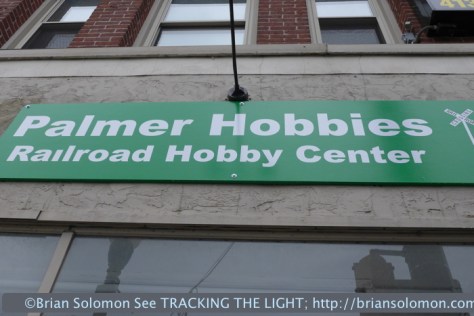
Proprietor of Palmer Hobbies, Bill Lanza, has opened his doors!
Come in and have a look around!
Palmer Hobbies’ Bill Lanza assists a customer.Fine Turf on sale at Palmer Hobbies.New products for viewing.Bill Lanza (left) and Rich Reed (right) discuss locomotive details.Palmer Hobbies is prominently located on Main Street. Come in and read their magazines!
Palmer Hobbies features a variety of model railway products, magazines, and, of course, railroad books!
Patrons of the old Tucker’s Hobbies (formerly Tucker’s Hardware) in nearby Warren, Massachusetts will find familiar faces.
The new store is easy to find. It’s located at 1428 Main Street in Palmer, Massachusetts. Take the Massachusetts Turnpike to Palmer, turn right and drive toward Depot Village. The shop is located in the center at the lights near the Hess Station and across from the CVS drug store.
Palmer Hobbies is near the famous Palmer Diamond, where New England Central’s former Central Vermont crosses CSXT’s Boston & Albany route. It’s across the tracks from the popular Steaming Tender restaurant (near CP 83).
On June 11, 2014. A CSX tie gang works the old Boston & Albany route. In the distance is the popular Steaming Tender railroad themed-restuarant.
Phone: 413-436-5318. Open Tuesday to Saturday. (Closed on Sunday and Monday).
It was a dull autumn day. My father and I were in New York City to visit a friend. We spent the afternoon wandering around on the subway system.
An L train Brooklyn, New York, November 1998. Exposed with a Nikon F3T with 24mm lens. (The route is L, not to be confused with the colloquial ‘El’ or Chicago’s ‘L’, just for clarification).
I made this photo at East New York Junction where the Canarsie Line crosses the Broadway Line.
The sky was dark and swollen and the street lights were just coming on. To make the most of the lighting, I exposed this photo on black & white film with my Nikon F3T with an AI 24mm Nikkor lens.
I’ve always felt there was an apocalyptic aesthetic to this image.
Avalon is at the heart of Arthurian myth. And, as it happens, it’s also on Wisconsin & Southern’s former Milwaukee Road Line between Janesville and Chicago!
No knights in armor here, nor Merlin, nor Lady of the Lake; just a matched set of SD40-2s in clean paint leading a long freight and tall late season grasses blowing gently in the wind.
A few hours earlier I’d met up John Gruber at the Janesville Roundhouse and we spent a pleasant afternoon photographing this freight. We had a fair wait at Avalon before the train came into view.
Exposed with a Canon EOS 7D with 200mm lens. ISO 200.
This photo is among my favorite from the day. I used a long lens to compress the locomotives while setting the grass in the foreground out of focus. I also made a closer view on Fujichrome film.
A few weeks ago, Ciarán Cooney asked me about photos I’d made of Irish Rail’s Athy Cement. This used to run weekdays from the cement factory near Limerick to a cement silo off a short branch that crossed the River Barrow in Athy, County Kildare. It was the only train to use this branch.
On several occasions, I’d made the effort to photograph this train, which tended to arrive laden in the very early morning, then depart empty after it had discharged. Most of the times I saw it, it ran with a single Bo-Bo General Motors diesel (class 141 or 181).
I caught it crossing the Barrow at Athy on a fine spring morning, May 3, 2002.
Exposed with a Nikon F3 with 85mm lens on Fujichrome Sensia 100 slide film.
That was more than 11 years ago, but it doesn’t seem so long.I think I last photographed this train about 2005, shortly before it was discontinued. While cement trains worked Irish Rail for a few more years, they are now extinct.
Exposed with a Nikon F3 with 85mm lens on Fujichrome Sensia 100 slide film.
Great Railway Exhibits and Antiques in Addition to the Streamlined Superstars.
In an environment characterized by streamlined sensory overload, it takes a trained eye (pardon pun) to see past Norfolk & Western’s 611, Burlington’s stainless steel E5A, Union Pacific’s radiant executive E-unit and the rest of the colorful Es and Fs paraded on display around the Spencer roundhouse.
Yet, in addition to the vintage streamliners, there were other noteworthy exhibits and interesting equipment. Amtrak’s 40th Anniversary Display Train with locomotive 42 (painted to commemorate America’s Veterans) was featured prominently, as was one of North Carolina’s train sets used for Piedmont services.
Various heritage locomotives attached to the Spencer shops added period interest. Back in the day (1980s), I was quite pleased to find a Southern high-hood GP30 working at Alexandria, Virginia. And lo and behold, here at Spencer was preserved locomotive just like the one I saw those many years ago!
For those interested in automobiles, Spencer has quite a collection of vintage cars on display. Lots to see and do! I’m glad I invested almost four days in the event.
Exposed with a Lumix LX-7. The diffused light made for wonderful reflections.
Among the stars of the Streamliner’s at Spencer event was Norfolk & Western 611, one of only a handful of preserved American streamlined steam locomotives. Here’s a sampling of the many images I made, and an excerpt of the text from my book Super Steam published by MBI (out of print), where I detailed the J class. Today the locomotive catches attention for its streamlined shrouds, but there’s a lot more to the N&W J than just good looks:
“Among the most impressive products of N&W’s Roanoke Shops were its 14 Class J 4-8-4s. These spectacular machines defied convention while settting record for performance and reliability. The first five J’s were built during 1941 and 1942, with N&W’s distinctive streamlined shrouds, and featured 27×32 inch cylinders, 70-inch drivers, 107.7 square foot firebox grate, and a huge boiler set for 275 lb. psi operation. As built these locomotives delivered 73,300 lbs. tractive effort. (N&W later increased the boiler pressure to 300 psi, and as result tractive effort was increased to 80,000 lbs.) The J class exhibited all of the trappings of modern locomotive, featuring roller bearings on all axles and reciprocating parts, one-piece cast steel frame, mechanical lubrication and light weight alloy-steel rods . . .”
611 Noir. Exposed with a Canon EOS 7D.N&W 611 surrounded by the enemy.611 in stereo. Lumix LX-7 photo. There’s nothing like a good puddle to make a great photo!Nose view of one of America’s most famous locomotives. Exposed with a Lumix LX-7.
I’ve been reviewing the hundreds of digital color photos I exposed at Spencer and I’ve added six of my favorites to my special page dedicated to the event.
Chicago & North Western 411 and friends. Canon EOS 7D photo.
For me, the Streamliners at Spencer event was a great opportunity to meet friends, old and new. In addition photographing the equipment, I photographed the photographers.
Below is a small selection. I’ll post more tomorrow!
Photographers at night. Lumix LX-7 photo.LX-7 photo at Salisbury station.In glow of Saturday evening. Lumix LX-7 photo (before my second battery went flat).Media man in Salisbury. Lumix LX-7 photo.Norfolk Southern’s Wick Moorman addresses Spencer. Canon EOS 7D with 200mm lens.LX-7 photo.Master of three-D photography. Lumix LX-7 photo.Norfolk Southern Museum. LX-7 photo.Waiting on the Piedmont at Salisbury. Lumix LX-7 photo.LX-7 photo.Waiting for the turntable to spin. Lumix LX-7 photo.
Back then, Irish Rail operated three daily ammonia trains between Marino Point, County Cork and Shelton Abbey near Arklow, County Wicklow. These were tightly scheduled and normally operated with the common 201-class General Motors diesels.
I was tuned into these trains, and made an effort to catch them in interesting locations. The traffic ended with little warning in 2002, so the photos I made are now prized images!
Irish Rail class 201 number 204 leads a laden Ammonia train above the Irish Sea at Killiney. Is that U2’s Bono waving off in the distance? Exposed on Kodak Tri-X with a Rolleiflex Model T f3.5 Tessar lens, processed in Ilford ID11 (special mix and time, 1:1 with water.)
In addition to color slides, I exposed thousands of black & white images of Irish railways on 120 size film between 1999 and 2005 (and a few here and there since).
Most of these photos have never seen the light of day. This rare photo of the Ammonia train was just one of several exposures I made on that bright May afternoon in 2001.
Why didn’t I make a color photo? And who said I didn’t? Must color and black & white be mutual exclusive? Why not make a color photo and convert it later? Why color anyway?
I’ve often worked with multiple formats at the same time. Black & white has a number of advantages and I’ve long prided myself on mastering this archaic image-making process.
Streamliners at Spencer: The Real Star of the Show?
Although streamlined steam locomotive 611 was getting most of the attention, historically the most important exhibit was General Motors FT demonstrator 103.
Last night FT 103 was lit up for all to see.
General Motors model FT lit up at Spencer Shops on May 30, 2014. Exposed with a Canon EOS 7D with 100mm lens on a Gitzo carbon-fiber tripod.
I’ve written about this locomotive in many of my books. It is the most influential American locomotive of the twentieth century because it demonstrated to the railroad industry that diesels offered a cost effective replacement for steam.
Electro-Motive’s most significant innovation was its development of the first commercially viable road freight diesel. From a technical perspective this was an advancement of the E-unit — the application of this long anticipated new road diesel proved revolutionary for American railroads. Once on a roll, it not only turned locomotive building on its ear, but forever changed the way railroads bought locomotives and operated trains EMD’s F-unit was the most important player in the rapid dieselization American lines.
NS CEO, Wick Moorman pointed out in yesterday’s address at Spencer, that FT 103 was ‘even older than 611,’ while sincerely thanking the St. Louis Museum of Transportation for sending the locomotive for display.
Pan Am at North Bennington? Who could have imagined this 20 years ago?
Pan Am Railways RJ1 at at North Bennington; Victorian-era railway station with a sky blue 1970s-era diesel-electric. Exposed with a Canon EOS 7D.
I spent that morning following Vermont Rail System’s ‘B&R Job’ south from Rutland. Yet the photographic highlight was catching its connection, Pan Am’s RJ-1 local, at North Bennington.
Back in the day, Pan Am was an airline with round the world schedules. The name conjures up images of handsome blue Boeing 747s, or pre-World War II ‘Clippers’ (see planes).
Pan Am Railways is a re-branding of the Guilford system which operates former Boston & Maine and Maine Central lines. In 2007, two former Canadian National GP40-2L (sometimes identified as ‘GP40-2W’) locomotives were painted in a livery reminiscent of the old Pan Am Airlines’ scheme.
Yet, this scenario seems just a bit weird to me, like some alternate version of the future. Anyway you look at it, the combination of the restored historic station and a sky blue engine is both fascinating and strange.
North Bennington station.Southward Pan Am RJ-1 passes the Bennington Battlefield site. For a number of years the tracks here were largely dormant.
When I was studying at the Rochester Institute of Technology, Kodak would annually supply photo students with a gift package of examples of their latest products.
Although I was a confirmed Kodachrome customer, as a poor student, I always make use of the other films supplied. In January 1989, I had a role of ‘Ektachrome of the year’. This was the latest 100 speed slide film.
I loaded up the Leica M2, and drove my Dodge Dart around the Rochester area looking for suitable subjects with which to sample this new emulsion.
Exposed on Kodak Ektachrome with a Leica M2. Film processed by Kodak. The image was adjusted in post-processing to compensate for exposure, contrast, and color balance.
At Charlotte, where Conrail accessed a portion of the old Hojack route, I found this local working. Was this the local freight that served Kodak’s Rochester factories on the far side of the Genesee River? I can’t say for certain, but that really would be appropriate, wouldn’t it?
January 1989; Conrail had a full ten years left. At the end of May 1999, Conrail’s independent operations ended and CSX and NS took over.
Afternoon at the North Carolina Transportation Museum, May 29, 2014.
I was keeping the Lumix busy this afternoon. The sun was elusive at times. But the selection of locomotives proved colorful.
Lumix LX-7 view of diesels at Spencer, North Carolina.Nickel Plate Road painted Alco PA at Spencer. Lumix LX-7 photo.A virtual sea of photographers at Spencer, all waiting for that perfect moment.A magnificent collection of fallen flags (and NS).The Burlington E5A goes for a spin. Lumix LX-7 photo.The New Haven FL9’s spin on the table went virtually undocumented, as all eyes were on Union Pacific’s E9A.Wings.General Motor’s grand daddy of Fs with its kin.
Morning Views, May 28, 2014—North Carolina Transportation Museum.
With more than two dozen classic locomotives to photograph, and lots of other relics of interest, I exposed more than 300 image with the Lumix LX-7 in just three hours. In addition, I was also working with my Canons, one for film, one for pixels.
Here are just some of detailed views I exposed with the Lumix. These are macro images, as opposed to wide shots that take in the whole scene. (And, yes, I made plenty of those too.)
General Motors classic FT—’the diesel that did it’.Atlantic Coast Line E3A. Exposed with a Lumix LX-7Alco PA builder’s plate. Is this the real thing or a replica?It’s not all about the locomotives, this fine old passenger car caught my eye.A bit of work on a Reading FP7A. My dad caught these on the ‘Crusader’ back in the day.Southern Railway: visions of yesterday and today. Spencer Shops was a Southern facility.
The light was mixed. Nice soft early sun soon gave way to a hazy flat bright light. I’m glad I brought my old Minolta IV light meter, this proved very useful.
The ease of use of the Lumix LX-7 made it an especially valuable too. Today I was working with the electronic view finder, instead of the rear screen display. I wonder if this altered my compositions?
Wabash 1009. What’s in a number? (When 1,009 =10,000.)Drumhead on the Sandy Creek round-end observation car.Erie Railroad E8A 833—last of its kind.Nose view of General Motors FT 103. I’d argue that this was probably the most significant locomotive in the 20th Century. Read about it in my American Diesel Locomotive and EMD Locomotives. Books on the history of American diesels.Could this be 1956?
I was very impressed by the paint on the Lackawanna F3’s, even if they were built for the Bangor & Aroostook, What are your favorite locomotives on display at Spencer?
One of three DL&W painted F-units on display.Washing Pennsylvania Railroad E8A 5711 at Spencer. Perhaps someone else should fling some mud and grime to make things seem more authentic?
More Spencer Streamliner photos to come over the next few days!
Tracking the Light posts new material every day, with special ‘Extra’ posts on the Streamliners at Spencer event this week!
I made this view on Kodachrome 64 with my Leica 3A and Summitar lens.
On May 29, 1985, I was visiting Montreal, having arrived that morning on the overnight VIA Rail train from Toronto. The signalman/tower operator was friendly, and allowed me to spend several hours photographing trains from the tower.
This was before VIA rationalized its schedules, and there was a constant parade of trains coming and going. Here, I’ve used the tower door to frame an inbound LRC train.
I didn’t think much of the modern LRC trains at the time. But I’m glad I preserved them on film.
Amtrak 79 Carolinian at Salisbury, North Carolina on the former Southern Railway. Lumix LX-7 photo.
We arrived on Amtrak 79 at Salisbury, North Carolina only 63 minutes behind the advertised.
Within a few minutes of our arrival we were afforded a glimpse of the streamliners event. I had my first ever view of an Alco PA. I’m happy.
Former Santa Fe Alco PA diesel-electric dressed in the classic Nickel Plate Road livery. North Carolina Transportation Museum’s Spencer Shops, North Carolina. May 28, 2014. Lumix LX-7 photo.
Today’s post is a follow up to both of yesterday’s posts, which covered my experiments with the Lumix LX-7 and the beginning of my adventure to Spencer.
As covered in yesterday’s Tracking the Light Special Post, I was traveling on Amtrak’s two-car shuttle, scheduled as train 475, which runs from Springfield, Massachusetts to New Haven, Connecticut to connect with Boston-Washington train 175. I sent my post from the train.
Amtrak 475 arrived early in New Haven, giving me about 15 minutes to wander around making photographs. I’m continuing to test my father’s Panasonic Lumix LX-7, and there was some nice low sun to work with.
Exposed with my father’s Panasonic Lumix LX-7. After exposing several angles digitally, I also made a few slides.
I was keen to photograph the Shore Line East train which features a ‘GP40-2H’ locomotive in the classic New Haven Railroad McGinnis livery.
I also fished out my Canon EOS3, that was buried in the depths of my camera bag, and exposed a few frames of Fuji Velvia 100 of the New Haven painted commuter engine. My hand held Minolta IV light meter aided my exposure; f5.6 1/500th.
It will be a few weeks yet before I see the slides, so for now we can settle for the Lumix instant digital images (that’s what they are for, right?)
A Metro-North local bound for Grand Central Terminal. Lumix LX-7 photo.
New Haven in the early evening is a busy place. In addition to Metro-North trains coming and going, an Acela bound for Boston was arriving on Track 4, just as Amtrak 175 approached Track 1.
I exposed a series of images of train 175, hauled by venerable Amtrak AEM7 number 943. How many millions of miles has this old electric have to its credit? Low sun and the angle of the curve made for a nice grab shot from the Boston-end of the passenger platform.
Amtrak 175 approaches New Haven. Lumix LX-7 photo. I found that the LX-7 reacts faster and cycles quicker than the older LX-3. This is especially useful in a situation like this one.Amtrak logo on the side of an Amfleet car. Lumix LX-7 photo.
Certainly, I found that the Lumix LX-7 has its moments, although the differences in the controls (as compared with my old LX-3) befuddled me a couple of times. Traveling on 175 was comfortable, but the WiFi on the train wasn’t working. I arrived in Trenton at the last glow of daylight.
I’m just getting warmed up, so stay tuned! (or what ever the Internet equivalent is to that old radio term).
Pat Yough, Chris Guss and I spent a few cold minutes making night photos in downtown Toronto. I exposed this image using my Lumix LX3 mounted on a Gitzo tripod. A GO Transit train was gliding away from Union Station. Twenty five years earlier on a glorious May morning, I’d been up in that tower! Different times, but basically the same place. Seems like a different world altogether.
I’ve often liked to make detailed studies of equipment. On this day, George S. Pitarys, Bill Linley and I had been following a westward Cape Breton & Central Nova Scotia freight.
Cape Breton & Central Nova Scotia Montreal Locomotive Works M630 on July 25, 1997.
In the evening it stalled near Afton and had to double the hill. This made for ample opportunity to make photos.
At one point when the train was stopped, I used my N90S with a 28mm lens to expose this backlit study of an M630 that was second unit in the consist.
I like the image for its great contrast and its ability to distill the curves and lines of the Alco Century profile. It’s moody, dark, and all about Alco.