About a week ago an Irish Rail ICR rolled past me. These parade by at such regularity that I often pay them little notice. Nice to travel on, but common.
Hey, wait . . . did that one have purple doors? (Since delivery in 2007-2008, these have been forest green).
It did. And I failed to even lift the camera to make a photo.
Shame on me.
So, the other day in nice light when an ICR approached, I was ready. And this one too had the purple doors.
Lumix LX7 photo.
I wasn’t out for the ICR, but rather for the down IWT liner (container train to Ballina, County Mayo) that was running late. Actually, I was on my way to buy batteries for my Nikon F3, which had failed the day before. The stop at Islandbridge Junction was a sideshow.
Lumix LX7 photo.
Reminder: Tomorrow night (28 Feb 2019 at 730pm) at the Irish Railway Record Society in Dublin, I will present my slide show on General Motors Diesels in the USA. The talk is open to the public. The IRRS Dublin premises is in an old brick and stone building along the Liffey near Heuston Station opposite the entrance to the public car park.
A beautiful thing about Dublin on a Sunday morning is the relative lack of traffic.
Not so pretty is the rubbish, broken glass and other carnage that tends to litter the streets following a lively Saturday night.
To make the most of the scene on Westmoreland Street looking back toward at College Green, I used my FujiFilm XT1 with 90mm and made low angle view of a northward LUAS tram passing the 18thcentury façade of the Bank of Ireland (right).
On Thursday 28 February 2019 at 7:30 pm, I’ll be giving my slide presentation on General Motors Diesel-Electric Locomotives in North America at the Irish Railway Record Society premises near Heuston Station in Dublin.
This venue is about a two to five minute walk from the station platforms opposite the car park.
Metrolink F59PH at Simi Valley, California in August 2016.
This is a variation on the program I gave in Cork last October.
I’ll will present grand selection of REAL 35mm colour slides detailing General Motors Electro-Motive Division diesels at work and will cover numerous models on many different railroads, and feature some dramatic locomotive photography.
For me the AEM-7s will always be ‘meatballs’. This name is twice-removed metaphorical allusion. The AEM-7 was derived from the Swedish class Rc electric. The allusion to meatballs is a reference to ‘Swedish meatballs’ and thus shortened to just meatballs, with Sweden being implied.
On December 27, 1986, my old pal TSH and I paid a visit to Bridgeport, Connecticut on a tour of former New Haven Railroad properties.
I made this photograph using my father’s Rollieflex Model T with 645 ‘super slide’ insert.
In my mind the composition made perfect use of the rectangular window. I wonder what I would have come up with if I’d exposed the view as a square?
In my notes, I have a photographic log sheet with details from our December 27, 1986. This should include time, film-type and exposure information, as well as the train number/name. Unfortunately my notes are nearly 3,800 miles away!
In the days after exposing this photograph I made a large print, 11×14 or 16×20 in size, which has sadly vanished. Perhaps, someday I’ll make another.
This morning (24 February 2019) saw a stunning bloody-red sunrise over Dublin.
I made a series of photos with my digital cameras.
It’s probably just as well I brought three cameras, since halfway through my photography with my Nikon F3 loaded with Kodak Tri-X, the button-battery in the camera ran out of juice.
And you say, ‘of course you brought a spare battery’.
No, no I didn’t.
And why was I photographing a blood red sunrise on black & white film anyway?
In the summer of 1999, I was standing on the footbridge at Kildare station where I focused on Irish Rail 225 leading Mark3 carriages as it approached at speed.
My first Nikon N90S was loaded with Ilford HP5 and fitted with an old Tokina 400mm fixed focal length telephoto.
The train was common; my photograph was unusual. Working with extreme telephoto compression, I’ve framed the train in the arch of road-bridge, which has the effect of accentuating the pattern of the crossovers east of the bridge.
I recall the piercing Doppler squashed screech of 225’s horn as it neared the platforms, warning passengers to stand back.
The memory of that sound and the following rush of air as the train raced past puts me back in that place in time nearly 20 years gone. I know too well how I was feeling at the time. Strange how one photograph of a train can summon such memories and feelings.
Last Friday’s (15 February 2019) adventure on Ireland’s Bord na Mona at Lanesborough Co., Longford proved well-timed and we caught many narrow gauge trains on the move.
Below are some more of the digitally exposed colour photos made with my FujiFilm and Lumix LX7 cameras.
Any favorites?
Lumix LX7 photo.FujiFilm XT1 photo with 18-135mm lens.
On Thursday 28 February 2019 at 7:30 pm, I’ll be giving a slide presentation to the Irish Railway Record Society in Dublin on General Motors Diesel-Electric Locomotives in North America.
The talk will be held at the IRRS Premises near Heuston Station in Dublin City. This is about a two to five minute walk from the station platforms opposite the car park.
This is a variation on the program I gave in Cork last October.
LeRoy, New York: 1989: EMD GP40s lead the northward Rochester & Southern road freight by the old Buffalo, Rochester & Pittsburgh station.
I’ll will present grand selection of REAL 35mm colour slides detailing General Motors Electro-Motive Division diesels at work and will cover numerous models on many different railroads, and feature some dramatic locomotive photography.
Thunder on Donner Pass: 645 diesels in run-8 work east at American—scanned Kodachrome 25 slide. I’ll be showing views like this one at my program.
There’s to be some surprises! (Different photos not previously presented)
Yesterday, 20 February 2019, Irish Rail operated two Ballina-Dublin IWT Liners—container trains.
The first, running as K801, had the 071 class leader in the as-built heritage-livery.
I photographed this train at Memorial road in Dublin.
The second, running about two hours behind the first, had freshly painted Irish Rail 074 (in the current gray and yellow). I caught this one from above the entrance to Dublin’s Phoenix Park Tunnel off the Conyngham Road.
In both instances, I worked with my FujiFilm XT1 with 90mm Fujinon telephoto lens.
On Friday, 15 February 2019, during my visit with Stephen Hirsch and Denis McCabe to Bord na Mona’s operations at Lanesborough, I worked with three cameras to document operations.
My FujiFilm XT1 and Lumix LX7 were for exposing colour digital photos, while I employed a Nikon F3 to make classic 35mm black & white images.
I processed the film yesterday using custom tailored formulas.
The first roll was Ilford HP5 that I’d bought a couple of days earlier at John Gunn’s Camera on Wexford Street in Dublin. I processed this using a two stage development, starting with an extremely dilute solution of Kodak HC110 (roughly 1 part developer to 250 parts water) which used as presoak. The weak developer helps activate the chemical reaction and improves shadow detail without overdeveloping highlight areas.
The second stage of development involved Ilford Perceptol mixed 1-1 with water and heated to 71F. Based on past experience, I left the film in the developer for 12 minutes, then stop bath, 1stfixer, 2ndfixer, pre-wash, hypoclear, main wash (10 minutes) and final rinse in distilled water.
After drying, I scanned the negatives with an Epson V500 flatbed scanner and touched up the scans using Lightroom.
I made these views the other day on Beresford Place near Bus Aras in Dublin.
An outbound LUAS tram on the Red Line had stopped for traffic Gardner Street, while a southward DART suburban train rolled across the Loop Line Bridge on its way from Connolly Station to Tara Street.
Lumix LX7 photo.Lumix LX7 photo.
This is the sort of common scene that is repeated hour after hour, day after day, and yet only rarely get recorded.
In theory, on any given weekday you ought to be able to make a representative photograph of Mass-Central’s local freight arriving in Palmer.
This goes on duty in the morning at Mass-Central’s Palmer yard, makes its run up the Ware River Valley and returns, typically dropping its interchange for CSX and New England Central at CSX’s former Boston & Albany yard.
However, catching a locomotive with the cab-facing south and at the correct end of the train can be more difficult. It’s luck of the draw to get the locomotive facing south. And for operational reasons, the locomotive may be placed in the middle or at the end of the interchange when passing the old Palmer Union Station.
I was lucky a couple of weeks ago, when I made this view at CP83 with Mass-Central GP38-2 1750 leading the train. All that’s missing is the sun.
The ‘Old Liffey Ferry’ that had ended service back in 1984 has been revived by Dublin Port, and so now you can cross the Liffey again by boat in the Dublin Docklands.
Although advertised as the ‘Old Liffey Ferry’, it was a new experience for me.
Last Thurday it was bright and warm, and I met with Mark Healy for a photo wander in Dublin and we crossed the Liffey twice by boat.
The posted fare is 2 Euro and the crossing takes just a few minutes. This is a novel way of seeing the Dublin Docklands and offered a variety of photographic opportunities.
The other evening I made a few handheld photos of Irish Rail class 201 diesel number 217 River Fleskat Dublin’s Heuston Station.
217 was working a Mark4 set on the 2100 schedule to Cork.
There are myriad approaches to night photography. In this instance, I worked with my Lumix LX7 without a tripod.
I’m fortunate because I have an unusually steady hand. The Lumix further aids my efforts because it has image stabilization.
I set the camera to ISO 200, and working in ‘A’ (aperture priority) I manually set the lens aperture to its widest opening, which in this case is f1.8. The wider the aperture, the more light passes through the lens to reach the sensor, so having a ‘fast’ lens (one with a small maximum aperture number, such as my f1.8 lens) is a huge benefit.
This set up allowed me work with a 1/10 of second shutter speed, which is adequate speed for a static photograph.
Lumix LX7 photo f1.8 at 1/10th second hand-held, ISO 200, auto white balance. JPG adjusted from a camera RAW file using Lightroom.
Lumix LX7 photo f1.8 at 1/10th second hand-held, auto white balance
If I had been using my FujiFilm XT1 with the kit zoom lens, my widest aperture would have been about f4.5, which is nearly two full stops slower than f1.8, which means at ISO200, I’d require about ½ second exposure to obtain a comparable result, which is too slow for a sharp handheld image in most instances.
Another way of approaching this would be raise the ISO. So with the FujiFilm set up just described, I could increase the ISO setting to 800, which would boost the effective sensitivity of the sensor by two stops (bringing me back up to 1/10thof a second using f4.5). However, this would also boost the noise level and reduce sharpness.
Back in the old days, I would have used Kodachrome, and that would have required a tripod, and probably some filters to colour-correct for the artificial light. Today, digital cameras when set to ‘auto white balance’ do an admirable job of balancing the colour for fluorescent, sodium vapor and other forms of artificial light that tend to tint an image.
Normally for night work with the Lumix, I’d dial in a 1/3 over exposure compensation (+ 1/3 on the exposure compensation dial) however in this situation the relatively bright night sky where low cloud was illuminated by lots of artificial light combined with the silver body of the locomotive and bright platform lighting, obviated the need for boosting the exposure by 1/3 of a stop.
However, I did make some very subtle changes in post processing to help visually separate the roof of the locomotive from the sky.
While the New CT Rail trains tend to capture most of attention on the Springfield-New Haven route (now branded as the ‘Hartford Line’), Amtrak continues to run its shuttles and through trains on the same route.
I made this view last week of Amtrak 490 working northward to Springfield, Massachusetts as it crossed the Connecticut River between Windsor Locks and Warehouse Point.
I like the distant vantage point, using a telephoto lens to feature the small train on the big bridge.
Monday, 11 February 2019 was bright and sunny in Dublin.
Although I was only just back across the Atlantic, I made use of the morning when I’d heard that Irish Rail 073 in heritage orange paint was working the down IWT Liner (container train operated from Dublin’s North Wall to Ballina, Co. Mayo).
As this exited Dublin’s Phoenix Park Tunnel approaching Islandbridge Junction, an Irish Rail ICR working the Hazelhatch-Grand Canal Docks service came the other way.
I hadn’t anticipated a ‘rolling meet’, but as luck had it I got two trains for the price of one.
This sequence of photos was exposed using my FujiFilm XT1 digital camera with 27mm pancake lens.
Last week, Paul Goewey and I revisited Thompsonville, Connecticut, an old mill village along the former New Haven Railroad, just south of Springfield, Massachusetts.
I made photos here in the mid-1980s and late 1990s, but hadn’t scoped the location since the start up of CT Rail passenger services last year.
I’d been inspired to go back when I traveled on CT Rail a few days earlier.
These views were exposed using my FujiFilm XT1 of southward CT Rail train 4405 on its way to Hartford and New Haven. I worked from the road, making images from the ‘dark side’ of the train by using my telephoto to feature the train rolling though the curve.
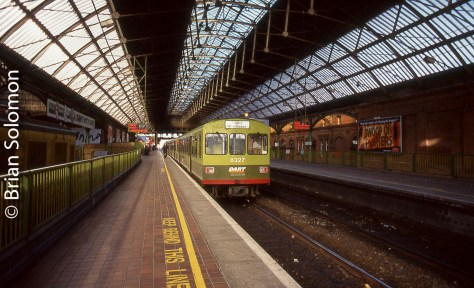
Pearse Station features a capacious Victorian-era balloon-style train shed. Presently this is under-going restoration making for seen very different scene today than this one that I exposed 21 years ago.
I was very impressed by the Pearse Station shed and exposed a number views to make the most of the structure.
This is among my favorites. I’m standing near the south entrance to the shed, and the illumination effects resulting from combination of the broad southward opening and skylights produce an excellent effect on the train and platforms.
My composition is simple, yet clever. I’ve centered the DART train— which some photographers would frown upon, insisting instead on arbitrary placement using rules of thirds or other preconceived notions—and so made the most of the train shed, which is really the subject of my image.
By allowing for greater amounts of interior space to the right of the train, I’ve caused visual tension, while helping to expand the space in the photograph occupied by train shed. This draws the eye away from the train, while the lighting on the front of the train pulls the eye back. Placement of the rails to the lower right corner has another effect, allowing the eye to follow lines of perspective back to the north opening of the shed.
A novice artist might crop this image by cutting the space to the right of the train, moving the corner from the rails, and thus spoiling the intended effects while placing greater emphasis on the DART train, and in so doing ruining my intended composition.
South of Stafford, Connecticut, the former Central Vermont Railway runs along Plains Road, before crossing it to continue its path along the Willimantic River.
This is a favorite morning location for me, but a week ago Tuesday I opted to catch the southward 608 in the last rays of winter sun.
These are 12mm wide-angle views exposed with the FujiFilm XT1 and 12mm lens.
Brian is Traveling but Tracking the Light tries to post Every Day!
Last Tuesday was another sunny afternoon, and so another opportunity to photograph 608 New England Central rolling through downtown Stafford Springs, Connecticut!
This time I worked with my FujiFilm XT1 with 12mm Zeiss Touit lens.
As the train eased through town I made my way to another location for an additional photograph. Stay tuned!
Recently discussions of Irish Rail’s Sligo Timber have led me to ask, ‘When did this traffic end?’
Sometimes my memory offers a clear picture of the past, in other situations it is fuzzy and lacking desired detail. This is among the reasons I try to apply detailed labels and captions to my photographs near the time of exposure.
I recall the Sligo timber’s revival in Spring 2002, and my many opportunities to photograph timber trains on the Sligo Line and in around Dublin in the years that followed, but I’m unable to remember when the last train operated.
On guessing, I thought 2007 or 2008 was pretty close. So on reviewing my photo files, I was a bit surprised to find this photograph dated 21 May 2009.
Photo by Brian Solomon on 21 May 2009.
I exposed this view on Fujichrome from my regular spot at Islandbridge Junction, which shows Irish Rail 232 in the modern green livery leading a timber out of the Phoenix Park Tunnel. The construction-progress of the apartments at left helps me confirm the date of the photo.
So, when was the final movement of timber by rail from Sligo? I must have been away.
—Not seeing semaphores? Click the link to Tracking the Light to get the full view and story—
I made this vertical (portrait) view of a driver’s training special on Irish Rail’s Sligo Line at Killucan back in April 2003
Railway Preservation Society of Ireland tank engine No 4 had run around its train at Killucan and then received the signal to reverse back on the main road (line). The driver had opened the regulator (throttle) and the engine had begun to move when I released the shutter, framing the engine in a cloud of its own effluence.
The semaphores were removed in conjunction with Irish Rail’s conversion of the Sligo line to operation using Mini CTC signaling during 2005, a change that closed Killucan cabin, among other classic signal cabins on the route.
Sunday, I featured a photo of Connecticut Southern’s southward road freight crossing the old New haven Railroad bridge over the Farmington River at Windsor.
Today’s photo is of the same structure, but in the morning from the east side.
Amtrak train 147 at Windsor, Connecticut. Exposed with a FujiFilm XT1 with 90mm lens.
This classic bridge is easily accessible with good parking, which makes it a nice place to catch trains on the Springfield-Hartford-New Haven Line (now marketed by CT Rail as the ‘Hartford Line’).
Brian Solomon is Traveling: Tracking the Light Normally Posts Daily
Here’s a follow up from Saturday’s post about traveling on CT Rail.
My CT Rail train had overtaken the southward CSOR freight south of Springfield. So when I got off at Windsor Locks, I drove to this location and waited for the freight to follow.
High water in the Farmington River made for a mirror-like reflection.
Brian Solomon is Traveling; however Tracking the Light Normally Posts Daily
The sun peeks through a laden sky after an Autumnal shower as Irish Rail V250, a sugar beet train from Wellingtonbridge to Mallow rolls along the Cork main at Shinanagh near Buttevant.
I exposed this view on Fujichrome Velvia100 using a wideangle lens.
My intent was to capture the dramatic light and textured sky.
This was to be Irish Rail’s final sugar beet season. The traffic ended forever in January 2006.
Brian is Traveling; Tracking the Light normally Posts Daily.
On Monday February 4, 2019, I took a spin on CT Rail from Windsor Locks, Connecticut to Springfield, Massachusetts and back. The fare was a reasonable $4.00 in each direction and I bought my tickets from the fare machines at the stations.
Traveling by train presented an opportunity to visit with my old friend Jack May, who had traveled up from the New York metro area.
XT1 photo.CT Rail train interior. Lumix LX7 photo.Connecticut Southern freight seen from the cab-car of the Northward CT Rail train. I was riding in the coach and photographed through the windows. The freight is shoving back from West Springfield Yard in preparation for its southward journey toward Hartford.
Restored Springfield Union Station. Lumix LX7 Photo.
Restored Springfield Union Station. Lumix LX7 Photo.
I made a few photos using my Lumix LX7 and FujiFilm XT1 digital cameras. It was a nice bright day! I scoped additional line-side locations from the train.
It was a bright overcast afternoon on 26 May 2005, when I photographed Irish Rail 077 leading an empty bubble cement train from Conyngham Road in Dublin looking toward platform 10 at Heuston Station.
I made this photo on Fujichrome slide film using my Nikon F3 with 180mm Nikkor ‘prime’ telephoto lens.
The telephoto compression has the effect of making the distant mountains seem closer while foreshortening the appearance of the cement train, which makes the individual four-wheel cement wagons seem even shorter than they were.
On July 7, 2001, I traveled with the late Norman McAdams to photograph an Railway Preservation Society of Ireland Strawberry Fairsteam special led by locomotive 171.
During the course of the day we caught this colourful excursion at a variety of locations on the Dublin & Southeastern route south of Dublin.
In the afternoon, typical Irish summer weather closed in on us, with heavy skies and haze.
I made this telephoto view of the northward trip at Killurin, County Wexford along the River Slaney. I opted to photograph the train at distance to show the full consist and the snaky track alignment.
Trains Magazine’s Brian Schmidt and I were making the most of sunny frosty weather in central Wisconsin.
We arrived at Columbus to refuel.
Upon exiting the gas station, we spotted a westward CP Rail train making its way over the old Milwaukee Road mainline. Soon we were in rapid pursuit.
I navigated using my iPhone and we found our way to an open crossing near Wyocena.
“Hey, I know this place” I remarked upon arrival at Salisbury Road. “I caught Milwaukee Road 261 here back in 2004.”
As we waited for our westward freight, I imagined what it would have been like to see Milwaukee’s famous streamlined Hiawatha race through at 100 plus mph.
Wow. That would have been exhilarating. An Otto Kuhler styled 4-6-4 in yellow, orange, gray and maroon.
Before my time . . .
So we happily settled for a BNSF former Santa Fe SD75M leading two CP Rail units on a long drag freight.
Photo exposed using a FujiFilm XT1 with 18-135mm pancake lens; ISO 400, Velvia Color Profile.
We were rewarded by a following westward freight a few minutes later, and then an eastbound!
I had Velvia in my Nikon F3 and I was focused on the boats in the River Liffey, when the Saturday laden timber from Sligo rolled out of Dublin’s Phoenix Park tunnel and crossed the bridge in front of me.
Brian Schmidt, Chris Guss and I didn’t know what to expect at Hamilton Road when we heard an old EMD grinding away up CN’s Byron Hill south of Fond du Lac, Wisconsin.
I still didn’t know what to expect when I first spotted a mustard yellow machine belching black smoke.