Last weekend, Kris and I traveled from Cork to Drogheda via Dublin on Irish Rail.
The first leg of our journey was on an Irish Rail InterCity Railcar from Kent Station to Dublin Heuston.
I made most of these photos using my Nikon Z6 with 24-70mm Z-series zoom lens.
For better internet presentation, I made adjustments to shadow and highlight detail, while refining color balance, color temperature and overall contrast.
f2.5 105mm lens with Nikon Z6 digital camera.Irish Rail ICR Kent Station, Cork. Exposed with a Nikon Z6 with 24-70mm Z-series lens.View of Irish Rail 215 from an ICR.Irish Rail ICR Kent Station, Cork. Exposed with a Nikon Z6 with 24-70mm Z-series lens.Irish Rail ICR Kent Station, Cork. Exposed with a Nikon Z6 with 24-70mm Z-series lens.Irish Rail ICR Kent Station, Cork. Exposed with a Nikon Z6 with 24-70mm Z-series lens.
Last week we paid an evening visit to Kent Station, Cork, to witness the departure of Irish Rail’s Mark IV to Dublin.
The lighting was mixed. My white balance on my Nikon Z6 was set to ‘auto’ which provided a good starting point. I didn’t want the balance to appear too neutral and negate the mood of evening.
I made a variety of small adjustments to the Nikon’s NEF RAW files in Adobe Lightroom to preserve the character of the light, while retaining highlight and shadow detail in what was a very constrasty situation.
Irish Rail class 201 number 221 works at the back of the train.
Last week, Kris and I traveled from Cork Kent Station on Irish Rail’s 2600-series railcars to Cobh—the town formerly called ‘Queenstown’—a place well-known for its role in Transatlantic transportation.
Among other things, Queenstown was the last port of call for the ill-fated Titanic, which sunk 110 years ago.
The old railway station building now houses the Cobh Heritage Centre.
I made my views with my Nikon Z6 mirrorless camera. Kris made the photo of me at Cobh station with her Fujifilm XT4.
Nikon Z6 with Z-series 24-70mm lens.Nikon Z6 with Z-series 24-70mm lens.Nikon Z6 with Z-series 24-70mm lens.Exposed using a FujiFilm XT4 digital camera.Doodles in training at Cobh. Nikon Z6 with 24-70mm.Cobh Heritage Centre. Nikon Z6 with AI f2.5 105mm lens.Cobh Heritage Centre.Cobh Harbour. Nikon Z6 with AI f2.5 105mm lens. Exposed for highlights.Nikon Z6 with AI f2.5 105mm lens.Nikon Z6 with AI f2.5 105mm lens.Nikon Z6 with AI f2.5 105mm lens.
Kris and I stopped over at Glounthaune on the way from Kent Station, Cork to Cobh.
This is a familiar station to me, and over the years I’ve exposed many photos here.
I made this selection during our 15 minutes between trains using my Nikon Z6 with 24-70mm lens. The tide was out and we spotted a pelican among the other seabirds near the station platforms.
At Cobh, we found a photo on the wall that shows how Glounthaune looked in the 1960s when it was called Cobh Junction.
The other evening, we paid a visit to the abandoned Chetwynd Viaduct that spans the Cork-Bandon road in County Cork, Ireland.
This was a spur of the moment visit. I was not carrying my tripod. However, through the magic of modern digital photography, I was able to make a few images of this unusal bridge.
These were made using my Nikon Z6 handheld with f4.0 24-70mm lens with ISO set to 51,200. The results are a bit grainy (pixelated), but amazing considering the scant amount of available light.
For another view of the Chetwynd Viaduct, see my post from 2015:
Thanks to our friends in Cork, the other evening Kris and I made a few photos of Irish Rail’s Cobh Branch near Cork’s Kent Station.
It had rained (and rather hard at that) before the clouds cleared for some intense evening sun. These were great conditions for photos.
Irish Rail’s 2600-series diesel railcars have been working the Cork-Cobh run since my first visit in 1998, but now these are on borrowed time.
I made these digital photos using my Nikon Z6. I’m curious to see how my Kodak Ektachrome 100 slides will turn out.
It was beginning to rain when I made this photo of 2600-series railcars arriving on Plaform 1 in Cork. Within the hour the skies had cleared.Less than an hour after the above photo, I made this view of an arriving train from Cobh.Good ol’ 2616 at Kent Station, Cork.Cork-bound train from an overhead bridge.
Our visit to Cork, included a tour of Kent Station, conducted over the course of serveral days.
Over the years, I’ve often featured this Victorian-era gem on Tracking the Light. It is unusual for its sharply curved train shed.
I was impressed by the frequency of passenger trains serving the station. There is a steady procession of trains to and through the station with regular departures for Dublin, Cobh, Mallow, Middleton, and Tralee.
I made these photos using my Nikon Z6 with 24-70mm lens.
On Monday, 3 October 2022, Kris and I traveled on Irish Rail’s 1200 Dublin Heuston to Cork (Kent) train.
It was a typically dull day with showers and occasional sun across the Midlands.
We had First Class tickets and traveled in Coach A of a five-piece ICR (InterCity Railcar).
At Cork we were given a warm and very special welcome by Irish Rail.
Heuston Station.Self portrait with the Nikon in Coach A on the way to Cork.Cork’s Kent Station upon arrival on platform 4.The arrivals/departures board at Cork had a special welcome for us!Cropped version of the above photo.
I made these photos of the trip using my Nikon Z6.
The other day while we were waiting for the DART to Howth Junction, I made this sequence of digital photos of Irish Rail’s DART electric trains passing Connolly Station.
All were exposed in RAW (NEF format) using my Nikon Z6 and adjusted using Adobe Lightroom.
Yesterday, I made this photo of an Irish Rail ICR (InterCity railcar) paused at Platform 4 at Dublin Connolly Station.
It was a comparatively quiet Sunday afternoon and dull outside, but the soft lighting made for a perfect time to portray the modern diesel railcar in the Victorian-era railway station.
Over my many visits to Dublin since the start of LUAS tram services in 2004, I’ve made many photos of the various specially decorated LUAS advertising trams that grace the system.
Over the last few days wandering the streets of Dublin, I’ve continued my LUAS photography and focused on a few of the Ad trams that add to the color of the City Centre.
I made these views of Sky television wrapped trams using my Lumix LX7.
Southward Green Line tram crossing the Rosie Hackett bridge over the LiffeyCloser view at the Rosie Hackett bridge.Eastward Red Line Tram on Abbey Street near O’Connell Street.Eastward Red Line Tram crossing O’Connell Street.Westward Red Line Tram on Abbey Street at the Jervis stop.
Step back to September 28, 2020. I had just bought my Nikon Z6 mirrorless camera. The foliage was turning, and I hiked up to the famed Frankenstein Trestle to catch the Mountaineer on its ascent of Crawford Notch.
This photo is among my favorites from 2020. I have used it extensively to promote Conway Scenic Railroad. It has appeared in various magazines and newspapers. The railroad sells refrigerator magnets featuring this image in the North Conway Brass Whistle Gift Shop, and we had monochromatic hoodies made up as well.
Saturday, September 17, 2022, Conway Daily Sun featured the photo on the cover of the newspaper.
The photo was exposed with my Z-series 24-70mm zoom set at 26mm, aperture at f4; camera shutter speed to 1/1000th of a second. I made adjustments to shadows, highlights and color temperature and saturation using Adobe Lightroom.
Another tip: So when selecting the appropriate Big Bus Dublin, it is helpful to find a relatively empty tour. Not only will the give you the best seat in on the bus (up top, at the back), but also great freedom to move around to capture the best angles.
The first bus of the day tends to be crowded, while I found those mid afternoon to have ample space.
I made these views with my Nikon Z6.
LUAS at College Green from the back of the Big Bus tour.LUAS near College Green from the back of the Big Bus tour.LUAS and the Aircoach at College Green from the back of the Big Bus tour.Heuston Station, Dublin.Heuston Station, Dublin.
Here’s an interesting way to make elevated views of Dublin’s trams: ride at the back of an open-top tour bus.
Kris and I bought 48-hour tickets for the Big Bus Dublin, which provides a half-hourly hop-on hop-off service.
This was primarily a way for us to play tourists in Dubln, but I quickly found that it offered an excellent means to photograph the LUAS.
We traveled on three different types of buses. The variety that was most effective allowed me to shoot over the railing at the very back of the bus. Some of the more modern coaches didn’t have this feature, so you should choose your bus carefully.
I made these photos using my Nikon Z6 mirrorless camera with a 24-70mm zoom.
In May 1978, my father drove us to Palmer, Massachusetts to watch the passage of the eastward Lake Shore Limited (train 448). I made a series of photos using my pre-war Leica IIIA rangefinder on Kodacolor II color negative film.
This trailing view looks east toward the old South Main Street Bridge and Conrail’s Palmer yard. It looks like something nasty happened to the westward signal (at right). A pair of E8s led the train.
Despite their age, these old color negatives have held up reasonably well. I scanned them in 2016 using an Epson V600 flatbed scanner.
Yesterday evening (September 22, 2022), I made a few photos of Dublin’s LUAS trams using my Nikon Z6.
It had been raining much of the day but about 6pm the sun came out, making for some interesting but high contrast scenes.
Back in the old days I’d have worked with black & white film to make the most of this type of lighting, and controlled the contrast chemically. Now, I’m applying contrast controls digitally to my Nikon’s NEF (RAW) files using Adobe Lightroom.
Do these photos work?
If they don’t, I’ll take more later.
LUAS tram on Parnell Street in Dublin. JPG from the unaltered NEF file (No changes to color, contrast, exposure etc).LUAS tram on Parnell Street in Dublin. This is my adjusted version of the same NEF file. I’ve paid special attention to the sky using Adobe Lightroom’s built in ‘select sky’ mask.Abbey Street in Dublin. JPG from the unaltered NEF file (No changes to color, contrast, exposure etc).Abbey Street in Dublin. JPG from the adjusted NEF file.
The wee Reading Company has had some new arrivals!
Thanks to my long-time friend and expert model railroader, Rich Reed, my model railroad now has a variety of new equipment.
Rich painted a Reading class I-8 2-8-0 camelback for me. This is an interim paint job while we search for the appropriate Reading Company decals. He also supplied as wedding gifts; a Reading I-10sa 2-8-0 (with conventional cab arrangement); a tiny Reading Company camelback 0-4-0 similar to the class A-4b No. 1187 that used to live at the Strasburg Rail Road, a selection of Reading Co. freight cars and some buildings and other small structures.
I made these photos the other night using my Lumix LX7 to feature some of the additions to my interpretation of coal country.
In the ‘real world,’ Penn Central and Reading Company camelback 2-8-0s missed each other by more than 20 years.Look through the trees! That’s a camelback 0-4-0 coming down grade.West Cressona Yard has a few new additions thanks to Rich Reed!This Penn Central RS-3 and caboose was a gift to me from Ken Buck that predated my wee Reading Company by almost a decade. The models had been his father’s. Look above the caboose and you’ll see the sign that Rich made for me that advertised Bob Buck’s Tucker’s Hobbies of Warren, Massachusetts.My RDCs now have a wee station to serve at Minersville.Schuylkillhaven now has a movie theatre!
When you make a lot of photos it is crucial to review and edit the images to select the most appropriate photos for presentation.
But what are the most appropriate images? I’ve often found that my second review of a batch of images will reveal a more interesting selection than the first edit.
The day of our special trip on RDC Millie for our wedding guests, I’d forgotten to pack my SD card reader. However, since my brother lent me a clever device I was able download selected photos from my Panasonic Lumix LX7’s SD card directly to my Apple iPhone. I posted a few of those images on Sunday.
Last night, while recovering from Sunday’s celebrations, I had the time to download and review all of the photos from Saturday’s trip and make the most of them.
Below is my ‘second edit’ from Saturday, September 17th, 2022.
Sanford, Florida reunion gang.Richard Jay Solomon holds up the signed copy of my latest book.Chris Guss shows off his drone at Moat Brook.Conductor Rob Flannigan and Mass Bay RRE’s Dave Brown.Millie at the Swift River Bridge.Photographers on the platform at North Conway, NH.Family and friends on the platform at North Conway, NH.
On Saturday, September 17, 2022, I’d arranged with Conway Scenic’s operating department to take Budd RDC-23 Millie on a special trip for our wedding guests.
We boarded at the North Conway grade crossing as the regularly scheduled Sawyer River excursions boarded at the station platform on the adjacent tracks.
I served as motorman, Rob Flannigan as conductor. We had more than 27 guests on board.
The weather was perfect; bright sun and blue skies.
Since our train was not operating on a schedule, we ran as an ‘extra’ and carried white flags, as per rulebook 34.
Our first stop was at the Moat Brook bridge, where we let guests off to make photos. We also stopped at the Swift River Bridge and at the Conway freight house.
Many of our closest friends and family were on board, including several long-time Tracking the Light readers. My friend Chris Guss made some drone photos of the event.
It was a lovely day for a train ride! In addition to these digital photos exposed with my Lumix LX7, I made seveal Fujichrome Provia 100F color slides.
My friends posed for photos with Millie.Re-boarding near Moat Brook.Photo stop at the Swift River Bridge.
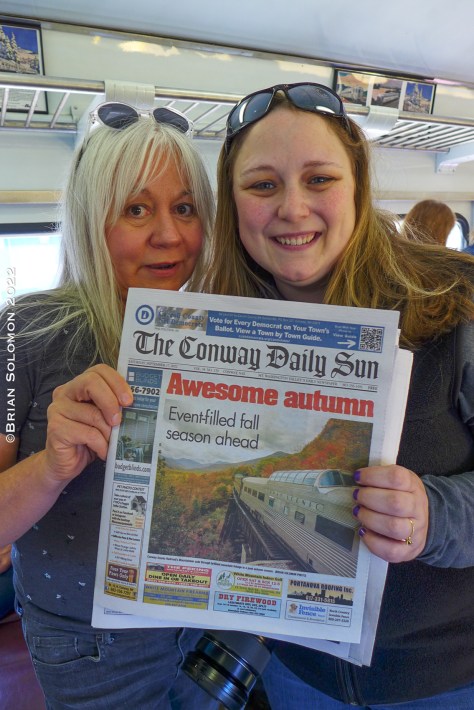
Our special train and upcoming wedding were mentioned on page 9.
Here’s a photo of my sister-in-law Isabelle (left) and Kris (right) holding the Conway Daily Sun aboard Conway Scenic Railroad’s Budd RDC Millie.
I am posting from the wedding venue. I left my SD card reader at home (by accident) so my brother lent me a clever device that allowed me to download my Lumix LX7 SD card to my Apple iPhone. I then forwarded the photos to my Apple MacBook Pro for adjustement and posting to Tracking the Light.
On January 4, 2020, I met my future fiancée at Mass Bay Railroad Enthisiast’s ‘Steam in the Snow’ event held at Conway Scenic Railroad—where I’d been appointed manager of marketing & events just a few weeks earlier.
I met Kris on the platform of the North Conway Station, where I said, ‘hello’, and was properly introduced by mutual friend Doug Scott a little while later.
At Notchland we all stood together to make photos.
Tomorrow, Sunday September 18, 2022, we are getting married in Lincoln, New Hampshire.
On September 16, 2019, I was traveling in Germany with my old pal T.S.H.
We’d set up north of Boppard along the River Rhein to photograph the morning parade of trains on the busy ‘Left Bank’ route.
For these photos I borrowed T.S.H.’s 50-140mm Fujinon zoom and fixed it to my Fujifilm XT1 as a test.
These images are scaled from the in-camera Fuji JPGsmade with the camera’s Velvia color profile. These files have not been adjusted in post-processing.
Both images are trailing views of northward train IC 2226 that were exposed from the same vantage point. The first has the zoom set at 50mm, while the second has the zoom set at 140mm.
Fujinon 50-140mm zoom at f5.6 1/500 sec; 50mm setting.Fujinon 50-140mm zoom at f6.3 1/500 sec; 140mm setting.
On September 15, 2013, I observed and photographed an airshow over Dublin.
Working with my Canon EOS7D with 200mm prime telephoto, I made these views of an historic World War II-era B-17 aircraft as it circled the city center.
These photos are scaled versions of the camera-profiled JPGs. Canon’s sensor has a wonderful ability to render sky colors.
Yesterday (September 13, 2022) I returned to Goves, where the old Maine Central Mountain Division ducks under Route 302 east of Bartlett, NH, to again photograph Conway Scenic Railroad’s Mountaineer on its westward run to Crawford Notch.
The other day in my Tracking the Light Post, ‘Poles and Wires Conundrum,’ I described my compositional frustrations with this location.
Working with my Nikon Z6 with 24-70mm lens, I selected a slightly lower position that was a bit closer to the tracks.
On this attempt, the Mountaineer had two units and seven cars, which made for a more photogenic train. Also, it was brightly overcast, which helped to minimize the poles and wires, and I opted for a tight crop.
Last Friday, Conway Scenic’s president and general manager Dave Swirk, asked if I could be available on Monday (September 12) to document the moving of steam locomotive 501 into the North Conway Roundhouse for the first step in its restoration evaluation.
Locomotive 501 is an Alco 2-8-0 built for Maine Central and was a regular freight locomotive on Maine Central’s Mountain Division for many years. It had been part of the Steamtown collection, but when Steamtown relocated from Vermont to Pennsylvania in the 1980s the locomotive was moved to North Conway, N.H. for display.
Until yesterday, 501 had been prominently displayed in front of the North Conway freight house.
The railroad used former Maine Central GP7 573 to move the collection of freight and passenger cars behind the locomotive 501, and then hauled the locomotive from its resting place to the run around track (known as the ‘WA’) in front of the station.
Former Canadian National 0-6-0 7470 was fired up to complete 501’s move to the roundhouse, and I made a series of photos of the two locomotives together.
In addition to photos of the move, I also recorded video using the railroad’s Sony 4K capable video camera.
These images were made using my Nikon Z6 mirrorless camera and adjusted for color temperature, contrast, and exposure using Adobe Lightroom.
Yesterday, Kris & I made a drive to Vermont to deliver Hans-the-Rooster-Chicken to an animal sacntuary where he will live out his days. Hans has lived in our back yard since 2020 and has faithfully ushered in the new day with his cockadoodeling for many months.
It was a beautiful day and on the way back we stopped at a various places to make photos.
All of these photos were exposed digitally using my Nikon Z6 with 24-70mm lens.
April 22, 1997: I ascended a footbridge over a busy Tokyo thoroughfare to make photos of the rarely captured Tokyo trolley.
Where most of the railway lines in Japan are meter-gauge, the Tokyo Trolley is unusual because it was an early use of 4 ft 8.5 inch gauge train in Japan. The other big users of ‘standard gauge’ in Japan are the Shinkansen routes.
In yesterday’s post, I described the compositional challenges of poles and wires near Bartlett, NH. Compare those images with the sea of poles and wires in this view!
Exposed on Fujichrome Velvia50 using a Nikon N90S with an AF f2.8 80-200mm Nikkor zoom lens.
Assemblies of poles and wires can make or break a photo location.
I’ve been flummoxed by the location on the former Mountain Division known as Goves, where the railroad ducks under Rt 302 on the way to Bartlett.
This is one of a scant few overpasses on the Conway Scenic Railroad. What makes the location difficult are several sets of road-side wires that run both parallel and perpendicular to the railroad line.
Wires and poles can create visually distracting elements that can disrupt a composition . Especially difficult are very heavy black cables in this scene that are thoroughly distracting and difficult to minimize.
Yesterday, I photographed the westbound Conway Scenic Mountaineer at Goves and the poles and wires ended up bisecting the scene in various awkward ways.
Below I’ve included two sets of photos, the top image in each set shows the uncropped image; the bottom in each set shows selective cropping aimed at minimizing the effect of the poles and wires.
Full-frame, without cropping.Cropped Full-frame, without cropping.Cropped