Category Archives: Tips and Technique

Ware? June 15, 2017.

It’s a town with a funny name.

Massachusetts Central serves Ware on a mix of former Boston & Albany and Boston & Maine lines.

For the last few years the railroad has stored two of its antique locomotives in the Ware yard, including its unusual former Southern Railway EMD NW5 number 2100.

I have many images of this locomotive in various paint schemes over the years; hauling freight, switching the yard, and working excursion trains.

I made these photos the other day with a Nikon F3 fitted with an old school (non-AI) Nikkor 24mm lens (a favorite tool of mine for making unusual and dramatic images).

24mm view in the afternoon.
A vertical engine photo with a wide-angle lens, and I clipped the pilot. The travesty of it all!

My process was also unusual. Working with Ilford HP5 rated at ISO 320 (instead of 400), in the dark room I allowed the film to get a very small degree of base fog to thus raise the detail in the shadow areas, while under-processing the film in Kodak D-76 (stock solution mixed 1-1 with water) by nearly 40 percent. Instead of an 11 minute time as recommended, I cut my time to just over 7 minutes, but raised the temperature to 73 degrees F for increased activity. This also boosts the grain a little but that adds to the texture of the photos and clearly distinguishes them from digital images produced by modern cameras.


As you might guess, I’m not opposed to visual characteristics in a photo that hint at the process that created them.


Tracking the Light Posts Daily

Bridge Street Monson—Two Takes, Four Views.

New England Central’s grade over State Line Hill climbs through Monson, Massachusetts. When I’m in Monson—where I live for part of the year—I can hear the trains as they pass through town.

In recent posts, I’ve focused my cameras on New England Central’s weekday freight, job 608, that runs from Willimantic, Connecticut to Palmer and back.

In the long days, the present schedule for 608 finds it in a number of classic locations that are well-lit for photography.

I can go after the train on any given morning, as often as I choose, and this allows me the freedom to explore different angles, photographic techniques, and visit locations repeatedly to make more interesting images.

I like to work in black & white and I choose to use traditional film cameras with which I can craft images in the old school. I process the film myself using custom-tailored recipes, and then scan for presentation here.

Why black & white film? First of all it’s not simply monochrome. My black & white photography is the culmination of decades of experimentation. This shouldn’t imply that the photos are inherently better than simple digital snap shots, but infers that I’ve put more thought and energy into achieving my end result.

Here I’ve displayed three variations of a black & white image I exposed using a Leica IIIa with 35mm Nikkor lens at Bridge Street in Monson. I’ve adjusted the contrast and tonal range producing subtle differences in each interpretation. For comparison, I’ve also supplied a similar digital color view that I exposed with my Lumix LX7.

I wonder how many viewers will notice the fundamental difference between the digital photograph and the film image variations?

My first post-processed variation of New England Central’s 608 climbing at Bridge Street, Monson, Mass.
Here I’ve lowered the over-all contrast, which allows for greater shadow and highlight detail, but overall produces a softer tonality.
My third variation; I’ve made a global exposure change and adjusted shadow areas to produce a starker image with greater tonality and deeper blacks.
Is color better? Chime in with your opinion in the comments section.

Tracking the Light Posts Every Day

Summer Solstice Special.

It was an early sunrise this morning; ruby red with feathered clouds.

Sunrise in Monson, Massachusetts on June 21, 2017. Exposed using a FujiFilm XT1 with 27mm pancake lens. Camera-JPG, no changes in post processing except to scale the image for internet presentation. That’s the sky how it looked this morning.

After catching the early glow, I wandered to Palmer, Massachusetts to make a few photographs along the old Boston & Albany route.

Although quiet during midday, CSX’s B&A route sees an intermodal train each way within about an hour or two of sunrise. Patience paid off.

Here’s a sample from this morning’s efforts (June 21, 2017).

CSX Q009 approaches CP83 in Palmer, Massachusetts. Exposed with a Canon 7D with 100-400mm zoom lens.
CSX Q009 at Palmer, Massachusetts. I’m pushing the limits of digital image data-capture: Exposed with a FujiFilm X-T1 fitted with Zeiss 12mm Touit and Lee 0.9 graduated neutral density filter (to hold sky detail and color saturation). RAW file adjusted in Lightroom to control highlights, shadows and overall exposure, plus color saturation (boosted).
A BNSF locomotive was trailing on the Q009. It’s rare that I’ve photographed a BNSF locomotive on the B&A route.
CSX Q009 tail-end at Palmer, Massachusetts. Exposed with a Canon 7D with 100-400mm zoom lens.
Exposed with a FujiFilm X-T1 fitted with Zeiss 12mm Touit and Lee 0.9 graduated neutral density filter (to hold sky detail and color saturation). RAW file adjusted in Lightroom to control highlights, shadows and overall exposure, plus color saturation (boosted).
CSX intermodal train Q022 works east at Tennyville in Palmer, Massachusetts. Exposed with a Canon EOS 7D with 100-400mm zoom lens.
CSX Q022 passing below the ‘Tennyville Bridge’ (Route 32) in Palmer, Massachusetts. Exposed using a FujiFilm X-T1 with 90mm f2.0 Fujinon lens.
Exposed using a FujiFilm X-T1 with 90mm f2.0 Fujinon lens.

Tracking the Light Posts everyday.

MBTA in the Summer; a Lesson in Midday High-Light.

For the discerning photographer, summer midday high-light presents difficulties with contrast and deep shadows.

In my Kodachrome days, I’d put the camera away from 10 am to after 2 pm during June-July. Kodachrome’s palate and contrast didn’t work with midday high-light and the slides would suffer from inky shadows, exceptionally harsh contrast, and bleached highlights.

Using digital photography and post processing, I can overcome some of the difficulties presented by summer high sun by adjusting color temperature and carefully controlling highlight and shadow detail.

Another tool is the external graduated neutral density filter. By attaching one of these filters to the front of the lens, I can darken the sky to better hold highlight detail and color saturation, while lightening the lower portions of the image area to make for a better balanced exposure and increasing the relative amount of data captured.

Final adjustment is still required in post processing to lighten shadows.

MBTA train 1403 from North Station, Boston passes Shirley, Massachusetts. I’ve lightened the shadows and controlled the highlights to make for a better balanced image. The lighting is still straight up, but the effect is less objectionable.
In both this view an the above image, I’ve used a graduated neutral density filter to hold sky detail and color saturation.
In this view high clouds have slight softened the sun at MBTA’s Wachesett Station.
This scene would have been a nightmare with Kodachrome. Bright whites in the foreground, dark green trees at the sides and noon time sun! Exposed digitally using a FujiFilm X-T1.

Tracking the Light Posts Daily!

Railroad Station at Bellows Falls, Vermont.

Three freight railroads, plus Amtrak share the tracks at Bellows Falls. Yet on the morning of my visit last week not a wheel was turning.

I worked with the cosmic morning light to make a few photos of the old station building and the railway environment.

Not all great railway photos need trains. And Tracking the Light is more about the process of making railway photos than simply the execution of ‘great train pictures’.

Fog and sun; Those specks in the sky are birds.

For these images I worked with my Lumix LX7 (color digital photos) and a Leica 3a with screw-mount 35mm focal length Nikkor lens (black & white photos exposed on Kodak Tri-X and processed in Ilford Perceptol).


I have my favorites. Can you guess which these are?


Tracking the Light Posts Daily!

Bartonsville Covered Bridge—Seven Origninal Photographs.

In 2011 a late summer storm swept away the old Bartonsville Covered bridge.

A year or so later a replacement bridge built to the same pattern as the old one was completed.

I made these views on my trip to Vermont on June 7, 2017.

The black & white photographs were exposed using a Leica IIIa with 35mm Nikkor lens, both in the morning on the east end, and in the afternoon on the west. The color views are products of my FujiFilm X-T1 digital camera.

Compare this image made on Kodak Tri-X (rated by me at ISO 320, Kodak sells it a ISO 400) with the other black & white photos exposed with the same camera but on Fomapan 100.
Leica IIIa photo on Fomapan 100.
Bartonsville Covered Bridge.
Vermont Rail System 263 approaches the Bartonsville Covered Bridge. Fomapan 100. Image adjusted in Lightroom to improve contrast.
Image made digitally using a FujiFilm X-T1.

I like the ability to make photos of a traditional appearing subject using traditional cameras and film. This requires skill and technique. However, it’s also nice to be able to work with more than one camera and in various media at the same time.

Any favorites?

Tracking the Light Posts Every Day.

Chester, Vermont—Revisited.

I don’t recall the first time I visited the old Rutland Station at Chester. It was in the Steamtown-era and lost in the fog of my earliest memories.

I do recall watching Canadian Pacific steam locomotives run around the excursion train here in the days before I regularly made photos.

Yes, there was a time when I didn’t always carry a camera.

Those days ended on my tenth birthday when Pop gave me my own Leica IIIa.

That camera rests on the shelf waiting to be repaired. In recent years I’ve been playing with identical IIIa bodies of the same period (late 1930s).

Here are a few views of Chester exposed with various cameras on June 7, 2017.

The details are in the captions. Any favorites?

Lumix LX7 view in the morning at Chester.
Leica IIIa with 35mm Nikkor lens on Fomapan 100.
Leica IIIa with 35mm Nikkor lens on Fomapan 100. Afternoon view with VRS 263 in the distance.
Leica IIIa with 35mm Nikkor lens on Fomapan 100.
Vermont Rail System freight 264 heading north (west) toward Rutland approaches Chester. Exposed using a FujiFilm XT1 digital camera with 18-135mm zoom lens.

Tracking the Light Posts Daily

Cavendish: A Study in High Light.

High sun in June doesn’t offer the most flattering light. Straight up and down sun, with harsh contrast, and inky shadows conspire to make for difficult photos.

Last week, Paul Goewey and I waited at this rural grade crossing near Cavendish, Vermont for Vermont Rail System’s southward (eastward) freight 263. Slow orders and other delays resulted in a much longer than expected wait.

I had Fomapan 100 black & white film in the Leica 3A. I’ve been experimenting with this Czech-made film since October last year. Among its benefits is its exceptional ability to capture shadow detail.

To intensify this desirable characteristic, I processed the film with two-stage development. First I let the film soak at 68F in a water bath mixed with a drop of HC110 and Kodak Photoflo for about 3 minutes.

For the primary developer I used Ilford Perceptol Stock for 5 minutes 25 seconds at 69F with very gentle agitation every 60 seconds. Then stop bath, two bath fixer, 1st rinse, Permawash, 10 minute second rinse.

I scanned the negatives using an Epson Perfection V750 Pro flatbed scanner, then imported the negatives into Lightroom.

Ideally my chemical processing should yield negatives that don’t require work in post processing. But in this case I found I needed to make minor adjustments to contrast and exposure.

I’ve presented two examples; one is scaled but otherwise unaltered. The other has my exposure and contrast adjustments.

The unaltered image. This is scaled for internet presentation but not adjusted for contrast or exposure.
By making minor adjustments with Lightroom, I lightened the shadow areas to make better use of the detail captured by the film, softened the overall contrast, lowered the highlights, and used a digitally applied graduated filter to adjust highlights in the sky to make the clouds stand out better.

Tracking the Light Posts Daily.

Mount Holly, Vermont—June 7, 2017; close and closer.

When is closer better?

Vermont Rail System’s freight 263 climbs at Mt. Holly, Vermont.

Working from a selection of photos I exposed on Wednesday June 7, 2017, I’ve picked these two similar views as a composition comparison,

Both were exposed digitally using my FujiFilm X-T1 with 90mm f2.0 fixed telephoto.

Red diesels and lush green scenery under an azure sky make for a pleasant railroad setting. So, which view do you like better?

Version 1; The locomotives are slightly further away and there’s more greenery.
Version 2; I’ve opened up the aperture about a half stop to lighten up the red engines, which occupy the majority of the photo.

Tracking the Light Posts Every Day!

Vermont Rail System—Cuttingsville Trestle, June 2017.

June 7, 2017 was a rare crystal clear day. Paul Goewey and I headed north to Vermont to retrace the path of the old Rutland Railroad, and retrace our own footsteps.

Many years earlier, we had made a similar trip to this railroad to photograph Maine Central RS-11 802 that had been loaned to the Green Mountain Railroad for the run from Bellows Falls to Rutland.

Where our 1983 adventured occurred in November on a gloomy gray day that soon turned snowy, this most recent trip benefitted from very fine conditions.

As we drove toward Rutland on Vermont Highway 103, we recalled the details of the earlier trip

In Rutland we located VRS freight 263 that was getting ready to depart. Positioning ourselves on the grade to Mount Holly we waited. Once the freight passed our first spot we entered in its pursuit, as one does, to make more photographs.

On the right Paul Goewey makes a digital photograph of Vermont Rail System GP40-2 303 working upgrade with train 263. Although I also exposed a black & white image, I made this digital photo using a FujiFilm X-T1 fitted with a Zeiss 12mm Touit lens. Working with the RAW file in Lightroom, I altered shadow areas, increased saturation, and made other nominal adjustments aimed at improving the image quality for presentation on the internet.

Among the spots we preselected was this view of the Cuttingsville Trestle. I selected an angle similar to that featured by famous photographs made in Rutland Railroad days by accomplished photographer Jim Shaughnessy.

I’ve included the technical details in my caption above.

Tracking the Light Posts Daily

Sunset, CP83 Palmer, Massachusetts—June 7, 2017

It’s that time of year when the setting sun aligns with CSX’s  old Boston & Albany at Palmer, Massachusetts.

I made these views using my FujiFilm X-T1 digital camera.

The camera’s color profile was set to ‘Velvia’ mode. White balance at ‘A’ (automatic). While I exposed both a  Camera RAW and Jpg simultaneously, these views are strictly camera-produced Jpg files scaled for internet presentation.

FujiFilm X-T1 with 18-135mm lens. Exposure = 1/500 f7.1. Auto white balance.
Exposed with a FujiFilm X-T1 at f13 1/500th of a second at ISO 400.

Gauging my exposure with the in-camera matrix meter, I set the aperture and shutter speed manually leaning toward ‘under exposure’ to ensure good highlight detail.

Tracking the Light Posts Daily!

Passenger Trains in Florence [Firenze S. M. Novella]

In April, I used my Lumix LX7 to expose this view of modern Italian passenger trains, including the Italo (at right)—a privately operated high-speed train—at Firenze S. M. Novella [Florence main station.]

Filtered noon-time light made for a painterly-like setting.

Tracking the Light Posts Daily

Obscure Subway—Lausanne Metro.

When I think of subway systems, New York, London and Paris immediately come to mind, as do Moscow, and Washington D.C.

I’ve traveled on subways in many cities over the last year including; Philadelphia, Los Angeles, Köln, Brussels, Boston, Prague and Vienna.

How about Lausanne?

In April, Denis McCabe and I briefly visited Lausanne, Switzerland and went for a short spin on the Lausanne Metro.

I’m not a fan of subways with exterior doors.

My primary complaint is that exterior doors make photography difficult. But also  these raises the cost of construction, maintenance  and operation without providing much benefit to passengers.

Not withstanding, I made this image at the Flon station using my Lumix LX7.

Exposed at ISO 80 at 1/25th of a second at f1.8 using a Lumix LX7 digital camera.

Tracking the Light Posts Daily.

Orange Locomotives on the Roll—611 works North.

New England Central’s 611 works from Brattleboro to Palmer and return.

The other day, Paul Goewey and I intercepted this freight on its northward run.

A former Conrail SD40 was in the lead, and a recently painted Providence & Worcester DASH8-40B was trailing. Two out of three locomotives wore Genesee & Wyoming’s corporate livery.

Then the sun came out.

We drove to a preselected location north of Barretts, Massachusetts and I made these photos with my FujiFilm X-T1.

To make for a more interesting composition, I positioned my camera to include the overhanging branch. The juxtoposition of the branch, clouds and train make for a nice triangular arrangement that is more interesting to look at the than just a train crossing a field. But would this work if the locomotives were black or dark green?
611 is often a very long freight.

Tracking the Light Posts Every Day.

Amtrak 449 at West Warren—Modified RAW file.

Working with my Lumix LX7, I exposed a camera RAW file of Amtrak’s 449 at West Warren, Massachusetts on May 31, 2017.

This location is old hat for me. I’ve made dozens of images of Amtrak here over the years.

Unaltered Camera RAW file. Although this was scaled for presentation, no changes were made in regards to constrast, exposure, color saturation or composition.

Here I’m presenting two versions.

The top is the completely un-modified camera RAW (no changes to color, contrast, shadow or highlight detail) that I converted in Lightroom to a JPG for internet presentation

On the bottom is a modified RAW file (saved as a Jpg for internet presentation). Here, using Lightroom I’ve applied a mask to the sky area to improve the exposure and better pulling in cloud detail, while adjusting for color and saturation.

The modified RAW file, converted to a Jpg for presentation here. The sky has been alternated using a mask, while a semi-circular mask was applied to the nose of the locomotive to minimize the effects of glare.

I applied a small circular mask on the front of the locomotive to reduce the effects of glare. In addition, I made overall changes to contrast, while boosting saturation, and lightening shadows slightly.

The end-effect is a more saturated and pronounced sky, lighter shadows, a slight warming of overall color temperature, and better controlled highlight areas.

If you don’t like these, you can try it yourself sometime. Amtrak 449 passes West Warren daily between 245 and 310 pm

Tracking the Light posts daily.

Sunrise Glint; Trams in Rome.

On April 6, 2017, I was up early to make photos of streetcars plying Rome’s streets.

Here, I’ve taken position where streetcars nip beneath the throat to Rome’s main passenger terminal. My goal was to work with the rosy rising sun to make some glint photos using my Lumix LX7.

These photos are all from the camera produced Jpg files. A little work in Lightroom might make for improved presentation, but that’s a topic for another day.

Any favorites?

I’m looking toward the rising sun working with glint, flare and silhouette—great elements to play with in the composing of interesting and potentially dramatic photographs.

By standing in the shadow of the railway overpass, I’ve blocked the sun from hitting the front element of the camera lens, thus eliminating the effects of flare, while retaining the glint on the side of the street car. I made several variations of this type of image, by playing with the light.

These narrow gauge cars work the vestige of an old interurban line.
Narrow gauge cars paused at a signal.

Tracking the Light Posts Daily.

Catching Rail Freight on the Way to the Airport.

Opportunity is the operative.

At the end of April, Denis McCabe and I were on our way to the Basel Airport on the airport bus (image omitted). On the way, we spotted an over bridge on the double-track line that connects Basel with France.

Arriving at the airport, we concluded that we were too early to check in for our flight, so rather than waste time milling around the airport, we doubled back to the bridge, a mere 10 minutes away.

Among the photos I made in the interval at the bridge was this trailing view of an SNCF freight heading to France from Switzerland.

Exposed using a FujiFilm X-T1 digital camera.


Tracking the Light Post something new EVERY day!

(It’s more or less true).

Evening Sun, Southward Freight and a Signal Lesson.

Two weeks ago, my friend Tim and I made photos of Pan Am Railway’s EDPL crossing the Connecticut River at Holyoke, Massachusetts.

A short history: Back in 1982, Conrail spun off some New England routes, including a group of former New Haven Railroad lines in Connecticut. Providence & Worcester and Boston & Maine were among the lines that picked up former Conrail routes.

A vestige of this acquisition, is Pan Am Railway’s (which operates the old Boston & Maine) East Deerfield, Massachusetts to Plainville, Connecticut freight.

Since this Pan Am freight works over Amtrak’s cab signal equipped Springfield-Hartford-New Haven line, the leading locomotive must be fitted with cab signal equipment on that portion of the run.

Since Pan Am only has a few locomotives so fitted (including MEC 352 seen trailing in this view), so today’s train was led by (leased or borrowed?) Providence & Worcester GP38-2 2009 that has the necessary cab signaling (installed for use on P&W’s North East Corridor freight assignments.)

This has been a common occurrence in recent years. Significantly, P&W has been acquired by the Genesee & Wyoming family, and it will be interesting to see how much longer locomotives will operate in the older P&W livery.

Exposed digitally using my FujiFilm X-T1 with 27mm pancake lens.

For the record: this photo was made on former Boston & Maine trackage, which is not cab-signal equipped. (Cab signal territory will begin about a dozen miles to the south of this location, once on Amtrak trackage)

Tracking the Light Posts Daily

CSX at Palmer-Low angle gives the appearance of a model railroad photo.

Using my FujiFilm X-T1, I tilted and extended the rear display screen so that I could hold the camera close to the ground. By doing this I photographed from an unusual perspective with a telephoto lens.

Since the angle is very low, the foreground is blurred, and the verticals are kept perpendicular to the horizon, the effect makes the photo appear like those often made of model railroads.

One of the circumstances that made this image possible, was a complete lack of automobiles in front of the old Palmer (Massachusetts) Union Station—now the popular Steaming Tender Restaurant.

CSX GP40-2s, working local freight B740, reverse through the points at CP83 during a switching move in May 2017.

Tracking the Light Posts Daily!

400mm view at Stateline Summit.

Using my Canon 7D with a 100-400mm zoom lens, I exposed this view of New England Central 608 approaching Stateline Summit on the Connecticut-Massachusetts boundary.

I selected this perspective to illustrate the undulating grade profile of the former Central Vermont Railway approaching Stateline Summit. The train is crossing the ‘false summit’ while the top of the grade is the rise in tracks near the switch stand.

I’m standing north of the state line looking south; the train is in Connecticut.

Looking south toward the northward New England Central 608 at Stateline.

While this camera-lens combination doesn’t represent my sharpest equipment, it is useful for photos like this one.

Tracking the Light Posts Daily
Processing Old Film; Union Pacific in the Blue Mountains.

So what do you do when you find an old roll of black & white film? A roll that has sat, exposed but unprocessed, for years, for decades.

You could throw it away. But that would be a dumb thing to do. There is another option.

Back in July 1991, my old pal TSH (a regular Tracking the Light reader) and I made an epic two and half week trip across the American West.

On that trip I exposed dozens of rolls of Kodachrome 25 slide film using my Nikon F3T. But I also brought my Leica M2, and exposed a few rolls of black & white film.

While I processed some of the black & white shortly after the trip, for reasons I can’t justify, two rolls of Ilford FP4 remained unprocessed.

These have followed me through the years. I had them so long that I’d forgotten when I’d exposed them. They were mixed in a bag with other unexposed film.

July 23, 1991, a Union Pacific unit train ascends the Blue Mountain grade toward Kamela, Oregon, passing a location known Bodie. I processed this film in May 2017 using my customized process. The results would have been better if I hadn’t waited more than a quarter century, but they aren’t bad considering. One of the defects of the long process time is an increase in grain size.
Union Pacific SD60M at Bodie, Oregon Jul 23, 1991. Leica M2 with 50mm Summicron.
At the back of the unit train were a pair of SD40-2s working as helpers.
Some great sound from these locomotives.

Several years ago, I worked out a special process for getting good results from old black & white film. I’ve processed rolls up to 40 years after exposure and found presentable images on them.

Although the latent image remains in the film’s silver halide crystals for decades, simply processing the film in the ordinary fashion won’t yield desirable results.

I’ve found it necessary to work with multiple stage development, which requires unusually long process times. Key to making this work is a carefully measured antifogging solution. I will detail this process in future posts.

Tracking the Light Posts Daily


Pan Am Southern’s Boston & Maine at Greenfield, Massachusetts.

Last week, on my way to Greenfield, Massachusetts, I learned there were a pair of westward freights heading over the old Boston & Maine Fitchburg route.

Pan Am’s EDRJ (East Deerfield to Rotterdam Junction) was nearly ready to depart East Deerfield yard, while empty autorack train symbol 287 (coming from Ayer, Massachusetts) was to run around it and proceed west first.

I opted for a different angle, deciding to make photos from the passenger platform built to serve Amtrak’s Vermonter in 2014.

I made these views with my FujiFilm X-T1 fitted with 18-135mm zoom lens.

Thin morning cloud/haze helped soften the effects of backlighting at this location.

Pan Am symbol freight 287 works west at Greenfield, Massachusetts.
Wide angle view; Pan Am symbol freight 287 works west at Greenfield, Massachusetts.
About 20 minutes after 287, Pan Am’s EDRJ came into view. In the lead are two of the former CSX GE-built Dash8-40Cs. I made this view to show more of the environment, including the chain-link fence by the passenger platform.
Wide view of EDRJ.
Nice shade of blue on Pan Am painted EMD diesels. Wouldn’t the GE Dash8-40Cs look nice in this paint?

Subtle control in post processing can really make a difference.

These images were adapted from the camera RAW files. I adjusted shadow contrast among other small changes to further balance for backlighting.

Tracking the Light Posts Daily

MBTA Gone Retro—Looking Back at Park Street.

Yesterday’s post featured contemporary views of MBTA’s Park Street Station in Boston. See: http://wp.me/p2BVuC-4Pk

Today’s post goes back in time.

I made this view of an Arborway-bound PCC car about 1980. I’d exposed the photo using my old Leica 3A with 50mm Summitar, probably on Tri-X processed in Microdol-X.

I  scanned this from a print I made back in the day. During that period (1978-1982) I often traveled with my father to Boston and I made a lot of photos of MBTA transit operations. Unfortunately, I didn’t keep precise notes on this print.

Here’s one of the photos displayed yesterday for comparison.

Green Line streetcars use the upper level at Park Street.

Tracking the Light posts every day!

Lumix Underground; MBTA Park Street—Boston, Massachusetts.

Earlier in the month, I changed from the Red Line to the Green Line at Park Street, reminding me of visits to Boston decades earlier.

I don’t ride the Massachusetts Bay Transportation Authority (MBTA) subway often anymore so it’s something of a novelty when I visit.

These photos were exposed using my Lumix LX7 with the white balance set to ‘auto’ (key to help balancing the variety of artificial light in the station).

Lumix set at 80 ISO.
Green Line streetcars use the upper level at Park Street.

There are not many subways where you are allowed to cross the tracks at grade.
Waiting for a southbound Red Line train.

Tracking the Light Posts Daily


New England Central—Making the Most of a Sunny Morning.

Lately, New England Central’s (NECR) Willimantic-Palmer freight 608 has been running on favorable schedule for photography.

If you’ve been following Tracking the Light lately, you might have gleaned the mistaken impression that New England Central’s northward freight can only be photographed hard out of the sun at Stafford Springs, Connecticut.

In fact  on its present schedule there are many nicely lit photographs of the northward run between Willington, Connecticut and Palmer, Massachusetts, this time of year.

And, when the crew turns quickly at Palmer, there can be a host of very nicely lit locations in the southward direction.

It helps to know where and when to go. I’ve been at this a while. Back in Central Vermont Railway days (precursor to New England Central) and before I could drive, I’d chase this line on my bicycle. By the time I was 15 I knew all the best angles.

These views are from one productive morning a few weeks ago. More to come!

Leica view on black & white film—Ilford HP5 rated at 320 ISO, processed in Ilford Perceptol developer and toned with selenium. NECR 608 northbound at Plains Road Willington, Connecticut.
NECR 608 northbound at Plains Road Willington, Connecticut. FujiFIlm X-T1 digital photo using in-camera. Velvia color profile.
Stafford Springs, Connecticut.
NECR 608 northbound at Stafford Springs, Connecticut.
NER 608 about to cross Rt319 north of Stafford Springs.
A few minutes later at Stateline (on the Massachusetts-Connecticut border). Note the passing siding. I’m standing on Route 32 looking southward.
Leica view at Stateline.
Washington Street in Monson, Massachusetts, near the site of the old Central Vermont Railway Monson Station (gone more than 60 years).
Leica view on HP5 at Washington Street.

Tracking the Light Posts Daily!

Framing Irish Rail.

Not a 1940s paperback title.

But an exercise in making better photos on overcast days.

Last month, two days in a row I hoofed it up to Blackhorse Avenue following the good advice of fellow photographer Colm O’Callaghan in order to make photos of Irish Rail’s class 071 diesel- hauled trains.

Blackhorse bridges Irish Rail’s branch the connects Islandbridge Junction with Dublin’s North Wall via the Phoenix Park tunnel. The north-facing portal is just out of sight around the corner in the cutting.

This is a nice place to make photos of Dublin-bound trains bright overcast days. Elevation allows me to minimize the sky, while an old stone-faced overbridge makes an effective frame that adds depth and historical interest to the photos.

Both were exposed using my FujiFilm X-T1 digital camera fitted with a fixed focal length (‘prime’) 90mm telephoto lens. One makes use of the landscape (horizontal) orientation, the other is a portrait (vertically) oriented photograph.

Irish Rail number 075 leads an empty spoil train toward Dublin’s North Wall on 27 April 2017. FujiFilm XT1 photo.
Irish Rail 081 with the Up-IWT liner from Ballina, County Mayo. FujiFilm XT1 photo.

Which photo do you feel is more interesting?

And yes, I also made black & white photos of these trains.

Tracking the Light Posts Daily.

South Station, Boston, Massachusetts—in B&W and Color.

I rarely travel with just one camera.

These days, I typically have at least one digital camera and a film camera loaded with either black & white or color slide film, plus a back-up instant photo capture/transmitter that subs as a portable telegraph, mobile map, music box, and portable phone.

On my May 6, 2017 visit to South Station with the New York Central System Historical Society, I made a variety of color photos using my Lumix LX7, and traditional black & white photos with an old Leica IIIa loaded with Ilford HP5.

So! Do you have any favorite photos from this selection? Which camera do you feel better captures Boston’s South Station?

Lumix LX7 photo.
Lumix LX7 photo.
Lumix LX7 photo.
Leica IIIa photo on Ilford HP5.
Lumix LX7 photo.
Leica IIIa photo on Ilford HP5.

Tracking the Light posts Every Day!

Pan Am Panned—Office Car Special at Speed.

There’s nothing like a carefully executed panned photograph to convey a train at speed.

I’ve covered the panning technique a number of times on Tracking the Light; essentially this accomplished by using a comparatively slow shutter speed (in this situation I chose 1/60th of a second) and moving the camera with the subject as it passes through a scene.

The real trick is maintain smooth full-body motion and continue to pan after the shutter is released. Novice pan photographers often violate this rule and stop panning the moment they release the shutter, which tends to result in badly blurred photos.

Yesterday (May 18, 2017) I was traveling with Tim, a friend and fellow photographer, who suggested this location at North Hatfield, Massachusetts on the former Boston & Maine Connecticut River line.

Rather than make a conventional image, I opted for a series of panned views, of which this is but one in a sequence.

Exposed at 1/60th of a second using a FujiFilm X-T1 fitted with f2.0 90mm lens.

Tracking the Light Posts Every Day!

Making use of a dull Morning—Another Take of 608.

So, if I called this Stafford Springs, Connecticut Part 3, would you be interested.

In truth, this is less about Stafford and its morning freight train and more about lighting and technique.

In two previous posts [see: New England Central at Stafford Springs, Connecticut—Again, and Going Against the Grain  I’ve detailed my efforts at photographing New England Central 608 working through Stafford Springs in harsh morning sunlight. This post depicts the same train on a dull morning, but also in black & white (Sorry Dave Clinton, but it has to be done).

I’m using the same camera-lens combination; a Leica IIIa with a screw-mount f3.5 Nikkor 35mm lens. This time loaded with Ilford HP5. My process is about the same as in my earlier post New England Central at Stafford Springs, Connecticut—Again.

This time, I processed it using Ilford Perceptol developer diluted 1:1 with water; after fixing and rinsing, negatives were toned in a 1:9 selenium solution for eight minutes, rewashed and scanned.

 One small change; in this instance, I gave the film a little more toning than previously, which should make for slightly more silvery highlights. This is a subtle change, and probably barely perceptible on internet presentation.

New England Central 608 at Stafford Springs at 7:20am on May 10, 2017 ; exposed using a Leica IIIa with f3.5 Nikkor 35mm lens at f4.5/f5.6 1/200th second on HP5.
A slightly closer view of New England Central 608 at Stafford Springs. I’ve made this on at a slightly lower angle.

Compositionally, I’ve made an effort to include the village and not just focus on the locomotives.

I’m by no means done with this project, and I’ll continue to post with more photos and insights over the coming weeks. (Including some color views to please Dave and others morally opposed to black & white).

Tracking the Light Posts Daily!

Bright Morning in Zürich!

It was a clear blue dome and working with my Lumix LX7, I made these photos of trams working the streets of Zürich, Switzerland.

Zürich continues to paint its trams in its classic sky-blue and creamy white livery. This photographs well when the sun is out, but can be challenging on dull days.

The Lumix LX7 when used with the add-on external viewfinder is an excellent tool for urban street photography. I like the LX7 because it allows me to make both Jpg and RAW digital files simultaneously. The RAWs were especially useful here as I could more easily adjust contrast in post processing.

Lumix LX7 photo. RAW file adjusted to improve contrast and shadow detail, then scaled as a Jpg in Lightroom for internet presentation.
Camera Jpg scaled for internet.

Tracking the Light posts every day!


New England Central at Stafford Springs, Connecticut—Again.

Call this ‘Part 2’—More hard light.

A few days ago, I displayed black & white photos I made at Stafford Springs, Connecticut in hard morning sunlight. See: Going Against the Grain.

Where the earlier images used an unusual film type (Foma Retropan), today’s image was made on Ilford HP-5, but with some special processing.

On May 9, 2017, New England Central freight 608 works timetable northward through Stafford Springs, Connecticut. Exposed on Ilford HP-5 using a Leica IIIa fitted with a Nikkor f3.5 35mm lens. Film was processed in Ilford Perceptol developer diluted 1:1 with water; after fixing and rinsing, negatives were toned in a 1:9 selenium solution for six minutes, then rewashed and scanned. The sky area received some localized exposure adjustment in post-processing, while there was some overall contrast adjustment to improve the appearance of the image.

In both posts, black & white photos feature New England Central 608 (a freight that runs between Willimantic, Connecticut and Palmer, Massachusetts) passing downtown Stafford Springs shortly after sunrise.
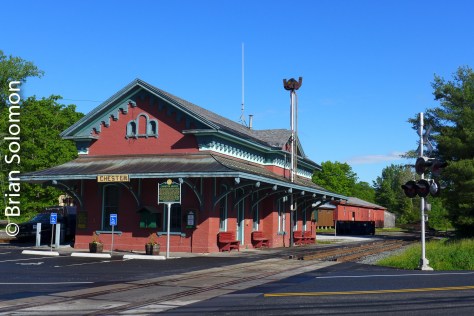
Today’s image was exposed from Main Street in Stafford on the opposite side of the tracks from the earlier photos, which provides a different perspective on the train and village.

Part of this exercise is aimed at demonstrating black & white photographic technique, however I’m also hoping to show how different angles at the same location can result in significantly different photos.

Also, that it’s possible to make interesting photos in difficult lighting situations, if you apply a creative approach to your photography.

I’m done here yet! To be continued on another day.

Tracking the Light Posts Daily!


Striving for Tonality.

Last month I made this photo of a tram near its terminus in Basel, Switzerland.

To achieve deeper tones, I’ve adjusted my photographic process, shortening the development time, then boosting highlights by toning the negatives after development.

Working with my Nikon N90S with f2.0 35mm lens, I exposed a roll of Ilford HP5, rating it at 320 ISO. I processed the film in Agfa (formula) Rodinal Special (mixed 1-30 with water) for 3 minutes 25 seconds at 68 degrees F.

By design, this resulted in acceptable negatives, slightly on thin (light) side. Then, after fixing (two stage) and a thorough 10 minute rinse, I toned the negatives in selenium (using a 1-9 mix) for nine minutes with regular agitation.

Selenium toner is poisonous, so I wear latex gloves and perform the toning outside to avoid breathing the fumes, and pre-rinse the film prior to bringing it back inside.

Toning the negatives in this way boosts the highlights, giving the images a slightly silvery glow, while improving archival stability.

For this photo, I made some additional changes in post processing.

After scanning, I imported the file to Lightroom, and digitally lowered the contrast and highlight density of the sky-area in the top 1/3 of the frame.

My intent was to produce an image with a darker moody tonality and glistening highlights. I wonder if this will translate to the internet well?


Agfa Rodinal Special and selenium toners can be purchased from Freestyle in California, (see: http://www.freestylephoto.biz).


Tracking the Light posts daily.

Oops at Arth-Goldau—Lets Crop!

I’m not a fan of cropping.

In general, I object to cropping, especially when executed by someone other than the photographer.

I accept that in the realm of publishing it is a necessary evil, and that with the internet, Facebook and other imaging venues embrace cropping without consequence of how it affects photographs.

Yet, occasionally I find necessary to crop one of my photos.

Last I month I made an image of an Italian ETR 610 Pendolino from the south-end of the station platform at Arth-Goldau, Switzerland. While focused on the impressive looking train, I inadvertently included a portion of a mast on the platform that appears as an out of focus blob at the left of the image.

While I often like to work with selective focus, in my opinion this accident in no way enhanced the photo. Furthermore once playing with the cropping feature in Lightroom, I found that cropping other elements of the line side infrastructure materially improved my photo.

Below are some examples. What do you think?

This is the uncropped Jpg file. Notice the fuzzy gray area on the left. This is the side of a mast on the platform. In no way does this make for a more interesting photo.
Lightroom and other post-processing software make cropping alarmingly easy. I’ve cut away the the objectionable fuzzy gray area from the image.
Once I had the cropping tool in hand, I decided to try my hand at eliminating more infrastructural clutter. In this view I’ve cut the catenary support that ran across the top of the image area and tightened the composition of the Pendolino. Is this a more effective image?


Tracking the Light is Daily!

Unexpected Extras at Grindlewald-Grund.

Extra trains are always a bonus; but an unexpected extra using antique equipment is a real treat!

Three weeks ago on our exploration of Swiss railways, Denis McCabe and I were photographing the steeply graded rack railway on the Wengernalbahn near Grindlewald-Grund where the scheduled passenger trains operate on half hour intervals.

In between the regular scheduled trains, we caught a wire train-extra and this passenger extra with heritage equipment.

All in the metaphoric shadow of the Eiger and the Jungfrau, two of the most famous Swiss mountain in the Swiss Bernese Alps.

When two trains really are better than one: A wire train ascends toward Kleine Scheidegg from Grindelwald-Grund, while in the distance a passenger train climbs in the opposite direction toward Grindelwald.
Special bonus, a Wengernalbahn heritage train works the rack on its way up the mountain. FujiFilm X-T1 photo.

Tracking the Light posts every day.


Color Photos of the 2017 New York Central System Historical Society Convention.

On the weekend of May 5-7 2017, I attended and spoke at the New York Central System Historical Society Convention held in Marlborough, Massachusetts.

The theme of the convention was the Boston & Albany and it was dedicated to my friend, the late-Robert A. Buck of Warren, Massachusetts. Key to the convention events was a chartered MBTA train that operated from Worcester to Boston.

I gave the banquet talk focusing it around Bob Buck’s B&A experiences and photography as well as my own B&A work.

Special thanks to Society and convention organizers, especially Joe Burgess, Bill Keay, and Rich & Nancy Stoving.

I made these photographs using my Lumix LX7 digital camera.

Joe Burgess at registration.
Victor Hand presenting his New York Central photographs.
Banquet hall.
Lumix panoramic view of the banquet hall.
Worcester Union Station.
Stovings at Worcester.
MBTA special at Worcester.

Rich Stoving.
Watching the passing scenery along the old Boston & Worcester route.
Bill Keay on a ‘busman’s holiday’.
Green flags at South Station.
MBTA HSP46 number 2004.
MBTA double-deck Kawasaki car.

Tracking the Light Posts Daily!

Nocturnal Basel Tram Pan

Using my Panasonic Lumix LX7, I exposed this pan photograph of a city tram on the streets of Basel, Switzerland in April 2017.

I’d set the camera at ISO 250, and with the ‘A’ (aperture priority) mode set the aperture to its widest opening (f1.7), which allowed for a shutter speed of 1/8 of a second.

By panning (moving) with the tram, the relatively long shutter speed places the background in a sea of blur while keeping the tram car comparatively sharp.

Basel, Switzerland has a complicated narrow gauge tram system. Lumix LX7 photograph, April 2017.

Tracking the Light posts Daily.