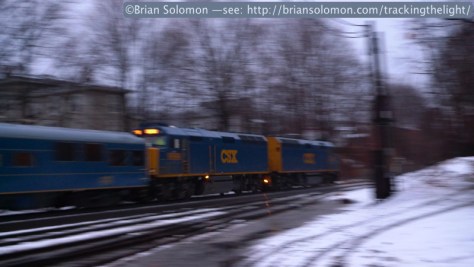
I’d called up to Tucker’s Hobbies at closing time. Bob Buck met me at the door. “The CSX Business train passed Worcester westbound more than 20 minutes ago!”
We made a hasty departure for Palmer. And halfway down the Quaboag River Valley between West Warren and Palmer, I hear CSX’s dragging equipment detector at West Warren report, ‘no defects’.
“It’s about 3 minutes behind us,” I said, as I accelerated the car.
We pulled into the yard at Palmer, near the site of the old freight house. It was wet, the light was fading. I prepped my Lumix as the train came into view, and popped off a few pan photos as it raced west. Bob was delighted! I made a few prints for him.
Exposed with a Panasonic Lumix LX3.Exposed with a Panasonic Lumix LX3.
Tucker’s Hobbies was the dream business for my late friend and mentor, Robert A. Buck, who in 1981 relocated and transformed his Tucker’s Hardware into Tucker’s Hobbies. This had long been a focal point for railway interest, a place to meet railroaders, model railroaders, enthusiasts, and others.
Bob Buck presides at Tucker’s Hobbies back in January 2001. Exposed on Ilford HP5 with a Nikon N90S with 24mm AF lens and fill flash.
I’ve been regularly visiting Tucker’s since its hardware store days on Main Street in Warren. In the 1980s, I was a regular for Friday night sessions and despite living in myriad locations, I’ve often come back for visits.
Tucker’s on the final Friday evening, May 16, 2014; exposed with Canon EOS 7D.Rich Reed at Tuckers.
Bob Buck passed away in October 2011. Yet, the store has remained open on Friday and Saturday’s. However, all things must end. And this past weekend (May 16-17) represented the store’s final opening hours in Warren.
I called into Tucker’s for an hour Friday night (May 16) to visit with old friends and take a final look at the shop. I made these digital images using my Canon EOS 7D. This was a venue that via Bob Buck had a profound influence on my interests in railways and on my photography.
Yet Tucker’s legacy lives on, and the store will be taking a new form as Palmer Hobbies opening soon on Main Street in nearby Palmer, Massachusetts.
Turning the sign at the end of the night.Tucker’s on the final Friday evening, May 16, 2014; exposed with Canon EOS 7D.
It was a hot, humid and hazy morning. The sunlight was tinted by gauzy smog which softened the scene.
Bob Karambelas and I were exploring the junction at Hunter Tower in Newark, New Jersey, where the former Lehigh Valley crossed the old Pennsylvania Railroad electrified mainline.
A westward freight with a pair of SD40-2s was departing Oak Island yard and I exposed this view looking a down a grungy side street with a 200mm lens.
I’ve always been fascinated with urban images like this, where the railroad is prominent but not necessarily dominant, and passes through post industrial decay. Look at the grime on surface of the street and the great beat up old cars!
I’d been out along the former Erie Railroad since before dawn that day. The tracks had been alive with freight. By early afternoon, I was down at Gang Mills Yard, near Corning, which served as a local hub for freight.
Exposed on Professional Kodachrome 25, with my college roommate’s Canon A1 with 50mm lens. The film was processed by Kodak in Rochester, New York with in 48 hours of exposure.
Back then General Electric B23-7s were a common locomotive. I’d grown up with these diesels working locals and road freights on the Boston & Albany route. I always like their classic GE style and their great sound. My B&A engineer friends despised them because of their ‘slow loading,’ ‘low cab doors,’ and other perceived inadequacies.
I made this photo at the engine terminal. I liked all the Conrail signage behind the locomotive. There’s nothing especially unusual about this scene, it was as ordinary as it got for the time, but today this really says, “Conrail” as I remember it.
Conrail ended independent operations at the end of May 1999, fifteen years ago. Between 1976 and 1999, I exposed thousands of views of Conrail. In 2004, Tim Doherty & I authored an illustrated book on Conrail for MBI.
Mike Gardner and I were enjoying a trip along the Hudson River on June 27, 1997.
This photo really says ‘1990s’ to me. A clean Conrail SD60I leads intermodal freight TVLA (New Jersey to Los Angeles) with a long line of piggyback trailers. I exposed it on Fujichrome slide film using my Nikon N90S with 80-200 zoom lens.
This lens/film combination had a color balance and contrast that I associate with my mid-1990s photography. On the down side, used of a telephoto zoom-lens and Fuji film resulted in bright headlights and ditch-lights appearing as ill-defined blobs.
I embraced the convenience and versatility of the N90S and zoom lens with 100 speed filem, which was easier and faster than my old prime lenses with Kodachrome, but I sacrificed quality.
At that stage I was still carry my Nikon F3T with Kodachrome. But following a string of processing disasters that summer, I largely phased out Kodachrome in favor of Fuji. Sometimes there’s no perfect solution, and some sort compromise is necessary.
Exposed with a Nikon F3T on Kodachrome 25 slide film. I was toying with my 35mm perspective control lens to keep the horizon in view, but my angle of view was a bit too extreme for the shift feature, which resulted in this slightly strange perspective.
Here’s something neat; I was photographing a westward Southern Pacific freight running along the shore of San Pablo Bay at Pinole, when I spotted this old Northern Pacific box car in consist.
By 1992, Northern Pacific had been gone for 22 years, which seemed like a lifetime to me! Here was this vision of a railroad long gone, but still moving freight.
Of course, today its not still uncommon to see Burlington Northern cars in old paint, and BN has been gone 19 years. Funny how that works.
At 10:45 am I exposed this view on Kodachrome 25 slide film using my Leica M2 with 50mm Summicron at f5.6 1/125th of second.
Making the most of a clear bright autumn morning, I’d driven to New London, where I visited Central Vermont’s waterfront yard, located below the massive Thames River bridges for I-95. CV’s local was getting ready to head north.
While I was waiting for the CV to get moving, I made photographed Amtrak’s late running Night Owl and its southward Colonial train 95.
The CV local had three GP9s, standard locomotives for that run. In the lead was a personal favorite, engine 4442.
What was special about 4442? Nothing, that’s why I liked it. It had been working CV rails as long as I’d been making photographs, and it seemed like it was always around. I liked 4442 simply because it was familiar. It looked good, and sounded great.
I followed CV’s northward local toward Willimantic, Connecticut, making photos along the way. This was one my best efforts for the day. It’s something of an icon in my collection of CV photos. At the time it was a grab shot. I barely had to time to jump out of my Plymouth Scamp and release the shutter.
SBB express trains to and from Basel approach the station in Gottmadingen, Germany (west of Singen) near the Swiss frontier.
Later in the day, I visited the Zeppelin museum at Friedrichshafen on Lake Constance.
Exposed with a Canon EOS 7D fitted with a 200mm lens. I’ve included a bit of out of focus foliage at the right to add visual balance with the front of the locomotive and depth to the image. Exposed using a Canon EOS 7D fitted with a 200mm lens. Telephoto compression visually simplifies the scene while emphasizing the soft morning light on the front of the electric.
Here’s a dozen images: On Monday May 5, 2014, I traveled to Kildare, and spent the day making photos of Irish Rail’s operations.
Irish Rail 22000-series ICR heading down road at Kildare on May 5, 2014. Exposed with a Canon EOS 7D with 20mm lens.
The goal was to photograph the Up and Down IWT (International Warehousing and Transport) Liners (running to and from Dublin from Ballina), with a hope that the elusive timber trains might operate.
Irish Rail’s timber is elusive enough, so far as I’m concerned. It only operates two or three days a week, and often seems to get canceled when I’m out for it.
The weather was mixed; a bit of rain in the morning, a few bursts of sun in the afternoon. In other words, a typical May day in Ireland, if a bit on the cold side. The foliage was lush and green.
The down IWT liner (Dublin-Ballina) ran later than I anticipated, while the up IWT was more or less as expected.
Timber trains made their appearance as hoped. Since the timber must run around at Kildare station to change direction (it runs from Waterford to county Mayo, and there’s no direct chord at Cherryville Junction to facilitate a move for trains moving from the Waterford Line to the West), this allows opportunity to catch the timber train twice.
Irish Rail’s Rotem Intercity Rail Cars are the standard equipment on most intercity passenger services. Trains passing Kildare serve Cork, Limerick, Waterford, Galway, and Mayo lines. Exposed with a Canon EOS 7D with 40mm lens.Irish Rail 220 leads Monday’s Dublin-Ballina IWT liner seen west of Kildare, near Cherryville Junction. Exposed with a Canon EOS 7D with 100mm lens.trailing view of the Dublin-Ballina IWT liner as it approaches the signals for Cherryville Junction. Exposed with a Canon EOS 7D with 100mm lens.Not long after the down IWT the up IWT came into view. An ICR has just passed down road and is approaching Cherryville Junction. Exposed with a Canon EOS 7D with 100mm lens.An ICR catches a burst of sun as it nears Kildare station. Exposed with a Canon EOS 7D with 20mm lens.Hark! Is that the drone of an 071? Yes, it is. Irish Rail 075 is a battle-worn veteran with many years of hard service. It leads an empty timber train from Waterford. This will run around at Kildare and head down road toward Mayo for reloading. Exposed with a Canon EOS 7D with 20mm lens.The Dublin-Cork Mark 4 hurtles down road at Hybla Bridge near Monasterevin. The empty timber wasn’t far behind. Exposed with a Canon EOS 7D with 40mm lens.Patience prevailed: Irish Rail 072 wails away with the laden timber heading toward Kildare to run around. Exposed with a Canon EOS 7D with 40mm lens.Trailing view of the laden timber at Hybla Bridge.The need for the timber train to run around leaves ample time to reposition on the Waterford Line south of Cherryville Junction. As the crow flies, this location is only about 4 miles from Hybla Bridge.Last shot of the day: Irish Rail 072 leads the laden timber at Oghill, milepost 36. Exposed with a Canon EOS 7D with 20mm lens.
All in all, it was a productive day photographically.
Since most of Irish Rail’s passenger services are now provided by common 22000 series Rotem-built InterCity Railcars (ICRs), I’ve only included at few of the many passenger trains that passed that day.
In 2007, I coordinated a team of 37 photographers to document a full day’s worth of North American railway activity from Nova Scotia to southern California and from the Pacific Northwest to southern Florida in what became a book titled The Railroad Never Sleepspublished by Voyageur Press.
In addition to coordination, I played an active role in making photographs. I’d coordinated with Genesee Valley Transportation to ride a locomotive on their former New York Central Falls Road (now Falls Road Railroad) and boarded the train at Lockport, New York.
My aim was to make photos of the crew to capture the feeling of an active short line railroad. Hal Reiser shadowed the train making photos from the ground, and at one point collected me so I could also make trackside views.
I’ve included several of the images from May 10, 2007.
Although The Railroad Never Sleeps is now out of print, it remains a stunning photographic collection, which is especially impressive considering it was entirely accomplished within the limits of just one day!
A variation of this photo appeared in a Railway Age supplement some years ago.
Exposed on Fujichrome Provia 100 using a Nikon F3T with 28mm AF lens. Exposure calculated manually with a Sekonic Studio Deluxe handheld photocell.
Back in June 1996, I was following the old Rock Island mainline. As I recall, I didn’t find much moving, and the day wasn’t the brightest. Yet, at Iowa City I visited a bridge over the Iowa Interstate’s yard and made a handful of images.
I’ve always liked this photo because it offers an unusual view with a lot of railway interest. The gondola carrying steel bars and open-door Burlington Northern 50ft boxcar are the sort of ordinary everyday elements of American railroading, meat and potato freight cars, that rarely get feature-treatment in photographs.
It was also the best way to make use of a dull day. Would this photograph be more effective if the sun had been out?
Back in the early 1990s, Southern Pacific was still serving the Northwestern Pacific route as far as Willits, California where it tapped connections, including its former line that was still in operation all the way to Eureka.
Sometimes on Sunday mornings, I’d drive north from San Francisco across the Golden Gate to Petaluma on Highway 101. There wasn’t much traffic at that time of day. Occasionally, I make this run with fellow Bay Area photographer Brian Jennison.
Although the Willits-Petaluma portion of the run was often nocturnal, on Sundays SP’s ‘NWP Sprint Train’ made a turn from Petaluma to Fairfield and this often called for groups of SD9s.
NWP Sprint Train at Novato, California in April 1992. Exposed on Kodachrome with a Nikon F3T with f1.8 105mm lens.
On this day, normal California blue skies were muted by a dull fog. Yet, I persevered and chased the train. It was hard to argue with the great sounds produced by a quartet of 1950s-era 16-567 diesels in multiple. Also, dull days have their moments too.
At Novato, I made this image featuring the gently rolling green hills that characterize Marin County as a back drop. Admitted, I was disappointed by the ‘lobotomized’ leader, which had its classic SP lighting package disturbed; its oscillating headlight was missing leaving a scar on the short hood. Oh the shame of it all!
Looking back, I’d quite happily take this again. It was an era before graffiti covered freight cars, the uniform proliferation of locomotive ditch lights, and when SP was still the SP!
Along the Rhein at Festung Ehrenbreitstein, May 1996.
Exposed on Fujichrome Provia with a Nikormat FTN and Nikoor f1.8 105mm lens. Ehrenbreitstein-Koblenz station on May 24, 1996.
I made this view from the massive fortress above the Rhein opposite Koblenz. My father and I had traveled by train from Köln.
The train pictured was a local train gliding in for a station stop.
The fortress is a popular attraction and offers magnificent views of the confluence of Rhein and Mosel Rivers, while also providing some nice elevated angles on the railway along the ‘right bank.’
Trains are plentiful on this line, and every few minutes freights would rumble along the river. To view the river and railway from the massive stone walls is an experience. We arrived by cable car, and departed by a Mercedes Taxi. What a cool place!
Among the difficulties of living within sight of the railway is the chance that such proximity may breed photographic apathy and slough. One the plus side, when something rumbles by, all I have to do is look out the window!
There are several nice photo locations within a ten minute walk of Islandbridge. On the downside, over the last decade I’ve covered these nearly to the point of exhaustion. Yet, that doesn’t keep me from taking advantage of them.
Shortly before 11am on Tuesday April 29, 2014, I heard the distinct roar of an Irish Rail 071 class diesel (built by General Motors Electro-Motive Division). I glanced out the window to see a gray locomotive roll into the Phoenix Park tunnel with a wagon transfer for Dublin’s North Wall.
Ah! A grey locomotive and the elusive wagon transfer!
I made a call to alert a friend, and a short while later I got a call back to say that the wagon transfer had collected three flats and was on its way back. The locomotive was 085 which wears a variation of the gray and yellow livery introduced a year ago.
Irish Rail 085 with three flat wagons approaches Islandbridge Junction on April 29, 2014. Canon EOS 7D with 100mm lens. I opted for vertical composition to feature the monumental Wellington Testimonial that sits in Dublin’s Phoenix Park. (Exposed at f9 1/500th of a second ISO 200).
It was a rare clear sunny morning, and I was keen to make a color slide of this engine passing Islandbridge Junction. Armed with good information, I walked five minutes up the road to my often-used location and waited. Less than 15 minutes passed before 085 appeared from the tunnel with the three flats.
A closer horizontal view with the same camera-lens combination. I adjusted the exposure by a one-third stop, opening to f8.0 to compensate for the lack of sky in the image. Locomotive 085 features a variation of the gray and yellow paint scheme introduced last year. This features the traditional three-digit locomotive number in larger fonts on the cab. This in addition to the recently introduced European multiple number printed in tiny type elsewhere on the engine.
I exposed a few digital images with my Canon EOS 7D and 100mm lens, before executing a color slide (or two) with my EOS 3 with 40mm lens. I was home less than 30 minutes after leaving. Back to the book writing! I’m presently researching a book on North American signaling.
It was a foggy dawn at Rockhill Furnace, Pennsyvlania on the second day of East Broad Top’s annual ‘Fall Spectacular’. Mike Gardner and I had arrived the day before for the event.
I exposed this view with a Nikon N90S with f2.8 80-200mm Nikon zoom lens.
Low dew point resulted in a cosmic mix of mist, steam exhaust and locomotive smoke.What I remember best was the clanging of locomotive bells and the soft whoosh of exhaust.
By 10 am the sun had burned off the fog and it was a glorious Pennsylvania day.
Years ago, I noticed that in mid-April the evening sun floods Abbey Street in Dublin with low warm bright light. This only lasts for a few weeks. During the winter, the street is largely shadowed and in summer the evening sun swings too far to the north.
The other day, I walked along the LUAS Red Line on my way into the City Centre. Where Abbey Street crosses Capel Street there’s a bit of jog in the tracks which allows for an interesting perspective with a telephoto lens.
Looking east on Abbey Street in Dublin, April 25, 2014.Inbound and outbound LUAS trams pass near the Jervis Stop.The 100mm lens allows for moderate compression of the scene and makes use of the jog in the tracks. A 400mm lens will look much farther down the street and bring in a hint of Irish Rail’s Loop Line Bridge.One last image before the LUAS tram whizzes by me.
In past years, I’ve worked this spot with some really long lenses. However on this occasion I took a more conservative approach, choosing my Canon 100mm.
It was a Friday evening so there were lots of people on the street and outbound trams were full with passengers heading home.
Surveying Places for Photography on the CP Mainline near Vale de Figuera.
An express passenger train glides upgrade near Vale de Figueira, Portugal. Exposed with a Canon EOS 7D with 20mm lens. This location didn’t jump out at me on the map, but it still warranted inspection. It turned out to be much better than I hoped for trains in the southward direction.
Using Google Maps, I’d pre-selected a variety of locations on Comboios de Portugal’s main line between Entroncamento and Santarem that I thought warranted investigation.
The great thing about modern tools is that they can save a great deal of time searching for photographic angles with minimum investment.
Back in the old days, I spent hours in libraries scouring USGS topographical maps and making photo copies of same in preparation for a trip.
Today, I simply go to Google Earth and make screen shots on my iPad of various maps and satellite views of prospective locations which I file for reference when navigating. Street view can offer additional perspectives.
I realize there are even more efficient ways to accomplish this, but I’m ‘old-school’ in my basic approach.
Finding a spot on a map is all well and good, but I still find it imperative to inspect locations in person and on the ground.
A place that looks good on a map or satellite view, may prove be unworkable for a variety of reasons; line-side brush, fences and other obstructions may interfere with photography, elevation may be too high or too low. Access may be restricted or difficult to obtain. Lines with overhead electrification can prove especially difficult.
Sometimes, a location that seemed uninspiring on a map proves to be just the right spot.
Case in point: these photos were made from an overhead bridge north of Vale de Figueira on a short steeply grade section of mainline.
What I liked about the location was the curves in the track, the texture of plants in the cutting, and the distinctively scenic backdrop. On the downside, this place would have been better a couple hours earlier in the day, as the light was harsher than I’d like.
The S-curve allowed for a dynamic perspective for northward trains, but by early afternoon the lighting was pretty harsh. This may have been a better spot for northward trains much earlier in the day. I photographed this double-headed electric coal train downgrade using my Canon EOS 7D with 20mm lens. By cropping the sky, I minimized the difficult contrast.
The old New York Central Mohawk Division is an enigmatic stretch of railroad. It’s very old. It has lots of history. It passes through some stunning scenery. It carries lots of traffic. And it can be really difficult to photograph.
Access to the line is limited, elevation is often in the wrong places, and trains seem to run in the wrong direction or at the wrong times. Or, following holidays, it seems that trains are absent altogether. Yet, when driving the New York State Thruway, it seems that every time you look across at the tracks there’s a train racing along.
On this day, I was driving west under sunny skies. I joined the Mohawk at Amsterdam, New York where I found Conrail B23-7 1999 working a local freight—hard out of the morning sun. A blanket of lake effect snow covered the ground. Hmm.
Very little else was moving, but I caught one of Amtrak’s Empire Corridor trains at Fonda. Then took my time to explore locations.
At Little Falls, I again caught up with this Conrail B23-7. At the time it was the booby prize, but I’m glad I took the time to make photographs.
Conrail’s General Electric-built B23-7 1999 works sidings along the old New York Central Mohawk Division at Little Falls, New York on January 3, 1989. I exposed this Kodachrome slide using my Leica M2 with 50mm Summicron lens. A layer of high cloud had dampened the sun.
Ten years later, Conrail faded into history. My dad and I made photographs along the Mohawk on Conrail’s final day.
It was a clear fresh May morning when I met my friend George S. Pitarys for a day’s photography. We were aiming to photograph the New Hampshire North Coast’s rock train, however, George said to me, ‘lad, we have a diversion.’
We set up at Boston & Maine’s heavy truss over the Merrimack River at Haverhill for a westward freight. The attraction was a trio of former Santa Fe SD26s in the lead.
A Guilford freight works west (compass south) at Haverhill, Massachusetts, the sounds of its EMD 645 engines permeating the morning air.
As the train approached the bridge, I was impressed by the view of the old brick buildings with the train looming to the left.
I exposed this image with my Nikon N90S with 80-200mm lens. I also made a more traditional view of the locomotives on the bridge, but for me, this one better conveys railroading in a post-industrial New England scene.
In 1984, the DART began electric services between Howth and Bray. This offered an improvement to existing Dublin suburban services by wiring existing routes. The service was later extended to Greystones and Malahide.
An 8600-series DART pauses at platform 5 in Connolly Station. April 2014.
The line between Pearse Station (formerly Westland Row) and Dún Laoghaire (formerly Kingstown) had been opened in 1834 and is considered the world’s oldest suburban railway.
The hum of DART’s electric multiple units are a familiar tone of Dublin transport.
Over the last few weeks, I’ve made several images of DART trains during my travels around Dublin. All were exposed with my Canon EOS 7D.
The DART crosses over lines leading toward the North Wall—one of the few grade separated junctions in Ireland.DART interior view.A DART train arrives at Howth on April 23, 2014. Canon EOS 7D with 20mm lens.Dublin Area Railway map in Irish.A view of an 8600-series DART at Tara Street Station as seen from the Railway Preservation Society Ireland’s Easter Eggspress.Connolly Station, Dublin.Approaching Connolly.Platform 6 at Connolly Station.
Railway Preservation Society Ireland celebrates 50 years this year. Canon EOS 7D with 100mm lens.
A clear bright day and an excellent crowd made for a great day out with locomotive 461 and the preserved Cravens carriages.
The train boarded at Dublin’s Connolly Station and ran directly to Wicklow with stunning views of Dublin bay from Killiney and Bray Head.
Irish Rail 227 with the Belfast-Dublin Enterprise rests alongside locomotive 071 (now 0117071) that was about to shunt the RPSI train from platform 3 at Connolly. 461 was steamed up and ready to couple to the train and take it into platform 5 for boarding. Canon EOS 7D with 100mm lens.Steam on a sunny morning. Locomotive 461 pulls into platform 5 at Connolly Station. Canon EOS 7D with 20mm lens.Departing Dublin offered views from the Loop Line bridge of the Customs House and River Liffey. Canon EOS 7D with 20mm lens.Passengers and RPSI staff at Wicklow. Canon EOS 7D with 100mm lens.Unloading prams from the van. Canon EOS 7D with 100mm lens.461 runs around at Wicklow for the short turn up to Greystones. Canon EOS 7D with 100mm lens.461 couples up at Wicklow. I miss the old mechanical semaphores with lattice masts that once protected Wicklow station. Canon EOS 7D with 20mm lens.
At Wicklow, the special was overtaken by a holiday ‘relief’ special to Gorey that operated with the freshly painted candy apple green 29000 set.
A short trip was run from Wicklow to Greystones and return, with some spirited running along the beaches south of Greystones.
Ah! The elusive freshly painted 29117!
Engine 461 is a former Dublin & South Eastern 2-6-0 goods engine, so it was working on old home rails. The locomotive was steaming well and made for a great performance.
Reported difficulties with the points at Wicklow resulted in minor delays on the return trip, but clear signals up to Dublin and excellent running by the steam crew found us back at Connolly only a few minutes behind the advertised.
I traveled on the train, and used opportunities at station stops to make photos of the crew.
These are some of my digital results. I also used my old Nikon F3 with a 24mm lens to exposed some Fuji Acros 100 black & white film. Somehow steam and B&W seems like an appropriate combination! Those images remain latent, and perhaps will be a topic for a future post!
The bushes match 461’s buffer beam.Assisting passengers at Wicklow.Dublin-Rosslare ICR approaches Wicklow. Canon EOS 7D with 100mm lens.Steam crew in the cab of 461. Canon EOS 7D with 100mm lens.461 shunts the train at Wicklow. Canon EOS 7D with 100mm lens.Shoveling coal is a dirty job, but someone has to do it!Canon EOS 7D with 100mm lens.Watching for a signal.RPSI Cravens under the shed at Connolly Station.
Irish Rail 0129117 in the new livery at Connolly Station on April 21, 2014. Canon EOS 7D with 20mm lens.
Several weeks ago, Irish Rail released one of its 29000-series suburban railcars in a fresh new two-tone green and yellow livery.
My initial haphazard attempts at finding this train on the move were unsuccessful. However, on April 21, 2014, I got lucky.
I was riding Railway Preservation Society of Ireland’s Easter Eggspress led by steam locomotive 461, when at Wicklow, our train was overtaken by an Easter Monday ‘relief’ from Connolly to Gorey worked by set 0129117 (formerly 29117) in the new livery!
Armed with this knowledge, I consulted my operations expert for advice on when the train would return to Dublin.
After the Easter Eggspress arrived back in Dublin, I made my way over to Platform 6. Here I scored these views of the freshly painted train that arrived about 15 minutes later.
Irish Rail 0129117 in the new livery at Connolly Station on April 21, 2014. Canon EOS 7D with 20mm lens.Irish Rail 0129117 in the new livery at Connolly Station on April 21, 2014. Canon EOS 7D with 20mm lens.
Soft early evening sun made for nearly perfect lighting conditions. After the train discharged its passengers, it worked back over the Loop Line toward Pearse Station and the old Boston sidings.
I always like to catch a new livery as soon as I can; Before it gets dirty, before someone decides to change it.
Tomorrow: Railway Preservation Society of Ireland’s Easter Eggspress!
A few years ago Irish Rail rebuilt a portion of its old line between Clonsilla and Navan. This had been closed in the early 1960s and the right of way had largely returned to nature.
In late 2009, I’d explored the rebuilding as tracks were being installed, but I’d been negligent in my photography of this new route since that time.
On Wednesday, April 16, 2014, I rode the LUAS tram to Dublin’s Docklands and walked over to Irish Rail’s Dockland station at the North Wall. This was built during the Celtic Tiger boom, which had also resulted in abandonment of most of Irish Rail’s North Wall freight yards.
An Irish Rail four-piece InterCity Railcar arrives at Dublin’s Docklands station on the afternoon of April 16, 2014. Lumix LX3 photo.Irish Rail at Docklands Station, North Wall, Dublin. April 16, 2014. This area was once sprawling freight yards. Lumix LX3.
I went for a relaxing spin directly to the end of the new branch at ‘M3 Parkway’. The track was in superb condition.
On my return trip, I changed trains at Clonsilla. Instead of returning via Docklands, I rode directly to Connolly Station. Later, I learned that two hours before my trip the elusive Sperry train had made a run to M3 Parkway and back! I had no idea. Right place, wrong time. Lucky miss, I guess.
ICR interior. Lumix LX3.Irish Rail’s InterCity Railcar at M3 Parkway station. Lumix LX3 photo.A 29000 series railcar works toward M3 Parkway at Clonsilla. Canon EOS 7D photo.On the left is a 29000 series railcar destined for M3 Parkway, in the distance a train from Maynooth to Connolly Station can be seen at the new Junction where the route to M3 Parkway diverges to the right. Canon EOS 7D with 100mm lens.
Exposed on Kodachrome 64 slide film with a Leica 3A fitted with 200mm Telyt lens via a Visoflex attachment and mounted on a Linhof tripod. Metered manually with a Sekonic Studio Deluxe hand held photocell.
On this hot and humid evening, fellow photographer Bob Karambelas and I were poised to catch the parade of rush hour trains that raced the former Pennsylvania Railroad at Linden, New Jersey.
Here six main tracks and high voltage overhead make for an impressive right of way.
At that time, the New York-Philadelphia Clockers were still run with heritage fleet cars, while the AEM7 in the lead was only a few years old.
Today, the AEM7 fleet still work for Amtrak, but will soon be running their final miles for the national passenger carrier as their replacements come on-line.
For more than 25 years this slide sat unattended in my files. For so many years, it just didn’t seem noteworthy. I see it now with fresh eyes.
Back in 1996 a European friend said to me, ‘you ought to visit Lisbon, they’ve got some wonderful old trams there.’ Some 18 years later, I finally ticked off that box in my notebook. Better late, than not at all.
Lumix LX3 photo; Lisbon April 6, 2014.
Lisbon is famous for its narrow gauge trams that crawl up narrow and steeply graded streets. This track work is amazing. It’s amazing that it was ever built, and even more so that some of the lines are still worked in 2014!
The old trams are of course a tourist attraction, but like San Francisco’s cable cars, these function as part of the transit system.
Visitors queue to board, much to the delight of local pickpockets. I was forewarned about light-fingered activities, so I took precautionary measures. And, also made a sport of spotting the picks. Not to point fingers, I saw nothing lifted, but I saw some suspicious characters in the queue (who didn’t seem to have any interest in riding a tram).
Steep gradients and colourful old buildings are part of the attraction of Lisbon’s tram network. They wouldn’t have the same charm serving suburban tower block apartments.A tram works up hill by Lisbon’s cathedral. Canon EOS 7D photo.The red trams worked a tourist circuit. Canon EOS 7D.Lumix LX3 photo; Lisbon April 6, 2014. Tram traffic jam.Lumix LX3 photo; Lisbon April 6, 2014.
The quirky old cars are enhanced by the colorful tapestry that makes up Lisbon’s old city. Sunny skies were delivered as ordered.
Route number 15 is populated by modern LRV style cars, but passes through some interesting areas and runs parallel to an old heavy-rail commuter rail route.
Modern cars work line 15. Lumix LX3 photo; Lisbon April 6, 2014.Trams tend to get bunched up in traffic and seem to appear in waves of three or four cars all at once. Canon EOS 7D with 200mm lens.Narrow alleys have barely enough room for single track. Yet, this is a bidirectional line with cars and trucks too. Canon EOS 7D.View from the door of a track-side cafe. Canon EOS 7D with 100 mm lens.This car works interlaced track where up-hill and down hill lines overlap. Careful, mind the Volkswagen! Canon EOS 7D.
The advantages of being up early include being treated to cosmic light. On this August 1996 morning, I was photographing Northern Pacific 4-6-0 number 328 as it was being prepared for a day’s excursions with the Minnesota Transportation Museum.
Exposed on Fujichrome Provia 100 using a Nikon F3T with an f1.8 105mm lens. Exposure calculated manually.
The engine’s rods, bathed in boiler steam reflected the muted glow of the rising sun. A magenta hue had graced the Wisconsin sky. The effect lasted only a few minutes, and before long the sun was shinning brightly.
I worked quickly, making many detailed views of the locomotive equipment and its crew. At the time I was researching for my book The American Steam Locomotive (published by MBI), while working as editor for Pacific RailNews
It was extraordinarily cold when Pat Yough, Chris Guss and I set out to photograph Toronto’s morning rush hour.
One of the biggest challenges working in very cold weather is the effect on battery life. After a couple of hours, almost all my batteries were dead. We made a mid morning trip back to our hotel to charge batteries.
Toronto bound GO Transit train near Sunnyside on February 8, 2010. I exposed this view on Fujichrome using my Canon EOS 3 with a 200mm lens.8
For this photograph, I opted to center the locomotive, while setting it back in the frame. This adds visual tension and draws the eye in.
Bright low sunlight reflecting from the white locomotive front made for a difficult exposure.
Although, I pre-set the camera manually, I continued to make fine adjustments as the train approached. In the last instant before I released the shutter, I stopped down (reduced the exposure) to compensate for the bright front end.
I was traveling with Tim Doherty in Pennsylvania. A full moon illuminated the landscape. We opted to make time exposures of the Herculean former Lackawanna Tunkhannock Creek Viaduct at Nicholson, Pennsylvania.
We opted for several vantage points. This view was exposed from a graveyard located on a hill above Nicholson to the west.
Nicholson, Pennsylvania by the light of moon. What sort of lunatic stands around in a grave yard on moon-lit October night without film in the camera?
Using my Nikon F3T firmly planted on a Bogan tripod, I exposed this image for more than a minute. The filtered moonlight allowed for a ethereal image of the viaduct.
I’m not completely satisfied with the photo. It doesn’t really convey the immense size of the bridge and the foreground is underexposed.
However, what really annoys me is that most of the photos I tried to make that evening never existed. In the darkness, I grabbed the wrong Nikon body. As it turned out, I failed to load that camera. So there was a lot of standing around making time exposures without a recording media in the camera! Poor show.
Exploring the former Central Railroad of New Jersey Elizabethport Shops, I found this decaying former Southern Railway E8A, still dressed in the railroad’s white, green and gold.
New Jersey Department of Transportation (antecedent to today’s NJ Transit) acquired this locomotive among others for commuter services, after Southern conveyed its passenger services (including the Crescent) to Amtrak in 1979.
Exposed on black & white negative film with a Rolleiflex Model T using a 645 size ‘super slide’ insert.
I’d never seen Southern’s Crescent and in 1986, I was delighted to find this rusting vestige from an earlier era. I made a few studies of the locomotive on black and white film and with color slides. I wonder what became of this locomotive?
Porto is an ancient and attractive city built along the River Douro. It was urbanized in Roman times, so relatively modern features such as electric trams, are really just a contemporary gloss on a place with a long history.
I think it’s important to put the timeline in perspective. There’s old, and there’s ancient! Car 131 is a one hundred year old Brill. While car 218 dates from the World War II era. Both add to the city’s charm.
Trams congregate in Porto. Car 131 on the right is a Brill product, now more than 100 years old. Lumix LX3 photo.Lumix LX3 photo.Technology from an earlier time. Lumix LX3 photo.
There are three historic routes in service. Two wind through steep and narrow streets in the city center. The third works the river-front. The sound of the clanging bells is a thread to another era.
While riding one of the cars, I overheard an elderly British woman explaining that her great grand-parents lived in Napoleonic times. Napoleon was routed from Porto by the British Duke of Wellington.
Wellington was born in Ireland (although he famously disparaged his birthplace) and in the Dublin’s Phoenix Park, across the river from my apartment, stands the Wellington Testimonial (that celebrates his military victories). I can view this giant obelisk from my window. So there you go!
Lumix LX3 photo.Lumix LX3 photo.Real old tram; really interesting ancient city. Canon EOS 7D with 100 mm lens.
A visit to Portugal’s national railway, Comboios de Portugal (known by initials ‘CP’) proved rewarding and photographically productive.
After arriving at Lisbon airport, I visited the rural station at Riachos T Novas in Golega. This place is a gem. Classic manned station building with freight sidings and all the trappings of another era, but very few of the intrusions of modern construction (in other words, no wire fences, overbuilt footbridges, etc.)
Locals gather on the platform at Riachos T. Novas station. April 2. 2014. Exposed with a Lumix LX3.A sand train was being loaded on the siding when I arrived. As the last car was filled, the crew made an air-test an pulled away—Not a minute wasted. Lumix LX3 photo.
The station is on the busy double-track electrified mainline between Lisbon and Entroncamento. This carries a variety of freight and passenger trains, including through trains to Porto, and Spanish border crossings. Trains passed every 10-15 minutes.
At one point the sky opened and rain fell hard for few minutes. When it passed, a double rainbow graced the sky for a few minutes. My images of a suburban train with the cosmic weather were exposed on Fujichrome and remain latent pending processing.
A classic clock keeps time at the station. Lumix LX3 photo.A local electric pauses to discharge passengers, its windows reflecting a dramatic sky. Canon EOS 7D photo.
A camera club was snapping all angles at the station at Riachos T Novas, Golega. The passing CP container train was just one of their many subjects. Exposed with Canon EOS 7D with 200 mm.A potted plant displays the CP logo, which reminds me of the old Irish Rail logo, except in royal blue instead of orange. Canon EOS 7D with 100mm lens.Storm clouds over the old freight house/goods store. Where was the camera club now? They’d jumped a train when it started to rain. Canon EOS 7D with 20mm lens.
You need rain for a rainbow. This one held in the sky for several minutes. Lumix LX3 photo. (And yes, I caught a train under it, but that’s on film!).
Interestingly, when I first arrived, a local camera club had descended en masse and was snapping away at everything. Unfortunately for the club, they departed before the rain and thus missed the glorious evening light! This was pity for them. By contrast, I worked through the best light and made the most of it.
A double-headed empty coal train blitzes the station at Riachos T Novas, Golega bound for the port of Sines, south of Lisbon. Canon EOS 7D with 20mm lens.Evening light makes for a nice study of the class railway station. Canon EOS 7D photo.The village beyond the station was pretty sleepy. Lumix LX3 photo.Another northward container train passes heading toward Entroncamento. Canon EOS 7D photo with 200mm lens.
Stay tuned for my further exploration of Portuguese railways.
Locomotive 461 as viewed from Mullingar Cabin, 14 years Difference.
Here’s a view of steam locomotive 461 on a Railway Preservation Society Ireland trip in April 2000, compared with similar views of the same locomotive from the same cabin, in March 2014.
In the interval, the railway has changed, and Mullingar has expanded. The junction was simplified in 2003, and mini CTC signaling installed in 2005.
Locomotive 461 shunts a carriage in Mullingar on April 21 2000.Compare this view from Mullingar cabin exposed on March 25, 2014, with the above image made 14 years earlier. Both were made of the same locomotive, from the same window, at essentially the same place.An overall view of the scene at Mullingar framed by the window of the signal cabin on March 25, 2014. Exposed with a Lumix LX3. The ‘double junction’ for route diverging at the right for the Galway road were removed with the 2003 simplification. The old junction was a carry over from when Mullingar was on the main route from Dublin (Broadstone) to Galway as built by the Midland Great Western. (In modern times, trains from Dublin to Galway have run from Dublin Heuston via Portarlington to Athlone.)
Locomotive 461 arrives at Mulligar on March 23, 2014.
In its heyday, Mullingar was an important station on the old Midland Great Western Railway. Here, the large signal cabin controlled the junction between Sligo and Galway routes. There were goods yards and locomotive sheds. It was a busy place.
Today, it’s little more than a big station serving Irish Rail’s Sligo Line. Yet, vestiges of its former glory remain. While the double line junction at the Dublin-end of the station was removed in 2003, and the signal cabin ceased to function as a block post on the Sligo line in 2005, the cabin remains. So do the platforms for the old Galway Road.
The Galway road continues toward Athlone, but vanishes into the weeds after it leaves the station. It has been more than a decade since the last train traveled the line, and that was only the annual weed-spraying run.
Semaphores and other antique infrastructure dot the plant.
The arrival of locomotive 461 allowed me opportunity to photograph the signal cabin and the old Galway side of Mulligar Station.
For me this was a flashback. Not to the glory days of the Midland Great Western, but to the late 1990s early 2000s, when I first visited Mullingar. So much had changed since then, yet so much more remains at Mullingar than many other places on Irish Rail.
Here’s just a few photos from the many images I exposed on Sunday, March 23, 2014.
Levers in Mullingar Cabin.Mullingar Cabin.Locomotive 461 as viewed from Mullingar Cabin.Driver Ken Fox at Mullingar.On the platforms at Mullingar.Looking west on the old Galway Road, Mullingar cabin and station on the right.461 navigates the old yard. Here a few mechanical semaphores remain active.461 goes for spin on the turntable at Mullingar.The light changed from sunny to hazy. 461 works back up through the old yard.Resting on the disused Galway side of Mullingar station, 461 takes water in preparation for its run back to Dublin.Visions of another era. Lumix LX3 photo.On the footplate.
When photographing a special train, I like to make the first photograph of the day count as one of the best.
Railway Preservation Society Ireland operated locomotive 461 with an excursion from Dublin Connolly Station to Mullingar on the old Midland route.
This railway was built along the banks of the Royal Canal, and canal-side running characterizes the line.
Locomotive 461 works west along the Royal Canal near Enfield on March 23, 2014. Exposed with a Canon EOS 7D fitted with a 20mm lens and firmly mounted on a Bogan tripod. Focus and exposure set manually.
Hugh Dempsey and I set out from Dublin about an hour ahead of the train, and selected this spot as one of the best.
The sun and clouds cooperated nicely. Yet, the extreme contrast of the scene require a bit of post-processing to control contrast. I made a variety of small changes to adjust the image, including both global and localized contrast adjustment.
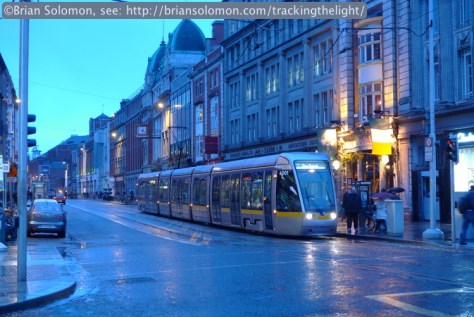
Who said a dull rainy evening isn’t a good time to make photos? I beg to challenge that!
On the evening of March 21, 2014, I was at the corner of Abbey and O’Connell Streets in Dublin just as the final hints of daylight were about to mopped up by heavy low clouds.
I exposed these photos with my handheld Lumix LX3 set at ISO 200. Dublin’s LUAS trams provided a handsome subject and the rain added a bit of gloss.
Abbey Street, Dublin. The Grand Central Bar on the right. Exposed at f2.8 1/15th second ISO 200.A cyclist negotiates O’Connell Street. Pan photo exposed at f2.8 1/6th of a second at ISO 200.Exposed at f2.8 1/8th of a second ISO 200.Looking west on Abbey Street.Waiting for the lights to change.Crossing O’Connell Street.
Cal-Train exposed on color slide film, August 24, 2009. In two months time, I’d receive my first digital camera.
I made this image using my Canon EOS 3 with a 20mm lens. This outbound Cal-Train commute had just discharged passengers at the old Southern Pacific station at San Mateo.
I want an iconic modern image that said ‘California’. What better way to do that, than focus on the Cal-Train logo while incorporating the warm blue sky, palm trees, and a reflection of the sun in the window of the train?