Conrail SEPW (Selkirk to Providence & Worcester at Worcester, Massachusetts) makes a drop at Palmer, Massachusetts on May 6, 1984.
I exposed these two views from almost the same angle on the South Main Street Bridge in Palmer, Massachusetts.
In 1984, Conrail operated the old Boston & Albany, and the main line was then a directional double track route under rule 251 (which allows trains to proceed in the current of traffic on signal indication).
SEPW has stopped on the mainline, while the headend has negotiated a set of crossovers to access the yard and interchange. That’s the head end off in the distance.
I made this 1984 view on Plus-X using a Leica fitted with a f2.8 90mm Elmarit lens.
The comparison view was exposed on July 25, 2016 using a Lumix LX7 set at approximately the same focal length. Although similar, I wasn’t trying to precisely imitate the earlier view and was working from memory rather than having a print with me on site.
Exposed using my Lumix LX7. I used the ‘A’ mode and dialed in -1/3 to compensate for the bright sunlight and the dark side of the train. This image was extracted from the in-camera Jpeg and compressed for internet viewing, but I also made a RAW file of the same image. Both are to be archived on multiple hard drives.
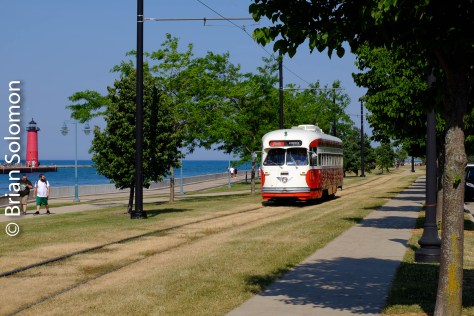
PCC car at Kenosha, Wisconsin in July 2016. Detailed view exposed on Ilford FP4 using a Leica 3A with 35mm Nikkor lens. Kenosha, Wisconsin operates a short streetcar circuit between the Metra station and Lake Michigan. This car was originally from Toronto, Ontario.
It was more than 25 years ago that I made this evening view at Pinole, California using my Leica looking west across San Pablo Bay toward Mt. Tamalpias.
Fog rolls in from the Pacific; and the SP was still the SP.
Exposed with a Leica M2 with 50mm Summicron on Kodak Tri-X processed in Agfa Rodinal.
Last week I traveled with John Gruber to the Illinois Railway Museum at Union. John needed to deliver some material in relation to his North Shore photo exhibit, and he wanted me to expose a few images of him with his photographs.
Between 1960 and 1963, John made a project of documenting the last years of operation of the Chicago North Shore & Milwaukee interurban electric line.
North Shore was an intensive electric line that connected the Chicago Loop (trains served downtown using the rapid transit ‘L’—[elevated line]) with Milwaukee, Wisconsin via Chicago’s northern suburbs. The line was well known for its articulated streamlined speedsters called Electroliners and its electrically cooked hamburgers known as Electroburgers. Operations concluded in January 1963.
John’s work is iconic. He exposed thousands of North Shore photographs and his photography goes well beyond ordinary images of the trains. He focused on people as well as machines, and preserved a feel for this unusual railway in motion.
Johns work was prominently featured in the pages of Trains magazine and in books such as those by the late William D. Middleton.
His current exhibit can be seen in the waiting room of the East Union station at IRM. It will be on display through the end of 2016.
Of course, while we were at IRM, we took the opportunity to travel the line, and visit some of the historic equipment (which includes several of North Shore’s cars).
In addition to a variety of digital photos, I exposed these black & white images with my Leica.
John Gruber at IRM. Exposed on Ilford Pan F using a Leica 3A with Nikkor f3.5 35mm lens.Exposed on Ilford FP4 black & white film using a Leica 3A with Nikkor f3.5 35mm lens.Exposed on Ilford FP4 black & white film using a Leica 3A with Nikkor f3.5 35mm lens. (image cropped).
For more information on the Illinois Railway Museum see: http://www.irm.org
I exposed these three photos last week on Wisconsin & Southern at Baraboo, Wisconsin using my old Leica 3A loaded with Ilford Pan F black & white film (ISO 50).
In its heyday, Baraboo was a division point on Chicago & North Western’s Chicago-Madison-Twin Cities main line.
Its glory days are now more than a century past; decline began in the early twentieth century, when this route was augmented by C&NW’s low-grade Adams Line (via Milwaukee), which became a preferred route for through freight and fast passenger expresses.
It was severed as a through line in the 1980s.
As mentioned in an earlier post, on this July 2016 day John Gruber and I were following Wisconsin & Southern’s Madison to Reedsburg freight.
Some photographers might object to the railroad’s choice of motive power: an SD40-2 operating long-hood first. I recall the wisdom of my late-friend Bob Buck who reminded me once many years ago, ‘The railroad isn’t operated for your benefit.’
(In other-words; if a long-hood forward SD40-2 is on offer, that’s what there is and so make the best of it.)
Compare these images:
Photo 1. In this view the harsh overhead light characteristic of ‘high sun’ was briefly soften by a passing fair weather cloud. Some photographers might cringe at the thought of a cloud, but here if offered opportunity for a variation on the scene. I adjusted the contrast of the image in post processing.Photo 2. Bright sun again; so with this photograph I used my rangefinder to focus on the trackside weeds instead of Wisconsin & Southern 4008.Photo 3. John Gruber looks on while Wisconsin & Southern 4008 switches at Baraboo. Exposed on Ilford Pan F using a Leica 3A rangefinder camera fitted with a Nikkor f3.5 35mm lens.
In one, I’ve adjusted the contrast to compensate for a cloud that momentarily softened the noonday sunlight. In the second, I’ve worked with depth of field and focused on trackside weeds instead of the locomotive. In the last, I’ve included fellow photographer John Gruber to add in a human element.
Earlier this week John Gruber and I visited Kenosha, Wisconsin to ride and photograph the vintage PCC streetcars that serve the town.
The cars are beautifully maintained; the line is short but interesting. Cars operated about every 15 minutes during the day. The fare is just $1.00—a true bargain.
On the downside, it is a bit difficult to figure out how and where to board the cars. A little bit of targeted advertising would go a long way.
In my early days photographing every so often I’d hit upon a great film-camera-lens combination.
You know, just the right set up to make memorable images.
On May 6, 1984, my dad lent me his Leica M3 with 50, 90 and 135mm lenses. For reasons I’ve long forgotten, I loaded this with Plus-X (ISO 125) rather than Ilford HP5 or Tri-X (my typical films choices back then).
More significantly, I decided to use an orange filter to alter the tonality of the film.
I went trackside along the Conrail’s former Boston & Albany and exposed a series of evocative images of trains rolling through the Quaboag Valley.
Conrail’s SEPW (Selkirk to Providence & Worcester) roars east through the Quaboag Valley east of Palmer on May 6, 1984. The magic combination: filtered Spring light; Plus-X film exposed using a Leica M3 with 90mm Elmar fitted with an orange filter. Processed in Microdol-X.
These photos were much more effective than what I typically achieved with my Leica 3A and 50mm Summitar. I’d made a leap forward.
At the time, I was delighted with the results and on a Friday night brought a stack of 3x5in. prints down to Tucker’s Hobbies (owned an operated by my friend Bob Buck).
Friday evenings were our normal time to convene. And, one of Bob Buck’s patrons, a friend and a well-meaning (published) enthusiast photographer (who is long since deceased and so shall remain anonymous) offered me some free photo criticism..
“Oh don’t use an orange filter, it makes the Conrail paint too dark, and stop using that telephoto lens, it distorts your perspective. Otherwise these are great shots.”
I heeded this bad advice and returned to my older set up. Nearly two years passed before I made another serious foray into the realm of the telephoto for railroad photos.
Also, I largely returned to using unfiltered Tri-X/HP5. (Partially because I’d dropped my 50mm and it would no longer accept filters.)
I didn’t know any better and my magic combination was unraveled before I had time to fully explore it.
I exposed this view of Irish Rail 071 class diesel number 079 at Sligo using my Rolleiflex Model T loaded with Fuji Neopan 400.
I processed the film at the Gallery of Photography at Meetinghouse Square in Dublin using Agfa Rodinal Special concentrated liquid developer.
Final processing was accomplished digitally using Lightroom.
The Rollei allowed me to compose using a square field rather than a more common rectangular field. I’ve found that the square changes the way I see, and thus produces different compositions. Someone might ask, ‘couldn’t you just crop it?’. You could, yes, but that’s not my point. ‘So what about the lead-in version? That’s cropped, isn’t it?’ Yes, but not by choice! That’s an effect of the software/internet/webhosts.
Tracking the Light discusses photography everyday.
“I don’t photograph trains anymore because I don’t like [fill in the blank here]”
In the 1980s, I thought Amtrak F40PHs were just about as dull as it got.
I didn’t mind the F40 per se, but the platinum mist livery with narrow stripes, black cab and black trucks didn’t do it for me. And these engines were everywhere!
They were the ubiquitous face of Amtrak: found on the Lake Shore, the Zephyr, the Broadway, etc.
I photographed them anyway. In black & white and in color.
Looking back, some of the photos have aged well.
Yet, the other day at when I was at Claremont Junction, New Hampshire to visit the traveling Amtrak Exhibit train, I still found it hard to get overly enthusiastic about an Amtrak F40!
None-the-less, I made this view on Fuji Neopan Across 100 using my old Leica fitted with a 21mm Super Angulon.
June 18, 2016, Claremont Junction, New Hampshire.
You know, it doesn’t look so bad now.
Tracking the Light offers daily insight into photography.
Sundays too!
Special advisory notice: Tomorrow’s Tracking the Light is a special post and will appear later than normal.
Back in the day, summer always meant that my father would bring my brother and me to one of the New England Trolley museums. Back then we’d ride back and forth and Pop would read the Sunday newspaper.
I’d make photos with my Leica.
This year for Father’s Day, I brought Pop to Connecticut’s Shore Line Trolley Museum located near East Haven, Connecticut. We used to know this as the Branford Trolley Museum (it is operated by the Branford Electric Railway Association).
FujiFilm XT1 photo.Lumix LX7 photo. Pop remembers Johnstown Traction Company 357 from its days in Pennsylvania.
Pat Yough, visiting from Pennsylvania, joined us and we all made photos. Turns out that fathers are admitted free of charge on Father’s Day. So that was a bonus.
Pop used his vintage Rolleiflex, which prompted a comment from the motorman,
“You’re still using film?”
Pop responded, “Sure, and you’re still running a trolley. Today is my ‘retro day’”.
They even had an old IRT Subway car on the move. (Pop said, “these aren’t ‘old’, I remember when they were new!”).
Lumix LX7.NYC subway car interior. Exposed with a Leica 3A with 21mm Super Angulon. HP5 processed in HC110.Lumix LX7 photo.Connecticut Company 775. Exposed with a Leica 3A with 21mm Super Angulon. HP5 processed in HC110.Exposed with a Leica 3A with 21mm Super Angulon. HP5 processed in HC110.An unlikely combination; streetcars from Atlanta, Georgia and Montreal, Quebec. Exposed digitally with a FujiFilm XT1.
It looks to be Spring of 1979: My parents drove my brother, Sean and me to Springfield (Massachusetts) Union Station to catch Amtrak to New York.
At that time most Amtrak services on the Springfield-Hartford-New Haven run were operated with vintage hand-me-down Budd Rail Diesel Cars, the much loved RDCs.
I always liked the Budd Cars because I could talk our way into a cab-run, which was vastly superior to sitting on the seats.
Bummer about the post; but I made this view from the head-end of another RDC at Springfield Union Station in Spring 1979 (April, I think.)
On this day we were treated to running ‘wrong main’ (against the current of traffic) because of track-work south of Springfield.
Nothing finer than a forward view. The top of Sean’s head is just visible in some this trip’s images. He was only nine at the time. Here we are looking westward at Springfield. Our train will take a hard left before reaching the Connecticut River and follow the former New Haven line toward its namesake.We were running wrong main because of a track gang on the normal southward track.Approaching the Connecticut River bridge between Enfield and Windsor Locks, Connecticut. This span dates to about 1906. Today it has just one track.
At New Haven we changed trains for an electric-hauled run toward New York City. At that time, Amtrak served Rye, New York (rather than New Rochelle as it does today) where our grand parents would collect us. I always hoped for a Pennsy GG1 leading our train from New Haven, but usually had to settle for a boxy General Electric E60.
I made these views from the head-end of the RDC using my Leica 3A with 50mm Summitar lens. The train crews were always friendly and on this day the engineer gave us a detail running commentary about the line, much of which I’ve either forgotten or melded in with my general knowledge of the New Haven Railroad.
Back then all photos were film photos (except for Polaroid, I suppose). If could you make photos like this now with your phone, where do you think you’ll find them in 37 years?
On June 25, 1986 at 7:18 am, a trio of Amtrak AEM-7s lead the Southward Montrealer (Montreal, Quebec to Washington D.C.) over Metro-North at South Norwalk.
My pal, T.S.H. and I were trackside from 6:50 am. Our primary objective was to catch the venerable former New Haven Railroad FL9s on the move.
Three AEM-7 electrics lead Amtrak’s Montrealer. All pantographs are up. Now, how cool is that?Exposed on June 25th 1986 using a Rolleiflex Model T with Zeiss 75mm Tessar lens, loaded with Kodak 6043 (120 size Tri-X); f5.6-f8 (f6.3) 1/500th of a second. Processed in D76.The Budd-built Heritage Fleet always looked nice behind the AEM-7s.
The late running Montrealer was an added bonus. We knew this as ‘The Bootlegger’—a prohibition-era term relating to the train’s cross-border activities.
Today, this photograph seems doubly appropriate because Amtrak’s AEM-7s made their farewell trip just a week ago.
After reviewing my black & white negatives from the 1980s, I decided it would be productive to use my old camera for some modern photography. So over the last couple of weeks I’ve exposed several rolls of 35mm film and processed them in the darkroom.
Last week I made use of my old Leica 3A at Old Saybrook, Connecticut.
While the passing trains were the primary subject; it was the fleecy cotton-candy sky that really caught my attention.
Successful black & white photography often makes use of texture and contrast. Here the sky worked well.
A New York bound Amtrak High Speed Train (working as an Acela service) blitzes the station at Old Saybrook, Connecticut. Exposed with a 21mm f4.0 Super Angulon. I exposed for the sky, while allowing other elements of the scene to remain in relative shadow.Sometimes wires are a nuisance; here they are integral park of the scene. Also rather than emphasize deep rich shadows, I’ve exposed for the sky to allow this textured area to draw the eye. Old Saybrook, Connecticut.Amtrak ACS-64 600 David Gunn pauses at Old Saybrook, Connecticut. Here I’ve used a Nikkor 35mm lens on my old Leica. Notice how this lens treats the contrast of the scene. Every lens is different, and choosing the best lens for the circumstance is more than merely selecting the desired focal length.
These images were exposed using Fuji Acros 100 negative film; processed in Kodak HC-110 at 1:32 (with water) for 4 minutes 30 seconds with continuous agitation.
Final image processing was done following scanning with Lightroom.
On June 15, 2016, I posted two views of Pan Am Railway’s leased Slug Set working in East Deerfield hump service and paused on the Connecticut River Bridge east of the yard.
I asked readers to voice an opinion on their preferred image, while explaining that one was exposed on black & white film the traditional way and the other exposed digitally as a monochrome image.
I’ve weighed the comments, email and Facebook messages and found that the response was more or less evenly split, with a slight leaning to the top image (film). One respondent voiced a dislike of both images (see comments).
Below are the two vertical images with details of how they were made.
Number 1; exposed on Ilford HP5 black & white negative film using a Leica 3A with Nikkor 35mm lens. Processed in Kodak HC110 developer.Number 2. This digital image was made using my FujiFilm X-T1 in a monochrome mode. I altered the output through the addition of a digital ‘red’ filter, that slightly darkened the green and blue areas of the image including the locomotive on the bridge. This adjustment was made in-camera, not in post processing.
Both images were scaled for internet presentation using Lightroom.
Ok, how about then and when? (click on the link to Brian Solomon’s Tracking the Light to see the modern view).
These photos were exposed 28 years apart from essentially the same place in West Warren, Massachusetts.
One view was made of an eastward Conrail freight in March of 1984; the other of an CSX freight at almost the same spot on November 15, 2012.
In both situations I opted to leave the train in the distance and take in the scene.
Conrail eastward freight grinds upgrade on a dull March 1984 morning. Exposed on black & white film using a Leica 3A with 50mm Summitar lens.CSX Q264 (carrying auto racks for delivery in East Brookfield, Massachusetts). Exposed on the morning of November 15, 2012 using a Lumix LX3 with Leica Vario-Summicron lens.
Over the years I’ve worked this vantage point with a variety of lenses, but I’ve chosen to display these two images to show how the scene has changed over the years.
In the 1984 view notice the code lines (the ‘telegraph poles’) to the left of the train and the scruffy trees between the railroad and the road. Also in 1984, the line was 251-territory (directional double track).
It was my second visit to Eagle Bridge, New York inside a week.
On this visit, We’d driven here on spec looking for Pan Am’s EDRJ (East Deerfield to Rotterdam Junction). No luck with that this time, but on arrival I’d noted that there were loaded grain cars on the interchange for the Battenkill Railroad.
So what?
Well, the Battenkill is known to run on weekdays; this was a Friday, its interchange had been delivered, but as of 1:30pm the Battenkill hadn’t come down to collect it yet.
The Battenkill’s primary attraction is its continued operation of vintage Alco RS-3 diesels. While the RS-3 was among the most common types built in the 1950s, only a scant few survive in traffic today outside of museums. (Perhaps a reader can supply a list?).
Photographer Paul Goewey, who was traveling with me, looked up the Battenkill’s radio information on his smart phone.
“We’ll go up the line and see if we can find the BK.”
So we drove ten yards and over the grade crossing near the old station and . . .
“There he is!”
That was easy, now wasn’t it?
Battenkill’s old RS-3 chortles its way up the interchange tracks. On the right is the old Boston & Maine station at Eagle Bridge, New York. Exposed on Ilford HP5 using a Leica 3A with Nikkor 35mm lens. Film processed using a two bath HC110 developer mix in a Jobo processing machine.Digital image at Eagle Bridge exposed with a FujiFilm X-T1 with 18-135mm lens.Battenkill collects part of its interchange. The B&M station is directly at my back.Alco diesels are famous for their exhaust. Note the nicely tamped track.Looks like someone came prepared for the day! I exposed this with my Leica 3A on HP5 (processed as described above. By using a two bath developer I was able to optimize the film’s shadow and highlight detail).Battenkill’s former Delaware & Hudson RS-3 is still lettered for the Greenwich & Johnsonville, a shoreline that operated the route prior to Battenkill.I thought I’d try a low angle.Now there’s some Alco exhaust!
Battenkill runs as required but Tracking the Light Runs Daily.
So it read on one end of Conrail’s specially painted New England Division caboose.
Ironically, on this day that ‘end’ of the caboose that was facing inward toward the freight cars.
I made these photos at the end of the day at Tennyville in Palmer, Massachusetts.
The freight was Conrail’s PWSE (Providence & Worcester to Selkirk).
These were among my reticulated negatives in my lost photo file described in detail in yesterday’s post (see: Conrail-Visions from another era.) They were exposed in Spring 1984.
Conrail’s one of a kind New England Division Caboose spent a couple years on the Boston & Albany in the mid-1980s. Sometime after Division Supt E.C. Cross retired it was sent west to New York State where it became the Buffalo Division Caboose. I have more photos of it out there. Most of them sharper than these.Interestingly, my unintentional and inept processing of the negatives resulted in producing better tonality in the sky. This was at the expense of sharpness and granular uniformity however.Looking west at Palmer, Massachusetts in the Spring of 1984.If you look carefully, you can spot the headlight of PWSE’s headend working Palmer yard to make a pick up. That’s the old Route 32 bridge over the tracks in the distance.
Interestingly, my unintentionally inept processing of the negatives resulted in producing better tonality in the sky. This was at the expense of sharpness and granular uniformity however.
For more than 30 years these negatives were stored unlabeled in a white envelope.
I scanned them last week; and using digital post-processing techniques I was able to adjust the contrast to partially compensate for the damage in processing.
I featured this caboose in my first book on American railroad cabooses authored with John Gruber and published by MBI.
It was Spring 1984 when I made this black & white photo of Conrail’s SEBO-B climbing east through Warren, Massachusetts.
Until a couple of day’s ago, this negative was lost and unprinted, part of a group of Conrail negatives on the Boston & Albany.
When I first relocated these images after 32 years, I was puzzled.
What had happened and Why?
Then I remember the situation: I’d messed up the processing of the negatives at the time and I was disgusted with the results. And, so I’d put the negatives away in a general file, where they were mostly mixed in with similar outtakes from my High School yearbook collection (I was a sort of unofficial class photographer.)
In 1984, I’d typically use Kodak Microdol-X as my black & white developer, aiming to work with this solution at 68 degrees F.
To mix the solution from powdered form, I’d have to bring the temperature up to about 120 degrees F, then let it cool (often in glass bottles soaking in ice water).
I must have been in a hurry, and in this instance, I’d failed to allow the developer to cool properly. When I processed the negatives the solution was still over 80 degrees F. Worse, the rest of my chemistry was still at 68 degrees.
The result was that my photos were grossly over processed, but since the developer was highly active, it affected highlights and shadow areas differently. This provided much greater shadow detail to highlight detail than I’d normally expect.
Also, the shock to the emulsion when I dropped the hot film into relatively cool stop bath solution caused it to reticulate.
Reticulated emulsion results in grain clumping that lowers the sharpness, produces a ‘halo-effect’, and creates a speckled and uneven grain pattern that is most noticeable in even areas such as the sky.
Since the negatives received much greater development than usual, they are very dense, and back in my day printing photos in the family kitchen, were effectively unprintable.
This enlargement of the front of the engine shows the effects of reticulated grain structure. When processed as intended Kodak Tri-X can deliver a relatively fine and even grain structure. Here we have a mottled speckled structure caused by shock from a very hot developer followed by the cool stop bath.
With modern digital scanning and post processing techniques, I was able to overcome difficulties with the density and contrast.
In the Spring of 1984 (second week of May based on the freshly leafing trees) I made this early evening image of Conrail’s SEBO-B working east through Warren, Massachusetts on the B&A route. (SEBO = Selkirk to Boston).
I find the end result pictorial. Perhaps, it’s not an accurate rendition of the scene, but pleasing to the eye none-the-less.
I’m just happy I didn’t throw these negatives away. After all, Conrail SD40-2s were common, and I had plenty of opportunities to photograph freights on the B&A.
Below is a comparison between two photos; one exposed digitally and one made with film. (Hint: click on Tracking the Light to see both).
I made these the other day of Pan Am’s hump engine working on the Connecticut River Bridge at East Deerfield, Massachusetts.
I won’t bore you with excessive detail, but one was made as a black & white image with a digital camera . The other was exposed in a traditional manner on black & white film, processed chemically and then scanned and scaled.
Number 1.Number 2.
So: which image do you prefer? (number one or number two).
Oh, and by the way, it is up to you to decide which was made with film and which was not.
I exposed this view at Dublin Connolly Station in April 1998 using a Nikon F2 fitted with a Nikkor f2.8 135mm lens and loaded with Ilford HP5 black & white negative film.
Ilford HP5 is a 400 ISO emulsion. I processed this roll in Kodak D76 1:1 with water. Today, I still occasionally use HP5, but now I’d opt to process it in HC110, which I find gives it a broader tonality and softer grain. This image was scanned from the original 35mm negative using an Epson V600 flatbed scanner and then adjusted using Lightroom.
The day was a characteristically bright overcast, a typically Irish day with lighting well suited to Ilford black & white.
Tracking the Light posts every day; sometimes twice!
On 30 April 2002, I found myself in Dresden and perishing low on film.
I’d been photographing in Poland and Slovakia for the better part of two weeks and underestimated how many photos I’d make. (Those who know me well, will recall this being a common occurrence on big trips).
Anyway, I’d found a shop with some black & white film, and exposed a roll of HP5 using my Nikon N90S, (trying to stretch out what little slide film I had left), and making parsimonious use of my 120 film.
This had me in a knot, as Dresden is a visually fascinating place, and I was seeing images everywhere I looked!
When I got back to Dublin, I processed the roll of HP5 in ID11 (Ilford’s relative equivalent to Kodak’s D76) and sleeved it, but I never got around to making prints.
The other day (May 2016), I was searching for some German tram photos, when I rediscovered this roll mixed in with a host of other unprinted B&W negatives from the mid-2000s.
A preserved four-wheel tram grinds along in Dresden on 30 April 2002. I exposed this image using a Nikon N90S with 24mm lens on Ilford HP5 black & white negative film. I used a deep red filter to adjust contrast. The other day I scanned it using an Epson V600 and then adjusted the file using Lightroom to tweak shadow detail, improve sky contrast, and eliminate some unwanted dust specs.
What immediately caught my eye was this silhouetted image of a preserved four-wheel tram. Searching the internet, I can conclude this is a museum car operated by the StrassenbahnmuseumDresden.
It was a spirited chase; the day was fine and we made many photos.
But, was it really more than 31 years ago that my friends and I followed an extra freight, symbol EDLA from Erving to Ayer? (That was an East Deerfield to Lawrence, Massachusetts train, which my notes show as an ‘EDLA-X’, but I’m not sure I have that down right.)
Even in 1985, catching a GP18-GP9-GP18 leading a freight on the old Fitchburg was considered a prize.
The Boston & Maine GP18s are long gone, but a few of the old GP9s are still knocking around.
My dad had lent me his Leica M4 and some lenses. On February 17, 1985. I exposed this image on Ilford FP4 at the East Wye in Ayer—after the freight had made its drop to the Hill Yard.
Recently, I scanned this negative using my Epson V600. I processed the file in Lightroom and cleaned up some of the dust spots.
Something to ponder: later that evening, symbol freight POPY (Portland to Potomac Yard) went west with D&H Alco C-420s in the lead.
Let’s gaze back in time; 30 plus years ago I was a young enthusiastic photographer with a 35mm Leica rangefinder. I was fascinated by the Boston & Maine, operated by Guilford Transportation Industries (as Pan Am Railways was then known).
B&M’s quaint operations, traditional signals, and antique General Motors diesels had a real appeal. Back then I focused on catching the EMD GP7s, GP9s, and GP18s, plus EMD switchers and run-through Delaware & Hudson Alco C-420s and C-424s.
I made hundreds of images trackside in those days.
On June 4, 2016, I picked up my old Leica, as I do from time to time, and loaded it with Ilford HP5 (often my choice film back in the day) and headed for Pan Am Railway’s East Deerfield yard before dawn, (as I have since I learned to drive 33 years ago).
Antiques still run the rails on Pan Am.
Pan Am Railways’ SD40-2s at East Deerfield Yard on the morning of June 4, 2016.A real rare pair in 2016; back to back high-hood GP40s. How sweet is that? This is Pan Am’s EDRJ (East Deerfield to Rotterdam Junction).
As the EDRJ was getting its train together the morning fog began to burn off. Cosmic light.
My lens of choice has a long history.
In the 1970s and very early 1980s, I’d often photograph with a Nikon 35mm wide angle made with a Leica screw-mount.
This lens had gone missing for decades and only recently re-emerged. In the interval it had seized up (as old equipment does when the lubrication dries out). My dad sent it for servicing and its now back in our arsenal of working photographic equipment.
Good lenses are relatively common these days. Most off the shelf digital cameras have pretty good optics compared with many consumer-grade film cameras of yesteryear.
But, truly great lenses remain hard to find.
This Nikon 35mm is a great lens. Not only is it sharp, lightweight and compact, but it has a distinctive optical quality that is rarely found with modern lenses. In short it has ‘that look.’ (look at the photos).
Pan Am’s EDRJ roars upgrade through Shelburne Falls, Massachusetts passing an old Boston PCC streetcar that resides at the Trolley Museum. I used to ride these cars on the Riverside Line in the early 1970s.
After exposing my film, I processed it with the aid of a Jobo film processor to my own custom formula.
Basically, I used a twin bath developer of Kodak HC110 with constant agitation at 71 degrees F for 4 minutes, 15 seconds. Stopbath for 30 seconds; twin bath fixer; rinse; permawash; and final wash. Negs were scanned as TIF files using an Epson V600 flatbed scanner at 3200 dpi . Nominal contrast adjustment was necessary with Lightroom.
Undoubtedly, someone will ask, ‘but isn’t that a lot of work?’
Yes, it is.
And, ‘Couldn’t you just convert your digital files to black & white?’
You could, yes.
And, so I ask, ‘do you have any favorites here?’
With a roar of 645 diesels and a cosmic cloud of exhaust, EDRJ approaches the east portal of the famed Hoosac Tunnel on the morning of June 4, 2016.North Adams, Massachusetts.The trees are taller at Eagle Bridge, but this station looks today much as it has looked for at least three decades. I’ve feature this in my book; Railway Depots, Stations and Terminals.Eagle Bridge, New York, the old Boston & Maine station is a relic of former times.Railroading gone retro! Hooray! Ilford HP5; f8 1/200th of a second.
Yesterday (Saturday June 4, 2016) I exposed this view of Berkshire Scenic’s RDC using my old 35mm Leica 3A rangefinder. I processed the film this morning and scanned it for internet presentation.
Coming up soon, I’ll detail specifically what I did and why.
Tracking the Light posts daily.
For details on Berkshire Scenic’s Hoosac Valley service which is now running out of North Adams, Massachusetts see: http://www.hoosacvalleytrainride.com
I was working with three cameras. Previously I’ve published color views exposed with my Contax G2 rangefinder and Nikon N90S single-lens reflex, however until today most of my black & white photos remained unpublished and unseen.
I made my black & white photos using a Rollei Model T twin-lens reflex (120 size film camera). So, rolling along at about 30 mph east of Tallinn, I made this view of a Riga-built Tallinn-area electric suburban train.
Exposed with a Rolleiflex Model T twin-lens reflex fitted with a 75mm Zeiss Tessar. Kodak Tri-X processed in Ilford ID-11 1:1 with water. Scanned at 3200 dpi with a Epson V600 flatbed scanner. Scaled for internet presentation using Lightroom; however there was no post-processing manipulation to density, contrast or sharpness.
Significantly,I made this image by using the Rollei’s field-finder— which is nothing more than a pair of open squares that allow you to frame up a photo while holding the camera at eye-level.
Normally, I’d focus using the camera’s built in magnifying glass on the waist level viewer (which supplies a view through the top lens arrangement that projects onto a Fresnel screen. The down side of this viewing mechanism is that you must look down into the camera and the image is in reverse.
So exposing photos from a moving locomotive cab using the waist-finder is not only impractical, but can lend to sea-sickness.
Another advantage of the field-finder is that you are actually looking at your subject without any distortion caused by a lens. In today’s photography it rare that you actually see your subject at the time the shutter is released. You’d be amazed how this direct viewing can improve composition.
Also, the Rollei’s mechanical shutter release is virtually instantaneous.
The purpose of this image was intended as a test of Kodak’s new T-Max 100 black & white film. Exposed with a Canon A-1 with 50mm lens.
I made this view of Conrail GP40-2s rolling east at Rochester, New York’s Amtrak station in November 1986—nearly 30 years ago.
At the time, Conrail was the order of the day, and the GP40-2s were common.
Although sharp and properly exposed, this view was marred by the shadow of the canopy and so at the time I disregarded it.
I’ve amended my opinion, however.
Now the whole scene has changed beyond recognition. Conrail is gone nearly 17 years and last year Amtrak demolished its old station in preparation for construction a new one.
I made this study of CSX’s former Boston & Albany mainline at Brookfield, Massachusetts in January 2001.
Step back a century and there were two main tracks and an array of sidings here; back when the railroad focused on local business in addition to long distance traffic.
Brookfield, Massachusetts. Exposed on black & white negative film using a Rolleiflex Model T with Zeiss 75mm Tessar lens.
CSX 611 is a AC6000CW—a big GE diesel by any measure.
In January 2001, My pal T.S.H. and I were making an inspection of the old Boston & Albany between Palmer and Worcester, Massachusetts ( reliving a trip we’d made in the summer of 1984).
CSX 611 leads a westward freight on the Boston & Albany route at East Brookfield in January 2001. Black & white 120 size negative scanned using an Epson V750 flatbed scanner and adjusted for contrast using Lightroom.
I exposed this view using a Rollei Model T that I’d bought from Mike Gardner.
My intent was to recreate a view I’d made of westward Conrail freight at the same location 16 years earlier.
Sadly, the old Boston & Albany station at East Brookfield was destroyed by arson in Autumn 2010.
Conrail eastward freight at Bullards Road, Hinsdale, Massachusetts on August 3, 1984. Take notice the former Erie Lackawanna SD45-2, Conrail 6659, second out. Some of those old EMD’s are still on the move. This day it’s 20-cylinder 645-diesel was adding to atmosphere. (Fear not, I have plenty of photos of the SD45-2s on the B&A and elsewhere on Conrail).
Looking back more than three decades; it was a warm August 1984 afternoon when my pal T.S.H. and I sat up on the grassy hill near the popular Bullards Road Bridge to photograph this Conrail eastward freight as it approached Boston & Albany’s summit of the Berkshire grade.
I made this image on 35mm Kodak Tri-X using my Leica 3A with a Canon 50mm lens.
Conrail was divided in Spring 1999, nearly 15 years after this photo was exposed.
In 2003, CSX removed the old Bullards Road bridge (and stone abutments).
I can’t say for certain what happened to the SD40, but a similar former Conrail engine still works for New England Central.
Personally, I’d trade my digital cameras for a fully functioning time machine.
It was April 1989 when I exposed this view of Conrail’s BUOI (Frontier Yard Buffalo to Oak Island, New Jersey) bumping along the number 2 track at Arkport, New York.
At that time this portion of the old Erie Railroad line from Hornell to Buffalo as still directional double track (rule 251) with block signals largely in the from of antique Union Switch & Signal Style S semaphores.
A 35mm black & white photograph exposed using a Leica M3 rangefinder with 90mm lens. That’s my old (then new) Bogen 3021 tripod that I’d lent to a fellow photographer ( seen at left).
Between Hornell and Hunt, New York, Erie’s old eastward main wasn’t maintained for speeds faster than about 10mph, and when possible Conrail routed traffic against the current of traffic on the westward (number 1 track.) Not on this day though.
I was working with two Leica M rangerfinders that day; I made a similar view on Kodachrome slide film with my M2 that appeared in RailNews for its ‘Farewell to Conrail’ issue back in 1999 (a little more than ten years after I exposed it).
While Conrail was only an extant player in American mainline freight operations for a little more than 23 years, it was my favorite of the big eastern railroads.
It was a day of big excitement. Up north, Guilford was in a knot as result of a strike action. Bob Buck phoned me early in the morning to say that ‘The Boot’ (the colloquial name for Amtrak’s Montrealer) was detouring to Palmer on the Central Vermont, then west on the Boston & Albany (Conrail).
Using my dad’s Rollei model T loaded with Kodak Tri-X, I made the most of the unusual move.
This was nearly a decade before Amtrak’s Vermonter began to regularly make the jog in Palmer from the CV/New England Central route to the B&A mainline.
And, it was only four months before Conrail ended traditional directional double-track operations between Palmer and Springfield.
Amtrak 61 followed CV’s southward road freight to Palmer arriving at 11 am with Canadian National M-420 2557 in the lead.. Here I pictured it near the old Boston & Albany freight house in Palmer, Massachusetts. Note the all heritage consist (except of course for the F40).An Amtrak CF7 had come out from Springfield to assist with the reverse move necessary to bring the Montrealer westward over the B&A.
I’d met some photographers at the Palmer diamond and encouraged them to take advantage of my favorite vantage point at the rock cutting at milepost 84, just over the Quaboag River from the Palmer Station.
As detouring Amtrak number 61 approached with a former Santa Fe CF7 leading the train to Springfield, we could hear an eastward Conrail freight chugging along with new GE C30-7As.
Moments after I exposed the classic view of this Montrealer working the old number 1 track, TV6 blasted east with intermodal piggybacks for Worcester and Boston. I was using the Rollei with a 645 ‘Superslide’ insert that allowed me 16 frames per roll.Conrail TV6 passes Amtrak’s Montrealer on the double track west of the Palmer diamond. Four months later, in July 1986, Conrail cut-in CP83 which ended double track operations between Palmer and the new CP92 in Springfield.Sometimes when the action is unfolding its best to just keep exposing pictures. Here I was cranking the Rollie as quickly as I could.
This is among my favorite sequences that show the old double track in action.
Some of these photos later appeared in Passenger Train Journal. Long before I was the Associate Editor of that magazine.
On a bright May morning at Wolsztyn, Poland, I organized a footplate trip for myself on a PKP (Polish National Railways) 2-6-2 running to Poznan with a revenue passenger train.
This was among the photos I made of the experience.
A PKP fireman feeds the fire at speed. Exposed with a Rollei Model T on 120 black & white film. Scanned with an Epson V500 flatbed scanner and processed digitally in Lightroom.
Let’s just say I had a nice view on the return trip.
Here’s another view from productive day last month photographing Pan Am Railway’s Office Car Special in the snow.
I made this view with my Canon EOS-3 on HP5 at Shelburne Falls, Massachusetts.
It is an old school technique to capture a traditional looking train.
PAR-1 kicks up the snow on the old Boston & Maine Fitchburg line at Shelburne Falls, Massachusetts on the afternoon of February 15, 2016. Exposed on HP5 black & white film, processed with Kodak HC-110 and scanned with an Epson V600 flatbed scanner. This view is full-frame (without cropping or contrast alteration in post-processing)
In the last few months I’ve been lucky to catch a variety of the more obscure operations on the Pan Am Railways system.
Last week, Mike Gardner and I spent the afternoon around North Adams, Massachusetts.
EDRJ arrived with two locomotives to drop for local freight AD-1.
Pan Am AD-1 is seen on the Boston & Maine mainline at North Adams. Exposed on HP5 using a Canon EOS-3 with 20mm lens.Boston & Albany on the left, Boston & Maine on the right. Exposed on HP5 using a Canon EOS-3 with 70-200mm lens.
Although, we had high hopes of following EDRJ west toward the Hudson River Valley (uttering the now-famous battle cry, ‘To the River!’), Pan Am had other ideas.
History will forgive them.
So instead we followed AD1 down the old Boston & Albany North Adams branch to Zylonite.
Zylonite on the old Boston & Albany, now Pan Am’s Adams branch. Exposed with a Lumix LX7.Who would have thought a high-hood GP40 would be working the old North Adams Branch! This was once the territory of Alco road switchers. Exposed with a Lumix LX7Pan Am local freight AD-1 on the Adams Branch at Zylonite. Exposed with a FujiFilm X-T1.Looking north toward North Adams.Former Canadian National Railways GP40-2L wears a nice shade of blue. Exposed with a Lumix LX7.
After a taste of this surviving segment of B&A’s extension to North Adams, we followed the abandoned vestige of the line that runs southward to Pittsfield, then made the most of the late afternoon on the former B&A mainline!
Too often I find that a brand or a ‘team theme’ is applied by photographers to railway photography. Their intent may be good spirited, but the results can be limiting.
Specifically in regards to equipment: Cameras and lenses are tools. (As are digital sensors and film emulsions). While each camera system has advantages and disadvantages, obsessive loyalty to one brand or another may stand between a photographer and their ability to make better photographs.
Over the years, I’ve worked with a variety of different cameras. Most have had their strengths, but also limitations.
30 years ago, I worked largely with Leicas. The lenses were very sharp, and when I loaded them with Kodachrome 25 or Kodak Panatomic X, I often produced very acceptable results.
20 years ago, Nikons were my primary tools. I was fussy about my selection of lenses, and I experimented with a variety of films.
10 years ago, I carried a Contax G2 range finder loaded with Fujichrome with me everywhere, yet exposed many images with Canon EOS3s.
New England Central southbound 611 crosses the Millers Falls high bridge. For this image I used one of my old Canon EOS3s fitted with a 100mm Canon lens and loaded with Ilford HP5. I processed the film according to my custom tailored recipe. (See yesterday’s post for details). Why Canon? Why black & white film? Because it these combinations worked for me.Moments after I exposed the black & white photo above, I made a burst of digital images with my FujiFilm X-T1. In this situation I have the best of film and digital photography, while working with two different camera systems. Standing next to me Mike Gardner exposed photos using his digital Leica M.
Today, I work with a Lumix LX7 and Fuji X-T1 digital cameras, as well as my old Canons and Nikons loaded with film. Occasionally, I borrow my dad’s Leica M rangefinders. Depending on the circumstances I’ll use digital or film, sometimes working with both at the same time.
Over the years I’ve made photos with Rollei 120 camera, and Hasselblads, Sinars and Linhofs, Pentax SLRs, along with a host of other equipment.
Why do I choose one camera over another?
Not because of loyalty to one brand or another. Not because one uses film and other is digital. But, because I’ve learned the strengths and weaknesses of individual camera systems and specific camera models. No two camera systems work the same way, and thus in similar situations no two cameras perform the same.
I’m not a team player. I won’t use a Canon because it’s a Canon, or grab my Lumix LX7 simply because it is a digital camera. I work with these tools because of the results they can produce in different circumstances.
Optical quality is always important, as is ease of use and relative affordability. But these days camera weight is often a deciding condition when I choose which tools to carry. My camera bag of the 1990s weighed about 4 times what my bag does today.
My Lumix LX7 is a great tool for making grab shots. Here Mike Gardner and I were pacing a New England Central freight. I rolled the window down, set the aperture to its smallest hole to force the camera to use a slow shutter speed (I had the Lumix in ‘A’ mode which allows me to select the aperture while the camera picks the shutter speed based on its internal meter). At the time I had three cameras to chose from, and I instantly opted for the Lumix.
I’m always on the lookout to see what a new piece of equipment can do. And, I’m always interested in finding ways to make old equipment work for me.
In the end, my camera selection is about the result and not the camera.




 Tracking the Light posts daily.


