Last weekend’s Reading & Northern Iron Horse Ramble was more than just a trip. It was an event and a confluence of railway people, railway fans, railway photographers, train riders, and even members of the general public.
I sent my dad an SMS text with a of photo of 2102. He wrote back, ‘take photos of the fans.’
He has photos of Reading Company’s rambles with the railroad’s class T-1s surrounded by fans and photographers.
Below is a selection of my people photos from Saturday July 1, 2023.
A few days ago, a storm had cleared away the hazy dust and for once there was some sweet evening light at Gap, Pennsylvania along the old Pennsylvania Railroad Main Line.
We’d stopped at a nearby Rita’sIce to get a treat for Kris and pulled up to a park-like setting in view of the famous clock tower. I was tracking Amtrak Keystone train 669 and knew it was close.
When Amtrak Siemen’s ACS-64 663 rounded the bend with train 669, I exposed a sequence of photos with my Nikon Z6 and 70-200mm lens then raised my Lumix LX-7 for coming and going wide angle views, followed by another sequence with the Nikon. Kris made a phone video of me taking photos.
I’d just sat back in the car, when Kris said, ‘Look! Another train,’ as an eastward Amtrak train squealed into view. My Lumix was still in my hand and ready to go, so I made a couple of grab shots. I assume this was a deadhead move, as it hadn’t appeared on the tracker. The engineer gave us a friendly toot! as the train passed.
I love bonus trains that I wasn’t expecting!
Keystone train 669 led by ACS-64 663 catches the light at Gap, PA. Nikon Z6 with Nikkor Z-series f2.8 70-200mm.Lumix LX7 view of Amtrak Keystone train 669 westbound at Gap. This was the first time I’d seen ACS-64 #663 in motion and so I was delighted to catch it in such nice evening light.My Lumix LX7 is a wonderful camera. However, one of it’s limitations is a comparatively narrow dynamic range. In this instance the sun has completely washed out.Trailing view of Keystone train 669 at Gap.A Lumix LX7 grab shot of an unexpected dead-head move eastbound at Gap, just a minute after westward 669 had passed. The best camera is the one you have with you and ready!Lumix LX7 trailing view at Gap, Pennsylvania.
I like to put the railroad in the context of its environment, but I also like to make macro views of the equipment.
Last weekend I had several opportunities to get up close to Reading & Northern’s T-1 class 4-8-4 #2102 to make a selection of detailed views of the machinery.
Reading & Northern 2102 ‘rods down’ at the beginning of the day.Headend crew viewed from the fireman’s side of the cab at Reading Outer Station, Reading Pennsylvania.Detailed view showing the valve gear and crosshead.Smokebox view of 2102 at Jim Thorpe, PA.
Last week my sister-in-law Isablle phoned to say that she found the perfect place to meet for dinner. ‘It’s like a pub, it’s near an antique place, it has a train parked out front, and its only about a half an hour away from where you live!’
And she was right!
So Kris and I arranged to meet my brother Sean and Isabelle, and our friend Pat Yough (long time TTL reader).
Pat and I took turns to walk up an photograph the engines of the East Penn Railroad that were parked across the street by the old Reading Company Station.
The restaurant/pub was old school with a classic tin ceiling, big windows and pool tables.
I made these photos with my Lumix LX7. The staff were friendly and we all had a good time!
The other day, photographer Mike Gardner (and TTL reader) sent me a photo he made of me on a trip back in October 2004. “I think you had two Nikon F3s and a Contax G2 around your neck.” That sounds about right.
So, when photographing Reading & Northern’s 2102 with Dan Cupper on July 1st, I worked with my two Nikon Z-mirrorless cameras in tandem.
As previously described on TTL, I have my Z6 set up with a Nikkor Z-series 70-200mm zoom, and I made the following photos using this combination.
These are all relative long-telephoto views, and offer a contrast to the more traditional approach presented on my earlier TTL posts of R&N 4-8-4 2102 in action.
Molino, Pennsylvania.River Road, Near Atlas Park in West Penn, PA.Nesquehoning, PA.Nesquehoning, PA.Nesquehoning Junction, PA.Nequehoning Junction, PA.East Mahanoy Junction, PA.
Among the challenges of the July 1st chase with 2102 was haze and smoke stemming from Canadian wildfires—conditions that had affected eastern Pennsyvlania for days. This produces some unusual color temperature and made for some unusal lighting conditions.
To celebrate American Independance Day, I’m posting this view that I made of Conway Scenic Railroad’s North Conway, New Hampshire station during the July 4, 2021 fireworks display.
This was a 6 second time exposure using my Nikon Z6 mounted on a tripod. ISO 200, f9.0 24-70mm Z-series lens set to 29mm. Highlights, shadows and color balance adjusted in post processing. Photo exposed July 4th, 2021 (two years ago)
Monday evening, July 3, 2023, I’d just collected my new glasses. We were driving east on highway 741 as a brilliant rainbow graced the eastern sky. We arrived at the Strasburg Rail Road just as the colors started to fade. All around us were dramatic clouds in a stormy sky. The contrast was fierce.
I made these photos using my Lumix LX7, exposing in RW2 (RAW). I made minor adjustments in Lightroom to better balance the ground and sky.
I’ve been sifting through hundreds of photos that I made of the July 1, 2023 Reading & Northern Iron Horse Ramble to Jim Thorpe, PA.
The railroad put on an amazing show of steam and I was very impressed by the performance of the locomotive and its crew.
Below are a couple sequences made on the outward leg of the trip. These were exposed using my Nikon Z7-II with 24-70mm Nikkor Z-series zoom.
My goal was to capture Reading & Northern’s 4-8-4 steam locomotive at work. In these images, I’ve tried to picture the engine in the classic ‘rods down’ position that was favored by many traditional locomotive photographers.
More 2102 images soon!
Hamburg, PA.Hamburg, PA. Lens set at 43mm.Crossing River Road near Atlas Park, West Penn, PA. Lens set at 49mm. Lens set at 49mm.Crossing River Road near Atlas Park, West Penn, PA. Lens set at 24mm.
In the 1950s and 1960s, my father photographed and traveled on Reading Company’s famous ‘Iron Horse Rambles’ over its lines in the coal country of eastern Pennsylvania.
I grew up hearing stories of these trips and viewing his many black & white and color photographs that feature the railroad’s mighty class T-1 4-8-4 steam locomotives.
I’d visited several of these engines over the years; in Baltimore, Scranton, and last year at Port Clinton, PA. But until yesterday, July 1, 2023, I’d never witnessed one under steam.
When I began my Reading Company model railroad project in 2020, among the models Kris and I purchased was an HO scale interpretation of Reading Company 2102. And this engine was a regular feature on the Wee Reading Company’s coal trains, until I dismantled the railroad back in May in preparation for our move to Pennsylvania.
Yesterday, I traveled with Dan Cupper to Reading & Northern’s Reading Outer Station (not to be confused with Reading Company’s original Outer Station) to photograph 2102.
We spent the day photographing the engine at work. These Nikon Z7-II photos at R&N’s Outer Station are merely prelude to our chase to Jim Thorpe and back photographing Reading & Northern 2012 in action. It was an exhilarating day of photography! Stay tuned . . . .
We arrived at Gap, PA about ten minutes ahead of Amtrak Keystone service 618 on its way east from Harrisburg.
I made my first photos in this curve at Gap on a visit 16 years ago—June 2007.
Thick smoky-haze filled the air and filtered the evening sun.
I made this telephoto series of images as Amtrak 618 (led by ACS-64 606) glided through the curve at Gap.
Nikon Z6 with 70-200mm zoom set to 200mm; f4.0 1/1600, ISO 400;Nikon Z6 with 70-200mm zoom set to 200mm; f4.0 1/2500, ISO 400Nikon Z6 with 70-200mm zoom set to 74mm; f4.0 1/1600, ISO 400;Nikon Z6 with 70-200mm zoom set to 200 mm; f4.0 1/500, ISO 400;
Yesterday evening the air and sky were thick with particulates. The landscape took on a surreal unworldly appearance.
As Kris and I drove around Strasburg, Pennsylvania, I made a few photos with my Nikon Z6 and 70-200mm lens.
The lighting was about as strange as anything I’ve worked with naturally.
The sun looked like a floating glob in a lava lamp. The sky was a pasty gray-lavender while wafting clouds of thick green-gray haze filled the air near the ground.
The sun didn’t so much set as it melted into the haze.
I exposed these images of Strasburg Rail Road’s preserved J-Tower and the Railroad Museum of Pennsylvania’s former Reading Crusader tail-end observation car, and the nearby farm.
Yesterday evening (June 28, 2023), poor air quality made for a rosy sunset in Lancaster, PA.
Kris and I took a short drive over to Amtrak’s Harrisburg Line to catch Amtrak’s Keystone service train 653 that was down about 18 minutes from the advertised.
I especially liked the trailing view because the stainless steel train caught the rich evening light.
I made some minor adjustments in Lightroom to make the most of the reddish glow.
Amtrak Keystone train 653 westbound. Nikon Z6 with 80-200mm Nikkor Z-series zoom set to 175mm; f2.8 1.1250 sec, ISO 800.Clear signal at 64 dot 5. 175mm f2.8 1/2000th of a second, ISO 800.Glinting Amfleet at Greenfield.Sunset in a smoky sky. June 28, 2023.
Amtrak’s former Pennsylvania Railroad Main Line from Philadelphia to Harrisburg runs a short distance from our new home. While this is primarily the route of the Keystone and Pennsylvanian trains, it also hosts Norfolk Southern locals that use the line to reach secondary lines and serve local industry.
Since we moved in, I’ve heard a few NS trains but not had the opportunity to investigate their movements in daylight. However, last night we saw this local near Greenfield Road in Lancaster, PA.
As a trainman was setting up the telemetry device on the locomotive that would become the rear of his train, I made a few photos with my Lumix LX7.
Lumix LX7 photo. Exposed handheld at f1.8 for 1.5th of a second at ISO80. Locomotives were positioned at each end of the short local freight. GP38-2 5607 was being set up as the rear of the freight.
Esbenshade! What a great name for a crossing suited to silhouette?
The other day I presented an example of a telephoto view of Strasburg Rail Road Number 89 leading the Saturday 6pm excursion at Esbenshade Road in Strasburg, PA.
Today, I’m offering two examples of wideangle views at the same crossing. These were exposed as NEF RAW files with my Nikon Z7-II, which has incredible dynamic range.
In this situation to make a silhouette, I set the camera in ‘M’-mode (manual) and used the in-camera meter to expose for the sky. I have my display showing an exposure histogram, the helps me best balance the detail captured in the extreme highlights and shadows. Although this detail isn’t evident in the thumbnail camera display, it has been captured in the NEF RAW file.
After downloading the camera, I import the NEF files into Adobe Lightroom, and use the ‘Light’ slider controls (including ‘highlights,’ and ‘shadows’) to adjust the images to better reveal details across the range of exposure. Again, by keeping an eye on an exposure histogram, I can avoid pushing the limits of adjustment and minimize data loss.
To allow for individual control of the sky, I made some adjustments using the ‘select sky’ mask.
Below are two examples of unadjusted NEF RAW files and the corresponding adjusted images.
This is how the unadjusted NEF RAW file appears (file converted to a scaled JPG for internet presentation) Note the lack of detail in the shadow areas.This is the adjusted version of the same photo.Unadjusted NEF RAW file. This is adjusted version of the same file.
The old Pennsylvania Railroad station at Christiana is a neat place to catch Amtrak’s Keystone trains. Over the last few months I’ve visited this location several times.
Saturday evening Kris and I stopped by Christiana to make a few photos an approaching eastward Keystone.
I track Amtrak’s trains on my phone using the ASM.transitdoc.com app, which updates about every 5-6 minutes and shows the train’s last reported location, operating speed, and indicates if it is on-time or runnng behind, while providing a full schedule of station stops.
This is often more useful than either Amtrak’s own website, which can be difficult to navigate quickly, and more up to date than 3rd party printed schedules.
We wanted to photograph Keystone Train 674. As it turned out this was operating on a special schedule owing to track work. I only discovered the train’s schedule alteration after the fact when researching the timetable for this Tracking the Light post.
However, since we used transitdoc App, the on-line interactive map provided all the information we needed and was up to date and literally at our finger tips!
So, despite the schedule alteration, we only had a short wait at Christiana and made some neat photos of the train coming and going at speed.
After Plymouth, we drove south along the old Boston, Concord & Montreal route to Ashland, New Hampshire, where I photographed the restored Boston & Maine station there.
We had visited this location a couple years earlier. So far as I could tell, very little had changed since our previous visit.
I made these photos with Nikon Z7, and few supplemental images with my Lumix LX7. All were processed using Adobe Lightroom.
Next stop was the White Mountain College for Pets in Holderness to collect Boomer-the-Dog.
Nikon Z7 photo.Historic Ashland station photo on display in front of the station museum (copied using a Lumix LX7).Historic Ashland station photo on display in front of the station museum (copied using a Lumix LX7).Nikon Z7 photo.Nikon Z7 photo.Nikon Z7 photo.Nikon Z7 photo.Nikon Z7 photo and self portrait.Nikon Z7Lumix LX7 photo.
While visiting the Seashore Trolley Museum at Kennebunkport, Maine, Kris and I went for a spin on car 1160, a 117-year old New England Classic. When this car was new, electricity was still a novelty and many homes across the region were without it.
Old 1160 is wooden-bodied car that served the Connecticut Company in the New Haven-area until the 1940s. Today, it is a reminder of another era in rail-transport.
On our trip, there were 29 passengers on board.
I made these photos using my Lumix LX7 and a Nikon Z6 with 70-200mm Z-series zoom lens. All images were exposed digitally and adjusted in Lightroom for color, contrast and exposure.
May 31st, 2014, I stood in the grass south of downtown Charlotte, North Carolina to photograph a German-dessigned Siemens Mobility-built model S70 tram working as the Lynx.
I like photographing modern lightrail systems in urban environments.
The sun was softened by a cloud moments before exposure. I rescued the image in post processing with some shadow-lightening and contrast adjustment, and by warming the color temperature.
Since my 2014 visit to Charlotte with photographer Pat Yough, the city has expanded its light rail system and purchased many more Siemens trams.
Lumix LX7 photo, exposed in RAW and adjusted with Adobe Lightroom to create an internet-sized JPG file.
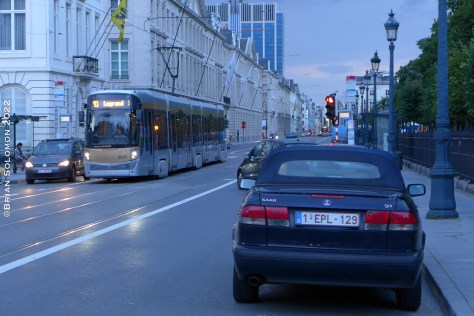
On this day seven years ago (25 April 2016), I made a day trip from Brussels to Antwerp, where I spent several hours riding and photographing trams in that city’s narrow cobblestone streets.
My camera of choice was Lumix LX7, which is compact, flexible, and produces extremely sharp RAW files. Perfect for an urban
This image was processed using Adobe Lightroom to make the most of the data captured in the RAW format.
On 22 April 2016, I spent the day traveling around Valenciennes, France on the city’s modern Alstom trams.
I made these views using my FujiFilm XT1 with an XF18-135mm lens.
Both photos were exposed from the same vantage point of the same tram; in the first photo the zoom was set to 135mm (telephoto), in the second I set it to 20mm (super wideangle).
Last night I made two scans of an ET 160 (Tungsten balance) Ektachrome slide. This film was designed for use with incandescent lighting.
I exposed this slide as part of sequnece of night images at the Connecticut Trolley Museum in East Windsor, CT in December 1993.
The first scan was using an Epson V600 flatbed scanner powered with Epson Scan 2 software. The second was using a Nikon LS5000 Slide scanner powered with the latest VueScan software (version 9.7.96).
Other than scale the scans for presentation here, I made no changes to color, exposure, sharpness etc.
I’ve included a greatly magnified portion of each scan for comparison.
Epson V600 scan; 3200 dpi TIF format, scaled for internet.Nikon LS 5000 scan at 4,000 dpi TIF format, scaled for internet.V600 scan enlarged.Nikon LS 5000 scan enlarged
Some of my earliest digital photographs were exposed in Kenosha, Wisconsin.
In Novemeber 2008, I’d traveled to Chicago to visit with photographer Chris Guss and attend the annual Beecherfest railroad slide program.
At the time I was exclusively using film to make photos. Chris lent me his Canon EOS 50D and we spent several days in northern Illinois and Wisconsin making photos.
We stopped in to Kenosha, where we traveled on the streetcar loop and made photos of the vintage PCCs.
I exposed this view using my 100-400mm Canon zoom fixed to Chris Guss’s Canon 50D.
It was almost a year before I bought my own digital camera, and 18 months before I invested in a Canon EOS-7D.
A month ago—LUAS on Provia—18 Oct 2022—I made these photos of LUAS trams working the Green Line in the Dublin City Centre using a Nikon F3 with Provia 100F (RDPIII) color slide film.
During our trip to Ireland I exposed 7 rolls of film along with hundreds of digital photos. This is just a sampling of a few photos from our last day in Dublin.
Last night, I scanned the slides using a Nikon LS 5000 (Super Coolscan5000) slide scanner powered by VueScan software and then imported the scanner’s hi-res TIF files into Adobe Lightroom for minor color and exposure corrections.
I find that film offers a different quality of image, which is part of the attraction. But, I also find that working with my old Nikon F3s produces different compositions than I get when making photos digitally. So despite the inconvenience of carrying both film and digital cameras and the comparatively high cost of exposing color film, I continue to work with both film and digital media.
Fuji Provia 100F slide exposed using a Nikon F3 with f2.5 105mm telephoto lens.Fuji Provia 100F slide exposed using a Nikon F3 with f2.5 105mm telephoto lens.Fuji Provia 100F slide exposed using a Nikon F3 with f2.8 24mm wideangle lens.
In mid-October, I traveled the length of the old Dublin and Kingstown route to meet with my friends in Dun Laoghaire.
The Dublin and Kingstown Railway was opened in 1834 between Westland Row (today Pearse Station) and the harbour in Kingstown (now called Dun Laoghaire).
It was the first railway in Ireland and often claimed as the world’s first suburban railway.
Today, this route is operated as a portion of Irish Rail’s Dublin Area Rapid Transit electric service and hosts InterCity services to/from Rosslare Europort.
I had excellent autumn sun for my spin to Dun Laoghaire and stopped off at a couple of stations to make photos using my Nikon Z6 digital camera.
Approaching Seapoint.Seapoint station stop.DART interior.Dun Laoghaire .Dun Laoghaire .
In mid-October, I was on my way over to Connolly Station, when I noticed the Ad-wrapped Sky LUAS tram gliding west on the Red Line near the Loop Line Bridge.
Working with my Lumix LX7, I made this view as the tram passed below the bridge.
The unusually decorated tram looked good in the rich morning sun.
During our October visit to Dublin, I made this trailing panned photo of LUAS Citadis tram 5040 crossing the famed O’Connell Bridge.
I was working with my Lumix LX7 set at ISO 80, shutter speed 1/100th of a second, and f6.3. The key was maintaining a steady pan motion as the tail-end of the tram passed me.
O’Connell bridge is noteworthy for being wider than it is long.
Dublin’s Pearse Station, formerly known as Westland Row, is credited as the world’s oldest city railway station in continuous use.
This has served as a passenger station since 1834 when it opened as the Dublin terminus for the Dublin & Kingstown Railway.
The balloon style train shed was built many years later.
While traveling around Dublin earlier this month, I arrived at Pearse with an aim of photographing the trainshed following extensive works to repair it. The last time I’d visited Pearse was back in November 2019, nearly three years ago.
I made several photos of passing DART suburban electric trains under the shed using my Nikon Z6 mirrorless camera.
Then, I spotted an old friend and we caught up over a few pints at a nearby pub, as you do.
Thanks to our friends in Cork, the other evening Kris and I made a few photos of Irish Rail’s Cobh Branch near Cork’s Kent Station.
It had rained (and rather hard at that) before the clouds cleared for some intense evening sun. These were great conditions for photos.
Irish Rail’s 2600-series diesel railcars have been working the Cork-Cobh run since my first visit in 1998, but now these are on borrowed time.
I made these digital photos using my Nikon Z6. I’m curious to see how my Kodak Ektachrome 100 slides will turn out.
It was beginning to rain when I made this photo of 2600-series railcars arriving on Plaform 1 in Cork. Within the hour the skies had cleared.Less than an hour after the above photo, I made this view of an arriving train from Cobh.Good ol’ 2616 at Kent Station, Cork.Cork-bound train from an overhead bridge.
Over my many visits to Dublin since the start of LUAS tram services in 2004, I’ve made many photos of the various specially decorated LUAS advertising trams that grace the system.
Over the last few days wandering the streets of Dublin, I’ve continued my LUAS photography and focused on a few of the Ad trams that add to the color of the City Centre.
I made these views of Sky television wrapped trams using my Lumix LX7.
Southward Green Line tram crossing the Rosie Hackett bridge over the LiffeyCloser view at the Rosie Hackett bridge.Eastward Red Line Tram on Abbey Street near O’Connell Street.Eastward Red Line Tram crossing O’Connell Street.Westward Red Line Tram on Abbey Street at the Jervis stop.
Yesterday evening (September 22, 2022), I made a few photos of Dublin’s LUAS trams using my Nikon Z6.
It had been raining much of the day but about 6pm the sun came out, making for some interesting but high contrast scenes.
Back in the old days I’d have worked with black & white film to make the most of this type of lighting, and controlled the contrast chemically. Now, I’m applying contrast controls digitally to my Nikon’s NEF (RAW) files using Adobe Lightroom.
Do these photos work?
If they don’t, I’ll take more later.
LUAS tram on Parnell Street in Dublin. JPG from the unaltered NEF file (No changes to color, contrast, exposure etc).LUAS tram on Parnell Street in Dublin. This is my adjusted version of the same NEF file. I’ve paid special attention to the sky using Adobe Lightroom’s built in ‘select sky’ mask.Abbey Street in Dublin. JPG from the unaltered NEF file (No changes to color, contrast, exposure etc).Abbey Street in Dublin. JPG from the adjusted NEF file.
April 22, 1997: I ascended a footbridge over a busy Tokyo thoroughfare to make photos of the rarely captured Tokyo trolley.
Where most of the railway lines in Japan are meter-gauge, the Tokyo Trolley is unusual because it was an early use of 4 ft 8.5 inch gauge train in Japan. The other big users of ‘standard gauge’ in Japan are the Shinkansen routes.
In yesterday’s post, I described the compositional challenges of poles and wires near Bartlett, NH. Compare those images with the sea of poles and wires in this view!
Exposed on Fujichrome Velvia50 using a Nikon N90S with an AF f2.8 80-200mm Nikkor zoom lens.