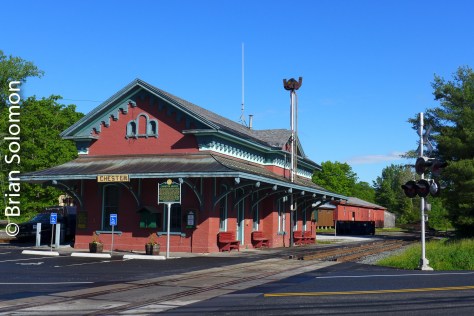
I don’t recall the first time I visited the old Rutland Station at Chester. It was in the Steamtown-era and lost in the fog of my earliest memories.
I do recall watching Canadian Pacific steam locomotives run around the excursion train here in the days before I regularly made photos.
Yes, there was a time when I didn’t always carry a camera.
Those days ended on my tenth birthday when Pop gave me my own Leica IIIa.
That camera rests on the shelf waiting to be repaired. In recent years I’ve been playing with identical IIIa bodies of the same period (late 1930s).
Here are a few views of Chester exposed with various cameras on June 7, 2017.
The details are in the captions. Any favorites?
Lumix LX7 view in the morning at Chester.Lumix LX7 view in the morning at Chester.Leica IIIa with 35mm Nikkor lens on Fomapan 100.Leica IIIa with 35mm Nikkor lens on Fomapan 100.Leica IIIa with 35mm Nikkor lens on Fomapan 100. Afternoon view with VRS 263 in the distance.Leica IIIa with 35mm Nikkor lens on Fomapan 100.Leica IIIa with 35mm Nikkor lens on Fomapan 100.Vermont Rail System freight 264 heading north (west) toward Rutland approaches Chester. Exposed using a FujiFilm XT1 digital camera with 18-135mm zoom lens.
Vermont Rail System’s freight 263 climbs at Mt. Holly, Vermont.
Working from a selection of photos I exposed on Wednesday June 7, 2017, I’ve picked these two similar views as a composition comparison,
Both were exposed digitally using my FujiFilm X-T1 with 90mm f2.0 fixed telephoto.
Red diesels and lush green scenery under an azure sky make for a pleasant railroad setting. So, which view do you like better?
Version 1; The locomotives are slightly further away and there’s more greenery.Version 2; I’ve opened up the aperture about a half stop to lighten up the red engines, which occupy the majority of the photo.
June 7, 2017 was a rare crystal clear day. Paul Goewey and I headed north to Vermont to retrace the path of the old Rutland Railroad, and retrace our own footsteps.
Many years earlier, we had made a similar trip to this railroad to photograph Maine Central RS-11 802 that had been loaned to the Green Mountain Railroad for the run from Bellows Falls to Rutland.
Where our 1983 adventured occurred in November on a gloomy gray day that soon turned snowy, this most recent trip benefitted from very fine conditions.
As we drove toward Rutland on Vermont Highway 103, we recalled the details of the earlier trip
In Rutland we located VRS freight 263 that was getting ready to depart. Positioning ourselves on the grade to Mount Holly we waited. Once the freight passed our first spot we entered in its pursuit, as one does, to make more photographs.
On the right Paul Goewey makes a digital photograph of Vermont Rail System GP40-2 303 working upgrade with train 263. Although I also exposed a black & white image, I made this digital photo using a FujiFilm X-T1 fitted with a Zeiss 12mm Touit lens. Working with the RAW file in Lightroom, I altered shadow areas, increased saturation, and made other nominal adjustments aimed at improving the image quality for presentation on the internet.
Among the spots we preselected was this view of the Cuttingsville Trestle. I selected an angle similar to that featured by famous photographs made in Rutland Railroad days by accomplished photographer Jim Shaughnessy.
I’ve included the technical details in my caption above.
Back on 9 April 2017, I exposed this view of my iPhone while traveling on Dublin’s LUAS Green Line.
The photo displayed on the phone was of a tram I’d photographed a week earlier in Brussels using my Lumix LX7 that was the featured post on Tracking the Light.
Lumix LX7 photo of my iPhone on 9 April 2017. A photo of a photo of tram on a tram.
You could call this ‘Tracking the Light on Tracking the Light.’
Years ago I’d ride my ten-speed bicycle to the Stafford Hollow Road Bridge in Monson, Massachusetts. I’d wait for Central Vermont’s freight to New London.
If I was lucky, I’d catch CV working upgrade with GP9s/Alco RS-11 making a healthy roar as they approached Stateline Summit.
On the morning May 31, 2017, I was leaving the Monson Post Office (having just mailed a letter to Ireland) when I heard New England Central 608 (running south from Palmer to Willimantic) tackling the grade in town.
I was surprised to see a Providence & Worcester GP38-2 in the lead. I supposed since New England Central and P&W are now both in the Genesee & Wyoming family it makes sense that the locomotives of these two connecting lines would get a bit mixed up.
Regardless, I knew that this would make for an interesting photograph. Among the places I caught 608 was at my old Stafford Hollow Road location.
My late friend Bob Buck had photographed here since the 1940s and always called the location ‘Smith’s Bridge’. I know he would have been delighted to see these photos of a P&W GP38-2 leading the southward freight.
Using my FujiFilm X-T1, I tilted and extended the rear display screen so that I could hold the camera close to the ground. By doing this I photographed from an unusual perspective with a telephoto lens.
Since the angle is very low, the foreground is blurred, and the verticals are kept perpendicular to the horizon, the effect makes the photo appear like those often made of model railroads.
One of the circumstances that made this image possible, was a complete lack of automobiles in front of the old Palmer (Massachusetts) Union Station—now the popular Steaming Tender Restaurant.
CSX GP40-2s, working local freight B740, reverse through the points at CP83 during a switching move in May 2017.
Earlier in the month I’ve highlighted various photographic adventures with New England Central 608 (freight that works from Willimantic, Connecticut to Palmer and back). Today’s post focuses on the southward journey.
Over the years, I’ve photographed many trains climbing the former Central Vermont Railway grade over State Line Hill, and beyond into Connecticut, so this chase is old hat for me.
Yet, I’m always looking for a new angle, or to place today’s train in a classic setting that I may have captured years ago.
These views are all from the morning of May 17, 2017 and exposed with my FujiFilm X-T1 digital camera.
Do you have any favorites?
New England Central 608 at Bunyan Road in Monson, Massachusetts.New England Central 608 from Academy Hill/Main Street Monson, Massachusetts.New England Central 608 at Stateline looking toward Monson, Massachusetts.New England Central tracks at Stafford Springs, Connecticut.Tight telephoto view of NECR 608 at Stafford Springs, Connecticut.South of Stafford Springs, Connecticut.New England Central 608 viewed from the Track 9 Diner in Willington, Connecticut.
There’s nothing like a carefully executed panned photograph to convey a train at speed.
I’ve covered the panning technique a number of times on Tracking the Light; essentially this accomplished by using a comparatively slow shutter speed (in this situation I chose 1/60th of a second) and moving the camera with the subject as it passes through a scene.
The real trick is maintain smooth full-body motion and continue to pan after the shutter is released. Novice pan photographers often violate this rule and stop panning the moment they release the shutter, which tends to result in badly blurred photos.
Yesterday (May 18, 2017) I was traveling with Tim, a friend and fellow photographer, who suggested this location at North Hatfield, Massachusetts on the former Boston & Maine Connecticut River line.
Rather than make a conventional image, I opted for a series of panned views, of which this is but one in a sequence.
Exposed at 1/60th of a second using a FujiFilm X-T1 fitted with f2.0 90mm lens.
A few days ago, I displayed black & white photos I made at Stafford Springs, Connecticut in hard morning sunlight. See: Going Against the Grain.
Where the earlier images used an unusual film type (Foma Retropan), today’s image was made on Ilford HP-5, but with some special processing.
On May 9, 2017, New England Central freight 608 works timetable northward through Stafford Springs, Connecticut. Exposed on Ilford HP-5 using a Leica IIIa fitted with a Nikkor f3.5 35mm lens. Film was processed in Ilford Perceptol developer diluted 1:1 with water; after fixing and rinsing, negatives were toned in a 1:9 selenium solution for six minutes, then rewashed and scanned. The sky area received some localized exposure adjustment in post-processing, while there was some overall contrast adjustment to improve the appearance of the image.
In both posts, black & white photos feature New England Central 608 (a freight that runs between Willimantic, Connecticut and Palmer, Massachusetts) passing downtown Stafford Springs shortly after sunrise.
Today’s image was exposed from Main Street in Stafford on the opposite side of the tracks from the earlier photos, which provides a different perspective on the train and village.
Part of this exercise is aimed at demonstrating black & white photographic technique, however I’m also hoping to show how different angles at the same location can result in significantly different photos.
Also, that it’s possible to make interesting photos in difficult lighting situations, if you apply a creative approach to your photography.
I’m done here yet! To be continued on another day.
Swiss railways tend to be known by three letter abbreviations of their names.
The initials ‘BLS’ represent the Bern-Lötschberg-Simplon Bahn, a standard-gauge mainline trunk-line with several branches in central western Switzerland.
It was a pleasant evening three weeks ago, when Denis McCabe and I photographed a procession of BLS freight and passenger trains at Spiez. What I found remarkable was the great variety of equipment operated by this colourful Swiss line.
I exposed these photos over the course of an hour using my FujiFilm X-T1.
Sinuous single track winding through lush Alpine meadows with snow capped peaks in the distance under a blazing blue sky.
Hard to go wrong here photographically. Pity about the choice of visually challenging of colors on the trains, but nothing is ever completely perfect, is it?
Exposed with a FujiFilm X-T1.Exposed with a FujiFilm X-T1.
Exposed with a FujiFilm X-T1 using the external adjustable rear display panel to compose the image while holding the camera close to the ground.
MOB station at Gruben.
This is but a small sample of the digital photos on a visit to Switzerland with Denis McCabe two weeks ago.
Among the most attractive modern trains I experienced traveling in Switzerland at the end of April were Transports Publics du Chablais’s (TPC) modern narrow gauge trains on its AOMC route that connects Aigle and Champéry.
TPC’s new Stadler railcars were clean, comfortable and nicely styled. These compact articulated narrow gauge vehicles are designed to work both adhesion and rack sections of TPC’s line.
Inside they are spacious, bright, and offer magnificent views of the Alpine scenery through large windows.
The ability for passengers to look out forward and trailing windows is an excellent feature.
I especially liked the styling treatment, which embraces TPC’s bright green livery and works with the curves of Stadler’s standardized modern railcar pattern. This is a pleasant contrast to many modern Swiss trains that wear dull, garish, or otherwise visually challenged liveries.
A TPC new Stadler railcar pauses between runs at Champéry, Switzerland. Exposed with a FujiFilm X-T1 fitted with a Zeiss 12mm Tuoit.
Denis McCabe and I traveled the length of TPC’s AOMC route. The most impressive section is the climb from Monthey to Champéry, where long sections of the line climb sharply into the mountains.
I exposed these photos of TPC’s new trains using my FujiFilm X-T1 digital camera.
Between Aigle and Monthey TPC’s AOMC route has an interurban railway quality with some roadside running. This view was made near Monthey at the junction with the line to Champéry.A train from Aigle in the afternoon.Detailed view exposed with a FujiFilm X-T1 fitted with a Zeiss 12mm Tuoit lens.Detailed view exposed with a FujiFilm X-T1 fitted with a Zeiss 12mm Tuoit lens.Interior view exposed with a FujiFilm X-T1 fitted with a Zeiss 12mm Tuoit lens.Interior view exposed with a FujiFilm X-T1 fitted with a Zeiss 12mm Tuoit lens.
Here’s one solution to a difficult lighting problem: A few days ago when I was photographing along the shore of Lake Geneve at St. Saphorin, Switzerland I had a nice clean over-the-shoulder sun lit view for eastward trains, but was looking directly into the blazing morning sun for westward trains.
The scenery was too good to let the photographic opportunity pass.
So what did I do? I changed lenses. Specifically, I opted to use my Zeiss 12mm Touit on FujiFilm X-T1, and then stop all the way down.
What do I mean by ‘stop down’? This is a traditional photographic term that means to close the aperture by a full-stop increment. Say from f4 to f5.6. (Each one-stop change doubles or halves the amount of light reaching the film/sensor. Opening up a stop doubles the light, closing down halves it.) To ‘stop all the way down’ is to close the lens to its smallest aperture. In the case of my Zeiss lens, this is f22.
With the 12mm Tuoit, at f22 the tiny hole with the very wide-angle focal length combine to allow for a sun-burst effect. To take advantage of this sun-effect with a moving train, I had to increase the ISO to 1250, (because f22 lets in much less light to the sensor than I normally would during daylight.)
The secondary difficulty with this image is the narrow exposure latitude of the digital media. By exposing for the sun, I’ve had to seriously underexpose for the front of the locomotive.
This is the unaltered camera-produced JPG, which doesn’t make full advantage of the information captured in the RAW file. Under normal lighting conditions the camera JPG is usual adequate for presentation, but in this circumstance it results in a loss of detail in the shadow areas, specifically at the front of the locomotive.
To compensate for this, I manipulated the RAW camera file in post-processing (after exposure) using Lightroom, which allowed me to brighten the shadow areas and control the highlights.
Unaltered camera-RAW file except for scaling.Here’s my interpretation of the RAW file, which has been scaled for internet. I’ve lightened shadow areas, removed a few spots caused by shadows of dirt on the front element, and controlled highlights. The flare is an effect of pointing directly at the sun. While the extreme wide-angle using a flat-field lens design results in some linear distortion at the edges, most noticeable on the locomotive.
I’ve included a screenshot of the Lightroom work panel that reveals how I’ve adjusted the slider controls on this specific file.
Lightroom work panel showing the positions of slider controls.
Significantly, Lightroom makes a working overlay file and DOES NOT alter the original RAW image. Working on the RAW directly would damage the original file. I advise against working directly with the original. Always make a copy.
Despite an aggressive schedule of passenger trains, SBB still has capacity to roll freights through.
I made these photos digitally using my FujiFilm X-T1.
The station consists of a classic stone faced building, arched through shed over the platforms, and all the expected amenities.
Look at this impressive list of departures! Not bad for 45 minutes. More trains than many American cities get all week.SBB Stadler railcars are common on many local trains.Under the train shed at Lausanne. RAW file adjusted for contrast and exposure.Freights are largely electrically hauled.
Geneva, Switzerland has a remarkable tram network that has melded traditional routes with modern construction.
I made this selection of photographs on my recent visit using both my FujiFilm X-T1 and Panasonic Lumix LX-7 digital cameras.
When making tram photographs I often aim to place the cars in their urban environment.
Geneva’s trams feature a variety of special liveries making for a colourful fleet.
Telephoto view using a FujiFilm X-T1 with 18-135mm lens.FujiFilm X-T1 photo.Blue and white is the standard livery on Geneva’s tram and bus fleet.FujiFilm X-T1 photo.An odd colour for tram; hot pink. Works for Easter I suppose. FujiFilm X-T1 photo.FujiFilm X-T1 photo.Tram, bus and trolley bus; FujiFilm X-T1 photo.Lumix LX-7 photo of tram taking a turning loop.My Lumix LX7 is a great tool for photographing urban night scenes.
Rome is one of the world’s most pictured cities, yet rarely does its tram network feature in photos.
So, on my brief visit to Rome I made many photos of its colourful urban rail-transit system.
Where else can you see multiple tram lines pass through a 3rd century city gate? Thanks to Stephen Hirsch for suggesting this photo location at Porta Maggiore.
An FS (Italian State Railway) articulated electric locomotive leads a northward freight at Framura on Italy’s Mediterranean coast.
Using my Lumix LX7, I made this photo in the minutes before sunset in early April 2017. To make the most of the camera’s RAW file, I adjusted contrast and exposure in post processing using Lightroom and outputted this as a JPG sized for internet presentation.
Framura, Italy.
Tracking the Light is posting automatically while Brian is traveling.
Genova (Genoa, Italy) is an old Mediterranean port city, famous as the home of Christopher Columbus .
(Facebook viewers will need to click on this post to see the full photo as FB has tends to crop vertical images to the horizontal with little consideration for content).
The old city is a maze of dark narrow alleys where the sun rarely shines.
Exposed using my Lumix LX7 in April 2017.
Tracking the Light is posting automatically while Brian is traveling.
Milano Stazione Centrale (Milan Central Station) is a monumental railway terminal that faces the Piazza Anrea Doria. . . [the station’s] design was the result of an architectural competition held in Milan in 1913 . . . Although the plan dated from before World War I, its blocky style and super human scale seems to typify the public architecture of the interwar Fascist period. [Milano Stazione Centrale] was one of the last great railway stations built in Europe before World War II.
Tracking the Light is Posting Automatically while Brian is Traveling.
The Peter Witt was a widely built steel-body center-door streetcar noted for its early use of the ‘pay as you enter’ system, where passengers paid fair to the motorman and eliminated need for a conductor. Exiting passengers used the center door to minimize delays during stops. The car-type was named for its designer, the Cleveland Street Railway commissioner, who originated the car arrangement about 1915 . . . The Peter Witt was adopted in Italy in the late 1920s.
I exposed these images of a venerable Peter Witt working the streets of Milan earlier this month (April 2017) using my Lumix LX7.
Lumix LX7 telephoto view at dawn in Milan, Italy. April 2017
See yesterday’s post Milan Peter Witt at Dusk for a view of the Peter Witt’s distinctive door arrangement.
Tracking the Light is posting automatically while Brian is traveling.
Just a few views from the lens of my Lumix LX7: trams on the roll in Köln during my recent visit.
Köln’s extensive light rail network has endless opportunities for photographs. Over the years I made a few images, but I’ve long felt a more extensive exploration is in the cards.
Someday . . .
At the Dom/Hauptbahnhof station.Rudolf Platz, Köln.On an elevated structure approaching Neusser Str.
Railway Preservation Society of Ireland’s Trip to Galway and Kilkenny—Part 2.
More photos from my Lumix exposed Saturday 8 April 2017, on the RPSI’s The Marble Tribesman Diesel Tour that ran from Dublin Connolly Station to Galway via Portarlington and Athlone then to Kilkenny via Kildare.
Galway. (something behind me must be more interesting than old 081 beneath the shed!).Irish Rail’s 081 catches the sun at Galway. Not much left of the sidings in the goods yard here.Galway.Photo at Woodlawn, County Galway.Welcome to Woodlawn! (Thanks to Stephen King for pointing out the sign).Kilkenny.
Kilkenny.
Detail of 081 at Kilkenny.Kilkenny.Station stop at Athy, County Kildare.Reviewing photos from the stop at Kilkenny.A surprise birthday song for barman Jon Nabb (left).Jon opens a gift.
Also surprised for his birthday was RPSI’s Fergus (left).We arrived back at Connolly Station at dusk after more than 12 hours on the road.Engine 088 having been uncouple from the train waits to run around at Connolly Station, Dublin.Group portrait of Irish Rail staff and hangers on at Connolly.
On Saturday 8 April 2017, I traveled on the RPSI’s The Marble Tribesman Diesel Tour that ran from Dublin Connolly Station to Galway via Portarlington and Athlone then to Kilkenny via Kildare.
Irish Rail locomotive 081 in fresh gray and yellow paint led the train to Galway and Kilkenny, while 088 brought the return leg to Connolly.
It was a fine day with blue skies from dawn to dusk. The trip largely held to time and a grand time was had by all involved.
I exposed photos with three cameras. These images were exposed with my Lumix LX7. More images to follow over the next few days.
Located adjacent to the SNCB lines at Schaarbeek (on the north side of Brussels), Train World is Belgium’s premier railway museum.
I visited last week, having arrived by train from the Brussels suburbs. I’d bought my museum ticket in conjunction with my SNCB fare.
City trams also serve the museum.
You enter Train World from the old railway station building, which has been beautifully restored. Beyond are a series of train halls, that display the history of Belgian railways using real equipment: locomotives, railway rolling stock, signals, literature, signage, etc.
It’s well worth a visit.
Photos exposed using my Lumix LX7
Tracking the Light aims to post new material Daily.
On the morning of 27 March 2017, freshly painted Irish Rail class 071 locomotive number 081 worked the down IWT liner.
I made the time to catch this from my often photographed location at Islandbridge Junction near Dublin’s Heuston Station.
Among the advantages of this spot is good morning lighting on westward trains (where most other places face difficult backlighting), ample elevation and the iconic Wellington Testimonial, which is located in the Phoenix Park on the north side of the River Liffey.
A couple of weeks ago I made these Irish Rail silhouettes on Stores Street near Bus Aras.
The black & white photo was exposed on Ilford HP5 with my Nikon F3T fitted with a f1.4 50mm lens, processed in ID11, and scanned with an Epson V500.
By contrast, the colour image was exposed digitally using my Lumix LX-7 with Leica Vario-Summilux lens.
Do you have a preference?
Personally I like the bird in this one, although my placement of the train is less than ideal because it blocks the nearer lamp.This view is closer to what I’d originally envisioned and features both lamps in silhouette.
Irish Rail crosses the Barrow at Monasterevin, again near Bagenalstown, and finally with a large bridge between Waterford and Campile near Great Island.
Largely forgotten is the long closed bridge northeast of New Ross on the line that once went to the Junction at Macmine via Palace East in County Wexford. More than half a century has passed since the last scheduled train over this bridge.
I made these pastoral views from a road high above the Barrow looking in a westerly direction.
Tracking the Light is on autopilot while Brian is traveling.
Tracking the Light will be on autopilot for a week while Brian is traveling. New material will continue to post everyday, but notices will be delayed. See the Tracking the Light home page at: http://briansolomon.com/trackingthelight.
Kent Station Cork:
For me there’s something about a Victorian train-shed that begs for black & white. I made this photo on my most recent trip to Kent Station in Cork on Kodak Tri-X using a Leica IIIA with 35mm Nikkor lens.
Kodak Tri-X processed in Agfa Rodinal Special (not to be confused with ordinary Ordinal) mixed 1:30 with water, 68 degrees F, at 3 minutes 15 seconds with 2 minute pre-soak (with a trace quantity of developer). After initial processing (dev, stop, 1st fix, 2nd fix, hypo clear, 10 minute wash), negatives were treated with Selenium toner for 7 minutes, then carefully rewashed in running water for 15 minutes). Scanned using Epson V500 flatbed scanner, and digitally processed using Lightroom.
Tracking the Light normally posts new material daily.
Among the subjects I photograph are Irish Rail’s Cork area suburban trains.
Although not the most varied of operations (2600 series diesel railcars are the rule), the Cork Commuter system is an interesting subject. It provides a reliable, functional and well-utilized transportation system that works on a regular interval timetable.
The scenery is pleasant and over the years I’ve made many interesting images of the trains.
These are recent views made over St. Patrick’s Day weekend (2017).
Kent Station Cork. Exposed with a FujiFilm X-T1.Passengers await the arrival of a 2600 railcar at Kent Station. Exposed with a FujiFilm X-T1.
Schematic map of Irish Rail’s Cork Commuter network.Glounthaune, Co. Cork.Approaching Glounthaune, Co. Cork.St. Patrick’s Day observers watch a passing 2600 railcar while waiting for Glounthaune’s parade. Exposed on Tri-X using a Leica IIIa.Moments before Glounthaune’s St. Patrick’s Day Parade. Exposed digitally with a Zeiss 12mm Touit Distagon lens.Littleisland signal cabin.Cobh, Co. Cork.
Thanks to Irish Rail’s Ken Fox for recommending locations and supplying history and context.
The most scenic portion of Irish Rail’s run from Dublin to Cork is the final stretch from Mallow to Kent Station Cork.
A few days ago, Ken Fox, Sean Twohig and I made a survey of this area of Co. Cork looking for locations to picture the Mark4 trains, which are among the only regularly scheduled locomotive powered passenger trains remaining on Irish Rail.
I exposed this view between Mourne Abbey and Rathduff. The lush greenery dotted with blossoming gorse makes for a bucolic scene.
Exposed using a FujiFilm X-T1 with 18-135mm lens set at 55mm; 1/500 second, ISO 1000.
Irish Rail’s Kent Station in Cork City is a cool place to make photos. It’s unusual curved train shed, plus antique platform awnings and brick station buildings have a Victorian appearance that offer a contrast with the modern trains that now serve passengers here.
I exposed these views on 16 March 2017.
Digital image exposed using a FujiFilm X-T1 with Zeiss 12mm Touit Distagon.Black & white film photograph exposed on Fuji Acros 100 with a Leica IIIa fitted with a screw-mount 35mm Nikkor wide angle lens.2600 railcars bask under sodium vapour lamps at Kent Station Cork. Digital image exposed using a FujiFilm X-T1 with Zeiss 12mm Touit Distagon.
Using my FujiFilm X-T1 fitted with a Zeiss 12mm Touit Distagon, I exposed this evening view at Limerick Junction.
At right is the down train from Dublin Heuston destined for Cork Kent Station, on the left is the shuttle train to/from Limerick .
FujiFilm X-T1 with Zeiss 12mm Touit Distagon set at f3.2, 1/15th of a second, handheld, ISO 3200.
I imported the camera-RAW file into Lightroom, and made nominal adjustments to the contrast while lightening shadow areas. Significantly, I cooled the colour temperature to compensate for the harsh effects of sodium and fluorescent lights to make for a more natural appearing colour balance.
Here’s key to a secret, one tightly held: More often than not I make photographs for a specific audience.
This has myriad manifests. It may be something as simple as photographing a friend’s favorite locomotive, or capturing a location once shared by a fellow photographer.
However, often it goes deeper. I’ll aim to capture a scene by working with light, shapes and subject in a way that I hope will appeal to a friend.
Sometimes, I’ll simply forward these photos directly to the person in question. To my father, I’ll send photos from my travels in Europe, to my mother, I’ll email photos of my friends and acquaintances.
I might forward an image to an editor that I made to pique their interest.
If I score something really unusual, I might goad a fellow photographer hoping to push them into exposing a similar or better photograph.
In April 1988, I made this photograph of Conrail’s BUOI working east through the Canisteo Valley near West Cameron, New York.
Yet, often my very best photographs are those that I make to fulfill a personal ideal.
What?
Ok, my most successful images are those I made to please me.



 Tracking the Light aims to post new material Daily.


