A few years ago, Irish Rail rebuilt its Youghal Branch between Cobh Junction and Midleton. After decades of inactivity, this route now enjoys a regular interval passenger service. I find it fascinating that this long closed railway is again alive with trains.
A year ago, on a previous visit to Cork, I tried some photos at this location near the Midleton Station. However, it was a flat dull morning and my results weren’t up to par.
So a few weeks ago, Irish Rail’s Ken Fox drove me back to this spot, and on this visit it was bright an sunny. Moments before the train arrived, a thin layer of high cloud momentarily diffused the sunlight, which complicated my exposure.
As the 2600-series railcar approached, I made several digital images with my Canon EOS 7D and 200mm lens and a single Fujichrome color slide using my Canon EOS 3 with 40mm pancake lens.
Digital image made with a Canon EOS 7D fitted with 200mm lens.Exposed Fujichrome Provia 100F with Canon EOS 3 with 40mm pancake lens. This image looks great projected on the screen.
Tracking the Light posts new material every morning.
Three years ago, I’d positioned myself in Palmer, Massachusetts for the annual autumn westward appearance of the Ringling Brothers Circus train. It was a bright clear day and lots of enthusiasts had gathered to see it.
CSX’s normally quiet former Boston & Albany route was alive with traffic that day. I recall four eastward freights meeting the circus train on the controlled siding between CP 83 and CP 79 in Palmer.
Lesson learned.
A long time ago I notice that when special trains operate, there is often lots of other movement as well. Having studied railroad operations for decades, I can offer no conclusive explanation as to why, yet I’ve often found this to be true.
On Monday October 20th, 2014 I went out with hopes of catching the circus train, again expected to make its appearance in Palmer, but I was prepared for, and expecting other trains. As it happened, CSX ran a fleet of eastward intermodal freights. I heard the first of these roaring up through Palmer about sunrise.
I arrived trackside about 9am, and over the course of the day photographed five eastbound freights, plus Amtrak’s Lake Shore Limited and the Palmer local.
Normally, if I saw two eastbound freights in that same time frame, I’d feel I had a successful day. But capturing this parade made Monday October 20th one of the best day’s I’ve spent photographing the B&A East End in about four years!
CSX’s local freight was working the Palmer yard when I arrived. This pair of GP40-2s departed with 66 cars for West Springfield yard. Canon EOS 7D with 200mm lens. By carefully controlling flare, I was able to lighten the shadow areas in this backlit image. I included brush on the left to add depth and add to the autumnal effect.CSX’s local snakes through CP83 as it stretched its train out of the yard at Palmer. The GP40-2s made a good roar going up the hill out of town. Canon EOS7D with 200mm lens.The first of the four eastward intermodal trains I photographed on Monday October 20th. CSX symbol Q020 rolls by the old Palmer Union Station (now Steamling Tender restaurant) at 11:16 am. On a normal day, I’d expect just one late morning intermodal train. Canon EOS 7D with 200mm lens.New England Central 603 was switching its consist in Palmer.At 12:25pm, CSX Q022 glides through CP 83 on the main track. This is the intermodal train I often see pass Palmer about this time of day. Canon EOS 7D with 100mm lens.Hot on the heals of the Q022 was CSX symbol Q012, which I photographed crossing the Palmer diamond at 12:40pm. Lumix LX7 photo.I heard chatter on the scanner that hinted at a 4th eastward freight. Not wanting to repeat my efforts at Palmer, I went up the Quaboag Valley to Warren and waited there. I was rewarded by yet another eastward intermodal train. Word to the wise; rarely I have I ever seen four eastward intermodal trains in daylight on the B&A route in modern times. Lumix LX7 photo. (Adjusted for contrast in post processing).This last intermodal train had the added bonus of a Union Pacific GE in the consist. Canon EOS 7D with 20mm lens at Warren, Massachusetts.Warren’s common featured a bright orange tree, but including this in my composition was difficult because of the row of dark trees between it and the tracks. I ended up using the tree at the right as a frame. Fortunately some high clouds softened the sun to reduce the contrast of the tree’s shadow. Canon EOS 7D with 20mm lens.West Warren was my choice for a setting to capture the Circus Train. I’ve photographed it a various locations on the Boston & Albany route over the years, but never here. It sure would have looked nice if it came west at this time. What’s that? Do I hear another eastward train climbing up the valley from Palmer? Lumix LX7 Photo.CSX Q264, the loaded eastward autorack train destined for the East Brookfield & Spencer at East Brookfield passes milepost 75 in West Warren. Canon EOS7D with 100mm lens. Nice foliage here.CSX Q264 passes the waterfall at West Warren. Lumix LX7 photo. The clouds were rolling in from the west and soon the light would be flat and dark.
Not only did I make a number of satisfying photographs, but at every location I visited, I met friends and fellow enthusiasts.
On the downside: The circus train encountered a host of delays working its way west. Despite unusual perseverance, by 4pm the light had fade from a clear blue dome to a dark dull evening. At 410pm, I gave up. The circus train passed the bridge at West Warren where I’d been waiting about 40 minutes later.
Tracking the Light posts new material every morning.
On, October 15, 2014, I was giving a tour to some visitors from France, and we passed through Ware on our way from the Quabbin Reservoir to West Brookfield’s Salem Cross Inn.
Earlier in the week, I’d noticed that Mass-Central had parked its rare Electro-Motive Division model NW5 2100 in Ware yard near the Route 9/32 overpass. So, we made a quick diversion so that I could make a photograph of the locomotive.
Mass-Central 210 rests at Ware yard on former Boston & Albany trackage on October 15, 2014. Exposed with a Canon EOS 7D with 20mm lens.
I’ve written about this before, but it was about 1981, when I rode my bicycle from Monson to Ware, specifically to photograph this locomotive, which had then just recently been delivered to Mass-Central.
When I think about all the locomotives that have come and gone in that time, I can’t help but smile. Old 2100 has nine lives, and then some! And it’s not that I need another photograph of it, but I make them anyway.
Mass-Central NW5 2100 is one of 13 such locomotives built by General Motors Electro-Motive Division between 1946 and 1947. It was originally bought by Southern Railway, but has worked Mass-Central’s Ware River Branch since the early 1980s. Exposed with a Lumix LX7 using the ‘Vivid’ color profile. Compare with the high dynamic range (HDR image below.)My Lumix LX7 has a HDR setting that makes three images at different exposure settings in rapid succession and then combines them in-camera to create a single image with greater highlight and shadow detail than possible with a single digital exposure. Notice how this effect mutes the color and lowers contrast. Which image is better? You decide. Lumix LX7 photo.
Tracking the Light posts new material every morning.
By the time of my visit in 2003, Irish Rail’s old Midland Great Western line between Mullingar and Athlone had been out of service for several years. In it’s heyday this had been a relatively busy double track mainline.
On this day the weed spraying train was due for its annual visit, so a man was sent to work the cabin. Thus this incongruous scene of a disused and brushed in line with an active signal cabin.
Tracking the Light posts new material every morning.
An Eastward Pan Am Railways Freight at East Portal.
I was working on my book North American Railroad Bridges for Voyageur Press and I’d been communicating via E-mail with the late William D. Middleton regarding the particulars of certain spans and photographs of same.
Bill asked a favor of me: He was working on article for TRAINS Magazine and hoped that I could travel to the Hoosac Tunnel to make some contemporary images to help illustrate his article.
A few days later, I met Tim Doherty, Pat Yough and Otto Vondrak at East Deerfield for a day’s photography. I needed some images of the former New Haven Railroad Whipple Truss span over the Connecticut River at Montague (now a walking trail).
Later in the day we went west against an eastward freight. This provided me ample opportunity to photograph both east and west portals of Boston & Maine’s famous tunnel under the spine of the Berkshires.
As it turned out, the eastward freight was led by one of only two locomotives painted for Pan Am Railway at the time.
Pan Am Railways freight at East Portal on March 4, 2007.
As the train approached and exited East Portal, I exposed a series of images. I sent the best of the slides to Bill via the US Postal Service. One of my photos, exposed with a wide-angle of the Pan Am Railway’s GP40-2L emerging from the tunnel wearing the experimental light blue and black paint, appeared in Bill’s TRAINS Magazine article.
I prefer this view, moments before the freight exits the inky black depths of Hoosac Mountain. For me this better conveys the experience of watching a train at Hoosac Tunnel.
Tracking the Light posts new material every morning.
Exposed on Fujichrome slide film using a Canon EOS 3 fitted with an f 1.4 50mm lens, set at f8 1/500th of second.
At 9:49am on July 29, 2009, I exposed this image of Union Pacific 5526 leading an eastward double stack train on the former Western Pacific at Sand Pass, Nevada. At the back of the train, another General Electric diesel is working as a ‘distributed power unit’ (a radio controlled remotely operated locomotive).
Phil Brahms and I were exploring the former Western Pacific route across one of the most remote and lightly inhabited regions of the continental United States. This is lonely, barren, wind-swept and wide-open country where you can see for great distances.
Rail traffic was sparse, but we found about four to five freights per day in daylight.
The desert gets much bigger after sunset; the haunting sounds of the wind blowing across the desert floor in the dead of night and the radiant sky with stars blazing above cannot be captured on film. Yet these things stay with you.
That morning, I wrote in my notebook, ‘at dawn, before sunrise, I climbed a hill—coyotes were howling to the east (of me).’
Tracking the Light posts new material every morning.
For many railway enthusiasts, the number 611 immediately conveys mental images of Norfolk & Western’s magnificent streamlined 4-8-4 steam locomotive. But the number is shared with another interesting engine.
On clear morning in February 2003, I arrived in Chicago on Amtrak’s Lake Shore Limited. Marshall W. Beecher met me at Union Station and we set out to explore Chicago’s railroads.
We stopped in at A2 tower, a busy place where the former Chicago & North Western crosses the former Milwaukee Road lines from Union Station. In addition to mainline suburban trains, a yard between the two mainlines west of the tower produces a host of light engine and equipment moves.
Metra 611 at A2 Tower Chicago in February 2003. Exposed on Fujichrome with a Nikon F3.
Metra 611, one of only a few remain F40Cs, was on its way to the yard. The light was perfect and I made this portrait of the unusual locomotive. The F40C was built in 1974 for Milwaukee Road’s Chicago suburban service and the near cousin to Amtrak’s unsuccessful SDP40F. By 2003 only a few remained in service.
My most recent book Chicago: America’s Railroad Capital is a collaborative project with Michael Blaszak, John Gruber and Chris Guss, and features many one of a kind photographs. It is available now through Voyageur Press. This illustrated volume illustrates the history of Chicago’s railroad from the steam era through the present.
Take a look! Keen observers will find yet another 611 displayed in the book’s pages.
Irish Rail’s 1200 (noon) departure from Dublin Heuston Station to Cork consisted of a now standard Rotem-built Intercity Railcar. I made this photo on platform 7 before boarding my train, which was actually just ahead of this train set on the same platform. Lumix LX7 photo.Close up view of Irish Rail’s ICR on platform 7 on October 6, 2014. Lumix LX7 photo.
On October 6, 2014, I took a spin from Dublin to Cork. Irish Rail has been offering low fares online, and I booked a one-way ticket in advance for just 14.90 Euro. Word to the wise, walk up fares are much more expensive.
Sitting across from me was an American engineer who had just arrived in Ireland on business. He was impressed by the fast, smooth riding Intercity Railcar and its relatively full load. Sadly, he didn’t book online and so paid more than 85 Euro for a round trip fare.
I opted for the 1200 departure from Heuston Station and made some photos of the train using my Lumix LX7.
The interior of my train. Leaving Dublin it was nearly full, however large numbers of passengers disembarked at Limerick Junction to take a connecting train to Limerick, and at Mallow for the connecting train to points in county Kerry.Kent Station Cork features a distinctive curved train shed. Exposed with my Lumix LX7.
Upon arrival in Cork, my more serious photography began, and I made good use of the next 24 hours to make lots of photos of Irish Rail’s operations around Cork . . .Stay tuned for more images!
Tracking the Light posts new material every morning.
Sometimes familiar locations work best. In the past, I’ve made many photographs along the Boston & Albany at West Warren, the combination of easy of access, scenic environment, identifiable scene, and excellent afternoon lighting continue to make it one of my favorite places to photograph Amtrak’s Lake Shore Limited, train 449.
The afternoon of October 12th was clear and bright with hints of autumn color tinged in the trees. My father and I opted to intercept 449—one of the few trains running at that time of the day on a Sunday—and so we put ourselves in position on the road bridge near the old mill race. After a short wait the train came into view.
Richard J. Solomon at West Warren, Massachusetts on October 12, 2014. Richard has a mix of modern digital cameras and a traditional Rolleiflex loaded with color negative film.
I worked with my Canon EOS 7D and Lumix LX7, my father exposed a photo using his vintage Rolleiflex Model T on a Gitzo tripod, and used his Lumix LX7, plus Minolta Mark IV light meter and various other bits and pieces.
Amtrak 449 The Lake Shore Limited rolls west along the Quaboag River at West Warren, Massachusetts on the afternoon of October 12, 2014. Exposed with a Canon EOS 7D with 100mm lens.Amtrak 449 The Lake Shore Limited rolls west along the Quaboag River at West Warren, Massachusetts on the afternoon of October 12, 2014. Exposed with a Lumix LX7.Trailing view of Amtrak 449 passing milepost 75 at West Warren, Massachusetts, the site of the old station. Canon EOS 7D with 100mm lens.
This maintained our long tradition of going out to photograph the Lake Shore Limited that dates back to the 1970s.
Tracking the Light posts new material every morning.
General Electric Dual Mode in New Haven Railroad Paint.
It was a bright Spring morning, when Pat Yough, Otto Vondrak & I made some photos along the former New Haven Railroad Danbury branch. We photographed this dual-mode at the old Danbury station.
Bright sun and fair-weather clouds make for a pleasant day. New Haven Railroad introduced this livery in the mid-1950s. The Connecticut Department of Transportation revived it in the mid-1980s when four former FL9s were rebuilt and repainted in their as-delivered scheme. Here we have a dual mode General Electric Genesis in an adaptation of the classic paint.
It was about 30 years earlier, when my father, my brother Sean, and I boarded a wheezing Budd RDC at this very spot on a dull December day. The poor old car wasn’t working well and it coiled up when we reached Branchville, Connecticut. A substitute bus brought us to the mainline.
Tracking the Light posts new material every morning.
I exposed this slide about ten years ago. Although lattice truss bridge has its date stamped on it, for me the photo conveys the timeless quality of rural Vermont railroading. Yet, the bridge cannot last here forever. It’s a relic of another age and its time may soon come due.
Looking toward Rutland. Exposed with a Nikon F3 with 105mm lens on Fujichrome.
Tracking the Light posts new material every morning.
July 28, 1987, TSH and I were poised on the footbridge at Works waiting for westbound freights to get their helpers and begin their climb over the Allegheny Divide via Horseshoe Curve.
A lone SW1200 was drilling freight cars in the yard. I’ve always like EMD switchers. So while waiting for the mainline action, I exposed this trailing view of the locomotive using my Leica M2 fitted with my father’s Leitz f2.8 90mm Elmarit and loaded with Kodachrome 25 slide film
A classic view of a Conrail SW1200 switcher at work. Exposed on July 28, 1987 using a Leica M2 with 90mm lens on Kodachrome 25 slide film.
Looking back, 1987 was a threshold year for my photography. After several years of fumbling with inadequate camera-meter-film combinations, I’d finally found a couple camera-film combinations that consistently yielded technically satisfactory results.
In June of that year, I’d bought my own M2. By then, I’d decided that Kodachrome 25 was the ‘right’ film for most daylight circumstances. Leica’s sharp fast lenses with Kodachrome’s extremely fine grain and exceptional dynamic range allowed me to make some very satisfactory images in a variety of circumstances.
Key to my winning formula was developing a working understanding of how Kodachrome 25 would react in different lighting situations. In 1986 I’d bought a Sekonic Studio Deluxe and had begun taking detailed notes on my exposures. This will be the topic of a future post.
Tracking the Light posts new material every morning.
August 31, 1991. I’ll put this in the ‘forgotten images’ category! I remember the trip, I remember the day, but until I scanned it, I’d completely forgotten that I’d made this photo on black & white film.
SP Daylight 4449 crosses the curved tower-supported plate girder viaduct at Redding, California on August 31, 1991. Exposed using a Leica M2 with 50mm Summicron lens.
As I’ve describe in my previous post, Daylight Beauty at Hooker Creek. Southern Pacific had organized the streamlined engine to make a public appearances in the Sacramento River Canyon as a goodwill gesture following a serious derailment at the Cantara Loop (which spilled toxins into the river above Dunsmuir), and the railroad had hired me for two days to make photographs of the PR event. Brian Jennison provided transport, and the two of us spent a long weekend making numerous images of SP 4449 with Daylight train.
I exposed this image on the first day of excursions using my Leica M2 with 50mm lens. I’ve published many of the color slides I exposed from the same trip, including views I made on Kodachrome with my Nikon F3T at this bridge.
Some can be found in my book The American Steam Locomotive published by MBI in 1998, Steam Power published by Voyageur Press in 2009. Also, Audio Visual Designs used my photo of SP 4449 at Redding on a picture postcard back in the 1990s.
Finding this picture was a pleasant surprise. Compared with earlier years, I have relatively few black & white images from the 1990s in California, although I went through a phase where I’d use the Leica loaded B&W during the ‘high light’ when Kodachrome yielded substandard results.
In this case, I made the most of the situation by using two cameras and different types of film, I obtained a variety of photos from location. Also, the locomotive repeated the exercise the following day. By then, I’d re-loaded the Leica with Kodachrome 25.
Tight crop on the locomotive from the same b&w negative. SP Daylight 4449 crosses the curved tower-supported plate girder viaduct at Redding, California on August 31, 1991. Exposed using a Leica M2 with 50mm Summicron lens.
Richard has been photographing railways for decades and brought me on many of my earliest railway excursions, including a trip on the Flushing Line in Queens way back in the day.
Richard has worked with Leicas, a Rolleiflex, and a Linhof 4×5 view camera. Today has also a few digital cameras to play with including a Lumix LX7.
Many years ago he gave me my first camera, and after I wrecked that one, he gave me another, and finally a Leica model 3A. I continue to wear them out.
Regular viewers of Tracking the Light will recognize the subjects and locations. Together, Richard and I have years of continuous photographic record of railways in the United States and around the world. His photographs have appeared in many of my books.
Richard in eastern Pennsylvania in October 1964. He’s sporting two Leica Ms, including one with 135mm telephoto, and a Rollieflex Model T (Which I wore out, but eventually replaced).Last October my father an I photographed New England Central’s southbound freight (Job 610) passing Stafford Springs, Connecticut. Photo by Brian SolomonRichard goes for a spin at the Railroad Museum of New England. Photo by Brian Solomon with Canon EOS 7D.A brand new Pennsylvania Railroad Budd Silverliner rolls through North Philadelphia in 1963. Richard was panning with his Rolleiflex Model T. He exposed this on Kodacolor negative film, which I scanned using an Epson V600.Richard has made good use of his Rolleflex cameras. He bought the first on a trip to Germany in 1960, and used it to expose this classic image of the North Shore Electroliner on the streets of Milwaukee in June 1961. Richard’s North Shore photos have been published by David P. Morgan in TRAINS Magazine and by William D. Middleton in his books.On August 20, 1960, Richard exposed a Kodachrome slide of this American-style PCC car on the streets of Charleroi, Belgium using a Kodak Retina 3C. See comparison photos below.
I returned to the same street in Charleroi last month and made similar views of trams. I actually went to almost the same spot as the above photo, but exposed a couple of colour slides, which remain latent. Perhaps at some point I’ll do a ‘now and then’ comparison. (Film and film).
LX7 view in Charleroi, Aug 2014. Photo by Brian Solomon.Canon 7D view in Charleroi, Aug 2014. Photo by Brian Solomon.Richard on a recent visit to New Haven, Connecticut. Lumix LX3 photo.
An A-B-B-A set of General Motors Electro-Motive Division F9 diesels leads a set of empty iron ore jennies at the Kramer Tunnel on September 24, 1994.
Exposed on September 24, 1994 with a Nikormatt FT3 with a Nikkon 28mm lens on Fujichrome Provia 100 slide film.
I’d traveled to the Iron Range with Mike and Tom Danneman. We spent three intensive days making photographs. It was early autumn and the trees were tinged with color. The Dannemans led the way, as it was my first visit to the Range.
We spent just one day photographing LTV Mining, which was one of the last operations in the United States to still routinely assigned four-unit sets of Fs to heavy freight.
A cropped version of this image appears on page 50 of my American Diesel Locomotive, published by MBI in 2000.
It was the morning of August 28, 2010. My father and I had arrived at Bellows Falls, on our way to St. Albans. It was quiet and nothing was moving on any of the three freight railroads that serve the town.
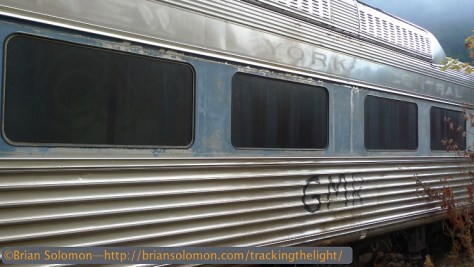
East of the passenger station there were a few old Budd RDCs stored on former Rutland Railroad sidings. I took a few minutes to made some photos with my Lumix LX3. My father has some nice Kodachrome slides of Boston & Maine and New York Central cars working in the 1960s. I remember riding them out of Boston in the 1970s.
Exposed digitally with a Lumix LX3.Vestiges of another era at Bellows Falls, Vermont. Exposed digitally with a Lumix LX3.New York Central was first to install Budd Rail Diesel Cars in revenue service. They were known as ‘Bee Liners.’ Exposed digitally with a Lumix LX3.
One of the benefits of Budd’s Shotwelded stainless steel construction is that the cars won’t rust. Yet, the overgrowth makes for some interesting studies in decay. The cars still reflected the light nicely.
More than 30 years earlier we’d explored these same sidings. Back then there were decayed vestiges of wooden sided boxcars around the place, and considerably few trees.
Tracking the Light posts new material every morning.
I first visited Roscrea in August 1998. Denis McCabe was giving me a tour of rural Irish stations, and we stopped there to intercept the branch passenger train running from Ballybrophy to Limerick.
Back then the train consisted of an 071 diesel, a steam heating van and two ancient looking Cravens carriages. It was a cloudy morning.
Fast forward to August 2014, and Denis and I made a return visit to Roscrea. While I’ve visited this rural station on several occasions in the intervening years, what struck me was how little the station and its environs have changed.
Irish Rail station at Roscrea, County Tipperary in August 2014. Exposed with a Lumix LX7. (And yes, I also made a color slide, for the sake of modal consistency and archival longevity.)
The old signal cabin is still open and active; the mechanical semaphores remain as I remember them, the station building seems unchanged. Compared to many of the station I visited in 1998, this is one of the few that still looks the same. The Celtic Tiger years didn’t result in unnecessary uglification—er, I mean improvement—to Roscrea.
In 2004, Irish Rail replaced the traditional locomotive-hauled steam-heated Cravens with a more modern railcar. Today 2800-series railcars in the latest green and silver paint work the Nenagh Branch. Exposed with a Canon EOS-7D with 100mm lens.Exposed with Lumix LX7.
On the downside, you must know where the station is in the village. I don’t think there was any sign off the Motorway or in the town itself giving any hint of an active railway station there. It’s a real pity too. The Nenagh Branch is one of those throwbacks to another age. Unsung, unloved, and largely ignored, it soldiers on in a world that time forgot.
Tracking the Light posts new material every morning.
Union Pacific on Donner Pass; Standing in Steinheimer’s Footsteps.
Among my favorite locations in California is the spectacular overlook at ‘American’ or ‘Old Gorge’ (if you have a really old time-table) located on the former Southern Pacific crossing of Donner Pass east of Alta.
Here the railroad crawls out on ledge high above the waters of the American River. It’s a on sustained 2.2 percent grade, so eastward trains are in full throttle which makes for sublime sound show.
I was in position on an overcast afternoon, October 30, 2003. The American River Canyon was filled with a thick fog. To the west I could hear traditional EMD 16-645E3 diesels roaring in Run-8. That meant SD40-2s. Real locomotives.
Exposed on Kodak Tri-X which I processed by hand in San Francisco. After initial processing I toned the negatives in a selenium solution mix 1:9 with water for 9 minutes, 1 minute agitation (in a well-ventilated area).
As the train approached, the atmospheric pressure changed and the fog rose out of the canyon and enveloped me. Although it was only the day before Halloween, all of sudden it began snowing furiously. Visibility dropped to nil, and the roar of the eastward freight grew intense.
Working with my Rolleiflex Model T loaded with Kodak Tri-X, I exposed a series of images. It was a memorable moment on Donner.
Union Pacific SD40-2s emerge from the fog and snow at ‘American’ on their ascent of Donner Pass.
Tracking the Light posts new material every morning.
Norfolk Southern eastbound near Mexico, Pennsylvania with a former Conrail General Electric DASH8-40CW in the lead.
The former Pennsylvania Railroad Middle Division is one of the busiest freight routes in the eastern United States. On November 5, 2001, Mike Gardner and I spent the afternoon on Middle Division photographing Norfolk Southern freights.
The combination of pastoral Pennsylvania scenery, low November sun, and steady parade of freights made for lots of opportunity to make interesting railway images.
I’m always looking for a new angle. Here I worked with light and shade to sculpt scenes that captured the character of the place as well as the trains passing through it. I exposed these images using my Nikon F3 with Fuji Provia 100F.
Piggyback trailers roll toward Tuscarora Mountain on their eastward journey along the Juniata River Valley.USGS topo map showing Mexico and Tuscarora, Pennsylvania. I made my photos near the Olive Branch School, across the Juniata from Mexico.
Tracking the Light posts new material every morning.
Last week I posted photos of freshly painted Irish Rail class 201 number 215 working the IWT liner. Today, it worked to Cork and back. I photographed it a little while ago passing Islandbridge Junction.
Irish Rail 215 works at the back of a Mark4 set from Cork. I panned this using my Canon EOS 7D with 40mm pancake lens at 1/40th of a second at f10, ISO 100. 12:45pm on September 18, 2014.Irish Rail 215 works at the back of a Mark4 set from Cork, seen approaching Heuston Station in Dublin at 12:45pm on September 18, 2014. Lumix LX-7 ISO 80, f3.5 1/500th second.
Among the iconic locations on the former Pennsylvania Railroad ‘West Slope’ (west of the summit at Gallitzin) is a massive curved stone-arch bridge near Mineral Point, known as ‘The Big Viaduct.’
In the early hours of September 5, 1997, Mike Gardner and I drove down a heavily brushed in road that had once been the right of way of a Johnstown Traction Company’s electric line.
Mike was dubious when I urged further forward progress into the inky gloom and thick bushes. It seemed like an adventure into the rain forest.
We arrived at on overlook near the famous bridge just as the first hints of daylight colored the sky. A thick fog covered the ground, but the fuzzy twinkling spots above told us that it would be a clear morning.
In the distance, I could hear Electro-Motive diesels whining in dynamic as they approached with a westward Conrail freight. Despite the fog and gloom, I set up my Bogen tripod, attached my N90s with 24 mm lens, and when the train passed, made a series of long exposures with Fujichrome Provia 100F.
A Conrail freight growls downgrade across the Big Viaduct. Exposed on Fujichrome Provia 100F with a Nikon N90s with 24mm lens. Time exposure: about 8 seconds with camera on tripod.
Soon the sun crawled above the hillsides and began to burn off the fog, Conrail ran a procession of trains, mostly westbound. Later in the morning when a clear blue dome prevailed I relocated trackside to make a view of an eastward freight climbing across the bridge.
A westward Conrail freight emerges from the fog near the Big Viaduct. Exposed on Kodachrome 200 using a Nikon F3T with 80-200 zoom lens.Conrail 6180 east at Big Viaduct Mineral Point PA September 5, 1997. Nikon N90S with 28mm lens, Fujichrome Provia 100F slide film.
It is mornings like that one, 17 years ago, that make me wish I was right now trackside in the mountains of Pennsylvania, and not thousands of miles away in front of a computer, writing about the experience.
Tracking the Light posts new material every morning.
Looking down from the CN Tower on Canadian National’s Spadina Roundhouse in Toronto.
I exposed this vertigo inducing view from the sky-reaching CN Tower using my Leica 3A with 50mm Summitar and Kodachrome 64.
It was a glorious clear morning and I was visiting Toronto for the first time. After the tower, I wandered around on the ground making a few select images.
While the nearby Canadian Pacific roundhouse at John Street survives as a museum, CN’s Spadina Street was demolished a year after my visit, and almost everything in this view has been erased from the scene.
Looking down from the CN Tower on Canadian National’s Spadina Roundhouse in Toronto.
Tracking the Light posts new material every morning.
When I was exploring Santa Fe’s Bay Area operations in the early 1990s, the railroad tended to operate a fleet of westward trains to its Richmond, California yards in the afternoon and early evening.
One afternoon, Brian Jennison and I had set up at the Alhambra Viaduct near Martinez. This was a relatively scenic portion of the line, but beginning to get hemmed in by suburban growth.
We knew that the 899 was on its way. This was a short high-priority piggy back train. The real prize of the day was the premier 199, which often had new ‘Super Fleet’ locomotives wearing the reintroduced Warbonnet paint scheme. But we wanted to make the most of the short train as we had time to make different photos of both trains.
To make the most of Santa Fe’s ‘shorty’ 899, I climbed atop the tunnel west of the bridge, and set up this view using my Nikon F3T fitted with a Nikkor f4.0 200mm lens. The light was classic California blue skies with soft autumnal haze that favored Kodachrome 25. My exposure was f5.6 1/250th of second.
This view minimized the suburban sprawl on both sides of the bridge, along with high tension lines in the valley, while putting the steel viaduct in a good perspective. Was it really 24 years ago?
Tracking the Light posts new material every morning.
I spent this hot hazy afternoon east of the passenger station at Utica, New York watching and photographing trains on the old New York Central Water Level Route.
Utica was unusual because it retained a variety of its New York Central-era structures on a route largely denuded of traditional railroad buildings.
Exposed on Fujichrome using a Nikon F3 with f2.8 180mm lens.
I made a point of include old Tower 30, which had still had Conrail sticker on its door. Without the tower in the picture, CSX AC6000CW 611 could be just about anywhere.
This is just one frame in a sequence. I think a previous image, with 611 slightly further back in the frame might be a more effective photo.
Tracking the Light posts new material every morning.
RPSI 461 at Islandbridge Junction, Dublin, Ireland at 11:53 am on September 4, 2014. Canon EOS 7D with 200mm lens.
Just a few minutes ago, Railway Preservation Society Ireland’s 1923-built 2-6-0 461 passed Islandbridge Junction near Dublin’s Heuston Station.
The locomotive is on its way to Limerick.
Nice to see steam on the move in bright daylight!
RPSI 461 at Islandbridge Junction, Dublin, Ireland at 11:53 am on September 4, 2014. Lumix LX7 photo.Just a minute later, uniquely painted class 201 diesel 8208 rolled the other way.
This is a Special Post,
but Tracking the Light posts new material every morning.
It was June 22, 2004, when Marshall Beecher organized a visit for the two of us to photograph from a rooftop opposite A2 tower in Chicago.
This busy plant is where the former Chicago & North Western line from C&NW station crosses the old Pennsylvania Railroad Panhandle/Milwaukee Road route from Union Station.
Our visit was timed to coincide with the passage of Milwaukee Road 4-8-4 261 with a passenger excursions. At the back of the train was one of Milwaukee’s unusual Skytop lounge observation cars.
Exposed on Fujichrome Velvia100 using a Nikon F3 fitted with 24mm lens. Exposure calculated with a Minolta MarkIV hand-held light meter. A variation of this image appeared in the book Milwaukee Road’s Hiawatha authored by John Gruber and me and published by Voyageur Press.
After the steam excursion was gone, we decided to make the best of the vantage point and spent several hours photographing Metra and Amtrak.
Thanks Marshall!
Tracking the Light posts new material every morning.
It was autumn 1986. As a photography student at the Rochester Institute of Technology, I’d receive an annual ‘care package’ of new, and sometimes experimental, Kodak products.
At the time I was a loyal Kodak film user, and dedicated to the careful exposure of Kodachrome 25. However, since I was on a shoe-string budget, I was happy to make use of the free roll of ‘Ektachrome du jour’—as we’d call whatever the latest flavor of Ektachrome was being peddled at the time.
Blessed with a rare bright day, and armed with my free roll of film, I wandered around Rochester documenting the railroads and the city. I had K25 in my Leica for the important photos, and loaded the free film into my roommate’s Canon A1 for experimental shots and comparison views.
I exposed this slide of Santa Fe freight cars on a westward Conrail freight using the Canon A1 fitted with a 50mm lens. I panned using a 1/30th of second to convey a sense of motion.
Metrolink is a popular name used by modern urban passenger rail systems.
As a follow-up from yesterday’s post, I’ve included more images from my Manchester visit earlier this month (August 2014).
MediaCity UK.
The present Metrolink colour scheme on the cars is a contrast from the 1990s-era trams that I experienced on my visit in 2000. Those were painted off-white with black and aqua-green stripes. While on this visit, I saw a few of the first generation trams stored at a depot, these no longer appeared to be in service. Too bad, it would be interesting to get photos of the old and new side by side.
I found Manchester Metrolink convenient to travel on and easy to photograph. Tram frequencies were very good and for the most part the trams were well patronized, but not overly crowded.
In my photography I tried to include the environment around Metrolink and not just focus on the railway. Among the more interesting places to make images was in the city centre where the trams run in the streets that were crowded with pedestrians.
Here the Lumix LX7 is an ideal tool. The camera is inconspicuous and allowed me to get some dramatic angles without difficulty. A mix of bright sun and sluicing rain made for dramatic changes in the quality of light.
Eccles. A burst of sun after a prolonged shower.A cafe in the Manchester City centre allowed me to get a bit of lunch and stay dry in between cloud bursts. While the sun is out in this image, minutes before it was gushing rain.The Lumix LX7 allowed me to get some low angle views to accentuate the damp streets and reflect the clouds in the windows of the tram.Urban scene, August 2014.Crowds wait at Market Street in the Manchester City Centre.A bit of glint graces the back of an outbound tram near Manchester Piccadilly Station.
On May 9, 2008, I took a trip on the California Western from Fort Bragg to North Spur as part of research for my book Railroads of California, published by Voyageur Press in 2009.
The attraction of California Western is the gargantuan trees along the line. The railway winds along the Noyo River passing trees reaching hundreds of feet into the sky.
I exposed this image with my Canon EOS 3 using a 20mm wide angle lens and Fujichrome film. The challenge was selecting the appropriate exposure: the shafts of bright noon-time sun making for extreme contrasts with the shadowy tree trunks. What is the primary subject of this photograph? Is it the GP9 situated at center? Or the ominous silhouettes of the massive trees at the right?
One of the spooky parts of this experience is the realization that these massive trees are second growth. The much larger original redwoods were cut down a century ago. All that remains of those leviathans is the occasional stump, some of which are more than a dozen feet in diameter.
My intent of this image was to show a simple juxtaposition between C&NW GP9 4153 and the steam-era coaling tower in the distance.
Exposed on Kodachrome 25 using a Nikon F3T with f4.0 200mm Nikkon telephoto lens.
By this late date, steam was four decades gone, and C&NW was already part of the Union Pacific system, having been absorbed just a few months earlier. Yet, despite UP being the operating company; in Adams, Wisconsin things still appeared to be business as usual on old C&NW.
To put the GP9 and coaling tower in relative perspective, I used my Nikon F3T fitted with a 200mm lens, and found a suitable angle at a distance from both subjects. My aim was to minimize extraneous elements and focus on the railroad interest.
Since the locomotive was static, I used the opportunity to make photos from a variety of other angles. Some of these photos appeared in my book on EMD F-units published by Specialty Press about 2005.
One of the highlights of the S&C route is the often photographed curved 24 arch Batty Moss Viaduct at Ribblehead. Some stunning views of this bridge can be made right off the main road, while the more intrepid photographers may brave the winds and rain by hiking around the massive bridge.
Although TSH and I waited with great patience for many hours, the mythical freight we had hope to see never materialized during our visit. As I wrote yesterday, bad luck. You can’t win all the battles, after all.
Ribblehead. Canon EOS 7D with 200mm lens.Ribblehead station with bovine all around.Ribblehead Viaduct with clouds streaming across the sun.
Bright morning in Leeds. Lumix LX7 photo.Bouncy railcars in a bay platform at Leeds. Lumix LX7 photo.
Back in July 2000, I changed trains here. That brief visit left me with a vague impression of a bouncy rail car in a bay platform. Back then, I was on my way to Brontë Country for a weekend on the Keighley & Worth Valley.
Fourteen Years seems like a long time. On this more recent visit, I had time to more thoroughly experience Leeds and its railway terminal. While not a Victorian throwback like London’s great terminals at Paddington or Liverpool Street, Leeds is a busy place with constant parade of trains.
There’s good variety too. In addition to a multitude of diesel and electric multiple units, there’s a fair few HSTs and Class 90 electrics on long distance trains. In the evenings, a the occasional freight rolls through.
In addition from platform views, I found some stunning vistas from the nearby Double Tree Hotel that overlooks the Manchester-end of the station.
Curiously, the bouncy railcars are still aplenty in Leeds, albeit painted differently than I remember from last time around.
The old BR logo still abounds in places. Lumix LX7 photo.Murals cover some trains with regional themes. Lumix LX7 photo.You have to love the old HSTs. The train that saved long distance passenger services in Britain. Study this story, there’s lessons to be learned! Lumix LX7 photo.HST, another view at Leeds. Lumix LX7 photo.Leeds is busy place. No shortage of trains. I think it’s safe to say there’s more action here than at South Station, Boston. Keep in mind these are the noon-time departures, not rush hour. Lumix LX7 photo.Lumix LX7 photo.Leeds station entrance. Soon the rain was cascading down. Lumix LX7 photo.An electric multiple unit glides out of the station. Lumix LX7 photo.Trains pass near Leeds station as viewed from the 13th floor of the Double Tree Hotel. Canon EOS 7D photo.Dusk settles over Leeds. Lumix LX7 photo.In the evening there’s a bit of freight; an EWS Class 66 rolls through with tonnage in tow. Lumix LX7 photo.
A few days ago, I flew from Dublin to Manchester, then hopped on the First TransPennine Express at Manchester Airport for Leeds.
It had been a while since I last made this journey, and in that time the trains and the train operators have changed.
The service is frequent, but not so cheap.
Give First credit for a wild paint scheme.Manchester Airport is blessed with a railway terminal within its transport complex. Service to and from the airport run every few minutes to points all over the Midlands region.The interior of the Class 185 DMU has decor that reminds me 1990s German InterCity trains. Lumix LX7 photo.
Ensconced on the class 185 DMU, I gazed out the window as the train arrived at under the shed at Manchester Piccadilly. Here the 185 reversed direction for Leeds and we crossed the services namesake hills. We ran parallel to an old canal for a while, and everywhere the landscape shows scars of industrialization.
Here’s my train as it departed Leeds for York. Exposed with a Lumix LX7, August 2014.
The train didn’t hang around and ran a steady clip, only pausing at Huddersfield before arriving at Leeds. On my arrival the skies opened up and rain cascaded down. So be it.
Hard to believe, but Pennsylvania Railroad’s GG1 electric 80 years old in 2014!
Exposed with a Nikon F3T with 105mm lens on Fujichrome Provia 100 film.
I made this detailed view of PRR’s pioneer GG1, number 4800 at the Railroad Museum of Pennsylvania in November 1996.
This machine was different than all the others because it didn’t have Raymond Loewy’s full styling refinement and featured a riveted skin. ‘Old Rivets’ is a favorite machine.
I’d followed this GP7 down from East Deerfield Yard. At South Deerfield, the local stopped to switch and I made several Kodachrome slides with my Leica M2 and a few 120 size black & white negatives with my dad’s Rollei Model T.
Exposed in June 1987; processed with special recipe in July 2012.
While these images aren’t too bad, I can’t recommend waiting a full 25 years to process the film.