Here’s another contemporary black & white view on Dublin’s O’Connell Street.
In the window of Ulster Bank is a view from 1916 showing the ruins of Dublin’s General Post Office, destroyed during the 1916 Easter Rising. Old trams grind along near the old terminus at Nelson’s Pillar.
A child looks at us across the void of time.
Modern pedestrians are a focused on their phones or the ATM at the side of the bank.
Today, tracks are being re-built on O’Connell Street, and after a long absence tram service is expected to resume in 2017.
Exposed on Ilford HP5 using a Nikon F3 with 24mm Nikkor lens. Do you think this photo would as effective in colour.
Guitarist Jimmy Page, best known for his work with Led Zeppelin and the Yard Birds, produces a daily web page (http://www.jimmypage.com) that chronicles his work over more than five decades.
On This Day picks an event (or two) and gives Jimmy’s viewers a bit of background, often describing the roles of his fellow musicians. On occasion he drops in a railway photo or a clip from an old movie. Jimmy often carried a Nikon SLR on his tours.
Today, I’ll borrow Jimmy’s format: on this day 22 years ago (23 September 1994) I was traveling with Tom and Mike Danneman in the Minnesota Iron Range.
At the time I was working with Tom at Pentrex Publishing in Waukesha, Wisconsin where we produced Pacific RailNews and Passenger Train Journal. Mike worked across town at Kalmbach’s Trains Magazine.
I learned a lot from our Midwestern excursions in the mid-1990s. Both of these brothers remain among the most talented railway photographers and artists in North America. Tom now works at Kalmbach, while Mike is a freelance artist based in Colorado.
Among our destinations on 23 September 1994 was Duluth, Missabe & Iron Range’s Fairlane facility, where in a thick fog we photographed this pair of SDM diesels with an iron ore train.
I exposed this classic Kodachrome 25 view at Fairlane, Minnesota using a Nikon F3T with an f1.8 105mm lens. My aperture was nearly wide open and as a result the headlights burned out a bit. I’ve always liked the way the loading equipment looms ominously in the fog. The leaning signal is a bit of distraction though.
Later in the day we visited Hibbing, Minnesota, which is probably best known as the boyhood home of Robert Zimmerman (aka Bob Dylan).
On 14 September 2016, I posted some black & white photos of an excursion train at Waverton near Chester in the UK. See: Three Mysteries.
My luck was catching this train, but I knew very little about it.
Several readers wrote to me with suggestions and the consensus was that I’d photographed Belmond’s Northern Belle excursion train, which often runs in central England.
Belmond’s Northern Belle at Waverton in March 2007. Readers have helped me solve the mystery behind this train.
That theme fits nicely with the more recent photos I’ve been running of Belmond’s Grand Hibernian on Irish Rail. However, it is truly coincidental, as the film had sat latent on my desk for more nine years!
I’d all but forgotten about the special move when I finally processed the film this month.
So there you go!
(Special thanks to everyone who wrote to me with details on the Northern Belle!).
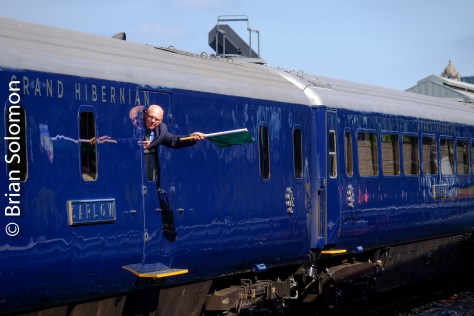
Sunday morning was overcast. Not the best weather for photographing Belmond’s dark blue Grand Hibernian. (Luxury cruise train).
However, since when the sun is out, the cutting at Cabra in Dublin is badly shadowed the best time to try this location is on an overcast morning.
Exploring this option, I found the most dramatic angle was the trailing view. Using a telephoto perspective, I was able to draw in the Dublin Mountains in the distance.
Waterford bound, the Grand Hibernian passes Cabra in Dublin.
Looking south, I saw that the rain was coming my way.
These images were exposed using my FujiFilm X-T1 digital camera.
I processed all three images using Lightroom.
I made nominal global adjustments to contrast and saturation and sharpened for the computer screen. Also, I used a digitally applied graduated neutral density filter to better retain detail in the sky.
There’s a certain thrill to having two trains approach simultaneously.
Saturday, Denis McCabe, David Hegarty and myself had selected a bridge near Mosney (mp25) on the old Great Northern Railway Dublin-Belfast line as a good place to catch Belmond’s Grand Hibernian cruise train.
The Belmond train departed Dublin Connolly behind an Irish Rail local passenger train and its progress was slowed when it encountered restrictive signals.
Another Irish Rail local was scheduled in the Dublin direction.
As it happened the two trains passed below us.
Belmont’s Grand Hibernian rolls northward at milepost 25. The lighting was tricky. Diffused backlit sun made for a complicated exposure calculation. I used a Lee .6 graduated neutral density filter to hold detail in the sky. In post processing I lightened shadow detail slightly while controlling highlights to reduce glare on the top of the locomotive.I turned quickly to make this grab shot of the Grand Hibernian meeting an Irish Rail 29000-series diesel railcar on the opposite main track. In retrospect, I think I’d could have made a more dramatic image if I’d used a telephoto lens setting.I moved over a few feet to get a better angle of the approaching railcar. The gray roofs on Belmond’s Mark3 carriages isn’t especially photogenic.
A sunny September Saturday afternoon in Dublin; what better time to make a visit to the airport. Not to travel to distant cities, but simply to watch and photograph the parade of commercial aircraft.
Lots of different airlines make for a colourful parade of planes.
I used this as an opportunity to test my FujiFilm X-T1’s various auto-focus settings.
The ‘C’ (continuous) setting seemed to produce the sharpest results, but introduced a slight delay from time I pressed the shutter-button until the actual moment of exposure. I found the delay difficult, but so long as I could anticipate the delay I was able to work around it.
Another challenge was trying to keep the camera level while panning the rapidly moving planes.
My visits to California’s Tehachapis in July and August (2016) made me curious to dig deep into my archives and revisit the photographs I made there in the early 1990s.
I traveled with J. D. Schmid on my first visits to Southern Pacific’s Tehachapi crossing. (Then Santa Fe operated in the Tehachapis via trackage rights on SP, as does BNSF on Union Pacific today).
I made this Santa Fe FP45 photo on a rainy morning February 1991. We were on our way back from a detailed study of the SP’s Beaumont Hill and environs.
Exposed on Kodachrome 25 using a Nikon F3T with 35mm PC lens. Santa Fe FP45 91 is the lead.
While hard to beat the great sound of EMD 20 cylinder diesels working the Tehachapi grades, it was difficult working with Kodachrome 25 to capture the experience. The film was slow and its spectral response didn’t favor dull days.
Certainly the weather was better on my more recent visits. I traveled with David Hegarty, and we had ample opportunity to make photographs in the bright California sun.
A southward BNSF intermodal train ascends the loop at Walong, California. In SP days the railroad was viewed on an east-west axis (west being San Francisco). Today, present owner Union Pacific deems the directions of operation on a north-south axis (regardless of compass.)
On an evening in 1978 my father and I visited South Station, Boston.
It was very different then; much quieter, low level platforms, no electrification, mechanical semaphores controlled movements on the approach to platforms.
I’d fitted my dad’s 21mm Super Angulon to my Leica 3A. I exposed several Kodachrome slides by resting the camera on something solid and making a 1 second exposure (or so).
I didn’t understand the concept of reciprocity failure, and so even though I’d taken the light reading of the hand-held Weston Master V literally, most of the slides were underexposed (too dark).
This one was the best of the lot, and in my early years was among my favorite railway photos.
In the interval since I made this image, I’ve perfected my night photography technique.
MBTA F40PH 1004 was nearly new at the time of this 1978 photograph. I’ve lightened the shadows a little bit for improved presentation here. This slide projects well despite its age, and my formative understanding of the peculiarities of exposing Kodachrome in low light.
I saw the wonderfully textured evening sky with hints of pink and orange. But what to do with this and how to best expose for it.
Working with my Lumix LX7, I exposed for the sky, controlling exposure using the +/- dial for overall ease of operation.
My intention was to retain detail in the sky, rather than risk blowing out the highlights, and then make adjustments to lighten the shadow area in post processing to compensate for an overall dark image.
Here I’ve displayed both the uncorrected file (converted from a camera RAW to a small Jpeg necessary for internet presentation) and my manipulated image.
Irish Rail 085 with a ballast train rests in the old Guinness sidings at Heuston Station, Dublin. This Jpg was converted directly from the Lumix camera RAW file. Other than necessary scaling and watermark, I did not alter the image. Under exposure was necessary to hold detail in the sky.My modified file; using the Lumix camera RAW, I adjusted the photo in Lightroom. Specifically, I applied a digital graduated filter to the lower half of the image and used to this to locally lighten the image while manipulating contrast and color saturation. Once completed, I then made further global adjustments to contrast and exposure, focusing on lightening shadows. Despite these changes, my intent was to maintain the scene as closely as possible to how I viewed it.
A minor point: I’ve not ‘fixed’ these photos. Rather I applied a known technique to hold both sky detail and shadow areas, beyond what the in-camera Jpg is capable of delivering without adjustment. From the moment I released the shutter, I planned to make these adjustments.
The other evening, I was passing Dublin’s Heuston Station, where I noticed a heron standing on the banks of the River Liffey during relatively low-tide.
Using my Nikon F3 with f1.4 50mm lens, I made this exposure on Ilford HP5 to show the bird and the classic 1840s-built railway terminal.
On a September 2016 evening, a lone heron stands in the River Liffey near Dublin’s Heuston Station. Exposed on Ilford HP5 black & white film (rated at 400 ISO) and processed in Kodak HC110 (dilution B) for 4 minutes at 68 degrees (with a presoak water bath containing a hint of developer to help actuate initial development and improve shadow detail).
I made some nominal localized post-processing adjustments in Lightroom to help draw the eye to the bird. It’s reflection in the water helps make it more obvious.
I wonder if this effort will be obvious as the photo transcends the irregularities of the internet.
Internet imposed cropping and compression are never the friends of subtle photography. Perhaps that’s one reason that brash, bold super-saturated images prevail on the web today?
Tracking the Light posts something different every day!
The First mystery: finding out what was on that long-unprocessed roll of Fuji Neopan 400 black & white film that sat in my back-log for the last few years.
The other day, I finally souped the film using Kodak HC110. My process time included a water-bath (with a hint of developer) then four minutes at 68 degrees F using dilution B (1:32 with water) at full strength.
Once processed, I recognized these images that I’d exposed way back in March 2007.
The Second mystery: toward the end of the roll, I found a sequence of photos along a double-track line in England. But where?
I recalled that David Hegarty and I were driving from suburban London to the ferry at Holyhead. Sadly, my notes from the day are in North America, and I’m in Ireland. So I’d have to work strictly from memory.
I remembered that we diverted from the M6 and used two-lane roads.
I pulled out my atlas and traced the railway line from Crewe to Chester in England, trying to figure out where we’d been. This isn’t an area I frequent often. I figured the old station would help me.
This station was my clue to the location.
My next step was to go to Google Earth. Using the satellite view, I closely examined a variety of overhead bridges. Finally, I figured out where we’d been. The station’s distinctive chimneys gave me a positive ID. The location is from Saighton Lane in Waverton immediately southeast of Chester.
The third mystery: what train is this?
Here comes a special train led by an English Welsh Scottish class 67 (EMD) diesel. Exposed using my Canon EOS 3 with 100mm lens.
Now I’m at loss. This was some kind of special passenger train led by an EWS class 67 diesel. We were very lucky to arrive in time to watch it pass, but I never knew what it was, who operated it, or where it was going. It was just dumb luck that we saw it at all.
Trailing view of the special at Waterton, UK in March 2007.
Have you willingly deleted a railroad photo because of an exposure error? Or perhaps pitched an underexposed color slide? Maybe traded away a photo that you dismissed as substandard. Or maybe even dumped an entire roll into the trash because of a camera flaw?
I have.
Step back to August 1998. That wasn’t yesterday. Denis McCabe and I were photographing on the Northern Line at Balbriggan. Our aim was to catch cement trains on the move.
It was a mostly sunny afternoon with the occasional puffy cloud in the sky.
An inbound suburban train approached the platforms with Irish Rail 078 in faded orange paint leading a pair of Cravens and the requisite generator van.
Just as the train reached the optimal location for my photograph, the sun was suddenly blocked by a cloud. [Most of us familiar with making railway photographs has experienced this phenomena, and it has many names, most of them are unsuitable for reiteration here.]
Despite this setback, I released the shutter anyway, and exposed this lone 35mm black & white negative.
This is the scaled scan of the otherwise unmodified black & white negative (made positive).
After I processed the film a few days later, I made prints from the best images on the roll, then sleeved all of the negatives: good, bad, and otherwise.
I never considered printing this one. At the time, seeing an 071-class diesel leading Cravens was not unusual. It happened daily. Nor was having a cloud ruin a photo in Ireland especially unusual.
I scanned the entire roll in November 2015, not for this photo, but for the better shots either side of it. It was only on close examination on the computer that it occurred to me that now, in 2016, this image is both interesting and historic.
Its lighting/exposure defect is easy enough to compensate for using Lightroom. So I present it to you now. In retrospect it offers a better lesson and a more interesting story than the perfectly lit images of cement trains exposed on the same roll.
Irish Rail class 071 General Motors diesel number 078 leads a pair of Cravens plus gen-van at Balbriggan in August 1998. Exposed on 35mm black & white film using a Nikon F2 (on a long-term loan from Brian Jennison) and Nikkor 24mm lens with yellow filter. Film processed in ID11, and image adjusted for exposure and contrast in Lightroom.A further refinement using Lightroom.One more variation with greater contrast.
In July, I spent a few minutes on the Long Island Rail Road platforms at Woodside in Queens, New York.
LIRR’s busy multiple-track third-rail route from Penn-Station to Jamaica, New York is one of the few places in North America where you can experience train-frequency on par with busy European mainlines.
In the course of only a few minutes I saw a half dozen trains.
These are a sample of the photos I exposed with my Lumix LX7.
My compact Panasonic Lumix LX7 is ideal for urban railway photography. This camera compact, lightweight and unobtrusive, while it uses a Leica optical system that yields excellent images. I have mine set up to expose both RAW and JPG files simultaneously.Trailing view of an outbound train.One of LIRR’s older Metropolitan-series trains is heading toward Penn-Station.It was nice to catch the older cars on the move.I made this view from the concourse of the Flushing Line station (operated by the NYCTA). Woodside offers a convenient connection between LIRR and NYCTA trains.
My photo of Railway Preservation Society of Ireland’s engine number 4 appears on the cover of this year’s Southern Steam Calendar.
RPSI’s former Northern Counties Commission engine number 4 works toward Pearse Station Dublin on 18 Dec 2010. The cool dry conditions combined with a rare blanket of Irish snow made for a classic view of RPSI’s Santa Train. I exposed this view digitally using my Canon EOS-7D.
The calendar features the work of a dozen of Ireland’s most talented railway photographers. It is arranged to display one large photo per month.
My view here has been specially cropped for display on Tracking the Light. The calendar displays a larger version of this image.
Southern Steam has been produced by my friends Kevin Meany and Ken Fox for the charity Pieta House—Centre of Prevention of Suicide Or Self-Harm.
Southern Steam—2017 is available in Ireland with proceeds going to the charity. If you are interested is obtaining a copy of the calendar please contact Ken Fox at:
Track and platform construction continues in Dublin on Ireland’s latest rail-transit route.
When completed LUAS Cross City will extend the Green Line north through the Dublin City Centre via Parnell Square to Broadstone and beyond to a new terminus at Broombridge.
The other day Mark Healy and I made an inspection of the work in progress.
Safety fences combined with the visual chaos of this urban setting makes for challenging photography. I’m hoping to add these images to my file of now and then images once the project is completed and functional.
Looking toward Broadstone from the North Circular Road. Lumix LX7 photo.Tracks at Broadstone. The old railway terminal is featured at the right. Lumix LX7 photo.Construction fences and other modern ugliness make visually effective photography difficult. Lumix LX7 photo.Dominick Street Upper. Lumix LX7 photo.Dominick Street Lower. Lumix LX7 photo.New tracks in Dublin’s north inner city. Lumix LX7 photo.O’Connell Street looking toward the Parnell monument. Lumix LX7 photo.General Post Office, O’Connell Street, Dublin. Lumix LX7 photo.New square crossing at Abbey Street and O’Connell Street. Red Line tram waiting at the lights. FujiFilm XT1 digital camera.A mix of new and old trackage on Abbey Street. One leg of the Cross City route will cross the Red Line at Abbey Street. FujiFilm XT1 digital camera.Some interesting trackage on the Red Line at Abbey Street. FujiFilm XT1 digital camera.Red Line LUAS trams pass near the Loop Line Bridge on Abbey Street. The new crossing on Marlborough Street is behind me.
The sinuous alignment of the old Southern Pacific in the Tehachapis is ideally suited to lining up sunrise photographs.
A blanket of airborne particulates filtered the rising sun, softening the light and giving it a luminous golden tint.
In the 1990s, I made many glint photos on Kodachrome. This one I exposed digitally and adjusted contrast in post processing to make for a more pleasing image.
Where K25 slide film would have retained the ring of the sun, now I have to settle for a golden blob of light.
BNSF symbol freight Z-LPKNBY7-05L (priority intermodal train from Logistics Park Kansas City to North Bay, California) catches the glint at Caliente, California. ISO 200 at f20 1/500th of a second.
A key to making an image such as this one is manually setting the aperture to control the amount of light reaching the sensor. I metered manually and ignored the camera’s recommended exposure, which wouldn’t have given me the desired effect.
Since I was preparing a classic silhouette, I wasn’t interested in retaining detail in the shadows, but instead aimed to hold tonality in the sky.
Where my ‘normal’ daylight exposure with ISO 200 is about f8 1/500th of second, for this photo, I closed down the aperture to f20, which made for two and half stops less exposure.
Thursday morning on my way to breakfast, I made this photo of Irish Rail’s IWT Liner (Dublin to Ballina) passing Islandbridge Junction.
I timed my visit well and so only waited a few minutes for the freight to pass.
I’ve often photographed the IWT at this location, so this was really just an exercise.
Soft morning clouds made for some pleasant lighting, but also a post-processing quandary.
My FujiFilm XT1 allows me to simultaneously expose a Camera RAW file and a camera interpreted JPG. Among the features of the Fuji cameras is the ability to select a film-like colour profile for the Jpg.
In this instance I’ve opted for the Velvia profile, which closely emulates the colour and contrast of this popular slide film.
Another colour adjustment is the white balance control. In this situation I selected ‘auto white balance’, which means the camera interprets the color temperature.
When I processed the photos, I wanted to see if I could improve upon the camera JPG by making subtle changes to the Camera RAW file (which has ten times more information imbedded in it than the Jpg, but serves in the same role as a ‘negative’ and is intended for adjustment rather than uninterpreted presentation).
Below are three images; the a JPG from the unmodified Camera RAW, Camera created JPG, and my interpretation of the Camera RAW file.
This is an uninterpreted JPG made directly from the camera RAW file. (The RAW file is way too large for presentation on Tracking the Light.) I have not made any modifications to color profile, color balance, sharpness or exposure. This file is not really intended for presentation.My in-camera JPG using the FujiFilm digitally applied Velvia colour profile with ‘auto white balance’ setting. I made no modifications to this file, except to scale it for presentation and add my watermark on the left.This is my modified JPG. Starting with the Camera RAW, I imported this into Lightroom and implemented the following adjustments: I masked the sky using a digitally applied graduated filter and custom adjusted to increase highlight saturation, decrease highlight exposure, and make for cooler colour balance. On a global level, I made minor adjustments to white balance (warmed it up) and to contrast by lightening the shadow areas, reducing highlight exposure and altering the contrast curve. I also made select exposure adjustments to the pilot area on the locomotive. To match the Camera JPG’s perceived sharpness, I applied some nominal image sharpening. (This uses edge effects to make the photo appear sharper on the computer screen.) Got all that?
Incidentally, by using Lightroom, I can make adjustments to the RAW files without permanently changing the original data. This is very important since it would be a mistake to modify the original file. That would be like adding colour dyes or bleach to your original slide to ‘improve’ the result.
Fifteen years ago, if you told me that I’d be out on a Sunday morning specifically to photograph a 201 class diesel with Mark 3 carriages on Irish Rail’s Dublin-Cork line, I wouldn’t have believed you!
This morning Colm O’Callaghan and I did just that.
The dark blue color is difficult to photograph satisfactorily though.
Irish Rail 201-class diesel (built by General Motors in Canada) number 216 is specially painted for Belmond’s Grand Hibernian cruise train. The train’s glossy dark blue represents a photographic quandary. I made this photo with my FujiFilm XT1; ISO 640, f5.6 1/500th of a second using a 18-135mm lens.
Tracking the Light is a Daily Blog on Railway Photography.
August 4, 2016 was a blistering hot day in San Bernardino. I arrived by Metrolink from Santa Ana, and departed a little while later by Metrolink for LA Union.
San Bernardino was a big deal on the old Santa Fe Railway; freight yards, locomotive shops, and a classic station.
An old smoke stack still reads Santa Fe.
During my short visit there was a steady procession of BNSF freights.
I exposed these views using my FujiFilm XT1 digital camera. In post processing, (using Lightroom) I adjusted contrast and lightened shadows to compensate for the harsh effects of midday sun.
The old Santa Fe station hosts a museum and offices. Exposed using a FujiFilm XT1 with Zeiss 12mm Tuoit lens.
On July 1, 2010, helpers work at the back of a loaded coal train. By including some leaves and branches of near by trees I’ve added depth to the photograph.
Norfolk Southern helpers are in ‘run-8’ working at the back of a loaded coal train at Cassandra, Pennsylvania on the famed ‘West Slope’—the old Pennsylvania Railroad Main Line grade over the Alleghenies.
Morning glint illuminates the tops of the locomotives and accentuates the exhaust smoke for added drama. The train was working upgrade at a crawl.
The Dublin and Kingstown Railway dates to 1834, which makes it among the earliest steam railways built outside of England.
Today the route composes a part of Irish Rail’s electrified Dublin Area Rapid Transit system. Outer suburban and Intercity trains (to Rosslare), plus occasional Railway Preservation Society Ireland steam trains also use the line.
Much of the old D&K is scenically situated along the Irish Sea, yet the electrification masts and wires, combined with sea walls, fences, graffiti and suburban growth can make it difficult to obtain a satisfactory vista with the line.
In late August, I rode the DART from Tara Street Station to Blackrock, where I exposed these views using my FujiFilm XT1.
My train accelerates away from the platform at Blackrock. The modern footbridge makes for a dominant visual element, but also offers a photo platform.A Dublin bound German-built DART train approaches Blackrock. I aimed to feature the terrace houses above the line while minimizing the visually obnoxious elements of catenary and graffiti covered seawalls.This view from the modern footbridge shows the old Blackrock Station. Here soft lighting is a real benefit.I applaud Irish Rail for installing attractive maps near the station. More of this please.
Looking toward Blackrock station and Dublin.A 29000-series diesel multiple-unit approaches Blackrock. I made this view from the public footbridge south of the station. Here the terrace houses make for added interest and a nice compositional element. The Irish Sea is on my left, but there’s a host of ugliness between the railway and the water.
Here, soft afternoon lighting helped minimize obtrusive elements, but there’s little in the photographs that convey the historic significance of the line.
The challenge continues . . .
Tracking the Light offers a daily views on railway photography.
It was dull mid-August day at Worcester, Massachusetts. I had my Leica 3A loaded with Ilford Pan F (ISO 50) and made a few exposures.
This hasn’t been my usual film choice. More typically, when working in black & white, I’d use Ilford HP5 or Fuji Acros 100.
I’ve found that difficult light can be a better measure of materials than clear bright morning. And flat summer light is about as difficult as it gets.
For this trial, I processed the film using a Jobo with Ilford Ilfosol 3 developer.
This was a crap shoot, as I’d only used this film/developer combination once before.
Exposed using a Leica 3A fitted with a Nikkor 35mm lens.
I opted for a 1:9 dilution, but scaled back my process time from the recommended amount to just 3 minutes 45 seconds. As is often the situation, I intentionally over-expose my black & white film and then under-process to obtain a greater range of tonality.
Once processed my negatives looked pretty good, but these still required a bit of contrast control using Lightroom. While my end results look ok, I’ll need to refine my chemical process for Ilford Pan F (ISO 50) if I expect this film to perform as well as Fuji Acros 100.
Also, I was hoping that the Pan F would approach the results I used to get with Kodak Panatomic X (ISO 32) back in the 1980s, but so far I’ve not achieved that goal.
Exposed using a Leica 3A fitted with a Nikkor 35mm lens.
It was a sunny Saturday morning and the old Boston & Albany mainline was quieter than a rural Polish branch line.
Finally about 10:30 am Mike Gardner and I heard distant stirrings of an eastward freight.
We made our way to Warren, Massachusetts.
The long days of summer have resulted in the B&A route becoming unfortunately brushed in. Much of the line is largely obscured by bushes, trees and undergrowth, which make railway photography difficult.
The old Boston & Albany station at Warren remains one of my favorite surviving structures on the line; it harks back to a time when the railroad was the principle corridor for commerce in the region. Recently it has been restored.
Here we made our photographs.
A few strategic shafts of sunlight illuminate the line. I set my FujiFilm XT1’s shutter release dial to ‘CH’ (continuous high—the setting I casually refer to as ‘turbo flutter’) and waited as the train approached.
When it neared the shafts of sunlight, I held the shutter down and exposed a rapid burst of digital images, knowing that at least of one of them would place the front of the locomotive in full sun.
This satisfied my desired composition to juxtapose CSX’s modern General Electric diesel with the 1890s-era railway station building.
To demonstrate the effect of ‘turbo flutter’ as a compositional exposure tool, I’ve displayed the below sequence of images. In practice my camera exposed about three times as many photos. (Frame numbers are sequential)
Since the real cost of making a burst of exposures is very small, in this situation, I’ll happily make as many images as I need to in order to produce the photo I want. Later, if I choose, I can throw away the unsatisfactory images to save space on my hard drives.
This afternoon, after years of planning and months of preparation, high-end hotel train operator Belmond debuted its latest train; the Grand Hibernian.
This departed platform 2 at Heuston Station at 2:20pm (30 August 2016).
I made these photographs of the train and its Irish Rail crew.
For the railway enthusiast this means the return of locomotive hauled Mark3 carriages to regular traffic.
All images were exposed a little while ago using my FujiFilm XT1 digital camera.
Train guards Noel and Mark at Heuston Station, Dublin.Each carriage is named for an Irish County. Sadly Mayo and Dublin were omitted.
Oy! Whosat goob?
Departing Heuston Station on the advertised.Green flag to depart.
Tracking the Light posts EVERY day and sometimes twice!
My last view. (Facebook, Twitter, Tumbler and Google Plus viewers may need to click on Brian Solomon’s Tracking the Light to see the big picture).
This former Boston & Albany freight yard was the site of some my earliest photographic efforts.
My last-ever view of Boston’s Beacon Park yard. Exposed in late-August 2016 using a Lumix LX7 and processed with Lightroom to adjust framing and contrast.
Several years ago, in a deal with the Commonwealth of Massachusetts, CSX agreed to close its Boston yard to open the property for redevelopment. As a result, its intermodal yard at Worcester was expanded to accommodate the lost capacity.
The result is that Boston now has virtually no through rail-freight service. The trickle of remaining CSX rail-freight traffic is handled by a local from Framingham, Massachusetts. Container (and piggyback) traffic is accommodated by road.
Many years ago, Boston was a major freight hub, and Beacon Park was a very busy place—those days have long since passed.
For the last few years, the tracks at Beacon Park have sat disused and rusted.
Presently, track gangs are salvaging what remains of the old yard.
Someone, somewhere will declare ‘progress’.
Ironically, I exposed this view from a bus on the Mass-Turnpike Extension, the highway that more than 50 years ago assumed operation on considerable chunks of former Boston & Albany right of way.
The familiar sound of 645 thunder down in the valley spurred me into action.
A southward New England Central freight was climbing Stateline Hill in Monson, Massachusetts. This is an old routine (and yes, I’ve written about this before.)
When I hear a train coming through Monson, I have a few minutes to get organized. In this instance, a brilliant clear blue dome with nice morning light was the deciding consideration.
En route, I heard the southward train get its ‘paper’ (radio–issued track authority) to proceed toward Willimantic, Connecticut. In this instance, I was alerted to the location of the train; south of milepost 55 (near the Massachusetts-Connecticut state line).
I headed for my preferred spot in downtown Stafford Springs, Connecticut south of milepost 49.
FujiFilm XT1 digital photo.
One advantage of Stafford Springs is that the railroad makes an east-west twist through the village on its otherwise north-south run. This favors the morning light for a southward train.
The other advantage is Stafford’s quaint and distinctive New England setting.
In the longer months, there’s nice morning sun on the north side of the tracks at Palmer, Massachusetts and this seems to offer a potentially good vantage point.
There are several interesting structures here: including the former Union Station (now the Steaming Tender restaurant) and the old Flynt building (painted grey and lavender with fluorescent pink trim).
Yet I’ve found that placing a train in this setting rarely yields a satisfactory composition.
Here’s the on-going compromise; using a wide-angle perspective if I place the train far away, it tends to get lost in the scene. And, yet when it’s too close it obscures the old station building. The Flynt building either dominates on the right, or ends up cropped altogether. A telephoto view here presents its own share of complications.
The other day, I turned on to South Main Street in time to see the CSX local freight (symbol B740) west of the New England Central diamond (crossing). This gave me just enough time to park the car, walk briskly across the street, set my exposure and use my FujiFilm XT1 to make this sequence of photos.
CSX local freight B740 has a pair of vintage GP40-2 diesels. To the left of the train is the old Palmer Union Station.This closer view obscures the station.The trailing view lacks a satisfactory sense of place. It is CP83 in Palmer, but it could be anywhere. Yet, it does offer a good view of the antique diesels and the signals, so that’s something.
Not bad for grab shots, but they still suffer from my visual quandary as described.
Puzzling through these sorts of vexations is part of my process for making better photos. Sometimes there’s no simple answer, but then again, occasionally I find a solution.
In the meantime I present my photos as work in progress.
Brian Solomon’s Tracking the Light is a Daily Blog.
Yesterday’s (August 25, 2016) Boston section of Amtrak’s Lake Shore Limited carried an American classic: the streamlined Budd-built observation car Babbling Brook, a former New York Central car of the type that operated on the New England States (Boston-Chicago).
My dad and I made photos of Amtrak’s eastward Lake Shore Limited (train 448) by the recently restored Warren, Massachusetts railroad station.
New York Central Babbling Brook passes the old Warren, Massachusetts station on August 25, 2016. The New York Central System leased the Boston & Albany in 1900. Central’s Budd-built New England States was B&A’s premier post-war passenger train and passed Warren daily. There were fewer line-side trees back then. This image was adjusted in post-processing using Light Room. I’ve tried to emulate the contrast and color palate of a late 1940s image.Telephoto view at Warren, Massachusetts.
I made these views using my FujiFilm XT1. Pop exposed a Fujichrome color slide with his Leica M.
Conrail SEPW (Selkirk to Providence & Worcester at Worcester, Massachusetts) makes a drop at Palmer, Massachusetts on May 6, 1984.
I exposed these two views from almost the same angle on the South Main Street Bridge in Palmer, Massachusetts.
In 1984, Conrail operated the old Boston & Albany, and the main line was then a directional double track route under rule 251 (which allows trains to proceed in the current of traffic on signal indication).
SEPW has stopped on the mainline, while the headend has negotiated a set of crossovers to access the yard and interchange. That’s the head end off in the distance.
I made this 1984 view on Plus-X using a Leica fitted with a f2.8 90mm Elmarit lens.
The comparison view was exposed on July 25, 2016 using a Lumix LX7 set at approximately the same focal length. Although similar, I wasn’t trying to precisely imitate the earlier view and was working from memory rather than having a print with me on site.
Exposed using my Lumix LX7. I used the ‘A’ mode and dialed in -1/3 to compensate for the bright sunlight and the dark side of the train. This image was extracted from the in-camera Jpeg and compressed for internet viewing, but I also made a RAW file of the same image. Both are to be archived on multiple hard drives.
Yesterday’s Tracking the Light featured the gripping headline:
“OH NO! I JUST WIPED MY CARD . . .”
And there I’ve told the story of how I accidentally erased my day’s finest efforts (and brought them back again.)
It’s bad enough to accidentally destroy your own work, but it’s especially galling to ruin the photos from such a great day. Bright sun, clear blue skies and a polished executive train moving a moderate speeds.
Simply we’d nailed the Pan Am train at multiple locations in great light, and there were several sets (groups of photos) that I was really happy about.
Followed by the sickening feeling of loss.
The day’s finest photos: GONE!
The film equivalent of this sort of disaster is the accidental opening the camera-back before rewinding, where-in you lose a half dozen photos or so, but if you close it up quickly you can usually save most of the roll.
The worse film-related catastrophe was when your box of film came back from the lab with a little green slip; ‘Owing to a unique laboratory occurrence, we are sorry to report . . .’
By contrast, my digital disaster was an easy fix (Click the link to read Monday’s post for details: http://wp.me/p2BVuC-4ih).
As I mentioned yesterday, when this sort of thing happens: avoid making it worse by continuing to use the card.
Although I’d ‘erased’ (wiped, zapped, cleaned) the camera’s memory card. In truth, all I’d done was erase the catalog. All of my photos remained on the card. Yet, resurrecting them was a slow painstaking process.
Here are some of my favorite photos that’d I never thought I’d have opportunity to post on Tracking the Light
Working west at Buckland. Exposed on a SanDisk Extreme PRO 32 GB memory car using my FujiFilm XT1. Erased accidentally and retrieved using RescuePRO Deluxe. For details see Monday’s Tracking the Light.My friend Tim D. was behind the wheel, and driving well-known back roads along the Deerfield River scored us this view near Charlemont, Massachusetts.This was a grab-shot near Zoar. I have to admit, it was this view that I was most disgusted having lost.Pan Am’s office cars disappear into Hoosac Mountain.A friendly wave near Eaglebridge, New York.Lots of folks were out for this view at Fisherman’s Lane in Schagticoke, New York.
I had that sinking feeling—like I just crashed into the county sheriff—Knowing I’d done a bad thing and that it was irreversible.
Or was it?
Here’s my lesson for you:
Saturday August 20, 2016, had been an exceptional day. Tim Doherty and I had followed the Pan Am Railway office car train with simonized F-units and a former Wabash dome along the old Boston & Maine.
From East Deerfield west we’d enjoyed a clear blue dome and made dozens of great shots.
Afterwards we stopped for lunch, and got news of a westward empty coal train.
There I was at Buskirk, New York. I knew the coal empties were getting close. I was reviewing the digital photos on the back of my Fuji XT1, watching for a headlight, and trying to dial the phone, when all of a sudden I noticed the back of the camera read, ‘no image’.
It was like a door slammed.
Off in the distance a coyote howled and the sky went dim.
“What have I done!”
Rather than completely panic I did two smart things:
I immediately shut the camera off.
I took the card out of the camera.
I always carry a spare card in my wallet; so I replaced my now unhappily blank card (formerly holding the day’s take) with my spare.
In this way I could carry on making photos without risking further loss. (That empty coal train was just minutes away).
Tim offered me some advice on retrieving my lost photos.
When I got home before I did anything else, I backed up what I could to hard drive on the computer; then I began the slow process of trying to rescue my lost files.
Luckily I’d been using a SanDisk ExtremePRO card. This had come with a link to SanDisk’s RescuePRO Deluxe software. I followed the instructions and over the next 9 hours my laptop was gradually able to retrieve the erased files.
Saturday’s photos were renumbered and mixed in with images from last April of trams in Bordeaux, France, but in the end all of my Pan Am OCS photos were safely recovered.
So more than 28 hours after my near-fatal mistake, I was finally able to view my photos of the Pan Am OCS in brilliant living color. Happy days!
PCC car at Kenosha, Wisconsin in July 2016. Detailed view exposed on Ilford FP4 using a Leica 3A with 35mm Nikkor lens. Kenosha, Wisconsin operates a short streetcar circuit between the Metra station and Lake Michigan. This car was originally from Toronto, Ontario.