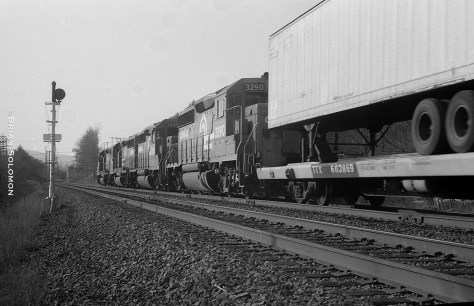
On this day nine years ago, I was traveling east from Chicago to Worcester, Massachusetts on Amtrak’s Lake Shore Limited (Train 48/448) and made these photos of the journey with my Lumix LX3 digital camera.
At the time I was working on a book about Chicago’s railroads with Mike Blaszak, Chris Guss and John Gruber.
CSX diesels at Collinwood shops, near Cleveland, Ohio. My friend Otto Vondrak waves at Rochester, New York.Amfleet II passenger car on Amtrak 448 near Post Road, NY.My seat on Amtrak 448 with my old Apple laptop. Self portrait with electronic flash having spent nearly 22 hours on the train.
On June 18, 2010, I was traveling with John Gruber on the way back to Madison, Wisconsin from Minneapolis, where John had collected Wallace Abbey’s photographs recently donated to the Center for Photography & Art.
John wanted to take a look at a surviving portion of the old Green Bay & Western at Hixton Wisconsin. And I made this evening view of grain elevators catching the glinting sun with my Lumix LX3.
Years earlier, John had made a project of photographing GB&W and its people. This was among the smaller railroads melded into Wisconsin Central in the 1990s.
On our last evening at Moosehead Lake, Kris and I made a strategic drive to Tarratine, Maine hoping to intercept Canadian Pacific’s westbound freight, #223, at the grade crossing with Route 6.
Within five minutes of our arrival, we could hear a whistle far to the east. Gradually the chug of General Electric diesels grew louder and more pronounced.
Kris set up her FujiFilm XT4, while I positioned my Nikon Z6 on my ancient Bogen tripod.
The moon was rising and the stars were glistening above. The time was approaching 11pm.
I made this sequence with the Z6 fitted with my 24-70mm zoom. The camera was set to ISO 400 and my exposures varied from 2.5 seconds to 30 seconds at f4.
After exposure, I made nominal adjustments to color and exposure in Adobe Lightroom.
Among the dozens of rolls of slides that I retrieved from storage at a friend’s house in Ireland was this one exposed of Irish Rail at Edgeworthstown, County Longford back on the 26th of March 2005.
On that day the down midday Connolly-Sligo passenger train terminated at Edgeworthstown and the passengers were transferred to a bus for the remainder of their journey west.
Locomotive 083 was hauling the train.
These were three of the photos I exposed on Fujichrome using a Contax G2 rangefinder.
A week ago Kris and I visited the crossing at Tarratine, west of Rockwood, Maine where we waited for the eastward Canadian Pacific freight number 132.
This remote crossing bisects the track in a sweeping curve in the forest. We waited here for quite some time. Finally, I heard the distant sound of laboring General Electric diesels. And then, finally, a distant whistle.
I set up with my Nikon Z6 fitted with a f2.8 70-200mm Z-series zoom. When the train came into view, I exposed a series of digital images and made a pair of color slides on Ektachrome.
The slides remain latent (unprocessed), but here are a few of my digital images.
Some my regular viewers on Tracking the Light have expressed interest in seeing more photos of the freight cars behind the locomotives. So I’ve included a few of those images too.
Later that night, Kris and I returned to this same crossing where we made a series of night photographs of the westward freight. Those will be featured in another posting.
Until Kris and I visited last week during our survey of Canadian Pacific’s Moosehead Sub, I had last made photos at Brownville Junction, Maine in 1997.
We arrived just in time to see a set of three nicely painted leased GATX Locomotive Group GP40s getting ready to depart the east end of the yard. These were operated by Irving Transportation’s NBM Railways, which runs the former Canadian Pacific east from Brownville Junction toward St. John, New Brunswick, Canada.
When I spotted these engines departing the yard, I acted quickly and pulled off to the side of the road, and framed up a view of the engines crossing a deck bridge.
Interestingly, it seems that GATX 3050 was originally Baltimore & Ohio GP40 3717. In 1984, on a visit to Brownville Junction with my late friend Robert A. Buck, we photographed a B&O GP40 in a consist on an eastward CP Rail freight at time the railroad had leased locomotives from Chessie System. Wouldn’t that be cool if this was the very same GP40! (I’ll need to find my photos from 1984 and check it out).
Canadian Pacific’s Moosehead Subdivision is arguably one of the most scenic railways lines in New England. But this lives up to inverse ratio of trains to scenery; more trains = less scenery; awesome scenery = fewer trains.
As discussed previously, on most days CP operates just one train east and one west, with only the eastbound passing in daylight.
In the long gaps between between trains, Kris and I found plenty of subjects to photograph, including the tracks winding through the trees, the scenery around the beautiful lake, and the wildlife.
Last week, after another wait in the rain near the East Outlet Bridge on Canadian Pacific’s Moosehead Sub, I decided to forego the bridge, and try a different location nearer to Greenville Junction, Maine. So, Kris and I drove toward Harford Point, where there is a nice sweeping curve east of a shallow rock cut.
We had inspected this spot last year, and had waited there about an hour for the eastward train before giving up. (That was in June 2021, and ultimately on that day we saw the train and photographed it further west).
On this year’s visit to Harford Point, the lighting was soft owing to cloudy conditions. Light rain had put a gloss all over the foliage and tracks.
While waiting, I had a brief chat with one of the locals near the grade crossing, who reassured me that we had not missed the train. And not long after we set up, we could here CP’s eastward 132 whistling for a crossing to the west.
As the freight came into view, I made this sequence using my Nikon Z6 with 70-200mm Z-series zoom lens. In post processng, I made some minor adjustments to contrast, shadow density, sky detail, color temperature and saturation.
Canadian Pacific freight 132 eastbound near Harford, Point, Maine on June 9, 2022.Canadian Pacific freight 132 eastbound near Harford, Point, Maine on June 9, 2022.Canadian Pacific freight 132 eastbound near Harford, Point, Maine on June 9, 2022.Canadian Pacific freight 132 eastbound near Harford, Point, Maine on June 9, 2022.Canadian Pacific freight 132 eastbound near Harford, Point, Maine on June 9, 2022.
Tracking the Light Explores Photography Every Day!
The former Canadian Pacific Railway station building at Greenville Junction, Maine is a distinctive wooden structure dating to 1889. A local preservation group has embarked on a mission to preserve and restore the structure.
Since Kris and I visited Greenville Junction a year ago (June 2021), considerable work has been done to the station and it looks much improved!
During Conway Scenic Railroad’s special Railfan Photographer’s Mountaineer, I traveled on the head end to help position the train, while making photos for the company archive.
While the train was discharging passengers at the site of the Mount Willard section house near Crawford Notch, NH, I was across the ravine to the east, set up to photograph the special crossing the famous Willey Brook Bridge (also known as the Willey Brook Trestle).
I made several dozen photos over the course of several minutes, trying to make the most of this photo opportunity. Below is a selection of similar compositions. Why so many? It is impossible to know exactly how a photo may be considered for publication in the future and I’ve learned from experience that it helps to position the subject in a variety of ways within the frame of the viewfinder.
On Wednesday (June 7, 2022), I walked from our lake-side cabin at Moosehead, Maine to Canadian Pacific’s East Outlet Bridge with the hope of catching the eastward 132 freight.
Not long after I arrived, the skies opened to a light drizzle. Gradually drizzle turned to a steady rain. The rain stirred up Maine’s famous mosquitoes. So after more than an hour of waiting under a tree, I was beginning to question my intentions. Yet having stood out in the elements, I decided to wait a while longer.
Finally, off to the west, I heard a distant train whistle! Hooray, it had to be CP’s 132! (Normally the railroad only operates one train east and one west every 24 hours.)
After another seven minutes, the sky brightened and a headlight came into view. By the time the train reached the East Outlet Bridge at Moosehead, the sun was out and shining brightly!
My perseverance was rewarded! Walking back to the cabin, I claimed this effort as a success.
In the woods of Maine, along the river that flows south from the Rockwood Dam at the West Outlet of Moosehead Lake is the site of a remote railway junction where the old Maine Central line to Kineo Dock crossed beneath Canadian Pacific’s Moosehead Subdivision.
Tracking the Light reader Wayne Duffett recommended that I inspect and photograph this virtually unvisited railroad confluence. Maine Central’s line has been abandoned for decades and now serves as a well maintained gravel road.
So feeling a little adventurous, the other morning Kris and I made the pilgrimage to see the unusual and rarely photographed bridges at the old Somerset Junction.
All photos exposed using my Nikon Z6 with 24-70mm lens.
Looking north on the gravel road that was once Maine Central’s line to Kineo Docks.Looking north on the gravel road that was once Maine Central’s line to Kineo Docks. Somerset Junction looking west
Five years ago, on June 7, 2017, I was traveling with my long-time friend and photographer Paul Goewey. We were photographing Vermont Rail System’s Green Mountain Railroad freight 264, and caught this train passing the former Rutland Railroad passenger station at Chester, Vermont.
In the 1970s and early 1980s, I recall watching Steamtown run around their excursion train at this location, although I don’t think I made any photos at that time.
On this day, I was working with my FujiFilm XT1 digital camera, which allows me to simultaneously save a photo file as both a JPG and as a camera RAW (RAF). At the time of exposure, I profiled the JPG in-camera using Fuji’s built in Velvia color slide film profile setting. . While in post processing, I custom profiled the RAF image by making minor adjustments to contrast, color temperture and saturation using Adobe Lightroom, and then created a JPG for internet presentation.
Below, I offer both the in-camera JPG with Velvia color and my own adjusted file. Both images were created digitally. I did not crop the image area or make changes to sharpness.
Fuji in-camera digital file save as JPG using Fuji’s Velvia slide film color profile.RAF file adjusted in Adobe Lightroom and converted to a scaled JPG for internet presentation.
East of the station and yard at Palmer, Massachusetts, Conrail’s former Boston & Albany passed the abutments of the Southern New England—a pre-World War I railroad scheme aimed at connecting Palmer with Providence.
Bob Buck referred to this location (milepost 81.81/81.82) as Electric Light Hill. It was near a electric substation, and not far from where the old interurban electric line crossed the Quaboag River.
I made these photos on a Spring 1982 evening. Conrail freights had backed up at the block signals, likely because the Central Vermont was occupying the Palmer diamond to the west..
While I recall relatively little about the events, I do remember the excitement of seeing a second headlight to the east after the first westbound had passed me.
I made these photos with my Leica 3A on black & white film, probably Kodak Tri-X, which I would have processed in Kodak Microdol-X. In those days, I had a tendency to over process the film which made for some pretty dense highlights and relatively grainy photos.
Looking west at milepost 81.81; notice the old abutments built to carry the Southern New England.A second westbound freight was right on the heals of the first.
the other night at Lockes Mills, Maine, a roar of EMDs and the blinding light from the headlights announced the passage of St. Lawrence & Atlantic’s 393-the westward road freight from Lewiston Junction.
I had my Lumix LX7 firmly mounted on a Bogen tripod.
The camera was set at ISO 200, the lens was wide open at f1.7, and I manually set the exposure for 15 seconds to allow the train to blur through the scene as it crossed the causeway over Round Pond.
For presentation here, I made some nominal adjustments to the camera RAW file using Abobe Lightroom. I lowered the highlights, raised the shadows, and softened the contrast to make for a more pleasing photograph.
Our recent ride on the Berkshire Scenic included several stops and photo run-by. On the return run from North Adams, we paused at the South View Cemetery. I opted for a position well away from the line in order to make pan-photos.
For these images, I set the camera lens to f22 to allow for use of a comparatively slow shutter speed (1/30 second at ISO 200). Then as the train passed, I used my body to pan with the train to keep my desired point of focus in constant movement with train. The slower shutter speed lets the background blur while camera motion keeps the train sharp.
Perhaps the most important thing about executing a successful pan is to release the shutter while continuing to move with the train.
Sunday, May 22, 2022, Conway Scenic Railroad operated its Railfan Photographer’s Mountaineer over Crawford Notch, NH.
This was the first time recently restored Boston & Maine F7A 4268 made a trip over the Mountain Division for Conway Scenic Railroad, and the first time that Conway Scenic had the two B&M F7As working in multiple with former Maine Central GP7 573.
All three were painted in the classic EMD-designed maroon & gold scheme.
It is rare that Conway Scenic operates three diesels in multiple.
The weather cooperated nicely.
I helped organize the photo stops and run-bys and traveled on the head-end in both directions.
Conway Scenic advertises boarding times rather than departure times. This train boarded at 9am, and departed 2 minutes ahead of schedule. We performed 8 special photo stops in addition to the normal run around at Crawford Station. The train arrived back at North Conway almost an hour ahead of its target. In other words, it was an extremely successful trip.
I made more than 400 digital images and haven’t had time to look at most of them. Last night, the day had caught up with me before I could go through my images. Today Conway Scenic has another special trip.
More Boston & Maine F7A photos to come in later posts!
Last month I was invited on an official tour of Irish Rail’s Inchicore Works. I joined a small group of journalists preparing a feature on the upcoming 175th Anniversary open house that occured about 10 days later (after I returned to the USA).
On my casual walk-around I had the opportunity to chat with a variety of Irish Rail employees and retirees.
In addition to some photos of locomotives and railcars, I made numerous vignettes of the shops and the details thereof using my Lumix LX7.
In a future post, I’ll include some more of the locomotive photos.
In my years visiting Dublin, I often noted changes to the character of the city between my visits.
On my April 2022 visit was the first in two an one half years, largely owing to travel complications imposed by Covid-19 and the demands of my full-time job at Conway Scenic Railroad.
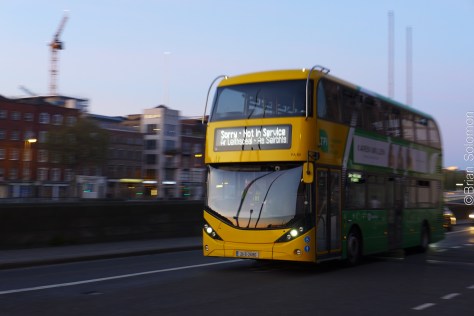
Among the changes to Dublin during my extended abscence was an upgrade to the city bus fleet and changes to many of the bus routes. Notably, Dublin Bus now operates a fleet of distinctive looking modern Hybrid buses.
Having traveled on Dublin bus for nearly 23 years, I found this change worthy of a few photos. Especially while the buses were still new and clean, and operating on a mix of new and old routes.
Photos exposed with my Lumix LX7.
Tracking the Light normally covers rail, but occasionally looks at other transport!
Fair weather clouds pose a challenge for railroad photographers. When on a sunny day, if a small puffy cloud covers the sun at the moment a train approaches it creates a difficult situation.
The cloud darkens the scene, changes color temperature, diffuses the light on the ground, and increases the difference in exposure between the sky and subjects on the ground.
Back in my Kodachrome days, having a small puffy cloud obscure the sun bascially ruined the photograph.
The other day at Bernardston, Massachusetts, I was in place to photograph the southward Vermonter cross a 19thcentury multiple stone arch bridge.
I could hear the horn blowing. The sun was bright . . . And then, as the train came into view, a small puffy cloud momentarily covered the sun.
I exposed a sequence of digital photos as the train rolled over the bridge. Later, working with Adobe Lightroom, I made a number of changes and adjustments to my files to present several alternatives to compensate for the effects of the clouded exposure.
Image 1:
Unaltered JPG converted directly from the Camera NEF RAW file.Corrected NEF RAW file with color temperature warmed, contrast and exposure adjusted, and highlight and shadow detail balanced.
Image 2
Unaltered JPG converted directly from the Camera NEF RAW file.Corrected NEF RAW file with color temperature warmed, contrast and exposure adjusted, and highlight and shadow detail balanced.Screen shot of the Lightroom control panel to show basic adjustments. In addition to the slider controls for the overall images, the bridge was digitally masked to lighten shadows and increase contrast.This is a monochrome version of the above image with many of the same contrast and exposure changes. Using the ‘Saturation’ slider, I removed all of the color.A warmed and saturated version of the same NEF RAW image.This is warmed, lightened and super saturated version of the same NEF RAW image.
Yesterday, May 11, 2022, it was bright sunny and warm in Conway, New Hampshire. The only train on the move was Conway Scenic’s ballast extra. So I conferred with the ballast train crew before they departed the yard (with engine 252 and a rider coach—for use as a shoving platform and to carry the crew between work sites), and then intercepted the train at Conway as they were putting the consist together.
In the afternoon, I tracked down the train again to make the most of the bright day.
Approaching Echo Acres.
All of these images were exposed using my Nikon Z6 mirrorless camera with 24-70 Z-series zoom.
On May 11, 2012, I made this digital photo with my Lumix LX3 of a LUAS Tram (dressed in Emirates advertising) passing Arnotts department store on Abbey Street in Dublin.
Less than two weeks ago we visited Arnotts on a shopping trip.
Now back in New Hampshire Arnotts just seems like a dream.
On May 10, 2007, I organized 37 photographers across North America to document railroading over the course of one 27- hour span.
I chose May 10th for several reasons: It was the anniversary of the Golden Spike at Promontory, Utah, which marked completion of the first Transcontinental Railroad; It was also the anniversary of New York Central’s 999 on its world famous speed run, and it was my friend, Eamon Jones’s birthday. (Eamon spent his working career running engines for Irish Rail).
I, along with all the other photographers, spent the day photographing railroad operations. Early in the day, I captured Genesee Valley Transportation’s Matt Wronski removing a blue flag from the Falls Road Railroad shop at Lockport, New York. This image was exposed on Fujichrome.
I was one of only a few photographers that exposed film on this day. Among the other film photographers were my father Richard Jay Solomon—who made photos around Palmer, Massachusetts, and Hal Reiser—who spent the morning with me on the Falls Road Railroad.
The Railroad Never Sleeps was published by Quarto Press and was sold in book stores around the continent.
Among the objectives of my recent trip to Dublin was to retrieve some of my old Nikkor lenses that I’d kept there over the last 18 years.
I’d left these lenses there back in 2019 expecting to return in a few months, only to have the world change in my absence.
In the meantime, I’d bought a new Nikon Z6 mirrorless camera system with an adapter to attach classic Nikkor lenses and I’ve been waiting for the day to play with some of the classic glass stored in Dublin.
Previously on Tracking the Light, I’ve shown examples of my Nikkor f2.5 105mm telephoto attached to the Z6.
The photos exposed here were made with an Nikkor AF-DC f2.0 135mm telephoto lens. All were exposed at the widest aperture (f2.0) to allow for very shallow depth of field (narrow range of focus). This is an imaging technique often employed in portraiture but rarely in railroad photography.
Controlling focus is a powerful photographic tool because it helps direct the viewers eye. Often modern digital imaging systems facilitate great depth of field but make it difficult if not impossible to make use of shallow focus.
Although not used in these photos, the AF-DC f2.0 135mm lens has an additional control ring to adjust the lens elements to offer a soft edge specifically for portraits. I will explore that feature of the lens at a later date.
The subject of these images is 470 Club’s recently restored Boston & Maine F7A 4268 that sits on the plow track at the North Conway.
Toward the end of April, for the second morning in a row, I was in position at ‘the box’ on St Johns Road in Dublin to witness the passing of Irish Rail’s down IWT liner.
It was a cosmic alignment. The sun came out just as three trains converged upon Islandbridge Junction. The first was an ICR that emerged from the Phoenix Park Tunnel and stopped across from Platform 10. The second was an ICR heading toward the tunnel.
Then the down IWT liner emerged from the tunnel weaved around both ICRs on its way through the junction.
Sometimes, it helps to be in place at the best spot and just wait out the action.
Exposed in April 2022 using a Lumix LX7 digital camera.
Yesterday, Thursday May 5, 2022 was a beautiful bright day in Conway, New Hampshire.
I traveled with the ballast train, which was the only train moving over the Conway Scenic Railroad.
Since the train made a number of stops to drop stone, I had ample opportunity to make photographs.
I exposed these views with my Lumix LX7, but also made a few photos of the lads working the train using my Nikon Z6 mirrorless digital camera. I’m saving the Z6 photos for a later post.
It was like old times again! Last week, Irish Rail’s General Motors diesel 073 in retro paint was working the down IWT Liner (Dublin North Wall to Ballina, County Mayo).
I’d met fellow photographer Jay Monaghan along Dublin’s St Johns Road. The sun had cleared away the clouds, and while I went to the famous ‘Box’ that overlooked the wall, Jay took a position closer to track level.
In my Nikon F3, I had a fresh roll of Kodak Ektachrome 100. I fitted the camera with a telephoto lens to make a classic photo, portrait format to feature the Wellington Testimonial. As the liner came around the corner at Islandbridge Junction, I exposed a couple of color slides, and then popped off a sequence of digital photos with my Lumix LX7.
After long last, I was photographing a freight from my old spot.
These digital photos were made in April 2022, but they reminded me of my efforts from years gone by! (I sent the slides in for processing on Monday and hope to get them back next week).
In March Kris & I arrived at Jim Thorpe, PA in time to travel on the midday Lehigh Gorge Scenic train. We were please to find Reading & Northern’s recently acquired former Norfolk Southern F-units on display near the old CNJ passenger station.
Exposed using my Nikon Z6 with 24-70mm Z-series zoom.
Yesterday, I returned to my old location at Islandbridge Junction in Dublin for the first time since November 2019.
Although I’d made countless photos here over the years, it was nice to be back at this once familiar place again.
The procession of passenger trains was certainly down from pre-Covid times, but in the course of about half an hour I photographed five trains passing through the junction.
I made these views using my Lumix LX7 and processed the Lumix RAW files using Adobe Lightroom.
Today (Sunday April 24, 2022), the 470 Club had arranged for a special surprise consist to work Conway Scenic Railroad’s Valley trains.
I helped organize the details of the trip and last Friday morning (April 22), I made photos of the Club’s popular F7A diesels positioned on the Plow Track at North Conway, New Hampshire.
I produced this Tracking the Light post in advance, as I’m now in Dublin many miles from New Hampshire.
The bottom line is that I won’t be around see the special suprise consist on Conway Scenic this morning but I was glad to catch these F7s back to back the other day.
Photos exposed using my Lumix LX7.
Tracking the Light aims to post every day, even when Brian Solomon is on the road.
Yesterday, April 22, 2022, Conway Scenic Railroad operated a Work Extra on the Redstone Line to Pudding Pond to dump ballast.
I traveled with the train and used my Panasonice Lumix LX7 to document the work.
This was the first time since the railroad acquired former Maine Central GP38 255 that it worked out the Redstone Branch as far east as Pudding Pond.
The significance of this foray east was that old 255 would have routinely worked Maine Central freights on this same section of track between the late 1960s and the early 1980s.
Among the qualities of my FujiFilm XT1 was that the camera’s built in JPG preset color profiles are tailored to emulate traditional Fujifilms.
My two favorites were ‘Provia’ and ‘Velvia’.
I was using the latter color profile in this April 20, 2016 view of a tram on the outskirts of Frieburg, Germany.
Exposed with a Fujinon 18-135mm zoom at its widest focal length, camera set at ISO 200, f7.1 at 1/500th of a second. Photo scaled for internet without changes to exposure, contrast, color or sharpness.
Add this to the list of, ‘You just couldn’t make this stuff up’:
Yesterday, on my drive to work in rural New Hampshire, a radio broadcast reminded of a blistering hot day in July 2007 when photographer Denis McCabe and I explored L’viv making photos of trains. This broadcast described a garage reportedly destroyed by a Russian missile-strike in L’viv earlier in the morning.
Yesterday afternoon, Denis pinpointed for me the location of the bombed garage as a building that he and I would have walked by not long after I’d exposed this July 2007 photograph of a UZ 2M62 diesel. (The building stood about about 700 feet behind me in this photo.)
This isn’t the sort of story I’d ever imagine featuring on Tracking the Light.
Exposed on Fujichrome in July 2007 using a Nikon F3 with 24mm Nikon lens.
Tracking the Light is a daily blog on railway imaging.