Earlier in the month I’ve highlighted various photographic adventures with New England Central 608 (freight that works from Willimantic, Connecticut to Palmer and back). Today’s post focuses on the southward journey.
Over the years, I’ve photographed many trains climbing the former Central Vermont Railway grade over State Line Hill, and beyond into Connecticut, so this chase is old hat for me.
Yet, I’m always looking for a new angle, or to place today’s train in a classic setting that I may have captured years ago.
These views are all from the morning of May 17, 2017 and exposed with my FujiFilm X-T1 digital camera.
Do you have any favorites?
New England Central 608 at Bunyan Road in Monson, Massachusetts.New England Central 608 from Academy Hill/Main Street Monson, Massachusetts.New England Central 608 at Stateline looking toward Monson, Massachusetts.New England Central tracks at Stafford Springs, Connecticut.Tight telephoto view of NECR 608 at Stafford Springs, Connecticut.South of Stafford Springs, Connecticut.New England Central 608 viewed from the Track 9 Diner in Willington, Connecticut.
Yesterday’s post featured contemporary views of MBTA’s Park Street Station in Boston. See: http://wp.me/p2BVuC-4Pk
Today’s post goes back in time.
I made this view of an Arborway-bound PCC car about 1980. I’d exposed the photo using my old Leica 3A with 50mm Summitar, probably on Tri-X processed in Microdol-X.
I scanned this from a print I made back in the day. During that period (1978-1982) I often traveled with my father to Boston and I made a lot of photos of MBTA transit operations. Unfortunately, I didn’t keep precise notes on this print.
Here’s one of the photos displayed yesterday for comparison.
Green Line streetcars use the upper level at Park Street.
So, if I called this Stafford Springs, Connecticut Part 3, would you be interested.
In truth, this is less about Stafford and its morning freight train and more about lighting and technique.
In two previous posts [see: New England Central at Stafford Springs, Connecticut—Again, and Going Against the Grain I’ve detailed my efforts at photographing New England Central 608 working through Stafford Springs in harsh morning sunlight. This post depicts the same train on a dull morning, but also in black & white (Sorry Dave Clinton, but it has to be done).
I’m using the same camera-lens combination; a Leica IIIa with a screw-mount f3.5 Nikkor 35mm lens. This time loaded with Ilford HP5. My process is about the same as in my earlier post New England Central at Stafford Springs, Connecticut—Again.
This time, I processed it using Ilford Perceptol developer diluted 1:1 with water; after fixing and rinsing, negatives were toned in a 1:9 selenium solution for eight minutes, rewashed and scanned.
One small change; in this instance, I gave the film a little more toning than previously, which should make for slightly more silvery highlights. This is a subtle change, and probably barely perceptible on internet presentation.
New England Central 608 at Stafford Springs at 7:20am on May 10, 2017 ; exposed using a Leica IIIa with f3.5 Nikkor 35mm lens at f4.5/f5.6 1/200th second on HP5.A slightly closer view of New England Central 608 at Stafford Springs. I’ve made this on at a slightly lower angle.
Compositionally, I’ve made an effort to include the village and not just focus on the locomotives.
I’m by no means done with this project, and I’ll continue to post with more photos and insights over the coming weeks. (Including some color views to please Dave and others morally opposed to black & white).
A few days ago, I displayed black & white photos I made at Stafford Springs, Connecticut in hard morning sunlight. See: Going Against the Grain.
Where the earlier images used an unusual film type (Foma Retropan), today’s image was made on Ilford HP-5, but with some special processing.
On May 9, 2017, New England Central freight 608 works timetable northward through Stafford Springs, Connecticut. Exposed on Ilford HP-5 using a Leica IIIa fitted with a Nikkor f3.5 35mm lens. Film was processed in Ilford Perceptol developer diluted 1:1 with water; after fixing and rinsing, negatives were toned in a 1:9 selenium solution for six minutes, then rewashed and scanned. The sky area received some localized exposure adjustment in post-processing, while there was some overall contrast adjustment to improve the appearance of the image.
In both posts, black & white photos feature New England Central 608 (a freight that runs between Willimantic, Connecticut and Palmer, Massachusetts) passing downtown Stafford Springs shortly after sunrise.
Today’s image was exposed from Main Street in Stafford on the opposite side of the tracks from the earlier photos, which provides a different perspective on the train and village.
Part of this exercise is aimed at demonstrating black & white photographic technique, however I’m also hoping to show how different angles at the same location can result in significantly different photos.
Also, that it’s possible to make interesting photos in difficult lighting situations, if you apply a creative approach to your photography.
I’m done here yet! To be continued on another day.
The other morning in Stafford Springs, Connecticut, I exposed this view of New England Central’s northward freight that runs daily from Willimantic, Ct., to Palmer, Massachusetts.
The train was coming hard out of a clear morning sun. Using a Leica IIIA fitted with a Nikkor 35mm screw-mount lens, I exposed this view on Foma Retropan 320.
Retropan is a comparatively coarse grain emulsion that offers a distinctly different range of tones than expected with Ilford HP5, Kodak Tri-X, or other black & white films in the same sensitivity range.
It also produces a characteristic halo-effect in bright highlight areas.
I processed the film more or less as recommended using Foma’s specially formulated Retro Special Developer, and then scanned it with an Epson V750 Pro flatbed scanner. I made minor adjustments to contrast in Lightroom.
As I anticipated, my results from this experiment are more pictorial than literal.
A photo of the setting at Stafford Springs, Connecticut.New England Central’s freight with EMD diesels working long-hood first at Stafford Springs, Connecticut. Retropan’s halo effect combined with the large amounts of flare from the sun hitting the front element of the lens contributes to this interpretive image.
Tracking the Light posts something different every day.
Sometimes the railway photo isn’t about the train.
I made this pair of photos at Bray Head, County Wicklow, Ireland on Easter Monday 2017.
Railway Preservation Society engine No 4 was working trips from Dublin to Graystones, so I made the trek out along the head to capture these timeless views.
Although I made a few digital images, I prefer these black & white photos.
These were exposed on Ilford HP5 using a Leica IIIA and processed in Perceptol (1:1 for 14 minutes at 69 degrees F). No toning. Although, I think a dip in selenium would improve the contrast a bit.
Boston & Albany freight house at Palmer, Massachusetts, photographed using a Rolleiflex Model T on Verichrome Pan black & white film in October 1985. Copyright Brian Solomon.
This Saturday, May 6, 2017, I will present a variation of my Boston & Albany program to the New York Central System Historical Society convention, to be held at the Best Western Royal Plaza Hotel, in Marlborough, Massachusetts.
I am listed as the guest speaker and my illustrated talk will begin at about 7pm. This will feature material from the Robert A. Buck collection, and images from the lens of William Bullard (early 20th century photographer), as well as a selection of my own work on the B&A, which spans more than 40 years.
For information on the convention and registration forms see the New York Central System HS website: www.NYCSHS.org
A couple of weeks ago, I found good deal on-line for a 1st Class SNCF ticket from Brussels Midi to Milan via Paris.
It was an early start from Brussels. I enjoyed some fast running, a quick change at Lille Europe, and an hour and half to navigate my way across Paris.
I made these photos of the train journey with my Lumix LX7.
Brussels Midi just before sunrise.Gliding along at speed near the Belgian-French frontier.Lille Europe high-speed station.I traveled on this TGV Duplex between Lille and Paris Gare du Nord.Upstairs on the TGV Duplex.Paris Gare du Nord.The longest and final leg of my TGV journey was between Gare de Lyon and Milan on this multi voltage TGV set.
Here’s a few more views exposed on Rollei 35mm Infrared film. These portray Irish Rail’s Loop Line Bridge over the River Liffey in Dublin.
Exposed on Rollei Infrared B&W film using Nikon F3T with 24mm Nikkor lens and 25A filter.Exposed on Rollei Infrared B&W film using Nikon F3T with 24mm Nikkor lens and 25A filter.Exposed on Rollei Infrared B&W film using Nikon F3T with 24mm Nikkor lens and 25A filter.
Tracking the Light is on Auto Pilot while Brian is traveling.
Five alternative views of Ireland’s Bord na Mona railway.
Here I’m trying something different: Working with an old Leica IIIa fitted with an ancient screw-mount Nikkor 35mm lens, I exposed some Fomapan 100 black & white film.
Instead of my normal process, I opted to soup the film in Ilford Perceptol. I mixed the stock solution from powder. Recommended development time was 8 minutes, but I cut this to 6 minutes, then after complete processing (stop, fix, hypo-clear and wash) I toned the negatives with a 1-9 Selenium solution to boost highlights (and then rewashed).
It was my first time working with Perceptol; overall I was pleased with the results, which yielded fine grain, broad tonality and a somewhat softer over-all image than what I’d been getting using ID-11.
This camera-lens-film-developer combination seems to have worked well with the rustic Bord na Mona narrow gauge industrial railway. I’ve opted to display a handful of the dozen or so monochrome images I exposed that day.
Tracking the Light takes a different approach today.
Bord na Mona (Irish peat board) operates an extensive network of narrow gauge industrial railways in the Irish midlands.
It has been nearly two years since I last explored this fascinating diminutive railway in action.
It helps to have the sun to photograph Bord na Mona, as the bog can be outright dreary on a dull wet day.
The sun seemed to have emerged from the lingering blanket of dampness that lately has prevailed across Ireland, so Denis McCabe and I made a foray to Shannonbridge, County Offaly location of the busiest Bord na Mona railway operation.
A laden Bord na Mona train clatters across the bog on the way to Shannonbridge, Co. Offaly. Exposed digitally using my FujiFilm X-T1.This side view offers an interesting perspective on the locomotive and laden peat wagons. Exposed digitally using my FujiFilm X-T1.
Bord na Mona trains come clattering along, often running in pairs or groups, but patience is often needed to find trains on the move.
Check out Tracking the Light’s archives for previous posts on the Bord na Mona.
Irish Rail’s section of three tracks running from Islandbridge Junction to Inchicore in Dublin runs upgrade through a cutting (parallel to Con Colbert Road) known colloquially as ‘The Gullet’.
On Friday, 10 March 2017, I exposed these photos over one half an hour.
My primary subject was Irish Rail’s elusive spoil train that was expected up-road. When this passed, I relocated.
Exposed with a FujiFilm X-T1 with f2.0 90mm prime lens.Exposed with a FujiFilm X-T1 with f2.0 90mm prime lens.Irish Rail GM diesel 072 leads the empty spoil train on 10 March, 2017. Exposed with a FujiFilm X-T1 with f2.0 90mm prime lens.
A classic Kodachrome color slide scanned then scaled for internet presentation.
It was a bright and clear Sunday morning in January 1988 when I exposed this Kodachrome 25 slide with my Leica M2 with 50mm Summicron at Rochester & Southern’s Brooks Avenue Yard near the Rochester Airport.
At dusk on the evening of March 2, 2017, I exposed this view of the River Liffey in Dublin.
An Irish Rail DART (Dublin Area Rapid Transit) electric train is crossing the Loop Line bridge on its way to Connolly Station.
Exposed using a Lumix LX7; f2.2 at 1/5th of a second, ISO 200. Camera mounted on a Gitzo mini tripod.
The most prominent elements of the image are the Custom House, an 18th century relic of the British Imperial presence in Ireland, and coloured lights reflecting in the Liffey. The railway takes a secondary role.
When the Loop Line bridge was built in the late 19th century, pundits moaned that it spoiled the view of the Custom House. Were they lazy or just being ironic?
On 14 May 2003, I exposed this trailing view of Irish Rail’s Sligo Liner rolling west along the old Royal Canal near Enfield, Co. Meath.
The liner was hauling kegs of beer, mostly Guinness. Long after it left my view, I could here the class 071 locomotive with its EMD 12-645 diesel roaring a way in the distance.
Exposed on Fujichrome using a Nikon F3 with 180mm Nikkor lens.
I intentionally included some foliage in this photograph. Not only do the leaves help block sun from causing flare by hitting the front element of my lens, but they add a sense of depth that would be lost without them.
Maybe this is why that at an early age some of us were so impressed by trains to begin with?
I made this view at East Troy, Wisconsin on September 3, 1994 using my Nikon F3T with an AF f2.8 28mm Nikkor lens. Kodachrome 25 was my preferred emulsion at that time.
This view is full-fram and un-cropped. I made a few color correction and contrast adjustments in Lightroom to improve presentation here.
My photographic exhibition at Valley Photo Center in Springfield, Massachusetts is on-going through January 28th. The gallery is in the Tower Square mall at 1500 Main St. in Springfield.
This Friday (January 27, 2017) I’ll be at the gallery for a reception between 5:30 and 8:00pm. I plan to present a live slide show (with real 35mm color slides!). This event is scheduled to coincide with the Railroad Hobby Show in West Springfield (just across the Connecticut River).
My exhibit features photographs spanning two decades from the late 1980s to 2008, and depicts trains in a variety of settings including the American West, Pennsylvania, New England and Europe.
In addition to large framed prints and canvas renditions, I also have a selection silver gelatin black and white prints, as well as giclee prints available for purchase. In addition, I plan to have examples of my books for sale.
I exposed this view of a westward Conrail double stack train crossing the former Erie Railroad Starrucca Viaduct in May 1989 using a Leica M2 with 35mm Sumicron lens. This is one of several dozen images on display at the Valley Photo Center in Springfield.Autumnal image at East Deerfield, Massachusetts. This is one of several dozen images on display at the Valley Photo Center in Springfield.Not all photographs are made on bright sunny days. I exposed this view in Scranton, Pennsylvania on a wet October evening in 2005. I was working with the Delaware Lackawanna Railroad on my ‘Working on the Railroad’ book—published by MBI/Voyageur Press. This is one of several dozen images on display at the Valley Photo Center in Springfield.
It was a misty January day. I thought, what better time to expose another roll of Foma Retropan 320 black & white film!
I was working with four cameras that day, so these images were just a small portion of my day’s results, but for me by far the most interesting. I was feeling nostalgic and the atmosphere of the moment seemed to lend itself to classic black & white.
The day after I exposed my film, I processed it. Where previously, I’d hand processed Retropan in Paterson tanks, for this roll I used the Jobo (a semi-automatic processing machine).
The Jobo eases processing by keeping all chemistry at a consistent temperature, taking care of agitation by continuously rotating the processing-drum, while simplifying pouring the chemicals in and out of the drum. Also, it makes more efficient use of the chemistry.
With the hand-processed rolls, I had used Retro Special Developer straight (undiluted stock solution) with a 3 minutes 30 second development time. Prior to introducing the primary developer, I pre-soaked in a water bath with a drop of HC110.
For the Jobo-processed roll, I diluted Retro Special Developer 1:1 with water and increased the time to 4 minutes. I also had a pre-bath with a drop of HC110, but like the main developer, this was agitated continuously.
My results were not as I expected.
Misty tracks on the old Rutland near Arlington, Vermont. Exposed on Retropan 320 using a Nikon F3 with f1.8 105mm lens.
My earlier experiments with Retropan demonstrated a fine grain film with broad tonality. But this roll had much coarser grain, and yet even smoother tones. At first, I was shocked by the more intensive grain, but in retrospect I’ve decided it adds a quality to the photos that I may not have obtained through other media.
Exposed on Retropan 320 using a Nikon F3 with f1.4 50mm lens.Exposed on Retropan 320 using a Nikon F3 with f1.4 50mm lens.Exposed on Retropan 320 using a Nikon F3 with f1.4 50mm lens.Exposed on Retropan 320 using a Nikon F3 with f1.4 50mm lens.
For my next experiments, I’ll return to hand-processing and I may skip the presoak bath with HC110.
Sometimes I take a haphazard approach to photography; I explore and see what I find, then run with what is handed to me. This works well some of the time.
However, I often take a more calculated approach, paying careful advanced attention to weather, lighting and train schedules/operating patterns. Obviously, this works best on railways that make an effort to operate to the schedule.
Back in autumn 2006, fellow photographer David Hegarty and I made several focused trips to Co. Mayo to photograph the Westport Line and Ballina Branch.
On Friday’s the once per week Dublin Heuston to Ballina direct passenger train was scheduled to cross the evening Westport-Dublin daily passenger at Ballyhaunis (one station east of Claremorris.) This meant that the cabin had to be staffed to work signals, points, Electric Train Staff instruments, etc.
I think we made three Friday evening visits before getting it right.
Exposed on Fujichrome Velvia 100 using a Canon EOS 3 with 200mm lens. To minimize flare, I used my handheld notebook to shade the front element of the lens. If there was one practical lesson from this exercise, that’s it!
On September 15, 2006, I exposed this trailing glint view of the down Friday Ballina train with a class 071 diesel and Mark 2 carriages meeting a class 201 locomotive leading Mark 3s on the up train to Dublin.
Soon all was to change. The signals were replaced with mini-CTC, the Mark 2s were retired, soon followed by the Mark 3s, and as a result the 071s relegated to freight/per way work.
Yet at the time the most difficult part of this photograph was the lighting! Finding a clear afternoon in Mayo isn’t an easy task.
Special thanks to Noel Enright for arranging for the sun to come out at the right moment.
Profound words for a man who never gazed upon, let alone exposed a photograph.
Cape Breton & Central Nova Scotia locomotive 2032 Lord Byron leads freight 306 in July 1997. Exposed on Fujichrome using a Nikon N90S with 80-200mm Nikkor zoom lens.
New Years Eve 2016, I was traveling with Pat Yough. We got news of a GE-built ES44AC Ferromex locomotive leading Norfolk Southern 39G (Camden, NJ to Allentown, PA) and so we went to investigate.
I made these photographs at HATCH in Pennsauken, New Jersey using my FujiFilm X-T1.
Not only were we rewarded with a Mexican locomotive in the lead, but also a rare opportunity to catch a caboose on a road freight. Not bad for the last day of 2016!
For me New Years Eve has another Mexican connection; on this day in 1979 I flew from Mexico City to New York’s Kennedy Airport on an Eastern Airlines L1011.
Things were more relaxed in those days, and I was afforded a nice forward view for part of my journey.
Ferromex 4679 leads Norfolk Southern symbol freight 39G at ‘Hatch’ in Pennsauken, New Jersey. Those are the tracks for NJ Transit’s River Line light rail on the left. I adjusted the file in post processing to lower the contrast and improve the color.It’s relatively rare to find a Mexican locomotive leading in New Jersey. First time I saw something like this anyway. Exposed using my FujiFilm X-T1.Exposed using my FujiFilm X-T1 with 18-135mm zoom lens.The caboose was a nice touch. NS 39G took this only as far as Abrahms Yard (near Norristown, PA).Exposed using my FujiFilm X-T1.In NORAC rules a red-over-yellow aspect means Medium Approach Medium, I don’t have a rule book for NJ Transit’s Light Rail. Any clues?
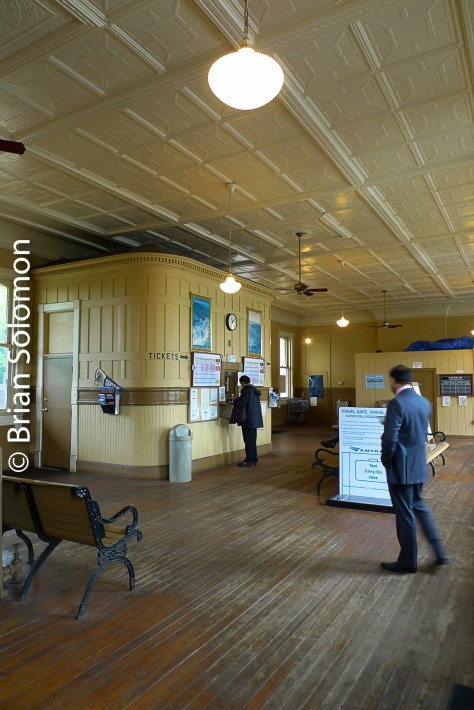
The old New Haven Railroad station at Berlin, Connecticut was a local favorite. Until recently, it was among the last small staffed Amtrak stations with an historic structure in southern New England.
My friend, and Tracking the Light reader, Bill Sample was a regular Amtrak Station Agent at Berlin. For me Berlin was like stepping back to that earlier era, when the small town station was the portal for travel. Bill would often help me plan trips and buy the most effective ticket for my travel plans.
The station itself was a gem. The interior retained characteristics of an early twentieth century station, complete with chalkboard arrival and departure information and rotating ceiling fan.
In recent months, the old Berlin station had been closed as part of double-tracking between Hartford and New Haven and related station renovations and construction of high-level platforms. The old building was to be integrated into a modern facility designed for more frequent service.
Wednesday (December 21, 2016), Otto Vondrak sent me the sad news that the old station had been gutted by fire. Media sources reported that the building was a ‘total loss.’
These Lumix LX3 digital photos show the building as I remember it in recent years.
Lumix LX3 photo.Lumix LX3 photo.Berlin was once an important junction with diamond crossings.
The photographic lesson is: never take anything for granted no matter how familiar it is. Someday it may be gone without warning.
This photo appeared in Pacific RailNews/RailNews not long after I exposed it on Kodachrome 25 in October 1996. [Click on Tracking the Light for the full vertical image.]
The Twin Ledges is a classic photo location a mile or so west of the old Boston & Albany Middlefield Station in the Berkshire Hills of western Massachusetts.
Conrail’s SD80MACs were an unusual modern locomotive because they were powered by a 20-cylinder variation of EMD’s 710 diesel, rated at 5,000 hp. They arrived only a few years before Conrail was bought and divided by CSX and Norfolk Southern.
Although their operation on the old B&A was short-lived, they were oft photographed (by me anyway).
Classic Kodachrome: a vertical telephoto view of Conrail SD80MACs leading symbol freight ML482 at the Twin Ledges in October 1996.
Beginning with the February 2017 issue (expected toward the end of December), I’ll be featured in a regular opinion column for Trains Magazine.
This is a new and exciting opportunity for me. With it I hope to explore a range of topics over the coming months
The idea for a regular Brian Solomon column came about as result of my conversations with Editor Jim Wrinn and Assistant Editor Brian Schmidt who were intrigued by my comparisons between European and North American railroading.
Unlike Tracking the Light, which is focused largely on photography, my Trains columns will be aimed at the railroad industry, its operations and practices.
I’ll be writing narratives that draw from my knowledge of history and technology. My hope to is to both entertain and inform, while also offering unusual perspectives on railroads.
I’ve been contributing to Trains Magazine since 1984. My first published photo in Trains had featured this Mass Bay RRE excursion (that had operated from Boston to Brattleboro, Vermont on February 25, 1984). The photo that appeared in the magazine was an angle of the Amtrak F40PHs on the south end of the train in the Brattleboro yard; by contrast these views were of the train shortly after it arrived at Brattleboro station. All were exposed using my old Leica 3A with 50mm Summitar.Although it was sunny at New London, by the time we’d reached Brattleboro it was raining very hard. I got soaked making my photographs. At the time I was senior at Monson Jr.-Sr High School, and David P. Morgan was still Trains Editor-in-Chief. Ironically, the original negative that was published in Trains, remains among my missing photographs. Hopefully it may resurface one of these days. This pair of images were from my ‘out-takes’, and I only recently rediscovered them.
Tracking the Light will continue to post everyday!
Yesterday evening I was visiting East Brookfield, Massachusetts.
As the sun neared the western horizon it illuminated some clouds from below, the effect that I call ‘drop under’.
It’s a stunning natural phenomena, but can be difficult to capture effectively because of the extreme contrast.
Armed with my Lumix LX7, I made my way to the overpass near the old station location, as per the suggestion of Dennis LeBeau— photographer, musician and long time East Brookfieldian.
As I made a series of exposures, I knew by observing the camera’s histogram that it would be necessary to work with the RAW files to produce the most effective interpretations of the scene.
Below are some examples for your inspection and consideration.
This is the unmodified file. The only change from camera RAW was a necessary scaling and conversion to JPG for internet presentation (the RAW is too large to upload). I made no changes to color saturation, contrast, or other elements of the image.This is my interpreted image from the above RAW. I’ve used a digitally applied graduated filter to better hold detail in the sky, while improving contrast and increasing saturation with a slight to warming of the color balance to enhance the effect of sunset. Without these changes, the scene would not look as it appeared to my eye at the time of exposure. Admittedly these alterations are mere subtle improvements and may not be evident on some electronic devices.This is a horizontal view similar to the above images. Using the ‘cut and paste’ feature in Lightroom, I’ve applied the same alterations to this RAW file as described in the image above. This feature not only saves time when adjusting images, but ensures an element of consistency between images made in similar lighting conditions. I use it regularly.A telephoto view made at the same location, but with slight adjustments to contrast controls to accentuate the clouds and rails. Note the wire crossing the line. I could have taken that out and you’d never have known better, but normally I avoid invasive alterations that physically change the scene.
Soo Line on Tax Day! A Soo Line SD40-2 leads an eastward CP Rail freight near Dalton, New York on 15 April 2004. Exposed on Fujichrome using a Contax G2 with 45mm Zeiss lens.
The old Erie Railroad is one of my favorite lines.
Mike Gardner and I got a very early start on 15 April 2004. We worked our way west to the Portage Bridge at the Letchworth Gorge in western New York State in time to intercept an eastward CP Rail freight.
We chased this capturing it in multiple locations along the old Erie line to Hornell. At this time Norfolk Southern was the owner operator, while CP Rail operated via Delaware & Hudson trackage rights.
Clear blue dome; bright red EMDs, and great scenery with a good quality chase road made the morning extra productive.
Among the European diesels with the most distinctive styling are the Czech class 750 (and related classes 753/754/755).
These are colloquially known as ‘Goggles’ because of their extended cab profile.
Last month (October 2016), I was pleased to find a variety of Goggles working freight and passenger services, many of them in fresh paint.
CD Cargo ‘Goggles’ at Kralupy nad Vitavou. FujiFilm XT1 digital photograph.CD Cargo ‘Goggles’ at Kralupy nad Vitavou. FujiFilm XT1 digital photograph.CD class 750 at Zebreh, Czech Republic.CD class 750 at Zebreh, Czech Republic.CD class 750 at Zebreh, Czech Republic.Pushing an empty passenger train in Prague. FujiFilm XT1 digital photo.
On July 19, 1992, Southern Pacific’s SNTA-C descends the west slope of Donner Pass near Midas, California.
I exposed this trailing view of Southern Pacific’s SNTA-C (Skyline Mine, Utah to Trona, California—coal) on its descent of Donner Pass using my Nikon F3T with a Nikkor 200mm lens.
Kodachrome 25 was my film of choice. It performed very well under bright California skies.
Tracking the Light is on Autopilot while Brian is traveling.
Note to Tracking the Light readers: The most effective way to receive Tracking the Light daily is to Subscribe!
PKP Ty45 works tender first at Stefanowo, Poland on 25 April 2002. Exposed on Fujichrome using a Nikon N90S.
Look back 14 years to a visit to Poland:
Iridescent grass, steam and semaphores, how can you go wrong?
I realize that someone might complain that the engine is working tender first. If so, they can complaint to PKP for their lack of turntables: Keep in mind this is a real revenue freight using an engine based at the roundhouse at Wolsztyn, Poland.
Tracking the Light posts daily with feeds to Facebook, Twitter, Google Plus, Tumblr and other social media.
Guitarist Jimmy Page, best known for his work with Led Zeppelin and the Yard Birds, produces a daily web page (http://www.jimmypage.com) that chronicles his work over more than five decades.
On This Day picks an event (or two) and gives Jimmy’s viewers a bit of background, often describing the roles of his fellow musicians. On occasion he drops in a railway photo or a clip from an old movie. Jimmy often carried a Nikon SLR on his tours.
Today, I’ll borrow Jimmy’s format: on this day 22 years ago (23 September 1994) I was traveling with Tom and Mike Danneman in the Minnesota Iron Range.
At the time I was working with Tom at Pentrex Publishing in Waukesha, Wisconsin where we produced Pacific RailNews and Passenger Train Journal. Mike worked across town at Kalmbach’s Trains Magazine.
I learned a lot from our Midwestern excursions in the mid-1990s. Both of these brothers remain among the most talented railway photographers and artists in North America. Tom now works at Kalmbach, while Mike is a freelance artist based in Colorado.
Among our destinations on 23 September 1994 was Duluth, Missabe & Iron Range’s Fairlane facility, where in a thick fog we photographed this pair of SDM diesels with an iron ore train.
I exposed this classic Kodachrome 25 view at Fairlane, Minnesota using a Nikon F3T with an f1.8 105mm lens. My aperture was nearly wide open and as a result the headlights burned out a bit. I’ve always liked the way the loading equipment looms ominously in the fog. The leaning signal is a bit of distraction though.
Later in the day we visited Hibbing, Minnesota, which is probably best known as the boyhood home of Robert Zimmerman (aka Bob Dylan).
My visits to California’s Tehachapis in July and August (2016) made me curious to dig deep into my archives and revisit the photographs I made there in the early 1990s.
I traveled with J. D. Schmid on my first visits to Southern Pacific’s Tehachapi crossing. (Then Santa Fe operated in the Tehachapis via trackage rights on SP, as does BNSF on Union Pacific today).
I made this Santa Fe FP45 photo on a rainy morning February 1991. We were on our way back from a detailed study of the SP’s Beaumont Hill and environs.
Exposed on Kodachrome 25 using a Nikon F3T with 35mm PC lens. Santa Fe FP45 91 is the lead.
While hard to beat the great sound of EMD 20 cylinder diesels working the Tehachapi grades, it was difficult working with Kodachrome 25 to capture the experience. The film was slow and its spectral response didn’t favor dull days.
Certainly the weather was better on my more recent visits. I traveled with David Hegarty, and we had ample opportunity to make photographs in the bright California sun.
A southward BNSF intermodal train ascends the loop at Walong, California. In SP days the railroad was viewed on an east-west axis (west being San Francisco). Today, present owner Union Pacific deems the directions of operation on a north-south axis (regardless of compass.)
Yesterday’s (August 25, 2016) Boston section of Amtrak’s Lake Shore Limited carried an American classic: the streamlined Budd-built observation car Babbling Brook, a former New York Central car of the type that operated on the New England States (Boston-Chicago).
My dad and I made photos of Amtrak’s eastward Lake Shore Limited (train 448) by the recently restored Warren, Massachusetts railroad station.
New York Central Babbling Brook passes the old Warren, Massachusetts station on August 25, 2016. The New York Central System leased the Boston & Albany in 1900. Central’s Budd-built New England States was B&A’s premier post-war passenger train and passed Warren daily. There were fewer line-side trees back then. This image was adjusted in post-processing using Light Room. I’ve tried to emulate the contrast and color palate of a late 1940s image.Telephoto view at Warren, Massachusetts.
I made these views using my FujiFilm XT1. Pop exposed a Fujichrome color slide with his Leica M.
Quantification isn’t the best approach. Yet, I like to consider various elements of the railway scene when reviewing my photography.
I realize that many photographers focus their work on those elements that grip their interest.
In my travels, I like to keep my spectrum as broad as possible. I’m always seeking to capture different scenes that relate to the railway as a whole.
Below are some of the many categories covered in my photography and in the posts on Tracking the Light. Undoubtedly some topics are more popular than others.
North American Class 1 lines.Freight cars.Suburban railways.Mainline steam trips.Signals.Railway maintenance equipment.Railway precursors.Subways and rapid transit.Train crews.Light rail and streetcar systems.North American short lines.Railway tracks.Preserved railways.Abandoned railways.Heritage streetcar lines.Maintenance trains.Amtrak.Railway bridges.Railway stations.Trolley museums.Disused lines.Advertising liveries.Industrial railways.Tourist trains.
It was more than 25 years ago that I made this evening view at Pinole, California using my Leica looking west across San Pablo Bay toward Mt. Tamalpias.
Fog rolls in from the Pacific; and the SP was still the SP.
Exposed with a Leica M2 with 50mm Summicron on Kodak Tri-X processed in Agfa Rodinal.