Back in 1994, I’d made a project of Southern Pacific’s famous Coast Line focusing on the line between Watsonville Junction and Santa Barbara, California.
Traffic was sparse compared with other SP mainlines. Yet there were 2-3 through freights in each direction daily, plus Amtrak numbers 11 and 14—the Coast Starlight.
Last week, I decided to revisit Gaviota, California to make photos of the Coast Starlight. I often require images of this popular train as illustrations in books and magazines, and my 1994 Kodachrome slides are now a bit dated.
However sparse through freight was on the Coast in 1994, it was busier then than now. I neither saw nor heard of any Union Pacific trains on the move during my exploration, and the only active UP presence I noted was that of a passing HyRail truck and a track gang.
Looking Southern Pacific timetable east (Union Pacific direction south—and never you mind the compass) Amtrak’s Seattle-bound Coast Starlight works along the Pacific Coast on the bluffs above Gaviota. Exposed using a FujiFilm X-T1 digital camera in August 2016. SP’s Daylight look especially fine here.
Amtrak 14 was on time and the pleasant mix of sun and coastal mist made for a nicely lit scene that captures the spirit of this supremely scenic run.
Last weekend, I gazed down upon that famous spiral officially known on the late Southern Pacific as Walong, but to the rest of the world as the ‘Tehachapi Loop’.
It was, and still is, one of the great places to watch trains; and on this day it didn’t disappoint. I’d been away a long time and now I was back.
The last time I was here, I’d stayed with my friends Dave and Helen Burton, who lived just over the hill on the north side of the spiral. Back then, Southern Pacific still owned the line, and the merger that was to consume the Santa Fe Railway was still more than a year away.
Now, SP, Santa Fe, and Dave and Helen are all just memories.
It was strange to watch a train traverse the loop. I was delighted to see it, but sad. It was like seeing some weird vision of the future.
So, I made these images—my first digital photos of this often-photographed landmark—while thinking back to earlier times.
I dedicated books to both of my friends: to Dave, I dedicated my BNSF book of 2005.
A week ago, I traveled with John Gruber and Scott Lothes for a day’s photography on the Wisconsin & Southern,
A couple of days previously, John and I had made some photographs exploring the line to Reedsburg (see previous posts). So armed with that experience plus good information on operations, we set out with Scott for another run.
Among the three of us we have a bit of photographic experience and a lot of railway knowledge, so we were in good position to make the most of the day. I always like learning from fellow photographers as everyone has their own way of seeing.
I have to admit that the old Chicago & North Western line between Madison and Reedsburg isn’t my strongest field of interest. When I lived in Wisconsin this line (then still operated by C&NW) was largely nocturnal. However in more recent times, John and I have made daylight photos.
Until a few months ago the route still featured some vintage wig-wag grade crossing signals, and these had been the focus of my earlier efforts on the line. Since these are gone, we were able to take a more diverse approach.
The Reedsburg line is now but a branch on the sprawling Wisconsin & Southern freight gathering network, but historically the line was a key Chicago & North Western mainline between Chicago, Madison and the Twin Cities. For me this legacy makes the line more interesting.
We picked up the train at Wisconsin & Southern’s Madison Yard, and over the next few hours intercepted it more than a dozen times.
Knutson Drive in Madison, Wisconsin.
Sunny weather plus a single clean SD40-2 running short-hood first put us in a good position to make satisfactory images. On the previous run John and I needed to make do with the engine running long-hood first, which is a more challenging subject to photograph.
Here are a few digital photos from our second chase. Any favorites?
A view of scrap cars from an over-pass west of Lodi, Wisconsin. After all, a freight train is about the freight, right?Pastoral Wisconsin scene near Okee.Crossing the Wisconsin River at Merrimac. John brought the car across on the ferry, while Scott and I waited on the south side of the river for the train.Devils Lake, Wisconsin. There’s a variety of angles on this place, most of them better in the afternoon or evening. We were there at lunch-time and had to make the best of it. I’ve adjusted the contrast using Lightroom. I’ve tried to maintain the sense of lighting while balancing it to produce a more pleasing overall image. It is of course possible to overdo contrast control, which may result in an unnatural appearing image.Baraboo station. Compare this photograph with my black & white views posted a few days ago.Our freight works at Rock Springs where it dropped grain cars for loading.Scott picked this spot. On the previous trip I’d tried a long telephoto view of the same bridge. I like this wide angle broadside better.We were a bit tardy arriving at the crossing. This is a quick grade crossing grab shot. Not much time to set up. As with a few of the other images, I’ve adjusted the contrast using Lightroom.
The Illinois Railway Museum has one of the best collections of North American railway equipment. Hundreds of pieces of equipment spanning more than a century are on display.
It’s great to be able to inspect a traditional 4-4-0, and a Forney Tank engine. I’m fond of classics such as the Santa Fe 2900-class 4-8-4, Burlington’s 4-6-4 Hudson and its streamlined Budd-built Nebraska Zephyr, and of course the Pennsylvania Railroad GG1 in Brunswick green.
Chicago, Burlington & Quincy 4-6-4 at IRM.Pennsylvania Railroad GG1 electric 4929. A masterpiece of engineering and design.I recall the GG1s under wire. Great sounding air horn on these.Budd stainless steel. And articulated too!My book on streamlined trains came out last year and so it was nice to reflect on these amazing machines in the museum. (Puns are extra).Some of the old girls still work; this Frisco 2-10-0 is serviceable. Just add coal, water and talent!Parts anyone?Sister to the popular Milwaukee Road 261 is engine 265. Sure would be neat to get both engines under steam together!Lots of electrics under the barns. PCC’s have been a regular feature on Tracking the Light.
The old diesels are neat, and there’s great array of old streetcars.
But then, what’s this? A Wisconsin Central SD45? Wow, nice to see that one of those was saved, but it just doesn’t seem that long ago and I was out catching these on the mainline.
And wait, what about this Metra Bi-Level electric? Weird to see THAT in a museum.
Two Chicago & North Western DASH9s!
Now I just feel old.
Views exposed with my FujiFilm X-T1 digital camera with Zeiss 12mm Tuoit.
A former Santa Fe Alco RSD-15. These must have looked great hauling freight back in the day.Eight motors, four in each truck, that’s what the DDA40X was all about.An Wisconsin Central SD45. Twenty years ago when I lived in Waukesha, Wisconsin I could hear these roar through town from my apartment. I spent lots of time putting these beast on film.It’s like Galesburg Railroad Days! The BN executive Fs! Always cool.Whoa! What’s this? A Metra electric? Hmm.Two Chicago & North Western DASH9s. Really?! It just doesn’t seem that long ago that I sat in the cab of one these when they still had that ‘new car smell’. And now they too are on display in a museum. Will anyone save a P40?
I exposed these three photos last week on Wisconsin & Southern at Baraboo, Wisconsin using my old Leica 3A loaded with Ilford Pan F black & white film (ISO 50).
In its heyday, Baraboo was a division point on Chicago & North Western’s Chicago-Madison-Twin Cities main line.
Its glory days are now more than a century past; decline began in the early twentieth century, when this route was augmented by C&NW’s low-grade Adams Line (via Milwaukee), which became a preferred route for through freight and fast passenger expresses.
It was severed as a through line in the 1980s.
As mentioned in an earlier post, on this July 2016 day John Gruber and I were following Wisconsin & Southern’s Madison to Reedsburg freight.
Some photographers might object to the railroad’s choice of motive power: an SD40-2 operating long-hood first. I recall the wisdom of my late-friend Bob Buck who reminded me once many years ago, ‘The railroad isn’t operated for your benefit.’
(In other-words; if a long-hood forward SD40-2 is on offer, that’s what there is and so make the best of it.)
Compare these images:
Photo 1. In this view the harsh overhead light characteristic of ‘high sun’ was briefly soften by a passing fair weather cloud. Some photographers might cringe at the thought of a cloud, but here if offered opportunity for a variation on the scene. I adjusted the contrast of the image in post processing.Photo 2. Bright sun again; so with this photograph I used my rangefinder to focus on the trackside weeds instead of Wisconsin & Southern 4008.Photo 3. John Gruber looks on while Wisconsin & Southern 4008 switches at Baraboo. Exposed on Ilford Pan F using a Leica 3A rangefinder camera fitted with a Nikkor f3.5 35mm lens.
In one, I’ve adjusted the contrast to compensate for a cloud that momentarily softened the noonday sunlight. In the second, I’ve worked with depth of field and focused on trackside weeds instead of the locomotive. In the last, I’ve included fellow photographer John Gruber to add in a human element.
In my early days photographing every so often I’d hit upon a great film-camera-lens combination.
You know, just the right set up to make memorable images.
On May 6, 1984, my dad lent me his Leica M3 with 50, 90 and 135mm lenses. For reasons I’ve long forgotten, I loaded this with Plus-X (ISO 125) rather than Ilford HP5 or Tri-X (my typical films choices back then).
More significantly, I decided to use an orange filter to alter the tonality of the film.
I went trackside along the Conrail’s former Boston & Albany and exposed a series of evocative images of trains rolling through the Quaboag Valley.
Conrail’s SEPW (Selkirk to Providence & Worcester) roars east through the Quaboag Valley east of Palmer on May 6, 1984. The magic combination: filtered Spring light; Plus-X film exposed using a Leica M3 with 90mm Elmar fitted with an orange filter. Processed in Microdol-X.
These photos were much more effective than what I typically achieved with my Leica 3A and 50mm Summitar. I’d made a leap forward.
At the time, I was delighted with the results and on a Friday night brought a stack of 3x5in. prints down to Tucker’s Hobbies (owned an operated by my friend Bob Buck).
Friday evenings were our normal time to convene. And, one of Bob Buck’s patrons, a friend and a well-meaning (published) enthusiast photographer (who is long since deceased and so shall remain anonymous) offered me some free photo criticism..
“Oh don’t use an orange filter, it makes the Conrail paint too dark, and stop using that telephoto lens, it distorts your perspective. Otherwise these are great shots.”
I heeded this bad advice and returned to my older set up. Nearly two years passed before I made another serious foray into the realm of the telephoto for railroad photos.
Also, I largely returned to using unfiltered Tri-X/HP5. (Partially because I’d dropped my 50mm and it would no longer accept filters.)
I didn’t know any better and my magic combination was unraveled before I had time to fully explore it.
Every so often someone will ask if have any regrets. I’m never sure what they’re getting at, but yes, Yes I do.
My regrets? Not learning photography skills more quickly.
In this view I had the right idea, I just didn’t have the right lens on the camera. Exposed on K64 using a Leica 3A with 50mm Summitar lens.
I made this photograph in late 1978 (slide mount reads ‘Feb 79’, but if I recall correctly, it was right around Christmas. Prompt processing wasn’t on my agenda back then).
I traveled with my father and brother to the old New Haven electrified lines. We picked this spot and set up. We were all delighted to catch this GG1 with an eastward Amtrak train. I can still feel the excitement when we spotted the old motor in the distance.
At that time I had access to all of my dad’s lenses. We probably had a 90 or 135mm with us at the time. Yet, I opted to use my 50mm.
Why? I just didn’t know any better.
Today, I look as this image and see three elements that I could have put together more effectively; the aged former Pennsylvania Railroad GG1 electric (pantograph first), old New Haven short-arm left-handed semaphores (most American semaphores aim to the right), and winter glint light.
Now, I’d use a telephoto to feature the signals and the electric in tighter more visually pleasing composition. This what I saw at the time, I just included too much dead space in my image and the locomotive and signals are too distant.
At least I was using good glass and Kodachrome film. There’s that anyway.
Here’s a much enlarged version of the image that suggests that I had the vision for a stunning photo but neither the skills or mindset to use the correct equipment to pull it off effectively.
Tracking the Light explores photography every day.
Among my themes in Tracking the Light has been; Anticipating Change and Acting on it.
It is easy to sit back in your easy chair and pontificate about the potential for change. Or go from day to day without ever thinking about the effects of change.
Yet, looking back at old photos, what so often catches our interest is how things have changed.
When I was a kid, I’d look back at my father’s photos, exposed 10-20 years earlier and marvel at the changes that had transpired. Amtrak had ended the age of privately operated passenger trains. Conrail and other mergers had swept away many of the classic railroads that appeared in those old images.
Having only lived a few years, it was my mistaken belief that all change was in the past.
Fast forward to 1999. My friend Mike Gardner dropped me in Boston. I was on my way to London and had several hours before my flight. Tim Doherty suggest I make some photos of the Green Line elevated near North Station, which was then due to be replaced.
At the time I thought, “Hmm, but I have plenty of photos of the old El.” True, but these images were already more than a decade out of date. Green Line had introduced a new livery, and most of my views featured PCCs and 1970s-era Boeing-Vertol LRVs.
I made the effort and exposed several color slides of Green Line cars squealing along the old elevated line. I’m glad I did; as predicted the El was removed and these views can never be repeated.
Sometime after I made this slide of Green Line cars on the El, MBTA discontinued operation of the old elevated line in front of North Station. Today the scene is completely changed. Exposed on Fujichrome using a Nikon.
Look around you, anticipate change and make photographs. What you see today may soon be different. Sometimes change is easy to predict; other times it occurs with little warning.
Click the link to Tracking the Light to see both photos.
I made these views featuring Irish Rail 076 in passenger service using Fujichrome slide film.
The top view was made on 28 April 2006 crossing the River Barrow at Monasterevin; the other was exposed on this year’s IRRS Two Day Tour at Kent Station Cork (9 April 2016).
Irish Rail 076 roars down road across the River Barrow. In modern times, the tone off of 076’s 645 engine is slightly different than the other 071 diesels owing to a replacement engine installed circa 2002. This has a different turbocharger, which I’m told is actually the original model of turbo used on the 071 class. I could always tell when this engine was getting near because of the sound.Irish Rail 076 is surrounded by fans, photographers and curiosity seekers at Kent Station Cork. How many photographers were using colour slide film on this day?
Funny thing; I didn’t see lots of people at Monasterevin that day ten years ago!
Tracking the Light posts every day—sometimes more than once!
On June 15, 2016, I posted two views of Pan Am Railway’s leased Slug Set working in East Deerfield hump service and paused on the Connecticut River Bridge east of the yard.
I asked readers to voice an opinion on their preferred image, while explaining that one was exposed on black & white film the traditional way and the other exposed digitally as a monochrome image.
I’ve weighed the comments, email and Facebook messages and found that the response was more or less evenly split, with a slight leaning to the top image (film). One respondent voiced a dislike of both images (see comments).
Below are the two vertical images with details of how they were made.
Number 1; exposed on Ilford HP5 black & white negative film using a Leica 3A with Nikkor 35mm lens. Processed in Kodak HC110 developer.Number 2. This digital image was made using my FujiFilm X-T1 in a monochrome mode. I altered the output through the addition of a digital ‘red’ filter, that slightly darkened the green and blue areas of the image including the locomotive on the bridge. This adjustment was made in-camera, not in post processing.
Both images were scaled for internet presentation using Lightroom.
Madison, Connecticut: until June 2016, I’d never made a photo there in my life, and as it turns out I was there twice inside of a week.
This isn’t really a coincidence; having scoped the location on June 7th, I returned a few days later to make the most of light on the long days.
I exposed these views from the Shore Line East station of Amtrak’s westward (southward) Acela train 2173 flying along the former New Haven Railroad Shoreline route.
For this angle, I employed my FujiFilm X-T1 fitted with a Zeiss 12mm Tuoit and a graduated neutral density filter (to retain sky detail). My shutter speed was 1/1000th of a second.
I had the motor drive set on ‘CH’ (continuous high), a setting I descriptively call ‘turbo flutter.’ This automatically exposes a burst of images in rapid succession.
Normally there’s only nominal differences between the frames, but in this situation the train’s rapid motion combined with my super-wide angle perspective resulted in considerable changes in the relative placement of the head-end.
Amtrak Acela 2173 at Madison, Connecticut.Amtrak Acela 2173 at Madison, Connecticut.Amtrak Acela 2173 at Madison, Connecticut.
Also, as it turns out, 1/1000th isn’t fast enough to stop the action. Maybe next time I’ll try 1/2000th.
I was on my way to New London, Connecticut in late 1996 when I first learned of the news that CSX was to make a bid for Conrail.
It was a big surprise to most observers. Ultimately CSX and Norfolk Southern divided Conrail.
Armed with the knowledge of Conrail’s pending split, I made many images to document the final months of Conrail operations.
Step back a decade: In the mid-1980s, I’d photographed the end of traditional double track operations on Conrail’s Boston & Albany line.
Long rumored, the B&A’s conversion from directional double-track (251-territory) to a single-main track with Centralized Traffic Control-style dispatcher controlled signaling and cab signals began in late 1985. It was largely complete three years later.
A year or so before the work began, I was sitting in an engine cab and a Conrail crewman pointed out to me that the railroad had re-laid one main track with continuous welded rail while the other line remained jointed.
“See that jointed track, that’s the line they’re going rip up. Better get your pictures kid.”
Sound advice. And I took it to heart. By anticipating the coming changes, I made many prized photographs of the old order—before the work began.
I continued to photograph while the work was in progress, but that’s not my point.
Conrail’s C30-7A and C32-8 diesels roll east with tonnage at milepost 84 in Monson, Massachusetts. In this view, I’m looking toward the Palmer diamond, and in the distance we can see Central Vermont cars for interchange. This was mid-1986. At this stage Conrail was still operating the B&A as a traditional directional-double track railroad, much the way it had been operated for decades. Yet, it was only a matter of weeks before the old westward main (seen here with jointed rail) would be removed from service. . By anticipating the changes to the railroad, I could emphasize the elements soon to change; the westward jointed track and the code lines. However, other more subtle changes also resulted. Without the old signals, the code lines came down, and the bushes and trees grew in their place.
Having observed New England railroading for the better part of four decades, I again have a sense that change is in the works for railways in the region.
Will today’s operators remain as they are for long? Will traffic soon find new paths and may some lines—now active—dry up? Will those antique locomotives, more than four decades on the roll soon be sent for scrap? Those are the questions we should think about. Take nothing for granted and keep a sharp eye for images.
While, my crystal ball remains clouded, I’ve learned not to wait for the big announcement. I hate standing in lines to get my photos or realizing I missed an opportunity when the time was ripe. Act now and stay tuned.
Tracking the Light Offers Insight and Stories Daily.
So it read on one end of Conrail’s specially painted New England Division caboose.
Ironically, on this day that ‘end’ of the caboose that was facing inward toward the freight cars.
I made these photos at the end of the day at Tennyville in Palmer, Massachusetts.
The freight was Conrail’s PWSE (Providence & Worcester to Selkirk).
These were among my reticulated negatives in my lost photo file described in detail in yesterday’s post (see: Conrail-Visions from another era.) They were exposed in Spring 1984.
Conrail’s one of a kind New England Division Caboose spent a couple years on the Boston & Albany in the mid-1980s. Sometime after Division Supt E.C. Cross retired it was sent west to New York State where it became the Buffalo Division Caboose. I have more photos of it out there. Most of them sharper than these.Interestingly, my unintentional and inept processing of the negatives resulted in producing better tonality in the sky. This was at the expense of sharpness and granular uniformity however.Looking west at Palmer, Massachusetts in the Spring of 1984.If you look carefully, you can spot the headlight of PWSE’s headend working Palmer yard to make a pick up. That’s the old Route 32 bridge over the tracks in the distance.
Interestingly, my unintentionally inept processing of the negatives resulted in producing better tonality in the sky. This was at the expense of sharpness and granular uniformity however.
For more than 30 years these negatives were stored unlabeled in a white envelope.
I scanned them last week; and using digital post-processing techniques I was able to adjust the contrast to partially compensate for the damage in processing.
I featured this caboose in my first book on American railroad cabooses authored with John Gruber and published by MBI.
June 10, 2016 was a perfect Spring day. Cool, clear, and sunny.
I made a project of following the Housatonic Railroad’s line up its namesake valley from Canaan, Connecticut toward Pittsfield.
Over the years I’d explored parts of this line, but never put all the pieces together.
So, with the northward freight on its way, and fellow photographer Paul Goewey in the navigator’s seat, I arrived at Housatonic in time to make a few photographs.
Contrast Control
Often, even in nearly ideal lighting conditions, it is necessary to make contrast adjustments to digital files.
You never adjusted contrast with color slides, why is this now necessary?
With slides, what you saw was what you got. The only means of adjusting the slide was through the degree of exposure or in filtration (to adjust color etc). The means was imperfect, yet as photographers we grew to accept the results and refine our technique.
Such was never the case with black & white negatives. The negative was only one step in making the photograph, and in the course of printing, contrast adjustment was part of the process.
A digital RAW file is kin to a black & white negative in that both the RAW and the negative are a work in progress; or can be viewed as a step towards an end result.
With these photos, I made some simple changes in post-processing using Lightroom.
Specifically, on the telephoto view I made the following adjustments by manipulating the slider controls (the numbers indicate the amount of change as indicated by the slider) I brought down the highlights (-21) and lightened the shadows (+36), while making nominal adjustments to clarity and saturation sliders.
All my changes were made globally (to the entire file).
Telephoto view of Housatonic Railroad’s northward freight NX-12 at Housatonic. Exposed with a FujiFilm X-T1 digital camera.
These adjustments were intended to improve presentation on the computer screen.
That is on my screen. I can’t anticipate how they will look on your screen.
Significantly, while I make these changes for presentation, I never alter my original files. Just like back in the day when after making prints I’d file the negatives in archival sleeves. I now store the un-modified RAW files on multiple hard drives. You never know when you might need to return to the original photograph.
Wide angle view at Housatonic. This image was exposed at precisely the same location as the telephoto view above. Here I’ve made a greater change to the shadow areas than with the telephoto view. I felt that the contrast was too harsh and the shadows too inky for the situation. That’s my call. Another photographer might opt to leave them as is.
A few weeks ago, my friends and I met to explore recent changes to the old Boston & Maine Fitchburg Route (Pan Am Southern’s main line) including re-signaling and trackage upgrades.
Among the first places on our tour was Gardner, Massachusetts, where we found Norfolk Southern 66N, which is a loaded Ethanol train destined for the Port of Providence.
This was led by four Norfolk Southern DASH9-40CWs that were followed by an idler car and 80 cars of ethanol. The train was waiting on Pan Am rails for a Providence & Worcester crew to take it south from Gardner.
Among the recent changes was the installation of a crossover at the Gardner yard that makes it easier to make a progressive move from the old eastward B&M mainline track to the P&W, which facilitates operation of unit trains such as the 66N. This is a low-tech solution, as the switches are operated manually (of the ‘hand-throw’ type).
I made this series of images featuring the 66N with my FujiFilm X-T1.
Static and slow moving freights offer many opportunities for photography.
When we arrived the morning was clear and sunny, but over the next hour, clouds rolled in from the west and softened the light.
The classic ‘wedge’ a three-quarter view of locomotives in low morning sun. Clutter from old ties and related track components is part of the scene, should these be cropped? Although these GE’s are leading an ethanol extra, there is nothing in the photograph to indicate this is any thing other than an ordinary eastward freight.Detailed vertical view of the leading engine, a General Electric DASH9-40CW.Using the FujiFilm X-T1’s panorama mode, I exposed this multi frame panoramic composite. This image was assembled automatically in-camera. The wide view offers an interesting perspective on the Gardner yard and the four GE locomotives.After about an hour of patient waiting, the P&W crew was on board and nearly ready to proceed south. I made this slightly elevated view from a parking lot on the site of the old Gardner Station. In the yard is one of P&W’s leased SD60s and some auto racks for interchange. Unfortunately, the auto racks block the view of the ethanol tanks. Note the crossover that links the old eastward mainline with the tracks in the P&W yard.Norfolk Southern 66N takes the switch on to the P&W at Gardner.
Trailing view of the leading locomotive easing down the P&W toward the Route 2 underpass. Soft light is excellent for showing detail on a largely black locomotive. This photo was made in Gardner, yet it could be almost anywhere.Trailing view of NS 66N on the P&W at Gardner. The 80 tanks make for a rolling pipeline. How many gallons of ethanol does this train carry?
Thanks to Rich Reed, Paul Goewey and Felix Legere.
Yesterday (Saturday June 4, 2016) I exposed this view of Berkshire Scenic’s RDC using my old 35mm Leica 3A rangefinder. I processed the film this morning and scanned it for internet presentation.
Coming up soon, I’ll detail specifically what I did and why.
Tracking the Light posts daily.
For details on Berkshire Scenic’s Hoosac Valley service which is now running out of North Adams, Massachusetts see: http://www.hoosacvalleytrainride.com
To improve this image, I’ve cropped distracting and unsightly elements (boxes and graffiti) from the left and the right hand sides of the frame. Exposed on Fujichrome and scanned with a Nikon LS-5000.
On 25 March 2007, Hassard Stacpoole and I were photographing the evolving British railway scene in the London area. Among our subjects for the day were the specially styled Gatwick Express class 460 Juniper train sets, such as this one, and Eurostar trains working via 3rd rail and serving London Waterloo International.
While the core of old Gatwick trains still exist, the distinctive styling was removed.
We knew then that both services would eventually change. The Gatwicks services were re-equipped while the Eurostar was routed into St. Pancras.
For this view, I used my Nikon N90S with a 105mm Nikkor lens loaded with Fujichrome. To achieve the sense of motion, I panned the front of the HST while using a comparatively slow shutter speed (about 1/30th of a second). The key to a successful pan image is to start panning well-before pressing the shutter and continuing the pan motion until after the shutter has been released. Turn your whole body and not just the camera.
I exposed this panned view of a GNER HST on the East Coast Mainline near the York station in December 1999.
A similar photo appeared in my book Railway Masterpieces published by Krause Publications in 2002.
Southern Pacific through freight RVME-M arrives at Medford, Oregon on the evening of May 11, 1990. Exposed on Kodachrome 25 using a Nikon F3 with f2.0 135mm lens. Slide scanned with a Nikon LS-5000 at 4,000 dpi and processed with Lightroom to remove dust.
I exposed this view of Southern Pacific’s RVME-M (Roseville to Medford, Manifest) arriving at Medford, Oregon.
This was one of many Kodachrome slides exposed on an exceptionally productive trip to SP’s Siskiyou Line with Brian Jennison in May 1990.
For more Siskiyou photos, click HERE to see my earlier post.
A Budd with a view! FujiFilm X-T1; contrast adjusted in post processing.
Looking southward on the old B&A branch. At one time Boston & Albany’s North Adams Branch connected its namesake with Pittsfield. As late as the 1940s, through trains operated fro Grand Central Terminal to North Adams using the Harlem line to Chatham and B&A mainline to Pittsfield.Berkshire Scenic’s RDC departs North Adams for Renfrew on May 28, 2016. FujiFilm X-T1; contrast adjusted in post processing.Berkshire Scenic’s RDC departs North Adams for Renfrew on May 28, 2016. FujiFilm X-T1; contrast adjusted in post processing.Where else does the old Boston & Albany cross below a route of the old Boston & Maine? Here we have trains top and bottom.Tickets!
It’s been more than 40 years since British Railway’s HST (High Speed Train) made its commercial debut.
These comfortable diesel powered 125mph push-push train-sets have worked intercity services on a variety of routes ever since.
Today they are one of the few types of 1970s-era equipment surviving in regular traffic in the United Kingdom.
I detailed the history and development of the HST in my book Railway Masterpieces (Krause Publications, 2002). Here’s an except from my text:
“[British Rail marketed the HST] as the Intercity 125, a name obviously playing on the HST’s high-speed ability. The most successful aspect of the HST development and where BR really scored a coup was how they used the trains. Where the old school might had ordered just a few trains to offer just a handful of premier high speed services, BR introduced a full service of high speed trains on the lines west of Paddington. The Intercity 125 was not just fast, new, clean and more comfortable than older trains, but operated frequently as well and did not cost any more to ride. When the full HST schedule was in service, there were some 48 daily Intercity 125s. This was exactly the sort of convenience needed to lure people away from their cars, and the strategy worked.”
HST at Reading on the old Great Western Railway route from Paddington.Trailing view of an HST Class 43 locomotive power car at Reading. All HST sets work with Class 43 diesels at each end with Mark3 carriages between.Evening view of an HST at Reading. Exposed with my Lumix LX7.
Rebuilt HST sets continue to serve several private operators in Britain.
Earlier this month, I traveled on HSTs with my father, and made several opportunities to photograph the trains in some of their most recent paint liveries.
In the shadow of Mallard; a Virgin HST idles at London’s Kings Cross on 3 May 2016. Lumix LX7 photo.
An invisible political boundary (the dashed line on a map) can prove a greater obstacle than a towering mountain range when it comes to impeding railway operations.
In mid-April, my Irish friends and I explored the Gotthard Pass, where massive investment will soon make the old line over the mountain redundant as the new 35.5 mile Basistunnel beneath the Alps will divert most of the through traffic.
A week later I was exploring the border area between northern France and Belgian Wallonia with Mauno Pajunen.
This is in an area of relatively dense population that was once the center of a thriving coal mining community. Quiévrain, Belgium is a town located an hour or so from Brussels and is relatively near to large French cities of Lille and Paris.
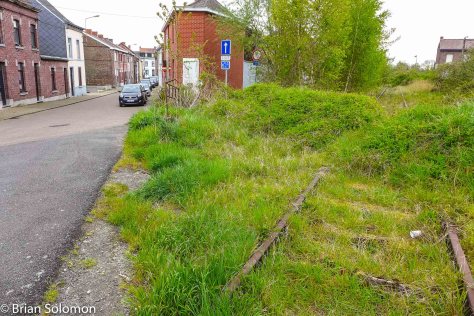
The tree growing out of the roof of the old station is indicative the sad state of the railway here.Despite the poor state of the facilities, SNCB continues to provide a relatively frequent passenger service to Quiévrain. Electric trains offer an inexpensive and comfortable way to travel to Mons and Brussels where connections are available to many other cities across the country.
Generally speaking SNCB (Belgian National Railways) provides an excellent service across Belgium, with most stations seeing at least an hourly passenger service and many lines operating with an even greater frequency.
Lumix LX7 photo.
At one time a through railway line connected Belgian cities of Brussels and Mons with the French city of Valenciennes via Quiévrain . Today, SNCB continues to operate a regular interval passenger service from Brussels to Mons with some trains continuing south to Saint Ghislain and Quiévrain.
But Quiévrain is the end of the line and the state of the station area is a sad reflection of better times now long gone.
This was once a handsome station.
Evidence of the old line remains and the tracks are still in place (although no longer connected).
The town is divided between Belgium and France, with the French town being called Quiéverchain. Differences in the price of tabacco and alcohol between the two countries has led to a thriving business on the Belgian side of the border.
Here we are at the French-Belgian frontier which divides the town of Quiéverchain/Quiévrain. Good luck getting through the place by rail!Oh dear! The connecting stink buggy has arrived.SNCB provides excellent signage at stations.
It had been many years since you could take a train directly from Mons to Valencienes.
In theory, you can ride from Brussels to Valenciennes via a change of trains at Lille, but this is the long way around and impractical for regular travelers.
The end of the line for SNCB! (but the tracks once continued into France.)
Elsewhere in Europe cross-border services have flourished, yet the end of track at Quiévrain clearly demonstrates how borders create barriers between population centers that need not exist.
Soon you will be able to travel faster than ever before from Zurich to Milan, but not by rail from Mons to Valenciennes!
Only a short walk from the end of track will reveal evidence of the old line that once continued across the border. A ghost from another era.I find disused railways sad, yet fascinating. Like discovering evidence of a forgotten empire.
Last October (2015), I visited Valenciennes in northern France. I stopped by again a few weeks ago during my April 2016 wanderings in France and Belgium.
In these views I focused on the old Chemin de fer du Nord Station (SNCF’s Gare de Valencienes) and the surrounding environment.
Using my FujiFilm X-T1, I made images that feature the old station as both subject and background. Notice how selective focus and use of light shifts the central interest from the old building to the tram.
Outback of the station, there are, of course, SNCF trains and an impressive array of trackage that make interesting subjects in their own right.
Together, the building, trams, SNCF trains and trackage make for a scene, but one not possible to adequately represent in one image. Thus this myriad collection of images. This is a work in progress.
An SNCF train approaches Gare de Valenciennes.
Tracking the Light posts every day! (Have you noticed?)
The purpose of this image was intended as a test of Kodak’s new T-Max 100 black & white film. Exposed with a Canon A-1 with 50mm lens.
I made this view of Conrail GP40-2s rolling east at Rochester, New York’s Amtrak station in November 1986—nearly 30 years ago.
At the time, Conrail was the order of the day, and the GP40-2s were common.
Although sharp and properly exposed, this view was marred by the shadow of the canopy and so at the time I disregarded it.
I’ve amended my opinion, however.
Now the whole scene has changed beyond recognition. Conrail is gone nearly 17 years and last year Amtrak demolished its old station in preparation for construction a new one.
I made this study of CSX’s former Boston & Albany mainline at Brookfield, Massachusetts in January 2001.
Step back a century and there were two main tracks and an array of sidings here; back when the railroad focused on local business in addition to long distance traffic.
Brookfield, Massachusetts. Exposed on black & white negative film using a Rolleiflex Model T with Zeiss 75mm Tessar lens.
CSX 611 is a AC6000CW—a big GE diesel by any measure.
In January 2001, My pal T.S.H. and I were making an inspection of the old Boston & Albany between Palmer and Worcester, Massachusetts ( reliving a trip we’d made in the summer of 1984).
CSX 611 leads a westward freight on the Boston & Albany route at East Brookfield in January 2001. Black & white 120 size negative scanned using an Epson V750 flatbed scanner and adjusted for contrast using Lightroom.
I exposed this view using a Rollei Model T that I’d bought from Mike Gardner.
My intent was to recreate a view I’d made of westward Conrail freight at the same location 16 years earlier.
Sadly, the old Boston & Albany station at East Brookfield was destroyed by arson in Autumn 2010.
Among my favorite German locomotives are the old ‘Rabbits’ (classes 215-218 and rebuilds), so-called because of their rabbit-ear shaped exhaust stacks.
On Monday, 18 April 2016, Gerry Conmy, Dennis McCabe, Stephen Hirsch and I made a project photographing this declining class of diesel on the line running east from Lindau.
Rabbit down grade racing toward Lindau.Double headed rabbit climbing east from Lindau with a Zurich-Munich IC train. Note the exhaust stacks.FujiFilm X-T1 photo.
The Zurich-Munich long distance trains are still worked with these vintage machines. Several years earlier, Dennis and I had explored locations on this scenic non-electrified double track line.
Soft morning light aided the effect of the pastoral setting.
I exposed these views using my FujiFilm X-T1 digital camera.
On the morning of April 18, 1993, I made this Kodachrome slide of an eastward Amtrak train on the shore of San Pablo Bay at Pinole, California.
Exposed using a Nikon F3T with 35mm PC (Perspective Control lens). Note the level horizon.
Compare my use of foreground of the image below with that featured in this morning’s post at Gurtnellen, Switzerland. In both situations I’ve held the camera close to the ground, while standing on a hill side above the train.
In the last three days, I’ve exposed more than 1000 digital images of the railway over Switzerland’s Gotthard Pass.
Although, I haven’t had time to thoroughly examine all my files, this image struck me as capturing the sprit of Swiss mainline mountain railroading in Spring.
Iridescent green grass and distant snow crested peaks, with modern electric locomotives humming upgrade with an intermodal train.
Railpool electrics lead an intermodal train upgrade at the middle-level of the Wassen Loops. In a few months time most freight will be diverted from the traditional Gotthard route to a new long tunnel beneath the Alps.
If you haven’t visited the Gotthard Pass, here’s my advice to you: don’t wait.
At the end of this year the Gotthard base tunnel opens and most of the traffic will be diverted away from this classic Alpine crossing.
At one time the wig wag signal was the standard grade crossing protection. Now the type is all but extinct.
I learned a few weeks ago that Wisconsin & Southern had finally removed the last of these classic American signals on its former Chicago & North Western line to Reedsburg, which had survived at Baraboo, Wisconsin.
Over the years, I’d photographed wig wags at various locations in Wisconsin.
I made these photographs at Baraboo with John Gruber in February 2008.
Using a Canon EOS3 with 20mm lens, I used a relatively slow shutter speed to help convey the classic motion of the wig wag signal. Fujichrome slide film.Fujichrome slide film.
Brian is Traveling, so Tracking the light is on Autopilot!
The trains are the excuse to travel, but for me many of the most interesting photos are the portraits.
In the end, it’s the cast of characters that make the trip worthwhile.
Here are just a few from the dozens of images I exposed on Saturday and Sunday 9-10 April 2016.
IRRS tour organizer Shane Roberts at Connolly on the morning of the tour.Platform self portraits at Connolly.Fixing a tail lamp.Green flag to proceed at Connolly.Discussing logistics in the crew van.On the platform at Kildare.RPSI’s bar staff.At Ballybrophy.Ed came all the way from America for this trip.Sometimes the routine makes for an interesting photograph. Seen at Limerick.Cup of tea in the van.Irish Rail staff are key to operations.Driver Ken Fox at Charleville.Catching up on the platform at Mallow.Inspection of the equipment.Crossing the viaduct at Mallow.
Cast of characters at Rathmore.Going for spin in the snow, like.Buffet car staff.
Photographers at Rathmore.Photographers vying for position at Waterford.Reviewing results.Product placement; Noel Enright holds my new book Railway Depots, Stations and Terminals.Watching the passing greenery.People wave at the train.
A couple of years ago I posted the coming-on view of this train at Northern Maine Junction. (see: Maine Central’s East Wind).
Last December, I located and scanned this trailing view.
Maine Central’s hot intermodal train East Wind blows through Northern Maine Junction in July 1983. Exposed on Ektachrome film with a Leica 3A with 50mm Summitar lens. Although not a great photo, this documented a fleeting period of railroading, and I’m glad to have made it. I think it was the first time I saw a caboose-less freight.
As I mentioned in the earlier post; at the time I photographed a single Maine Central U25B with two flat and four Sealand trailers, I was decidedly unimpressed.
One locomotive, short train, no caboose?
What I was witnessing was the result of transportation deregulation that completely changed the American freight railroads.
Innovation spurred by deregulation that began as short intermodal trains such as this one, gradually evolved into mile-long transcontinental double-stack moves.
Will intermodal someday return to the Maine Central.
An Amtrak ‘Capitols’—so named because the trains connect historic and contemporary California capital cities—works timetable east across the Suisun Bay Bridge in February 1992. Exposed on Fujichrome 100 color slide film.
I featured Southern Pacific’s massive Suisun Bay Bridge in my 2008 book North American Railroad Bridges. In this detailed book, I traced the development of bridges on American railroads and featured many of the most noteworthy spans.
Southern Pacific’s Suisun Bay Bridge opened for service on October 15, 1930, allowing the railroad to discontinue its intensive car ferry operations. It was the largest double track bridge west of the Mississippi.
I made this photograph with Brian Jennison on a foggy morning more than 16 years before the book’s publication. However this was not the image used to illustrate the bridge in the book. Instead, I opted for a broad-side silhouette exposed on Ektachrome in 1993.
Here’s a bridge photograph tip: to make a large span appear enormous crop the ends of the bridge, thus allowing the mind to expand the bridge to unseen ends.
Tracking the Light will post tomorrow at the usual time.
Conrail eastward freight at Bullards Road, Hinsdale, Massachusetts on August 3, 1984. Take notice the former Erie Lackawanna SD45-2, Conrail 6659, second out. Some of those old EMD’s are still on the move. This day it’s 20-cylinder 645-diesel was adding to atmosphere. (Fear not, I have plenty of photos of the SD45-2s on the B&A and elsewhere on Conrail).
Looking back more than three decades; it was a warm August 1984 afternoon when my pal T.S.H. and I sat up on the grassy hill near the popular Bullards Road Bridge to photograph this Conrail eastward freight as it approached Boston & Albany’s summit of the Berkshire grade.
I made this image on 35mm Kodak Tri-X using my Leica 3A with a Canon 50mm lens.
Conrail was divided in Spring 1999, nearly 15 years after this photo was exposed.
In 2003, CSX removed the old Bullards Road bridge (and stone abutments).
I can’t say for certain what happened to the SD40, but a similar former Conrail engine still works for New England Central.
Personally, I’d trade my digital cameras for a fully functioning time machine.
It was April 1989 when I exposed this view of Conrail’s BUOI (Frontier Yard Buffalo to Oak Island, New Jersey) bumping along the number 2 track at Arkport, New York.
At that time this portion of the old Erie Railroad line from Hornell to Buffalo as still directional double track (rule 251) with block signals largely in the from of antique Union Switch & Signal Style S semaphores.
A 35mm black & white photograph exposed using a Leica M3 rangefinder with 90mm lens. That’s my old (then new) Bogen 3021 tripod that I’d lent to a fellow photographer ( seen at left).
Between Hornell and Hunt, New York, Erie’s old eastward main wasn’t maintained for speeds faster than about 10mph, and when possible Conrail routed traffic against the current of traffic on the westward (number 1 track.) Not on this day though.
I was working with two Leica M rangerfinders that day; I made a similar view on Kodachrome slide film with my M2 that appeared in RailNews for its ‘Farewell to Conrail’ issue back in 1999 (a little more than ten years after I exposed it).
While Conrail was only an extant player in American mainline freight operations for a little more than 23 years, it was my favorite of the big eastern railroads.
Today, April 1, 2016, is the 40th birthday American eastern giant, Conrail. Commencement of operations on the Consolidated Rail Corporation began on this day 40 years ago.
Conrail was created by Congress to assume operations of a variety of financially troubled eastern railroads including Penn Central, Erie Lackawanna, Reading Company, Central Railroad of New Jersey and Lehigh Valley.
When I was growing up in the late 1970s and early 1980s, Conrail was the big show. By the time Conrail’s operations were divided by CSX and Norfolk Southern in 1999, I’d exposed tens of thousands of images of its locomotives, trains and people.
Conrail TV10B emerges from the mist-enshrouded Quaboag River Valley near CP79 east of Palmer, Massachusetts. It was scenes like this one, exposed on April 30, 1997, that made Conrail a favorite railroad. Nikon N90S with 80-200mm Nikkor AF zoom, Ektachrome film.
I miss Conrail. It’s blue locomotives photographed well; it ran lots of freight over my favorite Boston & Albany; its employees were friendly to me, and it embodied most of favorite historic railroads. Turn back the clock, let it be Conrail-days all over again!
In 2004, Tim Doherty and I co-authored a book on Conrail, published by MBI. If you have this prized tome, it’s now a collectible item! By the way, if you know a publisher interested in a follow-up title, I have access to virtually limitless material and keen knowledge of the railroad. Just sayin’
Happy Birthday Big Blue!
Tracking the Light Posts Every Day, don’t miss out, subscribe now!


 Tracking the Light posts daily.