On October 30, 2003, I spent a day photographing BNSF and Union Pacific trains on the old Western Pacific route through California’s Feather River Canyon.
This exceptionally scenic route has long been a popular place to picture trains.
Although photogenic, one of the conceptual problems with the canyon making the balance between train and scenery work.
Too much train, and the canyon becomes a sideshow. Too much canyon and the train is lost in the scenery.
One way to make balanced is through the clever use of lighting.
That’s what I’ve done here.
Exposed on Kodak 120-size Tri-X using a Rolleiflex Model T with a Zeiss Tessar; processed in Ilfotec HC, and scanned using an Epson V750. Final contrast adjustments were made in Lightroom to emphasize highlights and lighten shadows.
I’ve pictured an eastward BNSF climbing through Rich Bar, and by back lighting the train, I’ve helped emphasize it’s form that might otherwise be lost in the darker reaches of the canyon.
This is the cover of the January 2018 Trains. My column appears on page 17.
Yesterday I received my copy of the January 2018 Trains Magazine that features my most recent column.
Using my Lumix LX7, I made the photo illustrating my text on-board an SNCF TGV high-speed service from Brussels to Lille back in April 2017.
A photo of my iPhone displaying my E-Ticket is this months illustration. Note Tracking the Light business card to the left of the phone.
Below is a view of the same train at sunrise in Brussels prior to departure. Although unstated in the article, this was part of a trip across Europe during my research for my up-coming book on European Railway travel.
Last week (November 2017) I made these picturesque tableaus of the Strasburg Railroad in its classic Pennsylvanian Dutch settings.
All were made with my FujiFilm XT1 digital camera.
Over the years I’ve made more than a dozen visits to the Strasburg Railroad, but this most recent trip was the first time I’d exposed digital photos here. I guess it’s been a while since my last visit.
Alternatively, I could call this Tracking the Light post, ‘28N at Millers Falls.’
Whichever you like.
So what do you do in a situation where a train is coming directly out of the midday sun?
You could
1) give up.
2) go for a sandwich.
3) take up plane spotting.
4) all of the above.
Or you can try something different.
The other day at Millers Falls, Massachusetts I exposed these views looking timetable west on the old Boston & Maine. Train 28N is an eastward autorack destined for Ayer, Massachusetts.
Using a super wide-angle 12mm Zeiss Touit, I set the aperture to the smallest setting (f22), which produces a sunburst effect. To make the most of this effect, I positioned an autumn branch between the camera and the sun.
12mm Zeiss Touit, ISO 800, f22 at 1/125th of a second.
The other morning at Pan Am’s East Deerfield yard I met up with Tim, a fellow photographer.
He asked, ‘Are you going to take that?’—meaning the sunrise over the yard.
‘Yeah, since we’re here. Why not?’
I’ve only made countless photos of this yard in the morning, but that’s never stopped me before.
For this image, I exposed Ilford Pan F black & white film (ISO 50) using a Leica IIIA with Nikkor f3.5 35mm lens. With handheld meter to gauge the lighting, I exposed this frame at f3.5 1/60th of a second.
My aim was to capture detail in the sky and allow the tracks and yard to appear as a silhouette.
East Deerfield Yard looking east at sunrise. October 2017.
I processed my film as follows: Kodak D76 mixed 1 to 1 for 6 min 30 seconds at 68F, followed by stop bath, 1st fix, 2nd fix, 1st rinse, Permawash, 2nd rinse, then 9 min selenium toner mixed 1 to 9 (one part toner to nine parts water), 3rd rinse, permawash, 4th rinse.
After scanning the negative with an Epson V750 Pro flatbed scanner, I made a few nominal adjustments to contrast using Lightroom, while removing unwanted dust-specs.
A few weeks back on a trip to Belfast, I exposed these views of NI Railway’s CAF-built diesel railcars crossing the River Lagan.
To convey a sense of motion I panned the trains using a relatively slow shutter speed with a medium telephoto lens. By using an even panning motion I was able to keep the train sharp with the background is blurred.
Exposed at f 22 for 1/60th of a second. 135mm focal length.Exposed at f20 for 1/60th of a second.
It was a bright morning. I was out for the down IWT Liner (International Warehousing and Transport container train that runs almost daily from Dublin’s Northwall to Ballina, County Mayo).
While I was waiting this Irish Rail ICR (InterCity Railcar) came up road on it approach to Dublin’s Heuston Station.
Sometimes its nice to catch an ordinary train in great morning light.
Mifflin, Pennsylvania is a classic location on the old Pennsylvania Railroad.
I’ve visited here intermittently since Conrail days.
A couple of weeks ago, Pat Yough and I made these photos of Norfolk Southern trains passing Mifflin. I exposed these using my FujiFilm X-T1 with 90mm f2.0 lens of westward symbol freight 21T.
FujiFilm X-T1 with 90mm fixed telephoto lens set at f5.0 1/500, ISO 640.FujiFilm X-T1 with 90mm fixed telephoto lens set at f5.0 1/500, ISO 640.
Tracking the Light is Brian Solomon’s daily blog focused on the nuts and bolts of Railway Photography.
Today’s post explores the former Boston & Maine yard at Shelburne Falls (technically Buckland, but I’ll let the pundits argue that privately), now home to the modest Shelburne Falls Trolley Museum. See: http://sftm.org
Last week Mike Gardner visited the site to make photographs of Pan Am Railway’s eastward autorack train symbol 28N. While waiting, I exposed a few views of the disused yard tracks parallel to the old Boston & Maine, now Pan Am, mainline.
Kodak Tri-X processed in Ilford Perceptol 1-1 with water for 8 minutes at 70F, then toned in Selenium for 7 minutes. Negatives rinsed, washed, dried and scanned in color using an Epson V750 Pro.
Pan Am Southern symbol freight 28N at Shelburne Falls, Massachusetts.
Tracking the Light posts something different every day!
It always surprises me when I find some vestige of former times that I’ve managed to overlook.
Last week my on the advice of Felix Legere, we explored the old Nashua, Acton & Boston Railroad right of way near Forge Village east of Ayer, Massachusetts.
This 24-mile 19th century railroad was among the lines melded into the Boston & Maine system. In 1875, it carried three passenger trains daily between Nashua and Concord Junction. Near Forge Village it crossed the Stony Brook railroad and a trolley line on an overpass.
The NA&B was an early casualty of Boston & Maine retrenchment and abandoned about 1925.
Today, part of the right of way is maintained as Tom Paul Rail Trail. Felix led our expedition to the railroad’s vintage stone arch bridge over Stony Brook (for which the Stony Brook Railroad was named).
Bridge over Stony Brook. Exposed on Kodak Tri-X using a 50mm Summitar.Looking east.View made with 12mm Zeiss Touit.
I made the color photos with my FujiFilm X-T1, and the black & white with a Leica IIIa with 50mm Summitar lens.
Boston & Albany freight house at Palmer, Massachusetts, photographed using a Rolleiflex Model T on Verichrome Pan black & white film in October 1985. Copyright Brian Solomon.
This Saturday, May 6, 2017, I will present a variation of my Boston & Albany program to the New York Central System Historical Society convention, to be held at the Best Western Royal Plaza Hotel, in Marlborough, Massachusetts.
I am listed as the guest speaker and my illustrated talk will begin at about 7pm. This will feature material from the Robert A. Buck collection, and images from the lens of William Bullard (early 20th century photographer), as well as a selection of my own work on the B&A, which spans more than 40 years.
For information on the convention and registration forms see the New York Central System HS website: www.NYCSHS.org
Here’s key to a secret, one tightly held: More often than not I make photographs for a specific audience.
This has myriad manifests. It may be something as simple as photographing a friend’s favorite locomotive, or capturing a location once shared by a fellow photographer.
However, often it goes deeper. I’ll aim to capture a scene by working with light, shapes and subject in a way that I hope will appeal to a friend.
Sometimes, I’ll simply forward these photos directly to the person in question. To my father, I’ll send photos from my travels in Europe, to my mother, I’ll email photos of my friends and acquaintances.
I might forward an image to an editor that I made to pique their interest.
If I score something really unusual, I might goad a fellow photographer hoping to push them into exposing a similar or better photograph.
In April 1988, I made this photograph of Conrail’s BUOI working east through the Canisteo Valley near West Cameron, New York.
Yet, often my very best photographs are those that I make to fulfill a personal ideal.
What?
Ok, my most successful images are those I made to please me.
At 7:30pm tonight, Thursday 9 March, 2017, I plan to present my illustrated lecture called Night Trains, Pendolinos, Iron ore, Timber and Trams to the Irish Railway Record Society in Dublin.
This will be delivered at the IRRS premises near Heuston Station in Dublin (opposite the entrance to the car park). I will begin at 7:30pm (1930).
VR’s IC-274 arrives at Oulu, Finland on it’s overnight run to Helsinki. I traveled on this train. Exposed using a Fujifilm X-T1 mirrorless digital camera.
On 14 May 2003, I exposed this trailing view of Irish Rail’s Sligo Liner rolling west along the old Royal Canal near Enfield, Co. Meath.
The liner was hauling kegs of beer, mostly Guinness. Long after it left my view, I could here the class 071 locomotive with its EMD 12-645 diesel roaring a way in the distance.
Exposed on Fujichrome using a Nikon F3 with 180mm Nikkor lens.
I intentionally included some foliage in this photograph. Not only do the leaves help block sun from causing flare by hitting the front element of my lens, but they add a sense of depth that would be lost without them.
In Aug 2001, I used my new Contax G2 rangefinder to pan this Helsinki tram. A version of this image was published as two page spread in April 2005 Trains Magazine.
Rangefinders offer several advantages when making pan photos.
On Thursday 9 March , 2017, one week from tonight I’ll be giving my Illustrated Lecture called Night Trains, Pendolinos, Iron ore, Timber and Trams to the Irish Railway Record Society in Dublin.
This will be delivered at the IRRS premises near Heuston Station in Dublin (opposite the entrance to the car park). I will begin at 7:30pm (1930).
Tonight, Friday January 27, 2017, the Valley Photo Center in Springfield is hosting a reception for my Silver & Steel exhibit between 5:30 and 8:00pm. I plan to present a live slide show (with real 35mm color slides!).
The gallery is in the Tower Square mall at 1500 Main St. in Springfield.
In addition to large framed prints and canvas renditions, I also have a selection silver gelatin black and white prints, as well as giclee prints available for purchase. In addition, I plan to have examples of my books for sale.
Among my photos on exhibit is a large print of this image showing an Irish Rail passenger train near Athenry, County Galway. I exposed this on Fujichrome Sensia II with a Nikon N90S and a 24mm Nikkor lens.
My photographic exhibition at Valley Photo Center in Springfield, Massachusetts is on-going through January 28th. The gallery is in the Tower Square mall at 1500 Main St. in Springfield.
This Friday (January 27, 2017) I’ll be at the gallery for a reception between 5:30 and 8:00pm. I plan to present a live slide show (with real 35mm color slides!). This event is scheduled to coincide with the Railroad Hobby Show in West Springfield (just across the Connecticut River).
My exhibit features photographs spanning two decades from the late 1980s to 2008, and depicts trains in a variety of settings including the American West, Pennsylvania, New England and Europe.
In addition to large framed prints and canvas renditions, I also have a selection silver gelatin black and white prints, as well as giclee prints available for purchase. In addition, I plan to have examples of my books for sale.
I exposed this view of a westward Conrail double stack train crossing the former Erie Railroad Starrucca Viaduct in May 1989 using a Leica M2 with 35mm Sumicron lens. This is one of several dozen images on display at the Valley Photo Center in Springfield.Autumnal image at East Deerfield, Massachusetts. This is one of several dozen images on display at the Valley Photo Center in Springfield.Not all photographs are made on bright sunny days. I exposed this view in Scranton, Pennsylvania on a wet October evening in 2005. I was working with the Delaware Lackawanna Railroad on my ‘Working on the Railroad’ book—published by MBI/Voyageur Press. This is one of several dozen images on display at the Valley Photo Center in Springfield.
Profound words for a man who never gazed upon, let alone exposed a photograph.
Cape Breton & Central Nova Scotia locomotive 2032 Lord Byron leads freight 306 in July 1997. Exposed on Fujichrome using a Nikon N90S with 80-200mm Nikkor zoom lens.
Czech film manufacturer Foma introduced a new black & white film in 2015 called Retropan Soft (ISO 320).
This is advertised as a panchromatic, special negative film with ‘fine grain, good resolution and contour sharpness’. Among its features are a ‘wide range of half tones and a wide exposure latitude.
I tried my first roll in early December 2016. I have to admit that I was curious, but skeptical. Could this new b&w film change the way I approach film photography? Might it offer something decidedly different than Kodak Tri-X or Ilford HP5?
Working with an old Nikon F3 and 50mm lens I wandered around Philadelphia with my brother and exposed a variety of gritty urban images that I thought might benefit from the look advertised by ‘Retropan’.
Foma recommended using their specially formulated Retro Special Developer, so I ordered some from Freestyle Photographic Supplies .
I exposed my film at ISO 320, and processed it more or less as recommended using Retro Special Developer, with two small changes:
I shortened the processing time (as I generally find that manufacturer recommended times are too long and lead to excessively dense negatives); plus I pre-soaked the film in a water bath with a drop of HC110 (as described in previous posts).
The negatives scanned well, and I was impressed with the tonality of the photographs. I’ve included a selection below.
Please note, that although I scaled the files and inserted a watermark, I have not cropped them or manipulated contrast, exposure or sharpness. These photos are essentially un-interpreted.
Philadelphia exposed on Foma Retropan Soft and processed in Foma Retro Special Developer.Parkside Avenue, Philadelphia.42nd Street, Philadelphia.Philadelphia City Hall. Philadelphia exposed on Foma Retropan Soft and processed in Foma Retro Special Developer.Evening view from the same street corner as the daylight photo.Low angle view of an alley.Buying SEPTA transit tokens.
Stay tuned for my next Retropan test!
Brian Solomon presents something new on Tracking the Light every day.
During January 2017, I’ll have an exhibit of railway photography at the Valley Photo Center in Springfield, Massachusetts. The show will run from January 3 to January 28th in the Tower Square mall (formerly Bay State West) in downtown Springfield. The address is: 1500 Main St, Springfield, MA 01103, USA
The exhibit will feature photographs spanning two decades from the late 1980s to 2008, and depict trains in a variety of settings.
Conrail double-stack container train crosses the Starrucca Viaduct on the former Erie Railroad at Lanesboro, Pennsylvania in Spring 1989. Exposed with a Leica M2 with 35mm Summicron lens on Kodachrome 25.Among the large photographs display is this view of a southward Central Vermont freight crossing the Connecticut River. I exposed it using my Nikon F3T with 28mm lens on Kodachrome 25. A version of this image appeared in Trains Magazine 19 years ago.
Among my underlying themes are scale and environment. Consider the contrast between the view of a light rail tram crossing the Danube in Budapest and the very large print of a freight car wheel in West Virginia.
Highlights include a Conrail stack train crossing Pennsylvania’s Starrucca Viaduct, and Union Pacific freight rolling through California’s Feather River Canyon at the North Fork Bridge.
This is a rare opportunity to buy my framed photography. All prints displayed are available for purchase.
A reception will be held on the evening of Friday, January 27, 2017 between 5:30 and 8:00pm. I’ll be there to give a live slide show (with real 35mm color slides!) Refreshments will be served.
This reception is scheduled to coincide with the Railroad Hobby Show in West Springfield, just across the Connecticut River.
In December 1996, I made a sequence of photographs from this vantage point off 8th Avenue in Manhattan featuring the Empire State Building.
This is one of many images from essentially the same spot that I exposed to show the changes in lighting over New York City. I intended to use as a multiple slide dissolve sequence in a slide show, although I’ve yet to organize it.
Exposed on Kodachrome 25 using a Nikon N90S mounted on a tripod.
Photo exposed on 120 size Ektachrome film. Exposure calculated with a Sekonic Studio Deluxe handheld photocell (light meter).
I exposed this view twenty years ago using a Speed Graphic with 120 size roll film back that I’d borrowed from Doug More.
A decade earlier, fellow photographer Brandon Delaney had showed me this bridge at Bernardston, Massachusetts on the Boston & Maine’s Connecticut River Line.
The bridge survives much as pictured here; today it serves as the route of Amtrak’s Vermonter. However the old mill dam with accompanying waterfall were destroyed sometime after I made this December 1996-view.
Tomorrow, I’ll post a contemporary angle of the bridge.
Soo Line on Tax Day! A Soo Line SD40-2 leads an eastward CP Rail freight near Dalton, New York on 15 April 2004. Exposed on Fujichrome using a Contax G2 with 45mm Zeiss lens.
The old Erie Railroad is one of my favorite lines.
Mike Gardner and I got a very early start on 15 April 2004. We worked our way west to the Portage Bridge at the Letchworth Gorge in western New York State in time to intercept an eastward CP Rail freight.
We chased this capturing it in multiple locations along the old Erie line to Hornell. At this time Norfolk Southern was the owner operator, while CP Rail operated via Delaware & Hudson trackage rights.
Clear blue dome; bright red EMDs, and great scenery with a good quality chase road made the morning extra productive.
(Thanks to Stephen Hirsch for the title suggestion.)
Last week I passed my 50th milepost, so on Saturday evening some friends and I gathered at Nancy Hands pub on Parkgate Street in Dublin.
The Irish railways fraternity was well represented.
I was dressed as the ghost of Isambard K. Brunel— the famously eccentric, highly regarded Victorian engineer and polymath.
Thanks to everyone who dropped by! Special thanks to Paul Dowd for helping to organize the event. Extra special thanks to Helen Collins who created my costume!
These photos are a sampling of images exposed with my Lumix LX7. Some were made by me, others were exposed by various friends at the event.
Tracking the Night Celebrates Halloween and Brian’s 50th mile mark.
Long Island Rail Road’s Hudson Yards on the westside of Manhattan.
Funny how the internet’s autocropping tends makes a mockery of my composition. Be sure to click on Tracking the Light to see the photo as I intended to present it.
I exposed this view of Long Island Rail Road suburban trains at Manhattan’s Hudson Yards using my Lumix LX7. Thin cloud with a hint of air pollution makes for soft brown-tinted light.
Tracking the Light is on Auto-Pilot while Brian is Traveling.
For more than three years I’ve made an effort to post something new, each and every day.
If you are not already subscribed, have you considered subscribing? There is no cost: the primary advantage to a subscription is that an automatic notice is sent out with each and every post. This is more reliable than feeds via Facebook, Twitter, and Google Plus, and even my own Email notices.
I prepare posts in advance and put them in a queue on Word Press. I’ll assign to each posting a date and a time when it is supposed to appear on the web.
Sometimes owing to a technical fault, posts may miss its scheduled posting time. When that happens, I have to manipulate the system and post manually. (Post is both a noun a verb).
I like to keep the site timely, but it’s not intended as an up to the minute news source.
Although I often write daily, I tend plan post schedules so that photos appear several days after I make them. This is by intent.
That said, sometimes when I find something of immediate interest (such as Monday’s IWT Liner), I’ll make an effort to get the subject out there quickly for public consumption. (Thus Tracking the Light’s ‘Extra Posts’).
In other situations, I’ll capture something unique (or at least very unusual) but opt to hold that back for future presentation.
For every photo I’ve displayed on Tracking the Light, I have dozens more waiting for their day in the sun (metaphorically). The very best have yet to be seen!
For the next few days I’ll be traveling and may not have regular access to the internet. As a result, Tracking the Light will be coasting ‘autopilot.’
This means, I’ve placed a large batch of posts in the queue so that you should see something every day while I’m on the road.
If for some reason, a post misses its posting time, I may not be in a position to fix it right away.
Fear not, new material is being exposed! On digital, and with film.
Stay tuned!
An Amtrak Empire Service train led by a dual-mode GE Genesis diesel makes for a modern silhouette along the Hudson at Castleton, New York in 2004. Exposed on Fujichrome using a Contax G2 rangefinder with 28mm Zeiss Biogon.
I’ll be presenting a variation of my slide program Irish Railways Looking Back Ten Years to the Cork Branch of the Irish Railway Record Society at 8pm on Monday October 3, 2016.
The program will be held at the Metropole Hotel in Cork City.
I gave a version of this program titled ONE YEAR ON IRISH RAILWAYS; LOOKING BACK TEN YEARS on 10 March 2016 to the Dublin Branch of the Irish Railway Record Society.
While the core of the program will be similar, I’ve added a variety of new material to keep it interesting and fresh.
Irish Rail 213 at Kent Station, Cork. Exposed on Fujichrome, scanned with an Epson V500.Railway Preservation Society Ireland engine 186 arrives at Farranfore, County Kerry on 6 May 2006. Notice the effect of depth created by lining up the lighting posts on the right.Waterford-Ballina Norfolk Liner crosses the River Barrow at Monasterevin.
My photo of Railway Preservation Society of Ireland’s engine number 4 appears on the cover of this year’s Southern Steam Calendar.
RPSI’s former Northern Counties Commission engine number 4 works toward Pearse Station Dublin on 18 Dec 2010. The cool dry conditions combined with a rare blanket of Irish snow made for a classic view of RPSI’s Santa Train. I exposed this view digitally using my Canon EOS-7D.
The calendar features the work of a dozen of Ireland’s most talented railway photographers. It is arranged to display one large photo per month.
My view here has been specially cropped for display on Tracking the Light. The calendar displays a larger version of this image.
Southern Steam has been produced by my friends Kevin Meany and Ken Fox for the charity Pieta House—Centre of Prevention of Suicide Or Self-Harm.
Southern Steam—2017 is available in Ireland with proceeds going to the charity. If you are interested is obtaining a copy of the calendar please contact Ken Fox at:
I watched as a band of high cloud inched across the morning sky.
Irish Rail class 071 diesel number 080 brought Belmond’s Grand Hibernian Mark 3 consist through the wash at Heuston Station. Interesting light with an unusual train.
To hold detail in the textured sky, I used a Lee 0.6 graduated neutral density filter with the darker portion of the filter positioned at the top of the frame.
FujiFilm XT1 with 18-135mm lens and Lee 0.6 graduated neutral density filter. Minor post-processing contrast and saturation adjustment was made using Lightroom.FujiFilm XT1 with 18-135mm lens and Lee 0.6 graduated neutral density filter. Minor post-processing contrast and saturation adjustment was made using Lightroom.
On July 1, 2010, helpers work at the back of a loaded coal train. By including some leaves and branches of near by trees I’ve added depth to the photograph.
Norfolk Southern helpers are in ‘run-8’ working at the back of a loaded coal train at Cassandra, Pennsylvania on the famed ‘West Slope’—the old Pennsylvania Railroad Main Line grade over the Alleghenies.
Morning glint illuminates the tops of the locomotives and accentuates the exhaust smoke for added drama. The train was working upgrade at a crawl.
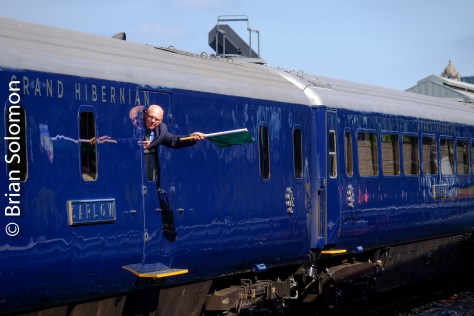
This afternoon, after years of planning and months of preparation, high-end hotel train operator Belmond debuted its latest train; the Grand Hibernian.
This departed platform 2 at Heuston Station at 2:20pm (30 August 2016).
I made these photographs of the train and its Irish Rail crew.
For the railway enthusiast this means the return of locomotive hauled Mark3 carriages to regular traffic.
All images were exposed a little while ago using my FujiFilm XT1 digital camera.
Train guards Noel and Mark at Heuston Station, Dublin.Each carriage is named for an Irish County. Sadly Mayo and Dublin were omitted.
Oy! Whosat goob?
Departing Heuston Station on the advertised.Green flag to depart.
Tracking the Light posts EVERY day and sometimes twice!