The familiar sound of 645 thunder down in the valley spurred me into action.
A southward New England Central freight was climbing Stateline Hill in Monson, Massachusetts. This is an old routine (and yes, I’ve written about this before.)
When I hear a train coming through Monson, I have a few minutes to get organized. In this instance, a brilliant clear blue dome with nice morning light was the deciding consideration.
En route, I heard the southward train get its ‘paper’ (radio–issued track authority) to proceed toward Willimantic, Connecticut. In this instance, I was alerted to the location of the train; south of milepost 55 (near the Massachusetts-Connecticut state line).
I headed for my preferred spot in downtown Stafford Springs, Connecticut south of milepost 49.
FujiFilm XT1 digital photo.
One advantage of Stafford Springs is that the railroad makes an east-west twist through the village on its otherwise north-south run. This favors the morning light for a southward train.
The other advantage is Stafford’s quaint and distinctive New England setting.
Conrail SEPW (Selkirk to Providence & Worcester at Worcester, Massachusetts) makes a drop at Palmer, Massachusetts on May 6, 1984.
I exposed these two views from almost the same angle on the South Main Street Bridge in Palmer, Massachusetts.
In 1984, Conrail operated the old Boston & Albany, and the main line was then a directional double track route under rule 251 (which allows trains to proceed in the current of traffic on signal indication).
SEPW has stopped on the mainline, while the headend has negotiated a set of crossovers to access the yard and interchange. That’s the head end off in the distance.
I made this 1984 view on Plus-X using a Leica fitted with a f2.8 90mm Elmarit lens.
The comparison view was exposed on July 25, 2016 using a Lumix LX7 set at approximately the same focal length. Although similar, I wasn’t trying to precisely imitate the earlier view and was working from memory rather than having a print with me on site.
Exposed using my Lumix LX7. I used the ‘A’ mode and dialed in -1/3 to compensate for the bright sunlight and the dark side of the train. This image was extracted from the in-camera Jpeg and compressed for internet viewing, but I also made a RAW file of the same image. Both are to be archived on multiple hard drives.
During one of my recent Metrolink blitzes, I rode from Los Angeles Union Station to Santa Ana where I changed for an Inland Empire-Orange County Line train running from Oceanside to San Bernardino.
I timed this brief visit to coincide with a flurry of Amtrak and Metrolink trains. I had just 45 minutes to make images of this classic Santa Fe station having never previously explored here.
I found Santa Ana to be an excellent mid-morning location.
The footbridge is photographer friendly and the old Santa Fe building makes for a suitably California setting. The height of the bridge allows for both distant telephoto views as well as wide-angle down-on photos.
I exposed these views digitally using my Lumix LX7 and FujiFilm XT1.
I arrived on Metrolink train 600 from Los Angeles Union Station. I had enough time to walk to the headend and expose this view with my Lumix LX7 before the train departed.Metrolink 687 arrives behind a borrow BNSF AC4400CW. This framed view was exposed using my Lumix LX7.A Metrolink F59PHI works at the back of Los Angeles bound train number 687. Here my Fujinon 18-135mm lens gave me a nice view of the train and station from the footbridge.Metrolink 633 is among Metrolink’s services that doesn’t serve Los Angeles Union Station. This is a short-turn that runs from Laguna Niguel/Mission Viejo to Fullerton.By using my 18-135 zoom on my Fuji XT1 I was able to exposed a series of trailing photos of Metrolink 633 as it accelerated away from Santa Ana.This is a telephoto view of train 633 from the same vantage point as the photo above.Metrolink’s timetable shows both of its services to Santa Ana as well as Amtrak’s Pacific Surfliner.A detailed view of the Santa Ana station exposed using my FujiFilm XT1.Amtrak 566 Pacific Surfliner slows for its station stop.Metrolink 802 will take me to San Bernardino. I arrived under partly cloudy skies and departed under a California blue dome. Happy days!
Perched atop a high hill in a purpose-built building in Simi Valley is Boeing 707 27000 that served for nearly three decades as Air Force One.
Boeing’s 707 is unquestionably one of the most beautiful commercial aircraft.
This 707 was styled by pioneer industrial designer Raymond Loewy for its role as Air Force One.
Loewy is well known in railroad circles for his locomotive and train designs. This included Pennsylvania’s GG1 electric and S1 Duplex steam locomotive, and Northern Pacific’s post-war North Coast Limited streamliner.
Panoramic composite exposed with a Lumix LX7.Working in silhouette, I made this low angle view to show the lines of the 707.
Under the belly of the plane.Classic Loewy styling.
Air Force One is a key display at Simi Valley’s Ronald Reagan and Air Force One Museum. I exposed these photographs using my Lumix LX7.
Last weekend, I gazed down upon that famous spiral officially known on the late Southern Pacific as Walong, but to the rest of the world as the ‘Tehachapi Loop’.
It was, and still is, one of the great places to watch trains; and on this day it didn’t disappoint. I’d been away a long time and now I was back.
The last time I was here, I’d stayed with my friends Dave and Helen Burton, who lived just over the hill on the north side of the spiral. Back then, Southern Pacific still owned the line, and the merger that was to consume the Santa Fe Railway was still more than a year away.
Now, SP, Santa Fe, and Dave and Helen are all just memories.
It was strange to watch a train traverse the loop. I was delighted to see it, but sad. It was like seeing some weird vision of the future.
So, I made these images—my first digital photos of this often-photographed landmark—while thinking back to earlier times.
I dedicated books to both of my friends: to Dave, I dedicated my BNSF book of 2005.
Last week I traveled with John Gruber to the Illinois Railway Museum at Union. John needed to deliver some material in relation to his North Shore photo exhibit, and he wanted me to expose a few images of him with his photographs.
Between 1960 and 1963, John made a project of documenting the last years of operation of the Chicago North Shore & Milwaukee interurban electric line.
North Shore was an intensive electric line that connected the Chicago Loop (trains served downtown using the rapid transit ‘L’—[elevated line]) with Milwaukee, Wisconsin via Chicago’s northern suburbs. The line was well known for its articulated streamlined speedsters called Electroliners and its electrically cooked hamburgers known as Electroburgers. Operations concluded in January 1963.
John’s work is iconic. He exposed thousands of North Shore photographs and his photography goes well beyond ordinary images of the trains. He focused on people as well as machines, and preserved a feel for this unusual railway in motion.
Johns work was prominently featured in the pages of Trains magazine and in books such as those by the late William D. Middleton.
His current exhibit can be seen in the waiting room of the East Union station at IRM. It will be on display through the end of 2016.
Of course, while we were at IRM, we took the opportunity to travel the line, and visit some of the historic equipment (which includes several of North Shore’s cars).
In addition to a variety of digital photos, I exposed these black & white images with my Leica.
John Gruber at IRM. Exposed on Ilford Pan F using a Leica 3A with Nikkor f3.5 35mm lens.Exposed on Ilford FP4 black & white film using a Leica 3A with Nikkor f3.5 35mm lens.Exposed on Ilford FP4 black & white film using a Leica 3A with Nikkor f3.5 35mm lens. (image cropped).
For more information on the Illinois Railway Museum see: http://www.irm.org
When I learned to use my old mechanical Leica there were three primary controls on the camera; a ring to adjust the focus (gauged with the aid of range finder using a ghost image overlaid on the main image); dials to adjust the shutter speed; and a ring on the lens to change the size of the aperture (lens hole) as indicated by a logarithmic scale with ‘f-stops/f-numbers’.
Other than merely pointing the camera, I needed to understand how these controls worked to make successful photos.
Today most imaging making devices take care of details such as exposure and focus, allowing image makers to snap away without concern for the mechanics.
In many instances this freedom facilitates the ability to make photos quickly and with relative ease. Yet, this loss of control steals from the photographer crucial tools.
I still like to set my aperture manually. This has less to do with obtaining the correct exposure (since in camera metering can quickly suggest or set appropriate shutter-speed/aperture combinations) and more to do with adjusting the depth of field to manipulate my composition.
A detailed discussion of how the f-stop (f-number) is determined on a lens and what the numbers mean can fill a textbook.
What is important here is knowing a few basics, such as; a smaller f-number represents a larger aperture size and, but more importantly, how you can use this.
As the size of aperture is increased more light is let into the camera, however with a big hole comes a decrease in depth of field (relative focus); conversely, the smaller the hole size (larger f-number), the less light and the greater the depth of field (relative sharpness between near and far objects).
By using a larger aperture (small f-number, say f1.4) the relative focus will be narrow, with those points not in focus appearing relatively soft compared with the subject in focus.
This relationship becomes exaggerated with longer focal length lenses. Where a super wide angle lens offers great depth of field even with a large aperture opening (small f-number), a long telephoto lens will offer relatively shallow depth of field even when using a small aperture (large f-number, say f16).
While the f-number may used as a constant gauging mark, what is most useful is controlling the degree of relative focus to achieve a desired effect.
Personally, I like the effect of a long lens with relatively shallow depth of field because this allows me to draw the eye of the viewer.
Full frame and uncropped; I exposed this view at Kent Station, Cork in January 2005 using a NikonF3 with 180mm lens at f2.8— its widest aperture.
As with many successful stories, it often helps to lead your audience on an unexpected path before giving them what they want. I’ll often tease a viewer by leaving some crucial element of an image just beyond the range of sharpness, while placing the focus on something else, like say a railroad signal. Or vice versa.
I can’t tell you what to look at, but I can try to draw your eye. Notice where I’ve placed the focus, but also those things I’ve allowed to be less than fully sharp. The larger this photo is viewed, the more relevant the topic of relative focus. An image viewed at 3×5 inches won’t necessarily convey the same impression when viewed much larger.
Tracking the Light offers daily discussion on Photography.
During the last week (July 2016), John Gruber and I were rewarded by our efforts at photographing Wisconsin & Southern freights on the move. John’s been documenting this route for decades.
On this day we’d picked up the Reedsburg Job near Merrimac and followed it west.
First of two images.
At this location near Baraboo, I asked John to stop the car near the top of a hill, rather than drive closer to the tracks.
So, is this how motorists perceive the Wisconsin & Southern?
Exposed using my FujiFilm XT1 with 18-135mm lens fully extended to its most telephoto setting (135mm). The camera’s built-in level is very helpful in situations such as this where set up time is at premium.
I’ve spent years prowling the old Boston & Albany on foot and by road.
Here’s some view made today (July 16, 2016) and over the last hour or so from the windows of Amtrak’s Lake Shore Limited train 448.
Exposed with my Lumix LX7 uploaded via Amtrak WiFi.
Old B&A station at Chatham, New York.State Line Tunnel.State Line Tunnel.North Adams Junction, Pittsfield, Massachusetts.Washington Cut, Washington, Massachusetts.Looking east on Route 20 at Huntington, Massachusetts.
I can’t say its a first; but it is the first time in awhile that I’ve been on Amtrak 448 (Boston section of the Lake Shore Limited) when it departed Albany-Rensselaer station precisely on schedule—3:05pm.
Things have certainly improved. Hooray for Amtrak!
I was among the first passengers to board Amtrak 448. Instead of running as a through train Chicago to Boston, the Boston section starts in Albany.
New York (left) and Boston (right) sections of the Lake Shore Limited. I made the cross platform transfer at Albany-Rensselaer, New York. Lumix LX-7 photo.
On my 1984 visit to Chicago I’d made photos and traveled to/from the old North Western Station.
Wow, have things changed.
Yes, I’ve made some visits between then and now, but it’s been a long time.
The old station was torn down not long after my first visit and replaced with an epic glass box. Today, this is known as the Ogilvie Transportation Center.
The Oglivie Transportation Center as seen in July 2016. Exposed with my Lumix LX7.
In the mid-1990s, about the time that Chicago & North Western was folded into Union Pacific, the station’s Bush train sheds were demolished and replaced with more modern platform coverings. I made a few photos during that transition.
Still, it seems a bit strange for me to see the former North Western Station in this modern format. My impressions from 32 years ago remain only in my memory and few photos that I made with my Leicas.
Inside the Oglivie Transportation Center. Tracks and trains at left. Exposed with my Lumix LX7.Lake Forest, that’s where I’m going. Exposed with my Lumix LX7.Hot as an oven. Exposed with my Lumix LX7.Metra. Exposed with my Lumix LX7.Panoramic composite exposed with my Lumix LX7. The old F40PH diesels run headend power off the prime mover. Deafening under the sheds.Exposed with my Lumix LX7.
I thought it was pretty easy. But, I’ve since concluded that I either missed my calling as the crafter of impossible puzzles or I should stick with straight-forward photographic tips.
I’m not sure which.
Ok, the whole post was the puzzle. In this I offered a variety of clues, each of which—when deciphered—should have produced a hint toward the correct answer.
Perhaps to make this easier I should have written; ‘what common theme of this post can be found in various elements within the post.’
The first clue was the title: “Tracking the Light Reaches 1500!”
The second was in the time of the posting (not the normal time, but at 3 pm EST; 1500 hours).
(I put in an ‘FYI’ to hint that the time zone was important.)
Each photo also offered a clue (or clues):
Conrail 9578 was a model SW1500 switcher rated at 1,500 horsepower. (I guess you just need to know that sort of thing, or look it up in a book?)
I picked an SW1500 because the model number neatly matched the output (rather than say an F7, also rated at 1,500 hp).
Conrail, September 1989. Exposed with a Leica M2 on Kodachrome 25.
Admittedly the final photo’s clue wasn’t especially obvious: this photo shows the overhead catenary on the Chicago, South Shore & South Bend (In the caption, I describe the railroad as the ‘South Shore’ along with the location of the image). The clue was that the South Shore’s wires are energized at 1,500 volts DC. (Sorry, the signal is just an attractive distraction).
South Shore at sunset near South Bend, Indiana. October 1994.
I’d mentioned that a one-word answer was all I was seeking; detailed explanations were optional.
The answer is an even four-digit number, evenly divisible by 1, 3, 5 and 100.
None of the answers from readers perfectly matched what I was aiming at, so I’ve decided to award the free book to the first answerer (who guessed in the form of a comment, as required by the rules) that mentioned the correct number, which as it happens was also the first answer that I received.
Thanks to all the readers who participated, and especially to those readers who provided well-thought out responses that produced answers that were more clever than I sought!
Tracking the Light doesn’t do Puzzles Everyday.
Incidentally, the puzzle behind the puzzle—my elusive allusive meaning—was that successful photography is like a puzzle: You have to put together a variety of pieces in the right order to make a picture, but kin to this puzzle, it is up to the photographer to pick which pieces to use.
This is the 1500th Tracking the Light posting since the blog began in July 2012.
All 1,500 posts are in the archives and available for browsing.
Once I posted the pieces to a puzzle and I was disappointed when my theme proved so opaque that no one figured it out!
Today I try again.
I don’t think this one is as difficult as the last.
FYI: Tracking the Light’s official posting time zone is Eastern Standard Time (New York, Boston, etc).
Conrail, September 1989. Exposed with a Leica M2 on Kodachrome 25.South Shore at sunset near South Bend, Indiana. October 1994.
To the first reader that sends me a comment attached today’s posting with the correct answer to my puzzle: I will send you a free book. As Wally says, ‘Free!’
I will accept a one word answer (if correct), but a little explanation as to why would be nice.
Please note: the first correct answer must be sent as a comment attached to this Tracking the Light post (not to the homepage or any place else); to clarify, any answer sent by Email, or left as Facebook comments, tweets, comments to Google Plus, Tumbler or sent by snail mail or phone cannot count for the free book. No ties, no second place. Sorry, but those are the rules.
Tracking the Light has posted 1500 individual stories!
After a long interval (33 years), I took a spin out the full length of MBTA’s Commonwealth Avenue Line.
On this most recent trip, my father and I rode from Park Street to the end of the line, made a few photos and returned to Copley.
The trip was longer than I remember; did the trolleys always crawl along the way they do now?
Here are two views from the front of the cars, exposed 33 years and a couple of blocks apart.
View from the front of a Boeing-Vertol LRV on June 19, 1983. Exposed on Ektachrome using a Leica 3A.View at Boston College on June 25, 2016. Exposed using a Lumix LX7.
It looks to be Spring of 1979: My parents drove my brother, Sean and me to Springfield (Massachusetts) Union Station to catch Amtrak to New York.
At that time most Amtrak services on the Springfield-Hartford-New Haven run were operated with vintage hand-me-down Budd Rail Diesel Cars, the much loved RDCs.
I always liked the Budd Cars because I could talk our way into a cab-run, which was vastly superior to sitting on the seats.
Bummer about the post; but I made this view from the head-end of another RDC at Springfield Union Station in Spring 1979 (April, I think.)
On this day we were treated to running ‘wrong main’ (against the current of traffic) because of track-work south of Springfield.
Nothing finer than a forward view. The top of Sean’s head is just visible in some this trip’s images. He was only nine at the time. Here we are looking westward at Springfield. Our train will take a hard left before reaching the Connecticut River and follow the former New Haven line toward its namesake.We were running wrong main because of a track gang on the normal southward track.Approaching the Connecticut River bridge between Enfield and Windsor Locks, Connecticut. This span dates to about 1906. Today it has just one track.
At New Haven we changed trains for an electric-hauled run toward New York City. At that time, Amtrak served Rye, New York (rather than New Rochelle as it does today) where our grand parents would collect us. I always hoped for a Pennsy GG1 leading our train from New Haven, but usually had to settle for a boxy General Electric E60.
I made these views from the head-end of the RDC using my Leica 3A with 50mm Summitar lens. The train crews were always friendly and on this day the engineer gave us a detail running commentary about the line, much of which I’ve either forgotten or melded in with my general knowledge of the New Haven Railroad.
Back then all photos were film photos (except for Polaroid, I suppose). If could you make photos like this now with your phone, where do you think you’ll find them in 37 years?
I exposed this view at Dublin Connolly Station in April 1998 using a Nikon F2 fitted with a Nikkor f2.8 135mm lens and loaded with Ilford HP5 black & white negative film.
Ilford HP5 is a 400 ISO emulsion. I processed this roll in Kodak D76 1:1 with water. Today, I still occasionally use HP5, but now I’d opt to process it in HC110, which I find gives it a broader tonality and softer grain. This image was scanned from the original 35mm negative using an Epson V600 flatbed scanner and then adjusted using Lightroom.
The day was a characteristically bright overcast, a typically Irish day with lighting well suited to Ilford black & white.
Tracking the Light posts every day; sometimes twice!
It was a spirited chase; the day was fine and we made many photos.
But, was it really more than 31 years ago that my friends and I followed an extra freight, symbol EDLA from Erving to Ayer? (That was an East Deerfield to Lawrence, Massachusetts train, which my notes show as an ‘EDLA-X’, but I’m not sure I have that down right.)
Even in 1985, catching a GP18-GP9-GP18 leading a freight on the old Fitchburg was considered a prize.
The Boston & Maine GP18s are long gone, but a few of the old GP9s are still knocking around.
My dad had lent me his Leica M4 and some lenses. On February 17, 1985. I exposed this image on Ilford FP4 at the East Wye in Ayer—after the freight had made its drop to the Hill Yard.
Recently, I scanned this negative using my Epson V600. I processed the file in Lightroom and cleaned up some of the dust spots.
Something to ponder: later that evening, symbol freight POPY (Portland to Potomac Yard) went west with D&H Alco C-420s in the lead.
I’ve said it before, I’ll write it again: If you don’t make the effort, you won’t get any photographs.
Yet, there have been many times where I’ve driven up the valley of the Deerfield River in western Massachusetts and was rewarded with only pleasant weather and fine scenery; not a bad thing, but . . .
On the morning of May 28, 2016, an early start allowed me to catch five trains between East Deerfield Yard and the Hoosac Tunnel.
My familiarity with this railroad and the terrain gave me the insights to act, while some clever driving allowed me to make the most of the opportunities that the railroad provided.
It helped to have fine Spring weather, which aided in creation of some satisfying images.
An empty auto rack train was tied down on the siding between Soapstone and East Portal. I exposed this view using my Lumix LX7 with the HDR setting that combines three images exposed in rapid succession and combines them. HDR infers ‘high dynamic range’, which is one tool available to digital photographers for working in high-contrast situations..The East Portal of the famed Hoosac Tunnel.I heard a whistle deep in the valley to the east. Curiously, this was a second empty auto rack train that was overtaking the train I’d photographed earlier. In the lead was Norfolk Southern SD60E 6900 which features a modern variation of the Safety cab. Exposed with my FujiFilm X-T1 at East Portal.I exposed this grab shot of NS SD60E 6900 as it roared by, moment before it entered the gloom of the tunnel. I adjusted the contrast in post-processing to make for a more pleasing image. Notice the profile of the locomotive cab. Panasonic LX7 Photo.An eastward freight approaches East Portal.Once a week, Pan Am has run a unit clay slurry train from the connection with Vermont Rail System at North Bennington/Hoosick Falls to Portland, Maine (symbol NBPO). This day it was later than usual. (So I’m told).Pan Am 617 leads the clay slurry train eastward at Charlemont, Massachusetts. Exposed with my FujiFilm X-T1.While waiting for the clay slurry train at Shelburne Falls, I was delighted to catch this westward move, Norfolk Southern symbol 11R that runs from East Deerfield to Enola, Pennsylvania.Trailing view of Norfolk Southern DASH9-40C 9258 at Shelburne Falls.I was looking for long sections of tangent track to best feature the effect of the clay slurry train which carries white tank cars full of clay used in the paper making process. Here I photographed it a Shelburne Falls (Buckland). That’s the Shelburne Falls Trolley Museum at the right.
Norfolk Southern 11R was held at Buckland. The next siding to the west (Soapstone-East Portal) was occupied by an empty auto rack train. The only eastward freight I’d seen was the once-per-week clay slurry train. ‘Do the math’ as they say; there must be another eastward freight! So I drove as fast as I could (within legal parameters) back up to the east portal of the Hoosac Tunnel. I arrived about three minutes before Norfolk Southern 28N (loaded auto racks) exited the mountain. Not bad for one morning’s effort! (PS, it isn’t always this busy).
This afternoon (June 6, 2016) received my author’s advance copy of Field Guide to Trains, Locomotives and Rolling Stock published by Voyageur Press.
The book will be soon available from the publisher, as well as Amazon, Barnes & Noble, among other select bookstores and vendors.
In this compact 208-page soft-cover volume, I’ve covered a lot of ground by including not just modern mainline freight and passenger locomotives, but also historic engines, railroad rolling stock, as well as a sampling of light rail and heavy rail rapid transit cars.
Breda Light Rail cars glide along on a former Santa Fe Railway right of way in Los Angeles, California. This photo is the opening spread for the section on Rail Transit that covers chapters on Light Rail Vehicles and Heavy Rail Rapid Transit cars. I exposed this image in Spring 2008 using my Canon EOS 3 and Fujichrome slide film. Many of the most recent images in the book were made digitally.
The high-quality photo reproduction impressed me.
I’ve dedicated the book to my friends Dan and Mary Howard.
In addition to my own photos, and those of my father’s and Dan’s, I’ve also included the work of contributing photographers including: Timothy Doherty, Chris Guss, Scott Lothes, Jack May, Tom Kline, Jim Shaughnessy, Patrick Yough, and Walter E. Zullig. The cover photo was supplied by Shutterstock.
This is the title page of my new book. My father, Richard Jay Solomon, exposed this classic view of Alco Road Switchers near 16th Street in Chicago on a trip there in June 1961. While most of the photos in the book are contemporary color views, I thought I’d spice up the content with a handful of historic photos. This one was made using a Rolleiflex Model T on black & white negative film. I’ve always like the semaphores at the far left. (Pardon the fold, I’ve scanned this directly from the book.)
In addition to basic technical descriptions, in my writing I’ve tried to put the different types of equipment in historical and developmental context, while illustrating the subjects using a variety of photographic styles. Many of the images are contemporary, but I’ve also included a few oldies from my father’s collection.
Thanks to everyone at Voyageur Press for their help in producing this fine looking book including my editor Todd Berger, project manager Alyssa Bluhm, art director James Kegley, and layout artist Amy Sly.
Special thanks to Steve Roth for helping to promote this book and for sending me my author’s advance copy!
Brian Solomon’s Tracking the Light is updated Every Day.
Cork’s railways were once vastly more complex than they are today.
Over a three-day span beginning 7 May 2016, I was given a thorough tour of Cork’s historic railways that included: a walking tour of the route of the old Cork City Railway; a cycle tour of the route of the Cork, Blackrock & Passage; and a detailed look at the numerous railway terminals that once served this southwestern Irish city.
I made numerous photographs composed to document railway settings as they are today. In many instances service was discontinued decades ago and the lines lifted and so the role of the railway is more conceptual than literal.
Thanks to Ken Fox, Donncha Cronin, Brian Sherman, Kevin Meany and Richard Lee for their expert guidance and historical knowledge.
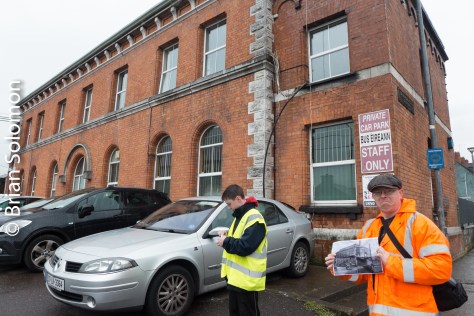
I arrived by Irish Rail’s Mark4 from Dublin. This view of Cork’s Kent Station (Glanmire Road) was made from the foot bridge over the right of way of the line to the old Summer Hill Station. I featured Kent Station in my book Railway Depots, Stations and Terminals.I’ve always liked Kent Station’s Victorian-era curved train shed. Exposed with a FujiFilm X-T1 digital camera.Irish Rail 201-class diesel 220 at Kent Station Cork on 7 May 2016. Lumix LX7 photo.Old footpath over the line to Summer Hill Station. Kent Station is 180 degrees behind this view.Site of Summer Hill station that once handled trains working the line toward Cobh.Detail of the iron work on the foot bridge near Summer Hill station.Kent Station viewed from the Glanmire Road bridge. The earlier Penrose Quay station was located to the right of the curved shed.Donncha Cronin holds a vintage photo of the Capwell Station at the old station building (now used by a Bus Eíreann maintenance depot). Historically, Capwell was the terminus for the Cork & Macroom Railway.Panoramic composite of the old Capwell Station (centre).Old railway gate at the site of Cork, Blackrock & Passage’s Albert Road Station. Lumix LX7 photo.Cork, Blackrock & Passage Railway’s Albert Road Station.The former offices for the Cork, Bandon & South Coast Railway near Albert Quay in Cork City.Quayside trackage on the Cork City quay.Right of way of the old Cork City Railway.Right of way of the old Cork City Railway.Perhaps one of the last vestiges of track relating to the Cork City Railway located near Albert Road in Cork.Perhaps one of the last vestiges of track relating to the Cork City Railway located near Albert Road in Cork.The old train staff that had been used to authorize train movements on the Cork City Railway. Photo courtesy of Kevin Meany.Site of the old Western Road station (now a hotel).Cork, Blackrock & Passage was originally a broad gauge line, later converted to a largely double track 3 foot gauge suburban railway (similar in concept to the Boston, Revere Beach & Lynn). Now a popular urban cycle path, seen here at Blackrock.Site of Blackrock Station on the Cork, Blackrock & Passage Railway.Near Monkstown Station on the Cork, Blackrock & Passage Railway right of way.Near Monkstown Station on the Cork, Blackrock & Passage Railway right of way.Ken Fox studies a sign illustrating the history of the Cork, Blackrock & Passage at Carrigaline, Co. Cork.A sign illustrating the history of the Cork, Blackrock & Passage at Carrigaline, Co. Cork.Site of the Crosshaven terminus of the Cork, Blackrock & Passage suburban narrow gauge.Irish Rail’s footbridge at Glounthaune Station. Lumix LX7 photo.Glounthaune Station.An Irish Rail 2600-series railcar passes the old container terminal at North Esk, last served by Irish Rail in summer 2005.
London boasts some of the most historic and most famous big city railway terminals.
Earlier this month I visited several of these stations during the course of my travels.
Soon Euston may be dramatically redeveloped. Yet, owing to its 1960s design, this terminal may be among the least photographed in modern times. FujiFilm X-T1 photo, May 2016.Euston Station, London.Departure boards at London Euston in May 2016. FujiFilm X-T1 photo, May 2016.
Hassard Stacpoole brought me on a tour of London’s 1960-era Euston Station to show me sites of anticipated changes to this busy terminus as result of its planned redevelopment.
My favorite London station is St. Pancras. Which is yours?
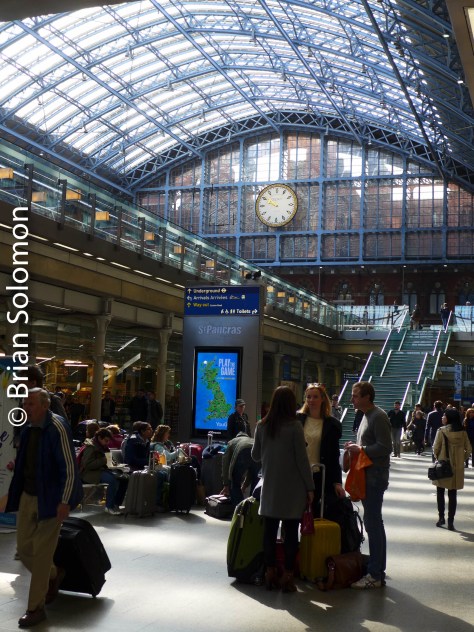
The most elegant and ornate London terminus is St. Pancras. The head house originally served as the Midland Grand Hotel as well as booking offices. Today the grand old building is again a hotel, while the station serves Eurostar trains to Paris, Lille and Brussels as well as domestic services using the old Midland route. FujiFilm X-T1 photo with Zeiss 12mm lens, May 2016.St. Pancras train shed was restored during redevelopment in 2007. FujiFilm X-T1 photo with 12mm Zeiss lens, May 2016.Kings Cross, London, May 2016. Lumix LX7 photo.Kings Cross, London, May 2016. Lumix LX7 photo.Grand Central train at Kings Cross, London, May 2016. Lumix LX7 photo.Statue of Isambard K. Brunel at Paddington Station, London. Lumix LX7 photo.Paddington Station, London. Lumix LX7 photo.London Victoria on a quiet Sunday morning. Lumix LX7 photo.
Tracking the Light presents new material every day!
Digital photography has made photography of the London Underground vastly easier than with film.
ISO 400 too slow? Notch it up to 1000, or 1600, or higher.
In the old days with film I’d rarely experiment with any lens longer than 100mm underground. Not only were my longer lenses relatively slow, but trying to keep them steady at low shutter speeds was impractical.
Today, I push up the ISO and snap away.
The adjustable rear screen on my FujiFilm X-T1 is a great tool for photographing from the hip. Back in the old days, I’d take the prism off my Nikon F3T for a similar technique, but this made focusing difficult.
I made these photos in Early May 2016. For me the Underground is more than just photos of the trains and tunnels.
Which is your favorite?
Lumix LX7 photo.Lumix LX7 photo at West Brompton.Telephoto view at Embankment with my Fuji X-T1.I like a bit of subtle humor or irony in my photos. FujiFilm X-T1 photo.FujiFilm X-T1 photo. Auto white balance is a blessing when working with artificial light.View of the Circle Line at Embankment.Some of the Tube is well below the surface.Bond Street Station at Oxford Street.
It’s been more than 40 years since British Railway’s HST (High Speed Train) made its commercial debut.
These comfortable diesel powered 125mph push-push train-sets have worked intercity services on a variety of routes ever since.
Today they are one of the few types of 1970s-era equipment surviving in regular traffic in the United Kingdom.
I detailed the history and development of the HST in my book Railway Masterpieces (Krause Publications, 2002). Here’s an except from my text:
“[British Rail marketed the HST] as the Intercity 125, a name obviously playing on the HST’s high-speed ability. The most successful aspect of the HST development and where BR really scored a coup was how they used the trains. Where the old school might had ordered just a few trains to offer just a handful of premier high speed services, BR introduced a full service of high speed trains on the lines west of Paddington. The Intercity 125 was not just fast, new, clean and more comfortable than older trains, but operated frequently as well and did not cost any more to ride. When the full HST schedule was in service, there were some 48 daily Intercity 125s. This was exactly the sort of convenience needed to lure people away from their cars, and the strategy worked.”
HST at Reading on the old Great Western Railway route from Paddington.Trailing view of an HST Class 43 locomotive power car at Reading. All HST sets work with Class 43 diesels at each end with Mark3 carriages between.Evening view of an HST at Reading. Exposed with my Lumix LX7.
Rebuilt HST sets continue to serve several private operators in Britain.
Earlier this month, I traveled on HSTs with my father, and made several opportunities to photograph the trains in some of their most recent paint liveries.
In the shadow of Mallard; a Virgin HST idles at London’s Kings Cross on 3 May 2016. Lumix LX7 photo.
We boarded at Lille Europe and flew a cross northern France on the ground. Breakfast was served to us by the staff. There was a minor delay at Calais and then we plunged into the darkness of the Channel Tunnel.
The Eurostar approaches! Lille Europe station is a modern facility with all the charm of an airport.Breakfast (with tea!) was served on board soon after departing Lille.In 1980, my brother was the first to photograph his meal (served on a World Airways DC-10). I’m following his example and not that of the millions of copycats.We sat at Calais for a while. At least there was some entertainment such as this ‘LeShuttle’.
Twenty Five minutes later we emerged again and were soon sailing across southern England toward London. My dad’s phone calculated our speed at 181 mph.
Soon the buildings began to look familiar. I recognized the M25 bridge.
English countryside blurring by at more than 180mph.Approaching London; there’s the M25 bridge.
And before we knew it we’d arrived at St. Pancras, London’s most elegant 19th century railway terminal. Last time I’d taken the Eurostar I’d come into Waterloo, and that wasn’t yesterday!
This is a selection of Lumix LX7 photos from the recent trip.
The famous balloon-style train-shed at St. Pancras was the first of its kind in the world.Morning sun filters through the skylights.Panoramic composite of our Eurostar set under the famous shed.There’s an hour time difference between Lille and London.In 2007, St Pancras was re-opened following a compressive upgrading of facilities. Do you remember the dark dingy hole of the mid-1990s?
Illustration versus documentation: Often I set out to document a scene. My process and techniques are focused toward making images that preserve the way a scene or equipment appear. Often, but not today.
Creation of an illustration may not be intended as documentation. An illustration is created to convey a message; perhaps that needed for advertising, art, or publicity.
While photographing in Bordeaux, I found that the juxtaposition of the modern trams against both modern and historic architectural backdrops looked remarkably like artist’s/architect’s impressional drawings.
So, as an exercise in illustration, I’ve intentionally manipulated the camera RAW files to make them appear more like the artist’s impressional drawings, such as those often displayed as visions of the future.
Specifically, I altered the contrast and de-saturated the color palate to mimic a water-color tinted image. I did not destroy the original files, and so I have the benefit of documentation and illustration with the same photos.
Questions:
Have I done anything fundamentally different here than with images created (augmented) by the manipulation of digital files to produce super-saturated colors, plus intensely contrast adjusted effects that result in dream-like sky-scapes?
Is a posed railway publicity photo that was heavily re-touched by air-brushing or similar alteration to be considered documentation?
In a later post, I’ll explore Bordeaux’s tram network in fully saturated color.
It was very windy, and I spent the whole morning standing around along the old Boston & Albany mainline reading about 19th century industrial practice while waiting for trains to pass.
I posted the photos I made of an eastward Norfolk Southern detour train near Middlefield, Massachusetts yesterday evening.
My goal was to catch the Ringling Brothers and Barnum & Bailey Circus Train, that was rumored to be on the move.
But, after 8 hours standing in the cold, I decided to head downgrade.
Nearing Westfield, the scanner came to life, ‘clear signal CP109’.
Time for a U-turn.
I’d scoped a location near Huntington.
Unfortunately this neatly coincided with a fast moving cloud. Bad luck.
A dark dirty cloud covered the sun at precisely the wrong moment. (It lifted in time for me to grab a wide-angle view on Fujichrome.)
A bit of hard driving got me to Washington Summit ahead of the train. The clouds stayed at bay.
All of these images were exposed with my FujiFilm X-T1 mirror-less digital camera.
Slides from the event remain latent.
Near Washington Summit at the location known as ‘Muddy Pond’.The Ringling Brothers and Barnum & Bailey Circus Train is a long consist.Containers and trailers were at the back.
Located in the north of France, Metz is an industrial city with a long history.
I’ll admit, I’d never given the place much thought until I had to change trains there in late April (2016).
Not only was the old city centre visually fascinating, but the railway station is a real gem!
That’s the great part about exploring without an agenda; you find wonderful things you really didn’t expect to see!
I made these images over the course of my brief visit using my Lumix LX7 and FujiFilm X-T1 digital camera (fitted with 12mm Zeiss Touit lens).
Interior architecture at SNCF’s Metz station. Lumix LX7 photo.Not an exhibit at the British Museum in London; no, this a bit of architectural detail at the Metz station.Metz Station exposed with a FujiFilm X-T1 with Zeiss 12mm lens.Main concourse of the Metz Station.Exterior detail: Metz Station exposed with a FujiFilm X-T1 with Zeiss 12mm lens.Luxembourg Railways railcar at Metz Station. Lumix LX7 photo.Here’s the next leg of my journey in France; a colorfully painted railcar.
On 21 April 2016, I had my First Class France Rail Pass Flexi validated at Basel, Switzerland.
My goal was by the first evening to reach Valenciennes (a city in northern France near the Belgian border) using only regional trains, rather than the TGV (plenty of opportunity for high speed travel later in my trip).
I found the challenge as in making local connections since these days SNCF focuses long-distance passengers onto high-speed routes. All very well, unless you want to experience secondary lines and ride trains off-the well-beaten path.
Thanks to Stephen Hirsch and Denis McCabe who helped with my planning, I traveled on a series of TER trains.
After four train-changes reached my destination 15 hours after I boarded the first train on the French side of Basel’s main station.
My first SNCF train was a loco-hauled push-pull service from Basel to Strasbourg. Exposed with my Lumix LX7.Among the benefits of SNCF’s secondary trains are large windows, ample space for luggage, and no requirement for advanced reservations which allows for spontaneous travel.I made good use of my pass, and proved a much better value than buying single tickets.Old school comfort. Proper 1st class railway travel. Lumix LX7 photo.Lumix LX7 photo; focus setting on ‘manual’.A rolling panorama of the French landscape.Plenty of locomotives and trains to be viewed from the window of the train.
Several lines come together at Rastatt, Germany, which is an historic city south of Karlsruhe.
Since most through traffic is focused on to a short double track section immediately south of Rastatt , the station serves as a holding area for southward trains queued up to pass through this bottleneck.
In addition to DB’s trains, freight is run by a of variety open-access and private operators. Freights share tracks with passenger trains including high-speed TGV and ICE services and the famous Karlsruhe tram-trains.
I made this selection of images on 19 April 2016 using my FujiFilm X-T1.
A Crossrail container train passes Rastatt on the morning of 19 April 2016.A DB electric leads at train of swap-bodies at Rastatt.An SBB Cargo electric waits for a signal to proceed south.The driver of a Crossrail electric cleans his windscreen while waiting for traffic to pass at Rastatt.A northward BLS freight crosses the double track bridge as it approaches the Rastatt station.Lines at Rastatt host a mix of freight and passenger trains including Regional Expresses.An electric hauled chemical train glides into Rastatt in the evening.Open access operators are plentiful in Germany.Four trains at Rastatt station, including a stopping Tram Train from Karlsruhe.Catching antique SBB Re 4/4s at work was a prize.SBB Re 4/4 electrics up close.A diesel leads a local freight from a nearby automotive factory.A northward SBB freight glides through Rastatt.Trailing view of the same train.A regional passenger train passes a freight.Once common, old DB class 151 electrics are now relatively rare on through freights.
I’ll offer Freiburg as one of Europe’s most colourful tram cities.
The combination of variety of cars, a range of paint liveries (advertising and otherwise), interesting trackage plus varied and interesting historic backdrops makes Freiburg hard to top.
Any suggested contenders?
Photos below exposed in April 2016 using my FujiFilm X-T1 digital camera.
Among my favorite German locomotives are the old ‘Rabbits’ (classes 215-218 and rebuilds), so-called because of their rabbit-ear shaped exhaust stacks.
On Monday, 18 April 2016, Gerry Conmy, Dennis McCabe, Stephen Hirsch and I made a project photographing this declining class of diesel on the line running east from Lindau.
Rabbit down grade racing toward Lindau.Double headed rabbit climbing east from Lindau with a Zurich-Munich IC train. Note the exhaust stacks.FujiFilm X-T1 photo.
The Zurich-Munich long distance trains are still worked with these vintage machines. Several years earlier, Dennis and I had explored locations on this scenic non-electrified double track line.
Soft morning light aided the effect of the pastoral setting.
I exposed these views using my FujiFilm X-T1 digital camera.