The Dublin and Kingstown Railway dates to 1834, which makes it among the earliest steam railways built outside of England.
Today the route composes a part of Irish Rail’s electrified Dublin Area Rapid Transit system. Outer suburban and Intercity trains (to Rosslare), plus occasional Railway Preservation Society Ireland steam trains also use the line.
Much of the old D&K is scenically situated along the Irish Sea, yet the electrification masts and wires, combined with sea walls, fences, graffiti and suburban growth can make it difficult to obtain a satisfactory vista with the line.
In late August, I rode the DART from Tara Street Station to Blackrock, where I exposed these views using my FujiFilm XT1.
My train accelerates away from the platform at Blackrock. The modern footbridge makes for a dominant visual element, but also offers a photo platform.A Dublin bound German-built DART train approaches Blackrock. I aimed to feature the terrace houses above the line while minimizing the visually obnoxious elements of catenary and graffiti covered seawalls.This view from the modern footbridge shows the old Blackrock Station. Here soft lighting is a real benefit.I applaud Irish Rail for installing attractive maps near the station. More of this please.
Looking toward Blackrock station and Dublin.A 29000-series diesel multiple-unit approaches Blackrock. I made this view from the public footbridge south of the station. Here the terrace houses make for added interest and a nice compositional element. The Irish Sea is on my left, but there’s a host of ugliness between the railway and the water.
Here, soft afternoon lighting helped minimize obtrusive elements, but there’s little in the photographs that convey the historic significance of the line.
The challenge continues . . .
Tracking the Light offers a daily views on railway photography.
It was dull mid-August day at Worcester, Massachusetts. I had my Leica 3A loaded with Ilford Pan F (ISO 50) and made a few exposures.
This hasn’t been my usual film choice. More typically, when working in black & white, I’d use Ilford HP5 or Fuji Acros 100.
I’ve found that difficult light can be a better measure of materials than clear bright morning. And flat summer light is about as difficult as it gets.
For this trial, I processed the film using a Jobo with Ilford Ilfosol 3 developer.
This was a crap shoot, as I’d only used this film/developer combination once before.
Exposed using a Leica 3A fitted with a Nikkor 35mm lens.
I opted for a 1:9 dilution, but scaled back my process time from the recommended amount to just 3 minutes 45 seconds. As is often the situation, I intentionally over-expose my black & white film and then under-process to obtain a greater range of tonality.
Once processed my negatives looked pretty good, but these still required a bit of contrast control using Lightroom. While my end results look ok, I’ll need to refine my chemical process for Ilford Pan F (ISO 50) if I expect this film to perform as well as Fuji Acros 100.
Also, I was hoping that the Pan F would approach the results I used to get with Kodak Panatomic X (ISO 32) back in the 1980s, but so far I’ve not achieved that goal.
Exposed using a Leica 3A fitted with a Nikkor 35mm lens.
It was a sunny Saturday morning and the old Boston & Albany mainline was quieter than a rural Polish branch line.
Finally about 10:30 am Mike Gardner and I heard distant stirrings of an eastward freight.
We made our way to Warren, Massachusetts.
The long days of summer have resulted in the B&A route becoming unfortunately brushed in. Much of the line is largely obscured by bushes, trees and undergrowth, which make railway photography difficult.
The old Boston & Albany station at Warren remains one of my favorite surviving structures on the line; it harks back to a time when the railroad was the principle corridor for commerce in the region. Recently it has been restored.
Here we made our photographs.
A few strategic shafts of sunlight illuminate the line. I set my FujiFilm XT1’s shutter release dial to ‘CH’ (continuous high—the setting I casually refer to as ‘turbo flutter’) and waited as the train approached.
When it neared the shafts of sunlight, I held the shutter down and exposed a rapid burst of digital images, knowing that at least of one of them would place the front of the locomotive in full sun.
This satisfied my desired composition to juxtapose CSX’s modern General Electric diesel with the 1890s-era railway station building.
To demonstrate the effect of ‘turbo flutter’ as a compositional exposure tool, I’ve displayed the below sequence of images. In practice my camera exposed about three times as many photos. (Frame numbers are sequential)
Since the real cost of making a burst of exposures is very small, in this situation, I’ll happily make as many images as I need to in order to produce the photo I want. Later, if I choose, I can throw away the unsatisfactory images to save space on my hard drives.
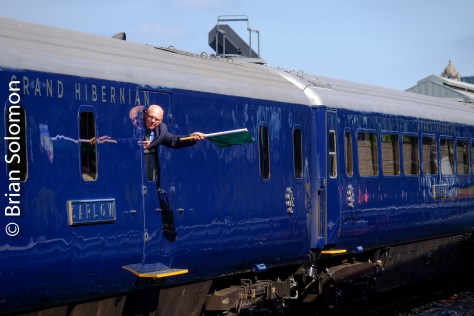
This afternoon, after years of planning and months of preparation, high-end hotel train operator Belmond debuted its latest train; the Grand Hibernian.
This departed platform 2 at Heuston Station at 2:20pm (30 August 2016).
I made these photographs of the train and its Irish Rail crew.
For the railway enthusiast this means the return of locomotive hauled Mark3 carriages to regular traffic.
All images were exposed a little while ago using my FujiFilm XT1 digital camera.
Train guards Noel and Mark at Heuston Station, Dublin.Each carriage is named for an Irish County. Sadly Mayo and Dublin were omitted.
Oy! Whosat goob?
Departing Heuston Station on the advertised.Green flag to depart.
Tracking the Light posts EVERY day and sometimes twice!
My last view. (Facebook, Twitter, Tumbler and Google Plus viewers may need to click on Brian Solomon’s Tracking the Light to see the big picture).
This former Boston & Albany freight yard was the site of some my earliest photographic efforts.
My last-ever view of Boston’s Beacon Park yard. Exposed in late-August 2016 using a Lumix LX7 and processed with Lightroom to adjust framing and contrast.
Several years ago, in a deal with the Commonwealth of Massachusetts, CSX agreed to close its Boston yard to open the property for redevelopment. As a result, its intermodal yard at Worcester was expanded to accommodate the lost capacity.
The result is that Boston now has virtually no through rail-freight service. The trickle of remaining CSX rail-freight traffic is handled by a local from Framingham, Massachusetts. Container (and piggyback) traffic is accommodated by road.
Many years ago, Boston was a major freight hub, and Beacon Park was a very busy place—those days have long since passed.
For the last few years, the tracks at Beacon Park have sat disused and rusted.
Presently, track gangs are salvaging what remains of the old yard.
Someone, somewhere will declare ‘progress’.
Ironically, I exposed this view from a bus on the Mass-Turnpike Extension, the highway that more than 50 years ago assumed operation on considerable chunks of former Boston & Albany right of way.
The familiar sound of 645 thunder down in the valley spurred me into action.
A southward New England Central freight was climbing Stateline Hill in Monson, Massachusetts. This is an old routine (and yes, I’ve written about this before.)
When I hear a train coming through Monson, I have a few minutes to get organized. In this instance, a brilliant clear blue dome with nice morning light was the deciding consideration.
En route, I heard the southward train get its ‘paper’ (radio–issued track authority) to proceed toward Willimantic, Connecticut. In this instance, I was alerted to the location of the train; south of milepost 55 (near the Massachusetts-Connecticut state line).
I headed for my preferred spot in downtown Stafford Springs, Connecticut south of milepost 49.
FujiFilm XT1 digital photo.
One advantage of Stafford Springs is that the railroad makes an east-west twist through the village on its otherwise north-south run. This favors the morning light for a southward train.
The other advantage is Stafford’s quaint and distinctive New England setting.
In the longer months, there’s nice morning sun on the north side of the tracks at Palmer, Massachusetts and this seems to offer a potentially good vantage point.
There are several interesting structures here: including the former Union Station (now the Steaming Tender restaurant) and the old Flynt building (painted grey and lavender with fluorescent pink trim).
Yet I’ve found that placing a train in this setting rarely yields a satisfactory composition.
Here’s the on-going compromise; using a wide-angle perspective if I place the train far away, it tends to get lost in the scene. And, yet when it’s too close it obscures the old station building. The Flynt building either dominates on the right, or ends up cropped altogether. A telephoto view here presents its own share of complications.
The other day, I turned on to South Main Street in time to see the CSX local freight (symbol B740) west of the New England Central diamond (crossing). This gave me just enough time to park the car, walk briskly across the street, set my exposure and use my FujiFilm XT1 to make this sequence of photos.
CSX local freight B740 has a pair of vintage GP40-2 diesels. To the left of the train is the old Palmer Union Station.This closer view obscures the station.The trailing view lacks a satisfactory sense of place. It is CP83 in Palmer, but it could be anywhere. Yet, it does offer a good view of the antique diesels and the signals, so that’s something.
Not bad for grab shots, but they still suffer from my visual quandary as described.
Puzzling through these sorts of vexations is part of my process for making better photos. Sometimes there’s no simple answer, but then again, occasionally I find a solution.
In the meantime I present my photos as work in progress.
Brian Solomon’s Tracking the Light is a Daily Blog.
Yesterday’s (August 25, 2016) Boston section of Amtrak’s Lake Shore Limited carried an American classic: the streamlined Budd-built observation car Babbling Brook, a former New York Central car of the type that operated on the New England States (Boston-Chicago).
My dad and I made photos of Amtrak’s eastward Lake Shore Limited (train 448) by the recently restored Warren, Massachusetts railroad station.
New York Central Babbling Brook passes the old Warren, Massachusetts station on August 25, 2016. The New York Central System leased the Boston & Albany in 1900. Central’s Budd-built New England States was B&A’s premier post-war passenger train and passed Warren daily. There were fewer line-side trees back then. This image was adjusted in post-processing using Light Room. I’ve tried to emulate the contrast and color palate of a late 1940s image.Telephoto view at Warren, Massachusetts.
I made these views using my FujiFilm XT1. Pop exposed a Fujichrome color slide with his Leica M.
Conrail SEPW (Selkirk to Providence & Worcester at Worcester, Massachusetts) makes a drop at Palmer, Massachusetts on May 6, 1984.
I exposed these two views from almost the same angle on the South Main Street Bridge in Palmer, Massachusetts.
In 1984, Conrail operated the old Boston & Albany, and the main line was then a directional double track route under rule 251 (which allows trains to proceed in the current of traffic on signal indication).
SEPW has stopped on the mainline, while the headend has negotiated a set of crossovers to access the yard and interchange. That’s the head end off in the distance.
I made this 1984 view on Plus-X using a Leica fitted with a f2.8 90mm Elmarit lens.
The comparison view was exposed on July 25, 2016 using a Lumix LX7 set at approximately the same focal length. Although similar, I wasn’t trying to precisely imitate the earlier view and was working from memory rather than having a print with me on site.
Exposed using my Lumix LX7. I used the ‘A’ mode and dialed in -1/3 to compensate for the bright sunlight and the dark side of the train. This image was extracted from the in-camera Jpeg and compressed for internet viewing, but I also made a RAW file of the same image. Both are to be archived on multiple hard drives.
Yesterday’s Tracking the Light featured the gripping headline:
“OH NO! I JUST WIPED MY CARD . . .”
And there I’ve told the story of how I accidentally erased my day’s finest efforts (and brought them back again.)
It’s bad enough to accidentally destroy your own work, but it’s especially galling to ruin the photos from such a great day. Bright sun, clear blue skies and a polished executive train moving a moderate speeds.
Simply we’d nailed the Pan Am train at multiple locations in great light, and there were several sets (groups of photos) that I was really happy about.
Followed by the sickening feeling of loss.
The day’s finest photos: GONE!
The film equivalent of this sort of disaster is the accidental opening the camera-back before rewinding, where-in you lose a half dozen photos or so, but if you close it up quickly you can usually save most of the roll.
The worse film-related catastrophe was when your box of film came back from the lab with a little green slip; ‘Owing to a unique laboratory occurrence, we are sorry to report . . .’
By contrast, my digital disaster was an easy fix (Click the link to read Monday’s post for details: http://wp.me/p2BVuC-4ih).
As I mentioned yesterday, when this sort of thing happens: avoid making it worse by continuing to use the card.
Although I’d ‘erased’ (wiped, zapped, cleaned) the camera’s memory card. In truth, all I’d done was erase the catalog. All of my photos remained on the card. Yet, resurrecting them was a slow painstaking process.
Here are some of my favorite photos that’d I never thought I’d have opportunity to post on Tracking the Light
Working west at Buckland. Exposed on a SanDisk Extreme PRO 32 GB memory car using my FujiFilm XT1. Erased accidentally and retrieved using RescuePRO Deluxe. For details see Monday’s Tracking the Light.My friend Tim D. was behind the wheel, and driving well-known back roads along the Deerfield River scored us this view near Charlemont, Massachusetts.This was a grab-shot near Zoar. I have to admit, it was this view that I was most disgusted having lost.Pan Am’s office cars disappear into Hoosac Mountain.A friendly wave near Eaglebridge, New York.Lots of folks were out for this view at Fisherman’s Lane in Schagticoke, New York.
I had that sinking feeling—like I just crashed into the county sheriff—Knowing I’d done a bad thing and that it was irreversible.
Or was it?
Here’s my lesson for you:
Saturday August 20, 2016, had been an exceptional day. Tim Doherty and I had followed the Pan Am Railway office car train with simonized F-units and a former Wabash dome along the old Boston & Maine.
From East Deerfield west we’d enjoyed a clear blue dome and made dozens of great shots.
Afterwards we stopped for lunch, and got news of a westward empty coal train.
There I was at Buskirk, New York. I knew the coal empties were getting close. I was reviewing the digital photos on the back of my Fuji XT1, watching for a headlight, and trying to dial the phone, when all of a sudden I noticed the back of the camera read, ‘no image’.
It was like a door slammed.
Off in the distance a coyote howled and the sky went dim.
“What have I done!”
Rather than completely panic I did two smart things:
I immediately shut the camera off.
I took the card out of the camera.
I always carry a spare card in my wallet; so I replaced my now unhappily blank card (formerly holding the day’s take) with my spare.
In this way I could carry on making photos without risking further loss. (That empty coal train was just minutes away).
Tim offered me some advice on retrieving my lost photos.
When I got home before I did anything else, I backed up what I could to hard drive on the computer; then I began the slow process of trying to rescue my lost files.
Luckily I’d been using a SanDisk ExtremePRO card. This had come with a link to SanDisk’s RescuePRO Deluxe software. I followed the instructions and over the next 9 hours my laptop was gradually able to retrieve the erased files.
Saturday’s photos were renumbered and mixed in with images from last April of trams in Bordeaux, France, but in the end all of my Pan Am OCS photos were safely recovered.
So more than 28 hours after my near-fatal mistake, I was finally able to view my photos of the Pan Am OCS in brilliant living color. Happy days!
PCC car at Kenosha, Wisconsin in July 2016. Detailed view exposed on Ilford FP4 using a Leica 3A with 35mm Nikkor lens. Kenosha, Wisconsin operates a short streetcar circuit between the Metra station and Lake Michigan. This car was originally from Toronto, Ontario.
Quantification isn’t the best approach. Yet, I like to consider various elements of the railway scene when reviewing my photography.
I realize that many photographers focus their work on those elements that grip their interest.
In my travels, I like to keep my spectrum as broad as possible. I’m always seeking to capture different scenes that relate to the railway as a whole.
Below are some of the many categories covered in my photography and in the posts on Tracking the Light. Undoubtedly some topics are more popular than others.
North American Class 1 lines.Freight cars.Suburban railways.Mainline steam trips.Signals.Railway maintenance equipment.Railway precursors.Subways and rapid transit.Train crews.Light rail and streetcar systems.North American short lines.Railway tracks.Preserved railways.Abandoned railways.Heritage streetcar lines.Maintenance trains.Amtrak.Railway bridges.Railway stations.Trolley museums.Disused lines.Advertising liveries.Industrial railways.Tourist trains.
During one of my recent Metrolink blitzes, I rode from Los Angeles Union Station to Santa Ana where I changed for an Inland Empire-Orange County Line train running from Oceanside to San Bernardino.
I timed this brief visit to coincide with a flurry of Amtrak and Metrolink trains. I had just 45 minutes to make images of this classic Santa Fe station having never previously explored here.
I found Santa Ana to be an excellent mid-morning location.
The footbridge is photographer friendly and the old Santa Fe building makes for a suitably California setting. The height of the bridge allows for both distant telephoto views as well as wide-angle down-on photos.
I exposed these views digitally using my Lumix LX7 and FujiFilm XT1.
I arrived on Metrolink train 600 from Los Angeles Union Station. I had enough time to walk to the headend and expose this view with my Lumix LX7 before the train departed.Metrolink 687 arrives behind a borrow BNSF AC4400CW. This framed view was exposed using my Lumix LX7.A Metrolink F59PHI works at the back of Los Angeles bound train number 687. Here my Fujinon 18-135mm lens gave me a nice view of the train and station from the footbridge.Metrolink 633 is among Metrolink’s services that doesn’t serve Los Angeles Union Station. This is a short-turn that runs from Laguna Niguel/Mission Viejo to Fullerton.By using my 18-135 zoom on my Fuji XT1 I was able to exposed a series of trailing photos of Metrolink 633 as it accelerated away from Santa Ana.This is a telephoto view of train 633 from the same vantage point as the photo above.Metrolink’s timetable shows both of its services to Santa Ana as well as Amtrak’s Pacific Surfliner.A detailed view of the Santa Ana station exposed using my FujiFilm XT1.Amtrak 566 Pacific Surfliner slows for its station stop.Metrolink 802 will take me to San Bernardino. I arrived under partly cloudy skies and departed under a California blue dome. Happy days!
Yesterday on Tracking the Light I displayed views of Metro Rail from the First Street Bridge in Los Angeles.
Here are few views of trains from the bridge.
This scene reminded me of Germany’s Rhein Valley with busy lines on opposite sides of a river; except cast in concrete, without much water or unspoiled scenery, hemmed in by urban growth and decorated with graffiti. Oh, and the trains are diesel-powered rather than electric.
A BNSF AC4400CW works toward Los Angeles Union Station with Metrolink train 607.At the back of 607 is a Metrolink MP36PH-3C diesel.Union Pacific light engines on the east bank of the LA River.Railways in stereo. An outbound Amtrak Pacific Surfliner can be seen on the west bank, with Union Pacific diesels on the east side.On its way to San Diego, Amtrak’s Pacific Surfliner against the LA skyline.
The broad, largely dry concrete channel is symbolic of the chronic drought in Southern California.
Although unworldly, the environment around the Los Angeles River is undoubtedly familiar to many people because of its prominent role in Hollywood Films and popular television.
Metrolink runs the Los Angeles-area heavy rail commuter/suburban services. Metro Rail runs LA’s subway and light rail lines.
Earlier this month (August 2016), I made some views of the Gold Line extension to Atlantic from First Street. This offers some nice views of the cars with downtown Los Angeles skyline.
Looking east toward Atlantic. Gold Line’s Pico/Aliso stop can be seen in the distance. (Not to be confused with Pico on the Blue Line/Expo Line that is located southwest of downtown. Just in case you were confused).This trailing view of an in bound Gold Line set was made with a slightly wide-angle focal length using my FujiFilm X-T1.Here’s the same light rail train exposed from the same vantage point, but using a telephoto focal length, which compresses the distance and allows for the skyscrapers to visually loom above the road. A secondary benefit from this perspective is that it crops out the high-voltage wires that featured prominently in the earlier view. (Not so good, of course, if you are a wire enthusiast!)
To pull in the skyline, I used a telephoto lens, which makes the buildings seem larger when compared to the light rail cars. When taken to extremes this effect can make the skyscrapers appear surreal.
I was keen to explore one of the Los Angeles-area’s most recent light rail extensions: Metro Rail’s so-called Expo Line that runs west from a connection with the Blue Line (near downtown) and roughly follows the alignment of an old Pacific Electric route along Exposition Boulevard to Santa Monica.
The portion of the line from Culver City to Santa Monica was opened in May this year, and so still has that newly-built appearance.
LA Metro Rail pays tribute to the old Pacific Electric at its stations with artwork and historical interludes.
Attention to the platform art will yield the viewer bits of history and PE heritage.
Using my Lumix LX7 and FujiFilm X-T1 I made these images under bright sunny skies. Yet, I wonder about the opportunities for evening and twilight images on this line?
The Expo Line’s largely east-west alignment combined with LA’s propensity for air-pollution should present some impressive lighting conditions.
I’m not the first observer to embrace the pictorial effects of Los Angeles air quality.
Perhaps a visit with a very long lens during a smog alert could yield some colorful results?
A telephoto view exposed with my FujiFilm X-T1 of a modern light rail car approaching Santa Monica.The Expo Line features a variety of light rail equipment, which is an uncommon feature for such a new line. Exposed at Santa Monica with my FujiFilm X-T1Many stations are decorated with artwork and embellished with historical tidbits. Exposed with my FujiFilm X-T1Expo Line station at Santa Monica.A Lumix LX7 view of an LA-bound car departing Santa Monica.Trailing view of the same cars. Metro Rail is advertising the Expo Line on the side of this car.An old car in new paint graces the streets of Santa Monica. LX7 photo.Clean new signs are a feature of the Expo Line extension.Outbound cars at Jefferson. Lumix LX7 photo.Jefferson; cars stop just long enough to make a photo before boarding. This one is 1027; do YOU remember the significance of that number?
At Pico, the Expo Line shares platforms with the Blue Line (that runs to Long Beach). Careful, you might board the wrong car outbound!Pico looking toward downtown LA. Lumix LX7 view.
For more on the Expo Line see this article in the LA Times:
It was more than 25 years ago that I made this evening view at Pinole, California using my Leica looking west across San Pablo Bay toward Mt. Tamalpias.
Fog rolls in from the Pacific; and the SP was still the SP.
Exposed with a Leica M2 with 50mm Summicron on Kodak Tri-X processed in Agfa Rodinal.
Back in the day, Southern Pacific’s famed Daylight was often pictured crossing Santa Susana Pass—a scenic cleft in the rocks between Simi Valley and Chatsworth, California.
Once a remote area, this is now hemmed in by suburban development, freeways and public parks.
Riding Metrolink, I’d noted several potentially interesting locations on the west side of the pass (SP timetable west, today Union Pacific timetable north).
Reviewing Google Maps, I found that views of the line should be accessible from Corriganville Park, located a little ways to the east of Simi Valley. So one afternoon last week, David Hegarty and I made an exploration of the area.
There’s a flurry of Metrolink and Amtrak trains in the evening. We found some locations near CP Davis (location of a passing siding) with an aim to make images of BNSF GE-built AC4400CWs that have been working many Metrolink trains.
A BNSF General Electric-built AC4400CW works Metrolink 118 near CP Davis on the west (north) side of Santa Susana Pass.A few of Metrolink’s F59PHI diesels have the full paint treatment completed with blue and aqua ribbons. It was nice to get this one working with a bit of scenery on train 117 from Los Angeles.Although not the prettiest locomotives, Metrolink’s boxy model F59PH diesels make for a bit of variety. Here train 119 is seen near tunnel 26.Amtrak Pacific Surfliner, train 790, featured a GE Genesis P42 instead of the Amtrak F59PH’s more commonly assigned to California services. The engine is at the back of the consist working in push-pull mode.
I exposed these images with my FujiFilm X-T1 digital camera, but I also made a few color slides that will be processed at a later date.
Back in 1994, I’d made a project of Southern Pacific’s famous Coast Line focusing on the line between Watsonville Junction and Santa Barbara, California.
Traffic was sparse compared with other SP mainlines. Yet there were 2-3 through freights in each direction daily, plus Amtrak numbers 11 and 14—the Coast Starlight.
Last week, I decided to revisit Gaviota, California to make photos of the Coast Starlight. I often require images of this popular train as illustrations in books and magazines, and my 1994 Kodachrome slides are now a bit dated.
However sparse through freight was on the Coast in 1994, it was busier then than now. I neither saw nor heard of any Union Pacific trains on the move during my exploration, and the only active UP presence I noted was that of a passing HyRail truck and a track gang.
Looking Southern Pacific timetable east (Union Pacific direction south—and never you mind the compass) Amtrak’s Seattle-bound Coast Starlight works along the Pacific Coast on the bluffs above Gaviota. Exposed using a FujiFilm X-T1 digital camera in August 2016. SP’s Daylight look especially fine here.
Amtrak 14 was on time and the pleasant mix of sun and coastal mist made for a nicely lit scene that captures the spirit of this supremely scenic run.
Perched atop a high hill in a purpose-built building in Simi Valley is Boeing 707 27000 that served for nearly three decades as Air Force One.
Boeing’s 707 is unquestionably one of the most beautiful commercial aircraft.
This 707 was styled by pioneer industrial designer Raymond Loewy for its role as Air Force One.
Loewy is well known in railroad circles for his locomotive and train designs. This included Pennsylvania’s GG1 electric and S1 Duplex steam locomotive, and Northern Pacific’s post-war North Coast Limited streamliner.
Panoramic composite exposed with a Lumix LX7.Working in silhouette, I made this low angle view to show the lines of the 707.
Under the belly of the plane.Classic Loewy styling.
Air Force One is a key display at Simi Valley’s Ronald Reagan and Air Force One Museum. I exposed these photographs using my Lumix LX7.
Metrolink is nearly a quarter century old, having commenced operations in 1992.
Over the last couple of weeks I’ve enjoyed traveling and photographing the Los Angeles-area Metrolink. The comfortable coaches, variety of locomotives, and interesting route structure makes it one of the more interesting suburban railways in the United States.
Interior view of a Rotem double deck
In addition to lines focused on Los Angeles Union Station are several non-radial routes/services, which makes Metrolink unusual among American commuter lines.
All trains are diesel powered with double-deck cars. The newer Rotem-built cars are my favorite to travel in.
Detail of a Rotem-built double deck.
Using my Lumix LX7 (and other cameras), I’ve made dozens of images from the train, as well as interior views of the equipment, and of course views of the trains and stations.
One of the older cars.Rotem double-deck detail.Rolling along through suburban LA.Passengers board a morning train.Rolling toward Los Angeles Union Station behind a BNSF AC4400CW.Paused at Riverside.BNSF local freight at San Bernardino.
A pair of Bord na Mona loaded trains work west toward Lanesborough, County Longford on August 9, 2013.
I made this image on Ireland’s three-foot gauge Bord na Mona (Peat Bord) near Lanesborough on this day three years ago.
To compress the space and make the most of the two trains following one another in close succession, I used my Canon 7D fitted with a 200m telephoto lens.
Tracking the Light is on Autopilot while Brian is Traveling!
Combine agricultural dust from the San Joaquin Valley with Los Angeles-area air pollution and you get some wonderful golden light. Throw in a few wild fires and it gets even better!
All that pollution acts as a huge red-orange filter.
On this evening in late July 2016, fellow photographer David Hegarty and I were fortunate to be in place in the California Tehachapis to make good use of the golden light.
As previously featured on Tracking the Light, the railroad was a bit backed up. This enabled us to find a train at the moment of sunset.
A timetable-southward BNSF freight gets a green signal at Belleville, California. FujiFilm X-T1 photo. Image was not altered in post processing except to scale for internet presentation.California golden glint; exposed digitally using a Fujifilm X-T1 with 18-135mm lens. Sorry about the wires. I’d crop them, but then the photo would have been ‘altered’. Right?Here I’ve included the setting sun. This shows the angle of the light relative to the train necessary to produce the glint effect. I’m standing at the Bealeville grade crossing.
These images have not been altered digitally in post processing, except for scaling necessary for digital presentation. To maintain the rich rosy glow, I selected a daylight white balance, and was very careful with my exposure, which I selected manually to maintain texture in the sky.
And yes, I also exposed a slide using Fujichrome Provia 100F.
I made these views at Los Angeles Union Station the other morning featuring some of Metrolink’s Electro Motive Division-built F59PHIs.
These locomotives were styled in accordance with mid-1990s General Motors automobile aesthetical considerations.
Today, with two decades of hard service behind them they look like battle worn machines and reminded me of the Penn-Central E-units I used to see as a kid.
Using my FujiFilm XT1, I made some detailed studies of several of these old machines.
For this view I wanted to include the tower to the left of the station. To make the composition work, I used my Zeiss 12mm Tuoit, which had secondary effect of providing a suitable color palate for the scene. Notice the optical illusion at the very top of the frame that makes the edge of the photo seem skewed. Still using the Zeiss 12mm, I walked up close to the old F59PHI and made this slightly unusual perspective. A little bit of contrast control was needed in post processing.Metrolink 880 has evidence of a collision. The nose section is made of of fiberglass and designed to help protect the crew. Exposed with my Fujinon 18-135mm lens.
Here’s a vertical format view made from the same angle. Which do you prefer?Nose comparison. I’ve always liked this sort of image where a locomotive’s shape is echoed. In the old days I’d do this sort of thing with E and F units.
Having been stuck in a few Los Angeles area-tailbacks lately, I’ll say, it’s no fun. However, when the railroad gets jammed, it can make for some bountiful photographic opportunities.
Union Pacific owns and dispatches the old Southern Pacific route over the Tehachapis, yet BNSF (operating on a trackage rights arrangement inherited from the Santa Fe ) runs the lion’s share of the traffic. The mix of UP and BNSF plus outstanding scenery and blazing sun have the stage set.
To adapt a hackneyed Hollywood phrase; ‘Light, cameras, action . . .’
On this late July afternoon UP wasn’t having a good day. One of its northward trains developed braking problems descending near Cable and northward trains began to stack up behind it, including the BNSF ‘Earthworm’ unit grain train that we’d photographed earlier in the day (see: The Earthworm and a Joshua Tree)
UP’s southward trains hadn’t faired much better; as a very heavy manifest had struggled upgrade at a walking pace adding to more congestion.
By evening, UP’s northward train had reached Caliente, where it held the mainline short of the first intermediate signal (as instructed by the dispatcher),while a BNSF southward manifest was in the siding.
More southward trains were coming behind this train, as the loaded northward earthworm crawled downgrade and stopped at the pit of the Caliente horseshoe, short of the grade crossing.
Gridlock!
Three trains at Caliente and nothing moving. Furthermore, a pair of UP Z-trains were making a meet at Cliff.
At this point it was like shooting fish in a barrel, to use another handy cliché, and the evening light was only getting better.
Stay tooned! 😉
Trains on all tracks and nothing moving; UP DPUs on the back of a northward freight holding the mainline, a BNSF northward train in the siding, while on the upper level of the horseshoe is the BNSF ‘Earthworm’ grain train, with its headend holding on the opposite side of the grade crossing behind me.Head-end of the Earthworm grain train. Just standing there in warm California sun. I think Kodak exited the Kodachrome business too soon!Finally, the BNSF Earthworm gets a signal. Here’s today’s photo lesson: By shifting the focus from the locomotives to the ballast in the foreground I’ve altered the natural perspective. Essentially, I’m tricking the eye into looking down and this focus combined with the pastel lighting makes the scene seem more like a diorama. Of course you may need to view this image larger than 3×5 inches to get the full effect.Ok, enough playing around, here I’ve focused on the main event as the rails have begun to squeal.Looking railroad timetable north (formerly this was west under the old SP timetable) the earthworm descends toward Bakersfield.Here we have the first set of DPUs (distributed power units—railroad speak for un-manned radio-controlled remotely-placed locomotives.)And a new BNSF GE-built Tier IV works as a second set of DPUs at the back of the grain train.Some quick driving to a pre-selected overlook granted me a final view of the Earthworm as it rolls along Caliente Creek. Who said, ‘you can’t have your cake and eat it’?
The magnificence of the former Southern Pacific crossing of California’s Tehachapi Range is the antique sinuosity of the line combined with the bucolic nature of the terrain and unusually heavy freight traffic.
Last weekend, I made these views near Tunnel 2 between Bealeville and Caliente using my FujiFilm XT1 digital camera.
On the SP this would have been an eastward train, today on Union Pacific it is considered southward. In both situations movement directions are by the timetable and have little relationship to the compass.
Like a long snake, the train winds its way uphill toward Tehachapi Summit.At the back of the train is another GE Tier 4 (ES45AH) working as a ‘Distributed Power Unit’—a radio controlled engine.
A nearly new Union Pacific GE tier 4 in fresh paint was an added attraction to the uphill Z-train (UP’s term for a priority intermodal run).
Last weekend, I gazed down upon that famous spiral officially known on the late Southern Pacific as Walong, but to the rest of the world as the ‘Tehachapi Loop’.
It was, and still is, one of the great places to watch trains; and on this day it didn’t disappoint. I’d been away a long time and now I was back.
The last time I was here, I’d stayed with my friends Dave and Helen Burton, who lived just over the hill on the north side of the spiral. Back then, Southern Pacific still owned the line, and the merger that was to consume the Santa Fe Railway was still more than a year away.
Now, SP, Santa Fe, and Dave and Helen are all just memories.
It was strange to watch a train traverse the loop. I was delighted to see it, but sad. It was like seeing some weird vision of the future.
So, I made these images—my first digital photos of this often-photographed landmark—while thinking back to earlier times.
I dedicated books to both of my friends: to Dave, I dedicated my BNSF book of 2005.
Last week (July 2016) I went for a spin on some brand new Kinkisharyo model P3010 light rail cars on the Los Angeles Gold Line extension to East LA.
Although the cars read ‘Test Train’ in the destination board, they were in fact running in revenue service. The automated station announcements hadn’t been activated, so instead a real live employee was calling out the stops.
The cars were shiny and still had that ‘new car’ aroma.
Pretty neat.
I made these photographs with my Lumix LX7
A pair of new Kinkisharyo cars approach the Gold Line station at Little Tokyo. Although it reads ‘Test Train’ in the destination board, I was still able to board the cars and take a spin.For interior views such as this one, I use the ‘+1/3’ exposure override feature in combination with the ‘A’ setting on my Lumix LX7. This helps compensate for the outside light streaming through the windows. In post processing, I made adjustments for contrast that help even the scene.Clean and shiny.Test train at Atlantic, the new terminal for the Gold Line in East LA.LA Metro Rail advertisement on the side of the car.New cars accelerate away from the platform at LA Union Station.
Former New Haven Railroad station at Windsor, Connecticut.
Low morning sun diffused with light fog (mist) from the Connecticut River made for nearly ideal lighting to capture this station’s classic architecture.
Tracking the Light is on autopilot while Brian is traveling.