On the evening of August 2, 2015, I made these photos of Dublin’s LUAS trams gliding along Benburb Street near Heuston Station, just a short walk from my old apartment at Islandbridge.
These are unaltered JPGs scaled from larger JPGs made by my old Lumix LX7 digital camera. I set the white balance to ‘auto’ and let the camera make the color temperture adjustment internally.
One of the nice things about digital photos is that every file has a date stamp, so when I want to find a photo from exactly six years ago, the process of locating it is relatively straightforward.
Twenty years ago on a visit to Germany, I spent a couple of days photographing around the historic city of Dresden.
This black & white photo at the Dresden Neustadt station features a former DR (East German Railways) Russian-built diesel-electric, DB class 234, a type colloquially known as a ‘Ludmilla’.
June 2001.
Working with myvintage German-made Rolleiflex Model T, I made this photo on 120-size Fuji Neopan 400 roll film. I processed the film in Agfa Rodinal Special (not to be confused with Agfa Rodinal) mixed 1-32 with water for 3 min 45 seconds. I scanned the negative using an Epson flatbed scanner.
I’ve been reviewing 40 years worth of Amtrak photos for an article I’m writing for a German magazine.
In the mix of old chromes was this 2003 view of the eastward Lake Shore Limited east of milepost 129 between Chester and Middlefield, Massachusetts on CSX’s old Boston & Albany mainline.
Relatively few of Amtrak’s P42 Genesis diesels were painted in the short-lived Northeast Direct livery, making this a relatively unusual photo.
Working with a Nikon fitted with an f2.8 180mm telephoto, I was trying to make the most of a heavily backlit situation in early October. In situations like this I’d typically use my notebook to shield the front element of my lens to minimize the effects of flare. Backlighting autumn foliage helps accentuate the colored leaves.
On this day Amtrak was the booby prize; I was really after the Ringling Brothers Circus Train that was coming east from Selkirk Yard. And that photo is stored in a different file.
There was a low ceiling at Crawford Notch, NH the other evening. The tops of the mountains were in the clouds, yet the tracks and station were clear from mist.
Kris & I arrived after sunset when there was just a hint of daylight remaining. Regular readers of Tracking the Light may recognize that I like to make photos at twilight, and often work my cameras when there is very little light remaining in the sky.
Below are three interpretations of the same Nikon NEF RAW file that reflect minor adjustments to contrast, color temperature and color saturation.
The old Pennsylvania Railroad Middle Division is a favorite stretch of railroad.
I first visited this location on the heavily traveled east-west trunk route back in 1988 with my old pal TSH.
In November 2001, Mike Gardner and I were on a week-long photograph blitz of Pennsylvania and paused a Mifflin for a few hours to make photos of the action.
A Norfolk Southern eastward freight led by a former Conrail DASH8-40C rolls by the old Pennsylvania Railroad station at Mifflin, PA.
I exposed this Fujichrome color slide using my Contax G2 rangefinder fitted with a 28mm Zeiss Biogon lens. The Zeiss lens was extremely sharp from corner to corner while offering exceptional color rendition.
July 3, 1992, I was poised on a hillside in Talent, Oregon to photograph Southern Pacific’s eastward RVME-M (Roseville to Medford manifest) on the sinuous Siskiyou Line
My Nikon F3T was loaded with Kodachrome and fitted with a 35PC lens.
An unfortunate cloud drifted in front of the sun moments before the freight descended into view.
Last night I opted to import a scan of this dark chrome into Adobe Lightroom where I imposed a series of small adjustments.
Below are two images: a scaled version of the othersie unadjusted scan, and my re-interpreted photo.
I can’t change the clouds, but I can lighten the image and adjust the color temperature and contrast to make for a nominally more pleasing photo.
Unaltered scan of SP’s RVME-M at Talent, Oregon.My re-interpreted image.
On this date, July 17, 2010, I exposed this series of digital images with my Canon EOS 7D fitted with a prime Canon f2.8 24mm lens.
This camera was very new to me at the time. It was my first digital SLR and I had purchased it on advice of Chris Guss just a month earlier.
I bought it to augment my first digital camera, a Lumix LX3 (first of four similar cameras).
I was traveling with David Hegarty, and we caught Pan Am Southern’s intermodal freight symbol 22K passing through the curves on the Boston & Maine Fitchburg line at North Pownal, Vermont.
This famous photographer’s location is located in the far south-west corner of the state.
This morning, I made some nominal adjustements to the Canon RAW files using Adobe PhotoShop to correct for color temperature and bring in detail in the shadows and highlights.
In October 2005, I traveled with Delaware-Lackawanna’s PT98 that operated from Scranton to Slateford Junction, Pennsylvania.
At Tobyhanna the eastward freight stopped to switch, and I made a few photos on Fujichrome using a Nikon F3. It was pouring rain, so I made the best of it.
I scanned this image using a Nikon Coolscan 5000, and adjusted the TIF raw file in Adobe Lightroom to correct the color temperature and color balance while adjusting contrast and shadow detail.
Gray Locomotives in High Sun—Variations on a theme.
High sun—when the sun is at or near the highest point in the sky—can be a difficult time to make railroad photos. The harsh contrast presented by midday light makes for unflattering and abrasive visual conditions. But does that mean we should refrain from photography? I know many photographers who might say ‘Yes.’
Last month on the way to Moosehead Lake, Kris Sabbatino and I paused at Pan Am Railway’s sprawling Waterville Yard where we made a few photos of a freight sitting near the east end of the yard.
Guilford painted GP40s are a rare item these days, and worthy of documentation. Soon all of Pan Am Railways may be swept into CSX, giving a growing urgency to photographs of this New England railroad system.
I made several images of the GP40s idling in the yard using my FujiFilm XT1. In Post processing, I adjusted the camera RAW files making slight changes to contrast, exposure and color temperature. Below are four similar variations of the same scene.
These top two variations were created from the same RAW file and primarily differ in the interpreatation of color and contrast, whith particular attention to lightening the shadow areas on the top image.
On October 8, 1992, I made this Kodachrome 25 slide of the old Boston & Maine station building at Woodsville, NH.
Although a relatively subtle quality, notice that the verticals are parallel with the sides of the photo. This was made possible by working with a Nikkor 35mm PC (Perspective Control) lens. This had an adjustible front element used to keep vertical lines from visually falling away from the film plane (when the camera was kept level).
I miss my old PC lens, which I sold in 1997.
The line in front of the Woodsville Station was lifted in the mid-1990s.
Last night Conway Scenic Railroad operated its annual Firecracker Expresses to carry spectators from Conway to North Conway for a patriotic fireworks display.
Although it had been raining all afternoon, the sky cleared off at sunset, and the fireworks went ahead as scheduled, beginning just after 930pm.
As part of of my role as Conway Scenic’s Manager of Marketing & Events, I helped organize our special trains and their promotion. Several hundred people rode the trains which operated as advertised.
My Fiancé Kris Sabbatino and I traveled on the Firecracker Express to North Conway and made photos of the railroad’s iconic station and the explosive displays.
It was an excellent event.
Working with my Nikon Z6 Mirrorless digital camera mounted on my antique Bogen tripod, I made a variety of time-exposures.
Years ago I’d photographed fireworks using color slide film. I realized that I hadn’t done this in a long time and this was my first serious effort to capture a fireworks display digitally. I was a bit rusty at getting my timing right, but after missing a few of the loud bangs in the sky, I managed to refine my technique.
Working with the camera at ISO 200, my exposure times ranged from 4 seconds to 30 seconds, while I varied my f-stop between 4.0 and f11.
In general, I found I obtained my most satisfactory results at about 10 seconds at approximately f8.
After exposure, I imported the camera’s RAW NEF files into Adobe Lightroom for contrast and color adjustment. Through this technique I was able to improve the sky detail and balance the appearance of the images to reflect the scene more closely as I saw it. The benefit of the Nikon Z6 is its sensor’s exceptional dynamic range.
In 1990, I’d bought a second-hand F4 Nikkor ‘prime’ 200mm telephoto. For several years I made great use of this lens to photograph trains across the West.
Through the 1990s, my photography was telephoto heavy.
These days, I’ve shifted my focal length wide.
Most of my digital photos are made with focal lengths between 16-70mm (super wide to short telephoto).
But, when I tend toward the longer telephoto range, I still reach for my film cameras.
Partially because I have several excellent long telephotos for my Canons, but also because when I think ‘long’, I think film.
So when Kris Sabbatino and I visited the Junction at ‘East Northfield,’ Massachusetts on March 8th (2021), I made this long view on Ektachrome using my old Canon EOS-3 with f2.8 200mm lens. This winning camera-lens combo has served me well for nearly 15 years.
Perhaps, it helps that I’m photographing a classic train with 1960s-1970s vintage EMD diesels bracketed by searchlight signals.
New England Central southward 611 approaches the junction at East Northfield, Massachusetts on March 8, 2021. Ektachrome 100 slide film.
I made these images the other night when Kris & I were photographing the St Lawrence & Atlantic’s westward road freight (train 393).
Night photography isn’t easy, or straight forward.
There’s a variety of approaches.
These images were exposed during the last hints of daylight.
To capture the train in motion in very low light I used a ‘secret combination’: a telephoto with a wide maximum aperture and a high ISO setting on the camera.
The telephoto minimizes the relative movement of the train to the camera sensor; the wide aperture lets in greater amounts of light and thus allows for a faster shutter speed. Likewise, the higher ISO also contributes to using a faster shutter speed.
However, the real secret was exposing manually, taking into account of the very bright headlights relative to the over all scene, while taking a position relatively off axis to the headlights to avoid the very bright lights directly hitting the front element of the lens.
FujiFilm XT1 with f2.0 90mm lens, camera set to ISO 3200 and 1/60th of a second.
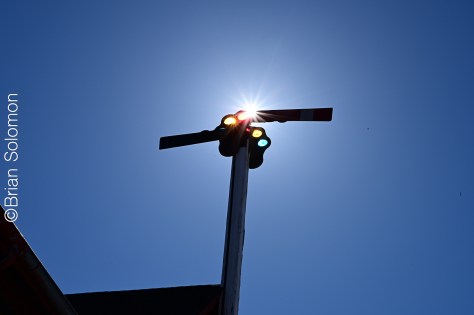
We paused last winter at Ely, Vermont where I made this silhouette on Ektachrome of the old Boston & Maine station and its historic train order semaphore.
This was one of several slides I made that day of railroads in Vermont.
Why film? Because it works. Because some photos made on film wouldn’t as well if exposed digitally. But most importantly, because I like film. I made my first Ektachrome color slide c1971, and some 50 years later, I still occasional expose slides.
Canon EOS-3 loaded with Kodak E100; 40mm Canon pancake lens set at f22. Film processed by AgX lab. Slide scanned using an Epson V600 flatbed scanner.
The long days of summer offer a rare opportunity to catch Genesee & Wyoming’s St. Lawrence & Atlantic through freights in daylight.
Last Friday, 25 June 2021, my fiancé Kris Sabbatino and I drove to Locke Miles, Maine, east of Bethel, where we set up along South Pond to wait for the westward freight, job 393.
The light was fading when we finally heard a distant whistle.
Our friend Andrew Dale had been keeping us updated as to the trains’s westward progress.
I made this image of the leading locomotives reflecting in South Pond using my Nikon Z6 mirrorless digital camera. I set the ISO to 800, the aperture to f4.0 (my widest setting), and the shutter speed to 1/100th of a second.
After the train passed we pursued it West into the night.
24-70mm Nikkor zoom set at 53mm. Full frame sensor
In April, Kris Sabbatino & I made a visit to Cape Cod, where we spent a morning at West Barnstable photographing the Mass Coastal and visiting a chicken farm.
Mass-Coastal operated a ballast train with its rare GP28 (as previously featured on Tracking the Light). Working with my vintage Canon EOS-3 with 100-400mm image stabilization zoom, I exposed a slide sequence on Kodak Ektachrome E100 reversal film.
The film was processed by AgX lab in Michigan, and last night I scanned a few of the slides using a Epson Perfection V600 flatbed scanner powered by Epson software. After scanning, I imported the TIF files into Adobe Lightroom for color and contrast fine-tuning.
My finished results are below.
Mass Coastal GP28 with_Ballast train at West Barnstable, Massachusetts, 1138am 23April2021._Mass Coastal GP28 with_Ballast train at West Barnstable, Massachusetts, 1138am 23April2021._
Finding trains on CP Rail’s Moosehead Subdivision requires patience and good luck. On our visit last weekend Kris Sabbatino & I found that operations consisted of basically one road freight in each direction a day.
Moosehead Lake is an area of exceptional scenic beauty and Greenville, Maine is a lovely rural town with several fine places to eat. We only spent a small portion of our visit to the area line-side waiting for trains, but kept our ear to the ground anticipating the sounds of an approaching freight.
Several times, Kris heard or spotted a train before I did. And this was a huge help in getting into position line side with time enough to make photos of the passing freight.
One evening at Greenville, we heard a distant whistle, and drove west to the old Greenville Junction station to photograph its passage.
Lighting at the station was tricky. The evening sky exhibited subtle hues of magenta and blue, while the station building was in shadow. Light levels were low enough to require a high ISO setting on the camera to stop the action.
For these photos, I worked with my FujiFilm XT1 with 16-55mm Fujinon zoom lens. I set the camera to ISO 1000.
In post processing, I converted the Fuji RAW files to DNG format using Iridient X Transformer, then imported these into Lightroom for adjustments. These included lightening the shadows, while darkening the highlight regions to hold detail and color in the sky, plus some contrast and color control.
For comparison, I’ve included the unmodified In-camera JPG and the adjusted DNG versions of the same image at the bottom of this posting.
Greenville Junction, Maine. Fuji RAW file converted to DNG format and adjusted using Adobe Lightroom.Greenville Junction, Maine. Fuji RAW file converted to DNG format and adjusted using Adobe Lightroom. Compare this version to the unmodified in-camera JPG of the same image below.Screenshot of the in-camera JPG file with information showing details of exposure.
On 12 April 2003, I traveled on the Irish Railway Record Society special from Dublin to Northern Ireland. This operated with NI Railways GM 111 class diesels and NIR Mark II carriages.
I made this photo during a photographers stop at Cultra on the Bangor Line.
This was exposed using a Contax G2 rangefinder loaded with FUJI Neopan 400 black & white film.
I processed the film using Agfa Rodinal Special mixed 1-32 for 3 minutes 45 seconds at 70 degrees F. I scanned the negatives last year with an Epson V600 flatbed scanner.
I’ve composed this post several days in advance as I am ‘off the grid’ for several days.
I’d just returned to Dublin from Belfast on an Irish Railway Record Society special train.
Working with my Contax G2 rangefinder loaded with Fuji Neopan 400 black & white film, I composed this silhouette of the signals and buildings near Dublin’s Connolly Station.
I processed the film using Agfa Rodinal Special mixed 1-32 for 3 minutes 45 seconds at 70 degrees F. I scanned the negatives last year with an Epson V600 flatbed scanner.
This post was prepared in advance as I am ‘off the grid’ for a few days.
Over the weekend, I continued to wire and tidy up our HO-scale interpretation of the Reading Company.
Scenery and structures are still in the future.
Working with my Lumix LX7, I made this series of photos.
A couple were hand-held, but others were made with aid of a tripod to allow for greater depth of field, or exposed with the camera positioned on the track for stability.
Handheld Lumix LX7 photo.Handheld with the Lumix LX7.Lumix set a f8 and mounted on a tripod for greater depth of field.Pottsville Junction—Lumix on the track set at f8.Checking out the 2102!Chicks dig the Reading Company!
The busy triple main track line at Drahotuse, Czech Republic made for an interesting place to catch trains on the move.
This was one of many locations that Denis McCabe suggested on our weeklong visit to the Czech Republic and Austria in October 2016.
I made this view of a westward Slovak express under wire using my FujiFilm XT1 with 18-135mm zoom. In the distance is a Czech Railways maintenance train led by a diesel.
The mist added depth to my images, while also transmitting the sounds of the passing trains for great distance which aided in set up time.
During the course of last weekend’s special Railfan Photo Freight hosted by the Conway Scenic Railroad, I made several hundred images of the train and its preparation.
Today, I’m just getting through the editing of these images.
Today, I offer this selection, all exposed using my FujiFilm XT1 with 16-55mm lens.
Conway, NH.View from the head end working west near Bartlett, NH.Run by at Second Iron, west of Bartlett, NH.Looking west near Cobb Farm Road.
I converted my Fuji RAW files using Iridient X-Transformer and made adjustments to color and contrast using Adobe Lightroom. When I make contrast adjustments, I generally use the ‘highlights’, ‘shadows’, and ‘contrast’ slider controls.
On Saturday, May 22, 2021, Conway Scenic Railroad operated a retro-photo freight for railfan photographers.
Overseeing operations was the railroad’s Trainmaster Mike Lacey, whose long railroad career gave him decades of experience working with local freights. Adam Bartley was at the throttle of GP7 573.
The train originated at North Conway and proceeded timetable East to Conway to collect ballast hoppers stored in the sidings there. After meeting the regularly scheduled Valley passenger train, the freight ran west, running through North Conway without stopping all the way to Second Iron on the Mountain Division.
I exposed the photo below for the company archives and publicity using my FujiFilm XT1 with 16-55mm zoom lens.
Working with the RAW file, I first converted the image to a DNG file, then imported that into Adobe Lightroom for adjustment. Among the changes were local contrast modification, warming overall color temperature, plus desaturation and shadow lightening to emulate a period color slide.
On this day, May 16, 2011, I exposed this telephoto image of a number 20 tram in Munich, Germany.
I was working with my Canon EOS7D with a fixed 200mm f2.8 telephoto.
Notice the unusual point-work on the tram track in the foreground.
Selective focus made possible by the relatively wide aperture with a long focal length lens helps direct the eye to the primary subject, allowing for other elements of the scene to remain slightly out of focus.
In March 2007, Pat Yough and I made a visit to the abandoned former Lackawanna Paulins Kill Viaduct in western New Jersey.
I was researching a book on railroad bridges, and needed to fill some gaps in my photographic coverage.
This was one of several massive concrete bridges built by the Lackawanna in the early 20th century. It has been disused since Conrail abandoned the Lackawanna Cutoff in the early 1980s.
Since that time the line has been repeatedly studied for reopening.
Previously on Tracking the Light in Jan 2014 I featured color photos of the bridge exposed the same day as these B&W images.
I made these photos on Fuji Neopan 400 black & white film using my Contax G2 rangefinder with 28mm Zeiss Biogon lens. I processed the film in Rodinal Special mixed 1-32 with water at 68F for three minutes and 15 seconds.
We had beautiful clear skies with fluffy fair weather clouds. It was warm with a slight wind, and the trees were just beginning to leaf out.
I traveled on the train, primarily riding in the caboose, and made photographs when it stopped to perform maintenance along the line.
I made these digital photos with my FujiFilm XT-1 with 16-55mm zoom lens. All of the images were processed in Adobe Lightroom, to adjust contrast, color temperature and saturation.
Among the most pictured locations on Conway Scenic’s former Boston & Maine Conway Branch is the wooden pile trestle at Moat Brook.
This stream is named for the Moat Mountains compass west of the railroad.
A few weeks ago during my bridge inspection with Wayne Duffett of TEC Associates, I carefully studied the bridge and its environs, considering how to best find a different angle on the bridge.
It occurred to me: while the bridge is often photographed, the stream itself is not. The reason is simple: much of the year there is very little water in the stream.
Last week Thursday and Friday were very wet. But Saturday was clear and sunny.
I walked the line and secured a new vantage point compass east of the famous bridge and along the swollen stream, where I captured the returning Valley train led by GP35 216 with engineer Tom Carver at the throttle.
These photos were exposed using my FujiFilm XT1 with 16-55mm lens,
I posted variations of these images on Conway Scenic’s Facebook page to assist with promotion of the popular Valley train on its Conway run.
Friday, April 9, 2021, Conway Scenic Railroad operated a Work Extra on its Conway Branch. The sky was clear and blue and the sun bright. This was a perfect opportunity to experiment with my Nikon Z6 digital camera.
Although I purchased this image making machine six months ago, I haven’t come close to mastering it.
The Z6 has an amazing ability to capture and store visual information.
However, to best translate the Nikon RAW (NEF) file requires a bit of study and interpretation, and it is in the interpretation that I am still learning.
Below are two images of the Work Extra, and two interpretations of each. The top in each sequence represents the camera-JPG output with built-in Vivid color profile (scaled but otherwise unadjusted in post processing). The bottom of each sequence is my interpretation of the NEF file using Lightroom, where I’ve made nominal changes to color temperature, shadow and highlights, and overall contrast.
Camera JPEG with built in Vivid color profile. No changes to exposure, color temperature or contrast in post processing.NEF (Camera RAW) file adjusted using Adobe Lightroom to correct for color temperature, contrast, and shadow/highlight exposure.Camera JPEG with built in Vivid color profile. No changes to exposure, color temperature or contrast in post processing.NEF (Camera RAW) file adjusted using Adobe Lightroom to correct for color temperature, contrast, and shadow/highlight exposure.
On a whirlwind trip to Belgium, France and Germany in Spring 1999, I made this long telephoto image of the high-speed Thalys departing Brussels Midi for Paris.
I was working with my original Nikon N90S that I’d bought secondhand from Mike Gardner two years earlier fitted with a Tokina 400mm fixed telephoto that I bought from Doug Moore in the early 1990s.
Most unusual was I was working with a short-lived slide film emulsion sold as Fujichrome MS 100/1000 that offered variable ISO through push/pull processing.
I’d rated this film at ISO 200, which gave me an extra stop over the Fujichrome Sensia II (ISO 100) that I normally used. Fuji offered processing for this film that came with a special mailer on which you would tick a box to select the desired ISO for processing.
The lighting was also unusual: it had been raining, but shafts of diffused sun light were peaking through heavy fast moving clouds.
400mm view at Brussels Midi in March 1999.
The effect of the 400mm lens compressed the complex array of track on approach to the busy Brussels terminal.
Enlarged portion of the above photo to show grain structure and detail.
Monday, March 22, 2021 was a clear bright day in North Conway, NH.
Not a steel wheel was turning, but Conway Scenic Railroad had a variety of equipment positioned around the yard, so in the afternoon I ventured out of my office in the North Tower of the railroad station to make a few photos.
All of these images were exposed using my FujiFilm XT1 with 16-55mm Fujinon zoom lens. These were scaled from the camera JPG files profiled using the in-camera Velvia color palate.
Two weeks ago on our northward journey, Kris Sabbatino and I paused at Wells River to photograph the Vermont Rail System freight that we had been shadowing.
Over the years I’ve photographed the former Boston & Maine routes around Well River on various occasions several times, but until this most recent trip, I never managed to catch a train in motion on this infamous span.
Infamous because, back in 1984, this bridge had been damaged and effectively shut the line to traffic until it was repaired.
Exposed using my Nikon Z6 with 24-70mm lens.
Tracking the Light is a Daily Blog on Railway Photography.
It was a clear cold afternoon when Kris Sabbatino and I headed north from White River Junction following the old Boston & Maine line toward Wells River.
We were about an hour ahead of Vermont Rail System’s freight that was running to its CP Rail connection at Newport, Vermont.
I exposed these digital silhouettes using my Nikon Z6 with 24-70mm lens set to f22. In post-processing using Adobe LightroomI adjusted NEF (RAW) files .
Last week, we heard New England Central 608 sounding for State Line from Moulton Hill in Monson, Massachusetts.
That was the call to send Kris Sabbatino and me into action.
We drove post haste through Monson, as the northward freight was approaching the ‘Monson Tunnel’ (Route 32 underpass at Academy Hill), and selected a spot well ahead of the train where the morning sun provided excellent illumination.
I made these two views using my Nikon Z6 with 24-70mm lens.
After exposure, I imported the NEF (RAW) files into Adobe Lightroom where I re-profiled the color and contrast.
Last Monday, March 8, 2021, Kris Sabbatino and I, followed New England Central’s southward 611 freight.
I drove us to my old standby location at East Northfield, where the NECR line toward Palmer, Massachusetts and New London, Connecticut diverges from the old Boston & Maine Connecticut River line (now operated by Pan Am Southern).
As the train approached I exposed a series of photos using my Nikon Z6.
I’ve displayed two variations of the same image.
The top image is a camera generated JPG with color set to Nikon’s Vivid profile.
The bottom image I created from the NEF RAW file in Adobe Lightroom by manipulating color, contrast, and saturation to emulate my FujiFilm XT1’s in-camera ‘Velvia’ mode.
This in-camera JPG was created by my Nikon Z6 set to VI ‘Vivid’ color profile.Working with Adobe Lightroom, I adjusted the Camera NEF RAW file by lightening shadows, adjusting saturation, fine-tuning contrast settings, and warming the color balance.
My Nikon Z6 Mirrorless camera is an amazing tool for capturing images.
It has a tremendous ability to capture detail across a broad dynamic range.
Its RAW (NEF) files allow for a high degree of exposure latitude and post processing adjustment.
It’s unadjusted files are the closest to ‘true’ color of any camera that I have owned.
And yet, it is almost too much detail. But without the supersaturated punch that I’ve come to accept from my other digital cameras, notably my Fuji X-series.
On Monday, Kris Sabbatino and I photographed New England Central’s 611 arriving at Brattleboro, Vermont under a clear polarized blue dome. A near perfect morning, and yet contrasty with crusty snow on the ground and deep dark shadows cast along the sides of the locomotives.
I exposed for the snow to retain highlight detail with an expectation of making post processing adjustments to the NEF files with Adobe Lightroom.
My goal was to eye-up (estimate) the adjustment of my RAW files in order to emulate the richly saturated color profile automatically provided by my Fujifilm XT1 JPGs. This was an unscientific approximation without benefit from a detail study of the Nikon’s histogram in comparison with the Fuji’s.
Scaled JPG from an otherwise unaltered or interpreted NEF file. Nikon Z6 with 24-70mm lens.
I’ll plan on making a more critical project by working with these types of comparisons at a later date.