Category Archives: photography

Mechanicville, New York; Then and Now Part 1.

Back in the mid-1980s, my friends and I made trips to Mechanicville, New York where the adjacent Boston & Maine and Delaware & Hudson yards lent to lots of action and a great variety of diesel locomotives.

The yard was an early casualty of Guilford’s short lived consolidation of B&M and D&H operations. By 1986 the yard was a ghost town.

In more recent times a small portion of the yards were redeveloped for intermodal and auto-rack facilities, but very little of the sprawling trackage remains

In December, I returned to Mechanicville with a Leica IIIA and Sumitar loaded with Kodak Tri-X in an effort to recreate the angles of photos I exposed in November 1984 using the same camera/film combination.

To aid this exercise, I scanned my old negatives and uploaded these to my iPhone. The viewfinder of the Leica IIIA presents difficulties as this is just a tiny window and not well suited to precision composition. (Topic for another day).

Also complicating my comparisons was the fresh layer of snow in the 2017 views.

In some places the only points of reference between ‘then’ and ‘now’ views are the electrical lines crossing the yard.

Horizontal view from November 24, 1984. An eastward B&M freight is about to cross the diamond with Maine Central 252 in the lead.
Nearly the same angle in December 29, 2017.
November 24, 1984.
December 29, 2017 at the same location.
Delaware & Hudson C-420 406 crossed Viall Avenue in Mechanicville, New York on November 24, 1984.
Looking east at Viall Avenue on December 29, 2017. Note the change of grade crossing signals.

Tracking the Light Posts Daily.

Train to Wonderland; Auto Balance.

For real.

I was going to call this Boston Blue Line. But the “Train to Wonderland” sounded more evocative.

Boston’s Blue Line subway offers a great example of when to make good use of a digital camera’s ‘auto white balance’ feature. This is in contrast to yesterday’s post describing when to avoid ‘auto white balance’.

Lumix LX7 set in ‘A’ mode with ISO200 and auto white balance.

Auto white balance is a good tool when exposing photos under fluorescent lighting, where the color balance varies with the color temperature of the bulbs. With this setting the camera will automatically select a neutral white that avoids unnatural tints caused by color-spikes in the bulb’s spectrum. These artificial bias-tints are typically invisible to the eye but produce a strong color cast in photos.

Lumix LX7 set in ‘A’ mode with ISO200 and auto white balance.

Tracking the Light Posts Daily

West Chester Raiway C-424 Upclose

I made this study of  West Chester Railway C-424 using my Panasonic Lumix LX7. Soft afternoon sun allowed for superb tonality and color.

This is a former Canadian Pacific locomotive. I wonder if I’d crossed paths with it  in years gone by on forays to Vermont, Quebec or Ontario?

It’s entirely possible.

Lumix LX7 photograph.

Tracking the Light Posts Daily.

Functional Antiques

One of the fun things about exploring old railway lines is discovering old hardware still in use.

When you look in out of the way places you can find some really antique signs, signals, and other equipment that date from decades past.

Never assume, though, that just because its there today, it will still be there next time you visit.

Tracking the Light Posts Daily.

Tracking the Light Photo Challenge Part 1.

Make it hard on yourself. Give yourself a handicap, but make it work.


Try this example: Limit yourself to one fixed lens.

Back story: Most camera systems these days give you a wide-range zoom that allows you to easily adjust the focal length from wide-angle to telephoto. This is convenient, too convenient. So how about forcing yourself to use just one fixed focal length lens, regardless of the circumstance.

Back in the day, many beginning photographers started with a camera and just one lens. Some photographers were happy to use one focal length for all their photos.

What do I mean by fixed lens? I mean a prime lens; in other words a lens with non-adjustable focal length, so not a ‘zoom lens’. Fill the frame as you see fit; you might need to walk around a bit to make your composition work.

So why not give it a try. Pick a lens, maybe a 50mm, but make it work.

In my examples, I was using a prime 90mm lens with my FujiFilm XT1.

90mm Fujinon prime lens.

Tracking the Light Posts Daily

Brian’s Impossible Three-Way Puzzle Photo.

I say impossible because I’ve previously posted photo puzzles that I thought were pretty easy, and no one came up with the right answer (although there were some really creative attempts).

In other situations I’ve posted puzzles that sharp-eyed viewers nailed in the matter of minutes.

So! This is a three part puzzle.

Take a close look. And then look again.
  1. There’s no train, but can you spot  three distinct rail elements featured in this image?
  2. Do you see what’s WRONG with this photo.
  3. How did I do it?

Tracking the Light Posts Daily!

On This Very Day 65 Years Ago!

On January 15, 1953, Pennsylvania Railroad GG1 electric number 4876 leading the Federal Express from Boston lost its airbrake and careened out of control on approach to Washington Union Station.

The train crashed most spectacularly and old 4876 sunk through the floor of the station concourse. It made national news and photos of the GG1 in the debris of the station was seen on most major papers across the country.

That wasn’t the end of 4876. The locomotive’s remains were remanufactured by the Pennsylvania Railroad and 4876 was restored to traffic. It operated for another 30 years.

In the late 1970s and early 1980s, my family and I made a project of photographing 4876. At that time it was operated by NJDOT the precursor to today’s NJ Transit.

April 1979, Sunnyside Yard, Queens, New York.
June 1983, more than 30 years after its famous incident, 4876 catches the sun at South Amboy, New Jersey.

Last April (2017) in Basel, Switzerland, I saw a model of the famous GG1 in a shop window.

GG1 in Basel, Switzerland. Lumix LX7 photo.

Less than a month later (May 2017), I photographed New England Central 608 at State Line crossing in Monson, Massachusetts; and this photo’s camera’s pre-assigned sequential file number was . . . (oh just take a wild guess—first four digit number that comes to mind).


NECR_3809_w_608_State_Line_Monson_DSCF4876.jpg. Oh look, calendar light! Hmmm.

Tracking the Light Posts Daily!

BNSF’s Four Fours. (It’s about a number).

Just luck. Last summer John Gruber and I were along the mighty Mississippi at Savanna, Illinois and photographed a westward BNSF freight with DASH9-44CW 4444.

That’s a lot of four.

Low afternoon sun made for some nice light at Savanna. BNSF 4444 works west. Exposed using a FujiFilm XT1 with 18-135mm lens.

Tracking the Light Posts Every Day!


Palmer— Then (again) and Now.

I’d mentioned that among the top ten reasons that I wanted to make photographs in 2018 was to revisit old places to make dramatic then and now comparisons.

This is a work in progress. And I’ve published similar comparisons for Palmer previously.

Below are several views looking west from the Palmer station toward the diamond crossing.

Over the decades I’ve made hundreds of photos here.

The vintage photo dates from Spring 1984. This view works well for modern companions because I conveniently left lots of room to the right of the locomotive while including details such as the code lines.

The color New England Central views were exposed on January 3, 2018.

These are imperfect comparisons because I’m not working from precisely the same angle, nor am I using equivalent lenses.

1984 view exposed with a Leica IIIA with 50mm Summitar. Central Vermont northward local freight crossing Conrail’s former Boston & Albany line.
For point of reference the old eastward Boston & Albany mainline is in the same place, as are the rails used to hold the old Palmer sign in the black & white photo that is now a white box with a yellow stripe near the second locomotive in the color view.
Compare the track arrangements between the 1984 and 2018 views.
Enlarged version of the 1984 view. The old westward main was removed from service in summer 1986, and later lifted.

The 1984 views were made with a 50mm Leica Summitar, while the more recent views were exposed digitally using a Fujinon 90mm lens. However, I also made a few color slides using a 40mm Canon lens. But those are pending processing.

Tracking the Light Posts Daily.

Style-S Semaphore Where You Wouldn’t Expect to Find One.

In my books on railroad signaling I’ve chronicled the history of Union Switch & Signal’s Style S semaphores.

See: Classic Railroad Signals

In the 1980s and 1990s, I made a project of photographing these three-position semaphores on Conrail’s former Erie Railroad route.

Recently a Style S signal has appeared in Palmer, Massachusetts in front of the railroad-themed ‘Train Masters Inn’.

A recent photo of the preserved US&S Style S semaphore in front of the Train Masters Inn on South Main Street in Palmer, Massachusetts. Can you spot the erroneous installation?

I asked the owner where he got it, and he indicated from a dealer in Ohio.

For point of comparison, I’ve included a few of my photos of semaphores along the old Erie.

This was a signal near Erie’s 242 milepost. The style of blade is a bit more modern than the signal in Palmer as it uses a different counterweight arrangement. However careful comparison between this blade and the preserved blade should lead to a conclusion.

Certainly, the signal in Palmer has similarities with the Erie’s; same type of blade as used on older installations, same type of finial.

Careful observers will notice the operating mistake in the way this preserved signal was installed; something that could be easily rectified.

A Susquehanna SD45 roars west at Canaseraga, New York on the old Erie Railroad mainline. Exposed on Kodachrome in May 1988.
Conrail’s BUOI is running on track 1 against the current of traffic so the semaphore is displaying ‘stop and proceed’ as this is automatic block signal territory. Believe it or not, this was exposed on May 7th, 1989 following a freak late season snow storm.
So I ask, where did this signal come from? Is it from the old Erie? And if so, where .I’d like to know.

The Train Masters Inn is a B&B located near the old Palmer Union Station. See: train masters inn.

Tracking the Light Posts Daily

Classic Angle at the Diamond.

I knew it as the Boston & Albany and Central Vermont diamond in Palmer (diamond describes the shape of rails made by the angled level crossing of the two lines). I made my first photos at this location before I entered 6th grade.

Fast forward to January 2, 2018. I stepped out of the car at Palmer and with the crisp winter air I could hear a train approaching eastbound.

So often my ears have alerted me to a train. In this case the two-cycle roar of classic EMD 645 diesels.

I ambled toward the diamond and made these views. Over-the-shoulder light, with rich mid-morning sun, at a readily identifiable location; nearly perfect.

Working with my FujiFilm X-T1 with 27mm lens, I exposed a sequence of images designed to mimic the angle I’d used here many years earlier.

There are more trees here now than in years gone by. Yet I’d made vertical views here before to emphasize the signal.
CSX GP40-2s lead B740 eastbound over the famous diamond.
CSX local freight B740 was carrying cars of pipe to be interchanged at Palmer Yard with the Mass-Central. That gave an a idea for the following day.


Tracking the Light Posts Every Day!


Swiss Colour—Trams at the Basel Hbf.

25 April 2017, I spent a few minutes making photographs of trams at the transit hub in front of the Basel Hauptbahnhof (main railway station).

In the vertical view I’ve included some flowers in the foreground for colour and depth.

The railway station makes for a nice transportation  backdrop.

Exposed using a FujiFilm X-T1 with 18-135mm Fujinon zoom lens.
The flowers mimic the colours of the the trams.


Tracking the Light posts Everyday!

Cross Lighting at State Line

Too often railway photographers seek ‘calendar lighting’, (over the shoulder three-quarter (morning or afternoon) sun, with a minimum of shadows, diffusion, or other natural lighting effects).

There’s nothing wrong with these classic conditions, but when applied repetitively in exclusion to other types of lighting it can result in a predictable body of work. Formulaic is a term that comes to mind.

Consider cross lighting; when the sun illuminates from an angle opposite the subject, yet not in the photo. This offers bright light on the front of the subject, but shadows on the side creating a more dramatic angle.

This effect can be tempered when the lighting is low, diffused (by clouds, mist or pollution) and/or when bright foreground (such as snow) reflects light into shadow areas.

Exposed digitally with a FujiFilm X-T1 with 12mm Zeiss Touit.

I made this cross-lit view on the New England Central at Stateline Summit in late afternoon. Notice my use of foreground.

Tracking the Light Posts Daily!


Retro Local Freight—CSX B740

Back in the early 1980s, Conrail routinely assigned GP40-2s to road freights on the Boston & Albany. Back then I ignorantly dismissed the GP40-2s as ‘boring’. (But, I made photos anyway).

Today, being older and wiser and having a greater appreciation for locomotives of all kinds, I look back fondly on those olden times.

Luckily, I don’t have to go too far to find GP40s on the move. CSX still assigns vintage GP40-2s (albeit modernized) to the Palmer, Massachusetts local freight, symbol B740. (On the old Boston & Albany).

I see these locomotives as classics, yet still earning their keep, and wearing modern paint.

Exposed digitally; metered manually, ISO 400, f7.1 at 1/500th of a second.
Telephoto view of CSX B740 at CP83 in Palmer, Massachusetts.

Last week when I exposed these views of CSX B740 at CP83 near the old Palmer Station, it was bright, but partly overcast midday with diffused high sun. Snow on the ground helps lighten the shadows—Decent, if not perfect, conditions for photographing locomotives.

Tracking the Light Posts Daily!


January 2018 Sunrise—The Day was Only Beginning.

Red sunrise means you’re going to have a good day. Right?

Or was that a red sunset?

Anticipating drop-under at Tennyville, Palmer, Massachusetts, January 3, 2018.
Looking east on the old Boston & Albany. Tennyville, Palmer, Massachusetts, January 3, 2018.
And yes, it was cold.

Tracking the Light Posts Daily.

New England Central in the Snow.

Sun and freshly fallen snow makes for a nice setting.

New England Central job 608 was making its way from Palmer back to Willimantic with about 20 cars of freight.

In the lead was one of the railroad’s original GP38s, still wearing the classic blue and yellow livery that was applied to these locomotives at the time of New England Central’s start-up in 1995.

I made this view at Plains Road south of Stafford, Connecticut.

Although much of the location was shadowed, a shaft of sun on the grade crossing made for photo opportunity with a telephoto lens. I stood back a bit to allow for slight compression effect owing to the longer focal length, and aimed to frame the leading locomotive between the crossing signals.

This distant view shows how the light was falling on the scene. I set my camera to ‘turbo flutter’ (motor drive at ‘continuous high’) and exposed a burst of images when the locomotive approached the window of sunlight on the crossing.

I set my focus point slightly off-center to hit the locomotive square in the nose.

FujiFilm X-T1 with 18-135mm lens set at 104mm (equivalent to a 156mm focal length on a traditional 35mm film camera). ISO 200, f7.1 1/500th of a second.

Tracking the Light Posts Every Day!

Final Photo of 2017.

This was the last photo I exposed in 2017.

It was about 4 degrees Fahrenheit at East Brookfield, Massachusetts, when I made this view at 9:38pm on December 31st looking west toward CP64.

The signal had just changed from all red (stop) to red over flashing green (Limited Clear) on the main track.

I exposed the photograph with my FujiFilm XT1 with 27mm pancake lens with the camera mounted on a Gitzo tripod.

Using the ‘A’ mode with aperture set to f2.8, the exposure value boosted by about 2/3rds of a stop, and ISO set to 400, my effective shutter speed was about 5 seconds. A length of time that seems like forever when you are standing alone in the dark with an icy wind in your face.

I checked my exposure and focus and thought to myself ‘good enough’. Which means that if it were warmer, I’d make another image.

This image is a scaled version of the camera-produced Jpg. I did not alter contrast, exposure, sharpness or make other visual corrections during post processing.
Some purest somewhere may someday examine my file and determine that it was made in 2018, and it would have been If I was in Ireland. I don’t bother recalibrating my camera’s clock when I switch time zones. It’s just one of those things.

CSX’s Q007 was lined west. But opted not to wait for it.

Tracking the Light posts Daily.

Top Ten Reasons to Make Photographs in 2018.

Too often I hear veteran photographers provide excuses for why they haven’t made photos in a long time. Here’s a tip for YOU in 2018, ditch the excuses and find the time to make photographs.

Here are ten reasons why I will be making railway photographs in 2018. Maybe you can come up with you own list:

10) It’s a great excuse to travel.

Milano Centrale. Exposed with my Lumix LX7.

9) It’s a great motivation to get out of bed.

I don’t want to miss the morning liner! Exposed with my FujiFilm XT1.

8) I might need new material to keep Tracking the Light fresh?

New England Central on the move.

7) I want to revisit old places to look for new angles.

I’ve made hundreds of photos at Dublin’s Connolly Station, but I’m always trying to find something a little different.

6) I want to revisit old places to make dramatic then and now comparisons.

Back in the 1980s, I made a lot of photos at the Palmer Diamond. I made this one in December 2017. I’m using a composite feature on the camera to simulate the effect of a model railroad.

5) I like to experiment with equipment, photographic techniques, lighting conditions, and new locations.

In April 2017, I made my first trip to Lake Geneva.

4) Things are on the cusp of change (really) and there’s no better time than now to photograph.

Just because a railroad has been around for more than 20 years, doesn’t mean it will be around forever. Get your photos before it’s too late.

3) It allows me to explore history.

The Railroad Museum of Pennsylvania allows you to step back in time. Lumix LX7 photo.

2) It gives me great opportunities to spend time with my friends.

I took lots of railway trips with my friends in 2017. This is a view on Northern Irish Railways.

1) I like being around railways and their inherent sense of motion and commerce.

PCC cars on the move in Philadelphia.

Tracking the Light Posts Every Day!

CSX at Warren, Massachusetts—Lessons in Composition Revisited—Six views.

Yes, I’ve done this before.

Warren, Massachusetts is a favorite place to photograph, but also a tricky one.

I used Warren as an example for a similar compositional conversation in Trains Magazine, published about two years ago and  featured photo of Amtrak’s westward Lake Shore Limited.

Yesterday (December 29, 2017), I arrived in Warren just in time to set up and catch CSX’s late-running Q264 (loaded autoracks for East Brookfield) race up the grade and pass the recently restored former Boston & Albany station.

Using my FujiFilm X-T1 with 18-135mm lens, I exposed a burst of images.

I’ve selected three of these, and then annotated versions of the image that I like the best so that you may benefit from my compositional considerations.

I prefer this view over the two closer images. I think the composition works better (as illustrated in the annotated versions) and it emphasizes the station, which personally I find more interesting than the train.
This view was made seconds after the one above. Although the train is closer, most of the interesting elements of the old station have been obscured.
This is a nice photo of CSX’s Q264, but it could be anywhere on the Boston & Albany line. Why bother going to Warren if the station and town are cropped?

There’s no correct answer to composition; in this instance I prefer the more distant view of the train because it better features the old passenger station and the town of Warren; here’s why I feel the composition works:

Important, yet subtle compositional elements at work. Look at the position of the locomotive cab where it visually intersects the station building. It does this as cleanly as possible, without obscuring the dormer window or resulting in visual confusion. The similar color of the locomotive cab and clock tower make for interesting counterpoint. What if the tower was red brick and the locomotive cab was blue?
Here I’ve highlighted several areas of interest. These are points that naturally attract the eye and are focal points to the composition,  providing both  interest and balance.
Here’s is general outline of the composition. The trees provide visual support and context, but are not central subjects. Would this image work as well without them?

Tracking the Light Posts Daily.

NECR 3476: Orange Locomotive in Winter Light.

The combination of snow on the ground, very cold temperatures, and low light make for excellent photographic conditions, if you can bear to be outside.

I exposed this view of New England Central 3476 shortly after sunset in Palmer, Massachusetts.

NECR 3476 has a complicated history. Today it may be considered to be a SD40M-2. Originally an General Motors Electro Motive Division  SD45 built for Southern Pacific Lines affiliate Cotton Belt, it was remanufactured in the 1990 which transformed it from 3,600 hp machine (as powered by 20-cylinder 645-diesel) into a 3,000hp machine  (with 16-cylinder version of the EMD 645-diesel) while retaining the tapered (or ‘flared’) radiator intake vents at the back the of locomotive that were characteristic of EMD’s higher horsepower designs.

The snow reflects light from below, thus providing greater illumination of shadow areas that under ordinary conditions would be underexposed at this time of day.

Cold temperatures and clear overhead conditions result in a inversion effect, which traps particulates and other airborne impurities that acts as a light filter resulting in a scene with more red and magenta spectrum than normal.

This effect is intensified at sunset because the sunlight has to pass through much greater amounts of polluted atmosphere because of its relative angle to the ground.

To make the most of these lighting conditions, it helps to set the camera white balance to ‘daylight’, since ‘auto white balance’ while tend to cancel out the effect of the rosy lighting conditions.

Tracking the Light Posts Daily.


Amtrak in the Snow; f9 and be there.

Running errands again.

Amtrak 449 was only 2 minutes late leaving Worcester.

I stopped in at CP83 in Palmer between tasks (I had to mail a letter and visit the bank).

Signals lit westbound; first all red, then a high green on the main track.

“Clear signal CP83 main to main”

f9.0 1/500th of second at ISO 400.

With my ISO preset to 400, using the histogram in the camera, I set my exposure as follows; f9.0 1/500th of a second.

I like my snow white; but not blown out (over exposed).

F7.1 1/500th at ISO 400.

Tracking the Light Posts Everyday!

Tracking the Light Wishes You Happy Holidays!

Here’s my holiday card. Amtrak’s westward 449 led by heritage locomotive 156 passes West Warren, Massachusetts, Sunday December 10, 2017.

Amtrak 156 has been on my list for a long time. Of all the Amtrak paint schemes over the years, this is by far my favorite.

Although I caught 156 second unit out three days earlier (see yesterday’s Tracking the Light), this locomotive had eluded my photography for years. Apparently it had been assigned to the Vermonter for a month a few years ago, but I was out of the country.

Every other time it was some place, I was some place else.

But finally everything came together; first snow of the season, Amtrak 156 in the lead, and soft afternoon sun at one of my favorite former Boston & Albany locations; the engineer gave me a friendly toot of the horn, and I’m pleased with the outcome of the photos.

Exposed using a FujiFilm X-T1 with 27mm Fujinon Aspherical pancake lens. File processed using Lightroom. And yes, I also exposed some color slides! (But no black & white film).

I hope you have a great holiday season and you find your 156 in the new year.

Tracking the Light wishes you Seasons Greetings too!


Amtrak Lake Shore Limited and a Wink of Sun.

At the end of the day (really!), Mike Gardner and I were waiting for Amtrak’s westward Lake Shore Limited (train 449) at the grade crossing in Westfield, Massachusetts (milepost 107).

Shortly before the train came into view the sun popped out of the clouds just above the tree line and illuminated the scene with golden light.

I popped off a couple of color slides and some digital images.

For the digital I made a last minute exposure adjustment. I didn’t have that luxury with the slides, but my film camera was set within about a half stop of the ideal exposure.

We’ll have to wait and see if my slides are ok. Or not.

My quarry was the elusive 156 in the ‘pointless arrow’ heritage scheme. Pity it was trailing.

Exposed using a FujiFilm X-T1 fitted with a 27mm pancake lens.

Tracking the Light Posts Every Day!


Puzzle Revealed: MBTA at South Station.

The other day I posted:

An Unusual Scene: MBTA at South Station, Boston December 2017.


With a photo similar to the one below.

What makes this ‘unusual’?

On MBTA, the normal operating practice is have push-pull train-sets with the locomotive on outward end of the train. Thus the locomotives should face away from Boston. This has been the standard practice since the 1990s.

In my photo a locomotive is facing South Station, and that is unusual. While not necessarily unheard of, nor ‘rare’, this is not the usual practice.

I’m not an every day visitor to South Station, but this is the first time I recall seeing an MBTA road-locomotive facing the station since the early 1980s.

What isn’t evident from my photo is that there are actually locomotives on BOTH ends of the train. Which is also unusual. The bottom photo shows the same train set at Worcester, and focuses on the outward facing locomotive.

Quite a few Tracking the Light readers guessed my puzzle correctly. One reader asked why the locomotive is facing the station. I’ll be honest, I don’t know why. However, I can guess. Maybe you can too.

Worcester, Massachusetts.

Tracking the Light Posts Every Day!

Something Green to Think About.

December 21 will be the Winter Solstice.

Since that usually means month’s more of cold wintery weather, I thought I would run a photo from last Spring to give you something to envy.

Exposed using a FujiFilm X-T1.

I made this photo of a TPC interurban car at Les Planches, Switzerland back in April.

The sun was warm, yet the air still cool. Alpine snows had melted and the grass and trees were turning green.

I made this image while researching Swiss Railways for my book on European Railway Travel. Today, I’m editing the layouts for the book, which is expected to be published by Kalmbach Books in 2018.

Tracking the Light Posts Daily.

CSX near Washington Summit.

Western RailRoad of Massachusetts; Boston & Albany; New York Central System; Penn Central; Conrail; CSX.

CSX is the current operator of the Boston & Albany route.

I made this photo earlier this month of train Q263 westbound at Muddy Pond approaching Washington Summit .

Exposed digitally using a FujiFilm XT1 with 18-135mm Fujinon zoom lens.

In recent years CSX freight volumes over the B&A route have been declining.

Saturday (December 16, 2017), we learned that Hunter Harrison, CSX’s Chief Executive Officer passed away.

I can’t help but wonder what will become of the B&A, and how Hunter’s controversial strategies have affected this route in the few months he was at the reigns of CSX.

Tracking the Light Posts Every Day.

Searchlight Sunset at Athol, Massachusetts.

Here are some views I made the other evening at Tyters interlocking, west of Athol, Massachusetts, where the old Boston & Maine Fitchburg goes from two to one track westbound.

Intermodal train symbol 23K from Ayer, Massachusetts was heading into the sun.

Over the last few years Pan Am Railways/Pan Am Southern has replaced many of its old General Railway Signal searchlight heads with modern signal hardware. Yet some of the old signals survive, for now.

Image exposed with a FujiFilm X-T1 digital camera with 18-135mm set at 66mm, (making this equivalent to a 100mm lens on a traditional 35mm film camera)
Searchlight hardware has been out of favor since the 1990s and in recent years have been replaced at rapid rates. I’d composed an editorial on this subject for Pacific RailNews back in 1996.

Tracking the Light Posts Daily!


Grain Train! Drama Along the Millers River.

The old Boston & Maine Railroad’s Fitchburg route hugs the Millers River east of Millers Falls as it ascends toward Erving and Athol.

Last week, Paul Goewey and I followed Pan Am’s slow moving eastward unit grain train destined for Ayer, Massachusetts. This had been delayed by telemetry communication problems with its tail end.

A radio telemetry unit is used in place of a caboose on most North American freight trains. This communicates air pressure information relating to the air brake system, and can allow the engineer to set train brakes from the rear end in event of an emergency.

Four former CSX GE-built DASH8-40Cs were leading the train.

We set up near Farley’s, located at a grade crossing a few miles timetable west of Erving, where I made these photos of the train working the grade.

Back-lighted conditions accentuated the drama of the ascent by illuminating the locomotive exhaust.

Telephoto view: Exposed using a FujiFilm X-T1 with 18-135mm zoom lens.
Wide-angle perspective from the same vantage point. Exposed using a FujiFilm X-T1 with 18-135mm zoom lens.
Sneaky tip: we removed a few wayward branches from the foreground of the scene prior to arrival of the train to minimize unwanted visual distractions in the composition of our photos.

Tracking the Light Posts Daily!

Nocturnal View—South Station on Atlantic Avenue, Boston, Massachusetts.

The other night I made this digital photograph of Boston’s South Station.

Working with my FujiFilm X-T1 with 12mm Touit, I set the ISO to 1600 and handheld the camera at ¼ sec.

I calculated exposure manually using the camera meter, and then intentionally increased the exposure by about ½ stop. (In otherwords I let in more light to the sensor than recommended by the meter).

In post processing, I adjusted contrast and exposure to control highlights and lighten the night sky in order to overcome two of the common failings of night photographs: blasted highlights and excessive inky blackness.

Boston’s South Station facing Atlantic Avenue.
Here’s a screen shot of my reduced Jpg with the EXIF data. This shows how the camera was set. Notice ISO, f-stop, shutter speed, and white balance fields.

Tracking the Light Posts Daily.


Amtrak HST at Kingston, Rhode Island.

Working with my FujiFilm X-T1 and 12mm Zeiss Touit, I made these views of an Amtrak High Speed Train at Kingston, Rhode Island.

Digital photograph exposed using a FujiFilm X-T1 with 12mm Zeiss Touit.

These trains are typically assigned to Amtrak’s Acela Express services on the Northeast Corridor between Boston, New York and Washington.

But are they Acelas if they aren’t working those scheduled trains?

And, when Amtrak’s newest high speed trains (note lack of capitals) assume Acela Express services (presuming the marketing name remains unchanged), what can we expect to call the old HST sets?

Sometimes railroad photography really is about the train.

Tracking the Light Posts Daily.

Amtrak 163 at Providence, Rhode Island.

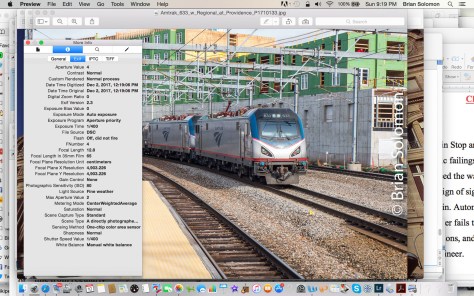
Amtrak ‘Cities Sprinter’ ACS-64 number 633 tows one of its sister electrics with train 163 as it arrives at Providence, Rhode Island on Saturday, December 2, 2017.

I exposed this view using my Lumix LX-7.

Amtrak’s line at Providence is charmless, but functional. Heavy electrification in an urban environment is rarely picturesque. To make a satisfactory image of a moving train takes patience, skill or both.

This is a routine view of American passenger rails in action, nothing sexy, and nothing complicated or tricky photographically.

Lumix LX-7 digital photo exposed at 12:19pm on December 2, 2017; ISO 80, f4.0 at 1/400th of a second, handheld with adjustable camera zoom lens set to the functional equivalent of a 65mm focal lens on tradition 35mm film camera.
Here’s a screen shot of the photo with a window showing the EXIF data stored with the digital file.

Does my cross-lit midday view of a Siemens electric with 1970s-era Amfleet passenger cars work for you?

Tracking the Light posts every day.

Housatonic at Housatonic—Revisited!

In June 2016, I posted on Tracking the Light some views of the Housatonic Railroad at Housatonic, Massachusetts (located along the Housatonic River).

See: http://briansolomon.com/trackingthelight/2016/06/14/housatonic-railroad-at-housatonic-an-example-of-contrast-control/

In November 2017, I returned to this location in advance of the approaching northward Housatonic freight NX-12 that featured two early 1960s-era GP35s in the lead followed by 32 cars (28 loads, 4 empties) and another GP35 at the back.

I find the railroad setting here fascinating. The combination of the traditional line with wooden ties and jointed rail in a setting of old factories, freight house and passenger station makes for a rustic scene out of another era.

Working with a Nikon F3 with 50mm lens I made a series of black & white photos on Kodak Tri-X. And, I also exposed a sequence of digital color photos using my FujiFilm X-T1.

Freight house at Housatonic, Massachusetts. Exposed on Tri-X with a Nikon F3 fitted with a 50mm Nikkor lens. Film processed in Kodak D76 1-1 with water for 7 minutes 20 seconds at 68F.
Freight house and factories, looking north from the westside of the tracks. In today’s railroad world, this scene is decidedly rustic. 
Digital color photo exposed with a FujiFilm X-T1. RAW File processed in Lightroom with contrast adjustment to improve shadows and highlights.
Tri-X black & white photo of Housatonic Railroad freight NX-12 working northward.
Digital color photo exposed with a FujiFilm X-T1. RAW File processed in Lightroom with contrast adjustment to lighten shadows and control highlights.
Tri-X photo with 50mm lens.
Digital color photo exposed with a FujiFilm X-T1. Fuji Velvia color profile; camera Jpg scaled for Internet.

Tracking the Light posts daily!


At the End of the Day; Twilight at Mechanicville, New York.

Here’s a photo from my lost archive.

I’d spent November 24, 1984 with some friends exploring railroads in the Albany area.

Delaware & Hudson had recently been included in the Guilford network and its operations were being melded with Boston & Maine. At the time, D&H still had a lot of old Alco diesels.

We had stopped by Mechanicville earlier in the day, and I made a selection of photos (that I’ll post at a later date) then we drove via Schenectady to Rotterdam Junction to photograph Conrail.

On the way back east, we made another visit to Mechanicville, when I exposed this twilight view. This is an evocative image that represents a symbolic twilight as well as a literal one.

Exposed with a Leica 3A on Kodak Tri-X, processed in Kodak D76 1-1.

It was twilight for the D&H Alcos; twilight for the old Mechanicville Yard; and twilight of the brief colorful and busy era on Guilford before a series of strikes changed everything.

Tracking the Light Posts Every Day.
Amtrak Pepsi Can on Kodachrome—High Resolution Scan (and how I made it).

I have thousands of properly exposed Kodachrome slides from the 1980s and 1990s. This view of Amtrak 502 was exposed at Oakland, California 16th Street Station in August 1992.

Gradually I’ve been scanning these into my archive. I’ve experimented with several different scanners and software, using various settings and techniques.

So far, I found that I get sharpest and most colorful scans by using a Nikon Super Coolscan 5000 driven with VueScan 9×64 (version 9.5.91) software.

For more on VueScan see: www.hamrick.com

VueScan offers me a high degree of control, but I’ve found requires a bit of practice and experimentation to obtain the best scans.

I typically scan Kodachrome 25 slides at 4000 dpi (dots per inch) and  then output as a Tif file to obtain the greatest amount of data. For this slide I opted to make a multiple pass scan to retain a higher degree of shadow detail. (VueScan offers the multiple pass option under its ‘Input’ pull down menu).

To make the most of the scan for internet presentation, I imported the Tif file into Lightroom and lightened the shadows and balanced the highlights, before outputting as a scaled Jpg. (The original scan remains unchanged during this process).

Kodachrome slides recorded tremendous amounts of information and the original Coolscan Tif is far too large to present here.

Incidentally, a version of this photo appears on page 148 of my book Modern Diesel Power (published by Voyageur Press in 2011). The scan in the book was made by my publisher and isn’t the scan presented here.

Tracking the Light posts Daily