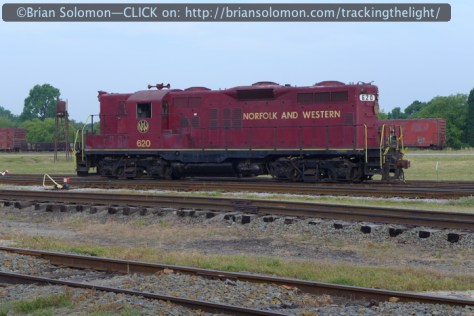
Exposed with a Lumix LX-7. The diffused light made for wonderful reflections.
Among the stars of the Streamliner’s at Spencer event was Norfolk & Western 611, one of only a handful of preserved American streamlined steam locomotives. Here’s a sampling of the many images I made, and an excerpt of the text from my book Super Steam published by MBI (out of print), where I detailed the J class. Today the locomotive catches attention for its streamlined shrouds, but there’s a lot more to the N&W J than just good looks:
“Among the most impressive products of N&W’s Roanoke Shops were its 14 Class J 4-8-4s. These spectacular machines defied convention while settting record for performance and reliability. The first five J’s were built during 1941 and 1942, with N&W’s distinctive streamlined shrouds, and featured 27×32 inch cylinders, 70-inch drivers, 107.7 square foot firebox grate, and a huge boiler set for 275 lb. psi operation. As built these locomotives delivered 73,300 lbs. tractive effort. (N&W later increased the boiler pressure to 300 psi, and as result tractive effort was increased to 80,000 lbs.) The J class exhibited all of the trappings of modern locomotive, featuring roller bearings on all axles and reciprocating parts, one-piece cast steel frame, mechanical lubrication and light weight alloy-steel rods . . .”
611 Noir. Exposed with a Canon EOS 7D.N&W 611 surrounded by the enemy.611 in stereo. Lumix LX-7 photo. There’s nothing like a good puddle to make a great photo!Nose view of one of America’s most famous locomotives. Exposed with a Lumix LX-7.
Part of the attraction of North Carolina Transportation Museum’s Streamliners at Spencer event was the pre-arranged night photograph sessions. Large industrial scale flood lamps were arranged to provide roughly even lighting on locomotives that had been arranged and spotted specifically for photography.
A look at the darker side of night photography! A view of Spencer shops exposed with a Lumix LX-7.
I’ve often worked on the darker side of photography, and this was no exception. While I took advantage of the ‘arranged’ lighting to make standard views of the equipment. I made a special effort to go beyond the obvious.
Here I worked in the shadows, using the lights in a more interpretive way. I sought out scenes of the shops and facilities that were part of the background.
Crime scene or photoline? The local constabulary provided security at the event. Exposed with a Canon EOS 7D.This view of Norfolk & Western 611 caught my eye. At the time there must have been 75 people with tripods set up for the 3/4 angle. Exposed with a Lumix LX-7.Rain made for a nice shiny gloss but made the difficult process of making photos in the dark even more complicated. Keeping water off lenses in the dark isn’t easy. At least with digital photography, instantaneous feed back allowed me to know when droplets had spoiled a clean view (or added an extra effect). Exposed with a Canon EOS 7D.Silhouettes with Lackawanna painted F3s. Lumix LX-7 photo.
The challenge was trying to stay out of the way of the photo lines to avoid the ire of those with a front-lit view.
On one of the evenings there was a thunderstorm, which made matters extra challenging!
After I made this image, I relaxed on the bench. Fortunately there weren’t many people set up on my side of the light. Lumix LX-7 photo.This angle reminded me of a Jim Shaughnessy photo exposed in the 1950s. Lumix LX-7 photo.Here I was mostly working with the ordinary sodium vapor lights, with the lights for the night photo event only providing secondary illumination by coloring the sky. Lumix LX-7 photo.Hard glint on the Norfolk Southern business train. Keeping the lights out of the frame is part of my technique. Lumix LX-7 photo.Spencer round house.Ghostly view of the old shops.Spencer, North Carolina—the village across the street from the old Southern Railway shops.
The locomotives were largely static and thus relatively easy to photograph. However, people move about constantly, and getting your friends to hold still long enough for a portrait in an environment characterized by sensory-overload, can be tough.
On the plus side, most everyone was smiling.
I used both a Canon EOS 7D and Lumix LX-7 to make digital portraits, while a few photos were captured on slide film using my EOS 3.
I’d been making photos on Boston’s Green Line for 40 years. Albeit I was a bit shorter for my first efforts using my Dad’s M3 in the early 1970s.
Subway photos on Kodachrome were a real challenge. I never knew if I’d gotten anything at all until the film came back weeks later. But that didn’t stop me from trying.
Boston’s Green Line Subway at North Station on June 2, 2012. Exposed with a Canon 7D with 28-135mm lens.
Digital photography technique is a real boon for subway images. For these photos I’d racked up the ISO setting to 2000 and worked with a telelphoto zoom. That was inconceivable in my film days.
Boston’s Green Line Subway at North Station on June 2, 2012. Exposed with a Canon 7D with 28-135mm image stabilization zoom lens.
Boston’s subways have changed quite a bit since my early photos; modern cameras for modern images.
At crew changes and other convenient points, Amtrak schedule’s ‘smoke breaks’ where passengers can get off the train, stretch their legs, enjoy the fresh air, and, in my case, make photos of the train.
I had about ten minutes at Raleigh, North Carolina this morning to make photos train 80, Carolinian during this momentary pause. By that time, I’d been on the train for more than 3 hours, with nearly another nine hours to go.
Rather than tow the whole camera kit, I just carried the Panasonic Lumix LX 7, which is light, easy to use, and is capable of making extremely sharp images.
Playing with the external Lumix Live View Finder, I adjusted this vertically, which allowed me to place the camera very close to the ground without the need for lying belly first on platform.
Exposed with a Lumix LX-7 using the Live View external finder. Camera set in ‘A’ (Aperture Priority) mode with a minus 1/3 exposure over ride to compensate for the bright platform, bleached station sign and bright sky. This forces the camera to make a slight darker image
The low angle with a slightly telephoto view provides a clean dramatic perspective that minimizes unnecessary and visually distracting foreground.
Number 80’s conductor. Amtrak’s crew was very friendly.
Check my Streamliners at Spencer page for photos of North Carolina Transportation Museum’s special event.
Following three and half successful days of photography at Spencer, North Carolina, Pat Yough and I boarded Amtrak 80, Carolinian at Charlotte this morning before 7am.
Charlotte, North Carolina at 6:35am June 1, 2014. Lumix LX-7 photo.Charlotte, North Carolina at 6:35am June 1, 2014. Lumix LX-7 photo.
We departed on time at 7am. In the lead is Amtrak P42 number 168. It was a strange sensation pausing a Salisbury and passing the Spencer Shops having just spent so much time there. The view from the train always offers a different perspective than being on the ground, or seeing a place from the road.
Salisbury Station, North Carolina. June 1, 2014. Lumix LX-7 photo.Salisbury, North Carolina. June 1, 2014. Lumix LX-7 photo.
As I write this we are heading toward Raleigh. I’m destined for Philadelphia. Presently, I’m reviewing, analyzing, and scaling hundreds of images I made at the event, plus side trips. I’ll be posting more images and commentary over the next few days.
Back then, Irish Rail operated three daily ammonia trains between Marino Point, County Cork and Shelton Abbey near Arklow, County Wicklow. These were tightly scheduled and normally operated with the common 201-class General Motors diesels.
I was tuned into these trains, and made an effort to catch them in interesting locations. The traffic ended with little warning in 2002, so the photos I made are now prized images!
Irish Rail class 201 number 204 leads a laden Ammonia train above the Irish Sea at Killiney. Is that U2’s Bono waving off in the distance? Exposed on Kodak Tri-X with a Rolleiflex Model T f3.5 Tessar lens, processed in Ilford ID11 (special mix and time, 1:1 with water.)
In addition to color slides, I exposed thousands of black & white images of Irish railways on 120 size film between 1999 and 2005 (and a few here and there since).
Most of these photos have never seen the light of day. This rare photo of the Ammonia train was just one of several exposures I made on that bright May afternoon in 2001.
Why didn’t I make a color photo? And who said I didn’t? Must color and black & white be mutual exclusive? Why not make a color photo and convert it later? Why color anyway?
I’ve often worked with multiple formats at the same time. Black & white has a number of advantages and I’ve long prided myself on mastering this archaic image-making process.
Streamliners at Spencer: The Real Star of the Show?
Although streamlined steam locomotive 611 was getting most of the attention, historically the most important exhibit was General Motors FT demonstrator 103.
Last night FT 103 was lit up for all to see.
General Motors model FT lit up at Spencer Shops on May 30, 2014. Exposed with a Canon EOS 7D with 100mm lens on a Gitzo carbon-fiber tripod.
I’ve written about this locomotive in many of my books. It is the most influential American locomotive of the twentieth century because it demonstrated to the railroad industry that diesels offered a cost effective replacement for steam.
Electro-Motive’s most significant innovation was its development of the first commercially viable road freight diesel. From a technical perspective this was an advancement of the E-unit — the application of this long anticipated new road diesel proved revolutionary for American railroads. Once on a roll, it not only turned locomotive building on its ear, but forever changed the way railroads bought locomotives and operated trains EMD’s F-unit was the most important player in the rapid dieselization American lines.
NS CEO, Wick Moorman pointed out in yesterday’s address at Spencer, that FT 103 was ‘even older than 611,’ while sincerely thanking the St. Louis Museum of Transportation for sending the locomotive for display.
When I was studying at the Rochester Institute of Technology, Kodak would annually supply photo students with a gift package of examples of their latest products.
Although I was a confirmed Kodachrome customer, as a poor student, I always make use of the other films supplied. In January 1989, I had a role of ‘Ektachrome of the year’. This was the latest 100 speed slide film.
I loaded up the Leica M2, and drove my Dodge Dart around the Rochester area looking for suitable subjects with which to sample this new emulsion.
Exposed on Kodak Ektachrome with a Leica M2. Film processed by Kodak. The image was adjusted in post-processing to compensate for exposure, contrast, and color balance.
At Charlotte, where Conrail accessed a portion of the old Hojack route, I found this local working. Was this the local freight that served Kodak’s Rochester factories on the far side of the Genesee River? I can’t say for certain, but that really would be appropriate, wouldn’t it?
January 1989; Conrail had a full ten years left. At the end of May 1999, Conrail’s independent operations ended and CSX and NS took over.
Morning Views, May 28, 2014—North Carolina Transportation Museum.
With more than two dozen classic locomotives to photograph, and lots of other relics of interest, I exposed more than 300 image with the Lumix LX-7 in just three hours. In addition, I was also working with my Canons, one for film, one for pixels.
Here are just some of detailed views I exposed with the Lumix. These are macro images, as opposed to wide shots that take in the whole scene. (And, yes, I made plenty of those too.)
General Motors classic FT—’the diesel that did it’.Atlantic Coast Line E3A. Exposed with a Lumix LX-7Alco PA builder’s plate. Is this the real thing or a replica?It’s not all about the locomotives, this fine old passenger car caught my eye.A bit of work on a Reading FP7A. My dad caught these on the ‘Crusader’ back in the day.Southern Railway: visions of yesterday and today. Spencer Shops was a Southern facility.
The light was mixed. Nice soft early sun soon gave way to a hazy flat bright light. I’m glad I brought my old Minolta IV light meter, this proved very useful.
The ease of use of the Lumix LX-7 made it an especially valuable too. Today I was working with the electronic view finder, instead of the rear screen display. I wonder if this altered my compositions?
Wabash 1009. What’s in a number? (When 1,009 =10,000.)Drumhead on the Sandy Creek round-end observation car.Erie Railroad E8A 833—last of its kind.Nose view of General Motors FT 103. I’d argue that this was probably the most significant locomotive in the 20th Century. Read about it in my American Diesel Locomotive and EMD Locomotives. Books on the history of American diesels.Could this be 1956?
I was very impressed by the paint on the Lackawanna F3’s, even if they were built for the Bangor & Aroostook, What are your favorite locomotives on display at Spencer?
One of three DL&W painted F-units on display.Washing Pennsylvania Railroad E8A 5711 at Spencer. Perhaps someone else should fling some mud and grime to make things seem more authentic?
More Spencer Streamliner photos to come over the next few days!
Tracking the Light posts new material every day, with special ‘Extra’ posts on the Streamliners at Spencer event this week!
It’s been almost 20 years since John Gruber and I intercepted Norfolk & Western 611 working west on the former Nickel Plate Road near Valpalraiso, Indiana. That was back in August 1994!
I also visited 611 once in Roanoke about 10 years ago.
Here she is last night at Spencer Shops, North Carolina, whereI opted for a moody backlit view.
May 28, 2014; Norfolk & Western 611. Exposed with a Lumix LX-7.
I made this view on Kodachrome 64 with my Leica 3A and Summitar lens.
On May 29, 1985, I was visiting Montreal, having arrived that morning on the overnight VIA Rail train from Toronto. The signalman/tower operator was friendly, and allowed me to spend several hours photographing trains from the tower.
This was before VIA rationalized its schedules, and there was a constant parade of trains coming and going. Here, I’ve used the tower door to frame an inbound LRC train.
I didn’t think much of the modern LRC trains at the time. But I’m glad I preserved them on film.
Hmm, sounds like the chorus to a song. It was cool and damp when Amtrak’s Carolinian departed Trenton a little after 8am this morning (May 28, 2014). Now, its 94 degrees Fahrenheit outside!
We’ve been traveling at a reduced speed because of the heat. An customer (passenger?) announcement was made in this regard, shortly after we crossed the diamonds at Doswell (historically where the Chesapeake & Ohio crossed the Richmond, Fredericksburg & Potomac).
There’s lots of CSX freight on the line, if not moving particularly fast.
Amtrak’s streamliner-era Budd-baggage car on train 79 at Richmond, Virginia at 1:31 pm May 28, 2014. Lumix LX-7 photo.
At Richmond, Staple Mills Station, we stopped for a crew change and a ‘smoke brake’. (If burning through the pixels with the LX-7 counts as ‘smoke,’ I’m in.)
A northward CSX trash train with an AC6000CW was parked near the head-end of Amtrak 79, Carolinian. It was a bit of shock to step out of the air-conditioned Amfleet car and into the heat.
Amtrak 79’s crew change at Richmond. Lumix LX-7 photo.CSX AC6000CW leads an empty trash train bound for The Bronx at Staples Mills Station, Richmond, Virginia. Lumix LX-7 photo.The AC6000CW features a pronounce radiator overhang that helps identify this locomotive. For a number of years these machines were common on the Boston & Albany route. Today, I saw no less than three in Richmond. Exposed on May 28, 2014 with a Lumix LX-7.Among the features of the Panasonic Lumix LX-7 is a ‘digital zoom’ which allows for the effect of a much longer lens than offered optically. While this is really simply cropping in on the sensor, it does make photos like this one possible on site. I used the digital zoom as a composition tool, but I made another image the limits of the optical zoom as well. What I like about this long-telephoto angle is the signals to the right and the picket-fence effect of the canopy supports on the left. LX-7 photo.
Our baggage car belongs to the streamlined era. Appropriate, since we are going to the North Carolina Transportation Museum’s Streamliners at Spencer event. Later this year I’ll be writing a book on American railroad’s streamlined era to be published by Voyageur Press!
TRACKING THE LIGHT SPECIAL POST—On the way to Spencer—Part 4
We had a few minutes to wander around and make photos while Amtrak crews changed ECS-64 number 602 for P42 117.
Carolinian on left; Cardinal on right. Lumix LX-7 exposed at ISO 80.Nearly new Siemens Cities Sprinter ECS-64 number 602 at Washington DC. This is a near cousin to the electrics I was photographing in Portugal last month. Lumix LX-7 photo.Amtrak 602. Lumix LX-7 photo.
Now rolling along the old RF&P!
I recall passing the sprawling Potomac yards back in 1984. Gone without a trace.
Trenton Makes the World Takes—That’s what the sign says!
May 28, 2014. Three passenger railways, lots of trains and not much time.
I’m traveling with Pat Yough. We arrived at Trenton about 20 minutes before the arrival of Amtrak 79 Carolinian. [Posted from the train via Amtrak’s WiFi.]
Trenton Transportation Center, Wednesday May 28, 2014. Exposed with a Lumix LX-7 at ISO 400. Unmodified camera JPG (except for scaling).Wednesday May 28, 2014. Exposed with a Lumix LX-7 at ISO 400. Unmodified camera JPG (except for scaling).
I put the Panasonic LX-7 through its paces. Changing the ISO proved to be a bit different than I was used to with my old LX-3. One of the great advantages of digital photography is the ability to adjust the ISO (camera sensitivity) and color profile from frame to frame. Back when I was just shooting film, I’d routinely carry several camera bodies loaded with different film types.
It took me a while to figure out how to change the ISO, but it turns out that Panasonic had anticipated my need. Where the LX-3 required multi-tier menu navigation, the LX-7 has a special button labeled ‘ISO.’ This allows an easy change.
While at Trenton, I experimented with 400 and 80 ISO settings. The sensor on the LX-7 is much improved over the LX-3s.
With the LX-7, I found the 400 ISO setting to be very acceptable on the computer screen. While nominally less saturated and with more noise in the shadows than ISO 80, over all the result was really very good. I’d generally avoided using 400 ISO on the LX-3.
Limited Clear (the lower head is flashing). LX-7 at ISO 80.SEPTA at Trenton. Lumix LX-7 set at ISO 80.LX-7 at ISO 80. NJ Transit at Trenton, NJ on May 28, 2014.
Amtrak 79 arrived with a new Cities Sprinter model ACS-64 electric number 602 in the lead. This is my first spin behind one of the new electrics. See my earlier post: Daily Post—Amtrak ACS-64 Debut, February 7, 2014.
Today’s post is a follow up to both of yesterday’s posts, which covered my experiments with the Lumix LX-7 and the beginning of my adventure to Spencer.
As covered in yesterday’s Tracking the Light Special Post, I was traveling on Amtrak’s two-car shuttle, scheduled as train 475, which runs from Springfield, Massachusetts to New Haven, Connecticut to connect with Boston-Washington train 175. I sent my post from the train.
Amtrak 475 arrived early in New Haven, giving me about 15 minutes to wander around making photographs. I’m continuing to test my father’s Panasonic Lumix LX-7, and there was some nice low sun to work with.
Exposed with my father’s Panasonic Lumix LX-7. After exposing several angles digitally, I also made a few slides.
I was keen to photograph the Shore Line East train which features a ‘GP40-2H’ locomotive in the classic New Haven Railroad McGinnis livery.
I also fished out my Canon EOS3, that was buried in the depths of my camera bag, and exposed a few frames of Fuji Velvia 100 of the New Haven painted commuter engine. My hand held Minolta IV light meter aided my exposure; f5.6 1/500th.
It will be a few weeks yet before I see the slides, so for now we can settle for the Lumix instant digital images (that’s what they are for, right?)
A Metro-North local bound for Grand Central Terminal. Lumix LX-7 photo.
New Haven in the early evening is a busy place. In addition to Metro-North trains coming and going, an Acela bound for Boston was arriving on Track 4, just as Amtrak 175 approached Track 1.
I exposed a series of images of train 175, hauled by venerable Amtrak AEM7 number 943. How many millions of miles has this old electric have to its credit? Low sun and the angle of the curve made for a nice grab shot from the Boston-end of the passenger platform.
Amtrak 175 approaches New Haven. Lumix LX-7 photo. I found that the LX-7 reacts faster and cycles quicker than the older LX-3. This is especially useful in a situation like this one.Amtrak logo on the side of an Amfleet car. Lumix LX-7 photo.
Certainly, I found that the Lumix LX-7 has its moments, although the differences in the controls (as compared with my old LX-3) befuddled me a couple of times. Traveling on 175 was comfortable, but the WiFi on the train wasn’t working. I arrived in Trenton at the last glow of daylight.
I’m just getting warmed up, so stay tuned! (or what ever the Internet equivalent is to that old radio term).
Tuesday May 27 at 5:10pm: I’m on board Amtrak 475. I boarded at Windsor Locks, Connecticut, I’ll change trains at New Haven. I’ve got an overnight stay planned for near Trenton, New Jersey.
This promises to be an excellent opportunity to photograph a great variety of restored classic diesels. I’m looking forward to seeing the Alco PA. I’ve written a great deal about this model, yet I’ve never seen one! It will be great to see 611 again.
And, I’ll finally get to see one of the Pan Am executive F-units! (Seems like when ever these run in New England, I’m either in Ireland, Chicago, or someplace over the hills and far away.)
I’ll be posting updates! Stay tuned to Tracking the Light for more photos!
Amtrak 475 approaches its station stop at Windsor Locks, Connecticut at 4:25pm, May 27, 2014. Exposed using my father’s Lumix LX-7. Photo sent from this train using Amtrak’s WiFi.
Last month (April 2104), my Panasonic Lumix LX-3 began performing erratically while I was photographing Irish Rail at Monasterevin.
Although annoying, this was only a minor setback of the day, because I had my Canon EOS 7D with me. I often travel with at least two cameras, just in case one develops problems.
The LX-3 suddenly suffered an electrical fault; specifically the rear display stopped working reliably. Sometimes it would flicker on, other times it was dark. I tried all the usual cures; I turned the camera off and then on, I removed the battery, I even tried the factory reset. No joy.
In the short term I found that if I pressed on the side of the camera body, the display would come on long enough to make adjustments. I continued to use the LX-3 for secondary services, while relying on the Canon EOS 7D and film cameras for more critical work.
I’ve had my LX-3 for almost five years and in that time I’ve carried it with me everywhere. It’s visited about a dozen countries, and more than a dozen US states. In addition to pictorial service, I’ve used it intensively to copy documents while in libraries. Using the in-camera file counter, I determined that I released the shutter more than 64,000 times.
Last November the camera took a very hard knock, which didn’t immediately affect its performance, but certainly didn’t do it any good. In April, the camera was subject to unusual dampness (it got wet) while I was making night shots in Porto, Portugal.
LX-7 view of Amtrak 54, the Vermonter, at Palmer on May 24, 2014. The camera was set to simultaneously expose Jpg and RAW files. It does an excellent job retaining highlight detail.
On May 24, 2014, my father lent me his Panasonic LX-7 to see if this newer Lumix model would offer a suitable replacement. This camera comes highly recommended to me by several people. Since it’s essentially the latest model kin to my LX-3, it may represent an ideal choice for my new ‘everywhere camera’.
I brought it to Palmer, Massachusetts where I exposed about 100 images in various conditions, both to get a feel for the cameras controls (which have several notable differences from the LX-3), and examine the quality of the images.
Checking the Amtrak timetable. The LX-7 manual focus controls are similar to those on the LX-3 but take a bit of getting used to.Among the advantages of digital photography are much improved photos exposed in overcast-lighting. Using the LX-7’s manual over-ride while in ‘A’—aperture priority, I intentionally over exposed by 1/3 stop to allow for better detail and contrast in ground-areas and trees. I hadn’t yet mastered the LX-7’s various metering modes, and it’s possible there was a more effective means for adjust the exposure.CSX Q423 (or L423) was working Palmer yard. In this view it pulls passed CP83 to double its train out of the yard. I exposed several telephoto views with the LX-7. By keeping the camera relatively low to the ground, I’ve minimized foreground distractions while allowing for a more dramatic perspective on the locomotives.
I found that the LX-7 had several positive points. In general it reacted quicker and cycled faster than the LX3. Its zoom lens has a wider range, and offers longer telephoto photo settings. The rear display seemed sharper and brighter.
On the downside, I was unfamiliar with the controls, so setting the camera proved challenging. Also, the camera is slightly larger.
In general I was happy with my results, and plan to experiment a bit more with the camera before I commit to buying one. There are a variety of excellent small cameras on the market these days, so I may wish to sample some of these too. More to come!
A modern GE Evolution-Series diesel faces a mid-1980s era SD50. The locomotives stopped, giving me ample time to make detailed views. LX-7 photo.Low-angle on CSX 875 leading symbol freight Q423 (or L423) at Palmer. LX7 at its widest view.Finally on its way west, this CSX freight crossing the Palmer diamond. Another CSX westbound was close behind. LX-7 view. All photos are un-modified except for scaling necessary for internet presentation. The LX-7 handles high contrast situations very well. I was in the ‘standard’ color setting.
I’ve often liked to make detailed studies of equipment. On this day, George S. Pitarys, Bill Linley and I had been following a westward Cape Breton & Central Nova Scotia freight.
Cape Breton & Central Nova Scotia Montreal Locomotive Works M630 on July 25, 1997.
In the evening it stalled near Afton and had to double the hill. This made for ample opportunity to make photos.
At one point when the train was stopped, I used my N90S with a 28mm lens to expose this backlit study of an M630 that was second unit in the consist.
I like the image for its great contrast and its ability to distill the curves and lines of the Alco Century profile. It’s moody, dark, and all about Alco.
It was a hot, humid and hazy morning. The sunlight was tinted by gauzy smog which softened the scene.
Bob Karambelas and I were exploring the junction at Hunter Tower in Newark, New Jersey, where the former Lehigh Valley crossed the old Pennsylvania Railroad electrified mainline.
A westward freight with a pair of SD40-2s was departing Oak Island yard and I exposed this view looking a down a grungy side street with a 200mm lens.
I’ve always been fascinated with urban images like this, where the railroad is prominent but not necessarily dominant, and passes through post industrial decay. Look at the grime on surface of the street and the great beat up old cars!
I’d been out along the former Erie Railroad since before dawn that day. The tracks had been alive with freight. By early afternoon, I was down at Gang Mills Yard, near Corning, which served as a local hub for freight.
Exposed on Professional Kodachrome 25, with my college roommate’s Canon A1 with 50mm lens. The film was processed by Kodak in Rochester, New York with in 48 hours of exposure.
Back then General Electric B23-7s were a common locomotive. I’d grown up with these diesels working locals and road freights on the Boston & Albany route. I always like their classic GE style and their great sound. My B&A engineer friends despised them because of their ‘slow loading,’ ‘low cab doors,’ and other perceived inadequacies.
I made this photo at the engine terminal. I liked all the Conrail signage behind the locomotive. There’s nothing especially unusual about this scene, it was as ordinary as it got for the time, but today this really says, “Conrail” as I remember it.
Conrail ended independent operations at the end of May 1999, fifteen years ago. Between 1976 and 1999, I exposed thousands of views of Conrail. In 2004, Tim Doherty & I authored an illustrated book on Conrail for MBI.
Mike Gardner and I were enjoying a trip along the Hudson River on June 27, 1997.
This photo really says ‘1990s’ to me. A clean Conrail SD60I leads intermodal freight TVLA (New Jersey to Los Angeles) with a long line of piggyback trailers. I exposed it on Fujichrome slide film using my Nikon N90S with 80-200 zoom lens.
This lens/film combination had a color balance and contrast that I associate with my mid-1990s photography. On the down side, used of a telephoto zoom-lens and Fuji film resulted in bright headlights and ditch-lights appearing as ill-defined blobs.
I embraced the convenience and versatility of the N90S and zoom lens with 100 speed filem, which was easier and faster than my old prime lenses with Kodachrome, but I sacrificed quality.
At that stage I was still carry my Nikon F3T with Kodachrome. But following a string of processing disasters that summer, I largely phased out Kodachrome in favor of Fuji. Sometimes there’s no perfect solution, and some sort compromise is necessary.
Exposed with a Nikon F3T on Kodachrome 25 slide film. I was toying with my 35mm perspective control lens to keep the horizon in view, but my angle of view was a bit too extreme for the shift feature, which resulted in this slightly strange perspective.
Here’s something neat; I was photographing a westward Southern Pacific freight running along the shore of San Pablo Bay at Pinole, when I spotted this old Northern Pacific box car in consist.
By 1992, Northern Pacific had been gone for 22 years, which seemed like a lifetime to me! Here was this vision of a railroad long gone, but still moving freight.
Of course, today its not still uncommon to see Burlington Northern cars in old paint, and BN has been gone 19 years. Funny how that works.
I thought I try something different; so I reached into a Logan slide storage box on the shelf and fished out a slide. This is what I found!
Step back 27 years . . . Doug Eisele and I had started the morning on the old Erie Railroad near Attica, New York. When Conrail’s heavy BUOI (Buffalo to Oak Island) freight came growling upgrade we followed it on side roads to Silver Springs. Here it took the siding for a westbound.
The signals read ‘yellow-over-red-over-red’—approach. What came along was Delaware & Hudson’s East Binghamton to Buffalo freight with a freshly painted former Santa Fe SD26 trailing.
It was precisely 11:18 am on May 2, 1987 at Silver Springs, New York. Exposed with a Canon A1 with 50mm lens on Professional Kodachrome 25 slide film.
At the time I wasn’t especially impressed by the D&H train. It was rolling hard out of the sun on tangent track. But, I rarely let an opportunity get away, so I made this going away view to show the signals and the meet.
In retrospect, I find this photo fascinating. The signals that interested me then, are all the more interesting today; the SD26 and leading GE U23Bs are all long gone; and Conrail’s former Erie operations faded into Norfolk Southern fifteen years ago. So, it’s pretty neat to look back and see what has changed!
At 10:45 am I exposed this view on Kodachrome 25 slide film using my Leica M2 with 50mm Summicron at f5.6 1/125th of second.
Making the most of a clear bright autumn morning, I’d driven to New London, where I visited Central Vermont’s waterfront yard, located below the massive Thames River bridges for I-95. CV’s local was getting ready to head north.
While I was waiting for the CV to get moving, I made photographed Amtrak’s late running Night Owl and its southward Colonial train 95.
The CV local had three GP9s, standard locomotives for that run. In the lead was a personal favorite, engine 4442.
What was special about 4442? Nothing, that’s why I liked it. It had been working CV rails as long as I’d been making photographs, and it seemed like it was always around. I liked 4442 simply because it was familiar. It looked good, and sounded great.
I followed CV’s northward local toward Willimantic, Connecticut, making photos along the way. This was one my best efforts for the day. It’s something of an icon in my collection of CV photos. At the time it was a grab shot. I barely had to time to jump out of my Plymouth Scamp and release the shutter.
LUAS advertising tram at Connolly Station, Dublin on September 7, 2012. Exposed with a Lumix LX3. I like the way the tram echoes the color of the sky.
Here was an opportunity. Back in autumn 2012, a single LUAS Citadis tram on the Red Line was dressed in this attractive blue advertising livery.
It was the sort of item you see in the corner of your eye when crossing O’Connell Street, or when boarding a bus heading in the opposite direction, or when gliding by on the DART.
After a while, I had a few lucky moments, where was able to make photographs of this elusive tram.
On September 7, 2012, I saw it heading to the stub-end turn-back terminal at Connolly Station. This was my chance to make a few images.
In addition to this digital photo, I exposed a few Fujichrome color slides for posterity.
Why slides? In my mind, digital photograph remains an ephemeral format; nice to have, nice to work with, but one good zap to the old hard drive and. . . .
Here’s a dozen images: On Monday May 5, 2014, I traveled to Kildare, and spent the day making photos of Irish Rail’s operations.
Irish Rail 22000-series ICR heading down road at Kildare on May 5, 2014. Exposed with a Canon EOS 7D with 20mm lens.
The goal was to photograph the Up and Down IWT (International Warehousing and Transport) Liners (running to and from Dublin from Ballina), with a hope that the elusive timber trains might operate.
Irish Rail’s timber is elusive enough, so far as I’m concerned. It only operates two or three days a week, and often seems to get canceled when I’m out for it.
The weather was mixed; a bit of rain in the morning, a few bursts of sun in the afternoon. In other words, a typical May day in Ireland, if a bit on the cold side. The foliage was lush and green.
The down IWT liner (Dublin-Ballina) ran later than I anticipated, while the up IWT was more or less as expected.
Timber trains made their appearance as hoped. Since the timber must run around at Kildare station to change direction (it runs from Waterford to county Mayo, and there’s no direct chord at Cherryville Junction to facilitate a move for trains moving from the Waterford Line to the West), this allows opportunity to catch the timber train twice.
Irish Rail’s Rotem Intercity Rail Cars are the standard equipment on most intercity passenger services. Trains passing Kildare serve Cork, Limerick, Waterford, Galway, and Mayo lines. Exposed with a Canon EOS 7D with 40mm lens.Irish Rail 220 leads Monday’s Dublin-Ballina IWT liner seen west of Kildare, near Cherryville Junction. Exposed with a Canon EOS 7D with 100mm lens.trailing view of the Dublin-Ballina IWT liner as it approaches the signals for Cherryville Junction. Exposed with a Canon EOS 7D with 100mm lens.Not long after the down IWT the up IWT came into view. An ICR has just passed down road and is approaching Cherryville Junction. Exposed with a Canon EOS 7D with 100mm lens.An ICR catches a burst of sun as it nears Kildare station. Exposed with a Canon EOS 7D with 20mm lens.Hark! Is that the drone of an 071? Yes, it is. Irish Rail 075 is a battle-worn veteran with many years of hard service. It leads an empty timber train from Waterford. This will run around at Kildare and head down road toward Mayo for reloading. Exposed with a Canon EOS 7D with 20mm lens.The Dublin-Cork Mark 4 hurtles down road at Hybla Bridge near Monasterevin. The empty timber wasn’t far behind. Exposed with a Canon EOS 7D with 40mm lens.Patience prevailed: Irish Rail 072 wails away with the laden timber heading toward Kildare to run around. Exposed with a Canon EOS 7D with 40mm lens.Trailing view of the laden timber at Hybla Bridge.The need for the timber train to run around leaves ample time to reposition on the Waterford Line south of Cherryville Junction. As the crow flies, this location is only about 4 miles from Hybla Bridge.Last shot of the day: Irish Rail 072 leads the laden timber at Oghill, milepost 36. Exposed with a Canon EOS 7D with 20mm lens.
All in all, it was a productive day photographically.
Since most of Irish Rail’s passenger services are now provided by common 22000 series Rotem-built InterCity Railcars (ICRs), I’ve only included at few of the many passenger trains that passed that day.
Satruday May 3, 2014 was cloudy and bright. I met Colm O’Callahan at an old favorite location west of Heuston known as ‘the Gullet.’
It was here in the 1840s that the Great Southern & Western Railway excavated a deep cutting for the line coming up the bank out of Dublin. In so doing, they cut through an ancient Viking burial ground. Some of the artifacts and bones can be viewed at the National Museum of Ireland on Kildare Street.
Exposed digitally with a Canon EOS 7D with 40mm lens. The leaves at left balance the front of Irish Rail 215 (leading the 1200 Dublin-Cork passenger train).
Photographing in the cutting has its challenges. However, in recent weeks, Irish Rail had re-ballasted the line, which brightened up the tracks and foreground. Directional overcast made for interesting lighting, while fresh green trees and grass offered some color.
To avoid the distraction of a white-sky, I completed cropped the horizon. This is a trick I learned years ago when studying at the Rochester Institute of Technology. If the horizon isn’t adding anything, lose it! To do this, it helps to have a bit of elevation.
In 2007, I coordinated a team of 37 photographers to document a full day’s worth of North American railway activity from Nova Scotia to southern California and from the Pacific Northwest to southern Florida in what became a book titled The Railroad Never Sleepspublished by Voyageur Press.
In addition to coordination, I played an active role in making photographs. I’d coordinated with Genesee Valley Transportation to ride a locomotive on their former New York Central Falls Road (now Falls Road Railroad) and boarded the train at Lockport, New York.
My aim was to make photos of the crew to capture the feeling of an active short line railroad. Hal Reiser shadowed the train making photos from the ground, and at one point collected me so I could also make trackside views.
I’ve included several of the images from May 10, 2007.
Although The Railroad Never Sleeps is now out of print, it remains a stunning photographic collection, which is especially impressive considering it was entirely accomplished within the limits of just one day!
A variation of this photo appeared in a Railway Age supplement some years ago.
Exposed on Fujichrome Provia 100 using a Nikon F3T with 28mm AF lens. Exposure calculated manually with a Sekonic Studio Deluxe handheld photocell.
Back in June 1996, I was following the old Rock Island mainline. As I recall, I didn’t find much moving, and the day wasn’t the brightest. Yet, at Iowa City I visited a bridge over the Iowa Interstate’s yard and made a handful of images.
I’ve always liked this photo because it offers an unusual view with a lot of railway interest. The gondola carrying steel bars and open-door Burlington Northern 50ft boxcar are the sort of ordinary everyday elements of American railroading, meat and potato freight cars, that rarely get feature-treatment in photographs.
It was also the best way to make use of a dull day. Would this photograph be more effective if the sun had been out?
June 2008. Exposed with a Canon EOS 3 on Fujichrome slide film.
I made this pan of a Blue Line light railcar on the streets of Long Beach, California while researching my book Railroads of California.
Panning is one of my preferred techniques for making a dynamic image while separating the subject from the background.
This can be especially useful on dull days where a lack of contrast makes for bland scenes, or in complex urban environments where the subject maybe lost in a tapestry of intersecting lines.
It’s also a great way to compensate for harsh lighting.
Some tricks for making successful pan photos: select a slow shutter speed (1/15 -1/60th of a second), aim for a broadside angle, and follow your subject while releasing the shutter as you move. Use smooth lateral motion. Do not stop panning once you release the shutter. Practice repeatedly.
Back in the early 1990s, Southern Pacific was still serving the Northwestern Pacific route as far as Willits, California where it tapped connections, including its former line that was still in operation all the way to Eureka.
Sometimes on Sunday mornings, I’d drive north from San Francisco across the Golden Gate to Petaluma on Highway 101. There wasn’t much traffic at that time of day. Occasionally, I make this run with fellow Bay Area photographer Brian Jennison.
Although the Willits-Petaluma portion of the run was often nocturnal, on Sundays SP’s ‘NWP Sprint Train’ made a turn from Petaluma to Fairfield and this often called for groups of SD9s.
NWP Sprint Train at Novato, California in April 1992. Exposed on Kodachrome with a Nikon F3T with f1.8 105mm lens.
On this day, normal California blue skies were muted by a dull fog. Yet, I persevered and chased the train. It was hard to argue with the great sounds produced by a quartet of 1950s-era 16-567 diesels in multiple. Also, dull days have their moments too.
At Novato, I made this image featuring the gently rolling green hills that characterize Marin County as a back drop. Admitted, I was disappointed by the ‘lobotomized’ leader, which had its classic SP lighting package disturbed; its oscillating headlight was missing leaving a scar on the short hood. Oh the shame of it all!
Looking back, I’d quite happily take this again. It was an era before graffiti covered freight cars, the uniform proliferation of locomotive ditch lights, and when SP was still the SP!
Among the difficulties of living within sight of the railway is the chance that such proximity may breed photographic apathy and slough. One the plus side, when something rumbles by, all I have to do is look out the window!
There are several nice photo locations within a ten minute walk of Islandbridge. On the downside, over the last decade I’ve covered these nearly to the point of exhaustion. Yet, that doesn’t keep me from taking advantage of them.
Shortly before 11am on Tuesday April 29, 2014, I heard the distinct roar of an Irish Rail 071 class diesel (built by General Motors Electro-Motive Division). I glanced out the window to see a gray locomotive roll into the Phoenix Park tunnel with a wagon transfer for Dublin’s North Wall.
Ah! A grey locomotive and the elusive wagon transfer!
I made a call to alert a friend, and a short while later I got a call back to say that the wagon transfer had collected three flats and was on its way back. The locomotive was 085 which wears a variation of the gray and yellow livery introduced a year ago.
Irish Rail 085 with three flat wagons approaches Islandbridge Junction on April 29, 2014. Canon EOS 7D with 100mm lens. I opted for vertical composition to feature the monumental Wellington Testimonial that sits in Dublin’s Phoenix Park. (Exposed at f9 1/500th of a second ISO 200).
It was a rare clear sunny morning, and I was keen to make a color slide of this engine passing Islandbridge Junction. Armed with good information, I walked five minutes up the road to my often-used location and waited. Less than 15 minutes passed before 085 appeared from the tunnel with the three flats.
A closer horizontal view with the same camera-lens combination. I adjusted the exposure by a one-third stop, opening to f8.0 to compensate for the lack of sky in the image. Locomotive 085 features a variation of the gray and yellow paint scheme introduced last year. This features the traditional three-digit locomotive number in larger fonts on the cab. This in addition to the recently introduced European multiple number printed in tiny type elsewhere on the engine.
I exposed a few digital images with my Canon EOS 7D and 100mm lens, before executing a color slide (or two) with my EOS 3 with 40mm lens. I was home less than 30 minutes after leaving. Back to the book writing! I’m presently researching a book on North American signaling.
It was a foggy dawn at Rockhill Furnace, Pennsyvlania on the second day of East Broad Top’s annual ‘Fall Spectacular’. Mike Gardner and I had arrived the day before for the event.
I exposed this view with a Nikon N90S with f2.8 80-200mm Nikon zoom lens.
Low dew point resulted in a cosmic mix of mist, steam exhaust and locomotive smoke.What I remember best was the clanging of locomotive bells and the soft whoosh of exhaust.
By 10 am the sun had burned off the fog and it was a glorious Pennsylvania day.