Author of more than 70 books on railways, photography, and Ireland, Brian lives with his wife, Kris, in Lancaster County, Pennsylvania. Brian holds a BFA in Photographic Illustration from the Rochester Institute of Technology. In 2022, he was presented with the Railway & Locomotive Historical Society’s prestigious Fred A.& Jane R. Stindt Photography Award for his lifetime achievements in railroad photography.
The other day I was scouring the files for a photo Amtrak’s Sunset Limited as an illustration for an article I was writing.
Instead, I found this slide; one of hundreds of images I made along SP’s Sunset Route in southern California during the early-mid 1990s.
A Cotton Belt GP60 leads an eastward Southern Pacific freight over Beaumont Hill near Cabazon, California on the evening of January 29, 1994. Kodachrome 25 slide scanned with an Epson V750 Pro and processed using Lightroom.
I’d been following this eastward Southern Pacific freight over Beaumont Pass and I exposed this view near Cabazon on the east slope. The setting sun was enhanced by the effects of Los Angeles-area smog that acted as a red filter (an effect of heavy particulates).
I was working with my Nikon F3T and Kodachrome 25 slide film. Always a favorite combination for image making on Southern Pacific Lines.
Tracking the Light presents new material every day!
February 8, 1994, I used my Nikormat FTN with a Tokina 400mm lens mounted on a Bogen 3021 tripod to make this view on Fujichrome 100 slide film of a Boeing-Vertol Light Rail Vehicle pausing for passengers on the N-Judah line.
It was the end of the day and the colors of a sunset sky are reflected in the windshield of the LRV. For me it is the contrast and subtle hues of the evening light that make this photo stand out.
San Francisco’s Muni light rail offers endless opportunities for dramatic photos on the streets of this famous California city.
If I recall correctly, my shutter speed was 1/60th of a second. The slide is slightly dark (about ½ stop) so I lightened it a bit in post processing.
A few weeks ago I posted some vintage Ektachrome slides of MBTA’s Mattapan-Ashmont trolley line that I made with my old Leica 3A when I was 12 years old.
Among these was this view at the Milton station that showed Conrail’s former New Haven Railroad tracks in addition to MBTA’s trolley line.
My 1979 Ektachrome view: I was fascinated by the ‘heavy rail’ tracks on both sides of the trolley line. Here is evidence that Conrail was still serving the former New Haven branch as far as Milton. There’s virtually no evidence of the freight operation today, and it takes a bit of imagination to figure out where the tracks were. Notice that I didn’t allow a PCC to interfere with the scene: this was about the PFE refers!
The trolley line had been adapted to use part of the railroad right of way, and yet it was still necessary to serve freight customers, so tracks from both operations had co-existed for decades.
Milton from approximately the same angle as the 1979 view above. More than just the tracks have changed. I exposed this with my FujiFilm X-T1 digital camera at the end of January 2016.
Today, the freight railroad at Milton is but a memory. (And, if news reports prove correct, the trolley may soon vanish too!). Take nothing for granted.
This is a slightly tighter view of Milton as it now looks. No PFE refers here, nor tracks for them to rest upon. This focal length more closely mimics the 50mm Leica Sumitar lens that I used in 1979.
I made these Now and Then views from approximately the same place looking in the same direction, but nearly 37 years apart.
An of course, I waited for a PCC. On Sunday’s trolleys operate about every 8 minutes in both directions. FujiFilm X-T1 photo.
In yesterday’s post [MBTA PCCs with a Cotton Candy Sky] I described my philosophy and technique with regards to working with a RAW file to maintain a high-level of detail with a textured sky.
With today’s post, I’ve selected a similar image as another example of how I’ve implemented adjustments using the program Lightroom.
The final image is intended as an ‘over the top’ example of how to create a fantasy image from a RAW file. I’m neither endorsing nor condemning photo fantasies, (they appear often enough on the internet), but simply describing one method of producing this result, as well as my interpretation of the scene as I saw it.
Example 1; this is the scaled RAW file, unaltered except for necessary sizing. Notice that the sky is not as blown out as with yesterday’s example. I exposed this image to favor the sky, making it about one half stop darker than the image presented yesterday. I expected to retrieve shadow detail to present a better exposure balance in the final image. Had I exposed for the streetcars, the sky would have been very over exposed, possibly beyond the ability to make correction.
Example 2. As with yesterday’s second example, I’ve digitally introduced a graduated neutral density filter to the sky. This helps darken the sky relative to the lower half of the image while better balancing detail and color in the clouds. I’ve not yet altered the shadow areas so the streetcars still appear too dark and dull.Example 3. Here I’ve lightened the above file by adjusting the ‘shadows’ slider and made nominal global adjustment to the mid-tone areas using the ‘clarity’ slider which gives the image a bit of snap. My goal was to make the streetcars appear more or less as they did when I made the photo. Normally this would be my ‘final’ interpretation. However for the sake of the exercise and to gauge public opinion, I’ve continued with my manipulation of the RAW file (see below).Here’s my fantasy. I’ve over-enhanced the RAW file by pushing the ‘clarity’, ‘saturation’ and ‘vibrance’ sliders to the right. The manipulation is easily accomplished and the result jumps out and grabs you. However, let me be clear: this is a fantasy, the scene never looked this way in real life.
However, if this image helps save the Mattapan-Ashmont trolley from extinction, then I’m all for fantasy!
Robert S. McGonigal has reviewed my book Streamliners—Locomotives and Trains in the Age of Speed and Style in the current issue (Spring 2016) of Classic Trains.
I’m flattered to read that he considers me, ‘the most prolific book author of our era.’
Don’t wait! Pick up the magazine (always filled with great articles and fascinating photographs), and don’t forget to order your copy of Streamliners today.
The book is available from Voyageur Press and on sale at Amazon as well as local outlets!
The sky can make all the difference in a photograph. However, often the way a modern camera presents exposure tends to push sky detail toward over exposure (that means its too light).
The result is a washed out sky that loses all the color and detail that made the scene interesting.
Thankfully, with careful exposure and post processing manipulation of a RAW file, it is easy enough to balance sky detail with the primary subject.
I made these photos the other day at Mattapan during a visit with Tim and Will Doherty and Pat Yough. All were exposed using my FujiFilm X-T1 with a Zeiss 12mm Touit lens
I processed the photos using Lightroom (an Adobe program that allows for easy adjustment of the the RAW files).
My first move was to digitally introduce a graduated neutral density filter across the sky to locally adjust contrast and exposure with an emphasis on retaining highlight detail. Next I lightened shadows and adjusted mid-tone detail with the clarity sliders.
My intent was to recreate the scene. It would be easy enough to create a total fantasy using these tools. That balance is purely subjective.
Example 1
Example 1; this is the scaled RAW file, unaltered except for necessary sizing. Notice that the sky is blown out, especially at the left while the streetcar and tracks are too dark. I exposed this image to favor the sky, knowing in advance that I could retrieve shadow detail to present a better exposure balance in the final image.An intermediate step for example 1: Here I’ve introduced a digital graduated neutral density filter that is only applied to the sky area. This makes the clouds darker while display greater detail in highlight and mid-tone areas. I haven’t altered the overall balance by adjusting contrast or exposure. As a result the streetcar and ground area are still too dark (because I’ve done nothing to address these areas).Example 1 final image: Now, I’ve made global adjustments by lightening the shadow areas and making nominal changes to the mid-tone contrast using the ‘clarity’ slider. This gives the streetcar and ground a bit of ‘snap’.
Tomorrow I’ll present a more dramatic example complete with ‘fantasy’ treatment. Stay tuned!
The old Boston New York Airline Railroad was a 54-mile line that connected Willimantic and New Haven, Connecticut.
This was built decades before the first aeroplane made its first flight. In theory it offered a direct route between its namesake points, but in practice it wasn’t really all that straight and itself never reached Boston or New York.
It did however, serve as part of a through route for New York & New England’s premier Boston-New York Express, which in its heyday in the 1880s-1890s was famous for its use of passenger cars that were painted gloss-white.
It was known as the ‘White Train’ or to residents along the line that saw it pass in the night as the ‘Ghost Train.’
Exposed digitally with a FujiFilm X-T1.
Today the old Airline is a hiking trail. I made this photo west of Willimantic.
Maybe there’s a true ghost train that passes on windless winter nights?
I used to say that with Conrail operations you needed a score-card to figure out what was going on, and by the time you figured out there was too much information to put on a slide mount.
It hasn’t become any easier: Here were have the former New York, New Haven & Hartford electrified four-track main line. New Haven was absorbed by Penn-Central in 1969 (although Penn-Central itself was created from the merger of Pennsylvania Railroad and New York Central in 1968). PC collapsed financially and resulted in Congress creating the Consolidated Rail Corporation (Conrail).
However, during this time ownership of the Northeast Corridor (comprised in part by the New Haven mainline) was separated from Conrail, with most of the Boston to Washington route conveyed to Amtrak. Except portions of the electrified line west of New Haven that were instead conveyed to the states of Connecticut and New York.
[Clarification: In the aftermath of Penn-Central bankruptcy, New York’s Metropolitan Transportation Authority assumed financial responsibility for the New York portion of suburban services, with the Connecticut Department of Transportation (C-Dot) supporting Connecticut operations on former New Haven Lines—details from my book Railroad Family Trees published by Voyageur Press.]
Yet, initially Conrail continued to provided freight and suburban operations. When Conrail exited the commuter business at the end of 1982, Metro-North assumed suburban operations.
So what’s this? Oh, well this is a former Amtrak P40 (technically a General Electric GENESIS— Series 1, model DASH 8-40BP) working for Shore Line East, which is another Connecticut sponsored passenger operator. Today SLE operates diesel-powered suburban trains between New London and New Haven. A few of these services continue west under wire to Stamford.
However, not all trains carry passengers. (Trains are moved empty to be in position for loading).
Also, as a tribute to the old New Haven Railroad, some SLE equipment is lettered New Haven using the traditional font and livery.
The result is we have an empty diesel-powered passenger train underwire on the former New Haven, partially lettered for the former New Haven.
So for a caption we could try:
Ex-Amtrak P40 (DASH8-40BP) 834 leads westbound Shore Line East train 1169 (deadhead) under wire at West Haven on Metro-North’s former New Haven Railroad mainline at 3:53 pm on January 29, 2016.
Thanks to Pat Yough for the train numbers!
Ex-Amtrak P40 (DASH8-40BP) 834 leads westbound Shore Line East train 1169 (deadhead) under wire at West Haven on Metro-North’s former New Haven Railroad mainline at 3:53 pm on January 29, 2016.Westbound Shore Line East train 1169 (deadhead) under wire at West Haven on Metro-North’s former New Haven Railroad mainline at 3:53 pm on January 29, 2016.
Denis McCabe, Stephen Hirsch and I were on a week-long exploration of central Austria in January 2012. I made this view through the windscreen of our hired car as we drove through a long Alpine tunnel.
Lumix LX3 view from inside an Alpine tunnel. For effect I exposed the photo at 1/2 second, which makes for a painterly like blur of the walls, road surface, and roof, while blurring the lights. The camera’s built-in image stabilization helps minimize lateral movement.
I arrived at Branford, Connecticut the other morning in time for a flurry of westward trains.
In the mix was brand new Amtrak ACS-64 Cities Sprinter 660 on test train with a pair of old Amfleet cars.
Amtrak 660 rolls west at Branford, Connecticut. Exposed with a FujiFilm X-T1; file enhanced with Lightroom.Amtrak 660 rolls west at Branford, Connecticut. Exposed with a FujiFilm X-T1; file enhanced with Lightroom.
It’s always cool to get an unexpected bonus when trackside. It’s like finding a prize in the cereal box!
It had been a few years since I last visited the old Boston & Maine station on the Fitchburg Line at South Acton, Massachusetts.
Pat Yough and I stopped in on Sunday, just a day or so after MBTA’s Grand Opening.
The new facility features long high-level platforms, a massive footbridge, and modern signaling.
A young woman waiting for a train to Leominster told me that she was very excited about the new station but found the signage confusing. “It’s traumatic when the train comes in on the other platform and you miss it!”
Pat and I waited for an outbound MBTA train destined for Fitchburg. High clouds made for diffused lighting that was ideal to show the new station at South Acton.
Last time I’d visited South Acton, there was a ‘blue- bird’ GP9 with a caboose working a local freight. Didn’t see that on Sunday!
Photos exposed with my FujiFilm X-T1 digital camera.
Below is a selection of images exposed with my Lumix LX7 at Amherst Railway Society’s annual Big Train Show at the Big E in West Springfield, Massachusetts.
It was a great show with lots of trains, models, people. Frankly, it was sensory overload.
You can’t take it all in! Four big buildings full of models, photos, artifacts, old timetables, books, and of course lots of friends!
The show is on today too!
I made hundreds of images. This selection was exposed with my FujiFilm X-T1 with 12mm Zeiss Touit Lens.
This super wide angle view provides an unusual perspective. It allows for great depth of field, but also some distortion.
More to come!
Slice of Light Photography.
Milk cars and Milk trains.
Otto Vondrak.
Lots and lots of models.Lotsa HO. That’s ‘Aich O’.Hey look, a BUS. (Call security!). Hey, we have standards you know.
Rich Reed found a rare copy of Robert W. Jones’ Boston & Albany book. (I wrote the epilog).
Chester & Becket. A railroad I can really approve of. Very Well Done!Chester & Becket.Chester & Becket.Ron’s Books had a bunch of my latest efforts. Get your’s before they sell out.At the end of the day . . .
A short segment of the Pan Am Railway’s Boston & Maine Greenville Branch extends northward from Ayer, Massachusetts.
While photographing around Ayer the other day, Bob Arnold, Paul Goewey and I had been discussing the branch, where it crosses Ayer’s West Main Street on plate girder bridge.
“I always wanted a photograph there.”
As luck would have it, a little later in the day our wish was granted.
Pan Am Railway’s local FI-1 (based in Fitchburg) crosses West Main Street in Ayer. I’ve been under this bridge dozens of times, but I’d never seen a train on it before. FujiFIlm X-T1 with 18-135mm lens.
Although like wish granted by a Genie in the bottle, this one came with caveats. The train went up the branch in very dull light, with the ugliest leased engine available and long hood first, with one car.
Beggars can’t be choosers, to quote the cliché. So we worked with what we had.
Ah yes, the old Boston & Maine Greenville Branch. A relic of another era. A vestige of former times. How neat it would have been to see a 4-4-0 with combine coach marching along this rural branch line?No 4-4-0 today. Not even one of Pan Am Railway’s nice blue GP40s. St. Mary’s cemetery is older than the railway. FujiFilm X-T1 photo.Approaching the Route 2A crossing. A Pan Am Railways highway truck is at left. Speed on the branch is a gingerly 5 mph.To deliver this car into a siding, the locomotive ran around, and then reversed. FujiFilm X-T1 digital photo.The switch stand dates to the era of the 4-4-0! FujiFilm X-T1 digital photo.FI-1 makes its drop. FujiFilm X-T1 digital photo.
On Saturday January 30, 2016, I exposed hundreds of photos while trying to capture the atmosphere and personalities of Amherst Railway Society’s Big Railroad Hobby Show at the Big E in West Springfield, Massachusetts.
This is just a preview photo. Stay tuned for more.
Reality check: small worlds in a big venue. FujiFilm X-T1 digital photo with Zeiss 12mm Touit lens.
If I captioned this post, ‘23K passes Shirley’, would you have looked any way?
The other day when Paul Goewey, Bob Arnold and I were photographing trains at Shirley, Massachusetts, I exposed these views of the daily westward intermodal train symbol 23K that originates a few miles to the east at Ayer.
The Lovely Trees: These two massive trunks have fascinated me for years, and make for an excellent means to frame up a photo. Here, in the first view the intermodal train is almost incidental to the scene.
Exposed with a FujiFilm X-T1 digital camera fitted with a Zeiss 12mm Tuoit lens.
Which of these views of Norfolk Southern/Pan Am Southern’s 23K do you prefer?
A closer view made moments after the first. In this image I’ve emphasized the train.This is an ‘enhanced’ version of the above. Working from the RAW file, I’ve made a variety of subtle changes to contrast, exposure, saturation and clarity in Lightroom as a means of making a more pleasing image.
This photo was product of one of dozens of trips I made to the old Boston & Albany west end in the mid-1980s.
The west end is the railroad west of Springfield over the Berkshires of Massachusetts toward Albany, New York.
Exposed on 120 black & white film using a Rollei Model T. Exposure calculated using a GE hand held light meter. Film processed in D76 1:1, and scanned with an Epson V750.
On this morning I waswest of Chester, Massachusetts perched on the top of an rock cutting that dated to the time of the line’s construction circa 1839-1840.
This Conrail eastward train was slowly making its way east. It was serenely quite in these hills and I’d hear the freight making its descent of Washington Hill miles before it finally appeared.
Imagine this setting one hundred and forty years earlier when it was the old Western Rail Road (precursor to the Boston & Albany). A time when one of Winan’s peculiar vertical boiler 0-8-0s would have led a train of primitive four wheel freight cars over this same line.
Fewer trees then. And no cameras!
Tracking the Light Posts Daily!
This is an adjusted version of the same image. I’ve slight altered contrast and exposure to make it appear better on some computer screens. On my screen this looks closer the way I would have printed the negative back in 1985 by using a cold head (diffusion) enlarger.
Not my finest print, but it was the best I capable of at the time. Today, what I find interesting is the effort I made at captioning the print, which has preserved the spirit of the day and the relative significance of the image. Information distinguishes the train pictured from that of a generic move to a specific train on a specific day and highlights the relative importance of the image.
Here’s an old print. I exposed this years ago. It shows an Amtrak train in the snow someplace. If I had to guess, I say it was made somewhere in New England in the mid-1980s/early 1990s based on the equipment.
Except I don’t need to guess. I know that it was exposed on the morning of January 16, 1984 and shows Amtrak’s late-running Washington D.C. to Montreal Montrealer passing South Deerfield, Massachusetts.
I chose to display this photograph because it has a decent caption on the back. My language skills weren’t fantastic, but all I was trying to do was convey the vital information that related to the photograph. I typed my caption up on label using an IBM Selectric typewriter (which imprinted letters with a rapidly rotating ball) and pasted it to the back of the print.
In the caption I was trying to do was convey the vital information. At the time, I’d hope to send this to a magazine. Catching the Montrealer in daylight was a real coup! (Or so I thought at the time.).
I find this photograph interesting for other reasons too. As regular viewers of Tracking the Light may be aware, I’ve made several recent views of Amtrak’s Vermonter at this same highway crossing (North Hillside Road) and so this makes for an interesting comparison view.
The primary reason I’ve posted this today is to provide an example of how a simple caption can solve many mysteries. Instead of a generic image of an Amtrak train kicking up snow, we instead know many of the crucial details; what, when where and why.
These details make the photo more relevant, and potentially more valuable as a record.
These modern locomotives have been on the move in New England for a few months now, but they managed to elude me. Or my camera anyway. (I saw one in Worcester some weeks ago.).
Pan-Am Railways symbol SEPO typically operates with run-though locomotives. The eastward freight is pictured at Ayer, Massachusetts. Fuji Film X-T1 digital camera.CSX logo on a new ET44AH diesel-electric.
The Tier 4 are the most modern high-horsepower freight locomotives offered by General Electric. They are designed to meet EPA’s Tier IV emissions standards.
While similar in appearance to other late model GE freight locomotives, they have a distinctive large capacity radiator and vents at the back. This provides increased heat exchange area in the radiator cab is required to meet the stricter Tier 4 exhaust emission requirement using by using Exhaust Gas Recirculation
On the morning of Tuesday January 26, 2016, Pan Am’s SEPO is seen at the Willows, east of Ayer, where the Stony Brook Branch diverges from the Fitchburg Route. The Stony Brook handles Pan Am’s though freights to Maine and New Hampshire destinations. This set of three locomotives demonstrates an evolution in modern radiator profiles. The lead locomotive has the most modern Tier 4 design, while the second locomotive is one of GE’s Evolution Series that was in production from 2004-2014, third out is a 1990s era design: the AC4400CW .
On Tuesday, January 26, Bob Arnold, Paul Goewey and I found CSX 3308 working symbol freight SEPO (CSX Selkirk Yard to Portland, Maine) at Ayer, Massachusetts.
I always like to catch new power on the move and we caught this freight at several locations.
GE’s modern Tier 4 locomotives can be instantly recognized by their enormous radiator profile. When photographing these modern locomotives, a trailing view such as this one offers a better view of the technologically distinctive features.This telephoto trailing view emphasizes the radiators. FujiFilm X-T1 digital camera.
What about a classic three-quarter ‘roster view’ you ask? Well, I exposed that on color slide film, of course!
I work with photographs almost every day. Often, I’m faced with drafting captions for historic images and too often I find historic prints without adequate information.
Back in the day some conscientious photographer made the effort to preserve a scene. When they went out the reason for their photograph was often brutally obvious (to them).
Maybe a new locomotive was working the daily express, or the local passenger train was running late. Perhaps an old machine was nearly ready for the scrap heap, or something special was on the move.
Or maybe it was just a nice day to be out, and the photographer wanted to document the railroad action.
Here we have a nice photo of a nearly new 4-4-0. With a little bit of footwork I was able to discover that it was an Illinois Central engine. The location, date, and specific significance of the image at the time of exposure are a mystery (to me anyway). There is no information on the print. Even the photographer has been forgotten. The print is from my collection. A simple caption such as: JL Jones and crew pose with new 934 at Podunk, Mississippi, February30, 1879 would have been helpful (hold on sherlock, I made up that caption to serve as potential example. So, it is pure fiction, not speculation— thus the date).
Holding an un-captioned photo may present many mysteries that could have been easily answered at the time of exposure. But the photographer passed on and the significance of the moment has been forgotten; the railroad was merged out of existence decades ago and the location has changed beyond recognition.
And so here I am trying to solve a mystery. Often, I can figure things out. But not always.
There maybe clues, but will they help? If you could find the location today, you might see that the double track line in the old print was reduced to single iron and the old station was bulldozed years ago, the mills in the distance are now the site of a shopping plaza, and trees have grown up everywhere.
My late-friend Robert A. Buck was a stickler for captioning photographs. Time, date, location, train number, engine number and class, engineer’s name, and so on.
A captioned photograph is vastly more useful, more valuable, and more relevant than an uncaptioned print. Never assume that the viewer, or even the photographer himself/herself will remember the details. The passage of time tends to blur those things that once seemed obvious.
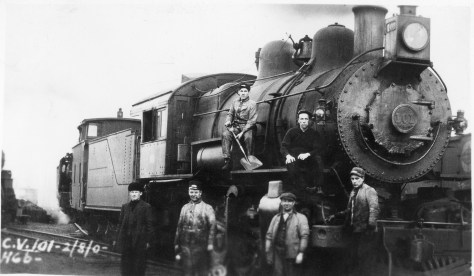
Here we have a wee bit of information. CV is for Cumberland Valley (not Central Vermont). The locomotive is a PRR Class H6b, engine number 101. A quick search of a PRR roster will reveal details about the engine. Also, we know it was exposed on February 8 or August 2, but the exact year is unknown. The men in the photo are obviously the crew, and knowledge of their uniforms and tools will give you an ideas as to their positions and roles; Engineer, Conductor, Fireman, Brakeman flagman, etc. But who are they? Where are we? Why? Who was the photographer? What was the significance of this image at the time? Mysteries, so far as I’m concerned.
A solution for future photos: take the time to write information on the images photos you make. If you caught something special, explain in detail. Never assume.
Be sure to include specifics regarding locations. Avoid potentially cryptic abbreviations.
Don’t make things up! Try to be as accurate as possible without wildly speculating as to important details such as date and location.
Don’t wait until you have 100,000 photographs that span 25 years to begin your task.
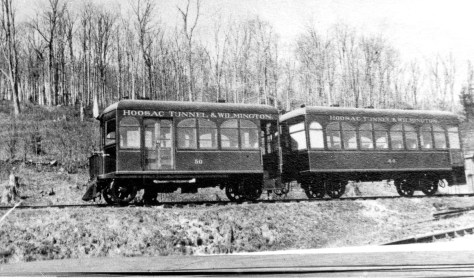
We know that this is a Hoosac Tunnel & Wilmington railcar and trailer. It looks relatively new and the numbers are displayed, so a search of rosters will reveal builder information and possible disposition. All other information is a mystery (there’s nothing on my print, not even the photographer’s name.) The photo is from my collection. Again I can speculate as to the year, location, etc.,, but that’s not my point. I’m not trying to solve this mystery, but rather offer an example of how a little bit of information in the form of a caption on the print would have gone a long way. Yet, what makes this photo fascinating to me is that its a rare example of a four-wheeled passenger vehicle built in the 20th century for an American railroad!
Beware: some time ago, an archivist told me that un-labeled photo collections are considered to be of low value to the historian. (His words were a bit stronger and involved trash receptacles).
A few final thoughts; when labeling old prints consider the type marker you use. Colored felt-tip pens are a very poor choice. For RC prints, consider a thin black permanent marker that won’t bleed, or a black ball-point pen with good action and ink that doesn’t smear. For paper prints a light pencil is a good choice, but don’t press down so hard that you damage the image area. Paste on labels are not good, eventually the glue will dry up (and fall off) and also the glue may bleed through. Digital images need captions too, but that’s a topic for another day.
More examples and more mysteries soon!
Tracking the Light Posts Daily!
Please help by forwarding Tracking the Light to your friends!
The other day down in the valley I heard the roar of a train ascending the old New London Northern grade to State Line.
EMD diesels working hard.
“Hmm. That’s odd. Daylight move on the New England Central?”
In recent months, New England Central’s freight south of Palmer, Massachusetts has been largely nocturnal.
I thought I’d best investigate, I hopped in my car and headed south to intercept.
Driving toward Stafford Springs, Connecticut I heard a telemetry hit on my scanner. (That’s the FRED—the end of train device the sends a signal reporting air-brake pressure from the tail end of the train to the engineer’s cab.) I knew the train was close.
Then, chatter on the radio: engineer to conductor. They were working the ground. The train was switching.
I altered my path and went to the south switch at State Line siding at Crow Hill Road, Stafford.
There I found the train: An NECR local freight from Palmer putting cars in the siding.
View from Crow Hill Road, Stafford, Connecticut. Lumix LX7 photo. I manually underexposed by 2/3s of a stop to compensate for the snow.
Sixteen loads and five empties.
At one end was a GP38 that’s nearly as old as I am. At the other end was NECR’s Tunnel Motor, engine 3317. A former Southern Pacific engine.
After dropping its cars on the siding, the crew of NECR’s local freight pulled across and prepared to head back north to Palmer. This allowed me to take a good look at the Tunnel Motor—so-called because of its specially designed air-flow arrangement originally configured for high-altitude operation in tunnels and snow sheds on Southern Pacific’s rugged line over Donner Pass in the California Sierra.
That’s neat. I’d never seen NECR’s Tunnel Motor south of Palmer before.
Sorry, did I mention that New England Central’s reporting marks are NECR?
NECR’s conductor sets the derail on the siding. Lumix LX7 photo.I drove to the north-end of the siding which begins just north of the Connecticut-Massachusetts line. Look to the right of the engines and you’ll see the crudely cut granite marker for the border.Not so many years ago, six-motors were banned from operation south of Palmer. These days it’s not so unusual. However, daylight moves don’t occur on a regular basis. Lumix LX7 photo.
In August 2011, I exposed this vertical (portrait oriented) interior view of the famous Cincinnati Union Terminal. The station is an architectural masterpiece designed by architects Fellheimer & Wagner.
I was visiting for the annual Summerail event (due to be held this year in Marion Ohio).
For this angle I used my Lumix LX3, which is a tool well suited for making interior views with mixed lighting.
Cincinnati Union Terminal’s art deco styling lends well to semi-abstract images. I especially like the enormous flag, which helps anchor the photo while providing both perspective and context.
Cincinnati was inspired by one of my favorite Scandinavian railway terminals—also featured on Tracking the Light. Do you know which one?
If you would like to read more about classic railway stations, including details on Cincinnati Union Terminal, consider ordering my book Railway Depots, Stations & Terminals published by Voyageur Press and available through Amazon and local book dealers.
Back in March 1984, I wandered down to Palmer with my dad’s Rolleiflex Model T loaded with Tri-X.
It was a miserable day; typical early of early Spring wet, clammy and dark.
Yet, Conrail was running trains. A westward midday freight (remember those?) was blocked at the diamond for a Central Vermont train.
Using the Rollei’s square format, I composed some interesting images. Conrail’s Boston and Albany was still a directional double-track railroad back then. This was before the modern signals and single tracking that began in 1986.
I took the negatives home and processed the negatives in the sink, as I often did in those days. I was using Microdol-X for developer. I was cheap, and my developer was rather depleted by the time I souped this roll.
The result; unacceptably thin negatives that wouldn’t print well, even when subjected to a number 4 polycontrast filter.
Poor show! These negatives were thin and very hard to print. At the time it wasn’t worth my time to mess about with them. Thankfully I saved them for more than 30 years. Despite under processing, most of the essential information necessary for an acceptible image was retained in the original negatives. This is the unmodified file.
It was a just a dark day in Palmer. Conrail in 1984 was common for me, so I sleeved the negatives, filed them away in an envelope and that was that.
Until a little while ago, when through the improved tools available to me through Lightroom, I was able to finally get the results I desired from these old photos.
A few easy adjustments in Lightroom and I was able to extract most of the detail I saw back on that March 1984 day. Now I have some suitable dramatic images from a favorite period on the railroad.
After nearly 32 years, they are looking pretty good now!
As a contrast to this morning’s frosty portrait view of a tightly cropped SEPTA Silverliner reflecting the snow on its inbound journey over former Pennsylvania Railroad rails, I thought I offer this summer evening’s view.
Berwin, Pennsylvania on the evening of June 30, 2012.
Like the earlier photo along the old Main Line (so-called because from the old ‘Main Line of Public Works) this depicts a Silverliner heading toward Philadelphia 30th Street.
However, this was a glorious summer’s evening with warm low sun in the western sky and fresh green leaves on the trees.
The camera and lens combination were also similar. This morning’s tightly cropped image was exposed with my Canon EOS7D with a 200mm telephoto, while this view used the same camera body but with a 100mm telephoto.
Anyway, if the weather today has you longing for the warmer months, here’s something for which you may look forward!
Please note, if you are viewing this post on Google Plus, Tumbler, Facebook or other sites, you’ll need to view Tracking the Light at: http://briansolomon.com/trackingthelight/ for the correct (unmodified, compressed or cropped) perspective on this image.
It was exactly two years ago; on this day, January 23, 2014, I made this tightly composed portrait-view (vertically oriented) photograph of a SEPTA Silverliner IV at Overbrook, Pennsylvania.
Over the years I’ve made many photographs along the former Pennsylvania Railroad Main Line, and more than my fair share of views at Overbrook.
SEPTA’s Silverliners are common enough, so I tried something a little different. Using my Canon EOS 7D with 200mm telephoto, I composed a tight vertical image of the SEPTA train as it glided through the station.
This is the full-frame portrait oriented view as I exposed it on January 23, 2014.
As a follow-up to Wednesday’s Tracking the Light post featuring vintage Ektachrome slides of Boston’s MBTA Mattapan-Ashmont PCCs from the late 1970s, I thought I’d present some of the images of this classic transit operation that I’ve made in the digital era.
I’ve featured this colorful trolley line about a once a year in Tracking the Light, but since the topic is timely as operation of the historic cars now appears to be under threat, I thought a Mattapan-Ashmont PCC review might be of interest.
Looking toward Ashmont from Cedar Grove. The Mattapab-Ashmont trolley line serves as an extension of MBTA’s Red Line. Exposed with a Canon EOS7D with 200mm lens.A classically painted PCC approaches Cedar Grove. Lumix LX3 photo, contrast adjusted in post processing.Milton was the station I featured in Wednesday’s post showing the old trackage arrangement. The 1979 view showed some PFE refrigerator cars delivered by Conrail on freight trackage that is now just a memory. Canon EOS7D with 40mm Pancake lens.A Mattapan bound car approaches Central Avenue. Exposed with a Canon EOS7D with 200mm lens.On an overcast May day, an MBTA PCC crosses Central Avenue. I like the contrast between the six decades old streetcar with modern automobiles. How much longer will scenes like this be possible on MBTA? Lumix LX7 photo.Careful inspection will reveal vestiges of the old New Haven Railroad freight trackage that ran parallel to the trolley line. Lumix LX7 photo.Mattapan is on the Red Line, served via vintage PCCs—at least for now. Lumix LX7 photo.It’s an era steeped in history, so it will be shame to see the old cars go. This is Boston’s equivalent of San Francisco’s Cable Cars—antique streetcars maintained for a modern application. LX7 photo.
I was searching through my Panasonic Lumix LX3 files from five years ago and I found this frosty low-sun photograph of Amtrak’s Vermonter departing CP83 in Palmer, Massachusetts for Springfield.
Rich winter sun offers a wonderful quality of light. While cold days maybe pose an endurance challenge for the photographer, the results can be outstanding.
Amtrak’s southward Vermonter heads west on CSX’s former Boston & Albany on January 25, 2011. (The train was working its southward schedule, although this portion of the railroad line is oriented East-West, which presents difficulties in captioning without long-winded explanations and a bit of historical background.) Exposed with a Panasonic Lumix LX3.
Recently, the TRAINS Newswire published a story on MBTA’s Mattapan-Ashmont Trolley line warning of the possible demise of the historic PCC cars and possibly of the trolley line itself. (The ‘bus’ word was uttered!)
So, the word is out, if Mattapan-Ashmont Trolley is something you want to see, DON’T Wait.
I recalled an early visit to this line with my father on a May Sunday in 1979. This was back when former Dallas double-ended PCCs dominated operations on the line, and the cars were largely painted red to reflect their operation as an extension of the Red Line.
Today, I find it fascinating to look back on these photos. I couldn’t have anticipated back then that more than 36 years later, old PCCs would still be working the line, albeit with different cars.
This old Type 3 car caught my attention. I’d seen these on the Green Line years earlier and always want to inspect one up close.Since my 1979 visit MBTA eliminated the classic trolley shelter at Mattapan and sent many of the double-ended cars to the scrapper.
However, from strictly a photographic point of view, what is now most interesting to me is that I knew virtually nothing of the ‘rules of photography’ , other than a rudimentary understanding of how to work my father’s Weston Master III light meter and translate the settings it offered to my Leica 3A.
No one had ever told me about three-quarter angles, or where the sun was ‘supposed to be’. Front-lighting, back-lighting, and side-lighting were foreign words. I was blind as to the relative importance of foreground and background, and I didn’t known that ‘good’ photos were only made with Kodachrome, and I knew nothing about the compositional ratios of 2/3s, or any of the other stuff that later influenced my photography.
Here were trolley cars and lots of them. What’s that Green car doing back there I wondered?
Honestly, as record of the scene, my raw unfettered, uninformed approach has a great appeal to me today. Had I known those things, I may have exposed less interesting images.
What you see here are the inspired views of an enthusiastic 12-year old exposed using a Leica with a 50mm Summitar lens on Ektachrome film.
Another view of the snow plow. Too much foreground? Lighting all ‘wrong’, just pitch this one in the bin.If the cars are double-ended, why do they spin them around on a loop. I couldn’t make heads or tails of this.I might not have known what I was doing, but I was visionary. I was fascinated by the ‘heavy rail’ tracks on both sides of the trolley line. Here is evidence that Conrail was still serving the former New Haven branch as far as Milton. There’s virtually no evidence of the freight operation today, and it takes a bit of imagination to figure out where the tracks were. Notice that I didn’t allow a PCC to interfere with the scene: this was about the PFE refers!
Sometimes a review of ‘out-takes’ will reveal a few gems. This is a lesson in how the passage of time can make the commonplace more interesting.
On the morning of September 7, 1989, I spent several hours around South Norwalk, Connecticut, making photos with my Leica M2 on Kodachrome 25 slide film. My primary subject was the old New Haven Railroad and the passage of Metro-North and Amtrak trains.
Since that time, the Metropolitan series cars that once dominated Metro-North’s suburban service have been all but replaced. But back then many of these cars still had a relatively new sheen to them.
More striking have been changes to the South Norwalk station. The scene is very different. Among the changes has been construction of a large multistory parking garage, which now occupies the space to the north of the station.
Grand Central bound Metro-North train approaches South Norwalk on September 7, 1989.South Norwalk station as it appeared on the morning of September 7, 1989. Today, the scene is complete changed.Notice the sheen of the stainless steel on this Metropolitan-series electric car.A view from the street looking north toward the old New Haven electrified line.Looking toward New Haven Connecticut.
Yet, I also made a few photos of the town and passing road vehicles, which help give a flavor for South Norwalk in the late 1980s now more than a quarter century gone.
The street had its fair share of interest too.Wheels said the bus.
The best of the photos from this morning are held in a different file, and these are merely what I deemed at the time as ‘extras.’
Last week, I wrote about violating one of the cardinal rules of good railroad photography, that is aiming directly into the sun. In question were some views along the Ware River Railroad, er . . . sorry, rather the Mass-Central, as it is now known.
It may come as a shock to some readers of Tracking the Light, but this was not my first time aiming the camera toward the sun when photographing trains!
What I present here is an unusual image. Not because it is a trailing view of an Amtrak Turbotrain racing through North Chili, New York (rhymes with Dubai rather than Silly Hippie) on its way to Grand Central. (Yes, the Turbos went there back in the day). But, because I’ve opted to make a mid-morning silhouette in an unlikely way.
A thin layer of cloud had softened the morning sun. I was working with a Linhof Karden Color B 4×5 view camera fitted with a 90mm Schneider Super Angulon lens and Tri-X black and white sheet film (manufactured nearby in Rochester, New York).
Photographing moving trains with a view camera is no easy task, and on this day I had the camera firmly set up on a heavy tripod.
However, one advantage to the view camera is the ability to lift the front plane of the camera. This allowed me to keep the camera level while obtaining more sky area without causing unnecessary distortion to the train.
I’d set up the camera well in advance of the Turbotrain’s passing. Back in 1987, when I made this image there were no cell phones nor Julie to provide me with schedule updates.
Behind me was the Union Road grade crossing (long since replaced with an overpass). I had only one shot and I wanted to place the rear nose of the Turbotrain such that it didn’t intersect the trees to the right or the silhouette effect would be lost.
Another advantage of the 4×5 media is the ability to capture much greater amounts of information than possible with smaller film formats. As a result, I was able to capture superb tonality across a wide exposure range.
Unmodified scan of the original 4×5 negative. No adjustments to contrast or exposure.
Admittedly this black & white negative had always vexed me in the darkroom. However, I scanned it the other day, and using Lightroom found that the contrast manipulation I was unable to achieve chemically, was easily accomplished with digital adjustment.
Adjusted photograph, using both localized and global contrast and exposure controls.
I just scanned this old negative a few minutes ago. (If you’re not viewing this on Tracking the Light, you’ll need to click the link to get the full effect of the image.)
Back in late 1996, friend Doug Moore (and Tracking the Light grammar and fact checker) had lent me a Baby Speed Graphic (sorry I don’t recall the specific model.).
This camera used a roll film back and featured both a leaf shutter and a focal plane shutter, which made it useful for exposing railroad photographs.
Kodak 120 Tri-X exposed using a Speed Graphic and processed in D-76 1:1 with water. December 5, 1996, West Warren, Massachusetts.
Among the images I made was this view of a westward Conrail freight from the bridge at West Warren. Tracking the Light viewers will likely recognize the location as I’ve often posted pictures from here.
Using Lightroom I was able to make some simple contrast and exposure adjustments that greatly improved the overall appearance of the photo.
Here’s a slightly lighter variation of the above image. Just a minor adjustment that may look brighter on the computer screen. Owing to the large size of the negative and careful processing, there’s lots of subtle tonality in the original.
I made this detailed telephoto view of Guilford Rail System’s former Santa Fe SD26 621 at East Deerfield yard.
The SD26 was a peculiar looking locomotive that featured a classic arched roof cab, slanted nose, with a humpbacked hood section and air reservoirs located on top.
Light and shade: By sculpting with low afternoon light, I was able to emphasize the SD26’s shapes while minimizing other elements of the scene. Notice the effects of reflections in the windows and off the cab nose.
Over the years, I made many photographs of these locomotives on the road. For me this unusual angle captures the distinctive shape of the SD26, two of which soldiered on in road-service into the mid-2000s.
One of the advantages of making a panned photograph is the ability to instantly transform a dull scene into a dynamic photograph.
I made this photograph of an eastward Amtrak train under wire on the old New Haven Railroad near New Haven, Connecticut at 9:38am on December 27, 1986.
Amtrak’s Material Handling Cars (MHCs) were some of the newest equipment on the move in 1986.
At the back of the train was a pair of relatively new Material Handling Cars, which where then allowed in high-speed service.
Rather than simply expose a flat light photo of the cars on the back of the train, I selected a slow shutter speed and kept the camera in constant motion with the train to make this panned view.
Aiding my ability to make this pan photograph was the Leica M3 camera that had a very soft shutter release. My exposure was 1/25th of a second at f5.6 on Kodachrome 25 slide film.
I’d be willing to wager that there are very few panned photos of new Amtrak MHC cars under wire!
After the spectacular January 15, 1953 Washington Union Station wreck, Pennsylvania Railroad rebuilt GG1 4876, which required substantial reconstruction resulting in an nearly new machine.
In the late 1970s and early 1980s, I made a project of photographing old 4876, at which time it was working for New Jersey Department of Transportation on New York & Long Branch suburban services.
I exposed this detailed view with my Leica 3A at Rahway Junction in the locomotive’s last year of service.