Sometimes it helps not to plan too hard. With the sun at our backs we headed out on the open road aiming to find our subject, but situations change, information is imperfect, and unexpected opportunities present themselves.
Tuesday February 9, 2016 wasn’t a day I’d expected to be making photos. But when at the last minute the task set for the day was postponed and the weather forecast improved, suddenly I had an opportunity to spend the day with cameras in hand.
A snowplow clearing the drive woke me up. I rang my old friend Paul Goewey to see if he was keen on a day’s photography and soon we were on the road.
My thoughts were to head toward Brattleboro, Vermont to intercept New England Central’s job 611, the southward freight to Palmer, Massachusetts.
However, all we knew was that at 8 am it hadn’t departed Brattleboro yard.
Driving north I made a spontaneous decision to divert and instead drove to Pan Am Railway’s East Deerfield Yard. After arriving we heard of an EDRJ (East Deerfield to Rotterdam Junction) that was being prepared for its westward journey.
Pan Am’s EDRJ lurked at East Deerfield. The prospect of a day long westward chase across the Boston & Maine’s Fitchburg Line reminded me of olden times. But would the train depart promptly? Exposed with my FujiFilm X-T1.
So much for our quest of the New England Central.
While we waited for EDRJ to be organized, Pan Am’s POED (Portland to East Deerfield) arrived with a consist of seven EMD diesels.
Pan Am’s POED with a monster consist; seven locomotives all old EMDs. Exposed with my FujiFilm X-T1.
Finally, EDRJ was ready to go.
The sun was out, there was a blue SD45 in the lead (well its was a locomotive that had once been a proper SD45) and we had plenty of daylight. I anticipated following the train all the way to the Mohawk Valley.
Finally, about 11:22 am, Pan Am Railway’s EDRJ was on the move with a handsome SD45 in the lead (yes yes, I know, this locomotive no longer has its 20-cylinder diesel. But it sure looks nice!). Exposed with my FujiFilm X-T1.The one caveat was that today’s EDRJ had only two cars. Not the monster freight that I’d expect of Pan AM. Yet, a small consist meant that the train was likely to make good time. Plus it had a pickup at Hoosick Junction and as they say; ‘it is what it is.’EDRJ catches the sun crossing a field freshly covered with snow near Buckland, Massachusetts. FujiFilm X-T1 photo.The road to Zoar was in better shape than I expected. Here EDRJ works west.A few minutes earlier EDRJ had met an eastward train at Soapstone. We opted to continue following EDRJ. I expected to reach the Mohawk Valley by dusk. Such was not the case though, as soon we had another distraction!
So further and further west we went. Later we found a fortuitous surprise.
Stay tuned tomorrow for our lucky Tuesday prize—handed to us like a birthday cake. Silver stars for going out; gold stars for persistence!
Thus far I’ve had a variety of spirited attempted guesses, but so far no one has come close to the correct answer! (Except Pop.)
Certainly the Mass-Central is a good guess, but which, if any, of the crossings on the Mass-Central have I failed to expose a photo of a train in the last 35 years?
Here’s a final clue: the line pictured was once part of a long-forgotten railroad empire.
Also another version of the photo:
Another versions of Wednesday’s Tracking the Light mystery photo. CAN YOU GUESS Where this is? Remember be specific!
I’ll reveal the location Friday evening or Saturday morning! Plenty of the time for more guesses.
Back to the old, ‘f5.6 and be there’. (While paying close attention to the signals and scanner).
Lately CSX’s freight operations on the old Boston & Albany have been largely nocturnal.
Mondays on the other hand can prove busy in the morning.
February 8, 2016: I wasn’t out for the day, but rather running some errands. As always, I had my Lumix at the ready. Snow was forecast and it was beginning to flurry.
On my way through East Brookfield, I took the time to check the signals at CP64.
These were lit: “Limited Clear” westbound. I knew a train must be close.
Soon I could hear the clatter of cars descending Charlton Hill. Then affirmation on the radio, ‘Q427 clear signal main to main CP60’.
CSX Q427 is the connection from Pan Am Railways that runs from Portland, Maine to Selkirk, New York via the Ayer-Worcester gateway. On Pan Am it’s called POSE.
I made my photographs. But a few minutes later I heard that Q427 had stopped west of milepost 72 owing to difficulties with the locomotives.
That’s Warren, 72 miles west of South Station, Boston.
I caught up with the freight as the crew was discussing its difficulties with CSX’s dispatcher in Selkirk. Soon, Q427, with its mix of CSX and Pan Am Railways locomotives. was again on the move west.
Q427 had to meet two eastward trains at CP83 (Palmer).
I continued to follow west, while making photographs along the way. Like shooting fish in a barrel.
Pacing view along Route 67 in West Warren. Lumix LX7 photo.My favorite field west of CP79. The view from Route 67.The old Palmer freight house location.It’s been a while since I saw a blue SD45 roll through Palmer on the Boston & Albany.
I arrived at CP83 just in time to hear the first of two eastward trains call the signal; “Limited Clear”. Not a second to waste: I was out of the car and immediately into position—switching the Lumix ‘on’ as I ran.
I made a few photos of the first meet, then opted to head back up the Quaboag Valley rather than stay put.
Radiator comparison. Lumix LX7 view.
The snow was now getting heavy and it wasn’t getting any warmer.
At Electric Light Hill (near milepost 82) I photographed CSX Q264 (loaded autoracks for East Brookfield).
This was a heavy train. And despite the snow, it was easy enough to follow up the grade to Warren.
The snow adds depth, but to keep the image from become purely abstract I opted to include the bush at the left. The roar of the train filled the valley.
It was just 18 degrees at the Warren station.
That’s good enough for my morning errands!
All photos nominally adjusted for contrast and saturation in post processing.
CSX Q264 passes the old Boston & Albany station at Warren, Massachusetts.This is the site of the old Warren yard. What happened to the old coal sheds? For that matter what happened to Anthracite? Car wash anyone?
Tracking the Light is a Daily Blog on Railway Photography!
The other day I was scouring the files for a photo Amtrak’s Sunset Limited as an illustration for an article I was writing.
Instead, I found this slide; one of hundreds of images I made along SP’s Sunset Route in southern California during the early-mid 1990s.
A Cotton Belt GP60 leads an eastward Southern Pacific freight over Beaumont Hill near Cabazon, California on the evening of January 29, 1994. Kodachrome 25 slide scanned with an Epson V750 Pro and processed using Lightroom.
I’d been following this eastward Southern Pacific freight over Beaumont Pass and I exposed this view near Cabazon on the east slope. The setting sun was enhanced by the effects of Los Angeles-area smog that acted as a red filter (an effect of heavy particulates).
I was working with my Nikon F3T and Kodachrome 25 slide film. Always a favorite combination for image making on Southern Pacific Lines.
Tracking the Light presents new material every day!
February 8, 1994, I used my Nikormat FTN with a Tokina 400mm lens mounted on a Bogen 3021 tripod to make this view on Fujichrome 100 slide film of a Boeing-Vertol Light Rail Vehicle pausing for passengers on the N-Judah line.
It was the end of the day and the colors of a sunset sky are reflected in the windshield of the LRV. For me it is the contrast and subtle hues of the evening light that make this photo stand out.
San Francisco’s Muni light rail offers endless opportunities for dramatic photos on the streets of this famous California city.
If I recall correctly, my shutter speed was 1/60th of a second. The slide is slightly dark (about ½ stop) so I lightened it a bit in post processing.
I used to say that with Conrail operations you needed a score-card to figure out what was going on, and by the time you figured out there was too much information to put on a slide mount.
It hasn’t become any easier: Here were have the former New York, New Haven & Hartford electrified four-track main line. New Haven was absorbed by Penn-Central in 1969 (although Penn-Central itself was created from the merger of Pennsylvania Railroad and New York Central in 1968). PC collapsed financially and resulted in Congress creating the Consolidated Rail Corporation (Conrail).
However, during this time ownership of the Northeast Corridor (comprised in part by the New Haven mainline) was separated from Conrail, with most of the Boston to Washington route conveyed to Amtrak. Except portions of the electrified line west of New Haven that were instead conveyed to the states of Connecticut and New York.
[Clarification: In the aftermath of Penn-Central bankruptcy, New York’s Metropolitan Transportation Authority assumed financial responsibility for the New York portion of suburban services, with the Connecticut Department of Transportation (C-Dot) supporting Connecticut operations on former New Haven Lines—details from my book Railroad Family Trees published by Voyageur Press.]
Yet, initially Conrail continued to provided freight and suburban operations. When Conrail exited the commuter business at the end of 1982, Metro-North assumed suburban operations.
So what’s this? Oh, well this is a former Amtrak P40 (technically a General Electric GENESIS— Series 1, model DASH 8-40BP) working for Shore Line East, which is another Connecticut sponsored passenger operator. Today SLE operates diesel-powered suburban trains between New London and New Haven. A few of these services continue west under wire to Stamford.
However, not all trains carry passengers. (Trains are moved empty to be in position for loading).
Also, as a tribute to the old New Haven Railroad, some SLE equipment is lettered New Haven using the traditional font and livery.
The result is we have an empty diesel-powered passenger train underwire on the former New Haven, partially lettered for the former New Haven.
So for a caption we could try:
Ex-Amtrak P40 (DASH8-40BP) 834 leads westbound Shore Line East train 1169 (deadhead) under wire at West Haven on Metro-North’s former New Haven Railroad mainline at 3:53 pm on January 29, 2016.
Thanks to Pat Yough for the train numbers!
Ex-Amtrak P40 (DASH8-40BP) 834 leads westbound Shore Line East train 1169 (deadhead) under wire at West Haven on Metro-North’s former New Haven Railroad mainline at 3:53 pm on January 29, 2016.Westbound Shore Line East train 1169 (deadhead) under wire at West Haven on Metro-North’s former New Haven Railroad mainline at 3:53 pm on January 29, 2016.
It had been a few years since I last visited the old Boston & Maine station on the Fitchburg Line at South Acton, Massachusetts.
Pat Yough and I stopped in on Sunday, just a day or so after MBTA’s Grand Opening.
The new facility features long high-level platforms, a massive footbridge, and modern signaling.
A young woman waiting for a train to Leominster told me that she was very excited about the new station but found the signage confusing. “It’s traumatic when the train comes in on the other platform and you miss it!”
Pat and I waited for an outbound MBTA train destined for Fitchburg. High clouds made for diffused lighting that was ideal to show the new station at South Acton.
Last time I’d visited South Acton, there was a ‘blue- bird’ GP9 with a caboose working a local freight. Didn’t see that on Sunday!
Photos exposed with my FujiFilm X-T1 digital camera.
A short segment of the Pan Am Railway’s Boston & Maine Greenville Branch extends northward from Ayer, Massachusetts.
While photographing around Ayer the other day, Bob Arnold, Paul Goewey and I had been discussing the branch, where it crosses Ayer’s West Main Street on plate girder bridge.
“I always wanted a photograph there.”
As luck would have it, a little later in the day our wish was granted.
Pan Am Railway’s local FI-1 (based in Fitchburg) crosses West Main Street in Ayer. I’ve been under this bridge dozens of times, but I’d never seen a train on it before. FujiFIlm X-T1 with 18-135mm lens.
Although like wish granted by a Genie in the bottle, this one came with caveats. The train went up the branch in very dull light, with the ugliest leased engine available and long hood first, with one car.
Beggars can’t be choosers, to quote the cliché. So we worked with what we had.
Ah yes, the old Boston & Maine Greenville Branch. A relic of another era. A vestige of former times. How neat it would have been to see a 4-4-0 with combine coach marching along this rural branch line?No 4-4-0 today. Not even one of Pan Am Railway’s nice blue GP40s. St. Mary’s cemetery is older than the railway. FujiFilm X-T1 photo.Approaching the Route 2A crossing. A Pan Am Railways highway truck is at left. Speed on the branch is a gingerly 5 mph.To deliver this car into a siding, the locomotive ran around, and then reversed. FujiFilm X-T1 digital photo.The switch stand dates to the era of the 4-4-0! FujiFilm X-T1 digital photo.FI-1 makes its drop. FujiFilm X-T1 digital photo.
If I captioned this post, ‘23K passes Shirley’, would you have looked any way?
The other day when Paul Goewey, Bob Arnold and I were photographing trains at Shirley, Massachusetts, I exposed these views of the daily westward intermodal train symbol 23K that originates a few miles to the east at Ayer.
The Lovely Trees: These two massive trunks have fascinated me for years, and make for an excellent means to frame up a photo. Here, in the first view the intermodal train is almost incidental to the scene.
Exposed with a FujiFilm X-T1 digital camera fitted with a Zeiss 12mm Tuoit lens.
Which of these views of Norfolk Southern/Pan Am Southern’s 23K do you prefer?
A closer view made moments after the first. In this image I’ve emphasized the train.This is an ‘enhanced’ version of the above. Working from the RAW file, I’ve made a variety of subtle changes to contrast, exposure, saturation and clarity in Lightroom as a means of making a more pleasing image.
This photo was product of one of dozens of trips I made to the old Boston & Albany west end in the mid-1980s.
The west end is the railroad west of Springfield over the Berkshires of Massachusetts toward Albany, New York.
Exposed on 120 black & white film using a Rollei Model T. Exposure calculated using a GE hand held light meter. Film processed in D76 1:1, and scanned with an Epson V750.
On this morning I waswest of Chester, Massachusetts perched on the top of an rock cutting that dated to the time of the line’s construction circa 1839-1840.
This Conrail eastward train was slowly making its way east. It was serenely quite in these hills and I’d hear the freight making its descent of Washington Hill miles before it finally appeared.
Imagine this setting one hundred and forty years earlier when it was the old Western Rail Road (precursor to the Boston & Albany). A time when one of Winan’s peculiar vertical boiler 0-8-0s would have led a train of primitive four wheel freight cars over this same line.
Fewer trees then. And no cameras!
Tracking the Light Posts Daily!
This is an adjusted version of the same image. I’ve slight altered contrast and exposure to make it appear better on some computer screens. On my screen this looks closer the way I would have printed the negative back in 1985 by using a cold head (diffusion) enlarger.
Not my finest print, but it was the best I capable of at the time. Today, what I find interesting is the effort I made at captioning the print, which has preserved the spirit of the day and the relative significance of the image. Information distinguishes the train pictured from that of a generic move to a specific train on a specific day and highlights the relative importance of the image.
Here’s an old print. I exposed this years ago. It shows an Amtrak train in the snow someplace. If I had to guess, I say it was made somewhere in New England in the mid-1980s/early 1990s based on the equipment.
Except I don’t need to guess. I know that it was exposed on the morning of January 16, 1984 and shows Amtrak’s late-running Washington D.C. to Montreal Montrealer passing South Deerfield, Massachusetts.
I chose to display this photograph because it has a decent caption on the back. My language skills weren’t fantastic, but all I was trying to do was convey the vital information that related to the photograph. I typed my caption up on label using an IBM Selectric typewriter (which imprinted letters with a rapidly rotating ball) and pasted it to the back of the print.
In the caption I was trying to do was convey the vital information. At the time, I’d hope to send this to a magazine. Catching the Montrealer in daylight was a real coup! (Or so I thought at the time.).
I find this photograph interesting for other reasons too. As regular viewers of Tracking the Light may be aware, I’ve made several recent views of Amtrak’s Vermonter at this same highway crossing (North Hillside Road) and so this makes for an interesting comparison view.
The primary reason I’ve posted this today is to provide an example of how a simple caption can solve many mysteries. Instead of a generic image of an Amtrak train kicking up snow, we instead know many of the crucial details; what, when where and why.
These details make the photo more relevant, and potentially more valuable as a record.
These modern locomotives have been on the move in New England for a few months now, but they managed to elude me. Or my camera anyway. (I saw one in Worcester some weeks ago.).
Pan-Am Railways symbol SEPO typically operates with run-though locomotives. The eastward freight is pictured at Ayer, Massachusetts. Fuji Film X-T1 digital camera.CSX logo on a new ET44AH diesel-electric.
The Tier 4 are the most modern high-horsepower freight locomotives offered by General Electric. They are designed to meet EPA’s Tier IV emissions standards.
While similar in appearance to other late model GE freight locomotives, they have a distinctive large capacity radiator and vents at the back. This provides increased heat exchange area in the radiator cab is required to meet the stricter Tier 4 exhaust emission requirement using by using Exhaust Gas Recirculation
On the morning of Tuesday January 26, 2016, Pan Am’s SEPO is seen at the Willows, east of Ayer, where the Stony Brook Branch diverges from the Fitchburg Route. The Stony Brook handles Pan Am’s though freights to Maine and New Hampshire destinations. This set of three locomotives demonstrates an evolution in modern radiator profiles. The lead locomotive has the most modern Tier 4 design, while the second locomotive is one of GE’s Evolution Series that was in production from 2004-2014, third out is a 1990s era design: the AC4400CW .
On Tuesday, January 26, Bob Arnold, Paul Goewey and I found CSX 3308 working symbol freight SEPO (CSX Selkirk Yard to Portland, Maine) at Ayer, Massachusetts.
I always like to catch new power on the move and we caught this freight at several locations.
GE’s modern Tier 4 locomotives can be instantly recognized by their enormous radiator profile. When photographing these modern locomotives, a trailing view such as this one offers a better view of the technologically distinctive features.This telephoto trailing view emphasizes the radiators. FujiFilm X-T1 digital camera.
What about a classic three-quarter ‘roster view’ you ask? Well, I exposed that on color slide film, of course!
I work with photographs almost every day. Often, I’m faced with drafting captions for historic images and too often I find historic prints without adequate information.
Back in the day some conscientious photographer made the effort to preserve a scene. When they went out the reason for their photograph was often brutally obvious (to them).
Maybe a new locomotive was working the daily express, or the local passenger train was running late. Perhaps an old machine was nearly ready for the scrap heap, or something special was on the move.
Or maybe it was just a nice day to be out, and the photographer wanted to document the railroad action.
Here we have a nice photo of a nearly new 4-4-0. With a little bit of footwork I was able to discover that it was an Illinois Central engine. The location, date, and specific significance of the image at the time of exposure are a mystery (to me anyway). There is no information on the print. Even the photographer has been forgotten. The print is from my collection. A simple caption such as: JL Jones and crew pose with new 934 at Podunk, Mississippi, February30, 1879 would have been helpful (hold on sherlock, I made up that caption to serve as potential example. So, it is pure fiction, not speculation— thus the date).
Holding an un-captioned photo may present many mysteries that could have been easily answered at the time of exposure. But the photographer passed on and the significance of the moment has been forgotten; the railroad was merged out of existence decades ago and the location has changed beyond recognition.
And so here I am trying to solve a mystery. Often, I can figure things out. But not always.
There maybe clues, but will they help? If you could find the location today, you might see that the double track line in the old print was reduced to single iron and the old station was bulldozed years ago, the mills in the distance are now the site of a shopping plaza, and trees have grown up everywhere.
My late-friend Robert A. Buck was a stickler for captioning photographs. Time, date, location, train number, engine number and class, engineer’s name, and so on.
A captioned photograph is vastly more useful, more valuable, and more relevant than an uncaptioned print. Never assume that the viewer, or even the photographer himself/herself will remember the details. The passage of time tends to blur those things that once seemed obvious.
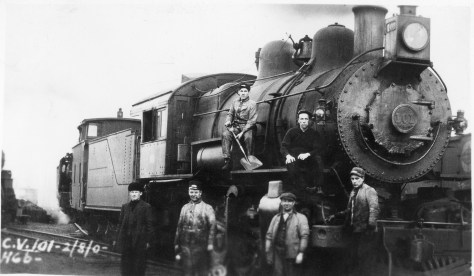
Here we have a wee bit of information. CV is for Cumberland Valley (not Central Vermont). The locomotive is a PRR Class H6b, engine number 101. A quick search of a PRR roster will reveal details about the engine. Also, we know it was exposed on February 8 or August 2, but the exact year is unknown. The men in the photo are obviously the crew, and knowledge of their uniforms and tools will give you an ideas as to their positions and roles; Engineer, Conductor, Fireman, Brakeman flagman, etc. But who are they? Where are we? Why? Who was the photographer? What was the significance of this image at the time? Mysteries, so far as I’m concerned.
A solution for future photos: take the time to write information on the images photos you make. If you caught something special, explain in detail. Never assume.
Be sure to include specifics regarding locations. Avoid potentially cryptic abbreviations.
Don’t make things up! Try to be as accurate as possible without wildly speculating as to important details such as date and location.
Don’t wait until you have 100,000 photographs that span 25 years to begin your task.
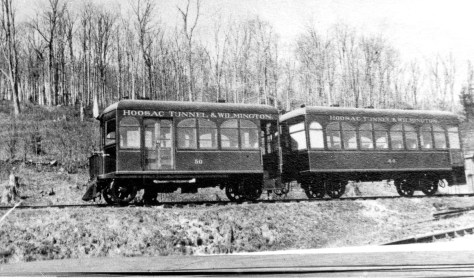
We know that this is a Hoosac Tunnel & Wilmington railcar and trailer. It looks relatively new and the numbers are displayed, so a search of rosters will reveal builder information and possible disposition. All other information is a mystery (there’s nothing on my print, not even the photographer’s name.) The photo is from my collection. Again I can speculate as to the year, location, etc.,, but that’s not my point. I’m not trying to solve this mystery, but rather offer an example of how a little bit of information in the form of a caption on the print would have gone a long way. Yet, what makes this photo fascinating to me is that its a rare example of a four-wheeled passenger vehicle built in the 20th century for an American railroad!
Beware: some time ago, an archivist told me that un-labeled photo collections are considered to be of low value to the historian. (His words were a bit stronger and involved trash receptacles).
A few final thoughts; when labeling old prints consider the type marker you use. Colored felt-tip pens are a very poor choice. For RC prints, consider a thin black permanent marker that won’t bleed, or a black ball-point pen with good action and ink that doesn’t smear. For paper prints a light pencil is a good choice, but don’t press down so hard that you damage the image area. Paste on labels are not good, eventually the glue will dry up (and fall off) and also the glue may bleed through. Digital images need captions too, but that’s a topic for another day.
More examples and more mysteries soon!
Tracking the Light Posts Daily!
Please help by forwarding Tracking the Light to your friends!
The other day down in the valley I heard the roar of a train ascending the old New London Northern grade to State Line.
EMD diesels working hard.
“Hmm. That’s odd. Daylight move on the New England Central?”
In recent months, New England Central’s freight south of Palmer, Massachusetts has been largely nocturnal.
I thought I’d best investigate, I hopped in my car and headed south to intercept.
Driving toward Stafford Springs, Connecticut I heard a telemetry hit on my scanner. (That’s the FRED—the end of train device the sends a signal reporting air-brake pressure from the tail end of the train to the engineer’s cab.) I knew the train was close.
Then, chatter on the radio: engineer to conductor. They were working the ground. The train was switching.
I altered my path and went to the south switch at State Line siding at Crow Hill Road, Stafford.
There I found the train: An NECR local freight from Palmer putting cars in the siding.
View from Crow Hill Road, Stafford, Connecticut. Lumix LX7 photo. I manually underexposed by 2/3s of a stop to compensate for the snow.
Sixteen loads and five empties.
At one end was a GP38 that’s nearly as old as I am. At the other end was NECR’s Tunnel Motor, engine 3317. A former Southern Pacific engine.
After dropping its cars on the siding, the crew of NECR’s local freight pulled across and prepared to head back north to Palmer. This allowed me to take a good look at the Tunnel Motor—so-called because of its specially designed air-flow arrangement originally configured for high-altitude operation in tunnels and snow sheds on Southern Pacific’s rugged line over Donner Pass in the California Sierra.
That’s neat. I’d never seen NECR’s Tunnel Motor south of Palmer before.
Sorry, did I mention that New England Central’s reporting marks are NECR?
NECR’s conductor sets the derail on the siding. Lumix LX7 photo.I drove to the north-end of the siding which begins just north of the Connecticut-Massachusetts line. Look to the right of the engines and you’ll see the crudely cut granite marker for the border.Not so many years ago, six-motors were banned from operation south of Palmer. These days it’s not so unusual. However, daylight moves don’t occur on a regular basis. Lumix LX7 photo.
I was searching through my Panasonic Lumix LX3 files from five years ago and I found this frosty low-sun photograph of Amtrak’s Vermonter departing CP83 in Palmer, Massachusetts for Springfield.
Rich winter sun offers a wonderful quality of light. While cold days maybe pose an endurance challenge for the photographer, the results can be outstanding.
Amtrak’s southward Vermonter heads west on CSX’s former Boston & Albany on January 25, 2011. (The train was working its southward schedule, although this portion of the railroad line is oriented East-West, which presents difficulties in captioning without long-winded explanations and a bit of historical background.) Exposed with a Panasonic Lumix LX3.
Sometimes a review of ‘out-takes’ will reveal a few gems. This is a lesson in how the passage of time can make the commonplace more interesting.
On the morning of September 7, 1989, I spent several hours around South Norwalk, Connecticut, making photos with my Leica M2 on Kodachrome 25 slide film. My primary subject was the old New Haven Railroad and the passage of Metro-North and Amtrak trains.
Since that time, the Metropolitan series cars that once dominated Metro-North’s suburban service have been all but replaced. But back then many of these cars still had a relatively new sheen to them.
More striking have been changes to the South Norwalk station. The scene is very different. Among the changes has been construction of a large multistory parking garage, which now occupies the space to the north of the station.
Grand Central bound Metro-North train approaches South Norwalk on September 7, 1989.South Norwalk station as it appeared on the morning of September 7, 1989. Today, the scene is complete changed.Notice the sheen of the stainless steel on this Metropolitan-series electric car.A view from the street looking north toward the old New Haven electrified line.Looking toward New Haven Connecticut.
Yet, I also made a few photos of the town and passing road vehicles, which help give a flavor for South Norwalk in the late 1980s now more than a quarter century gone.
The street had its fair share of interest too.Wheels said the bus.
The best of the photos from this morning are held in a different file, and these are merely what I deemed at the time as ‘extras.’
Last week, I wrote about violating one of the cardinal rules of good railroad photography, that is aiming directly into the sun. In question were some views along the Ware River Railroad, er . . . sorry, rather the Mass-Central, as it is now known.
It may come as a shock to some readers of Tracking the Light, but this was not my first time aiming the camera toward the sun when photographing trains!
What I present here is an unusual image. Not because it is a trailing view of an Amtrak Turbotrain racing through North Chili, New York (rhymes with Dubai rather than Silly Hippie) on its way to Grand Central. (Yes, the Turbos went there back in the day). But, because I’ve opted to make a mid-morning silhouette in an unlikely way.
A thin layer of cloud had softened the morning sun. I was working with a Linhof Karden Color B 4×5 view camera fitted with a 90mm Schneider Super Angulon lens and Tri-X black and white sheet film (manufactured nearby in Rochester, New York).
Photographing moving trains with a view camera is no easy task, and on this day I had the camera firmly set up on a heavy tripod.
However, one advantage to the view camera is the ability to lift the front plane of the camera. This allowed me to keep the camera level while obtaining more sky area without causing unnecessary distortion to the train.
I’d set up the camera well in advance of the Turbotrain’s passing. Back in 1987, when I made this image there were no cell phones nor Julie to provide me with schedule updates.
Behind me was the Union Road grade crossing (long since replaced with an overpass). I had only one shot and I wanted to place the rear nose of the Turbotrain such that it didn’t intersect the trees to the right or the silhouette effect would be lost.
Another advantage of the 4×5 media is the ability to capture much greater amounts of information than possible with smaller film formats. As a result, I was able to capture superb tonality across a wide exposure range.
Unmodified scan of the original 4×5 negative. No adjustments to contrast or exposure.
Admittedly this black & white negative had always vexed me in the darkroom. However, I scanned it the other day, and using Lightroom found that the contrast manipulation I was unable to achieve chemically, was easily accomplished with digital adjustment.
Adjusted photograph, using both localized and global contrast and exposure controls.
I just scanned this old negative a few minutes ago. (If you’re not viewing this on Tracking the Light, you’ll need to click the link to get the full effect of the image.)
Back in late 1996, friend Doug Moore (and Tracking the Light grammar and fact checker) had lent me a Baby Speed Graphic (sorry I don’t recall the specific model.).
This camera used a roll film back and featured both a leaf shutter and a focal plane shutter, which made it useful for exposing railroad photographs.
Kodak 120 Tri-X exposed using a Speed Graphic and processed in D-76 1:1 with water. December 5, 1996, West Warren, Massachusetts.
Among the images I made was this view of a westward Conrail freight from the bridge at West Warren. Tracking the Light viewers will likely recognize the location as I’ve often posted pictures from here.
Using Lightroom I was able to make some simple contrast and exposure adjustments that greatly improved the overall appearance of the photo.
Here’s a slightly lighter variation of the above image. Just a minor adjustment that may look brighter on the computer screen. Owing to the large size of the negative and careful processing, there’s lots of subtle tonality in the original.
I made this detailed telephoto view of Guilford Rail System’s former Santa Fe SD26 621 at East Deerfield yard.
The SD26 was a peculiar looking locomotive that featured a classic arched roof cab, slanted nose, with a humpbacked hood section and air reservoirs located on top.
Light and shade: By sculpting with low afternoon light, I was able to emphasize the SD26’s shapes while minimizing other elements of the scene. Notice the effects of reflections in the windows and off the cab nose.
Over the years, I made many photographs of these locomotives on the road. For me this unusual angle captures the distinctive shape of the SD26, two of which soldiered on in road-service into the mid-2000s.
One of the advantages of making a panned photograph is the ability to instantly transform a dull scene into a dynamic photograph.
I made this photograph of an eastward Amtrak train under wire on the old New Haven Railroad near New Haven, Connecticut at 9:38am on December 27, 1986.
Amtrak’s Material Handling Cars (MHCs) were some of the newest equipment on the move in 1986.
At the back of the train was a pair of relatively new Material Handling Cars, which where then allowed in high-speed service.
Rather than simply expose a flat light photo of the cars on the back of the train, I selected a slow shutter speed and kept the camera in constant motion with the train to make this panned view.
Aiding my ability to make this pan photograph was the Leica M3 camera that had a very soft shutter release. My exposure was 1/25th of a second at f5.6 on Kodachrome 25 slide film.
I’d be willing to wager that there are very few panned photos of new Amtrak MHC cars under wire!
After the spectacular January 15, 1953 Washington Union Station wreck, Pennsylvania Railroad rebuilt GG1 4876, which required substantial reconstruction resulting in an nearly new machine.
In the late 1970s and early 1980s, I made a project of photographing old 4876, at which time it was working for New Jersey Department of Transportation on New York & Long Branch suburban services.
I exposed this detailed view with my Leica 3A at Rahway Junction in the locomotive’s last year of service.
A few minutes ago I scanned this Kodachrome slide. When I went to caption the file, I thought,
“Jan 14th 1989. Wow, that’s exactly 27 years ago.”
So, there you go.
Kodachrome 25 exposed with a Leica M2 on January 14, 1989.
I’d been photographing Conrail symbol freight BUOI-4X (extra section of Buffalo to Oak Island Yard, New Jersey). This freight worked the old Erie Railroad route and picked up re-built New York City Subway cars from the Morrison-Knudsen plant in Hornell, New York.
I made this view at the old Erie Railroad East Hornell Yards that was mostly used for storage of old freight cars. (And yes, I do have some nice photographs of the old freight cars).
Stop for a moment and gauge the passage of time and your relative perception of it.
I made this photograph about 1980. I’d been fascinated by the New Haven Railroad, and what I saw here I viewed then as a relic of times long gone.
The old railroads such as the New Haven were those that my dad had photographed back in the days of sunny Kodachrome.
At the time, I made this view of old New Haven cars at New Haven, Connecticut, I was 13. Conrail was then only 4 years old (formed on April 1, 1976), yet for me even its predecessor, Penn-Central was already a foggy memory.
Looking back now, to me it doesn’t seem so long ago that Conrail vanished (Its operations ended in 1999). And yet, for point of comparison Conrail been gone almost four years longer (17 years) than I’d been alive at the time I made the photo.
What is interesting? What seems old?
These old New Haven ‘washboard’ multiple units were only about 26 years on the property (built new c1954). I thought they were ancient. Yet, now in 2016 how old are the few surviving Metropolitan sets? Well into their 40s!
In a high-school math class, I once remarked to my teacher, Mr. Ed Lucas, “Time and your perception of time are in inverse proportions to each other. The more time you experience, the faster it seems to go by.”
He replied, “That’s awfully profound for someone your age!”
Before Christmas, I related this story over dinner. However, I was stunned to learn a little more than a week later that Ed Lucas passed away on New Years eve.
It doesn’t seem so long since I sat in his class, and yet in another way it also seems like the dawn of time (or my perception of time)!
(If you are not viewing Tracking the Light, please click on the post to see the variations from Dark to Light.)
Kodachrome was a great film but it had its failings. It’s spectral sensitivity tended to render blue too dark in relation to the other colors.
An unfortunate result of this sensitivity was that at times of high sun, when there is a greater amount of ambient blue light, Kodachrome was both less sensitive and produced an unacceptably constrasty result that over emphasize the already unflattering light of midday.
For this reason, I often put the camera away during midday, or switched to black & white.
This slide is an exception. On June 29, 1989, I photographed an eastward Conrail freight with C32-8(a model known colloquially as a ‘Camel’) passing the old Boston & Albany station at East Brookfield, Massachusetts.
The unaltered scan from the original Kodachrome 25 color slides. Owing to the time of the day, the slide is contrasty and as a result of the sensitivity curve of the film, it appears underexposed.
I have many better photographs of these unusual locomotives and superior views of the old station, both of which are now gone. Yet, I’m glad I made this slide.
For years, it remained in its yellow box as returned to me by Kodak. Although sharp, it wasn’t up to par with my slides from the time and so I’d deemed it unworthy of projection.
Today this is a pretty interesting image and through the comparative ease of digital processing, I can compensate for some of the failings of the film.
Using Lightroom, I’ve been able to adjust the contrast, exposure and color balance to make for a more acceptable image.
I’ve presented three variations: the above image is the unmodified scan (scaled for internet presentation); the other two have various levels of adjustment aimed at producing a more pleasing image.
In this variation, I made some quick adjustments to color temperature, overall exposure, while lightening the shadows.This version required more intensive work in post processing. I’ve locally adjusted shadows and highlights, while further tweaked overall exposure and made localized changes to color balance.
Sometimes small operational anomalies on a railroad will combine to benefit the photographer by opening up different angles or opportunities.
Last Wednesday, delays on Mass-Central’s northward run (owing in part to congestion at Palmer Yard that resulted in a later than usual departure) combined with operation of engine 1750 with a southward facing cab opened some different winter angles on the old Ware River Branch.
I was traveling with Bob Arnold and Paul Goewey and we made the most of the variations in winter lighting along the route.
As I mentioned in an earlier post, over the last three decades, I’ve made many photos along this line. So, I’m always keen to find new viewpoints of this operation.
Low clear sun in January makes for rich colors and wonderful contrast, but also posed problems caused by long shadows.
It is true that carefully placed shadows can augment a scene, but random hard shadows too often do little more than add distractions and disrupt a composition.
Below are a few of the more successful angles I exposed on this southward trip.
Three-quarter lighting at South Barre, allowed for nice illumination of the railroad’s logo on the side of GP38-2 1750, while showing the old Mill that is now home to the Wildwood Reload. Exposed with my FujiFilm X-T1 with 18-135mm lens.Beautiful afternoon light near Barre Plains makes for great contrast that brings out the texture in the foreground grasses. Exposed with a FujiFilm X-T1 digital camera.I could make this view of the old Mills at Hardwick any day of the week, and I’ve been meaning to drive up one of these days to make the most of the light. So as I was walking into position to make my set on the far side of the Ware River at Gilbertville (featured below, I exposed this view with my 12mm Zeiss Touit. The old Boston & Maine line that ran parallel to the B&A Ware River Branch had run behind these mills. The tracks were lifted in the 1930s, although the Hardwick station survives. Mass-Central’s present line is behind me.The sun had swung around at Gilbertville, so we tried this angle to feature the buildings alongside the tracks. I’ve cropped this 12mm view to eliminate the harsh shadows in the foreground.Must all railroad photos be serious? Mass-Central’s crew are friendly, so we gave them a passing wave. I was multitasking, by waving and photographing at the same time. Photo exposed with my Zeiss 12mm Touit.A telephoto view south of the Church Street crossing Ware off State Route 32. Exposed with my 18-135mm lens set at 135mm.Same location as above but with a wide-angle setting on my zoom lens to take in the Ware River Valley. At one time B&M’s line was located on the opposite side of this narrow valley.Afternoon lighting at Ware made for some nice texture on the old coal sheds along the Boston & Albany. In summer these tend to be obscured by foliage.South Street in Ware was lit nicely. This is the same location (albeit from a different angle) featured on Tracking the Light on Thursday January 7, 2016. In those earlier images I was standing in St. Mary’s Cemetery. See: Mass-Central on Ware Hill; Boston & Albany’s Ware River Branch in a Modern Context. (link below).
Sometimes the shadows conspire against making the desired view of the train. By the time Mass-Central arrived at Thorndike, the shadows had covered the tracks. Oh well, a challenge for another day.
Not happy with these? I’ll try again on another day when the freight runs a bit earlier, or in a softer day, when there are no harsh shadows.
Tracking the Light explores new angles; New Posts Daily!
While on the roll with Mass-Central, I thought I’d present some more of my latest views. Made over the last week or so, these portray the railroad and its environs in the Ware River Valley.
In my photography and writing, I believe that providing context is an important component of telling a story.
Not all these photos depict trains, but together they are intended to paint a picture of modern railroading in this historic New England valley.
Since Mass-Central’s history is closely tied to the geography and industries that once-populated the Ware River Valley, to relay this story, it is important to capture more than just pretty pictures of the locomotive engine.
The old textile mills, villages, mill-ponds, and local highways all play an important part of the greater story.
Forest Lake.Gilbertville.
Tomorrow, I’ll take a slightly more focused approach and highlight Mass-Central’s southbound run to Palmer. This will feature a variety of classically inspired views in low winter sun.
South Barre, Massachusetts.South Barre, Massachusetts.South Barre, Massachusetts.South Barre, Massachusetts.Gilbertville.Along Route 181 in Palmer, Mass.Along Route 181 in Palmer, Mass.
Someone once said, ‘never photograph by aiming directly into the midday sun’. And, this advice has been melded into the cardinal rules of good railway photography.
The other day, while photographing along Mass-Central’s former Boston & Albany Ware River Branch at Gilbertville, I opted to violate this basic premise of good photography.
Three considerations;
Over the years (35 of them) I’ve exposed a great many images of the Mass-Central on its former B&A branch. (A fair few of these images, I feel are indeed quite good, and perhaps border the category of ‘above average’.) So, if I end up making a bad photo (or two), who cares?
My 12mm Zeiss Touit lens is an unusual piece of equipment. Owing to the nature of its design and exceptional high quality glass, I can make photos that frankly wouldn’t work so well with more conventional equipment.
By selecting a very small aperture (f22), I can create a sunburst effect in a clear polarized sky while continuing to retain shadow detail.
By selecting a small aperture and carefully exposusing manually by close attention to the camera’s histogram, I’ve optimized the digital sensors data capture. Essentially, I’ve attempted to retain some detail in the shadow areas while controlling the highlights. The use of a very small aperture (f22) creates the sunburst effect. This would be far less effective with this lens set (for example) at f5.6.Another tip: to help reduce the exposure of highlights (bright areas) I’ve taken advantage of a high wispy cloud that muted the direct effects of the sun. Exposed with a 12mm Zeiss Touit lens on a FujiFilm X-T1 digital camera. This is a camera produced Jpg, unaltered except for scaling necessary for internet presentation.An extreme lighting situation. Another effect of using a very wide-angle lens set with a very small aperture is tremendous depth of field (the relative focus between near and far objects in the photo). A jet contrail help diffused the light. I’ve also made a very nominal global contrast adjustment to lighten the shadow areas. In this instance, I have not applied any external filters.
So, are these photos good? Will I be fined by the aesthetics police? That’s up to you to decide!
But, honestly, what else would you have me do with a northward train coming directly out of the midday sun? I could have made no photos, but that wouldn’t make for a very interesting post, now would it?
Winter is an excellent time to photograph Mass-Central former Boston & Albany Ware River Branch.
The lack of foliage and a dearth of heavy underbrush opens up angles for photography obscured during the warmer months.
My challenge is to find new views on this railroad that I’ve often documented over the last 35 years.
On Monday, January 4, 2016, I made these views of the southward Mass-Central freight descending Ware Hill on its return run to Palmer.
Here I present two of the sequence of images. Compositionally, I feel the first image works better as it allows the eye to wander from the locomotive at right to the other subjects. The second image places too much emphasis on the left side.
Mass-Central 1750 leads the railroad’s southward freight near South Street in Ware, Massachusetts on January 4, 2016. Color temperature and contrast adjusted in post-processing, notably with the addition of a ‘graduated filter’ setting over the sky area to improve detail. (Note, this is not a true external graduated filter, as will be detailed in later posts.)Color temperature and contrast adjusted in post-processing, notably with the addition of a ‘graduated filter’ setting over the sky area to improve detail. (Note, this is not a true external graduated filter, as will be detailed in later posts.) Both images exposed with a FujiFilm X-T1 digital camera with Zeiss 12mm Touit lens.
Which do you prefer?
Tracking the Light Explores Photographic Technique Daily!
Before January 2, 2016, I’d never seen a SEPTA PCC making the loop from 40th onto Parkside Avenue, then on to the normal number 15 route along Girard Avenue.
My motto is always have a camera at the ready. So while waiting at the traffic light, I made these views with my Panasonic Lumix LX7.
It was rare glorious sunny day back in September 2015. Irish Rail had a full complement of trains on the move. Catching clean 071 class diesel 077 with the second IWT Liner was a bonus.
I exposed these photos along the Dublin-Cork line at Hazelhatch (about ten miles southwest of Dublin). Special thanks to John Cleary, who advised me on the day’s program, provided road-based transport and suggested some angles.
Down Irish Rail InterCity Railcar at Hazelhatch. FujiFilm X-T1 photo.
Photos by the rules:
Sunny day; tick!
Sun at least 30 degrees above the horizon and over right shoulder and positioned for evenly-lit three-quarter view; tick!
Rolling stock nearly free from shadows; tick!
Polls and wires minimized; tick!
View of railway wheels; tick!
shutter speed fast enough to stop the action; tick!
Trees and fences safely in the distance; tick!
Bonus qualifications: nominal elevation, clearly identifiable location and clean equipment.
Points subtracted: zoom lens used instead a prime ‘standard lens’. Digital used instead of film. Colour used instead of black & white. Evidence of people in some of the photos (minus two points, Tsk!)
Everyday Tracking the Light presents new material (qualified and otherwise).
The backyard is always a good place to experiment with a new lens:
See familiar territory in a new way; if something goes wrong, nothing is lost. If you succeed, you’ll know your new equipment’s strengths, but if something isn’t right, you’ll learn how to work around the problem before setting out to photograph less familiar places.
Wright’s Mills, West Warren, Massachusetts. Exposed digitally with a 12mm Zeiss Touit.
On St. Stephen’s Day, I took a drive up the Quaboag Valley along the old Boston & Albany route and made some photos with my FujiFilm X-T1 fitted with a new Carl Zeiss 12mm Touit super wideangle lens.
These are some of the digital images I exposed with my new camera-lens combination. I adjusted image contrast in post processing to maximize shadow and highlight detail for internet presentation.
Looking west at Warren, Massachusetts. Exposed digitally with a 12mm Zeiss Touit.In the shadow of Warren station. Exposed digitally with a 12mm Zeiss Touit.Warren common. Exposed digitally with a 12mm Zeiss Touit.Boston & Albany’s West Brookfield Station. Exposed digitally with a 12mm Zeiss Touit.West Brookfield Station.Old Western Rail Road freight house at West Brookfield.
(only see one sunrise photo? click thislink to view Tracking the Light’s site.)
Looking forward to 2016: I’ve decided to usher in the New Year with a collection of sunrise views that I’ve made over the years.
Sunrise is one of the best times to make photos as the light is low, colorful and dramatic. Sunrise is always varied.
Also, I’d like to dispel a myth that I’m never up early. 😉
Of these varied views, which do you like the most?
Sunrise, Dublin. Lumix LX7 photo.Sunrise, San Francisco, exposed with a Nikon F3T on Fujichrome slide film in 2009.NJ Jersey Transit sunrise at Matawan, New Jersey in December 2015. Lumix LX7 photo.Sunrise, CP83 Palmer, Massachusetts October 25, 2009. Lumix LX3 photo.Sunrise, West Warren, Massachusetts, November 2015. Lumix LX7 photograph.Sunrise near Oulu, Finland, July 2015. FujiFilm X-T1 digital camera.Boston & Albany sunrise, Tennyville, Palmer, Massachusetts, December 2015. FujiFilm X-T1 digital photo.1990s smoky sunrise at Solitude, Utah.Sunrise at Newark, New Jersey, December 2015. Lumix LX7 photo.Another Palmer sunrise. Sometime, before today.
Of these two photos, which do you like best? (only see one photo? click on Tracking the Light for the full post).
As the years ends, I’ve drawn on two clichés; reflection and sunset.
A couple of weeks ago, I exposed both of these images using my Lumix LX7 on the Black River & Western.
Reflect back over the last year? Did you make memorable photographs?
Steam locomotive number 60 reflects in the windows of doodlebug M-55 at Ringoes, New Jersey. Lumix LX7 photo.Sunset symbolizes the end of the day, but also the beginning of night. It is when light is in transition.
For my sunset image of Black River & Western 2-8-0 number 60, I show a dual transition; the fading light of day is one; the other is the conceptual juxtaposition of the antique world of the steam locomotive with the modern world of tarmac roads, uninspired modern architecture and a proliferation of wires.
‘Something about Norfolk Southern’s 24K, sorry didn’t catch the details,’ I replied.
A call was made; the angle of sun was inspected and Pat made a decision.
‘We can get breakfast, then catch the 24K before it arrives at Morrisville.’
Vintage PRR map with key lines identified in red.
Back in the days of the old Pennsylvania Railroad, the Trenton Cutoff was an electrified freight route used by freights as a shortcut around Philadelphia, that also served to avoid grades and minimize interference between through freight and passenger operations.
This late-era heavily engineered line is comparatively difficult to photograph these days.
Under Norfolk Southern’s modern operations, the Trenton Cutoff no longer functions as it had under PRR.
Conrail discontinued the electrification on the line in the early 1980s; today, the old PRR Main Line east of Harrisburg is largely void of through freight (as it primarily serves as a passenger route for Amtrak Keystones and SEPTA suburban trains).
However, today a few NS symbol freights are routed via old Reading Company lines to Norristown then via a Conrail-era connection to the Trenton Cutoff, thus avoiding the old Main Line. Got that?
Anyway, our quarry, intermodal freight 24K, terminated at yard near Morrisville, Pennsylvania opposite the Delaware River from Trenton. We set up near the yard.
First we scored our breakfast, then we scored photos of the 24K, before moving on to other projects.
Not all important railroads are blessed with pastoral scenery. The catenary poles and wires tell of the Trenton Cutoff’s history. At one time Pennsylvania Railroad’s P5A, GG1 and E44 electrics plied the line. More has changed than the just locomotives