It’s been more than 40 years since British Railway’s HST (High Speed Train) made its commercial debut.
These comfortable diesel powered 125mph push-push train-sets have worked intercity services on a variety of routes ever since.
Today they are one of the few types of 1970s-era equipment surviving in regular traffic in the United Kingdom.
I detailed the history and development of the HST in my book Railway Masterpieces (Krause Publications, 2002). Here’s an except from my text:
“[British Rail marketed the HST] as the Intercity 125, a name obviously playing on the HST’s high-speed ability. The most successful aspect of the HST development and where BR really scored a coup was how they used the trains. Where the old school might had ordered just a few trains to offer just a handful of premier high speed services, BR introduced a full service of high speed trains on the lines west of Paddington. The Intercity 125 was not just fast, new, clean and more comfortable than older trains, but operated frequently as well and did not cost any more to ride. When the full HST schedule was in service, there were some 48 daily Intercity 125s. This was exactly the sort of convenience needed to lure people away from their cars, and the strategy worked.”
HST at Reading on the old Great Western Railway route from Paddington.Trailing view of an HST Class 43 locomotive power car at Reading. All HST sets work with Class 43 diesels at each end with Mark3 carriages between.Evening view of an HST at Reading. Exposed with my Lumix LX7.
Rebuilt HST sets continue to serve several private operators in Britain.
Earlier this month, I traveled on HSTs with my father, and made several opportunities to photograph the trains in some of their most recent paint liveries.
In the shadow of Mallard; a Virgin HST idles at London’s Kings Cross on 3 May 2016. Lumix LX7 photo.
We boarded at Lille Europe and flew a cross northern France on the ground. Breakfast was served to us by the staff. There was a minor delay at Calais and then we plunged into the darkness of the Channel Tunnel.
The Eurostar approaches! Lille Europe station is a modern facility with all the charm of an airport.Breakfast (with tea!) was served on board soon after departing Lille.In 1980, my brother was the first to photograph his meal (served on a World Airways DC-10). I’m following his example and not that of the millions of copycats.We sat at Calais for a while. At least there was some entertainment such as this ‘LeShuttle’.
Twenty Five minutes later we emerged again and were soon sailing across southern England toward London. My dad’s phone calculated our speed at 181 mph.
Soon the buildings began to look familiar. I recognized the M25 bridge.
English countryside blurring by at more than 180mph.Approaching London; there’s the M25 bridge.
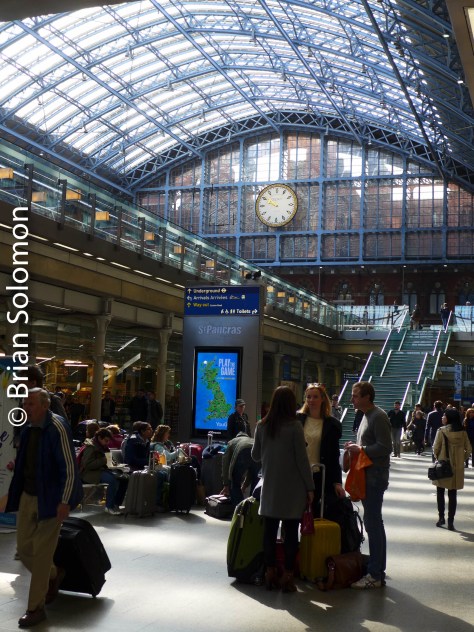
And before we knew it we’d arrived at St. Pancras, London’s most elegant 19th century railway terminal. Last time I’d taken the Eurostar I’d come into Waterloo, and that wasn’t yesterday!
This is a selection of Lumix LX7 photos from the recent trip.
The famous balloon-style train-shed at St. Pancras was the first of its kind in the world.Morning sun filters through the skylights.Panoramic composite of our Eurostar set under the famous shed.There’s an hour time difference between Lille and London.In 2007, St Pancras was re-opened following a compressive upgrading of facilities. Do you remember the dark dingy hole of the mid-1990s?
Irish Rail Intercity Railcars work downroad (away from Dublin) at Kildare.
To make the most of this scene I needed to make some global (overall) and localized contrast adjustments in Lightroom. This was necessary to compensate for the contrast characteristics inherent to the digital file produced by my FujiFilm X-T1.
I worked with the RAW file which has substantially more data than the in-camera JPG (which is compressed and thus offers very little information above what is immediately visible to the eye).
Illustration versus documentation: Often I set out to document a scene. My process and techniques are focused toward making images that preserve the way a scene or equipment appear. Often, but not today.
Creation of an illustration may not be intended as documentation. An illustration is created to convey a message; perhaps that needed for advertising, art, or publicity.
While photographing in Bordeaux, I found that the juxtaposition of the modern trams against both modern and historic architectural backdrops looked remarkably like artist’s/architect’s impressional drawings.
So, as an exercise in illustration, I’ve intentionally manipulated the camera RAW files to make them appear more like the artist’s impressional drawings, such as those often displayed as visions of the future.
Specifically, I altered the contrast and de-saturated the color palate to mimic a water-color tinted image. I did not destroy the original files, and so I have the benefit of documentation and illustration with the same photos.
Questions:
Have I done anything fundamentally different here than with images created (augmented) by the manipulation of digital files to produce super-saturated colors, plus intensely contrast adjusted effects that result in dream-like sky-scapes?
Is a posed railway publicity photo that was heavily re-touched by air-brushing or similar alteration to be considered documentation?
In a later post, I’ll explore Bordeaux’s tram network in fully saturated color.
Société National de Chemin de Fer’s Trains à Grande Vitesse is 35 years old.
Last month (April 2016) I made a series of trips across France on SNCF’s TGV, a means of flying by rail.
And, yes the speed is impressive: it makes the Acela Express seem like it’s coasting.
Here are just a sampling of my Lumix LX7 images from and of SNCF’s TGV and its stations.
TGV arriving at Brussels Midi. Today, TGV operates to a variety of countries across Europe including Belgium, Germany, Switzerland, and Spain.Room with a view.TGV map.
I wrote about the TGV in my book Bullet Trains published by MBI in 2001.
Here’s an excerpt of the text on TGV:
In conjunction with the construction of the new high speed railway called the Lignes à Grande Vitesse (LGV), SNCF developed of the Trains à Grande Vitesse (TGV), an entirely new high speed train. When discussing the French system the LGV refers to the new high speed infrastructure, including the tracks, while TGV refers to the high speed railway technology, including the trains themselves.
Lounge on a TGV Duplex set (a double-deck TGV train).Upstairs/Downstairs at 186 mph. (And no one to yap at you about moving between cars at speed, let alone descending stairs).View from the train.TGV Lyria at the Charles de Gaulle airport station.TGV pauses at Charles de Gaulle airport. Take the plane to the train! It works, just ask Pop.TGV Duplex after arrival at Bordeaux in southern France.Typical Frist class seating on the TGV Duplex.Lille Europe, TGV/Eurostar Station.
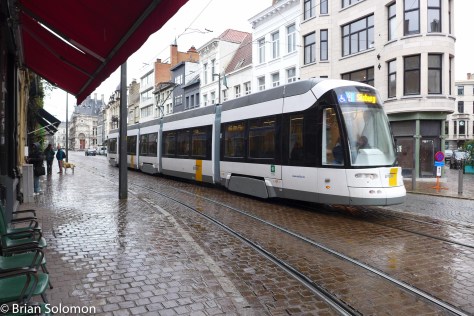
It was a rainy Monday when I arrived in Antwerp. Working with my Lumix LX7, I spent several hours riding the Lijn trams and making photos.
Does the rain and gloom ad atmosphere to this eclectic Flemish port city? There’s a lot of history here.
Lijn has been buying new low-floor articulated Flexity-2 trams to replace its antique fleet of four-axle PCCs, so I was keen to catch the older cars at work while I still can.
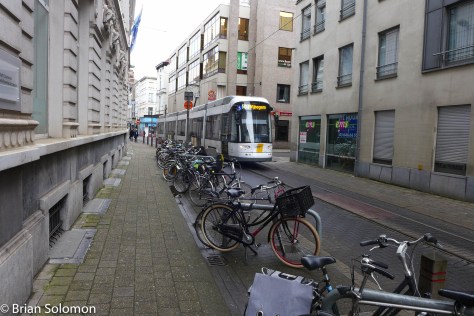
A modern Flexity2 tram glides through the rain in Antwerp. Lumix LX7 photo.Complicated track work makes for a more interesting urban image. The PCC is almost incidental to the scene.There are plenty of eclectic establishments in Antwerp where you can grab a bite to eat an enjoy a glass of beer while watching the tram cars grind along cobblestone streets.Antwerp enjoys a complex transport system with tram lines on many streets. However, expansion of the tram subway may soon reduce the number of surface services in some parts of the city center.
Could a bus be as photogenic in such a setting?
Among the advantages of photographing on a cold wet day is that there tends to be few people on the streets to get in your way. Not to sound antisocial, but masses of urban humility can be a hindrence when composing tram photos.
Near the main railway station there’s a tram loop used by route 11 cars.This level crossing is a great place to catch the action.I don’t think everyone was quite as enthusiastic about tram tracks and cobblestones as I was.
Curbside running makes it easier to board the cars.Here’s my car now!
White trams navigating narrow dark cobble-stone streets makes for some interesting contrast. So, would shafts of sun have improved these images?
It was very windy, and I spent the whole morning standing around along the old Boston & Albany mainline reading about 19th century industrial practice while waiting for trains to pass.
I posted the photos I made of an eastward Norfolk Southern detour train near Middlefield, Massachusetts yesterday evening.
My goal was to catch the Ringling Brothers and Barnum & Bailey Circus Train, that was rumored to be on the move.
But, after 8 hours standing in the cold, I decided to head downgrade.
Nearing Westfield, the scanner came to life, ‘clear signal CP109’.
Time for a U-turn.
I’d scoped a location near Huntington.
Unfortunately this neatly coincided with a fast moving cloud. Bad luck.
A dark dirty cloud covered the sun at precisely the wrong moment. (It lifted in time for me to grab a wide-angle view on Fujichrome.)
A bit of hard driving got me to Washington Summit ahead of the train. The clouds stayed at bay.
All of these images were exposed with my FujiFilm X-T1 mirror-less digital camera.
Slides from the event remain latent.
Near Washington Summit at the location known as ‘Muddy Pond’.The Ringling Brothers and Barnum & Bailey Circus Train is a long consist.Containers and trailers were at the back.
This morning (May 16, 2016), I was out on the Boston & Albany (CSX Boston Line) for the Ringling Bros circus extra. While waiting word came over the wire that a Norfolk Southern intermodal train for Ayer, Massachusetts was detouring on CSX.
A derailment near Charlemont, Massachusetts (on NS/Pan Am Southern’s Boston & Maine route) on Saturday resulted in a traffic disruption and thus this very unusual move.
A CSXT SD40-2 led the Norfolk Southern consist, presumably because of the cab signaling requirements on the Boston Line .
All photos exposed with my FujiFilm X-T1 near milepost 129 east of Middlefield, Massachusetts.
Locked away in an old locomotive shed at Saint Ghislain, Belgium are a wonderful collection of historic SNCB locomotives maintained by Patrimoine Ferroviare et Tourisme. See: http://www.pfttsp.be/index.php/fr/
Mauno Pajunen organized a visit to this collection and provided translation while Rousman Phillippe offered a guided tour.
I was most impressed by the semi-streamlined stainless-steel clad electric (SNCB 1805) that formerly worked TEE international services and by the Baldwin diesel locomotive built under license.
Until my visit the to the shed at Saint Guislain, I’d only seen this class of locomotive in old photos. The pitched cab profile and stainless-steel side panels are very pleasing. They just don’t style locomotives like this anymore!
Photographing in a locomotive shed such as this one requires special technique.
If you just let the in-camera meter do the work you will get under-exposed (dark) images such as this. Why? Because the camera meter is trying to balance the scene for the window which leads to overall under-exposure. Action on the photographer is necessary on-site to avoid this problem.
Direct and indirect lighting from skylights in the roof and large side windows results in extreme contrast with lower regions of the locomotives bathed in darkness that tends to confuse the in-camera light meter. (A meter doesn’t know what your subject is and only provides a balanced reading and doesn’t work in this situation.)
If you are not careful you may end up with an unacceptably dark result. (see above).
By manually controlling the exposure you can compensate for the effect of windows and skylights, thus creating a more pleasing exposure inside the shed.
My solution is relatively simple: manually over-expose in range of 2/3s of a stop to 1 stop, and then control highlight detail in post processing.
The easiest way to do this with a digital camera is used a manual mode and then watch the suggested exposure settings offered by the built in meter and then add 2/3s to 1 stop to the recommended value. Thus if the meter suggests exposing a f2.8 at 1/60th of second, open up the aperture to nearly f2.0 without changing the shutter speed.
Another way of doing this is by adjusting the meter to over expose by 2/3 or 1 full stop. Each camera has its own means of doing this.
In my case, I set the ISO to 400, so my average exposure was f4.5 1/60 of a second (camera meter was recommending f5.6 to f6.3, which would have resulted in an unacceptably dark image).
I adjusted my exposure from scene to scene, while tending toward overexposure based on the meter setting and carefully gauging the histogram to avoid loosing data in the shadow areas.
Since the highlights of the outside windows and skylights are not important to the overall scene, it isn’t a problem to allow for a loss of detail in these areas.
After exposure, I adjusted the files in post-processing to bring the mid-tones and shadow areas to an expected level.
This was one of my favorites: a Baldwin diesel built under license. Careful exposure allowed for adequate detail of the trucks and underbody.
The boiler was outside.Wide angle close up of Walschearts valve gear. Old Egide was a Belgian after all!
Another trick is working in confined spaces. For these images I used a super wide-angle lens, specifically a Zeiss 12mm Touit, which I purchased specifically for photography in settings such engine sheds, signal towers and locomotive cabs.
An invisible political boundary (the dashed line on a map) can prove a greater obstacle than a towering mountain range when it comes to impeding railway operations.
In mid-April, my Irish friends and I explored the Gotthard Pass, where massive investment will soon make the old line over the mountain redundant as the new 35.5 mile Basistunnel beneath the Alps will divert most of the through traffic.
A week later I was exploring the border area between northern France and Belgian Wallonia with Mauno Pajunen.
This is in an area of relatively dense population that was once the center of a thriving coal mining community. Quiévrain, Belgium is a town located an hour or so from Brussels and is relatively near to large French cities of Lille and Paris.
The tree growing out of the roof of the old station is indicative the sad state of the railway here.Despite the poor state of the facilities, SNCB continues to provide a relatively frequent passenger service to Quiévrain. Electric trains offer an inexpensive and comfortable way to travel to Mons and Brussels where connections are available to many other cities across the country.
Generally speaking SNCB (Belgian National Railways) provides an excellent service across Belgium, with most stations seeing at least an hourly passenger service and many lines operating with an even greater frequency.
Lumix LX7 photo.
At one time a through railway line connected Belgian cities of Brussels and Mons with the French city of Valenciennes via Quiévrain . Today, SNCB continues to operate a regular interval passenger service from Brussels to Mons with some trains continuing south to Saint Ghislain and Quiévrain.
But Quiévrain is the end of the line and the state of the station area is a sad reflection of better times now long gone.
This was once a handsome station.
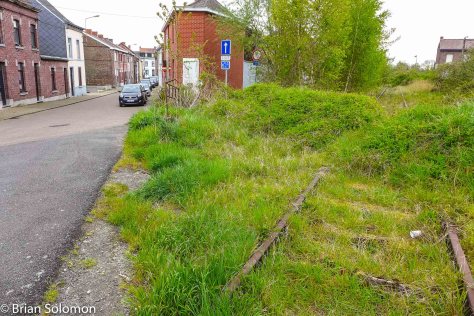
Evidence of the old line remains and the tracks are still in place (although no longer connected).
The town is divided between Belgium and France, with the French town being called Quiéverchain. Differences in the price of tabacco and alcohol between the two countries has led to a thriving business on the Belgian side of the border.
Here we are at the French-Belgian frontier which divides the town of Quiéverchain/Quiévrain. Good luck getting through the place by rail!Oh dear! The connecting stink buggy has arrived.SNCB provides excellent signage at stations.
It had been many years since you could take a train directly from Mons to Valencienes.
In theory, you can ride from Brussels to Valenciennes via a change of trains at Lille, but this is the long way around and impractical for regular travelers.
The end of the line for SNCB! (but the tracks once continued into France.)
Elsewhere in Europe cross-border services have flourished, yet the end of track at Quiévrain clearly demonstrates how borders create barriers between population centers that need not exist.
Soon you will be able to travel faster than ever before from Zurich to Milan, but not by rail from Mons to Valenciennes!
Only a short walk from the end of track will reveal evidence of the old line that once continued across the border. A ghost from another era.I find disused railways sad, yet fascinating. Like discovering evidence of a forgotten empire.
Last October (2015), I visited Valenciennes in northern France. I stopped by again a few weeks ago during my April 2016 wanderings in France and Belgium.
In these views I focused on the old Chemin de fer du Nord Station (SNCF’s Gare de Valencienes) and the surrounding environment.
Using my FujiFilm X-T1, I made images that feature the old station as both subject and background. Notice how selective focus and use of light shifts the central interest from the old building to the tram.
Outback of the station, there are, of course, SNCF trains and an impressive array of trackage that make interesting subjects in their own right.
Together, the building, trams, SNCF trains and trackage make for a scene, but one not possible to adequately represent in one image. Thus this myriad collection of images. This is a work in progress.
An SNCF train approaches Gare de Valenciennes.
Tracking the Light posts every day! (Have you noticed?)
It was a pleasantly warm Spring day when I set out with Lumix LX7 in hand to make a few photos of the Strasbourg trams.
Strasbourg was among the first French cities to re-adopt the electric tram, and in 1994 introduced an elegant modern tram system using a pioneer type of low-floor car (the first batch were built by ABB) called the Eurotram.
I’ve been meaning to visit Strasbourg for a long time, but only recently managed to finally get there.
Any favorites from this selection?
Among my first views of the Strasbourg tram system. Notice the rail-mounted cleaning truck in the distance.
Contrast of old and new.
Like with many modern tram systems, in Strasbourg you must validate your paper ticket before boarding the car. I noted teams of fare enforcement specialists intimidating non-paying passengers.Strasbourg offers many places to include the trams in attractive cityscapes such as this one.A few of the cars were painted in this lime, red and white livery.
Located in the north of France, Metz is an industrial city with a long history.
I’ll admit, I’d never given the place much thought until I had to change trains there in late April (2016).
Not only was the old city centre visually fascinating, but the railway station is a real gem!
That’s the great part about exploring without an agenda; you find wonderful things you really didn’t expect to see!
I made these images over the course of my brief visit using my Lumix LX7 and FujiFilm X-T1 digital camera (fitted with 12mm Zeiss Touit lens).
Interior architecture at SNCF’s Metz station. Lumix LX7 photo.Not an exhibit at the British Museum in London; no, this a bit of architectural detail at the Metz station.Metz Station exposed with a FujiFilm X-T1 with Zeiss 12mm lens.Main concourse of the Metz Station.Exterior detail: Metz Station exposed with a FujiFilm X-T1 with Zeiss 12mm lens.Luxembourg Railways railcar at Metz Station. Lumix LX7 photo.Here’s the next leg of my journey in France; a colorfully painted railcar.
On 21 April 2016, I had my First Class France Rail Pass Flexi validated at Basel, Switzerland.
My goal was by the first evening to reach Valenciennes (a city in northern France near the Belgian border) using only regional trains, rather than the TGV (plenty of opportunity for high speed travel later in my trip).
I found the challenge as in making local connections since these days SNCF focuses long-distance passengers onto high-speed routes. All very well, unless you want to experience secondary lines and ride trains off-the well-beaten path.
Thanks to Stephen Hirsch and Denis McCabe who helped with my planning, I traveled on a series of TER trains.
After four train-changes reached my destination 15 hours after I boarded the first train on the French side of Basel’s main station.
My first SNCF train was a loco-hauled push-pull service from Basel to Strasbourg. Exposed with my Lumix LX7.Among the benefits of SNCF’s secondary trains are large windows, ample space for luggage, and no requirement for advanced reservations which allows for spontaneous travel.I made good use of my pass, and proved a much better value than buying single tickets.Old school comfort. Proper 1st class railway travel. Lumix LX7 photo.Lumix LX7 photo; focus setting on ‘manual’.A rolling panorama of the French landscape.Plenty of locomotives and trains to be viewed from the window of the train.
Germany’s traditional large railway stations offer endless opportunities for photographic composition.
Over the years, I’ve made several visits to the Karlsruhe Hauptbahnhof (main station) and have always found it photographically rewarding. I made these photos a couple of weeks ago (April 2016.)
The train-shed lends to making geometric images while providing a visually intriguing setting for train photos. I like the sense of scale that the shed offers.
Any favorites?
An InterCity train pauses for passengers. FujiFilm X-T1 photo.When I first visited Karlsruhe in the late-1990s, DB’s 101 class were the latest in new motive power. Now these are battle worn veterans.The curves of this class 146 electric complement the train shed while the bright red livery makes for a stunning contrast with the monotones of the station environs.At the south end of the shed.Pay attention!
Irish Rail has painted 201-class General Motors diesel number 231 into an interim version of the latest Enterprise livery.
This is yet to feature the pink swooshes that now characterize the Enterprise scheme.
This morning (4 May 2016) the clean locomotive worked the scheduled 11am service from Dublin Heuston Station to Cork. I made this image at Islandbridge Junction using my Lumix LX7.
Annoying me was a line of cloud that was just covering the sun. While this appeared to be moving, in fact the cloud was forming as it moved. Bright sun was so close, yet elusive.
This phenomenon is probably explainable by the effects of condensation, wind currents and cool air; but irksome when you are anticipating the sun emerging from nature’s diffusion screen.
Irish Rail 231 on the 11am to Cork at Islandbridge Junction at 1103 on Wednesday 4 May 2016.Irish Rail 231 on the 11am to Cork at Islandbridge Junction at 1103 on Wednesday 4 May 2016. Lumix LX7 photo.
Ultimately, the sun came out. About 45 minutes after the train went by. Poor show.
I’ve made minor adjustments to the RAW file to improve contrast.
Tracking the Light posts every day, don’t miss it!
Several lines come together at Rastatt, Germany, which is an historic city south of Karlsruhe.
Since most through traffic is focused on to a short double track section immediately south of Rastatt , the station serves as a holding area for southward trains queued up to pass through this bottleneck.
In addition to DB’s trains, freight is run by a of variety open-access and private operators. Freights share tracks with passenger trains including high-speed TGV and ICE services and the famous Karlsruhe tram-trains.
I made this selection of images on 19 April 2016 using my FujiFilm X-T1.
A Crossrail container train passes Rastatt on the morning of 19 April 2016.A DB electric leads at train of swap-bodies at Rastatt.An SBB Cargo electric waits for a signal to proceed south.The driver of a Crossrail electric cleans his windscreen while waiting for traffic to pass at Rastatt.A northward BLS freight crosses the double track bridge as it approaches the Rastatt station.Lines at Rastatt host a mix of freight and passenger trains including Regional Expresses.An electric hauled chemical train glides into Rastatt in the evening.Open access operators are plentiful in Germany.Four trains at Rastatt station, including a stopping Tram Train from Karlsruhe.Catching antique SBB Re 4/4s at work was a prize.SBB Re 4/4 electrics up close.A diesel leads a local freight from a nearby automotive factory.A northward SBB freight glides through Rastatt.Trailing view of the same train.A regional passenger train passes a freight.Once common, old DB class 151 electrics are now relatively rare on through freights.
I’ll offer Freiburg as one of Europe’s most colourful tram cities.
The combination of variety of cars, a range of paint liveries (advertising and otherwise), interesting trackage plus varied and interesting historic backdrops makes Freiburg hard to top.
Any suggested contenders?
Photos below exposed in April 2016 using my FujiFilm X-T1 digital camera.
Evening sun with a textured fair-weather sky combined with well maintained paving stones and a healthy tree at left made for a visually compelling setting.
Freiburg, Germany still operates some of its vintage Duewag trams that feature a streamlined body and rounded front-end.
To make the most of the svelte classic tram I opted for a low angle and favored the angle of sun for reflective glint. The bicyclist was a fortuitous subject that makes for a more interesting photograph by introducing a human element.
To expose this image I worked my FujiFilm X-T1 digital camera with the rear live-view display tilted upward, which allowed me to compose the photo while holding the camera relatively low to the ground.
I adjusted my 18-135mm zoom lens to near its widest angle.
Duewag tram in Freiburg, exposed using a FujiFilm X-T1. RAW file modified to improve contrast and exposure.
Notice the effect of the bicycle’s double shadow?
The real trick was keeping the composition interesting as the action rapidly unfolded.
In post-processing I darkened the sky and lightened the shadow areas to improve overall contrast.
Which of the three images is your favorite?
(This essay was composed while transiting the Channel Tunnel between Calais and Folkstone on 30 April 2016).
On 20 April 2016, I made this image of a Swiss BLS Cargo (Bern Lötschberg Simplon) electric leading a northward freight on DB’s (German Railways) heavily traveled double-track line north of Freiburg, Germany.
Although clear and sunny, the direction of the light was directly behind the locomotive, which is anything but ideal.
To make the most of this awkward lighting situation, I opted to feature the flowering tree that was well-lit by the angle of the sun, and work with the locomotive in silhouette, while taking a low angle to minimize distracting elements on the far side of the line.
In post processing, I’ve lightened the shadow areas of the RAW file to restore detail and improve the overall contrast to the locomotive.
Below are both the unimproved RAW file (only scaled for presentation) and my modified file.
This is a Jpg made from FujiFilm X-T1 camera RAW file (scaled for internet presentation). No contrast adjustments.Using Lightroom, I’ve lightened the shadow areas and made an overall contrast adjustment with the ‘clarity’ slider. My aim was to produce a more graphic and interesting illustration of the BLS electric and flowering tree. Exposed on 20 April 2016.
Among my favorite German locomotives are the old ‘Rabbits’ (classes 215-218 and rebuilds), so-called because of their rabbit-ear shaped exhaust stacks.
On Monday, 18 April 2016, Gerry Conmy, Dennis McCabe, Stephen Hirsch and I made a project photographing this declining class of diesel on the line running east from Lindau.
Rabbit down grade racing toward Lindau.Double headed rabbit climbing east from Lindau with a Zurich-Munich IC train. Note the exhaust stacks.FujiFilm X-T1 photo.
The Zurich-Munich long distance trains are still worked with these vintage machines. Several years earlier, Dennis and I had explored locations on this scenic non-electrified double track line.
Soft morning light aided the effect of the pastoral setting.
I exposed these views using my FujiFilm X-T1 digital camera.
On the morning of 21 April 2016, I had a few minutes to make photos of Basel’s trams using my Lumix LX7.
Low clear morning sun helped make my brief efforts a photographic success.
Perhaps on future visit, it would be nice to re-explore the Basel network to a greater extent.
This side-lit view favors the tram’s modern profile.Sun and shadows in Basel on 21 April 21, 2016.A modern tram waits for passengers at Basel’s SBB Bahnhof.Here I was aiming to feature the Swiss flag.
This shadowed view offers different contrast than images in direct sun.
The boards at Andermatt indicated that an unscheduled train was due to arrive.
Our curiosity was piqued.
This turned out to be a charter using a Glacier Express train set.
I’ve augmented the views of the train descending to Andermatt with a few images of another Glacier Express set parked in Matterhorn Gotthard Bahn’s sidings at Andermatt.
In mid-April, my friends and I visited Andermatt and were fortunate to catch this charter of Glacier Express equipment descending the rack railway grade toward Andermatt.Express is a relative term. The train isn’t very fast; but the views available from its windows are stunning.Looking toward Andermatt, Switzerland in April 2016.I made this view of Glacier Express equipment resting static on sidings in Andermatt. Can equipment stored out of service be called a ‘train?’
Below are two versions of an image I made of a Matterhorn Gotthard Bahn narrow-gauge train engaging the Abt rack system on its steep ascent from Göschenen to Andermatt.
These were made with my FujiFilm X-T1 digital camera on my visit to the Alps with Stephen Hirsch, Gerry Conmy and Denis McCabe in mid April 2016.
The first is the unadjusted (except for scaling) Jpg produced in camera. Notice that the sky is washed out and lacking in detail.
Camera produced Jpg exposed at Göschenen, Switzerland where the MGB meets the standard gauge line over the Gotthard Pass.
The second image is a Jpg that I produced from the camera RAW file by making nominal contrast and saturation adjustments in Lightroom.
Improved image; this was made from the RAW file by adjusting contrast and saturation .
The aim of the second image was to hold the sky and highlight detail that was lost by the camera Jpg. This demonstrates the ability of the RAW file to retain greater detail than the Jpg.
Instead of using an external graduated neutral density filter, as I had with some previous images displayed on Tracking the Light, I used the equivalent graduated neutral density filter in the Lightroom program.
Why not use the external filter in this situation? Two reasons:
The external filter is cumbersome and takes time to set up.
I wanted to improve the appearance of the sky without darkening the mountains. Using the electronic filter gives me the ability to selectively control highlights and shadows in the graduated area selected by the filter, while the external graduated filter would have covered the top of the image and darkened the mountains as well as the sky.
Both are valuable tools for improving a photograph.
I remember seeing open auto racks on American railroads. One of my few pre-Conrail images is of a former Pennsylvania Railroad tri-level.
Open car trains are still common in Europe. I made this view last week of a train load of new cars climbing southward on the Gotthard route heading for Italy.
Its nice to see the cars out in the open instead of sequestered inside full-enclosed multi-levels.
Exposed with a FujiFilm X-T1 digital camera.Exposed with a FujiFilm X-T1 digital camera. Notice the effect of backlighting which adds depth to the image and detail in the grass.
Using my FujiFilm X-T1, I exposed this image last week looking across a field of dandelions near Erstfeld, Switzerland.
By using the tilting live-view display screen, I was able to hold the camera very low to the ground which allows for this exaggerated perspective of the foreground greenery and flowers.
The technique for both photos is essentially the same, however with the photo below of the Swiss ICN passenger train I used a slight telephoto and opted to crop the sky, rather than use a graduated neutral density filter to balance the contrast/retain detail.
An SBB ICN train glides along near Erstfeld in April 2016.
Below is another view from the same location near Erstfeld. Same camera, same lens, but I’ve set the zoom to a wide-angle view and I’m not as low to the ground.
The result is that the flowers remain in relative focus to the train and distant scenery. (Also I’m using the graduated neutral density filter to retain highlight detail at the top of the image).
A northward SBB freight approaches Erstfeld on the Gotthard route.
The train is a bit small, but this photograph is more about the whole scene rather than being focused on the train.
En route to Milan, this Italian State Railway ETR610 high-speed tilting train was ascending the Gotthard Pass just south of Gurtnellen, Switzerland.
For this image I blended several techniques.
To emphasize the wild flowers in the foreground, I’ve held the camera low to the ground and used the tilting back screen to compose the angle. (Aiding this approach is the FujiFilm X-T1’s built in line-level which appears as a ‘heads up’ display on the screen.)
By applying a Lee graduated neutral density filter to the front of the lens, I’ve maintained highlight detail in the sky.
My adjustments the RAW file in post processing lightened shadow density and increased color saturation to help make for a lush scene.
Notice the four layers: foreground, middle ground (the train), near background (the village of Gurtnellen), and the far background (snow crested peaks).
Once the new Gotthard Base tunnel is open to traffic at the end of this year, scenes such as this one of the Italian tilting train on the old route may be rare.
In the last three days, I’ve exposed more than 1000 digital images of the railway over Switzerland’s Gotthard Pass.
Although, I haven’t had time to thoroughly examine all my files, this image struck me as capturing the sprit of Swiss mainline mountain railroading in Spring.
Iridescent green grass and distant snow crested peaks, with modern electric locomotives humming upgrade with an intermodal train.
Railpool electrics lead an intermodal train upgrade at the middle-level of the Wassen Loops. In a few months time most freight will be diverted from the traditional Gotthard route to a new long tunnel beneath the Alps.
If you haven’t visited the Gotthard Pass, here’s my advice to you: don’t wait.
At the end of this year the Gotthard base tunnel opens and most of the traffic will be diverted away from this classic Alpine crossing.
Last weekends Irish Railway Record Society 071 trip offered countless opportunities to make detailed views of the trains, stations and other equipment.
When I wasn’t focusing on the people or on scenes with the special train, I looked for iconic images of Irish Rail closeup.
These were exposed using my FujiFilm X-T1.
Signals at Limerick.Locomotive 076 cab detail.Irish Rail 076 with 40 year plate.Signs at Mallow, Co. Cork.Kent Station, Cork with signal cabin.Irish Rail 076 at Kent Station, Cork.Driver Fox on locomotive 076.Great Southern & Western Railway chairs at Tralee.Irish Rail locomotive 077 at Waterford.Irish Rail station sign.Carlow Station.
I will be on the road beginning 14 April; Tracking the Light posts should continue to appear daily for the duration of this trip.
Irish Railway Record Society’s ‘071 class two-day 40th anniversary railtour‘ covered a lot of ground in just two days.
The trip represented a mastery of coordination; special to thanks to everyone at Irish Railway Record Society, Railway Preservation Society of Ireland, and Irish Rail!
This a selection of 20 new images I made with my Lumix LX7. (I’m still down-loading the photos made with my FujiFilm X-T1).
The train was comprised of Railway Preservation Society of Ireland’s Cravens, seen here at Dublin’s Connolly Station. Lumix LX7 photo.
We started and finished at Dublin’s Connolly Station, running to Ballybrophy (with train continuing ‘empty carriages’ to Lisduff sidings to change direction, then via the Nenagh Branch to Limerick.
Limerick to Cork, Cork back to Mallow, then to Killarney for an overnight stay. In the morning to Tralee (my visit there since I bought a digital camera!) then back to Kilarney.
Back via Mallow to Limerick Junction, then down my favorite line to Waterford via Carrick-on-Suir. From Waterford to Killkenny and via Cherryville Junction back up to Dublin.
There were lots of intermediate photographic stops along the way.
Engine 083 brought us from Dublin to Limerick via Nenagh. Viewed in a rare moment of sun at Connolly Station in Dublin.
In the bay at Ballybrophy.Change of locos at Limerick; here 076 took over.083 at Limerick under the train shed.
Ken Fox at the throttle after arriving in Cork.
Kent Station in Cork features an unusual curved train shed, which I’ve featured in my recent book Railway Depots, Stations and Terminals (published by Voyageur Press).Amoung our numerous photo stops included a brief visit to Rathmore on the line from Mallow to Killarney.A wink of sun on arrival in Killarney. It wasn’t so nice the following morning.Killarney town is a popular tourist destination. I made this view on a wander after checking in to the hotel.Sunday morning in Killarney was cold and dark; but atmospheric. I made some of my most memorable images, if not the sunniest.Cold rain greeted us at Farranfore. It has been 18 years and some months since I first visited this classic Irish station. I wouldn’t expect that 076 in gray paint has been here very often. Except for rail tours and the infrequent per way train, the Kerry Road is a locomotive free zone.Is that an authentic Irish spelling for ‘Tralee’? I noted no less than three variations on official signage.This was a bit of a shock; tracks lifted in front of the old cabin at Tralee. I remember sitting up in the cabin chatting with the signalman back in the late 1990s.Palisade fencing in the old goods yard complicated photography at Tralee. Thankfully my Lumix LX7 is very thin.Another change of engine at Waterford. Here 077 took over from 076. A view across the Suir toward the old Viking town.A plaque to William Dargan at Carlow on the Kilkenny to Cherryville line.Local folks were bemused by the disgorging of passengers at Athy and frantic efforts to make photos in the 7 minutes allowed for the stop. (engine 079 took over at Kilkenny).
I’ll be posting more photos from the popular trip soon!
Yesterday morning, Saturday 9 April 2016, I made this panoramic composite image at Connolly Station featuring the Irish Railway Record Society ‘071 class two-day 40th anniversary railtour.‘
(If you are not viewing Tracking the Light directly, you may need to click the link to the site to get the full effect of the panorama.)
I traveled on this epic and ambitious diesel-hauled special and I’m presently downloading the hundreds of digital photos I exposed of the trains and the people involved with it.
More soon!
Panoramic composite exposed using a Lumix LX-7 digital camera.
I like to have at least two cameras handy. This especially true when I’m in a situation where photographic opportunities are rapidly unfolding.
These days I usually have both my FujiFilm X-T1 and Lumix LX7 at the ready.
Both are very good image-making machines, yet each has its strengths.
My Lumix is great for candid views and situations where it isn’t necessary or practical to have the camera at eye level. Often I use strictly with the live-view rear screen.
Panoramic composite view inside one of RPSI’s Cravens carriages.
Cravens carriage prepped and ready for passengers.The day’s scheduled running times as per Irish Rail.Footplate crew at Connolly.Engine 461 at Connolly Station; camera held high at arm’s length to clear the heads of spectators on the platform.
Yesterday, the Railway Preservation Society of Ireland (RPSI) operated a pair of excursions from Dublin’s Connolly Station to Greystones, County Wicklow and return using former Dublin & South Eastern 2-6-0 461.
The trains were well patronized, which demonstrates a continued interest in Irish steam trains.
461 approaches Connolly Station tender first.
Driver Ken Fox on the footplate.
Dull weather prevailed, while cool temperatures made lots of steam condensation.
Sometimes I find that dull days makes for better steam photos.
Here’s a sample of digital images I made with my FujiFilm X-T1.
Most required contrast and saturation adjustment in post-processing.
Any favorites?
Connolly shed with two locomotives in steam.View from the Loop Line bridge in Dublin.461 with admirers in the rain at Greystones.After the trip, Irish Rail 075 brought the RPSI carriages back across to Inchicore. I made this image using an external graduated neutral density filter to improve detail in the sky.