I made these views with my FujiFilm X-T1 digital camera of the former Chicago & North Western Chicago-Madison-Twin Cities mainline at Evansville, Wisconsin.
Looking west toward Madison, Wisconsin. Agricultural dust and other pollutants contribute to a rosy sunset. I’ve exposed manually for the sky. With Kodachrome film I could have retained better detail in the sky. f22 1/250th second.
John Gruber was giving me a tour of the line. He explained that in its heyday this route had been a double track mainline with a top speed of 75 mph.
Today it is a truncated vestige of that earlier era. The tracks are now operated by Union Pacific to serve local freight customers. No fast Pacifics with varnish in tow any more.
To ensure new material daily, Tracking the Light is coasting on autopilot while Brian is traveling.
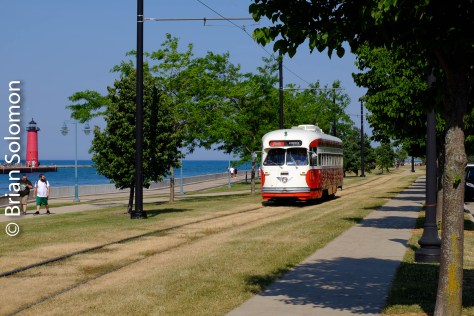
Earlier this week John Gruber and I visited Kenosha, Wisconsin to ride and photograph the vintage PCC streetcars that serve the town.
The cars are beautifully maintained; the line is short but interesting. Cars operated about every 15 minutes during the day. The fare is just $1.00—a true bargain.
On the downside, it is a bit difficult to figure out how and where to board the cars. A little bit of targeted advertising would go a long way.
Brian Solomon’s Tracking the Light posts something different daily!
The other day, John Gruber met me at the Metra station in Lake Forest, Illinois and we had lunch with Art Miller and David Mattoon.
John Gruber (left), Art Miller (center) and David Mattoon (right). Lumix LX7 photo.
Art recalled that I was among the very first speakers at the Center for Railroad Photography & Art’s conference held at Lake Forest College every year.
That was back in 2003!
Interior panoramic composite of a Metra gallery-style commuter railway car. Exposed on my way to Lake Forest using my Lumix LX7.
On my 1984 visit to Chicago I’d made photos and traveled to/from the old North Western Station.
Wow, have things changed.
Yes, I’ve made some visits between then and now, but it’s been a long time.
The old station was torn down not long after my first visit and replaced with an epic glass box. Today, this is known as the Ogilvie Transportation Center.
The Oglivie Transportation Center as seen in July 2016. Exposed with my Lumix LX7.
In the mid-1990s, about the time that Chicago & North Western was folded into Union Pacific, the station’s Bush train sheds were demolished and replaced with more modern platform coverings. I made a few photos during that transition.
Still, it seems a bit strange for me to see the former North Western Station in this modern format. My impressions from 32 years ago remain only in my memory and few photos that I made with my Leicas.
Inside the Oglivie Transportation Center. Tracks and trains at left. Exposed with my Lumix LX7.Lake Forest, that’s where I’m going. Exposed with my Lumix LX7.Hot as an oven. Exposed with my Lumix LX7.Metra. Exposed with my Lumix LX7.Panoramic composite exposed with my Lumix LX7. The old F40PH diesels run headend power off the prime mover. Deafening under the sheds.Exposed with my Lumix LX7.
I boarded Amtrak’s Cardinal, train 51, at Trenton.
A little more than 28 hours later, having traveled through 10 states plus the District of Columbia, I arrived in Chicago, where I had 45 minutes to walk to my next train.
I enjoyed the seemingly endless panorama, but was happy to get some fresh air upon arrival.
Here are some views from my journey exposed with my Lumix LX7.
Amtrak 51 arrives on Platform 4 at Trenton, New Jersey. Lumix LX7 photo.Amfleet 2 to Chicago!Philadelphia Zoo at Zoo Junction.30th Street Philadelphia.Wilmington, Delaware.I thought I saw a ghost! Here’s one of Amtrak’s AEM-7s working out its final miles on Maryland MARC at Baltimore.I’ve had bad luck catching Amtrak’s ACS-64 642 painted in a special livery for America’s Veterans. Here it is at Ivy City in Washington D.C. One of these days I’ll get it on the move!K-tower Washington Union Station.I got a bit of air at Washington D.C. while 51 exchanged its electric for a diesel.Amtrak’s logo represent tracks on a rolling landscape.Here’s my car on the platform at Washington Union Station.Manasass, Virginia.13 months ago I was here to see Norfolk & Western J-Class steam locomotive 611.Rural Virginia.A view at Gorduonsville, Virginia.This preserved Chesapeake & Ohio GP7 was on display at Clifton Forge, Virginia.CSX GE diesel at Clifton Forge. I saw quite a few freights on the move on the old C&O route. More than I expected include several unit coal trains.
In West Virginia I saw considerable evidence of recent floods.Hinton, West Virginia-one of several small towns still served by the train.Hinton, West Virginia. We were here for at least ten minutes.Old C&O signal tower west of Hinton.Rolling along the New River Gorge. I used a relatively slow shutter speed to capture the effect of motion.Work trains to help repair flood damage. Train 51 was blocked at several locations as repairs were still underway.Fixer upper, West Virginia.Upon leaving Alexandria all the way to Chicago my train was fully occupied. I was surprised at the large numbers traveling to and from intermediate stations. I’d guess 50 or so got on in Cincinnati when we stopped at about 2:30 Am. Why not run a day train?Sunset in the New River Gorge.Black tea at sunrise crossing the Indiana corn fields.Monon, Indiana.Chicago.Crossing 21st Street Bridge, Chicago.Cardinal’s Chicago passengers at Union Station.
The other morning I boarded Amtrak’s Cardinal for Chicago at Trenton, New Jersey.
While waiting for my train to arrive I made a few photos with my Lumix (and some others on film).
Here’s the Lumix views. Stay tuned for some views from the train; 28 hours via West Virginia.
SEPTA AEM-7 laying over for the weekend. Lumix LX7 photo.Clear morning sun made for a variety of photo options. I’ll be curious to see my black & white film views of this engine.Just in case you didn’t know where I was . . .Trenton is served by Amtrak, SEPTA and NJ Transit. Busy place even on a Sunday morning.Amtrak’s Cardinal connects Trenton with Chicago three days a week. More Cardinal photos coming soon!
This afternoon on the way to catch Amtrak 57, the southward Vermonter, my dad and I stopped in for a visit to the Connecticut Trolley Museum at East Windsor for old time sake.
Three cars were on the line today. We went for a spin on a vintage 1902 Brill-built open car.
These photos were exposed using my Lumix LX7, downloaded to my laptop on board Amtrak 57, manipulated in Lightroom, and then uploaded to Tracking the Light courtesy of Amtrak’s WiFi. From my camera to the world: a demonstration of the miracles of modern technology.
I exposed this view of Irish Rail 071 class diesel number 079 at Sligo using my Rolleiflex Model T loaded with Fuji Neopan 400.
I processed the film at the Gallery of Photography at Meetinghouse Square in Dublin using Agfa Rodinal Special concentrated liquid developer.
Final processing was accomplished digitally using Lightroom.
The Rollei allowed me to compose using a square field rather than a more common rectangular field. I’ve found that the square changes the way I see, and thus produces different compositions. Someone might ask, ‘couldn’t you just crop it?’. You could, yes, but that’s not my point. ‘So what about the lead-in version? That’s cropped, isn’t it?’ Yes, but not by choice! That’s an effect of the software/internet/webhosts.
Tracking the Light discusses photography everyday.
The benefits of familiarity; knowing your locations.
Take the Bellows Falls Tunnel on the Connecticut River line. Back in 1988, I’d photographed a southward Boston & Maine (Guilford) freight in the afternoon and noted that late in the day, when the south portal was in shadow, a shaft of light illuminates the train on the north side of the tunnel.
The location and effect were filed away for future reference.
A couple of week ago, on June 18, 2016, Pat Yough and I were following Amtrak’s Exhibition Train on its way south from Claremont, New Hampshire. At Bellows Falls, Vermont the train paused to refuel, and this resulted in the leading locomotive, Amtrak F40PH 406, pulling past the grade crossing near the station.
I noticed it had gone just far enough to bask in the window of sun near the north portal of the tunnel.
This opened up opportunity for photography.
Below are a examples angles exposed from the south portal, a location reached by a narrow street from the center of town. I like the relative abstraction of tracks and engine appearing to float in a sea of darkness.
The classic Vermont setting of the Bellows Falls Tunnel fascinates photographers and model railroaders.A 2006 Volkswagen Rabbit gingerly takes the turn on to the road that leads to the tunnel portal. Exposed using a FujiFilm XT1 digital camera.This could almost pass for an early 1990s view of Amtrak’s Montrealer. (Except that the train was scheduled to come through Bellows Falls in the middle of the night). I like the inky darkness. Exposed manually using a FujiFilm XT1. Careful metering and examination of the histogram will aid in correct exposure of scene such as this one. Most automatic metering systems will tend to try to compensate for the dark tunnel portal which negates the intended effect. Focusing can be tricky too.
Back in the day, summer always meant that my father would bring my brother and me to one of the New England Trolley museums. Back then we’d ride back and forth and Pop would read the Sunday newspaper.
I’d make photos with my Leica.
This year for Father’s Day, I brought Pop to Connecticut’s Shore Line Trolley Museum located near East Haven, Connecticut. We used to know this as the Branford Trolley Museum (it is operated by the Branford Electric Railway Association).
FujiFilm XT1 photo.Lumix LX7 photo. Pop remembers Johnstown Traction Company 357 from its days in Pennsylvania.
Pat Yough, visiting from Pennsylvania, joined us and we all made photos. Turns out that fathers are admitted free of charge on Father’s Day. So that was a bonus.
Pop used his vintage Rolleiflex, which prompted a comment from the motorman,
“You’re still using film?”
Pop responded, “Sure, and you’re still running a trolley. Today is my ‘retro day’”.
They even had an old IRT Subway car on the move. (Pop said, “these aren’t ‘old’, I remember when they were new!”).
Lumix LX7.NYC subway car interior. Exposed with a Leica 3A with 21mm Super Angulon. HP5 processed in HC110.Lumix LX7 photo.Connecticut Company 775. Exposed with a Leica 3A with 21mm Super Angulon. HP5 processed in HC110.Exposed with a Leica 3A with 21mm Super Angulon. HP5 processed in HC110.An unlikely combination; streetcars from Atlanta, Georgia and Montreal, Quebec. Exposed digitally with a FujiFilm XT1.
It’s Amtrak’s Vermonter in Vermont (although those hills in the distance are across the Connecticut in New Hampshire.)
On June 18, 2016, Amtrak P42 number 106 leads train 57, the southward Vermonter. This view is from a parking lot immediately south of the passenger platform in Brattleboro. Exposed with my Lumix LX7.
Vermont’s relatively clear air and elevation compensate for the harsh visual effects associated with summer high light (when the sun is nearly directly overhead).
The other day Pat Yough showed me some examples he made with his digital Nikon of trains glinting in the curve at Madison. Since to emulate this effort, I’d require a longer focal length lens than I have for my FujiFilm X-T1, I opted to fire up my Canon 7D with a 200mm lens, and joined Pat for another evening’s photography on the Shore Line route.
Often I find that by making repeated trips through the same territory will allow me to make the most of my photography. I can learn where the light and shadow fall, how the railroad operates, and how to work with the various elements at hand to make the most effective images. If I miss something or make a mistake on one trip; I learn from it and armed with this knowledge try again.
I made this dramatic glint photo using my Canon EOS 7D with a 200mm lens. The camera’s smaller sensor size contributes to the telescopic effect. If I were using a 35mm film camera, this view would required a lens length of approximately 280mm. [Update; I’ve been given a revised figure of 320mm based upon Canon’s conversion 1.6 factor.]A trailing view of Amtrak’s Boston-bound Acela (train 2168) at the same curve in Madison, Connecticut.
In this situation, I needed a longer lens to make the image work. However since the sun is only sets on the north side of the tracks here for a few weeks, I needed to act while the light was right.
The MBTA platforms at Mansfield, Massachusetts feature modern information displays.
As with many modern signs used by passenger railways these use light emitting diodes (LEDs).
You may have noticed that although LED displays seem clear to the eye, in many instances they do not photograph well and appear in your pictures as random spots rather than full letters and words.
This occurs because many LED systems pulse on and off at a rapid rate. You eye cannot detect this pulsing and so you see a steady light, but when a photograph is made at higher shutter speeds, the exposure may capture an LED during the ‘off’ portion of the pulse sequence.
Since the LEDs may not be synchronized with each other, the result sometimes appears as a random collection of spots (each is an individual LED) or if they are synced the pulse may be coupled with a scanning effect that results wide gaps of LEDs in the ‘off’ portion of the sequence. (Such is the case at Mansfield).
This unfortunate effect is especially pronounced when the message is scrolling laterally.
One effective way to expose images of LED displays is to set your camera to a slower shutter speed. This will allow the shutter to stay open for a full pulse cycle.
I’ve found that shutter settings of 1/60th of a second or less will usually work effectively. (It helps to test this, as display pulse rates vary).
Below is a sequence of images that I made at various shutter speeds to demonstrate the effectiveness of slower shutter speeds in regards to the LED display. In each situation I’ve used an equivalent shutter speed/aperture combinations to allow for uniform exposure between images.
Exposed at 1/250th of a second. Notice the black line as the result of high frequency on-off pulse combined with a scan effect.At 1/125th of a second the effect is less pronounced but still annoying. Please note that the bottom part of the message is scrolling from left to right.1/60th of a second works well in this instance.This final view was exposed at 1/30th of a second during an interval when the scrolling bottom line of the message was not displayed.
In this instance the MBTA train was stationary as it discharged passengers.
Obviously, using slow shutter speeds with rapidly moving trains will present other problems. No solution is perfect.
[Click the link to Brian Solomon’s Tracking the Light for the full effect!]
The long days of June offer distinct lighting. In the morning the sun rises earlier and further north than the other times of the year, and this makes for photographic opportunity if you know where to look.
These days much of the Boston & Albany route east of Palmer is a tree tunnel, but West Warren has a nice vista with characteristic 19th century New England mill buildings complete with a mill-dam on the Quaboag River.
As long as I’ve been making photos on the old Boston & Albany mainline, there’s been a westward intermodal train that passes through the Quaboag Valley early in the morning.
In Conrail times it was symbol TV9 (TV=Trailvan; Boston to Chicago). With the transition to CSX operations this became Q119. Now with revised intermodal terminals and changes to train symbols, I think this morning train carries the Q019 symbol (which runs from Worcester, Massachusetts since the closure of Boston’s Beacon Park yard a few years ago).
Sunrise at West Warren, Massachusetts. CSX’s Q-019 has just entered the scene. For me the mist on the river adds a delicious element. June 2016.
In the 1990s, I’d identified West Warren as a place to catch this train on the long days; where the sun rises on the north side of the tracks for about 10-20 minutes. This only occurs over a span of about three weeks, and provides the backlit glint effect that offers a distinct view at this classic location.
The other day, all the pieces came together. The weather was perfect; I was in place at my location with cameras at the ready at the moment the sun illuminated the north-side of the tracks; and CSX’s westward intermodal train passed at precisely the right moment.
Exposed using a FujiFilm X-T1 with 18-135mm lens and graduated neutral density filter to hold sky detail.
On June 15, 2016, I posted two views of Pan Am Railway’s leased Slug Set working in East Deerfield hump service and paused on the Connecticut River Bridge east of the yard.
I asked readers to voice an opinion on their preferred image, while explaining that one was exposed on black & white film the traditional way and the other exposed digitally as a monochrome image.
I’ve weighed the comments, email and Facebook messages and found that the response was more or less evenly split, with a slight leaning to the top image (film). One respondent voiced a dislike of both images (see comments).
Below are the two vertical images with details of how they were made.
Number 1; exposed on Ilford HP5 black & white negative film using a Leica 3A with Nikkor 35mm lens. Processed in Kodak HC110 developer.Number 2. This digital image was made using my FujiFilm X-T1 in a monochrome mode. I altered the output through the addition of a digital ‘red’ filter, that slightly darkened the green and blue areas of the image including the locomotive on the bridge. This adjustment was made in-camera, not in post processing.
Both images were scaled for internet presentation using Lightroom.
Madison, Connecticut: until June 2016, I’d never made a photo there in my life, and as it turns out I was there twice inside of a week.
This isn’t really a coincidence; having scoped the location on June 7th, I returned a few days later to make the most of light on the long days.
I exposed these views from the Shore Line East station of Amtrak’s westward (southward) Acela train 2173 flying along the former New Haven Railroad Shoreline route.
For this angle, I employed my FujiFilm X-T1 fitted with a Zeiss 12mm Tuoit and a graduated neutral density filter (to retain sky detail). My shutter speed was 1/1000th of a second.
I had the motor drive set on ‘CH’ (continuous high), a setting I descriptively call ‘turbo flutter.’ This automatically exposes a burst of images in rapid succession.
Normally there’s only nominal differences between the frames, but in this situation the train’s rapid motion combined with my super-wide angle perspective resulted in considerable changes in the relative placement of the head-end.
Amtrak Acela 2173 at Madison, Connecticut.Amtrak Acela 2173 at Madison, Connecticut.Amtrak Acela 2173 at Madison, Connecticut.
Also, as it turns out, 1/1000th isn’t fast enough to stop the action. Maybe next time I’ll try 1/2000th.
Yesterday, June 18, 2016, Amtrak’s Display Train made a special visit to Claremont Junction, New Hampshire. See: Amtrak Press Release
Fine weather prevailed and I exposed these views with my Lumix LX-7. I also made a few photos on Fuji Acros 100 black & white using my old Leica 3A, but those are still latent (in camera).
It was my second visit to Eagle Bridge, New York inside a week.
On this visit, We’d driven here on spec looking for Pan Am’s EDRJ (East Deerfield to Rotterdam Junction). No luck with that this time, but on arrival I’d noted that there were loaded grain cars on the interchange for the Battenkill Railroad.
So what?
Well, the Battenkill is known to run on weekdays; this was a Friday, its interchange had been delivered, but as of 1:30pm the Battenkill hadn’t come down to collect it yet.
The Battenkill’s primary attraction is its continued operation of vintage Alco RS-3 diesels. While the RS-3 was among the most common types built in the 1950s, only a scant few survive in traffic today outside of museums. (Perhaps a reader can supply a list?).
Photographer Paul Goewey, who was traveling with me, looked up the Battenkill’s radio information on his smart phone.
“We’ll go up the line and see if we can find the BK.”
So we drove ten yards and over the grade crossing near the old station and . . .
“There he is!”
That was easy, now wasn’t it?
Battenkill’s old RS-3 chortles its way up the interchange tracks. On the right is the old Boston & Maine station at Eagle Bridge, New York. Exposed on Ilford HP5 using a Leica 3A with Nikkor 35mm lens. Film processed using a two bath HC110 developer mix in a Jobo processing machine.Digital image at Eagle Bridge exposed with a FujiFilm X-T1 with 18-135mm lens.Battenkill collects part of its interchange. The B&M station is directly at my back.Alco diesels are famous for their exhaust. Note the nicely tamped track.Looks like someone came prepared for the day! I exposed this with my Leica 3A on HP5 (processed as described above. By using a two bath developer I was able to optimize the film’s shadow and highlight detail).Battenkill’s former Delaware & Hudson RS-3 is still lettered for the Greenwich & Johnsonville, a shoreline that operated the route prior to Battenkill.I thought I’d try a low angle.Now there’s some Alco exhaust!
Battenkill runs as required but Tracking the Light Runs Daily.
Below is a comparison between two photos; one exposed digitally and one made with film. (Hint: click on Tracking the Light to see both).
I made these the other day of Pan Am’s hump engine working on the Connecticut River Bridge at East Deerfield, Massachusetts.
I won’t bore you with excessive detail, but one was made as a black & white image with a digital camera . The other was exposed in a traditional manner on black & white film, processed chemically and then scanned and scaled.
Number 1.Number 2.
So: which image do you prefer? (number one or number two).
Oh, and by the way, it is up to you to decide which was made with film and which was not.
June 10, 2016 was a perfect Spring day. Cool, clear, and sunny.
I made a project of following the Housatonic Railroad’s line up its namesake valley from Canaan, Connecticut toward Pittsfield.
Over the years I’d explored parts of this line, but never put all the pieces together.
So, with the northward freight on its way, and fellow photographer Paul Goewey in the navigator’s seat, I arrived at Housatonic in time to make a few photographs.
Contrast Control
Often, even in nearly ideal lighting conditions, it is necessary to make contrast adjustments to digital files.
You never adjusted contrast with color slides, why is this now necessary?
With slides, what you saw was what you got. The only means of adjusting the slide was through the degree of exposure or in filtration (to adjust color etc). The means was imperfect, yet as photographers we grew to accept the results and refine our technique.
Such was never the case with black & white negatives. The negative was only one step in making the photograph, and in the course of printing, contrast adjustment was part of the process.
A digital RAW file is kin to a black & white negative in that both the RAW and the negative are a work in progress; or can be viewed as a step towards an end result.
With these photos, I made some simple changes in post-processing using Lightroom.
Specifically, on the telephoto view I made the following adjustments by manipulating the slider controls (the numbers indicate the amount of change as indicated by the slider) I brought down the highlights (-21) and lightened the shadows (+36), while making nominal adjustments to clarity and saturation sliders.
All my changes were made globally (to the entire file).
Telephoto view of Housatonic Railroad’s northward freight NX-12 at Housatonic. Exposed with a FujiFilm X-T1 digital camera.
These adjustments were intended to improve presentation on the computer screen.
That is on my screen. I can’t anticipate how they will look on your screen.
Significantly, while I make these changes for presentation, I never alter my original files. Just like back in the day when after making prints I’d file the negatives in archival sleeves. I now store the un-modified RAW files on multiple hard drives. You never know when you might need to return to the original photograph.
Wide angle view at Housatonic. This image was exposed at precisely the same location as the telephoto view above. Here I’ve made a greater change to the shadow areas than with the telephoto view. I felt that the contrast was too harsh and the shadows too inky for the situation. That’s my call. Another photographer might opt to leave them as is.
The long days make for photographic opportunity. While modern digital cameras have the ability to capture scenes previously out of reach with film. Yet, sometimes there’s still work to be done after the fact.
The other day, Pat Yough and I were exploring locations along Amtrak’s former New Haven Shoreline at Madison, Connecticut.
“Headlight!”
“It’s the Acela.”
Working with my FujiFilm X-T1 fitted with a 27mm pancake lens, I had very little time to prepare for my image.
However, the colors of the evening sky attracted my attention and I knew I needed to use a relatively fast shutter speed to stop the action. I set the ISO to 6400, which allowed me to use a 1/500th of second shutter speed at f3.2.
(I set my camera manually.)
While the front of the Acela was exposed more or less as I’d hoped, the sky detail was washed out.
Later, using Lightroom for post processing, I was quickly able to produce three variations of the original image that brought back sky detail.
Admittedly the original file isn’t the sharpest image. But, I find one the great benefits of the digital medium is the ability to go back to the camera RAW file and adjust color and contrast sliders to make for a more pleasing final photograph.
Which of the four photos is your favorite?
This image was made from the unmodified RAW file. RAW represents the data captured by the camera. However, often there is greater detail in the file than is immediately evident.First adjusted variation. Using Lightroom, I inserted a digital graduated filter to bring in sky detail and improve color saturation, while making over all adjustments to contrast. I also cropped the image slightly to minimize the intrusive visual elements on the left.Second adjusted variation: My overall work was similar to the first adjusted image (above) except I lightened the shadow areas. This is an interesting example of an illustration, but doesn’t really convey how the scene appeared to me at the time of exposure: the trees to the right of the Acela were pretty dark. In other words I’ve over compensated in my interpretation. It does show the level of information captured by the camera.Third adjusted variation. Instead of using a graduated filter, as with the first two adjusted images, I made all my changes globally (in other words equally to the whole image area). I brought down the highlights, darkened the overall exposure, while nominally lightened the shadow regions to keep them from becoming too dark. I ever so slightly boosted the saturation. While a little darker than the other images, this was is closest to what I saw at the scene. (Also, notice that I’ve run this image full frame without cropping).
Tracking the Lightdisplays new imageseachand every day!
Many photographers typically expose from a standing position, and in many instances this provides a suitable vantage point.
Yet, in some circumstances your natural standing height may not give you the optimal viewpoint.
I’m not talking about gaining elevation; that’s a topic for another day.
Sometimes making a small adjustment, by lowering the height of your camera can make for a noticeably different photograph.
Both images below were exposed the other day from the Shore Line East high-level platform at Westbrook, Connecticut. I was using my FujiFilm X-T1 digital camera fitted with a 27mm pancake lens. This is a fixed focal length lens, rather than a zoom. My exposure and nominal post-processing adjustment were the same in both images.
The first was made from my normal standing position.
The second was made from the same basic angle to the train, but from about a foot lower down.
I was able to improve on this image by lowering the position of my camera by about a foot (see below).
I was especially troubled by the hooks of the platform lamps on the far side of the cars that makes for an incongruous shapes. These add nothing of value to the image, and could easily be mistaken for some appendage atop the cars.
Although very similar; this photo offers a cleaner perspective that is free from some of the distracting elements that detract from the photo above.
Notice the relationship of the NH herald, and more importantly the change to the distracting elements above and beyond the passenger cars.
Try this technique for yourself.
Use the opportunity offered by a paused train to expose several images from slightly different angles by making small changes in elevation. Pay careful attention to foreground and background elements as well as window reflections.
Tracking the Light displays new material every day.
I’ve said it before, I’ll write it again: If you don’t make the effort, you won’t get any photographs.
Yet, there have been many times where I’ve driven up the valley of the Deerfield River in western Massachusetts and was rewarded with only pleasant weather and fine scenery; not a bad thing, but . . .
On the morning of May 28, 2016, an early start allowed me to catch five trains between East Deerfield Yard and the Hoosac Tunnel.
My familiarity with this railroad and the terrain gave me the insights to act, while some clever driving allowed me to make the most of the opportunities that the railroad provided.
It helped to have fine Spring weather, which aided in creation of some satisfying images.
An empty auto rack train was tied down on the siding between Soapstone and East Portal. I exposed this view using my Lumix LX7 with the HDR setting that combines three images exposed in rapid succession and combines them. HDR infers ‘high dynamic range’, which is one tool available to digital photographers for working in high-contrast situations..The East Portal of the famed Hoosac Tunnel.I heard a whistle deep in the valley to the east. Curiously, this was a second empty auto rack train that was overtaking the train I’d photographed earlier. In the lead was Norfolk Southern SD60E 6900 which features a modern variation of the Safety cab. Exposed with my FujiFilm X-T1 at East Portal.I exposed this grab shot of NS SD60E 6900 as it roared by, moment before it entered the gloom of the tunnel. I adjusted the contrast in post-processing to make for a more pleasing image. Notice the profile of the locomotive cab. Panasonic LX7 Photo.An eastward freight approaches East Portal.Once a week, Pan Am has run a unit clay slurry train from the connection with Vermont Rail System at North Bennington/Hoosick Falls to Portland, Maine (symbol NBPO). This day it was later than usual. (So I’m told).Pan Am 617 leads the clay slurry train eastward at Charlemont, Massachusetts. Exposed with my FujiFilm X-T1.While waiting for the clay slurry train at Shelburne Falls, I was delighted to catch this westward move, Norfolk Southern symbol 11R that runs from East Deerfield to Enola, Pennsylvania.Trailing view of Norfolk Southern DASH9-40C 9258 at Shelburne Falls.I was looking for long sections of tangent track to best feature the effect of the clay slurry train which carries white tank cars full of clay used in the paper making process. Here I photographed it a Shelburne Falls (Buckland). That’s the Shelburne Falls Trolley Museum at the right.
Norfolk Southern 11R was held at Buckland. The next siding to the west (Soapstone-East Portal) was occupied by an empty auto rack train. The only eastward freight I’d seen was the once-per-week clay slurry train. ‘Do the math’ as they say; there must be another eastward freight! So I drove as fast as I could (within legal parameters) back up to the east portal of the Hoosac Tunnel. I arrived about three minutes before Norfolk Southern 28N (loaded auto racks) exited the mountain. Not bad for one morning’s effort! (PS, it isn’t always this busy).
Continuing with yesterday’s theme of change on the Fitchburg Route, these photos were made on an exploration of recent investment along the old Boston & Maine line between Gardner and Ayer, Massachusetts.
In earlier Tracking the Light posts, I’ve focused on the old searchlights and other changes to the Fitchburg Route.
In May (2016) Rich Reed provided a detailed tour for Felix Legere, Paul Goewey and me, and we examined some of the new signals that have been installed, along with other changes, such as the construction of a new MBTA storage yard near Westminster, Massachusetts.
Panoramic composite view of MBTA’s new storage facility near Westminster. Exposed with a Fuji XT1.
Ultimately these improvements will facilitate expanded MBTA operations on the Fitchburg Line while enabling Pan Am freights to continue to share mainline tracks with commuter rail.
Photographing changes to railway infrastructure is challenging because often construction results in visual discordance. Broken ties, piles of ballast, and messy scenes resulting from digging and other work are hard to photograph in a meaningful way.
New signal bridges at Westminster. Exposed with a Fuji XT1.Pan Am Railway’s freight EDPO (East Deerfield to Portland, Maine) crawls through the worksite at Westminster. Consider my use of foreground and background. Notice the old infrastructure and the new. Exposed with a Fuji XT1.Pan Am’s EDPO at Wachusett; since I last made photos here the trees and underbrush have been cleared away and the cutting widened among other changes. Exposed with a Fuji XT1.New signals on the move. Exposed with a Fuji XT1.Would this photo have been better on a clear day? Mind you I’d be looking into the noonday sun! (I’m on the station platform on the northside of the line).An outbound MBTA train approaches the Fitchburg Station.Pan Am’s POED (Portland to East Deerfield) roars west through Shirley. We learned that the new signals here illuminate when a train is coming from the opposite direction. Good to know!An MBTA HSP46 pushing the back of a Boston-bound train passes the new signal gantry at the Willows (east of Ayer, Massachusetts). Panned with a FujiFilm X-T1.
A few weeks ago, my friends and I met to explore recent changes to the old Boston & Maine Fitchburg Route (Pan Am Southern’s main line) including re-signaling and trackage upgrades.
Among the first places on our tour was Gardner, Massachusetts, where we found Norfolk Southern 66N, which is a loaded Ethanol train destined for the Port of Providence.
This was led by four Norfolk Southern DASH9-40CWs that were followed by an idler car and 80 cars of ethanol. The train was waiting on Pan Am rails for a Providence & Worcester crew to take it south from Gardner.
Among the recent changes was the installation of a crossover at the Gardner yard that makes it easier to make a progressive move from the old eastward B&M mainline track to the P&W, which facilitates operation of unit trains such as the 66N. This is a low-tech solution, as the switches are operated manually (of the ‘hand-throw’ type).
I made this series of images featuring the 66N with my FujiFilm X-T1.
Static and slow moving freights offer many opportunities for photography.
When we arrived the morning was clear and sunny, but over the next hour, clouds rolled in from the west and softened the light.
The classic ‘wedge’ a three-quarter view of locomotives in low morning sun. Clutter from old ties and related track components is part of the scene, should these be cropped? Although these GE’s are leading an ethanol extra, there is nothing in the photograph to indicate this is any thing other than an ordinary eastward freight.Detailed vertical view of the leading engine, a General Electric DASH9-40CW.Using the FujiFilm X-T1’s panorama mode, I exposed this multi frame panoramic composite. This image was assembled automatically in-camera. The wide view offers an interesting perspective on the Gardner yard and the four GE locomotives.After about an hour of patient waiting, the P&W crew was on board and nearly ready to proceed south. I made this slightly elevated view from a parking lot on the site of the old Gardner Station. In the yard is one of P&W’s leased SD60s and some auto racks for interchange. Unfortunately, the auto racks block the view of the ethanol tanks. Note the crossover that links the old eastward mainline with the tracks in the P&W yard.Norfolk Southern 66N takes the switch on to the P&W at Gardner.
Trailing view of the leading locomotive easing down the P&W toward the Route 2 underpass. Soft light is excellent for showing detail on a largely black locomotive. This photo was made in Gardner, yet it could be almost anywhere.Trailing view of NS 66N on the P&W at Gardner. The 80 tanks make for a rolling pipeline. How many gallons of ethanol does this train carry?
Thanks to Rich Reed, Paul Goewey and Felix Legere.
It was five years ago today—June 1, 2011—when extremely unusual weather conditions produced a tornado that swept through Monson, Massachusetts and surrounding towns.
I’d just returned from Dublin a few days earlier.
I made a few photographs of the storm from my window on Moulton Hill Road. I only glimpsed the funnel for a few moments and the passage of the storm was remarkably quick.
Funnel cloud Monson, 4:55 pm June 1, 2011. Photograph by Brian Solomon with Lumix LX3 digital camera.Tornadic sky, Monson, Massachusetts shortly before 5pm on June 1, 2011. Lumix LX3 photo.
Fortunately for us the funnel missed Moulton Hill by about 2 miles. Many others were not so lucky.
On June 3, 2011, I ventured into the village and made photographed evidence of the most extreme damage.
National Guard patrols Main Street Monson on June 3, 2011.
Dozens of buildings in town were destroyed and many thousands of trees were ruined. The event made national and international news.
These photographs are intended as a document of the event and its aftermath as I witnessed it and do not represent an interpretation of the storm nor complete record of its destruction.
First Church, Monson on June 3, 2011.First Church, Monson on June 3, 2011.Destruction on Washington Street, Monson on June 3, 2011.Ruined buildings on Washington Street, Monson on June 3, 2011.Tornado damage, Monson on June 3, 2011.Monson on June 3, 2011.Tornado damage in Monson as seen on June 3, 2011.
Cork’s railways were once vastly more complex than they are today.
Over a three-day span beginning 7 May 2016, I was given a thorough tour of Cork’s historic railways that included: a walking tour of the route of the old Cork City Railway; a cycle tour of the route of the Cork, Blackrock & Passage; and a detailed look at the numerous railway terminals that once served this southwestern Irish city.
I made numerous photographs composed to document railway settings as they are today. In many instances service was discontinued decades ago and the lines lifted and so the role of the railway is more conceptual than literal.
Thanks to Ken Fox, Donncha Cronin, Brian Sherman, Kevin Meany and Richard Lee for their expert guidance and historical knowledge.
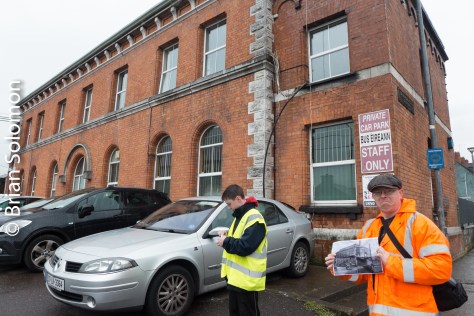
I arrived by Irish Rail’s Mark4 from Dublin. This view of Cork’s Kent Station (Glanmire Road) was made from the foot bridge over the right of way of the line to the old Summer Hill Station. I featured Kent Station in my book Railway Depots, Stations and Terminals.I’ve always liked Kent Station’s Victorian-era curved train shed. Exposed with a FujiFilm X-T1 digital camera.Irish Rail 201-class diesel 220 at Kent Station Cork on 7 May 2016. Lumix LX7 photo.Old footpath over the line to Summer Hill Station. Kent Station is 180 degrees behind this view.Site of Summer Hill station that once handled trains working the line toward Cobh.Detail of the iron work on the foot bridge near Summer Hill station.Kent Station viewed from the Glanmire Road bridge. The earlier Penrose Quay station was located to the right of the curved shed.Donncha Cronin holds a vintage photo of the Capwell Station at the old station building (now used by a Bus Eíreann maintenance depot). Historically, Capwell was the terminus for the Cork & Macroom Railway.Panoramic composite of the old Capwell Station (centre).Old railway gate at the site of Cork, Blackrock & Passage’s Albert Road Station. Lumix LX7 photo.Cork, Blackrock & Passage Railway’s Albert Road Station.The former offices for the Cork, Bandon & South Coast Railway near Albert Quay in Cork City.Quayside trackage on the Cork City quay.Right of way of the old Cork City Railway.Right of way of the old Cork City Railway.Perhaps one of the last vestiges of track relating to the Cork City Railway located near Albert Road in Cork.Perhaps one of the last vestiges of track relating to the Cork City Railway located near Albert Road in Cork.The old train staff that had been used to authorize train movements on the Cork City Railway. Photo courtesy of Kevin Meany.Site of the old Western Road station (now a hotel).Cork, Blackrock & Passage was originally a broad gauge line, later converted to a largely double track 3 foot gauge suburban railway (similar in concept to the Boston, Revere Beach & Lynn). Now a popular urban cycle path, seen here at Blackrock.Site of Blackrock Station on the Cork, Blackrock & Passage Railway.Near Monkstown Station on the Cork, Blackrock & Passage Railway right of way.Near Monkstown Station on the Cork, Blackrock & Passage Railway right of way.Ken Fox studies a sign illustrating the history of the Cork, Blackrock & Passage at Carrigaline, Co. Cork.A sign illustrating the history of the Cork, Blackrock & Passage at Carrigaline, Co. Cork.Site of the Crosshaven terminus of the Cork, Blackrock & Passage suburban narrow gauge.Irish Rail’s footbridge at Glounthaune Station. Lumix LX7 photo.Glounthaune Station.An Irish Rail 2600-series railcar passes the old container terminal at North Esk, last served by Irish Rail in summer 2005.
A Budd with a view! FujiFilm X-T1; contrast adjusted in post processing.
Looking southward on the old B&A branch. At one time Boston & Albany’s North Adams Branch connected its namesake with Pittsfield. As late as the 1940s, through trains operated fro Grand Central Terminal to North Adams using the Harlem line to Chatham and B&A mainline to Pittsfield.Berkshire Scenic’s RDC departs North Adams for Renfrew on May 28, 2016. FujiFilm X-T1; contrast adjusted in post processing.Berkshire Scenic’s RDC departs North Adams for Renfrew on May 28, 2016. FujiFilm X-T1; contrast adjusted in post processing.Where else does the old Boston & Albany cross below a route of the old Boston & Maine? Here we have trains top and bottom.Tickets!
Saturday May 28, 2016, I rode and photographed Berkshire Scenic Railway’s RDC-1 on the former Boston & Albany North Adams Branch. (More RDC photos see: This Budd Could Be For You!)
On Saturday May 28, 2016, Berkshire Scenic Railway’s classic RDC-1 worked between North Adams and Renfrew, Massachusetts on the old Boston & Albany branch. Exposed with a FujiFilm X-T1; contrast adjusted in post processing.
Last autumn my dad and I rode this classic railway vehicle, but at that time it was being hauled/propelled by a vintage SW8 diesel. Saturday, I found the RDC-1 running as intended as a self-propelled diesel rail car.
I recalled riding RDCs on the Springfield-New Haven shuttle back in the 1970s and 1980s, and on Metro-North branch line trains, as well as Boston area service.
For details on Berkshire Scenic’s Hoosac Valley service which is now running out of North Adams, Massachusetts see: http://www.hoosacvalleytrainride.com
London boasts some of the most historic and most famous big city railway terminals.
Earlier this month I visited several of these stations during the course of my travels.
Soon Euston may be dramatically redeveloped. Yet, owing to its 1960s design, this terminal may be among the least photographed in modern times. FujiFilm X-T1 photo, May 2016.Euston Station, London.Departure boards at London Euston in May 2016. FujiFilm X-T1 photo, May 2016.
Hassard Stacpoole brought me on a tour of London’s 1960-era Euston Station to show me sites of anticipated changes to this busy terminus as result of its planned redevelopment.
My favorite London station is St. Pancras. Which is yours?
The most elegant and ornate London terminus is St. Pancras. The head house originally served as the Midland Grand Hotel as well as booking offices. Today the grand old building is again a hotel, while the station serves Eurostar trains to Paris, Lille and Brussels as well as domestic services using the old Midland route. FujiFilm X-T1 photo with Zeiss 12mm lens, May 2016.St. Pancras train shed was restored during redevelopment in 2007. FujiFilm X-T1 photo with 12mm Zeiss lens, May 2016.Kings Cross, London, May 2016. Lumix LX7 photo.Kings Cross, London, May 2016. Lumix LX7 photo.Grand Central train at Kings Cross, London, May 2016. Lumix LX7 photo.Statue of Isambard K. Brunel at Paddington Station, London. Lumix LX7 photo.Paddington Station, London. Lumix LX7 photo.London Victoria on a quiet Sunday morning. Lumix LX7 photo.
On my visit to London earlier this month, I called into Clapham Junction to visit with my friend Hassard Stacpoole who lives nearby.
Hassard brought me on a tour of the area to highlight the changes south of the Thames since my last visit.
London is a dynamic city. There are cranes and construction sites everywhere you look.
The area around Battersea Park is rapidly being transformed from an old industrial area to a modern residential community.
Using my FujiFilm X-T1 and Lumix LX7, I made these photos from our tour of the area.
Five car Overground trains now serve Clapham Junction.
My intention is to compare these images with similar views exposed years ago, as well as photos showing further change from my next visit.
FujiFilm X-T1 digital photograph at Clapham Junction.Clapham Junction.Wandsworth Road looking toward Battersea Park. Construction now dominates this horizon.The old Battersea Park Generating Station is being repurposed.Massive modern apartment blocks have sprung up around Battersea Park like mushrooms after the rain.Transportation changes are part of the story.Thames bridge on approach to Victoria. Look at all the new building underway.Looking south from Victoria toward Battersea Park. Here the background is the subject.In London little remains unchanged for long. Even the train companies play musical chairs with the franchises every few years. How much longer will South West Trains serve Clapham Junction?A view south of Clapham Junction Station.A South West Trains emu clatters along south of Clapham Junction.It’s been a long time since the London, Brighton and South Coast was a going concern. This is part of the old station complex at Clapham Junction.
Tracking the Light presents new material every day!
Digital photography has made photography of the London Underground vastly easier than with film.
ISO 400 too slow? Notch it up to 1000, or 1600, or higher.
In the old days with film I’d rarely experiment with any lens longer than 100mm underground. Not only were my longer lenses relatively slow, but trying to keep them steady at low shutter speeds was impractical.
Today, I push up the ISO and snap away.
The adjustable rear screen on my FujiFilm X-T1 is a great tool for photographing from the hip. Back in the old days, I’d take the prism off my Nikon F3T for a similar technique, but this made focusing difficult.
I made these photos in Early May 2016. For me the Underground is more than just photos of the trains and tunnels.
Which is your favorite?
Lumix LX7 photo.Lumix LX7 photo at West Brompton.Telephoto view at Embankment with my Fuji X-T1.I like a bit of subtle humor or irony in my photos. FujiFilm X-T1 photo.FujiFilm X-T1 photo. Auto white balance is a blessing when working with artificial light.View of the Circle Line at Embankment.Some of the Tube is well below the surface.Bond Street Station at Oxford Street.