
Recently the cross-border Enterprise service operated by Irish Rail and NIR has undergone an image upgrade.
In early April 2016, I made these images a revamped Enterprise set with engine 207 arriving at Connolly Station in Dublin.


Recently the cross-border Enterprise service operated by Irish Rail and NIR has undergone an image upgrade.
In early April 2016, I made these images a revamped Enterprise set with engine 207 arriving at Connolly Station in Dublin.
London boasts some of the most historic and most famous big city railway terminals.
Earlier this month I visited several of these stations during the course of my travels.


Hassard Stacpoole brought me on a tour of London’s 1960-era Euston Station to show me sites of anticipated changes to this busy terminus as result of its planned redevelopment.
My favorite London station is St. Pancras. Which is yours?


On my visit to London earlier this month, I called into Clapham Junction to visit with my friend Hassard Stacpoole who lives nearby.
Hassard brought me on a tour of the area to highlight the changes south of the Thames since my last visit.
London is a dynamic city. There are cranes and construction sites everywhere you look.
The area around Battersea Park is rapidly being transformed from an old industrial area to a modern residential community.
Using my FujiFilm X-T1 and Lumix LX7, I made these photos from our tour of the area.

My intention is to compare these images with similar views exposed years ago, as well as photos showing further change from my next visit.


Digital photography has made photography of the London Underground vastly easier than with film.
ISO 400 too slow? Notch it up to 1000, or 1600, or higher.
In the old days with film I’d rarely experiment with any lens longer than 100mm underground. Not only were my longer lenses relatively slow, but trying to keep them steady at low shutter speeds was impractical.
Today, I push up the ISO and snap away.
The adjustable rear screen on my FujiFilm X-T1 is a great tool for photographing from the hip. Back in the old days, I’d take the prism off my Nikon F3T for a similar technique, but this made focusing difficult.
I made these photos in Early May 2016. For me the Underground is more than just photos of the trains and tunnels.
Which is your favorite?


Yesterday, Jerry Puffer of KSEN Radio (1150 AM) in Shelby, Montana interviewed me and we spoke at length about my new book: The World’s Most Exotic Railway Journeys and my upcoming Voyageur Press title: A Field Guide to Trains.
You can listen to the Jerry Puffer show on-line tomorrow on KSEN Wednesday 25 May 2016 at 4:30 pm Mountain Time (that’s 6:30 pm Eastern Time, and 11:30 pm in Dublin and London).
To reach KSEN’s website click the link below:

The World’s Most Exotic Railway Journeys was published in the UK by John Beaufoy Publishing. The book is available at The Guardian Bookshop, at Amazon, and in select bookshops, including Chapters on Parnell Square in Dublin.
The Field Guide to Trains is available via Amazon.
Tracking the Light posts daily!
The other day my music-guru Dennis LeBeau phoned from East Brookfield, Massachusetts.
“Come on down to the South Barre Rod & Gun Club on Sunday, my sons and I are playing a gig!”
Where?
“You know it, it’s just across the Mass-Central line south of the Barre/South Barre town line. We’ve got some great bands. Real talent. You’ll like it!”


As it turned out, I was well familiar with the crossing. Over the years I’ve worked this location for photographs of Mass-Central freights.
Mass-Central is a weekday operations, so my Sunday visit was strictly about the music.
Country music has its railway influences, and in the end this tied together nicely.


Dave Pike & the Good Old Boys, The Franklin County Sweethearts, and The Jays, were all playing. These bands have some crossover and were all helping each other out. You can find them on Facebook.


Tracking the Light Posts New Material Daily.
It’s been more than 40 years since British Railway’s HST (High Speed Train) made its commercial debut.
These comfortable diesel powered 125mph push-push train-sets have worked intercity services on a variety of routes ever since.
Today they are one of the few types of 1970s-era equipment surviving in regular traffic in the United Kingdom.
I detailed the history and development of the HST in my book Railway Masterpieces (Krause Publications, 2002). Here’s an except from my text:
“[British Rail marketed the HST] as the Intercity 125, a name obviously playing on the HST’s high-speed ability. The most successful aspect of the HST development and where BR really scored a coup was how they used the trains. Where the old school might had ordered just a few trains to offer just a handful of premier high speed services, BR introduced a full service of high speed trains on the lines west of Paddington. The Intercity 125 was not just fast, new, clean and more comfortable than older trains, but operated frequently as well and did not cost any more to ride. When the full HST schedule was in service, there were some 48 daily Intercity 125s. This was exactly the sort of convenience needed to lure people away from their cars, and the strategy worked.”


Rebuilt HST sets continue to serve several private operators in Britain.
Earlier this month, I traveled on HSTs with my father, and made several opportunities to photograph the trains in some of their most recent paint liveries.

Tracking the Light Posts Daily.
We boarded at Lille Europe and flew a cross northern France on the ground. Breakfast was served to us by the staff. There was a minor delay at Calais and then we plunged into the darkness of the Channel Tunnel.


Twenty Five minutes later we emerged again and were soon sailing across southern England toward London. My dad’s phone calculated our speed at 181 mph.
Soon the buildings began to look familiar. I recognized the M25 bridge.


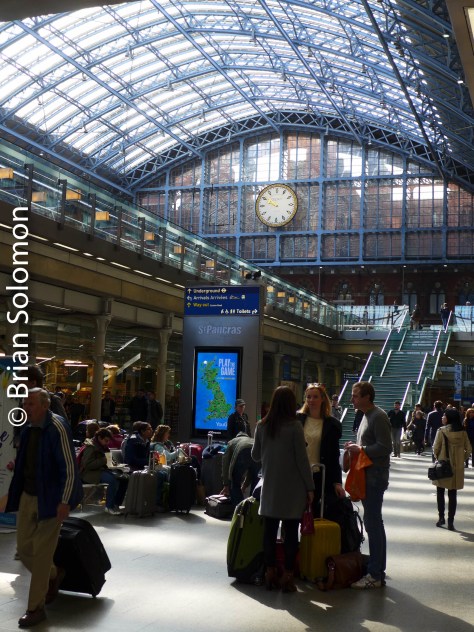
And before we knew it we’d arrived at St. Pancras, London’s most elegant 19th century railway terminal. Last time I’d taken the Eurostar I’d come into Waterloo, and that wasn’t yesterday!
This is a selection of Lumix LX7 photos from the recent trip.

Would you like to read more about St. Pancras? I’ve written about this station in my new book Railway Depots, Stations and Terminals published by Voyageur Press.


Tracking the Light posts daily!

To make the most of this scene I needed to make some global (overall) and localized contrast adjustments in Lightroom. This was necessary to compensate for the contrast characteristics inherent to the digital file produced by my FujiFilm X-T1.
I worked with the RAW file which has substantially more data than the in-camera JPG (which is compressed and thus offers very little information above what is immediately visible to the eye).
Illustration versus documentation: Often I set out to document a scene. My process and techniques are focused toward making images that preserve the way a scene or equipment appear. Often, but not today.
Creation of an illustration may not be intended as documentation. An illustration is created to convey a message; perhaps that needed for advertising, art, or publicity.
While photographing in Bordeaux, I found that the juxtaposition of the modern trams against both modern and historic architectural backdrops looked remarkably like artist’s/architect’s impressional drawings.
So, as an exercise in illustration, I’ve intentionally manipulated the camera RAW files to make them appear more like the artist’s impressional drawings, such as those often displayed as visions of the future.


Specifically, I altered the contrast and de-saturated the color palate to mimic a water-color tinted image. I did not destroy the original files, and so I have the benefit of documentation and illustration with the same photos.


Questions:
Have I done anything fundamentally different here than with images created (augmented) by the manipulation of digital files to produce super-saturated colors, plus intensely contrast adjusted effects that result in dream-like sky-scapes?
Is a posed railway publicity photo that was heavily re-touched by air-brushing or similar alteration to be considered documentation?
In a later post, I’ll explore Bordeaux’s tram network in fully saturated color.
Société National de Chemin de Fer’s Trains à Grande Vitesse is 35 years old.
Last month (April 2016) I made a series of trips across France on SNCF’s TGV, a means of flying by rail.
And, yes the speed is impressive: it makes the Acela Express seem like it’s coasting.
Here are just a sampling of my Lumix LX7 images from and of SNCF’s TGV and its stations.


I wrote about the TGV in my book Bullet Trains published by MBI in 2001.
Here’s an excerpt of the text on TGV:
In conjunction with the construction of the new high speed railway called the Lignes à Grande Vitesse (LGV), SNCF developed of the Trains à Grande Vitesse (TGV), an entirely new high speed train. When discussing the French system the LGV refers to the new high speed infrastructure, including the tracks, while TGV refers to the high speed railway technology, including the trains themselves.


It was a rainy Monday when I arrived in Antwerp. Working with my Lumix LX7, I spent several hours riding the Lijn trams and making photos.
Does the rain and gloom ad atmosphere to this eclectic Flemish port city? There’s a lot of history here.
Lijn has been buying new low-floor articulated Flexity-2 trams to replace its antique fleet of four-axle PCCs, so I was keen to catch the older cars at work while I still can.
(See related posts: Gent Revisited—Trams, Castles and Cobble Stones, Gent in Six Photos, Trams of Gent Part 2, Trams in Basel, Switzerland; 21 April 2016).
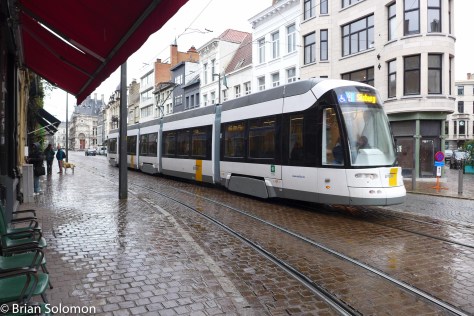


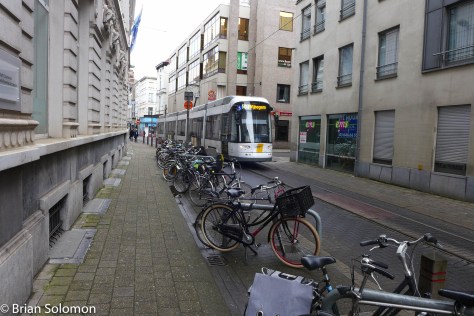

White trams navigating narrow dark cobble-stone streets makes for some interesting contrast. So, would shafts of sun have improved these images?
It was very windy, and I spent the whole morning standing around along the old Boston & Albany mainline reading about 19th century industrial practice while waiting for trains to pass.
I posted the photos I made of an eastward Norfolk Southern detour train near Middlefield, Massachusetts yesterday evening.
My goal was to catch the Ringling Brothers and Barnum & Bailey Circus Train, that was rumored to be on the move.
But, after 8 hours standing in the cold, I decided to head downgrade.
Nearing Westfield, the scanner came to life, ‘clear signal CP109’.
Time for a U-turn.
I’d scoped a location near Huntington.
Unfortunately this neatly coincided with a fast moving cloud. Bad luck.


A bit of hard driving got me to Washington Summit ahead of the train. The clouds stayed at bay.
All of these images were exposed with my FujiFilm X-T1 mirror-less digital camera.
Slides from the event remain latent.


This morning (May 16, 2016), I was out on the Boston & Albany (CSX Boston Line) for the Ringling Bros circus extra. While waiting word came over the wire that a Norfolk Southern intermodal train for Ayer, Massachusetts was detouring on CSX.
A derailment near Charlemont, Massachusetts (on NS/Pan Am Southern’s Boston & Maine route) on Saturday resulted in a traffic disruption and thus this very unusual move.
A CSXT SD40-2 led the Norfolk Southern consist, presumably because of the cab signaling requirements on the Boston Line .
All photos exposed with my FujiFilm X-T1 near milepost 129 east of Middlefield, Massachusetts.


 Tracking the Light posts Daily!
Circus Train photos tomorrow!
Locked away in an old locomotive shed at Saint Ghislain, Belgium are a wonderful collection of historic SNCB locomotives maintained by Patrimoine Ferroviare et Tourisme. See: http://www.pfttsp.be/index.php/fr/
Mauno Pajunen organized a visit to this collection and provided translation while Rousman Phillippe offered a guided tour.
I was most impressed by the semi-streamlined stainless-steel clad electric (SNCB 1805) that formerly worked TEE international services and by the Baldwin diesel locomotive built under license.


Photographing in a locomotive shed such as this one requires special technique.

Direct and indirect lighting from skylights in the roof and large side windows results in extreme contrast with lower regions of the locomotives bathed in darkness that tends to confuse the in-camera light meter. (A meter doesn’t know what your subject is and only provides a balanced reading and doesn’t work in this situation.)
If you are not careful you may end up with an unacceptably dark result. (see above).

My solution is relatively simple: manually over-expose in range of 2/3s of a stop to 1 stop, and then control highlight detail in post processing.
The easiest way to do this with a digital camera is used a manual mode and then watch the suggested exposure settings offered by the built in meter and then add 2/3s to 1 stop to the recommended value. Thus if the meter suggests exposing a f2.8 at 1/60th of second, open up the aperture to nearly f2.0 without changing the shutter speed.
Another way of doing this is by adjusting the meter to over expose by 2/3 or 1 full stop. Each camera has its own means of doing this.
In my case, I set the ISO to 400, so my average exposure was f4.5 1/60 of a second (camera meter was recommending f5.6 to f6.3, which would have resulted in an unacceptably dark image).

I adjusted my exposure from scene to scene, while tending toward overexposure based on the meter setting and carefully gauging the histogram to avoid loosing data in the shadow areas.

Since the highlights of the outside windows and skylights are not important to the overall scene, it isn’t a problem to allow for a loss of detail in these areas.
After exposure, I adjusted the files in post-processing to bring the mid-tones and shadow areas to an expected level.


Another trick is working in confined spaces. For these images I used a super wide-angle lens, specifically a Zeiss 12mm Touit, which I purchased specifically for photography in settings such engine sheds, signal towers and locomotive cabs.
Tracking the Light Posts Daily.
International borders are often bad for railways.
An invisible political boundary (the dashed line on a map) can prove a greater obstacle than a towering mountain range when it comes to impeding railway operations.
In mid-April, my Irish friends and I explored the Gotthard Pass, where massive investment will soon make the old line over the mountain redundant as the new 35.5 mile Basistunnel beneath the Alps will divert most of the through traffic.
A week later I was exploring the border area between northern France and Belgian Wallonia with Mauno Pajunen.
This is in an area of relatively dense population that was once the center of a thriving coal mining community. Quiévrain, Belgium is a town located an hour or so from Brussels and is relatively near to large French cities of Lille and Paris.


Generally speaking SNCB (Belgian National Railways) provides an excellent service across Belgium, with most stations seeing at least an hourly passenger service and many lines operating with an even greater frequency.

At one time a through railway line connected Belgian cities of Brussels and Mons with the French city of Valenciennes via Quiévrain . Today, SNCB continues to operate a regular interval passenger service from Brussels to Mons with some trains continuing south to Saint Ghislain and Quiévrain.
But Quiévrain is the end of the line and the state of the station area is a sad reflection of better times now long gone.

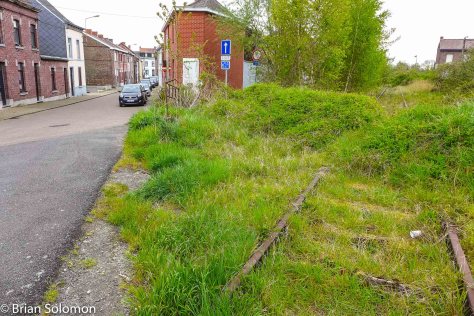
Evidence of the old line remains and the tracks are still in place (although no longer connected).
The town is divided between Belgium and France, with the French town being called Quiéverchain. Differences in the price of tabacco and alcohol between the two countries has led to a thriving business on the Belgian side of the border.


It had been many years since you could take a train directly from Mons to Valencienes.
In theory, you can ride from Brussels to Valenciennes via a change of trains at Lille, but this is the long way around and impractical for regular travelers.


Elsewhere in Europe cross-border services have flourished, yet the end of track at Quiévrain clearly demonstrates how borders create barriers between population centers that need not exist.
Soon you will be able to travel faster than ever before from Zurich to Milan, but not by rail from Mons to Valenciennes!

Last October (2015), I visited Valenciennes in northern France. I stopped by again a few weeks ago during my April 2016 wanderings in France and Belgium.


In these views I focused on the old Chemin de fer du Nord Station (SNCF’s Gare de Valencienes) and the surrounding environment.
Using my FujiFilm X-T1, I made images that feature the old station as both subject and background. Notice how selective focus and use of light shifts the central interest from the old building to the tram.

Outback of the station, there are, of course, SNCF trains and an impressive array of trackage that make interesting subjects in their own right.
Together, the building, trams, SNCF trains and trackage make for a scene, but one not possible to adequately represent in one image. Thus this myriad collection of images. This is a work in progress.


Some photos age well.

I made this view of Conrail GP40-2s rolling east at Rochester, New York’s Amtrak station in November 1986—nearly 30 years ago.
At the time, Conrail was the order of the day, and the GP40-2s were common.
Although sharp and properly exposed, this view was marred by the shadow of the canopy and so at the time I disregarded it.
I’ve amended my opinion, however.
Now the whole scene has changed beyond recognition. Conrail is gone nearly 17 years and last year Amtrak demolished its old station in preparation for construction a new one.
 It was a pleasantly warm Spring day when I set out with Lumix LX7 in hand to make a few photos of the Strasbourg trams.
Strasbourg was among the first French cities to re-adopt the electric tram, and in 1994 introduced an elegant modern tram system using a pioneer type of low-floor car (the first batch were built by ABB) called the Eurotram.
I’ve been meaning to visit Strasbourg for a long time, but only recently managed to finally get there.
Any favorites from this selection?


Located in the north of France, Metz is an industrial city with a long history.
I’ll admit, I’d never given the place much thought until I had to change trains there in late April (2016).
Not only was the old city centre visually fascinating, but the railway station is a real gem!
That’s the great part about exploring without an agenda; you find wonderful things you really didn’t expect to see!
I made these images over the course of my brief visit using my Lumix LX7 and FujiFilm X-T1 digital camera (fitted with 12mm Zeiss Touit lens).


I made this study of CSX’s former Boston & Albany mainline at Brookfield, Massachusetts in January 2001.
Step back a century and there were two main tracks and an array of sidings here; back when the railroad focused on local business in addition to long distance traffic.

CSX 611 is a AC6000CW—a big GE diesel by any measure.
In January 2001, My pal T.S.H. and I were making an inspection of the old Boston & Albany between Palmer and Worcester, Massachusetts ( reliving a trip we’d made in the summer of 1984).

I exposed this view using a Rollei Model T that I’d bought from Mike Gardner.
My intent was to recreate a view I’d made of westward Conrail freight at the same location 16 years earlier.
Sadly, the old Boston & Albany station at East Brookfield was destroyed by arson in Autumn 2010.
Tracking the Light is on Autopilot today.
It was a hazy sunny August morning when I exposed this trailing view of a Conrail coal train east of Bennington Curve on the famous former Pennsylvania Railroad grade between Altoona and Gallitzin.

Tracking the Light is on Autopilot while Brian is traveling.

I’ve always liked the classic lines of Alco’s Century line. This engine was still at work for its original owner when I used my 200mm lens to craft a study of its cab.
On 21 April 2016, I had my First Class France Rail Pass Flexi validated at Basel, Switzerland.
My goal was by the first evening to reach Valenciennes (a city in northern France near the Belgian border) using only regional trains, rather than the TGV (plenty of opportunity for high speed travel later in my trip).
I found the challenge as in making local connections since these days SNCF focuses long-distance passengers onto high-speed routes. All very well, unless you want to experience secondary lines and ride trains off-the well-beaten path.
Thanks to Stephen Hirsch and Denis McCabe who helped with my planning, I traveled on a series of TER trains.
After four train-changes reached my destination 15 hours after I boarded the first train on the French side of Basel’s main station.


Germany’s traditional large railway stations offer endless opportunities for photographic composition.
Over the years, I’ve made several visits to the Karlsruhe Hauptbahnhof (main station) and have always found it photographically rewarding. I made these photos a couple of weeks ago (April 2016.)


The train-shed lends to making geometric images while providing a visually intriguing setting for train photos. I like the sense of scale that the shed offers.
Any favorites?


Exposed with my FujiFilm X-T1 at Kent Station, Cork.

Irish Rail has painted 201-class General Motors diesel number 231 into an interim version of the latest Enterprise livery.
This is yet to feature the pink swooshes that now characterize the Enterprise scheme.
This morning (4 May 2016) the clean locomotive worked the scheduled 11am service from Dublin Heuston Station to Cork. I made this image at Islandbridge Junction using my Lumix LX7.
Annoying me was a line of cloud that was just covering the sun. While this appeared to be moving, in fact the cloud was forming as it moved. Bright sun was so close, yet elusive.
This phenomenon is probably explainable by the effects of condensation, wind currents and cool air; but irksome when you are anticipating the sun emerging from nature’s diffusion screen.


Ultimately, the sun came out. About 45 minutes after the train went by. Poor show.
I’ve made minor adjustments to the RAW file to improve contrast.
Tracking the Light posts every day, don’t miss it!

My brother and I were changing trains at Washington D.C. on December 18, 1984. I had time to stealthily wander down the platforms and make photos of the Alco RS-1s that worked the station. I was pleased to feature three of the enigines in one image.
Several lines come together at Rastatt, Germany, which is an historic city south of Karlsruhe.
Since most through traffic is focused on to a short double track section immediately south of Rastatt , the station serves as a holding area for southward trains queued up to pass through this bottleneck.
In addition to DB’s trains, freight is run by a of variety open-access and private operators. Freights share tracks with passenger trains including high-speed TGV and ICE services and the famous Karlsruhe tram-trains.
I made this selection of images on 19 April 2016 using my FujiFilm X-T1.


Tracking the Light posts daily.

If you are not looking at Tracking the Light directly you may need to click the link to see the full photo.
The image was exposed using my FujiFilm X-T1.
The Athy locals were fascinated by this odd looking train that arrived and disgorged its eager passengers.
I’ll offer Freiburg as one of Europe’s most colourful tram cities.
The combination of variety of cars, a range of paint liveries (advertising and otherwise), interesting trackage plus varied and interesting historic backdrops makes Freiburg hard to top.
Any suggested contenders?
Photos below exposed in April 2016 using my FujiFilm X-T1 digital camera.


Evening sun with a textured fair-weather sky combined with well maintained paving stones and a healthy tree at left made for a visually compelling setting.
Freiburg, Germany still operates some of its vintage Duewag trams that feature a streamlined body and rounded front-end.
To make the most of the svelte classic tram I opted for a low angle and favored the angle of sun for reflective glint. The bicyclist was a fortuitous subject that makes for a more interesting photograph by introducing a human element.
To expose this image I worked my FujiFilm X-T1 digital camera with the rear live-view display tilted upward, which allowed me to compose the photo while holding the camera relatively low to the ground.
I adjusted my 18-135mm zoom lens to near its widest angle.


The real trick was keeping the composition interesting as the action rapidly unfolded.
In post-processing I darkened the sky and lightened the shadow areas to improve overall contrast.
Which of the three images is your favorite?
(This essay was composed while transiting the Channel Tunnel between Calais and Folkstone on 30 April 2016).
On 20 April 2016, I made this image of a Swiss BLS Cargo (Bern Lötschberg Simplon) electric leading a northward freight on DB’s (German Railways) heavily traveled double-track line north of Freiburg, Germany.
Although clear and sunny, the direction of the light was directly behind the locomotive, which is anything but ideal.
To make the most of this awkward lighting situation, I opted to feature the flowering tree that was well-lit by the angle of the sun, and work with the locomotive in silhouette, while taking a low angle to minimize distracting elements on the far side of the line.
In post processing, I’ve lightened the shadow areas of the RAW file to restore detail and improve the overall contrast to the locomotive.
Below are both the unimproved RAW file (only scaled for presentation) and my modified file.


Tracking the Light posts daily.
Among my favorite German locomotives are the old ‘Rabbits’ (classes 215-218 and rebuilds), so-called because of their rabbit-ear shaped exhaust stacks.
On Monday, 18 April 2016, Gerry Conmy, Dennis McCabe, Stephen Hirsch and I made a project photographing this declining class of diesel on the line running east from Lindau.


The Zurich-Munich long distance trains are still worked with these vintage machines. Several years earlier, Dennis and I had explored locations on this scenic non-electrified double track line.
Soft morning light aided the effect of the pastoral setting.
I exposed these views using my FujiFilm X-T1 digital camera.
Tracking the Light posts every day!


