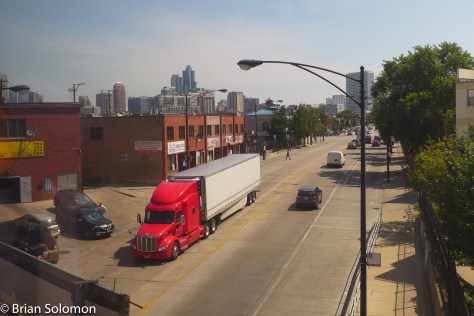
Last week I had a few minutes between trains, during which time I exposed these views of the Chicago Transit Authority’s famous ‘L’ at the Chicago Loop.
Although it is common misconception that the ‘loop’ is so named for the circular arrangement of CTA’s elevated railway downtown, the name pre-dates the ‘L’ and actually stems from Chicago’s cable car days. (Chicago, rather than San Francisco, once held title to the world’s most extensive cable operated streetcar network.)
Photos exposed using my FujiFilm X-T1.
Telephoto view in the evening looking toward Lake Michigan.I like this image because you can clearly see the train’s operator in silhouette in the front window. Of course, you’ll need to view the image at a sufficiently large size to perceive this essential detail.
A week ago, I traveled with John Gruber and Scott Lothes for a day’s photography on the Wisconsin & Southern,
A couple of days previously, John and I had made some photographs exploring the line to Reedsburg (see previous posts). So armed with that experience plus good information on operations, we set out with Scott for another run.
Among the three of us we have a bit of photographic experience and a lot of railway knowledge, so we were in good position to make the most of the day. I always like learning from fellow photographers as everyone has their own way of seeing.
I have to admit that the old Chicago & North Western line between Madison and Reedsburg isn’t my strongest field of interest. When I lived in Wisconsin this line (then still operated by C&NW) was largely nocturnal. However in more recent times, John and I have made daylight photos.
Until a few months ago the route still featured some vintage wig-wag grade crossing signals, and these had been the focus of my earlier efforts on the line. Since these are gone, we were able to take a more diverse approach.
The Reedsburg line is now but a branch on the sprawling Wisconsin & Southern freight gathering network, but historically the line was a key Chicago & North Western mainline between Chicago, Madison and the Twin Cities. For me this legacy makes the line more interesting.
We picked up the train at Wisconsin & Southern’s Madison Yard, and over the next few hours intercepted it more than a dozen times.
Knutson Drive in Madison, Wisconsin.
Sunny weather plus a single clean SD40-2 running short-hood first put us in a good position to make satisfactory images. On the previous run John and I needed to make do with the engine running long-hood first, which is a more challenging subject to photograph.
Here are a few digital photos from our second chase. Any favorites?
A view of scrap cars from an over-pass west of Lodi, Wisconsin. After all, a freight train is about the freight, right?Pastoral Wisconsin scene near Okee.Crossing the Wisconsin River at Merrimac. John brought the car across on the ferry, while Scott and I waited on the south side of the river for the train.Devils Lake, Wisconsin. There’s a variety of angles on this place, most of them better in the afternoon or evening. We were there at lunch-time and had to make the best of it. I’ve adjusted the contrast using Lightroom. I’ve tried to maintain the sense of lighting while balancing it to produce a more pleasing overall image. It is of course possible to overdo contrast control, which may result in an unnatural appearing image.Baraboo station. Compare this photograph with my black & white views posted a few days ago.Our freight works at Rock Springs where it dropped grain cars for loading.Scott picked this spot. On the previous trip I’d tried a long telephoto view of the same bridge. I like this wide angle broadside better.We were a bit tardy arriving at the crossing. This is a quick grade crossing grab shot. Not much time to set up. As with a few of the other images, I’ve adjusted the contrast using Lightroom.
The Illinois Railway Museum has one of the best collections of North American railway equipment. Hundreds of pieces of equipment spanning more than a century are on display.
It’s great to be able to inspect a traditional 4-4-0, and a Forney Tank engine. I’m fond of classics such as the Santa Fe 2900-class 4-8-4, Burlington’s 4-6-4 Hudson and its streamlined Budd-built Nebraska Zephyr, and of course the Pennsylvania Railroad GG1 in Brunswick green.
Chicago, Burlington & Quincy 4-6-4 at IRM.Pennsylvania Railroad GG1 electric 4929. A masterpiece of engineering and design.I recall the GG1s under wire. Great sounding air horn on these.Budd stainless steel. And articulated too!My book on streamlined trains came out last year and so it was nice to reflect on these amazing machines in the museum. (Puns are extra).Some of the old girls still work; this Frisco 2-10-0 is serviceable. Just add coal, water and talent!Parts anyone?Sister to the popular Milwaukee Road 261 is engine 265. Sure would be neat to get both engines under steam together!Lots of electrics under the barns. PCC’s have been a regular feature on Tracking the Light.
The old diesels are neat, and there’s great array of old streetcars.
But then, what’s this? A Wisconsin Central SD45? Wow, nice to see that one of those was saved, but it just doesn’t seem that long ago and I was out catching these on the mainline.
And wait, what about this Metra Bi-Level electric? Weird to see THAT in a museum.
Two Chicago & North Western DASH9s!
Now I just feel old.
Views exposed with my FujiFilm X-T1 digital camera with Zeiss 12mm Tuoit.
A former Santa Fe Alco RSD-15. These must have looked great hauling freight back in the day.Eight motors, four in each truck, that’s what the DDA40X was all about.An Wisconsin Central SD45. Twenty years ago when I lived in Waukesha, Wisconsin I could hear these roar through town from my apartment. I spent lots of time putting these beast on film.It’s like Galesburg Railroad Days! The BN executive Fs! Always cool.Whoa! What’s this? A Metra electric? Hmm.Two Chicago & North Western DASH9s. Really?! It just doesn’t seem that long ago that I sat in the cab of one these when they still had that ‘new car smell’. And now they too are on display in a museum. Will anyone save a P40?
Last week I traveled with John Gruber to the Illinois Railway Museum at Union. John needed to deliver some material in relation to his North Shore photo exhibit, and he wanted me to expose a few images of him with his photographs.
Between 1960 and 1963, John made a project of documenting the last years of operation of the Chicago North Shore & Milwaukee interurban electric line.
North Shore was an intensive electric line that connected the Chicago Loop (trains served downtown using the rapid transit ‘L’—[elevated line]) with Milwaukee, Wisconsin via Chicago’s northern suburbs. The line was well known for its articulated streamlined speedsters called Electroliners and its electrically cooked hamburgers known as Electroburgers. Operations concluded in January 1963.
John’s work is iconic. He exposed thousands of North Shore photographs and his photography goes well beyond ordinary images of the trains. He focused on people as well as machines, and preserved a feel for this unusual railway in motion.
Johns work was prominently featured in the pages of Trains magazine and in books such as those by the late William D. Middleton.
His current exhibit can be seen in the waiting room of the East Union station at IRM. It will be on display through the end of 2016.
Of course, while we were at IRM, we took the opportunity to travel the line, and visit some of the historic equipment (which includes several of North Shore’s cars).
In addition to a variety of digital photos, I exposed these black & white images with my Leica.
John Gruber at IRM. Exposed on Ilford Pan F using a Leica 3A with Nikkor f3.5 35mm lens.Exposed on Ilford FP4 black & white film using a Leica 3A with Nikkor f3.5 35mm lens.Exposed on Ilford FP4 black & white film using a Leica 3A with Nikkor f3.5 35mm lens. (image cropped).
For more information on the Illinois Railway Museum see: http://www.irm.org
I exposed these three photos last week on Wisconsin & Southern at Baraboo, Wisconsin using my old Leica 3A loaded with Ilford Pan F black & white film (ISO 50).
In its heyday, Baraboo was a division point on Chicago & North Western’s Chicago-Madison-Twin Cities main line.
Its glory days are now more than a century past; decline began in the early twentieth century, when this route was augmented by C&NW’s low-grade Adams Line (via Milwaukee), which became a preferred route for through freight and fast passenger expresses.
It was severed as a through line in the 1980s.
As mentioned in an earlier post, on this July 2016 day John Gruber and I were following Wisconsin & Southern’s Madison to Reedsburg freight.
Some photographers might object to the railroad’s choice of motive power: an SD40-2 operating long-hood first. I recall the wisdom of my late-friend Bob Buck who reminded me once many years ago, ‘The railroad isn’t operated for your benefit.’
(In other-words; if a long-hood forward SD40-2 is on offer, that’s what there is and so make the best of it.)
Compare these images:
Photo 1. In this view the harsh overhead light characteristic of ‘high sun’ was briefly soften by a passing fair weather cloud. Some photographers might cringe at the thought of a cloud, but here if offered opportunity for a variation on the scene. I adjusted the contrast of the image in post processing.Photo 2. Bright sun again; so with this photograph I used my rangefinder to focus on the trackside weeds instead of Wisconsin & Southern 4008.Photo 3. John Gruber looks on while Wisconsin & Southern 4008 switches at Baraboo. Exposed on Ilford Pan F using a Leica 3A rangefinder camera fitted with a Nikkor f3.5 35mm lens.
In one, I’ve adjusted the contrast to compensate for a cloud that momentarily softened the noonday sunlight. In the second, I’ve worked with depth of field and focused on trackside weeds instead of the locomotive. In the last, I’ve included fellow photographer John Gruber to add in a human element.
When I learned to use my old mechanical Leica there were three primary controls on the camera; a ring to adjust the focus (gauged with the aid of range finder using a ghost image overlaid on the main image); dials to adjust the shutter speed; and a ring on the lens to change the size of the aperture (lens hole) as indicated by a logarithmic scale with ‘f-stops/f-numbers’.
Other than merely pointing the camera, I needed to understand how these controls worked to make successful photos.
Today most imaging making devices take care of details such as exposure and focus, allowing image makers to snap away without concern for the mechanics.
In many instances this freedom facilitates the ability to make photos quickly and with relative ease. Yet, this loss of control steals from the photographer crucial tools.
I still like to set my aperture manually. This has less to do with obtaining the correct exposure (since in camera metering can quickly suggest or set appropriate shutter-speed/aperture combinations) and more to do with adjusting the depth of field to manipulate my composition.
A detailed discussion of how the f-stop (f-number) is determined on a lens and what the numbers mean can fill a textbook.
What is important here is knowing a few basics, such as; a smaller f-number represents a larger aperture size and, but more importantly, how you can use this.
As the size of aperture is increased more light is let into the camera, however with a big hole comes a decrease in depth of field (relative focus); conversely, the smaller the hole size (larger f-number), the less light and the greater the depth of field (relative sharpness between near and far objects).
By using a larger aperture (small f-number, say f1.4) the relative focus will be narrow, with those points not in focus appearing relatively soft compared with the subject in focus.
This relationship becomes exaggerated with longer focal length lenses. Where a super wide angle lens offers great depth of field even with a large aperture opening (small f-number), a long telephoto lens will offer relatively shallow depth of field even when using a small aperture (large f-number, say f16).
While the f-number may used as a constant gauging mark, what is most useful is controlling the degree of relative focus to achieve a desired effect.
Personally, I like the effect of a long lens with relatively shallow depth of field because this allows me to draw the eye of the viewer.
Full frame and uncropped; I exposed this view at Kent Station, Cork in January 2005 using a NikonF3 with 180mm lens at f2.8— its widest aperture.
As with many successful stories, it often helps to lead your audience on an unexpected path before giving them what they want. I’ll often tease a viewer by leaving some crucial element of an image just beyond the range of sharpness, while placing the focus on something else, like say a railroad signal. Or vice versa.
I can’t tell you what to look at, but I can try to draw your eye. Notice where I’ve placed the focus, but also those things I’ve allowed to be less than fully sharp. The larger this photo is viewed, the more relevant the topic of relative focus. An image viewed at 3×5 inches won’t necessarily convey the same impression when viewed much larger.
Tracking the Light offers daily discussion on Photography.
During the last week (July 2016), John Gruber and I were rewarded by our efforts at photographing Wisconsin & Southern freights on the move. John’s been documenting this route for decades.
On this day we’d picked up the Reedsburg Job near Merrimac and followed it west.
First of two images.
At this location near Baraboo, I asked John to stop the car near the top of a hill, rather than drive closer to the tracks.
So, is this how motorists perceive the Wisconsin & Southern?
Exposed using my FujiFilm XT1 with 18-135mm lens fully extended to its most telephoto setting (135mm). The camera’s built-in level is very helpful in situations such as this where set up time is at premium.
I’ve spent years prowling the old Boston & Albany on foot and by road.
Here’s some view made today (July 16, 2016) and over the last hour or so from the windows of Amtrak’s Lake Shore Limited train 448.
Exposed with my Lumix LX7 uploaded via Amtrak WiFi.
Old B&A station at Chatham, New York.State Line Tunnel.State Line Tunnel.North Adams Junction, Pittsfield, Massachusetts.Washington Cut, Washington, Massachusetts.Looking east on Route 20 at Huntington, Massachusetts.
I can’t say its a first; but it is the first time in awhile that I’ve been on Amtrak 448 (Boston section of the Lake Shore Limited) when it departed Albany-Rensselaer station precisely on schedule—3:05pm.
Things have certainly improved. Hooray for Amtrak!
I was among the first passengers to board Amtrak 448. Instead of running as a through train Chicago to Boston, the Boston section starts in Albany.
New York (left) and Boston (right) sections of the Lake Shore Limited. I made the cross platform transfer at Albany-Rensselaer, New York. Lumix LX-7 photo.
I made these views using my Lumix LX7 this morning east of Cleveland, Ohio on the old New York Central Water Level Route from Amtrak 48, the Lake Shore Limited.
I up-loaded them to my laptop, processed in Lightroom (to add my name and scale the file) and transmitted them to Tracking the Light a few minutes ago while riding on the train over the Boston & Albany.
Sunrise east of Cleveland, Ohio this morning (16 July 2016). Lumix LX7 ISO set at 400.Lumix LX7 view.
I made these views with my FujiFilm X-T1 digital camera of the former Chicago & North Western Chicago-Madison-Twin Cities mainline at Evansville, Wisconsin.
Looking west toward Madison, Wisconsin. Agricultural dust and other pollutants contribute to a rosy sunset. I’ve exposed manually for the sky. With Kodachrome film I could have retained better detail in the sky. f22 1/250th second.
John Gruber was giving me a tour of the line. He explained that in its heyday this route had been a double track mainline with a top speed of 75 mph.
Today it is a truncated vestige of that earlier era. The tracks are now operated by Union Pacific to serve local freight customers. No fast Pacifics with varnish in tow any more.
To ensure new material daily, Tracking the Light is coasting on autopilot while Brian is traveling.
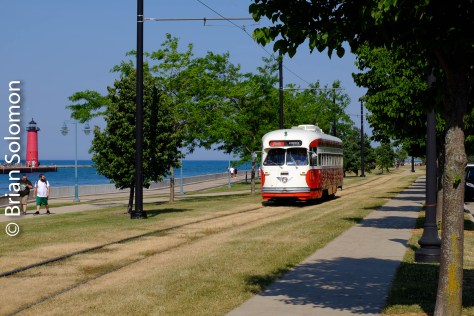
Earlier this week John Gruber and I visited Kenosha, Wisconsin to ride and photograph the vintage PCC streetcars that serve the town.
The cars are beautifully maintained; the line is short but interesting. Cars operated about every 15 minutes during the day. The fare is just $1.00—a true bargain.
On the downside, it is a bit difficult to figure out how and where to board the cars. A little bit of targeted advertising would go a long way.
Brian Solomon’s Tracking the Light posts something different daily!
The other day, John Gruber met me at the Metra station in Lake Forest, Illinois and we had lunch with Art Miller and David Mattoon.
John Gruber (left), Art Miller (center) and David Mattoon (right). Lumix LX7 photo.
Art recalled that I was among the very first speakers at the Center for Railroad Photography & Art’s conference held at Lake Forest College every year.
That was back in 2003!
Interior panoramic composite of a Metra gallery-style commuter railway car. Exposed on my way to Lake Forest using my Lumix LX7.
On my 1984 visit to Chicago I’d made photos and traveled to/from the old North Western Station.
Wow, have things changed.
Yes, I’ve made some visits between then and now, but it’s been a long time.
The old station was torn down not long after my first visit and replaced with an epic glass box. Today, this is known as the Ogilvie Transportation Center.
The Oglivie Transportation Center as seen in July 2016. Exposed with my Lumix LX7.
In the mid-1990s, about the time that Chicago & North Western was folded into Union Pacific, the station’s Bush train sheds were demolished and replaced with more modern platform coverings. I made a few photos during that transition.
Still, it seems a bit strange for me to see the former North Western Station in this modern format. My impressions from 32 years ago remain only in my memory and few photos that I made with my Leicas.
Inside the Oglivie Transportation Center. Tracks and trains at left. Exposed with my Lumix LX7.Lake Forest, that’s where I’m going. Exposed with my Lumix LX7.Hot as an oven. Exposed with my Lumix LX7.Metra. Exposed with my Lumix LX7.Panoramic composite exposed with my Lumix LX7. The old F40PH diesels run headend power off the prime mover. Deafening under the sheds.Exposed with my Lumix LX7.
I boarded Amtrak’s Cardinal, train 51, at Trenton.
A little more than 28 hours later, having traveled through 10 states plus the District of Columbia, I arrived in Chicago, where I had 45 minutes to walk to my next train.
I enjoyed the seemingly endless panorama, but was happy to get some fresh air upon arrival.
Here are some views from my journey exposed with my Lumix LX7.
Amtrak 51 arrives on Platform 4 at Trenton, New Jersey. Lumix LX7 photo.Amfleet 2 to Chicago!Philadelphia Zoo at Zoo Junction.30th Street Philadelphia.Wilmington, Delaware.I thought I saw a ghost! Here’s one of Amtrak’s AEM-7s working out its final miles on Maryland MARC at Baltimore.I’ve had bad luck catching Amtrak’s ACS-64 642 painted in a special livery for America’s Veterans. Here it is at Ivy City in Washington D.C. One of these days I’ll get it on the move!K-tower Washington Union Station.I got a bit of air at Washington D.C. while 51 exchanged its electric for a diesel.Amtrak’s logo represent tracks on a rolling landscape.Here’s my car on the platform at Washington Union Station.Manasass, Virginia.13 months ago I was here to see Norfolk & Western J-Class steam locomotive 611.Rural Virginia.A view at Gorduonsville, Virginia.This preserved Chesapeake & Ohio GP7 was on display at Clifton Forge, Virginia.CSX GE diesel at Clifton Forge. I saw quite a few freights on the move on the old C&O route. More than I expected include several unit coal trains.
In West Virginia I saw considerable evidence of recent floods.Hinton, West Virginia-one of several small towns still served by the train.Hinton, West Virginia. We were here for at least ten minutes.Old C&O signal tower west of Hinton.Rolling along the New River Gorge. I used a relatively slow shutter speed to capture the effect of motion.Work trains to help repair flood damage. Train 51 was blocked at several locations as repairs were still underway.Fixer upper, West Virginia.Upon leaving Alexandria all the way to Chicago my train was fully occupied. I was surprised at the large numbers traveling to and from intermediate stations. I’d guess 50 or so got on in Cincinnati when we stopped at about 2:30 Am. Why not run a day train?Sunset in the New River Gorge.Black tea at sunrise crossing the Indiana corn fields.Monon, Indiana.Chicago.Crossing 21st Street Bridge, Chicago.Cardinal’s Chicago passengers at Union Station.
The other morning I boarded Amtrak’s Cardinal for Chicago at Trenton, New Jersey.
While waiting for my train to arrive I made a few photos with my Lumix (and some others on film).
Here’s the Lumix views. Stay tuned for some views from the train; 28 hours via West Virginia.
SEPTA AEM-7 laying over for the weekend. Lumix LX7 photo.Clear morning sun made for a variety of photo options. I’ll be curious to see my black & white film views of this engine.Just in case you didn’t know where I was . . .Trenton is served by Amtrak, SEPTA and NJ Transit. Busy place even on a Sunday morning.Amtrak’s Cardinal connects Trenton with Chicago three days a week. More Cardinal photos coming soon!
Below are some view I made from Amtrak 57 on my trip from Windsor Locks, Connecticut to Trenton, New Jersey (and then beyond)
More views from my journey as the WiFi permits!
Changing engines at New Haven. Exposed with a Lumix LX7.Near Bridgeport. Lumix LX7 photo.New York Penn-Station. Lumix LX7 photo.My bag at Trenton. Lumix LX7 photo.
Tracking the Light is on the (rail) road this week.
In my early days photographing every so often I’d hit upon a great film-camera-lens combination.
You know, just the right set up to make memorable images.
On May 6, 1984, my dad lent me his Leica M3 with 50, 90 and 135mm lenses. For reasons I’ve long forgotten, I loaded this with Plus-X (ISO 125) rather than Ilford HP5 or Tri-X (my typical films choices back then).
More significantly, I decided to use an orange filter to alter the tonality of the film.
I went trackside along the Conrail’s former Boston & Albany and exposed a series of evocative images of trains rolling through the Quaboag Valley.
Conrail’s SEPW (Selkirk to Providence & Worcester) roars east through the Quaboag Valley east of Palmer on May 6, 1984. The magic combination: filtered Spring light; Plus-X film exposed using a Leica M3 with 90mm Elmar fitted with an orange filter. Processed in Microdol-X.
These photos were much more effective than what I typically achieved with my Leica 3A and 50mm Summitar. I’d made a leap forward.
At the time, I was delighted with the results and on a Friday night brought a stack of 3x5in. prints down to Tucker’s Hobbies (owned an operated by my friend Bob Buck).
Friday evenings were our normal time to convene. And, one of Bob Buck’s patrons, a friend and a well-meaning (published) enthusiast photographer (who is long since deceased and so shall remain anonymous) offered me some free photo criticism..
“Oh don’t use an orange filter, it makes the Conrail paint too dark, and stop using that telephoto lens, it distorts your perspective. Otherwise these are great shots.”
I heeded this bad advice and returned to my older set up. Nearly two years passed before I made another serious foray into the realm of the telephoto for railroad photos.
Also, I largely returned to using unfiltered Tri-X/HP5. (Partially because I’d dropped my 50mm and it would no longer accept filters.)
I didn’t know any better and my magic combination was unraveled before I had time to fully explore it.
Every so often someone will ask if have any regrets. I’m never sure what they’re getting at, but yes, Yes I do.
My regrets? Not learning photography skills more quickly.
In this view I had the right idea, I just didn’t have the right lens on the camera. Exposed on K64 using a Leica 3A with 50mm Summitar lens.
I made this photograph in late 1978 (slide mount reads ‘Feb 79’, but if I recall correctly, it was right around Christmas. Prompt processing wasn’t on my agenda back then).
I traveled with my father and brother to the old New Haven electrified lines. We picked this spot and set up. We were all delighted to catch this GG1 with an eastward Amtrak train. I can still feel the excitement when we spotted the old motor in the distance.
At that time I had access to all of my dad’s lenses. We probably had a 90 or 135mm with us at the time. Yet, I opted to use my 50mm.
Why? I just didn’t know any better.
Today, I look as this image and see three elements that I could have put together more effectively; the aged former Pennsylvania Railroad GG1 electric (pantograph first), old New Haven short-arm left-handed semaphores (most American semaphores aim to the right), and winter glint light.
Now, I’d use a telephoto to feature the signals and the electric in tighter more visually pleasing composition. This what I saw at the time, I just included too much dead space in my image and the locomotive and signals are too distant.
At least I was using good glass and Kodachrome film. There’s that anyway.
Here’s a much enlarged version of the image that suggests that I had the vision for a stunning photo but neither the skills or mindset to use the correct equipment to pull it off effectively.
Tracking the Light explores photography every day.
This afternoon on the way to catch Amtrak 57, the southward Vermonter, my dad and I stopped in for a visit to the Connecticut Trolley Museum at East Windsor for old time sake.
Three cars were on the line today. We went for a spin on a vintage 1902 Brill-built open car.
These photos were exposed using my Lumix LX7, downloaded to my laptop on board Amtrak 57, manipulated in Lightroom, and then uploaded to Tracking the Light courtesy of Amtrak’s WiFi. From my camera to the world: a demonstration of the miracles of modern technology.
Among my themes in Tracking the Light has been; Anticipating Change and Acting on it.
It is easy to sit back in your easy chair and pontificate about the potential for change. Or go from day to day without ever thinking about the effects of change.
Yet, looking back at old photos, what so often catches our interest is how things have changed.
When I was a kid, I’d look back at my father’s photos, exposed 10-20 years earlier and marvel at the changes that had transpired. Amtrak had ended the age of privately operated passenger trains. Conrail and other mergers had swept away many of the classic railroads that appeared in those old images.
Having only lived a few years, it was my mistaken belief that all change was in the past.
Fast forward to 1999. My friend Mike Gardner dropped me in Boston. I was on my way to London and had several hours before my flight. Tim Doherty suggest I make some photos of the Green Line elevated near North Station, which was then due to be replaced.
At the time I thought, “Hmm, but I have plenty of photos of the old El.” True, but these images were already more than a decade out of date. Green Line had introduced a new livery, and most of my views featured PCCs and 1970s-era Boeing-Vertol LRVs.
I made the effort and exposed several color slides of Green Line cars squealing along the old elevated line. I’m glad I did; as predicted the El was removed and these views can never be repeated.
Sometime after I made this slide of Green Line cars on the El, MBTA discontinued operation of the old elevated line in front of North Station. Today the scene is completely changed. Exposed on Fujichrome using a Nikon.
Look around you, anticipate change and make photographs. What you see today may soon be different. Sometimes change is easy to predict; other times it occurs with little warning.
I exposed this view of Irish Rail 071 class diesel number 079 at Sligo using my Rolleiflex Model T loaded with Fuji Neopan 400.
I processed the film at the Gallery of Photography at Meetinghouse Square in Dublin using Agfa Rodinal Special concentrated liquid developer.
Final processing was accomplished digitally using Lightroom.
The Rollei allowed me to compose using a square field rather than a more common rectangular field. I’ve found that the square changes the way I see, and thus produces different compositions. Someone might ask, ‘couldn’t you just crop it?’. You could, yes, but that’s not my point. ‘So what about the lead-in version? That’s cropped, isn’t it?’ Yes, but not by choice! That’s an effect of the software/internet/webhosts.
Tracking the Light discusses photography everyday.
These are some roster views of equipment I’ve used over the years.
I say ‘roster’ to clarify, that these are not ‘builders’ photos of the equipment. Like decades old General Motors diesels, my cameras are battle-worn machines that show the effects from years of hard service.
While I’ve lit these images to show detail, I’ve not made any effort to disguise, clean or dress up these old cameras. You see them as they are.
In my youth I made most of my photos with various Leica 3s that were the better part of fifty years old at the time.
In the 1990s, my pal TSH exclaimed sarcastically that I’d missed my calling as a Nikon endurance tester.
I’ve typically chosen to work with durable equipment that featured excellent optics and rarely worried about acquiring the latest models or gadgetry. These are tools to an end and not jewelry.
One of several Leica model 3s that I used extensively in the 1970s and 1980s. This one is fitted with a 21mm Super Angulon, the aftermarket viewfinder for same is mounted atop the camera. The camera body is nearly 80 years old. It still works, I exposed several rolls of black & white film with it in June 2016.One of four Rolleiflex Model T twin-lens rangefinders that I’ve exposed photos with over the years. My dad’s first Rollei had gray leather. I wore that camera out in the late 1980s. This is one of the replacements.Between 2001 and 2007, I exposed hundreds of rolls of film with this Contax G2 rangefinder. It’s a solid and heavy little camera; seen here with a 45mm Zeiss Planar lens.Here’s my first digital camera, a Panasonic Lumix DMC-LX3. I bought it on the recommendation of Eric Rosenthal, who lent me one to test. I made my first photos with it in October 2009. After more than 65,000 exposures it developed a fault and I replaced it with a Lumix LX7 (with which I made this image). Over all, I like the LX7 better, but I wonder if it will prove as durable as this olds LX3?This Canon EOS 7D has served me well since 2010. It is seen here with a prime 200mm lens. These days I only use it occasionally, but it still works as well as the day I took it out of the box.
Among the cameras missing from this selection of photos are several of my work-horse machines; my dad’s original Rolleiflex, my old Leica M2 rangefinder (that my brother occasionally still uses), various Nikon model F2/F3/F3T and N90s bodies (plus lenses) that I dragged all around the world between 1990-2006, a Nikkormat FT3 (with red leather), and my Canon EOS-3s, which I continued to carry around to exposed film. Also, my two newest machines, a Lumix LX7 (that exposed these images) and a FujiFilm X-T1 digital camera).
This is the 1500th Tracking the Light posting since the blog began in July 2012.
All 1,500 posts are in the archives and available for browsing.
Once I posted the pieces to a puzzle and I was disappointed when my theme proved so opaque that no one figured it out!
Today I try again.
I don’t think this one is as difficult as the last.
FYI: Tracking the Light’s official posting time zone is Eastern Standard Time (New York, Boston, etc).
Conrail, September 1989. Exposed with a Leica M2 on Kodachrome 25.South Shore at sunset near South Bend, Indiana. October 1994.
To the first reader that sends me a comment attached today’s posting with the correct answer to my puzzle: I will send you a free book. As Wally says, ‘Free!’
I will accept a one word answer (if correct), but a little explanation as to why would be nice.
Please note: the first correct answer must be sent as a comment attached to this Tracking the Light post (not to the homepage or any place else); to clarify, any answer sent by Email, or left as Facebook comments, tweets, comments to Google Plus, Tumbler or sent by snail mail or phone cannot count for the free book. No ties, no second place. Sorry, but those are the rules.
Tracking the Light has posted 1500 individual stories!
“I don’t photograph trains anymore because I don’t like [fill in the blank here]”
In the 1980s, I thought Amtrak F40PHs were just about as dull as it got.
I didn’t mind the F40 per se, but the platinum mist livery with narrow stripes, black cab and black trucks didn’t do it for me. And these engines were everywhere!
They were the ubiquitous face of Amtrak: found on the Lake Shore, the Zephyr, the Broadway, etc.
I photographed them anyway. In black & white and in color.
Looking back, some of the photos have aged well.
Yet, the other day at when I was at Claremont Junction, New Hampshire to visit the traveling Amtrak Exhibit train, I still found it hard to get overly enthusiastic about an Amtrak F40!
None-the-less, I made this view on Fuji Neopan Across 100 using my old Leica fitted with a 21mm Super Angulon.
June 18, 2016, Claremont Junction, New Hampshire.
You know, it doesn’t look so bad now.
Tracking the Light offers daily insight into photography.
Sundays too!
Special advisory notice: Tomorrow’s Tracking the Light is a special post and will appear later than normal.
The benefits of familiarity; knowing your locations.
Take the Bellows Falls Tunnel on the Connecticut River line. Back in 1988, I’d photographed a southward Boston & Maine (Guilford) freight in the afternoon and noted that late in the day, when the south portal was in shadow, a shaft of light illuminates the train on the north side of the tunnel.
The location and effect were filed away for future reference.
A couple of week ago, on June 18, 2016, Pat Yough and I were following Amtrak’s Exhibition Train on its way south from Claremont, New Hampshire. At Bellows Falls, Vermont the train paused to refuel, and this resulted in the leading locomotive, Amtrak F40PH 406, pulling past the grade crossing near the station.
I noticed it had gone just far enough to bask in the window of sun near the north portal of the tunnel.
This opened up opportunity for photography.
Below are a examples angles exposed from the south portal, a location reached by a narrow street from the center of town. I like the relative abstraction of tracks and engine appearing to float in a sea of darkness.
The classic Vermont setting of the Bellows Falls Tunnel fascinates photographers and model railroaders.A 2006 Volkswagen Rabbit gingerly takes the turn on to the road that leads to the tunnel portal. Exposed using a FujiFilm XT1 digital camera.This could almost pass for an early 1990s view of Amtrak’s Montrealer. (Except that the train was scheduled to come through Bellows Falls in the middle of the night). I like the inky darkness. Exposed manually using a FujiFilm XT1. Careful metering and examination of the histogram will aid in correct exposure of scene such as this one. Most automatic metering systems will tend to try to compensate for the dark tunnel portal which negates the intended effect. Focusing can be tricky too.
Back in the day, summer always meant that my father would bring my brother and me to one of the New England Trolley museums. Back then we’d ride back and forth and Pop would read the Sunday newspaper.
I’d make photos with my Leica.
This year for Father’s Day, I brought Pop to Connecticut’s Shore Line Trolley Museum located near East Haven, Connecticut. We used to know this as the Branford Trolley Museum (it is operated by the Branford Electric Railway Association).
FujiFilm XT1 photo.Lumix LX7 photo. Pop remembers Johnstown Traction Company 357 from its days in Pennsylvania.
Pat Yough, visiting from Pennsylvania, joined us and we all made photos. Turns out that fathers are admitted free of charge on Father’s Day. So that was a bonus.
Pop used his vintage Rolleiflex, which prompted a comment from the motorman,
“You’re still using film?”
Pop responded, “Sure, and you’re still running a trolley. Today is my ‘retro day’”.
They even had an old IRT Subway car on the move. (Pop said, “these aren’t ‘old’, I remember when they were new!”).
Lumix LX7.NYC subway car interior. Exposed with a Leica 3A with 21mm Super Angulon. HP5 processed in HC110.Lumix LX7 photo.Connecticut Company 775. Exposed with a Leica 3A with 21mm Super Angulon. HP5 processed in HC110.Exposed with a Leica 3A with 21mm Super Angulon. HP5 processed in HC110.An unlikely combination; streetcars from Atlanta, Georgia and Montreal, Quebec. Exposed digitally with a FujiFilm XT1.
After a long interval (33 years), I took a spin out the full length of MBTA’s Commonwealth Avenue Line.
On this most recent trip, my father and I rode from Park Street to the end of the line, made a few photos and returned to Copley.
The trip was longer than I remember; did the trolleys always crawl along the way they do now?
Here are two views from the front of the cars, exposed 33 years and a couple of blocks apart.
View from the front of a Boeing-Vertol LRV on June 19, 1983. Exposed on Ektachrome using a Leica 3A.View at Boston College on June 25, 2016. Exposed using a Lumix LX7.
It’s Amtrak’s Vermonter in Vermont (although those hills in the distance are across the Connecticut in New Hampshire.)
On June 18, 2016, Amtrak P42 number 106 leads train 57, the southward Vermonter. This view is from a parking lot immediately south of the passenger platform in Brattleboro. Exposed with my Lumix LX7.
Vermont’s relatively clear air and elevation compensate for the harsh visual effects associated with summer high light (when the sun is nearly directly overhead).
The other day Pat Yough showed me some examples he made with his digital Nikon of trains glinting in the curve at Madison. Since to emulate this effort, I’d require a longer focal length lens than I have for my FujiFilm X-T1, I opted to fire up my Canon 7D with a 200mm lens, and joined Pat for another evening’s photography on the Shore Line route.
Often I find that by making repeated trips through the same territory will allow me to make the most of my photography. I can learn where the light and shadow fall, how the railroad operates, and how to work with the various elements at hand to make the most effective images. If I miss something or make a mistake on one trip; I learn from it and armed with this knowledge try again.
I made this dramatic glint photo using my Canon EOS 7D with a 200mm lens. The camera’s smaller sensor size contributes to the telescopic effect. If I were using a 35mm film camera, this view would required a lens length of approximately 280mm. [Update; I’ve been given a revised figure of 320mm based upon Canon’s conversion 1.6 factor.]A trailing view of Amtrak’s Boston-bound Acela (train 2168) at the same curve in Madison, Connecticut.
In this situation, I needed a longer lens to make the image work. However since the sun is only sets on the north side of the tracks here for a few weeks, I needed to act while the light was right.
It looks to be Spring of 1979: My parents drove my brother, Sean and me to Springfield (Massachusetts) Union Station to catch Amtrak to New York.
At that time most Amtrak services on the Springfield-Hartford-New Haven run were operated with vintage hand-me-down Budd Rail Diesel Cars, the much loved RDCs.
I always liked the Budd Cars because I could talk our way into a cab-run, which was vastly superior to sitting on the seats.
Bummer about the post; but I made this view from the head-end of another RDC at Springfield Union Station in Spring 1979 (April, I think.)
On this day we were treated to running ‘wrong main’ (against the current of traffic) because of track-work south of Springfield.
Nothing finer than a forward view. The top of Sean’s head is just visible in some this trip’s images. He was only nine at the time. Here we are looking westward at Springfield. Our train will take a hard left before reaching the Connecticut River and follow the former New Haven line toward its namesake.We were running wrong main because of a track gang on the normal southward track.Approaching the Connecticut River bridge between Enfield and Windsor Locks, Connecticut. This span dates to about 1906. Today it has just one track.
At New Haven we changed trains for an electric-hauled run toward New York City. At that time, Amtrak served Rye, New York (rather than New Rochelle as it does today) where our grand parents would collect us. I always hoped for a Pennsy GG1 leading our train from New Haven, but usually had to settle for a boxy General Electric E60.
I made these views from the head-end of the RDC using my Leica 3A with 50mm Summitar lens. The train crews were always friendly and on this day the engineer gave us a detail running commentary about the line, much of which I’ve either forgotten or melded in with my general knowledge of the New Haven Railroad.
Back then all photos were film photos (except for Polaroid, I suppose). If could you make photos like this now with your phone, where do you think you’ll find them in 37 years?
The MBTA platforms at Mansfield, Massachusetts feature modern information displays.
As with many modern signs used by passenger railways these use light emitting diodes (LEDs).
You may have noticed that although LED displays seem clear to the eye, in many instances they do not photograph well and appear in your pictures as random spots rather than full letters and words.
This occurs because many LED systems pulse on and off at a rapid rate. You eye cannot detect this pulsing and so you see a steady light, but when a photograph is made at higher shutter speeds, the exposure may capture an LED during the ‘off’ portion of the pulse sequence.
Since the LEDs may not be synchronized with each other, the result sometimes appears as a random collection of spots (each is an individual LED) or if they are synced the pulse may be coupled with a scanning effect that results wide gaps of LEDs in the ‘off’ portion of the sequence. (Such is the case at Mansfield).
This unfortunate effect is especially pronounced when the message is scrolling laterally.
One effective way to expose images of LED displays is to set your camera to a slower shutter speed. This will allow the shutter to stay open for a full pulse cycle.
I’ve found that shutter settings of 1/60th of a second or less will usually work effectively. (It helps to test this, as display pulse rates vary).
Below is a sequence of images that I made at various shutter speeds to demonstrate the effectiveness of slower shutter speeds in regards to the LED display. In each situation I’ve used an equivalent shutter speed/aperture combinations to allow for uniform exposure between images.
Exposed at 1/250th of a second. Notice the black line as the result of high frequency on-off pulse combined with a scan effect.At 1/125th of a second the effect is less pronounced but still annoying. Please note that the bottom part of the message is scrolling from left to right.1/60th of a second works well in this instance.This final view was exposed at 1/30th of a second during an interval when the scrolling bottom line of the message was not displayed.
In this instance the MBTA train was stationary as it discharged passengers.
Obviously, using slow shutter speeds with rapidly moving trains will present other problems. No solution is perfect.