Click the link to Tracking the Light to see both photos.
I made these views featuring Irish Rail 076 in passenger service using Fujichrome slide film.
The top view was made on 28 April 2006 crossing the River Barrow at Monasterevin; the other was exposed on this year’s IRRS Two Day Tour at Kent Station Cork (9 April 2016).
Irish Rail 076 roars down road across the River Barrow. In modern times, the tone off of 076’s 645 engine is slightly different than the other 071 diesels owing to a replacement engine installed circa 2002. This has a different turbocharger, which I’m told is actually the original model of turbo used on the 071 class. I could always tell when this engine was getting near because of the sound.Irish Rail 076 is surrounded by fans, photographers and curiosity seekers at Kent Station Cork. How many photographers were using colour slide film on this day?
Funny thing; I didn’t see lots of people at Monasterevin that day ten years ago!
Tracking the Light posts every day—sometimes more than once!
Cork’s railways were once vastly more complex than they are today.
Over a three-day span beginning 7 May 2016, I was given a thorough tour of Cork’s historic railways that included: a walking tour of the route of the old Cork City Railway; a cycle tour of the route of the Cork, Blackrock & Passage; and a detailed look at the numerous railway terminals that once served this southwestern Irish city.
I made numerous photographs composed to document railway settings as they are today. In many instances service was discontinued decades ago and the lines lifted and so the role of the railway is more conceptual than literal.
Thanks to Ken Fox, Donncha Cronin, Brian Sherman, Kevin Meany and Richard Lee for their expert guidance and historical knowledge.
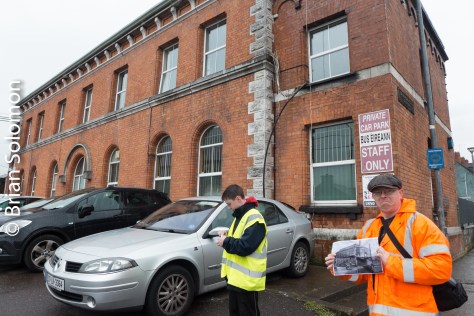
I arrived by Irish Rail’s Mark4 from Dublin. This view of Cork’s Kent Station (Glanmire Road) was made from the foot bridge over the right of way of the line to the old Summer Hill Station. I featured Kent Station in my book Railway Depots, Stations and Terminals.I’ve always liked Kent Station’s Victorian-era curved train shed. Exposed with a FujiFilm X-T1 digital camera.Irish Rail 201-class diesel 220 at Kent Station Cork on 7 May 2016. Lumix LX7 photo.Old footpath over the line to Summer Hill Station. Kent Station is 180 degrees behind this view.Site of Summer Hill station that once handled trains working the line toward Cobh.Detail of the iron work on the foot bridge near Summer Hill station.Kent Station viewed from the Glanmire Road bridge. The earlier Penrose Quay station was located to the right of the curved shed.Donncha Cronin holds a vintage photo of the Capwell Station at the old station building (now used by a Bus Eíreann maintenance depot). Historically, Capwell was the terminus for the Cork & Macroom Railway.Panoramic composite of the old Capwell Station (centre).Old railway gate at the site of Cork, Blackrock & Passage’s Albert Road Station. Lumix LX7 photo.Cork, Blackrock & Passage Railway’s Albert Road Station.The former offices for the Cork, Bandon & South Coast Railway near Albert Quay in Cork City.Quayside trackage on the Cork City quay.Right of way of the old Cork City Railway.Right of way of the old Cork City Railway.Perhaps one of the last vestiges of track relating to the Cork City Railway located near Albert Road in Cork.Perhaps one of the last vestiges of track relating to the Cork City Railway located near Albert Road in Cork.The old train staff that had been used to authorize train movements on the Cork City Railway. Photo courtesy of Kevin Meany.Site of the old Western Road station (now a hotel).Cork, Blackrock & Passage was originally a broad gauge line, later converted to a largely double track 3 foot gauge suburban railway (similar in concept to the Boston, Revere Beach & Lynn). Now a popular urban cycle path, seen here at Blackrock.Site of Blackrock Station on the Cork, Blackrock & Passage Railway.Near Monkstown Station on the Cork, Blackrock & Passage Railway right of way.Near Monkstown Station on the Cork, Blackrock & Passage Railway right of way.Ken Fox studies a sign illustrating the history of the Cork, Blackrock & Passage at Carrigaline, Co. Cork.A sign illustrating the history of the Cork, Blackrock & Passage at Carrigaline, Co. Cork.Site of the Crosshaven terminus of the Cork, Blackrock & Passage suburban narrow gauge.Irish Rail’s footbridge at Glounthaune Station. Lumix LX7 photo.Glounthaune Station.An Irish Rail 2600-series railcar passes the old container terminal at North Esk, last served by Irish Rail in summer 2005.
Catching the light in Ireland can be a fleeting experience. Even on a bright day, cloud often covers the sky. Yet, sometimes luck shines on me. Such was the case last week when I made this photograph of the down Dublin-Cork Mark4 passenger train led by Irish Rail 215.
A brief wink of sun graced the front of the engine just as it approached.
It was seventeen years ago that I caught my first glimpse of the multiple-arch Kilnap viaduct from the window of a scheduled Bus Éireann coach running from Limerick to Cork.
On various occasions since then, I’ve travelled across Kilnap on trains running between Dublin and Cork.
On April 20th, thanks to the expert guidance of Irish Rail’s Ken Fox, I finally visited this noteworthy bridge on the ground and made these photographs. It is just a few miles from Cork’s Kent Station on the double-track Dublin-Cork mainline.
Panoramic composite exposed with a Fujifilm X-T1 digital camera.Panasonic Lumix LX7 photo.Irish Rail 222 leads the down Dublin-Cork passenger train. Exposed with a Fujifilm X-T1 digital camera.
Irish Rail’s peak hour services on the Cork-Cobh and Cork-Midleton routes have a half hour frequency, which results in four trains an hour stopping at the Glounthaune Station.
The railway is scenically situated along an inlet and the station still features an open lattice metal footbridge, of the kind that was common all over Ireland until just a few years ago.
Fuji X-T1 photo.
Fuji X-T1 photo.
I made these images using my Fujifilm X-T1 and Lumix LX7 digital cameras. Thanks to Donncha Cronin and Irish Rail’s Ken Fox for their hospitality in Cork.
A few years ago, Irish Rail rebuilt its Youghal Branch between Cobh Junction and Midleton. After decades of inactivity, this route now enjoys a regular interval passenger service. I find it fascinating that this long closed railway is again alive with trains.
A year ago, on a previous visit to Cork, I tried some photos at this location near the Midleton Station. However, it was a flat dull morning and my results weren’t up to par.
So a few weeks ago, Irish Rail’s Ken Fox drove me back to this spot, and on this visit it was bright an sunny. Moments before the train arrived, a thin layer of high cloud momentarily diffused the sunlight, which complicated my exposure.
As the 2600-series railcar approached, I made several digital images with my Canon EOS 7D and 200mm lens and a single Fujichrome color slide using my Canon EOS 3 with 40mm pancake lens.
Digital image made with a Canon EOS 7D fitted with 200mm lens.Exposed Fujichrome Provia 100F with Canon EOS 3 with 40mm pancake lens. This image looks great projected on the screen.
Tracking the Light posts new material every morning.
Last week on my visit to Cork, I met with Ken Fox and Donncha Cronin, who are helping me with a book project on overseas rail travel.
During discussions about travel to wild and exotic places, Donncha says, “you might like my view. I don’t know, maybe you can do something with it?”
I’ve said this before, but you have to be there to get the photo.
It helps to have the right tools. In my case, I’d brought a full range of lenses to Cork, and based on my experience last year, I was prepared to make a long telephoto view at Glounthaune.
I wasn’t, however, expecting to make this elevated photograph of the rising sun. That was a bit of luck. Having inspected Donncha’s view, I decided, that ‘yes’, I might be able to work with that.
A few minutes before sunrise, Irish Rail 2600-series railcars pass at Glounthaune, Cork. At this hour the light changes quickly. Thankfully with modern digital cameras it is easy to adjust the ISO setting.
Fortunately, the next morning was mostly clear, and Irish Rail runs an intensive morning service with trains every half hour from Cobh and Midleton to Kent Station, Cork. (Cobh Junction is where the two lines join.)
With a copy of a working timetable in hand, and my Canon EOS 7D at the ready, I exposed this series of photos as the sun brightened the day.
One trick: I manually set the camera’s white balance to ‘daylight’ to avoid the camera trying to balance out the effect of the colored sunrise.
In addition to these digital photos, I made a couple of color slides.
Looking into the rising sun at Glounthaune, Cork. A layer of low cloud and mist help control the contrast while adding a bit of color to the scene. I had only a few minutes when the light was at its optimum to make a dramatic image. Thankfully, Irish Rail runs lots of trains at this hour. Canon EOS 7D with 200mm lens.An Irish Rail 2600 pauses at Glounthaune. The car catches the glint of the sun. In a moment it will depart the station and head out onto the causeway that connects Fota Island. Canon EOS 7D with 200mm lens.Here the 2600 railcar is on causeway to Fota Island. Canon EOS 7D with 200mm lens. The difficulty is selecting the best exposure. This image like the others presented here is unmodified, except for necessary scaling for internet presentation.
This was only the auspicious beginning to another very productive day documenting railways around Cork. More to come in tomorrow’s post!
Tracking the Light posts new material every morning.
Now and Then: How Changes to Infrastructure Affect Composition.
Photographic pairs showing locations that have been changed by time are nothing new. Yet, usually there are decades between photo pairs, not just one year.
In the interval between my September 2013 visit to Kent Station, Cork and my subsequent visit in the first week of October this year, the station suffered damage during a fierce storm.
On December 18, 2013, high winds caused the collapse of the historic canopy that had protected the platform serving tracks 1 and 2. In the wind, the old cast iron columns supporting the canopy snapped like toothpicks, and wooden sheathed canopy turned to splinters.
Kent Station, Cork on September 25, 2013. The old canopy is a central element to this image, exposed with my Lumix LX3. I’ve used the canopy in several ways, including to block out much of the textureless white sky, and to divide the frame in a meaningful way.The canopy is now gone, but that makes it more of story than in the earlier image. Here, on October 6, 2014, the ominous sky alludes to the storm some 10 months earlier, while the boxed vestiges on the platform hint at the old cast iron columns. I’ve made no effort to precisely duplicate my earlier photograph. That would only result in an awkwardly composed contemporary image. Lumix LX7 photo.
When I arrived off the train from Dublin in the afternoon of October 6, 2014, I was well aware of the change to the canopy, having read about it on RTE’s internet news and again some months later in the Journal of the Irish Railway Record Society.
However, a change such as this cannot really be fully appreciated until witnessed in person. The old canopy was an important fixture of Kent Station and it altered the quality of light on the platforms, as well as protecting passengers from the elements.
In this September 25, 2013 image, I’m looking away from Kent Station toward Cobh and Midlton. Here the black mass of the canopy helps balance the shapes of the rail cars while shadowing the platform and ground making for a more contrasty image. Lumix LX3 photo.I’m nearly in the same place for this photo as I was in the 2013 image above. But without the canopy to add a balancing element, I focused more intently on the 2600-series diesel railcars. The lighting in both photographs is similar. Which do you prefer? Lumix LX7 photo exposed on October 6, 2014.
In these photo pairings, my goal wasn’t to make precise comparisons to show the exact nature of the changed scene, but rather to show how the canopy, and the lack there of, affected the way I composed my images. I was keen to show the broken cast iron columns because they now tell the story.
Likewise, someday the semaphores will go. And when they are gone, I’ll no longer be intent to frame trains with them. Some other element of the scene will take their place.
In this September 25, 2013 view I’ve carefully used the old canopy as a frame for the 2600 railcar departing Kent Station. Notice the relative location of semaphores, lighting masts and cast iron canopy supports. Lumix LX3 photo.In the above photo, the canopy serves more as a frame than as subject. While in this October 6, 2014 image, the broken cast iron column is an element of interest, especially after you know the story. Imagine the sound it made when it broke! Here an arriving 2600 railcar passes the old semaphores, long may they last! Notice how I’ve included more platform is this more recent image. Lumix LX7 photo.
When you make photos, how do you balance the elements in the scene? Do you focus on just the primary subject or do you adjust your composition to take in secondary elements, such as that offered by the platform canopy and semaphores in these images? Think about it.
Tracking the Light posts new material every morning.
A Dublin bound train has the starting signal to depart Limerick Junction. In the lead is a Class 201 General Motors diesel number 215 (again!). Limerick Junction North Cabin is at the left. Exposed with a Rollei model T on black & white film.
On May 16, 2001, I was on my way from Dublin to Kilarney by train. Rather than take the most efficient route, I aimed to wander a bit on the way down.
I changed trains at Ballybrophy for the Nenagh Branch to Limerick, then traveled from Limerick to Limerick Junction where I’d time my arrival to intercept the weekday 10:34 Waterford to Limerick cement train.
At the time I was making good use of my Rolleiflex Model T to document Ireland and Irish railways in black & white.
I’d process my negatives in my Dublin apartment and make 5×7 proofing prints at the Gallery of Photography’s darkrooms at Meeting House Square, Temple Bar. Often, I schedule one day a week for printing.
Over the course of a half dozen years, I exposed several thousand black & white images, and made hundreds of prints. Sometimes I’d give prints to friends on the railroad. On more than one occasion I’d later visit a station or signal cabin and find my work displayed on the wall.
However, most of the prints remain stored in boxes. While this may help in their preservation, it doesn’t allow people to enjoy the images.
Here I’ve displayed just a few photos, where instead of scanning the negatives, I’ve scanned prints and this shows both my cropping of the image and the borders. I developed a distinctive border style for my square images that I felt worked well with the format.
In the dozen years that have passed since I exposed these photos, Limerick Junction and the trains that serve it have changed dramatically. The semaphores, cement trains and Class 121 diesels are all gone.
Irish Rail 133 works the Limerick Junction-Limerick push-pull set as the train departs the Junction on May 16, 2001. After this train departed, the signalman in the cabin gave the waiting cement train the signals to cross the Cork line (at right), then reverse into Limerick Junction.Here a pair of Class 121s leads the 10:34 Waterford-Limerick empty cement across the ‘square crossing’ at Limerick Junction. In America, we’d probably call this the ‘Diamond at Limerick Junction’. Although this image was exposed as a square, I cropped the negative in printing to better focus on the railway infrastructure. The top third or so of the original negative just show clouds.The Cement train crew gets off the engines after stabling the train in the sidings. After exposing these photos I boarded a train for Mallow and Tralee.
During my fifteen years in Ireland, few railway locations have changed as much as the area around Hazelhatch. I made this photo of a single 121 leading the empty gypsum train (destined for Kingscourt) on June 17, 2000 from Stucumny bridge.
It was my first visit to Stucumny. I was there with Colm O’Callaghan and Mark Hodge, who were well familiar with the spot. It was a Saturday afternoon and there was an air show going on at the nearby Baldonnel Aerodrome. While waiting for the up gypsum we watched the airborne acrobatics.
Compare this photo with those exposed at the same location last week. (see yesterday’s post: Irish Rail, September 27, 2013)
The gypsum traffic left the rails in 2001. Locomotive 128 was cut up in early 2003. During the late 2000s, Irish Rail added two tracks to the Cork line between Cherry Orchard and Hazelhatch.
Cues that link this image with modern ones include the old barn/castle to the right of the tracks and the high voltage electric lines in the distance.
I exposed this image with my Nikon F3T on Fujichrome Sensia 100.
Last week, I traveled by train from Dublin to Cork to make photographs and visit with friends. I was traveling light and only brought two cameras, my Lumix LX3 and Canon EOS 3. In addition to some Velvia 100F, I also played around with some Fuji 400 color print film I had stored in the refrigerator.
Initially I focused my attention on Kent Station, which features a unique curved train-shed that make it one of the most interesting railway structures in Ireland. Signaling at the Cobh-end still retains a few mechanical semaphores.
Kent Station, Cork. Lumix LX3 photo.New Irish Rail logo.
Later, I worked east making a variety of images at Glounthuane (Cobh Junction) where Cobh and Midleton lines come together. The Midleton line had been closed for decades and was only reopened for passenger service in 2009. Years earlier, I’d explored the then derelict line.
Where that visit was blessed with bright sun through out the day, on this recent trip I experienced more ordinary Irish weather.
Irish Rail signs at Glounthaune, Cork. Lumix LX3 photo.Irish Rail 2600-series rail car at Glounthaune, Cork. Lumix LX3 photo.Irish Rail train to Cobh near Fota, Cork. Lumix LX3 photo.Irish rail train departing Midleton, Co. Cork. Lumix LX3 photo.Irish Rail 2600s passing North Esk, Co. Cork. Lumix LX3 photo.
Here are a few views from the two cameras. Special thanks to Ken and Janet Fox and Donncha Cronin for location advice and local transportation. Also thanks to John Gunn Camera shop on Wexford Street in Dublin for color negative film processing and prints.
Kent Station, Cork. September 2013. Lumix LX3 photo.
Irish Rail Mark 4 at Kent Station, Cork. Exposed on Fuji 400 ISO color negative film (C41 process) using a Canon EOS 3 with 28-135 mm lens.
Tracking the Light posts new material daily. Please spread the word and share Tracking the Light with anyone who may enjoy seeing it!
Sometimes special events make for great opportunities to make detailed photos of equipment, structures and settings.
Last Saturday’s Irish Railway Record Society excursion from Dublin to Cork, Cobh and Midleton was an opportunity for visual exploration.
Check previous posts for other images of this historic trip.
Irish Rail diesel number 073 catches the sun at Kent Station Cork on 20 July 2013. Canon EOS 7D photo.
Driver Ken Fox works the ground at Cork.
Railway Preservation Society Ireland’s Cravens catch the sunlight at Kent Station Cork on 20 July 2013.
Brake cylinder on locomotive 071.Freshly painted Irish Rail locomotive 92 60 0117071-7 catches the sun at Heuston Station in Dublin. Its still just old 071 to me! Lumix LX3 photo.Irish Rail’s Rotem-built intercity rail cars arrive at Heuston Station on the morning of 20 July 2013. Lumix LX3 photo.
In previous posts I focused on the human side of Irish Railway Record Society’s Dublin-Cork excursion on 20 July 2013.
However, I also made my own share of classic views showing Saturday’s railway excursion at identifiable locations. I’ve displayed a few view here. In addition to digital image I also exposed color slides at key locations.
See posts from the last few days for more views of Irish Railway Record Society’s 20 July 2013 diesel hauled trip on Irish Rail to Cork, Cobh and Midleton.
Irish Rail 071 and 073 with IRRS Special at Templemore on 20 July 2013.Irish Rail class 071 number 073 led the excursion on the Cork-Cobh leg of the trip. It is seen during a photographers stop at Rushbrooke, County Cork. The best classic views were made from a nearby road bridge. The train was well spotted for photos. Canon EOS 7D with 28-135mm lens.
Irish Rail 071 catches the sun at Cobh, County Cork on 20 July 2013. Lumix LX3 photo.A vertical three-quarter view (or near to it) of Irish Rail 071 at Cobh, County Cork on 20 July 2013. Canon EOS 7D photo.At Kent Station Cork, engine 071 runs around the train and will follow to Middleton. There doesn’t appear to be anyone in my photo and who’s that shouting? oops. 😉Irish Rail 073 reflects into a Mark 4 train at Kent Station in Cork on 20 July 2013. Canon EOS 7D photo.
Operation to Midleton required a bit of shuffle owing to a lack of run around facilities. Presently this is the end of the branch. Normally the only equipment on the line are double-ended railcars. Photos of locomotive hauled trains here are highly prized and photographers vied for position to get the best views. Locomotive 073 which brought the train from Cork can be seen in this distance. Canon EOS 7D photo.
A bit of color: 201-class General Motors diesel number 209 (painted for the Dublin-Belfast Enterprise) on a Mark 4 set at Cork on 20 July 2013.Twin 071s couple on to the excursion at Kent Station Cork. The view from the Dublin-end of the shed is among the best in the city. Lumix LX3 photo.
Irish Rail’s 2600-series railcars pause at the back of the train shed in Cork. These are typical of the trains normally assigned to Cork suburban services. Canon EOS 7D photo.Irish Rail 086 rests with a ballast train at Lisduff as viewed on the return trip of the IRRS special. Lumix LX3 photo.
More views of Irish Railway Record Society Trip to County Cork, 20 July 2013.
There’s a long history of special trains with unusual locomotives, rare events, or otherwise noteworthy occurrences of railway operations that have encouraged railway photography.
Saturday’s trip to Cork and Midleton was no exception. (see yesterday’s post).
Among the photographic events was the rare locomotive hauled consist on Cobh and Midleton Branches. The Cobh branch has been exclusively a railcar operation since the mid-2000s, while the Midleton line has only seen railcar operation since its reopening a few years ago.
Our train pauses at Templemore for photographers on the morning of 20 July 2013. Canon EOS 7D photo. A strategically placed bit of greenery adds depth to the image. (And, yes, I have photos without it).Fans snap freshly painted 071 class leader at Templemore on 20 July 2013. Canon EOS 7D photo.Enjoying the spin.
In time-honoured tradition, at every photo stop, photographers rushed to snap images of the train. Occasionally, an individual entranced by the fresh paint on locomotive 071 or fascinated by some other peculiarity of operation or equipment, would wander haplessly in front of a line of eager photographers. Shouts of ‘Hey!’ ‘Oy!’, ‘Down in front!’ and the like would ensue.
Especially amusing was when a particularly oblivious passenger or passerby would drift with their backs to the anxious photo line (time is precious on these outings as only a few minutes are allowed at each stop), and proceed to linger staring in wonder at the train. In such cases a diplomat would be elected to negotiate a solution.
‘Down in front!’RPSI staff make necessary arrangements with Irish Rail staff at Kent Station Cork.
A Cobh, I was queried by a German woman as to why so many people were photographing the train. It didn’t appear in the slightest bit unusual to her. Significance is in the eye of the observer. I explained that, ‘locomotives were never operated on this line, and the locomotive that brought the train down was in fresh paint, and that the train had carried the photographers for this purpose.’ She seemed satisfied with that.
While I made plenty of images of the train, 071 and 073 and etc, I also focused on the people. From my experience, images of people surrounding the train tend to be more interesting than the train, and tend to have greater value in the end.
Photographs provide clues to memories that may last a lifetime. Someday everyone and everything maybe gone, yet we can remember the thrill of the day as a result of pictures. At Cobh, two young lads get their image made with the driver of locomotive 071. Canon EOS 7D photo.Kevin, a tracking the Light follower, proudly displays his model of Irish Rail’s 071 in the new livery.
Photographers vie for positon at Kent Station Cork.Aiming for the best angle at Midleton on 20 July 2013. Lumix LX3 photo.Staff water the train at Kent Station, Cork. Lumix LX3 photo.
RPSI staff servicing the train at Cork. Lumix LX3 photo.Not everyone is bothered to get every photo. Some prefer to relax and enjoy the journey. Lumix LX3 photo.Irish Rail employee (and Railway Preservation Society Ireland member) Kevin Walker enjoyed the view from a Cravens window on the Irish Railway Record Society’s outing.Irish Rail staff conducted the trip professionally and efficiently, keeping to schedule despite abnormally complex arrangements necessary for the trip.
Driver Ken Fox on 071 at Cork.Driver Ken Fox greets passengers after arrival at Heuston Station. Lumix LX3 photo.
At the end of the day, Heuston, Station. Lumix LX3.
Extra! Extra! Irish Rail 077 in the new Livery makes one its first daylight runs.
Irish Rail locomotive number 0117077 leads a wagon transfer over the River Liffey at Islandbridge at 4:25pm on April 10, 2013. Canon EOS 7D with 28-135mm lens.
A few minutes ago, at 4:25 pm, April 10, 2013, I caught Irish Rail’s 071 class locomotive 0117077 working a wagon transfer from Inchicore to Dublin’s Northwall . While the locomotive has worn this new paint for about a month, today it finally left its sequester at Inchicore works. It was understood to have worked a trial to Sallins (on the Cork road) earlier in the day.
Irish Rail locomotive number 0117077 leads a wagon transfer over the River Liffey at Islandbridge at 4:25pm on April 10, 2013. Canon EOS 7D with 28-135mm lens.
The locomotive’s expanded number is intended to comply with European numbering conventions.
Irish Rail 0117077 leads a wagon transfer over the River Liffey at Islandbridge at 4:25pm on April 10, 2013. Canon EOS 7D with 28-135mm lens.