A hot and hazy late summer evening, and Amtrak 48 the Lake Shore Limited was running late.
In the lead was FL9 489. I exposed this cross-lit Kodachrome slide to show the train with the Hudson in the background.
This, after all, is the former New York Central ‘Water Level Route’. It was here that the famed 20th Century Limited rolled up the miles between Chicago and Grand Central Terminal behind J3A Hudsons, S1 Niagaras, and Electro-Motive E-units in lightning stripe paint.
All before my time.
I was just happy to catch an Amtrak FL9 roaring along in the late light.
I exposed this view on Kodachrome with my Leica M2 and 35mm Summicron. My notes indicate that this was at an overhead bridge at the beginning of grade separation near an interlocking called ‘Snyders.’ It’s been 25 years since I made the photo, so I question my memory as to correct name for the location, but it was several miles timetable east of B&M’s Hudson River Bridge at Mechanicville.
I’d been photographing the west-end of the old Boston & Maine all day. In the afternoon, I caught NADH (Nashua-Delaware & Hudson) rolling through Eaglebridge, New York with SD26 639 in the lead.
A westbound in evening light, what could be better than that? The light was perfect, so I followed it west to Mechanicville. There’s something special about the golden glow of a sunny afternoon in June that just makes a scene seem better. I get nostalgic for that sort of light.
It was on June 19, 2010, that John Gruber, Henry A. Koshollek, and I drove from Madison, Wisconsin to Union, Illinois to photograph at the Illinois Railway Museum.
Among the attractions that day were a freshly restored former North Shore interurban car and the former North Shore Electroliner.
Back in the day, John was among the lucky ones who rode and photographed the North Shore in service. He was on hand for North Shore’s final runs in January 1963.
Later, John photographed Denver & Rio Grande Western’s narrow gauge steam in its final years. In August 1967, John had the rare opportunity to ride and photograph one of D&RGW’s very last revenue freights over Cumbres Pass, courtesy of David P. Morgan at TRAINS.
As a child, I recalled looking through an old dog-eared copy of that issue of TRAINS with John’s cover feature. Back then, I never could have imagined that I’d become friends with John, let alone work with him editing magazines.
Four years ago today: John Gruber with his vintage Nikon F on a restored North Shore car at the Illinois Railway Museum. Exposed with a Canon EOS 7D.
Recently, John and I have collaborated on several book projects. He was an important contributor to The Twilight of Steam, which features some of his outstanding D&RGW photographs. John also helped make important connections, and introduced me to several of the participating photographers. It should be no surprise to readers when they read my dedication.
John and I have also authored book on American streetcars, expected this summer.
Amtrak train 57, the southward Vermonter rolls across Federal Street in Belchertown, Massachusetts on May 25, 2014. Exposed with a Lumix LX-7.
Since 1995, Amtrak’s Vermonter has operated via Palmer and Amherst, Massachusetts. This requires a 13-mile jog over CSX’s former Boston & Albany from Springfield to Palmer, where the train reverses direction and heads north on New England Central’s former Central Vermont main line.
Presently, Pan Am Southern’s former Boston & Maine Connecticut River Line is being upgraded between Springfield and the Massachusetts-Vermont Stateline at East Northfield. This will allow a restoration of passenger service to the traditional route north of Springfield.
The Vermonter is expected to switch to the former B&M routing via Holyoke, Northampton and Greenfield by the end of this year. As a result, I’ve been making photographs of Amtrak’s train at various places between Palmer and East Northfield, while the service still operates that way.
Several years ago, my late friend Bob Buck and I, were following a northward New England Central freight. Bob had been making photos on the Central Vermont since steam days.
We were just a few minutes ahead of the freight as we passed Belchertown.
We turned on Route 9 toward Amherst. After a couple of minutes Bob pointed, ‘take a left, there on Federal Street.’ We found the tracks and I made a photo of Bob rolling the freight by the crossing.
It was here I chose to capture the Vermonter, while I still can.
Radio host, Jerry Puffer at KSEN 1150 AM (Shelby, Montana) will broadcast the interview on Wednesday June 18, 2014 in the 4:30 pm slot (4:30 pm Mountain Time/6:30pm standard time/11:30pm in Dublin and London). You can tune in via the internet.
Brian spoke with Jerry for about 25 minutes, and discussed railroads, photography and Ireland, as well as his new book The Twilight of Steam, and Tracking the Light!
For anyone who wants to tune in, Jerry said that Brian will probably come on at about 4:36 pm mountain time (after introductory commentary, and other events).
Check it out!
Don’t forget, 6:30pm Eastern Standard Time Wednesday June 18th, Brian Solomon will be speaking on the Jerry Puffer Show KSEN 1150 AM!
Russell Buck, son of late photographer Robert A. Buck, holds a preview copy of Brian Solomon’s The Twilight of Steam. This book features photography and stories from some of the great steam photographers.
The book can be viewed at Palmer Hobbies on 1428 Main Street in Palmer, Massachusetts. Phone: 413-436-5318. Open Tuesday to Saturday.
A couple of weeks ago I was visiting my brother in Philadelphia. He suggested that we take his canoe and explore the John Heinz National Wildlife Refuge near the Philadelphia Airport. So we strapped the craft to the top of the car and drove via city streets across the city.
SEPTA’s number 15 Streetcar takes the corner at 63rd Street. Vintage PCCs are a feature of this route. Canon EOS 7D photo.Silhouette from the Subaru with PCC 2326 in the background.SEPTA’s Market-Frankfurt elevated at 63rd Street.SEPTA’s number 34 streetcar works west.View from the canoe at the John Heinz National Wildlife Refuge.Look an eagle!SEPTA’s Airport Train.SEPTA number 36 streetcar outbound at Eastwick.
Our route conveniently intersected many of SEPTA’s surviving streetcar lines. And while at the wildlife refuge, I was able to make views of SEPTA’s heavy rail Airport Line. I made all of these images with my Canon EOS 7D during the course of the trip.
John Pickett with his Graflex in July 2013. Photo by Brian Solomon
John E. Pickett is among the great photographers I featured in my book The Twilight of Steam. A life long friend of Jim Shaughnessy (also featured), John has had the opportunity to photograph steam locomotives all across North America.
In the 1940s, he was fortunate to grow up in Canajoharie, New York, located just across the Mohawk River from New York Central’s four-track mainline at Palentine Bridge. His early experiences watching the parade of Hudsons, Mohawks, and Niagaras working the Water Level Route inspired him to make wonderful photographs of locomotives at work before diesels took over.
John’s early New York Central photos were exposed with 616 Kodak Monitor but he later bought a National Graflex that had a relatively fast Bausch & Lomb f3.5 lens and 1/500th of a second top shutter speed, and then a Series B Graflex with a top shutter speed of 1/1000th.
The Twilight of Steam features dozens of John’s images and tells of his experiences and techniques.
West of Rochelle, Illinois, June 15, 2004: the sky was aflame with the evening glow. As the setting sun illuminated prairie-dust and low cloud that had blown in from the west.
I was parked near the Global III intermodal yard south of Union Pacific’s former Chicago & North Western mainline. This is a busy stretch of railroad.
A Union Pacific coal train works east near Rochelle, Illinois. Exposed with a Nikon F3 on Fujichrome slide film. Notice the ditch-lights; I’ve given just enough of an angle so there’s the faint twinkle at the front of the locomotive.
Central Illinois is flat open country which is prefect for making sunset silhouettes: using the big sky as back drop for a train.
Here I’ve taken nearly a broadside position, exposed for the sky while keeping the train in the lower quarter of the frame.
When I worked at Pacific RailNews in the mid-1990s, we favored silhouetted views with lots of sky to use for opening spreads. It was the style to lay headlines and text in the sky.
I’ve always like the simplicity of silhouettes; raw and dramatic with details largely left to the imagination.Tracking the Light posts new material every morning.
Iconic Railroad Photographs from Great Photographers.
Tomorrow, June 15, 2014, my latest book titled The Twilight of Steam officially goes on sale.
This was my big book project for 2013, and I spent much of last summer researching and writing it. Yet, the real stars of the book are the contributing photographers and their outstanding work.
PRR’s four-track Middle Division (Harrisburg to Altoona, Pennsylvania) was a favorite for photographers because of its accessibility, splendid scenery and a continuous parade of freight and passenger trains. PRR’s big boiler M1 Mountains were a standard mainline freight power from the mid-1920s until the diesels took over. The M1 shared the boiler used by the I1s 2-10-0 ‘Hippo’, where the I1s was intended for slow-speed drag freight work, the M1 was designed for relatively fast mainline running. These were good looking locomotives and made for great photos. Photo by John E. Pickett
Over the years, I’ve been privileged to interview and work with some of the most accomplished railway photographers in North America. Significantly, TheTwilight of Steam focuses on evocative images exposed toward the era of revenue steam operations.
These were exposed when steam locomotives were still active, and not of excursion services after the end of the era. In many instances, I’ve included photos with steam and first generation diesels working together or side by side.
For this book, I’ve adapted my Tracking the Light concepts. In addition to simply writing about the locomotives, where possible I’ve included stories about the photographer’s techniques and experiences. I included details about their cameras and films.
Many of the photographers were very young when they began making dramatic railway images, and that is a great part of the story.
It was a bright afternoon in Charlotte. I was curious to see this city’s innovative light rail system that uses Siemens built trams. Charlotte’s public transport goes by the initial’s ‘CATS’ while the Blue Line light rail is called the ‘Lynx.’
More tracks are being built, and a heritage style trolley is in the works.
Here’s a few views made with the Lumix LX-7.
Lynx outbound near Tremont with Charlotte skyline.Some of the light rail cars carry advertising.Light rail along Norfolk Southern in suburban Charlotte.
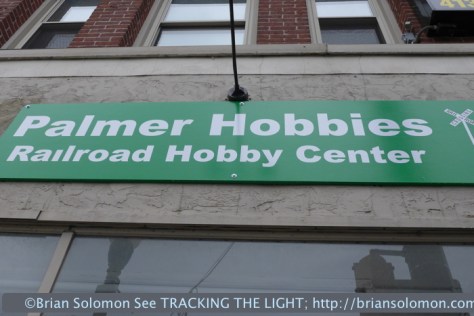
Proprietor of Palmer Hobbies, Bill Lanza, has opened his doors!
Come in and have a look around!
Palmer Hobbies’ Bill Lanza assists a customer.Fine Turf on sale at Palmer Hobbies.New products for viewing.Bill Lanza (left) and Rich Reed (right) discuss locomotive details.Palmer Hobbies is prominently located on Main Street. Come in and read their magazines!
Palmer Hobbies features a variety of model railway products, magazines, and, of course, railroad books!
Patrons of the old Tucker’s Hobbies (formerly Tucker’s Hardware) in nearby Warren, Massachusetts will find familiar faces.
The new store is easy to find. It’s located at 1428 Main Street in Palmer, Massachusetts. Take the Massachusetts Turnpike to Palmer, turn right and drive toward Depot Village. The shop is located in the center at the lights near the Hess Station and across from the CVS drug store.
Palmer Hobbies is near the famous Palmer Diamond, where New England Central’s former Central Vermont crosses CSXT’s Boston & Albany route. It’s across the tracks from the popular Steaming Tender restaurant (near CP 83).
On June 11, 2014. A CSX tie gang works the old Boston & Albany route. In the distance is the popular Steaming Tender railroad themed-restuarant.
Phone: 413-436-5318. Open Tuesday to Saturday. (Closed on Sunday and Monday).
May 30, 2014, Salisbury’s Innes Street Overpass was a popular gathering point for photographers seeking mainline attraction during North Carolina Transportation Museum’s Streamliners at Spencer event.
At lunchtime, I was poised to photograph Amtrak number 75, one of North Carolina sponsored Piedmont services that runs with F59PHI diesels and heritage style equipment. This is one of the most distinctive long distance trains on the East Coast.
Amtrak number 75 makes its station stop at Salisbury, North Carolina. Exposed with a Canon EOS 7D with 200mm lens.Lumix LX-7 view of Amtrak 75 Piedmont at Salisbury, North Carolina. This is one of the only F59PHI’s in Amtrak service east of the Sierra.
I returned in the evening, to catch Juniata Terminal’s Pennsylvania E8A 5809 and three matching streamlined cars on its return run from Spencer to Charlotte. The sun made a surprise appearance just in the nick of time.
Lumix LX-7 photo at Innes Street, Salisbury, North Carolina.
It was a dull autumn day. My father and I were in New York City to visit a friend. We spent the afternoon wandering around on the subway system.
An L train Brooklyn, New York, November 1998. Exposed with a Nikon F3T with 24mm lens. (The route is L, not to be confused with the colloquial ‘El’ or Chicago’s ‘L’, just for clarification).
I made this photo at East New York Junction where the Canarsie Line crosses the Broadway Line.
The sky was dark and swollen and the street lights were just coming on. To make the most of the lighting, I exposed this photo on black & white film with my Nikon F3T with an AI 24mm Nikkor lens.
I’ve always felt there was an apocalyptic aesthetic to this image.
Ok, so this Alco PA was delivered new to the Santa Fe, and in later years worked for Delaware & Hudson, and then for Mexican railways. But now it wears a fresh coat of Nickel Plate Road paint.
Until Streamliners at Spencer, I’d never had the opportunity to photograph an Alco PA, a locomotive often cited as one of the most loved and most attractive (if not the most reliable) of the steam to diesel transition era.
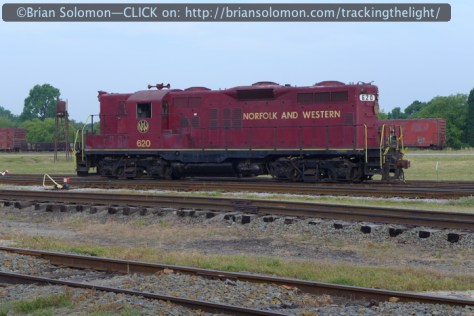
The Nickel Plate Road merged into Norfolk & Western two years before I was born, so while I’ve photographed trains on the old Nickel Plate route, I never knew the railway either.
So there you go. It’s like meeting a ghost. Or, perhaps, seeing a James Joyce impersonator. Or, going to listen to a Led Zeppelin tribute-band.
When it comes to a Nickel Plate Road PA, I never experienced the real thing, and I never will. I never saw an Erie Triplex either.
Avalon is at the heart of Arthurian myth. And, as it happens, it’s also on Wisconsin & Southern’s former Milwaukee Road Line between Janesville and Chicago!
No knights in armor here, nor Merlin, nor Lady of the Lake; just a matched set of SD40-2s in clean paint leading a long freight and tall late season grasses blowing gently in the wind.
A few hours earlier I’d met up John Gruber at the Janesville Roundhouse and we spent a pleasant afternoon photographing this freight. We had a fair wait at Avalon before the train came into view.
Exposed with a Canon EOS 7D with 200mm lens. ISO 200.
This photo is among my favorite from the day. I used a long lens to compress the locomotives while setting the grass in the foreground out of focus. I also made a closer view on Fujichrome film.
A few weeks ago, Ciarán Cooney asked me about photos I’d made of Irish Rail’s Athy Cement. This used to run weekdays from the cement factory near Limerick to a cement silo off a short branch that crossed the River Barrow in Athy, County Kildare. It was the only train to use this branch.
On several occasions, I’d made the effort to photograph this train, which tended to arrive laden in the very early morning, then depart empty after it had discharged. Most of the times I saw it, it ran with a single Bo-Bo General Motors diesel (class 141 or 181).
I caught it crossing the Barrow at Athy on a fine spring morning, May 3, 2002.
Exposed with a Nikon F3 with 85mm lens on Fujichrome Sensia 100 slide film.
That was more than 11 years ago, but it doesn’t seem so long.I think I last photographed this train about 2005, shortly before it was discontinued. While cement trains worked Irish Rail for a few more years, they are now extinct.
Exposed with a Nikon F3 with 85mm lens on Fujichrome Sensia 100 slide film.
To compensate for bad luck, and a series of bad timings, I made it a point to photograph Pan Am Railways executive F-unit at Spencer.
What?
Just about every time Pan Am Railway’s has run their glossy metallic blue F-units, I’ve either been in the air, out of the country, and/or at least a thousand miles away and traveling in the wrong direction.
Not this time. Not at Spencer. No, I knew I’d get a photo! Two or three, maybe, and in color!
I realize that PAR-1 may not have been the chief attraction of the Streamliners at Spencer event, but I was very happy to finally see this New England resident up close and in person!
PAR 1 and Southern Railway 6133 bask in the morning light at Spencer, North Carolina. Lumix LX-7 photo.Cab detail of F9A PAR-1 exposed with my Canon EOS 7D with 100mm lens.The logo that once graced globe-encircling Boeing 747s decorates PAR 1.
Great Railway Exhibits and Antiques in Addition to the Streamlined Superstars.
In an environment characterized by streamlined sensory overload, it takes a trained eye (pardon pun) to see past Norfolk & Western’s 611, Burlington’s stainless steel E5A, Union Pacific’s radiant executive E-unit and the rest of the colorful Es and Fs paraded on display around the Spencer roundhouse.
Yet, in addition to the vintage streamliners, there were other noteworthy exhibits and interesting equipment. Amtrak’s 40th Anniversary Display Train with locomotive 42 (painted to commemorate America’s Veterans) was featured prominently, as was one of North Carolina’s train sets used for Piedmont services.
Various heritage locomotives attached to the Spencer shops added period interest. Back in the day (1980s), I was quite pleased to find a Southern high-hood GP30 working at Alexandria, Virginia. And lo and behold, here at Spencer was preserved locomotive just like the one I saw those many years ago!
For those interested in automobiles, Spencer has quite a collection of vintage cars on display. Lots to see and do! I’m glad I invested almost four days in the event.
Exposed with a Lumix LX-7. The diffused light made for wonderful reflections.
Among the stars of the Streamliner’s at Spencer event was Norfolk & Western 611, one of only a handful of preserved American streamlined steam locomotives. Here’s a sampling of the many images I made, and an excerpt of the text from my book Super Steam published by MBI (out of print), where I detailed the J class. Today the locomotive catches attention for its streamlined shrouds, but there’s a lot more to the N&W J than just good looks:
“Among the most impressive products of N&W’s Roanoke Shops were its 14 Class J 4-8-4s. These spectacular machines defied convention while settting record for performance and reliability. The first five J’s were built during 1941 and 1942, with N&W’s distinctive streamlined shrouds, and featured 27×32 inch cylinders, 70-inch drivers, 107.7 square foot firebox grate, and a huge boiler set for 275 lb. psi operation. As built these locomotives delivered 73,300 lbs. tractive effort. (N&W later increased the boiler pressure to 300 psi, and as result tractive effort was increased to 80,000 lbs.) The J class exhibited all of the trappings of modern locomotive, featuring roller bearings on all axles and reciprocating parts, one-piece cast steel frame, mechanical lubrication and light weight alloy-steel rods . . .”
611 Noir. Exposed with a Canon EOS 7D.N&W 611 surrounded by the enemy.611 in stereo. Lumix LX-7 photo. There’s nothing like a good puddle to make a great photo!Nose view of one of America’s most famous locomotives. Exposed with a Lumix LX-7.
I’ve been reviewing the hundreds of digital color photos I exposed at Spencer and I’ve added six of my favorites to my special page dedicated to the event.
Part of the attraction of North Carolina Transportation Museum’s Streamliners at Spencer event was the pre-arranged night photograph sessions. Large industrial scale flood lamps were arranged to provide roughly even lighting on locomotives that had been arranged and spotted specifically for photography.
A look at the darker side of night photography! A view of Spencer shops exposed with a Lumix LX-7.
I’ve often worked on the darker side of photography, and this was no exception. While I took advantage of the ‘arranged’ lighting to make standard views of the equipment. I made a special effort to go beyond the obvious.
Here I worked in the shadows, using the lights in a more interpretive way. I sought out scenes of the shops and facilities that were part of the background.
Crime scene or photoline? The local constabulary provided security at the event. Exposed with a Canon EOS 7D.This view of Norfolk & Western 611 caught my eye. At the time there must have been 75 people with tripods set up for the 3/4 angle. Exposed with a Lumix LX-7.Rain made for a nice shiny gloss but made the difficult process of making photos in the dark even more complicated. Keeping water off lenses in the dark isn’t easy. At least with digital photography, instantaneous feed back allowed me to know when droplets had spoiled a clean view (or added an extra effect). Exposed with a Canon EOS 7D.Silhouettes with Lackawanna painted F3s. Lumix LX-7 photo.
The challenge was trying to stay out of the way of the photo lines to avoid the ire of those with a front-lit view.
On one of the evenings there was a thunderstorm, which made matters extra challenging!
After I made this image, I relaxed on the bench. Fortunately there weren’t many people set up on my side of the light. Lumix LX-7 photo.This angle reminded me of a Jim Shaughnessy photo exposed in the 1950s. Lumix LX-7 photo.Here I was mostly working with the ordinary sodium vapor lights, with the lights for the night photo event only providing secondary illumination by coloring the sky. Lumix LX-7 photo.Hard glint on the Norfolk Southern business train. Keeping the lights out of the frame is part of my technique. Lumix LX-7 photo.Spencer round house.Ghostly view of the old shops.Spencer, North Carolina—the village across the street from the old Southern Railway shops.
The locomotives were largely static and thus relatively easy to photograph. However, people move about constantly, and getting your friends to hold still long enough for a portrait in an environment characterized by sensory-overload, can be tough.
On the plus side, most everyone was smiling.
I used both a Canon EOS 7D and Lumix LX-7 to make digital portraits, while a few photos were captured on slide film using my EOS 3.
Chicago & North Western 411 and friends. Canon EOS 7D photo.
For me, the Streamliners at Spencer event was a great opportunity to meet friends, old and new. In addition photographing the equipment, I photographed the photographers.
Below is a small selection. I’ll post more tomorrow!
Photographers at night. Lumix LX-7 photo.LX-7 photo at Salisbury station.In glow of Saturday evening. Lumix LX-7 photo (before my second battery went flat).Media man in Salisbury. Lumix LX-7 photo.Norfolk Southern’s Wick Moorman addresses Spencer. Canon EOS 7D with 200mm lens.LX-7 photo.Master of three-D photography. Lumix LX-7 photo.Norfolk Southern Museum. LX-7 photo.Waiting on the Piedmont at Salisbury. Lumix LX-7 photo.LX-7 photo.Waiting for the turntable to spin. Lumix LX-7 photo.
I’d been making photos on Boston’s Green Line for 40 years. Albeit I was a bit shorter for my first efforts using my Dad’s M3 in the early 1970s.
Subway photos on Kodachrome were a real challenge. I never knew if I’d gotten anything at all until the film came back weeks later. But that didn’t stop me from trying.
Boston’s Green Line Subway at North Station on June 2, 2012. Exposed with a Canon 7D with 28-135mm lens.
Digital photography technique is a real boon for subway images. For these photos I’d racked up the ISO setting to 2000 and worked with a telelphoto zoom. That was inconceivable in my film days.
Boston’s Green Line Subway at North Station on June 2, 2012. Exposed with a Canon 7D with 28-135mm image stabilization zoom lens.
Boston’s subways have changed quite a bit since my early photos; modern cameras for modern images.
At crew changes and other convenient points, Amtrak schedule’s ‘smoke breaks’ where passengers can get off the train, stretch their legs, enjoy the fresh air, and, in my case, make photos of the train.
I had about ten minutes at Raleigh, North Carolina this morning to make photos train 80, Carolinian during this momentary pause. By that time, I’d been on the train for more than 3 hours, with nearly another nine hours to go.
Rather than tow the whole camera kit, I just carried the Panasonic Lumix LX 7, which is light, easy to use, and is capable of making extremely sharp images.
Playing with the external Lumix Live View Finder, I adjusted this vertically, which allowed me to place the camera very close to the ground without the need for lying belly first on platform.
Exposed with a Lumix LX-7 using the Live View external finder. Camera set in ‘A’ (Aperture Priority) mode with a minus 1/3 exposure over ride to compensate for the bright platform, bleached station sign and bright sky. This forces the camera to make a slight darker image
The low angle with a slightly telephoto view provides a clean dramatic perspective that minimizes unnecessary and visually distracting foreground.
Number 80’s conductor. Amtrak’s crew was very friendly.
Check my Streamliners at Spencer page for photos of North Carolina Transportation Museum’s special event.
Following three and half successful days of photography at Spencer, North Carolina, Pat Yough and I boarded Amtrak 80, Carolinian at Charlotte this morning before 7am.
Charlotte, North Carolina at 6:35am June 1, 2014. Lumix LX-7 photo.Charlotte, North Carolina at 6:35am June 1, 2014. Lumix LX-7 photo.
We departed on time at 7am. In the lead is Amtrak P42 number 168. It was a strange sensation pausing a Salisbury and passing the Spencer Shops having just spent so much time there. The view from the train always offers a different perspective than being on the ground, or seeing a place from the road.
Salisbury Station, North Carolina. June 1, 2014. Lumix LX-7 photo.Salisbury, North Carolina. June 1, 2014. Lumix LX-7 photo.
As I write this we are heading toward Raleigh. I’m destined for Philadelphia. Presently, I’m reviewing, analyzing, and scaling hundreds of images I made at the event, plus side trips. I’ll be posting more images and commentary over the next few days.
Back then, Irish Rail operated three daily ammonia trains between Marino Point, County Cork and Shelton Abbey near Arklow, County Wicklow. These were tightly scheduled and normally operated with the common 201-class General Motors diesels.
I was tuned into these trains, and made an effort to catch them in interesting locations. The traffic ended with little warning in 2002, so the photos I made are now prized images!
Irish Rail class 201 number 204 leads a laden Ammonia train above the Irish Sea at Killiney. Is that U2’s Bono waving off in the distance? Exposed on Kodak Tri-X with a Rolleiflex Model T f3.5 Tessar lens, processed in Ilford ID11 (special mix and time, 1:1 with water.)
In addition to color slides, I exposed thousands of black & white images of Irish railways on 120 size film between 1999 and 2005 (and a few here and there since).
Most of these photos have never seen the light of day. This rare photo of the Ammonia train was just one of several exposures I made on that bright May afternoon in 2001.
Why didn’t I make a color photo? And who said I didn’t? Must color and black & white be mutual exclusive? Why not make a color photo and convert it later? Why color anyway?
I’ve often worked with multiple formats at the same time. Black & white has a number of advantages and I’ve long prided myself on mastering this archaic image-making process.
Streamliners at Spencer: The Real Star of the Show?
Although streamlined steam locomotive 611 was getting most of the attention, historically the most important exhibit was General Motors FT demonstrator 103.
Last night FT 103 was lit up for all to see.
General Motors model FT lit up at Spencer Shops on May 30, 2014. Exposed with a Canon EOS 7D with 100mm lens on a Gitzo carbon-fiber tripod.
I’ve written about this locomotive in many of my books. It is the most influential American locomotive of the twentieth century because it demonstrated to the railroad industry that diesels offered a cost effective replacement for steam.
Electro-Motive’s most significant innovation was its development of the first commercially viable road freight diesel. From a technical perspective this was an advancement of the E-unit — the application of this long anticipated new road diesel proved revolutionary for American railroads. Once on a roll, it not only turned locomotive building on its ear, but forever changed the way railroads bought locomotives and operated trains EMD’s F-unit was the most important player in the rapid dieselization American lines.
NS CEO, Wick Moorman pointed out in yesterday’s address at Spencer, that FT 103 was ‘even older than 611,’ while sincerely thanking the St. Louis Museum of Transportation for sending the locomotive for display.
Pan Am at North Bennington? Who could have imagined this 20 years ago?
Pan Am Railways RJ1 at at North Bennington; Victorian-era railway station with a sky blue 1970s-era diesel-electric. Exposed with a Canon EOS 7D.
I spent that morning following Vermont Rail System’s ‘B&R Job’ south from Rutland. Yet the photographic highlight was catching its connection, Pan Am’s RJ-1 local, at North Bennington.
Back in the day, Pan Am was an airline with round the world schedules. The name conjures up images of handsome blue Boeing 747s, or pre-World War II ‘Clippers’ (see planes).
Pan Am Railways is a re-branding of the Guilford system which operates former Boston & Maine and Maine Central lines. In 2007, two former Canadian National GP40-2L (sometimes identified as ‘GP40-2W’) locomotives were painted in a livery reminiscent of the old Pan Am Airlines’ scheme.
Yet, this scenario seems just a bit weird to me, like some alternate version of the future. Anyway you look at it, the combination of the restored historic station and a sky blue engine is both fascinating and strange.
North Bennington station.Southward Pan Am RJ-1 passes the Bennington Battlefield site. For a number of years the tracks here were largely dormant.
This beautifully restored locomotive is a vision from an earlier era. Passenger trains just don’t look like this anymore.
Exposed on May 30, 2014 using a Panasonic Lumix LX-7. Exposure f8 at 1/40th of a second. Except for scaling for internet presentation, this file is unmodified. There were no corrections to exposure, color or contrast.
I made a spot decision to pan in order to visually separate the green on the locomotive from the densely foliated background.
Since I had only a few seconds to adjust my exposure, I left the camera in ‘A’ mode (aperture priority), added +1/3 of a stop (to lighten the scene), and turned the external aperture ring to f8, the smallest setting. This forced the camera to select a slower shutter speed, which is what I needed for a successful pan.
I moved the camera with the front of the locomotive as it passed.
One other trick: this engine was trailing, not leading.
When I was studying at the Rochester Institute of Technology, Kodak would annually supply photo students with a gift package of examples of their latest products.
Although I was a confirmed Kodachrome customer, as a poor student, I always make use of the other films supplied. In January 1989, I had a role of ‘Ektachrome of the year’. This was the latest 100 speed slide film.
I loaded up the Leica M2, and drove my Dodge Dart around the Rochester area looking for suitable subjects with which to sample this new emulsion.
Exposed on Kodak Ektachrome with a Leica M2. Film processed by Kodak. The image was adjusted in post-processing to compensate for exposure, contrast, and color balance.
At Charlotte, where Conrail accessed a portion of the old Hojack route, I found this local working. Was this the local freight that served Kodak’s Rochester factories on the far side of the Genesee River? I can’t say for certain, but that really would be appropriate, wouldn’t it?
January 1989; Conrail had a full ten years left. At the end of May 1999, Conrail’s independent operations ended and CSX and NS took over.
Afternoon at the North Carolina Transportation Museum, May 29, 2014.
I was keeping the Lumix busy this afternoon. The sun was elusive at times. But the selection of locomotives proved colorful.
Lumix LX-7 view of diesels at Spencer, North Carolina.Nickel Plate Road painted Alco PA at Spencer. Lumix LX-7 photo.A virtual sea of photographers at Spencer, all waiting for that perfect moment.A magnificent collection of fallen flags (and NS).The Burlington E5A goes for a spin. Lumix LX-7 photo.The New Haven FL9’s spin on the table went virtually undocumented, as all eyes were on Union Pacific’s E9A.Wings.General Motor’s grand daddy of Fs with its kin.
Morning Views, May 28, 2014—North Carolina Transportation Museum.
With more than two dozen classic locomotives to photograph, and lots of other relics of interest, I exposed more than 300 image with the Lumix LX-7 in just three hours. In addition, I was also working with my Canons, one for film, one for pixels.
Here are just some of detailed views I exposed with the Lumix. These are macro images, as opposed to wide shots that take in the whole scene. (And, yes, I made plenty of those too.)
General Motors classic FT—’the diesel that did it’.Atlantic Coast Line E3A. Exposed with a Lumix LX-7Alco PA builder’s plate. Is this the real thing or a replica?It’s not all about the locomotives, this fine old passenger car caught my eye.A bit of work on a Reading FP7A. My dad caught these on the ‘Crusader’ back in the day.Southern Railway: visions of yesterday and today. Spencer Shops was a Southern facility.
The light was mixed. Nice soft early sun soon gave way to a hazy flat bright light. I’m glad I brought my old Minolta IV light meter, this proved very useful.
The ease of use of the Lumix LX-7 made it an especially valuable too. Today I was working with the electronic view finder, instead of the rear screen display. I wonder if this altered my compositions?
Wabash 1009. What’s in a number? (When 1,009 =10,000.)Drumhead on the Sandy Creek round-end observation car.Erie Railroad E8A 833—last of its kind.Nose view of General Motors FT 103. I’d argue that this was probably the most significant locomotive in the 20th Century. Read about it in my American Diesel Locomotive and EMD Locomotives. Books on the history of American diesels.Could this be 1956?
I was very impressed by the paint on the Lackawanna F3’s, even if they were built for the Bangor & Aroostook, What are your favorite locomotives on display at Spencer?
One of three DL&W painted F-units on display.Washing Pennsylvania Railroad E8A 5711 at Spencer. Perhaps someone else should fling some mud and grime to make things seem more authentic?
More Spencer Streamliner photos to come over the next few days!
Tracking the Light posts new material every day, with special ‘Extra’ posts on the Streamliners at Spencer event this week!