Author of more than 70 books on railways, photography, and Ireland, Brian lives with his wife, Kris, in Lancaster County, Pennsylvania. Brian holds a BFA in Photographic Illustration from the Rochester Institute of Technology. In 2022, he was presented with the Railway & Locomotive Historical Society’s prestigious Fred A.& Jane R. Stindt Photography Award for his lifetime achievements in railroad photography.
Two weeks ago, fellow photographer Mike Gardner and I were in Pittsfield, Massachusetts waiting for the arrival of the Housatonic Railroad freight from Canaan.
Standing on a bridge completed in 2016, we were at the center of what had been a massive General Electric plant, but has since been closed and largely demolished.
Somewhere in my older photos, I have a photo of an eastward Conrail freight led by GE diesels passing through this plant that had straddled the Boston & Albany mainline. I also have a photo of the Alco switcher that worked the plant.
The Housatonic freight arrived and paused to make its drop for CSX. The sun emerged from the clouds and I made these views.
Lumix LX7 view. The buildings in the distance were once part of the GE complex that occupied this site.
Wide angle view with Lumix LX7.This new bridge is more than a vantage point, but part of the story. I like the extreme depth of field in this view.
For me the train is incidental. The dramatic cloudy sky with the ruins of the GE Plant tell the story. A story so often repeated across New England.
On MBTA, the normal operating practice is have push-pull train-sets with the locomotive on outward end of the train. Thus the locomotives should face away from Boston. This has been the standard practice since the 1990s.
In my photo a locomotive is facing South Station, and that is unusual. While not necessarily unheard of, nor ‘rare’, this is not the usual practice.
I’m not an every day visitor to South Station, but this is the first time I recall seeing an MBTA road-locomotive facing the station since the early 1980s.
What isn’t evident from my photo is that there are actually locomotives on BOTH ends of the train. Which is also unusual. The bottom photo shows the same train set at Worcester, and focuses on the outward facing locomotive.
Quite a few Tracking the Light readers guessed my puzzle correctly. One reader asked why the locomotive is facing the station. I’ll be honest, I don’t know why. However, I can guess. Maybe you can too.
Since that usually means month’s more of cold wintery weather, I thought I would run a photo from last Spring to give you something to envy.
Exposed using a FujiFilm X-T1.
I made this photo of a TPC interurban car at Les Planches, Switzerland back in April.
The sun was warm, yet the air still cool. Alpine snows had melted and the grass and trees were turning green.
I made this image while researching Swiss Railways for my book on European Railway Travel. Today, I’m editing the layouts for the book, which is expected to be published by Kalmbach Books in 2018.
Here are some recent examples of photos gone wrong.
It would be grand if every time I pressed the shutter I made a calendar perfect picture. (If, of course, I wanted to illustrate calendars all day long).
Trains move while I’m trying to make photos. If I don’t get everything set right, move at the wrong instant, or the technology slips up, then the moment is gone by the time I get it together.
Many times I get what I’m aiming for, but sometimes I goof it up.
Yes, I make lousy photos. Sometimes.
Auto focus failure. Large amounts of infrared light, the lack of a defined focus area, or low contrast can confuse a camera’s autofocus system.This is really hopeless and I’m not even sure what I was aiming at. Great use of pixels, eh?Too late! There was a photo opportunity, probably about a second before this exposure was made. There’s also too much foreground. Ah well, it was a dull day anyway.I previously published a better version of this effort. Here the framing is off, the level is wrong, and I shook the camera. A bad photo all around, certainly one for the bin! (Trash).Oh no a post got in my way, and I included fellow railway enthusiasts. And it was cloudy and I’m tight to the platform. It’s just ALL WRONG. Time for a beer.
Too often the cause of the lousy photo is malfunctioning technology, or my over reliance on automated camera functions. Other times it’s just me. People make mistakes. Luckily no harm comes if I make a bad photo.
Western RailRoad of Massachusetts; Boston & Albany; New York Central System; Penn Central; Conrail; CSX.
CSX is the current operator of the Boston & Albany route.
I made this photo earlier this month of train Q263 westbound at Muddy Pond approaching Washington Summit .
Exposed digitally using a FujiFilm XT1 with 18-135mm Fujinon zoom lens.
In recent years CSX freight volumes over the B&A route have been declining.
Saturday (December 16, 2017), we learned that Hunter Harrison, CSX’s Chief Executive Officer passed away.
I can’t help but wonder what will become of the B&A, and how Hunter’s controversial strategies have affected this route in the few months he was at the reigns of CSX.
Here are some views I made the other evening at Tyters interlocking, west of Athol, Massachusetts, where the old Boston & Maine Fitchburg goes from two to one track westbound.
Intermodal train symbol 23K from Ayer, Massachusetts was heading into the sun.
Over the last few years Pan Am Railways/Pan Am Southern has replaced many of its old General Railway Signal searchlight heads with modern signal hardware. Yet some of the old signals survive, for now.
Image exposed with a FujiFilm X-T1 digital camera with 18-135mm set at 66mm, (making this equivalent to a 100mm lens on a traditional 35mm film camera)Searchlight hardware has been out of favor since the 1990s and in recent years have been replaced at rapid rates. I’d composed an editorial on this subject for Pacific RailNews back in 1996.
The old Boston & Maine Railroad’s Fitchburg route hugs the Millers River east of Millers Falls as it ascends toward Erving and Athol.
Last week, Paul Goewey and I followed Pan Am’s slow moving eastward unit grain train destined for Ayer, Massachusetts. This had been delayed by telemetry communication problems with its tail end.
A radio telemetry unit is used in place of a caboose on most North American freight trains. This communicates air pressure information relating to the air brake system, and can allow the engineer to set train brakes from the rear end in event of an emergency.
Four former CSX GE-built DASH8-40Cs were leading the train.
We set up near Farley’s, located at a grade crossing a few miles timetable west of Erving, where I made these photos of the train working the grade.
Back-lighted conditions accentuated the drama of the ascent by illuminating the locomotive exhaust.
Telephoto view: Exposed using a FujiFilm X-T1 with 18-135mm zoom lens.Wide-angle perspective from the same vantage point. Exposed using a FujiFilm X-T1 with 18-135mm zoom lens.Sneaky tip: we removed a few wayward branches from the foreground of the scene prior to arrival of the train to minimize unwanted visual distractions in the composition of our photos.
I wanted to write, ‘why sometimes winter is better.’ Except this is a late autumn photo. (If you accept that the Winter Solstice is the defining date for the beginning of Winter.).
On December 6, 2017, Paul Goewey and I arrived at Depot Road in Leverett, Massachusetts several minutes ahead of the southward New England Central road freight, job 611 from Brattleboro.
I was interested in exploring this angle looking toward the rock cut immediately north of the old station location.
I’ve made a number of views from the old station area in summer, when the cutting tends to be obscured by brush and harshly shadowed.
And that’s why sometimes Winter (or late autumn) is better. The lack of foliage combined with diffused light opens up numerous photo possibilities that are impractical when the trees are leafed out and underbrush is thick.
Exposed using a FujiFilm X-T1 with an 18-135mm lens.Exposed using a FujiFilm X-T1 with 18-135mm lens.
I made this night photo at South Station with my Lumix LX7.
Recently I was looking through a MENSA puzzle book that contains nearly impossible puzzles. It inspired me to post this image.
This is an unusual scene for Boston. Keen observers of MBTA operations should be able to spot what makes this an uncommon view. What’s at my back is an important clue.
The other night I made this digital photograph of Boston’s South Station.
Working with my FujiFilm X-T1 with 12mm Touit, I set the ISO to 1600 and handheld the camera at ¼ sec.
I calculated exposure manually using the camera meter, and then intentionally increased the exposure by about ½ stop. (In otherwords I let in more light to the sensor than recommended by the meter).
In post processing, I adjusted contrast and exposure to control highlights and lighten the night sky in order to overcome two of the common failings of night photographs: blasted highlights and excessive inky blackness.
Boston’s South Station facing Atlantic Avenue.Here’s a screen shot of my reduced Jpg with the EXIF data. This shows how the camera was set. Notice ISO, f-stop, shutter speed, and white balance fields.
Working with my FujiFilm X-T1 and 12mm Zeiss Touit, I made these views of an Amtrak High Speed Train at Kingston, Rhode Island.
Digital photograph exposed using a FujiFilm X-T1 with 12mm Zeiss Touit.Digital photograph exposed using a FujiFilm X-T1 with 12mm Zeiss Touit.
These trains are typically assigned to Amtrak’s Acela Express services on the Northeast Corridor between Boston, New York and Washington.
But are they Acelas if they aren’t working those scheduled trains?
And, when Amtrak’s newest high speed trains (note lack of capitals) assume Acela Express services (presuming the marketing name remains unchanged), what can we expect to call the old HST sets?
Sometimes railroad photography really is about the train.
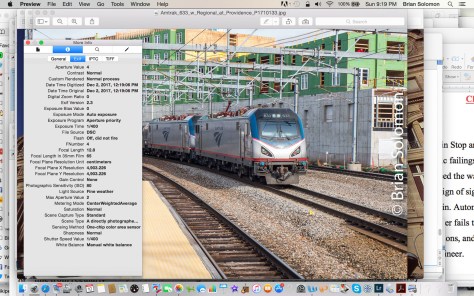
Amtrak ‘Cities Sprinter’ ACS-64 number 633 tows one of its sister electrics with train 163 as it arrives at Providence, Rhode Island on Saturday, December 2, 2017.
I exposed this view using my Lumix LX-7.
Amtrak’s line at Providence is charmless, but functional. Heavy electrification in an urban environment is rarely picturesque. To make a satisfactory image of a moving train takes patience, skill or both.
This is a routine view of American passenger rails in action, nothing sexy, and nothing complicated or tricky photographically.
Lumix LX-7 digital photo exposed at 12:19pm on December 2, 2017; ISO 80, f4.0 at 1/400th of a second, handheld with adjustable camera zoom lens set to the functional equivalent of a 65mm focal lens on tradition 35mm film camera.Here’s a screen shot of the photo with a window showing the EXIF data stored with the digital file.
Does my cross-lit midday view of a Siemens electric with 1970s-era Amfleet passenger cars work for you?
Autumn sunrise. No two are the same. The mix of clouds and particulates in the air make for endless mixtures of texture and color.
Last week I arrived in Worcester to take the 7am MBTA train to Boston.
I made these sunrise views using my FujiFilm X-T1 with 12mm Zeiss Touit lens handheld.
Worcester Union Station: MBTA 011 with the 7am train to Boston.Worcester Union Station.December sunrise in Worcester, Massachusetts.
Working with the RAW files, I made some minor adjustments in Lightroom to balance highlights with shadows and tweak color balance.
The RAW file is not what your eye sees.
Where the in-camera Jpg uses a pre-profiled set of parameters in regards to color saturation, contrast etc. The digital RAW file represents the data as captured by the camera and is comparable to a film negative; it represents an intermediate step that requires adjustment and interpretation to produce a pleasing photograph.
I typically expose both a pre-set in-camera Jpg (often with one of Fuji’s digitally replicated film color profiles, such as Velvia) and a RAW file simultaneously.
In November 2017, I returned to this location in advance of the approaching northward Housatonic freight NX-12 that featured two early 1960s-era GP35s in the lead followed by 32 cars (28 loads, 4 empties) and another GP35 at the back.
I find the railroad setting here fascinating. The combination of the traditional line with wooden ties and jointed rail in a setting of old factories, freight house and passenger station makes for a rustic scene out of another era.
Working with a Nikon F3 with 50mm lens I made a series of black & white photos on Kodak Tri-X. And, I also exposed a sequence of digital color photos using my FujiFilm X-T1.
Freight house at Housatonic, Massachusetts. Exposed on Tri-X with a Nikon F3 fitted with a 50mm Nikkor lens. Film processed in Kodak D76 1-1 with water for 7 minutes 20 seconds at 68F.Freight house and factories, looking north from the westside of the tracks. In today’s railroad world, this scene is decidedly rustic. Digital color photo exposed with a FujiFilm X-T1. RAW File processed in Lightroom with contrast adjustment to improve shadows and highlights.Tri-X black & white photo of Housatonic Railroad freight NX-12 working northward.Digital color photo exposed with a FujiFilm X-T1. RAW File processed in Lightroom with contrast adjustment to lighten shadows and control highlights.Tri-X photo with 50mm lens.Digital color photo exposed with a FujiFilm X-T1. Fuji Velvia color profile; camera Jpg scaled for Internet.Digital color photo exposed with a FujiFilm X-T1. Fuji Velvia color profile; camera Jpg scaled for Internet.
I’d spent November 24, 1984 with some friends exploring railroads in the Albany area.
Delaware & Hudson had recently been included in the Guilford network and its operations were being melded with Boston & Maine. At the time, D&H still had a lot of old Alco diesels.
We had stopped by Mechanicville earlier in the day, and I made a selection of photos (that I’ll post at a later date) then we drove via Schenectady to Rotterdam Junction to photograph Conrail.
On the way back east, we made another visit to Mechanicville, when I exposed this twilight view. This is an evocative image that represents a symbolic twilight as well as a literal one.
Exposed with a Leica 3A on Kodak Tri-X, processed in Kodak D76 1-1.
It was twilight for the D&H Alcos; twilight for the old Mechanicville Yard; and twilight of the brief colorful and busy era on Guilford before a series of strikes changed everything.
I have thousands of properly exposed Kodachrome slides from the 1980s and 1990s. This view of Amtrak 502 was exposed at Oakland, California 16th Street Station in August 1992.
Gradually I’ve been scanning these into my archive. I’ve experimented with several different scanners and software, using various settings and techniques.
So far, I found that I get sharpest and most colorful scans by using a Nikon Super Coolscan 5000 driven with VueScan 9×64 (version 9.5.91) software.
VueScan offers me a high degree of control, but I’ve found requires a bit of practice and experimentation to obtain the best scans.
I typically scan Kodachrome 25 slides at 4000 dpi (dots per inch) and then output as a Tif file to obtain the greatest amount of data. For this slide I opted to make a multiple pass scan to retain a higher degree of shadow detail. (VueScan offers the multiple pass option under its ‘Input’ pull down menu).
To make the most of the scan for internet presentation, I imported the Tif file into Lightroom and lightened the shadows and balanced the highlights, before outputting as a scaled Jpg. (The original scan remains unchanged during this process).
Kodachrome slides recorded tremendous amounts of information and the original Coolscan Tif is far too large to present here.
Incidentally, a version of this photo appears on page 148 of my book Modern Diesel Power (published by Voyageur Press in 2011). The scan in the book was made by my publisher and isn’t the scan presented here.
The old Western Pacific Junction at Keddie, California between WP’s east-west transcon line from Oakland to Salt Lake City and the Inside Gateway/High Line route north to Bieber was once one of the most photographed bridges in California.
What’s not evident from most photographs is that this impressive looking bridge can be viewed from California Highway 70—the main road through the Feather River Canyon.
The famous Keddie Wye.
On a dull October 2003 afternoon I made this view of the famed ‘Keddie Wye’ (as the junction is popularly known).
Contrast and texture make this photo work. My color slides from that day of the train crossing the bridge are less impressive.
Exposed on Kodak 120-size Tri-X using a Rolleiflex Model T with a Zeiss Tessar; processed in Ilfotec HC, and scanned using an Epson V750. Final contrast adjustments were made in Lightroom to emphasize highlights and lighten shadows.
Tracking the Light Publishes Something New Everyday!
A little more than a month after the events of 911, the historic Canaan, Connecticut Union Station was destroyed by fire.
Thankfully the classic structure has since been reconstructed and today it stands along the Housatonic Railroad line where the old Central New England route once crossed.
Exposed with a FujiFilm X-T1 digital camera fitted with a 18-135mm Fujinon zoom lens set at 98mm.Exposed with a FujiFilm X-T1 digital camera fitted with a 90mm Fujinon prime lens.Exposed with a FujiFilm X-T1 digital camera fitted with a 90mm Fujinon prime lens.
I made these photos last week on a visit to Canaan. Sometimes it helps to be in position at a sunrise and watch how the light changes as the sun climbs into the sky.
I featured the old Canaan Union Station in my book Railroad Stations published by MetroBooks in 1998.
In March 1984, I borrowed my father’s Rolleiflex Model T and exposed a roll of 120-size Ektachrome of Boston & Maine freights in the Connecticut River Valley.
The Rollei was an old camera and there was nothing electronic on it. Setting the camera was entirely up to the photographer. I was still in high school and my skills at using a hand-held light meter were less than perfect.
In short, the combined effect of snow on the ground and my lack of experience left me with some seriously underexposed medium format transparencies.
Scanning lightened the photos significantly, yet the results still demonstrate my failure to expose properly. To make for a more pleasing images I needed to adjust exposure and contrast in post processing. However it was important to scan the transparencies in such a way as to capture as much information as possible.
I was disappointed with my results and left the uncut film in the box that it was returned to me from the lab. I left them there for 33 years and only re-discovered them a few weeks ago. (Try that with your digital photos. No actually, don’t try that!).
With the technology now at hand I decided to see what I could do to make these photos presentable despite serious underexposure (suffering from receiving insufficient light).
Working with an Epson V750 flatbed scanner, I scanned the transparencies (positive color film) using VueScan 9×64 (version 9.5.91) software.
Scanning, like photography, is an art and I’ve found to make the most effective scans often requires a bit of knowledge and skill.
I’ve worked with both the Epson and VueScan software, and while both produce excellent results, for this effort I chose VueScan because it allowed me greater control of the scanning process.
To extract more information from these difficult photos, I opted to make multi-pass scans, which do a better job of capturing detail in high-lights and shadows. The software combines the data in the final file.
This is a screen shot of the VueScan work window. Notice the histogram at the left. This shows the distribution of data in the image relative to highlights, middle areas and shadows. The graph thus indicates that too much of the data is toward the shadow end, thus the unfortunate effect of gross underexposure.This is the input control window. Notice that I’ve selected to make a multiples scan with three samples. This gathers greater amounts of information from the image than a single pass scan. While not necessarily immediately evident to the naked eye, this provides a base with which to adjust the photograph in post processing. In other words I’ll lighten the image after scanning, but want to retain as much detail as possible.
Once scanned, I then imported the Tif files into Lightroom for post processing adjustments. The photos presented here are scaled from the original tif files (which are far too large for internet presentation).
Here’s the lightened scan after scaling for internet presentation. Keep in mind that original transparencies are nearly opaque.
The results are not perfect, but vastly superior to the muddy, dense original chromes.
To allow you to better understand how I’ve set up the scanner with the VueScan software, I’ve included screen shots (above) of the various sub-menus which show the various options and parameters I used.
There is more than one way to make a scan, and I’m sure if I continue to play with these chromes I may get an even better result. However, I have thousands of photographs that need scanning, and I’m limited to 24 hours a day.
On October 30, 2003, I spent a day photographing BNSF and Union Pacific trains on the old Western Pacific route through California’s Feather River Canyon.
This exceptionally scenic route has long been a popular place to picture trains.
Although photogenic, one of the conceptual problems with the canyon making the balance between train and scenery work.
Too much train, and the canyon becomes a sideshow. Too much canyon and the train is lost in the scenery.
One way to make balanced is through the clever use of lighting.
That’s what I’ve done here.
Exposed on Kodak 120-size Tri-X using a Rolleiflex Model T with a Zeiss Tessar; processed in Ilfotec HC, and scanned using an Epson V750. Final contrast adjustments were made in Lightroom to emphasize highlights and lighten shadows.
I’ve pictured an eastward BNSF climbing through Rich Bar, and by back lighting the train, I’ve helped emphasize it’s form that might otherwise be lost in the darker reaches of the canyon.
On my visit to the Railroad Museum of Pennsylvania last month, I made this late afternoon view of a Baldwin switcher in the ‘Train Yard’ outside the museum’s ‘Rolling Stock Hall’.
Exposed using a Lumix LX7 digital camera.
For a dozen interior views exposed in the Rolling Stock Hall, take a look at this morning’s Tracking the Light post:
The Railroad Museum of Pennsylvania is one of my favorite American railway museums both because of its great collection of Pennsylvania Railroad, Reading Company, Conrail and Amtrak equipment, and for its stunning interior presentation that makes railroad equipment compelling to look at.
I exposed these photos on a visit in mid-November 2017 with Pat Yough having spent the afternoon photographing the nearby Strasburg Railroad at work.
FujiFilm X-T1 with Zeiss 12mm Touit lens. Here’s a trick for making more effective museum photos in a dimly lit environment such as the Railroad Museum of Pennsylvania’s main hall: over expose by about 1/2 a stop (let more light in). This avoids blocking up the shadow areas.FujiFilm X-T1 photo.FujiFilm X-T1 photo.FujiFilm X-T1 photo.FujiFilm X-T1 photo.FujiFilm X-T1 photo.FujiFilm X-T1 photo.Lumix LX7 photo.
Among the fascinating aspects of the museum’s static collection are the numerous vintage freight cars that span a century of service. Too often the common freight car—the backbone of American railroad freight transport—is overshadowed in preservation by more glamorous equipment.
This is the cover of the January 2018 Trains. My column appears on page 17.
Yesterday I received my copy of the January 2018 Trains Magazine that features my most recent column.
Using my Lumix LX7, I made the photo illustrating my text on-board an SNCF TGV high-speed service from Brussels to Lille back in April 2017.
A photo of my iPhone displaying my E-Ticket is this months illustration. Note Tracking the Light business card to the left of the phone.
Below is a view of the same train at sunrise in Brussels prior to departure. Although unstated in the article, this was part of a trip across Europe during my research for my up-coming book on European Railway travel.
Over the years I made countless photos of Amtrak’s block-like E60 electrics working underwire.
So for me it’s a bit strange to see one of these 1970s-era machines on static display outside of the Railroad Museum of Pennsylvania alongside a PRR DD1 electric and some other classics, including a 1980s-era AEM-7 (topic of a future Tracking the Light Post).
Exposed using a Lumix LX7 in November 2017.
Since today Amtrak 603 represents the E60 fleet, I scanned through my archives to locate photo of 603 at work on the Northeast Corridor. It’s pictured with a long distance train on August 1, 1986 at Linden, New Jersey.
I made this view on Kodachrome using a Leica 3A fitted with a 200mm Leitz Tellyt using Visoflex reflex attachment.
I couldn’t have anticipated then that engine 603 would someday be a museum piece!
On a trip to the Pittsburgh area, I made these black & white photos on Tri-X in February 1987 at New Castle, Pennsylvania.
While, I like the effects of back lighting on this westward Chessie System train, I was thwarted in my efforts at producing satisfactory prints.
Complicating my printing problems were edge effects that had resulted in un-even processing that affected the sky highlights more dramatically than shadow areas.
This is a scan of the original black & white negative. The photo suffers from flare, uneven processing and less than ideal contrast. Also the sky is a bit over processed and thus appears too dark on the negative (and too light in the prints).
After about a half dozen attempts using Kodak double-weight paper I’d given up.
The other day this roll of 120 Tri-X finally worked its way to the top of the scanning pile, and after scanning at high-resolution, I thought maybe I’d try to work with the back-lit photos using Lightroom to see if I could improve upon my printing efforts from 1987.
This is the un-modified scan from the negative. I’ve not made any corrections to contrast, exposure, or provided localized improvement. Nor have I spotted the image.Here’s the photo after my first round of corrections.
Instead of dodging and burning on the aisle, working digitally I’ve applied digital graduated filters to control highlights and shadows, contrast, and the overall exposure.
After some more adjusting this is my final image. Not perfect, but a big improvement over the muddy mottled original photo.
Two weeks ago I caught Amtrak engine 184 in the Northeast Direct heritage scheme working train number 56 (northward Vermonter).
The light was fading, so I upped the ISO on my FujiFilm X-T1 to 1000 and exposed these views using my 27mm pancake lens.
Although I set the shutter to 1/320 of a second, the relatively fast train still necessitated panning to keep the locomotive sharp. Panning had the effect of setting off the background in a sea of blur and conveying a sense of motion to the photos.
The Northeast Direct livery was briefly applied to locomotives in the mid-1990s. Engine 184 was repainted in this livery in 2011 to commemorate Amrak’s 40th Anniversary.
White balance was set at ‘daylight’ in order to better retain the blue glow of dusk.
On my visit to Carneys Point, New Jersey earlier this month, I exposed a few select frames of Kodak Tri-X using my Canon EOS-3 with 40mm pancake lens.
Previously, I posted a selection of the digital color photos that featured Conrail Shared Assets freight CA11. See: Bright Day on the Pennsylvania-Reading Seashore Lines. https://wp.me/p2BVuC-59B
I processed the film yesterday (Monday, 27 November 2017) using my two-stage development recipe:
By starting with ‘presoak’ solution that features a very weak developer, I allow for increased development in the shadow areas. My primary developer for this roll was Kodak D-76 stock solution diluted 1-1 with water.
While I intentionally under processed the film to avoid excessive highlight density, following stop bath, fixing baths, and rinse, I then soaked the negatives in selenium toner (mixed 1 to 9 )for 8 minutes to boost highlights to my desired ideal.
The results are these broad-toned monochromatic images with delicate silvery highlights.
A side effect of this process is the exceptionally archival quality of selenium toned original negatives that without any expensive storage conditions should long outlive my digital photos.
Conrail Shared Assets CA11 works at Carney Point, New Jersey.The old Bell Telephone logo is a blast from the past.My special ‘presoak’ developer aids in greater shadow detail.
I made this view of a pair of Pan Am Railway’s recently acquired four-motor GE diesels at East Deerfield Yard.
When they were new in the 1980s, these locomotives were intended for moving intermodal trains at top speed.
Conrail’s B40-8s (DASH8-40B) were routinely assigned in sets of three to trailvan and double stack trains on the Water Level Route, while Susquehanna’s similar locomotives would work its double stack trains on the old Erie Railroad ‘Southern Tier Route’
So, I find it odd to see them now in faded CSX paint at Pan Am’s East Deerfield.
Perhaps, its an appropriate photographic metaphor to picture them in fading afternoon light passing the shell of the old tower.
A ‘zoom lens’ is a lens with adjustable focal length. Often the term is confused with a telephoto. Where a zoom lens may be a telephoto, it isn’t necessarily so.
In the case of my 18-135mm Fujinon lens, this is a wide-angle to medium telephoto range zoom.
I used this to good advantage the other day at Millers Falls, Massachusetts to make a sequence of photos of New England Central’s southward road freight 611.
Both of these photos were exposed from the same vantage point. All I did was adjust the focal length of the zoom as the train approached.
Telephoto view; 18-135mm zoom lens set at 116mm (equivalent of 174mm on a 35mm film camera).Wide angle view from the same vantage point. 18-135mm Fujinon zoom lens set to 23.3mm (equivalent to a 35mm lens on a traditional 35mm film camera.) Incidentally; when making these comparisons it is crucial to distinguish between historic film size and the focal length of the lenses. Both photos were exposed digitally.
Since Genesee & Wyoming took over Rail America, gradually the fleets of diesels operated by the component railways have been repainted into G&W’s corporate livery of orange and black with yellow highlights.
This traditional paint scheme had been used by the original G&W short line railroad for decades.
Here I’ve put the brightly colored diesels in scene that makes the most of the scheme.
New England Central 611 is southbound at Northfield, Massachusetts with locomotive 3475 in the lead. A cloud has briefly diffused the morning sun.
To make the most of the lighting and the scene, I made this telephoto view looking down a road, visually placing the orange and black locomotive in front of a yellow house.
The dominance of orange and yellow for the primary subjects works well in the late autumnal scene, as these colors mimic the muted foliage and grasses associated with the season.
Last week I exposed this view of New England Central 611 (Brattleboro to Palmer) crossing the Connecticut River at East Northfield, Massachusetts.
New England Central 611 crosses the Connecticut River at East Northfields, Massachusetts. Exposed with a Fuji Film XT1.
To compensate for the back lit high-contrast scene, I made a few necessary adjustments in post processing.
Working with the Camera RAW file, I applied a digital graduated filter across the sky and locally lowered highlight density, while altering the contrast curve and boosting saturation.
I then made global adjustment to contrast and saturation across the entire image, while brightening the shadow areas. The intent was to better hold detail in the sky.
To make this possible, it was necessary to expose for the sky, and allow the train and bridge to become comparatively dark. I did this knowing I’d make adjustments after the exposure.
Dusk at Elm Street, Norristown, Pennsylvania.Dusk at Elm Street, Norristown, Pennsylvania.
I exposed this view using my Lumix LX7. The angle of view is equivalent to a 24mm lens on 35mm film camera.
The ISO was set to 200, White Balance at ‘Auto’, shutter speed 1/25th of a second, and f-stop at ‘A’ (aperture priority which resulted in a f2.2 setting).
I’d been to Gap, Pennsylvania many times to photograph Amtrak trains. But I never ventured railroad-east along the Main Line to Christiana, instead driving Highway 30 toward Coatesville.
I should have known better.
Often the most interesting locations are away from the main road.
There’s your tip for the day!
Former Pennsylvania Railroad station at Christiana.Former Pennsylvania Railroad station at Christiana.The old Main Line. Now Amtrak’s Keystone Corridor.
Last week (November 2017) I made these picturesque tableaus of the Strasburg Railroad in its classic Pennsylvanian Dutch settings.
All were made with my FujiFilm XT1 digital camera.
Over the years I’ve made more than a dozen visits to the Strasburg Railroad, but this most recent trip was the first time I’d exposed digital photos here. I guess it’s been a while since my last visit.