Author of more than 70 books on railways, photography, and Ireland, Brian lives with his wife, Kris, in Lancaster County, Pennsylvania. Brian holds a BFA in Photographic Illustration from the Rochester Institute of Technology. In 2022, he was presented with the Railway & Locomotive Historical Society’s prestigious Fred A.& Jane R. Stindt Photography Award for his lifetime achievements in railroad photography.
Amtrak Extra and Pan Am’s Office Cars on the Move.
8 digital photos and more!
Today, in preparation for the opening of the Knowledge Corridor next week, special trains converged on Greenfield, Massachusetts.
Amtrak’s special was ahead of schedule departing Holyoke with officials on board. Lumix LX7 photo. (You’ll need to be patient to see the color slide exposed here.)
Paul Goewey and I intercepted the northward Amtrak special at Holyoke—where we made use of a location recently opened up by brush clearing in conjunction with work on the line.
Amtrak’s special crosses the Deerfield River on the Cheapside Bridge. Back in the day there was a canal harbor near here. Lumix LX7 photo, December 22, 2014.Pan Am’s Office Car train with F-unit at Greenfield, Massachusetts on December 22, 2014. Canon EOS 7D with 200mm lens.A convergence of passenger trains at Greenfield. Soon, Amtrak will call here everyday! Canon EOS 7D with 200mm lens.
We followed the train northward. Pan Am posed its Office Car train, complete with vintage F-unit at Greenfield.
Later, we waited patiently at East Deerfield Yard to catch the Pan Am train reversing back. This was my first opportunity to catch one Pan Am F-units on the move.
It wasn’t the brightest day for photography, but we made the best of it with digital cameras. (And I exposed a few slides for posterity!)
Nose to nose at Greenfield. Canon EOS 7D with 200mm lens.An added bonus were these two Pan Am locomotives at East Deerfield Yard.Pan Am’s Office Cars reverse toward East Deerfield in the fading light of evening. Canon EOS 7D with 100mm lens.Pan photo of PAR-1 at East Deerfield. Lumix LX7 photo.
In the last few months, I’ve sampled several mirror-less cameras. I played with a Panasonic Lumix LX7, and bought one. Thanks to Eric Rosenthal, I put a brand new Lumix LX100 through its paces. Thanks to Pat Yough, I’ve experimented with both the Fuji X-E2 and X-T1.
The new Panasonic Lumix LX100. Exposed using my Lumix LX7. I played around by comparing the two cameras.
Where the Lumix LX7 and LX100 both use a permanently attached zoom lenses, the Fuji X-E2 and X-T1 use Fuji interchangeable lenses.
Fuji X-E2 fitted with 18-55mm lens exposed with a Lumix LX7.Fuji X-T1 with 18-55mm zoom lens. Traditional manual controls such as those on the X-T1 are an important consideration for me. I want camera operation to be intuitive so I can make necessary adjustments as the action is unfolding without fighting with the equipment. The X-T1’s digital viewfinder is another important feature that gives this camera an edge over similar models.
I view these types cameras as augmenting one another rather than competing for space on my roster of equipment.
To make an analogy, back in the 1950s when a railroad dieselized, it often bought different types of locomotives for various assigned services.
For me the Panasonic Lumix LX7 is like a 1,000hp switcher; the LX100 is a 1,350hp switcher with road trucks; but the two Fuji’s are like 1,600 hp road switchers—jacks of all trades—with enough power to work heavy road trains in tandem with other equipment.
Low sun on the former Reading Company station at West Trenton, New Jersey made for an ideal subject to test the Fuji X-E2. This gave me an opportunity to try various focus and metering modes without the pressure imposed by trying to work with a moving subject. Fuji X-E2 with 18-55mm lens.West Trenton with Fuji X-E2 with 18-55mm lens. The exceptional sharpness of Fuji’s lenses is a real selling point. Also, the color palate reminds me of Kodachrome exposed with Leica lenses (how’s that for ironic!).Detail of the West Trenton station exposed with the Fuji X-E2 with 55-200mm zoom. This is a very sharp lens, but I found that in some lighting situations the auto focus didn’t work. Autofocus was particularly ineffective when the subject was back lit. I did not experience this focus problem with the 18-55mm zoom.
My goal is to supplement my Canon EOS7D and/or replace it when traveling without a car.
As regular viewers of Tracking the Light are aware, I often travel on public transport (trains, trams, planes & whatnot). When I travel, I carry my cameras plus a laptop in a backpack. Every ounce counts. Since my Canon’s are relatively heavy, I’ve been looking for a lighter option.
I’ve determined that the Fuji mirror-less cameras will allow me to significantly reduce the weight in my bag, while simultaneously upgrade to a new generation of equipment.
I like the Fuji lenses because they are exceptionally sharp and offer a very desirable color palate.
A SEPTA Silverliner V has paused for its inbound station stop at West Trenton. Here back lighting didn’t pose a focus issue when using the 18-55mm lens with the X-E2.Here’s a similar view that I exposed with my Lumix LX7. My familiarity with the Lumix makes this camera easy to use. Which is the better photo? Which was easier to make?I was still trying to find my way through the menus on the Fuji X-E2 when this CSX unit oil train approached West Trenton. One of the advantages of the X-E2 is the ability to adjust the auto focus point. However, this feature was of no use to me because I couldn’t find the control for it fast enough. Instead I grabbed my Lumix LX7 and exposed this photo. Again, familiarity can make the difference between making a photo or not.Fuji’s cameras offer exceptional results at higher ISO ratings. The light was pretty dim when I photographed this CSX mixed freight rolling through West Trenton. I’d bumped the ISO up to 3200 and exposed this image using the 18-55mm lens set at 22.3mm; f3.2 at 1/160th of a second. I’ve sacrificed color saturation for speed. Also, in retrospect I’d had made this image about 1/3 of stop darker, but that’s not a big problem. Fuji X-E2 with 18-55mm lens.I’ve cropped in tight an enlarged the above image so that you can inspect it for sharpness and motion blur. Keep in mind this was exposed at 3200 ISO and the train was moving at about 15-20mph. Fuji X-E2 image enlarged.SEPTA in the snow at Glenside, Pennsylvania. The Fuji cameras are fantastic tools for night photography. ISO 2000 1/15th of a second with Fuji X-E2 with 27mm pancake lens.SEPTA at Glenside. Handheld with a Fuji X-E2 fitted with 27mm pancake lens. ISO 6400 f2.8 at 1/20 of a second. Exposed in aperture priority mode.
Of the two Fuji cameras, I’ve come to favor the X-T1 over the X-E2. Both camera’s use the same lenses, and while the X-E2 is slightly lighter, I found the X-T1 easier to use. It has a superior digital viewfinder. (Also it seemed to have a superior auto focus system, but I can’t confirm that.) Both are excellent cameras, but Given a choice of the two, I’d reach for the X-T1.
Another potential benefit of the Fuji system is that I can buy lens adaptors that will allow me to use both my older Nikon and Leica lenses with the Fuji digital cameras. This will offer a level of redundancy when I choose to bring a film body. If I carry my old Nikon F3, I’ll be able to take advance of the Nikon lenses in event of a Fuji lens failure or if the Nikon glass offers a pictorial advantage.
Fuji’s X-T1 is a compact and versatile camera. I exposed this image of Central Railroad of New Jersey 0-6-0 number 113 using the X-T1 with 18-55mm zoom lens. The camera’s meter and sensor offered broad tonality and contrast. I did not manipulate or adjust this image in post processing, except for necessary scaling for internet presentation.Steam action frozen with a Fuji X-T1 with 55-200mm zoom lens. I exposed this view at Cressona, Pennsylvania on December 14, 2014.Auto focus can be a boon, but it can also pose its own fair share of difficulties. Both the Fuji X-E2 and X-T1 allow you to adjust the focus point. Familiarity with the camera’s layers of menus is necessary. In this case I went for the center point option as a default. If I buy a X-T1, I’ll spend some time reviewing the manual! Among the features of the Fuji cameras is the ability to select color profiles comparable to Fuji slide films. As a long-time Fuji slide shooter, I consider this to be a really good thing! This image was made with the X-T1 in ‘Velvia’ mode, handheld at ISO400 with the 18-55mm lens at 1/8th of a second. The lens has a built in image-stabilization system which allows for greater sharpness without a tripod at slow shutter speeds. This image was exposed at Prospect Park, Pennsylvania just after sunset, one of my favorite times of the day. Fuji X-T1 with 18-55mm lens.Another view at Prospect park with the X-T1.
I’ll still plan to carry the LX7 as my ‘everywhere camera’, and I may someday upgrade to the LX100. My Canons will also remain active. Regarding my steam fleet (that would be my film cameras), YES, these will all remain active too—although they see less service now than they did back in the day. Each tool has its place.
I’ve been fascinated by Fuji’s mirror-less cameras for a while. Pat Yough has a couple of them. In my previous post, I wrote of my fleeting experience with Pat’s X-T1. The other day, Pat gave me his X-E2 to play with.
Previously, I’d experimented with the X-E2 at the Streamliners at Spencer event last summer in North Carolina. On that occasion, I’d used the camera with a pancake lens and tried to match scenes using a Lumix LX7 as a side by side comparison.
Fuji X-E2 fitted with 18-55mm lens exposed with a Lumix LX7.
I quickly found that making these type of comparisons obviated the inherent operating advantages of each camera system. This is an important point for me, and one too often ignored by professional camera reviewers.
For me the way a camera handles and its ease of use are crucial functional considerations. I make different types of images with different equipment.
So, what can a Fuji X-E2 do for me?
Picking up any unfamiliar camera and charging into the image-making process has its fair share of challenges. This is acerbated by the inherent complexity of many modern digital cameras. To simply get the camera meter mode and focus point where I’d expect them, requires layers of menu surfing.
The old Pennsy station at Lambertville, New Jersey made for a good subject. Fuji X-E2 with 18-55mm lens, set at 18mm, ISO 200, f8.0 at 1/35th of a second, hand-held auto-white balance. This combination yielded excellent depth of field. I was very impressed by the color/contrast reproduction with the blue sign. The sharpness of the RAW file is outstanding.
It took more than a few minutes to get a handle on the X-E2. On Thursday December 11, 2014, we explored the New Hope & Ivyland’s tourist train operations.
This was a perfect opportunity to put the camera through its paces; I wasn’t pressured by the need to document the operation, since I can come back anytime and photograph it again. Also, poor and changeable weather conditions allowed me to push the X-E2 and see what it can do in lousy light. I also made a few comparisons with my Lumix LX-7.
New Hope & Ivyland’s excursion train approached New Hope, Pennsylvania. Fuji X-E2 with 18-55mm lens, set at 55mm. Exposed at 400 ISO f4.0 a 1/250th of a second. Auto white balance, hand-held.The X-E2 has several motor drive modes. These are accessed by scrolling through the menus. Exposed at 400 ISO f4.0 a 1/250th of a second. Auto white balance, hand-held.The ability to adjust the shutter speed with a traditional dial atop the camera is a real boon. In this situation I was able to make a quick change based on instinct and a hint from the camera meter. Exposed at 400 ISO f4.0 a 1/180th of a second. Auto white balance, hand-held.Fuji X-E2 with 18-55mm lens, set at 18mm. Exposed at ISO 800, f4.0 1/240th of a second. The extreme contrast in this image made for test of the X-E2’s dynamic range.A hand held pan with the motor drive in its fastest mode. The rangefinder-like quality of the X-E2 makes it an excellent tool to make pan photos. Exposed using 18-55mm lens at 55mm. ISO 200 at f4.0 1/12th of a second. Shutter speed calculated by the camera in ‘A’ mode.Dusk at New Hope. I mounted the X-E2 on my old Bogen 3021 tripod. To allow for a more pleasing color, I manually set the white balance to ‘daylight’ rather than use the auto white balance. Fuji X-E2 with 18-55 lens, set at 55mm. ISO 200, f4.0 at 0.8 seconds.Where the Fuji camera come into their own is with the high ISO settings. SEPTA local to Philadelphia at Glenside, Pennsylvania. Fuji X-E2 with 27mm pancake lens. ISO 2000 at f2.8 1/12th second handheld.
In other circumstances, I kept the Lumix handy. When push came to shove, I’d grab my familiar camera to ensure that I got results. I don’t want to be fighting with a camera when the action is unfolding. Equipment familiarity is key to consistently making good images.
The photos here have been scaled for internet presentation, but otherwise unaltered.
Fuji’s X-T1 with 18-55mm lens. Exposed using a Panasonic LX7.
An ideal test of new equipment might include a thorough tutorial, followed by a gradual immersion into the camera’s distinct features in order to be operationally confident prior to making any serious photos.
I didn’t do any of that. It was a sunny day in Philadelphia. Pat Yough and I were following SEPTA’s Route 15 streetcar line (famous for its use of ‘retro’ PCC cars).
“Here’s my X-T1, try that.”
SEPTA PCC at the Northern Liberties Loop near the Sugar House Casino. Exposed with a Fuji X-T1 fitted with 55-200mm zoom. ISO 200 at f7.1 1/640th second.SEPTA PCC at the Northern Liberties Loop near the Sugar House Casino. Detailed view exposed with a Fuji X-T1 fitted with 55-200mm zoom. ISO 200 at f8.0 1/640th second.
This was initially fitted with an older Fuji 55-200 zoom lens. I made a few photos of a static PCC car, but found the lens slow to focus. In back lit situations it didn’t seem to grab a focus point at all and hunted incessantly.
“This doesn’t like glint,” I said, “What other lenses do you have?”
“Try the 18-55mm kit lens”
SEPTA PCC at the Northern Liberties Loop near the Sugar House Casino. Exposed with a Fuji X-T1 fitted with 18-55mm zoom. ISO 200 at f11 1/250th second.
This worked vastly better. It focused quickly. And I was soon snapping away.
We drove around Philadelphia, finishing daylight along Amtrak’s Northeast Corridor at Prospect Park, Pennsylvania. By the time the sun had set I’d exposed 15 GB of photos!
Whee! There’s nothing like something new. Exposed with a Fuji X-T1 with 18-55mm lens in South Philadelphia.
The X-T1 is a mirror-less camera formatted similar to a SLR but without the ‘reflex’. The viewfinder is digital. The camera has an excellent ergonomic shape—I found it comfortable to hold and easy to use.
On the down side, there’s a lever on the left-hand side of the body beneath the dial to set the ISO, which I kept inadvertently knocking with my thumb. This adjusts the motor-drive and introduces such novel features as ‘autobracket’ and an in-camera filter set.
The details of these features must be programmed by scrolling through fields of menus and making some intelligent selections. All very well, except I didn’t know how to do any of that at first, and suddenly found I was getting bursts of photos everytime I released the shutter.
At one point Pat joined a queue at Tony Luke’s Philly Cheese Steak to procure lunch, while I fiddled with the X-T1’s menu options. This allowed me to finally, tune, and then exit the bracket mode.
Amtrak at sunset, Prospect Park, PA. Fuji X-T1 with 18-55mm lens. ISO 200 f6.4 1/950th of a second.
Along the Northeast Corridor, I was able to test the camera’s ability to work in low light and stop the action at its higher ISO settings.
The rapid fire motor drive is a real boon when picturing Amtrak’s Acela Express at speed. I was able to wind up the ISO to 6400, which impressed me. At lower ISOs, I was able to pull off some creative pans and photographs that incorporated movement.
Amtrak Acela Express blitzes Prospect Park. Fuji X-T1 with 18-55mm lens at ISO 800 f4.0 1/1000 of a second.Amtrak AEM-7 928 leads a Washington DC bound train at Prospect Park. Fuji X-T1 with 18-55mm lens. ISO 6400 f4.0 1/125th of a second.
I walked away from my brief time with the X-T1, very impressed by the camera. It can output both a Jpg and RAW files simultaneously and has an impressive dynamic range. It has color profiles designed to emulate some of my favorite Fuji slide films, and has excellent high ISO response and output.
Pity about the slow focusing zoom, but Pat indicated there’s other options for longer lenses, and I hope to explore that at a later date.
All the X-T1 photos displayed here have been scaled for internet presentation, but are otherwise unaltered. I have not sharpened, cropped, or enhanced the files.
Exposed with a Fuji X-T1 with 18-55mm lens. ISO 1600 f4.0 1/15th of a second. Prospect Park station.SEPTA at Prospect Park. Pan photo exposed using a Fuji X-T1 fitted with a 18-55mm lens. ISO 400 f3.6 1/4th secondSEPTA at Prospect Park, PA. Exposed with a Fuji X-T1 fitted with 55-200mm zoom. ISO 400 f3.6 1/15th of a second. I like the metallic look. Reminds me of . . . 120 size chrome film!
Today (Dec 19, 2014) Amtrak operated a test train north from Springfield, Massachusetts on Pan Am Southern’s recently rehabilitated Boston & Maine Connecticut River Line in preparation for re-routed Vermonter service (expected to begin at the end of this month).
My father and I went out to document this special move, then went over to the New England Central route to photograph the Vermonter on its present route.
Amtrak 111 leads the northward test train at Old Ferry Road in Holyoke (south of Mt Tom) on December 19, 2014. Exposed with a Canon EOS 7D with 200mm lens. ISO 800.Amtrak’s southward test train at Old Ferry Road in Holyoke (south of Mt Tom) on December 19, 2014. Exposed with a Canon EOS 7D with 200mm lens. ISO 800. Brush cutting efforts have opened up numerous photo locations along the line.
Tracking the Light presents a few views at this busy location.
Amtrak’s Northeast Corridor is in transition as the old battle-worn AEM-7s are being phased out and the new Siemens ACS-64 ‘City Sprinter’ locomotives gradually assume their duties.
Fellow photographer Pat Yough and I were out to make good use of the sunlight. We’d caught Amtrak 600 the ‘David L. Gunn’ (recently named for Amtrak’s former president 2002-2005) working a Harrisburg-New York Penn Station Keystone on the Main Line and were aiming for another photograph of this unique locomotive.
Amtrak AEM-7 924 crosses the Schuylkill River working toward Philadelphia’s 30th Street Station on the former Pennsylvania Railroad. Canon EOS 7D with 200mm lens.Amtrak AEM-7 924. Canon EOS 7D with 200mm lens.New Amtrak ACS-64 621 leads a Northeast Regional train at Zoo Junction. Canon EOS 7D with 200mm lens.A former Metroliner cab-car leads a Keystone service at Zoo Junction. Canon EOS 7D with 200mm lens.Amtrak 600 was named ‘David L. Gunn’ and works at the back of a Keystone train. Canon EOS 7D with 200mm lens.Amtrak 600 was named ‘David L. Gunn’ and works at the back of a Keystone train. Canon EOS 7D with 200mm lens.
Back on November 14, 1959, my dad photographed Reading Company T-1 2124 charging through Oak Lane station on Kodachrome.
But where is Oak Lane? Obviously this is in suburban Philadelphia. However, when I consulted a modern day SEPTA rail map, I couldn’t find it.
A puzzle. I called my dad. But he didn’t specifically remember making the photo, nor anything about the station. “I chased a lot of the Reading trips. I don’t know which one that was.”
Reading’s T-1 2124 charges through Oak Lane, near Philadelphia on November 14, 1959. Photo by Richard Jay Solomon
Perhaps the station had been closed?
Finally, after a bit of research, I concluded that Oak Lane had been renamed Melrose Park. Armed with that knowledge, my brother Sean and I traveled to Melrose Park on SEPTA on Friday December 5, 2014.
Surprisingly, the station isn’t radically different. The old building still serves as a railway station, and the old canopy on the outbound side of the tracks still looks as it did in 1959.
Two big changes were installation of high-level platforms and removal of the center track.
I attempted to emulate the angle and perspective of the 1959 photo as closely as possible. My father was using a Kodak Retina 3C, probably fitted with a 50mm lens, although he also had a 35mm. So using my Lumix LX7, I adjusted the Vario Summilux to about the 45-50mm range. Both photos were made in late-autumn on overcast days.
Outbound SEPTA multiple unit at Melrose Park. December 5, 2014.
The other big change is the equipment. Where in 1959, Reading’s class T-1 4-8-4 number 2124 was the star attraction, on December 5, 2014 we had to settle for a 1970s-vintage Silverliner IV multiple unit.
Keep in mind that at the time of the 1959 photo, the steam locomotive was only a dozen years old at the time. Happily, the 2124 is preserved at Steamtown in Scranton.
Philadelphia 30th Street Station this morning, December 17, 2014.Philadelphia 30th Street Station this morning, December 17, 2014.
Today’s (December 17, 2014) views from Amtrak’s Vermonter en route from Philadelphia to Amherst, Massachusetts. Posted live from the train!
I write from the relative comfort of an Amfleet coach on Amtrak number 56, the Vermonter. Below are some views exposed today with my Lumix LX7.
I thought I’d take the opportunity to use the Amherst Station while I still can.
Amtrak is due to shift the Vermonter to the ‘Knowledge Corridor’ route at the end of this month. This will result in a restoration of Amtrak service to the former Boston & Maine Connecticut River Line, and the first regularly scheduled passenger trains on the line since Amtrak suspended its Montrealer north of Springfield in the mid-1980s
In July 1989, Amtrak’s Washington D.C,- Montreal Montrealer was restored using a Central Vermont (CV) routing via New London, Palmer and Amherst.
Then, beginning in early 1995, shortly after New England Central assumed operations of the old CV, the daytime Vermonter (DC-St. Albans) replaced the nocturnal Montrealer schedule.
However, this new train used a revised routing via Hartford, Springfield and over the former Boston & Albany to Palmer, then up New England Central’s former CV line to East Northfield.
Soon Palmer to East Northfield will be freight only!
Amtrak 56 arriving at 30th Street.Vermonter arriving at 30th Street.Near Harrison, NJ.My view from the Hell Gate Bridge looking toward Manhattan.A BL20GH diesel at Bridgeport with a train from Waterbury. December 17, 2014. LX7 photo.A BL20GH diesel at Bridgeport with a train from Waterbury. December 17, 2014. LX7 photo.Amfleet interior on train 56 Vermonter.New Haven line train viewed from Amtrak’s Vermonter, December 17, 2014.New Haven, Connecticut. The WiFi remained active during the engine change. Notice ‘Amherst’ in the station list.Rolling along the old canal and Connecticut River at Windsor Locks, Connecticut.Crossing the Connecticut. I’m looking down on the river bank where I photographed the Vermonter about a month ago.
SEPTA’s Independence Pass offers great value for the $12 price and more importantly gives you the freedom to jump from train to train and one mode to another without worrying about buying individual tickets.
We started at Overbrook, where the agent in the station sold us our Independance Passes. Of the tens of thousands of railway stations that once dotted the North American network, how many still have open ticket windows and waiting rooms for passengers? Lumix LX7 photo.Outbound SEPTA multiple unit at Overbrook, Pennsylvania. Lumix LX7 photo.SEPTA logo. Lumix LX7 photo.
My brother Sean set out on a wandering tour that included SEPTA’s commuter rail, Broad Street Subway and Market-Frankford rapid transit, and light rail lines.
Part of our quest was to find the elusive Oak Lane station on the former Reading Company lines.
Modern maps won’t show this station, and I had a special interest in finding it, which I’ll explain in tomorrow’s post! Stay tuned!
Inbound SEPTA train at Jenkintown on the former Reading. Lumix LX7 photo.This sign was at the old Oak Lane Station. Mystery revealed tomorrow!SEPTA trains at Fern Rock. Lumix LX7 photo.SEPTA 2304 was built in Graz, Austria. Lumix LX7 photo.SEPTA’s Broad Street Subway must be the region’s least photographed railway line. Why, I don’t know? Lumix LX7 photo.Indeed!Kowasaki cars on the Broad Street line.Just so you know!Girard and Broad Street. Lumix LX7 photo.Route 15 PCC’s at the new Northern Liberties loop near the new Casino. Lumix LX7 photo.SEPTA PCC 2328 up close. Exposed using a Canon EOS 7D with 40mm Pancake lens.PCC 2324 at the Northern Liberties loop. Lumix LX7 photo.PCC at dusk on Frankford Street near The Handle Bar. LX7 Photo.SEPTA’s Market-Frankford El at dusk. Lumix LX7 photo.Market-Frankford El at Girard Ave. Lumix LX7 photo.SEPTA’s celebrathing 50 years. Our passes were valid on the buses, but we opted for an all-rail journey. Lumix LX7 photo.Philadelphia City Hall at night. Lumix LX7 photo.A Silverliner V dressed for the Philadelphia Eagles at Suburban Station.And, finally, back to Overbrook. LX7 photo.
Tracking the Light presents 14 recent images—a work in progress.
Not any old mainline, but The Main Line—the former Pennsylvania Railroad west of Philadelphia. This is hallowed ground in the eyes of PRR enthusiasts.
My brother and I spent several hours examining various locations from Overbook to Bryn Mawr.
A training special (not listed in the public timetable) approaches Narberth on December 4, 2014. Lumix LX7 photo.A training special at Narberth on December 4, 2014. Lumix LX7 photo.A SEPTA training special departs Narberth on December 4, 2014. Lumix LX7 photo.
We were rewarded by a training special operating in midday with SEPTA AEM-7 2306 and a push-pull train. These trains are typically only used at rush hours, so it was nice to catch one off peak.
Narberth. Lumix LX7 photo.
The Main Line loves its trees.
The Main Line is a throwback to another time. The line still retains many of its visual cues from year’s gone by, including classic Pennsylvania Railroad position light signal hardware.
SEPTA locals pass at Narberth. Classic postion light signaling still protects the mainline.SEPTA local approaching Wynnewood. Lumix LX7 photo.SEPTA training special inbound near Wynnewood. Lumix LX7 photo.
Among the challenges to photographing this line is the proliferation of trees along the right of way. While these can make for nice props, they also cast shadows which complicate photography.
From an operations standpoint, I would think that having so many line-side trees would be a serious problem. Not only will these cause wheel-slip in the autumn that will result in difficulties for suburban trains trying to meet tight schedules, but falling branches and trunks will interfere with the catenary.
Would the PRR have tolerated so many trees along its primary east-west trunk?
SEPTA local at Wynnewood.Advertising on a Silverliner V. Lumix LX7 photo.Old PRR-era station at Haverford. Lumix LX7 photo.An Amtrak Keystone blitzes Bryn Mawr. Lumix LX7 photo.Bryn Mawr. Lumix LX7 photo.
Tracking the Light remembers the Chicago, Central & Pacific.
On April 23, 1995, Howard Ande and I chased this westward CC&P freight through the Missouri Valley to Council Bluffs, Iowa.
CC&P was a short-lived 1980s-era Illinois Central Gulf spin-off.
This mixed consist of former Illinois Central Gulf Geeps, a former Chessie System unit, and one of the few CC&P painted locomotives seems to sum up the state of affairs.
Chicago Central & Pacific westward freight near Woodbine, on April 23, 1995.Chicago Central & Pacific westward freight near Woodbine, on April 23, 1995. Exposed with a Nikkormat FTN on Fujichrome Provia 100.
Among the most unusual 1980s-de-constructions was the result of Illinois Central Gulf’s compulsive trimming of most of its network outside the former IC principal north-south core. Among the new regional railroads created were: Chicago, Central & Pacific in 1985 on the old IC Chicago-Omaha route; Mississippi-based MidSouth in 1986; and the former Alton network spun off as Chicago, Missouri & Western in 1987. All were short-lived creations, and within a decade had been absorbed by other major carriers. In 1996, IC (having dropped ‘Gulf’ from its name in 1988) bought back the CC&P, MidSouth went to KCS, while C&MW routes were divided between Southern Pacific and Gateway Western (which was later absorbed by KCS). Also created from the ICG network was Paducah & Louisville in 1986, which continues to operate as a independent railroad in 2013.
Weso is a contraction implying ‘Western Pacific Southern Pacific’. This is the control point at the western end of the famed ‘paired track’ where SP’s and WP’s single track mainlines were coordinated during World War I to function as directional double track to ease operations.
Weso, Nevada on July 21, 1991. Exposed on Kodachrome 25 using a Nikon F3T fitted with a f1.8 105mm Nikkon lens, mounted on a Bogen 3021 tripod.
My long-time photo pal TSH and I camped here in July 1991 and made a promising morning exposing Kodachrome of the parade of trains that passed after sunrise.
This view is of an eastward SP Modoc Line freight on Union Pacific’s former WP line just east of the crossovers at Weso, mile post 537. Weso is near Winnemucca. The parallel SP line is off camera to the left.
Weso, Nevada on July 21, 1991. Exposed on Kodachrome 25 using a Nikon F3T fitted with a f1.8 105mm Nikkon lens, mounted on a Bogen 3021 tripod.
It was a clear September 1989 morning when I parked near the twin former New York Central tunnels at Breakneck Ridge and followed a hiking trail to this commanding vantage point looking back toward Cold Spring, New York.
I exposed this photo on Kodachrome 25 slide film using my Leica M2 fitted with 50mm f2.0 Summicron firmly mounted on a Bogen 3021 tripod.
This features some of best known works of black & white photographic giants David Plowden, Jim Shaughnessy, Mel Patrick and Ron Wright as well as more recent work by Mike Froio himself, and his contemporaries including Scott Lothes, John Sanderson, and Travis Dewitz, along with Pennsylvania Railroad poster art from the Bennnett Levin collection.
These are some memorable railway images well worthy of display!
For my final Night Photo Challenge image, I thought I’d display this image.
This is not an ordinary ‘night photo’, but there are no PhotoShop computer generated enhancements. Except for cropping, which I did after scanning the slide, the rest of my technique was performed ‘in-camera’.
Making it was considerably more involved than my typical night photos. I used my old Nikon F3T with an old school f2.8 24mm lens mounted on a Gitzo tripod.
Trams pause in the fog at the Olomouc main station. This former provincial capital is now in the Czech Republic, located about three and one half hours east of Prague. It enjoys an excellent passenger service with direct trains to many Czech cities. Exposed on Fujichrome with a Canon EOS 3 fitted with a 100mm lens. Contrast and colour adjusted in post processing.
Olomouc—known as Olmütz in the day of the old Hapsburg Empire when it was the capital of Moravia—is an ancient city dating back to Roman times. I found it an exceptionally photogenic small city.
In January 2009, Denis McCabe and Tim Doherty visited Olomouc on a week-long photographic trip to central Europe. On the evening of our arrival from Prague, a heavy fog had settled across the city, making its eclectic architecture, Soviet Era trams, and well worn cobblestone street even more evocative.
We spent several hours walking around in the mist.
Olomouc, Czech Republic, January 2009. Exposed on Fujichrome with a Canon EOS 3.
Delaware-Lackawanna shops, Scranton, Pennsylvania, October 13, 2005.
Beauty is in the eye of the beholder: I was researching and photographing for my book Working on the Railroad, when I made this image in the rain at Scranton.
Exposed on Fujichrome Provia 100F with a Nikon F3T fitted with a 24mm f2.8Nikkor lens fitted to a Manfrotto tripod. Exposure calculated with a Minolta Mark IV light meter. (Note the code lines.)
The former British Columbia Railroad Alco Century was my primary subject. Here the combination of raw unpleasant weather, harsh sodium lighting, and a scene festooned with junk, litter and tired look side tracks meets all the aesthetical requirements for a great photo. No?
Dusk at Killucan Cabin, May 3, 2002. This was a favorite place of mine to make photos, and before the cabin was closed, I spent many afternoons and evenings here.
Signalman Donal Flynn stands at the base of the cabin poised to hand the electric train staff hoop to a Dublin-bound passenger train (seen, headlights dimmed, approaching in the distance). Exposed on Fujichrome with a Contax G2 with 28mm Biogon Lens mounted on a Manfrotto tripod. Exposure calculated with the aid a Minolta Mark IV light meter.
This image was exposed several years before Irish Rail implemented the signalling program that converted the Sligo line to Mini-CTC with remote signaling control and colour-lights. Yet, for me it is evocative of the cabin at the end of its useful life.
The final hints of daylight are symbolic of the cabin’s fate; Soon the light in the sky will fade to darkness and the cabin will close.
In response to my recent nomination by Phil Brahms and Blair Kooistra for the Facebook Night Photo challenge, I’ve selected five groups of photos that I feel might be interesting to review on Tracking the Light.
I have to admit, I’m not clear on the rules for this challenge. As a result, I’ll follow my standard policy and just wing it. Who needs rules anyway?
Among the difficulties in selecting photos for this challenge has been simply finding them. For the most part I’ve not organized images in regards to the time of day they were exposed. A related problem is the large number of night views that I’ve attempted over the years.
Lastly, what makes for a successful night photo?
Over the years, I’ve made hundreds of night photos at Palmer, Massachusetts. I exposed this image on an exceptionally foggy May 1985 evening. My subject was the old Palmer Union Station near the crossing of Conrail’s Boston & Albany line and the Central Vermont Railway. Today this old station has been restored and serves as the Steaming Tender restaurant. Tracking the Light viewers will find it a familiar subject, as I’ve often featured images in and around this building. Exposed on black & white film with a Leica 3A with 50mm Summitar lens.More than 11 years later, I exposed this view at Palmer. Here I’m looking west with the station at my back. A southward New England Central freight is waiting north of the diamond. Exposed with a Nikon F3T with 28mm lens on Fujichrome Provia 100F. December 6, 1996. Color is an added complication for night work. Would this photo be more effective as a black & white image? Or would the effect of the red signal lights be lost?
Tracking the Light; Five photos on the old Pennsylvania Railroad.
A Post-Prologue to a Night Photo Challenge . . .
On December 1, 2014, I’d met my latest deadline, and so I finally had a few minutes to make photos before charging headlong into the next project.
My brother Sean lent me back my old Bogen 3021 tripod, a piece of equipment I’d not seen in many years. I’d bought this new in Rochester in March 1989 and dragged it all around North America in the early 1990s. At some point, I upgraded to a newer tripod and gave this one to Sean.
Former Pennsylvania Railroad station at Overbrook, Pennsylvania. LX7 photo, exposed at ISO 80 f3.2 at 2.5 seconds.Rainy Night on the Main Line at Overbrook. Lumix LX7 photo ISO 80 f3.2 at 1.3 seconds. Auto white balance.A SEPTA Silverliner V pauses at Overbrook on the evening of December 1, 2014. Lumix LX7 photo. ISO 80, f3.2 1.3 seconds. (Exposed in ‘A’ mode using a + 2/3 manual override.)
It seemed like overkill to steady my Lumix LX7 on such a heavy tripod, but it did the job.
It was cold, wet and dark, but that worked fine for me. I exposed a few photos at Overbrook, Pennsylvania, and a couple of more at Wynnewood. No GG1 electrics passed me that night. Not for a long time.
Former Pennsylvania Railroad four-track Main Line west of Wynnewood, Pennsylvania. Lumix LX7 photo exposed at ISO 80 at f2.1 for 8 seconds. Auto white balance. I’ve experimented with this angle as a night photo before, and so this is really just my latest effort.Former Pennsylvania Railroad four-track Main Line west of Wynnewood, Pennsylvania. Lumix LX7 photo exposed at ISO 80 at f2.0 for 8 seconds. Auto white balance. This is from the same location as the previous image, but looking west. Would this photo be improved with a train blurring by?
Tomorrow, I begin the first of five night photo-challenges as given to me by Blair Kooistra and Phil Brahms via Facebook.
Tracking the Light Daily Post: A View from a Favorite Location.
For this photograph, I’ve selected an off-center composition and used strong side-lighting and selective focus to increase the sensation of depth.
Autumn on the Boston & Albany in the Berkshires of Massachusetts. An eastward CSX freight descends Washington Hill at the old Middlefield station-location on October 7, 2004.
On August 15-16, 2009, I’d been camping in California’s Feather River Canyon near the curved Rock Creek trestle. In the early light of dawn, I made a series of photos of this Union Pacific container train crossing the bridge.
Exposed on Fujicrome with a Canon EOS 3 with 28mm lens. I gauged my exposure on the sky, intending to make a silhouette of the train and bridge.
This image features the tail-end ‘Distributed Power Unit’ (a radio controlled remote locomotive). After making this photo I followed the train west down the canyon and made more images.
Thankfully Union Pacific paints its bridges an aluminum color which helps visually separate the girders from the inky blackness of the trees beyond. Would this photo work if the bridge were painted black?
This is the second of three posts in my three part series covering San Francisco’s Streetcars. Shirebooks recently published my book Streetcars of America co-authored with John Gruber.
A cable car crests Lombard Street just after sunrise on a September morning. See Shirebooks Journal for Brian Solomon’s feature on San Francisco’s Cable Cars.
I prefocused and zoomed the lens to keep pace with the nose of the train. Although it may not be immediately evident, this train is moving away from the camera.
Working with a Nikon N90S with 80-200 zoom lens and Fujichrome Provia 100 I made this zoom-pan of a Series 100 train blitzing the station at Shizuoka, Japan.
The trick to making a zoom-pan is use a relatively low shutter speed (1/15 to 1/30th of a second) and use the zoom to keep pace with the train’s motion. This is actually easier to do with a fast moving train. In this case the Series 100 train was traveling at more than 130mph.
This technique takes a bit of practice, so it helps to experiment on a really busy high-speed railway line such as the New Tokaido line. When I made this photo in April 1997, there were about 10-11 trains in each direction every hour over the line.
I made several of these ‘zoom-pans’ on color slide film. I didn’t know how well I’d succeeded until weeks later when I reviewed my slides.
This photo appeared as the title-page spread of my 2001 book Bullet Trains published by MBI. The book took a look at high-speed railway networks around the world.
On June 14, 1993, the world’s largest operating steam and diesel locomotives worked together on the Oregon Trail Special. Brian Jennison and I photographed these massive machines at Quartz on their ascent of Union Pacific Encina Hill east of Baker City, Oregon.
Kodachrome 25 exposed with a Nikormatt FTN with Nikkor 28.
It may surprise some readers, but the full moon provides the same light color balance as the sun, just at a significantly lower intensity.
This is one of the many differences between the way a human eye interprets a scene and a photographic image.
Where to the eye moonlight—even the full moon, appears dark, a camera can capture a moonlit scene so that it has the same color and illumination ratios as daylight. The difference isn’t with the scene, it is with our perception of it.
Complicating matters are the ways cameras collect light. Back when I used Kodachrome 25, very long time exposures rarely turned out as I hope they would. The film’s ISO rating in very low light was irrelevant.
The primary reason for this condition was a combination of the film’s long reciprocity curve and its very poor sensitivity in extremely low light. Essentially in moonlight, the film lost its effective sensitivity.
Basically this meant that Kodachrome was optimized for daylight situations and its ratio of sensitivity was not proportional in very low light (and effectively lost its ability to record images). So, when I left the shutter open for hours in moonlight, the film was incapable of recording an accurate image.
Even when I’d calculated the theoretical correct exposure. All I’d get back from the lab was a fairly dark slide with a few overexposed specular highlights (bright spots). Not very inspiring.
In the mid-1990s, Mel Patrick encouraged me to experiment with Fuji Provia 100F in moonlight. This was a modern film. Not only was it vastly more sensitive in low light, but it provided a much better color rendition in night situations. While the film still suffered from the reciprocity effect, I found it possible to calculate and compensate for this failing.
Yet, even with this improved film, moonlight exposures still required very long exposures, sometimes up to an hour or more.
Mel had made some outstanding railway landscapes by moonlight, and I tried to emulate his successes.
Cumbres Pass by the light of the moon. A long time exposure made using the full-moon as the primary light source. Does this look like daylight? The star trails in the sky are the tip-off.
A difficulty was finding situations where there was virtually no man made light, since mercury, sodium, and incandescent lights not only tend to be much brighter than moonlight, but cause objectionable color casts and harsh contrast (a topic for another day).
While there are relatively few places in the eastern United States that are completely free from man-made light (even in the wee hours), in the West, clear open skies (and a dearth of population and objectionable light) abound.
I made this image at the summit of Cumbres Pass, Colorado in September 1998. My car and my tent can be seen in the distance. I don’t recall offhand, but my exposure was about 40 minutes at f2.8 using a Nikon F3T with Nikkor 24mm lens. My camera was firmly mounted on a Bogen tripod.
Tight crop of the same Fujichrome colorslide. I don’t think this image is critically sharp, but keep in mind the shutter was open for more than half an hour, and even a gentle breeze will create a slight vibration.
Are you seeing the whole picture? Tracking the Light presents: A Glinty Electric Bus.
Exposed on Fujichrome using a Canon EOS3 with 100-400 IS Zoom lens. Forest fires east of San Francisco made for an extra rosy sunrise.
Did I notice this scene in my rear view mirror one morning in the 1990s? I think so. Anyway, a memory of a image—something like this was nagging me.
On the morning September 3, 2009, I set up on Hayes Street in San Francisco with my 100-400mm lens. Just after sunrise I exposed a series of images of an electric bus (trolley bus) catching the glint of the rising sun as it crested Alamo Hill.
For me the wires make the photo interesting. Not only do the dual wires power the bus, but they visually tie the scene together.
I like the dramatic lighting and monochromatic effect of the silhouette. I’ve carefully included the pole at the far left to visually anchor the wire network to the ground. This also adds balance.
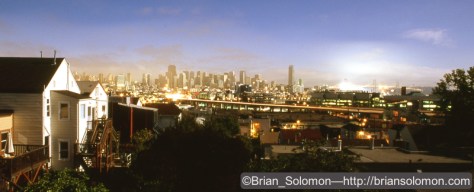
There’s a famous vista made just to the left of my location. It features a staggered row of gingerbread style Victorians with the San Francisco skyline. It is an iconic setting that appears on post cards, calendars, books and etc. You’d recognize it if you saw it. While the clichéd vista is typically exposed in the afternoon from the park, my view is from the street in the early morning.
PKP at Brzeszce, Poland on the 18th of August 2006.
Poland is a great place to make railway photos. There’s tremendous variety and something new at every turn.
Polish National Railways class ET41 electric with coal train at Brzeszce, Poland. Exposed on Fujichrome using a Nikon N90S with f2.0135mm defocus lens.
I made two trips to Poland in 2006, largely to photograph freight trains. Denis McCabe and I were exploring coal lines in Silesia when we found this location where lines cross near Brzeszce. The north-south line was an unusually busy route. We didn’t need to wait long between trains.
For this image, I opted for a cross lit shot. Taking this angle with a medium telephoto from the ‘dark side,’ allowed me to emphasized the front of the locomotive, while including interesting elements such as the long train of coal cars and the overhead Warren-truss bridge in the distance.
The engine driver is illuminated nicely too, which adds a human element often missing from modern railway photos.
Today’s Tracking the Light displays two images exposed about a year apart from the same overhead bridge near Orbisonia, Pennsylvania.
In both instances I’m photographing the first train of the morning working upgrade away from Orbisonia station using a telephoto lens.
East Broad Top 2-8-2 number 15 working on rusty rail near Rockhill Furnace in October 1996, exposed with a Nikon F3T with f4.0 200mm lens.On September 20, 1997, East Broad Top 2-8-2 number 14 tackles the same grade as pictured above. Exposed using a Nikon N90S with Nikkor f.2.8 80-200mm zoom lens.
Although the location and time of year, and overall scene are similar, I’ve produced two different images, owing to slight differences in my angle and the lighting, as well as the position of the locomotive and its exhaust smoke. In addition I was using different camara-lens combinations.
Subtle changes can result in significantly different photos.
Should I head to the mainline (Conrail’s water level route) or explore branch lines? Do I stick with Conrail or seek out a short line? These were among the quandaries facing my photographic choices when I had some time off from college.
As a photography student at the Rochester Institute of Technology, I had a full schedule of classes, labs, and projects. I was a ‘work-study’ student, which implied I had to spend about 25-30 hours a week toiling for peanuts on top of classes, assignments & etc.
My point is that I had very little free time, and rarely a full day off, and so when I made time to make railway photos, there were tough choices (like mainline versus branchline; Conrail versus those other outfits).
Now and again I’d cheat. (I don’t mean on exams). A bright sunny day? Now who will miss me in class?
Unfortunately on a glorious October day, one RIT’s photo professors and I had the same idea. We were both photographing the Livonia, Avon & Lakeville freight. We crossed paths at Avon, New York. We knew that each of us should be someplace else, and we knew where that was. He said to me, “I won’t say anything . . .”
October 26, 1987 was a clear and bright day. Conrail’s WBRO-15 had 37 cars for the Livonia, Avon & Lakeville. I didn’t go to class. Kodachrome 25 exposed at Avon using my Leica M2 with 50mm lens.
Often I’d head to the mainline. My time was short and I wanted results, and Conrail rarely disappointed. Sometimes I’d select a known good spot, and work through my exhaustive reading list while waiting for a headlight to appear.
Other times, when the sun was out, I’d take a more aggressive approach and select my locations purely based on photographic merit and move from place to place as suited the action and the light.
On January 8, 1989, a rare Conrail C30-7 (one of only ten on the roster) leads a westward empty coal train through Rochester, New York. I exposed a sequence of photos using my Leica M2 with a 200mm Telyt fitted to a Visoflex. In retrospect that was a bizarre and awkward camera-lens combination for making moving train photos. But I used it all the time with great results. A thin layer of high cloud softened the sun.
An eastward KCS train 29 works its way upgrade through a tunnel and kudzu covered cutting. It was the dead of winter so the vines had died. I wonder what it’s like here in July? This is the former Mid South, nee Illinois Central east-west route, now part of the KCS-Norfolk Southern Meridian Speedway joint-venture.
KCS 29 had changed power and crews at the Vicksburg Yard and at 1pm on January 21, 1996 was working east upgrade. Exposed on Fujichrome 100 using a Nikkormatt FTN with Nikkor 35mm PC lens. Lens set at f4.5, camera at 1/125th of a second. Slide scanned with an Epson V600. Contrast adjusted in post processing.
In January 1996, I was the guest of Gerald Hook. He’d invited me to Baton Rouge to give a presentation on how a magazine was produced to the Southeast Louisiana Chapter of the National Railway Historical Society. At the time I was Editor of Pacific RailNews and had a bit of insight into these matters.
Gerald gave me a tour of area railroads. On January 21, 1996, we drove from Baton Rouge to Vicksburg, Mississippi to meet with Danny Johnson, who led our expedition.
It was a great day to explore railroads! Thanks guys!
On the morning of April 29, 2002, I was changing trains with John Gruber and M. Ross Valentine at Chojnów, Poland. We were on our way from Żagań (Zagan) to Dresden, Germany. (see earlier post: PKP Class SU45 at Sunrise, Chojnów, Poland, April 29, 2002.)
The old station at Chojnow was once a fine facility but had seen better days. The tracks, although highly polished, were tired looking and overgrown with grass, the station building was in need of fresh paint, while the platforms were crumbing and everything was covered in layers of graffiti and grime.
In other words, it made for a fascinating place to make some photos with the rising sun while waiting for a minor cross-border express train. A long electric freight had just entered the passing siding to clear the mainline.
Sunrise at Chojnów, Poland on April 29, 2002; exposed on Fujichrome with a Nikon N90S fitted with a Nikkor f2.0 135mm DC ‘defocus’ telephoto. Using narrow depth of field, my intention with this image is draw attention to the freight train on the siding in the distance, thus making for a graphic photograph with multiple points of interest. I wonder how well this works on a small computer screen; my intended audience was using a slide projector in a darkened room with the image enlarged to more than four feet across. Sometimes these images make the media transition, other times, they don’t.
In the mid-2000s, PKP reminded me a lot of Penn-Central in the1970s.
In my travels around Poland, I’d photographed many stations and lines in various states of functional decay; a tenuous state. When a railway reaches such a condition, it will either vanish altogether, or find itself ripe for investment. In either case, it will be forever changed.
Sunrise at Chojnów, Poland on April 29, 2002; exposed on Fujichrome with a Nikon N90S fitted with a Nikkor f2.0 135mm DC ‘defocus’ telephoto.
In the 1980s, I often bemoaned the ‘telegraph wires’ as I called the code lines that lined most mainlines.
Conrail’s fomer New York Central main line at Churchville, New York on April 10, 1987. The infamous code lines were lurking on the south side of the tracks. Exposed on Kodachrome 25.
It seemed like more often than not, railroads placed these multiple-tier code lines on the south side of their mainlines. This inevitably interfered with my photography and plenty of otherwise good photographic locations were fouled by the rows of poles and the wires between them.
In early 1989, when Conrail was cutting down the old code lines east of Buffalo. I thought, Hurray! Good riddance!
However, I quickly realized how wrong I’d been. In fact I’d been photographing the wires for years.
On the afternoon of February 25, 1987, at Churchville, New York I exposed this Kodachrome 25 color slide using my college roommates’s Canon A1 with 50mm lens; f4.5 1/250th of a second. The poles and wires were my primary subject, the westward Conrail intermodal train was included for incidental interest.
Yes, the code lines made for a visual challenge. And, undoubtedly these sometimes got in the way. But they were part of the railroad. Traditionally, they were key to its operations and often serving as a crucial part of the signaling system. They had been there since the steam era. After all, the railroad was more than just locomotives rolling along at speed.
It occurred to me how I’d often improved my photographs by working with the wires. The visual elements and patterns added by the army of time-worn polls connected by rows of cables made for more compelling images.
Conrail C30-7A 6593 leads symbol freight PXSE -9 eastbound at mp397 South Byron, New York. Exposed on K25 using a Leica M2 with 50mm Summicron. ‘Full sun setting’-240 foot candles according to my Sekonic Studio Deluxe. Camera set at: f4.5 1/250th of a second. Here’s I’ve worked with the code line, using it to frame up the passing freight.Sunrise at Donahue Road in Batavia, New York finds PXSE rolling east and SENF (Selkirk-Niagara Falls) roaring west. For me the code lines and morning glint light made this a favorite sequence. Exposed on PKL (Kodachrome 200) using a Leica M3 fitted to a Visoflex with 200mm Telyt lens mounted on a tripod. f6.3 1/250th of a second.Sunrise at Donahue Road in Batavia, New York with SENF (Selkirk-Niagara Falls) roaring west. Exposed on PKL (Kodachrome 200) using a Leica M3 fitted to a Visoflex with 200mm Telyt lens at f8 1/250th of a second.
After the code lines were gone, the brush started to grow. And that’s now a much worse photo-hazard than the wires ever were.