Working with my Nikon F3 fitted with a vintage Nikkor f1.4 50mm lens, I made these views at Strafford, Pennsylvania along the old Pennsylvania Railroad Main Line west of Philadelphia.
It was a dull Sunday afternoon in January and my hope was to make iconic views using traditional materials that might work more effectively than modern digital color photographs (although I exposed some digital images as well.)
For this batch of Foma Retropan, I returned to hand processing in Paterson tanks. I used Retro Special Developer stock solution (diluted 1:1 with water) with a 4 minutes development time. Prior to introducing the primary developer, I pre-soaked in a water bath with a drop of Retro Special Developer stock for 1 minute.
My aim was to retain the broad tonality achieved with earlier experiments while keeping the grain size relatively fine.
Shallow depth of field and classic graininess make for a photo that looks like film. Because it was made with film. I like that concept. Not sure about the results however. I think this one needs refinement.Amtrak train number 670, a Keystone service from Harrisburg, Pennsylvania blitzes Strafford on the old Main Line. Exposed using a Nikon F3 with 50mm lens; f2.2 1/250th of a second.You know it’s not very bright when the streetlights are lit. This was a pretty low contrast scene. I scanned the negatives but did not manipulate the end result.
Honestly, I’m not sure that these photographs work for me. But the lighting was pretty tough. (Flat, dull, and lacking in character and direction).
My brother Sean is restoring a Victorian row house on Viola Street in Philadelphia.
It is only a few blocks from SEPTA’s route 15 Streetcar on Girard Avenue, and within ear shot of old Reading Company and Pennsylvania Railroad routes.
I’ve been documenting his house for more than 15 years. Last week I exposed these views of Foma Retropan 320 in his kitchen using a Nikon F3 with f1.4 50mm lens.
This soft emulsion with its broad tonality works well with the subject matter.
I used my Lumix LX7 for my earlier post of photos at the Amherst Railway Society’s BIG Railroad Hobby Show (held last weekend at the Big E fairgrounds in West Springfield, Massachusetts).
Ah, my old Lumix. Yes indeed. But, I was also carrying a FujiFilm X-T1 digital camera fitted with a ‘fast’ (wide aperture) 90mm lens.
Using a 90mm lens at f2 allowed me to make telephoto views with very shallow depth of field.
I think selective focus is a neat technique for capturing model railways. It’s a great tool for making portraits too.
Below is a selection of views exposed at last weekend’s show made with my fast 90mm.
Working with my Panasonic Lumix LX-7, the other night I made these handheld views of SEPTA’s number 10 Trolley at the subway entrance off 36th Street in West Philadelphia.
To keep the trolley sharp, I panned the final image is this sequence. Thus, I moved the camera to keep pace with the streetcar.
Exposed with the Lumix LX7 in ‘A’ mode; f1.9 at 1/13th of a second. ISO 200.
I exposed this view of Boston & Maine GP18 1753 using my Leica 3A with 50mm Summitar on Kodachrome 64.
The light was diffused by a thin layer of high cloud, which made for a relatively low-contrast scene.
This batch of K64 had a magenta bias resulting in a pinkish hue to the snow and sky.
This is a scaled JPG from my hi-res scan of the original Kodachrome slide. I did not make changes to alter the appearance of the scan. Compare this image with the variation below.
Using Lightroom, I made several adjustments to scan. By altering the contrast, color temperature and color balance, I produced a JPG file that I feel has a more natural looking image—at least as it appears on my computer screen.
This screen shot of the Lightroom work-window shows the positions of the various sliders that I used to adjust image contrast, exposure, color temperature and color balance.Here’s the improved image, which reflects the adjusts implemented in Lightroom.
Tonight, Friday January 27, 2017, the Valley Photo Center in Springfield is hosting a reception for my Silver & Steel exhibit between 5:30 and 8:00pm. I plan to present a live slide show (with real 35mm color slides!).
The gallery is in the Tower Square mall at 1500 Main St. in Springfield.
In addition to large framed prints and canvas renditions, I also have a selection silver gelatin black and white prints, as well as giclee prints available for purchase. In addition, I plan to have examples of my books for sale.
Among my photos on exhibit is a large print of this image showing an Irish Rail passenger train near Athenry, County Galway. I exposed this on Fujichrome Sensia II with a Nikon N90S and a 24mm Nikkor lens.
It was a damp and foggy evening at East Portal. Mike Gardner and I arrived as the final glow of daylight was beginning to fade. The rich blue glow of dusk lasts but a few minutes.
A Pan Am train was working its way west. I had visions of capturing the old searchlight signals lit after the train passed. But this was not to be.
I made this sequence of images with my FujiFilm X-T1 mounted on a tripod. The Hoosac Tunnel is behind me.
The former Reading Company station at Pottstown, Pennsylvania features some impressive code line poles in front of the building.
In these views of Norfolk Southern symbol freight 38G, I like the way the horizontal lines on the NS logo on the front of the locomotive mimics the lateral braces on the poles.
To minimize foreground distractions, I exposed the photos near ground level by using the adjustable rear display on my FujiFilm X-T1.
As a fan of the Erie, I’m drawn to Port Jervis out of curiosity.
Historically this was an important place on the old Erie Railroad. The Erie passed into history years ago, and now Port Jervis is little more than a minor commuter train terminal.
Today, it’s Erie heritage is honored at several locations in the town.
The old turntable west of the Metro-North station was restored in the 1990s. Former Erie E8A locomotive 833 is displayed in Erie paint on the table, with a former Delaware & Hudson RS-3 in a near-Erie livery (lettered for owner New York & Greenwood Lakes) rests nearby.
Exposed using my Lumix LX7. Not the nicest morning, but the wet dreary condition seem to suit the old Erie.Photo exposed using a Lumix LX7 as a RAW file. I made several adjustments to exposure, contrast and color temperature to improve the overall appearance of the photo.Not an Erie locomotive, although the Erie had plenty of similar Alco road switcher and these would have been common at Port Jervis in the 1950s and early 1960s.
Several blocks away is the restored Erie Depot and a nearby business styled as the Erie Hotel [http://theeriehotel.com/hotel] that boasts historic links with to Erie passenger travel.
I visited Port Jervis the other day and made these digital photos with my Lumix LX7.
I also a exposed a few color slides and some black & white film (pending processing).
Some readers might wonder why I persist with traditional black & white photography, when modern digital imaging is easier and doesn’t involve all that messing about with chemistry.
Detailed view of an old plow. Exposed on Ilford HP5 with a Nikon F3 fitted with a Nikkor f1.8 105mm lens. Lens set at f1.8 for minimum depth of field.My old Nikons were paid for many years ago. The cost of a roll of HP5 is about $6, and the processing costs are pennies per frame. True, my labor costs are much greater per image, but I feel the results justify the effort. (An yes, I also made a digital photograph of this scene).
The reasons are simple:
I like tradition. I’ve always made black & white photos and processed my own film. While there have been gaps in my black & white work (usually owing to a lack of adequate facilities), I like the continuity by occasionally working with a consistent medium.
My black & white efforts can achieve desired results that may not be equivalent to images made digitally.
Because traditional black & white photography is more difficult, I feel it hones my image making skills.
I process my negatives in an archival fashion and I scan them digitally. This leaves me with greater chances that the images will survive for generations than images strictly stored on ephemeral digital media.
Some years ago, someone asked me if I had adjusted to the switch to digital photography. I said, “I still haven’t adjusted to the switch to color!”
However, just because I continue with the time-honored tradition of black & white photography, doesn’t prevent me from also working digitally.
As regular viewers know, I routinely expose, present (and occasionally publish) modern digital images. In fact I find that two types of photography complement each other nicely.
Profound words for a man who never gazed upon, let alone exposed a photograph.
Cape Breton & Central Nova Scotia locomotive 2032 Lord Byron leads freight 306 in July 1997. Exposed on Fujichrome using a Nikon N90S with 80-200mm Nikkor zoom lens.
For my second roll, I focused on a variety of railway subjects, aiming to see how this film would perform. This one was exposed using a Nikon F3 with various Nikkor lenses, exposure calculated manually with the aid of a handheld light meter.
I made these images in parallel with digital images exposed with my other cameras.
As with the first roll, I exposed the Retropan at ISO 320 and processed it more or less as recommended by Foma.
A view of Girard and Broad in Philadelphia, exposed using a Nikon F3 with 24mm f2.8 wide-angle lens.A retro streetcar as seen exposed on Retropan 320. Philadelphia’s Route 15 PCC glides along Girard Avenue. Exposed using a Nikon F3 with 24mm f2.8 wide-angle lens. 1/60th of a second.Another view of a SEPTA PCC car on Girard Avenue, Philadelphia. Exposed using a Nikon F3 with 24mm f2.8 wide-angle lens.A pan with Retropan!A SEPTA Silverliner IV approaches Cornwells Heights, Pennsylvania on the former Pennsylvania Railroad. Exposed using a Nikon F3 with 24mm f2.8 wide-angle lens.Hard glint at New Brunswick, New Jersey. A Washington DC-bound Acela train zips along at speed. Notice how the film reacts to the tremendous contrast between highlights and shadows. Exposed using a Nikon F3 with 135mm f2.8 telephoto lens.Exposed using a Nikon F3 with 135mm f2.8 telephoto lens.
Again, for this roll I used the Retro Special Developer with shortened the processing time (I opted for 3 minutes 30 seconds plus a pre-soaked in a water bath with a drop of HC110.
Overall, I was pleased with the tonality and tight grain structure. The film has a softer look than other fast black & white films, such as Ilford’s HP5, and a broad tonal range that holds highlight and shadow detail very well.
I scanned the negatives with an Epson V750 Pro flatbed scanner. These images are essentially unmodified scans, except for necessary scale reduction for internet presentation plus addition of my watermark. I did not alter contrast, exposure, tonality, or perform sharpening.
This test went so well, for my next experiment, I decided to significantly alter my processing of the film. Stay tuned for my bold experiment with Retropan Roll 3! (Sometimes changes produce unexpected consequences).
Air pollution, fluffy clouds and very low sun can create some wonderful soft lighting.
Evening glint is a fleeting ephemeral condition.
The Northeast Corridor in central New Jersey is an ideal place to make use of soft glint.
Long tangent sections of track, a favorable north-east to southwest alignment and ample quantities of air-pollution plus very frequent service, allow for excellent opportunities as the light shifts and fades.
I made these photographs at Jersey Avenue in New Brunswick.
Exposed using anFujiFilm X-T1 digital camera with 18-135mm lens. Camera set at ISO 1000, 1/180 of a second at f7.1. Here I’ve set the white balance to ‘auto’, however typically I recommend that for glint photography a white balance setting for ‘daylight’ will yield redder more impressive photos.ISO 1250, f5.6 1/250th using the Fujifilm ‘Velvia’ color profile, with white balance set to ‘auto’.
Getting the exposure right is crucial for successful glint photos.
I usually use manual settings. I’ve found that when exposing for glint light it is important pay careful attention to the highlight and shadow areas.
I avoid clipping the highlights (as result of over exposure), but also make sure that I don’t stop down (reducing the amount of light reaching the sensor ) too much, which will make the shadows completely opaque.
Over the shoulder light is easy to work with but doesn’t always make for the most dramatic images. When possible, I like to find dramatic lighting and to see what I can make of it.
So here we have an unusual, captivating and difficult lighting situation.
Looking down the New Brunswick, New Jersey station, fellow photographer Pat Yough and I found this brief shaft of light made by the setting winter sun.
Luckily during the few minutes where sun penetrated New Jersey’s concrete canyons we had a flurry of trains to catch the glint.
NJ Transit train 7004 has an electric at the back of the consist. I like the way a bit of reflected light catches the front of the engine.The old Pennsylvania Railroad station at New Brunswick, New Jersey seems out of place with the modern buildings that now surround it. This view focuses on the classic architecture.NJ Transit 3856 is bound for New York City.Boxy double deck coaches make for an interesting composition. The stainless-steel sides catch the glint nicely.Amtrak train 186 races eastward through New Brunswick as NJ Transist 3937 departs the outbound platform.
I made these images with my FujiFilm X-T1 fitted with a Lee 0.9 graduated neutral density filter to hold sky detail. I made nominal adjustments to shadow and highlight contrast to improve the overall appearance of the images.
It was a warm April afternoon in 1978 when my father and I arrived at Jersey Avenue to make photos.
For me this was a thrill. The long tangent in both directions seemed to reach to the horizon, and the trains passed at tremendous speed.
It was also one of my earliest experiences working with a long telephoto lens.
Pop had fitted his 200mm Leitz Telyt with Visoflex to my Leica 3A.
The Visoflex provided me with an equivalent to an SLR (single lens reflex) arrangement for a rangefinder camera by using a mirror with prism to see through the lens.
A New York-bound Metroliner races along the old Pennsylvania Railroad at Jersey Avenue, New Brunswick, New Jersey. I hadn’t figured out how to focus quickly yet.My trailing view of the Metroliner was more successful.
Where I was well used to the peculiarities of Leica’s pre-war rangefinder arrangement, using the Visoflex offered a new set of challenges, especially in regards to focusing.
Jersey Avenue April 1978: there I am age 11. Photo by Richard J. SolomonThis southward Amtrak long distance train was led by one of Amtrak’s E60 electrics. I was disappointed as I’d hoped for a GG1.Check out all the great old streamlined cars. At the time I was so concerned about making this image, I didn’t really appreciate the details of the train.
Fast forward to December 2016. Pat Yough and I were exploring locations on Amtrak’s North East Corridor. I suggested Jersey Avenue because I was curious to see if that was where Pop and I had made those photos so many years ago. (Back in 1978, my photo notes were a bit thin).
Indeed it was. So we made a few photos from approximately the same spot before investigating other locations. Compare my December 2016 views with my much earlier attempts.
Amtrak 93 races through Jersey Avenue in December 2016.Trailing view of Amtrak 93 at Jersey Avenue.
Back in 1989, the DASH8-40C was the latest offering from General Electric. In April that year, I photographed some glistening Conrail units at Buffalo’s Bison Yard. Some months later I was delighted to catch a freshly painted CSX DASH8-40C working on the old Baltimore & Ohio at Deshler, Ohio.
Fast forward to 2017; reports of Pan Am’s recent acquisition of 20 former CSX DASH8-40Cs has interested New England railroad observers. I’ll admit, I find it strange that these locomotives causing such a stir.
On Thursday January 5, 2017, fellow photographer Mike Gardner and I visited Pan Am’s East Deerfield Yard (located near Greenfield, Massachusetts).
Upon our arrival, we saw road freight EDRJ (East Deerfield to Rotterdam Junction) getting ready for its westward journey. In the lead was a pair of the ‘New’ DASH8-40Cs.
I learned that this was the first run of these locomotives since arriving on Pan Am a few days earlier. Not to waste an opportunity we geared up for some photography.
And, yes, among the trains we photographed that day was EDRJ (always a favorite train to catch on the scenic westend of the old Boston & Maine). We followed it all the way to Eagle Bridge, New York, ‘new’ GEs in the lead.
Below are a few of the photos I made using my FujiFilm XT1 digital camera. While we made the most of these old ‘new’ locomotives, in truth we probably would have photographed Pan Am’s EDRJ regardless of its motive power.
Still, I’ll be keen to see these old goats painted in Pan Am blue and white.
DASH8-40Cs glint in the morning sun at East Deerfield Yard.EDRJ works upgrade along the Deerfield River at Zoar, Massachusetts.EDRJ ambles along near Pownal, Vermont.Sun and clouds color the sky near North Pownal, Vermont.
Approaching Petersburg Junction near the New York-Vermont state line.
What better way to get a fresh view than to play with a new lens?
I’ve been working with my FujiFilm X-T1 mirror-less digital camera for nearly two years and it has proven to be an excellent tool.
The other day I visited Allen’s Camera in Levittown, Pennsylvania where I bought a Fujinon f2.0 90mm lens. I call this my ‘fast 90’ because of its relatively large aperture size for its length.
In the early 1990s, I routinely worked with a Nikon f1.8 105mm lens, and made thousands of Kodachrome slides with it.
Among the advantages of a ‘fast lens’ is the ability to work with shorter shutter speeds.
Where my 18-135mm zoom lens has a maximum aperture of f5.6, the ‘Fast 90’ is a full three stops faster. The difference is f5.6 at 1/125 versus f2.0 at 1/1000 working at ISO 200 on an overcast morning
Exposed at 1/1000 of a second.Another advantage of a fast telephoto lens is the ability to use selective focus.I’ve found selective focus exceptionally useful as a means for subtly guiding the eye through a complex composition.
I made this selection of images on the morning I bought the lens. Stayed tuned for more results later!
Someone in the administration office at Monson High School may have noted my absence.
But the freshly fallen snow and Alco RS-11s working the road freight to New London distracted me. Really now, I think that making this sequence of photographs was more important than sitting around in some old classroom.
On January 5, 1983, CV RS-11s work a southward freight at Chestnut Street in Monson, Massachusetts. Exposed on Kodak Tri-X using a Leica 3A with 50mm Summitar.Look! A school bus. Ha!
Now, 34 years later I still don’t think I was wrong. Do you?
During January 2017, I’ll have an exhibit of railway photography at the Valley Photo Center in Springfield, Massachusetts. The show will run from January 3 to January 28th in the Tower Square mall (formerly Bay State West) in downtown Springfield. The address is: 1500 Main St, Springfield, MA 01103, USA
The exhibit will feature photographs spanning two decades from the late 1980s to 2008, and depict trains in a variety of settings.
Conrail double-stack container train crosses the Starrucca Viaduct on the former Erie Railroad at Lanesboro, Pennsylvania in Spring 1989. Exposed with a Leica M2 with 35mm Summicron lens on Kodachrome 25.Among the large photographs display is this view of a southward Central Vermont freight crossing the Connecticut River. I exposed it using my Nikon F3T with 28mm lens on Kodachrome 25. A version of this image appeared in Trains Magazine 19 years ago.
Among my underlying themes are scale and environment. Consider the contrast between the view of a light rail tram crossing the Danube in Budapest and the very large print of a freight car wheel in West Virginia.
Highlights include a Conrail stack train crossing Pennsylvania’s Starrucca Viaduct, and Union Pacific freight rolling through California’s Feather River Canyon at the North Fork Bridge.
This is a rare opportunity to buy my framed photography. All prints displayed are available for purchase.
A reception will be held on the evening of Friday, January 27, 2017 between 5:30 and 8:00pm. I’ll be there to give a live slide show (with real 35mm color slides!) Refreshments will be served.
This reception is scheduled to coincide with the Railroad Hobby Show in West Springfield, just across the Connecticut River.
The other day my brother and I drove along Philadelphia’s Girard Avenue on the way back from an errand.
This gave me the opportunity to make a few photographs along the way.
I had two cameras to play with. A Nikon F3 with 24mm lens loaded with Fomapan 100 Classic, and my Lumix LX7.
Inspired by my monochrome successes earlier this month, photographer Mike Gardner had encouraged me to make more Philly streetcar photos using black & white film, and so that’s what I did.
But, as you read this the images on film are still latent. As I worked the F3, I also popped off a few digital photos with the LX7. While anticipating the black & white, we can enjoy the digital images.
Not only does the LX7 produce instant results, but it’s a flexible tool with a very sharp lens.
Digital RAW file adjusted using Lightroom to improve exposure, contrast and color.Digital RAW file adjusted using Lightroom to improve exposure, contrast and color.Digital RAW file adjusted using Lightroom to improve exposure, contrast and color.Digital RAW file adjusted using Lightroom to improve exposure, contrast and color.
Film versus digital? How about having your cake and eating it too?
I exposed this sunset scene at Solitude, Utah in September 1996 using a Nikkor 16mm full-frame fisheye lens that I’d borrowed from fellow photographer Mel Patrick.
My FujiFilm XT-1 has an adjustable rear screen that allows me to hold the camera very low. The heads up display includes a line-level and exposure information that greatly aid in making action photos from a low angle.
I made these images of a southward Amtrak train near Manitou, New York from Mine Dock Park on the far side of the Hudson River (near Fort Montgomery).
Keeping the camera low to the water offers a more dramatic perspective.
By classic definition a Railroad station is the designated place where the railroad conducts its business. It may, or may not involve a structure.
Too often the station-building is confused for the station itself.
This may seem pedantic, but it leads to both linguistic problems and logistical complications.
Take the old New York Central station building at Garrison, New York. It’s now been repurposed as the Philipstown Depot Theatre. It still looks like a railroad station, but it isn’t one any more.
Exposed using a FujiFilm X-T1 digital camera on December 27, 2016. File adjusted for contrast and exposure to improve sky detail and overall mood..
The ‘Tickets’ sign is misleading. I don’t think you’ll be able to purchase a round trip to Grand Central Terminal here!
Today’s Metro-North Garrison station is nearby; this is a modern facility with an ugly overhead footbridge and high-level platforms. The old building is fenced off from the tracks with no access to the line.
A Poughkeepsie-bound Metro-North train accelerates away from its station stop at Garrison, New York. The current ‘station’ is located south of the historic station building.
I made this view the other day at Garrison, New York on the old New York Central Hudson Division.
The combination of my elevated angle, soft lighting, unusual track arrangement with a short tunnel, plus a clean Amtrak Genesis dual-mode locomotive make this scene look like a well-executed model railway.
Amtrak 710 leads Empire Service train 236 from Albany-Rensselaer at Garrison, New York on the morning of December 27, 2016. Exposed with a FujiFilm X-T1.
My Leica was loaded with Kodachrome 64 on December 28, 1985. I was traveling with Brandon Delaney. First we photographed Boston & Maine local freight ED-4, seen here just north of the Brattleboro yard.
31 years ago today; December 28, 1985.
Later in the day we caught road freight CPED coming down from it’s interchange with Canadian Pacific. This was a big freight led by 5 or 6 GPs and we followed it all the way to East Deerfield yard.
K64 was an excellent film, but tended to have a magenta bias, as evident in this wintery view. Also, I found that the sky tended to reproduce a bit lighter than other films. By mid-1986, I’d largely switched to K25 for my color work.
In May 1992, I was on my way back to San Francisco from a visit to Southern Pacific’s Siskiyou Line. I stopped at SP’s Redding Station and made this afternoon image of a locomotive reflecting in the window.
Someday, someone might want to know what the Pacific Bell shelter was for, and wonder about the curious device positioned within!
Notice that I carefully included the station name in the view.
I exposed this on Kodachrome 25, which was a good film for daylight scenes but tended to do a poor job of rendering shadows. Yet, because the shadow areas under the station canopy are a bit dark this effect helps emphasize daylight on the locomotive reflected in the glass.
Pay close attention to the effect of color balance on this scene. Subtle changes in color can alter the way we see an image and affect the emphasis. In this view my careful use of lighting and focus keeps the eye trained on the main subject, while allowing other elements to remain prominent. What is more interesting? SP’s GP38-2 or the push-button telephone?
How would I make this photo digitally? First of all, I’d preset the white balance to ‘daylight’ rather than use the automatic setting. This would give the shadow areas a slight bluish tint, while maintaining more natural colors in the reflection.
Secondly, I’d set the exposure manually, and pay careful attention to the density of window reflection, while allowing the rest of the scene to go a bit dark (about ½ half stop).
Over the last 39 years I’ve exposed countless hundreds of photos of trains rolling through Palmer, Massachusetts. But that’s not stopped me from continuing the exercise.
Friday, December 23, 2016, I was at CP83 near the Steaming Tender restaurant, when the signals lit up: high green on the mainline for a westward move. That was my cue to get ready.
The previous day I’d gone fishing through the camera cabinet and found an old Nikkormat FT. Perfect! I loaded this up with some HP5 and set out making photos old school. It had been 20 years since I last worked with Nikkormat. I fitted it with a vintage Nikkor 24mm lens.
With this antique in hand I set up a shot by the old Palmer Union Station (Steaming Tender) using the building to partly shade the rising sun. I’d misplaced my handheld lightmeter, so I used my Lumix LX7 to help gauge the exposure.
This was a tricky, I wanted the sun light to be set apart from the skylight and normally this requires a bit of underexposure. But I didn’t want the front of the locomotives to become completely opaque. Ideally, I’d want there to be some detail in the shadows.
As the headlight of a westward freight appeared to east I was still dithering over my exposure. Ultimately I settled on f11 1/500th of a second.
CSX symbol freight Q427 rolls through Palmer on the morning of December 23, 2016. Exposed on Ilford HP5 with a Nikkormat FT and 24mm lens. Notice how I’m just letting the sun peak past the station building. A small aperture (f11) aids with the starburst lighting.I’ve always like the glint effect, and so I made this view of the second locomotive as it rolled by at 30mph. I realize that photographing the second locomotive at speed is a non-standard approach, but it makes for a nice image, does it not?
The trick to bring up the shadow detail was more a result of my processing technique. I needed to retain enough detail in the negative to work with, but once that was established on site, the rest of the work was with the chemistry.
I’ve described this a few times in recent months, but I’ll mention it again:
Before the main process, I prepare a ‘pre-soak’. In this case, I used a Jobo semi-automated processing machine with continuously reversing agitation.
My ‘presoak’ bath consisted of about 200ml of water at 74 degrees F (pardon my mixing of measurement standards) with a drop of Kodak HC110 (about 2-3 ml of developer solution), plus some Kodak Photoflo.
I let film presoak for about 3-4 minutes. Long enough to let the emulsion swell and for the minimal quantity of developer to become completely exhausted. This has the effect giving the shadow areas proportional more development than the highlights, while getting the processing reaction going.
For my main developer, I used Kodak D76 mixed 1-1 with water at 69F for 9 minutes. (This is less than the recommended time of about 11 minutes).
Afterwards I scanned the film using an Epson V750 at 4800 dpi. The photos presented here are scaled in Lightroom from my hi-res files.
A cropped detailed view of the front of the leading locomotive. This view is intended to show that there is reasonable detail in the shadow areas. If I want to I can enhance the shadow contrast in post processing.
No good? Don’t like it? No problem, I can go back and try it all over again!
Tracking the Light Discusses Photography Every Day!
A little while ago, I was thrilled to receive my advance copy of the February 2017 Trains Magazine that features my first monthly column (see pages 18 and 19). This is illustrated by a photograph my father exposed with his Leica M on Ektachrome in Livingston, Montana.
Today has been a busy day; earlier Jerry Puffer of KSEM radio in Montana sent me a link to his review of my book A Field Guide to Trains; Locomotives and Rolling Stock published this year by Voyageur Press. Check it out at:
Yesterday (December 23, 2016) dawned clear and bright. Everything fell into place nicely, and without too much effort on my part, I made some nice photos of a New England Central (NECR) empty ethanol extra rolling through Monson.
Lately it seems that the elusive loaded ethanol trains tend to reach Stateline Hill in darkness. Over the last few weeks I’ve heard a number of these heavy trains laboring up the grade.
So, I was happy to catch this move. Not only was it the longest train I’ve photographed on the NECR in Monson, but it was my first time catching Providence & Worcester’s relatively new SD70M-2s.
Providence & Worcester EMD-built SD70M-2 4302 leads an empty ethanol extra at Washington Street in Monson. It was here in June 2011 that a tornado swept through the town destroying dozens of buildings and thousands of trees—an event that made international news. I made this image using my FujiFilm XT1 with 18-135mm zoom lens. Later, I made minor adjustments in post processing to lighten the shadows.
Now that P&W and New England Central are both part of the Genesee & Wyoming family, perhaps these big locomotives will make more frequent appearances on the NECR line over Stateline Hill.
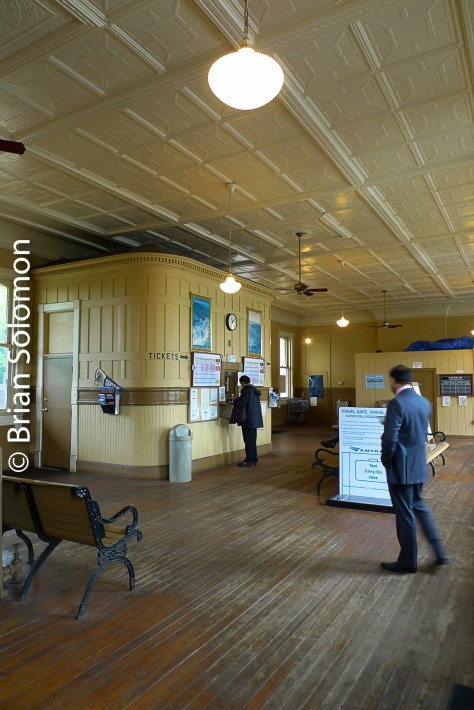
The old New Haven Railroad station at Berlin, Connecticut was a local favorite. Until recently, it was among the last small staffed Amtrak stations with an historic structure in southern New England.
My friend, and Tracking the Light reader, Bill Sample was a regular Amtrak Station Agent at Berlin. For me Berlin was like stepping back to that earlier era, when the small town station was the portal for travel. Bill would often help me plan trips and buy the most effective ticket for my travel plans.
The station itself was a gem. The interior retained characteristics of an early twentieth century station, complete with chalkboard arrival and departure information and rotating ceiling fan.
In recent months, the old Berlin station had been closed as part of double-tracking between Hartford and New Haven and related station renovations and construction of high-level platforms. The old building was to be integrated into a modern facility designed for more frequent service.
Wednesday (December 21, 2016), Otto Vondrak sent me the sad news that the old station had been gutted by fire. Media sources reported that the building was a ‘total loss.’
These Lumix LX3 digital photos show the building as I remember it in recent years.
Lumix LX3 photo.Lumix LX3 photo.Berlin was once an important junction with diamond crossings.
The photographic lesson is: never take anything for granted no matter how familiar it is. Someday it may be gone without warning.
This photo appeared in Pacific RailNews/RailNews not long after I exposed it on Kodachrome 25 in October 1996. [Click on Tracking the Light for the full vertical image.]
The Twin Ledges is a classic photo location a mile or so west of the old Boston & Albany Middlefield Station in the Berkshire Hills of western Massachusetts.
Conrail’s SD80MACs were an unusual modern locomotive because they were powered by a 20-cylinder variation of EMD’s 710 diesel, rated at 5,000 hp. They arrived only a few years before Conrail was bought and divided by CSX and Norfolk Southern.
Although their operation on the old B&A was short-lived, they were oft photographed (by me anyway).
Classic Kodachrome: a vertical telephoto view of Conrail SD80MACs leading symbol freight ML482 at the Twin Ledges in October 1996.
In March 1982, I exposed these photographs of MBTA Green Line PCCs taking the corner at Boston’s Cleveland Circle.
The relative proximity of three Green Line trolley routes at Cleveland Circle made this an ideal place to photograph streetcars since there was lots of trackage and variety of action.
The streetcars pictured had just finished their run and were turning into the storage/staging area at the end of Green Line’s ‘C’ route.
By this time MBTA’s old PCC cars were nearing the end of their regular service on Green Line routes, which made them an added attraction for me. The cars were tired and battered from decades of hard service yet soldiered on.
A tired old Presidents’ Conference Committee car has just finished its outbound run.Check out the ad at the back of the trolley.
Today, it’s the period signs that make the photos interesting. Look at the ad for ‘Peoples Express’ on the back of one of the streetcars. Also, the cinema is advertising ‘Chariots of Fire’ among other films from 35 years ago.
Here’s an enlargement of the above photo that better shows the cinema sign.
I exposed these images on Ilford HP5 using my Leica 3A with 50mm Summitar. Unfortunately, I processed the film in Kodak Microdol-X. This developer offered very fine grain, but at the expense of tonality. It was tricky to get the timing right, and in this case I left the film in the developer too long. The result is that negatives display excessive contrast and blocked up highlights.
Back in October, I made photos of Tatra’s PCC-derived trams in the Czech Republic using Czech made Fomapan 100 Classic black & white film.
I was pleased with my results, so, I bought more of this film from B&H photo (saves me a trip to Prague). Earlier this month, while wandering in Philadelphia with my brother Sean, I exposed a few photographs of SEPTA PCC’s working the route 15 Trolley line on Girard Avenue in Philadelphia.
Exposed with a Leica 3A fitted with a Nikkor f3.5 35mm screw-mount lens.Exposed on Fomaran Classic (ISO 100) using a Leica 3A fitted with a Nikkor f3.5 35mm screw-mount lens.
Where trams in Prague run on very tight intervals, often following one another through the city streets, making for a unceasing parade of vehicles to photograph, SEPTA’s Route 15 requires more patience.
I processed the film using the traditional tank method. For this batch, I used Kodak D76 developer 1:1 (with water) for 5 minutes 15 seconds at 69F, preceded by a water-bath presoak with a drop of HC110. After processing I scanned the negatives with a Epson V750 Pro and made minor adjustments to files using Lightroom.
Exposed using a Leica 3A fitted with a Nikkor f3.5 35mm screw-mount lens.